![[*]](/icons/foot_motif.gif) ,
,
A&A 415, 145-154 (2004)
DOI: 10.1051/0004-6361:20034067
,
 M 29
M 29C. Boeche1 - U. Munari1 - L. Tomasella1 - R. Barbon2
1 -
Osservatorio Astronomico di Padova, Sede di Asiago,
36012 Asiago (VI), Italy
2 -
Osservatorio Astrofisico del Dipartimento di Astronomia,
Universitá di Padova, 36012 Asiago (VI), Italy
Received 10 July 2003 / Accepted 7 October 2003
Abstract
Between 1996 and 2003 we obtained 226 high resolution spectra of 16
stars in the field of the young open cluster NGC 6913, to
constrain its main properties and study its internal kinematics. Twelve
of the program stars turned out to be members, one of them probably unbound.
Nine are binaries (one eclipsing and another double lined) and for seven of
them the observations allowed us to derive the orbital elements. All but two of
the nine discovered binaries are cluster members. In spite of the young
age (a few Myr), the cluster already shows signs that could be interpreted
as evidence of dynamical relaxation and mass segregation. However, they may
be also the result of an unconventional formation scenario. The dynamical
(virial) mass as estimated from the radial velocity dispersion is larger
than the cluster luminous mass, which may be explained by a combination of
the optically thick interstellar cloud that occults part of the cluster, the
unbound state or undetected very wide binary orbit of some of the
members that inflate the velocity dispersion and a high inclination for the
axis of possible cluster angular momentum. All the discovered binaries are
hard enough to survive average close encounters within the cluster and do
not yet show signs of relaxation of the orbital elements to values typical of
field binaries.
Key words: stars: binaries: spectroscopic - stars: early type - ISM: bubbles - Galaxy: open clusters and associations: general - Galaxy: open clusters and associations: individual: NGC 6913
This is the second paper of a series devoted to the results of a long term, high resolution spectroscopic study of early type members of young open clusters, trapezium systems and OB associations. The aims of this series are discussed in Paper I (Munari & Tomasella 1999).
NGC 6913, the topic of this paper, is a young open cluster harboring O-type
members and lying close to the plane of the Galaxy
(
 ,
,
 (J2000);
 ,
,
 ). Despite appearing in
the Messier catalog as M 29, few papers in the literature deal with it,
furthermore they show some disagreement in the results. Cluster distance is
reported to be 2.2 kpc by Morgan & Harris (1956) and
Massey et al. (1995), 1.5 kpc by Joshi et al. (1983), and
1.1 kpc by Hoag et al. (1961), while Tifft (1958) suggested
that NGC 6913 is indeed the result of two separate groups of stars, one at
1.6 kpc and the other somewhere between 1.9 and 2.4 kpc. The mean and
differential reddening span a range of values too:
). Despite appearing in
the Messier catalog as M 29, few papers in the literature deal with it,
furthermore they show some disagreement in the results. Cluster distance is
reported to be 2.2 kpc by Morgan & Harris (1956) and
Massey et al. (1995), 1.5 kpc by Joshi et al. (1983), and
1.1 kpc by Hoag et al. (1961), while Tifft (1958) suggested
that NGC 6913 is indeed the result of two separate groups of stars, one at
1.6 kpc and the other somewhere between 1.9 and 2.4 kpc. The mean and
differential reddening span a range of values too:
 ,
,
 according to Joshi et al. (1983),
 and
and
 for Wang & Hu (2000), and
 following Massey et al. (1995). Similarly, estimated ages span from
0.3-1.75 Myr of Joshi et al. (1983) to 10 Myr of Lyngå (1987).
following Massey et al. (1995). Similarly, estimated ages span from
0.3-1.75 Myr of Joshi et al. (1983) to 10 Myr of Lyngå (1987).
The internal and galactic kinematics of NGC 6913 have not so far been
investigated in the literature. The cluster radial velocity used by Hron (1987)
in modeling the rotation curve of the Galaxy, -25 km s-1, was
assembled from scanty literature data that apparently missed all the
brightest cluster members, and is far from our much more accurate and
representative -16.9( 0.6) km s-1 value (see Sect. 3.2).
The internal kinematics and binary content of NGC 6913 are unknown because no
detailed radial velocity study of its members has been pursued, and
proper motions investigations (Sanders 1973; Dias et al.
2002) are not deep and accurate enough for a firm membership
segregation over a wide range of magnitudes, do not cover all candidate
members and do not allow resolution of the internal kinematics.
0.6) km s-1 value (see Sect. 3.2).
The internal kinematics and binary content of NGC 6913 are unknown because no
detailed radial velocity study of its members has been pursued, and
proper motions investigations (Sanders 1973; Dias et al.
2002) are not deep and accurate enough for a firm membership
segregation over a wide range of magnitudes, do not cover all candidate
members and do not allow resolution of the internal kinematics.
Table 1:
Program stars. The first four columns give our identification
number (cf. finding chart in Fig. 1), and that assigned by Hoag et al.
(1961), Sanders (1973) and Kazlauskas & Jasevicius (1986). V and B-Vare Tycho-2
 and
and
 transformed into Johnson system following
Bessell (2000) prescriptions. U-B is the median of the measurements by
Massey et al. (1995), Joshi et al. (1983) and Hoag et al. (1961).
Star #10 is reported as a short period variable by Peña et al. (2001).
transformed into Johnson system following
Bessell (2000) prescriptions. U-B is the median of the measurements by
Massey et al. (1995), Joshi et al. (1983) and Hoag et al. (1961).
Star #10 is reported as a short period variable by Peña et al. (2001).
In this paper we aim to look in more detail at NGC 6913 general properties (like astrometric membership, photometry, reddening, distance, mass and age) and to present and discuss the results of our extensive spectroscopic study of NGC 6913 based on 226 high resolution spectra monitoring of 16 stars in the field of the cluster over the time span 1996-2003. These observations are used to constrain the internal velocity dispersion, the cluster galactic motion, the individual rotational velocities, and the internal kinematical and evolutionary status of the cluster. Spectroscopic orbits are calculated for the discovered binary stars.
Table 1 summarizes the main properties of the 16 selected program stars, and Fig. 1 provides a finding chart for them. The program stars have been spectroscopically observed over the period 1996-2003 with the 1.82 cm telescope and Echelle+CCD spectrograph of the Astronomical Observatory of Padova at Asiago (Italy). Table 2 provides the journal of observations. The instrumental set-up, spectra extraction and calibration, accuracies, etc. are identical to Paper I and the reader is referred there for details.
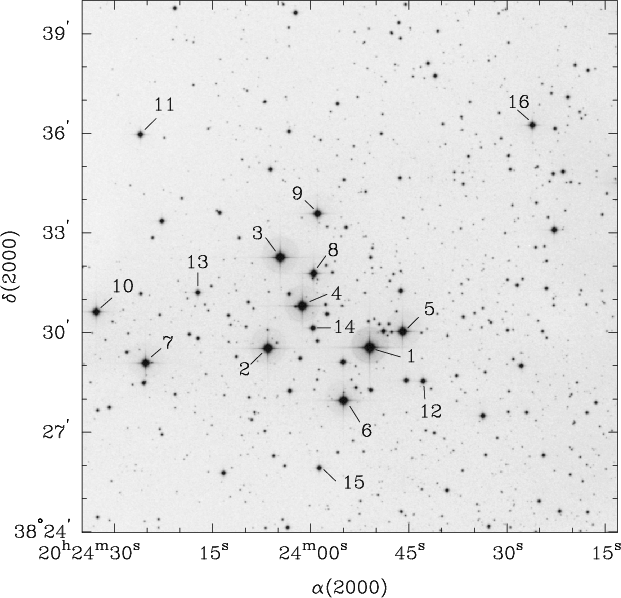 |
Figure 1: Finding chart for NGC 6913 program stars. |
| Open with DEXTER | |
Scanty information exists on the spectral classification of the program
stars. Wang & Hu (2000) derived spectral types from low resolution
spectra (5.3 Å/pix) covering the range 4200-6900 Å. Kazlauskas &
Jasevicius (1986) obtained photoelectric photometry in the Vilnius system,
that we have converted into spectral types using the reddening-free color
parameters  defined by Strayzis (1977) appropriate for the
RV = AV / EB-V=3.6 reddening law that applies to
NGC 6913 according to Johnson (1962). We have also derived spectral
classification of the program stars using our Echelle spectra, classified
against the Yamashita et al. (1977) spectral atlas. Even if spectral
classification of Echelle spectra has to be carried out with care (lines to
be compared normally fall in different Echelle orders), nevertheless the
resulting spectral types look quite reasonable, and, given the far superior
spectral resolution and high S/N, also are possibly more accurate than those
of Wang & Hu (2000). The three estimates of the spectral type are
compared in Table 3. The last two columns of the table give the reddening
and distance when Fitzgerald (1970) intrinsic colors and our spectral
classification are compared to V, B-V photometry in Table 1. The
positions of the program stars on the reddening-corrected HR diagram are
shown in Fig. 2.
defined by Strayzis (1977) appropriate for the
RV = AV / EB-V=3.6 reddening law that applies to
NGC 6913 according to Johnson (1962). We have also derived spectral
classification of the program stars using our Echelle spectra, classified
against the Yamashita et al. (1977) spectral atlas. Even if spectral
classification of Echelle spectra has to be carried out with care (lines to
be compared normally fall in different Echelle orders), nevertheless the
resulting spectral types look quite reasonable, and, given the far superior
spectral resolution and high S/N, also are possibly more accurate than those
of Wang & Hu (2000). The three estimates of the spectral type are
compared in Table 3. The last two columns of the table give the reddening
and distance when Fitzgerald (1970) intrinsic colors and our spectral
classification are compared to V, B-V photometry in Table 1. The
positions of the program stars on the reddening-corrected HR diagram are
shown in Fig. 2.
Table 3: Spectral types of the program stars from Wang & Hu (2000), from photometry in the Vilnius system by Kazlauskas & Jasevicius (1986) transformed by us into spectral types following Strayzis (1977), and from classification of our Echelle spectra against the Yamashita et al. (1977) reference spectral atlas. The last columns give the EB-V (from Fitzgerald 1970 intrinsic colors) and the spectro-photometric distances for our spectral classification and the photometry in Table 1.
Radial velocities from individual observations (hereafter referred to as epoch radial velocities) of the program stars are given in Table 4. For O and B type program stars they are based on individual measurement of He I and He II lines. For the other, cooler program stars the radial velocities come from measurement of the metallic absorptions lines (mainly Fe I, Mg I, Ti II). The radial velocities of the Be program star #5 pertain to the emission lines, which completely fill the helium and hydrogen absorption lines.
![\begin{figure}
\par\includegraphics[width=7.8cm,clip]{Boeche_fig_2.ps}
\end{figure}](/articles/aa/full/2004/07/aa0067/img30.gif) |
Figure 2: The program stars on the reddening corrected V0, (B-V)0 diagram using EB-V from Table 3 and V, B-V photometry from Table 1 for RV=AV/EB-V=3.6 appropriate for NGC 6913 according to Johnson (1962). The isochrone for solar metallicity and 5 Myr is from Bertelli et al. (1994) and it is scaled to m-M=10.5(dotted line), m-M=11.0 (solid line) and m-M=11.7 (dashed line). It is evident how the cluster distance cannot be well constrained. In this paper we adopt a 1.6 kpc distance. |
| Open with DEXTER | |
About half of the program stars have turned out to be spectroscopic
binaries. Table 5 summarizes the barycentric velocity, the membership and
the binary status based on epoch radial velocities in Table 4. Table 6 gives
the spectroscopic orbits computed for all the binary stars but #6 and 16,
which are clearly binaries but the available radial velocities are not
enough to determine the orbital period and thus to allow to derive an
orbital solution. Therefore the
 quoted for stars #6 and 16 in
Table 5 is the mean of the measurements, not the barycentric velocity, and
the two velocities tend to differ with increasing eccentricity and paucity
of measurements. Consequently, the
of stars #6 and 16 quoted
in Table 5 which differ by slightly more than 3
quoted for stars #6 and 16 in
Table 5 is the mean of the measurements, not the barycentric velocity, and
the two velocities tend to differ with increasing eccentricity and paucity
of measurements. Consequently, the
of stars #6 and 16 quoted
in Table 5 which differ by slightly more than 3 from the cluster
mean velocity cannot be considered as a firm indication that stars #6 and
16 are field stars.
from the cluster
mean velocity cannot be considered as a firm indication that stars #6 and
16 are field stars.
Similarly to Paper I, the spectroscopic orbits have been obtained with a Fortran code written by Roger F. Griffin (Cambridge University) and adapted to run under GNU/Linux by us.
Table 4: Example of the table containing the epoch radial velocities (and their errors) for the program stars, available in full only in electronic form at the CDS.
Program stars #1-7 have been observed also by Liu et al. (1989,
1991) who reported some epoch radial velocities for them. Such data
appear affected by large errors for the O and B stars (program stars
#2-7), which make them useless in our analysis. They are instead in good
agreement with our velocities for star #1, which is much cooler having a
spectral type F0 III. The reason for the poor quality of the Liu et al.
radial velocities for hot stars probably lies in the shortness of the
wavelength range they observed ( 150 Å) and in the fact that it is
dominated by H
150 Å) and in the fact that it is
dominated by H ,
which we ignored in our analysis given the Balmer
progression and its excessive scatter compared to the much more performing
He I and He II lines. It is also worth noticing that Liu et al. did not
recognized star #7 as double lined, in spite of having observed it at
orbital phase 0.66 when the velocity separation between the components is 140 km s-1 (cf. Fig. 3) and therefore outstanding.
,
which we ignored in our analysis given the Balmer
progression and its excessive scatter compared to the much more performing
He I and He II lines. It is also worth noticing that Liu et al. did not
recognized star #7 as double lined, in spite of having observed it at
orbital phase 0.66 when the velocity separation between the components is 140 km s-1 (cf. Fig. 3) and therefore outstanding.
The spectroscopic orbits of stars #2 and 11 in Fig. 3 and Table 6 are to be considered quite preliminary, given their small amplitude, high eccentricity and limited number of observations. Further observations are obviously encouraged for these two stars. Photometric observations of the double lined star #7 are in progress to constrain the orbital inclination and derive individual masses, and they will reported elsewhere when completed.
Table 5:
Heliocentric radial velocity (with its standard error) of the
program stars, binary status and cluster membership according to radial
velocities, and projected rotational velocity (with its standard error). The
radial velocity of the binary stars is the barycentric velocity from the
orbital solutions in Table 6. The last column gives the projected rotation
period
 /
/ of the solved binaries to be compared with the
orbital period.
of the solved binaries to be compared with the
orbital period.
![\begin{figure}
\par {\includegraphics[width=7.6cm,clip]{Boeche_fig_3.ps} }\end{figure}](/articles/aa/full/2004/07/aa0067/img66.gif) |
Figure 3: Orbital solutions for the binary program stars (cf. Table 6). |
| Open with DEXTER | |
Rotation velocities for the program stars are given in Table 5. They have been derived from He I lines for stars #2, 3, 4, 6, 7, 8, 10, 12, 15, 16 and Fe I lines for the remaining ones, following the numerical relations for the Asiago Echelle spectrograph calibrated in Paper I (its Fig. 7). No rotation velocity is derived for the Be program star #5 because all He I lines are badly affected by emissions. The correspondence of the rotational velocity scale between He I and Fe I lines (which we have been forced to used in all program stars with a spectral type later than B) has been carefully checked on a grid of Kurucz rotationally broadened spectra we have calculated for this purpose.
Table 6: Orbital solution for the binary stars we discovered in NGC 6913. For binaries #6 and 16 the epoch radial velocities in Table 4 did not allowed a determination of the orbital period and therefore the derivation of the orbit. The errors are given in parenthesis in units of the last digit. The last raw gives the rms deviation of the solution from the observed radial velocities.
From the spectral classification in Table 3, the stellar radii over the HR
diagram as tabulated by Straizys & Kuriliene (1981) and the observed
 projected rotation velocity, we present in the last
column of Table 5 the projected rotation period (
/)
for the
binaries with an orbital solution in Table 6. The projected rotation period
is obviously an upper limit to the true rotation period. Compared to the
orbital period in Table 6, it can be used to infer the co-rotation
status of the binaries.
projected rotation velocity, we present in the last
column of Table 5 the projected rotation period (
/)
for the
binaries with an orbital solution in Table 6. The projected rotation period
is obviously an upper limit to the true rotation period. Compared to the
orbital period in Table 6, it can be used to infer the co-rotation
status of the binaries.
Star #1 is an SB1 eclipsing binary and therefore the
projection
factor converges toward unity, which allows a direct comparison between
rotation and orbital periods, the former being twice the latter. The lack of
synchronisation could be related to the primary evolving away from the main
sequence and the time scales of the two processes.
Given the masses estimated from the spectral type and the amplitude of radial velocity variation, star #7 probably has a high inclination too, possibly itself being eclipsing. The rotational velocity in Table 5 pertains to the B5 IV primary, the measurement of the secondary being too uncertain given the difference in brightness. The rotation and orbital periods are quite close, and in view of the uncertainties at play, the primary in star #7 looks synchronized.
Stars #3 and 12 are evidently not co-rotating, because the projected
rotation period is at least several times shorter than the orbital period in
Table 6, and working on
can only enlarge the difference. For the
remaining binary stars #2, 4 and 11, no conclusion can be drawn about the
co-rotation status, the projected rotation period being longer than the
orbital one.
![\begin{figure}
\par {\includegraphics[width=8.7cm,clip]{Boeche_fig_4.ps} }
\end{figure}](/articles/aa/full/2004/07/aa0067/img69.gif) |
Figure 4: Comparison between Dias et al. (2002) and Sanders (1973) membership data for the 24 stars in common. |
| Open with DEXTER | |
Sanders (1973, hereafter S73) has published an astrometric
investigation of 228 stars in the field of NGC 6913, identifying 92 possible
members. He has however used only one plate pair, with an epoch separation
of just 22 yr, with moreover the first epoch plate "severely blackened
by the moon''. Consequently, noting the too large fraction of detected
members among the measured stars, he warned that the cluster separation from
the field is not satisfactory, and that the member/non-member status he
assigned may be frequently wrong. The S73 limiting magnitude is V=13.8, with
a completness limit not fainter than V=13.0 that corresponds to
1.2  on the main sequence of NGC 6913. Dias et al. (2002,
hereafter D02) have used proper motions from the Tycho-2 catalog to
accomplish the astrometric member segregation, following the analytical
approach of Sanders (1971). They have 24 stars in common with S73. As
Fig. 4 shows, for 6 of the 24 common stars the membership status of S73
and D02 is in disagreement, and for the remaining 18 there is a fair
agreement.
on the main sequence of NGC 6913. Dias et al. (2002,
hereafter D02) have used proper motions from the Tycho-2 catalog to
accomplish the astrometric member segregation, following the analytical
approach of Sanders (1971). They have 24 stars in common with S73. As
Fig. 4 shows, for 6 of the 24 common stars the membership status of S73
and D02 is in disagreement, and for the remaining 18 there is a fair
agreement.
A firm membership segregation is required for any kinematical investigation of the cluster, and to achieve the best possible result, the astrometric data should be complemented by radial velocities and placing of the program stars on the HR diagram.
![\begin{figure}
\par {\includegraphics[width=8.7cm,clip]{Boeche_fig_5.ps} }
\end{figure}](/articles/aa/full/2004/07/aa0067/img70.gif) |
Figure 5:
Radial velocity distribution of the program stars. A Gaussian with
center at
 km s-1 and km s-1 and
 km s-1 fits the
member stars. Shaded elements represent stars which radial velocity differs
by more than 3
from the cluster mean velocity. km s-1 fits the
member stars. Shaded elements represent stars which radial velocity differs
by more than 3
from the cluster mean velocity. |
| Open with DEXTER | |
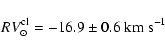
The radial velocity distribution of the program stars is presented in
Fig. 5, where the cluster grouping at -16.9 km s-1 is evident,
with a dispersion of
 km s-1.
Table 7: Cluster membership of program stars from the literature according to astrometric, photometric, and spectral type criteria, and ours based on spectrophotometric parallaxes and radial velocities. The last column gives our final membership status obtained by merging the results of the various criteria. S73 = Sanders (1973), D02 = Dias et al. (2002), C77 = Crawford et al. (1977), J83 = Joshi et al. (1983), W00 = Wang & Hu (2000).
Table 7 summarizes the membership status according to the astrometric investigations of S73 and D02, the photometry presented and discussed by Crawford et al. (1977) and Joshi et al. (1983), the spectral classification of Wang & Hu (2000), our reddening-free HR diagram of Fig. 2 and the radial velocities in Table 5. Their combination provides our final, adopted membership reported in the last column of Table 7.
As reviewed in the Introduction, all previous investigations of NGC 6913 agree on the large differential and total reddening affecting the cluster. Inspecting the Palomar charts it is evident how NGC 6913 lies close to a very thick interstellar cloud that seems to hide part of it.
Our and literature estimates about the cluster distance converge toward a 1.6 kpc value. Studies of the interstellar extinction toward NGC 6913 (Crawford et al. 1977; Neckle & Klare 1980) agree on a steep increase of the extinction at 1 kpc, about half the distance to the cluster, as if a single, major cloud is responsible for the majority of the extinction of NGC 6913.
In Fig. 6 we compare the same field centered on NGC 6913 as seen on
Palomar POSS-II blue charts and by the IRAS satellite at 100  m. The
north-east quadrant is clearly deprived of stars in the optical image, while
it is bright in the far infrared, a clear sign of thick dust absorbing in
the optical and emitting in the IR. Star counts from USNO-A2.0 (stars
detected in both blue and red POSS-I prints) and near-infrared 2MASS survey
(stars detected both in J as well as H and K bands) strongly support
the argument of a strong foreground interstellar extinction crossing the
field of NGC 6913 and increasing steeply toward the north-east quadrant.
m. The
north-east quadrant is clearly deprived of stars in the optical image, while
it is bright in the far infrared, a clear sign of thick dust absorbing in
the optical and emitting in the IR. Star counts from USNO-A2.0 (stars
detected in both blue and red POSS-I prints) and near-infrared 2MASS survey
(stars detected both in J as well as H and K bands) strongly support
the argument of a strong foreground interstellar extinction crossing the
field of NGC 6913 and increasing steeply toward the north-east quadrant.
We expect this foreground optically thick cloud to hide from view part of the cluster, even if the cluster center seems confidently identifiable with the grouping of the massive O and B stars seen in the optical.
There are no published estimates of the NGC 6913 total mass. Two static approaches are considered in this subsection, a dynamical one is investigated in Sect. 3.4.
A lower limit to the cluster mass is obtained by adding the mass appropriate
to the spectral type of known members (luminous mass). Taking Wang & Hu
(2000) spectral types of all S73 probable members classified by them and
calibration into masses from Straizys & Kuriliene (1981), we have
 |
(1) |
is taken as a fair indication of
the total luminous mass of the cluster.
![\begin{figure}
\par {\includegraphics[width=17.8cm,clip]{Boeche_fig_6.ps} }
\end{figure}](/articles/aa/full/2004/07/aa0067/img73.gif) |
Figure 6:
Comparison of a 30
 field from
POSS-II (top left) and IRAS 100 m wavelength image (bottom left)
centered on NGC 6913. Stellar surface density of the same stellar field is
obtained from USNO-A2.0 optical catalog (top right) with minimum and maximum
density of 0.5 and 4.7 stars/arcmin2 (clearest and darkest zone)
respectively and grey levels in step of 0.25 stars/arcmin2, and from
2MASS infrared catalog (bottom right) with minimum and maximum density of
6.9 and 14.2 stars/arcmin2 (clearest and darkest zone) respectively and
grey levels in step of 0.5 stars/arcmin2.
field from
POSS-II (top left) and IRAS 100 m wavelength image (bottom left)
centered on NGC 6913. Stellar surface density of the same stellar field is
obtained from USNO-A2.0 optical catalog (top right) with minimum and maximum
density of 0.5 and 4.7 stars/arcmin2 (clearest and darkest zone)
respectively and grey levels in step of 0.25 stars/arcmin2, and from
2MASS infrared catalog (bottom right) with minimum and maximum density of
6.9 and 14.2 stars/arcmin2 (clearest and darkest zone) respectively and
grey levels in step of 0.5 stars/arcmin2. |
| Open with DEXTER | |
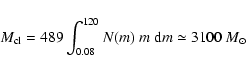
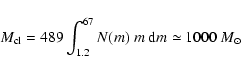
Assuming that the members of NGC 6913 distribute according to the Salpeter
(1955) law
N(m)=C m-2.35 offers another possibility to estimate the
cluster mass. It seems fair to assume that all O and B type cluster members
have been detected and recognized as such in the Wang & Hu (2000) spectral
survey of NGC 6913. They are 31 in total, spanning the range between 6 and
67 .
This allows to estimate the constant C
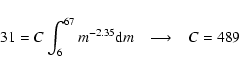 |
(2) |
 |
(3) |
 |
(4) |
![\begin{figure}
\par {\includegraphics[width=8.7cm,clip]{Boeche_fig_7.ps} }
\end{figure}](/articles/aa/full/2004/07/aa0067/img77.gif) |
Figure 7:
Mass function of the cluster NGC 6913 as it results from the
spectral classification of the member stars. The dashed line is a fit with a
Salpeter law
N(m)=489 m-2.35 to O and B stars ( ). ). |
| Open with DEXTER | |
![\begin{figure}
\par {\includegraphics[width=8.7cm,clip]{Boeche_fig_8.ps} }
\end{figure}](/articles/aa/full/2004/07/aa0067/img78.gif) |
Figure 8:
Member stars of NGC 6913 with mass smaller (left) and
larger (right) then 6 .
Massive stars show a clear clustering
while the lighter seem randomly distributed. |
| Open with DEXTER | |
Cluster member venturing on orbits wider than the cluster tidal radius have
a fair chance to become unbound due to the action of the gravitational field
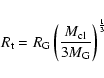
of the Galaxy. The cluster tidal radius is defined as (cf. Binney &
Tremaine 1987):
 ,
,
 are the radius of the cluster galactic orbit and the
galactic mass contained within (
are the radius of the cluster galactic orbit and the
galactic mass contained within (
 kpc and
 ). Inserting
 provides
 pc,
corresponding to 20
pc,
corresponding to 20 at the estimated 1.6 kpc cluster distance. On
photographs, the cluster tidal radius is conventionally taken as the
distance from the cluster center at which the stellar density drops to the
field value, estimated by Lyngå (1987) to be
at the estimated 1.6 kpc cluster distance. On
photographs, the cluster tidal radius is conventionally taken as the
distance from the cluster center at which the stellar density drops to the
field value, estimated by Lyngå (1987) to be  for
NGC 6913, which corresponds to 4.7 pc at the adopted cluster distance
1.6 kpc. For
for
NGC 6913, which corresponds to 4.7 pc at the adopted cluster distance
1.6 kpc. For
 pc Eq. (5) would provide a much lighter cluster
mass,
pc Eq. (5) would provide a much lighter cluster
mass,
 .
Equation (5) describes the statistical relation of
equilibrium between cluster and galactic potentials that can be realized
only on time scales long enough for perturbation fluctuations to average.
Given the very young age of NGC 6913 (corresponding to just 2% of its
galactic orbital period), the conditions supporting Eq. (5) can hardly be
matched, and an
.
Equation (5) describes the statistical relation of
equilibrium between cluster and galactic potentials that can be realized
only on time scales long enough for perturbation fluctuations to average.
Given the very young age of NGC 6913 (corresponding to just 2% of its
galactic orbital period), the conditions supporting Eq. (5) can hardly be
matched, and an
 estimated via Eq. (5) cannot be trusted. For the
same reason, the
estimated via Eq. (5) cannot be trusted. For the
same reason, the  estimated from star counts has to be preferred to the
value estimated using Eq. (5).
estimated from star counts has to be preferred to the
value estimated using Eq. (5).
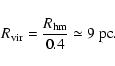
The half-mass radius (
 )
is a useful quantity frequently used in
N-body simulations. We have estimated it by measuring the radius that
contains half of the 700
luminous mass of Eq. (1), which turned out
to be 8,
corresponding to
)
is a useful quantity frequently used in
N-body simulations. We have estimated it by measuring the radius that
contains half of the 700
luminous mass of Eq. (1), which turned out
to be 8,
corresponding to
 pc at a distance of 1.6 kpc.
Following Binney & Tremaine (1987) the virial radius can be expressed as
pc at a distance of 1.6 kpc.
Following Binney & Tremaine (1987) the virial radius can be expressed as
 |
(6) |
The mean radial velocity of NGC 6913 members is
 |
(7) |
 km s-1. The average
uncertainty of the radial velocity of individual members is
km s-1. The average
uncertainty of the radial velocity of individual members is
 km s-1, which leads to an intrinsic radial
velocity dispersion of NGC 6913 members amounting to
km s-1, which leads to an intrinsic radial
velocity dispersion of NGC 6913 members amounting to
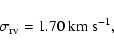 |
(8) |
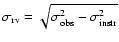 .
Many of the physical quantities for NGC 6913 derived in the following
critically depend upon this number. We are confident that our observations,
reductions and measurements are state-of-the-art and involve so many high
resolution observations of such a large number of stars over a so long
period of time, that doing much better with 2 m-class telescopes is hardly
feasible. On the other hand, the high competition to access larger
instruments prevents them to be assigned on programs like the present one
that require such a massive telescope usage (even if equipped with MOS
devices). Undoubtly, observations of more member stars over longer period of
times would be useful to better constrain the intrinsic radial velocity
dispersion, but this does not appear as an easy task. Therefore, we believe
that in absence of deeper/better efforts, our measurement of the intrinsic
radial velocity dispersion of NGC 6913 is worth some dynamical
considerations that we develop in the rest of this paper.
.
Many of the physical quantities for NGC 6913 derived in the following
critically depend upon this number. We are confident that our observations,
reductions and measurements are state-of-the-art and involve so many high
resolution observations of such a large number of stars over a so long
period of time, that doing much better with 2 m-class telescopes is hardly
feasible. On the other hand, the high competition to access larger
instruments prevents them to be assigned on programs like the present one
that require such a massive telescope usage (even if equipped with MOS
devices). Undoubtly, observations of more member stars over longer period of
times would be useful to better constrain the intrinsic radial velocity
dispersion, but this does not appear as an easy task. Therefore, we believe
that in absence of deeper/better efforts, our measurement of the intrinsic
radial velocity dispersion of NGC 6913 is worth some dynamical
considerations that we develop in the rest of this paper.
The virial theorem links the cluster mass M within the radius R to the
velocity dispersion in the form
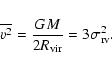 |
(9) |
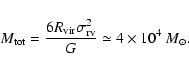 |
(10) |
 vs.
vs.
 ). Could it be
intra-cluster mass? Wang & Hu (2000) have derived a differential
reddening across the cluster amounting to
mag. Even
supposing the effect is solely caused by intra-cluster extinction (from the
above discussion the major contribution to differential reddening should
actually come from the optically thick foreground dust cloud) the amount of
dust required to produce it is of the order of
). Could it be
intra-cluster mass? Wang & Hu (2000) have derived a differential
reddening across the cluster amounting to
mag. Even
supposing the effect is solely caused by intra-cluster extinction (from the
above discussion the major contribution to differential reddening should
actually come from the optically thick foreground dust cloud) the amount of
dust required to produce it is of the order of
 .
This is
derived assuming a simple spherical symmetry, constant density, a standard
dust-to-gas ratio (
.
This is
derived assuming a simple spherical symmetry, constant density, a standard
dust-to-gas ratio (
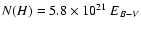 atoms cm-2, Kilian
1992) and that a
mag differential extinction is
accumulated as result of the line of sight crossing the whole cluster.
Even under these assumptions the corresponding amount of intracluster material
is far from filling the gap between the luminous (i.e. Eq. (1)) and dynamical
mass (i.e. Eq. (10)).
atoms cm-2, Kilian
1992) and that a
mag differential extinction is
accumulated as result of the line of sight crossing the whole cluster.
Even under these assumptions the corresponding amount of intracluster material
is far from filling the gap between the luminous (i.e. Eq. (1)) and dynamical
mass (i.e. Eq. (10)).
Possible explanations for such a discrepancy
could be any combination of the following effects:
(i) the large and optically thick interstellar cloud discussed in
Sect. 3.1 hides from view a significant portion of the cluster, causing an
underestimate of the tidal radius and luminous mass from star counts.
Deep infrared imaging at K band and longer wavelengths could test
this scenario;
(ii) the cluster is still relaxing and some of the stars considered as
members are actually unbound, leaving the cluster at velocities just larger
than the escape one, inflating the apparent dispersion of radial velocities.
An example could be star #6 which is a member according to both astrometric
investigations and combined photometric+spectroscopic criteria, and lies
projected close to cluster center sporting one of the earliest spectral
types (B0 V). Its radial velocity is well determined as -25.6( ) km s-1, which is however 8.7 km s-1 away from the
cluster mean velocity of -16.9(
) km s-1, which is however 8.7 km s-1 away from the
cluster mean velocity of -16.9( ) km s-1. The difference
exceeds 4
) km s-1. The difference
exceeds 4
 .
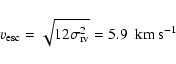
The escape velocity from NGC 6913 is
.
The escape velocity from NGC 6913 is
 |
(11) |
1.5 km s-1 at
half mass radius could be enough to bring the virial mass in agreement with
the luminous mass.
Lighter cluster members seem to be evaporating from NGC 6913 as the comparison in Fig. 7 between the observed and Salpeter mass function supports, and as mass segregation in Fig. 8 suggests.
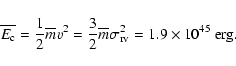
In fact, for O and B type members the mean mass is
 and
and
 km s-1 being the radial velocity intrinsic dispersion,
the mean kinetic energy of O and B type members is
km s-1 being the radial velocity intrinsic dispersion,
the mean kinetic energy of O and B type members is
 |
(12) |
 follows from
 |
(13) |
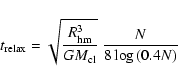
Crossing time and relaxing time are theoretical quantities which play a
relevant role in cluster dynamics. They are closely related to the
mass of the cluster, its dynamical status and the number of members.
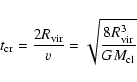
The crossing time is related to virial radius and cluster mass by (v from Eq. (9))
 |
(14) |
In the case of the luminous mass,
 and N=92 (cf.
Sect. 2.4), it is
and N=92 (cf.
Sect. 2.4), it is
 Myr and
 Myr, significantly
longer that the estimated cluster age (5 Myr). For the Salpeter mass
Myr, significantly
longer that the estimated cluster age (5 Myr). For the Salpeter mass
 and N=104 (cf. Eq. (3)), the crossing time
reduces to
and N=104 (cf. Eq. (3)), the crossing time
reduces to
 Myr while the relaxation time goes up to
 Myr, both still larger than the cluster lifetime.
NGC 6913 appears relaxed, at least in its core (where the relaxation time is
expected to be shorter given the higher mass density) as mass segregation in
Fig. 8 shows. Note that concentration of massive stars toward the cluster
center is observed in some clusters to be present since their birth and not
as the result of purely dynamical evolution (i.e. the Orion trapezium
system, see Hillenbrand & Hartmann 1998) and that some
N-body simulations (Portegies Zwart et al. 2001) show mass
segregation to happen in clusters over ages shorter then the canonical
 .
So, the apparent concentration of heavier members toward the
center of NGC 6913 could also be due to mechanism other than dynamical
relaxation.
.
So, the apparent concentration of heavier members toward the
center of NGC 6913 could also be due to mechanism other than dynamical
relaxation.
The dispersion of velocities in NGC 6913 is
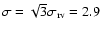 km s-1. Binaries with orbital
velocities faster than this tend to survive close encounters, those orbiting
slower risk ionization (Kroupa 2000). An orbital velocity of
2.9 km s-1 corresponds to an orbital period of 106.3 days for a
binary with a total mass of 5.5 ,
which would go clearly undetected
in the course of a 6-yr long monitoring program like ours. Such a binary would have
an angular separation of 0.4 arcsec (within the detection threshold of current
observational techniques from the ground) which would rise to 4.4 arcsec for
members with a total mass of 67
and decrease to 0.07 arcsec for
members with a total mass of 1 .
km s-1. Binaries with orbital
velocities faster than this tend to survive close encounters, those orbiting
slower risk ionization (Kroupa 2000). An orbital velocity of
2.9 km s-1 corresponds to an orbital period of 106.3 days for a
binary with a total mass of 5.5 ,
which would go clearly undetected
in the course of a 6-yr long monitoring program like ours. Such a binary would have
an angular separation of 0.4 arcsec (within the detection threshold of current
observational techniques from the ground) which would rise to 4.4 arcsec for
members with a total mass of 67
and decrease to 0.07 arcsec for
members with a total mass of 1 .
All binaries detected in this investigation appear strongly bound, not ionizable by close encounters with other cluster members, and quite probably primitive (the short cluster age argue against a capture scenario). Their large eccentricities and non synchronous orbits indicate how far they still are from tidal circularization of the orbits and locking of the rotation and orbital periods which characterize the field binaries. Wider, more ionizable binaries are beyond the realm of spectroscopy, and would be profitably searched for by high spatial resolution imaging.
A deep and wide field photometric investigation of NGC 6913 and surrounding
field would be a good starting point to better constraint the total mass,
tidal radius and drop in the luminosity function of the cluster, and to
address the large discrepancy between observed luminous mass, integrated IMF
mass and the observed virial mass. At the cluster distance and reddening,
UBVRI photometry complete to V=20 will map all cluster members more
massive than 0.8 ,
thus venturing well into the realm of masses
that should be already evaporating from the cluster. Such a photometric
investigation, which is highly encouraged, should extend over a radius of
not less that 20
from the cluster center and should include JHKL
bands to overcome the very strong differential extinction caused by the
foreground interstellar cloud discussed in Sect. 3.1. Once members lighter
than those here investigated will be firmly identified, a study of their
radial velocity distribution would add constraints to the kinematical status
and evolution scenario of NGC 6913.
Acknowledgements
We would like to thank R. Griffin for the provided software and P. M. Marrese for securing the four spectra obtained during 2003. CB has been finacially supported by ASI I-R-050/02 and I-R-117/01 grants.
Table 2:
Journal of observations. D is the dispersions (Å/pix) at
H (0.19 corresponding to unbinned spectra, 0.38 to 2
 binned
spectra), and
binned
spectra), and
 is the wavelength coverage. The last column
gives the program stars observed in each given run (the table is only
available in electronic form).
is the wavelength coverage. The last column
gives the program stars observed in each given run (the table is only
available in electronic form).