o
- A. Woszczyna
o
- A. Woszczyna
A&A 414, 1-6 (2004)
DOI: 10.1051/0004-6361:20031624
G. Siemieniec-Oziebo
- A. Woszczyna
Astronomical Observatory, Jagellonian University, Faculty of Mathematics, Physics and Computer Science, ul. Orla 171, 30-244 Kraków, Poland
Received 12 March 2002 / Accepted 19 September 2003
Abstract
Nonlinear growth of one-dimensional density structures with a frozen-in magnetic field is
investigated in Newtonian cosmology. A mechanism of magnetic field amplification is
discussed. We discuss the relation between the initial conditions
for the velocity field and the basic time-scales determining the growth of the magnetized structure.
Key words: cosmology: theory - cosmology: miscellaneous
 0.1
0.1  G, along the 6 Mpc filament (Bagchi et al. 2002), with evidence for their coherent nature.
Understanding of the magnetic field behaviour at different phases of the matter-dominated era is crucial
to explain the microgauss fields observed in high redshift objects  ;
starting from the
damped Ly
;
starting from the
damped Ly  systems, through the distant radiogalaxies and the galaxy clusters up to the scales
typical of galaxy superclusters. While the magnetic field of galaxies may result from dynamo effects, the
fields at larger scales cannot be explained by the same mechanism. Here there is either no
rotation, necessary for dynamo action, or the structures are dynamically too
young to leave dynamo action enough time to operate. Magnetic fields at Mpc scales are likely to be
primordial. Some pre-dynamo mechanisms of
the primeval magnetic field amplification must be at work at least in the linear and weakly nonlinear regime.
systems, through the distant radiogalaxies and the galaxy clusters up to the scales
typical of galaxy superclusters. While the magnetic field of galaxies may result from dynamo effects, the
fields at larger scales cannot be explained by the same mechanism. Here there is either no
rotation, necessary for dynamo action, or the structures are dynamically too
young to leave dynamo action enough time to operate. Magnetic fields at Mpc scales are likely to be
primordial. Some pre-dynamo mechanisms of
the primeval magnetic field amplification must be at work at least in the linear and weakly nonlinear regime.
In this paper we discuss the mutual relationships between density growth and the magnetic field
evolution in early nonlinear stages, when the wall or filamentary structure is formed. We investigate
whether the growing planar density structure may drag and amplify the magnetic field. We employ the exact
solutions for 2D (pancake) inhomogeneity evolution in the Newtonian description![[*]](/icons/foot_motif.gif) and emphasize
the role of initial conditions, in particular, the large-scale primordial flows. The magnitude of
primordial velocity fields at recombination determines the time and the growth rate of density
fluctuation. As a consequence, it defines the duration time of the pre-dynamo and dynamo amplification phase.
To avoid problems with a mathematical
definition of the weakly nonlinear regime we work with fully nonlinear equations and their solutions. Although finally we
refer to the regime where the density contrast
and emphasize
the role of initial conditions, in particular, the large-scale primordial flows. The magnitude of
primordial velocity fields at recombination determines the time and the growth rate of density
fluctuation. As a consequence, it defines the duration time of the pre-dynamo and dynamo amplification phase.
To avoid problems with a mathematical
definition of the weakly nonlinear regime we work with fully nonlinear equations and their solutions. Although finally we
refer to the regime where the density contrast  is between 1 and 100 (which is relevant
for the cosmological structures we discuss), dynamical equations are true for
is between 1 and 100 (which is relevant
for the cosmological structures we discuss), dynamical equations are true for
 .
.
Magnetohydrodynamic equations in the covariant notation are given in Sect. 2. Simplifying physically relevant assumptions and the resulting nonlinear perturbation equations are discussed in Sect. 3. Nonlinear solutions for the density contrast and the magnetic field enhancement are given in Sect. 4. Section 5 contains numerical estimations and graphical presentation of the magnetized pancake formation.
Magnetohydrodynamic equations for self-gravitating fluid with infinite conductivity
(Chandrasekhar & Fermi 1953; Wasserman 1978; Papadopoulos & Esposito 1982), expressed in a manifestly covariant way, form a dynamical system for the density  ,
the expansion rate
,
the expansion rate  ,
and the magnetic field Hi
,
and the magnetic field Hi
 and
and  ,
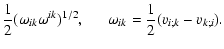
which measure the shear and the rotation,
respectively, are
,
which measure the shear and the rotation,
respectively, are
 |
= |  |
(4) |
 |
= |  |
(5) |
 .
Semicolon means the covariant derivative with respect to the space
coordinates, dot stands for the time convective derivative, e.g.
.
Semicolon means the covariant derivative with respect to the space
coordinates, dot stands for the time convective derivative, e.g.
 ,
while
,
while
 is the Kronecker delta; the Einstein summation convention is employed. Equations
(1)-(3) are coordinate-independent. (In the Cartesian coordinates,
covariant derivatives reduce to the partial derivatives, and tensor indices are raised
and lowered by Kronecker delta.) Equation (1) is the continuity equation.
Equation (2) is a Newtonian analogue of the Raychaudhuri-Ehlers equation (Ellis 1971) - a scalar
form of the equation of motion for continuously gravitating media with the Poisson equation
included. System (1)-(3) has the same form in general relativity and
Newtonian theory (Ellis 1971, compare also Tsagas & Barrow 1997),
and therefore is of particular interest in the cosmological context.
is the Kronecker delta; the Einstein summation convention is employed. Equations
(1)-(3) are coordinate-independent. (In the Cartesian coordinates,
covariant derivatives reduce to the partial derivatives, and tensor indices are raised
and lowered by Kronecker delta.) Equation (1) is the continuity equation.
Equation (2) is a Newtonian analogue of the Raychaudhuri-Ehlers equation (Ellis 1971) - a scalar
form of the equation of motion for continuously gravitating media with the Poisson equation
included. System (1)-(3) has the same form in general relativity and
Newtonian theory (Ellis 1971, compare also Tsagas & Barrow 1997),
and therefore is of particular interest in the cosmological context.
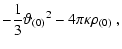
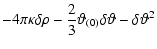
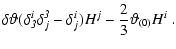
The approximation of infinite conductivity results in a vanishing electric field. The magnetic contribution to the equation of motion is quadratic in Hi (the last term in Eq. (2)), and therefore, can be neglected in the weak magnetic field limit. In this limit the system (1)-(3) splits into the autonomous system (1)-(2) and the induction Eq. (3). Then, the fluid dynamics is entirely determined by gravitational forces, while the magnetic field is dragged along by fluid flow.
1. The unperturbed "background space" is an isotropic and homogeneous (Newtonian) universe.
2. The initial perturbation state is given at random, i.e. perturbation in the density and velocity fields
![${\Delta}_{(\rm ini)}=\left[{\delta\rho\over \rho{_{(0)}}}\right]_{(\rm ini)}$](/articles/aa/full/2004/04/aa2466/img33.gif) and
and
![${\Theta}_{(\rm ini)}=\left[{\delta\vartheta\over \vartheta{_{(0)}}}\right]_{(\rm ini)}$](/articles/aa/full/2004/04/aa2466/img34.gif) are independent quantities. The perturbation is initially small, i.e.
are independent quantities. The perturbation is initially small, i.e.
 and
and
 .
.
3. After the recombination epoch, the infinite conductivity approximation is adequate.
The electric field vanishes (
 ), while the magnetic field Hi is frozen
(Chandrasekhar
), while the magnetic field Hi is frozen
(Chandrasekhar  Fermi 1953). The matter pressure is negligible (p= 0).
4. During the considered period the primordial magnetic fields and their gradients are small
compared with the density and the density gradients, respectively (
 ,
,
 ). In the noncovariant approach to MHD this implies a small value of
the ratio of Lorentz force
). In the noncovariant approach to MHD this implies a small value of
the ratio of Lorentz force  to the gravitational force
  .
.
5. The perturbation is rotationless and has a planar symmetry, i.e. the velocity potential
V(t,xi) can
be expressed as
 ,
where
,
where
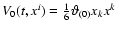 stands for unperturbed Hubble flow, and
the perturbation
stands for unperturbed Hubble flow, and
the perturbation
 is independent of two of Cartesian coordinates.
Consequently, all the hydrodynamic scalars depend solely on time and on the only one
space variable
is independent of two of Cartesian coordinates.
Consequently, all the hydrodynamic scalars depend solely on time and on the only one
space variable
 , the one parallel
to the fluid contraction (orthogonal to the pancake plane).
, the one parallel
to the fluid contraction (orthogonal to the pancake plane).
Under these assumptions the system (1)-(3) can be divided into the
background dynamics
 and
and
 are defined as differences between local and
background values. They are not assumed to be small, hence nonlinear terms in
(8)-(9) remain. The shear tensor for planar
perturbation
are defined as differences between local and
background values. They are not assumed to be small, hence nonlinear terms in
(8)-(9) remain. The shear tensor for planar
perturbation
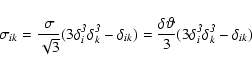 |
(11) |
has been expressed by the variation in the expansion rate
 ,
i.e.
,
i.e.
 .
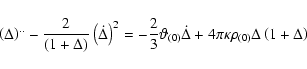
The autonomous
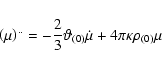
sub-system (8)-(9) can be evaluated to a single second order
differential equation for the density contrast
.
The autonomous
sub-system (8)-(9) can be evaluated to a single second order
differential equation for the density contrast

Equation (12)
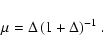
reduces to the Jeans-Bonnor equation (Bonnor 1957; Weinberg 1972)
 takes the form
 ,
formally defined by the differential equation
,
formally defined by the differential equation
 ,
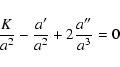
satisfies the Friedman equation for a dust-filled universe
,
satisfies the Friedman equation for a dust-filled universe
 ,
both K and
,
both K and
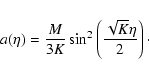
 are constants of motion. The two independent solutions of the
Eq. (15) read
are constants of motion. The two independent solutions of the
Eq. (15) read
 limit yield
 and
and
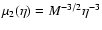 ,
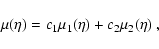
respectively. The arbitrary solution to (13) is a linear combination
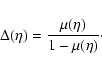
can be found by use of the
reciprocal transform
,
respectively. The arbitrary solution to (13) is a linear combination
can be found by use of the
reciprocal transform
Although the solutions
 form the linear space (20), the solutions
 to Eq. (12) obviously do not. On the other hand the time evolution of
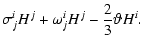
the magnetic field is governed by the linear Eq. (10), which after investing (8)
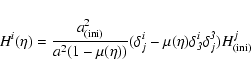
can be integrated exactly. The solution written covariantly reads
to Eq. (12) obviously do not. On the other hand the time evolution of
the magnetic field is governed by the linear Eq. (10), which after investing (8)
can be integrated exactly. The solution written covariantly reads
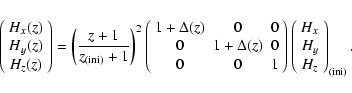
 of the pancake structure
observed at the redshift z (we write it in the matrix form)
of the pancake structure
observed at the redshift z (we write it in the matrix form)
All the dynamical effects of gravity, pressure or magnetic field cumulate in the
or
evolution. For the dust filled universe in the weak magnetic field approximation the formulae
(23), (20), (18), (19) and (17) constitute a closed form
solution for the magnetic field enhancement.
It is reasonable to view the numerical results in the K=0 universe, where the linear solution for
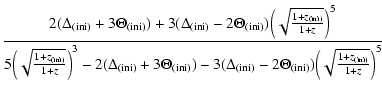
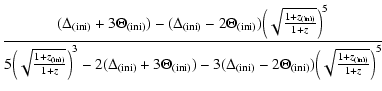
 expressed as a function of the redshift z takes the form
![${\Delta}=\left[{\delta\rho\over \rho{_{(0)}}}\right]$](/articles/aa/full/2004/04/aa2466/img93.gif) ,
,
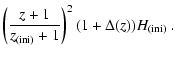
![${\Theta}=\left[{\delta\vartheta\over \vartheta{_{(0)}}}\right]$](/articles/aa/full/2004/04/aa2466/img94.gif) and the magnetic field H(z) read respectively
and the magnetic field H(z) read respectively
 and the initial flow
 (the velocity divergence). Setting
 at z=1200, as suggested by the CMBR measurements, we draw
and
at z=1200, as suggested by the CMBR measurements, we draw
and  as functions of z and the initial flow
(see Figs. 1 and 2).
as functions of z and the initial flow
(see Figs. 1 and 2).
![\begin{figure}
\par\includegraphics[width=8.8cm,clip]{figure1.eps}\end{figure}](/articles/aa/full/2004/04/aa2466/img102.gif) |
Figure 1:
Density contrast as a function of redshift z and initial velocity flow
. |
| Open with DEXTER | |
![\begin{figure}
\par\includegraphics[width=8.8cm,clip]{figure2}\end{figure}](/articles/aa/full/2004/04/aa2466/img103.gif) |
Figure 2:
Velocity field contrast as a function of redshift z and initial velocity flow
. |
| Open with DEXTER | |
Galactic superclusters with the density contrast
 are considered as nonvirialized
structures (Peacock 1999). Their length scales of about 10 Mpc are typically expected at the moment
of transition from the linear to nonlinear regime. The evolution of these structures relative to the
initial values of the large scale inflows
is presented in Fig. 3. The evolutionary paths with different
form horizontal lines, while the solid sloped
lines mark the beginning (
are considered as nonvirialized
structures (Peacock 1999). Their length scales of about 10 Mpc are typically expected at the moment
of transition from the linear to nonlinear regime. The evolution of these structures relative to the
initial values of the large scale inflows
is presented in Fig. 3. The evolutionary paths with different
form horizontal lines, while the solid sloped
lines mark the beginning (
 ,
,
 )
and the end (
)
and the end (
 ,
,
 )
of the
weakly nonlinear regime (the shaded region). The magnitudes of the contrasts at both characteristic
moments are set to be compatible with the values obtained from the numerical simulation (Gramann et al. 2002).
The region below the shaded region represents the linear evolution, while the region
above - the strongly nonlinear collapse. The existence of the low z structures with
,
confirmed by the observations, when compared with the theoretical low redshift behaviour
(Fig. 3) favours the initial inflow
)
of the
weakly nonlinear regime (the shaded region). The magnitudes of the contrasts at both characteristic
moments are set to be compatible with the values obtained from the numerical simulation (Gramann et al. 2002).
The region below the shaded region represents the linear evolution, while the region
above - the strongly nonlinear collapse. The existence of the low z structures with
,
confirmed by the observations, when compared with the theoretical low redshift behaviour
(Fig. 3) favours the initial inflow
 at the recombination
epoch.
at the recombination
epoch.
![\begin{figure}
\par\includegraphics[width=8.8cm,clip]{figure3}\end{figure}](/articles/aa/full/2004/04/aa2466/img106.gif) |
Figure 3:
Schematic diagram of weakly nonlinear evolution of the density and velocity contrasts.
For both contrasts the
 and
and
 sections are presented. The solid lines correspond to the initial and final
states of the previrial nonlinear evolution of
and .
The shaded area represents all the evolutionary states between (
,
)
and (
,
).
Horizontal dashed lines show the evolutionary tracks.
sections are presented. The solid lines correspond to the initial and final
states of the previrial nonlinear evolution of
and .
The shaded area represents all the evolutionary states between (
,
)
and (
,
).
Horizontal dashed lines show the evolutionary tracks. |
| Open with DEXTER | |
 )
is crucial for the efficiency of the dynamo action (e.g. Widrow 2002). The amplification degree in this
process exponentially depends on the time available for the dynamo mechanism to operate. The pre-dynamo
magnetic field compression (Lesch et al. 1995) is followed by the dynamo amplification, which in the case of
protogalaxies results in some 104-1010 enhancement in amplitude, depending on the time when the
field reaches the observed value. The question if the dynamo mechanism is applicable to galactic
cluster structures is still open. Even more intriguing is the origin of the almost equipartized
supercluster magnetic fields (
)
is crucial for the efficiency of the dynamo action (e.g. Widrow 2002). The amplification degree in this
process exponentially depends on the time available for the dynamo mechanism to operate. The pre-dynamo
magnetic field compression (Lesch et al. 1995) is followed by the dynamo amplification, which in the case of
protogalaxies results in some 104-1010 enhancement in amplitude, depending on the time when the
field reaches the observed value. The question if the dynamo mechanism is applicable to galactic
cluster structures is still open. Even more intriguing is the origin of the almost equipartized
supercluster magnetic fields ( 10-7) (Sigl et al. 1998). Figure 3 illustrates that structures with
initial inflow
10-7) (Sigl et al. 1998). Figure 3 illustrates that structures with
initial inflow
 reaches the weakly nonlinear regime (
 )
at redshift z=3, and
leaves the weakly nonlinear phase (
)
at redshift z=3, and
leaves the weakly nonlinear phase (
 )
at z=1.3. A dynamo may operate then for
)
at z=1.3. A dynamo may operate then for
 ,
which (taking into account the typical dynamo time scale
,
which (taking into account the typical dynamo time scale
 )
results in the
)
results in the
 enhancement of magnetic field. On the other hand, for the structures with the initial
inflows at the level of
enhancement of magnetic field. On the other hand, for the structures with the initial
inflows at the level of
 (or
(or
 ), the beginning
and the end of the previrial nonlinear stage occur at
), the beginning
and the end of the previrial nonlinear stage occur at
 (
(
 )
and
)
and
 (
(
 ), respectively, which limits the dynamo operation phase to less than
 (or none). In this latter case i.e. for systems which presently attain the previrial
collapse state (
at
(or none). In this latter case i.e. for systems which presently attain the previrial
collapse state (
at  ), the primordial magnetic field constrained at z = 103to magnitudes below 10-9 G (Barrow et al. 1997) are pre-dynamo amplified by merely 2 orders of magnitude.
We provided the nonlinear exact solutions for the density, velocity and magnetic fields
for the pancake-type structures in the Newtonian expanding universe. The approximations of the potential velocity field
and vanishing matter pressure have been employed. The time when the compressing flat structure enters the regime of
nonlinear growth is controlled by the initial value of velocity field at the recombination. The structures accompanied
by large hydrodynamic flows collapse earlier, i.e. the moment when dynamo mechanism
may switch on occurs at higher redshifts, which eventually results in stronger magnetic field enhancement.
For presently observed velocity fields, 10-1, (see, e.g. Dekel 1997) in supergalactic structures of 100 Mpc and
 the initial inflows
and initial magnetic fields
the initial inflows
and initial magnetic fields
 -10-8 Gauss are expected.
The result is compatible with the simulation estimations (Gramann et al. 2002).
-10-8 Gauss are expected.
The result is compatible with the simulation estimations (Gramann et al. 2002).
Firm evidence of primordial magnetic fields in structures at pre-virial stages is of particular importance, as these fields "remember'' the initial conditions and thus set constraints on the seed magnetic fields, density and velocity fields at the recombination. The observational techniques become more important (Faraday rotation measurements and the indications coming from the propagation of cosmic radiation UHE in the Local Supercluster), which potentially might distinguish between the large scale magnetic seed component from other magnetic fields of astrophysical origin (i.e. resulting from galactic dynamo, outflows from radiogalaxies etc.). The rotation measure which have the same sign along the Supercluster plane would suggest a coherent, relic field at this scale.
Acknowledgements
We thank the referee for efforts to improve the manuscript.









![\begin{displaymath}{\mu}''+{a'\over a}{\mu}'-{3\over 2}\left[K+\left({a'\over a}\right)^2\right]=0 \ ,
\end{displaymath}](/articles/aa/full/2004/04/aa2466/img70.gif)

![$\displaystyle -10 {{M}\over K}\left[1+{3\over 2}\left(-2+\sqrt{K} \eta \cot{\sqrt{K}\eta\over 2}\right)\sin^{-2}{\sqrt{K}\eta\over 2}\right]$](/articles/aa/full/2004/04/aa2466/img78.gif)

![$\displaystyle \left({{M}\over K}\right)^{-3/2}\left[1+\tan^{-2}{\sqrt{K}\eta\over 2}\right]\cot^3{\sqrt{K}\eta\over 2}$](/articles/aa/full/2004/04/aa2466/img80.gif)
![\begin{displaymath}{\mu}({z})={{\Delta}_{(\rm ini)}\over 5}\left[3{\left(\sqrt{\...
...qrt{\frac{1+{z}_{(\rm ini)}}{1+{z}}}\right)}^{-3}\right] \cdot
\end{displaymath}](/articles/aa/full/2004/04/aa2466/img92.gif)