![\begin{figure}
\par\rotatebox{0}{\includegraphics[height=6.62cm,width=8.8cm,clip]{H4692F1.ps}}
\end{figure}](/articles/aa/full/2004/03/aah4692/img58.gif) |
Figure 1: Prototype X-ray spectrum of a type-1 AGN (illustration idea taken from Fabian 1998). The spectrum is dominated by the global Comptonized continuum. At low energies, there is the soft excess, in principle a composition of some black bodies belonging to the disk divided into rings. At energies around 1 keV, one can recognize a complex of absorption dips, originating from the warm absorbers. The reflection component consists of a broad bump peaking around 20 keV and the prominent fluorescence emission line complex around 6.4 keV. |
| Open with DEXTER | |
In the text
![\begin{figure}
\par\rotatebox{0}{\includegraphics[height=4.8cm,width=8.8cm,clip]{H4692F2.ps}}
\end{figure}](/articles/aa/full/2004/03/aah4692/img68.gif) |
Figure 2: Illustration of topological elements in the innermost region of accreting black hole systems. The size and morphology of these elements depend on accretion rate, black hole mass and radiative cooling. |
| Open with DEXTER | |
In the text
![\begin{figure}
\par\rotatebox{0}{\includegraphics[height=5.09cm,width=8.8cm,clip]{H4692F3.ps}}
\end{figure}](/articles/aa/full/2004/03/aah4692/img70.gif) |
Figure 3: Radial behaviour of the Boyer-Lindquist functions at extreme Kerr (a=1.0) in the equatorial plane. Relativistic units were used. |
| Open with DEXTER | |
In the text
![\begin{figure}
\par\rotatebox{0}{\includegraphics[height=4.82cm,width=8.8cm,clip]{H4692F4.ps}}
\end{figure}](/articles/aa/full/2004/03/aah4692/img104.gif) |
Figure 4: Schematical representation of a Kerr ray tracer. The light rays start at the screen ( back tracking) and hit the disk surface in the equatorial plane. On the screen the lensed image is formed as seen by a distant observer. Our solver folds directly from equatorial plane to screen. |
| Open with DEXTER | |
In the text
![\begin{figure}
\par\rotatebox{0}{\includegraphics[height=6.9cm,width=8.8cm,clip]{H4692F5.ps}}
\end{figure}](/articles/aa/full/2004/03/aah4692/img136.gif) |
Figure 5:
Simulated disk image at inclination of
 and extreme Kerr
a=0.999999 with color-coded distribution of generalized Doppler
factor g (white corresponds to g=1). The beamed blue approaching left side is clearly seen (triangular segment, g>1). Gravitational redshift (dark colors, g<1)
darkens the inner edge until g vanishes at the horizon.
and extreme Kerr
a=0.999999 with color-coded distribution of generalized Doppler
factor g (white corresponds to g=1). The beamed blue approaching left side is clearly seen (triangular segment, g>1). Gravitational redshift (dark colors, g<1)
darkens the inner edge until g vanishes at the horizon. |
| Open with DEXTER | |
In the text
![\begin{figure}
\par\rotatebox{0}{\includegraphics[height=6cm,width=8.8cm,clip]{H4692F6.ps}}
\end{figure}](/articles/aa/full/2004/03/aah4692/img141.gif) |
Figure 6:
Radial dependence of the velocity component
 in the equatorial plane for Kerr parameter a=0.8. Prograde case is shown in
the upper curve; retrograde case is illustrated in the lower curve. The matter starts in free-fall from a drift radius of
in the equatorial plane for Kerr parameter a=0.8. Prograde case is shown in
the upper curve; retrograde case is illustrated in the lower curve. The matter starts in free-fall from a drift radius of
 .
vanishes self-consistently (for ZAMOs) at the horizon at .
vanishes self-consistently (for ZAMOs) at the horizon at
 . . |
| Open with DEXTER | |
In the text
![\begin{figure}
\par\rotatebox{0}{\includegraphics[height=7.63cm,width=8.8cm,clip]{H4692F7.ps}}
\end{figure}](/articles/aa/full/2004/03/aah4692/img144.gif) |
Figure 7:
Distribution of the Doppler factor g4 over the disk. The inner disk edge touches at
 the horizon of the black hole with
a=0.999999. The inclination angle is
and the outer edge is at
the horizon of the black hole with
a=0.999999. The inclination angle is
and the outer edge is at
 .
The shadow of the black hole is clearly seen. Beaming on the left approaching side brightens any emission originating there. The right
receeding part of the disk is darkened. This distribution is always folded in the flux integral and therefore important for any emission
near black holes. .
The shadow of the black hole is clearly seen. Beaming on the left approaching side brightens any emission originating there. The right
receeding part of the disk is darkened. This distribution is always folded in the flux integral and therefore important for any emission
near black holes. |
| Open with DEXTER | |
In the text
![\begin{figure}
\par\rotatebox{0}{\includegraphics[height=4.96cm,width=8.8cm,clip]{H4692F8.ps}}
\end{figure}](/articles/aa/full/2004/03/aah4692/img172.gif) |
Figure 8:
Distribution of specific angular momentum,
 ,
for Kerr parameter
a=0.8. Fixing a constant specific angular momentum, ,
for Kerr parameter
a=0.8. Fixing a constant specific angular momentum,
 ,
is only allowed
inbetween the two levels: the lower one, ,
is only allowed
inbetween the two levels: the lower one,
 ,
and the upper one, ,
and the upper one,
 . . |
| Open with DEXTER | |
In the text
![\begin{figure}
\par\rotatebox{0}{\includegraphics[height=5.26cm,width=8.8cm,clip]{H4692F9.ps}}
\end{figure}](/articles/aa/full/2004/03/aah4692/img173.gif) |
Figure 9:
Radial distribution of prograde (solid curve),
 ,
and retrograde (dashed curve)
angular velocity limit, ,
and retrograde (dashed curve)
angular velocity limit,
 ,
for Kerr parameter a=0.8. The dotted curve illustrates
the frame-dragging potential, ,
for Kerr parameter a=0.8. The dotted curve illustrates
the frame-dragging potential,  .
At the horizon, here at
,
all curves
coincide. This is the visualization of the frame-dragging effect. .
At the horizon, here at
,
all curves
coincide. This is the visualization of the frame-dragging effect. |
| Open with DEXTER | |
In the text
![\begin{figure}
\par\rotatebox{0}{\includegraphics[height=5.82cm,width=8.8cm,clip]{H4692F10.ps}}
\end{figure}](/articles/aa/full/2004/03/aah4692/img187.gif) |
Figure 10:
Radial velocity component in the ZAMO for different radial drift models, that means different rotation state of black hole, a, and
drift radius,  .
In all cases, the radial drift becomes light speed at the horizon radii. .
In all cases, the radial drift becomes light speed at the horizon radii. |
| Open with DEXTER | |
In the text
![\begin{figure}
\par\rotatebox{0}{\includegraphics[height=6.98cm,width=8cm,clip]{H4692F11.ps}}
\end{figure}](/articles/aa/full/2004/03/aah4692/img188.gif) |
Figure 11: Illustration of different radial emissivity models. |
| Open with DEXTER | |
In the text
![\begin{figure}
\par\rotatebox{0}{\includegraphics[height=6.28cm,width=8.8cm,clip]{H4692F12.ps}}
\end{figure}](/articles/aa/full/2004/03/aah4692/img199.gif) |
Figure 12:
Influence of radial drift. Upper hemisphere: pure Keplerian rotation
 .
Bottom hemisphere: Keplerian rotation plus radial drift .
Bottom hemisphere: Keplerian rotation plus radial drift
 .
Enhanced gravitional redshift is clearly seen by darkening near the horizon indicated by an arrow.
Parameters were a=0.1, .
Enhanced gravitional redshift is clearly seen by darkening near the horizon indicated by an arrow.
Parameters were a=0.1,
 , ,
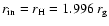 , ,
 .
The radial drift starts at .
The radial drift starts at
 . . |
| Open with DEXTER | |
In the text
![\begin{figure}
\par\rotatebox{0}{\includegraphics[height=9cm,width=8.8cm,clip]{H4692F13.ps}}
\end{figure}](/articles/aa/full/2004/03/aah4692/img200.gif) |
Figure 13:
The upper disk shows the distribution of the g-factor over a narrow ring with radial drift starting at
 .
White color indicates no net photon energy shift (g=1), the left side is beamed (g>1) whereas the right side and the regions near the horizon are strongly
redshifted (g<1). The inclination angle is .
White color indicates no net photon energy shift (g=1), the left side is beamed (g>1) whereas the right side and the regions near the horizon are strongly
redshifted (g<1). The inclination angle is
 ,
the black hole rotation is fast, a=0.8, inner edge is the horizon at ,
the black hole rotation is fast, a=0.8, inner edge is the horizon at
 and outer edge is only at
 .
The lower disk indicates the associated distribution of the emission of the same narrow ring.
White indicates high emission, black low emission. Here, the emissivity follows a broad Gaussian profile with
and constant Gaussian width .
The lower disk indicates the associated distribution of the emission of the same narrow ring.
White indicates high emission, black low emission. Here, the emissivity follows a broad Gaussian profile with
and constant Gaussian width
 . . |
| Open with DEXTER | |
In the text
![\begin{figure}
\par\includegraphics[height=6cm,width=6cm,clip]{H4692F14.ps}
\end{figure}](/articles/aa/full/2004/03/aah4692/img217.gif) |
Figure 14:
Three effects form the line profile. This simulated profile of an iron K line has typical parameters for Seyfert-1 s. The observer is intermediately inclined, the plasma rotates
only Keplerian and typical disk sizes
 , ,
 were taken.
 |
| Open with DEXTER | |
In the text
![\begin{figure}
\par\rotatebox{-90}{\includegraphics[height=8.8cm,width=4cm,clip]...
...{-90}{\includegraphics[height=8.8cm,width=4cm,clip]{H4692F15e.ps}}
\end{figure}](/articles/aa/full/2004/03/aah4692/img238.gif) |
Figure 15: A selection of topology types of relativistic emission lines. From top to bottom: triangular, double-horned, double-peaked, bumpy and shoulder-like. Line flux in normalized arbitrary units is plotted over g-factor. |
| Open with DEXTER | |
In the text
![\begin{figure}
\par\rotatebox{0}{\includegraphics[height=8cm,width=8cm,clip]{H4692F16.ps}}
\end{figure}](/articles/aa/full/2004/03/aah4692/img252.gif) |
Figure 16:
Illustration of line criteria to determine characteristics of a typical emission line profile. The position of the relic Doppler peaks
(if existing) can be used to fix their flux ratio (Doppler Peak Ratio,  )
and energetic distance (Doppler Peak Spacing, )
and energetic distance (Doppler Peak Spacing,  ).
Other specific quantities are the maximal flux, ).
Other specific quantities are the maximal flux,
 ,
and the minimum and maximum energy of a line, ,
and the minimum and maximum energy of a line,
 and
and
 .
These criteria
can be used to describe a line shape, observed or theoretically derived, with a few numerical values. .
These criteria
can be used to describe a line shape, observed or theoretically derived, with a few numerical values. |
| Open with DEXTER | |
In the text
![\begin{figure}
\par\rotatebox{-90}{\includegraphics[height=8.8cm,width=5.7cm,clip]{H4692F17.ps}}
\end{figure}](/articles/aa/full/2004/03/aah4692/img253.gif) |
Figure 17:
Relativistic emission line forming directly in front of the horizon. The parameters were chosen to
 ,
Kerr parameter a=0.998,
disk size ,
Kerr parameter a=0.998,
disk size
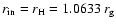 , ,
 ,
radial drift starting at ,
radial drift starting at
 and a localized emissivity by means of a Gaussian
profile with
and
and a localized emissivity by means of a Gaussian
profile with
and
 .
This more or less unphysical example for line emission should demonstrate
the strongly suppressed emission due to the shadow of the black hole. Even if emission lines could form in the direct vicinity of black holes, the
high power of the generalized Doppler factor g reduces the flux and shifts the line significantly to lower energies due to gravitational redshift
effects. .
This more or less unphysical example for line emission should demonstrate
the strongly suppressed emission due to the shadow of the black hole. Even if emission lines could form in the direct vicinity of black holes, the
high power of the generalized Doppler factor g reduces the flux and shifts the line significantly to lower energies due to gravitational redshift
effects. |
| Open with DEXTER | |
In the text
![\begin{figure}
\par\rotatebox{-90}{\includegraphics[height=8.8cm,width=5.7cm,clip]{H4692F18.ps}}
\end{figure}](/articles/aa/full/2004/03/aah4692/img265.gif) |
Figure 18:
Investigation of the dependence on the Kerr parameter a. The plasma motion is only Keplerian, the inclination is
 .
The black
hole spin decreases from top to bottom line profile, .
The black
hole spin decreases from top to bottom line profile,
 .
The inner disk edge is equal to the corresponding black hole
horizon, .
The inner disk edge is equal to the corresponding black hole
horizon,
 ,
and the disk edges are chosen so that the total disk surface remains constant. ,
and the disk edges are chosen so that the total disk surface remains constant. |
| Open with DEXTER | |
In the text
![\begin{figure}
\par\rotatebox{-90}{\includegraphics[height=8.8cm,width=5.7cm,clip]{H4692F19.ps}}
\end{figure}](/articles/aa/full/2004/03/aah4692/img266.gif) |
Figure 19:
Reproduction of the line set with variable inclination,
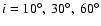 in Schwarzschild (Fabian et al. 2000). The
main difference is that here an additional radial drift is adapted whereas Fabian et al. (2000) only assumed Keplerian motion.
In both cases the emissivity follows a standard single power law. For better comparison, the abscissa is scaled to the iron K
in Schwarzschild (Fabian et al. 2000). The
main difference is that here an additional radial drift is adapted whereas Fabian et al. (2000) only assumed Keplerian motion.
In both cases the emissivity follows a standard single power law. For better comparison, the abscissa is scaled to the iron K line with 6.4 keV rest frame energy. line with 6.4 keV rest frame energy. |
| Open with DEXTER | |
In the text
![\begin{figure}
\par\rotatebox{-90}{\includegraphics[height=8.8cm,width=5.79cm,clip]{H4692F20.ps}}
\end{figure}](/articles/aa/full/2004/03/aah4692/img267.gif) |
Figure 20:
Relativistic emission lines with radial drift model and Gaussian emissivity. The drift radius
from the plasma velocity field
couples to the emissivity. From bottom to top, the drift radius increases,
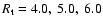 .
The black hole rotates slowly, a=0.1, the
inclination angle is
, .
The black hole rotates slowly, a=0.1, the
inclination angle is
,
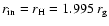 and
.
The emissivity is modelled
with constant
.
and
.
The emissivity is modelled
with constant
. |
| Open with DEXTER | |
In the text
![\begin{figure}
\par\rotatebox{0}{\includegraphics[height=4.5cm,width=8.8cm,clip]{H4692F21.ps}}
\end{figure}](/articles/aa/full/2004/03/aah4692/img272.gif) |
Figure 21:
Cut-emissivity with
 for different truncation radii. From bottom to top, the drift radius increases,
.
With this choice of
and
for different truncation radii. From bottom to top, the drift radius increases,
.
With this choice of
and  ,
the emissivity peaks naturally at .
For ,
the emissivity peaks naturally at .
For
 the emissivity decreases exponentially.
 |
| Open with DEXTER | |
In the text
![\begin{figure}
\par\rotatebox{0}{\includegraphics[height=4.5cm,width=8.8cm,clip]{H4692F22.ps}}
\end{figure}](/articles/aa/full/2004/03/aah4692/img274.gif) |
Figure 22:
Relativistic emission lines with radial drift model and cut-power law emissivity. The drift radius
from the plasma velocity field
couples to the emissivity. From bottom to top, the drift radius increases,
.
The black hole rotates slowly, a=0.1, the
inclination angle is
,
and
.
The emissivity is modelled with constant
. |
| Open with DEXTER | |
In the text
![\begin{figure}
\par\rotatebox{-90}{\includegraphics[height=8.8cm,width=5.17cm,clip]{H4692F23.ps}}
\end{figure}](/articles/aa/full/2004/03/aah4692/img276.gif) |
Figure 23:
Direct confrontation of relativistic emission lines with and without radial drift model. A single-power law emissivity with  is chosen. The black hole spin parameter is a=0.8, the inclination angle is
,
and
is chosen. The black hole spin parameter is a=0.8, the inclination angle is
,
and
 .
The pure Keplerian case, top line, is modelled by constant specific angular momentum for .
The pure Keplerian case, top line, is modelled by constant specific angular momentum for
 .
The non-Keplerian case, bottom line, includes drift starting at .
The non-Keplerian case, bottom line, includes drift starting at
 . . |
| Open with DEXTER | |
In the text
![\begin{figure}
\par\rotatebox{0}{\includegraphics[height=4.6cm,width=8.8cm,clip]{H4692F24.ps}}
\end{figure}](/articles/aa/full/2004/03/aah4692/img277.gif) |
Figure 24:
Suggestion of a multi-species line system fitting the XMM-Newton observation of MCG-6-30-15 (Fabian et al. 2002). A line
complex consisting of Fe K at 6.4 keV, Fe K
at 7.06 keV, Ni K
at 7.48 keV and one weak contribution of Cr K
at 5.41 keV (all energies measured in the rest frame) is simulated. |
| Open with DEXTER | |
In the text