A&A 413, 505-523 (2004)
DOI: 10.1051/0004-6361:20031507
Molecular gas in the galaxy M 83
I. The molecular gas distribution
A. A. Lundgren1,2 - T. Wiklind3,4 - H. Olofsson1 - G. Rydbeck4
1 - Stockholm Observatory, AlbaNova, 106 91 Stockholm, Sweden
2 - European Southern Observatory, Casilla 19001, Santiago 19, Chile
3 - Space Telescope Science Institute, 3700 San Martin Drive Baltimore, MD 21218, USA
4 - Onsala Space Observatory, 43992 Onsala, Sweden
Received 2 January 2003 / Accepted 22 September 2003
Abstract
We present 12CO J=1-0 and J=2-1 Swedish-ESO Submillimetre
Telescope (SEST) observations of the
barred spiral galaxy M 83 (NGC 5236). The size of the CO maps is
 and they cover the entire optical disk.
The grid spacing is 11
and they cover the entire optical disk.
The grid spacing is 11
 for CO(J=1-0) and 11
or 7
for CO(J=2-1) depending on the position in the galaxy. In total
we have obtained spectra in 1900 and 2574 positions in the CO(J=1-0) and CO(J=2-1) lines, respectively. The CO emission is strongly peaked toward the
nucleus, which breaks up into two separate components in the CO(J=2-1) data
due to the higher spatial resolution. Emission from the bar is
strong, in particular on the leading edges of the bar. The molecular
gas arms are clearly resolved and can be traced for more than 360
for CO(J=1-0) and 11
or 7
for CO(J=2-1) depending on the position in the galaxy. In total
we have obtained spectra in 1900 and 2574 positions in the CO(J=1-0) and CO(J=2-1) lines, respectively. The CO emission is strongly peaked toward the
nucleus, which breaks up into two separate components in the CO(J=2-1) data
due to the higher spatial resolution. Emission from the bar is
strong, in particular on the leading edges of the bar. The molecular
gas arms are clearly resolved and can be traced for more than 360 .
Emission in the inter-arm regions is detected. The average CO
(J=2-1)/(J=1-0) line ratio is 0.77.
The ratio is lower than this on the spiral arms and higher in the
inter-arm regions.
The arms show regularly spaced concentrations of molecular gas,
Giant Molecular Associations (GMA's), whose masses are of the order
.
Emission in the inter-arm regions is detected. The average CO
(J=2-1)/(J=1-0) line ratio is 0.77.
The ratio is lower than this on the spiral arms and higher in the
inter-arm regions.
The arms show regularly spaced concentrations of molecular gas,
Giant Molecular Associations (GMA's), whose masses are of the order
 .
The total molecular gas mass is estimated to be
.
The total molecular gas mass is estimated to be
 .
This mass is comparable
to the total HI mass, but H2 dominates in the optical disk. In the
disk, H2 and HI show very similar distributions, including small
scale clumping.
We compare the molecular gas distribution with those of other
star formation tracers, such as B and H
.
This mass is comparable
to the total HI mass, but H2 dominates in the optical disk. In the
disk, H2 and HI show very similar distributions, including small
scale clumping.
We compare the molecular gas distribution with those of other
star formation tracers, such as B and H images.
Key words: galaxies: individual: M 83; NGC 5236 - galaxies: spiral -
galaxies: structure - galaxies: ISM - radio lines: galaxies -
galaxies: abundances
In disk galaxies the mass of the molecular (H2) gas is usually
similar to, or a bit less than, that of the atomic (HI) gas
(Young & Scoville 1991; Casoli et al. 1998). However, their spatial distributions are
completely different, both in the radial and in the vertical
directions. The molecular gas is concentrated to a relatively thin
disk, which often has a radial extent similar to that of the optical
disk and a vertical scale height which is smaller than that of the
young, massive stars. The radius of the HI disk is usually much
larger than that of the optical disk (up to 5 times the Holmberg
radius), and the atomic gas is also less concentrated to the disk in
the vertical direction (Knapp 1987).
If the mass surface density in a region exceeds a certain critical density,
massive star formation is triggered (Kennicutt 1989).
So, naturally, the study of interstellar gas, and especially the molecular
gas phase, plays a key role in understanding the structure and
evolution of galaxies. Unfortunately, direct studies (in emission) of
the cold ( 10 K) H2 gas in molecular clouds are very difficult,
since the energy of the first excited rotational level is of the order
of 500 K (corresponding to a wavelength of 28
10 K) H2 gas in molecular clouds are very difficult,
since the energy of the first excited rotational level is of the order
of 500 K (corresponding to a wavelength of 28  m), and
therefore much larger than the average kinetic temperatures in the
clouds. Carbon monoxide (CO) is the second most common molecule with
a relative abundance with respect to H2 of about 10-4. The
heavy, asymmetrical CO molecule has rotational levels which are
easily excited by collisions with H2, and it radiates at mm
wavelengths where observations can be carried out using radio telescopes.
However, the conversion factor which is used to derive the H2 column density from the velocity-integrated CO intensity,
m), and
therefore much larger than the average kinetic temperatures in the
clouds. Carbon monoxide (CO) is the second most common molecule with
a relative abundance with respect to H2 of about 10-4. The
heavy, asymmetrical CO molecule has rotational levels which are
easily excited by collisions with H2, and it radiates at mm
wavelengths where observations can be carried out using radio telescopes.
However, the conversion factor which is used to derive the H2 column density from the velocity-integrated CO intensity,
 ,
is
not well-known, and this is a source of major uncertainty
(Young & Scoville 1991; Combes 1991).
,
is
not well-known, and this is a source of major uncertainty
(Young & Scoville 1991; Combes 1991).
CO emission at mm wavelengths has been detected in many galaxies ranging in
distance from the nearby irregular galaxies The Large and The Small Magellanic
Clouds to quasars at a redshift of more than z 5, and in essentially
all galaxy types. A large survey of 300 galaxies (of which 236 were
detected) of different types was done by Young et al. (1995) using the FCRAO
14 m telescope. The analysis of the data is still ongoing, but some
interesting results have been published, e.g., the conversion factor
(
)
appears relatively constant, at least within each galaxy type
(Young & Rownd 2001), and the global star formation efficiency decreases with
increasing galaxy size (Young 1999). In this survey a number of
galaxies were also mapped and radial distributions of the molecular
gas can be examined. Recently, in a more detailed study, 28 nearby
galaxies were mapped with the 45 m Nobeyama telescope
(Nishiyama et al. 2001; Kuno et al. 2000). Among other things, this showed that barred and
non-barred galaxies differ in both the distribution and the kinematics
of the molecular gas. Another large survey is the BIMA SONG project
(Helfer et al. 2003; Regan et al. 2001), in which 44 nearby (
 km s-1) galaxies
have been observed with the BIMA array and the NRAO 12 m telescope.
Early results show that many galaxies have multiple peaks at the nucleus,
that the CO distribution usually cannot be fitted with a single exponential
disk model, and that the ratio of the scale length in the CO disk and
the scale length in the stellar disk is on average 1 (but the scatter
around this average is large).
km s-1) galaxies
have been observed with the BIMA array and the NRAO 12 m telescope.
Early results show that many galaxies have multiple peaks at the nucleus,
that the CO distribution usually cannot be fitted with a single exponential
disk model, and that the ratio of the scale length in the CO disk and
the scale length in the stellar disk is on average 1 (but the scatter
around this average is large).
Detailed morphological studies of selected galaxies are more rare, partly because
there are so few nearby galaxies for which the limited angular
resolution of radio telescopes gives an adequate spatial resolution.
Nakai et al. (1994) outlined a number of important observational conditions
that should be fulfilled in order to be able to extract useful
information on the properties of the molecular gas in different
regions of a galaxy: (1) a spatial resolution better than one kpc, which is
the typical width of molecular spiral arms and the spacing between
them, (2) high sensitivity in order to detect the weak inter-arm
emission, (3) mapping of a large field in order to get statistically
meaningful results, and (4) filled aperture telescope data, since it
is important to detect the diffuse emission in the inter-arm regions.
To this list we add a fifth condition, (5) the
observation should be carried out in (at least) two lines per molecular species
(and preferably also partially observed in a few
isotopomers) in order to gain insight into the density, temperature,
and chemistry of the molecular gas.
Single-dish measurements are therefore essential to our determination of
the molecular gas distribution, its relation to star formation
activity, its location with respect to dynamical resonances, and the
total reservoir of gas capable of forming future generations of stars.
The most detailed single-dish maps of molecular gas in spiral
galaxies are the mappings of M 51, using the IRAM 30 m telescope
(Garcia-Burillo et al. 1993) and the Nobeyama 45 m telescope (Nakai et al. 1994), and two projects currently underway to map our neighbor M 31
(Loinard et al. 1999; Nieten et al. 2000). In M 51 the molecular spiral arms were resolved, and
streaming motions were detected. Also, the CO emission
was found to peak on the inside of the spiral arms, giving support to
a scenario where molecular gas agglomerates and forms new stars, which
in their turn produce H emission and other star formation tracers,
close to the spiral arms. Support was also found for the proposal that
gravitational instability in the disk is the main formation mechanism
of GMAs (Galactic Molecular Associations of mass 107  ).
Other large spiral galaxies that have been completely surveyed in CO with a
single-dish telescope are IC 342 (Crosthwaite et al. 2001), M 101 (Kenney et al. 1991),
NGC 253 (Houghton et al. 1997), and NGC 6946 (Tacconi & Young 1989). Some large scale CO mapping projects, such as the OVRO maps of M 51 (Aalto et al. 1999) and M 83 (Rand et al. 1999), have been done using mm-wave interferometers.
Although this gives a superior angular resolution and important unique
information, a significant part of the emission is resolved out
(especially the diffuse component in the inter-arm regions).
).
Other large spiral galaxies that have been completely surveyed in CO with a
single-dish telescope are IC 342 (Crosthwaite et al. 2001), M 101 (Kenney et al. 1991),
NGC 253 (Houghton et al. 1997), and NGC 6946 (Tacconi & Young 1989). Some large scale CO mapping projects, such as the OVRO maps of M 51 (Aalto et al. 1999) and M 83 (Rand et al. 1999), have been done using mm-wave interferometers.
Although this gives a superior angular resolution and important unique
information, a significant part of the emission is resolved out
(especially the diffuse component in the inter-arm regions).
We have mapped the CO(J=1-0) and CO(J=2-1) emission in the barred,
grand-design, spiral galaxy M 83 located at a
distance of 4.5 Mpc. The observations were done with the 15 m
Swedish-ESO Submillimetre Telescope (SEST) providing beam widths
of 45
(1-0) and 23
(2-1), which
corresponds to 980 pc and 500 pc, respectively, at the adopted distance.
M 83 is among the brightest galaxies in terms of CO emission, and it is
also one of the most nearby barred spirals. Its low inclination ( 24)
and proximity make it a perfect candidate to
investigate the correlation between various tracers of stellar
activity.
24)
and proximity make it a perfect candidate to
investigate the correlation between various tracers of stellar
activity.
In this paper we present the CO(J=1-0) and CO(J=2-1) observational data. We
show the distribution of the molecular gas, as inferred from the CO data,
and compare it to the distributions of optical light, obtained in
different filters, and the HI gas. We examine the CO (J=2-1)/(J=1-0) line ratio and its variation over
the disk. In two forth-coming papers we will present and discuss the
kinematics of the molecular gas, and discuss the relation between the
molecular gas and star formation.
M 83 is a relatively nearby, barred, grand-design, spiral galaxy (see
Table 1). It is viewed almost face-on and the bar is
aligned with the major axis. Color images show clumpy, well-defined
spiral arms, evidently rich in young blue stars. It is also fairly
symmetrical and has no nearby massive optical companions and no
immediate evidence of interaction or outflows.
Table 1:
General parameters of M 83.
Table 2:
Previous CO observations of M 83 divided into
two groups: single-dish and interferometer observations.
If no location is given, the map is centered on the nucleus
and oriented along the major axis.
Due to its favorable properties it is one of the most well-observed
galaxies: HI
(Tilanus & Allen 1993; Rogstad et al. 1974; Huchtmeier & Bohnenstengel 1981), radio continuum (Neininger et al. 1993; Ondrechen 1985), CO (see
Table 2), IR continuum (Elmegreen et al. 1998; Fitt et al. 1992; Adamson et al. 1987), optical continuum
(Jensen et al. 1981), Balmer lines (Tilanus & Allen 1993; de Vaucouleurs et al. 1983; Comte 1981), and in X-ray emission
(Immler et al. 1999; Soria & Wu 2002).
The distance to M 83 is a long-standing issue.
Sandage & Tammann (1974) used a relation between the luminosity class and the
angular size of the three largest H II regions to deduce a distance
of 8.9 Mpc, while de Vaucouleurs (1979) used a number
of methods to derive a distance of 3.7 Mpc.
Recently, Cepheids have been observed in M 83 by Thim et al. (2003) using the VLT.
Twelve Cepheid candidates were observed and the distance was estimated to
be  Mpc. This distance is also supported by studies that seem to
indicate that M 83 interacted with NGC 5253 some 1-2
Mpc. This distance is also supported by studies that seem to
indicate that M 83 interacted with NGC 5253 some 1-2  109
years ago (Calzetti et al. 1999; Kobulnicky & Skillman 1995). This small, metal-poor dwarf galaxy about 2 SE of M 83 has roughly the same systemic velocity, and shows a highly
disturbed HI velocity field and intense star formation. There has
been a number of distance measurements to NGC 5253
(Saha et al. 1995; Gibson et al. 2000; Parodi et al. 2000), and they all favor a distance of about 4 Mpc.
109
years ago (Calzetti et al. 1999; Kobulnicky & Skillman 1995). This small, metal-poor dwarf galaxy about 2 SE of M 83 has roughly the same systemic velocity, and shows a highly
disturbed HI velocity field and intense star formation. There has
been a number of distance measurements to NGC 5253
(Saha et al. 1995; Gibson et al. 2000; Parodi et al. 2000), and they all favor a distance of about 4 Mpc.
3.1 Observations
Table 3:
SEST observation parameters for M 83.
The CO(J=1-0 and J=2-1) observations of M 83 were done using the
15 m SEST![[*]](/icons/foot_motif.gif) during two epochs,
1989-1994
and 1997-2001 (a description of the
telescope is given by Booth et al. 1989). Between 1988 and 1994 we observed
CO(J=1-0) in the inner disk of M 83. A segment of these observations were
presented in Wiklind et al. (1990). In 1998 and 1999 we completed this map by
observing the outer disk. During the latter observations it was
possible to do simultaneous observations in two frequency bands. We
used this option to observe the CO(J=2-1) line in parallel with the
CO(J=1-0) line. The map spacing (11
)
and integration times were set
by the requirements on the CO(J=1-0) data. In 2000 and 2001 our
primary task was to fill in the central area of the CO(J=2-1) map. For
these observations we chose a grid spacing of 7
.
We used the
other receiver to observe the 13CO(J=1-0) line, but these
data will be presented elsewhere.
during two epochs,
1989-1994
and 1997-2001 (a description of the
telescope is given by Booth et al. 1989). Between 1988 and 1994 we observed
CO(J=1-0) in the inner disk of M 83. A segment of these observations were
presented in Wiklind et al. (1990). In 1998 and 1999 we completed this map by
observing the outer disk. During the latter observations it was
possible to do simultaneous observations in two frequency bands. We
used this option to observe the CO(J=2-1) line in parallel with the
CO(J=1-0) line. The map spacing (11
)
and integration times were set
by the requirements on the CO(J=1-0) data. In 2000 and 2001 our
primary task was to fill in the central area of the CO(J=2-1) map. For
these observations we chose a grid spacing of 7
.
We used the
other receiver to observe the 13CO(J=1-0) line, but these
data will be presented elsewhere.
The receivers were centered on the CO(J=1-0) and CO(J=2-1) lines (115.271 and 230.538 GHz, respectively), where the full half-power beam widths
(HPBWs) are 45
 and 23
,
respectively. Observations
performed during 1988-1994 were made with a cooled Schottky-diode
mixer receiver, while the subsequent observations were done with
SIS receivers. All receivers operated in the single-sideband mode, and
the average system temperatures, corrected for the atmospheric and
antenna ohmic losses, were 660 K and 390 K for the CO(J=1-0) observations in the first and second epoch, respectively, and 340 K
for the CO(J=2-1) observations.
The backends were acousto-optical spectrometers, with channel
separations of 0.69 MHz (1.8 and 0.9 km s-1 at the two rest
frequencies) and total bandwidths varying between 0.5 and 1 GHz.
and 23
,
respectively. Observations
performed during 1988-1994 were made with a cooled Schottky-diode
mixer receiver, while the subsequent observations were done with
SIS receivers. All receivers operated in the single-sideband mode, and
the average system temperatures, corrected for the atmospheric and
antenna ohmic losses, were 660 K and 390 K for the CO(J=1-0) observations in the first and second epoch, respectively, and 340 K
for the CO(J=2-1) observations.
The backends were acousto-optical spectrometers, with channel
separations of 0.69 MHz (1.8 and 0.9 km s-1 at the two rest
frequencies) and total bandwidths varying between 0.5 and 1 GHz.
We used the dual beam switching mode with a throw of 12
 in azimuth. In dual beam switching the source is
placed first in the signal beam and then in the reference beam. The
two spectra produced are then subtracted to generate a spectrum with
a minimum of baseline variation. Great care was taken to ensure the
quality of the data. No observations were done below the elevation of 30 or above 84 (M 83 passes within 1 from zenith at
SEST), and pointing was regularly checked and updated using the
SiO(v=1, J=2-1) maser line of the nearby AGB-star W Hya
(3
from M 83). Total pointing errors were typically less
than 3
,
and data with pointing offsets suspected to be larger
than 4
were disregarded in the subsequent data reduction (when
possible, map points with such data were reobserved). The intensity
scale was calibrated using the conventional chopper wheel method, and
the internal calibration errors in the corrected antenna temperatures,
in azimuth. In dual beam switching the source is
placed first in the signal beam and then in the reference beam. The
two spectra produced are then subtracted to generate a spectrum with
a minimum of baseline variation. Great care was taken to ensure the
quality of the data. No observations were done below the elevation of 30 or above 84 (M 83 passes within 1 from zenith at
SEST), and pointing was regularly checked and updated using the
SiO(v=1, J=2-1) maser line of the nearby AGB-star W Hya
(3
from M 83). Total pointing errors were typically less
than 3
,
and data with pointing offsets suspected to be larger
than 4
were disregarded in the subsequent data reduction (when
possible, map points with such data were reobserved). The intensity
scale was calibrated using the conventional chopper wheel method, and
the internal calibration errors in the corrected antenna temperatures,
 ,
is within
,
is within  10% according to the SEST manual.
In this paper we use the main beam
brightness temperature scale
10% according to the SEST manual.
In this paper we use the main beam
brightness temperature scale
 ,
which is defined by
,
which is defined by
 .
According to the SEST manual
the main beam efficiencies (
.
According to the SEST manual
the main beam efficiencies (
 (115 GHz)=0.7,
(230 GHz)=0.5) have been constant throughout the period of our
observations.
(115 GHz)=0.7,
(230 GHz)=0.5) have been constant throughout the period of our
observations.
The observations were centered on the coordinates
 ,
,
 (J2000), which is the
optical center given by de Vaucouleurs et al. (1976). For CO(J=1-0) we have 3634 spectra in 1900 positions with 11
spacing, and the coverage is
complete out to a radius of 4
(J2000), which is the
optical center given by de Vaucouleurs et al. (1976). For CO(J=1-0) we have 3634 spectra in 1900 positions with 11
spacing, and the coverage is
complete out to a radius of 4 20
.
The grid extends
parallel to the equatorial coordinate system, and the dense spacing
(1/4 of the HPBW) was chosen in order to facilitate the use of
deconvolution techniques.
The integration time per position was chosen to render an rms around 70 mK (
-scale) at the original velocity resolution (1.8 km s-1). During normal weather conditions we had a typical
on-source integration time of 60 s. Among the final 1900 spectra we have
20
.
The grid extends
parallel to the equatorial coordinate system, and the dense spacing
(1/4 of the HPBW) was chosen in order to facilitate the use of
deconvolution techniques.
The integration time per position was chosen to render an rms around 70 mK (
-scale) at the original velocity resolution (1.8 km s-1). During normal weather conditions we had a typical
on-source integration time of 60 s. Among the final 1900 spectra we have  3
3 detections in 1201 positions,
i.e. a detection rate of 63%.
The average rms noise in our data set is 74 mK, which should be
compared to the peak temperature which usually lies around 0.3 K
(
-scale) in the spiral arms in the outskirts of the map.
detections in 1201 positions,
i.e. a detection rate of 63%.
The average rms noise in our data set is 74 mK, which should be
compared to the peak temperature which usually lies around 0.3 K
(
-scale) in the spiral arms in the outskirts of the map.
In CO(J=2-1) we have two maps with different spacings covering two,
partly overlapping, regions. The inner
 is covered
with a 7
grid, while the rest of the optical disk (out to a
radius of 4
is covered
with a 7
grid, while the rest of the optical disk (out to a
radius of 4
 5) is covered with an 11
grid. In total,
we have spectra in 2574 positions, out of which we have 3
detections in 1898 positions (73% detection rate).
The spectra have an average rms of about 90 mK at the original velocity resolution (0.9 km s-1).
The observational parameters are summarized in Table 3.
5) is covered with an 11
grid. In total,
we have spectra in 2574 positions, out of which we have 3
detections in 1898 positions (73% detection rate).
The spectra have an average rms of about 90 mK at the original velocity resolution (0.9 km s-1).
The observational parameters are summarized in Table 3.
The data reduction was carried out with CLASS,
DRP, and XS. During the
CO(J=1-0) observations, the number of channels and the frequency resolution
varied between the spectrometers.
We therefore resampled all data to 1.8 km s-1 (0.69 MHz) and
by selecting the central 700 channels this gave us a (fully sufficient)
total bandwidth of 1260 km s-1.
After flagging bad channels, and replacing them with a value obtained from
interpolation between adjacent channels, all spectra at the same
position were averaged using a weight determined by the noise level.
The baselines were stable, and only linear polynomial fits were
subtracted. From the spectra we created a FITS data cube for
each transition, where the first two axes represent spatial coordinates, and
the third axis represents frequency (or velocity).
We adopted a relatively dense grid spacing, compared to the beamwidth, in
order to be able to increase the spatial resolution of the data using
a MEM-deconvolution routine (maximum entropy method); the
Statistical Image Analysis (SIA) routine (Rydbeck 2000).
This procedure is particularly effective on a data
set as densely spaced as ours (spacing in the range 1/4-1/2 of the
HPBW), due to the high redundancy. The routine starts by
deconvolving a velocity-integrated intensity map, where the velocity
range is chosen to be large enough to encompass all the emission.
Once this is done, the procedure splits the initial velocity range
into three equally wide regions, calculates their velocity-integrated
intensities, and then deconvolves these three maps, using the
deconvolved map from the previous step as the input guess. The
deconvolution continues in this hierarchical manner, successively
narrowing the velocity interval, until a velocity range of 5 km s-1 is reached. To deconvolve beyond this point is not
meaningful since the S/N-ratios in the (narrow velocity range) maps
drop below a critical value.
For each of the two CO transitions we created 81 (34) maps per transition
(each covering about 5 km s-1) which we assembled into a data
cube per transition. By convolving the MEM-deconvolved data cube by a
Gaussian with a FWHM equal to the observational HPBW and comparing
with the raw spectra, we verified that the MEM-results are
reliable, and that the raw data set is homogeneous, i.e., free from
variations in gain and pointing errors. The angular resolutions of
the MEM-cubes are estimated to be 22
and 14
for the CO(J=1-0) and CO(J=2-1) data, respectively, and the
velocity resolution is 5 km s-1.
We have also constructed convolved data sets by convolving the raw
data cubes with a HPBW beam size of 20
and 15
for the CO(J=1-0) and CO(J=2-1) data, respectively (the spacing in these cubes are 11
).
Even if this degrades the resolution by 10-20%, the average rms
noise in these cubes decreases from 74 mK to 25 mK and from 90 mK to 31 mK,
respectively. The dramatically decreased noise level is
due to the fact that the spacing is small with respect to the
HPBW of the convolution kernels.
Since the peak intensity in the spectra are relatively unaffected by this process,
the average S/N-ratio in the spectra increases by a factor of 3.
As a result of this, the detection rate increases to 92% and 89% for the
CO(J=1-0) and CO(J=2-1) data, respectively (cf. Sect. 3.1).
These cubes were used to cross-check the
results we got from the MEM-deconvolved data. Some results were also
derived directly from the convolved cubes, especially in cases where
the velocity resolution was more important than the spatial
resolution. Furthermore, we convolved the raw CO(J=2-1) cube with a beam
size of 44
and regridded it to 11
spacing in order to
compare with the convolved CO(J=1-0) cube at the same resolution (49
).
In order to avoid problems with baseline irregularities when calculating
the zero moment (over velocity) of the intensities we used
a sliding window technique where at each position integration was
performed inside a velocity window whose center and width depend on
the position within the galaxy. We checked carefully that the window
always covered all the emission.
3.3 Correction for the error beam
A closer inspection of the CO(J=2-1) spectra reveals, apart from the expected
main component seen in the CO(J=1-0) spectra, a broad (velocity width 400 km s-1) and faint (peak intensity around 0.03 K) component.
Despite the low peak intensity of this feature, its integrated intensity
is quite appreciable due to its large width. Typically, it makes up
to 20%-35% of the total integrated intensity. This feature was
discovered in the MEM-deconvolved data, which are noise-free,
but it can be seen also in spectra produced by convolving the raw
CO(J=2-1) data cube with a 45
beam. The appearance of this broad
component changed with position in the disk, and we found that its
shape could, in any given position, be reproduced very well by
convolving the data set with a relatively large Gaussian beam. This
indicates that the SEST picks up emission from a much larger area than
the HPBW of 23'', i.e., at 230 GHz the SEST suffers from a
non-negligible error beam.
We have corrected the CO(J=2-1) data sets
for this error using a method described in Appendix A.
We have found no trace of an error beam contribution in the CO(J=1-0) data
(not unexpectedly, considering the higher main beam efficiency), and
consequently we have not applied any correction to these data.
![\begin{figure}
\par\includegraphics[angle=-90,width=8.8cm,clip]{H4219F01.eps}\includegraphics[angle=-90,width=8.8cm,clip]{H4219F02.eps}
\end{figure}](/articles/aa/full/2004/02/aah4219/Timg42.gif) |
Figure 1:
Left: Global CO(J=1-0) spectrum. Right: Peak
intensity CO(J=1-0) spectrum. |
| Open with DEXTER |
In general, the spectra have a smooth and symmetric shape, but in some areas
they show deviations. The spectra close to the nucleus are asymmetric,
show extended wings, and a few of them have multiple peaks.
The main reason for this is a large velocity gradient
over spatial scales small compared to the telescope beam.
Further out in the disk there are a few (interarm) regions which show
multiple-peak spectra, such as the "Gould-belt structure'' located
about 3
SE of the galaxy center (Comerón 2001). However, in the
vast majority of the observed positions the spectral feature can be
well described by a single, Gaussian profile.
![\begin{figure}
\par\includegraphics[angle=-90,width=8.8cm,clip]{H4219F03.eps}\includegraphics[angle=-90,width=8.8cm,clip]{H4219F04.eps}
\end{figure}](/articles/aa/full/2004/02/aah4219/Timg43.gif) |
Figure 2:
Left: Global CO(J=2-1) spectrum. Right: Peak intensity
CO(J=2-1) spectrum. Before producing these spectra the CO(J=2-1) data cube was
regridded to 11
spacing. |
| Open with DEXTER |
In the arms we find that the peak temperatures are typically 0.2-0.4 K, and
in the inter-arm regions they are about 0.1 K. The spectra are widest in the
nuclear region with (Gaussian) widths of 80-100 km s-1.
Further out the linewidths are of the order of 7-14 km s-1 in
the arms, with no systematic difference between arm and inter-arm
regions.
The global CO(J=1-0) spectrum (left panel in Fig. 1) has a
velocity-integrated intensity of
 K km s-1(excluding the calibration error) and a noise level of 1.8 mK
(all errors in this paper are 3
unless otherwise noted). The receding
part of the galaxy (SW) has more CO(J=1-0) emission than the approaching
part (NE): the velocity interval 510-610 km s-1 is 18% more
luminous than the 410-510 km s-1 interval. An excess of
higher-velocity emission has also been seen in the atomic gas.
Huchtmeier & Bohnenstengel (1981) found that the higher-velocity part of the H I emission is 16% more luminous than the lower-velocity part.
K km s-1(excluding the calibration error) and a noise level of 1.8 mK
(all errors in this paper are 3
unless otherwise noted). The receding
part of the galaxy (SW) has more CO(J=1-0) emission than the approaching
part (NE): the velocity interval 510-610 km s-1 is 18% more
luminous than the 410-510 km s-1 interval. An excess of
higher-velocity emission has also been seen in the atomic gas.
Huchtmeier & Bohnenstengel (1981) found that the higher-velocity part of the H I emission is 16% more luminous than the lower-velocity part.
The peak intensity spectrum (Fig. 1, right panel)
has been obtained by selecting, for
every channel, the highest intensity in the map. Therefore, the noise
level in this spectrum reflects the noise in the overall worst case.
From studies of the channel maps we conclude that the peaks in this
spectrum arise from the nuclear region (487, 514, and 534 km s-1), the western bar end (580 km s-1), the
eastern bar end (460 km s-1), and the NE outer spiral arm (437 km s-1).
By adding the CO(J=1-0) spectra (from the raw data cube) in concentric,
20
wide annuli (compensated for inclination and position angle
and centered on the IR nucleus, see Table 1), we produced
the spectra in Fig. 3. They show how the average CO(J=1-0) velocity-integrated intensity changes with galactocentric radius (which
is indicated, in arc-seconds, in the upper right corner of each panel).
The coverage in the map is complete to a radius of 229
.
![\begin{figure}
\par\includegraphics[angle=-90,width=17cm,clip]{H4219F05.eps}
\end{figure}](/articles/aa/full/2004/02/aah4219/Timg45.gif) |
Figure 3:
CO(J=1-0) spectra produced by averaging all spectra
within successive, concentric (and inclination-corrected) annuli.
The average radius (in arc-seconds) of each annuli is shown in
the upper right corner. The center spectrum is shown in the upper
left corner, and the outermost spectrum in the lower right corner.
Note that the intensity scale varies from panel to panel (the scaling
factor is shown in the upper right corner of each panel). The velocity
resolution has in this image been reduced to 5 km s-1. |
| Open with DEXTER |
The global and peak intensity CO(J=2-1) spectra show characteristics very
similar to those of the CO(J=1-0) data, Fig. 2
(since the CO(J=2-1) spectra were obtained with two different spacings, we regridded these data to a common
11
spacing before producing the spectra in Fig. 2).
The main difference is that the peak intensity spectrum is brighter than the
corresponding CO(J=1-0) spectrum. This is most
likely an effect of the emitting objects being smaller than the
CO(J=1-0) beam.
In Table 4 we summarize the characteristics of the global spectra.
The global line intensity ratio
 is
is
 ,
based on the
errors from Table 4. Note that, including errors in the
calibration and the main beam and error beam efficiencies, the result is
,
based on the
errors from Table 4. Note that, including errors in the
calibration and the main beam and error beam efficiencies, the result is
 .
However, it should be noted that the relative calibration of the CO(J=1-0) and
CO(J=2-1) data may be better than the absolute calibration and hence the
error in their ratio can be smaller than indicated by the absolute
error.
.
However, it should be noted that the relative calibration of the CO(J=1-0) and
CO(J=2-1) data may be better than the absolute calibration and hence the
error in their ratio can be smaller than indicated by the absolute
error.
Table 4:
Peak intensities, velocity-integrated intensities (with
errors), intensity-weighted velocities, and equivalent widths of
the global CO(J=1-0) and CO(J=2-1) spectra in Figs. 1 and 2. The errors are estimated from the noise levels.
In the column for integrated intensities we also show the absolute errors.
Figure 4 shows maps of the CO(J=1-0) velocity-integrated intensity
(hereafter I1-0) and the peak intensity (hereafter T1-0) for both the convolved data set (left column) and the
MEM-deconvolved data set (right column).
The CO(J=1-0) emission is concentrated to the nucleus, the central part of
the bar, the bar ends, and the spiral arms. The velocity-integrated
intensity at the nucleus and the eastern and western bar ends are: 73,
24, and 30 K km s-1, respectively, which is very close to the
corresponding values in Crosthwaite et al. (2002): 73, 22, and 28 K km s-1.
In the MEM-deconvolved data set these features are brighter due
to the increased spatial resolution: at the eastern bar end we measure 49 K km s-1, at the western bar end 52 K km s-1, and at the nucleus the maximum I1-0 is 235 K km s-1 (
T1-0=2.8 K).
By fitting an ellipse to the MEM-deconvolved I1-0-distribution
we find that the CO peak coincides with the IR nucleus within the
absolute position accuracy of our maps (3
).
The axes
ratio of this ellipse is 60
:29
with a position angle
of 36.
In the MEM-deconvolved maps the spiral arms are
resolved, and they can be followed for almost 360.
The emission
in the spiral arms breaks up into regularly spaced maxima, which we
interpret to be giant molecular associations (GMAs), a phenomenon
previously seen in e.g. M 51 (Nakai et al. 1994). The outer arm, to the SE
of the nucleus, seems somewhat disturbed in the sense that in the
MEM-deconvolved T1-0 map it is possible to discern two parallel
arms. Further toward the west, this arm appear to almost
merge with the inner arm, which also appears to be the case on the
opposite side of the galaxy (NE of the nucleus).
![\begin{figure}
\par\includegraphics[angle=-90,width=18cm,clip]{H4219F06.eps}
\end{figure}](/articles/aa/full/2004/02/aah4219/Timg49.gif) |
Figure 4:
The CO(J=1-0) maps. Velocity-integrated intensity in the
convolved data set (resolution 49
;
upper left) and in
the MEM-deconvolved data set (resolution 22
;
upper
right). Contours are: 1, 3, 5, 7, 9, 13, 18, 27 (first white
contour), 37, 50, 100 and 175 K km s-1. Maximum intensities
in the convolved and MEM-deconvolved maps are 127 and 235 K km s-1, respectively. Peak intensities in the convolved
data set (lower left) and in the MEM-deconvolved data set (lower
right). Contours are: 0.05, 0.1, 0.2, 0.3, 0.5 (first white contour),
0.7, 0.9, 1.2, 1.5, 2.0 and 2.5 K. Peak intensity at the center are
1.4 and 2.8 K for the convolved and deconvolved set, respectively. |
| Open with DEXTER |
Rand et al. (1999) (hereafter RLH) mapped the CO(J=1-0) emission in the inner eastern arm using the OVRO Millimeter Array
(spatial resolution
 ). In Fig. 5 we
show their data overlayed on our deconvolved I1-0 map.
The components close to the nucleus (components 1-5
using their nomenclature), are not prominent in our data. They are
distributed along the leading edge of the bar. The reason is probably
that a shock in this region creates substructures (in temperature, in
density, and/or in velocity) in the CO distribution which elsewhere is
smooth and therefore undetectable by an interferometer (RLH found that
only 2-5% of the single-dish emission was recovered in their
interferometer observations). Our eastern
bar end is located between components 6 and 7, and the spiral arm
segment which continues southward is located between components 9 and 10.
). In Fig. 5 we
show their data overlayed on our deconvolved I1-0 map.
The components close to the nucleus (components 1-5
using their nomenclature), are not prominent in our data. They are
distributed along the leading edge of the bar. The reason is probably
that a shock in this region creates substructures (in temperature, in
density, and/or in velocity) in the CO distribution which elsewhere is
smooth and therefore undetectable by an interferometer (RLH found that
only 2-5% of the single-dish emission was recovered in their
interferometer observations). Our eastern
bar end is located between components 6 and 7, and the spiral arm
segment which continues southward is located between components 9 and 10.
![\begin{figure}
\par\mbox{\includegraphics[width=8.8cm,clip]{H4219F07.eps} \includegraphics[width=8.8cm,clip]{H4219F08.eps} }
\end{figure}](/articles/aa/full/2004/02/aah4219/Timg51.gif) |
Figure 5:
OVRO interferometer CO(J=1-0) emission (thin lines)
superposed on a gray+contour map of our CO(J=1-0) (left) and CO(J=2-1) data (right).
|
| Open with DEXTER |
The CO(J=2-1) maps show structures very similar to those in the CO(J=1-0) maps,
however with a higher angular resolution, Fig. 6. The
deconvolved I2-1 map shows the "double nucleus'' previously seen in
the CO(J=3-2) and CO(J=4-3) lines by Petitpas & Wilson (1998).
This "double nucleus'' is apparent also in our raw CO(J=2-1) data, but it is
not possible to see in the convolved I2-1 map, since this map is
made using data which was both convolved (with a 15
beam) and
regridded (to 11
spacing). Since the gray-scale and contour
levels in Figs. 4 and 6 are the same, we can
directly infer that the CO(J=2-1) emission is less concentrated to the
arms than the CO(J=1-0) emission.
![\begin{figure}
\par\includegraphics[angle=-90,width=18cm,clip]{H4219F09.eps}
\par\end{figure}](/articles/aa/full/2004/02/aah4219/Timg52.gif) |
Figure 6:
Same as in Fig. 4 but for CO(J=2-1) . The contours are also the
same. The resolution of the maps are 27
and 12
for the
convolved and the MEM-deconvolved data set, respectively. For
the convolved data maps the values at the center are 110 K km s-1 and 1.3 K. In the MEM-deconvolved map, the
nucleus breaks up into two discrete sources, with similar
velocity-integrated and peak intensities: 240 K km s-1 and 3.0 K. |
| Open with DEXTER |
5.1 Molecular mass in M 83
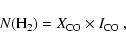
The H2 column density in external galaxies is commonly derived from the
velocity-integrated CO(J=1-0) intensity (
 )
using the
expression
)
using the
expression
 |
(1) |
where
is a conversion factor. The actual value of this factor,
and its applicability in different environments have been widely
discussed, see e.g. Wilson (1995), Arimoto et al. (1996), Combes (2000), Young & Rownd (2001). In this paper we have adopted the value
 (K km s-1)-1 cm-2 (Strong et al. 1988), which is
supported by the analysis done in RLH. In order to convert the
measured intensities into mass surface density we used the expression
(K km s-1)-1 cm-2 (Strong et al. 1988), which is
supported by the analysis done in RLH. In order to convert the
measured intensities into mass surface density we used the expression
 |
(2) |
where i is the inclination of the galaxy, and
 is given in K km s-1 (This expression can be obtained by integrating Eq. (1)). Using this conversion factor to convert the
integrated intensity of the global CO(J=1-0) spectrum
(8.18 K km s-1, Table 4) we find that the average
(over the entire optical disk, and including the bar and the nucleus)
surface mass density is 27.2 pc-2, and that the total
molecular gas mass within the surveyed area is
is given in K km s-1 (This expression can be obtained by integrating Eq. (1)). Using this conversion factor to convert the
integrated intensity of the global CO(J=1-0) spectrum
(8.18 K km s-1, Table 4) we find that the average
(over the entire optical disk, and including the bar and the nucleus)
surface mass density is 27.2 pc-2, and that the total
molecular gas mass within the surveyed area is
 .
.
![\begin{figure}
\par\includegraphics[width=17.8cm,clip]{aah4219f10.eps}
\end{figure}](/articles/aa/full/2004/02/aah4219/Timg59.gif) |
Figure 7:
The CO(J=1-0) velocity-integrated intensity versus galactocentric
distance is shown in the left panel (obtained from the convolved
data set). The dispersion is dominated by the
arm-interarm contrast, and the bar-ends are evident at 2 kpc.
In the right panel the H2 mass surface densities are shown with formal
errors (the data are taken from the spectra in Fig. 3),
together with HI mass surface densities.
Also shown, as a solid line, is the fit of an H2 mass distribution
described in the text. It consists of a Gaussian central part (dashed
line) and an exponential disk (dash-dotted line). |
| Open with DEXTER |
Table 5:
CO(J=1-0) and CO(J=2-1) velocity-integrated intensities of spectra
averaged within inclination-corrected annuli. The annuli are fully
sampled out to 230
.
The CO(J=2-1) data were regridded to the same
spacing as the CO(J=1-0) so that the disk was sampled in the same way for
both transitions. The difference in angular resolution in the data
sets has an effect on the response at the center. The errors (5)
do not include the calibration uncertainty.
We have, using the sliding-window technique described above, calculated
the velocity-integrated intensity, centroid velocity, peak intensity, and
center and width of a Gaussian emission profile fitted to the spectrum
for all spectra in all data cubes. The left panel of Fig. 7 shows
the CO(J=1-0) velocity-integrated intensities (obtained from the convolved
data set) as a function of the (inclination-corrected) distance from the
galaxy center. The scatter is dominated by the arm-interarm contrast.
The data in the right panel of Fig. 7 were obtained from
the integrated intensities of spectra averaged within concentric
annuli (see Fig. 3 and Table 5) by
converting the CO(J=1-0) integrated intensity into mass surface density as
described above. In this procedure we used the raw data set, since we
needed neither the higher spatial resolution of the
MEM-deconvolved spectra nor the lower noise of the convolved spectra.
The error bars reflect the uncertainty in the azimuthally-averaged
radial distribution. To these data we fitted an H2 mass surface density
distribution which is a combination of a Gaussian component and an
exponential function (for the disk),
![\begin{displaymath}
\Sigma({\rm H}_2) = 216\exp\left[-\left(\frac{r}{649 {\rm ~p...
...ft[-\frac{r}{2265 {\rm ~pc}}\right]
\ M_\odot {\rm\ pc^{-2}}.
\end{displaymath}](/articles/aa/full/2004/02/aah4219/img60.gif) |
(3) |
The Gaussian shape of the inner part of the distribution depends
mainly on the convolution of the true distribution with the beam (the
scale length 649 pc in Eq. (3) corresponds to a FWHM of 50
). The right panel of Fig. 7 shows also the mass
surface density of the HI gas. These data were obtained from
Tilanus & Allen (1993) (hereafter TA). The column densities in TA were obtained
with the VLA, and the authors noted that their estimated total HI mass
within the Holmberg radius (
 )
was lower than the
corresponding masses estimated by other authors using single dish
observations, e.g., both Rogstad et al. (1974) and
Huchtmeier & Bohnenstengel (1981) obtained about
)
was lower than the
corresponding masses estimated by other authors using single dish
observations, e.g., both Rogstad et al. (1974) and
Huchtmeier & Bohnenstengel (1981) obtained about
 (all masses recalculated to
the distance 4.5 Mpc). The most probable explanation for the
deficiency was, according to TA, the absence of short-spacing
information. In order to compensate for this we have added the
"missing'' mass surface density (2.4 pc-2) to the HI data of TA. The resulting HI mass surface densities are still low and
typically H2 gas constitute about 70%
of the total mass of neutral hydrogen (H
(all masses recalculated to
the distance 4.5 Mpc). The most probable explanation for the
deficiency was, according to TA, the absence of short-spacing
information. In order to compensate for this we have added the
"missing'' mass surface density (2.4 pc-2) to the HI data of TA. The resulting HI mass surface densities are still low and
typically H2 gas constitute about 70%
of the total mass of neutral hydrogen (H
 )
in the disk inside 6.8 kpc.
)
in the disk inside 6.8 kpc.
Based upon the H2 mass surface density distribution (Eq. (3))
we estimate a total molecular gas mass within a radius of 7.3 kpc
(the extent of the map) of
 ,
and extrapolated to the Holmberg
radius (7
,
and extrapolated to the Holmberg
radius (7
 3 or 9.6 kpc) the mass becomes
(which agrees
well with the result of Crosthwaite et al. (2002),
3 or 9.6 kpc) the mass becomes
(which agrees
well with the result of Crosthwaite et al. (2002),
 (cf. also to the
result
that was derived in Sect. 5.1 using the
velocity-integrated intensity in the global spectrum).
This is more than
twice the total HI mass within the same galactocentric radius. It
should, however, be noted that 80% of the HI mass in M 83 is found
outside the Holmberg radius (Huchtmeier & Bohnenstengel 1981).
As a comparison, the stellar mass of M 83 is
(cf. also to the
result
that was derived in Sect. 5.1 using the
velocity-integrated intensity in the global spectrum).
This is more than
twice the total HI mass within the same galactocentric radius. It
should, however, be noted that 80% of the HI mass in M 83 is found
outside the Holmberg radius (Huchtmeier & Bohnenstengel 1981).
As a comparison, the stellar mass of M 83 is
 ,
given
,
given
 (de Vaucouleurs et al. 1992) and assuming a mass-to-light ratio of 2.
In the Gaussian/exponential disk decomposition the major part of the molecular
gas mass within the Holmberg radius lies in the disk,
 .
Lord (1987) made CO(J=1-0) observations in 21 positions in the central parts
of M 83, and he estimated the total molecular gas mass within 115
to be
.
Lord (1987) made CO(J=1-0) observations in 21 positions in the central parts
of M 83, and he estimated the total molecular gas mass within 115
to be
 (we have compensated for the difference
in
and distance). Our H2 distribution gives
(we have compensated for the difference
in
and distance). Our H2 distribution gives
 .
.
5.2.2 Comparison with data at other wavelengths
In Fig. 8 we compare the CO radial distributions with
corresponding photometry data in the B, K, and H bands. The B and H data come from Talbot et al. (1979), and the K data from
Adamson et al. (1987). The scale lengths of the various tracers compare well
over most of the radial range, but the comparatively low spatial
resolution affects the CO curves in the central region and at the bar
ends. The latter are responsible for the peaks at 120
.
We have fitted a single exponential to the data in the radial range
140
-240
,
which corresponds to the region outside the
bar but inside the area where our CO survey is complete. The scale
lengths are:
 ,
,
 ,
,
 ,
,
 and
and
 for CO(J=1-0), CO(J=2-1), K, B, and H,
respectively (the errors of the latter three do not include
the measurement errors). Thus, the disk scale lengths are, within the
errors, the same for these star formation tracers.
for CO(J=1-0), CO(J=2-1), K, B, and H,
respectively (the errors of the latter three do not include
the measurement errors). Thus, the disk scale lengths are, within the
errors, the same for these star formation tracers.
The CO intensities decrease exponentially over the entire surveyed area,
and we do not observe the sharp cut-off at 4
5 seen by
Crosthwaite et al. (2002). In fact, we find CO emission with
 K km s-1 in selected spectra as far from
the nucleus as 5
5.
K km s-1 in selected spectra as far from
the nucleus as 5
5.
![\begin{figure}
\par\includegraphics[angle=-90,width=8.8cm,clip]{H4219F12.eps}
\end{figure}](/articles/aa/full/2004/02/aah4219/Timg77.gif) |
Figure 8:
Azimuthally-averaged CO(J=1-0) and CO(J=2-1) velocity-integrated
intensity (cf. Table 5) in annular zones compared to surface
brightnesses in the H,
B, and K filters.
Note how the bar ends appear as a bump at 120
in the
distributions. The spatial resolution of the CO(J=2-1) is better than that of the
CO(J=1-0) data, which results in the difference in slopes of the inner parts
of these distributions. The dashed lines show the fits of
exponentials discussed in the text. |
| Open with DEXTER |
We find that in the MEM-deconvolved map the average CO(J=1-0) intensity in the arms is about 2.5 times higher than in the interarm
regions. Assuming a direct proportionality between CO emission and mass
surface density, this agrees well with the lower limit
of the arm-interarm mass surface density ratio, 2.3, found by RLH
using purely kinematical arguments.
In Fig. 9 we show the MEM-deconvolved CO(J=1-0) velocity-integrated intensity map superposed on a true-color image.
This image is a composite of three images in the filters B, V, and R,
rendered as blue, green, and red, respectively. These images have
been obtained at the ESO Danish 1.54 m telescope by Sören Larsen and the data
are described in Larsen & Richtler (1999). On the large scale the CO(J=1-0) emission
follows the dust lanes, both in and between spiral arms, but at some
locations the CO(J=1-0) emission is displaced toward the regions where star
formation takes place (Wiklind et al. 1990).
Most notably, in the inner spiral arm on the
eastern side, the CO(J=1-0) ridge is located downstream of the dust lane
with a separation of about 10-15
(also shown in RLH), as are
the HI and H emissions as shown by TA. We note that in general
the OB associations straddle the rims of the CO(J=1-0) emission
concentrations, presumably due to extinction in combination with the
photodissociation by the young stellar population. The outer and
inner spiral arms appear to connect at several locations, and these
connection regions often show an increased number of OB associations.
The "Gould belt structure'', at (1
75,
emissions as shown by TA. We note that in general
the OB associations straddle the rims of the CO(J=1-0) emission
concentrations, presumably due to extinction in combination with the
photodissociation by the young stellar population. The outer and
inner spiral arms appear to connect at several locations, and these
connection regions often show an increased number of OB associations.
The "Gould belt structure'', at (1
75,
 25) in the coordinate
system of Fig. 9, is such a region (Comerón 2001).
25) in the coordinate
system of Fig. 9, is such a region (Comerón 2001).
![\begin{figure}
\par\includegraphics[width=18cm,clip]{H4219F13.eps}
\end{figure}](/articles/aa/full/2004/02/aah4219/Timg80.gif) |
Figure 9:
The MEM-deconvolved velocity-integrated CO(J=1-0) intensity
as contours superposed on an RGB-map produced from images in B, V, and R. The optical images were obtained by Sören Larsen at the ESO Danish 1.5 m telescope on La Silla, Chile. Three stars have been
used for image alignment. These are located in the lower left corner
and in both upper corners and are marked with crosses. The inset
shows the CO(J=1-0) map in gray-scale. |
| Open with DEXTER |
Figure 10 shows the CO(J=2-1) velocity-integrated intensity as
contours on an RGB image, where the colors represent star formation
(H;
red), infrared emission (I band; green), and dust lanes
(filters V-I; blue). In the disk, the observed CO(J=2-1) brightness
distribution strengthens the conclusions drawn from the CO(J=1-0) emission.
In the central region the higher angular resolution at the CO(J=2-1) frequency reveals additional details. There are two central nuclear
components relatively symmetrically placed on opposite sides of the IR center. At these locations the dust lanes, on the leading edges of
the bar, attach to the nuclear ring seen in J-K by Elmegreen et al. (1998).
Their color difference map (V-I) shows an area of high dust
extinction at the location of the NE component, whereas at the SW component there appears to be relatively small amounts of dust. It
appears as if the NE CO component lies above the disk (or the bulge) and
the SW CO component lies below or behind the same. This was also
concluded by Sofue & Wakamatsu (1994) based on similar data. Along
the bar, the CO(J=2-1) emission follows the dust lanes on the leading
edges. In the disk the CO emission traces the H emission
very well, although there are regions with a clear anti-correlation,
i.e., substantial CO emission but none, or very weak, H emission,
such as the peak at about half an arcminute west of the nucleus.
![\begin{figure}
\par\includegraphics[width=16cm,clip]{H4219F14.eps}
\end{figure}](/articles/aa/full/2004/02/aah4219/Timg81.gif) |
Figure 10:
The MEM-deconvolved CO(J=2-1) velocity-integrated intensity as
contours on an RGB image where the colors red, green and blue
represent star formation (H), infrared emission (I band), and
dust lanes (filters V-I), respectively. The inset shows the CO(J=2-1) map in gray-scale. |
| Open with DEXTER |
Figure 11 shows the CO(J=1-0) velocity-integrated intensity on a
gray-scale image of the HI column density (data kindly provided by
R. P. J. Tilanus and R. J. Allen). The angular
resolution of the HI map is slightly better than that of the CO map.
The CO emission (which is assumed to be linearly proportional to the H2 mass surface density intensity) and the HI column density follow each other
closely,
with one outstanding exception: the
nucleus, where very little HI is present. At some places in the disk
the H2 and HI maxima are displaced from each other, but there is no
apparent systematic trend that H2 is outside HI or vice versa.
In general, the separations are of the order of 3-9
,
which is small
compared to the resolution in these maps (23
).
Local minima in the HI and H2 gas surface densities also correlate
well. At (50
,
180
)
in the coordinate system of
Fig. 11, marked minima can be seen in both H2 and HI.
The total gas surface density in this area is about
3-6 pc-2, of which only
1 pc-2 is in the form of molecular gas.
Such low mass surface densities should not give rise to any massive
star formation, and indeed, the H image shows very little
emission here.
![\begin{figure}
\par\includegraphics[width=18cm,clip]{H4219F15.eps}
\end{figure}](/articles/aa/full/2004/02/aah4219/Timg82.gif) |
Figure 11:
The MEM-deconvolved velocity-integrated CO(J=1-0) intensity
as contours on an HI column density map (gray-scale) of roughly
similar resolution (20
). The HI data comes from TA.
The inset shows the CO(J=1-0) map in gray-scale. |
| Open with DEXTER |
Figure 12 compares the H2 (as probed by the CO(J=2-1) emission) and the HI gas in more detail, the resolution being 10
.
In the main disk the CO(J=2-1) emission and HI emission follow each other closely and several of the concentrations
in the CO(J=2-1) emission are also seen in the HI distribution. Again the
exception is the nuclear region. The mass surface density of HI at
the two nuclear components differ markedly: the SW component has a
peak mass surface density of 6 pc-2, while at the
center of the NE component HI is actually seen in absorption
against a nuclear
continuum source, which again speaks in favor of the idea that the SW
and NE components lie on different sides of the disk (or a bulge).
The mass surface density of HI at the center is very much lower
than that of H2, where the highest value in the I1-0 map
corresponds to 750 pc-2. In the I1-0 map it is not possible to distinguish the separate nuclei due to the
relatively low spatial resolution and the coarse grid. However, using
the average 2-1/1-0 line ratio (see Sect. 5.4), the mass surface density is 1100 pc-2 for each of these components.
As the physical properties of the molecular gas in the center may
differ from that in the disk, application of the standard conversion
factor may lead to an erroneous result.
Indeed, it is likely that at least part of
the emission in the center comes from a diffuse and
non-virialized component. This would lead to an
overestimate of the molecular gas mass (Papadopoulos & Allen 2000).
The explanation for the nice correlation may be that the HI
is mostly a dissociation product, as TA discuss. A smooth distribution of
"primordial'' HI gas would not be detected in the interferometer
observations (in which roughly 50% of the HI gas was detected) while
HI produced as an effect of dissociation of molecular gas in the
neighborhood of star formation would be localized, and therefore
detected by the interferometer.
![\begin{figure}
\par\includegraphics[width=17cm,clip]{H4219F16.eps}
\end{figure}](/articles/aa/full/2004/02/aah4219/Timg83.gif) |
Figure 12:
The MEM-deconvolved velocity-integrated CO(J=2-1) intensity
as contours on an HI column density map (gray-scale) of roughly
similar resolution (12
). The HI data comes from TA.
The inset shows the CO(J=2-1) map in gray-scale. |
| Open with DEXTER |
5.4 The CO (J=2-1)/(J=1-0) line intensity ratio
We have created a map of the CO(J=2-1)/(J=1-0) line intensity
ratio, R21, at 49
resolution. The mean value over this
map is
 ,
which is within the errors the value derived
from the velocity-integrated intensities in Table 4.
Crosthwaite et al. (2002) estimate a ratio of
,
which is within the errors the value derived
from the velocity-integrated intensities in Table 4.
Crosthwaite et al. (2002) estimate a ratio of  ,
which we suspect is
higher than ours because they have not corrected their CO(J=2-1) data for the
error beam contribution (considering the main beam efficiency of the
NRAO 12 m telescope at this frequency, 0.56, the error beam is likely
to be comparable to that of the SEST). In the nuclear region and along the
bar the ratio is
,
which we suspect is
higher than ours because they have not corrected their CO(J=2-1) data for the
error beam contribution (considering the main beam efficiency of the
NRAO 12 m telescope at this frequency, 0.56, the error beam is likely
to be comparable to that of the SEST). In the nuclear region and along the
bar the ratio is
 .
The R21 map shows also that on the arms,
the line intensity ratio is lower than in the interarm regions. This is
illustrated in Fig. 13, where R21 is plotted as a function
of radius in a
.
The R21 map shows also that on the arms,
the line intensity ratio is lower than in the interarm regions. This is
illustrated in Fig. 13, where R21 is plotted as a function
of radius in a
 wide sector of the galaxy (position angle
90-135). In order to quantify and compare the ratio on the arms
to that in the interarm regions, we have selected two sectors where the
arms are well separated. The position angle of these sectors are:
90-135 (SE) and 270-315 (NW).
In these sectors we selected spectra belonging to the inner, outer and
inter-arm regions, and averaged them separately. Finally,
"arm''-spectra were created by taking the average of the inner and outer arm
spectra in the two respective sectors. From these eight spectra, four
ratios were calculated.
Assuming our error beam is correct (Sect. A),
the line ratio is significantly lower on
the arms:
wide sector of the galaxy (position angle
90-135). In order to quantify and compare the ratio on the arms
to that in the interarm regions, we have selected two sectors where the
arms are well separated. The position angle of these sectors are:
90-135 (SE) and 270-315 (NW).
In these sectors we selected spectra belonging to the inner, outer and
inter-arm regions, and averaged them separately. Finally,
"arm''-spectra were created by taking the average of the inner and outer arm
spectra in the two respective sectors. From these eight spectra, four
ratios were calculated.
Assuming our error beam is correct (Sect. A),
the line ratio is significantly lower on
the arms:
 (SE) and
 (NW) compared to the
ratio in the interarm region
(NW) compared to the
ratio in the interarm region
 (SE) and
 (NW)
(the errors are 3
and are estimated from the noise level in the spectra).
We believe that this is an effect of a (partly) different cloud component in
the interarm regions, where the heating of the gas is more efficient
than in the dense arm cloud complexes.
As a note: We have also calculated the
R21 value for the MEM-deconvolved CO(J=1-0) and CO(J=2-1) maps at
the common resolution 30
.
The arm value is roughly the same (
(NW)
(the errors are 3
and are estimated from the noise level in the spectra).
We believe that this is an effect of a (partly) different cloud component in
the interarm regions, where the heating of the gas is more efficient
than in the dense arm cloud complexes.
As a note: We have also calculated the
R21 value for the MEM-deconvolved CO(J=1-0) and CO(J=2-1) maps at
the common resolution 30
.
The arm value is roughly the same ( ), but the interarm value is higher,
 .
.
![\begin{figure}
\par\includegraphics[width=8.8cm,clip]{aah4219f17.eps}
\par\end{figure}](/articles/aa/full/2004/02/aah4219/Timg93.gif) |
Figure 13:
The CO (J=2-1)/(J=1-0) line intensity ratio, R21, as
a function of galactocentric radius. The interarm region shows a
clear trend of increased line ratio. The data are taken from a
wide sector SE of the nucleus (position angle 90-135). |
| Open with DEXTER |
By averaging R21 in concentric annuli, we find a trend in the line
intensity ratio in the sense that it decreases with galactocentric
distance, Fig. 14 (this is also indicated in
Fig. 8).
In particular, the lower envelope of the R21-values is clearly decreasing.
A similar difference between the R21 line ratio in the disk and towards
the nucleus has previously been shown to exist in our Galaxy (Sawada et al. 2001).
The wiggles in Fig. 14 can be
associated with features in the R21 map. The nucleus appears to be
surrounded by a ring of excited gas, which is reflected as a bump in
the radial distribution. The bar ends and inner arms are reflected as a
flat region at 120-150
,
while the low
R21-values in the outer arms suppresses the average
R21-ratio in the range 200-300
.
![\begin{figure}
\par\includegraphics[width=8.8cm,clip]{aah4219f18.eps}
\end{figure}](/articles/aa/full/2004/02/aah4219/Timg94.gif) |
Figure 14:
The CO (J=2-1)/(J=1-0) line intensity ratio for individual
positions (dots) and the azimuthally averaged ratio (with error bars)
in annular zones in the plane of the galaxy. |
| Open with DEXTER |
We have mapped, in over-sampling mode, the CO(J=1-0) and CO(J=2-1) brightness
distributions over the entire optical disk of M 83. Significant corrections
for an error beam have been applied to the CO(J=2-1) data.
A MEM-method has been used to increase the angular
resolution of the data.
We find that:
i) the CO emission is strongly peaked toward the nucleus, which splits
up into two components in the CO(J=2-1) data. Also the bar ends are
prominent. The CO emission follows the leading edges of the bar.
ii) Molecular gas spiral arms are clearly identified, and they trace,
in most cases, the dust lanes. There are frequent "bridges'' between
spiral arms, and in some areas the arms are clearly disturbed.
iii) An average arm-interarm brightness contrast of about 2.5 is found
for the CO(J=1-0) line.
iv) The CO (J=2-1)/(J=1-0) line ratio, which is
about 0.77 on average, differ between the arm and interarm regions.
It is significantly higher in the latter.
v) Regularly spaced molecular gas concentrations of mass 107
lie along the arms.
vi) The estimated total molecular gas mass is
,
and within 7.3 kpc the H2 mass
dominates over that of HI by a factor of more than two. The estimated
gas/stellar mass ratio is 0.1 in the optical disk.
vii) The CO and HI emissions are very well correlated in the
optical disk, and frequently concentrations of the two gas components coincide.
viii) The CO radial brightness distribution in the disk follows
that of other starformation tracers as H emission, and
continuum light in the B and K filters. The estimated scale length,
of a fitted exponential, is about 120
,
corresponding to 2.6 kpc at the adopted distance.
Acknowledgements
We are very grateful toward the SEST staff for their support
during observations and Swedish Natural Science Research Council
for travel expenses support.
We also wish to thank Remo Tilanus and Ron Allen
for letting us use their HI data and Sören Larsen for the use of the
optical images and the referee for valuable input.
The beam pattern of a radio telescope is affected by
its surface accuracy. This means that the power received in the
error beam may very well be comparable to the power received in the
main beam. For sources that are compact relative to the extent of the
beam, it is relatively easy to compensate for this underestimate
of the true flux: The measured antenna temperature (
)
is
simply divided by the main beam efficiency,
,
to attain the
main beam brightness temperature (
). The main beam efficiency
is usually well known and can be found in the user manual of the different
telescopes. For extended sources, the situation is more complex, since
the antenna may receive power not only from the main beam. If the size of
the error beam is comparable to the extent of the source, a
simple multiplication of
 will overestimate the
flux at the position where the measurement is done. If the antenna pattern
is well known, it is possible to calculate how the beam couples to the
source and thus compensate for this effect. Unfortunately, the antenna
pattern for SEST has never been measured properly, so this was not an
option for us. Instead we devised a procedure to remove the impact of
the error beam, using our own data set to estimate the strength and size
of the error beam pattern.
will overestimate the
flux at the position where the measurement is done. If the antenna pattern
is well known, it is possible to calculate how the beam couples to the
source and thus compensate for this effect. Unfortunately, the antenna
pattern for SEST has never been measured properly, so this was not an
option for us. Instead we devised a procedure to remove the impact of
the error beam, using our own data set to estimate the strength and size
of the error beam pattern.
Nearly all CO(J=2-1) spectra did show two components: one narrow line, that agrees
with the width and center velocity of the CO(J=1-0) spectra at the same position
and another, broader, component that is picked up by the error beam.
By studying these broad wings in a number of spectra in the deconvolved
CO(J=2-1) data set and by comparing with spectra
in data cubes convolved with different FWHPs, we estimated that the size
of the error beam at 230 GHz is of the order of 200
.
This is
in good agreement with the error beam size of 3,
which was assumed by
Johansson et al. (1998).
![\begin{figure}
\par\includegraphics[angle=-90,width=8.8cm,clip]{H4219F19.eps}
\end{figure}](/articles/aa/full/2004/02/aah4219/Timg96.gif) |
Figure A.1:
These spectra show the original spectra (solid lines),
200
convolved spectra (short-dashed lines) and
subtracted spectra (long-dashed lines) in four typical positions.
The coordinates with respect to the map center is, from upper
left to lower right, (-42, -70), (-42, 0), (-42, 70) and (-42, 140).
The 200
convolved spectra are scaled with the derived error
beam efficiency. |
In order to try to estimate the impact of the error beam we produced a data
set where we convolved the MEM-deconvolved data set with a
200
Gaussian profile. In each position an automated process, using the
sliding window technique, calculated the velocity-integrated intensity in
the region of the extended wings (i.e. outside the velocity range
where we have seen emission in the CO(J=1-0) data) in both the deconvolved
cube and in the 200
convolved cube. The ratio between these
intensities corresponds to the fraction of the available emission which is
picked up by the error beam. We will refer to this as the error beam
efficiency.
In principle, the error beam
efficiency must lie in the interval 0.1-0.5, since the main beam
efficiency is 0.5 and the moon beam efficiency is 0.9. Some values of our
error beam efficiency estimates are higher than 0.5. This
happens in regions where the emission in the main beam falls outside
the expected velocity range (e.g., in regions with exceptionally
strong streaming motions or wide emission profiles), leading to an
over-estimation of the flux in the wings. An attempt to make the
window wider had a negative impact on the results since we were left
with fewer channels to calculate the velocity-integrated emission in
the wings. Neglecting values above 0.5, we found that the error beam
efficiency was on average
 .
.
Figure A.1 shows the original spectrum, the 200
convolved
spectrum (scaled with the error beam efficiency), and the resulting (cleaned)
spectrum after subtraction of the two previous spectra, in four
typical positions. The convolved spectra reproduces the shape of the wings
very well, and the shape of the cleaned spectra resembles the
corresponding CO(J=1-0) spectra (not shown).
We have corrected the convolved and the MEM-deconvolved data sets
for this error by subtracting the error beam contribution for each
individual spectrum. Based on the previous result, we took a
conservative approach and fixed the error beam contribution to 0.27.
In principle, we could have let this ratio vary from spectrum to
spectrum by fitting the 200
-convolved spectrum to the extended
wings, but this would have introduced other, not easily controlled,
errors.
-
Aalto, S., Hüttemeister, S., Scoville, N. Z., & Thaddeus, P.
1999, ApJ, 522, 165
In the text
NASA ADS
-
Adamson, A. J., Adams, D. J., & Warwick, R. S. 1987, MNRAS, 224, 367
In the text
NASA ADS
-
Arimoto, N., Sofue, Y., & Tsujimoto, T. 1996, PASJ, 48, 275
In the text
NASA ADS
-
Booth, R. S., Delgado, G., Hagstrom, M., et al. 1989, A&A, 216, 315
In the text
NASA ADS
-
Calzetti, D., Conselice, C. J., Gallagher, J. S., & Kinney, A. L.
1999, AJ, 118, 797
In the text
NASA ADS
-
Casoli, F., Sauty, S., Gerin, M., et al. 1998, A&A, 331, 451
In the text
NASA ADS
-
Combes, F. 1991, ARA&A, 29, 195
In the text
NASA ADS
-
Combes, F. 2000, in Euroconference, The Evolution of Galaxies, I- Observational Clues, ed. J. Vilchez, G. Stasinska, & E. Perez, 7318
In the text
-
Combes, F., Encrenaz, P. J., Lucas, R., & Weliachew, L. 1978, A&A,
67, L13
NASA ADS
-
Comerón, F. 2001, A&A, 365, 417
In the text
NASA ADS
-
Comte, G. 1981, A&AS, 44, 441
In the text
NASA ADS
-
Crosthwaite, L. P., Turner, J. L., Buchholz, L., Ho, P. T. P., &
Martin, R. N. 2002, AJ, 123, 1892
In the text
NASA ADS
-
Crosthwaite, L. P., Turner, J. L., Hurt, R. L., et al. 2001, AJ, 122,
797
In the text
NASA ADS
-
de Vaucouleurs, G. 1979, AJ, 84, 1270
In the text
NASA ADS
-
de Vaucouleurs, G., de Vaucouleurs, A., & Corwin, H. G. 1976, Second
Reference Catalogue of Bright Galaxies (RC2) (University of Texas Press)
In the text
-
de Vaucouleurs, G., de Vaucouleurs, A., Corwin, H. G., et al. 1992,
VizieR Online Data Catalog, 7137
In the text
-
de Vaucouleurs, G., Pence, W. D., & Davoust, E. 1983, ApJS, 53, 17
In the text
NASA ADS
-
Elmegreen, D. M., Chromey, F. R., & Warren, A. R. 1998, AJ, 116, 2834
In the text
NASA ADS
-
Fitt, A. J., Howarth, N. A., Alexander, P., & Lasenby, A. N. 1992,
MNRAS, 255, 146
In the text
NASA ADS
-
Garcia-Burillo, S., Guelin, M., & Cernicharo, J. 1993, A&A, 274, 123
In the text
NASA ADS
-
Gibson, B. K., Stetson, P. B., Freedman, W. L., et al. 2000, ApJ, 529,
723
In the text
NASA ADS
-
Handa, T., Ishizuki, S., & Kawabe, R. 1994, in IAU
Colloq. 140, Astronomy with Millimeter and Submillimeter Wave Interferometry, ASP Conf. Ser., 59,
341
-
Handa, T., Nakai, N., Sofue, Y., Hayashi, M., & Fujimoto, M. 1990,
PASJ, 42, 1
NASA ADS
-
Helfer, T. T., Thornley, M. D., Regan, M. W., et al. 2003, ApJS, 145,
259
In the text
NASA ADS
-
Houghton, S., Whiteoak, J. B., Koribalski, B., et al. 1997, A&A, 325,
923
In the text
NASA ADS
-
Huchtmeier, W. K., & Bohnenstengel, H. 1981, A&A, 100, 72
In the text
NASA ADS
-
Immler, S., Vogler, A., Ehle, M., & Pietsch, W. 1999, A&A, 352, 415
In the text
NASA ADS
-
Israel, F. P., & Baas, F. 2001, A&A, 371, 433
NASA ADS
-
Jensen, E. B., Talbot, R. J., & Dufour, R. J. 1981, ApJ, 243, 716
In the text
NASA ADS
-
Johansson, L. E. B., Greve, A., Booth, R. S., et al. 1998, A&A, 331,
857
In the text
NASA ADS
-
Kenney, J. D. P., & Lord, S. D. 1991, ApJ, 381, 118
NASA ADS
-
Kenney, J. D. P., Scoville, N. Z., & Wilson, C. D. 1991, ApJ, 366, 432
In the text
NASA ADS
-
Kennicutt, R. C. 1989, ApJ, 344, 685
In the text
NASA ADS
-
Knapp, G. R. 1987, PASP, 99, 1134
In the text
NASA ADS
-
Kobulnicky, H. A., & Skillman, E. D. 1995, ApJ, 454, L121
In the text
NASA ADS
-
Kuno, N., Nishiyama, K., Nakai, N., et al. 2000, PASJ, 52, 775
In the text
NASA ADS
-
Larsen, S. S., & Richtler, T. 1999, A&A, 345, 59
In the text
NASA ADS
-
Loinard, L., Dame, T. M., Heyer, M. H., Lequeux, J., & Thaddeus, P.
1999, A&A, 351, 1087
In the text
NASA ADS
-
Lord, S. D. 1987, Ph.D. Thesis, Massachusetts Univ., Amherst
In the text
-
Lord, S. D., & Kenney, J. D. P. 1991, ApJ, 381, 130
NASA ADS
-
Nakai, N., Kuno, N., Handa, T., & Sofue, Y. 1994, PASJ, 46, 527
In the text
NASA ADS
-
Neininger, N., Beck, R., Sukumar, S., & Allen, R. J. 1993, A&A, 274,
687
In the text
NASA ADS
-
Nieten, C., Neininger, N., Guélin, M., et al. 2000, in The
interstellar medium in M 31 and M 33, Proc. 232, WE-Heraeus Seminar, 21
In the text
-
Nishiyama, K., Nakai, N., & Kuno, N. 2001, PASJ, 53, 757
In the text
NASA ADS
-
Ondrechen, M. P. 1985, AJ, 90, 1474
In the text
NASA ADS
-
Papadopoulos, P. P., & Allen, M. L. 2000, ApJ, 537, 631
In the text
NASA ADS
-
Parodi, B. R., Saha, A., Sandage, A., & Tammann, G. A. 2000, ApJ,
540, 634
In the text
NASA ADS
-
Petitpas, G. R., & Wilson, C. D. 1998, ApJ, 503, 219
In the text
NASA ADS
-
Rand, R. J., Lord, S. D., & Higdon, J. L. 1999, ApJ, 513, 720
In the text
NASA ADS
-
Regan, M. W., Thornley, M. D., Helfer, T. T., et al. 2001, ApJ, 561,
218
In the text
NASA ADS
-
Rogstad, D. H., Lockart, I. A., & Wright, M. C. H. 1974, ApJ, 193, 309
In the text
NASA ADS
-
Rydbeck, G. 2000, in Imaging at Radio through
Submillimeter Wavelengths, ASP Conf. Ser., 217, 224
In the text
-
Saha, A., Sandage, A., Labhardt, L., et al. 1995, ApJ, 438, 8
In the text
NASA ADS
-
Sandage, A., & Tammann, G. A. 1974, ApJ, 194, 559
In the text
NASA ADS
-
Sawada, T., Hasegawa, T., Handa, T., et al. 2001, ApJS, 136, 189
In the text
NASA ADS
-
Sofue, Y., & Wakamatsu, K. 1994, AJ, 107, 1018
In the text
NASA ADS
-
Soria, R., & Wu, K. 2002, A&A, 384, 99
In the text
NASA ADS
-
Strong, A. W., Bloemen, J. B. G. M., Dame, T. M., et al. 1988, A&A,
207, 1
In the text
NASA ADS
-
Tacconi, L. J., & Young, J. S. 1989, ApJS, 71, 455
In the text
NASA ADS
-
Talbot, R. J., Jensen, E. B., & Dufour, R. J. 1979, ApJ, 229, 91
In the text
NASA ADS
-
Thim, F., Tammann, G. A., Saha, A., et al. 2003, ApJ, 590, 256
In the text
NASA ADS
-
Tilanus, R. P. J., & Allen, R. J. 1993, A&A, 274, 707
In the text
NASA ADS
-
Wall, W. F. 1991, Ph.D. Thesis, Texas Univ., Austin
-
Wiklind, T., Rydbeck, G., Hjalmarson, A., & Bergman, P. 1990, A&A,
232, L11
In the text
NASA ADS
-
Wilson, C. D. 1995, ApJ, 448, L97
In the text
NASA ADS
-
Young, J. S. 1999, ApJ, 514, L87
In the text
NASA ADS
-
Young, J. S., & Rownd, B. K. 2001, in Galaxy Disks and
Disk Galaxies, ASP Conf. Ser., 230, 391
In the text
-
Young, J. S., & Scoville, N. Z. 1991, ARA&A, 29, 581
In the text
NASA ADS
-
Young, J. S., Xie, S., Tacconi, L., et al. 1995, ApJS, 98, 219
In the text
NASA ADS
Copyright ESO 2003
![\begin{figure}
\par\includegraphics[angle=-90,width=8.8cm,clip]{H4219F01.eps}\includegraphics[angle=-90,width=8.8cm,clip]{H4219F02.eps}
\end{figure}](/articles/aa/full/2004/02/aah4219/img42.gif)
![\begin{figure}
\par\includegraphics[angle=-90,width=8.8cm,clip]{H4219F03.eps}\includegraphics[angle=-90,width=8.8cm,clip]{H4219F04.eps}
\end{figure}](/articles/aa/full/2004/02/aah4219/img43.gif)
![\begin{figure}
\par\includegraphics[angle=-90,width=17cm,clip]{H4219F05.eps}
\end{figure}](/articles/aa/full/2004/02/aah4219/img45.gif)
![\begin{figure}
\par\includegraphics[angle=-90,width=18cm,clip]{H4219F06.eps}
\end{figure}](/articles/aa/full/2004/02/aah4219/img49.gif)
![\begin{figure}
\par\mbox{\includegraphics[width=8.8cm,clip]{H4219F07.eps} \includegraphics[width=8.8cm,clip]{H4219F08.eps} }
\end{figure}](/articles/aa/full/2004/02/aah4219/img51.gif)
![\begin{figure}
\par\includegraphics[angle=-90,width=18cm,clip]{H4219F09.eps}
\par\end{figure}](/articles/aa/full/2004/02/aah4219/img52.gif)
![\begin{figure}
\par\includegraphics[width=17.8cm,clip]{aah4219f10.eps}
\end{figure}](/articles/aa/full/2004/02/aah4219/img59.gif)
![\begin{figure}
\par\includegraphics[angle=-90,width=8.8cm,clip]{H4219F12.eps}
\end{figure}](/articles/aa/full/2004/02/aah4219/img77.gif)
![\begin{figure}
\par\includegraphics[width=18cm,clip]{H4219F13.eps}
\end{figure}](/articles/aa/full/2004/02/aah4219/img80.gif)
![\begin{figure}
\par\includegraphics[width=16cm,clip]{H4219F14.eps}
\end{figure}](/articles/aa/full/2004/02/aah4219/img81.gif)
![\begin{figure}
\par\includegraphics[width=18cm,clip]{H4219F15.eps}
\end{figure}](/articles/aa/full/2004/02/aah4219/img82.gif)
![\begin{figure}
\par\includegraphics[width=17cm,clip]{H4219F16.eps}
\end{figure}](/articles/aa/full/2004/02/aah4219/img83.gif)
![\begin{figure}
\par\includegraphics[width=8.8cm,clip]{aah4219f17.eps}
\par\end{figure}](/articles/aa/full/2004/02/aah4219/img93.gif)
![\begin{figure}
\par\includegraphics[width=8.8cm,clip]{aah4219f18.eps}
\end{figure}](/articles/aa/full/2004/02/aah4219/img94.gif)
![\begin{figure}
\par\includegraphics[angle=-90,width=8.8cm,clip]{H4219F19.eps}
\end{figure}](/articles/aa/full/2004/02/aah4219/img96.gif)