 -ray and radio observations:
Are radio mini-halos of hadronic origin?
-ray and radio observations:
Are radio mini-halos of hadronic origin?
A&A 413, 17-36 (2004)
DOI: 10.1051/0004-6361:20031464
-ray and radio observations:
Are radio mini-halos of hadronic origin?C. Pfrommer - T. A. Enßlin
Max-Planck-Institut für Astrophysik, Karl-Schwarzschild-Str. 1, Postfach 1317, 85741 Garching, Germany
Received 18 April 2003 / Accepted 12 September 2003
Abstract
We wish to constrain the cosmic-ray proton (CRp) population in
galaxy clusters. By hadronic interactions with the thermal gas of the
intra-cluster medium (ICM), the CRp produce -rays for which we
develop an analytic formalism to deduce their spectral distribution.
Assuming the CRp-to-thermal energy density ratio
 and the CRp
spectral index to be spatially constant, we derive an analytic relation
between the -ray and bolometric X-ray fluxes,
and the CRp
spectral index to be spatially constant, we derive an analytic relation
between the -ray and bolometric X-ray fluxes,
 and
and  .
Based on our relation, we compile a sample of suitable
clusters which are promising candidates for future detection of -rays
resulting from hadronic CRp interactions. Comparing to EGRET upper limits, we
constrain the CRp population in the cooling flow clusters Perseus and Virgo
to
.
Based on our relation, we compile a sample of suitable
clusters which are promising candidates for future detection of -rays
resulting from hadronic CRp interactions. Comparing to EGRET upper limits, we
constrain the CRp population in the cooling flow clusters Perseus and Virgo
to
 .
Assuming a plausible value for the CRp diffusion
coefficient
.
Assuming a plausible value for the CRp diffusion
coefficient  ,
we find the central CRp injection luminosity of M 87 to
be limited to
,
we find the central CRp injection luminosity of M 87 to
be limited to
 .
The synchrotron emission from secondary electrons
generated in CRp hadronic interactions allows even tighter limits to be
placed on the CRp population using radio observations. We obtain excellent
agreement between the observed and theoretical radio brightness profiles for
Perseus, but not for Coma without a radially increasing CRp-to-thermal energy
density profile. Since the CRp and magnetic energy densities necessary to
reproduce the observed radio flux are very plausible, we propose synchrotron
emission from secondary electrons as an attractive explanation of the radio
mini-halos found in cooling flow clusters. This model can be tested with
future sensitive -ray observations of the accompanying
.
The synchrotron emission from secondary electrons
generated in CRp hadronic interactions allows even tighter limits to be
placed on the CRp population using radio observations. We obtain excellent
agreement between the observed and theoretical radio brightness profiles for
Perseus, but not for Coma without a radially increasing CRp-to-thermal energy
density profile. Since the CRp and magnetic energy densities necessary to
reproduce the observed radio flux are very plausible, we propose synchrotron
emission from secondary electrons as an attractive explanation of the radio
mini-halos found in cooling flow clusters. This model can be tested with
future sensitive -ray observations of the accompanying
 -decays. We identify Perseus (A 426), Virgo, Ophiuchus, and Coma
(A 1656) as the most promising candidate clusters for such observations.
-decays. We identify Perseus (A 426), Virgo, Ophiuchus, and Coma
(A 1656) as the most promising candidate clusters for such observations.
Key words: galaxies: cooling flows - galaxies: cluster: general - galaxies: cluster: individual: Perseus (A426) - galaxies: intergalactic medium - ISM: cosmic rays - radiation mechanisms: non-thermal
Cooling flows are regions where the influence of non-thermal intra-cluster medium (ICM) components such as magnetic fields and cosmic rays may be strongest within a galaxy cluster owing to strong observed magnetic fields, central active galaxies, and increasing non-thermal-to-thermal energy ratio due to rapid thermal cooling processes. They are also regions where such components are best detectable due to the high gas density which allows for secondary particle production in hadronic interactions of cosmic ray nuclei with the ambient gas. By the term cooling flow we do not rely on specific models but only on observed properties such as declining temperature gradients and enhanced electron density profiles towards the center of the cluster.
Non-thermal relativistic particle populations such as cosmic ray electrons (CRe) and protons (CRp) can be injected into the ICM mainly by three different processes (following Brunetti 2002) which produce radio signatures that differ morphologically as well as spectrally:
 )
being injected over
cosmological timescales into the ICM by sources like radio galaxies,
supernova remnants, merger shocks, and galactic winds can provide an
efficient supply of highly-energetic CRe. Owing to their long lifetimes of a
few times 109 years these mildly relativistic CRe can accumulate within
the ICM (see Sarazin 2002, and references therein), until they
experience continuous in-situ acceleration either via shock acceleration or
resonant pitch angle scattering by turbulent Alvén waves as originally
proposed by Jaffe (1977), reconsidered by
Schlickeiser et al. (1987), and lately by Ohno et al. (2002).
These acceleration processes of CRe possibly yield extended radio halos
centered on the cluster (Brunetti et al. 2001) while there are also
suggestions that radio mini-halos within a cooling flow cluster originate
from these processes (Gitti et al. 2002). There is also evidence
that reacceleration processes acting on fossil radio plasma produces small
filamentary radio relics at the cluster periphery, so-called revived radio
ghosts (Enßlin & Gopal-Krishna 2001; Enßlin & Brüggen 2002) presumably by
adiabatic compression in shock waves.
-rays in inelastic collisions taking place throughout
the cluster volume which would generate radio halos through synchrotron
emission (first pointed out by Vestrand 1982; Dennison 1980). In the ICM the CRp have lifetimes of the order of
the Hubble time (Enßlin et al. 1997; Völk et al. 1996; Berezinsky et al. 1997), long enough to diffuse away from the production site
and to maintain a distribution over the cluster volume. This process was
reconsidered in more detail by Blasi & Colafrancesco (1999) and by
Dolag & Enßlin (2000), the latter authors using numerical
hydro-dynamical simulations including magnetic fields. Recently,
Miniati et al. (2001b) have performed cosmological simulations of
cluster formation including injection processes of primary CRp. These
authors conclude that under certain conditions extended diffuse radio
emission could be due to hadronically produced CRe. However, there are also
claims that extended radio halos cannot be generated by secondary electrons
due to the morphological steepness of predicted radio brightness profiles in
contrast to observations (Brunetti 2002). Besides constraining
the population of CRp in the ICM, this work will present arguments for the
hadronic origin of radio mini-halos or a substantial contribution of
secondary electrons to these mini-halos. We further perform a parameter study
which shows that the large cluster radio halos could be also of hadronic
origin, provided the CRp-to-thermal energy density profile is radially
increasing.
)
being injected over
cosmological timescales into the ICM by sources like radio galaxies,
supernova remnants, merger shocks, and galactic winds can provide an
efficient supply of highly-energetic CRe. Owing to their long lifetimes of a
few times 109 years these mildly relativistic CRe can accumulate within
the ICM (see Sarazin 2002, and references therein), until they
experience continuous in-situ acceleration either via shock acceleration or
resonant pitch angle scattering by turbulent Alvén waves as originally
proposed by Jaffe (1977), reconsidered by
Schlickeiser et al. (1987), and lately by Ohno et al. (2002).
These acceleration processes of CRe possibly yield extended radio halos
centered on the cluster (Brunetti et al. 2001) while there are also
suggestions that radio mini-halos within a cooling flow cluster originate
from these processes (Gitti et al. 2002). There is also evidence
that reacceleration processes acting on fossil radio plasma produces small
filamentary radio relics at the cluster periphery, so-called revived radio
ghosts (Enßlin & Gopal-Krishna 2001; Enßlin & Brüggen 2002) presumably by
adiabatic compression in shock waves.
-rays in inelastic collisions taking place throughout
the cluster volume which would generate radio halos through synchrotron
emission (first pointed out by Vestrand 1982; Dennison 1980). In the ICM the CRp have lifetimes of the order of
the Hubble time (Enßlin et al. 1997; Völk et al. 1996; Berezinsky et al. 1997), long enough to diffuse away from the production site
and to maintain a distribution over the cluster volume. This process was
reconsidered in more detail by Blasi & Colafrancesco (1999) and by
Dolag & Enßlin (2000), the latter authors using numerical
hydro-dynamical simulations including magnetic fields. Recently,
Miniati et al. (2001b) have performed cosmological simulations of
cluster formation including injection processes of primary CRp. These
authors conclude that under certain conditions extended diffuse radio
emission could be due to hadronically produced CRe. However, there are also
claims that extended radio halos cannot be generated by secondary electrons
due to the morphological steepness of predicted radio brightness profiles in
contrast to observations (Brunetti 2002). Besides constraining
the population of CRp in the ICM, this work will present arguments for the
hadronic origin of radio mini-halos or a substantial contribution of
secondary electrons to these mini-halos. We further perform a parameter study
which shows that the large cluster radio halos could be also of hadronic
origin, provided the CRp-to-thermal energy density profile is radially
increasing.
Radio observations of the radio halo in the Coma cluster find a strong steepening of the synchrotron spectrum with increasing radius (Giovannini et al. 1993). This behavior is expected for a reaccelerated population of CRe (Brunetti et al. 2001,1999). There is also a report of radial spectral steepening in the case of the radio mini-halo of Perseus according to Sijbring (1993). This, however, could easily be an observational artifact owing to a poor signal-to-noise ratio in the outer core parts of the cluster in combination with the ambiguity of determining the large scale Fourier components owing to the nonuniform coverage of the Fourier plane and missing short-baseline information: the so-called "missing zero spacing''-problem of interferometric radio observations. By comparing the spectral index distribution of the three radio maps (92 cm, 49 cm, and 21 cm), there seems to be likewise a possibility of radial spectral flattening depending on the chosen radial direction. The hadronic electron model does not necessarily produce the radial spectral steepening without fine-tuning.
Assumptions:
The purpose of this work is to provide conceptually simple analytic instruments
for describing the spectral signatures in radio, X-rays, and -rays
resulting from inelastic cosmic ray ion collisions. It is especially important to
constrain the population of CRp within clusters of galaxies in order to
understand the governing physical processes of these objects and the important
theoretical implications for the non-thermal content of the ICM, i.e. if
non-thermal CR pressure plays an important role in supporting the intra-cluster
ionized gas (Enßlin et al. 1997).
The assumptions of our models are:
-rays resulting from neutral pion decay
because we use cluster volume averaged spectra in order to compare to
observation, and is not severe in the case of radio emission, since the
profiles are obtained from deprojected X-ray data. The magnetic field
configuration is assumed to be spherically symmetric on cluster core scales
and follows the electron density with a power-law index as a free parameter
within the suggested range (Dolag et al. 1999,2001).
-ray spectra resulting from hadronic CRp-p interactions and presents
models of synchrotron and IC radiation emitted by secondary electrons. The
second part discusses the astrophysical application of this formalism to a
nearby cluster sample including cooling flow clusters. After modeling the
spatial distribution of CRp within cooling flow clusters we constrain this
population by comparing to EGRET upper limits. We furthermore obtain limits on
the CRp population by the morphology of radio brightness profiles in the case
of Perseus and Coma. Throughout this paper we assume the standard  CDM
cosmology with
CDM
cosmology with
 ,
,
 ,
and
,
and
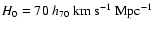 ,
where h70 indicates the
scaling with H0.
,
where h70 indicates the
scaling with H0.
In order to study non-thermal emission from clusters we model the IC and
synchrotron radiation of secondary CRe produced in inelastic collisions by CRp
scattering off thermal nuclei as well as the -ray spectrum produced by
decaying pions being produced by these CRp-p collisions. After introducing
our definitions (Sect. 2.1), we develop an analytic formalism
describing the decay of secondary neutral pions into two high-energy
-rays (Sect. 2.2). Section 2.2.2
uses the analytical fireball model for inelastic CRp interactions with nuclei
of the intergalactic medium in the high-energy regime of CRp (
 ), following Mannheim & Schlickeiser (1994). Based on that we develop
in Sect. 2.2.3 an analytic formula describing the -ray
spectrum by parameterizing important effects near the pion threshold using an
approximate description developed by Dermer (1986a,b), which combines isobaric (Stecker 1970) and
scaling models (Stephens & Badhwar 1981; Badhwar et al. 1977) of the hadronic
reaction. Using this formalism, an analytic
-
scaling relation is derived in the
framework of a simple scenario of spatial distribution of CRp
(Sect. 2.3). Finally, Sect. 2.4 deals
with radio and X-ray emission of secondary electrons being produced by decaying
charged pions.
), following Mannheim & Schlickeiser (1994). Based on that we develop
in Sect. 2.2.3 an analytic formula describing the -ray
spectrum by parameterizing important effects near the pion threshold using an
approximate description developed by Dermer (1986a,b), which combines isobaric (Stecker 1970) and
scaling models (Stephens & Badhwar 1981; Badhwar et al. 1977) of the hadronic
reaction. Using this formalism, an analytic
-
scaling relation is derived in the
framework of a simple scenario of spatial distribution of CRp
(Sect. 2.3). Finally, Sect. 2.4 deals
with radio and X-ray emission of secondary electrons being produced by decaying
charged pions.
 ,
the emissivity
,
the emissivity
 and the volume
integrated quantities, respectively:
and the volume
integrated quantities, respectively:
 ,
the number of particles produced per unit time
interval within a certain volume,
,
the number of particles produced per unit time
interval within a certain volume,
 ,
and the particle flux
,
and the particle flux
 can be derived.
The definitions of the energy weighted quantities are denoted on the right hand
side, respectively,
can be derived.
The definitions of the energy weighted quantities are denoted on the right hand
side, respectively,
-ray spectrum from hadronic CRp interactions
The differential number density distribution of a CRp population can be
described by a power-law in momentum  ,
,
 is not a real CRp number
density while it exhibits those dimensions. We choose the normalization
is not a real CRp number
density while it exhibits those dimensions. We choose the normalization
 in such a way that the kinetic CRp energy density
 is proportional to the thermal energy density
 of the ICM,
 and the thermal energy density of
the ICM
and the thermal energy density of
the ICM
 are given by
![$\element[][4]{He}$](/articles/aa/full/2004/01/aa3877/img82.gif) mass fraction
mass fraction
 ,
and
,
and
 denotes the beta-function (Abramowitz & Stegun 1965).
The functional dependence of the CRp scaling parameter
denotes the beta-function (Abramowitz & Stegun 1965).
The functional dependence of the CRp scaling parameter
 is a
priori unknown. In order to draw astrophysical conclusions for the CRp
population in clusters of galaxies, we adopt three different models for the
spatial distribution of CRp later on in Sect. 3.2.
is a
priori unknown. In order to draw astrophysical conclusions for the CRp
population in clusters of galaxies, we adopt three different models for the
spatial distribution of CRp later on in Sect. 3.2.
![\begin{figure}
\par\resizebox{8.4cm}{!}{
\includegraphics[clip]{3877.f1.eps}}\end{figure}](/articles/aa/full/2004/01/aa3877/img88.gif) |
Figure 1:
The ratio of CRp energy densities
 with and without a lower cutoff
 in the CRp number density
distribution function as a function of
for different values
of the CRp spectral index
in the CRp number density
distribution function as a function of
for different values
of the CRp spectral index
 (see Eq. (15)).
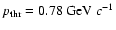
For CRp the kinematically allowed threshold in order to produce
-mesons hadronically is given by
(see Eq. (15)).
For CRp the kinematically allowed threshold in order to produce
-mesons hadronically is given by
 . . |
| Open with DEXTER | |
 |
= | ![$\displaystyle \left[ - \frac{1}{\gamma_{\rm p}} \left(
\frac{{\rm d}\gamma_{\rm p}}{{\rm d}t} \right)_{\rm ee} \right]^{-1}$](/articles/aa/full/2004/01/aa3877/img90.gif) |
(12) |
| = | ![$\displaystyle \frac{m_{\rm e}~ c^3 ~ m_{\rm p}~ \beta_{\rm p}~\gamma_{\rm p}}{4...
... p}^2}{\hbar
\omega_{\rm pl}} \right) - \frac{\beta_{\rm p}^2}{2} \right]^{-1},$](/articles/aa/full/2004/01/aa3877/img91.gif) |
(13) |
 denotes the velocity of the proton,
 its
relativistic Lorentz factor, and
its
relativistic Lorentz factor, and
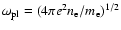 the plasma frequency.
Inserting typical values for cooling flows yields a lower
cutoff on the CRp momentum
the plasma frequency.
Inserting typical values for cooling flows yields a lower
cutoff on the CRp momentum
In order not to rely on too many assumptions, we do not impose a specific
momentum cutoff which is possible since the spectral index
varies in our model in between 2 and 3.
Instead, we quantify the influence of a lower cutoff
on the population of CRp by taking the ratio of CRp energy densities
with and without a lower
cutoff. This ratio as shown in Fig. 1 can be
written using the definition for the normalized lower CRp momentum
cutoff
 ,
,
 denotes the incomplete beta-function
(Abramowitz & Stegun 1965) with
denotes the incomplete beta-function
(Abramowitz & Stegun 1965) with
 .
Combining Fig. 1 and Eq. (14) demonstrates the
small influence of Coulomb cooling to the CRp energy density within cooling flows.
.
Combining Fig. 1 and Eq. (14) demonstrates the
small influence of Coulomb cooling to the CRp energy density within cooling flows.
The CRp interact hadronically with the thermal background gas and produce
pions with relative multiplicities
 according to isospin symmetry and assuming thermal equilibrium of the pion
cloud in the center of mass (Fermi 1950). The charged pions decay
into secondary electrons (and neutrinos) and the neutral pions into
-rays:
according to isospin symmetry and assuming thermal equilibrium of the pion
cloud in the center of mass (Fermi 1950). The charged pions decay
into secondary electrons (and neutrinos) and the neutral pions into
-rays:
 |
|||
 |
are able to produce pions hadronically and are
therefore visible through their decay products in both the -ray and
radio bands via radiative processes.
Only the CRp population above this threshold is constrained by this work while
the lower energy part of this population in general can not be limited by
only considering hadronic interactions.
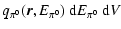
In the high-energy limit for CRp (
)
the pion source
function resulting from hadronic CRp-p interactions can be calculated following
Mannheim & Schlickeiser (1994) to be
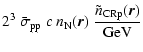
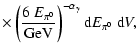
 |
 |
 |
|
 |
(16) |
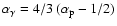 ,
,
 is the inelastic p-p cross section, and
 is the target nucleon density in the ICM.
The -decay induced omnidirectional
(i.e. integrated over
is the target nucleon density in the ICM.
The -decay induced omnidirectional
(i.e. integrated over  solid angle) differential -ray source
function can be calculated in this energy regime assuming the decay products
are distributed isotropically in their rest frame, yielding
solid angle) differential -ray source
function can be calculated in this energy regime assuming the decay products
are distributed isotropically in their rest frame, yielding
 and
and
 .
Because of an incomplete accounting of physical processes at the threshold of
pion production like the velocity distribution of CRp and momentum dependent
inelastic CRp-p cross section, Eq. (17) overestimates the number of
-rays for energies around
.
Because of an incomplete accounting of physical processes at the threshold of
pion production like the velocity distribution of CRp and momentum dependent
inelastic CRp-p cross section, Eq. (17) overestimates the number of
-rays for energies around
 .
.
In order to make detailed predictions for the -decay induced -ray
spectrum, more realistic effects near the -production threshold have to
be included. This was done by using the code COSMOCR originally designed for
cosmic ray studies by Miniati (2001).
The underlying
 -isobaric model was shown to work well at low
proton energies (Stecker 1970).
It assumes the CRp-p interaction to be mediated by the excitation of the
-resonance which subsequently decays into two protons and a
-meson. The production spectrum of secondary -mesons is given by
a convolution of the normalized
-isobar mass spectrum represented
by a Breit-Wigner distribution with the energy distribution function.
The scaling model used at high energies (Stephens & Badhwar 1981)
uses Lorentz invariant cross sections for charged and neutral pion production
in p-p interactions inferred from accelerator data.
COSMOCR includes also the contribution of the two main kaon decay modes to
secondary pion spectra (following Moskalenko & Strong 1998) which are
-isobaric model was shown to work well at low
proton energies (Stecker 1970).
It assumes the CRp-p interaction to be mediated by the excitation of the
-resonance which subsequently decays into two protons and a
-meson. The production spectrum of secondary -mesons is given by
a convolution of the normalized
-isobar mass spectrum represented
by a Breit-Wigner distribution with the energy distribution function.
The scaling model used at high energies (Stephens & Badhwar 1981)
uses Lorentz invariant cross sections for charged and neutral pion production
in p-p interactions inferred from accelerator data.
COSMOCR includes also the contribution of the two main kaon decay modes to
secondary pion spectra (following Moskalenko & Strong 1998) which are
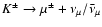 (63.5%) and
 (21.2%) where the latter channel also contributes
to the -ray source function.
(21.2%) where the latter channel also contributes
to the -ray source function.
In order to derive an analytic formula describing the omnidirectional
differential -ray source function over the energy range shown in
Fig. 2, we keep the behavior of the spectrum in
the fireball model for
and
parameterize the detailed physics at the -threshold by the shape
parameter
 which smoothly joins the two power laws to the
asymptotic expansion of the
which smoothly joins the two power laws to the
asymptotic expansion of the
 -function of Eq. (17),
yielding
-function of Eq. (17),
yielding
 characterizing the two
leading pion jets leaving the interaction site in direction of the incident
protons diametrically and carrying the
high longitudinal momenta owing to Lorentz contraction of the interacting
nuclei in the center of mass system and Heisenberg's uncertainty relation
(Nachtmann 1990).
This assumption of constant pion multiplicity of the scaling model is
in contrast to the fireball model (Mannheim & Schlickeiser 1994), which assumes
a state of hot quark-gluon plasma in thermal equilibrium after the hadronic
interaction subsequently ablating pions with multiplicities
characterizing the two
leading pion jets leaving the interaction site in direction of the incident
protons diametrically and carrying the
high longitudinal momenta owing to Lorentz contraction of the interacting
nuclei in the center of mass system and Heisenberg's uncertainty relation
(Nachtmann 1990).
This assumption of constant pion multiplicity of the scaling model is
in contrast to the fireball model (Mannheim & Schlickeiser 1994), which assumes
a state of hot quark-gluon plasma in thermal equilibrium after the hadronic
interaction subsequently ablating pions with multiplicities
![$\xi_{\pi^0} \simeq [(E_{\rm p}- E_{\rm th})/\mbox{GeV}]^{1/4}$](/articles/aa/full/2004/01/aa3877/img127.gif) ,
where
,
where
 denotes the threshold energy for pion
production.
denotes the threshold energy for pion
production.
The -ray source function peaks at the energy of
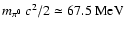 .
It is well known, that the asymptotic slope of the -ray spectrum,
characterized by its spectral index
.
It is well known, that the asymptotic slope of the -ray spectrum,
characterized by its spectral index
 ,
reproduces the spectral index of the
population of CRp,
,
reproduces the spectral index of the
population of CRp,
 (Dermer 1986b).
This is again in contrast to the fireball model which predicts a steeper
asymptotic slope in the -ray spectrum for
(Dermer 1986b).
This is again in contrast to the fireball model which predicts a steeper
asymptotic slope in the -ray spectrum for
 ,
amounting
to
.
In the following we restrict ourselves to Dermer's model because it is better
motivated by accelerator data.
,
amounting
to
.
In the following we restrict ourselves to Dermer's model because it is better
motivated by accelerator data.
![\begin{figure}
\par\resizebox{8.4cm}{!}{
\includegraphics[clip]{3877.f2.eps}}\end{figure}](/articles/aa/full/2004/01/aa3877/img134.gif) |
Figure 2:
a) The omnidirectional (i.e. integrated over
solid
angle) differential -ray source function
 normalized by the target number density
 and CRp
normalization
in order to be independent of the spatial
dependence of any specific model. The dotted lines show the simulated
-ray spectra while the solid curves represent our models given by
Eq. (19) with the spectral indices from top to bottom,
and CRp
normalization
in order to be independent of the spatial
dependence of any specific model. The dotted lines show the simulated
-ray spectra while the solid curves represent our models given by
Eq. (19) with the spectral indices from top to bottom,
 .
b) Relative deviation of our analytic approach to simulated
-ray spectra. .
b) Relative deviation of our analytic approach to simulated
-ray spectra. |
| Open with DEXTER | |
By comparing the logarithm of the -ray source function of
Eq. (19) to numerically calculated spectra using COSMOCR we
recognized that the influence of the detailed
physics at the threshold together with the kaon contribution can be modeled in
our semi-analytic approach in Eq. (19) by self-consistent scaling
relations for the shape parameter
and the effective inelastic
p-p cross section
 including the kaon decay modes.
The shape parameter
scales with the spectral index of the
-ray spectrum as
including the kaon decay modes.
The shape parameter
scales with the spectral index of the
-ray spectrum as
also depends on
which can be modeled by
-ray source function
for flat spectral indices
is due to the larger contribution of the channel
 relative to
 for larger energies, approaching
asymptotically a value of 27% at energies larger than 1 TeV
(Miniati 2001) which we did not account for a priori in our simple
model.
Secondly, this scaling behavior also includes higher order contributions to the
effective pion multiplicity for harder spectra characterized by a lower
spectral index
.
for larger energies, approaching
asymptotically a value of 27% at energies larger than 1 TeV
(Miniati 2001) which we did not account for a priori in our simple
model.
Secondly, this scaling behavior also includes higher order contributions to the
effective pion multiplicity for harder spectra characterized by a lower
spectral index
.
The effective description of the spectrum with the smooth peak characterized by
the shape parameter
starts to fail for very steep
spectra of
 where relativistic kinematics at the
threshold plays a crucial role. Then the higher number of decaying low
energetic -mesons results in a more concentrated peak on top of the
boosted broader distribution of decaying highly-energetic pions.
The lower panel of Fig. 2 shows that the relative deviation
of the semi-analytic approach of Eq. (19) to the simulated
-ray spectra amounts below 0.2 for the spectral range shown in
Fig. 2, which is sufficient for the purpose of our work.
where relativistic kinematics at the
threshold plays a crucial role. Then the higher number of decaying low
energetic -mesons results in a more concentrated peak on top of the
boosted broader distribution of decaying highly-energetic pions.
The lower panel of Fig. 2 shows that the relative deviation
of the semi-analytic approach of Eq. (19) to the simulated
-ray spectra amounts below 0.2 for the spectral range shown in
Fig. 2, which is sufficient for the purpose of our work.
-ray luminosity: Analytic
-F X scaling relation
In the following, we derive an analytic
-scaling relation which should serve as an approximate estimate for a given
cluster of galaxies. As a simple scenario we choose the CRp energy density to
be a constant fraction of the thermal energy density,
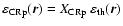 .
However, this is not a fundamental
constraint for this scaling relation. Any other spatial dependency for the CRp
scaling parameter
may be substituted instead of the assumed one.
.
However, this is not a fundamental
constraint for this scaling relation. Any other spatial dependency for the CRp
scaling parameter
may be substituted instead of the assumed one.
The bolometric X-ray emission of the hot thermal intra cluster electrons is
given by the cooling function for thermal bremsstrahlung
(Rybicki & Lightman 1979),
 is the electron number density,
  the temperature,
 is the nucleon density in the ICM relative to the electrons
for primordial element composition, Z the charge number
is the nucleon density in the ICM relative to the electrons
for primordial element composition, Z the charge number![[*]](/icons/foot_motif.gif) and
and
 is the frequency and velocity
averaged Gaunt factor.
is the frequency and velocity
averaged Gaunt factor.
In order to obtain the integrated -ray source density
 for pion decay induced -rays the -ray source function
 in Eq. (19) can be integrated over an
energy interval yielding
in Eq. (19) can be integrated over an
energy interval yielding
| [f(x)]x1x2 = f(x2) - f(x1). | (30) |
-ray spectral index scales as
in contrast to the fireball model where

 .
The shape parameter
is given by the
-
scaling relation in Eq. (20)
which strictly holds for Dermer's model, but should also be valid for the
extended fireball model.
.
The shape parameter
is given by the
-
scaling relation in Eq. (20)
which strictly holds for Dermer's model, but should also be valid for the
extended fireball model.
Comparing the integrated -ray source density
 of Eq. (25) to that of thermal bremsstrahlung
(Eq. (22)) we obtain an analytic
-
scaling relation for the ratio
of -ray fluxes
and bolometric X-ray fluxes
,
of Eq. (25) to that of thermal bremsstrahlung
(Eq. (22)) we obtain an analytic
-
scaling relation for the ratio
of -ray fluxes
and bolometric X-ray fluxes
,
 (Eq. (27)),
 (Eq. (28)), and
  (Eq. (23)).
The
-
ratio scales linearly with
the scaling parameter
given by Eq. (7) and is
independent of the underlying cosmology, however not of redshift due to the
K-correction.
Inferred values for the expected -ray flux
are
consistent with those obtained by Enßlin et al. (1997) for the spectral
index of our Galaxy
(Eq. (23)).
The
-
ratio scales linearly with
the scaling parameter
given by Eq. (7) and is
independent of the underlying cosmology, however not of redshift due to the
K-correction.
Inferred values for the expected -ray flux
are
consistent with those obtained by Enßlin et al. (1997) for the spectral
index of our Galaxy
 .
.
This section is based on a formalism developed in Dolag & Enßlin (2000).
The steady-state  spectrum is governed by injection of secondaries and
cooling processes so that it can be described by the continuity equation
spectrum is governed by injection of secondaries and
cooling processes so that it can be described by the continuity equation
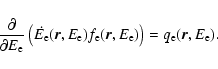 |
(32) |
 this equation is solved by
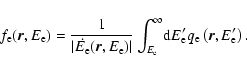 |
(33) |
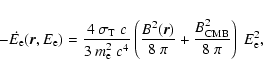
is dominated by synchrotron and
inverse Compton losses giving
 |
(34) |
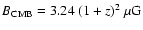
 is the Thomson cross section,
 is the local magnetic field strength and
 is the energy
density of the cosmic microwave background expressed by an equivalent field
strength
is the energy
density of the cosmic microwave background expressed by an equivalent field
strength
 .
The
population above a GeV is therefore described by a power-law
spectrum
is given by
Eq. (21) in contrast to the fireball model where
.
The
population above a GeV is therefore described by a power-law
spectrum
is given by
Eq. (21) in contrast to the fireball model where
 mbarn. The approach of the scaling relation of Eq. (21)
is approximately valid for CRe although the decay channels
of charged kaons provide a stronger contribution to the
mbarn. The approach of the scaling relation of Eq. (21)
is approximately valid for CRe although the decay channels
of charged kaons provide a stronger contribution to the
 branching ratio relative to -mesons
resulting also in slightly higher injection rates for electrons and positrons.
Differences in normalization and radio brightness morphology due to the
different models governing the CRp-p interaction are small and irrelevant for
our conclusions.
branching ratio relative to -mesons
resulting also in slightly higher injection rates for electrons and positrons.
Differences in normalization and radio brightness morphology due to the
different models governing the CRp-p interaction are small and irrelevant for
our conclusions.
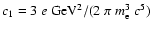
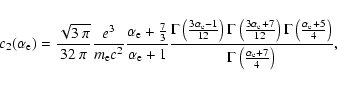
The synchrotron emissivity  at frequency
  and per steradian of a
power law distribution of CRe (Eq. (35)) in an isotropic distribution of
magnetic fields and electrons within the halo volume
(Eq. (6.36) in Rybicki & Lightman 1979), is obtained after averaging over
an isotropic distribution of electron pitch angles yielding
and per steradian of a
power law distribution of CRe (Eq. (35)) in an isotropic distribution of
magnetic fields and electrons within the halo volume
(Eq. (6.36) in Rybicki & Lightman 1979), is obtained after averaging over
an isotropic distribution of electron pitch angles yielding
 ,
,
 |
(40) |
 denotes the
  -function (Abramowitz & Stegun 1965)
and
-function (Abramowitz & Stegun 1965)
and
 in Dermer's model.
In our models the magnetic field B(r) was assumed to be spherically symmetric
on cluster core scales and to follow the electron density
in Dermer's model.
In our models the magnetic field B(r) was assumed to be spherically symmetric
on cluster core scales and to follow the electron density
 (Dolag et al. 1999,2001):
 are free parameters in our model.
Assuming the radio emissivity
are free parameters in our model.
Assuming the radio emissivity
 in Eq. (39) to be only a
function of radius, then the line of sight integration yields the surface
brightness of the radio halo
in Eq. (39) to be only a
function of radius, then the line of sight integration yields the surface
brightness of the radio halo
The source function
 owing to IC scattering of
cosmic microwave background (CMB) photons off an isotropic power law
distribution of hadronically originating CRe (Eq. (35)) is
(derived from Eq. (7.31) in Rybicki & Lightman 1979, in the case of Thomson scattering),
owing to IC scattering of
cosmic microwave background (CMB) photons off an isotropic power law
distribution of hadronically originating CRe (Eq. (35)) is
(derived from Eq. (7.31) in Rybicki & Lightman 1979, in the case of Thomson scattering),
 denotes the spectral index,
 the classical electron radius,
  the Riemann
 -function (Abramowitz & Stegun 1965), and
 is
given by Eq. (36). After integrating over the IC emitting volume in the
cluster we obtain the particle flux
is
given by Eq. (36). After integrating over the IC emitting volume in the
cluster we obtain the particle flux
 (see
Eqs. (4) and (5)). The same CRe population seen in the
radio band via synchrotron emission scatter CMB photons into the hard X-ray
regime. In the -ray spectrum, there is a point of equal contribution of
the IC spectrum of the CRe showing a decreasing slope of
(see
Eqs. (4) and (5)). The same CRe population seen in the
radio band via synchrotron emission scatter CMB photons into the hard X-ray
regime. In the -ray spectrum, there is a point of equal contribution of
the IC spectrum of the CRe showing a decreasing slope of
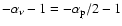 (assuming Dermer's model) and the pion decay induced
-ray spectrum being characterized by the rising slope
(see Eq. (19)). In the high energy limit (
), the pion decay induced -ray spectrum declines with
a slope of
(assuming Dermer's model) and the pion decay induced
-ray spectrum being characterized by the rising slope
(see Eq. (19)). In the high energy limit (
), the pion decay induced -ray spectrum declines with
a slope of
 which is the same as the IC emission
for
which is the same as the IC emission
for
 and slightly steeper for larger values of
(for
illustration, see Fig. 3).
and slightly steeper for larger values of
(for
illustration, see Fig. 3).
-ray spectrum from a CRp population over a
broad range of -ray energies extending from below MeV up to TeV.
Moreover, we presented a formalism of calculating the synchrotron and IC
emission from a stationary population of CRe resulting from hadronic CRp
interactions of the thermal gas of the ICM. Assuming a constant scaling
between kinetic CRp energy density and thermal energy density of the ICM we
derived an analytic
-
scaling relation for
the ratio of -ray flux to bolometric X-ray flux to obtain
observationally promising cluster candidates for constraining the CRp
population. In order to obtain reliable flux estimates we are going to
introduce in the following three possible spatial distributions of the CRp,
whose population is either in fractional pressure equilibrium with the thermal
particle population (as assumed for selecting the clusters), experienced
adiabatic compression during the formation of the cooling flow cluster or is
shaped by diffusion away from a central source of CRp. By modeling the
-ray emission of these particular clusters and comparing to EGRET upper
limits we are going to present bounds on the CRp population. Furthermore, we
will derive upper bounds on the CRp population by radio synchrotron emission of
hadronically originating CRe and will compare azimuthally averaged radio
brightness profiles of the the Perseus radio-mini halo and the radio halo of
Coma.
![\begin{figure}
\par\resizebox{8.7cm}{!}{
\includegraphics[clip]{3877.f3.eps}}\end{figure}](/articles/aa/full/2004/01/aa3877/img206.gif) |
Figure 3:
The simulated differential flux of -rays from Perseus reaching
the Earth. Shown are upper limits of the IC emission of secondary CRe
(power-laws, assuming zero magnetic field) as well as
pion decay induced -ray emission (represented by broad distribution
centered on
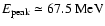 ).
The normalization of the spectra differing in their values of the CRp spectral
index
(Dermer's model) depends on the assumed
scaling between CRp and thermal energy density.
We fix this scaling parameter
assuming the isobaric model
(Sect. 3.2.1) by comparing the integrated flux above
100 MeV to EGRET upper limits (see Reimer et al. 2003). ).
The normalization of the spectra differing in their values of the CRp spectral
index
(Dermer's model) depends on the assumed
scaling between CRp and thermal energy density.
We fix this scaling parameter
assuming the isobaric model
(Sect. 3.2.1) by comparing the integrated flux above
100 MeV to EGRET upper limits (see Reimer et al. 2003). |
| Open with DEXTER | |

The spectral index of the ICM CRp population
is not well
constrained by observations. However, because galaxy clusters are able
to store CRp for cosmological times (Enßlin et al. 1997; Völk et al. 1996; Berezinsky et al. 1997) the spectral index of the
global CRp population (allowing for spatial differentiation) is
expected to be that of the injection process, if no re-acceleration
processes modified the spectrum after injection. We discuss briefly
different possible CRp sources in galaxy clusters:
Structure formation shock waves have generated most of the
thermal energy content of galaxy clusters. Therefore, it is plausible
to assume that they also produced most of the CR energy of clusters.
Shock acceleration is able to produce momentum power-law particle
distributions characterized by a spectral index, which is in the
test-particle picture of non-relativistic shock acceleration
 |
(47) |
 is the shock compression factor. The lowest spectral
indices are therefore generated by the strongest shocks, which are
preferentially found in peripheral regions of the clusters
(Miniati et al. 2000; Quilis et al. 1998). Thus, harder CRp
populations (
is the shock compression factor. The lowest spectral
indices are therefore generated by the strongest shocks, which are
preferentially found in peripheral regions of the clusters
(Miniati et al. 2000; Quilis et al. 1998). Thus, harder CRp
populations (
 )
are mostly injected into
the outskirts of clusters. However, motion of the ICM gas
transports them efficiently into the cluster centers
(Miniati et al. 2001b).
)
are mostly injected into
the outskirts of clusters. However, motion of the ICM gas
transports them efficiently into the cluster centers
(Miniati et al. 2001b). )
since radio emission from radio
galaxies indicates flat CRe spectra.
If, however, only a small fraction of the
CRp is able to leave the radio plasma diffusively, an even flatter
spectrum (say
)
since radio emission from radio
galaxies indicates flat CRe spectra.
If, however, only a small fraction of the
CRp is able to leave the radio plasma diffusively, an even flatter
spectrum (say
 )
can be expected due to
increasing escape probability with momentum
(Enßlin 2003).
)
can be expected due to
increasing escape probability with momentum
(Enßlin 2003). )
CR populations and they are believed
to be the main CRp source of our galaxy (Schlickeiser 2002, and references
therein).
The reason for the steeper (
)
CR populations and they are believed
to be the main CRp source of our galaxy (Schlickeiser 2002, and references
therein).
The reason for the steeper (
 )
galactic CRp spectrum
is thought to be the momentum dependent escape probability from our Galaxy.
Thus, the spectrum of CRp escaping
from galaxies should be flat again (
). The spectrum injected into galaxy clusters could be
even flatter, if termination shock waves of the galactic winds are
able to re-accelerate them, as proposed by
Völk et al. (1996).
)
galactic CRp spectrum
is thought to be the momentum dependent escape probability from our Galaxy.
Thus, the spectrum of CRp escaping
from galaxies should be flat again (
). The spectrum injected into galaxy clusters could be
even flatter, if termination shock waves of the galactic winds are
able to re-accelerate them, as proposed by
Völk et al. (1996).
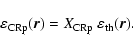
The CRp population in galaxy clusters which is able to interact with the thermal gas and thus to produce observable signatures will be a mixture of contributions of the different sources, modified by acceleration and energy loss processes. In order not to rely too much on a specific physical picture, we discuss simplified models, which should be able to capture many typical situations.
is a constant fraction of the
thermal energy density
of the ICM
 |
(48) |
 |
= | 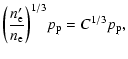 |
(49) |
 |
= |  |
(50) |
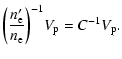
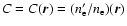 has
been introduced, which is larger than unity within cooling flows.
Provided that the electrons have been in hydrostatic equilibrium during this
transition, this implies
has
been introduced, which is larger than unity within cooling flows.
Provided that the electrons have been in hydrostatic equilibrium during this
transition, this implies
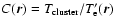 ,
where
,
where
 denotes the electron temperature in the outer core
region.
This transformation implicitly assumes that the ratio of the CRp number
densities before and after the adiabatic compression equals that of the
electron population.
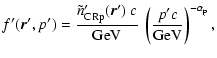
If the differential number density distribution of the CRp population may be
described by a power-law in momentum ,
then after adiabatic compression
of CRp the functional shape of their distribution remains unchanged, however
shifted according to
denotes the electron temperature in the outer core
region.
This transformation implicitly assumes that the ratio of the CRp number
densities before and after the adiabatic compression equals that of the
electron population.
If the differential number density distribution of the CRp population may be
described by a power-law in momentum ,
then after adiabatic compression
of CRp the functional shape of their distribution remains unchanged, however
shifted according to
 |
(51) | ||
![$\displaystyle \tilde{n}_{\rm CRp}'(\vec{r}') = \tilde{n}_{\rm CRp}\left[\vec{r}'(\vec{r})\right]~C(\vec{r}')^{(\alpha_{\rm p}+ 2)/3}.$](/articles/aa/full/2004/01/aa3877/img223.gif) |
(52) |
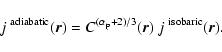
is chosen in such a way that the kinetic CRp
energy density makes up a constant fraction of the thermal energy density prior
to cooling flow formation and is described by a scaling parameter
 |
(53) |
 we obtain the following relation,
 |
(55) |
Many galaxy clusters - especially those with a cooling flow - harbor a central galaxy, which often exhibits nuclear activity. The relativistic plasma bubbles produced by the AGN may contain relativistic protons, which can partly escape into the thermal ICM. Most of the CRp that have been injected into the cluster center are either diffusively transported into the surrounding ICM (as assumed by Blasi 1999; Colafrancesco & Blasi 1998) or form relativistic bubbles which rise in the gravitational potential of the cluster due to buoyant forces (Churazov et al. 2001, and references therein). An argument in favor of a significant central CRp injection into the ICM is the much more efficient escape of CRp from the magnetic confinement of the radio plasma bubble during the very early stages due to the bubbles higher geometrical compactness and and expected stronger turbulence level (Enßlin 2003). In addition to this, any galactic wind from a central galaxy will also inject CRp into the cluster center. In order to treat these diffusion processes analytically one has to distinguish between clusters containing a cooling flow region or not. In the first case CRp diffusion will shape their emission profiles owing to the peaked cooling flow profiles while the emission strength in non-cooling flow clusters is mainly governed by the effective injection timescale.
Cooling flow clusters: The transport of CRp through the ICM is diffusive,
with a diffusion coefficient
 which in general may depend on
momentum and position. For illustration we use
which in general may depend on
momentum and position. For illustration we use
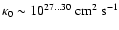 being
plausible values. By using this ansatz, we ignore likely deviations of the
diffusion coefficient from Eq. (56) in the mildly relativistic
regime because these CRp are also not constrained by observations of their
hadronic interactions. The coefficient
being
plausible values. By using this ansatz, we ignore likely deviations of the
diffusion coefficient from Eq. (56) in the mildly relativistic
regime because these CRp are also not constrained by observations of their
hadronic interactions. The coefficient
 describes the
momentum dependence of the diffusion and is expected to be
describes the
momentum dependence of the diffusion and is expected to be
 for active CRp diffusion in a Kolmogorov-like small-scale
magnetic turbulence spectrum and
for active CRp diffusion in a Kolmogorov-like small-scale
magnetic turbulence spectrum and
 for passive
advective transport in a turbulent flow. In the latter case
for passive
advective transport in a turbulent flow. In the latter case
 ,
where
,
where
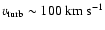 and
and
 kpc are the
turbulent velocity and coherence length, respectively.
kpc are the
turbulent velocity and coherence length, respectively.
Table 1:
Parameters of electron density profiles
of our cluster
sample (central densities ni are subject to different formulae (66)
and (67)). The cluster are ordered according to their property of
being a cooling flow cluster (upper part) or a non-cooling flow cluster (lower
part).
In a stationary situation, which is a valid approximation for timescales longer
than the typical CRp diffusion timescale in the case of a stationary or
short-term intermittent CRp source, the CRp distribution functions is given by
 ,
which in general
is not identical to the spectral index of the CRp population within radio
plasma since the escape fraction is expected to depend on momentum
(Enßlin 2003). For the last step in Eq. (57) we
assume for simplicity the diffusion coefficient to be independent of
position. Possible models of spatial distributions for the diffusion
coefficient depend strongly on many unknown quantities such as the dominant
diffusion mechanism (active diffusion versus passive advective transport),
the velocity field, the turbulence scale, and the topology of the magnetic
field, only to mention a few. Therefore we are unable to guess a realistic
profile for
,
which in general
is not identical to the spectral index of the CRp population within radio
plasma since the escape fraction is expected to depend on momentum
(Enßlin 2003). For the last step in Eq. (57) we
assume for simplicity the diffusion coefficient to be independent of
position. Possible models of spatial distributions for the diffusion
coefficient depend strongly on many unknown quantities such as the dominant
diffusion mechanism (active diffusion versus passive advective transport),
the velocity field, the turbulence scale, and the topology of the magnetic
field, only to mention a few. Therefore we are unable to guess a realistic
profile for
 without enlarging the accessible parameter space
tremendously. However since we expect the diffusion coefficient not to
change dramatically over the cooling flow scale and since the distribution
function
without enlarging the accessible parameter space
tremendously. However since we expect the diffusion coefficient not to
change dramatically over the cooling flow scale and since the distribution
function
 is sufficiently steep in radius
(Eq. (57)) our results should be approximately correct. The
total CRp luminosity of the source can be estimated from Eq. (57)
to be
is sufficiently steep in radius
(Eq. (57)) our results should be approximately correct. The
total CRp luminosity of the source can be estimated from Eq. (57)
to be
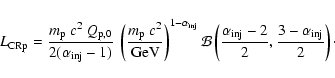 |
(59) |
 .
.
Table 2:
Parameters of temperature profiles
 of our cluster
sample. The estimated -ray flux
of our cluster
sample. The estimated -ray flux
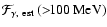 was calculated using the
-
scaling relation
(Eq. (31)) with
was calculated using the
-
scaling relation
(Eq. (31)) with
 and bolometric X-ray fluxes from
David et al. (1993). Note that
scales linearly with
which was set to
and bolometric X-ray fluxes from
David et al. (1993). Note that
scales linearly with
which was set to
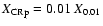 in this
table. The range for
in this
table. The range for
 reflects the
temperature spread in cooling flow clusters between the central temperature
T0 and the peripheral temperature T1.
reflects the
temperature spread in cooling flow clusters between the central temperature
T0 and the peripheral temperature T1.
In order to obtain a realistic estimate for the diffusion volume to be
considered, the relevant length scale needs to be taken into account. We
define the characteristic scale
 by calculating the second
moment of the time-dependent distribution function of the first particles
released by the source, yielding
by calculating the second
moment of the time-dependent distribution function of the first particles
released by the source, yielding
 denotes the number of spatial dimensions. Here we
assume a typical lifetime of
denotes the number of spatial dimensions. Here we
assume a typical lifetime of
 Gyr and
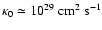 .
Beyond this scale
there can be a CRp population resulting from diffusion away
from the central AGN which is however exponentially suppressed. Because the
-ray luminosity resulting from hadronic CRp interactions scales as
-ray profiles, since the cooling
radius is smaller than the diffusion scale,
.
Beyond this scale
there can be a CRp population resulting from diffusion away
from the central AGN which is however exponentially suppressed. Because the
-ray luminosity resulting from hadronic CRp interactions scales as
-ray profiles, since the cooling
radius is smaller than the diffusion scale,
 ,
and
,
and
 within cooling flow regions (compare Table 1).
Thus, the -ray luminosity is only weakly dependent on
as long as it reflects the correct order of magnitude.
within cooling flow regions (compare Table 1).
Thus, the -ray luminosity is only weakly dependent on
as long as it reflects the correct order of magnitude.
In this work we constrain
 with the aid of -ray
observations of galaxy clusters. From these constraints limits on the
averaged CRp luminosity escaping from the radio plasma of the central
galaxy can be derived using
with the aid of -ray
observations of galaxy clusters. From these constraints limits on the
averaged CRp luminosity escaping from the radio plasma of the central
galaxy can be derived using
 |
(64) |
 ,
2.2, 1.6, and 1.7 for
,
2.2, 1.6, and 1.7 for
 2.3, 2.5, and 2.7, respectively.
In Sect 3.3.4 we analyze these constraints for our cluster sample in
more detail.
2.3, 2.5, and 2.7, respectively.
In Sect 3.3.4 we analyze these constraints for our cluster sample in
more detail.
Non-cooling flow clusters: In transforming the above considerations on
diffusion length scales to the case of non-cooling flow clusters we point out
the following differences: In non-cooling flow clusters the core radius is
normally larger than the diffusion scale,
 ,
over
which the electron density varies only slightly. Thus, a stationary solution
to the diffusion equation is not applicable in the case of a flat target
profile. It follows that the volume integrated -ray spectrum does not
depend on the diffusion coefficient but only on the injection time
,
over
which the electron density varies only slightly. Thus, a stationary solution
to the diffusion equation is not applicable in the case of a flat target
profile. It follows that the volume integrated -ray spectrum does not
depend on the diffusion coefficient but only on the injection time
 of CRp into the ICM of the cluster core. We therefore adopt
a modification to the diffusion model for non-cooling flow clusters. The
averaged CRp luminosity of the central galaxy reads in this context
of CRp into the ICM of the cluster core. We therefore adopt
a modification to the diffusion model for non-cooling flow clusters. The
averaged CRp luminosity of the central galaxy reads in this context
 denotes the integrated number of CRp being injected
into the ICM of the cluster and
denotes the integrated number of CRp being injected
into the ICM of the cluster and
 ,
because there
is no diffusion induced spectral steepening simply due to the fact that the
even more energetic CRp which are still significantly contributing to the
-ray flux in the EGRET energy band are not able to leave the central
core region within a reasonable timescale.
,
because there
is no diffusion induced spectral steepening simply due to the fact that the
even more energetic CRp which are still significantly contributing to the
-ray flux in the EGRET energy band are not able to leave the central
core region within a reasonable timescale.
-rays in different clusters
Applying the
-
scaling relation
(Eq. (31)) and taking bolometric X-ray fluxes from
David et al. (1993) while fixing
and
we estimated -ray fluxes
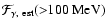 for the spectral
sensitivity of EGRET in order to choose our cluster sample (see Table 2). Inferred values for the estimated -ray flux
by means of the
-
scaling relation sensitively depend on the
bolometric X-ray luminosity of the particular cluster such that values for
in Table 2 represent
a rough estimate. A detailed modeling using density and temperature profiles
will be described later on in Sect. 3.3.2 in order to
obtain upper limits on the CRp population. By comparing -ray fluxes
obtained from these two different methods we recognized
an inconsistency for the Virgo and Centaurus cluster: this discrepancy is
explained by a too small aperture of the X-ray experiments analyzed by
David et al. (1993) giving rise to an underestimation of the X-ray flux
of these two nearest clusters in our sample (
for the spectral
sensitivity of EGRET in order to choose our cluster sample (see Table 2). Inferred values for the estimated -ray flux
by means of the
-
scaling relation sensitively depend on the
bolometric X-ray luminosity of the particular cluster such that values for
in Table 2 represent
a rough estimate. A detailed modeling using density and temperature profiles
will be described later on in Sect. 3.3.2 in order to
obtain upper limits on the CRp population. By comparing -ray fluxes
obtained from these two different methods we recognized
an inconsistency for the Virgo and Centaurus cluster: this discrepancy is
explained by a too small aperture of the X-ray experiments analyzed by
David et al. (1993) giving rise to an underestimation of the X-ray flux
of these two nearest clusters in our sample (
 and
and
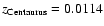 )
and therefore an underestimate of
for these two clusters. Moreover, we
noticed a systematic discrepancy of the order of 50% between the different
methods in cooling flow clusters which is due to an insufficient accounting for
the radial temperature variation in Eq. (31).
)
and therefore an underestimate of
for these two clusters. Moreover, we
noticed a systematic discrepancy of the order of 50% between the different
methods in cooling flow clusters which is due to an insufficient accounting for
the radial temperature variation in Eq. (31).
Table 3:
Upper limits on the CRp scaling parameter
by comparing the
integrated flux above 100 MeV to EGRET upper limits assuming a -ray
spectral index in Dermer's model
.
The spatial
distribution of CRp is given by the isobaric and the adiabatic model of CRp,
respectively (see Sects. 3.2.1 and 3.2.2).
Parameters of electron density profiles
of our cluster sample are
given in Table 1 where the clusters are ordered according to
their property of containing a cooling flow (upper part) or not (lower part).
Note that the parameters are subject to different formulae (66) and
(67),
 models. The
derivation of this deprojection is given in Appendix A.
For simplicity and consistency with the X-ray surface brightness profiles given
in Mohr et al. (1999) we ignored the weak dependency on
in Eq. (67).
models. The
derivation of this deprojection is given in Appendix A.
For simplicity and consistency with the X-ray surface brightness profiles given
in Mohr et al. (1999) we ignored the weak dependency on
in Eq. (67).
In order to model the temperature profiles
for our cooling flow
cluster sample we applied the universal temperature profile for relaxed
clusters proposed by Allen et al. (2001) to data taken from the
literature,
 ,
which is sufficient for our purposes since we are especially
interested in the core region of clusters.
The parameters of the temperature profile for particular cluster are given in
Table 2.
,
which is sufficient for our purposes since we are especially
interested in the core region of clusters.
The parameters of the temperature profile for particular cluster are given in
Table 2.
-ray flux normalized by EGRET limits: The case
of Perseus cluster
The volume integrated omnidirectional differential -ray source function
 can be obtained by integrating Eq. (19). We
integrated the volume out to a radius of
3 h70-1 Mpc which corresponds
to the characteristic distance where the simple -model of electron
densities breaks down due to accretion shocks in clusters. The integration
kernel
scales linearly with
(as
shown in Eq. (19)) which is obtained by solving Eqs. (7) and (10). By comparing the integrated -ray
flux above 100 MeV,
can be obtained by integrating Eq. (19). We
integrated the volume out to a radius of
3 h70-1 Mpc which corresponds
to the characteristic distance where the simple -model of electron
densities breaks down due to accretion shocks in clusters. The integration
kernel
scales linearly with
(as
shown in Eq. (19)) which is obtained by solving Eqs. (7) and (10). By comparing the integrated -ray
flux above 100 MeV,
 ,
to EGRET upper
limits (see Reimer et al. 2003), we constrain the CRp scaling
parameter
.
The inferred value for
in the Perseus cluster
normalizes the differential -ray flux
,
to EGRET upper
limits (see Reimer et al. 2003), we constrain the CRp scaling
parameter
.
The inferred value for
in the Perseus cluster
normalizes the differential -ray flux
 |
(69) |
-meson decay induced distinct spectral
signature resulting in the peak at a -ray energy of
 MeV can be clearly seen.
Figure 3 shows also upper limits on the differential
-ray flux owing to IC emission of hadronically originating CRe
represented by power-laws.
The IC spectra are computed by means of Eq. (43) for different spectral
indices
and zero magnetic field.
Non-zero magnetic fields can be included since the IC spectra scale according
to
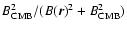 (see Eq. (36))
which results in a lower normalization.
(see Eq. (36))
which results in a lower normalization.
using -ray
observations in different clusters
Table 4:
Cooling flow clusters: upper limits on the CRp density
parameter
and average CRp luminosity
 of the
central active galaxy by comparing the integrated flux above 100 MeV to EGRET
upper limits assuming a -ray spectral index in Dermer's model
.
The spatial distribution of CRp is is calculated
according to the diffusion model of CRp away from a central AGN assuming
,
where
of the
central active galaxy by comparing the integrated flux above 100 MeV to EGRET
upper limits assuming a -ray spectral index in Dermer's model
.
The spatial distribution of CRp is is calculated
according to the diffusion model of CRp away from a central AGN assuming
,
where
 .
Non-cooling flow clusters: upper limits on the CRp number parameter
and average CRp luminosity
without any diffusion
induced spectral steepening, i.e.
.
Non-cooling flow clusters: upper limits on the CRp number parameter
and average CRp luminosity
without any diffusion
induced spectral steepening, i.e.
 .
Note
that
scales in the case of cooling flow clusters with the diffusion
coefficient
.
Note
that
scales in the case of cooling flow clusters with the diffusion
coefficient  while it only depends on the CRp injection time
for non-cooling flow clusters
(see Sect. 3.2.3).
while it only depends on the CRp injection time
for non-cooling flow clusters
(see Sect. 3.2.3).
By employing the technique described in Sect. 3.3.2 we
constrained the CRp scaling parameter
using EGRET upper limits of the
-ray flux by Reimer et al. (2003). As described in that
section, we infer the -ray flux of this clusters originating from
within a sphere of radius
3 h70-1 Mpc. Owing to the vicinity of the
Virgo cluster this maximum radius subtends an angle on the sky which is larger
than the width of the point spread function of the EGRET instrument
(
![$\theta_{\rm max} = 5.8\hbox{$^\circ$ }~[E_\gamma/(100\mbox{ MeV})]^{-0.534}$](/articles/aa/full/2004/01/aa3877/img309.gif) ,
Reimer et al. 2003). Thus in the case of Virgo we use this smaller
integration volume. Table 3 shows constraints for
using the isobaric and the adiabatic model of CRp described in Sect. 3.2. Because in the adiabatic model the CRp scaling parameter
is a function of radius, the value
,
Reimer et al. 2003). Thus in the case of Virgo we use this smaller
integration volume. Table 3 shows constraints for
using the isobaric and the adiabatic model of CRp described in Sect. 3.2. Because in the adiabatic model the CRp scaling parameter
is a function of radius, the value
 given
in Table 3 refers to the unprimed quantity in
Eq. (54) which reflects the outer core region of the cluster.
For clusters like Perseus (A 426), Virgo, Ophiuchus, and Coma (A 1656) we can
obtain quite tight constraints on the population of CRp.
given
in Table 3 refers to the unprimed quantity in
Eq. (54) which reflects the outer core region of the cluster.
For clusters like Perseus (A 426), Virgo, Ophiuchus, and Coma (A 1656) we can
obtain quite tight constraints on the population of CRp.
in the AGN-diffusion model
The procedure of inferring constraints on CRp diffusing away from a central
source is mostly sensitive to the CRp population of the central cooling flow
region rather than the shock region in the outer parts of the cluster. In
order to constrain the CRp density parameter
and averaged
CRp luminosity
of the central active galaxy in our AGN-diffusion model
of cooling flow clusters we have to calculate the volume integrated
omnidirectional differential -ray source function
(see Eq. (2)). The integration kernel
is
proportional to
(Eq. (19)) which is
obtained by solving Eqs. (6) and (60). By comparing
the integrated -ray flux above 100 MeV to EGRET upper limits
(see Reimer et al. 2003), we constrain the CRp density parameter
.
In the case of non-cooling flow clusters we
constrain the averaged CRp luminosity
with the aid of the integrated
CRp number parameter
,
yielding an indirect measure of a
combination of the CRp escape fraction from the radio plasma of the central
galaxy and the averaged CRp luminosity of this source.
Upper limits on the CRp density parameter
,
number
parameter of CRp
,
and averaged CRp luminosity
of the central active galaxy (by means of Eq. (63)) are presented in
Table 4. This shows that within this conceptually simple model we
are able to put constraints on the averaged CRp luminosity
.
The limits which are strongest in the case of M87 in the Virgo
cluster represent conservative bounds since we choose the active CRp
diffusion scenario resulting in spectral steepening of the CRp population. We
obtain even tighter limits when assuming a passive advective transport of the
CRp in a turbulent flow in which case we infer
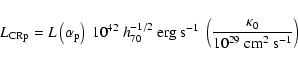 |
(70) |
 4.8, 7.2, and 20.9 for
 2.5, 2.7,
and 2.9, respectively. These values are slightly smaller than
instantaneous jet power estimates of M87 being of the order of
2.5, 2.7,
and 2.9, respectively. These values are slightly smaller than
instantaneous jet power estimates of M87 being of the order of
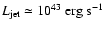 (Young et al. 2002; Bicknell & Begelman 1996). In general, this
demonstrates the ability of future high resolution -ray observations
to constrain the energy fraction of CRp escaping from the radio plasma.
(Young et al. 2002; Bicknell & Begelman 1996). In general, this
demonstrates the ability of future high resolution -ray observations
to constrain the energy fraction of CRp escaping from the radio plasma.
In contrast to -rays induced by hadronic CRp interactions whose
spectral shape and normalization is only governed by the spectral index
as free parameter, the resulting radio emission from secondary
electrons also depends on the morphology and strength of the magnetic field
.
Because only a subsample of cooling flow clusters contain radio mini-halos
which are not outshined by the central AGN we decided to concentrate on the
Perseus cluster. It has the fortunate property that the radio emission due to
the central galaxy NGC 1275 is spatially resolved and can be separated
from the diffuse emission due to the radio-mini halo.
Magnetic fields in galaxy clusters seem to be on the level of
 G. Indirect estimates of magnetic field strength assuming
equipartition of energy density of the fields and that of a
radio synchrotron emitting relativistic electron population
give low field strengths of
G. Indirect estimates of magnetic field strength assuming
equipartition of energy density of the fields and that of a
radio synchrotron emitting relativistic electron population
give low field strengths of
 G. Also lower limits on the
field strength of a comparable level can be derived using the
measurements or upper limits on IC scattered CMB photons in the hard
X-ray band (Enßlin et al. 1999; Rephaeli et al. 1994; Fusco-Femiano et al. 1999). Conversely, Faraday rotation measurements indicate
magnetic fields strengths of several
G. Also lower limits on the
field strength of a comparable level can be derived using the
measurements or upper limits on IC scattered CMB photons in the hard
X-ray band (Enßlin et al. 1999; Rephaeli et al. 1994; Fusco-Femiano et al. 1999). Conversely, Faraday rotation measurements indicate
magnetic fields strengths of several  G in typical galaxy clusters
and a few
G in typical galaxy clusters
and a few  G in cooling flow regions of clusters (Carilli & Taylor 2002, for
a review). Faraday rotation based measurements of
the field strength depend on estimating the magnetic autocorrelation
length from fluctuations in the Faraday rotation maps. Although the
formerly used methods to estimate this length-scale seem to be
questionable (Enßlin & Vogt 2003) a refined analysis gives
comparable results for the magnetic field strengths (Vogt &
Enßlin 2003, in preparation).
G in cooling flow regions of clusters (Carilli & Taylor 2002, for
a review). Faraday rotation based measurements of
the field strength depend on estimating the magnetic autocorrelation
length from fluctuations in the Faraday rotation maps. Although the
formerly used methods to estimate this length-scale seem to be
questionable (Enßlin & Vogt 2003) a refined analysis gives
comparable results for the magnetic field strengths (Vogt &
Enßlin 2003, in preparation).
![\begin{figure}
\par\resizebox{8.25cm}{!}{
\includegraphics[clip]{3877.f4.eps}}\end{figure}](/articles/aa/full/2004/01/aa3877/img320.gif) |
Figure 4:
The radial distribution of radio brightness as a function of impact
parameter  .
Shown are the CRp adiabatic and isobaric model
for model parameters .
Shown are the CRp adiabatic and isobaric model
for model parameters
 , ,
 ,
and
(details are described in the text) as well as the
azimuthally averaged radio brightness profile of the the Perseus radio-mini
halo (data was taken from Pedlar et al. 1990).
The normalization of the radio brightness depends on the assumed scaling
between CRp and thermal energy density. We fix this scaling parameter
by comparing the simulated radio brightness to the measured data at
24.65
h70-1 kpc. ,
and
(details are described in the text) as well as the
azimuthally averaged radio brightness profile of the the Perseus radio-mini
halo (data was taken from Pedlar et al. 1990).
The normalization of the radio brightness depends on the assumed scaling
between CRp and thermal energy density. We fix this scaling parameter
by comparing the simulated radio brightness to the measured data at
24.65
h70-1 kpc. |
| Open with DEXTER | |
The radio data was taken from Pedlar et al. (1990) where we neglected
the innermost data points because of enhanced contribution to radio brightness
of the radio jet of NGC 1275 and the outermost data points due to the
limited sensitivity on the larger scales of the specific VLA configuration
likely leading to an artificial decline in the radio surface brightness. The
values for the azimuthally averaged radio surface brightness were converted
assuming a two-dimensional Gaussian beam which leads to a beam area
 .
Figure 4 shows the radial distribution of radio brightness
.
Figure 4 shows the radial distribution of radio brightness
 as a function of impact parameter
obtained by means of
Eq. (42) in comparison to the radio data. The CRp adiabatic and
isobaric model being described in Sect. 3.2 are both shown
using model parameters of
,
,
and
,
where the latter two parameters refer to Eq. (41). The normalization of the radio brightness depends on the assumed
scaling between CRp and thermal energy density. We fix this scaling parameter
by comparing the simulated radio brightness to the measured data at
24.65
h70-1 kpc. There is an excellent morphological concordance of
the isobaric model of CRp and the radio data for the radio-mini halo of the
Perseus cluster. Since the required values of
are plausible (
as a function of impact parameter
obtained by means of
Eq. (42) in comparison to the radio data. The CRp adiabatic and
isobaric model being described in Sect. 3.2 are both shown
using model parameters of
,
,
and
,
where the latter two parameters refer to Eq. (41). The normalization of the radio brightness depends on the assumed
scaling between CRp and thermal energy density. We fix this scaling parameter
by comparing the simulated radio brightness to the measured data at
24.65
h70-1 kpc. There is an excellent morphological concordance of
the isobaric model of CRp and the radio data for the radio-mini halo of the
Perseus cluster. Since the required values of
are plausible ( 0.01-0.1, see Sect. 3.4.3), the hadronic secondary CRe model
is a very attractive explanation for the observed radio mini-halos in cooling
flow clusters.
0.01-0.1, see Sect. 3.4.3), the hadronic secondary CRe model
is a very attractive explanation for the observed radio mini-halos in cooling
flow clusters.
using radio
observations in different models
Table 5:
Upper limits on the CRp scaling parameter
inferred from
radio brightness profiles of the radio mini-halo of Perseus cluster for
different values of B0, ,
and
.
By comparing the simulated radio brightness to the measured radio data at
 which is the innermost azimuthally averaged
data point not being outshined by the radio galaxy cocoon of NGC 1275
we determine the CRp scaling parameter
.
Taking this point of reference
yields more conservative upper limits for
instead of normalizing by the integrated radio surface brightness especially in
the case of poorer morphological matches. The inferred values for
in
Table 5 are shown for different combinations of B0,
,
and
.
which is the innermost azimuthally averaged
data point not being outshined by the radio galaxy cocoon of NGC 1275
we determine the CRp scaling parameter
.
Taking this point of reference
yields more conservative upper limits for
instead of normalizing by the integrated radio surface brightness especially in
the case of poorer morphological matches. The inferred values for
in
Table 5 are shown for different combinations of B0,
,
and
.
Deduced values of this scaling parameter
which are obtained by
considering only pion decay induced secondary electrons resulting from hadronic
CRp interactions in the ICM reflect upper limits because there are also other
mechanisms in galaxy clusters leading to relativistic populations of electrons
(see Sect. 1).
By analyzing the variations of our model parameters in Table 5 we conclude a weak dependence of
on
while the
magnetic field strength at the cluster center B0 and the CRp spectral index
show a stronger influence on
.
The spectral parameter of the magnetic field
impacts mostly on the
radial extensions of the radio brightness profiles while the CRp scaling
parameter reflects a degeneracy with respect to B0 and
.
Figure 5 shows the scaling parameter
 as a function of
radius r between CRp and thermal energy density in the adiabatic model
according to Eq. (54) for models defined in Table 5. The enhancement of CRp relative to the thermal energy density
owing to adiabatic compression of the CRp population during the formation of
the cooling flow can be clearly seen.
as a function of
radius r between CRp and thermal energy density in the adiabatic model
according to Eq. (54) for models defined in Table 5. The enhancement of CRp relative to the thermal energy density
owing to adiabatic compression of the CRp population during the formation of
the cooling flow can be clearly seen.
![\begin{figure}
\par\resizebox{8.4cm}{!}{
\includegraphics[clip]{3877.f5.eps}}\end{figure}](/articles/aa/full/2004/01/aa3877/img327.gif) |
Figure 5:
The deprojected scaling parameter
between CRp and thermal
energy density in the adiabatic model applied to the mini-radio halo of
Perseus and presented for models which are defined in Table 5. |
| Open with DEXTER | |
We also applied this formalism of synchrotron radiation emitted by secondary
electrons as presented in Sect. 2.4 to the radial distribution of
radio brightness in the radio halo of the Coma cluster using radio data at
1.4 GHz by Deiss et al. (1997). Assuming the CRp population to be
distributed according to the isobaric model, the spatial radio brightness
profile obtained by this secondary electron model declines too fast with
increasing impact parameter
in order to account for the observed
extended radio halo of Coma. To check whether this shortfall of the theoretical
model represents a serious problem for the hadronic model of radio synchrotron
emission we are asking in turn for the necessary radial variation of the CRp
scaling parameter
that is able to explain the observed radio halo.
Deprojecting the azimuthally averaged observed radio surface brightness profile
which is described by a -model yields (as laid down in
Appendix A)
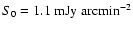 ,
,
 ,
and
,
and
 .
By comparing the observed to the
theoretically expected radio emissivity at each radius we infer the ratio of
CRp-to-thermal energy density
.
Figure 6 shows a
comparison of
and the ratio of magnetic-to-thermal energy density
.
By comparing the observed to the
theoretically expected radio emissivity at each radius we infer the ratio of
CRp-to-thermal energy density
.
Figure 6 shows a
comparison of
and the ratio of magnetic-to-thermal energy density
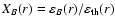 for particular model parameters
,
,
and B0. Whereas
and B0 impact mostly
on the normalization of both scaling parameters
and XB(r), the
choice of
governs the relative curvature of these functions:
for particular model parameters
,
,
and B0. Whereas
and B0 impact mostly
on the normalization of both scaling parameters
and XB(r), the
choice of
governs the relative curvature of these functions:
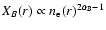 is curved in a convex fashion for
 and exhibits concave curvature for
 assuming the
cluster to be isothermal which is a valid approximation for Coma. While there
are combinations of parameters for which
becomes larger than unity
and thus question the hadronic scenario (Brunetti 2002), only small
variations in parameter space yield plausible values for
(compare
Fig. 6).
assuming the
cluster to be isothermal which is a valid approximation for Coma. While there
are combinations of parameters for which
becomes larger than unity
and thus question the hadronic scenario (Brunetti 2002), only small
variations in parameter space yield plausible values for
(compare
Fig. 6).
![\begin{figure}
\par\resizebox{8.4cm}{!}{ \includegraphics[clip]{3877.f6.eps}}\end{figure}](/articles/aa/full/2004/01/aa3877/img336.gif) |
Figure 6:
The deprojected CRp scaling parameter
required to
account for the observed radio halo in Coma within the framework of the
hadronic scenario. The rising curves with increasing radius represent
while the declining curves show XB(r) for the particular
choice of a magnetic field being frozen into the flow and isotropized,
i.e.
 (Tribble 1993).
 |
| Open with DEXTER | |
In order to quantify these considerations we perform a parameter study to
exclude regions of parameter space spanned by
,
,
and
B0 where the hadronic scenario is challenged to account for the radio halo
in Coma. Figure 7 shows the resulting contour lines of
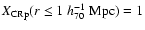 and
and
 in this parameter space. The gradient of
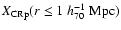 points towards the lower right corner
in Fig. 7 and thus leaves the upper left region of
parameter space where the hadronic scenario is able to account for the observed
radio halo depending on the specific choice of .
Since
points towards the lower right corner
in Fig. 7 and thus leaves the upper left region of
parameter space where the hadronic scenario is able to account for the observed
radio halo depending on the specific choice of .
Since
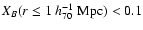 for the entire region of parameter space
investigated here there are no further constraints imposed on the hadronic
scenario.
for the entire region of parameter space
investigated here there are no further constraints imposed on the hadronic
scenario.
![\begin{figure}
\par\resizebox{8.1cm}{!}{
\includegraphics[clip]{3877.f7.eps}}\end{figure}](/articles/aa/full/2004/01/aa3877/img341.gif) |
Figure 7:
Parameter study on the ability of hadronically originating CRe to
generate the radio halo of Coma. Shown are contour lines of
(solid) and
(dotted) in parameter space spanned by
and B0 for three choices of magnetic field morphology
characterized by .
The contour line of
 for
for
 has been omitted since it almost coincides with the contour of
 for
.
The lower right corner represents the region in
parameter space, where the hadronic scenario faces challenges for explaining
the observed radio halo of Coma.
for
.
The lower right corner represents the region in
parameter space, where the hadronic scenario faces challenges for explaining
the observed radio halo of Coma. |
| Open with DEXTER | |
Choosing the energy density of the magnetic field to decline like the thermal
energy density, i.e.
,
requires
to increase by a
factor of less than two orders of magnitude from the center to the outer parts
of the cluster in order to reproduce the observed radio halo of Coma. This
factor, however, is reduced for smaller values of .
It is further
reduced due to the non-spherical morphology of Coma, as explained in the
following. The X-ray emissivity and the radio emissivity resulting from
hadronic CRp interactions differ in their scaling with the electron density
according to
and
.
Thus, any anisotropy like the Coma X-ray and radio
bridge yields biased azimuthal averages when comparing observational to
theoretical radio surface brightness profiles where the latter uses density
profiles obtained by deprojecting X-ray profiles. Remarkably, this discrepancy
is largest for large values of
and
for which we infer
the tightest limits on the hadronic scenario
(cf. Fig. 7) and thus softens these limits. This
results in biased profiles of
which increase too strongly towards
larger radii (cf. also Dolag & Enßlin 2000). Pursuing an approach of
averaging only along the line of sight could attenuate the bias
(Govoni et al. 2001).
An increase of
towards the cluster's periphery is indeed observed
in cosmological structure formation simulations due to adiabatic compression
inside the cluster which increases the thermal pressure at a higher rate than
the CRp pressure (Miniati et al. 2001b,a). Bearing in
mind that the CRp-to-thermal pressure ratio of Miniati et al. (2001b,a) is obtained from volume averages and the energy density
stored in magnetic fields declines shallower in comparison to the thermal
energy density we conclude that our results arising the parameter study may be
well in agreement with these simulations.
One might object that the CRp spectral index should be determined better owing
to radio observations than the range of
 being considered in
the previous parameter study (Sect. 3.5.1). The following line
of argumentation shows, that this, on the contrary, is not the case. First,
there is an ambiguity of relating the CRp spectral index
to the
induced synchrotron spectral index
being considered in
the previous parameter study (Sect. 3.5.1). The following line
of argumentation shows, that this, on the contrary, is not the case. First,
there is an ambiguity of relating the CRp spectral index
to the
induced synchrotron spectral index
 which is either
 (Dermer's model) or
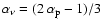 (fireball model). When comparing multifrequency observations of diffuse radio
emission of the ICM which extends to several GHz the Sunyaev-Zel'dovich (SZ)
distortion of the spectrum has to be taken care of. At these frequencies of the
Rayleigh-Jeans part of the Planck spectrum the SZ effect amounts to a decrement
which introduces a cutoff in the radio spectrum as can be seen in
Fig. 8. Following Enßlin (2002) the SZ
luminosity reads for Coma in the Rayleigh-Jeans part
(fireball model). When comparing multifrequency observations of diffuse radio
emission of the ICM which extends to several GHz the Sunyaev-Zel'dovich (SZ)
distortion of the spectrum has to be taken care of. At these frequencies of the
Rayleigh-Jeans part of the Planck spectrum the SZ effect amounts to a decrement
which introduces a cutoff in the radio spectrum as can be seen in
Fig. 8. Following Enßlin (2002) the SZ
luminosity reads for Coma in the Rayleigh-Jeans part
 . However, the SZ amplitude is uncertain within
a factor of 2 which stems mostly from density profiles being inferred from
X-ray observations and extrapolated to
. However, the SZ amplitude is uncertain within
a factor of 2 which stems mostly from density profiles being inferred from
X-ray observations and extrapolated to
 .
Furthermore, the
multifrequency dataset as compiled by Thierbach et al. (2003) is
inhomogeneous because the solid angle over which the observed radio fluxes have
been integrated may vary among these observations. Finally, the quoted
uncertainties may underestimate the systematic uncertainties which e.g. result
from incomplete accounting for point source subtraction.
.
Furthermore, the
multifrequency dataset as compiled by Thierbach et al. (2003) is
inhomogeneous because the solid angle over which the observed radio fluxes have
been integrated may vary among these observations. Finally, the quoted
uncertainties may underestimate the systematic uncertainties which e.g. result
from incomplete accounting for point source subtraction.
![\begin{figure}
\par\resizebox{8.55cm}{!}{
\includegraphics[clip]{3877.f8.eps}}\end{figure}](/articles/aa/full/2004/01/aa3877/img351.gif) |
Figure 8:
Observed radio halo fluxes of the Coma cluster as compiled by
Thierbach et al. (2003). Shown are synchrotron power-law spectra for
different spectral indices
.
The spectra are
modified at higher frequencies by means of the SZ effect while the SZ
decrement (a negative flux at the Rayleigh-Jeans part of the Planck
spectrum) is also shown (dotted). The SZ flux is derived from the cluster
volume up to the assumed position of the accretion shock. |
| Open with DEXTER | |
-rays by satellite missions and Cerenkov
telescopes
Based on the previous results we discuss the detectability of IC emission by
secondary CRe and pion decay induced -ray emission by current and
future satellite missions as well as operating and future Cerenkov
telescopes.
-ray and IC emission by
secondary CRe with INTEGRAL
The imager IBIS which is the Imager on Board the
"INTErnational Gamma-Ray Astrophysics Laboratory''
(INTEGRAL)
Satellite covers an energy range from 15 keV up to 10 MeV and is capable of high
resolution imaging (
 FWHM) and source identification.
Its spectral sensitivity reaches down to
FWHM) and source identification.
Its spectral sensitivity reaches down to
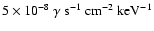 (
( in 106 s,
 )
to the continuum at 10 MeV.
However, this is most probably not sufficient in order to detect the pion decay
induced -rays of a particular cluster (compare Fig. 3).
Assuming a CRp spectral index of
and taking the results of
Table 5 we expect an IC emission
of hadronically originating CRe in the Perseus cluster of
)
to the continuum at 10 MeV.
However, this is most probably not sufficient in order to detect the pion decay
induced -rays of a particular cluster (compare Fig. 3).
Assuming a CRp spectral index of
and taking the results of
Table 5 we expect an IC emission
of hadronically originating CRe in the Perseus cluster of
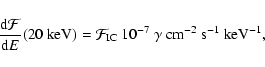 |
(75) |
 1.5, and 0.8 for
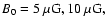 and
and
 .
By comparing to the spectral
sensitivity of
.
By comparing to the spectral
sensitivity of
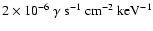 to the continuum at 20 keV for an observation time of 106 s
(
detection) there is only a minor chance to detect IC emission
of CRe. However, for steeper spectral indices or a strongly inhomogeneously
magnetized environment, IC fluxes can be enhanced at the expense of synchrotron
emission according to Enßlin et al. (1999).
to the continuum at 20 keV for an observation time of 106 s
(
detection) there is only a minor chance to detect IC emission
of CRe. However, for steeper spectral indices or a strongly inhomogeneously
magnetized environment, IC fluxes can be enhanced at the expense of synchrotron
emission according to Enßlin et al. (1999).
-ray detection by GLAST
The "Large Area Telescope'' (LAT) onboard the "Gamma-ray Large Area Space
Telescope''
(GLAST)
scheduled to be launched in 2006 has an angular resolution smaller than
 at 100 MeV while covering an energy range of 20 MeV up to 300 GeV
with an energy resolution smaller than 10%.
Assuming a photon spectral index of
at 100 MeV while covering an energy range of 20 MeV up to 300 GeV
with an energy resolution smaller than 10%.
Assuming a photon spectral index of
 for the -ray
background the point source sensitivity at high galactic latitude in an one
year all-sky survey is better than
for the -ray
background the point source sensitivity at high galactic latitude in an one
year all-sky survey is better than
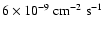 for energies integrated
above 100 MeV.
Assuming the radio-mini halo in the Perseus cluster mainly to
originate from secondary electrons emitting synchrotron radiation then
we expect the CRp scaling parameter to be typically one order of
magnitude below the upper limits obtained by comparing to EGRET data.
This immediately would imply a good possibility to detect pion decay induced
-ray emission by GLAST preferentially in nearby cooling flow clusters
like Perseus and Virgo.
Specifically for our secondary model of the radio mini-halo of Perseus,
while assuming
in the CRp isobaric model we
expect an integrated -ray flux above 100 MeV from Perseus of
for energies integrated
above 100 MeV.
Assuming the radio-mini halo in the Perseus cluster mainly to
originate from secondary electrons emitting synchrotron radiation then
we expect the CRp scaling parameter to be typically one order of
magnitude below the upper limits obtained by comparing to EGRET data.
This immediately would imply a good possibility to detect pion decay induced
-ray emission by GLAST preferentially in nearby cooling flow clusters
like Perseus and Virgo.
Specifically for our secondary model of the radio mini-halo of Perseus,
while assuming
in the CRp isobaric model we
expect an integrated -ray flux above 100 MeV from Perseus of
 ,
,
 for
for
 .
The expected -ray flux is ever higher when including lower
energetic photons.
.
The expected -ray flux is ever higher when including lower
energetic photons.
-ray flux for Cerenkov telescopes
In the near future there will be different Cerenkov telescope experiments
operating with several telescopes simultaneously and
therefore allowing stereoscopic observations.
On the southern hemisphere there are the "Collaboration between Australia and
Nippon for a Gamma Ray Observatory in the Outback''
(CANGAROO)
in Australia and the "High Energy Stereoscopic System''
(HESS) in Namibia.
On the northern hemisphere there will be the
"Very Energetic Radiation Imaging Telescope Array System''
(VERITAS) in Arizona.
All these telescopes have comparable lower energy thresholds of
 GeV and provide flux sensitivities better than
 .
On the northern hemisphere there will also be the
"Major Atmospheric Gamma-ray Imaging Cerenkov detector''
(MAGIC) on the Canary Islands
observing with a single dish telescope of 234
.
On the northern hemisphere there will also be the
"Major Atmospheric Gamma-ray Imaging Cerenkov detector''
(MAGIC) on the Canary Islands
observing with a single dish telescope of 234
 providing an even
lower energy threshold of
providing an even
lower energy threshold of
 GeV.
GeV.
Following the formalism described in Sect. 3.3.2 and
comparing the resulting -ray flux
 to expected flux sensitivities of
Cerenkov telescopes
to expected flux sensitivities of
Cerenkov telescopes
 ,
we obtain possible
upper limits on the CRp scaling parameter
for an integrated volume
out to a radial distance of
3 h70-1 Mpc. Table 6
shows constraints for
using the isobaric and the adiabatic model of
CRp described in Sect. 3.2. By comparing these limits to
those obtained by analyzing synchrotron emission in the Perseus and Coma
cluster (see Table 5) and assuming a substantial
contribution of hadronically originating CRe to these radio halos there is a
realistic chance to detect extragalactic pion decay induced -ray
emission in clusters like Perseus (A 426), Virgo, Ophiuchus, and Coma (A 1656).
,
we obtain possible
upper limits on the CRp scaling parameter
for an integrated volume
out to a radial distance of
3 h70-1 Mpc. Table 6
shows constraints for
using the isobaric and the adiabatic model of
CRp described in Sect. 3.2. By comparing these limits to
those obtained by analyzing synchrotron emission in the Perseus and Coma
cluster (see Table 5) and assuming a substantial
contribution of hadronically originating CRe to these radio halos there is a
realistic chance to detect extragalactic pion decay induced -ray
emission in clusters like Perseus (A 426), Virgo, Ophiuchus, and Coma (A 1656).
Table 6:
Expected limits on the CRp scaling parameter
by comparing
the integrated pion decay induced -ray flux above 100 GeV to
sensitivity limits of Cerenkov telescopes of
 assuming a -ray spectral index in Dermer's model
.
Note that limits on
roughly
assuming a -ray spectral index in Dermer's model
.
Note that limits on
roughly
 0.01 for
in the
isobaric model provide good chances to detect -rays in these particular
clusters with new generation Cerenkov telescopes.
0.01 for
in the
isobaric model provide good chances to detect -rays in these particular
clusters with new generation Cerenkov telescopes.
We investigated hadronic CRp-p interactions in the ICM of clusters and
simulated the resulting emission mechanisms in radio, X-rays, and -rays
assuming spherical symmetry. By applying this technique to a sample of prominent
clusters of galaxies including cooling flow clusters we succeeded in constraining
the population of CRp. Especially cooling flow regions are perfectly suited for
constraining non-thermal ICM components due to their high gas density and
magnetic field strength.
For the first time we developed an analytic formalism to describe the
-decay induced -ray spectrum self-consistently for a given
differential number density distribution of the CRp population being described
by a power-law in momentum
and parametrized by the spectral index
.
Assuming a constant scaling between kinetic CRp energy density
and thermal energy density of the ICM we derived an analytic
-
scaling relation which only applies
accurately for isothermal clusters. Given the bolometric X-ray luminosity of a
particular cluster this formula estimates the expected -ray flux
owing to inelastic cosmic ray ion collisions. From the
literature we collected electron density and temperature profiles of seven
cooling flow clusters and four non-cooling flow clusters using the
-
scaling relation to obtain
observationally promising candidates. We furthermore present formulae
describing the synchrotron and inverse Compton emission of hadronically
originating secondary electrons assuming an isotropic distribution of magnetic
fields following a smooth profile.
In order to apply this method to our sample of clusters of galaxies we
introduced three specific models for the spatial distribution of CRp within
cooling flow cluster. In our first two scenarios we characterized the kinetic
CRp energy density
to be a constant fraction of the
thermal energy density
of the ICM parametrized by
.
The CRp isobaric model assumes the average pressure of CRp not to
change during the formation of the cooling flow while the adiabatic model
hypothesizes this proportionality prior to transition because the CRp
experience adiabatic compression during the relaxation phase. In our third
scenario we modeled the resulting distribution of CRp diffusion from a central
source. By modeling the particular -ray emission of our cluster sample
and comparing to EGRET upper limits we obtained upper bounds on the CRp scaling
parameter
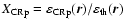 .
For
Perseus and Virgo we infer the strongest upper limits which lie in the range
.
For
Perseus and Virgo we infer the strongest upper limits which lie in the range
![$X_{\rm CRp}\in [0.08,0.18]$](/articles/aa/full/2004/01/aa3877/img377.gif) for different choices of the CRp spectral index
for different choices of the CRp spectral index
![$\alpha_{\rm p}\in [2.1,2.7]$](/articles/aa/full/2004/01/aa3877/img378.gif) .
.
Furthermore, the radio emission due to hadronically produced secondary
electrons emitting synchrotron radiation was calculated and resulting radio
brightness profiles were compared to measured data of the radio-mini halo of
Perseus as well as the radio halo of Coma. In the case of Coma our CRp
profiles characterized by a flat CRp scaling parameter
are not able
to reproduce the observed radio profiles particularly in the peripheral
regions of the cluster. In the following we adjusted the radial behavior of
such that the synchrotron emission resulting from hadronic CRe is
able to account for the observed radio surface brightness profile and thus
allowing for an additional degree of freedom. The resulting increase of
for larger radii could be due to adiabatic compression which
increases the thermal energy density at a higher rate than the CRp energy
density. Even more important, the aspherical Coma cluster morphology reduces
the required radial increase in
.
By exploring the accessible
parameter space spanned by parameters describing the magnetic field and the
spectral index of the CRp population we identify regions where the hadronic
scenario is able to reproduce the observed radio profiles preferentially for
an energy density of the magnetic field which declines shallower than the
thermal energy density. We conclude that the secondary model for radio halos
is still viable.
In the case of the Perseus mini-radio halo, we conclude upper limits on
which are ranging for the isobaric model of CRp within the interval
![$X_{\rm CRp} \in [0.01,0.1]$](/articles/aa/full/2004/01/aa3877/img379.gif) for conservative combinations of values of the magnetic
field B and the CRp spectral index
while upper limits for the CRp
adiabatic model are typically half an order of magnitude below. By comparing
calculated radio brightness profiles to measured data of the radio-mini halo in
Perseus, we found excellent morphological agreement between the CRp isobaric
model and the radio data especially for the choice of
,
,
and
.
In the course of this paper we argued
that this specific choice of parameters for the magnetic fields in cooling flow
clusters is also preferred by experiments like Faraday rotation measurements
and cosmological cluster simulations including magnetic fields. A
discussion of different acceleration mechanisms of CRp such as structure
formation shocks, supernovae remnants, and injection by active radio galaxies
supports also a value of
close to the inferred one. Because of
the required moderate CRp energy density we propose synchrotron radiation by
non-thermal secondary electrons from hadronic interactions as a likely
explanation of radio mini-halos. In order to scrutinize this model we provide
predictions of -ray fluxes for Cerenkov telescopes as well as the
INTEGRAL and GLAST satellites.
for conservative combinations of values of the magnetic
field B and the CRp spectral index
while upper limits for the CRp
adiabatic model are typically half an order of magnitude below. By comparing
calculated radio brightness profiles to measured data of the radio-mini halo in
Perseus, we found excellent morphological agreement between the CRp isobaric
model and the radio data especially for the choice of
,
,
and
.
In the course of this paper we argued
that this specific choice of parameters for the magnetic fields in cooling flow
clusters is also preferred by experiments like Faraday rotation measurements
and cosmological cluster simulations including magnetic fields. A
discussion of different acceleration mechanisms of CRp such as structure
formation shocks, supernovae remnants, and injection by active radio galaxies
supports also a value of
close to the inferred one. Because of
the required moderate CRp energy density we propose synchrotron radiation by
non-thermal secondary electrons from hadronic interactions as a likely
explanation of radio mini-halos. In order to scrutinize this model we provide
predictions of -ray fluxes for Cerenkov telescopes as well as the
INTEGRAL and GLAST satellites.
Finally, we analyzed the possibility of detecting such pion decay induced
-ray and IC emission by current and future satellite missions as well
as new generation Cerenkov telescopes.
Depending on the CRp spectral index, the fragmentation of the spatial
distribution of the magnetic field as well as its field strength, it will be
difficult for INTEGRAL to detect the IC emission of the hadronically
originating secondary CRe while GLAST has the potentiality to detect the
distinct signature of the pion decay induced -ray emission
preferentially in nearby cooling flow clusters.
By investigating the opportunity of detecting extragalactic -rays
by Cerenkov telescopes we argued in favor of four candidate clusters
(Perseus (A 426), Virgo, Ophiuchus, and Coma (A 1656)) which are
especially suited to detect hadronically originating -ray emission.
Acknowledgements
In particular we are indebted to Francesco Miniati for fruitful discussions and providing numerical
-models
Owing to the enhanced electron density in the central region the X-ray surface
brightness profile
 in cooling flow cluster can be
represented by double
models,
in cooling flow cluster can be
represented by double
models,
 ,
,
 |
= | ![$\displaystyle \int_{-\infty}^\infty {\rm d}z ~n_{\rm e}^2\left( \sqrt{r_\bot^2+...
...ilde{\Lambda}_{\rm X} \left[ T_{\rm e}\left( \sqrt{r_\bot^2+ z^2}\right)\right]$](/articles/aa/full/2004/01/aa3877/img384.gif) |
(A.2) |
| = | ![$\displaystyle 2 \int_{r_\bot}^\infty {\rm d}r ~\frac{r~n_{\rm e}^2 (r) ~
\tilde{\Lambda}_{\rm X}\left[T_{\rm e}(r)\right]}{\sqrt{r^2 - r_\bot^2}}\cdot$](/articles/aa/full/2004/01/aa3877/img385.gif) |
(A.3) |
can be derived from
by inverting the Abel equation
![$\displaystyle n_{\rm e}^2 (r) ~ \tilde{\Lambda}_{\rm X}[T_{\rm e}(r)]$](/articles/aa/full/2004/01/aa3877/img386.gif) |
= | 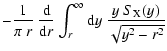 |
(A.4) |
| = | 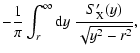 |
(A.5) |
is bounded for
 .
Using Eq. (A.1) this equation can be solved analytically yielding
.
Using Eq. (A.1) this equation can be solved analytically yielding
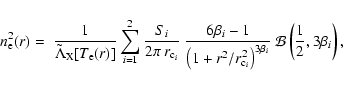 |
(A.6) |
denotes the beta-function (Abramowitz & Stegun 1965).
Provided the central density
 is known and assuming furthermore the
special case of equality of the two
parameter,
is known and assuming furthermore the
special case of equality of the two
parameter,
 ,
we
arrive at the following compact formula for the electron density profile
,
we
arrive at the following compact formula for the electron density profile
![$\displaystyle n_{\rm e}(r) = ~\left[\frac{\tilde{\Lambda}_{\rm X}[T_{\rm e}(0)]...
...2 n_i^2 ~ \left( 1+\frac{r^2}{r^2_{{\rm c}_i}}\right)^{-3~\beta}
\right]^{1/2},$](/articles/aa/full/2004/01/aa3877/img393.gif) |
(A.7) | ||
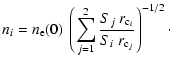 |
(A.8) |
-profiles can be obtained by means of induction.




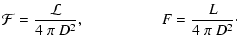
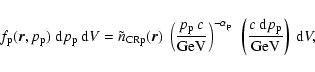


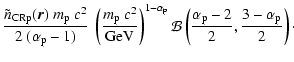
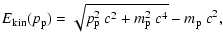
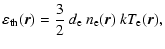
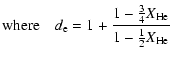
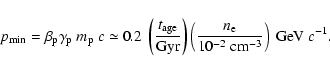
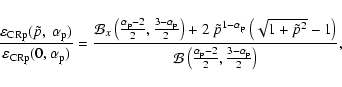

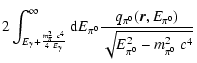


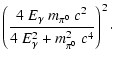

![$\displaystyle ~~~ \times \frac{4}{3~\alpha_\gamma}~\left( \frac{m_{\pi^0}~c^2}
...
...delta_\gamma}
\right]^{-\alpha_\gamma/\delta_\gamma}\!{\rm d}E_\gamma~{\rm d}V.$](/articles/aa/full/2004/01/aa3877/img125.gif)
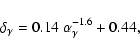
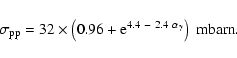
![$\displaystyle \Lambda_{\rm X}[n_{\rm e}(\vec{r}),T_{\rm e}(\vec{r})]
= \Lambda_0~ n_{\rm e}(\vec{r})^2 ~\sqrt{k T_{\rm e}(\vec{r})},$](/articles/aa/full/2004/01/aa3877/img142.gif)
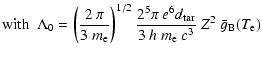

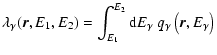

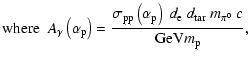
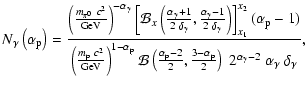
![$\displaystyle \mbox{and~~}
x_i = \left[1+\left(\frac{m_{\pi^0}~c^2}{2~E_i}
\right)^{2~\delta_\gamma}\right]^{-1} \mbox{~for~~}
i \in \{1,2\}.$](/articles/aa/full/2004/01/aa3877/img156.gif)
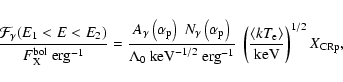
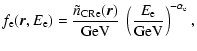

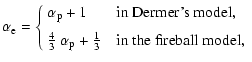
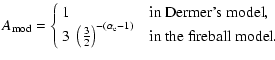
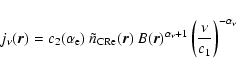
![\begin{displaymath}
B(r) = B_0 ~\left[\frac{n_{\rm e}(r)}{n_{\rm e}(0)}\right]^{\alpha_B},
\end{displaymath}](/articles/aa/full/2004/01/aa3877/img188.gif)
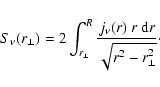

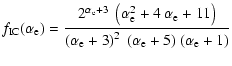
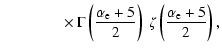
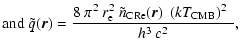
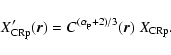
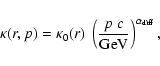

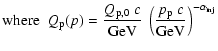
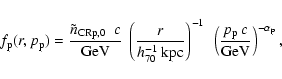
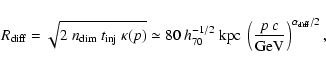
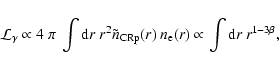
 =
= 


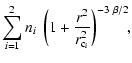
![$\displaystyle ~\left[\frac{\tilde{\Lambda}[T_{\rm e}(0)]}{\tilde{\Lambda}[T_{\r...
...2 ~ \left( 1+\frac{r^2}{r^2_{{\rm c}_i}}
\right)^{-3 ~\beta} \right]^{1/2}\cdot$](/articles/aa/full/2004/01/aa3877/img300.gif)
![\begin{displaymath}
T_{\rm e}(r) = T_0 + (T_1 - T_0)~
\left[ 1+\left( \frac{r}{r_{\rm temp}} \right)^{-\eta}\right]^{-1}\cdot
\end{displaymath}](/articles/aa/full/2004/01/aa3877/img301.gif)
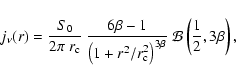
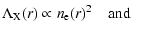

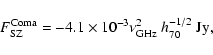
![\begin{displaymath}S_{\rm X} (r_\bot)= \sum_{i=1}^2 ~S_i~
\left[ 1 + \left( \frac{r_\bot}{r_{{\rm c}_i}}\right)^2\right]
^{-3\beta_i + 1/2},
\end{displaymath}](/articles/aa/full/2004/01/aa3877/img381.gif)