A&A 412, 751-765 (2003)
DOI: 10.1051/0004-6361:20031406
The Trumpler 14 photodissociation region in the Carina Nebula
K. J. Brooks1, 2
- P. Cox3
- N. Schneider4
- J. W. V. Storey5
- A. Poglitsch6
- N. Geis6 - L. Bronfman1
1 - Departamento de Astronomía, Universidad de Chile, Casilla
36-D, Santiago, Chile
2 - European Southern Observatory, Casilla 19001 Santiago, Chile
3 - Institut d'Astrophysique Spatiale, Université de Paris-Sud,
91405 Orsay Cedex, France
4 - Observatoire de Bordeaux, Université de Bordeaux I,
33270 Floirac Cedex, France
5 - School of Physics, University of New South Wales, Sydney
2052, NSW, Australia
6 - Max Planck für Extraterrestrische Physik, Garching bei
München, Germany
Received 23 June 2003 / Accepted 9 September 2003
Abstract
We report the results of observations of the fine-structure
emission lines [C II] 158  and [O I] 63
using
FIFI on the Kuiper Airborne Observatory (KAO) and the Long Wavelength
Spectrometer (LWS) on board ISO, towards the molecular cloud
associated with the stellar cluster Trumpler 14 (Tr 14) in the Carina
Nebula. These data are compared with selected CO and CS transitions
obtained with the SEST as well as IRAS and MSX images to produce
a detailed view of the morphology and the physical conditions
prevailing in the photodissociation region (PDR) at the interface
between the ionized gas and the molecular dust lane. The relative
intensity distribution observed for the various tracers is consistent
with the stratification expected for a molecular cloud seen edge-on
and exposed to a radiation field of
and [O I] 63
using
FIFI on the Kuiper Airborne Observatory (KAO) and the Long Wavelength
Spectrometer (LWS) on board ISO, towards the molecular cloud
associated with the stellar cluster Trumpler 14 (Tr 14) in the Carina
Nebula. These data are compared with selected CO and CS transitions
obtained with the SEST as well as IRAS and MSX images to produce
a detailed view of the morphology and the physical conditions
prevailing in the photodissociation region (PDR) at the interface
between the ionized gas and the molecular dust lane. The relative
intensity distribution observed for the various tracers is consistent
with the stratification expected for a molecular cloud seen edge-on
and exposed to a radiation field of 
 ,
which
is dominated by the most massive stars of Tr 14. The grain
photoelectric heating efficiency,
,
which
is dominated by the most massive stars of Tr 14. The grain
photoelectric heating efficiency,  ,
is estimated to be
,
is estimated to be
 and is comparable to other galactic
PDRs. The molecular gas has a complicated velocity structure with a
high velocity dispersion resulting from the impact of the stellar
winds arising from Tr 14. There is evidence of small-scale clumping
with a very low volume filling factor. Despite the rich concentration
of massive O stars in Tr 14 we find that the parameters of the PDR are
much less-extreme than those of the Orion and M 17 massive
star-forming regions.
and is comparable to other galactic
PDRs. The molecular gas has a complicated velocity structure with a
high velocity dispersion resulting from the impact of the stellar
winds arising from Tr 14. There is evidence of small-scale clumping
with a very low volume filling factor. Despite the rich concentration
of massive O stars in Tr 14 we find that the parameters of the PDR are
much less-extreme than those of the Orion and M 17 massive
star-forming regions.
Key words: stars: formation - ISM: lines and bands -
ISM: clouds - ISM: individual objects: Carina nebula
Throughout their lifetime massive stars (O and B stars) have a
dramatic impact on the interstellar medium of galaxies. Starting from
birth, their extreme-ultraviolet photons (
 eV) ionize the
surrounding molecular gas forming H II regions. Furthermore, their
far-ultraviolet (FUV) photons (6 eV
eV) ionize the
surrounding molecular gas forming H II regions. Furthermore, their
far-ultraviolet (FUV) photons (6 eV
 eV) penetrate
beyond the H II region and into the molecular cloud where they
dominate the heating and chemistry, giving rise to photodissociation
regions (PDRs). PDRs are found to be ubiquitous in star-forming giant
molecular clouds (GMCs) (see review by Hollenbach & Tielens 1997 and
references therein). Understanding the nature of the interaction
between FUV radiation and molecular gas and how it influences the
evolution of the cloud is important, particularly with regards to the
cloud's star-forming capacity.
eV) penetrate
beyond the H II region and into the molecular cloud where they
dominate the heating and chemistry, giving rise to photodissociation
regions (PDRs). PDRs are found to be ubiquitous in star-forming giant
molecular clouds (GMCs) (see review by Hollenbach & Tielens 1997 and
references therein). Understanding the nature of the interaction
between FUV radiation and molecular gas and how it influences the
evolution of the cloud is important, particularly with regards to the
cloud's star-forming capacity.
Previous studies of galactic massive star-forming regions such as
Orion and M 17 (Meixner et al. 1992; Wolfire et al. 1990) infer that
the FUV fields in the PDRs associated with these regions are very high
(
104 - 105 G0, where G0 =
 erg s-1 cm-2 is the average intensity of the local Galactic FUV flux,
Habing 1968). In these well-studied cases the brightest stellar
members of the exciting cluster are, at most, a few O-type stars. Even
the Orion Nebula, which represents the nearest example of a massive-star forming region, is excited by a cluster whose principle
members are an O6 and an O9 star (Hillenbrand 1997). To date, there
have been no comprehensive PDR studies of galactic regions harboring
higher concentrations of O-type stars. Results from PDR studies
towards the massive stellar cluster R136 in the 30 Doradus Nebula (30 Dor) of the Large Magellanic Cloud (which contains more than 30 O3 stars, Walborn & Blades 1997), are consistent with a significantly lower
incident FUV field (10
2 - 103 G0, Israel et al. 1996) than
regions like Orion and M 17. A lower FUV field is rather surprising
given the extreme stellar radiation field the molecular gas would be
exposed to. Not enough is known about the nature of PDRs associated
with similarly massive stellar clusters in our galaxy to attribute the
lower FUV fields to metallicity effects alone. Perhaps the measured
lower FUV field reflects the environment of a more evolved
star-forming region in which the molecular gas in the immediate
vicinity of the massive cluster has been destroyed.
erg s-1 cm-2 is the average intensity of the local Galactic FUV flux,
Habing 1968). In these well-studied cases the brightest stellar
members of the exciting cluster are, at most, a few O-type stars. Even
the Orion Nebula, which represents the nearest example of a massive-star forming region, is excited by a cluster whose principle
members are an O6 and an O9 star (Hillenbrand 1997). To date, there
have been no comprehensive PDR studies of galactic regions harboring
higher concentrations of O-type stars. Results from PDR studies
towards the massive stellar cluster R136 in the 30 Doradus Nebula (30 Dor) of the Large Magellanic Cloud (which contains more than 30 O3 stars, Walborn & Blades 1997), are consistent with a significantly lower
incident FUV field (10
2 - 103 G0, Israel et al. 1996) than
regions like Orion and M 17. A lower FUV field is rather surprising
given the extreme stellar radiation field the molecular gas would be
exposed to. Not enough is known about the nature of PDRs associated
with similarly massive stellar clusters in our galaxy to attribute the
lower FUV fields to metallicity effects alone. Perhaps the measured
lower FUV field reflects the environment of a more evolved
star-forming region in which the molecular gas in the immediate
vicinity of the massive cluster has been destroyed.
The Carina Nebula is renowned for its rich concentration of massive
stars and is often likened to 30 Dor in that respect. The two most
influential star clusters associated with the Carina Nebula are
Trumpler 14 and Trumpler 16 (hereafter Tr 14 and Tr 16) which contain
a combined total of more than 30 O stars, including several O3 stars
(Feinstein 1995; Vázquez et al. 1996). Tr 16 also harbors one
of the most massive stars known - Eta Carinae (hereafter
 Car). Distances to Tr 14 and Tr 16 are quoted in the range
2.2
- 2.8 kpc (e.g. Davidson & Humphreys 1997), and we will adopt throughout
this paper a distance of 2.2 kpc. The relative proximity of such a
rich concentration of massive stars makes the Carina Nebula an ideal
target for which to study in detail the parameters of both the PDR and
the FUV radiation field and see how they compare with 30 Dor and other
galactic PDRs.
Car). Distances to Tr 14 and Tr 16 are quoted in the range
2.2
- 2.8 kpc (e.g. Davidson & Humphreys 1997), and we will adopt throughout
this paper a distance of 2.2 kpc. The relative proximity of such a
rich concentration of massive stars makes the Carina Nebula an ideal
target for which to study in detail the parameters of both the PDR and
the FUV radiation field and see how they compare with 30 Dor and other
galactic PDRs.
Figure 1 shows an H image of the central part of
the Carina Nebula. The image is bisected by a prominent optical dark
lane that consists of intermixed warm dust and molecular gas situated
close to the nebula (Dickel 1974). This dark lane forms the
western part of a GMC that extends over 150 pc
(Grabelsky et al. 1988). Prevalent throughout the GMC is CO(4-3) and [C I] emission arising from PDRs, indicating the vast extent to which
the FUV radiation field has penetrated into the molecular material
(Zhang et al. 2001). All that remains of the GMC in the vicinity of Tr 16
are small externally heated globules (Brooks et al. 2000;
Cox & Bronfman 1995). In contrast, the molecular cloud surrounding Tr 14
appears relatively intact, albeit exposed to the effects of strong
ionizing radiation and stellar winds of the O3 stars.
image of the central part of
the Carina Nebula. The image is bisected by a prominent optical dark
lane that consists of intermixed warm dust and molecular gas situated
close to the nebula (Dickel 1974). This dark lane forms the
western part of a GMC that extends over 150 pc
(Grabelsky et al. 1988). Prevalent throughout the GMC is CO(4-3) and [C I] emission arising from PDRs, indicating the vast extent to which
the FUV radiation field has penetrated into the molecular material
(Zhang et al. 2001). All that remains of the GMC in the vicinity of Tr 16
are small externally heated globules (Brooks et al. 2000;
Cox & Bronfman 1995). In contrast, the molecular cloud surrounding Tr 14
appears relatively intact, albeit exposed to the effects of strong
ionizing radiation and stellar winds of the O3 stars.
In this paper, we present the first comprehensive study of the PDR in
the vicinity of Tr 14. We have incorporated a series of molecular-line
data at millimetre wavelengths to characterize the properties of the
molecular gas. Furthermore we have included data on the far-infrared
fine structure emission lines of [C II] and [O I]. These emission
lines are dominant gas cooling lines for PDRs and their relative
strengths can be used in conjunction with PDR models to constrain the
incident FUV radiation field and density of the irradiated gas. All of
the observations were centered on the 60  m emission peak arising
from the dust lane adjacent to Tr 14 (see Fig. 1).
m emission peak arising
from the dust lane adjacent to Tr 14 (see Fig. 1).
![\begin{figure}
\par\includegraphics[width=18cm,clip]{brooks_fig1.eps}\end{figure}](/articles/aa/full/2003/49/aa4140/Timg42.gif) |
Figure 1:
A contour representation of IRAS 60 m emission superimposed on an H
image taken from
the Digitized Sky Survey. Contour levels range from 10 to 99% of the peak emission of 29 500 MJy sr-1 in
increments of 8%. The regions bounded by the respective
thick dashed and solid lines indicate the extent of the [C II]
158 m and
 data discussed in this
work. The thin dashed line marks the cut (joining Tr 14 to the
far-infrared peak emission) used for the set of
intensity-position diagrams shown in Fig. 11 and the
five squares mark the positions along the central raster for
the ISO observations. The centers of Tr 14 and Tr 16 (denoted
by the star
Car) are also indicated.
data discussed in this
work. The thin dashed line marks the cut (joining Tr 14 to the
far-infrared peak emission) used for the set of
intensity-position diagrams shown in Fig. 11 and the
five squares mark the positions along the central raster for
the ISO observations. The centers of Tr 14 and Tr 16 (denoted
by the star
Car) are also indicated. |
| Open with DEXTER |
The [O I] 3P1 - 3P2 63.2 m and [C II]
 P1/2 158 m maps were obtained with the MPE/UCB Far-Infrared
Imaging Fabry Pérot Interferometer (FIFI - Poglitsch et al. 1991)
on the NASA Kuiper Airborne Observatory (KAO) in March 1993. FIFI had
a 5
P1/2 158 m maps were obtained with the MPE/UCB Far-Infrared
Imaging Fabry Pérot Interferometer (FIFI - Poglitsch et al. 1991)
on the NASA Kuiper Airborne Observatory (KAO) in March 1993. FIFI had
a 5  5 focal plane array with a detector spacing of 40
 and a FWHM beamsize of 55
at the frequency of the [C II] line. The beamsize is approximately Gaussian with an equivalent disk
of 69
and a corresponding beam solid angle of
and a FWHM beamsize of 55
at the frequency of the [C II] line. The beamsize is approximately Gaussian with an equivalent disk
of 69
and a corresponding beam solid angle of
 sr. At the frequency of the [O I] 63 line, the FWHM beamsize is 22
.
The bandpass of the Fabry-Pérot was
centered at the velocity -30 km s-1. The Lorentzian instrument profile
has a spectral resolution of 64 km s-1 for the [O I] line and 52 km s-1 for the [C II] line, leaving both lines unresolved. Observations were
performed in a beam-switching mode with a chopping frequency of 23 Hz. The corresponding reference positions were selected from IRAS maps and expected to be free from contaminating [C II] and [O I] line emission. However, because the Carina region lies in the galactic
plane, the self-chopping is still estimated to be 10-15% of the
peak values. Typical integration times were 5 min per array placement.
sr. At the frequency of the [O I] 63 line, the FWHM beamsize is 22
.
The bandpass of the Fabry-Pérot was
centered at the velocity -30 km s-1. The Lorentzian instrument profile
has a spectral resolution of 64 km s-1 for the [O I] line and 52 km s-1 for the [C II] line, leaving both lines unresolved. Observations were
performed in a beam-switching mode with a chopping frequency of 23 Hz. The corresponding reference positions were selected from IRAS maps and expected to be free from contaminating [C II] and [O I] line emission. However, because the Carina region lies in the galactic
plane, the self-chopping is still estimated to be 10-15% of the
peak values. Typical integration times were 5 min per array placement.
The [C II] 158 m map covers a region of
 arcmin2 and includes both Tr 14 and a large part of the
molecular cloud around the western dust lane (see
Fig. 1). A pointing grid of 40
was used with
additional pointings on a grid of 20
near the center (see
Fig. 2). The chopping parameters were 7
arcmin2 and includes both Tr 14 and a large part of the
molecular cloud around the western dust lane (see
Fig. 1). A pointing grid of 40
was used with
additional pointings on a grid of 20
near the center (see
Fig. 2). The chopping parameters were 7 north-south and 12
east-west. The [O I] 63 m map is
centered on the peak [C II] emission and corresponds to an area of 12 arcmin2 (see Fig. 2). Observations were
made on a pointing grid of 20'' with the chopping set to 10'east-west. Additional observations of [O I]
north-south and 12
east-west. The [O I] 63 m map is
centered on the peak [C II] emission and corresponds to an area of 12 arcmin2 (see Fig. 2). Observations were
made on a pointing grid of 20'' with the chopping set to 10'east-west. Additional observations of [O I]
 P1145 m were obtained but with insufficient signal-to-noise to
produce a final map. Data were calibrated by observing an internal
black body source and the calibration uncertainty is estimated to be
30%. The integrated line intensities were determined from Lorentzian
fits to the instrumental profile and were corrected for
leakage. Pointing uncertainties are below 15
.
P1145 m were obtained but with insufficient signal-to-noise to
produce a final map. Data were calibrated by observing an internal
black body source and the calibration uncertainty is estimated to be
30%. The integrated line intensities were determined from Lorentzian
fits to the instrumental profile and were corrected for
leakage. Pointing uncertainties are below 15
.
![\begin{figure}
\par\includegraphics[width=18cm,clip]{brooks_fig2.eps}\end{figure}](/articles/aa/full/2003/49/aa4140/Timg51.gif) |
Figure 2:
Maps of a) [C II] 158 m emission and b) [O I]
63
emission. The contour levels are 0.35 ( ),
0.50, 0.65, 0.80, 0.95, 1.10, 1.25, 1.40, ),
0.50, 0.65, 0.80, 0.95, 1.10, 1.25, 1.40,
 for the [C II] map, and 3.1,
3.6, 4.2, 4.8, 5.5
for the [C II] map, and 3.1,
3.6, 4.2, 4.8, 5.5
 for the [O I] map. The grid of dots
represent the observed positions. Their offsets are given with
respect to the position RA(J2000) =
for the [O I] map. The grid of dots
represent the observed positions. Their offsets are given with
respect to the position RA(J2000) =
 ,
Dec(J2000) = ,
Dec(J2000) =
 .
The center of
Tr 14 is marked by the cross. .
The center of
Tr 14 is marked by the cross. |
| Open with DEXTER |
Low resolution grating spectra from 43 to 196
were obtained
with the Infrared Space Observatory (ISO) using the LWS AOT 01 mode
(Clegg et al. 1996). The flux and wavelength were calibrated according to
the procedures described in Swinyard et al. (1996). Each spectrum
consists of six fast grating scans with 0.5 s integration at each
commanded grating position and ten overlapping sub-spectra, one for
each of the ten detectors. The observations were sampled at 1/4 of a
spectral resolution element, the latter being 0.283
in
second spectral order (detectors SW1-SW5 covering
 m) and 0.584
in first spectral order (detectors LW1-LW5 covering
m) and 0.584
in first spectral order (detectors LW1-LW5 covering
 m).
m).
The Tr 14 region was observed with the LWS in a
 raster
centered on RA(J2000) =
raster
centered on RA(J2000) =
 ,
Dec(J2000) =
,
Dec(J2000) =
 (see
Fig. 1). The spacing between each position was
100
,
slightly bigger than the size of the LWS beam which is
known to vary with wavelength between 66
and 86
HPFW
(Gry et al. 2002). We have adopted a value of 80
for our
analysis. Post-pipeline reduction and analysis were performed using
the ISO Spectroscopy Analysis Package (ISAP) and included further
deglitching, averaging of the individual scans for every detector,
defringing and profile fitting. No scaling between the sub-spectra was
applied. The accepted absolute flux error per detector is 10% (e.g.,
Swinyard et al. 1996; Peeters et al. 2002). At each position in the
raster, the integrated intensities for the fine structure lines were
measured by fitting a Gaussian profile. Note that for the [O I] 145 m line, only the line flux measured in the detector LW4 was
used, as the emission also seen in detector LW3 is strongly affected
by fringes. In the case of the [O III] line, the values measured by
the SW5 and LW1 detectors agree very well and we used the SW5 value.
(see
Fig. 1). The spacing between each position was
100
,
slightly bigger than the size of the LWS beam which is
known to vary with wavelength between 66
and 86
HPFW
(Gry et al. 2002). We have adopted a value of 80
for our
analysis. Post-pipeline reduction and analysis were performed using
the ISO Spectroscopy Analysis Package (ISAP) and included further
deglitching, averaging of the individual scans for every detector,
defringing and profile fitting. No scaling between the sub-spectra was
applied. The accepted absolute flux error per detector is 10% (e.g.,
Swinyard et al. 1996; Peeters et al. 2002). At each position in the
raster, the integrated intensities for the fine structure lines were
measured by fitting a Gaussian profile. Note that for the [O I] 145 m line, only the line flux measured in the detector LW4 was
used, as the emission also seen in detector LW3 is strongly affected
by fringes. In the case of the [O III] line, the values measured by
the SW5 and LW1 detectors agree very well and we used the SW5 value.
Observations of 13CO(2-1) were carried out with the SEST
during May 1994 towards the IRAS peak adjacent to Tr 14. An area of
 arcmin2 was mapped using a pointing grid of 20 arcsec (see Fig. 1). Data were taken with the superseded
cooled Schottky mixers and the current AOS system. An integration time
of 2 min per position was adopted. Subsequent observations were
obtained in 1999 August of the transitions 12CO(2-1),
CS(5-4), CS(3-2) and CS(2-1). The data were taken using an
on-source integration time of 1 min and a 20
pointing
grid. For the 12CO(2-1) and CS(5-4) data the IRAM-built
230-GHz SIS receiver was utilised and for the CS(3-2) and CS(2-1)
data the SIS 150-GHz and 100-GHz receivers were used in parallel. The
final maps cover an area of
arcmin2 was mapped using a pointing grid of 20 arcsec (see Fig. 1). Data were taken with the superseded
cooled Schottky mixers and the current AOS system. An integration time
of 2 min per position was adopted. Subsequent observations were
obtained in 1999 August of the transitions 12CO(2-1),
CS(5-4), CS(3-2) and CS(2-1). The data were taken using an
on-source integration time of 1 min and a 20
pointing
grid. For the 12CO(2-1) and CS(5-4) data the IRAM-built
230-GHz SIS receiver was utilised and for the CS(3-2) and CS(2-1)
data the SIS 150-GHz and 100-GHz receivers were used in parallel. The
final maps cover an area of
 arcmin2 centered on the
same position as the 13CO(2-1) map. The exception is
CS(5-4) for which the final map is only
arcmin2 centered on the
same position as the 13CO(2-1) map. The exception is
CS(5-4) for which the final map is only
 arcmin2. The observing parameters for all transitions are
summarized in Table 1.
arcmin2. The observing parameters for all transitions are
summarized in Table 1.
Table 1:
Observing parameters of the molecular line
data. Parameters include: the transition frequency ( ), the
Half Power Beam Width (HPBW), the main beam efficiency
(
), the
Half Power Beam Width (HPBW), the main beam efficiency
(
 ), the average system temperature (
 )
and the
average rms noise temperature per channel (
)
and the
average rms noise temperature per channel (
 ).
).
For both the 1994 and 1999 data sets a position-switching operation
was adopted with the position of Car used as the line-free off
position. Zero order baselines were subtracted from all spectra. Flux
calibration was done using the standard chopper-wheel method. The
resulting atmosphere-corrected antenna temperatures were converted to
main-beam brightness temperatures utilising the values for main-beam
efficiencies quoted in the SEST Handbook. The telescope pointing and
subreflector focusing were checked regularly on the SiO maser in R-Car. We estimate a pointing accuracy better
than 5
and adopt
the standard SEST value of 10% for the uncertainty in the antenna
temperature scales. All the profiles were smoothed with a Boxcar
method to a velocity resolution of 0.176 km s-1.
The maps of the emission of the fine-structure [C II] 158 m and [O I] 63 m lines in Tr 14 are displayed in Fig. 2.
The [C II] 158 m (hereafter [C II]) line map shows a roughly
circular region of extended emission centered at RA(J2000) =
 ,
Dec(J2000) =
,
Dec(J2000) =
 .
This matches the far-infrared dust
continuum emission at 60 m shown in Fig. 1. The [C II] peak surface brightness is
.
This matches the far-infrared dust
continuum emission at 60 m shown in Fig. 1. The [C II] peak surface brightness is
 .
The higher spatial resolution [O I] 63 m emission is resolved into a ridge of emission running
north-south with three distinct maxima. The middle peak is the
brightest with a surface brightness value of
.
The higher spatial resolution [O I] 63 m emission is resolved into a ridge of emission running
north-south with three distinct maxima. The middle peak is the
brightest with a surface brightness value of
 erg s-1 cm-2 sr-1 and is centered at RA(J2000) =
 ,
Dec(J2000) =
,
Dec(J2000) =
 .
Detected at approximately the same
position lies the peak of the [O I] 145 m emission with a peak surface brightness of
.
Detected at approximately the same
position lies the peak of the [O I] 145 m emission with a peak surface brightness of
 .
.
Figure 3 shows the ISO LWS spectra toward three of the
central raster positions: one nearest to the H II region; one towards
the peak of the [C II] emission; and one nearest to the molecular
cloud. All three spectra are dominated by the dust continuum emission
that peaks at
 m. Superimposed on this continuum are a
series of strong fine-structure atomic lines: from the H II region -
the two [O III] lines at 51.8 and 88.3 ,
[N II] at 121.7 ,
and [N III] at 57.3 ;
and from the PDR - [C II] and the two [O I] lines.
m. Superimposed on this continuum are a
series of strong fine-structure atomic lines: from the H II region -
the two [O III] lines at 51.8 and 88.3 ,
[N II] at 121.7 ,
and [N III] at 57.3 ;
and from the PDR - [C II] and the two [O I] lines.
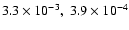
Figure 4 presents the variation of the intensities of the [C II] and the 63 and 145
[O I] fine-structure lines
across the five ISO raster positions. Peak values for all three PDR
lines were found towards the raster center (corresponding to the peak
of the [C II] map):
 and
and
 for [O I] 63 m, [O I] 145 m and [C II] 158 m, respectively.
Values for [C II] and [O I] 145 m emission are slightly higher
(20%) than the corresponding KAO values, a difference which could be
accounted for by self-chopping effects in the case of the KAO observations. For the [O I] 63 m emission the ISO value is half
that of the KAO value. This difference may be caused by beam dilution
for the ISO data. The fluxes of the PDR emission lines decrease almost
symmetrically from the central peak out to the H II region and the
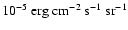
molecular cloud. The [O III] emission line is strongest towards the H II region, which is to be expected since it arises from high
excitation gas. After a steep decrease between offset -100
and the center, the [O III] emission is still detected towards the
molecular cloud with a surface brightness of a few
for [O I] 63 m, [O I] 145 m and [C II] 158 m, respectively.
Values for [C II] and [O I] 145 m emission are slightly higher
(20%) than the corresponding KAO values, a difference which could be
accounted for by self-chopping effects in the case of the KAO observations. For the [O I] 63 m emission the ISO value is half
that of the KAO value. This difference may be caused by beam dilution
for the ISO data. The fluxes of the PDR emission lines decrease almost
symmetrically from the central peak out to the H II region and the
molecular cloud. The [O III] emission line is strongest towards the H II region, which is to be expected since it arises from high
excitation gas. After a steep decrease between offset -100
and the center, the [O III] emission is still detected towards the
molecular cloud with a surface brightness of a few
 .
This result could imply that
extended ionized gas is surrounding the molecular cloud associated
with Tr 14.
.
This result could imply that
extended ionized gas is surrounding the molecular cloud associated
with Tr 14.
![\begin{figure}
\par\includegraphics[width=8.3cm,clip]{brooks_fig3.eps}\end{figure}](/articles/aa/full/2003/49/aa4140/Timg69.gif) |
Figure 3:
LWS spectra (solid line) at three positions across
the Tr 14 region, corresponding to the H II region
(-200
,
0
), the far-infrared peak (0
,
0
)
and the molecular cloud (+200
,
0
). The
best-fitted modified blackbody spectra (dashed line) are shown
(see text) and the fine-structure lines are identified. |
| Open with DEXTER |
![\begin{figure}
\par\includegraphics[width=8.5cm,clip]{brooks_fig4.eps}\end{figure}](/articles/aa/full/2003/49/aa4140/Timg70.gif) |
Figure 4:
Variation of the intensity of the fine-structure
lines and the dust temperature across the Tr 14 region taken
from the ISO LWS observations. The location of the five data
points are marked in Fig. 1 and their offsets
are given with respect to the peak position (RA(J2000) =
,
Dec(J2000) =
)
along the east-west
direction. a) The [C II] 158
line and the two
[O I] lines at 63 and 145
(dashed and dotted
lines, respectively). b) The distributions of the [O III]
88
line (dotted) and the dust temperature
(dashed). |
| Open with DEXTER |
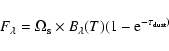
Estimates for the dust temperatures have been derived by fitting the
43-196
spectrum with a modified black-body curve:
 |
(1) |
where
 is the source solid angle,
 is the
blackbody emission at temperature T, and
is the
blackbody emission at temperature T, and
 is the
optical depth. The dust opacity was assumed to have a spectral index
of -1. The derived dust temperatures vary from 65 K towards the H II region to 40-50 K in the PDR and the molecular cloud, with a sharp transition at the PDR interface (see Fig. 4b).
is the
optical depth. The dust opacity was assumed to have a spectral index
of -1. The derived dust temperatures vary from 65 K towards the H II region to 40-50 K in the PDR and the molecular cloud, with a sharp transition at the PDR interface (see Fig. 4b).
The total far-infared flux towards the KAO [C II] peak has been
calculated by way of integrating the fitted black-body curve from 43
to 196
(LWS range), yielding
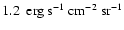 .
This corresponds to a total infrared
luminosity of
.
This corresponds to a total infrared
luminosity of
 ,
which is in
agreement with the estimate by Ghosh et al. (1988) but much lower than the
luminosity derived by Harvey et al. (1979). The [O I] 63 m, [O I] 145 m and [C II] 158 m emission lines are expected to be the
dominant cooling lines. Therefore by taking the ratio of the sum of
the intensity of the three lines to the total far-infrared flux, we
have an estimate of the grain photoelectric heating efficiency ,
which is the fraction of FUV photon energy that is
converted to gas heating. We derive
,
which is in
agreement with the estimate by Ghosh et al. (1988) but much lower than the
luminosity derived by Harvey et al. (1979). The [O I] 63 m, [O I] 145 m and [C II] 158 m emission lines are expected to be the
dominant cooling lines. Therefore by taking the ratio of the sum of
the intensity of the three lines to the total far-infrared flux, we
have an estimate of the grain photoelectric heating efficiency ,
which is the fraction of FUV photon energy that is
converted to gas heating. We derive
 ,
a value comparable to other galactic PDRs where
is
typically a few 10-3 (e.g., Vastel et al. 2002 and references
therein).
,
a value comparable to other galactic PDRs where
is
typically a few 10-3 (e.g., Vastel et al. 2002 and references
therein).
![\begin{figure}
\par\includegraphics[width=18cm,clip]{brooks_fig5.eps}\end{figure}](/articles/aa/full/2003/49/aa4140/Timg78.gif) |
Figure 5:
Maps of 13CO, CO and CS emission integrated over the
velocity range -35 to -5 km s-1. The grid of dots show the
observed positions, where the offsets are with respect to the
reference position used in Fig. 2. The dashed box in
the 13CO(2-1) map delineates the region which was subsequently
mapped in 12CO(2-1) and CS(3-2). a) 13CO(2-1)
emission with contour levels 20 (3 ), 30, 40, 50, 60, 70,
80, 90, 100, 110, 120 K km s-1. b) 12CO(2-1) emission with contours
from 20 to 80% of the peak emission 449 K km s-1 in increments of 10%.
c) CS(3-2) emission with contours from 20 to 90% of the peak
emission 14 K km s-1 in increments of 10%. ), 30, 40, 50, 60, 70,
80, 90, 100, 110, 120 K km s-1. b) 12CO(2-1) emission with contours
from 20 to 80% of the peak emission 449 K km s-1 in increments of 10%.
c) CS(3-2) emission with contours from 20 to 90% of the peak
emission 14 K km s-1 in increments of 10%. |
| Open with DEXTER |
The maps of the 13CO(2-1), 12CO(2-1) and CS(3-2) velocity integrated emissions are shown in Fig. 5. For the 13CO(2-1) emission there
is a prominent ring-shaped feature comprised of several emission
concentrations. The curved eastern part of this ring matches a bright
optical rim at the edge of the dust lane. The region of strongest
integrated intensity emission![[*]](/icons/foot_motif.gif) is situated in the
northwestern part of the emission ring at RA(J2000) =
is situated in the
northwestern part of the emission ring at RA(J2000) =
 ,
Dec(J2000) =
,
Dec(J2000) =
 and has a value of 126 K km s-1. The
emission ring is also traced by the 12CO(2-1) and CS emission but with some small-scale differences. Emission from the 12CO(2-1) line is clearly strongest in the northwestern
part (near the peak of the 13CO(2-1) emission) whereas
the brightest CS emission extends much further to the east.
and has a value of 126 K km s-1. The
emission ring is also traced by the 12CO(2-1) and CS emission but with some small-scale differences. Emission from the 12CO(2-1) line is clearly strongest in the northwestern
part (near the peak of the 13CO(2-1) emission) whereas
the brightest CS emission extends much further to the east.
![\begin{figure}
\par\includegraphics[angle=270,width=18cm,clip]{brooks_fig6.eps}\end{figure}](/articles/aa/full/2003/49/aa4140/Timg84.gif) |
Figure 6:
12CO(2-1) (solid line) and
13CO(2-1) (dashed line) spectra. The offset positions
indicated in each box (in arcsec) are given with respect to the
reference position used in Fig. 2. |
| Open with DEXTER |
![\begin{figure}
\par\includegraphics[width=14cm,clip]{brooks_fig7.eps}\end{figure}](/articles/aa/full/2003/49/aa4140/Timg85.gif) |
Figure 7:
Channel maps of the 13CO(2-1) emission
integrated over 4 velocity ranges indicated in the upper left
corners of each panel. The contour levels are 3 (3), 9, 15,
21, 27, 33, 39, 45, 51 K km s-1. |
| Open with DEXTER |
A sample of individual 12CO(2-1) and 13CO(2-1) spectra are shown in Fig. 6. Both
sets of profiles show a complex velocity structure with multiple
components that extend over a velocity range from -30 to -8 km s-1 and which show no signs of self absorption. There are as many as six
individual velocity components in the profile towards the brightest CO integrated emission (offset position -120, +60).
The overall kinematics of the CO emitting ring are displayed in Fig. 7 as a series of velocity channel maps using the 13CO(2-1) data. In the velocity range -25 to -22 km s-1, the blue-shifted emission traces the western part of the ring. The velocity range -21 to -19 km s-1 corresponds to the
systemic velocity of the northern cloud (-17 km s-1 as determined
from the Mopra large-scale
 map of
Brooks et al. 1998). In this range, emission arises from the eastern
part of the ring, corresponding to the region of brightest integrated
CO emission. There is also another weaker emission component extending
almost east-west along the northern part of the map which is likely
to be part of the more extended molecular cloud. Between -18 and -14 km s-1 there is a ridge of emission that extends in a northwest-southeast direction and which contains several emission
peaks. This ridge matches the south-western part of the ring. At the
most red-shifted velocities, between -13 and
map of
Brooks et al. 1998). In this range, emission arises from the eastern
part of the ring, corresponding to the region of brightest integrated
CO emission. There is also another weaker emission component extending
almost east-west along the northern part of the map which is likely
to be part of the more extended molecular cloud. Between -18 and -14 km s-1 there is a ridge of emission that extends in a northwest-southeast direction and which contains several emission
peaks. This ridge matches the south-western part of the ring. At the
most red-shifted velocities, between -13 and  km s-1, the
emission is detected in an isolated peak located at the eastern edge
of the ring.
km s-1, the
emission is detected in an isolated peak located at the eastern edge
of the ring.
Figure 8 shows spectra of the CS(5-4), (3-2) and (2-1) transitions averaged over the whole map. Approximately the same
four velocity components described above for the
13CO(2-1) data can be identified. The two strongest
emission components are at -25 to -22 km s-1 and -21 to -18 km s-1.
The clear detection of the CS(5-4) line in these two components
indicates the presence of high density
(
 (H2) = 8
106 cm-3) gas.
(H2) = 8
106 cm-3) gas.
Our primary goal is to determine whether the massive stellar members
of Tr 14 are responsible for the observed properties of the PDR and molecular gas emission. With the new data obtained in this study it is
possible to estimate the FUV radiation field associated with the PDR emission and compare it to the stellar radiation field emanating from Tr 14. The extent of the 13CO(2-1) data also allows us to
study the structure and large-scale kinematics of the northern cloud.
In this section we first discuss the connection between the PDR
emission and the molecular gas and quantify the mass and small-scale
structure of the GMC. We then analyze the fine-structure and molecular
line data towards the PDR emission peak in order to constrain the FUV radiation field and gas density at this location. Next we introduce a series of existing data to examine the stratification at the PDR/molecular gas interface and ultimately obtain a schematic model
for the Tr 14 region. We then discuss whether the stellar energy
budget of Tr 14 can sustain the FUV radiation field towards the PDR emission peak as well as the large-scale geometry and kinematics of
the northern cloud. Finally our findings towards Tr 14 are compared
with those towards the Orion bar and 30 Dor.
[C II] emission can arise from PDRs and from low-density warm ionized
gas. The close correlation between the morphology of the KAO [C II] emission and the molecular gas in Tr 14 suggests that the [C II] emission predominantly originates from the PDR layers of the dense
molecular components. The morphology surrounding the central [C II] emission core follows the same curved shape as the molecular emission
ring (see Fig. 10). The actual [C II] emission peak
matches the central emission peak in the 13CO(2-1)
emission ridge evident between velocities of -18 and -14 km s-1 (see Fig. 7). Moreover there is a striking similarity
between this molecular ridge and the distribution of the KAO [O I] 63 m emission. It is tempting to speculate that the PDR emission
may be associated with this molecular gas component. However,
additional velocity information on the fine structure line emission is
necessary before a link can be firmly established.
As outlined in Poglitsch et al. (1991), for the case when the [C II] emission
is optically thin and the density and temperature of the gas is high enough
for thermalised emission, the C II column density, N(C II), is related to
the intensity of the [C II] 158 m emission line, I(C II) via:
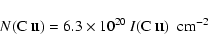 |
(2) |
We assume that C+ is the predominant mode of the gas-phase carbon
in PDRs (which may not necessarily be the case, see
Sect. 4.3.2). Taking the abundance ratio of C/H to be
 and using the spatially averaged KAO [C II] intensity we can
therefore derive a minimum average PDR column density of hydrogen
nuclei N(H)
and using the spatially averaged KAO [C II] intensity we can
therefore derive a minimum average PDR column density of hydrogen
nuclei N(H)
 cm-2. Integrated over the
mapped area we find a minimum hydrogen mass of 360
cm-2. Integrated over the
mapped area we find a minimum hydrogen mass of 360  .
.
4.2 The mass and clump-mass distribution of the molecular gas
To estimate the physical properties of the four molecular gas
components identified in Fig. 7 we have averaged the  CO(2-1) and 12CO(2-1) data over the spatial extent
of each component and then fitted Gaussian functions to the resultant
spectral profiles, within the matching velocity range. Table 2 lists the physical properties derived from these fits
assuming local thermodynamic equilibrium (LTE). The 12CO(2-1)
emission was supposed to be optically thick (and therefore equal to
the gas kinetic temperature) and the 13CO(2-1) emission
optically thin. Estimates of the H2 column densities,
CO(2-1) and 12CO(2-1) data over the spatial extent
of each component and then fitted Gaussian functions to the resultant
spectral profiles, within the matching velocity range. Table 2 lists the physical properties derived from these fits
assuming local thermodynamic equilibrium (LTE). The 12CO(2-1)
emission was supposed to be optically thick (and therefore equal to
the gas kinetic temperature) and the 13CO(2-1) emission
optically thin. Estimates of the H2 column densities,
 ),
were obtained by assuming that the integrated 13CO emission is
proportional to the H2 column density (cm-2) with a factor of
),
were obtained by assuming that the integrated 13CO emission is
proportional to the H2 column density (cm-2) with a factor of
 (K km s-1)-1 as determined by Lada et al. (1994). It
is well known that this factor changes from cloud to cloud. The
uncertainty value for a given type of cloud (e.g. GMC in the inner
Galaxy) is about 1.5. (For further discussion see Maloney & Black 1988
and Hayakawa et al. 1999.) LTE mass estimates were determined using
(K km s-1)-1 as determined by Lada et al. (1994). It
is well known that this factor changes from cloud to cloud. The
uncertainty value for a given type of cloud (e.g. GMC in the inner
Galaxy) is about 1.5. (For further discussion see Maloney & Black 1988
and Hayakawa et al. 1999.) LTE mass estimates were determined using
![$M_{{\rm LTE}}[M_{\odot}] = 6.6 \times 10^{-24} N({\rm H}_2)D^2A$](/articles/aa/full/2003/49/aa4140/img96.gif) with the
distance of the cloud D in parsecs and the angular extent A in degrees.
Estimates for the Virial mass were calculated using the
linewidths of the 13CO(2-1) profiles,
with the
distance of the cloud D in parsecs and the angular extent A in degrees.
Estimates for the Virial mass were calculated using the
linewidths of the 13CO(2-1) profiles,  (km s-1),
and assuming a Gaussian density and velocity profile:
(km s-1),
and assuming a Gaussian density and velocity profile:
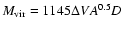 .
Estimates for the average H2 density were
derived by assuming a radial density distribution.
.
Estimates for the average H2 density were
derived by assuming a radial density distribution.
The resulting mean H2 densities (
 )
and
mass range (40 to
)
and
mass range (40 to
 )
are typical of warm clumps
found in other GMCs (e.g. Turner 1996). In the case of two
components the LTE masses are not too different from their
corresponding Virial masses, suggesting that these components may be
gravitationally bound.
)
are typical of warm clumps
found in other GMCs (e.g. Turner 1996). In the case of two
components the LTE masses are not too different from their
corresponding Virial masses, suggesting that these components may be
gravitationally bound.
![\begin{figure}
\par\includegraphics[width=8.5cm,clip]{brooks_fig8.eps}\end{figure}](/articles/aa/full/2003/49/aa4140/Timg101.gif) |
Figure 8:
CS(5-4), (3-2) and (2-1) spectra averaged over the
whole map. The four main velocity intervals determined by the CO
observations are indicated. |
| Open with DEXTER |
In order to quantify the small scale structure of the molecular cloud,
we applied the automated clump identification algorithm GAUSSCLUMPS to the 13CO(2-1) data cube. This algorithm,
developed by Stutzki & Güsten (1990), decomposes the data cube into a number
of clumps by fitting a series of Gaussian components in an iterative
process (see Kramer et al. 1998 for further details). Clumps with
parameters intrinsically larger than 10% of the spatial and velocity
resolution were used. Based on a 3
noise detection, the
minimum detectable clump mass is 0.07 .
A total of 282 clumps were found with LTE masses ranging from 0.2 to
 ,
adding to a total mass of
,
adding to a total mass of
 .
Six of these clumps are found to be more massive than
.
Six of these clumps are found to be more massive than
 ,
contributing to over half of the total mass. The clump
diameters (FWHM) are typically 1
and their average
,
contributing to over half of the total mass. The clump
diameters (FWHM) are typically 1
and their average  densities lie in the range 1.5 to
 .
The clump-mass distribution (shown in Fig. 9)
indicates that for clumps more massive than
.
The clump-mass distribution (shown in Fig. 9)
indicates that for clumps more massive than
 ,
the
clump-mass index is
,
the
clump-mass index is
 ,
a value consistent with what
has been derived in other giant molecular clouds
(e.g. Kramer et al. 1998; Schneider et al. 1998).
,
a value consistent with what
has been derived in other giant molecular clouds
(e.g. Kramer et al. 1998; Schneider et al. 1998).
![\begin{figure}
\par\includegraphics[angle=270,width=8cm,clip]{brooks_fig9.eps}\end{figure}](/articles/aa/full/2003/49/aa4140/Timg109.gif) |
Figure 9:
LTE clump-mass distribution for 282 clumps found by the
clump-finding algorithm GAUSSCLUMPS. N is the number of
clumps in each mass bin. |
| Open with DEXTER |
4.3.1 Application of a one-dimensional PDR model
We have compared our observed line intensities at the position of the
[C II] emission peak with predictions from the stationary PDR model of Kaufman et al. (1999) in order to constrain the gas density and
the FUV radiation field at the PDR surface (
 ). The PDR model assumes a 1-dimensional slab exposed to an incident radiation
field with a face-on geometry. The standard model parameters are given
in Table 1 of Kaufman et al. (1999). Included as inputs to the model were
the measured ISO fluxes for the [O I] 63 m, [O I] 146 m and [C II] 158 m emission lines as well as the intensity ratio of 12CO(2-1) and (1-0) emission derived from our
). The PDR model assumes a 1-dimensional slab exposed to an incident radiation
field with a face-on geometry. The standard model parameters are given
in Table 1 of Kaufman et al. (1999). Included as inputs to the model were
the measured ISO fluxes for the [O I] 63 m, [O I] 146 m and [C II] 158 m emission lines as well as the intensity ratio of 12CO(2-1) and (1-0) emission derived from our  CO(2-1) data and the CO(1-0) data presented in
Brooks et al. (1998). The CO emission was taken over the velocity range
-35 to -5 km s-1.
CO(2-1) data and the CO(1-0) data presented in
Brooks et al. (1998). The CO emission was taken over the velocity range
-35 to -5 km s-1.
In the case of the Tr 14 region, the geometry of the dust lane implies
more of an edge-on situation which can cause a limb-brightening effect
for the optically thin [C II] and [O I] 145 lines. To
correct for a nominal viewing angle of 60 instead of
face-on, a limb-brightening factor of two has been assumed for both of
these lines (calculations have been made using half the observed
intensities values). The initial result did not define a unique
solution and the [C II] emission line intensity appears too high. This
could be caused by a contribution from non-PDR emission. Using the
flux of the ISO [C II] emission toward the Tr 14 H II region (position -200 in Fig. 4), we estimate the non-PDR contribution
to be 30%. Reducing the input [C II] emission accordingly
leads to a better final solution defining a parameter space with a
range in density of
instead of
face-on, a limb-brightening factor of two has been assumed for both of
these lines (calculations have been made using half the observed
intensities values). The initial result did not define a unique
solution and the [C II] emission line intensity appears too high. This
could be caused by a contribution from non-PDR emission. Using the
flux of the ISO [C II] emission toward the Tr 14 H II region (position -200 in Fig. 4), we estimate the non-PDR contribution
to be 30%. Reducing the input [C II] emission accordingly
leads to a better final solution defining a parameter space with a
range in density of
 to
to
 cm-3 and a
range in FUV field of
cm-3 and a
range in FUV field of
 to
to
 G0.
G0.
In order to obtain a second estimate of the FUV field, we determined
the dust color temperature derived from the IRAS 60 m to 100 m flux ratio and applied it to the original PDR model of
Hollenbach et al. (1991). The ratio of the two IRAS fluxes at the [C II] emission peak is 1 which implies a dust color temperature
of 50 K and a FUV flux of 104  .
.
These results should only be taken only as a first estimate in
quantifying the excitation conditions within the Tr 14 PDR and a more
thorough analysis incorporating other models
(e.g. Le Bourlot et al. 1993) should be carried out in the future. For
instance, the single-slab PDR models used here over-simplify the
complex morphology of the region. The multiple components evident in
the molecular line profiles and the results of the clump-mass analysis
imply that a more realistic model would be one with several PDR surfaces in a clumpy molecular medium. Moreover, there are
uncertainties within the PDR models themselves, particularly the
charge exchange rates and the metalicity parameters (refer to
Kaufman et al. 1999 for further discussion). It also should be noted
that we have used a stationary model whereas the Tr 14 PDR interaction
is most certainly not stationary. However, as discussed in Sect. 4.7, Tr 14 is more evolved than other well-studied Galactic PDR regions. Therefore, the interaction zones at the Tr 14 PDR interface
are closer to pressure equilibrium, increasing the applicability of a stationary PDR model.
4.3.2 The amount of carbon in the main phases C+,C,CO
From the observed [C II] and 13CO column densities and using the
value for the [C I] column density given in Zhang et al. (2001) we can
determine the particle numbers and therefore the fractional abundance
of carbon in each of the three main carbon phases (C+:C:CO)
at the PDR emission peak. Within a 3.5' beam Zhang et al. (2001) found a [C I] column density of 1.4
1017 cm-2. In the same
area (4 pc2), we obtain a [C II] column density of 5.9
1017 cm-2. The mean 13CO column density of
the molecular gas integrated from -35 to -5 km s-1 is
3.5
1016 cm-2. Assuming a 12CO/13CO ratio
of 50, we then obtain in a slightly smaller area ( 3 pc2) a CO column density of 1.7
1018 cm-2. This means the
ratio C+:C:CO is 28:7:64 indicating that the majority of
gas-phase carbon is locked in CO. Several galactic PDRs with weaker
[C II] emission show a ratio of around 40:20:40 (e.g. NGC 2024
Jaffe & Plume 1995; and IC 63 Jansen et al. 1996). For S106 the ratio
is 10:5:85 (Schneider et al. 2003).
3 pc2) a CO column density of 1.7
1018 cm-2. This means the
ratio C+:C:CO is 28:7:64 indicating that the majority of
gas-phase carbon is locked in CO. Several galactic PDRs with weaker
[C II] emission show a ratio of around 40:20:40 (e.g. NGC 2024
Jaffe & Plume 1995; and IC 63 Jansen et al. 1996). For S106 the ratio
is 10:5:85 (Schneider et al. 2003).
![\begin{figure}
\par\includegraphics[width=13cm,clip]{brooks_fig10.eps}\end{figure}](/articles/aa/full/2003/49/aa4140/Timg121.gif) |
Figure 10:
Comparison of different emission tracers in the Tr 14
region. a) MSX  m emission with contours of the 4.8-GHz
radio continuum emission taken from Brooks et al. (2001). The
contour levels are 0.08, 0.15, 0.2, 0.25, 0.3, 0.35, 0.4, 0.45,
0.5, 0.55, 0.6, 0.65 Jy beam-1. b) MSX m emission with contours of the 4.8-GHz
radio continuum emission taken from Brooks et al. (2001). The
contour levels are 0.08, 0.15, 0.2, 0.25, 0.3, 0.35, 0.4, 0.45,
0.5, 0.55, 0.6, 0.65 Jy beam-1. b) MSX  m emission with
contours of the KAO [C II] m emission with
contours of the KAO [C II]  m emission taken from
Fig. 2. c) 13CO(2-1) emission taken from
Fig. 5 with contours of the KAO [C II] m
emission.The center of Tr 14 is marked by the cross. m emission taken from
Fig. 2. c) 13CO(2-1) emission taken from
Fig. 5 with contours of the KAO [C II] m
emission.The center of Tr 14 is marked by the cross. |
| Open with DEXTER |
A more sophisticated approach to determine the physical parameters of
the molecular gas is to solve the radiative transfer equation
explicitly but using the approximation that the level populations are
independent of the position in the cloud. Here we use the escape
probability model of Stutzki & Winnewisser (1995) for a homogeneous, spherical
cloud. Analysis was performed at the PDR emission peak only and on
the two brightest CS emission components for which there were clear
detections of the CS(5-4) emission line: -25 to -22 km s-1 and -21 to -18 km s-1. We used the observed line ratio of CS(3-2) to CS(2-1) as well as the CS(5-4) line intensity. Data were smoothed to an angular resolution of 50
.
For both emission components, kinetic temperatures above 30 K were
necessary for the model to converge. The outputs were in the range 105 to 106 cm-3 for
 ). We can obtain an
estimate for the volume filling factor using F
). We can obtain an
estimate for the volume filling factor using F
 .
In this case the local density,
.
In this case the local density,
 ,
is obtained
from the model output and the average density,
,
is obtained
from the model output and the average density,
 ,
is taken to
be the densities listed in Table 2. The result is of the
order of 1% or less for both components. Average filling factors
derived from CS data of less than 5% have been reported in several
other massive star-forming regions (e.g., Beuther et al. 2000;
Goldsmith et al. 1997) and are consistent with small-scale structure.
,
is taken to
be the densities listed in Table 2. The result is of the
order of 1% or less for both components. Average filling factors
derived from CS data of less than 5% have been reported in several
other massive star-forming regions (e.g., Beuther et al. 2000;
Goldsmith et al. 1997) and are consistent with small-scale structure.
The emergent scenario therefore is that the CS emission of the two
most negative velocity molecular-gas components at the PDR emission
peak arise from small, high density molecular clumps heated to
temperatures greater than 30 K. The high densities are not in
contradiction to the results from the PDR model obtained in
Sect. 4.3.1 which utilised emission from a wider velocity
range. Moreover, the peak PDR emission may not actually be associated
with the two most negative velocity components. As already mentioned,
the morphology of the PDR emission matches very well with the
molecular component between velocities of -18 to -14 km s-1, for
which there is insufficient CS(5-4) emission to be included in the CS analysis.
Table 2:
Derived parameters for the four components shown
in Fig. 7. The parameters include mean values for the
excitation temperature (
 ); the
13CO(2-1) optical depth
(
); the
13CO(2-1) optical depth
(
 ); and the 13CO and H2 column
densities (
); and the 13CO and H2 column
densities (
 CO),
CO),
 ), respectively). Also listed are the corresponding
estimates for the LTE mass (M
), respectively). Also listed are the corresponding
estimates for the LTE mass (M
 ), Virial mass (M
 )
and average H2 volume density (
)
and average H2 volume density (

4.4 Disentangling the discrete emission zones in Tr 14
The distributions of the 13CO(2-1) and KAO [C II] emission with respect to the location of Tr 14 and the dust lane are
consistent with an ionizing-cluster / PDR / molecular-cloud interface,
viewed approximately edge on. Further comparisons with other emission
species allow us to trace the different layers within this interface.
Figure 10 shows MSX data (see Price 1995) of the Tr 14 region arising from two bands:
 m (m) and
 m (m) . The m band is dominated by
line emission arising from PAHs which are readily associated with PDRs. The m band is dominated by continuum emission from
heated dust. The m emission exhibits a bright arc centered on
the detected [C II] emission peak. This arc has been traced via
3.29
PAH emission (Rathborne et al. 2002) and matches exactly
our detected [O I] 63
emission ridge. It is also adjacent
to the sharply curved western edge of the 4.8-GHz continuum emission
arising from ionized gas (Brooks et al. 2001). This emission edge is known
as Car I-W and is centered at a velocity of -25 km s-1. Bright
emission in the corresponding m image is situated closer to
the Tr 14 cluster center and arises from two main components. One of
these overlaps with the eastern edge of the detected [C II] emission,
a second 3.29
PAH emission ridge, as well as a second
4.8-GHz continuum emission component known as Car I-E, with a velocity
of -19 km s-1.
m (m) . The m band is dominated by
line emission arising from PAHs which are readily associated with PDRs. The m band is dominated by continuum emission from
heated dust. The m emission exhibits a bright arc centered on
the detected [C II] emission peak. This arc has been traced via
3.29
PAH emission (Rathborne et al. 2002) and matches exactly
our detected [O I] 63
emission ridge. It is also adjacent
to the sharply curved western edge of the 4.8-GHz continuum emission
arising from ionized gas (Brooks et al. 2001). This emission edge is known
as Car I-W and is centered at a velocity of -25 km s-1. Bright
emission in the corresponding m image is situated closer to
the Tr 14 cluster center and arises from two main components. One of
these overlaps with the eastern edge of the detected [C II] emission,
a second 3.29
PAH emission ridge, as well as a second
4.8-GHz continuum emission component known as Car I-E, with a velocity
of -19 km s-1.
To further illustrate the discrete emission zones we have taken a cut
through the center of the Tr 14 cluster and the [C II] emission peak
and recorded the intensity variation for a sequence of different
emission tracers (see Fig. 11). One of the datasets
is that of [C I] 492 GHz emission taken from the study by
Zhang et al. (2001). According to models by Hollenbach & Tielens (1999), much of
the [C II] and [O I] fine structure emission originates from the
outermost surfaces of the PDRs whereas the [C I] fine structure
emission arises from layers further within. Evident in
Fig. 11 are the two emission peaks arising from 4.8-GHz continuum, 3.29
PAH and 13CO(2-1)
emission, consistent with two PDRs separated by 1.
The brightest 3.29
PAH emission peak
corresponds to the Car I-W continuum emission component and with the
13CO(2-1) emission arising from the velocity range -21to -14 km s-1. The angular resolution of both the [C I] and [CII] data is not sufficient to resolve both PDR peaks. However, in the
direction away from Tr 14 is first the 4.8-GHz continuum emission peak
(Car I-W), followed by the [C II] emission peak and then the [C I] emission peak.
Also evident in the sequence of cuts is a striking positional offset
between the IRAS emission at 100 and 60 m and the IRAS emission
at 25 and 12 m. The emission peak at longer wavelengths is
centered on the [C II] emission peak, whereas the emission peak at
shorter wavelengths (analogous to the MSX 20 m emission) is
located further towards the center of Tr 14. This positional offset
has been noted in earlier studies. Cox (1995) attributes it to a
strong dust temperature gradient in the direction of Tr 14.
![\begin{figure}
\par\includegraphics[width=16.6cm,clip]{brooks_fig11.eps}\end{figure}](/articles/aa/full/2003/49/aa4140/Timg145.gif) |
Figure 11:
Emission brightness as a function of position along the
cut shown in Fig. 1. The position units are in arcmin (1 arcmin =
0.65 pc at a distance of 2.2 kpc) with respect to the center of Tr 14. [C I] 492 GHz data has been taken from Zhang et al. (2000),
4.8-GHz data from Brooks et al. (2001) and PAH 3.29 m data
from Rathborne et al. (2002). Note the PAH 3.29 m data
contains stellar (continuum) emission. The dashed vertical line
marks the boundary of the dust lane. |
| Open with DEXTER |
Based on the stellar properties of Tr 14 (see Appendix A) the flux of
the FUV field impinging on the position of the [C II] emission
peak is estimated to be
 G0
(neglecting dust effects). Moreover, using Eq. (11) of Garay & Lizano (1999),
the total luminosity of Tr 14 is sufficient to heat the dust at the
[C II] emission peak to 50 K. These values are
consistent with the output of the PDR model analysis in
Sect. 4.3.1 and implies that the massive stellar members of Tr 14 are responsible for the excitation of the PDR. This is further
supported by the distribution of the [C II] emission: the [C II] emission peak is adjacent to Car I-W and the more diffuse emission at
the outer eastern edge is adjacent to Car I-E. Brooks et al. (2001) have
argued that Car I-E and Car I-W are two ionization fronts arising from Tr 14 and which envelope dense molecular components. Adopting this
premise, the [C II] emission we have detected therefore arises from
the PDRs at the interfaces of these two ionization fronts.
G0
(neglecting dust effects). Moreover, using Eq. (11) of Garay & Lizano (1999),
the total luminosity of Tr 14 is sufficient to heat the dust at the
[C II] emission peak to 50 K. These values are
consistent with the output of the PDR model analysis in
Sect. 4.3.1 and implies that the massive stellar members of Tr 14 are responsible for the excitation of the PDR. This is further
supported by the distribution of the [C II] emission: the [C II] emission peak is adjacent to Car I-W and the more diffuse emission at
the outer eastern edge is adjacent to Car I-E. Brooks et al. (2001) have
argued that Car I-E and Car I-W are two ionization fronts arising from Tr 14 and which envelope dense molecular components. Adopting this
premise, the [C II] emission we have detected therefore arises from
the PDRs at the interfaces of these two ionization fronts.
While Tr 14 may be the primary source of excitation for the fine
structure line emission detected in this work, we cannot rule out
secondary contributors. For instance, Tapia et al. (2003) have recently
detected an embedded stellar population which includes at least on O9-B0 star that is associated with a compact radio continuum source
(marked in Fig. 10). Furthermore, the massive stellar
members of Tr 16, including Car, may be as close as 8 pc away.
4.6 Geometry of the northern molecular cloud
The large-scale 12CO(1-0) survey obtained with the Mopra
Telescope (Brooks et al. 1998) illustrates that emission between -20 and -5 km s-1 (red-shifted) extends over the entire northern part of the
nebula, including the western dust lane, whereas emission between -35 and -20 km s-1 (blue-shifted) is confined to the dust lanes
only. Assuming that the gas and dust are well intermixed
(Dickel 1974), the red-shifted emission must arise from behind the
optical nebulosity and the blue-shifted emission must arise from in
front. This is consistent with the picture first used by
de Graauw et al. (1981) in which the molecular gas and dust wrap around the
nebula, partly obscuring the western part. Brooks et al. (2001) develop
this picture further by suggesting that the ionized gas associated
with Car I is expanding into the molecular cloud and carving out an
ionized cavity.
There is no indication of a simple expanding molecular gas structure
in our 13CO(2-1) data. However, as previously mentioned,
the spectra do indicate a wide velocity dispersion. The highest
velocity dispersion is found closest to the edge of the dust lane (and Tr 14). This corresponds to the emission component between velocities
of -25 to -22 km s-1. The coincidence of this emission distribution
with a bright rim at the edge of the dust lane is consistent with it
being part of the front face of the molecular cloud. Moreover, the way
in which the ionization front Car I-E curves around this clump implies
that it too is situated in the front part of the nebula. In contrast,
Car I-W is situated well into the dust lane and is therefore
enveloping molecular gas closer to the back face of the molecular
cloud. Using this information we have constructed a new schematic
diagram for the Tr 14 molecular cloud (see Fig. 12).
![\begin{figure}
\par\includegraphics[width=8.8cm,clip]{brooks_fig12.eps}\end{figure}](/articles/aa/full/2003/49/aa4140/Timg147.gif) |
Figure 12:
Schematic representation of the Tr 14 region based
on the data discussed in this paper. |
| Open with DEXTER |
We can estimate whether the stellar winds emanating from Tr 14 can
provide enough kinetic energy to sustain the measured velocity
dispersion between the front and back face of the northern molecular
cloud. Consider the most blue-shifted molecular component in Fig. 7 (between velocities of -25 to -22 km s-1). Adopting a value of 6 km s-1 for the central velocity with
respect to the systemic velocity of the cloud (-17 km s-1) and a total
mass of 540
(see Table 2) gives a kinetic
energy of
 erg. The total mechanical luminosity
output from the center of Tr 14 is estimated to be
erg. The total mechanical luminosity
output from the center of Tr 14 is estimated to be
 erg yr-1 (see Table A.1). The molecular component
subtends a solid angle of 0.2 from the center of Tr 14. Therefore if
we take the time period over which the stellar winds have been active
to be 106 yr (e.g. Tapia et al. 2003) then the amount of kinetic
energy available to the molecular component is
erg yr-1 (see Table A.1). The molecular component
subtends a solid angle of 0.2 from the center of Tr 14. Therefore if
we take the time period over which the stellar winds have been active
to be 106 yr (e.g. Tapia et al. 2003) then the amount of kinetic
energy available to the molecular component is
 erg. This implies that the stellar winds from Tr 14 can sustain the
velocity dispersion measured in our molecular-line data.
erg. This implies that the stellar winds from Tr 14 can sustain the
velocity dispersion measured in our molecular-line data.
Table 3:
A summary of the PDR parameters for Tr 14.
The intensities (I) are in erg s-1 cm-2 sr -1.
A summary of the parameters for the Tr 14 PDR are listed in
Table 3. Also included are the most prominent
well-studied PDRs listed in Table 4 of Vastel et al. (2002). A value of
103 - 104 G0 for the Tr 14 FUV field is comparable to that
found in 30 Dor and the reflection nebulae NGC 7023 and NGC 2068. In contrast, star-forming regions such as M17, Orion Bar and W49N all
have FUV fields around 105 G0.
In the case of the Orion Bar, the characteristics of the O6 star,
 Ori C, determines most of the properties of the ionized
material and the PDR (O'Dell 2001;
Hollenbach & Tielens 1997). The distance
between Ori C and the main ionization front is 0.25 pc. For comparison, the
distance between the Tr 14 center and the Car I-W ionization front is
2 pc. Moreover, the ionization front adjacent to the
brightest [C II] emission in the 30 Dor is located 20 pc
northeast of the luminous star cluster R136 (Israel et al. 1996).
Ori C, determines most of the properties of the ionized
material and the PDR (O'Dell 2001;
Hollenbach & Tielens 1997). The distance
between Ori C and the main ionization front is 0.25 pc. For comparison, the
distance between the Tr 14 center and the Car I-W ionization front is
2 pc. Moreover, the ionization front adjacent to the
brightest [C II] emission in the 30 Dor is located 20 pc
northeast of the luminous star cluster R136 (Israel et al. 1996).
The greater displacement between the ionization fronts and the
exciting cluster for the Tr 14 and 30 Dor regions may explain why the
measured PDR FUV fields are relatively low. For the Tr 14 region the
bulk of the molecular material in the vicinity of the Tr 14 cluster
has been destroyed and what we are seeing now are PDRs forming at the
remaining outer parts of the GMC. It appears that the expanding
ionization fronts arising from the Tr1 4 cluster are responsible for
both the PDR and the destruction of the molecular gas. In the case of
the Orion Bar the host molecular cloud (OMC-1) appears to be still
relatively intact and therefore the PDRs have formed much closer to
the exciting stars.
We have presented a detailed view of the morphology and the physical
conditions prevailing in the PDR associated with the Tr 14 stellar
cluster in the Carina Nebula. Included in this study were observations
taken with the KAO of the fine-structure emission lines [C II] 158
and [O I] 63  m as well as selected CO and CS transitions obtained using the SEST. Also incorporated into the study
were a series of existing data including ISO LWS full grating
spectra and IRAS and MSX images.
m as well as selected CO and CS transitions obtained using the SEST. Also incorporated into the study
were a series of existing data including ISO LWS full grating
spectra and IRAS and MSX images.
The PDR emission arises from the dust lane adjacent to Tr 14 with a
minimum hydrogen mass of 360 .
The grain photoelectric
heating efficiency, ,
is estimated to be
with the majority of the gas-phase carbon existing as
CO. Results from a 1-dimensional PDR model at the emission peak imply
a FUV field of 104 G0 and a density of 104 cm-3. The PDR emission overlaps with the warmest and densest part
of the northern molecular cloud. Here the morphology of the gas
resembles a ring which can be decomposed into four main velocity
components ranging from -30 to -8 km s-1 and with average hydrogen
densities of 103 cm-3 and masses in the range 40 to 540 .
There is evidence of a clumpy structure down to small
scales with a volume-filling factor of less than 1%. Results from a multi-line CS analysis show that at the location of the PDR emission
peak the two most negative velocity components have local hydrogen
densities greater than 105 cm-3 and temperatures
greater than 30 K.
The Tr 14 cluster, in particular the O3 star HD93129A, determines the
properties of the region. The emanating radiation field is sufficient
to produce the ionization fronts and the FUV flux measured at the PDR emission peak. Furthermore, the kinetic energy provided by the stellar
winds can sustain the high velocity dispersion measured in the
molecular gas. The overall geometry of the northern molecular cloud
associated with Tr 14 is one in which the molecular gas wraps around
the optical nebulosity leaving a cavity in the vicinity of the
cluster. The PDR emission and ionization fronts are currently forming
at the outer parts of the original GMC.
Acknowledgements
We are grateful to Xiaolee Zhang and colleagues for making their [C I] data available to us. Although it was a long time ago, the crew of the
Kuiper Airborne Observatory is kindly thanked for their constant
support. The referee J. Le Bourlot is acknowledged for his useful
comments which improved the content of this paper. This work has been
funded by grants from Australian Research Council, ANSTO,
ECOS-CONICYT/C99U03, Chilean Centro de Astrofísica FONDAP
N 15010003 (to L.B.) and the ESO-Chile Visiting Scientist Program
(to P.C.).
15010003 (to L.B.) and the ESO-Chile Visiting Scientist Program
(to P.C.).
Table A.1 lists the properties of the brightest stellar
members of Tr 14 quoted by Vázquez et al. (1996). Values for their
luminosity and effective temperature were derived using bolometric
corrections from Schmidt-Kaler (1982) and atmospheric models of
Schaller et al. (1992). These 13 stars represent approximately 50%
of the total stellar luminosity and 40% of the
total mass of Tr 14. The remaining stars in the cluster are all younger than
spectral type O9. Estimates for the FUV radiation field and Lyman
continuum photon flux from each of the 13 stars have been derived
using stellar energy distributions models of Kurucz (1997). In addition, estimates for the mechanical luminosity estimate have been
obtained using stellar mass-loss rates and terminal velocities given
in Kudritzki & Puls (2000).
Table A.1:
Parameters for the brightest stellar members of
Tr 14. Values include: luminositya (L); effective temperaturea (
 ); FUV
luminosityb (
); FUV
luminosityb (
 ); ionizing photon flux per secondb (
 ), stellar wind terminal velocityc (
 ); stellar wind
mass-loss rated ( M) and the
mechanical luminosity (LW) given by
); stellar wind
mass-loss rated ( M) and the
mechanical luminosity (LW) given by
 .
.
Of the stars listed here all but 3 are concentrated within 1 arcmin of
each other and centered at the core of Tr 14. This core is located
4 arcmin to the northeast of the [C II] emission peak. The
outlying stars, HD93160 and 13, are also 4 arcmin from this
position, but located further to the east. Star 23 is situated less
than 2 arcmin away yet contributes relatively little to the overall
flux. Therefore it is fair to assume that the bulk of the source of
the radiation field and mechanical luminosity is separated by 4 arcmin from the location of the [C II] emission peak. Assuming zero
projection this translates to 2.6 pc at a distance of 2.2 kpc. Therefore the maximum value for the FUV field impinging on
the position of the [C II] emission peak is estimated to be
G0 (neglecting dust effects).
-
Beuther, H., Kramer, C., Deiss, B., & Stutzki, J. 2000, A&A, 362, 1109
In the text
NASA ADS
-
Brooks, K. J., Burton, M. G., Rathborne, J. M., Ashley, M. C. B., & Storey, J. W. V. 2000, MNRAS, 319, 95
In the text
NASA ADS
-
Brooks, K. J., Storey, J. W. V., & Whiteoak, J. B. 2001, MNRAS, 327, 46
In the text
NASA ADS
-
Brooks, K. J., Whiteoak, J. B., & Storey, J. W. V. 1998, Proc. Astron. Soc. Aust., 15, 202
In the text
-
Clegg, P. E., Ade, P. A. R., Armand, C., et al. 1996, A&A, 315, L38
In the text
NASA ADS
-
Cox, P. 1995, RevMexAA (Ser. Conf.), 2, 105
In the text
-
Cox, P., & Bronfman, L. 1995, A&A, 299, 583
In the text
NASA ADS
-
Davidson, K., & Humphreys, R. M. 1997, ARA&A, 35, 1
In the text
NASA ADS
-
de Graauw, T., Lidholm, S., Fitton, B., et al. 1981, A&A, 102, 257
In the text
NASA ADS
-
Dickel, H. R. 1974, A&A, 31, 11
In the text
NASA ADS
-
Feinstein, A. 1995, RevMexAA (Ser. Conf.), 2, 57
In the text
-
Garay, G., & Lizano, S. 1999, PASP, 111, 1049
In the text
NASA ADS
-
Ghosh, S. K., Iyengar, K. V. K., Rengarajan, S. N., et al. 1988, ApJ, 330, 928
In the text
NASA ADS
-
Goldsmith, P. F., Bergin, E. A., & Lis, D. C. 1997, ApJ, 491, 615
In the text
NASA ADS
-
Grabelsky, D. A., Cohen, R. S., Bronfman, L., & Thaddeus, P. 1988, ApJ, 331, 181
In the text
NASA ADS
-
Gry, C., Swinyard, B., Harwood, A., et al. 2002, in LWS - The Long Wavelength Spectrometer, ISO Handbook, ed. T. G. Millar, & J. Blommaert, Vol. 4 (LWS), SAI/99-077/Dc. ( Noodwijk: ESA), 79
In the text
-
Habing, H. J. 1968, Bull. Astr. Inst. Netherlands, 19, 421
In the text
NASA ADS
-
Harvey, P. M., Hoffmann, W. F., & Campbell, M. F. 1979, ApJ, 227, 114
In the text
NASA ADS
-
Hayakawa, T., Mizuno, A., Onishi, T., et al. 1999, PASJ, 51, 919
In the text
NASA ADS
-
Hillenbrand, L. A. 1997, AJ, 113, 1733
In the text
NASA ADS
-
Hollenbach, D. J., Takahashi, T., & Tielens, A. G. G. M. 1991, ApJ, 377, 192
In the text
NASA ADS
-
Hollenbach, D. J., & Tielens, A. G. G. M. 1997, ARA&A, 35, 179
In the text
NASA ADS
-
Hollenbach, D. J., & Tielens, A. G. G. M. 1999, Rev. Mod. Phys., 71, 173
In the text
-
Israel, F. P., Maloney, P. R., Geis, N., et al. 1996, ApJ, 465, 738
In the text
NASA ADS
-
Jaffe, D. T., & Plume, R. 1995, ASP Conf. Ser., Vol. 73
In the text
-
Jansen, D. J., van Dishoeck, E. F., Keene, J., Boreiko, R. T., & Betz, A. L. 1996, A&A, 309, 899
In the text
NASA ADS
-
Kaufman, M. J., Wolfire, M. G., Hollenbach, D. J., & Luhman, M. L. 1999, ApJ, 527, 795
In the text
NASA ADS
-
Kramer, C., Stutzki, J., Röhrig, R., & Corneliussen, U. 1998, A&A, 329, 294
In the text
-
Kudritzki, R.-P., & Puls, J. 2000, A&ARv, 38, 613
In the text
-
Kurucz, R. 1997, in Fundamental Stellar Properties (Dordrecht: Kluwer Academic Publishers), ed. T. R. Bedding, & J. J. D. Booth, Proc. IAU Colloq., 189
In the text
-
Lada, C. J., Lada, E. A., Clemens, D. A., & Bally, J. 1994, ApJ, 429, 694
In the text
NASA ADS
-
Le Bourlot, J., Pineau des Forêts, G., Roueff, E., & Flower, D. 1993, A&A, 267, 233
In the text
NASA ADS
-
Maloney, P., & Black, J. H. 1988, ApJ, 325, 389
In the text
NASA ADS
-
Meixner, M., Haas, M. R., Tielens, A. G. G., Erickson, E. F., & Werner, M. 1992, ApJ, 390, 499
In the text
NASA ADS
-
O'Dell, C. R. 2001, A&ARv, 39, 99
In the text
-
Peeters, E., Martín-Hernández, N. L., Damour, F., et al. 2002, A&A, 381, 571
In the text
NASA ADS
-
Poglitsch, A., Beeman, J. W., Geiz, N., et al. 1991, in Atoms, ions and molecules: New results in spectral line astrophysics, ASP Conf. Ser., 16, 451
In the text
-
Price, S. D. 1995, Space Sci. Rev., 74, 81
In the text
NASA ADS
-
Rathborne, J. M., Burton, M. G., Brooks, K. J., et al. 2002, MNRAS, 331, 85
In the text
NASA ADS
-
Schaller, G., Schaerer, D., Meynet, G., & Maeder, A. 1992, A&AS, 96, 269
In the text
NASA ADS
-
Schmidt-Kaler, T. 1982, Landolt-Bornstein, I, 2b
In the text
-
Schneider, N., Simon, R., Kramer, C., et al. 2003, A&A, 406, 915
In the text
NASA ADS
-
Schneider, N., Stutzki, J., Winnewisser, G., & Block, D. 1998, A&A, 335, 1049
In the text
NASA ADS
-
Stutzki, J., & Güsten, R. 1990, ApJ, 356, L63
In the text
NASA ADS
-
Stutzki, J., & Winnewisser, G. 1995, A&A, 144, 13
In the text
NASA ADS
-
Swinyard, B. M., Clegg, P. E., Ade, P. A. R., et al. 1996, A&A, 315, L43
In the text
NASA ADS
-
Tapia, M., Roth, M., Vázquez, R. A., & Feinstein, A. 2003, MNRAS, 339, 44
In the text
NASA ADS
-
Turner, B. E. 1996, in Astrophysical Implications of the Laboratory Study of Presolar Materila (New York: American Insitute of Physics), ed. T. J. Bernatowicz, & E. Zinner, 477
In the text
-
Vastel, C., Spaans, M., Ceccarelli, C., Tielens, A. G. G. M., & Caux, E. 2002, A&A, 376, 1064
In the text
NASA ADS
-
Vázquez, R. A., Baume, G., Feinstein, A., & Prado, P. 1996, A&AS, 116, 75
In the text
NASA ADS
-
Walborn, N. R., & Blades, J. C. 1997, ApJS, 112, 457
In the text
NASA ADS
-
Wolfire, M. G., Tielens, A. G. G. M., & Hollenbach, D. J. 1990, ApJ, 358, 116
In the text
NASA ADS
-
Zhang, X., Lee, Y., Bolatto, A., & Stark, A. A. 2001, ApJ, 553, 274
In the text
NASA ADS
Copyright ESO 2003
![\begin{figure}
\par\includegraphics[width=18cm,clip]{brooks_fig1.eps}\end{figure}](/articles/aa/full/2003/49/aa4140/img42.gif)
![\begin{figure}
\par\includegraphics[width=18cm,clip]{brooks_fig2.eps}\end{figure}](/articles/aa/full/2003/49/aa4140/img51.gif)
![\begin{figure}
\par\includegraphics[width=8.3cm,clip]{brooks_fig3.eps}\end{figure}](/articles/aa/full/2003/49/aa4140/img69.gif)
![\begin{figure}
\par\includegraphics[width=8.5cm,clip]{brooks_fig4.eps}\end{figure}](/articles/aa/full/2003/49/aa4140/img70.gif)
![\begin{figure}
\par\includegraphics[width=18cm,clip]{brooks_fig5.eps}\end{figure}](/articles/aa/full/2003/49/aa4140/img78.gif)
![\begin{figure}
\par\includegraphics[angle=270,width=18cm,clip]{brooks_fig6.eps}\end{figure}](/articles/aa/full/2003/49/aa4140/img84.gif)
![\begin{figure}
\par\includegraphics[width=14cm,clip]{brooks_fig7.eps}\end{figure}](/articles/aa/full/2003/49/aa4140/img85.gif)
![\begin{figure}
\par\includegraphics[width=8.5cm,clip]{brooks_fig8.eps}\end{figure}](/articles/aa/full/2003/49/aa4140/img101.gif)
![\begin{figure}
\par\includegraphics[angle=270,width=8cm,clip]{brooks_fig9.eps}\end{figure}](/articles/aa/full/2003/49/aa4140/img109.gif)
![\begin{figure}
\par\includegraphics[width=13cm,clip]{brooks_fig10.eps}\end{figure}](/articles/aa/full/2003/49/aa4140/img121.gif)
![\begin{figure}
\par\includegraphics[width=16.6cm,clip]{brooks_fig11.eps}\end{figure}](/articles/aa/full/2003/49/aa4140/img145.gif)
![\begin{figure}
\par\includegraphics[width=8.8cm,clip]{brooks_fig12.eps}\end{figure}](/articles/aa/full/2003/49/aa4140/img147.gif)