A&A 412, 331-339 (2003)
DOI: 10.1051/0004-6361:20031433
Incorporation of cosmic ray transport into the ZEUS MHD code
Application for studies of Parker instability in the ISM
M. Hanasz1 - H. Lesch2
1 - Torun Centre for Astronomy, Nicholas Copernicus University,
87148 Piwnice/Torun, Poland
2 -
University Observatory, München University, Scheinerstr. 1, 81679, Germany
and
Center for Interdisciplinary Plasma Science (CIPS)
Received 16 June 2003 / Accepted 9 September 2003
Abstract
We present a numerical algorithm for the incorporation of the
active cosmic ray transport into the ZEUS-3D magnetohydrodynamical code.
The cosmic ray transport is described by the diffusion-advection equation. The
applied form of the diffusion tensor allows for anisotropic diffusion of cosmic
rays along and across the magnetic field direction, which is controlled by two
parameters: the parallel and perpendicular diffusion coefficients.
The implemented numerical algorithm is tested by comparison of the diffusive
transport of cosmic rays to analytical solutions of the diffusion equation. Our
method is numerically stable for a wide range of diffusion coefficients,
including the realistic values inferred from the observational data for the
Milky Way of about
 .
The presented algorithm is applied for
exemplary simulations of the Parker instability triggered by cosmic rays injected
by a single SN remnant.
.
The presented algorithm is applied for
exemplary simulations of the Parker instability triggered by cosmic rays injected
by a single SN remnant.
Key words: ISM: magnetic fields - ISM: cosmic rays
One of the major components of the interstellar medium (ISM), the cosmic ray
(CR) gas, consists of relativistic electrons, protons and heavier atomic nuclei
(see e.g. Berezinski et al. 1990). It was shown beyond any doubt that the cosmic
ray particles are accelerated in the process of diffusive acceleration by
shocks associated with supernova remnants (SNR) in galactic disks (e.g. Koyama
et al. 1995). Recent models suggest that the conversion
rate of the supernova energy into cosmic ray energy is in the range of 10 - 50%
(see e.g. Jones 1998 and references therein). The total kinetic energy output
from a single supernova is of the order of
 ,
therefore the total
CR energy per unit volume, produced within a supernova remnant, is significant
as compared to thermal, kinetic and magnetic energy densities of the ISM.
,
therefore the total
CR energy per unit volume, produced within a supernova remnant, is significant
as compared to thermal, kinetic and magnetic energy densities of the ISM.
Although the velocity of individual CR particles is close to the speed of
light, the bulk motion of CR is diffusive and the CR bulk speed is of the order
of Alfvén speed, i.e. typically a few tens of km s-1. Recent studies by
Giacalone & Jokipii (1999) and Jokipii (1999)
suggest that the diffusion of
cosmic ray gas in a turbulent magnetic field proceeds preferentially along the
direction of the mean magnetic field. In our case the term cosmic rays
means protons and nuclei but not electrons, since their contribution to the
pressure is negligible. The estimations made by Strong & Moskalenko (1998)
based on the GALPROP model provide the parallel diffusion coefficients of the
order of
 .
This value is 2-3 orders of magnitude larger than the diffusion coefficient for turbulent mixing
of the ISM. The large energies carried by the cosmic ray component as well as
its highly diffusive nature imply that the cosmic ray component cannot be
neglected in the studies of dynamics of the ISM. That statement follows
directly from investigations of stability of the ISM on spatial scales of the
order of one up to a few kiloparsecs. Parker (1966, 1967) found that the
multicomponent interstellar medium stratified by vertical gravity is subject to
an instability which is caused by the buoyancy of the weightless ISM
components, i.e. magnetic field and cosmic rays.
.
This value is 2-3 orders of magnitude larger than the diffusion coefficient for turbulent mixing
of the ISM. The large energies carried by the cosmic ray component as well as
its highly diffusive nature imply that the cosmic ray component cannot be
neglected in the studies of dynamics of the ISM. That statement follows
directly from investigations of stability of the ISM on spatial scales of the
order of one up to a few kiloparsecs. Parker (1966, 1967) found that the
multicomponent interstellar medium stratified by vertical gravity is subject to
an instability which is caused by the buoyancy of the weightless ISM
components, i.e. magnetic field and cosmic rays.
The Parker instability has been extensively studied by numerous authors in the
linear approximation under various circumstances like different disk gravity
models (Giz & Shu 1993; Kim & Hong 1998), rigid and differential rotation
(Shu 1974; Foglizzo & Tagger 1994, 1995; Hanasz & Lesch 1997) the presence of
random magnetic field component (Parker & Jokipii 2000; Kim & Ryu 2001) and
nonadiabatic effects in the ISM (Kosinski & Hanasz 2003).
The majority of the work was done within the limit of very
large diffusion of cosmic rays along magnetic field lines and negligible
diffusion across magnetic field lines. The effect of finite diffusion was
studied by Kuznetsov & Ptuskin (1983) and recently by
Ryu et al. (2003), who
demonstrate that within the linear approximation, incorporation of the
diffusion-advection equation and realistic diffusion coefficients leads to
results consistent with the mentioned simplified description of cosmic ray
transport. According to the analysis done by Ryu et al. (2003) the finiteness of
the diffusion coefficient decreases the growth rate of the Parker instability.
On the other hand, numerical studies of the Parker instability investigate
the effects of uniform vertical gravity (Kim et al. 1998), realistic
vertical gravity (Kim et al. 2000), selfgravity (Chou et al. 2000), the
effects of spiral arms (Franco et al. 2002), finite resistivity (Hanasz et al.
2002; Tanuma 2003; Kowal et al. 2003), partial ionization (Birk 2002) and
coupling to other disk instabilities (Kim et al. 2002).
Surprisingly, the powerful cosmic ray component, which according to the linear
analysis is crucial for the growth rate of the Parker instability, is
neglected in numerical studies except the recent paper by Hanasz & Lesch
(2000) who incorporate the diffusion-advection equation for the cosmic ray
transport along magnetic field and study the Parker instability triggered by
cosmic ray injection in SN remnants, applying the thin fluxtube approximation.
That paper demonstrates the importance of the cosmic ray component for the
global dynamics of the ISM, including the hydromagnetic dynamo effect.
In this paper we describe how to introduce the cosmic ray component, within
the diffusion-advection equation, into the ZEUS-3D MHD code (Stone &
Norman 1992a, 1992b) developed at the Laboratory of Computational Astrophysics
(NCSA, University of Illinois at Urbana Champaign, see
http://lca.ncsa.uiuc.edu/lca_codes_docs.html).
The ZEUS code uses a time-explicit, operator-split,
finite-difference method to solve the MHD equations on a staggered mesh. The MHD
algorithm employs the constrained transport formalism and the method of
characteristics for accurate propagation of Alfvén waves (Evans & Hawley 1988;
Hawley & Stone 1995).
In the present paper we focus on the numerical method for the active cosmic-ray
transport. In Sect. 2. we introduce the set of basic equations. The numerical
algorithm is described in Sect. 3, followed by tests of the numerical method
and a comparison of some results of computations to analytical solutions in
Sect. 4. Section 5 contains as an example an application of the extended code
for studies of the Parker instability triggered by the cosmic ray injection in
a single SN remnant. Finally in Sect. 6 we summarize our results.
The diffusive cosmic ray (CR) transport on macroscopic astrophysical scales is
described by the diffusion-advection equation. Following Schlickeiser &
Lerche (1985) we apply the following form of the transport equation
 |
(1) |
where
 and
and
 are the
cosmic ray energy density and cosmic ray pressure,
are the
cosmic ray energy density and cosmic ray pressure,
 (=4/3 in
this paper) denotes the ratio of the specific heats of the relativistic cosmic
ray gas,
(=4/3 in
this paper) denotes the ratio of the specific heats of the relativistic cosmic
ray gas,  presents the diffusion tensor,
 is velocity of the
thermal gas and Q is the source term for the CR energy density resulting from
the cosmic ray injection by supernova remnants (SNR) or alternative sources.
We note that Eq. (1) assumes that cosmic rays are treated
as a magnetized relativistic gas. This assumption holds as long as the
particles are tied to the magnetic field, i.e. as long as their gyroradius is
significantly smaller than the characteristic spatial scales of the magnetic
field. Only cosmic rays with ultrahigh energies are ruled out by our approach
since their gyroradius is larger than the thickness of the galactic disk. Equation (1) implicitly assumes that the diffusion tensor describes the
interaction of charged particles with magnetic fluctuations which appear on
spatial scales considerably smaller than the characteristic scales in the
interstellar medium. In the limit of low energies (<100 MeV), the
current approximation is not valid because cosmic-ray energy losses
become important, although, the cosmic ray pressure still remains in that
range.
is velocity of the
thermal gas and Q is the source term for the CR energy density resulting from
the cosmic ray injection by supernova remnants (SNR) or alternative sources.
We note that Eq. (1) assumes that cosmic rays are treated
as a magnetized relativistic gas. This assumption holds as long as the
particles are tied to the magnetic field, i.e. as long as their gyroradius is
significantly smaller than the characteristic spatial scales of the magnetic
field. Only cosmic rays with ultrahigh energies are ruled out by our approach
since their gyroradius is larger than the thickness of the galactic disk. Equation (1) implicitly assumes that the diffusion tensor describes the
interaction of charged particles with magnetic fluctuations which appear on
spatial scales considerably smaller than the characteristic scales in the
interstellar medium. In the limit of low energies (<100 MeV), the
current approximation is not valid because cosmic-ray energy losses
become important, although, the cosmic ray pressure still remains in that
range.
In the present approach we apply the concept of anisotropic cosmic ray
diffusion following Giaccalone & Jokipii (1999), Jokipii (1999),
Hanasz &
Lesch (2000) and Ryu et al. (2003). In order to describe formally the
anisotropic cosmic ray diffusion we implement the diffusion tensor (see e.g.
Ryu et al. 2003) of the form
 |
(2) |
where
ni = Bi/B are components of the unit vectors tangent to magnetic
field lines.
The above cosmic-ray transport equation supplements the standard
set of ideal MHD equations
 |
(3) |
 |
(4) |
 |
(5) |
 |
(6) |
where the gradient of cosmic ray pressure
 has been
included in the equation of gas motion (see Berezinski et al. 1990). The
other symbols have their usual meaning.
has been
included in the equation of gas motion (see Berezinski et al. 1990). The
other symbols have their usual meaning.
The actual form of the diffusion-advection Eq. (1) is similar
to the energy Eq. (4) except the diffusion term, therefore we
incorporate an integration algorithm for the advection part of the
cosmic-ray transport, following the method of integration of the energy
equation (see Stone & Norman 1992a,b).
The integration method for the energy equation consists of a source step and
a transport step. In the source step the
 term is
evaluated together with possible explicit sources of the internal energy. In the
transport step fluxes of internal energy, through cell boundaries, are
computed using directional splitting. The total amount of internal energy
within each cell is subsequently updated according to the sum of fluxes through
all cell boundaries.
term is
evaluated together with possible explicit sources of the internal energy. In the
transport step fluxes of internal energy, through cell boundaries, are
computed using directional splitting. The total amount of internal energy
within each cell is subsequently updated according to the sum of fluxes through
all cell boundaries.
The implementation of the cosmic ray transport requires an additional contribution
of diffusive fluxes
 |
(7) |
corresponding to the term
 in the
cosmic ray diffusion-advection equation. The tensorial form of the diffusion
coefficient
is used to describe the anisotropic cosmic ray diffusion.
in the
cosmic ray diffusion-advection equation. The tensorial form of the diffusion
coefficient
is used to describe the anisotropic cosmic ray diffusion.
In order to incorporate the diffusion of cosmic rays in the numerical
algorithm, along the magnetic field lines one should compute first components
of the unit vector
 parallel to the magnetic field
direction, separately for each cell face. Since in the ZEUS code vector field
components are centered on different cell faces an averaging is necessary for
these vector components which are parallel to the given cell face. For
instance, the magnetic field components on 1-faces (assigned with the
superscript "1f'') are given by
parallel to the magnetic field
direction, separately for each cell face. Since in the ZEUS code vector field
components are centered on different cell faces an averaging is necessary for
these vector components which are parallel to the given cell face. For
instance, the magnetic field components on 1-faces (assigned with the
superscript "1f'') are given by
| |
|
 |
(8) |
| |
|
0.25(B2(i,j,k)+B2(i-1,j,k)+B2(i-1,j+1,k)+B2(i,j+1,k)), |
|
| |
|
0.25(B3(i,j,k)+B3(i-1,j,k)+B3(i-1,j,k+1)+B3(i, j,k+1))]. |
|
The field components on the other faces are computed analogously.
The next step is a computation of cosmic-ray diffusive fluxes across cell
interfaces. This requires a prior computation of components of the gradient of
cosmic-ray energy density. All three gradient components contributing to fluxes
through a given cell-face should be centered at the center of that cell-face.
Moreover, a monotinization of derivatives is essential for the numerical
stability of the overall algorithm as soon as cosmic rays are coupled to the
gas dynamics through the
term in the equation of gas
motion. We apply the following formulae for numerical derivatives needed for
the the flux components through the 1-faces:
![\begin{displaymath}(\nabla e_{\rm cr})_{(i,j,k)}^{\rm 1f} =
[(d_x e_{{\rm cr}})_...
...,
(d_y e_{{\rm cr}})_{(i,j,k)},
(d_z e_{{\rm cr}})_{(i,j,k)}],
\end{displaymath}](/articles/aa/full/2003/48/aa4111/img24.gif) |
(9) |
where
 |
(10) |
 |
(11) |
 |
(12) |
and the left and right derivatives used in the above formulae are given by
 |
= |
 |
|
| |
|
 |
(13) |
 |
= |
 |
|
| |
|
 |
(14) |
 |
= |
|
|
| |
|
 |
(15) |
 |
= |
 |
|
| |
|
 |
(16) |
The monotonized derivatives used in formulae (11) and (12)
reduce to centered derivatives if signs of left and right derivatives are the
same. The cosmic ray energy fluxes through the cell-faces in the y and z-directions are constructed in the analogous way. The cosmic ray diffusive
fluxes through each cell-face can be now computed according to the formula (7).
The standard stability analysis (see e.g. Fletcher 1991) imposes the following
necessary stability condition for the explicit numerical
solutions of the diffusion equation:
 |
(17) |
where
 is the Courant number corresponding to the diffusion
problem. Numerical tests show that a
slightly lower value, namely 0.3 suits better for the current problem.
is the Courant number corresponding to the diffusion
problem. Numerical tests show that a
slightly lower value, namely 0.3 suits better for the current problem.
The above limitation for the timestep, which is quadratic in the cell size,
together with the application of monotonized derivatives implemented according
formulae (11) and (12), ensures a stable numerical scheme for
the active cosmic ray transport in the ZEUS code.
The standard types of boundary conditions for the cosmic ray component can be
implemented in a similar way as for the internal energy, except the outflow
boundary condition. In case of the internal energy the outflow boundary
condition relies on the replication of the contents of the starting and ending
cells to the adjacent ghost zones. This kind of the outflow boundary condition
is, however, not appropriate for the diffusing cosmic ray component, since
replication of cell contents means no gradients across the boundary. If
gradients of cosmic ray energy vanish then only advection and no diffusion is
possible across the boundary. In order to make it possible for cosmic rays to
diffuse across the boundary of the physical domain we first compute gradients
of cosmic ray energy density across the boundary and then perform a linear
extrapolation of the cosmic ray energy density from the interior cells to the
ghost zones.
In this section we present several tests of our new numerical algorithm for the
cosmic-ray diffusion-advection problem.
In the following considerations we apply units which are convenient for the
investigations of the dynamics of ISM on large spatial scales. The unit of
length and time are 1 pc and 1 Myr, respectively. The unit of velocity is
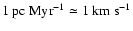 .
The density is given in
.
The density is given in
 corresponding to the number density of hydrogen atoms. The unit of the magnetic
field is
corresponding to the number density of hydrogen atoms. The unit of the magnetic
field is
 .
The diffusion coefficient is expressed in units of
.
The diffusion coefficient is expressed in units of
 .
The realistic parallel diffusion coefficients for the cosmic
ray transport as estimated by Strong & Moskalenko (1998), is based on the
GALPROP model:
.
The realistic parallel diffusion coefficients for the cosmic
ray transport as estimated by Strong & Moskalenko (1998), is based on the
GALPROP model:
 .
In our numerical tests we apply diffusion coefficients
ranging from
.
In our numerical tests we apply diffusion coefficients
ranging from
 .
.
We present test problems which are performed in the
computational box of physical size
 with a spatial resolution of
 grid zones in the x, y and
z directions, respectively. Periodic boundary conditions are applied on
all the domain boundaries.
grid zones in the x, y and
z directions, respectively. Periodic boundary conditions are applied on
all the domain boundaries.
As a first step we perform a test of passive cosmic ray transport along the
magnetic field, which is directed along the x-axis, assuming  and
a static medium, i.e.
and
a static medium, i.e.
 .
The passive transport means that
the cosmic ray gas has no dynamical influence onto the motion of thermal gas. This
can be achieved by neglecting the
in the equation of gas
motion. In case of a static distribution of gas and a uniform magnetic field
parallel to the x-axis the cosmic ray transport equation reduces to a
one-dimensional diffusion problem, described by the equation
.
The passive transport means that
the cosmic ray gas has no dynamical influence onto the motion of thermal gas. This
can be achieved by neglecting the
in the equation of gas
motion. In case of a static distribution of gas and a uniform magnetic field
parallel to the x-axis the cosmic ray transport equation reduces to a
one-dimensional diffusion problem, described by the equation
 |
(18) |
Assuming that the initial condition is given by
the cosmic-ray distribution
 |
(19) |
where r0 denotes the initial
half-width of the Gaussian profile, we expect that the numerical solution
should be close to the following analytical solution at any time
 |
(20) |
The comparison of the numerical solutions
with the analytical solution (Eq. (20)) is shown in Fig. 1. A perfect
consistency of the both analytical and numerical solutions is obvious.
![\begin{figure}
\par\includegraphics[width=7.5cm,clip]{4111-f1a.eps}\par\vspace*{3mm}
\includegraphics[width=7.3cm,clip]{4111-f1b.eps}
\end{figure}](/articles/aa/full/2003/48/aa4111/Timg54.gif) |
Figure 1:
Comparison of numerical solutions of the 1D, pure diffusion problem to
analytical solutions for t= 0 ( upper panel) and t=100 ( lower panel).
Continuous lines denote analytical
solutions for different times and crosses represent numerical solutions. |
| Open with DEXTER |
The next test for the diffusive cosmic-ray propagation is to check if the
simulated diffusion follows the analytical solution in case of an inclined magnetic field.
We set up the values of
 and
and perform simulations for
and
and perform simulations for
 and Bz=0.
Figure 2 presents two snapshots of cosmic ray distribution at t=0and t=100. It is apparent that qualitatively the anisotropic transport of
cosmic ray energy proceeds along the magnetic field according to our expectations.
![\begin{figure}
\par\includegraphics[width=8.4cm,clip]{4111-f2a.eps}\par\vspace*{3mm}
\includegraphics[width=8.4cm,clip]{4111-f2b.eps}
\end{figure}](/articles/aa/full/2003/48/aa4111/Timg57.gif) |
Figure 2:
Diffusion of cosmic rays along an inclined magnetic field: a) the initial
spheroidal distribution of
at t= 0 and b) the ellipsoidal
distribution at t=100. |
| Open with DEXTER |
However, a more precise evaluation of the numerical algorithm can be performed by
fitting a 2D-Gaussian function for the distribution of cosmic ray energy density
in the xy-plane. The diffusion along the z-direction is absent in the current
setup. The fitting procedure is performed with the aid of IDL routine gauss2dfit, which returns parameters of a 2D-Gaussian distribution, i.e. the
semi-axis of the ellipsoid, as well as the amplitude of the peak and the level
of the constant background distribution of cosmic ray energy. The results of
the fitting are shown in Fig. 3, where two 1-d slices along the
major and minor axis of the ellipsoid (crosses and asterisks respectively) are
shown together with the corresponding curves calculated on the base of the derived
parameters of the ellipsoid.
In the present case the fitted values of the parallel and perpendicular widths
of the 2D Gaussian profile and the fitted amplitude are
 ,
,
 ,
,
 .
Since ,
the
corresponding parameters of the exact solution can be derived from formula (20) representing the time evolution of 1D Gaussian profile. The
exact analytical solution gives
.
Since ,
the
corresponding parameters of the exact solution can be derived from formula (20) representing the time evolution of 1D Gaussian profile. The
exact analytical solution gives
 and
and
 .
If no perpendicular diffusion is
present, the perpendicular widths should not change, i.e.
.
If no perpendicular diffusion is
present, the perpendicular widths should not change, i.e.
 .
.
We note that the parallel width of the 2D Gaussian profile of the simulated cosmic
ray distribution coincides well with the analytical solution.
However, there are two noticeable effects of the limited accuracy of our numerical
algorithm. The first effect is the broadening of the perpendicular widths
 by about 10% of the original value. The broadening leads to a
lowering of the peak amplitude
by about 10% of the original value. The broadening leads to a
lowering of the peak amplitude  with respect to the exact solution since
the total cosmic ray energy is conserved in absence of gas flows. The second
effect of the limited numerical accuracy affects the formation of regions with
negative values of cosmic ray energy density at the base of steep sides of the
ellipsoid.
with respect to the exact solution since
the total cosmic ray energy is conserved in absence of gas flows. The second
effect of the limited numerical accuracy affects the formation of regions with
negative values of cosmic ray energy density at the base of steep sides of the
ellipsoid.
![\begin{figure}
\par\includegraphics[width=7.9cm,clip]{4111-f3.eps}
\end{figure}](/articles/aa/full/2003/48/aa4111/Timg66.gif) |
Figure 3:
Diffusion of cosmic rays along an inclined magnetic field at t=100. Two cuts
of the ellipsoid shown in Fig. 2 are made ( b) along the major axis
(crosses) and along the minor axis (asterisks). The full and dotted lines
represent the corresponding cuts of the fitted 2D Gaussian profile. |
| Open with DEXTER |
The depth of the
deficit (currently equal to -0.09123 at t=100) is
strongly dependent on the grid resolution and the steepness of the initial
cosmic ray energy distribution across the magnetic field lines. The presence of
negative CR energy density regions may lead to significant numerical artifacts
as soon as cosmic rays are coupled to the equation of gas motion. Therefore the
spatial resolution of the grid in conjunction with the magnitude of the cosmic ray
gradients is an issue of primary importance. The deficit vanishes in
proportion to the grid resolution, however there is a limited freedom of
reducing the size of the grid cell due to a drastic reduction of the timestep
given by formula (17).
An alternative way is to incorporate an
explicit perpendicular diffusion given by  equal to a few up to a few
10 percent of
equal to a few up to a few
10 percent of
 .
This procedure can be physically justified by
studies of cosmic ray transport in turbulent magnetic fields (Giaccalone &
Jokipii 1999). Another way to eliminate the spots of negative cosmic ray
energy density is to add a smooth background of cosmic rays prior to the
injection of very localized portions of cosmic ray energy. This is also a
physically justified procedure, since e.g. the smooth background of cosmic rays
is present in the ISM.
.
This procedure can be physically justified by
studies of cosmic ray transport in turbulent magnetic fields (Giaccalone &
Jokipii 1999). Another way to eliminate the spots of negative cosmic ray
energy density is to add a smooth background of cosmic rays prior to the
injection of very localized portions of cosmic ray energy. This is also a
physically justified procedure, since e.g. the smooth background of cosmic rays
is present in the ISM.
After testing the passive diffusion of cosmic rays we can now describe the
active propagation of cosmic rays within the overall setup similar to that of
the previous subsection. In the present configuration we apply the uniform
background of cosmic rays resulting from the assumption that cosmic ray
pressure is equal to the magnetic and gas pressure
 |
(21) |
where
 |
|
|
(22) |
 |
|
|
(23) |
and
 and
and
 are in
general constants of the order of 1 in the ISM. In the present case we adopt
are in
general constants of the order of 1 in the ISM. In the present case we adopt
 .
The constant scaling factors between
cosmic ray and gas background pressures as well as between magnetic and gas
pressures is adopted for testing purposes only. This approach is useful
especially in linear studies of Parker instability and follows the original
work by Parker (1966, 1967). In general, one can start with any arbitrarily
chosen initial magnetic field and cosmic ray distributions. The corresponding
background cosmic ray energy density in our units is
.
The constant scaling factors between
cosmic ray and gas background pressures as well as between magnetic and gas
pressures is adopted for testing purposes only. This approach is useful
especially in linear studies of Parker instability and follows the original
work by Parker (1966, 1967). In general, one can start with any arbitrarily
chosen initial magnetic field and cosmic ray distributions. The corresponding
background cosmic ray energy density in our units is
 ,
where
,
where
 denotes the isothermal sound speed and
 is the background
gas density.
is the background
gas density.
In order to investigate the coupling of cosmic rays to gas and magnetic field
we switch on the
term in the equation of gas motion
and inject about 50%
of
of the kinetic output of the SN
explosion. In our scaled units this corresponds to the initial peak amplitude
of the Gaussian CR distribution equal to 100 times the background thermal
energy density, i.e.
 .
Currently we apply a
rather small diffusion coefficient of cosmic rays
(corresponding to
.
Currently we apply a
rather small diffusion coefficient of cosmic rays
(corresponding to
 )
and
)
and
 in
order to illustrate the effects of cosmic ray propagation qualitatively.
in
order to illustrate the effects of cosmic ray propagation qualitatively.
![\begin{figure}
\par\includegraphics[width=8.4cm,clip]{4111-f4a.eps}\par\vspace*{3mm}
\includegraphics[width=8.4cm,clip]{4111-f4b.eps}
\end{figure}](/articles/aa/full/2003/48/aa4111/Timg81.gif) |
Figure 4:
Diffusion of cosmic rays along an inclined magnetic field at t=40: a) the cosmic ray energy density
and magnetic field
and b) distribution of gas density and gas velocity. |
| Open with DEXTER |
In Fig. 4 we present the cosmic ray - magnetic field distribution (panel a) and the density - velocity distribution (panel b) at t=40. The difference
between the passive and active cosmic ray transport is remarkable. First of all
the gradient of the cosmic ray pressure leads to the acceleration of gas. Due to
the effect of magnetic tension gas accelerates preferentially along the magnetic
field up to a few
 .
The outflow of gas from the cosmic
ray injection region together with the expansion forced by the cosmic ray pressure
implies the formation of a cavity in the gas distribution. On the other hand, gas
accumulates outside the cavity as it is visible in Fig. 4b, in the
upper-left and lower-right corners of the graphic.
.
The outflow of gas from the cosmic
ray injection region together with the expansion forced by the cosmic ray pressure
implies the formation of a cavity in the gas distribution. On the other hand, gas
accumulates outside the cavity as it is visible in Fig. 4b, in the
upper-left and lower-right corners of the graphic.
The gas motion along the magnetic field lines leads to an advection of cosmic rays
with the gas flows, which is noticeable in Fig. 4a as an enhanced
cosmic ray energy density coinciding with the enhanced gas density in
Fig. 4b. The coupling of cosmic rays to the gas component implies
that the cosmic rays spread faster with respect to the passive (pure diffusion)
transport. A broadening of the cosmic ray profile across the magnetic field is due
to the pressure of the cosmic ray gas and partially due to the imposed perpendicular
diffusion.
For the simulations of the cosmic ray transport in a stratified atmosphere we
adopt a physical domain and grid sizes
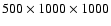 pc
and
pc
and
 grid zones, in x, y and z directions
respectively. We apply periodic boundary conditions to all the vertical domain
boundaries, a reflection boundary condition to the lower domain boundary and
outflow condition to the upper boundary.
grid zones, in x, y and z directions
respectively. We apply periodic boundary conditions to all the vertical domain
boundaries, a reflection boundary condition to the lower domain boundary and
outflow condition to the upper boundary.
The goal of the present work is to incorporate the cosmic ray transport into
studies of the dynamics of a gravitationally stratified interstellar medium.
In this section we perform an experiment similar to the ones presented in the previous
sections. However, in the present case a uniform vertical gravity is taken into
account for the construction of an initial equilibrium state.
The equilibrium fulfills the magnetohydrostatic force balance equation
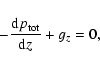 |
(24) |
where
 denotes the total pressure and
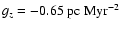 is the vertical, uniform gravitational
acceleration. The center of cosmic ray injection is placed at x=0, y=0 and
z=100. Two slices illustrating the geometry of the initial state are shown
in Fig. 5.
is the vertical, uniform gravitational
acceleration. The center of cosmic ray injection is placed at x=0, y=0 and
z=100. Two slices illustrating the geometry of the initial state are shown
in Fig. 5.
![\begin{figure}
\par\includegraphics[width=8.3cm,clip]{4111-f5a.eps}\par\vspace*{3mm}
\includegraphics[width=8.3cm,clip]{4111-f5b.eps}\end{figure}](/articles/aa/full/2003/48/aa4111/Timg88.gif) |
Figure 5:
Geometry of the initial state stratified by vertical gravity: a) the
slice in yz-plane showing the stratification of the background distribution of
cosmic rays and magnetic field along with the localized cosmic ray injection
region, b) the initial, horizontal magnetic field is parallel to the
horizontal and parallel to the y-axis. |
| Open with DEXTER |
![\begin{figure}
\par\includegraphics[width=8.3cm,clip]{4111-f6a.eps}\par\vspace*{...
...cm}\includegraphics[width=5.8cm,clip]{4111-f6c.eps}\hspace*{1cm}}
\end{figure}](/articles/aa/full/2003/48/aa4111/Timg89.gif) |
Figure 6:
Propagation of cosmic rays in a vertically stratified atmosphere for the
diffusion coefficient
 ,
after the local injection of cosmic
ray energy: a) cosmic ray energy density and magnetic field in the yz-plane
at x=0 and b) in the xy-plane at z=400, c) the density perturbation ,
after the local injection of cosmic
ray energy: a) cosmic ray energy density and magnetic field in the yz-plane
at x=0 and b) in the xy-plane at z=400, c) the density perturbation
 and the gas velocity in the xz-plane.
 |
| Open with DEXTER |
Figure 6 shows the state of the system at t=100 in case of
(corresponding to
 )
and .
Cosmic rays injected into a localized region diffuse anisotropically along the
magnetic field lines and populate a fluxtube marked by magnetic lines
threading the initial injection volume. Due to an excess of cosmic ray pressure
the flux tube becomes underdense and its central part starts to rise against
vertical gravity. The overall evolution of the fluxtube follows closely the
one described in the thin fluxtube approximation by Hanasz & Lesch (2000). The
gradient of the cosmic ray pressure accelerates gas, along the direction of
magnetic field, reducing additionally the gas density at the neighborhood of the
injection region. That effect enhances the strength of the buoyancy force.
)
and .
Cosmic rays injected into a localized region diffuse anisotropically along the
magnetic field lines and populate a fluxtube marked by magnetic lines
threading the initial injection volume. Due to an excess of cosmic ray pressure
the flux tube becomes underdense and its central part starts to rise against
vertical gravity. The overall evolution of the fluxtube follows closely the
one described in the thin fluxtube approximation by Hanasz & Lesch (2000). The
gradient of the cosmic ray pressure accelerates gas, along the direction of
magnetic field, reducing additionally the gas density at the neighborhood of the
injection region. That effect enhances the strength of the buoyancy force.
At t=100 the cosmic ray populated flux tube forms a rising Parker loop. In
Fig. 6c the relative density
is
shown in the xz-plane together with the velocity field. The apparent
tube-like cavity in the density distribution results from the local excess of
cosmic rays. The upward gas velocity is a consequence of the buoyancy force.
The rising tube compresses the overlying gas and pushes it toward higher
altitudes. The system perturbed by cosmic rays injected in a localized
spherical region forms a buoyant fluxtube and evolves in a fashion resembling
the development of an undulatory Parker instability mode.
When the diffusion coefficient takes a realistic value
 ,
which corresponds to
,
which corresponds to
 the evolution of the system
is remarkably different (see Figs. 7 and 8). The distribution
of cosmic rays along the flux tube becomes relatively uniform before the
buoyancy force starts to displace the tube in the vertical direction. The
perturbation provided by the cosmic ray input excites initially (up to t=100)
the interchange mode of the Parker instability with a weak contribution of the
undulatory mode. Later on, at t=150, the growing contribution of the
undulatory mode becomes apparent.
the evolution of the system
is remarkably different (see Figs. 7 and 8). The distribution
of cosmic rays along the flux tube becomes relatively uniform before the
buoyancy force starts to displace the tube in the vertical direction. The
perturbation provided by the cosmic ray input excites initially (up to t=100)
the interchange mode of the Parker instability with a weak contribution of the
undulatory mode. Later on, at t=150, the growing contribution of the
undulatory mode becomes apparent.
Due to the more efficient diffusion, cosmic rays fill in initially a larger
volume, compared to the case of lower diffusion coefficient. Therefore the
excess of cosmic ray pressure, and hence the buoyancy force, becomes weaker
but distributed over a larger volume. At the fixed time t=100 after the
cosmic ray injection the maximum vertical speed is smaller compared to the case
of smaller diffusion coefficient
,
although later on the
instability accelerates following the emergence of the undulatory mode. The
apparent tendency seems to be opposite to that resulting from the linear
stability analysis by Ryu et al. (2003). However, we point out that the lower
values of the diffusion coefficient are clearly leading to stronger nonlinear
effects, (for instance the vertical speed of the buoyant gas is almost equal to
the sound speed). The large cosmic ray energy remains localized in a more
compact region, therefore the applicability of the linear approximation for the
discussed case of lower parallel diffusion coefficient (
)
is
questionable. Despite the mentioned differences the late stages of the system
for small and realistic diffusion coefficients remains rather similar.
In this paper we presented a numerical algorithm for the inclusion of cosmic
ray dynamics, described by the diffusion-advection equation, into the MHD
code ZEUS-3D. In order to check the presented method we compared results of
the diffusive passive transport of cosmic rays with analytical solutions
of the diffusion equation. Our method appeared to be numerically stable in
case of active transport for a wide range of diffusion coefficients, including
the realistic values inferred from the observational data by Strong &
Moskalenko (1998) for the Milky Way.
We applied the presented numerical algorithm to two exemplary simulations of
the excitation of the Parker instability triggered by cosmic rays injected by
a single SN remnant. The only difference between the input parameters of the
two simulations is the magnitude of the parallel diffusion coefficient. The
simulation corresponding to the realistic value of the parallel diffusion
coefficient
 ,
presented in
Figs. 7 and 8 appeared to develop the Parker instability
mode slower than the one performed for
,
presented in
Figs. 7 and 8 appeared to develop the Parker instability
mode slower than the one performed for
 ,
presented in Fig. 6. Such a tendency differs from the one
resulting from linear analysis of the Parker instability by Ryu et al. (2003).
We show these two examples of evolution of the system in order to demonstrate
that in some circumstances the finiteness of the diffusion coefficient may lead
to effects which can not be described within the simple linear approximation.
Therefore a verification of all former analytical and numerical results
concerning the nonlinear development of the Parker instability in presence of
cosmic rays is necessary.
,
presented in Fig. 6. Such a tendency differs from the one
resulting from linear analysis of the Parker instability by Ryu et al. (2003).
We show these two examples of evolution of the system in order to demonstrate
that in some circumstances the finiteness of the diffusion coefficient may lead
to effects which can not be described within the simple linear approximation.
Therefore a verification of all former analytical and numerical results
concerning the nonlinear development of the Parker instability in presence of
cosmic rays is necessary.
The presented work is just a starting point, that focuses on developing the
basic computational techniques. In the next step we plan to combine the cosmic
ray transport in a more realistic application by including the dynamo action of
the cosmic ray component, reconfiguration of the magnetic field by magnetic
reconnection, different random spatial cosmic ray source distributions and
different supernova rates. The future work should also include effects of
cosmic ray losses and extensions of the present algorithm to the energy-dependent cosmic ray transport.
Acknowledgements
This work was supported by the Polish Committee for
Scientific Research (KBN) through the grant PB 404/P03/2001/20. The presented
work is continuation of a research program realized by MH under the financial
support of Alexander von Humboldt Foundation. We thank the Laboratory for
Computational Astrophysics, University of Illinois for providing the original
ZEUS-3D MHD code and the referee Dr. A. W. Strong for helpful comments. The
presented computations were done on the Linux cluster HYDRA placed at Torun
Centre for Astronomy.
- Beck, R. 2001,
Space Sci. Rev., 99, 243
NASA ADS
-
Berezinskii, V. S., Bulanov, S. V., Dogiel, V. A., Ginzburg, V. L., & Ptuskin, V. S. 1990,
Astrophysics of cosmic rays (Amsterdam: North-Holland)
In the text
- Birk, G. T.
2002, A&A, 391, 1155
In the text
NASA ADS
- Chou, W., Matsumoto, R., Tajima, T. Umekawa, M., & Shibata,
K. 2000, ApJ, 538, 710
In the text
NASA ADS
- Evans, C. R., & Hawley, J. F. 1988, ApJ, 332, 659
In the text
NASA ADS
- Ferriere, K. M. 2001, ApJ, 497, 759
NASA ADS
- Ferriere, K. M. 2001, Rev. Mod. Phys., 73, 1031
NASA ADS
- Fletcher, C. A. J. 1991, Computational Techniques for
Fluid Dynamics 1 (Springer-Verlag)
In the text
-
Foglizzo, T., & Tagger, M. 1994, A&A, 287, 297
In the text
NASA ADS
-
Foglizzo, T., & Tagger, M. 1995, A&A, 301, 293
In the text
NASA ADS
- Franco, J., Kim, J., Alfaro, E., & Hong, S. S.
2002, ApJ, 570, 647
In the text
NASA ADS
-
Giacalone, J., & Jokipii, R. J. 1999, ApJ, 520, 204
In the text
NASA ADS
- Giz, A. T., & Shu, F. H. 1993, ApJ, 404, 185
In the text
NASA ADS
- Hanasz, M., & Lesch, H. 1997, A&A, 321, 1007
In the text
NASA ADS
- Hanasz, M., & Lesch, H. 1998, A&A 332, 77
NASA ADS
- Hanasz, M., & Lesch, H. 2000, ApJ, 543, 235
In the text
NASA ADS
- Hanasz, M., & Lesch, H. 2001, Space Sci. Rev., 99, 231
NASA ADS
- Hanasz, M., Otmianowska-Mazur, K., & Lesch, H. 2002, A&A, 386, 347
In the text
NASA ADS
- Hawley, J. F., & Stone, J. M. 1995, Comput. Phys. Commun.,
89, 127
In the text
NASA ADS
- Jokipii, J. R. 1999,
in Interstellar Turbulence, ed. J. Franco, & A. Carraminana
(Cambridge University Press), 70
In the text
-
Jones, T. W., Rudnick, L., Jun, B.-I., et al. 1998, PASP, 110, 125
In the text
NASA ADS
- Kim, J., & Hong, S. S. 1998, ApJ, 507, 254
In the text
NASA ADS
- Kim, J., Hong, S. S., Ryu, D., & Jones, T. W.
1998, ApJ, 506, L139
NASA ADS
- Kim, J., Franco, J., Santillan, A., & Martos, M. A.
2000, ApJ, 531, 873
In the text
NASA ADS
- Kim, J., & Ryu, D. 2001, ApJ, 561, L135
In the text
NASA ADS
- Kuznetsov, V. D., & Ptuskin, V. S. 1983, Sov. Astron. Lett., 9, 75
In the text
NASA ADS
- Kim, W.-T., Ostriker, E. C., & Stone, J. M.
2002, ApJ, 581, 1080
In the text
NASA ADS
- Kowal, G. Hanasz, M., & Otmianowska-Mazur, K.
2003, A&A, 404, 533
In the text
NASA ADS
- Kosinski, R., & Hanasz, M.
2003, A&A, submitted
In the text
- Koyama, K. P., Petre, P., Gotthelf, E. V., et al. 1995, Nature, 378, 255
In the text
NASA ADS
-
Parker, E. N. 1966, ApJ, 145, 811
In the text
-
Parker, E. N. 1967, ApJ, 149, 535
In the text
NASA ADS
- Ryu, D., Kim, J., Hong, S. S., & Jones, T. W. 2003, ApJ, 589, 338
In the text
NASA ADS
- Schlickeiser, R., & Lerche, I. 1985, A&A, 151, 151
In the text
NASA ADS
- Shu, F. H. 1974, A&A, 33, 55
In the text
NASA ADS
-
Stone, J. M., & Norman, M. L. 1992a, ApJS, 80, 753
In the text
NASA ADS
-
Stone, J. M., & Norman, M. L. 1992b, ApJS, 80, 791
In the text
NASA ADS
- Strong, A. W., & Moskalenko, I. V. 1998, ApJ, 509, 212
In the text
NASA ADS
- Tanuma, S., Yokoyama, T., Kudoh, T., & Shibata, K.
2003, ApJ, 582, 215
In the text
NASA ADS
Copyright ESO 2003
![\begin{figure}
\par\includegraphics[width=7.5cm,clip]{4111-f1a.eps}\par\vspace*{3mm}
\includegraphics[width=7.3cm,clip]{4111-f1b.eps}
\end{figure}](/articles/aa/full/2003/48/aa4111/img54.gif)
![\begin{figure}
\par\includegraphics[width=8.4cm,clip]{4111-f2a.eps}\par\vspace*{3mm}
\includegraphics[width=8.4cm,clip]{4111-f2b.eps}
\end{figure}](/articles/aa/full/2003/48/aa4111/img57.gif)
![\begin{figure}
\par\includegraphics[width=7.9cm,clip]{4111-f3.eps}
\end{figure}](/articles/aa/full/2003/48/aa4111/img66.gif)
![\begin{figure}
\par\includegraphics[width=8.4cm,clip]{4111-f4a.eps}\par\vspace*{3mm}
\includegraphics[width=8.4cm,clip]{4111-f4b.eps}
\end{figure}](/articles/aa/full/2003/48/aa4111/img81.gif)
![\begin{figure}
\par\includegraphics[width=8.3cm,clip]{4111-f5a.eps}\par\vspace*{3mm}
\includegraphics[width=8.3cm,clip]{4111-f5b.eps}\end{figure}](/articles/aa/full/2003/48/aa4111/img88.gif)
![\begin{figure}
\par\includegraphics[width=8.3cm,clip]{4111-f6a.eps}\par\vspace*{...
...cm}\includegraphics[width=5.8cm,clip]{4111-f6c.eps}\hspace*{1cm}}
\end{figure}](/articles/aa/full/2003/48/aa4111/img89.gif)
![\begin{figure}
\par\includegraphics[width=8.3cm,clip]{4111-f7a.eps}\par\vspace*{...
...cm}\includegraphics[width=5.8cm,clip]{4111-f7c.eps}\hspace*{1cm} }\end{figure}](/articles/aa/full/2003/48/aa4111/img90.gif)
![\begin{figure}
\par\includegraphics[width=8.3cm,clip]{4111-f8a.eps}\par\vspace*{...
...1cm}\includegraphics[width=5.8cm,clip]{4111-f8c.eps}\hspace*{1cm}}\end{figure}](/articles/aa/full/2003/48/aa4111/img91.gif)