A&A 410, 833-845 (2003)
DOI: 10.1051/0004-6361:20031343
Chandra discovery of an X-ray jet and lobes in 3C 15
J. Kataoka1 -
J. P. Leahy2 -
P. G. Edwards3 -
M. Kino4,5 -
F. Takahara5 -
Y. Serino1 -
N. Kawai1 -
A. R. Martel6
1 - Tokyo Institute of Technology,
Meguro-ku, Tokyo, Japan
2 -
University of Manchester, Jodrell Bank Observatory,
Macclesfield, Cheshire SK11 9DL, UK
3 -
Institute of Space and Astronautical Science, Sagamihara,
Kanagawa, Japan
4 -
Earth and Planetary Science, University of Tokyo, Japan
5 -
Department of Earth and Space Science, Osaka University,
Osaka, Japan
6 -
Space Telescope Science Institute, 3700 San Martin Drive,
Baltimore, MD 21218, USA
Received 6 June 2003 / Accepted 13 August 2003
Abstract
We report the Chandra detection of an X-ray jet in 3C 15.
The peak of the X-ray emission in the jet is 4.1'' (a projected
distance of 5.1 kpc) from the nucleus, and coincident with a component
previously identified in the radio and optical jets.
We construct the spectral energy distribution (SED) for this
component, optical knot C, and find that X-ray flux is well below the
extrapolation of the radio-to-optical continuum.
We examine four models for the X-ray jet emission:
(I) weak synchrotron cooling in equipartition,
(II) moderate synchrotron cooling in equipartition,
(III) weak synchrotron plus synchrotron self-Compton (SSC) cooling, and
(IV) moderate synchrotron plus SSC cooling.
Given weak evidence for a concave feature in the X-ray spectrum, we
argue that case (II) can most reasonably explain the overall emission
from knot C.
Case (III) is also possible, but requires a large departure from
equipartition and for the jet power to be comparable to that of the
brightest quasars.
In all models, (I)-(IV), electrons must be accelerated
up to
 ,
suggesting that re-acceleration is necessary in knot C of the 3C 15 jet.
Diffuse X-ray emission has also been detected, distributed widely
over the full extent (63 kpc
,
suggesting that re-acceleration is necessary in knot C of the 3C 15 jet.
Diffuse X-ray emission has also been detected, distributed widely
over the full extent (63 kpc  25 kpc) of the radio lobes. The
X-ray spectrum of the diffuse emission is described by a two-component model,
consisting of soft thermal plasma emission from the host galaxy
halo and a hard nonthermal power-law component. The hard component
can be ascribed to the inverse Comptonization of cosmic microwave
background (CMB) photons by the synchrotron emitting electrons
in the radio lobes.
We compare the total energy contained in the lobes with the jet power
estimated from knot C, and discuss the energetic link between the jet
and the lobes. We argue that the fueling time (
25 kpc) of the radio lobes. The
X-ray spectrum of the diffuse emission is described by a two-component model,
consisting of soft thermal plasma emission from the host galaxy
halo and a hard nonthermal power-law component. The hard component
can be ascribed to the inverse Comptonization of cosmic microwave
background (CMB) photons by the synchrotron emitting electrons
in the radio lobes.
We compare the total energy contained in the lobes with the jet power
estimated from knot C, and discuss the energetic link between the jet
and the lobes. We argue that the fueling time (
 )
and
the source age (
)
and
the source age (
 )
are comparable for case (II), whereas
)
are comparable for case (II), whereas
 is likely for case (III).
The latter may imply that the jet has a very small filling factor,
is likely for case (III).
The latter may imply that the jet has a very small filling factor,
 10-3. We consider the pressure balance between the thermal
galaxy halo and non-thermal relativistic electrons in the radio lobes.
Finally, we show that the X-ray emission from the nucleus is not
adequately fitted by a simple absorbed power-law model, but needs an
additional power-law with heavy absorption (
10-3. We consider the pressure balance between the thermal
galaxy halo and non-thermal relativistic electrons in the radio lobes.
Finally, we show that the X-ray emission from the nucleus is not
adequately fitted by a simple absorbed power-law model, but needs an
additional power-law with heavy absorption (
 cm-2) intrinsic to the source. Such a high column
density is consistent with the presence of a dense,
dusty torus which obscures the quasar nucleus.
cm-2) intrinsic to the source. Such a high column
density is consistent with the presence of a dense,
dusty torus which obscures the quasar nucleus.
Key words: galaxies: active - galaxies: individual: 3C 15 -
galaxies: jets - X-rays: galaxies
Jets are among the most exciting (but also among the least understood)
cosmic phenomena, being highly efficient particle accelerators that
generate relativistic electron distributions. This extreme jet power is
most likely generated near a super-massive black hole, probably via the
conversion of gravitational energy from accreting matter.
The interest in observations of jets at shorter wavelengths is
related to the ability to (1) probe the sites of high energy particle
acceleration and help determine their physical parameters, and (2) trace the energy transport from the nucleus to the outer hot
spots/radio lobes. However, observations of jets with high spatial
resolution ( 1'') have until recently only been possible at
lower frequencies, i.e., at radio and optical wavelengths.
1'') have until recently only been possible at
lower frequencies, i.e., at radio and optical wavelengths.
The excellent spatial resolution of the Chandra X-Ray
Observatoryhas now resolved the X-ray spatial structure along the jets of more than
20 radio galaxies (e.g., Harris & Krawczynski 2002, and references
therein). The broadband spectral energy distributions (SEDs) of knots
and hotspots show great variety between the radio and X-ray energy
bands. In most cases, the X-ray spectra are much harder than expected
from a simple extrapolation of the optical fluxes. This suggests that both
the radio and optical photons are due to the same non-thermal synchrotron
radiation, whereas X-ray photons are produced via Compton scattering
of either synchrotron photons (SSC; e.g., Wilson et al.
2001 for the hotspot of Pictor A) and/or cosmic microwave background
photons (EC/CMB; e.g., Sambruna et al. 2001 for the knots in 3C 273).
In other cases, the X-ray-optical-radio spectrum is consistent with a
single smoothly broken power-law spectrum, suggesting that the broad
band emission is entirely due to non-thermal synchrotron radiation
(e.g., Wilson & Yang 2002 for the jet of M 87, and Hardcastle et al. 2001 for jet in 3C 66B).
The X-ray detections of jets and hotspots have a great impact on the
determination of their physical parameters, as well as the maximum energy of
accelerated electrons (see (1) above). Once the source of seed
photons is identified, a comparison of the synchrotron (radio to X-ray)
and inverse Compton (SSC or EC/CMB; X-ray) fluxes allows us to
independently determine the energy densities of the relativistic electrons and
the magnetic field,  and uB respectively. This approach has
been applied to X-ray observations of radio lobes with ASCA(Kaneda et al. 1995; Tashiro et al. 2001), in which the X-ray emission
extends over arcmin scale sizes. By analyzing X-ray data of more than
10 radio lobes, Isobe (2002) found that lobes are generally
"particle dominated'', in the sense that
and uB respectively. This approach has
been applied to X-ray observations of radio lobes with ASCA(Kaneda et al. 1995; Tashiro et al. 2001), in which the X-ray emission
extends over arcmin scale sizes. By analyzing X-ray data of more than
10 radio lobes, Isobe (2002) found that lobes are generally
"particle dominated'', in the sense that
 .
Recent Chandra detections of knots and hotspots have resulted in this
idea being extended to more compact regions in jets with arcsec
spatial extents. In some objects, the X-ray fluxes of knots and hotspots
turned out to be much brighter than that expected from equipartition
between particles and fields (e.g., Hardcastle et al. 2002;
Kataoka et al. 2003; Georganopoulos & Kazanas 2003).
.
Recent Chandra detections of knots and hotspots have resulted in this
idea being extended to more compact regions in jets with arcsec
spatial extents. In some objects, the X-ray fluxes of knots and hotspots
turned out to be much brighter than that expected from equipartition
between particles and fields (e.g., Hardcastle et al. 2002;
Kataoka et al. 2003; Georganopoulos & Kazanas 2003).
Comparison of the powers in jets and lobes provides an important
clue to the formation of astrophysical jets and the evolution of radio
galaxies (see (2) above). This is because lobes are undoubtedly
fueled by jets over a long time, possibly throughout their lifetime.
Assuming the total power of the jet ( )
and the total
energy supplied in the radio lobes (
)
and the total
energy supplied in the radio lobes (
 ),
the "fueling time'' of the system may be defined as
),
the "fueling time'' of the system may be defined as
 .
Meanwhile, the "source age'' can be defined as
.
Meanwhile, the "source age'' can be defined as
 ,
where the D is the
spatial extent and
,
where the D is the
spatial extent and
 is the expansion speed of the radio
lobes. Observationally, symmetry arguments show that the main-axis
expansion of FR II lobes is sub-relativistic
(
0.1 c; e.g., Scheuer 1995),
and since the lobes are not spherical the
limit to transverse expansion is several times lower. In fact, lobes are
surrounded by hot plasma which will prevent them expanding freely,
either by thermal or by ram-pressure confinement (e.g., Leahy & Gizani 2001).
We expect
is the expansion speed of the radio
lobes. Observationally, symmetry arguments show that the main-axis
expansion of FR II lobes is sub-relativistic
(
0.1 c; e.g., Scheuer 1995),
and since the lobes are not spherical the
limit to transverse expansion is several times lower. In fact, lobes are
surrounded by hot plasma which will prevent them expanding freely,
either by thermal or by ram-pressure confinement (e.g., Leahy & Gizani 2001).
We expect
 if the jet power is
injected into the radio lobes in a stationary, constant manner.
A large departure from this equality may imply that either the injection
of power by the jet is not uniform, and/or that there are significant
contributions from particles which we cannot observe.
Comparison of
and
provides important information for understanding the jet-lobe connection.
if the jet power is
injected into the radio lobes in a stationary, constant manner.
A large departure from this equality may imply that either the injection
of power by the jet is not uniform, and/or that there are significant
contributions from particles which we cannot observe.
Comparison of
and
provides important information for understanding the jet-lobe connection.
3C 15 is an unusual radio source with an optical jet
which has been imaged with the Hubble Space Telescope (HST).
The HST observations found no bright,
unresolved nucleus in the core of the galaxy,
in contrast to other galaxies hosting optical jets (Martel et al. 1998).
The radio structure of 3C 15 is intermediate between Fanaroff-Riley (FR)
classes I and II,
although its luminosity is above that of a number of sources
showing classical FR II structure (Leahy et al. 1997). The optical
morphology of the jet matches the features of the radio jet very well,
suggesting that the optical emission is strongly dominated by
synchrotron radiation.
In this paper, we report the Chandra discovery of X-ray emission
from the knots, lobes and nucleus of 3C 15.
By combining the data from radio to X-rays, we derive the power of the
jet and the lobes separately for extensive study.
Throughout this paper, we adopt H0 = 75 km s-1 Mpc-1 and
q0 = 0.5, so that 1'' corresponds to 1.25 kpc at the redshift of
3C 15, z=0.073.
3C 15 has a bright northern jet containing four prominent knots,
with a much weaker counter-jet on the southern side of the nucleus.
VLA observations at 8.3 GHz were made by Leahy et al. (1997), and
we use these data in this paper, with an 0.34 arcsec resolution image shown
as contour levels in Fig. 1 (upper right).
The nucleus and jets are surrounded by lobe emission, which extends over
50 arcsec (a projected distance of 63 kpc). The surface brightness profile
of 3C 15 projected onto the major axis of the radio lobes
is shown in Fig. 2. Leahy et al. (1997) labeled the four radio knots A, B, C and D, however, the optical observations described in the next
section resolved the radio knot A into two optical knots. In this paper
we follow the optical scheme of labeling the knots A and B (corresponding
to radio knot A) and C (corresponding to radio knot B).
The jet-counter-jet flux density ratio is 50  10 (Leahy et al. 1997).
The VLA images suggests the source does not lie in the plane of the sky,
in which case the jet asymmetry may partially be due to relativistic
beaming. Assuming a spectral index,
10 (Leahy et al. 1997).
The VLA images suggests the source does not lie in the plane of the sky,
in which case the jet asymmetry may partially be due to relativistic
beaming. Assuming a spectral index,
 ,
of 0.6 (where
,
of 0.6 (where
 ), the flux asymmetry implies
 ,
hence
,
hence
 -
-
 for
for
 .
This corresponds to a Doppler beaming factor in the range
.
This corresponds to a Doppler beaming factor in the range
 .
.
![\begin{figure}
\par\includegraphics[width=6cm]{aa4072-f1a.eps}\hspace*{1.6cm}
\...
...{4.1cm}\includegraphics[width=6cm]{aa4072-f1c.eps}\hspace*{4.1cm}}
\end{figure}](/articles/aa/full/2003/42/aa4072/Timg35.gif) |
Figure 1:
Upper left: a 0.4-8 keV X-ray image of 3C 15
(Chandra ACIS-S3) smoothed with a two-dimensional Gaussian of
 arcsec. Upper right: radio and X-ray image of 3C 15
lobes and jet (expanded plot of the solid square in the left panel).
The grey scale is the X-ray image smoothed with a arcsec. Upper right: radio and X-ray image of 3C 15
lobes and jet (expanded plot of the solid square in the left panel).
The grey scale is the X-ray image smoothed with a
 arcsec Gaussian. The VLA 8.3 GHz image is adapted from
Leahy et al. (1997). The contour levels are (0.02, 0.11, 0.62, 3.5, 20)
mJy beam-1 for a beam size of 0.34 arcsec Gaussian. The VLA 8.3 GHz image is adapted from
Leahy et al. (1997). The contour levels are (0.02, 0.11, 0.62, 3.5, 20)
mJy beam-1 for a beam size of 0.34
 .
Bottom: expanded plot of the central jet region (17.4 .
Bottom: expanded plot of the central jet region (17.4
 )
shown by the solid square in the upper right panel).
The image is smoothed with a
arcsec Gaussian. A, B, and C
denote the jet knots as defined in Martel et al. (1998).
The VLA contour levels are (0.2, 0.56, 1.6, 4.3, 12) mJy beam-1 for a
beam size of 0.34
. )
shown by the solid square in the upper right panel).
The image is smoothed with a
arcsec Gaussian. A, B, and C
denote the jet knots as defined in Martel et al. (1998).
The VLA contour levels are (0.2, 0.56, 1.6, 4.3, 12) mJy beam-1 for a
beam size of 0.34
.
|
| Open with DEXTER |
The optical counterpart of the radio jet in 3C 15 was found in HST
observations by Martel et al. (1998), and we use these HST data in
this paper. The optical morphology of the jet closely matches the
features of the radio jet, suggesting that the optical emission is
strongly dominated by synchrotron radiation (Fig. 5 of Martel et al. 1998).
Three prominent knots in the jet were detected at a PA of -30 .
Thanks to the excellent image resolution of the HST (0.1''), the size of each knot has been accurately measured.
The innermost knot, knot A, is broad and diffuse. It extends from
2.6 kpc (2.1'') to 3.5 kpc (2.8'') from the nucleus. Knots B and C
are comparatively compact and well defined. The FWHMs of knot B and C
are both 0.5 kpc. The outermost knots of the radio jet, defined as
C and D by Leahy et al. (1997) are not detected in the optical image.
Martel et al. (1998) compared the fluxes of the jet measured in the V and R bands with radio and soft X-ray data. The low resolution
radio data and the X-ray observations made by ROSAT include flux
contributions from both the jet and the nucleus of 3C 15. A fit through
the radio to optical data yields
.
Thanks to the excellent image resolution of the HST (0.1''), the size of each knot has been accurately measured.
The innermost knot, knot A, is broad and diffuse. It extends from
2.6 kpc (2.1'') to 3.5 kpc (2.8'') from the nucleus. Knots B and C
are comparatively compact and well defined. The FWHMs of knot B and C
are both 0.5 kpc. The outermost knots of the radio jet, defined as
C and D by Leahy et al. (1997) are not detected in the optical image.
Martel et al. (1998) compared the fluxes of the jet measured in the V and R bands with radio and soft X-ray data. The low resolution
radio data and the X-ray observations made by ROSAT include flux
contributions from both the jet and the nucleus of 3C 15. A fit through
the radio to optical data yields
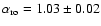 .
When the flux measurement of only the northern jet (combined knots A, B, and C) is considered, a radio-optical spectral index of 0.95
0.01
is obtained.
.
When the flux measurement of only the northern jet (combined knots A, B, and C) is considered, a radio-optical spectral index of 0.95
0.01
is obtained.
3C 15 was observed by the Chandra X-ray
Observatory on 2000 November 6
in a guaranteed time observation (sequence number 700 368, obs. ID 2178)
using the Advanced CCD Imaging Spectrometer (ACIS-S) spectroscopic
array. The nucleus of 3C 15 was centered 20'' in the -Y direction
from the location of the best focus on chip S3 (nominal position of the
ACIS-S3 chip).
All of the regions of radio emission from 3C 15 were imaged on S3.
The total good time interval was 28.2 ksec, taken with the default frame
time of 3.2 s.
We have analyzed archival data on 3C 15 provided by HEASARC Browse
(http://heasarc.gsfc.nasa.gov/ dp-perl/ W3Browse/ Browse.pl).
The raw level-1 data were reprocessed using the latest version
(CIAO 2.2.1) of the CXCDS software and version 11.1.0 of XSPEC.
We generated a clean data set by selecting the standard grades
(0, 2, 3, 4 and 6) and the energy band 0.4-8 keV.
The X-ray image, produced by smoothing the raw Chandra image
in the energy range of 0.4-8 keV with a Gaussian of width 1.0''
is shown in Fig. 1 (upper left). We find faint X-ray emission
surrounding the nucleus, extended in the north-west-south-east
direction. Comparing this to the 8.3 GHz VLA image in Leahy et al. (1997),
the extended X-ray emission appears to be correlated with the extended
radio lobes. An expanded plot of the solid square in the left figure is shown in
the right panel, where the radio contours are superposed on the
X-ray image (grey scale) smoothed with a  = 0.3 arcsec Gaussian.
X-ray emission can be clearly seen from the bright central nucleus and
the northern jet. An expanded plot of the central jet region
(17.4''
17.4'') is shown in the bottom panel.
The nucleus and jet knots are detected at the 22.9
(527 counts)
and 7.7
(60 counts for knot C: see below) level, respectively.
The number of net X-ray photons associated with the radio lobes is 246 photons, which includes a background of 73 photons in the 0.4-8 keV
range (11 level), where we have excluded pixels within 1.9''
of the possible
point sources, including knot C, knot A' and the nucleus (see below).
= 0.3 arcsec Gaussian.
X-ray emission can be clearly seen from the bright central nucleus and
the northern jet. An expanded plot of the central jet region
(17.4''
17.4'') is shown in the bottom panel.
The nucleus and jet knots are detected at the 22.9
(527 counts)
and 7.7
(60 counts for knot C: see below) level, respectively.
The number of net X-ray photons associated with the radio lobes is 246 photons, which includes a background of 73 photons in the 0.4-8 keV
range (11 level), where we have excluded pixels within 1.9''
of the possible
point sources, including knot C, knot A' and the nucleus (see below).
![\begin{figure}
\par\includegraphics[angle=90,width=8.8cm,clip]{aa4072-f2.eps} \end{figure}](/articles/aa/full/2003/42/aa4072/Timg38.gif) |
Figure 2:
Log profiles along the major axis of the lobes of 3C 15.
a) The X-rays in the 0.4-8 keV range, b) the radio emission at
8.3 GHz (normalized to the nuclear radio flux),
and c) the ratio between the radio and X-ray profiles
(
 / / ;
normalized to central nucleus). ;
normalized to central nucleus). |
| Open with DEXTER |
In order to examine the spatial correlation between the radio and X-ray
emission, we projected the raw ACIS image onto the major axis of the
radio lobes. Here the strip integration is restricted to a width of
20'' transverse to the major axis.
The X-ray logarithmic surface brightness profile
is shown in Fig. 2a, together with the radio profile
in Fig. 2b. The X-ray profile has been smoothed with a
Gaussian of width 1''. No background subtraction has been performed in
the X-ray image, hence the profile contains an average background of 0.64 counts/bin in the 0.4-8.0 keV band (given as the dashed line in
Fig. 2a).
Although the X-ray photon statistics are limited, the X-ray and radio profiles
clearly show similar spatial extents but different structures.
The X-ray profile exhibits a "center-filled'' morphology with a
relatively uniform surface brightness (except for the nucleus region),
while the northern jet and southern rim are bright in the radio image.
These differences can also be seen in the bottom panel, where the
surface brightness ratio
(
/;
normalized to the nucleus)
is a minimum at the center, and gradually increases at larger distances.
The expanded profile of the X-ray jet is shown in Fig. 3, together
with the radio (VLA 8.3 GHz) and optical (HST) jet profiles.
Note that the strong background light of host galaxy is subtracted in the
optical profile, resulting in only the jet knots being visible
(see also Sect. 4.3).
The X-ray image resolution is poorer than that of the optical and radio, but
it is clear that most of the X-ray jet emission originates
from the knot C of Martel et al. (1998). The total extent (FWHM) of the
X-ray nucleus and knot C are both 1'',
consistent with the the broadening
of the Chandra PSF (0.5'' half-energy radius).
There is also a suggestion of faint X-ray emission
from the northern jet intermediate between the nucleus and knot C
(denoted A' in Fig. 3c), although this is heavily
contaminated by the bright nuclear emission.
This feature is located 1.8
0.1'' from
the nucleus, and contains 45
12 photons.
This position is
approximately coincident with the innermost knot detected
by HST (knot A; see Sect. 2.2), however the offset of (0.2-0.9)
0.1''
between the X-ray and optical peaks, with the X-ray peak being closer
to the nucleus, seems to be significant.
Future observations with improved photon statistics and image resolution
are necessary to confirm this.
![\begin{figure}
\par\includegraphics[angle=90,width=8.8cm,clip]{aa4072-f3.eps} \end{figure}](/articles/aa/full/2003/42/aa4072/Timg39.gif) |
Figure 3:
Log profiles along the major axis of the jet of 3C 15,
a) the radio emission at 8.3 GHz,
b) the V band (HST; adapted from Fig. 3 in Martel et al. 1998), and
c) the X-rays in the 0.4-8 keV range.
All jet profiles are normalized to the knot C flux.
The underlying galactic light, and hence bright nuclear
emission, are subtracted in the optical profile b). |
| Open with DEXTER |
Table 1:
Best-fit spectral parameters for knot C of 3C 15.
![\begin{figure}
\par\includegraphics[angle=90,width=8.8cm,clip]{aa4072-f4.eps} \end{figure}](/articles/aa/full/2003/42/aa4072/Timg46.gif) |
Figure 4:
Background-subtracted ACIS spectrum of knot C
fitted by a broken power-law function. The middle panel shows the residuals to
the power-law fit with a differential photon index of  1.7.
A concave feature is apparent in the residuals. The bottom panel shows the
residuals to the best-fit broken power-law model fixed at
1.7.
A concave feature is apparent in the residuals. The bottom panel shows the
residuals to the best-fit broken power-law model fixed at  =
3.0 and =
3.0 and  = 1.5. = 1.5. |
| Open with DEXTER |
We extracted the X-ray photons from knot C
within a circular region of 1.6'' radius, to reduce the contamination
of photons from knot A' (to less than 10%).
Approximately 97% of the counts from a point source are
collected within a circular region of this size.
Background subtraction was performed, where the
background counts were accumulated at the same off-nuclear distance.
Figure 4 shows the background-subtracted ACIS
spectrum of knot C. We first assumed a power-law function absorbed by
Galactic  only (fixed to 3.03
1020 cm2: Stark
et al. 1992). The best fit X-ray photon index was
only (fixed to 3.03
1020 cm2: Stark
et al. 1992). The best fit X-ray photon index was
 = 1.71
+0.44-0.36,
and the corresponding 0.5-5 keV
flux was (8.38
+1.83-1.85)
10-15 erg cm-2 s-1. The
reduced
= 1.71
+0.44-0.36,
and the corresponding 0.5-5 keV
flux was (8.38
+1.83-1.85)
10-15 erg cm-2 s-1. The
reduced  is 3.1 for 2 degrees of freedom, which corresponds to
 = 5%. Although the photon spectrum can formally
be fitted by a simple power-law function, in the sense
that
= 5%. Although the photon spectrum can formally
be fitted by a simple power-law function, in the sense
that  5%, it is apparent that the model
does not provide the best possible fit to the data;
the observed X-ray spectrum show a concave feature with a break around
1 keV (Fig. 4). Spectral fits with a broken power-law model improve
the goodness of the fit significantly, as summarized in Table 1.
Note that, below this break energy, the photon spectrum shows a steep
power-law index of
5%, it is apparent that the model
does not provide the best possible fit to the data;
the observed X-ray spectrum show a concave feature with a break around
1 keV (Fig. 4). Spectral fits with a broken power-law model improve
the goodness of the fit significantly, as summarized in Table 1.
Note that, below this break energy, the photon spectrum shows a steep
power-law index of
 3.0, which
flattens appreciably to
3.0, which
flattens appreciably to
 1.5 above the break.
The 0.5-5 keV flux was estimated to be
(8.73
+1.85-2.02)
10-15 erg cm-2 s-1.
1.5 above the break.
The 0.5-5 keV flux was estimated to be
(8.73
+1.85-2.02)
10-15 erg cm-2 s-1.
To examine the diffuse X-ray emission from the radio lobes,
we accumulated an ACIS spectrum
within an elliptical region containing the whole radio structure.
An ellipse of 60''
30'' centered
on the nucleus was selected, excluding regions around the jet and the
nucleus (see above) and those within 2'' of a
possible point source. We accumulated the background spectrum
over a circular region of 1 arcmin radius centered on the nucleus,
excluding the region of the lobes. Figure 4 shows the background-subtracted ACIS
spectrum of the lobes of 3C 15 in the 0.5-5 keV range. The X-ray
spectrum could not be fitted well by either
a simple Raymond-Smith (RS) model or a power-law (PL) function. The
were 2.1 and 1.8
for 6 degrees of freedom, respectively ( = 0.05, 0.09),
with a significant excess around 0.7-1.0 keV.
We thus fitted the data by a single PL plus RS model
with the abundance fixed at 0.4 solar. The obtained parameters are
summarized in Table 2, and results of fits by PL+RS model is shown in
Fig. 5. The total X-ray flux of the radio lobes is calculated to be
(3.18
+0.75-0.61)
10-14 erg cm-2 s-1 in the
0.5-5 keV energy range. The X-ray luminosity of the thermal component
fitted to RS model is
 =
(4.51+2.99-1.91)
1040 erg s-1,
whereas
=
(4.51+2.99-1.91)
1040 erg s-1,
whereas
 =
(1.25+0.42-0.46)
1041 erg s-1
for the non-thermal PL component.
=
(1.25+0.42-0.46)
1041 erg s-1
for the non-thermal PL component.
Table 2:
Best-fit spectral parameters for the lobes of 3C 15.
![\begin{figure}
\par\includegraphics[angle=90,width=8.8cm,clip]{aa4072-f5.eps} \end{figure}](/articles/aa/full/2003/42/aa4072/Timg62.gif) |
Figure 5:
Background-subtracted ACIS spectrum of the lobes of
3C 15. The dotted and dashed histograms represent the best-fit soft
RS and hard PL components, respectively. The solid line shows their
sum. The second panel shows the residuals to the Raymond-Smith fit with a
temperature of kT = 2.9 keV. The third panel shows the residuals to the
power-law fit with differential photon index 1.9.
The bottom panel shows the residuals to the best-fit Raymond-Smith
plus power-law model. |
| Open with DEXTER |
Table 3:
Best-fit spectral parameters for the nucleus of 3C 15.
![\begin{figure}
\par\includegraphics[angle=90,width=8.8cm,clip]{aa4072-f6.eps} \end{figure}](/articles/aa/full/2003/42/aa4072/Timg70.gif) |
Figure 6:
Background-subtracted ACIS spectrum of the nucleus of 3C 15. The best-fit model, consisting of two power-law components, is
shown with the histograms. The middle panel shows the residuals to
the power-law fit with a differential photon index
0.5.
The bottom panel shows the residuals to the best-fit double power-law model. |
| Open with DEXTER |
X-ray photons from the nucleus were extracted from a circular
region of 1.9'' radius (within which approximately 98% of counts
from a point source would be collected).
Contamination of photons from knot A' is less than 1%. The background
photons were accumulated over the lobe region.
Figure 6 shows the background-subtracted ACIS spectrum of the
nucleus. A high energy bump is seen in the spectrum,
which cannot be fitted by a simple power-law function
(red. = 32.0 for 22 degrees of freedom; = 0.08).
We therefore adopt a model consisting of two power-law functions,
one of which is modified by Galactic absorption (PL1) with the
other (PL2) having a heavily absorbed neutral hydrogen column
density intrinsic to the source. A satisfactory fit was obtained if
we assumed = (
7.3-3.9+6.0)
1022 cm-2
for PL2. In order to reduce the error in the power-law index for PL2,
we thus fixed
to 7.0
1022 cm-2 and refit
the data. The best-fit parameters are summarized in Table 3.
The absorption corrected fluxes were
(6.81-1.00+1.14)
10-14 erg cm-2 s-1 for PL1, and
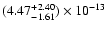 erg cm-2 s-1 for PL2, respectively. The corresponding X-ray luminosities are
 =
(3.52+0.59-0.52)
1041 erg s-1, and
=
(3.52+0.59-0.52)
1041 erg s-1, and
 =
(2.31+1.24-0.83)
1042 erg s-1,
respectively.
=
(2.31+1.24-0.83)
1042 erg s-1,
respectively.
![\begin{figure}
\par\includegraphics[angle=90,width=8.6cm,clip]{aa4072-f7a.eps}\h...
...*{2mm}
\includegraphics[angle=90,width=8.6cm,clip]{aa4072-f7d.eps} \end{figure}](/articles/aa/full/2003/42/aa4072/Timg73.gif) |
Figure 7:
SED of knot C of the 3C 15 jet. The radio and optical fluxes are
calculated by direct integration from the radio and optical images
given in Leahy et al. (1997) and Martel et al. (1998).
The X-ray data are from the Chandra observations
(this work; 1
error at 1 keV flux).
The four models considered in the text are plotted:
(I) weak synchrotron cooling for = uB,
(II) moderate synchrotron cooling for = uB,
(III) weak synchrotron plus SSC cooling, and
(IV) moderate synchrotron plus SSC cooling.
The fitting parameters are summarized in Table 4. |
| Open with DEXTER |
As described in the previous sections, we have detected the X-ray
counterpart of the radio-optical jet-knot in the radio galaxy 3C 15.
Figure 7 shows the SED from radio to X-ray energies of knot C.
Since only the integrated fluxes of the radio and optical knots (from A to C or D) are given in the literature, we calculated the radio and optical
fluxes of knot C by direct integration from the radio and optical images.
These are 35 mJy for 8.3 GHz and 6.5  Jy for V band, respectively
(see Leahy et al. 1997 and Martel et al. 1998 for the integrated jet
fluxes).
Figure 7 clearly indicates that the X-ray flux obtained with Chandra
is well below the extrapolation from the radio-to-optical continuum.
A power-law fit (
Jy for V band, respectively
(see Leahy et al. 1997 and Martel et al. 1998 for the integrated jet
fluxes).
Figure 7 clearly indicates that the X-ray flux obtained with Chandra
is well below the extrapolation from the radio-to-optical continuum.
A power-law fit (

 ,
where
is the flux density) through the radio and optical points yields a
spectral index of
,
where
is the flux density) through the radio and optical points yields a
spectral index of
 = 0.9, whereas a
power-law fit through the optical and X-ray (at 1 keV) data yields a
steeper spectral index of
= 0.9, whereas a
power-law fit through the optical and X-ray (at 1 keV) data yields a
steeper spectral index of

 1.1-1.2.
This fact suggests that the synchrotron peak in the
1.1-1.2.
This fact suggests that the synchrotron peak in the

 plot must lie below the X-ray energy bands.
However, the X-ray emission process of knot C is currently uncertain due
to the poor photon statistics (Fig. 4): in fact, we cannot conclude if
the X-ray spectrum is "falling'' or "rising'' in the
SED plane. The former case would suggest that the X-rays are produced
by pure synchrotron emission, as for the radio-to-optical bands, whereas the
latter would imply that the X-rays are the low end of the hard inverse
Compton (IC) emission. In the following, we thus consider both these scenarios
in discussing the jet parameters.
plot must lie below the X-ray energy bands.
However, the X-ray emission process of knot C is currently uncertain due
to the poor photon statistics (Fig. 4): in fact, we cannot conclude if
the X-ray spectrum is "falling'' or "rising'' in the
SED plane. The former case would suggest that the X-rays are produced
by pure synchrotron emission, as for the radio-to-optical bands, whereas the
latter would imply that the X-rays are the low end of the hard inverse
Compton (IC) emission. In the following, we thus consider both these scenarios
in discussing the jet parameters.
Table 4:
Comparison of fitting parameters of the SED for knot C.
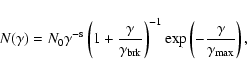
A power-law energy injection of electrons up to a certain maximum
energy
 (as expected from shock acceleration) into the
radiating region should yield a steady-state electron distribution
approximated by
(as expected from shock acceleration) into the
radiating region should yield a steady-state electron distribution
approximated by
 |
(1) |
where s is the injection index, and N0 is the number density of
electrons per energy at  = 1 (e.g., Inoue & Takahara 1996).
We assume the minimum Lorentz factor of electrons,
= 1 (e.g., Inoue & Takahara 1996).
We assume the minimum Lorentz factor of electrons,
 ,
is equal to unity unless otherwise stated (see below).
The parameter
,
is equal to unity unless otherwise stated (see below).
The parameter
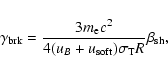
 is the characteristic energy above
which the electron spectrum breaks by one power in the index,
and is determined by the balance between radiative cooling and
advective escape and/or adiabatic energy loss,
is the characteristic energy above
which the electron spectrum breaks by one power in the index,
and is determined by the balance between radiative cooling and
advective escape and/or adiabatic energy loss,
 |
(2) |
where uB is the magnetic energy density,
 is the seed
photon energy density, R is the source radius and
is the seed
photon energy density, R is the source radius and
 is the shock velocity normalized to the velocity of light.
The parameter
could be determined by equating the
radiative cooling time with the acceleration time scale. Although the
acceleration time is not as well understood as the cooling time
(via the synchrotron and inverse-Compton losses), it can be approximated
by considering the mean free path,
 ,
for the
scattering of electrons with magnetic disturbances.
Taking the mean free path to be proportional to the Larmor radius,
,
for the
scattering of electrons with magnetic disturbances.
Taking the mean free path to be proportional to the Larmor radius,
 ,
by introducing another parameter,
,
by introducing another parameter,  [=
[= /], the maximum energy of electrons is given by
![\begin{displaymath}%
\gamma_{\rm max} = \left[\frac{9 e B}{80(u_B + u_{\rm soft}) \sigma_{\rm T}\xi}\right]^{1/2} \beta_{\rm sh}.
\end{displaymath}](/articles/aa/full/2003/42/aa4072/img138.gif) |
(3) |
We note that the break in the electron population, of course, will not
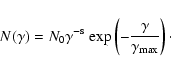
appear if
is larger than
.
In this
case, Eq. (1) will be reduced to a simpler form
 |
(4) |
Following Kino & Takahara (2003), we call the latter situation "weak cooling
(WCL)'' since radiative cooling is not efficient, and the
injected electron spectrum keeps its original form. Meanwhile,
"moderate cooling (MCL)'' represents the former situation
(
<
), producing a cooling
break in the electron spectral distribution (Eq. (1)).
Our goal is to derive the above jet parameters so as not to conflict
with the observational results. Assuming a spherical geometry for
the emission region, the radius of the knot C in 3C 15 can be set to
R = 7.7
1020 cm (corresponding to the FWHM of 0.5 kpc; see
Sect. 2.2). We do not consider Doppler beaming/de-beaming effects
and take
 1, following the suggestion of Leahy et al. (1997).
The injection index of electrons can be determined either by the
radio-optical index
or optical-X-ray index
:
s = 1 + 2
= 2.8 for WCL,
whereas s = 2
= 2.2 for MCL.
We can estimate the synchrotron luminosity integrated over all
frequencies using the formula given by Band & Grindlay (1985),
with the result that
1, following the suggestion of Leahy et al. (1997).
The injection index of electrons can be determined either by the
radio-optical index
or optical-X-ray index
:
s = 1 + 2
= 2.8 for WCL,
whereas s = 2
= 2.2 for MCL.
We can estimate the synchrotron luminosity integrated over all
frequencies using the formula given by Band & Grindlay (1985),
with the result that
 1042 erg s-1.
Thus the synchrotron photon energy density is
1042 erg s-1.
Thus the synchrotron photon energy density is
 10-11 erg cm-3 (see also Table 4).
Comparing this with the cosmic
microwave background (CMB) photon energy density boosted in the jet,
10-11 erg cm-3 (see also Table 4).
Comparing this with the cosmic
microwave background (CMB) photon energy density boosted in the jet,
 = 4.1
10-13 (1+z)4
= 4.1
10-13 (1+z)4
 = 5.4
10-13
erg cm-3,
the synchrotron photon energy density is more than a factor of
three larger. Here the
= 5.4
10-13
erg cm-3,
the synchrotron photon energy density is more than a factor of
three larger. Here the
 is bulk Lorentz factor of the
jet and we assume
2.3
(corresponding to
is bulk Lorentz factor of the
jet and we assume
2.3
(corresponding to  = 0.9 and
  =
=
 ;
see Sect. 2.1).
This indicates that the dominant source of seed
photons which are upscattered is synchrotron photons,
(synchrotron self-Compton (SSC)
dominated).
;
see Sect. 2.1).
This indicates that the dominant source of seed
photons which are upscattered is synchrotron photons,
(synchrotron self-Compton (SSC)
dominated).
In the following, we consider four possible cases to account
for overall SEDs:
(I) Synchrotron X-ray emission under the weak cooling [Sy, WCL];
(II) as for (I), but with moderate cooling [Sy, MCL];
(III) A composite synchrotron plus SSC X-ray emission under the weak
cooling [Sync+SSC, WCL];
(IV) as for (III), but with moderate cooling [Sync+SSC, MCL].
(I) Synchrotoron, weak cooling
We first consider a scenario in which the X-ray emission is purely due to
synchrotron emission from a power-law electron distribution (Eq. (4)).
In this case, we cannot determine physical quantities
uniquely, since the observed SED can be reproduced by any choice
of magnetic field uB or electron energy density such that
uB.
Here we assume the conventional
equipartition condition between particles and fields ( =
uB) for simplicity. Figure 7 (I) shows the SED fit assuming the
parameters listed in Table 4. We found that a magnetic field of
 570 G is required to reproduce the spectra in
equipartition, which corresponds to = uB =
1.3
10-8 erg cm-3. Comparing this with the
synchrotron photon energy density,
= 1.2 10-11 erg cm-3, both the field and particle energy densities
are about 1000 times larger than the radiation energy density.
570 G is required to reproduce the spectra in
equipartition, which corresponds to = uB =
1.3
10-8 erg cm-3. Comparing this with the
synchrotron photon energy density,
= 1.2 10-11 erg cm-3, both the field and particle energy densities
are about 1000 times larger than the radiation energy density.
Since the peak frequency of synchrotron emission of an electron
of energy  c2 is given by
106 B
c2 is given by
106 B (1+z)-1,
6.0 106 is needed to produce X-ray photons. The cooling time of the
highest energy electrons is 3.9
108 s, which corresponds to a
travel distance of c
(1+z)-1,
6.0 106 is needed to produce X-ray photons. The cooling time of the
highest energy electrons is 3.9
108 s, which corresponds to a
travel distance of c
 3.8 pc, which is much
smaller than the region size of R = 250 pc. In such a situation,
high energy electrons should lose their energy by radiation,
and hence produce a break in the power-law index at
0.01
.
This is inconsistent with our
original assumption of "weak cooling'',
.
There are two different ways of solving this problem.
We may introduce a cooling break, as is discussed in
detail in (II), or alternatively,
the equipartition condition ( = uB)
may not be met in this source. The latter assumption requires smaller
values of B, since the highest energy electrons must have a longer life
time. For example, in order for
107,
the magnetic field must be B
55 G (see Eq. (2)),
which is an order of magnitude smaller than the equipartition value.
This latter situation is discussed in detail in (III).
3.8 pc, which is much
smaller than the region size of R = 250 pc. In such a situation,
high energy electrons should lose their energy by radiation,
and hence produce a break in the power-law index at
0.01
.
This is inconsistent with our
original assumption of "weak cooling'',
.
There are two different ways of solving this problem.
We may introduce a cooling break, as is discussed in
detail in (II), or alternatively,
the equipartition condition ( = uB)
may not be met in this source. The latter assumption requires smaller
values of B, since the highest energy electrons must have a longer life
time. For example, in order for
107,
the magnetic field must be B
55 G (see Eq. (2)),
which is an order of magnitude smaller than the equipartition value.
This latter situation is discussed in detail in (III).
(II) Synchrotron, moderate cooling
As we have discussed in (I), equipartition between the electron
energy density
and magnetic field
energy density
inevitably requires a cooling break since the
magnetic field is so strong. Here we assume that both the optical and
X-ray photons are produced by cooled part of the electron population
(
 ). By setting s = 2.2 for the electron
spectral index, we obtain
0.6 and
= 1.1, respectively.
Note that the
falls in the typical spectral index
of FR-I/FR-II jets in GHz band
(0.5-0.7; e.g., Bridle & Perley 1984).
Extrapolation of these two lines locates the
break frequency at
). By setting s = 2.2 for the electron
spectral index, we obtain
0.6 and
= 1.1, respectively.
Note that the
falls in the typical spectral index
of FR-I/FR-II jets in GHz band
(0.5-0.7; e.g., Bridle & Perley 1984).
Extrapolation of these two lines locates the
break frequency at
 1012 Hz
106 B
1012 Hz
106 B
 .
Under these conditions,
physical parameters are determined to reproduce the SED (Fig. 7 (II)).
A cooling break causes two important effects on the estimation of
jet quantities;
(i) substantially reducing electron energy/number density below
,
and hence (ii) reducing the equipartition magnetic field
considerably (
.
Under these conditions,
physical parameters are determined to reproduce the SED (Fig. 7 (II)).
A cooling break causes two important effects on the estimation of
jet quantities;
(i) substantially reducing electron energy/number density below
,
and hence (ii) reducing the equipartition magnetic field
considerably (
 = 240 G). We found that all the jet
parameters can be determined self-consistently if the shock velocity
is sub-relativistic;
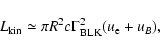
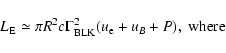
0.05. The kinetic power, the total power and the
pressure of the jet are estimated by the following relations:
= 240 G). We found that all the jet
parameters can be determined self-consistently if the shock velocity
is sub-relativistic;
0.05. The kinetic power, the total power and the
pressure of the jet are estimated by the following relations:
 |
(5) |
 |
(6) |
 |
(7) |
We obtain
 2.6
1044
erg s-1, = 3.4
1044
erg s-1, and P = 1.5
10-9 erg cm-3, respectively. We will compare these jet powers to the
energy contained in the radio lobes in Sect. 4.4.
2.6
1044
erg s-1, = 3.4
1044
erg s-1, and P = 1.5
10-9 erg cm-3, respectively. We will compare these jet powers to the
energy contained in the radio lobes in Sect. 4.4.
An interesting prediction from this model is that the spatial extent of
knot C would be different at different energy bands. This is because
the radio photons are emitted by the non-cooled part of the
electron population (
 ), whereas both the
optical and X-ray photons are radiated by cooled electrons
(
).
If the emission region's size is approximately related by
R
c
), whereas both the
optical and X-ray photons are radiated by cooled electrons
(
).
If the emission region's size is approximately related by
R
c
 for cooled electrons, a simple relation
can be expected for the region sizes;
for cooled electrons, a simple relation
can be expected for the region sizes;
 <
<
 <
<
 .
Unfortunately, the image resolutions of radio (0.34''),
optical (0.1''), and X-rays (0.5'') are not sufficient to test this
hypothesis, but such an approach will provide an interesting
opportunity for probing the particle acceleration/deceleration mechanism
in the jet in the near future.
.
Unfortunately, the image resolutions of radio (0.34''),
optical (0.1''), and X-rays (0.5'') are not sufficient to test this
hypothesis, but such an approach will provide an interesting
opportunity for probing the particle acceleration/deceleration mechanism
in the jet in the near future.
(III) Synchrotron + SSC, weak cooling
As we have seen in Sect. 3.2, the X-ray spectrum of knot C shows weak evidence
of mixed power-law (broken power-law) emission. One possibility
to account for the apparent concave feature in the X-ray spectrum
is the overlap of the synchrotron and SSC components in the
Chandra X-ray energy band. Under this assumption, we first discuss
"weak cooling'' with an electron spectral index of s = 2.8.
In principal, we can constrain the physical quantities tightly by
comparing the synchrotron and SSC luminosity ratio;
uB,
and
 .
In order to produce
comparable synchrotron and inverse Compton luminosities, a large
departure from an equipartition is unavoidable since uB
.
Assuming the observed value of
(10-11 erg cm-3), we require a magnetic
field of an order B
10 G. In order to explain the observed
synchrotron spectrum with such a weak magnetic field, the electron
energy density
must be large, since
/uB. A more accurate calculation provides a satisfactory fit
to the SED for B
12 G (uB = 5.7
10-12 erg cm-3) and = 2.1
10-5 erg cm-3,
respectively (Fig. 7 (III)).
.
In order to produce
comparable synchrotron and inverse Compton luminosities, a large
departure from an equipartition is unavoidable since uB
.
Assuming the observed value of
(10-11 erg cm-3), we require a magnetic
field of an order B
10 G. In order to explain the observed
synchrotron spectrum with such a weak magnetic field, the electron
energy density
must be large, since
/uB. A more accurate calculation provides a satisfactory fit
to the SED for B
12 G (uB = 5.7
10-12 erg cm-3) and = 2.1
10-5 erg cm-3,
respectively (Fig. 7 (III)).
Note, however, that the SSC luminosity is quite uncertain because we have to
infer the overall SSC spectra from the "bottom edge'' of the hard
X-ray spectrum.
We thus consider whether or not other choices of magnetic field could
also reproduce the data. For a given synchrotron luminosity
(
)
in a given region size (R), the SSC peak frequency
and luminosity vary as
 B-1 and
 B-2, respectively.
Therefore, variations in B shift the position of the SSC peak
as
B-2, respectively.
Therefore, variations in B shift the position of the SSC peak
as
 .
In order to achieve
comparable synchrotron/SSC fluxes in the Chandra X-ray band, only a
magnetic field of B
10 G is acceptable.
In such a situation, the cooling time of the highest energy electrons
(
= 1.4
107) is 1.4
1011 s,
which corresponds to a travel distance of 1400 pc. This suggests that
does not appear as long as
.
In order to achieve
comparable synchrotron/SSC fluxes in the Chandra X-ray band, only a
magnetic field of B
10 G is acceptable.
In such a situation, the cooling time of the highest energy electrons
(
= 1.4
107) is 1.4
1011 s,
which corresponds to a travel distance of 1400 pc. This suggests that
does not appear as long as
 0.2. In contrast to the case (I), this is consistent with our
original assumption of weak cooling.
0.2. In contrast to the case (I), this is consistent with our
original assumption of weak cooling.
While this model (III) reproduces the observed concave feature of
X-ray spectrum, there are two major difficulties in understanding
the derived jet quantities.
First, the departure from equipartition, /uB
3.6
106, seems to be too large. One
possibility to reduce the discrepancy is to adopt a larger value of
( 1), since the electron energy density behaves
 .
For example, if we assume
103, then /uB would be
1.4
104. This is still far from equipartition, though the
difference is significantly reduced. (Note, however, that such a large value
of
is unlikely from the viewpoint of shock
dynamics in jets, where
;
Kino & Takahara 2003.) Therefore, a large departure from equipartition
cannot be avoided within the framework of model (III).
The second problem is related with unreasonably large jet power expected
with this model. The total power of the jet is given by =
1.5
1048
erg s-1. This
jet power exceeds the total output of most bright quasars (e.g., Celotti et al. 1997), though 3C 15 is a relatively weak radio
source (intermediate between FR-I and FR-II; Leahy et al. 1997).
.
For example, if we assume
103, then /uB would be
1.4
104. This is still far from equipartition, though the
difference is significantly reduced. (Note, however, that such a large value
of
is unlikely from the viewpoint of shock
dynamics in jets, where
;
Kino & Takahara 2003.) Therefore, a large departure from equipartition
cannot be avoided within the framework of model (III).
The second problem is related with unreasonably large jet power expected
with this model. The total power of the jet is given by =
1.5
1048
erg s-1. This
jet power exceeds the total output of most bright quasars (e.g., Celotti et al. 1997), though 3C 15 is a relatively weak radio
source (intermediate between FR-I and FR-II; Leahy et al. 1997).
Also if the jet X-ray emission were of inverse Compton origin, we would
expect it to follow the synchrotron emission more closely (emission from
low-energy electrons not affected by radiative loss), whereas in fact
it is closer to the optical, suggesting that X-ray emissions are
dominated by synchrotron emission. Therefore, we consider model (III)
to be less plausible than (II), given the very weak evidence from
the X-ray spectrum. In Sect. 4.4, we will discuss this model from the
view point of the energetic link between the jet and lobes.
Future observations at the radio-IR bands (
1011-13 Hz), as well as
higher quality X-ray data are strongly encouraged to test the
predictions
of model (III).
(IV) Synchtotron + SSC, moderate cooling
Finally we consider the case in which the electron distribution has
a cooling break and most of the X-ray photons are produced via SSC.
Following case (II), we assume s = 2.2 and the break frequency of
1012 Hz. Figure 7 (IV) shows the SED fit using
this model. The existence of a cooling break substantially reduces
the electron energy density, ,
and hence reduces the discrepancy
between
and uB. However, the magnetic field strength is still
30 times below the equipartition value of
= 240 G.
The total power of the jet is estimated to be = 4.3 1046
erg s-1, which is reduced by a factor
of 40 from model (III). In such a situation, the shock velocity must be
non-relativistic;
2
10-3.
Although this model (IV) seems to reproduce the overall SED well,
it requires an acceleration parameter of smaller than unity
( = 0.1). In the conventional picture of resonant
pitch angle scattering (Blandford & Eichler 1987),
can be
identified with the ratio of energy in the non-turbulent magnetic field to
that in the turbulent field. Thus,
is expected to be larger than 1
by definition. For example, Inoue & Takahara (1996) argued that
1 for sub-pc-scale jets in blazar type AGNs, whereas
in normal plasmas such as that in the interstellar medium or
supernova remnants,
is inferred to be of order unity
(e.g., Bamba et al. 2003). We thus consider < 1 is
unreasonable in the framework of diffusive
shock acceleration theory.
Summary of Model Fitting for Knot C
In summary, we have considered four possible models to reproduce the
overall SED of knot C in 3C 15. The major results of our
considerations are:
(i) The synchrotron X-ray model under equipartition inevitably requires a
cooling break, since high energy electrons lose their energy on
very short time scales (
R/c).
(ii) A composite synchrotron plus SSC model predicts a magnetic
field far below equipartition (
 30 B).
Taking these into account, we consider case (II) to be the
most likely for the overall SED of knot C (Sy, MCL).
Although case (III) is still possible, the large departure from
equipartition, as well as the extremely large jet power, >
1048 erg s-1, seems to be problematic. In all four models,
(I)-(IV), electrons must be accelerated up to
107 in knot C of 3C 15,
which corresponds to a travel distance of
 1.4 kpc
(see Table 4).
Comparing this with the projected distance of knot C from the nucleus,
5.1 kpc, re-acceleration is clearly necessary in knot C.
1.4 kpc
(see Table 4).
Comparing this with the projected distance of knot C from the nucleus,
5.1 kpc, re-acceleration is clearly necessary in knot C.
![\begin{figure}
\par\includegraphics[angle=90,width=8.6cm,clip]{aa4072-f8.eps} \end{figure}](/articles/aa/full/2003/42/aa4072/Timg169.gif) |
Figure 8:
SED of radio lobes in 3C 15. Bow tie: X-ray power-law
spectrum obtained with Chandra (this work),
Open circle: obtained by direct integration
from the 3.6 cm radio image in Leahy et al. (1997).
Crosses: NED data base, but multiplied by 0.76. |
| Open with DEXTER |
Table 5:
Fitting parameters of the SED for radio lobes.
In our 30 ksec Chandra observation of 3C 15, we have detected
diffuse X-ray emission closely associated with the radio lobes.
The X-ray spectrum can be reproduced by a two component model consisting of
soft and hard components. Considering the temperature and the luminosity
of the Raymond-Smith fit, the soft X-ray component may naturally be
attributed to thermal emission from the hot halo of the host galaxy
(e.g., Matsushita et al. 2000). In fact, the X-ray luminosity of
thermal component,
= 4.5
1040 erg s-1, is well within the typical range
of elliptical galaxies, 1039-42 erg s-1
(e.g., Eskridge et al. 1995).
The power-law modeling of the hard component gives a spectral index
 = 0.33
+0.35-0.43. Unfortunately we cannot
compare it with the synchrotron radio index of 3C 15, since we have
the radio-lobe flux at only one frequency (i.e. the 3.6 cm map).
However, it is known that the
integrated radio spectrum has
= 0.75 from the NED photometry data base
(http://nedwww.ipac.caltech.edu/). Since the total radio flux is
almost entirely dominated by the lobes at radio frequencies (e.g.,
76% of the radio flux is due to lobe emission at 3.6 cm),
it could be a reasonable approximation of synchrotron radio emission
from radio lobes. Figure 8 shows the SED of radio lobes
thus produced. The NED data, multiplied by a factor 0.76, are nicely
consistent with the lobe flux estimated at 3.6 cm.
We can clearly see that the radio flux does not connect smoothly
with the flat X-ray spectrum. We thus consider that the diffuse hard
X-rays are produced via inverse Compton scattering on the electrons which emit
the synchrotron photons in the radio band. The slightly different spectral
index between the radio and X-rays may imply that X-ray photons are
produced by lower energy electrons than those which produce the
observed radio emission.
In fact, Kellermann et al. (1969) reported that the spectral index
does flatten somewhat at lower frequencies.
= 0.33
+0.35-0.43. Unfortunately we cannot
compare it with the synchrotron radio index of 3C 15, since we have
the radio-lobe flux at only one frequency (i.e. the 3.6 cm map).
However, it is known that the
integrated radio spectrum has
= 0.75 from the NED photometry data base
(http://nedwww.ipac.caltech.edu/). Since the total radio flux is
almost entirely dominated by the lobes at radio frequencies (e.g.,
76% of the radio flux is due to lobe emission at 3.6 cm),
it could be a reasonable approximation of synchrotron radio emission
from radio lobes. Figure 8 shows the SED of radio lobes
thus produced. The NED data, multiplied by a factor 0.76, are nicely
consistent with the lobe flux estimated at 3.6 cm.
We can clearly see that the radio flux does not connect smoothly
with the flat X-ray spectrum. We thus consider that the diffuse hard
X-rays are produced via inverse Compton scattering on the electrons which emit
the synchrotron photons in the radio band. The slightly different spectral
index between the radio and X-rays may imply that X-ray photons are
produced by lower energy electrons than those which produce the
observed radio emission.
In fact, Kellermann et al. (1969) reported that the spectral index
does flatten somewhat at lower frequencies.
In order to determine the origin of the seed photons which are upscattered
to X-ray energies, we approximate the geometry of the radio lobes as a
cylinder 62.5 kpc (50'') in length and 20 kpc (16'') in diameter.
This yields a lobe volume of V = 5.8
1068 cm3 and
a synchrotron photon energy density of
3.5
10-14 erg cm-3 (see Table 5).
Similarly, IR/optical photons from the host galaxy halo are expected
to provide an energy density of
2
10-13 (10 kpc/d)2 erg cm-3, where d is
the distance from the nucleus to the X-ray emitting region in the lobe
(Sandage 1973). Since the energy density of these seed photons falls
below that of the CMB,
= 5.4
10-13 erg cm-3, we will consider CMB photons as the dominant seed photons
for inverse Compton X-ray emission. Note, however, that IR/optical
emission may dominate over the CMB in the innermost regions of the radio
lobe,  5 kpc. In this case, it may be that inverse
Compton scattering of different seed photons is occurring in the
X-ray (CMB seed photons) and -ray (IR/optical seed photons) bands.
5 kpc. In this case, it may be that inverse
Compton scattering of different seed photons is occurring in the
X-ray (CMB seed photons) and -ray (IR/optical seed photons) bands.
The ratio of the radio (synchrotron) flux to the X-ray
(inverse Compton) flux is therefore related by
 |
(8) |
Here, we must compare the radio/X-ray fluxes which correspond to
the same population of relativistic electrons. The Lorentz factors
of electrons which upscatter CMB photons (
 1011 Hz) to the X-ray band (
 1017-18 Hz) would be
10
2.9-3.4.
These electrons emit synchrotron photons in the frequency range
of
106-7 (B/1 G) Hz, for which there is no
observational data (Fig. 8). We thus extrapolate the observed radio
flux by assuming the radio spectral index of
1017-18 Hz) would be
10
2.9-3.4.
These electrons emit synchrotron photons in the frequency range
of
106-7 (B/1 G) Hz, for which there is no
observational data (Fig. 8). We thus extrapolate the observed radio
flux by assuming the radio spectral index of
 0.75. We obtain
 = 2.1
10-14 (B/1 G)
= 2.1
10-14 (B/1 G)
 erg cm-2 s-1 for the
frequency range of
106-7 (B/1 G) Hz.
Comparing this with the integrated X-ray flux of
erg cm-2 s-1 for the
frequency range of
106-7 (B/1 G) Hz.
Comparing this with the integrated X-ray flux of  =
(2.3
0.5)
10-14 erg cm-2 s-1 in the Chandra bandpass, the magnetic field strength is estimated to be
B
4 G. The result of SED model fitting is shown as solid
lines in Fig. 8. We have assumed the maximum Lorentz factor of electrons
to be
106.
The best fit parameters are summarized in Table 5.
=
(2.3
0.5)
10-14 erg cm-2 s-1 in the Chandra bandpass, the magnetic field strength is estimated to be
B
4 G. The result of SED model fitting is shown as solid
lines in Fig. 8. We have assumed the maximum Lorentz factor of electrons
to be
106.
The best fit parameters are summarized in Table 5.
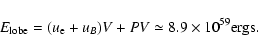
A comparison of the synchrotron and inverse Compton flux densities
allows us to derive = 1.1
10-9 erg cm-3
2100 uB. Thus we find that there is a significant electron
dominance in the lobes of 3C 15. This ratio is larger than those
reported for lobes in other radio galaxies (/uB
100;
e.g., Tashiro et al. 1998; Isobe 2002), but the difference is
mainly due to the different choice of
:
we have assumed
= 1 throughout this paper as discussed in Sect. 4.1.
If we set
1000 as for these published works,
we obtain
66 uB, which is well in the range of
published works.
The total power supplied in the lobes is estimated as:
 |
(9) |
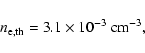
It is interesting to compare the thermal pressure estimated
from the Raymond-Smith (RS) X-ray emission, and non-thermal pressures
of relativistic electrons in the radio lobe.
If we assume a very simplified model in which
thermal photons are produced by electrons which have a constant number
density,
 over the radio lobes,
the best fit X-ray spectral model
(see Sect. 3.3 and Table 2) provides the number density of thermal
electrons as
over the radio lobes,
the best fit X-ray spectral model
(see Sect. 3.3 and Table 2) provides the number density of thermal
electrons as
 |
(10) |
where we have assumed that the thermal plasma volume is equal to that of
radio lobes; V = 5.8
1068 cm3. The pressure of thermal
plasma is thus given by
 |
(11) |
where kT = 0.85 keV from Sect. 3.3 (see Table 2).
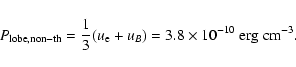
Meanwhile, the non-thermal pressure of relativistic electrons is estimated as
 |
(12) |
The large difference between
 and
and
 may partly due to our over-simplified model for the thermal plasma
distribution, but it seems that a
more powerful (dense) thermal plasma, other than that
emitting the X-rays, is necessary to confine the relativistic electrons in
the radio lobes.
may partly due to our over-simplified model for the thermal plasma
distribution, but it seems that a
more powerful (dense) thermal plasma, other than that
emitting the X-rays, is necessary to confine the relativistic electrons in
the radio lobes.
Finally, we should comment on the features of the surface brightness ratio
(
/)
given as Fig. 2c. It has been claimed that
this ratio represents the magnetic field distribution along the major
axis of the lobes, since
/
B2
(except for the nucleus regions; see Eq. (8)).
In this sense, the magnetic field may be weakest near the nucleus,
increasing several-fold at larger distances,
as was suggested for the field-particle distribution of the FR II radio
galaxy 3C 452 (Isobe et al. 2002). However, we should note that the
thermal component, if
distributed over the scale of the galaxy, could be centrally condensed.
These are possibly related to the thermal RS emission seen
in the X-ray spectrum of the radio lobes (Fig. 5). In principle,
it would be possible to discriminate between the two emission components by
comparing X-ray images in different energy bands, where the soft X-rays
(2 keV) are dominated by thermal RS emission and the hard X-rays
(2 keV) would be of non-thermal inverse Compton origin.
Unfortunately, photon statistics are not sufficient for such a study.
We simply comment here that the apparent center filled morphology of
the X-ray image
(Fig. 2a) may partly be due to a centrally condensed thermal plasma,
rather than variations in the magnetic field strength. The actual
inverse-Compton profile of the radio lobes might be closer to the synchrotron
radio profile than suggested in Fig. 2. Future deep X-ray observations
will clarify this point further.
In Sect. 3.4, we showed that the X-ray spectrum of the nucleus consists
of two different power-law components. The low-energy component is well
represented by a hard power-law with Galactic
absorption, whereas the high-energy component is heavily absorbed with
= 1022-23 cm-2. One possibility to account for
this X-ray spectrum is that the two components are produced in
different emission regions around the nucleus:
the low-energy power-law may be due to the inner-jet emission and
possibly comes from the parsec-scale region,
whereas the high-energy component may be
emission from the hidden active nucleus at the center.
Considering the symmetrical lobe morphology, the obscuring
material is most likely the molecular torus fueling the nucleus which is
postulated to exist in active galaxies (e.g., Antonucci & Miller 1985;
Krolik & Begelman 1986).
Interestingly, additional evidence of a hidden active nucleus has been
obtained from the surface brightness profile of 3C 15 in the V and R
bands. While these are very well described by a de Vaucouleurs profile,
r1/4, between 0.5 kpc and 10 kpc, 3C 15 lacks a sharp,
point-like AGN inside a radius of 0.3'' (Martel et al. 1998).
This optical observation is consistent with the lack of strong
AGN-type features in the spectrum of 3C 15 (Tadhunter et al. 1993).
Two possibilities have been suggested to account for the absence of a
resolved AGN, which is in contrast common to the other 3C radio galaxies
with optical jets imaged with HST. First, the central source may be
presently inactive, but is activated at regular intervals, leading to
the periodic ejection of material along the jet axis
(resulting in knots A, B, and C).
Alternatively, heavy obscuration by dust towards the line of sight
to the nucleus could also account for the nondetection of an AGN.
Dust permeates the central regions of 3C 15: if the extinction is
large enough, the bright nucleus would then be hidden from our line
of sight as implied from the X-ray spectrum of the nucleus.
It should be noted that
the dust seen in the HST images is on a much larger scale than the
hypothetical molecular torii around AGNs. Thus it might be possible
that the dust cloud orbiting on the kpc-scale that we directly
see is the material which obscures part of the X-ray core; in other
words, a large "dust torus'' might be present around the nucleus of 3C 15.
Comparison of the power transported by the jet ()
and
the total energy contained in the lobes (
)
provides an
interesting opportunity to probe the dynamics in the jet. By dividing
by ,
we can estimate the "fueling time'' of
the jet
,
which can be compared with the source age
(see Sect. 1). In model (II) of Sect. 4.1, we obtained
3.4
1044
erg s-1. The fueling time is expected to be
=
8.2
107
 yrs.
This is qualitatively consistent with the source age of radio lobes,
2.1
107 (0.01 c/
) yrs.
In contrast, other models, in particular (III), predict
significantly smaller
compared to
.
In fact, for
1.5
1048
erg s-1, we obtain
= 1.9
104 yrs.
yrs.
This is qualitatively consistent with the source age of radio lobes,
2.1
107 (0.01 c/
) yrs.
In contrast, other models, in particular (III), predict
significantly smaller
compared to
.
In fact, for
1.5
1048
erg s-1, we obtain
= 1.9
104 yrs.
These facts suggest again that the synchrotron emission with moderate
cooling, case (II), provides a reasonable explanation of
the X-ray emission mechanism of knot C.
However, there are still several possibilities to account for the
apparent discrepancy in model (III), i.e.,
.
First, we may have
underestimated the total energy in the lobes since
we only take account of relativistic electrons. In fact, we cannot
estimate the contribution from thermal electrons and possibly protons
which should constitute a reservoir for acceleration of non-thermal
electrons.
If only 0.1% of electrons
are "visible'' in the radio and X-ray bands, the discrepancy may be
reduced significantly. (However, we note that the situation is the
same for the total power of the jet, ,
in the sense that we only
take account of the contribution from "visible'' relativistic electrons.)
Alternatively, it is plausible that by considering the brightest jet
knot (knot C) we have
overestimated the jet power. The knots are
thought to be where the particle and/or field densities are
enhanced compared to the rest of the jet. It may be reasonable
to assume that the jet is actually very sparse, and that its average
power is much lower, e.g., 0.1% of that in the bright knot. It might
be said that the jet has a spatial filling factor of only 10-3.
Such uneven jet structure may be related with the activity of the
central nucleus. If the nucleus expels blobs of material
intermittently, rather than in a stationary manner, it will produce
bright knots along the jet axis at semi-regular intervals
(such as that observed for knots A, B, and C).
This idea can be readily accommodated
by the internal shock scenario, recently proposed
by a number of authors to account for the variability properties of
sub-pc scale jets (e.g., Spada et al. 2001; Kataoka et al. 2001; Tanihata et al. 2003).
Although somewhat speculative, occasional activity of the jet
(0.1% of the time) may explain the energy link between
the jets and the lobes in radio galaxies quite well. Future observations in
the hard X-ray and gamma-ray bands are necessary to test this further.
We have reported the X-ray detection of the jet, lobes,
and absorbed nucleus of the FR II radio galaxy 3C 15.
The X-ray image obtained with Chandra clearly shows that most
of the X-ray jet emission comes from knot C, which was previously detected
in the radio and optical jets. We found that the X-ray flux is well below
the extrapolation from the radio-to-optical continuum. We consider four
possible cases to reproduce the overall SED:
(I) weak synchrotron cooling with = uB,
(II) moderate synchrotron cooling with = uB,
(III) weak synchrotron plus SSC cooling, and
(IV) moderate synchrotron plus SSC cooling.
Case (I) and (IV) were safely ruled out by considering the acceleration
and radiative cooling processes over the source. We argue that case (II)
is a reasonable scenario to understand the SED of knot C, but
the case (III) is possible if equipartition is strongly violated
(/uB
3.6
106) and the jet power is
extremely large (
1048 erg s-1).
In either case, the highest energy electrons, with
107, need to be re-accelerated in knot C.
The diffuse hard X-ray emission associated with the lobes
is most likely due to the inverse Compton emission of CMB photons by
the synchrotron emitting electrons in the radio lobes. Assuming a radio
spectral index of
0.75, we found that the
lobes in 3C 15 are particle dominated, where /uB
2100.
The fueling time (
)
is qualitatively consistent with the
source age
for the case (II), whereas the latter must
be significantly shorter for the case (III). The discrepancy of (III),
however, can be understood if the jet is actually very sparse, and has a
spatial filling factor of only 10-3.
By comparing the thermal pressure associated with the galaxy halo and
non-thermal pressure in the radio lobe, we found that relativistic
electrons cannot be confined only with the X-ray emitting thermal gas.
Finally, we show that the X-ray emission from the nucleus consists of
two power-law components, one of which suffers from
significant absorption
1022-23 cm-2 intrinsic to the source.
Such a high column density may support the existence of dusty
torus around the nucleus, as suggested by the optical observations.
Acknowledgements
We appreciate the insightful comments and suggestions of the referee, Dr. M. Georganopoulos, that have improved this paper.
We also thank Dr. N. Isobe for useful discussion of X-ray properties of radio
lobes. J.K. acknowledges a support by JSPS.KAKENHI (14340061).
This research has made use of the NASA/IPAC Extragalactic Database (NED)
which is operated by the Jet Propulsion Laboratory, California
Institute of Technology, under contract with the National Aeronautics
and Space Administration.
-
Antonucci, R., & Miller, J. 1985, ApJ, 297, 621
In the text
NASA ADS
-
Bamba, A., Yamazaki, R., Ueno, M., & Koyama, K. 2003, ApJ, 589, 827
In the text
NASA ADS
-
Band, D. L., & Grindlay, J. E. 1985, ApJ, 298, 128
In the text
NASA ADS
-
Blandford, R. D., & Eichler, D. 1987, Phys. Rep., 154, 1
In the text
NASA ADS
-
Bridle, A. H., & Perley, R. A. 1984, ARA&A, 22, 319
In the text
NASA ADS
-
Celotti, A., Padovani, P., Ghisellini, G., et al. 1997, MNRAS, 286, 415
In the text
NASA ADS
-
Eskridge, P. B., Fabbiano, G., & Kim, D.-W. 1995, ApJS, 97, 141
In the text
NASA ADS
-
Georganopoulos, M., & Kazanas, D. 2003, ApJ, 589, L5
In the text
NASA ADS
-
Hardcastle, M. J., Birkinshaw, M., & Worrall, D. M. 2001, MNRAS, 326, 1499
In the text
NASA ADS
-
Hardcastle, M. J., Birkinshaw, M., Cameron, R. A., et al. 2002, ApJ, 581, 948
In the text
NASA ADS
-
Harris, D. E., & Krawczynski, H. 2002, ApJ, 565, 244
In the text
NASA ADS
-
Inoue, S., & Takahara, F. 1996, ApJ, 463, 555
In the text
NASA ADS
-
Isobe, N., Tashiro, M., Makishima, K., et al. 2002, ApJ, 580, L111
In the text
NASA ADS
-
Isobe, N. 2002, Ph.D. Thesis, University of Tokyo
In the text
-
Kaneda, H., Tashiro, M., Ikebe, Y., et al. 1995, ApJ, 453, L13
In the text
NASA ADS
-
Kataoka, J., Takahashi, T., Wagner, S. J., et al. 2001, ApJ, 560, 659
In the text
NASA ADS
-
Kataoka, J., Edwards, P., Georganopoulos, M., Takahara, F., & Wagner, S. 2003, A&A, 399, 91
In the text
NASA ADS
-
Kellermann, K. I., Pauliny-Toth, I. I, & Williams, P. J. S. 1969, ApJ, 157, 1
In the text
NASA ADS
-
Kino, M., & Takahara, F. 2003, MNRAS, submitted
In the text
-
Krolik, J., & Begelman, M. 1986, ApJ, 308, L55
In the text
NASA ADS
-
Leahy, J. P., Black, A. R. S., Dennett-Thorpe, J., et al. 1997, MNRAS, 291, 20
In the text
NASA ADS
-
Leahy, J. P., & Gizani, N. A. B. 2001, ApJ, 555, 709
In the text
NASA ADS
-
Martel, A. R., Sparks, W. B., Macchetto, D., et al. 1998, ApJ, 496, 203
In the text
NASA ADS
-
Matsushita, K., Ohashi, T., & Makishima, K. 2000, PASJ, 52, 685
In the text
NASA ADS
-
Sambruna, R. M., Urry, C. M., Tavecchio, F., et al. 2001, ApJ, 549, L161
In the text
NASA ADS
-
Sandage, A. 1973, ApJS, 183, 711
In the text
-
Scheuer, P. A. G. 1995, MNRAS, 277, 331
In the text
NASA ADS
-
Spada, M., Ghisellini, G., Lazzati, D., & Celotti, A. 2001, MNRAS, 325, 1559
In the text
NASA ADS
-
Stark, A. A., Gammie, C. F., Wilson, R. W., et al. 1992, ApJS, 79, 77
In the text
NASA ADS
-
Tadhunter, C. N., Morganti, R., di Serego Alighieri, S., et al. 1993, MNRAS, 263, 999
In the text
NASA ADS
-
Tanihata, C., Takahashi, T., Kataoka, H., & Madejski, G. M. 2003, ApJ, 584, 153
In the text
NASA ADS
-
Tashiro, M., Kaneda, H., Makishima, K., et al. 1998, ApJ, 499, 713
In the text
NASA ADS
-
Tashiro, M., Makishima, K., Iyomoto, N., Isobe, N., & Kaneda, H. 2001, ApJ, 546, L19
In the text
NASA ADS
-
Wilson, A. S., Young, A. J., & Shopbell, P. L. 2001, ApJ, 547, 740
In the text
NASA ADS
-
Wilson, A. S., & Yang, Y. 2002, ApJ, 568, 133
In the text
NASA ADS
Copyright ESO 2003
![\begin{figure}
\par\includegraphics[width=6cm]{aa4072-f1a.eps}\hspace*{1.6cm}
\...
...{4.1cm}\includegraphics[width=6cm]{aa4072-f1c.eps}\hspace*{4.1cm}}
\end{figure}](/articles/aa/full/2003/42/aa4072/img35.gif)
![\begin{figure}
\par\includegraphics[angle=90,width=8.8cm,clip]{aa4072-f2.eps} \end{figure}](/articles/aa/full/2003/42/aa4072/img38.gif)
![\begin{figure}
\par\includegraphics[angle=90,width=8.8cm,clip]{aa4072-f3.eps} \end{figure}](/articles/aa/full/2003/42/aa4072/img39.gif)
![\begin{figure}
\par\includegraphics[angle=90,width=8.8cm,clip]{aa4072-f4.eps} \end{figure}](/articles/aa/full/2003/42/aa4072/img46.gif)
![\begin{figure}
\par\includegraphics[angle=90,width=8.8cm,clip]{aa4072-f5.eps} \end{figure}](/articles/aa/full/2003/42/aa4072/img62.gif)
![\begin{figure}
\par\includegraphics[angle=90,width=8.8cm,clip]{aa4072-f6.eps} \end{figure}](/articles/aa/full/2003/42/aa4072/img70.gif)
![\begin{figure}
\par\includegraphics[angle=90,width=8.6cm,clip]{aa4072-f7a.eps}\h...
...*{2mm}
\includegraphics[angle=90,width=8.6cm,clip]{aa4072-f7d.eps} \end{figure}](/articles/aa/full/2003/42/aa4072/img73.gif)
![\begin{figure}
\par\includegraphics[angle=90,width=8.6cm,clip]{aa4072-f8.eps} \end{figure}](/articles/aa/full/2003/42/aa4072/img169.gif)