![[*]](/icons/foot_motif.gif) ,
,
A&A 410, 527-551 (2003)
DOI: 10.1051/0004-6361:20031213
,T. Bensby - S. Feltzing - I. Lundström
Lund Observatory, Box 43, 221 00 Lund, Sweden
Received 14 April 2003 / Accepted 5 August 2003
Abstract
Based on spectra from F and G dwarf stars, we present elemental
abundance trends in the Galactic thin and thick disks in the
metallicity regime
![$\rm -0.8\lesssim [Fe/H] \lesssim +0.4$](/articles/aa/full/2003/41/aah4451/img53.gif) .
Our
findings can be summarized as follows. 1) Both the thin and the thick
disks show smooth and distinct abundance trends that, at sub-solar
metallicities, are clearly separated. 2) For the
.
Our
findings can be summarized as follows. 1) Both the thin and the thick
disks show smooth and distinct abundance trends that, at sub-solar
metallicities, are clearly separated. 2) For the  -elements the
thick disk shows signatures of chemical enrichment from SNe type Ia. 3) The age of the thick disk sample is in the mean older than the thin
disk sample. 4) Kinematically, there exist thick disk stars with super-solar metallicities. Based on these findings, together with other
constraints from the literature, we discuss different formation
scenarios for the thick disk. We suggest that the currently most likely
formation scenario is a violent merger event or a close encounter with
a companion galaxy. Based on kinematics the stellar sample was selected
to contain stars with high probabilities of belonging either to the
thin or to the thick Galactic disk. The total number of stars are 66 of
which 21 belong to the thick disk and 45 to the thin disk. The analysis
is based on high-resolution spectra with high signal-to-noise (
-elements the
thick disk shows signatures of chemical enrichment from SNe type Ia. 3) The age of the thick disk sample is in the mean older than the thin
disk sample. 4) Kinematically, there exist thick disk stars with super-solar metallicities. Based on these findings, together with other
constraints from the literature, we discuss different formation
scenarios for the thick disk. We suggest that the currently most likely
formation scenario is a violent merger event or a close encounter with
a companion galaxy. Based on kinematics the stellar sample was selected
to contain stars with high probabilities of belonging either to the
thin or to the thick Galactic disk. The total number of stars are 66 of
which 21 belong to the thick disk and 45 to the thin disk. The analysis
is based on high-resolution spectra with high signal-to-noise (
 and
and
 ,
respectively) recorded
with the FEROS spectrograph on La Silla, Chile. Abundances have been
determined for four -elements (Mg, Si, Ca, and Ti), for four
even-nuclei iron peak elements (Cr, Fe, Ni, and Zn), and for the light
elements Na and Al, from equivalent width measurements of
,
respectively) recorded
with the FEROS spectrograph on La Silla, Chile. Abundances have been
determined for four -elements (Mg, Si, Ca, and Ti), for four
even-nuclei iron peak elements (Cr, Fe, Ni, and Zn), and for the light
elements Na and Al, from equivalent width measurements of
 30 000 spectral lines. An extensive investigation of the
atomic parameters,
30 000 spectral lines. An extensive investigation of the
atomic parameters,  -values in particular, have been performed
in order to achieve abundances that are trustworthy. Noteworthy is that
we find for Ti good agreement between the abundances from Ti I
and Ti II. Our solar Ti abundances are in concordance with the
standard meteoritic Ti abundance.
-values in particular, have been performed
in order to achieve abundances that are trustworthy. Noteworthy is that
we find for Ti good agreement between the abundances from Ti I
and Ti II. Our solar Ti abundances are in concordance with the
standard meteoritic Ti abundance.
Key words: stars: fundamental parameters - stars: abundances - Galaxy: disk - Galaxy: formation - Galaxy: abundances - Galaxy: kinematics and dynamics
Ever since it was revealed that the Galactic disk contains two distinct stellar populations with different kinematic properties and different mean metallicities their origin and nature have been discussed. The first evidence for the second disk population was offered by Gilmore & Reid (1983) who discovered that the stellar number density distribution as a function of distance from the Galactic plane was not well fitted by a single density profile. A better match was found by using two components with scale heights of 300 pc and 1350 pc, respectively. The latter component was identified as a Galactic thick disk, as a complement to the more well-known thin disk.
Thick disk stars move in Galactic orbits with a scale height of 800 pc
(e.g. Reylé & Robin 2001) to 1300 pc (e.g. Chen 1997),
whereas the thin disk stars have a scale height of 100-300 pc
(e.g. Gilmore & Reid 1983; Robin et al. 1996). The velocity
dispersions are also larger in the thick disk than in the thin disk.
Soubiran et al. (2003), for example, find

 ,
and
,
and
 for the
thick and thin disks, respectively. Further, the thick disk is as a whole a
more slowly rotating stellar system than the thin disk. It lags behind the
local standard of rest (LSR) by approximately 50
(e.g. Soubiran et al. 2003). The thick disk is also known to mainly
contain stars with ages greater than 8 Gyr,
e.g. Fuhrmann (1998), while the thin disk is populated by younger
stars. The normalization of the densities of the stellar populations in the
solar neighbourhood gives a thick disk fraction of 2-15%, with the lowest
values from Gilmore & Reid (1983) and Chen (1997), and the
highest from Chen et al. (2001) and Soubiran et al. (2003).
Robin et al. (1996) and Buser et al. (1999) found values around
6%. A high value of the normalization is usually associated with a low value
of the scale height.
for the
thick and thin disks, respectively. Further, the thick disk is as a whole a
more slowly rotating stellar system than the thin disk. It lags behind the
local standard of rest (LSR) by approximately 50
(e.g. Soubiran et al. 2003). The thick disk is also known to mainly
contain stars with ages greater than 8 Gyr,
e.g. Fuhrmann (1998), while the thin disk is populated by younger
stars. The normalization of the densities of the stellar populations in the
solar neighbourhood gives a thick disk fraction of 2-15%, with the lowest
values from Gilmore & Reid (1983) and Chen (1997), and the
highest from Chen et al. (2001) and Soubiran et al. (2003).
Robin et al. (1996) and Buser et al. (1999) found values around
6%. A high value of the normalization is usually associated with a low value
of the scale height.
The presence of a thick disk in the Milky Way galaxy is not unique. Extra-galactic evidence of thick disks in edge-on galaxies is continuously growing (e.g. Reshetnikov & Combes 1997; Schwarzkopf & Dettmar 2000; Dalcanton & Bernstein 2002).
There are essentially two major formation scenarios for the Milky Way thick
disk. First, we have the merger scenario in which the thick disk got
puffed up as a result of a merging event with a companion galaxy
(e.g. Robin et al. 1996) and as a consequence star formation stopped
8 Gyrs ago. However, Kroupa (2002) shows that the Milky Way
actually does not have to merge with another galaxy to produce a kinematical
heating of the galactic disk. An episode of kinematical heating and increased
star formation can be caused by a passing satellite. Second, we have the
possibility that the thin and thick disk form an evolutionary sequence.
In this scenario the thick disk formed first and once star formation had
stopped the remaining gas (maybe replenished through in-fall) settled in to a
thin disk with a smaller scale height. The initial collapse can be either a
slow, pressure supported collapse or a fast collapse due to increased
dissipation (e.g. Burkert et al. 1992). The main difference between
these two is that vertical abundance gradients will have time to build up in
the thick disk in the slow collapse, while results from modelling indicate that
there is not enough time to build up such gradients in a fast collapse. In the
model by Burkert et al. (1992) star formation in the thick disk
ceases after only 400 Myr. Naively, both the merging and the collapse
scenarios predict that the lowest age for a thick disk star must be greater
than the highest age for a thin disk star. It also appears plausible in both
scenarios that the mean metallicity of the thin disk should be higher than that
of the thick disk. But, because in-fall is most likely needed in order to
produce the stars in the thin disk the actual distributions of
metallicities in the two components should be overlapping.
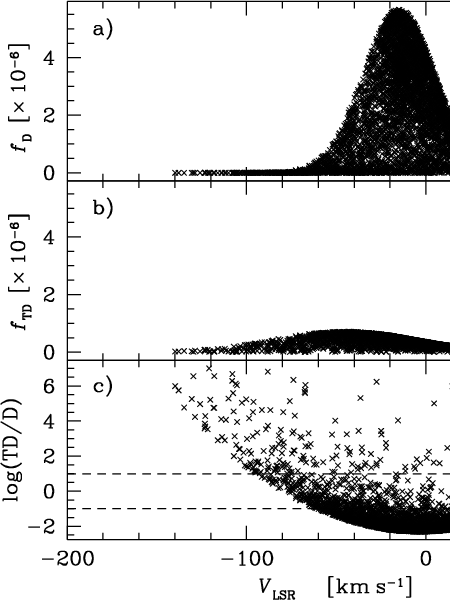 |
Figure 1:
a) and b) show the  and the
 "probabilities", Eq. (1), and c) the TD/D
relative probabilities, Eq. (3). Dashed lines indicate
TD/D = 10 and TD/D = 0.1.
"probabilities", Eq. (1), and c) the TD/D
relative probabilities, Eq. (3). Dashed lines indicate
TD/D = 10 and TD/D = 0.1. |
| Open with DEXTER | |
In addition to the two major scenarios discussed above several other ways of producing the kinematical and density distributions found in the two disks have been proposed (see e.g. Gilmore et al. 1989). Noteworthy is the direct accretion of material scenario in which extra-galactic debris ends up in the Milky Way and finally forms a larger entity, the thick disk. This scenario will most likely result in a stellar population with a wide spread in age and metallicity. Another possibility is that the thick disk formed as a result of kinematic diffusion of stellar orbits, i.e. stars in a thin disk are influenced by their surroundings and their orbits will change with time due to interaction with e.g. giant molecular clouds or "collisions" with other stars. In this formation scenario for the thick disk the stars of the thin and the thick disks have the same origin. Also note that, in this case, the formation time for the thick disk must be long as diffusion of orbits is a slow process.
Recently, the chemical evolution of the stellar population in the thick disk
has become a subject of intense study and discussion
(e.g. Mashonkina & Gehren 2001;
Tautvaisiene et al. 2001; Chen et al. 2000;
Gratton et al. 2000; Prochaska et al. 2000;
Fuhrmann 1998). The evidence from these studies points in
conflicting directions. While Gratton et al. (2000) conclude that
the time scale for the formation of the thick disk is less than 1 Gyr,
Prochaska et al. (2000) infer a time scale longer than 1 Gyr. The
estimate by Mashonkina & Gehren (2001) falls in between these two
estimates and they also found that the gas out of which the thick disk
formed had been enriched by s-process nuclei. Further Chen et al. (2000)
found that the chemical trends of the thin disk follow smoothly upon those of
the thick disk, while Fuhrmann (1998) and
Prochaska et al. (2000) both found the chemical trends in the thin
and the thick disks to be disjunct. None of these studies include thick disk
stars with metallicities higher than
![$\rm [Fe/H] \sim -0.3$](/articles/aa/full/2003/41/aah4451/img62.gif) .
.
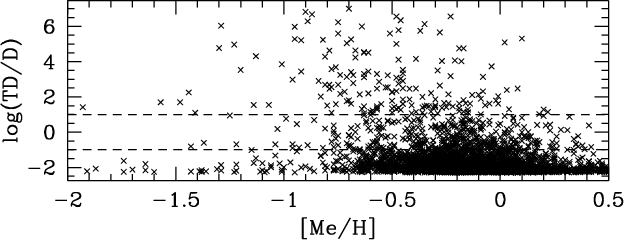 |
Figure 2: The TD/D "relative probabilities" versus photometric metallicity for the whole catalogue. Dashed lines indicate TD/D = 10 and TD/D = 0.1. |
| Open with DEXTER | |
In this paper we will investigate the elemental abundance trends of two kinematically distinct stellar samples that can be associated with the thin and the thick Galactic disks, respectively. We will not use criteria on stellar ages and metallicities when we select our samples. This means that we will probe the thick disk at higher metallicities than what has been done in previous studies. We will show that the stellar populations of the thin and the thick disks have distinct and different chemical trends. This is most likely due to the different origins of the two disks and will be further discussed in the paper.
The paper is organized as follows. In Sect. 2 the criteria
for the selection of stars are described. The observations and data reductions
are presented in Sect. 3 and in
Sect. 4 we derive new radial velocities for the stars. The
determination of the fundamental stellar parameters, as well as elemental
abundances, is described in Sect. 5. In
Sect. 6 we describe the atomic data, the -values in
particular, that have been used in the abundance determination.
Section 7 explores the errors, both random and systematic, that
are present in the abundance determination, and the most probable error
sources. The determination of stellar ages is described in
Sect. 8, and then, in Sect. 9, we present our
resulting abundances relative to Fe and Mg in terms of diagrams where
[X/Y] is
plotted versus
![$[Y/{\rm H}]$](/articles/aa/full/2003/41/aah4451/img65.gif) (where Y is either Fe or Mg). In
Sect. 10 our abundance results are further discussed in the
context of Galactic chemical evolution. Constraints are set on the different
formation scenarios for the thick disk and we discuss the most likely scenario.
Section 11 summarizes our findings.
(where Y is either Fe or Mg). In
Sect. 10 our abundance results are further discussed in the
context of Galactic chemical evolution. Constraints are set on the different
formation scenarios for the thick disk and we discuss the most likely scenario.
Section 11 summarizes our findings.
Table 1:
Characteristic velocity dispersions
(
 ,
,
 ,
and
,
and
 )
in the thin
disk, thick disk, and stellar halo, used in
Eq. (1). X is the observed fraction of stars for
the populations in the solar neighbourhood and
)
in the thin
disk, thick disk, and stellar halo, used in
Eq. (1). X is the observed fraction of stars for
the populations in the solar neighbourhood and
 is the
asymmetric drift. The values fall within the intervals that are
characteristic for the thin and thick disks, see Sect. 1.
is the
asymmetric drift. The values fall within the intervals that are
characteristic for the thin and thick disks, see Sect. 1.
There is no obvious predetermined way to define a sample of purely thick disk stars (or thin disk stars!) in the solar neighbourhood. There are essentially two ways of finding local thick or thin disk stars; the pure kinematical approach (that we adopted), or by looking at a combination of kinematics, metallicities, and stellar ages (e.g. Fuhrmann 1998). Both methods will produce, for example, thick disk samples that are "contaminated" with thin disk stars. In this study we have tried to minimize this type of contamination by selecting thin and thick disk stars that kinematically are "extreme members" of their respective population.
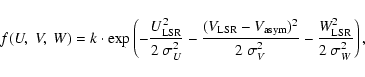
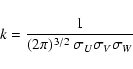
The selection of thick and thin disk stars is done by assuming that the
Galactic space velocities (
 ,
,
 ,
and
,
and
 ,
see Appendix A) of the stellar populations in the thin disk,
the thick disk, and the halo have Gaussian distributions,
,
see Appendix A) of the stellar populations in the thin disk,
the thick disk, and the halo have Gaussian distributions,
,
,
and
are the characteristic velocity dispersions, and
is the asymmetric drift. Table 1 lists the
values we adopted for the three populations (J. Holmberg 2000, private comm.).
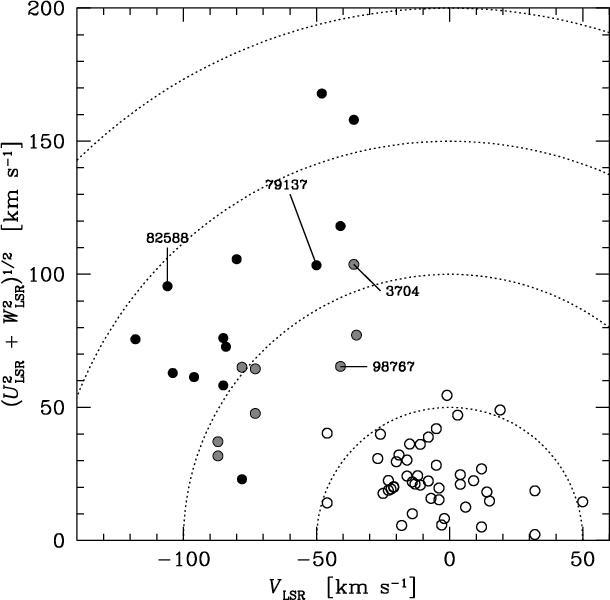 |
Figure 3:
Toomre diagram for our stellar sample. Dotted lines indicate constant
peculiar space velocities,
 ,
in steps of 50 km s-1. Stars that we discuss in
Sect. 9.4 have been identified with their
Hipparcos numbers. Thin disk stars are marked by empty circles and
thick disk stars by filled
(black: TD/D > 10, grey: 1 < TD/D < 10) circles. ,
in steps of 50 km s-1. Stars that we discuss in
Sect. 9.4 have been identified with their
Hipparcos numbers. Thin disk stars are marked by empty circles and
thick disk stars by filled
(black: TD/D > 10, grey: 1 < TD/D < 10) circles.
|
| Open with DEXTER | |
For a given star, when computing the relative likelihoods of belonging to
either the thick or the thin disk, one has to take in to account that the local
number densities of thick and thin disk stars are different. In the solar
neighbourhood 94% of stars belong to the thin disk whereas only 6%
belong to the thick disk (according to Robin et al. 1996 or
Buser et al. 1999). To really get the probability (which we will call
D, TD, and H, for the thin disk, thick disk, and stellar halo, respectively)
that a given star belongs to a specific population we therefore have to
multiply the probabilities from Eq. (1) by the observed
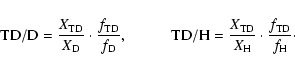
fractions (X) of each population in the solar neighbourhood. By then dividing
the thick disk probability (TD) with the thin disk (D) and halo (H)
probabilities, respectively, we get two relative probabilities for
the thick-disk-to-thin-disk (TD/D) and thick-disk-to-halo (TD/H) membership,
i.e.
Table 2:
Stellar parameters for our program stars. The first three columns give
the identification of each star, Hipparcos, HD, and HR numbers. The
fourth column gives the spectral class as listed in Simbad. The fifth
to the seventh columns give V,  ,
and
,
and
 ,
all from
the Hipparcos catalogue. Columns 8 to 10 give the fundamental
parameters, metallicity, effective temperature, and surface gravity
that we derive and Col. 11 the microturbulence
(see Sect. 5). Column 12 gives the masses that we
derive and Col. 13 the bolometric corrections used in
Sect. 5.2.3. Columns 14 to 17 list the radial velocities
measured by us and the subsequently calculated U, V, and W
velocities relative to the local standard of rest (LSR). Columns 18 and
19 give the relative probabilities of the thick disk-to-thin disk and
thick disk-to-halo memberships, respectively. The last three columns
(20 to 22) give the results of our age determinations, see
Sect. 8. In the last column an "s" indicates that
Salasnich et al. (2000) isochrones were used when
determining the stellar age, a "g" that
Girardi et al. (2000) isochrones were used, and an "sg" that
the combination of both sets of isochrones were used.
,
all from
the Hipparcos catalogue. Columns 8 to 10 give the fundamental
parameters, metallicity, effective temperature, and surface gravity
that we derive and Col. 11 the microturbulence
(see Sect. 5). Column 12 gives the masses that we
derive and Col. 13 the bolometric corrections used in
Sect. 5.2.3. Columns 14 to 17 list the radial velocities
measured by us and the subsequently calculated U, V, and W
velocities relative to the local standard of rest (LSR). Columns 18 and
19 give the relative probabilities of the thick disk-to-thin disk and
thick disk-to-halo memberships, respectively. The last three columns
(20 to 22) give the results of our age determinations, see
Sect. 8. In the last column an "s" indicates that
Salasnich et al. (2000) isochrones were used when
determining the stellar age, a "g" that
Girardi et al. (2000) isochrones were used, and an "sg" that
the combination of both sets of isochrones were used.
(note that they
could only derive good ages for 6000 of these stars). As a basis for
their determinations they used the Hipparcos catalogue (ESA 1997) and
Strömgren photometry from Hauck & Mermilliod (1998). Magnitudes and
colours were corrected for interstellar reddening by the model by
Hakkila et al. (1997) and for Lutz-Kelker bias by the mean bias
correction term from Koen (1992). Effective temperatures were derived
using the calibration by Alonso et al. (1996) and metallicities by
the calibration of Schuster & Nissen (1989). For all stars, in
Feltzing et al. (2001), with radial velocities from
Barbier-Brossat et al. (1994) and positions and proper motions from
the Hipparcos catalogue we calculated Galactic velocity components,
,
and
,
relative to the local standard
of rest (LSR) (see Appendix A). Since not all stars in
Feltzing et al. (2001) have measured radial velocities the final
sample, out of which we select our target stars, contains approximately 4500
stars.
In Figs. 1a and b we show the thin and thick disk
probability distributions, calculated with Eq. (1), and in
Fig. 1c the TD/D distribution, calculated with
Eq. (3). In order to try to minimize the contamination of thin disk
stars in the thick disk sample we originally selected thick disk stars as those
with TD/D  10, i.e. those stars that are at least ten times more likely
to be a thick disk star than a thin disk star. Thin disk stars were
consequently selected from those that are at least ten times more likely of
being a thin disk star than a thick disk star (TD/D
10, i.e. those stars that are at least ten times more likely
to be a thick disk star than a thin disk star. Thin disk stars were
consequently selected from those that are at least ten times more likely of
being a thin disk star than a thick disk star (TD/D  0.1). These
dividing lines have been marked in Fig. 1c by dashed
lines. According to these criteria the full sample contains 180 thick disk
stars and 3800 thin disk stars. Figure 2 also shows the
TD/D distribution versus metallicity for the catalogue, 4500 stars.
However, it should be noted that these limits are by no means definite and
indeed investigations of HR-diagrams resulting from different cuts indicate
that more relaxed criteria are possible. This is especially true for the thick
disk.
0.1). These
dividing lines have been marked in Fig. 1c by dashed
lines. According to these criteria the full sample contains 180 thick disk
stars and 3800 thin disk stars. Figure 2 also shows the
TD/D distribution versus metallicity for the catalogue, 4500 stars.
However, it should be noted that these limits are by no means definite and
indeed investigations of HR-diagrams resulting from different cuts indicate
that more relaxed criteria are possible. This is especially true for the thick
disk.
The stellar samples analyzed in this article originate from two observing
proposals (programs) 65.L-0019 (new constraints on models of galactic
chemical evolution from oxygen abundances in dwarf stars with
[Me/H] > 0.0) and 67.B-0108 (the chemical evolution of the thick disk
as seen through oxygen abundances). Both these programs utilized the FEROS as
well as the CES spectrographs. As our observations with the CES were very
time-consuming we had to limit ourselves to stars brighter than V<8( 3 hours on the CES). This left 56 stars with TD/D > 10 that
were bright enough and that also had suitable metallicities. Of these 29 were
observable from La Silla on the observing night with FEROS for the thick disk
program. However, the mount of the ESO 1.5 m telescope limits the number of
available stars further as did the full Moon. This meant that, in order to
sample the full metal range of the thick disk, we had to relax our selection
criteria. Hence we have observed 13 thick disk stars with TD/D > 10 and 8
thick disk stars with 1 < TD/D < 10. As we will see in the abundance
analysis, see Sect. 9 (and especially Sects. 9.3.2
and 9.4), all but one of the stars in these two groups of
thick disk stars trace exactly the same abundance trends. The number of thin
disk stars (TD/D < 0.1) is 45. We list all probabilities in
Table 2.
Figure 3 shows the Toomre diagram for our samples.
3 hours on the CES). This left 56 stars with TD/D > 10 that
were bright enough and that also had suitable metallicities. Of these 29 were
observable from La Silla on the observing night with FEROS for the thick disk
program. However, the mount of the ESO 1.5 m telescope limits the number of
available stars further as did the full Moon. This meant that, in order to
sample the full metal range of the thick disk, we had to relax our selection
criteria. Hence we have observed 13 thick disk stars with TD/D > 10 and 8
thick disk stars with 1 < TD/D < 10. As we will see in the abundance
analysis, see Sect. 9 (and especially Sects. 9.3.2
and 9.4), all but one of the stars in these two groups of
thick disk stars trace exactly the same abundance trends. The number of thin
disk stars (TD/D < 0.1) is 45. We list all probabilities in
Table 2.
Figure 3 shows the Toomre diagram for our samples.
Observations were carried out with ESO's 1.52 m telescope on La Silla, Chile,
on 16th September 2000 (SF and TB as observers) and 28th August 2001 (TB as
observer). By using the Fiber Extended Range Optical Spectrograph (FEROS) the
complete optical spectrum from 3560 Å to 9200 Å was recorded in one
exposure with a resolving power of
for each star. We aimed
for a signal-to-noise ratio (S/N) of about 250 at 5500 Å, but due to
weather conditions the final values are usually around 150. We also obtained
integrated solar spectra by observing the late afternoon sky. These spectra
have S/N>300.
The FEROS data were reduced using the MIDAS context
"feros'' which was especially developed for the FEROS data format. The CCD
images were processed in the following way: First the different echelle orders
are defined from a flat field image. The background consists of several
components; the bias level (determined from the over-scan region), dark current
(determined from a series of long dark exposures), and scattered light which is
smoothly varying over the CCD. The latter is determined from regions outside
the spectrum, i.e. between orders and between the two fibers. Dark current is
subtracted before scattered light is subtracted. Next the spectral orders are
extracted. This is done by an optimum extraction algorithm that also detects
and removes cosmic ray events. The flat-fielding is done by dividing the
extracted object spectrum with the flat-field spectrum. Wavelength calibration
uses ThAr calibration frames and the extracted spectrum is re-binned to
constant steps in wavelength. Finally the different orders are merged into a
single spectrum.
Since the selection of the stellar sample was based on the
,
,
and
velocities, which were calculated using radial
velocities from Barbier-Brossat et al. (1994), we need to confirm the
radial velocities in order to verify the calculated probabilities.
We measured line shifts and derived new radial velocities for all 66 stars using Fe I lines with accurate wavelengths from Nave et al. (1994) that were evenly distributed over the whole spectrum. The standard errors of the average radial velocities from these lines are generally below 0.4 km s-1. Agreement with the radial velocities from Barbier-Brossat et al. (1994) is good with only one thick disk star (Hip 14086) having a significantly different value. However, this deviation does not affect the star's initial classification as a thick disk star. The new velocities are given in Table 2.
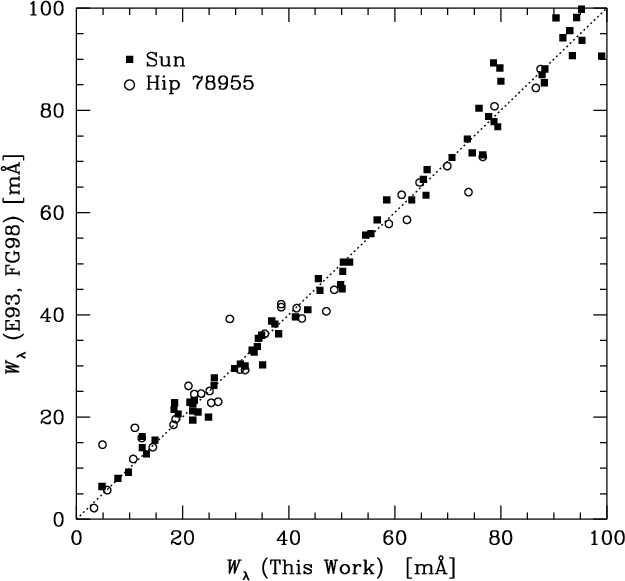 |
Figure 4: Equivalent widths measured in the Sun and the metal-rich star Hip 78955. Comparison for the Sun (filled squares) is made to Edvardsson et al. (1993) (E93), while equivalent widths for Hip 78955 (open circles) are compared to those measured in Feltzing & Gustafsson (1998) (FG98). Equivalent widths from this study are plotted on the abscissa. |
| Open with DEXTER | |
Spectral lines for the analysis were selected using the solar line list by
Moore et al. (1966) as well as various sources from the literature
(notably Edvardsson et al. 1993;
Feltzing & Gustafsson 1998; Stephens 1999; and
Nave et al. 1994 for Fe I). The lines were then checked for
suitability (line strength, blends, etc.) with guiding help from the solar
atlas by Kurucz et al. (1984). The final number of lines is
approximately 450, which for our 66 program stars adds up to 30 000
equivalent width measurements. The task SPLOT in IRAF was used to interactively measure
the equivalent widths ( )
of the spectral lines. SPLOT offers several
ways of measuring equivalent widths and we chose the option which measures
by fitting a Gaussian, Lorentzian or a Voigt profile to the line.
The local continuum was set at every measurement.
)
of the spectral lines. SPLOT offers several
ways of measuring equivalent widths and we chose the option which measures
by fitting a Gaussian, Lorentzian or a Voigt profile to the line.
The local continuum was set at every measurement.
In Fig. 4 we compare our equivalent width measurements for the
Sun and for one metal-rich star with Edvardsson et al. (1993) and
with Feltzing & Gustafsson (1998), respectively. The resolution for
the Edvardsson et al. (1993) spectra are
R 80 000-100 000 and for the
Feltzing & Gustafsson (1998) spectra R 100 000. We have
good agreement, although there might be a weak trend for our equivalent widths
in the metal-rich stars to be slightly larger than those measured by
Feltzing & Gustafsson (1998).
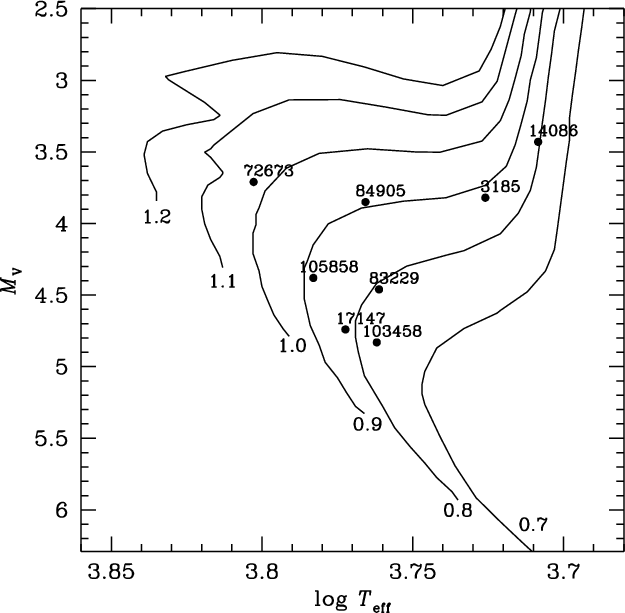 |
Figure 5:
Example of mass estimates. The evolutionary tracks are from
Salasnich et al. (2000) and have a metallicity of
-0.74 dex, and the masses they represent are indicated in the
figure. The stars shown have
![$\rm [Fe/H]<-0.5$](/articles/aa/full/2003/41/aah4451/img10.gif) and their Hipparcos
numbers have been indicated.
and their Hipparcos
numbers have been indicated.
|
| Open with DEXTER | |
Elemental abundances were derived using the Uppsala Eqwidth abundance program, maintained by Bengt Edvardsson. As input it needs an opacity table for the stellar atmosphere and a line table with atomic data and the measured equivalent widths.
Opacity tables for the stellar model atmospheres were calculated using the
Uppsala MARCS code, originally described by
Gustafsson et al. (1975) and Edvardsson et al. (1993)
with updated line opacities by Asplund et al. (1997). The models are
standard 1-D LTE and require metallicity (
![$\rm [Fe/H]$](/articles/aa/full/2003/41/aah4451/img11.gif) ), effective temperature
(
), effective temperature
(
 ), and surface gravity (
 )
as input.
)
as input.
To determine the stellar atmospheric parameters we made use of Fe I lines since they have a wide coverage of line strengths as well as excitation potentials. Fe I (e.g. viz. Fe II) is also by far the most common ion in terms of number of lines in a stellar spectrum.
Effective temperatures (
)
for the stars were determined by
requiring Fe I lines with different lower excitation potentials to
produce equal abundances.
Stellar masses were estimated from the evolutionary tracks by
Girardi et al. (2000) and Salasnich et al. (2000) with
the same metallicities and -enhancements as described in
Sect. 8. Figure 5 shows an example for stars with
,
using the -enhanced tracks from
Salasnich et al. (2000) with a metallicity of -0.74 dex.
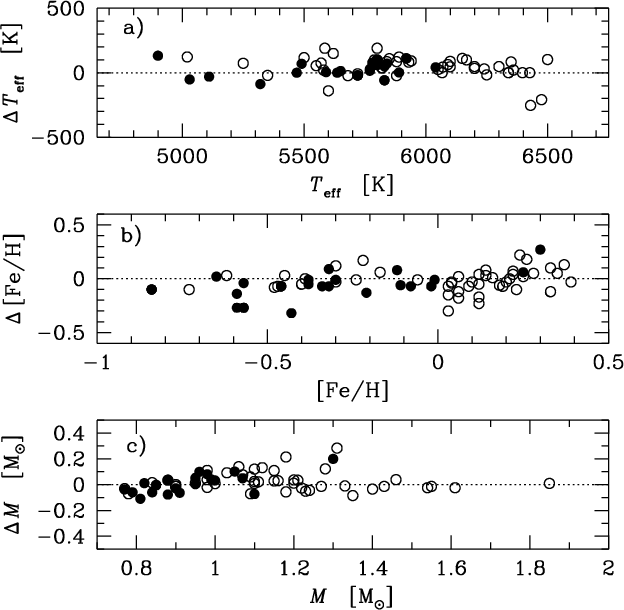 |
Figure 6:
The difference between our final
,
,
and
 and the starting values from
Feltzing et al. (2001) as functions of our
,
,
and
.
Thick and thin disk stars are marked
by filled and open circles, respectively.
and the starting values from
Feltzing et al. (2001) as functions of our
,
,
and
.
Thick and thin disk stars are marked
by filled and open circles, respectively. |
| Open with DEXTER | |
A common way to determine
is by requiring ionization equilibrium,
e.g. that Fe I and Fe II lines produce the same Fe abundance.
There are, however, some indications that Fe I is sensitive to
departures from LTE while Fe II is not (see
e.g. Thévenin & Idiart 1999; Gratton et al. 1999).
This could lead to erroneous values for .
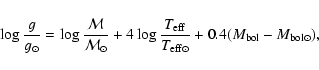
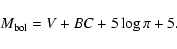
We therefore instead used the trigonometric parallax and the fundamental
relation
is the
stellar mass,
is the effective temperature,
 the
absolute bolometric magnitude, V the visual magnitude, BC the bolometric
correction, and
the parallax. The stars in our sample are all relatively
bright and nearby and therefore have good parallaxes
(
the
absolute bolometric magnitude, V the visual magnitude, BC the bolometric
correction, and
the parallax. The stars in our sample are all relatively
bright and nearby and therefore have good parallaxes
(
 %, Table 2) determined by the
Hipparcos satellite (ESA 1997). Bolometric corrections were interpolated
from the grids by Alonso et al. (1995).
%, Table 2) determined by the
Hipparcos satellite (ESA 1997). Bolometric corrections were interpolated
from the grids by Alonso et al. (1995).
![\begin{figure}
\par\resizebox{18cm}{!}{
\includegraphics[bb=18 144 592 375,clip...
...space{10mm}
\includegraphics[bb=18 144 592 350,clip]{h4451f7h.eps}}\end{figure}](/articles/aa/full/2003/41/aah4451/img87.gif) |
Figure 7:
[Fe I/Fe II] and [Ti I/Ti II]
versus [Fe/H],
 ,
,
and ,
,
and
 .
Thin and thick disk stars are marked by open and filled circles,
respectively. In each plot we also show, with a solid line, a least
square fit and we give the coefficients, slope (k) and constant (m). .
Thin and thick disk stars are marked by open and filled circles,
respectively. In each plot we also show, with a solid line, a least
square fit and we give the coefficients, slope (k) and constant (m).
|
| Open with DEXTER | |
Motions in a stellar atmosphere related to volume sizes that are small compared
to the mean free path of a photon are usually referred to as microturbulence
(
). As long as a spectral line is weak, i.e. not saturated, the
microturbulence only makes the line more shallow, conserving its Gaussian shape
and equivalent width. However, for stronger lines the total absorption will
increase due to a wider wavelength coverage for absorption when the line starts
to saturate. Strong lines were therefore rejected. We determined the
microturbulence by forcing all Fe I lines to give the same abundance
regardless of line strength (
 ).
).
The fundamental parameters were tuned through the following iterative process:
,
,
and
[Me/H] from Feltzing et al. (2001). From these abundances
diagnostic plots were created and interpreted in the following manner.
was then
altered to get a zero slope. A negative slope requires a decrease of
and vice versa for a positive slope. GOTO 2.
 )
is interpreted as due to an erroneous
microturbulence.
was then altered to get a zero slope. A
negative slope requires a lower value for
and vice versa
for a positive slope. If
needs to be changed recalculate
the abundances with the new
and GOTO 1, else
GOTO 3.
)
is interpreted as due to an erroneous
microturbulence.
was then altered to get a zero slope. A
negative slope requires a lower value for
and vice versa
for a positive slope. If
needs to be changed recalculate
the abundances with the new
and GOTO 1, else
GOTO 3.
based on the new mass and create a new model
atmosphere and calculate new elemental abundances, then GOTO 1,
else GOTO 5.
was automatically altered when changing
and/or
by Eq. (4). Generally less than ten models
were generated for each star before the parameters converged. The final values
of
,
,
,
and
are given in
Table 2. Figure 6 shows a comparison of our
final
,
,
and
to the starting values
taken from Feltzing et al. (2001). The average differences are
![$\rm\Delta [Fe/H] = -0.02 \pm 0.11$](/articles/aa/full/2003/41/aah4451/img90.gif) ,
,
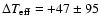 K, and
 .
This provide an important
test of the calibrations used in Feltzing et al. (2001)
(see Sect. 2).
.
This provide an important
test of the calibrations used in Feltzing et al. (2001)
(see Sect. 2).
As noted in Sect. 5.2.3 there are some indications that Fe I
lines are subject to NLTE effects, mainly through over-ionization in hot stars
(
 K) with low surface gravities. Since we have not used
the Fe II lines (which are supposed to be free from NLTE effects) in the
tuning of the stellar atmosphere parameters we utilized them to check on the
derived atmospheric parameters as well as the Fe I abundances. In
Figs. 7a-d we plot the difference between the derived
Fe I and Fe II abundances, [Fe I/Fe II], versus
,
,
,
and [Fe/H] as derived by Fe I
lines. We also show the same plots for Ti I and Ti II in
Figs. 7e-h. In the plots we also show linear regression lines
and their coefficients. As can be seen, the slopes are generally negligible and
the offsets at the "zero points" are at the most a few tenths of a dex.
K) with low surface gravities. Since we have not used
the Fe II lines (which are supposed to be free from NLTE effects) in the
tuning of the stellar atmosphere parameters we utilized them to check on the
derived atmospheric parameters as well as the Fe I abundances. In
Figs. 7a-d we plot the difference between the derived
Fe I and Fe II abundances, [Fe I/Fe II], versus
,
,
,
and [Fe/H] as derived by Fe I
lines. We also show the same plots for Ti I and Ti II in
Figs. 7e-h. In the plots we also show linear regression lines
and their coefficients. As can be seen, the slopes are generally negligible and
the offsets at the "zero points" are at the most a few tenths of a dex.
The lack of any discernible trends therefore suggest that Fe I and Ti I do not appear to suffer from appreciable NLTE effects in our sample.
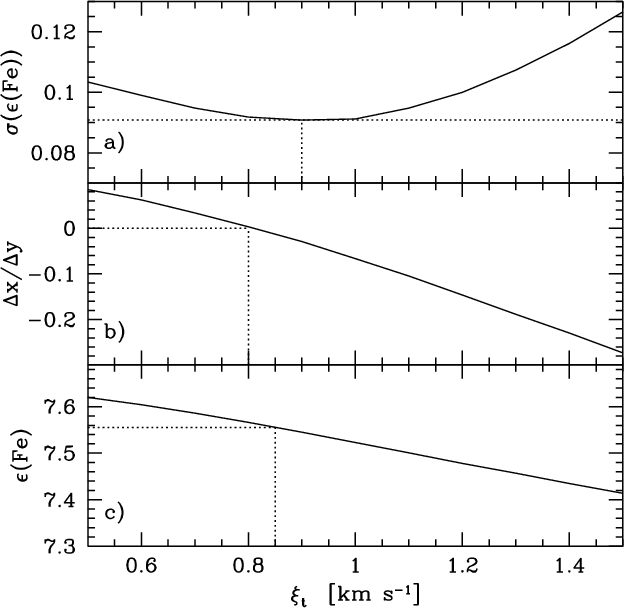 |
Figure 8:
Determination of
for the Sun. a) The standard
deviation of the Fe I abundance. The horizontal dotted line
indicates the minimum scatter in [Fe/H] and the vertical line the
corresponding
.
b) The slope
(
 )
when abundances from individual Fe I
lines are plotted versus line strength, )
when abundances from individual Fe I
lines are plotted versus line strength,
 .
The horizontal dotted line indicates a zero slope and the vertical line the corresponding
.
c) Solar Fe I abundance versus
.
The vertical dotted line indicates the value for
that we adopt, and the horizontal line the corresponding solar Fe I abundance. .
The horizontal dotted line indicates a zero slope and the vertical line the corresponding
.
c) Solar Fe I abundance versus
.
The vertical dotted line indicates the value for
that we adopt, and the horizontal line the corresponding solar Fe I abundance. |
| Open with DEXTER | |
 K and
K and
 (in cgs
units), e.g. Livingston (1999). A consistent value for the
microturbulence was harder to find. For example
Edvardsson et al. (1993) used
(in cgs
units), e.g. Livingston (1999). A consistent value for the
microturbulence was harder to find. For example
Edvardsson et al. (1993) used
 km s-1,
Feltzing & Gustafsson (1998) 1.00 km s-1,
Chen et al. (2000) 1.44 km s-1,
Prochaska et al. (2000) 1.00 km s-1, and
Fulbright (2000) 0.80 km s-1. These studies all used reduced
equivalent widths to derive the solar microturbulence. Other methods, such as
e.g. line profile analysis, usually come out with a lower value of
km s-1,
Feltzing & Gustafsson (1998) 1.00 km s-1,
Chen et al. (2000) 1.44 km s-1,
Prochaska et al. (2000) 1.00 km s-1, and
Fulbright (2000) 0.80 km s-1. These studies all used reduced
equivalent widths to derive the solar microturbulence. Other methods, such as
e.g. line profile analysis, usually come out with a lower value of
 km s-1 (e.g. Gray 1977; Takeda 1995).
Our analysis (see Sect. 3), as well as all of the above
cited studies, make use of integrated solar light (i.e. the Sun seen as a
star).
km s-1 (e.g. Gray 1977; Takeda 1995).
Our analysis (see Sect. 3), as well as all of the above
cited studies, make use of integrated solar light (i.e. the Sun seen as a
star).
Figure 8 shows how the Fe I abundance, the spread
of the Fe I abundance, and the slope of the solar Fe I abundances
from individual lines as a function of reduced equivalent widths
(
 )) vary as functions of
.
For a
correct microturbulence the spread of the derived abundances should reach a
minimum and the slope should be zero. As can be seen, the lowest spread in
[Fe/H] is for a microturbulence of 0.9 km s-1,
Fig. 8a, while the abundance versus line strength shows
no trend for a microturbulence of 0.8 km s-1
(see Fig. 8b). We therefore adopted a value of
0.85 km s-1 for the solar microturbulence. The adherent solar
Fe I abundance is
)) vary as functions of
.
For a
correct microturbulence the spread of the derived abundances should reach a
minimum and the slope should be zero. As can be seen, the lowest spread in
[Fe/H] is for a microturbulence of 0.9 km s-1,
Fig. 8a, while the abundance versus line strength shows
no trend for a microturbulence of 0.8 km s-1
(see Fig. 8b). We therefore adopted a value of
0.85 km s-1 for the solar microturbulence. The adherent solar
Fe I abundance is
 (see Fig. 8c). The abundance from Fe II for this
microturbulence is
(see Fig. 8c). The abundance from Fe II for this
microturbulence is
 ,
which is in reasonable agreement with the Fe I abundance
(see Table 4 and discussion in
Appendix B).
,
which is in reasonable agreement with the Fe I abundance
(see Table 4 and discussion in
Appendix B).
The abundance derived from a single spectral line is directly proportional to
the oscillator strength, -value, for the transition
(see e.g. Eq. (14.4) in Gray 1992). It is therefore of the highest
priority to find -values that are as homogeneous and accurate as
possible.
We are here faced with a choice between laboratory or astrophysically
determined -values. Both have their advantages and disadvantages.
Using laboratory data means that we have one parameter less that is dependent
on the model atmosphere, i.e. the error in the -value is truly
independent. This is valuable especially when analyzing stars that are not
close to the Sun as regards stellar parameters, e.g. metal-poor giants in the
halo. But, as discussed in e.g. Sikström et al. (2002), even if a
-value has been determined using laboratory measurements, usually
through measurements of lifetimes and branching fractions with a claimed high
precision there are still uncertainties present.
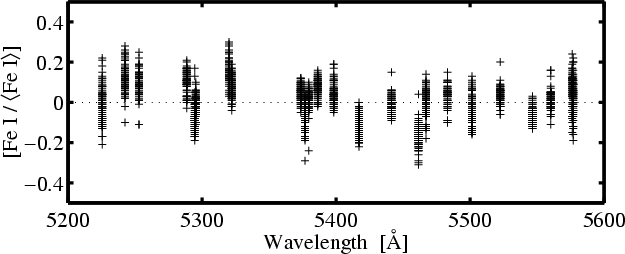 |
Figure 9:
Example of the difference between Fe I abundances derived from
individual lines and the mean Fe I abundance. Each vertical
distribution consists of
![$[\mbox{Fe {\sc i}}_{\lambda} / \langle\mbox{Fe {\sc i}}\rangle_{\star}]$](/articles/aa/full/2003/41/aah4451/img103.gif) for up to
66 stars (all lines are not measured in all stars).
for up to
66 stars (all lines are not measured in all stars).
|
| Open with DEXTER | |
Astrophysical -values are determined by requiring the equivalent
widths, usually measured in a solar spectrum, to reproduce the standard solar
abundance of that element. Other well-studied stars may also be used as
reference. Using astrophysical -values will result in a truly
differential study. This means that the internal errors in the study will be
minimized and thus it is possible to find also small differences between stars.
However, even though astrophysical -values give a very high internal
consistency, comparisons with other studies become more difficult as another
source of errors is included.
The aim with our analysis is to quantify any differences between F and G dwarf
stars in the thin and thick disks. Therefore it might at first seem that
astrophysical -values would be our natural choice. However, we also
want to put our derived abundances on a baseline that is as general as possible
as we want to compare with e.g. our own upcoming study of giant stars in the
thick disk. It should also be noted that indeed all our stars are not solar
like. The most metal-poor stars have for instance [Fe/H] -1.
We therefore decided to investigate the possibility to use laboratory data in
our analysis. This proved to be a most useful excursion and we indeed found
that for many elements not only good but also homogeneous sets of laboratory
data are available. Given our large number of lines we were also able to check
certain corrections that have been suggested in previous studies
(see Appendix B, and especially Fe I). But for a
number of important -elements and for Zn no good, homogeneous sets of
laboratory data are available. We then chose to derive our own astrophysical
-values.
In Appendix B we discuss, for each element and ion, the
available laboratory data and the reasons for choosing astrophysical
-values for certain cases. Table 3 lists our
adopted -values. As starting points in our search for -values
we used large data compilations such as VALD (Piskunov et al. 1995;
Kupka et al. 1999), NIST Spectra Atomic Database
(Martin et al. 1988; Fuhr et al. 1988), Kurucz Atomic Line
Database (Kurucz & Bell 1995), and for Fe I
Nave et al. (1994). However, all original sources have been
checked, and Table 3 lists these references for the selected
-values.
Table 3:
Atomic line data. Columns 1 and 2 give the element and the degree of
ionization (
 ,
,
 ionized). Column 3 gives the
wavelength (in Å), Col. 4 the lower excitation potential (in eV),
Col. 5 the correction factor to the classical Unsöld damping
constant, and Col. 7 the radiation damping constant. A "S" in Col. 6
indicates that the broadening by collisions have been taken from
Anstee & O'Mara (1995),
Barklem & O'Mara (1997, 1998), and
Barklem et al. (1998, 2000), instead of the
classical Unsöld broadening (indicated by an "U"). Column 8 gives
our adopted -values and Col. 9 the references to the original
sources. Astrophysical -values are indicated by "asterisks"
in the reference column. The full table is available in electronic form at the CDS via anonymous ftp to cdsarc.u-strasbg.fr (130.79.128.5) or via http://cdsweb.u-strasbg.fr/cgi-bin/qcat?J/A+A/410/527.
ionized). Column 3 gives the
wavelength (in Å), Col. 4 the lower excitation potential (in eV),
Col. 5 the correction factor to the classical Unsöld damping
constant, and Col. 7 the radiation damping constant. A "S" in Col. 6
indicates that the broadening by collisions have been taken from
Anstee & O'Mara (1995),
Barklem & O'Mara (1997, 1998), and
Barklem et al. (1998, 2000), instead of the
classical Unsöld broadening (indicated by an "U"). Column 8 gives
our adopted -values and Col. 9 the references to the original
sources. Astrophysical -values are indicated by "asterisks"
in the reference column. The full table is available in electronic form at the CDS via anonymous ftp to cdsarc.u-strasbg.fr (130.79.128.5) or via http://cdsweb.u-strasbg.fr/cgi-bin/qcat?J/A+A/410/527.
After tuning the stellar parameters we checked for deviating abundances from
individual lines in all stars. Spectral lines that produced abundances that
deviated a lot from the mean abundance of all the lines from the same atom or
ion were further investigated. In Fig. 9 we give an example for
Fe I, where we plot
for 32 lines in
the interval 5200-5600 Å for all 66 stars. Fe I
 is the
abundance from a specific
Fe I line and
is the
abundance from a specific
Fe I line and
 the mean abundance
from all measured Fe I lines.
the mean abundance
from all measured Fe I lines.
Ideally a spread around zero is expected, representing the errors in the derived stellar parameters as well as the measurements of the equivalent widths and the placement of continua.
Table 4:
Solar elemental abundances. Column 1 indicate the elements and ions and Cols. 2 and 3 give the meteoritic and solar photospheric standard
abundances from Grevesse & Sauval (1998). Our solar abundances are given in Cols. 4 and 5 gives the differences between
this study and the photospheric values. Asterisks indicate that we have
used astrophysical -values and thereby forced the abundance to
the standard photospheric value. Asterisks in parenthesis indicate that
some of the lines have astrophysical -values.
Table 5:
Estimates of the effects on the derived abundances due to internal
(random) errors for four stars. When calculating
 we have assumed
 for Hip 88622, Hip 3142, and Hip 118115,
and
for Hip 88622, Hip 3142, and Hip 118115,
and
 for Hip 103682, see
Sect. 7.1.1. The total random errors (
for Hip 103682, see
Sect. 7.1.1. The total random errors (
 )
were calculated assuming the individual errors to be uncorrelated. The
final line gives the average of the total random error for the four stars.
)
were calculated assuming the individual errors to be uncorrelated. The
final line gives the average of the total random error for the four stars.
The reasons why a specific line deviates in all stars from the mean abundance
can be several. A too high abundance can be caused by blends, incorrect
-values, or blends by telluric lines. However, since the stars have
different radial velocities some stars would be affected by telluric lines and
some not. Hence the star-to-star scatter would be large. In the case of a blend
by another stellar line the star-to-star scatter should be smaller. The
smallest scatter should be expected for incorrect -values as all stars
are equally affected. For a too low abundance, relative to the mean, the most
likely cause of the deviation is an incorrect -value. A final cause
for both too high and too low abundances are incorrect measurements of the
equivalent widths, in particular the placement of the continuum. We do,
however, believe this error to be rather negligible and reasonably well
understood (see Sect. 7.1.1).
For Fe I and Fe II we rejected all lines that, for all stars, showed a large deviation in the same direction. Other elements were treated similarly.
Table 4 lists the solar abundances we derive. As can be
seen they are in reasonable agreement with the standard photospheric abundances
from Grevesse & Sauval (1998), but there are cases when the
agreement is less good. Such disagreements could be caused by erroneous
-values. However, as discussed in Appendix B there
are good reasons to believe that many of the laboratory -values are of
high quality. We have therefore choosen to keep the homogeneous sets of
laboratory -values and instead apply a correction term to the stellar
abundances. The correction term is the difference between Cols. 3 and 4 in
Table 4. Effectively this could be viewed as overall
correction terms to the -values (see also discussion in
Chen et al. 2000). For elements where only astrophysical
-values have been used there are, obviously, no correction terms. In
Table 6 we give the corrected abundances.
The broadening of atomic lines by radiation damping was considered in the
determination of abundances. Radiation damping constants (
 )
for the different lines were collected from Kurucz & Bell (1995).
)
for the different lines were collected from Kurucz & Bell (1995).
Collisional broadening, or van der Waals broadening, was also considered. The
width cross-sections are taken from Anstee & O'Mara (1995),
Barklem & O'Mara (1997, 1998), and
Barklem et al. (1998, 2000). Lines present in these
studies have been marked by an "S" in Table 3. For spectral
lines not present in these studies (marked by a "U" in
Table 3) we apply the correction term (
 )
to
the classical Unsöld approximation of the van der Waals damping, which for
most elements were set to 2.5, following Mäckle et al. (1975).
For Fe I we take the correction terms from
Simmons & Blackwell (1982), but for Fe I lines with a lower
excitation potential greater than 2.6 eV we follow Chen et al. (2000)
and adopt a value of 1.4. For Fe II we adopt a constant value of 2.5
(Holweger et al. 1990).
)
to
the classical Unsöld approximation of the van der Waals damping, which for
most elements were set to 2.5, following Mäckle et al. (1975).
For Fe I we take the correction terms from
Simmons & Blackwell (1982), but for Fe I lines with a lower
excitation potential greater than 2.6 eV we follow Chen et al. (2000)
and adopt a value of 1.4. For Fe II we adopt a constant value of 2.5
(Holweger et al. 1990).
For stronger lines the effect on the abundances of including the new
collisional broadening cross-sections can be large. Therefore it is difficult
to compare our astrophysical -values to those in the literature that
were published prior to the appearance of the studies cited above. Our
astrophysical Ni I -values, for example, do not compare at all
to the ones in Edvardsson et al. (1993) although the measured
equivalent widths for the same lines are in good agreement
(see Fig. 4).
![\begin{figure}
\par\resizebox{18cm}{!}{\includegraphics[bb=18 270 592 718,clip]{...
...51f16.eps}
\includegraphics[bb=150 144 630 710,clip]{h4451f17.eps}}\end{figure}](/articles/aa/full/2003/41/aah4451/img113.gif) |
Figure 10:
Comparison of abundances to
to
Edvardsson et al. (1993) ( ),
Feltzing & Gustafsson (1998) ( ),
Feltzing & Gustafsson (1998) ( ), and
Chen et al. (2000) ( ), and
Chen et al. (2000) ( ). The elements are indicated in the
plots. Dotted lines indicate the 1:1 relationships and values from this
work, [X/H] ). The elements are indicated in the
plots. Dotted lines indicate the 1:1 relationships and values from this
work, [X/H] ,
are always plotted on the abscissas. ,
are always plotted on the abscissas.
|
| Open with DEXTER | |
Undetected blends, telluric lines, or artefacts caused by the reduction process
are examples of features that can distort a spectral line so that it gives an
erroneous
.
We have been observant of strangely shaped lines and
rejected them from further analysis.
Stellar rotation ( )
poses no major problem as long as it is
mild. It simply broadens the spectral lines in a manner such that the total
line strengths are unaffected. One possible effect is that faint lines might be
smeared out and disappear and in crowded regions lines can be difficult to
resolve. A few stars that were observed had to be rejected in the analysis due
to high values of
(Hip 238, 13679, 17651, 20284, 24162, 85397,
86736, 96556, 102485, 104680, 109422, and 115713).
)
poses no major problem as long as it is
mild. It simply broadens the spectral lines in a manner such that the total
line strengths are unaffected. One possible effect is that faint lines might be
smeared out and disappear and in crowded regions lines can be difficult to
resolve. A few stars that were observed had to be rejected in the analysis due
to high values of
(Hip 238, 13679, 17651, 20284, 24162, 85397,
86736, 96556, 102485, 104680, 109422, and 115713).
The major source of error is actually not distortions of the line, but the
placement of the stellar continuum. For spectral lines at shorter wavelengths,
and especially in metal-rich stars, this possibility is higher than for lines
located in uncrowded parts of the spectra, or for stars at lower metallicities.
From our FEROS spectra we estimate that a maximum error of 5% in the measured
is typical for most stars. In the worst cases, in very crowded
parts of the spectra, we estimate a maximum error of 10% in the measured
equivalent widths due to the misplacement of continua.
The precision by which an equivalent width is determined also depends on the
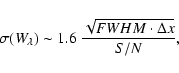
signal-to-noise ratio in the spectrum. The error in
due to the
S/N can be estimated using the relationship from Cayrel (1989):
 |
(6) |
 is the
dispersion (in Å pixel-1), and S/N is the signal-to-noise ratio.
For a rather weak line (
is the
dispersion (in Å pixel-1), and S/N is the signal-to-noise ratio.
For a rather weak line (
 mÅ) at
 Å (
Å (
 Å pixel-1
in our FEROS spectra) with
FWHM = 0.15 Å in a spectrum with
S/N =150 its equivalent width is measured with a precision of 0.7
mÅ according to this formula, or in other words with an uncertainty of
5%. The influence of low S/N is smaller for stronger lines,
e.g. for
Å pixel-1
in our FEROS spectra) with
FWHM = 0.15 Å in a spectrum with
S/N =150 its equivalent width is measured with a precision of 0.7
mÅ according to this formula, or in other words with an uncertainty of
5%. The influence of low S/N is smaller for stronger lines,
e.g. for
 mÅ with
 Å the precision becomes 0.8 mÅ or
<1%.
Å the precision becomes 0.8 mÅ or
<1%.
For stronger lines (
 mÅ) there is a potential
problem with the actual fitting procedure. Sometimes a Gaussian line profile
does not match the observed line profile whereupon we instead fitted a Voigt
profile. This selection was made by eye. We have in general good agreement
between abundances from weaker and stronger lines, which encourage us to
believe that a misjudgment is not particularly common.
mÅ) there is a potential
problem with the actual fitting procedure. Sometimes a Gaussian line profile
does not match the observed line profile whereupon we instead fitted a Voigt
profile. This selection was made by eye. We have in general good agreement
between abundances from weaker and stronger lines, which encourage us to
believe that a misjudgment is not particularly common.
In summary, we estimate our measured equivalent widths to have an average
uncertainty of  5% for stars with low or moderate metallicities
and maybe up to 10% for stars with
5% for stars with low or moderate metallicities
and maybe up to 10% for stars with
![$\rm [Fe/H] \gtrsim 0.1$](/articles/aa/full/2003/41/aah4451/img124.gif) .
This amounts
to 0.02-0.04 dex in the abundance determination from individual lines. For an
element represented by N lines these estimates should be decreased by a
factor
.
This amounts
to 0.02-0.04 dex in the abundance determination from individual lines. For an
element represented by N lines these estimates should be decreased by a
factor  to give the formal error in the mean of the abundance based
on those lines. These errors are exemplified in Table 5.
to give the formal error in the mean of the abundance based
on those lines. These errors are exemplified in Table 5.
As is seen in Fig. 9 there are discrepancies between abundances
even if they are derived with -values that are believed to be of high
accuracy. However, the uncertainty of the mean abundance decreases as
 where N is the number of lines. For an abundance derived
from many lines the formal error in the mean arising from uncertainties in the
atomic parameters is therefore often negligible.
where N is the number of lines. For an abundance derived
from many lines the formal error in the mean arising from uncertainties in the
atomic parameters is therefore often negligible.
The damping constants are usually associated with large uncertainties, but the effects on the derived abundances are normally small. We estimate a maximum influence by increasing the adopted enhancement factors by 50% (see Table 5). However, this estimate only applies to those lines for which the collisional broadening was derived by the classical Unsöld approximation (marked by an "U" in Table 3).
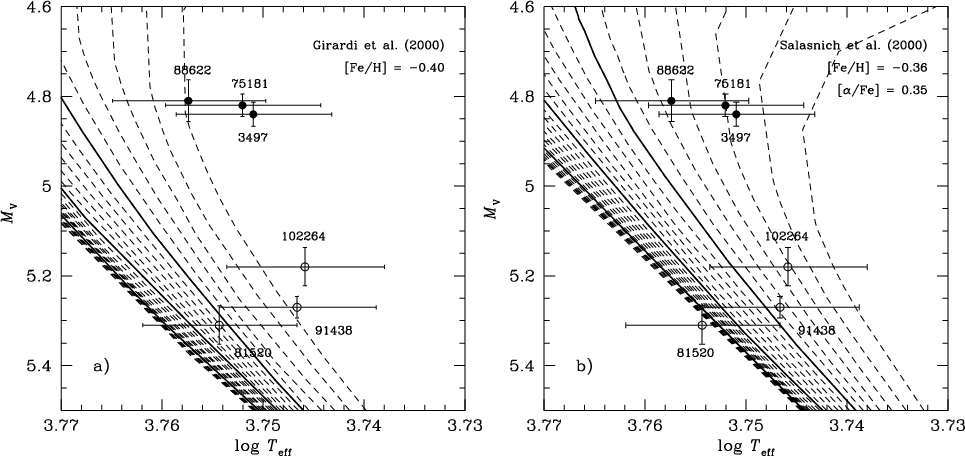 |
Figure 11:
Examples of age estimates. In a) we show the
Girardi et al. (2000) isochrones for
![$\rm [Fe/H] = -0.40$](/articles/aa/full/2003/41/aah4451/img31.gif) and
in b) the Salasnich et al. (2000) isochrones for
and
in b) the Salasnich et al. (2000) isochrones for
![$\rm [Fe/H] = -0.36$](/articles/aa/full/2003/41/aah4451/img32.gif) and an -enhancement of
and an -enhancement of
![$\rm [\alpha /Fe] = 0.35$](/articles/aa/full/2003/41/aah4451/img34.gif) .
The ages that the isochrones represent are
..., 2, 2.2, 2.5, 2.8, 3.2, 3.5, 4.0, 4.5, 5.0, 5.6, 6.3, 7.1, 7.9,
8.9, 10, 11.2, 12.6, 14.1, 15.9, 17.8, and 19.9 Gyr (the last one only
for Salasnich et al. 2000). Isochrones for 2, 5, and 10 Gyr
are marked by solid lines. The stars in the plots have metallicities in
the interval .
The ages that the isochrones represent are
..., 2, 2.2, 2.5, 2.8, 3.2, 3.5, 4.0, 4.5, 5.0, 5.6, 6.3, 7.1, 7.9,
8.9, 10, 11.2, 12.6, 14.1, 15.9, 17.8, and 19.9 Gyr (the last one only
for Salasnich et al. 2000). Isochrones for 2, 5, and 10 Gyr
are marked by solid lines. The stars in the plots have metallicities in
the interval
![$\rm -0.55 < [Fe/H] < -0.20$](/articles/aa/full/2003/41/aah4451/img35.gif) .
Thick and thin disk stars
are marked by filled and open circles, respectively.
Horizontal error-bars represent the 100 K uncertainty in
and the vertical error-bars the individual errors in the parallaxes. .
Thick and thin disk stars
are marked by filled and open circles, respectively.
Horizontal error-bars represent the 100 K uncertainty in
and the vertical error-bars the individual errors in the parallaxes. |
| Open with DEXTER | |
and
A change in
with  K affected the
![$\rm [Fe/H]~ vs. ~\chi_{\rm l}$](/articles/aa/full/2003/41/aah4451/img129.gif) plot by an amount that was easily
recognizable, as was a change of
plot by an amount that was easily
recognizable, as was a change of  km s-1 in the
,
easily discernible in the plot of
km s-1 in the
,
easily discernible in the plot of
![$\rm [Fe/H]~ vs. ~ \log(W_{\lambda}/\lambda)$](/articles/aa/full/2003/41/aah4451/img131.gif) .
These values can therefore be
taken to represent the absolute maximum errors of these two atmospheric
parameters under the assumption of LTE. If errors have a Gaussian distribution
within these limits a reasonable estimate of the (
.
These values can therefore be
taken to represent the absolute maximum errors of these two atmospheric
parameters under the assumption of LTE. If errors have a Gaussian distribution
within these limits a reasonable estimate of the ( )
uncertainties
would be
)
uncertainties
would be
 K and
K and
 km s-1. To ensure that we do not
underestimate the errors we used
km s-1. To ensure that we do not
underestimate the errors we used
 K and
K and
 km s-1 when doing the calculations
for Table 5.
km s-1 when doing the calculations
for Table 5.
We determined the surface gravities through parallaxes and hence the
uncertainty is dependent on the uncertainties of the parameters in
Eq. (4), i.e.
,
,
,
and BC. The
maximum relative error of the parallaxes in our sample is 4.4%,
K, and we estimate that
 % and
% and
 mag. This translates into an internal (random)
uncertainty in
of 0.08 dex. In the calculations for
Table 5 we used
mag. This translates into an internal (random)
uncertainty in
of 0.08 dex. In the calculations for
Table 5 we used
 to make sure that we
are not too optimistic when estimating the uncertainties of the stellar masses
and the bolometric corrections.
to make sure that we
are not too optimistic when estimating the uncertainties of the stellar masses
and the bolometric corrections.
In Table 5 the effect on derived abundances from the random
errors discussed above are tabulated for four of our stars. There is one thin
disk and one thick disk star at
![$\rm [Fe/H] \sim -0.4$](/articles/aa/full/2003/41/aah4451/img140.gif) and two thin disk
stars are at
and two thin disk
stars are at
![$\rm [Fe/H] = 0$](/articles/aa/full/2003/41/aah4451/img141.gif) and
and
![$\rm [Fe/H] = +0.3$](/articles/aa/full/2003/41/aah4451/img142.gif) ,
respectively.
The main contributors to the total error are the uncertainties in
and
,
where the latter error is clearly increasing with
metallicity. This trend is mainly due to the fact that lines that are closer to
saturation in the line cores (more common in metal-rich stars) have a strong
dependence on
.
,
respectively.
The main contributors to the total error are the uncertainties in
and
,
where the latter error is clearly increasing with
metallicity. This trend is mainly due to the fact that lines that are closer to
saturation in the line cores (more common in metal-rich stars) have a strong
dependence on
.
Typical values on the total random error are 0.05 dex for Hip 88622
and Hip 3142 and 0.07 dex for Hip 103682 with Hip 118115 lying in
between. The average values of the total random errors from these four stars
are also given in the bottom line of Table 5.
Systematic errors are more difficult to quantify. By comparing atmospheric parameters and derived abundances to already published values it is however possible to see if there are offsets present. In Fig. 10 we compare our derived abundances for stars that we have in common with Edvardsson et al. (1993), Feltzing & Gustafsson (1998), and Chen et al. (2000). There is generally good agreement with no particular trends. Small offsets might however be present when comparing to individual studies.
Also the atmospheric parameters,
and ,
show good
agreement for the stars in common with Edvardsson et al. (1993),
Feltzing & Gustafsson (1998), and Chen et al. (2000).
Stellar ages were determined using isochrones from
Girardi et al. (2000) for stars with no -enhancement and
isochrones (with
![$\rm [\alpha/Fe] \simeq 0.35$](/articles/aa/full/2003/41/aah4451/img143.gif) )
from
Salasnich et al. (2000) for stars with -enhancements. The
chemical compositions of the different sets of isochrones were translated to
-metallicities using (Bertelli et al. 1994)
)
from
Salasnich et al. (2000) for stars with -enhancements. The
chemical compositions of the different sets of isochrones were translated to
-metallicities using (Bertelli et al. 1994)
![\begin{displaymath}\textrm{[Fe/H]} = 1.024 \cdot \log Z + 1.739,
\end{displaymath}](/articles/aa/full/2003/41/aah4451/img144.gif) |
(7) |
![\begin{displaymath}\textrm{[Fe/H]} = \log (Z/0.019) - \log (X/0.708) - 0.3557,
\end{displaymath}](/articles/aa/full/2003/41/aah4451/img145.gif) |
(8) |
.
The impact of
considering -enhanced isochrones is obvious. As an approximate dividing
limit we treated stars with
![$\rm [Mg/Fe] \gtrsim 0.1$](/articles/aa/full/2003/41/aah4451/img146.gif) as being
-enhanced. For stars within
as being
-enhanced. For stars within  dex of this limit we determined
ages from both sets of isochrones and adopted the mean value. Lower and upper
age limits were estimated from the end points of the errors bars representing
the uncertainties in the stellar parallaxes and
(see Fig. 11). The final columns in Table 2 give
these lower and upper limits and the most probable ages.
Table 2 also indicates which sets of isochrones were
used. Stars that are not sufficiently evolved, i.e. still on the main sequence,
do not have age estimates.
dex of this limit we determined
ages from both sets of isochrones and adopted the mean value. Lower and upper
age limits were estimated from the end points of the errors bars representing
the uncertainties in the stellar parallaxes and
(see Fig. 11). The final columns in Table 2 give
these lower and upper limits and the most probable ages.
Table 2 also indicates which sets of isochrones were
used. Stars that are not sufficiently evolved, i.e. still on the main sequence,
do not have age estimates.
We find average ages of 4.9 2.8 Gyr and 11.24.3 Gyr for the thin and
thick disks, respectively. In Feltzing et al. (2003) we quoted
slightly higher average ages of 6.12.0 Gyr and 12.13.8 Gyr for the
same thin and thick disk stellar samples. Those ages were taken from
Feltzing et al. (2001) who did not use -enhanced
isochrones, which in general give lower ages than isochrones without
-enhancements. Note also that here we use the spectroscopic
s, which for individual stars can have an impact. However, the
mean ages of the two populations are still separated.
2.8 Gyr and 11.24.3 Gyr for the thin and
thick disks, respectively. In Feltzing et al. (2003) we quoted
slightly higher average ages of 6.12.0 Gyr and 12.13.8 Gyr for the
same thin and thick disk stellar samples. Those ages were taken from
Feltzing et al. (2001) who did not use -enhanced
isochrones, which in general give lower ages than isochrones without
-enhancements. Note also that here we use the spectroscopic
s, which for individual stars can have an impact. However, the
mean ages of the two populations are still separated.
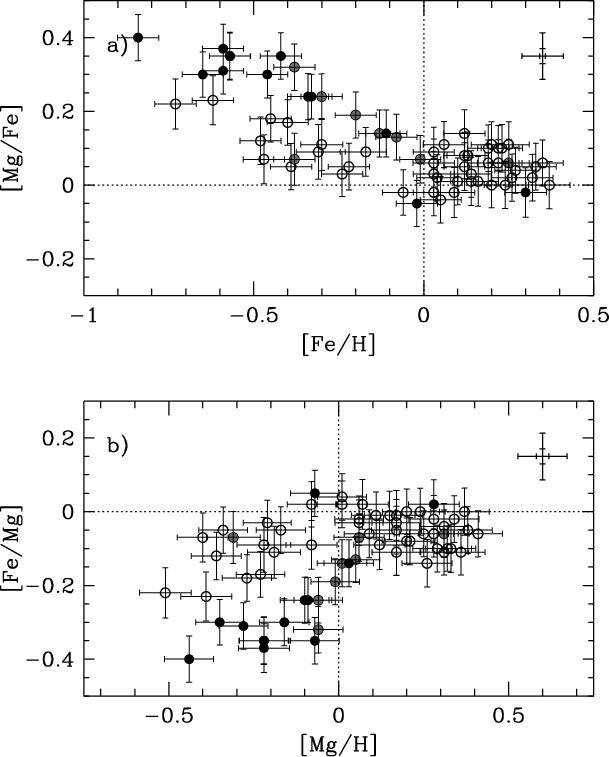 |
Figure 12: Magnesium abundances. The error bar in top right corner gives both the average formal error in the mean and the average total error (see Sect. 9). Individual error bars give the total error. Thin disk stars are marked by empty circles and thick disk stars by filled (black: TD/D > 10, grey: 1 < TD/D < 10) circles. |
| Open with DEXTER | |
![\begin{figure}
\par\resizebox{18cm}{!}{
\includegraphics[clip]{h4451f21.eps} \h...
...pace{10mm}
\includegraphics[bb=18 144 592 450,clip]{h4451f28.eps}}
\end{figure}](/articles/aa/full/2003/41/aah4451/img154.gif) |
Figure 13:
Elemental abundances relative to Fe. Dotted lines indicate solar
values. The error bar give both the average formal error in the mean
and the average total error, see Sect. 9. For the thin
and thick disk subsamples at
![$\rm [Fe/H]<0$](/articles/aa/full/2003/41/aah4451/img36.gif) in the Cr and Ni trends we
performed linear regressions. The slopes (k) and the zero-point
constants (m) are:
in the Cr and Ni trends we
performed linear regressions. The slopes (k) and the zero-point
constants (m) are:
 and
and
 for Cr, and
 and
and
 for Ni.
Thin disk stars are marked by empty circles and thick disk stars by
filled (black: TD/D > 10, grey: 1 < TD/D < 10) circles.
for Ni.
Thin disk stars are marked by empty circles and thick disk stars by
filled (black: TD/D > 10, grey: 1 < TD/D < 10) circles. |
| Open with DEXTER | |
Our abundance results are shown in Figs. 12,
13 and 15 where we plot abundances relative
to Fe and Mg. The error bars that are shown in the top right hand corner of
these plots represent two different types of errors. The smallest error-bar
represents the average of the formal error in the mean
(
 )
from all stars. The formal error in the
mean is given by
)
from all stars. The formal error in the
mean is given by
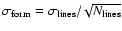 ,
where
,
where
 is the line-to-line scatter
(see e.g. Gray 1992, page 444). The larger represents the total
internal error in our study and is given by
is the line-to-line scatter
(see e.g. Gray 1992, page 444). The larger represents the total
internal error in our study and is given by
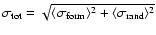 ,
where
,
where
 is given on the last row in
Table 5. In Fig. 12 we also show the
is given on the last row in
Table 5. In Fig. 12 we also show the
 for individual stars.
In some cases we derive abundances from both the atom and the ion of the element. In the plots we have used the average of Ti I & Ti II for Ti and the average of Cr I & Cr II for Cr in order to increase the statistics. The abundance trends do not change when using the mean values as compared to using the different ions separately. There is, however, lower scatter in the plots when the average values are used. For Fe we used the abundances from Fe I only since the number statistics are large.
All abundances have been normalized with respect to the standard solar photospheric abundances as given in Grevesse & Sauval (1998) (see Table 4 and discussion in Sect. 6 and Appendix B).
-elements
The three key results for the -elements in our study are:
the thin and thick disks show clearly
distinct abundance trends (see Figs. 12a, and
13c-e). This difference is statistically robust, and, as is seen in Fig. 12a, there is no overlap of the distributions even when uncertainties in the derived abundances are considered.
![$\rm [\alpha/Fe] = 0.3$](/articles/aa/full/2003/41/aah4451/img161.gif) -0.4 at
-0.4 at
![$\rm [Fe/H] \simeq -0.8$](/articles/aa/full/2003/41/aah4451/img162.gif) ,
and
remaining flat until
,
and
remaining flat until
![$\rm [Fe/H]\simeq -0.4$](/articles/aa/full/2003/41/aah4451/img163.gif) ,
the thick disk
,
the thick disk
![$\rm [\alpha/Fe]$](/articles/aa/full/2003/41/aah4451/img164.gif) trend then declines toward the solar values. This
behaviour is interpreted as being due to the time delay between the
supernovae type II (hereafter SN II) and the long-lived SN Ia in the
enrichment of the interstellar medium.
trend then declines toward the solar values. This
behaviour is interpreted as being due to the time delay between the
supernovae type II (hereafter SN II) and the long-lived SN Ia in the
enrichment of the interstellar medium.
![$\rm [\alpha/Fe] = 0.1$](/articles/aa/full/2003/41/aah4451/img165.gif) -0.2 at
-0.2 at
![$\rm [Fe/H] \simeq -0.7$](/articles/aa/full/2003/41/aah4451/img166.gif) until
reaching solar values at
.
The "knee'' that we see in
e.g. the [Mg/Fe] trend for the thick disk does not appear in the thin
disk. This is indicative of a lower star-formation rate
(see e.g. McWilliam 1997).
until
reaching solar values at
.
The "knee'' that we see in
e.g. the [Mg/Fe] trend for the thick disk does not appear in the thin
disk. This is indicative of a lower star-formation rate
(see e.g. McWilliam 1997).
For
![$\rm [Fe/H] > 0$](/articles/aa/full/2003/41/aah4451/img167.gif) the spread is remarkably low for [Si/Fe] and [Ti/Fe].
This is a significant improvement compared to previous studies (notably
Edvardsson et al. 1993; Feltzing & Gustafsson 1998).
the spread is remarkably low for [Si/Fe] and [Ti/Fe].
This is a significant improvement compared to previous studies (notably
Edvardsson et al. 1993; Feltzing & Gustafsson 1998).
At
the number of thick disk stars in our sample is small.
Whether they truly are members of the thick disk or not is further discussed in
Sect. 9.4.
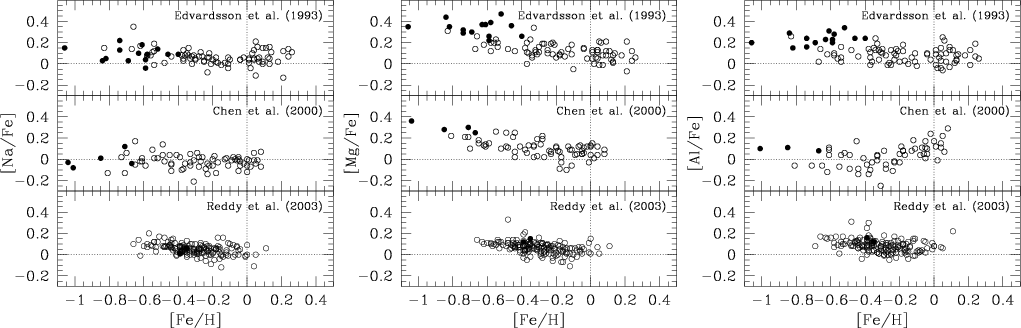 |
Figure 14: Na, Mg, and Al abundances for stars from Edvardsson et al. (1993), and Chen et al. (2000). The stars are selected according to the criteria that we have used for thin and thick disk membership in our sample, Sect. 2. Thick and thin disk stars are marked by filled and open circles, respectively. For a discussion see Sect. 9.1.3. |
| Open with DEXTER | |
McWilliam (1997) noted, from a phenomenological point of view, that
Al and perhaps Na could be classified as mild -elements, even though
their nuclei have odd numbers of protons.
Al behaves, relative to Fe, exactly as an -element,
Fig. 13b. We also reproduce the upward trend in
![$\rm [Al/Fe]$](/articles/aa/full/2003/41/aah4451/img169.gif) at
seen in
Edvardsson et al. (1993) and
Feltzing & Gustafsson (1998).
at
seen in
Edvardsson et al. (1993) and
Feltzing & Gustafsson (1998).
The [Na/Fe] trend is not as clear as that of Al
(compare Figs. 13a and 13b). The
distributions of the two stellar populations have a more "merged'' appearance.
Thick disk stars show a shallow rise or a flat trend from solar abundances to
![$\rm [Na/Fe] \simeq 0.1$](/articles/aa/full/2003/41/aah4451/img170.gif) at
where it levels
out and continues at a constant value to lower metallicities. For
there is a rise in the [Na/Fe] trend, which was also seen in
Feltzing & Gustafsson (1998) and
Edvardsson et al. (1993) but there it was slightly less
pronounced.
at
where it levels
out and continues at a constant value to lower metallicities. For
there is a rise in the [Na/Fe] trend, which was also seen in
Feltzing & Gustafsson (1998) and
Edvardsson et al. (1993) but there it was slightly less
pronounced.
Both Na and Al can be subject to NLTE effects. For recent discussions see
Baumüller et al. (1998) and
Baumüller & Gehren (1997). In general the effects on the
abundances tend to be that they are too high if they are derived under the
assumption of LTE. However, the effects become severe only for metallicities
below
![$\rm [Fe/H]=-1$](/articles/aa/full/2003/41/aah4451/img171.gif) and/or for temperatures greater than
and/or for temperatures greater than
 K. At solar values the effects are usually negligible.
Given the
s and
s of our stars we did not consider the
NLTE effects in the determination of our Na and Al abundances, and furthermore,
the effects would have been small.
K. At solar values the effects are usually negligible.
Given the
s and
s of our stars we did not consider the
NLTE effects in the determination of our Na and Al abundances, and furthermore,
the effects would have been small.
In Fig. 14 we have taken the abundance data from the three
studies Edvardsson et al. (1993), Chen et al. (2000), and
Reddy et al. (2003) and applied our kinematic selection criteria to
their samples. New galactic velocity components were calculated, using
Hipparcos data and radial velocities from
Barbier-Brossat et al. (1994), for the
Edvardsson et al. (1993) stars. For the
Reddy et al. (2003) and the Chen et al. (2000) stars we adopted
their published
,
,
and
velocities.
Thin and thick disk stars were then selected in the same manner as in
Sect. 2, i.e. TD/D 0.1 and TD/D 10 for the
thin and the thick disks, respectively.
The Edvardsson et al. (1993) stars were originally selected to, in
each [Fe/H] bin, sample different parts of the velocity space. This means that
we should expect their sample to contain both thin and thick disk stars. Since
metal-poor (-0.6 dex) thin disk stars and metal-rich
( -0.4 dex) thick disk stars are rare we could expect these parts
of the disks to be poorly sampled. These preconceptions are born out in the
three Edvardsson et al. (1993) plots in
Fig. 14. The trends in their and our data are (where the
distributions overlap) the same. We note that the internal accuracy in
Edvardsson et al. (1993) should be lower when compared with our
study as they use, in most cases, significantly fewer spectral lines.
-0.4 dex) thick disk stars are rare we could expect these parts
of the disks to be poorly sampled. These preconceptions are born out in the
three Edvardsson et al. (1993) plots in
Fig. 14. The trends in their and our data are (where the
distributions overlap) the same. We note that the internal accuracy in
Edvardsson et al. (1993) should be lower when compared with our
study as they use, in most cases, significantly fewer spectral lines.
When applying our kinematic selection criteria to the Chen et al. (2000) sample we get a small and rather scattered sample of thick disk stars. However, if we view the scatter in the data as due to internal errors we can conclude that the overall trend in the thin disk agrees roughly with ours (allowing for extra scatter in the Al thin disk data) and that the thick disk data is not, within the errors, inconsistent with our trends.
Finally, we apply our selection criteria to the Reddy et al. (2003) data. Their sample was originally selected to trace the chemical evolution in the thin disk below solar metallicity. Our selection criteria give 163 of their stars as thin disks stars and 2 stars as thick disk stars. Our thin disk trends nicely agree with theirs. We note that the thick disk stars follow the thin disk trend.
![\begin{figure}
\par\resizebox{18cm}{!}{
\includegraphics[bb=18 195 592 475,clip...
...space{10mm}
\includegraphics[bb=18 144 592 450,clip]{h4451f37.eps}}\end{figure}](/articles/aa/full/2003/41/aah4451/img174.gif) |
Figure 15: Elemental abundances relative to Mg. Dotted lines indicate solar values. The error bar give both the average formal error in the mean, and the average total error, see Sect. 9. Thin disk stars are marked by empty circles and thick disk stars by filled (black: TD/D > 10, grey: 1 < TD/D < 10) circles. |
| Open with DEXTER | |
Cr is an iron peak element that has been found to vary in lockstep with Fe (e.g. Edvardsson et al. 1993; Feltzing & Gustafsson 1998; Chen et al. 2000). Our abundance trends do not present any novelties concerning Cr apart from that it shows an extremely tight trend with a potential shallow decline (see Fig. 13f).
Ni is usually found to show a solar value of
![$\rm [Ni/Fe]$](/articles/aa/full/2003/41/aah4451/img175.gif) for all
(e.g. Edvardsson et al. 1993;
Feltzing & Gustafsson 1998; Chen et al. 2000). We find,
however, that [Ni/Fe] shows a slight overabundance at the lowest metallicities
and, at
,
an increase in
that is different to
previous studies (see Fig. 13g). This rise in
at
will have an impact on the observed
for all
(e.g. Edvardsson et al. 1993;
Feltzing & Gustafsson 1998; Chen et al. 2000). We find,
however, that [Ni/Fe] shows a slight overabundance at the lowest metallicities
and, at
,
an increase in
that is different to
previous studies (see Fig. 13g). This rise in
at
will have an impact on the observed
![$\rm [O/Fe]$](/articles/aa/full/2003/41/aah4451/img176.gif) trend when
oxygen abundances are derived from the forbidden oxygen line at 6300 Å as
this line has a Ni blend (see Johansson et al. 2003;
Bensby et al. 2003a,b). The overall scatter in the
[Ni/Fe] trend is low.
trend when
oxygen abundances are derived from the forbidden oxygen line at 6300 Å as
this line has a Ni blend (see Johansson et al. 2003;
Bensby et al. 2003a,b). The overall scatter in the
[Ni/Fe] trend is low.
For both Cr and Ni we see a potential offset between the thin and thick disk subsamples at [Fe/H] < 0, with the thick disk being more enhanced. These offsets could be further strengthened by linear regressions (see caption of Fig. 13) but considering the internal errors in our data these offsets are marginally significant. Larger stellar samples would be needed to confirm them.
The [Zn/Fe] trend is shown in Fig. 13h. At [Fe/H] < 0 the
thin and thick disk trends are distinct. The thick disk stars show
overabundances that resemble those of the -elements. Thin disk stars
have roughly
![$\rm [Zn/Fe] = 0$](/articles/aa/full/2003/41/aah4451/img177.gif) ,
although with a slight negative slope at
higher
.
At metallicities above solar there is a pronounced rise in
,
although with a slight negative slope at
higher
.
At metallicities above solar there is a pronounced rise in
![$\rm [Zn/Fe]$](/articles/aa/full/2003/41/aah4451/img178.gif) .
The previous major studies of Galactic Zn abundances are
Sneden et al. (1991) and Mishenina et al. (2002). These
studies concentrated on stars spanning the metallicity range
.
The previous major studies of Galactic Zn abundances are
Sneden et al. (1991) and Mishenina et al. (2002). These
studies concentrated on stars spanning the metallicity range
![$\rm -3<[Fe/H]<-0.1$](/articles/aa/full/2003/41/aah4451/img179.gif) and they found that Zn abundances closely track
the overall metallicities, but with a slight overabundance of
and they found that Zn abundances closely track
the overall metallicities, but with a slight overabundance of
![$\rm [Zn/H] \sim +0.04$](/articles/aa/full/2003/41/aah4451/img180.gif) .
Prochaska et al. (2000) find for their
10 thick disk stars an overabundance of [Zn/Fe] in concordance with our
results. Our uprising [Zn/Fe] trend at
is, to our best
knowledge, new. There is, however, a possibility that the uprising trend could
be somewhat overestimated (see Appendix B).
.
Prochaska et al. (2000) find for their
10 thick disk stars an overabundance of [Zn/Fe] in concordance with our
results. Our uprising [Zn/Fe] trend at
is, to our best
knowledge, new. There is, however, a possibility that the uprising trend could
be somewhat overestimated (see Appendix B).
After investigating different elemental abundances, all compared to Fe, it is
illustrative to make comparisons to an element such as Mg. This element is
believed to be solely produced by SN II, see e.g. Arnett (1996) and
Woosley & Weaver (1995), while Fe is produced by both SN Ia and
SN II (e.g. Thielemann et al. 2002). Especially for the other
-elements, Si, Ca, and Ti, such comparisons can lead to further
understanding of the events in which these elements are synthesized, i.e.
SN II vs. SN Ia contributions.
Due to a lower star-formation rate the time scales for the enrichment of the interstellar medium in the thin disk are longer than for the thick disk. Also, as the thin disk forms and evolves, embedded in the thick disk, it could be influenced by SN Ia that emerge from the thick disk population. These two things will make the observed abundance trends in the thin disk more difficult to interpret.
In Fig. 12b we plot the "inverse" of Fig. 12a,
i.e.
![$\rm [Fe/Mg]$](/articles/aa/full/2003/41/aah4451/img181.gif) versus
versus
![$\rm [Mg/H]$](/articles/aa/full/2003/41/aah4451/img182.gif) .
The upward trend in
,
that
is a signature of the onset of the contribution from SN Ia to the chemical
enrichment of the interstellar medium, is seen for the thick disk at
.
The upward trend in
,
that
is a signature of the onset of the contribution from SN Ia to the chemical
enrichment of the interstellar medium, is seen for the thick disk at
![$\rm [Mg/H]\sim -0.1$](/articles/aa/full/2003/41/aah4451/img183.gif) .
At lower Mg abundances
is mainly flat,
corresponding to an epoch where SN II are the only contributors to the Fe
enrichment.
.
At lower Mg abundances
is mainly flat,
corresponding to an epoch where SN II are the only contributors to the Fe
enrichment.
For the thin disk at
![$\rm [Mg/H]<0$](/articles/aa/full/2003/41/aah4451/img184.gif) there is a shallow rise towards the
solar value. Since Mg is only produced in SN II the observed trend must be
interpreted as due to Fe enrichment from SN Ia.
there is a shallow rise towards the
solar value. Since Mg is only produced in SN II the observed trend must be
interpreted as due to Fe enrichment from SN Ia.
Above
![$\rm [Mg/H]=0$](/articles/aa/full/2003/41/aah4451/img185.gif) the
trend for the thin disk is
essentially flat. Most models of galactic chemical evolution are normally not
evolved much beyond the Sun. This makes the exact interpretation of the
abundance patterns above solar difficult. However, it appears that the
production of Mg and Fe reaches an equilibrium for
the
trend for the thin disk is
essentially flat. Most models of galactic chemical evolution are normally not
evolved much beyond the Sun. This makes the exact interpretation of the
abundance patterns above solar difficult. However, it appears that the
production of Mg and Fe reaches an equilibrium for
![$\rm [Mg/H]>0$](/articles/aa/full/2003/41/aah4451/img186.gif) ,
indicating that contributions from SN Ia and SN II are equal.
,
indicating that contributions from SN Ia and SN II are equal.
-elements
Ca, Si, and Ti are all made in SN II. According to SN Ia models they should also be made in these events (e.g. Thielemann et al. 2002). Given the interpretation of the Fe and Mg trends we can now use our data to check if a discernible fraction of these elements are also produced in SN Ia.
We see a flat [Si/Mg] trend for the thick disk while for [Ca/Mg] we see an
upward trend at
![$\rm [Mg/H]\sim 0$](/articles/aa/full/2003/41/aah4451/img187.gif) (see Figs. 15c, d). For Ti the scatter is too large for any trends to be
deciphered (see Fig. 15e). The [Ca/Mg] trend in the thick
disk support the idea that an observable amount of Ca is also produced in
SN Ia (compare Fe, Sect. 9.2.1). This is of course a tentative result
that needs to be confirmed with future studies.
(see Figs. 15c, d). For Ti the scatter is too large for any trends to be
deciphered (see Fig. 15e). The [Ca/Mg] trend in the thick
disk support the idea that an observable amount of Ca is also produced in
SN Ia (compare Fe, Sect. 9.2.1). This is of course a tentative result
that needs to be confirmed with future studies.
The thick disk [Si/Mg] trend implies that no Si is produced in SN Ia, i.e. the
trend remains flat to the highest
.
However, this appears to be
contradictory to nucleosynthesis models of SN Ia
(e.g. Thielemann et al. 2002) which show Si to be produced in
significant amounts in these events.
A first interpretation for the [Ca/Mg] trend in the thin disk is that it first
increases due to Ca enrichment by SN Ia (compare the discussion for Fe in
Sect. 9.2.1). The reason for the subsequent down-turn at higher [Mg/H]
could have several reasons. One interpretation could be that the SN Ia rate
reaches a peak around or slightly after
and after that
SN II dominate the enrichment more and more. Alternatively, SN yields become
metallicity-dependent at super-solar metallicities.
Na and Al are results of Ne and C burning in massive stars that later become SN II (see e.g. Arnett 1996). For Al this explanation is supported by our abundance trends. Since Mg is a sole product of SN II the flat [Al/Mg] trend in Fig. 15b indicates that Mg and Al have similar origins.
The
![$\rm [Na/Mg]$](/articles/aa/full/2003/41/aah4451/img188.gif) trends for the two populations separate nicely
(see Fig. 15a). For the thin disk we have
[Na/Mg] 0, with some scatter and an upward trend at [Mg/H] > 0.
The thick disk
trend shows large under-abundances at the lowest
and then steadily rises with increasing
.
The
interpretation of these trends is unclear. They might have implications for the
effect on yields from the mass cut off in SN explosions.
trends for the two populations separate nicely
(see Fig. 15a). For the thin disk we have
[Na/Mg] 0, with some scatter and an upward trend at [Mg/H] > 0.
The thick disk
trend shows large under-abundances at the lowest
and then steadily rises with increasing
.
The
interpretation of these trends is unclear. They might have implications for the
effect on yields from the mass cut off in SN explosions.
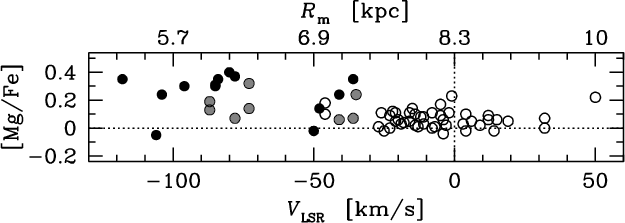 |
Figure 16:
![$\rm [Mg/Fe]~ vs.~ {\it V}_{\rm LSR}$](/articles/aa/full/2003/41/aah4451/img189.gif) ,
with ,
with  indicated on the top axis of the plot. Thin disk stars are marked by empty circles and thick
disk stars by filled (black: TD/D > 10,
grey: 1 < TD/D < 10) circles.
indicated on the top axis of the plot. Thin disk stars are marked by empty circles and thick
disk stars by filled (black: TD/D > 10,
grey: 1 < TD/D < 10) circles. |
| Open with DEXTER | |
![\begin{figure}
\par\resizebox{8.8cm}{!}{\includegraphics[bb=18 144 592 450]{h4451f39.eps}}\end{figure}](/articles/aa/full/2003/41/aah4451/img192.gif) |
Figure 17:
![$\rm [Mg/Fe]~ vs.~ [Fe/H]$](/articles/aa/full/2003/41/aah4451/img191.gif) for the thick disk sample. Stars with
< -60 km s-1 are marked by solid squares,
and those with
> -60 km s-1 with crosses.
The stars discussed in Sect. 9.4 are marked by
their Hipparcos numbers.
for the thick disk sample. Stars with
< -60 km s-1 are marked by solid squares,
and those with
> -60 km s-1 with crosses.
The stars discussed in Sect. 9.4 are marked by
their Hipparcos numbers.
|
| Open with DEXTER | |
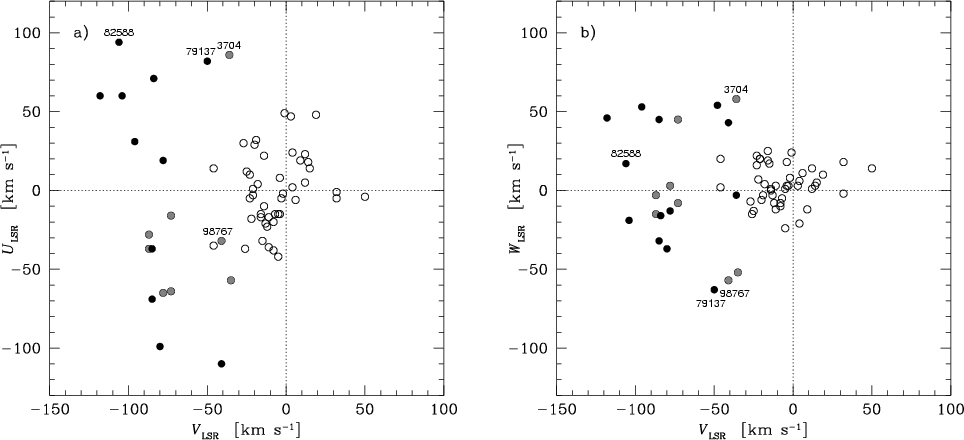 |
Figure 18:
Galactic
and
velocities versus
.
Four thick disk stars are marked by their Hipparcos
numbers, see Sect. 9.4. Thin disk stars are marked
by empty circles and thick disk stars by filled (black: TD/D > 10,
grey: 1 < TD/D < 10) circles.
|
| Open with DEXTER | |
The resemblance of the Zn abundance trend to that of the -elements is
weaker when it is compared to Mg rather than Fe (compare
Figs. 13 and 15). From this it is clear
that the nucleosynthetic origin of Zn is not as clear as e.g. for Si.
According to Mishenina et al. (2002) roughly 1/3 of the Zn yields
comes from primary processes in massive stars (SN II) and 2/3 from SN Ia.
Given the spread in the data this is compatible with our results since we see a
gentle rise in the
![$\rm [Zn/Mg]$](/articles/aa/full/2003/41/aah4451/img194.gif) for all
which is indicative of
contributions from both SN Ia and SN II. We also note that the [Zn/Mg] trend
is fairly similar to the [Na/Mg] trend in Fig. 15a.
for all
which is indicative of
contributions from both SN Ia and SN II. We also note that the [Zn/Mg] trend
is fairly similar to the [Na/Mg] trend in Fig. 15a.
To check if the abundance trends we see for the whole thick disk sample are the
same irrespective of birthplace in the Galaxy we make use of the tight
correlation between galactocentric distance
()
and the
space velocity component
(Edvardsson et al. 1994).
is calculated as the
mean value of the apo- and perigalactic distances of the stellar orbits in a
given model potential.
Figure 16 shows
![$\rm [Mg/Fe]$](/articles/aa/full/2003/41/aah4451/img195.gif) versus
and it
so happens that our thick disk sample has two main groupings, which also can be
seen in Fig. 3; one around
versus
and it
so happens that our thick disk sample has two main groupings, which also can be
seen in Fig. 3; one around
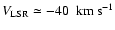 and one around
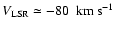 or
or
 kpc and
 kpc. The innermost sample should have
a minimum of contamination of thin disk stars with thick disk kinematics.
kpc. The innermost sample should have
a minimum of contamination of thin disk stars with thick disk kinematics.
Figure 17 shows the
trends
with the thick disk sample split into the two velocity groups. We have a well
defined abundance trend for the stars with
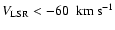 (filled squares). The trend is the
same for the stars with
(filled squares). The trend is the
same for the stars with
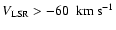 although
not as well sampled (crosses). Also, the one deviating thick disk star
(Hip 3704) is in the sample with the larger
although
not as well sampled (crosses). Also, the one deviating thick disk star
(Hip 3704) is in the sample with the larger
 and can
thus readily be attributed to thin disk contamination
(see Sect. 9.4).
and can
thus readily be attributed to thin disk contamination
(see Sect. 9.4).

Thick disk stars that were selected with relaxed criteria 1 < TD/D < 10, see Sect. 2, do follow the same abundance trends as thick disk stars with TD/D > 10, see Figs. 12, 13, and 15, indicating that the dividing limits we set for the thin and thick disks (TD/D < 0.1 and TD/D > 10, respectively) are by no means definite.
![\begin{figure}
\par\resizebox{17cm}{!}{
\includegraphics[bb=18 144 592 630,clip...
...451f42.eps}
\includegraphics[bb=18 144 592 630,clip]{h4451f43.eps}}\end{figure}](/articles/aa/full/2003/41/aah4451/img203.gif) |
Figure 19:
a) Stellar ages versus
and b) versus
.
The error-bars represent the lowest and highest possible
ages inferred by the errors introduced by parallaxes and effective
temperatures in the fitting of the isochrones, see Fig. 11,
Sect. 8, and Table 2. Thin disk stars
are marked by empty circles and thick disk stars by filled
(black: TD/D > 10, grey: 1 < TD/D < 10) circles.
|
| Open with DEXTER | |
Based on their -element abundances and kinematics there are four thick
disk stars that merit further discussion. These stars are marked by their
Hipparcos numbers in Figs. 3, 17, and
18.
The thick disk star Hip 82588 has a large
velocity and a low
velocity (see Figs. 18a and b). This implies a
shallow elongated galactic orbit. Its
velocity
(-106 km s-1) gives a galactocentric radius of 5.5 kpc
(compare Fig. 16). Hip 82588 could therefore possibly be
attributed to the inner disk or be a nearby bulge-like star
(e.g. Pompéia et al. 2002). The thick disk stars Hip 3704 and
Hip 79137 both have high
and
velocities. This means
that they have elongated orbits but also that they reach high above the
galactic plane. This makes them likely thick disk stars. However, Hip 3704 has
typical thin disk abundances, see Fig. 17, which makes
it a prime candidate for a thin disk star that has had its orbit perturbed by a
molecular cloud, or close encounter with another star, or it could have been
expelled from a binary system. Hip 98767 has a low
velocity and a
high
velocity which gives a typical thick disk orbit.
Figures 19a and b show the stellar ages, see
Sect. 8, as functions of
and
.
Within
the uncertainties there is no evidence that the
< -60 km s-1 thick disk subsample
(
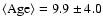 Gyr) is older than the
> -60 km s-1 subsample
(
Gyr) is older than the
> -60 km s-1 subsample
(
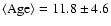 Gyr).
Gyr).
The mean age for the metal-poor (
)
thin disk stars are, within
the uncertainties, equal to the mean age of the metal-rich (
)
thin disk stars (
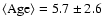 Gyr and
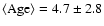 Gyr, respectively).
The various possible formation scenarios for the thick disk were discussed in the Introduction. We will now summarize the observational constraints and discuss the most likely formation scenario for the thick (and thin) disk.
For
we find that the thin and thick disk abundance trends
are clearly separated (see Sect. 9). Not only for the
-elements, but also for other elements such as Al and to a lesser
extent Ni and Cr. These findings should rule out any model that predicts the
two disks to form a continuous distribution. It is therefore most likely that
the thin and thick disks have formed at epochs that are clearly separated in
time and/or space.
The abundance trends we see are also well defined and smooth with small overall scatter. This is indicative of both the thin and thick disks having formed from interstellar gas that was reasonably well mixed.
That we see such a clear and well defined signature from SN Ia in the thick
disk indicates that the gas from which it formed must have been chemically
homogeneous. Star formation must also have continued in the thick disk after
the serious onset of SN Ia since we see thick disk stars with
![$\rm [Fe/H]>-0.4$](/articles/aa/full/2003/41/aah4451/img208.gif) that have formed from interstellar gas with a lower
.
that have formed from interstellar gas with a lower
.
This means that the star formation rate in the thick disk must initially have
been fast to allow the build-up of -elements from SN II to high
metallicities before the enrichment from SN Ia. The horizontal position of the
"knee" sets a lower limit to how long the star formation went on for in the
thick disk. An often quoted time-scale for SN Ia to contribute to the chemical
enrichment is one billion years. However, depending on the star formation rate
this time-scale might be shorter. In e.g. Matteucci (2001) it is
shown how, in a bursting scenario, the SN Ia rate peaks after only a few
hundred million years, i.e. significantly earlier.
Table 6:
Derived abundances relative hydrogen, [X/H], where X denotes the
different elements as indicated. Each element has three columns, mean
abundance ([X/H]), standard deviation of the mean abundance
(
![$\sigma _{\rm [X/H]}$](/articles/aa/full/2003/41/aah4451/img48.gif) ), and the number of spectra lines (N) that has
been used in computing the mean abundance. The abundances have been
normalized with respect to the solar photospheric abundances as given
in Grevesse & Sauval (1998), see also
Table 4. The second column indicates if the star
belongs to the thin disk (
), and the number of spectra lines (N) that has
been used in computing the mean abundance. The abundances have been
normalized with respect to the solar photospheric abundances as given
in Grevesse & Sauval (1998), see also
Table 4. The second column indicates if the star
belongs to the thin disk (
 )
or the thick disk (
)
or the thick disk (
 )
(
)
(
 indicates the Sun). The full table is available in electronic form at the CDS via anonymous ftp to cdsarc.u-strasbg.fr (130.79.128.5) or via http://cdsweb.u-strasbg.fr/cgi-bin/qcat?J/A+A/410/527.
We find that our thick disk sample is on average older than our thin disk
sample,
 Gyr and
 Gyr, respectively
(see Sect. 8). This indicates that the thin and thick disks formed
at separate time epochs.
Gyr, respectively
(see Sect. 8). This indicates that the thin and thick disks formed
at separate time epochs.
The lack of vertical abundance gradients in the thick disk (Gilmore et al. 1995). This indicates that the thick disk formed on a reasonably short time scale. If not, gradients would have had time to build up (compare Burkert et al. 1992). The evidence is based on observations of two stellar samples at distances of 1 kpc and 1.5 kpc from the galactic plane, respectively.
In a study of 110 edge-on spiral galaxies
Schwarzkopf & Dettmar (2000) found that thick disks are much
more common under conditions where the host galaxies are in merging/interacting
environments. Their sample consisted of 69 non-interacting galaxies and of 49
interacting galaxies/minor merging candidates. The disk scale heights for
perturbed disks were found to be 1.5 times larger than for galaxies
having unperturbed disks. Also Reshetnikov & Combes (1997) found
the scale height of interacting galaxies to be two times higher than for
isolated galaxies. Their sample consisted of 29 edge-on interacting spiral
galaxies and 7 edge-on isolated galaxies. This indicates that thick disks are
more likely to be present if the host galaxies are in environments where they
are gravitationally influenced by other galaxies.
The observational evidence that we have presented in this study, i.e. constraints I to III presented above, favours a formation scenario for the thick disk that produces smooth abundance trends that are distinct and well separated between the thin and the thick disks. This should also be the case for the age distributions in the two disks. The scenarios that fulfill this are the fast and the slow dissipational collapses and the merging/interacting scenarios (see e.g. Gilmore et al. 1989, and Sect. 1). Other evidence that can be found in the literature puts the merging/interacting scenarios at advantage to the dissipational ones. Constraint IV e.g. rules out a slow dissipational collapse and constraint V indicates that thick disks are common in merging/interacting scenarios. Taking all this evidence together makes the merging scenario the most likely.
The merger scenario has been modelled with N-body simulations
(e.g. Quinn et al. 1993; Walker et al. 1996;
Huang & Carlberg 1997; Velázquez & White 1999).
Although the full consequences of a merger event are not yet fully understood
it is clear that some heating will occur. In order to inflate the old thin disk
to the velocity dispersions that today's thick disk exhibits, the simulations
indicate that the merging galaxy has to be quite massive (0.1-0.2 of the
Milky Way disk). We note that dwarf galaxies in the Local Group with masses of
that order are rare (see e.g. Mateo 1998).
In this paper we have presented a detailed abundance analysis of 66 F and G
dwarf stars located in the solar neighbourhood. The stellar sample was
kinematically selected with two subsamples representative of the thin and thick
disks. In order to fully disentangle the chemical properties of the thin and
thick disks we selected the samples on purely kinematical grounds. We have
merely strived for an equal number of thin and thick disk stars in each
metallicity bin below
.
All stars have been observed with the
same telescope, using the same settings, the same reduction procedures, and
abundances have been derived with exactly the same atomic parameters and model
atmospheres. This enables a very robust differential comparison of the chemical
evolution of the thin and thick disks with minimal internal uncertainties.
We find that the abundance trends in the thin and thick disks are distinct and
well separated. For the -elements the thick disk shows signatures of
the onset of chemical enrichment to the interstellar medium from SN Ia. No
such fossil record was found in the thin disk, which indicates its more quiet
evolution. Previously it is only in the study by
Mashonkina & Gehren (2001) that the SN Ia signature in the thick
disk has been indicated.
Further we find that there exist stars with thick disk kinematics at
.
In general these stars follow the abundance trends
outlined by the thin disk stars. However, some of them have Galactic orbits
with high ellipticity and whether or not they truly belong to the thick disk or
any other stellar sub-system (such as the Bulge) remains unclear.
We propose that a merging/interacting scenario for the thick disk is the most likely. This conclusion rests on two facts: that thick disks are more common in galaxies that are in merging/interacting environments; that there is no evidence for a vertical abundance gradient in the Galactic thick disk. As discussed the extra-galactic evidence is continuously growing while the Galactic evidence is based on only one study. We think that the most important future observational investigation would be to confirm the lack of a vertical abundance gradient in the thick disk.
We have performed an extensive investigation of the atomic data,
-values in particular, that we used in the determination of the
stellar abundances. However, we sometimes had to rely on astrophysical
-values. In particular we note that in the optical region, good
laboratory data is missing for many elements (e.g. Si, Mg, and Al), and that
the Ca I -values draught from Smith & Raggett (1981)
do not reproduce the solar abundances. The discrepancy that usually is found
between abundances from Ti I and Ti II is not reproduced in this
study. We find good consistency, which for the Sun is in concordance with the
standard meteoritic value in Grevesse & Sauval (1998).
In the same observing runs as we obtained the FEROS spectra we also observed the faint forbidden oxygen line at 6300 Å for the same stars with the Coudé Echelle Spectrograph (CES) on the ESO 3.6 m telescope. With a resolving power exceeding 210 000 and a signal-to-noise above 400 these high quality spectra will enable accurate oxygen abundance determinations. First reports have been presented in Bensby et al. (2003a,b) and the full analysis will be presented in Bensby et al. (2003, submitted).
Acknowledgements
We would like to thank the developers of the Uppsala MARCS code, Bengt Gustafsson, Kjell Eriksson, Martin Asplund, and Bengt Edvardsson who we also thank for letting us use the Eqwidth abundance program. We also thank Bengt Edvardsson, Poul Erik Nissen, and Bengt Gustafsson for valuable comments on draft versions of the paper. TB thanks Kungliga Fysigrafiska Sällskapet i Lund for financial support to the first trip to La Silla in September 2000. SF is grateful for computer grants from the same society. This research has made use of the SIMBAD database, operated at CDS, Strasbourg, France.
Galactic space velocity components were calculated by the following equation
(L. Lindegren 2001, private comm.):
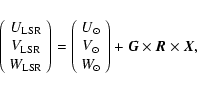 |
(A.1) |
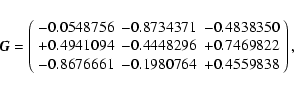 |
(A.2) |
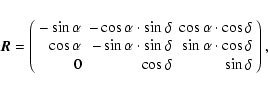 |
(A.3) |
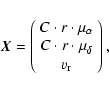 |
(A.4) |
and  denote the ICRS equatorial coordinates,
 and
and
 the proper motions in [mas/yr],
  the
radial velocity in [km s-1], C = 4.74047, r the distance in [pc],
and
the
radial velocity in [km s-1], C = 4.74047, r the distance in [pc],
and
 km s-1that are the solar motions, relative the LSR, was taken from
Dehnen & Binney (1998).
km s-1that are the solar motions, relative the LSR, was taken from
Dehnen & Binney (1998).
-values from
Prochaska et al. (2000) (based on Buurman 1986). These
give an average abundance 0.13 dex below the standard solar value. The other
four lines have theoretically determined -values from
Kurucz & Bell (1995) giving abundances 0.26 dex below the solar
value. We chose to determine astrophysical -values.
-values we were however unable to reproduce the solar
abundance. Chen et al. (2000) also used these oscillator strengths but
had to adjust practically all the -values by subtracting
0.1-0.2 dex in order to reproduce average abundances defined from
selected stars. Our abundance from the lines where
Smith & Raggett (1981) values were available give on average a value
0.17 dex below the standard solar value. We therefore chose to use our own
astrophysical -values.
 Å,
Blackwell et al. 1984) we only found astrophysical
-values (Kostyk 1981) and -values with uncited
sources in the compilation by Fuhr et al. (1988). This combination of
-values from the laboratory, the Sun, and by unknown methods lead us
to abundances with a large dispersion and a solar abundance that was too low by
Å,
Blackwell et al. 1984) we only found astrophysical
-values (Kostyk 1981) and -values with uncited
sources in the compilation by Fuhr et al. (1988). This combination of
-values from the laboratory, the Sun, and by unknown methods lead us
to abundances with a large dispersion and a solar abundance that was too low by
 dex.
dex.
For Cr II we only found astrophysical -values from
Kostyk & Orlova (1983). We therefore made use of our own
astrophysical -values for both Cr I and Cr II.
-values (-0.04 if
 and -0.10 if
 ). These corrections caused abundances from the
May et al. (1974) lines to show overabundances in the Sun of
). These corrections caused abundances from the
May et al. (1974) lines to show overabundances in the Sun of
 dex (relative the mean abundance from all the lines). For the
whole stellar sample differences varied between 0.07 and 0.13 dex (with an
average value of
dex (relative the mean abundance from all the lines). For the
whole stellar sample differences varied between 0.07 and 0.13 dex (with an
average value of
 dex) above the mean abundance from all
Fe I lines for each star. We therefore adopted the original
May et al. (1974) -values which give consistent results.
dex) above the mean abundance from all
Fe I lines for each star. We therefore adopted the original
May et al. (1974) -values which give consistent results.
Our first source of -values for Fe II was the critical
compilation by Giridhar & Ferro (1995). However, these represent an
exotic mixture of different procedures for deriving -values.
Raassen & Uylings (1998) have theoretically determined
-values for thousands of Fe II lines. Comparisons in the UV to
high quality measurements from the FERRUM project show them to be in excellent
agreement with laboratory data, see for instance
Karlsson et al. (2001) and Nilsson et al. (2000).
By using the Raassen & Uylings (1998) oscillator strengths we
obtained a homogeneous set of reliable -values for Fe II.
Compared to the standard Fe abundance from Grevesse & Sauval (1998) our solar abundances are slightly higher (see Table 4).
-values for Mg I,
Kurucz (1995). We used our own astrophysical -values.
-values were rejected as a source due to their
astrophysical origin. Doerr & Kock (1985) and
Lennard et al. (1975) were also rejected since they contained too few
lines in common with our study. We instead choose the recently published
-values from Wickliffe & Lawler (1997) whenever possible
and our own astrophysical for the remaining lines. On average the
Wickliffe & Lawler (1997) solar abundances are 0.09 dex too low
compared to the standard Ni abundance from
Grevesse & Sauval (1998). Since astrophysical -values are
in the majority, among our lines, the derived solar abundance from all our
lines are only 0.02 dex too low compared to
Grevesse & Sauval (1998).
-values by Garz (1973) decreased by 0.10 dex, as
recommended by Becker et al. (1980), were used when available. For the
other lines we used our own astrophysical -values.
 dex lower than if
derived from Ti II lines. Their Ti I abundances showed a clear
temperature dependence while there was none or little dependence for the
Ti II abundances. Prochaska et al. (2000) found that
Ti II abundances exceeded the Ti I abundances by
0.10-0.15 dex for all their stars. Their solar Ti abundance derived from
Ti I was 4.89 and from Ti II 5.05. Also
Stephens & Boesgaard (2002), who used -values from
Bizzarri et al. (1993) and the compilation by
Martin et al. (1988), got
dex lower than if
derived from Ti II lines. Their Ti I abundances showed a clear
temperature dependence while there was none or little dependence for the
Ti II abundances. Prochaska et al. (2000) found that
Ti II abundances exceeded the Ti I abundances by
0.10-0.15 dex for all their stars. Their solar Ti abundance derived from
Ti I was 4.89 and from Ti II 5.05. Also
Stephens & Boesgaard (2002), who used -values from
Bizzarri et al. (1993) and the compilation by
Martin et al. (1988), got
![$\langle[Ti {\sc i}/Ti {\sc ii}]\rangle = -0.06 \pm 0.06$](/articles/aa/full/2003/41/aah4451/img229.gif) .
Note, however,
that they used the Ti I and Ti II abundances in the determination
of their surface gravities.
.
Note, however,
that they used the Ti I and Ti II abundances in the determination
of their surface gravities.
Using laboratory -values from the studies of
Blackwell et al. (1982a, 1982b, 1983,
1986) (corrected according to Grevesse et al. 1989)
for Ti I and from Pickering et al. (2001) for Ti II
we found solar abundances that are 0.10 dex too low for Ti I and
0.11 dex too low for Ti II when compared to the standard solar
photospheric abundance,
 ,
from
Grevesse & Sauval (1998). There is also good agreement between
Ti I and Ti II abundances for all 69 stars
(
,
from
Grevesse & Sauval (1998). There is also good agreement between
Ti I and Ti II abundances for all 69 stars
(
![$\langle [Ti {\sc i}/Ti {\sc ii}]\rangle = 0.00 \pm 0.04$](/articles/aa/full/2003/41/aah4451/img231.gif) ). No trends of
abundances with effective temperature, surface gravity, metallicity, or
microturbulence were found for either Ti I, Ti II or the
difference between the two, Figs. 7e-f.
). No trends of
abundances with effective temperature, surface gravity, metallicity, or
microturbulence were found for either Ti I, Ti II or the
difference between the two, Figs. 7e-f.
The main difference between this study and previous studies is the choice of
oscillator strengths for Ti II. We used the recently published data from
Pickering et al. (2001), while e.g.
Prochaska et al. (2000) mainly used two sources,
Bizzarri et al. (1993) and Savanov et al. (1990), where
the latter is a compilation of published data. For the 13 Ti II lines we
have in common with Prochaska et al. (2000) the mean difference is
 with their -values giving higher abundances. This
difference could explain the difference between their Ti I and
Ti II abundances.
with their -values giving higher abundances. This
difference could explain the difference between their Ti I and
Ti II abundances.
Since the abundances in our study from Ti I and Ti II are
consistent, Figs. 7e-h, we believe that the atomic data we
have used for Ti are correct and that Ti I might not suffer from NLTE
effects (i.e. previous discrepancies were due to incorrect -values) in
the temperature range spanned by our stars. A probable reason for our low solar
abundance is that the photospheric standard Ti abundance might be erroneous. A
value of
 is a better match to our
observations and closer to the meteoritic value (see
Table 4).
is a better match to our
observations and closer to the meteoritic value (see
Table 4).
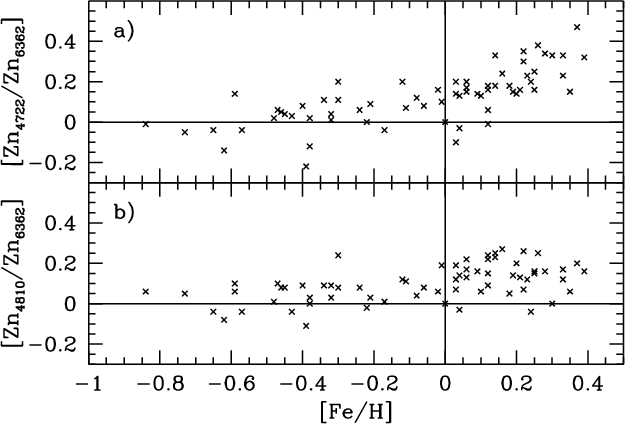 |
Figure B.1:
The difference between Zn abundances when derived from a) the
 4722, 6362 Å lines, and b) the
4810, 6362 Å lines. The -values for all
three lines are astrophysical. 4722, 6362 Å lines, and b) the
4810, 6362 Å lines. The -values for all
three lines are astrophysical. |
-values for Zn. Originally the Zn lines at
4722, 4810, 6362 Å were used. The two lines at shorter
wavelengths are quite strong and are located in crowded parts of the spectra.
This makes them susceptible to blends. The line at 6367 Å is located in a
part of the spectrum where the continuum is lowered by ozone depression.
Placement of the local continuum for this line is, however, no problem. By
comparing the abundances from the two lines at shorter wavelengths to the
6362 Å line we discovered the 4722 Å line to show a prominent increase
when going to higher
,
Fig. B.1a. We interpret
this increase as due to a blend (probably Fe I) that is growing with
metallicity. The 4810 Å line shows different offsets to the 6362 Å line
at sub- and super-solar
,
Fig. B.1b. There is,
however, no indication of a gradual increase with metallicity, but rather an
abrupt increase of the spread at
![$\rm [Fe/H]\sim 0$](/articles/aa/full/2003/41/aah4451/img235.gif) .
We therefore choose to
keep the 4811 Å line in combination with the 6362 Å line for our Zn
abundances. It should however be noted that our Zn abundances at
could be slightly too high.
.
We therefore choose to
keep the 4811 Å line in combination with the 6362 Å line for our Zn
abundances. It should however be noted that our Zn abundances at
could be slightly too high.