![[*]](/icons/foot_motif.gif)
A&A 410, 117-129 (2003)
DOI: 10.1051/0004-6361:20031215
A. S. Gusev 1,2,3 - M.-G. Park 2
1 - Korea Astronomy Observatory, 61-1 Whaam-Dong,
Yuseong-Gu, Taejon 305-348, Korea
2 -
Department of Astronomy and Atmospheric Sciences,
Kyungpook National University, Taegu 702-701, Korea
3 -
Sternberg Astronomical Institute, Moscow University,
Universitetskii Pr. 13, Moscow 119992, Russia
Received 9 November 2001 / Accepted 30 July 2003
Abstract
Results are presented for surface UBVRI photometry of the giant
spiral galaxy NGC 2336. The data were obtained with the 1.8-m
telescope of the Bohyunsan Optical Astronomy Observatory in Korea,
using a CCD camera. The structure and radial light distribution of
the galaxy were studied. The compositions of the stellar populations
in various regions of the galaxy were estimated using two-color
diagrams, and regions of star formation were identified. The
properties of the 34 largest such regions were determined. The ages
of these star formation regions were estimated using stellar
evolutionary synthesis models. It is shown that active, constant,
non-burst star formation has been recently proceeding in the disk of
NGC 2336.
Key words:
galaxies: spiral
- galaxies: individual: NGC 2336
- galaxies: photometry
- galaxies: structure
-
galaxies: stellar content
NGC 2336 is a giant, ringed, barred galaxy. It has highly developed spiral structure (Fig. 1). The basic parameters of NGC 2336 from the LEDA Database (see Paturel et al. 1997) are presented in Table 1 (in this paper, a Hubble constant of H0 = 75 km s-1Mpc-1 has been assumed).
This galaxy has been studied in the optical, infrared (IR) and radio
wavelengths, including surface photometry in B
(Boroson 1981; Blackman & van Moorsel 1984), in V
(Heraudeau & Simien 1996; Baggett et al. 1998), in
RJ (Grosbol 1985) and in JK (Wilke et al. 1999),
as well as aperture photometry in H (Aaronson et al. 1982).
Optical (3400-6700 Å) spectra of NGC 2336 have been studied by
Tifft (1982) and Schechter (1983). Observations in the
12-120  m range were obtained by Wunderlich & Klein
(1991), Keel (1993) and van Driel et al. (1993).
NGC 2336 has also been observed at radio wavelengths of: 2.6 mm
(Young et al. 1995), 2.8 cm (Niklas et al. 1995),
6.3 cm (Heckman 1980; Niklas et al. 1995) and 21 cm
(see, e.g., Aaronson et al. 1982 and van Moorsel 1983).
However, to the best of our knowledge, multicolor surface photometry
of NGC 2336 has not yet been published.
m range were obtained by Wunderlich & Klein
(1991), Keel (1993) and van Driel et al. (1993).
NGC 2336 has also been observed at radio wavelengths of: 2.6 mm
(Young et al. 1995), 2.8 cm (Niklas et al. 1995),
6.3 cm (Heckman 1980; Niklas et al. 1995) and 21 cm
(see, e.g., Aaronson et al. 1982 and van Moorsel 1983).
However, to the best of our knowledge, multicolor surface photometry
of NGC 2336 has not yet been published.
Table 1: Basic parameters of NGC 2336 (from LEDA).
The galaxies NGC 2336 and IC 467 form a wide pair (van Moorsel
1983). The projected distance between NGC 2336 and IC 467 is
 (van Moorsel 1983), corresponding to a linear
scale of 180 kpc at the distance assumed in van Moorsel
(R=30.5 Mpc). A radial velocity difference of
(van Moorsel 1983), corresponding to a linear
scale of 180 kpc at the distance assumed in van Moorsel
(R=30.5 Mpc). A radial velocity difference of
 km s-1 exists between the pair (van Moorsel
1987). However, IC 467 does not influence the structure and
kinematics of NGC 2336 (Schneider & Salpeter 1992; Keel
1993).
km s-1 exists between the pair (van Moorsel
1987). However, IC 467 does not influence the structure and
kinematics of NGC 2336 (Schneider & Salpeter 1992; Keel
1993).
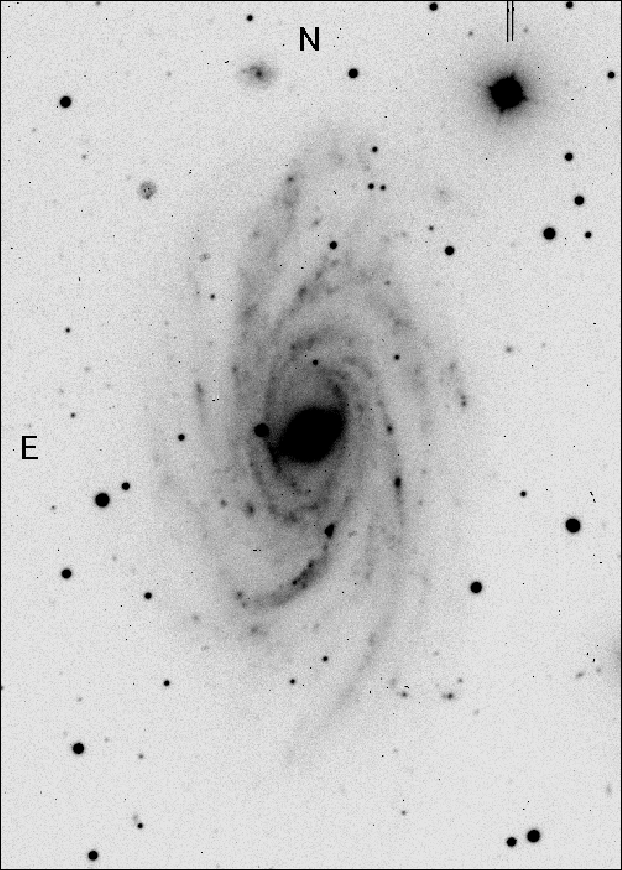 |
Figure 1:
 CCD image of NGC 2336
in the V passband.
CCD image of NGC 2336
in the V passband. |
| Open with DEXTER | |
NGC 2336 has a non-active nucleus: strong nuclear emission has not been detected in either the optical (Tifft 1982; Heckman 1980), IR (Quillen et al. 2001) or radio (Heckman 1980; Hummel et al. 1985; Niklas et al. 1995) wavelengths. The nucleus also has a non-starlike profile in the visual passband (van den Bergh 1995).
The major axis of the relatively short bar in NGC 2336
(
 )
is approximately in line with the minor axis of
the galaxy. Corrected for inclination, the angular radius of the bar
is
)
is approximately in line with the minor axis of
the galaxy. Corrected for inclination, the angular radius of the bar
is
 (Boroson 1981; Wilke et al.
1999). The apparent bar axis ratio is
(Boroson 1981; Wilke et al.
1999). The apparent bar axis ratio is
 ;
corrected for inclination, it is
;
corrected for inclination, it is
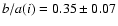 (Martin
1995; Wilke et al. 1999). The ring radius
(
(Martin
1995; Wilke et al. 1999). The ring radius
(
 )
is approximately equal to the bar
semi-length (Boroson 1981; Buta & de Vaucouleurs 1983).
Several developed, symmetrical spiral arms spring from the ring
(Boroson 1981; Biviano et al. 1991).
)
is approximately equal to the bar
semi-length (Boroson 1981; Buta & de Vaucouleurs 1983).
Several developed, symmetrical spiral arms spring from the ring
(Boroson 1981; Biviano et al. 1991).
A bulge-disk decomposition of the radial light profiles of NGC 2336
has been carried out in the B, V, RJ and J passbands
(Boroson 1981; Baggett et al. 1998; Grosbol 1985;
Wilke et al. 1999). However, both the disk and bulge parameter
values differ among these papers: for example, the disk scale length
was estimated to be
 by Baggett et al. (1998) in
the V passband, as well as by Grosbol (1985) in the RJ
passband, whereas Boroson (1981) found it to be
by Baggett et al. (1998) in
the V passband, as well as by Grosbol (1985) in the RJ
passband, whereas Boroson (1981) found it to be
 in
the B passband. The bulge contributes about 5-6% of the total
luminosity of the galaxy in the visible passbands (Boroson
1981; Grosbol 1985), and 21% in the J passband
(Wilke et al. 1999). The fractional contribution from the bar
is 14% of the total luminosity of NGC 2336 (Wilke et al.
1999).
in
the B passband. The bulge contributes about 5-6% of the total
luminosity of the galaxy in the visible passbands (Boroson
1981; Grosbol 1985), and 21% in the J passband
(Wilke et al. 1999). The fractional contribution from the bar
is 14% of the total luminosity of NGC 2336 (Wilke et al.
1999).
In general, NGC 2336 is characterized as a galaxy with symmetrical
structure and regular kinematics (van Moorsel 1983; Keel
1993, 1996). Apparent deviations from the symmetrical
velocity field were detected only at an angular distance of
 north of the center (van Moorsel 1983). However,
the H I distribution is clearly symmetric (van Moorsel
1983). The eastern part of NGC 2336 is inclined away from us
(Keel 1993).
north of the center (van Moorsel 1983). However,
the H I distribution is clearly symmetric (van Moorsel
1983). The eastern part of NGC 2336 is inclined away from us
(Keel 1993).
The total mass of NGC 2336 is
 within a
4
within a
4
 1 radius (van Moorsel 1983). A study of the
NGC 2336-IC 467 system shows that its minimum orbital mass is
1 radius (van Moorsel 1983). A study of the
NGC 2336-IC 467 system shows that its minimum orbital mass is
 times the sum of the individual galaxy masses (van
Moorsel 1983). Wilke et al. (1999) conducted a
bulge-bar-disk mass decomposition within a 1
8 radius, and
estimated the total mass of NGC 2336 to be
times the sum of the individual galaxy masses (van
Moorsel 1983). Wilke et al. (1999) conducted a
bulge-bar-disk mass decomposition within a 1
8 radius, and
estimated the total mass of NGC 2336 to be
 ,
the bulge mass to be
,
the bulge mass to be
 ,
and the bar mass to be
,
and the bar mass to be
 .
.
NGC 2336 is a gas-rich galaxy. Its H I mass is
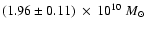 (Wunderlich & Klein 1991;
Young et al. 1996; Martin 1998), and that of H2 is
(Wunderlich & Klein 1991;
Young et al. 1996; Martin 1998), and that of H2 is
 (Young et al. 1996). The detected
neutral hydrogen stretches out to the twice the optical radius of
the galaxy (Martin 1998). Young et al. (1995) found a
molecular ring with a radius of
(Young et al. 1996). The detected
neutral hydrogen stretches out to the twice the optical radius of
the galaxy (Martin 1998). Young et al. (1995) found a
molecular ring with a radius of
 ,
which is 2.5 times that
of the optical ring.
,
which is 2.5 times that
of the optical ring.
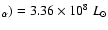
The galaxy has a relatively high H luminosity of
L(H
luminosity of
L(H
 ,
or
0.04 LB
(Young et al. 1996). In contrast, the far-infrared (FIR)
luminosity of NGC 2336 (
,
or
0.04 LB
(Young et al. 1996). In contrast, the far-infrared (FIR)
luminosity of NGC 2336 (
 or
0.2 LB) is lower than typical values for Sbc type galaxies
(van Driel et al. 1993; Xu et al. 1994; Young et al.
1996). This is probably due to the presence of a cold dust
component in the galaxy (Wunderlich & Klein 1991; van Driel
et al. 1993). The FIR flux ratio is only
or
0.2 LB) is lower than typical values for Sbc type galaxies
(van Driel et al. 1993; Xu et al. 1994; Young et al.
1996). This is probably due to the presence of a cold dust
component in the galaxy (Wunderlich & Klein 1991; van Driel
et al. 1993). The FIR flux ratio is only
 (van Driel et al. 1993;
Young et al. 1996). The effective temperature of the dust is
(van Driel et al. 1993;
Young et al. 1996). The effective temperature of the dust is
 K (Wunderlich & Klein 1991). The dust
mass was estimated to be
K (Wunderlich & Klein 1991). The dust
mass was estimated to be
 (Young et al.
1996).
(Young et al.
1996).
The azimuthal distributions of the H2 gas and H
line
flux are not symmetrical. A 10-20% excess of H2, and a 30%
deficiency of H
flux, have been detected in the northern
part of the galaxy (Rownd & Young 1999).
Active star formation processes have been noted in NGC 2336.
Hodge & Kennicutt (1983) found 49 H II regions in
this galaxy. The star formation rate (SFR) was estimated to be
 yr-1 from FIR observations (Young et al.
1996) and
yr-1 from FIR observations (Young et al.
1996) and
 yr-1 from H
line
observations (Rownd & Young 1999). The corresponding star
formation efficiencies (SFEs) are
yr-1 from H
line
observations (Rownd & Young 1999). The corresponding star
formation efficiencies (SFEs) are
 yr-1 and
 yr-1, respectively (converting from the SFRs,
and assuming the estimated masses of H I and H2). In 1987,
a supernova burst was detected 1
4 south-east of the galaxy
center (Bartunov et al. 1994).
yr-1, respectively (converting from the SFRs,
and assuming the estimated masses of H I and H2). In 1987,
a supernova burst was detected 1
4 south-east of the galaxy
center (Bartunov et al. 1994).
With the adopted Hubble constant of H0 = 75 km s-1 Mpc-1, we estimate a linear scale of 156.3 pc/arcsec, at the assumed distance (R=32.2 Mpc) to NGC 2336.
UBVRI CCD observations of NGC 2336 were made on 2001 February
22/23, using the 1.8-m telescope of the Bohyunsan Optical Astronomy
Observatory (BOAO), with a CCD camera at the Ritchey-Chrétien
f/8 focus. The camera was a SITe AR-coated
 pixel
array, with a plate scale of
pixel
array, with a plate scale of
 /pixel. The field of view
was about
/pixel. The field of view
was about
 .
The average seeing was about
.
The average seeing was about
 .
Two exposures in each of the B, V, R and I
filters, and three exposures in the U filter, were obtained. The
journal of observations is given in Table 2.
.
Two exposures in each of the B, V, R and I
filters, and three exposures in the U filter, were obtained. The
journal of observations is given in Table 2.
Table 2: Journal of observations of NGC 2336 (available in electronic form).
The BOAO filters used with the CCD detector together formed a photometric system close to the standard Johnson-Cousins UBVRI system.
The data reduction was carried out using standard techniques, with the ESO-MIDAS image processing system. The main image reduction stages were as follows:
 mag,
mag,
 mag,
mag,
 mag,
mag,
 mag and
 mag.
mag.
Table 3: Galactic and internal absorption for NGC 2336.
We studied the structure and photometric parameters of NGC 2336
on various scales >2
 (the observational seeing, see
Table 2). The images were smoothed using different sized
boxes, for display in the figures: smoothing for the photometric
profiles of NGC 2336 is
(the observational seeing, see
Table 2). The images were smoothed using different sized
boxes, for display in the figures: smoothing for the photometric
profiles of NGC 2336 is
 pixels
(
pixels
(
 )
in the U and B passbands
(Figs. 2a, c), and
)
in the U and B passbands
(Figs. 2a, c), and
 pixels
(
pixels
(
 )
in the V, R and I passbands
(Figs. 2a-d). Smoothing for the
isophotal maps is
pixels (
)
in both B and I passbands (Figs. 3a, b). The smoothing box for the color maps and color
profiles of the galaxy is
)
in the V, R and I passbands
(Figs. 2a-d). Smoothing for the
isophotal maps is
pixels (
)
in both B and I passbands (Figs. 3a, b). The smoothing box for the color maps and color
profiles of the galaxy is
 pixels
(
pixels
(
 )
for all color indices
(Figs. 5a-d,
6a-d). The photometric accuracies of
the smoothed images are:
)
for all color indices
(Figs. 5a-d,
6a-d). The photometric accuracies of
the smoothed images are:
 mag,
mag,
 mag,
mag,
 mag,
mag,
 mag,
mag,
 mag,
mag,
 mag,
mag,
 mag,
mag,
 mag and
 mag.
The values show the accuracies for the profiles and maps in
Figs. 2a-d, 3a, 3b, 5a-d,
6a-d only. They are not valid for any
other data.
mag.
The values show the accuracies for the profiles and maps in
Figs. 2a-d, 3a, 3b, 5a-d,
6a-d only. They are not valid for any
other data.
![\begin{figure}
\par\includegraphics[width=16.2cm]{aa2054f2.eps}\end{figure}](/articles/aa/full/2003/40/aa2054/img90.gif) |
Figure 2:
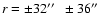
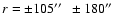
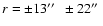
NGC 2336 photometric profiles (in mag arcsec-2) along
the major axis of the galaxy (
 )
( a), b)), and
along the major axis of the bar ( )
( a), b)), and
along the major axis of the bar (
 )
( c), d)), in
the U (dotted line), B (dashed line), V (solid
line) ( a), c)), and V (solid line), R (dashed line), and
I (dotted line) ( b), d)) passbands. Negative angular distances correspond
to the southern ( a), b)) and the eastern ( c), d)) parts of
NGC 2336. These profiles cut across the galactic components at
the following locations: ( a), b)) nucleus
( )
( c), d)), in
the U (dotted line), B (dashed line), V (solid
line) ( a), c)), and V (solid line), R (dashed line), and
I (dotted line) ( b), d)) passbands. Negative angular distances correspond
to the southern ( a), b)) and the eastern ( c), d)) parts of
NGC 2336. These profiles cut across the galactic components at
the following locations: ( a), b)) nucleus
(
 ), bulge
( ), bulge
(
 ), ring
( ), ring
(
 ), external disk
( ), external disk
(
 ), spiral arms
( ), spiral arms
(
 );
( c), d)) nucleus (
), bulge
( );
( c), d)) nucleus (
), bulge
(
 ), bar
( ), bar
(
 ), ring ( ), ring (
 ),
spiral arms ( ),
spiral arms (
 ). The two sharp-peaked maxima
in ( a), b)) at radii of ). The two sharp-peaked maxima
in ( a), b)) at radii of
 and
and
 are field stars. The coordinate accuracy is
 . . |
| Open with DEXTER | |
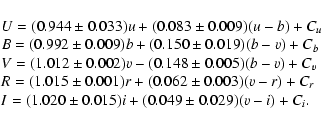
In this paper, we corrected all data for Galactic absorption, following the standard procedure given in the RC3 Catalogue (de Vaucouleurs et al. 1991). The data in Sects. 3.4 and 3.5 were additionally corrected for dust absorption due to the inclination of NGC 2336; these inclination-corrected values are indicated by an "i'' superscript: "CI0i''. The corrections in the standard Johnson-Cousins system associated with Galactic absorption (E0), and with the transformation of quantities to their "face-on'' values (Ei), were calculated using information from the LEDA Database; they are presented in Table 3.
A small starlike nucleus of 0.8 kpc (
 )
diameter appears
in the photometric profiles presented in
Figs. 2a-d. The surface brightness of
the nucleus reaches a maximum of 18.3 mag arcsec-2 in B. In
contrast, a large bulge is observed, with a radius of 2.6 kpc
(
)
diameter appears
in the photometric profiles presented in
Figs. 2a-d. The surface brightness of
the nucleus reaches a maximum of 18.3 mag arcsec-2 in B. In
contrast, a large bulge is observed, with a radius of 2.6 kpc
(
 ).
).
![\begin{figure}
\par\includegraphics[width=12.5cm]{aa2054f3.eps}\end{figure}](/articles/aa/full/2003/40/aa2054/img93.gif) |
Figure 3: Isophotal map of NGC 2336 in the a) B and b) I passbands. The isophotal contour levels a) 20.0, 21.0, 21.5, 22.0, 22.5, 23.5, 24.5 B mag arcsec-2, and b) 19.5, 20.0, 20.5, 21.0, 21.5, 22.0, 22.5 I mag arcsec-2, are shown. |
| Open with DEXTER | |
The major axis of the short bar of the galaxy lies roughly in the
same direction as the minor axis of NGC 2336
(Figs. 3a, b). The apparent semi-length of
the bar is
 (Figs. 2c, d),
corresponding to a deprojected distance of 5.9 kpc (
(Figs. 2c, d),
corresponding to a deprojected distance of 5.9 kpc (
 ).
The western part of the bar appears to be smaller than the eastern
part, in the longer wavelength passbands (see Figs. 2d,
3b). In the bluer passbands, this bar asymmetry is less
pronounced (Figs. 2c, 3a). A probable
reason for this is the presence of more active star formation in
the eastern arm of the bar (see Sect. 3.4 for
more details). The bar of NGC 2336 has an exponential-like intensity
profile, with a scale length for the eastern arm of
).
The western part of the bar appears to be smaller than the eastern
part, in the longer wavelength passbands (see Figs. 2d,
3b). In the bluer passbands, this bar asymmetry is less
pronounced (Figs. 2c, 3a). A probable
reason for this is the presence of more active star formation in
the eastern arm of the bar (see Sect. 3.4 for
more details). The bar of NGC 2336 has an exponential-like intensity
profile, with a scale length for the eastern arm of
 kpc (
kpc (
 )
in the
I passband. The average surface brightness of the bar,
)
in the
I passband. The average surface brightness of the bar,
 mag arcsec-2 in B and
 mag arcsec-2 in V (see Fig. 2c), is typical of
bars.
mag arcsec-2 in V (see Fig. 2c), is typical of
bars.
In our images of NGC 2336, the ring is not an easily distinguished
structural unit (Figs. 1, 2a, 2b, 3a). We estimate its radius to be
 kpc (
kpc (
 ). The outer ring radius is
about equal to the bar semi-length. The surface brightness of the
ring reaches
). The outer ring radius is
about equal to the bar semi-length. The surface brightness of the
ring reaches
 mag arcsec-2 in B, which is only
0.2 - 0.3 mag arcsec-2 higher than the surface brightness of
the background to the ring (Fig. 2a). This difference
is even smaller in the redder passbands (see Figs. 2a, b).
mag arcsec-2 in B, which is only
0.2 - 0.3 mag arcsec-2 higher than the surface brightness of
the background to the ring (Fig. 2a). This difference
is even smaller in the redder passbands (see Figs. 2a, b).
Several field stars are projected onto the galactic disk. One bright
star is
 east of the center of NGC 2336
(Figs. 1, 3a, 3b). Two field
stars are projected onto the major axis of the galaxy (at radii of
and
in Figs. 2a, b). These field stars were subtracted to allow further
investigations, such as quantifying the azimuthal and radial light
distributions.
east of the center of NGC 2336
(Figs. 1, 3a, 3b). Two field
stars are projected onto the major axis of the galaxy (at radii of
and
in Figs. 2a, b). These field stars were subtracted to allow further
investigations, such as quantifying the azimuthal and radial light
distributions.
NGC 2336 has numerous, long, developed and twisted spiral arms
(Figs. 1, 3a, 3b). Detailed
explorations of its spiral structure are difficult to perform, due
to the large inclination of this galaxy. We found six distinct
spiral arms in NGC 2336: four arms in the northern and western
regions, one bright arm in the southern part of the galaxy, and one
faint arm in the eastern part. As a result, some asymmetry is
expected to appear in the photometric profiles along the major axis
of the galaxy (see Figs. 2a, b). The
surface brightness of the spiral arms decreases from
B mag arcsec-2 in the inner part of the disk,
to
 B mag arcsec-2 in the outer part. The
numerous, small "hills'' in Figs. 2a-d
result from the spiral arms cutting across the chosen photometric
profile axes.
B mag arcsec-2 in the outer part. The
numerous, small "hills'' in Figs. 2a-d
result from the spiral arms cutting across the chosen photometric
profile axes.
In spite of the apparent difference in surface brightness between the western and eastern parts of NGC 2336 (Fig. 1), the western part is actually less than 0.15 B mag arcsec-2brighter than the eastern part (see Figs. 3a, b).
![\begin{figure}
\par\includegraphics[width=7.7cm]{aa2054f4.eps}\end{figure}](/articles/aa/full/2003/40/aa2054/img105.gif) |
Figure 4:
The dependence of a) position angle and b)
ellipticity (
 )
of the smoothed isophotes of
NGC 2336, on the angular distance r from the galaxy center, in the
U (thick solid line), B (long dashed line), V (dotted line),
R (short dashed line) and I (thin solid line) passbands. )
of the smoothed isophotes of
NGC 2336, on the angular distance r from the galaxy center, in the
U (thick solid line), B (long dashed line), V (dotted line),
R (short dashed line) and I (thin solid line) passbands. |
| Open with DEXTER | |
![\begin{figure}
\par\includegraphics[width=7.2cm]{aa2054f5.eps}\end{figure}](/articles/aa/full/2003/40/aa2054/img106.gif) |
Figure 5: NGC 2336 color index maps in a) U-B, b) B-V, c) V-R, and d) R-I. Contours of constant color index are shown, with levels set at: a) U-B = 0.2, 0.4, 0.6 mag, b) B-V = 0.45, 0.6, 0.75 mag, c) V-R = 0.35, 0.42, 0.5 mag, and d) R-I = 0.4, 0.5 mag. Redder regions are shaded darker than bluer ones. Regions with SNR < 5 are indicated by the white areas. |
| Open with DEXTER | |
Many bright star formation regions are observed in the spiral arms
of NGC 2336, and the surface brightness in these regions reaches
a maximum of 20.2 B mag arcsec-2. The largest star formation
complex is located in the southern spiral arm, at a distance of
12 kpc (
 )
south of the center of NGC 2336
(Figs. 2a, 2b, 3a). Its size
is
)
south of the center of NGC 2336
(Figs. 2a, 2b, 3a). Its size
is
 kpc (
kpc (
 ).
).
The estimated position angles and ellipticities (
)
of the smoothed isophotes of NGC 2336, as a function of angular
distance from the galaxy center, are presented in
Figs. 4a, b. These results are in agreement
with Heraudeau & Simien (1996).
We used a smoothing box of
 pixels
(
pixels
(
 )
for studying the position angles and
ellipticities in the images. The accuracy of the ellipticity
functions constructed from the smoothed isophotal images is 0.04 mag
in the U and R passbands, and 0.03 mag in the B, V and
I passbands.
)
for studying the position angles and
ellipticities in the images. The accuracy of the ellipticity
functions constructed from the smoothed isophotal images is 0.04 mag
in the U and R passbands, and 0.03 mag in the B, V and
I passbands.
The bulge of NGC 2336 is not circularly symmetric. Its ellipticity
is
 (Fig. 4b), and its position angle is

 ,
which is close to that of the galaxy as a
whole (Fig. 4a).
,
which is close to that of the galaxy as a
whole (Fig. 4a).
Among the observed passbands, the isophotal position angles and
ellipticities differ most notably in the angular distance range
 from the galaxy center. The relatively
young stellar population of the bar and ring occupy this region.
The wavelength dependence of position angle and ellipticity is a
result of a change in stellar population content along the bar of
NGC 2336 (see Sect. 3.4). We estimated the bar
position angle to be
from the galaxy center. The relatively
young stellar population of the bar and ring occupy this region.
The wavelength dependence of position angle and ellipticity is a
result of a change in stellar population content along the bar of
NGC 2336 (see Sect. 3.4). We estimated the bar
position angle to be
 in the V, R and I
passbands, and its apparent ellipticity to be
in the V, R and I
passbands, and its apparent ellipticity to be
 in the
U, B, V and R passbands. This result for the bar ellipticity
is more precise than those of Martin (1995) and Wilke et al.
(1999).
in the
U, B, V and R passbands. This result for the bar ellipticity
is more precise than those of Martin (1995) and Wilke et al.
(1999).
The isophotal position angles are approximately constant
(
 )
at radial distances (
)
at radial distances (
 )
where the disk dominates the light from the galaxy. A local
"maximum'' (
)
where the disk dominates the light from the galaxy. A local
"maximum'' (
 )
appears at an angular
distance of
from the galaxy center
(Fig. 4a). The ellipticity increases from
)
appears at an angular
distance of
from the galaxy center
(Fig. 4a). The ellipticity increases from
 at
to
at
to
 at
at
 (Fig. 4b). The ellipticity values
determined from the U and B images are smaller than those
determined from the redder passbands, in the angular range
(Fig. 4b). The ellipticity values
determined from the U and B images are smaller than those
determined from the redder passbands, in the angular range
 .
This region undergoes active star
formation in numerous star formation complexes (see
Sects. 3.4, 3.5); the chance
distribution of these star formation regions distorts the
ellipticity values determined from the bluer passbands.
.
This region undergoes active star
formation in numerous star formation complexes (see
Sects. 3.4, 3.5); the chance
distribution of these star formation regions distorts the
ellipticity values determined from the bluer passbands.
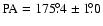
We estimated the position angle and ellipticity for the galaxy
as a whole, in the V, R and I passbands, as
 and
and
 .
This
ellipticity corresponds to a galactic inclination of
.
This
ellipticity corresponds to a galactic inclination of
 .
.
The data presented in this section, and in the next, have been corrected just for Galactic absorption.
Only regions with signal-to-noise ratio (SNR) greater than 5 were studied in this section. Thus, we did not consider the U-B data for the disk of NGC 2336 (see Fig. 5a).
The total color indices of NGC 2336 are typical of intermediate-type spiral galaxies: U-B = -0.01 mag, B-V = 0.51 mag, and V-I = 0.99 mag (these values are from the LEDA Database).
Table 4: Radial photometric parameters for the disk and bulge of NGC 2336.
The nucleus and bulge of NGC 2336 are the reddest parts of the
galaxy (Figs. 5a-d,
6a-d). The color indices of the bulge
are:
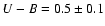 mag,
mag,
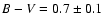 mag,
mag,
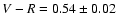 mag, and
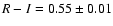 mag. The color
indices at the galaxy center reach as high as:
U-B = 0.83 mag,
B-V = 0.86 mag,
V-R = 0.58 mag, and
R-I = 0.63 mag. These
values indicate an old stellar population in the central regions.
mag. The color
indices at the galaxy center reach as high as:
U-B = 0.83 mag,
B-V = 0.86 mag,
V-R = 0.58 mag, and
R-I = 0.63 mag. These
values indicate an old stellar population in the central regions.
The ring of NGC 2336 has a relatively blue color:
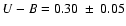 mag,
mag,
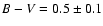 mag,
mag,
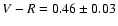 mag, and
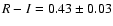 mag. The color
along the bar becomes progressively bluer on going from the bulge to
the ring.
mag. The color
along the bar becomes progressively bluer on going from the bulge to
the ring.
![\begin{figure}
\par\includegraphics[width=15.7cm]{aa2054f6.eps}\end{figure}](/articles/aa/full/2003/40/aa2054/img165.gif) |
Figure 6:
NGC 2336 color profiles along the major axis
of the galaxy (
)
( a), b)), and along the major
axis of the bar (
)
( c), d)), in the ( a), c)) U-B (solid
line), B-V (dashed line), V-R (solid line), and
R-I (dashed line) ( b), d)) color indices. Only profiles for regions
having
 are shown. Negative angular distances
correspond to the southern ( a), b)) and eastern
parts ( c), d)) of NGC 2336. These profiles cut across the galactic
components at the following locations: ( a), b)) nucleus
(
), bulge
(
), ring
(
), external disk
(
), spiral arms
(
);
( c), d)) nucleus (
), bulge
(
), bar
(
), ring (
),
spiral arms (
). The coordinate accuracy is
.
are shown. Negative angular distances
correspond to the southern ( a), b)) and eastern
parts ( c), d)) of NGC 2336. These profiles cut across the galactic
components at the following locations: ( a), b)) nucleus
(
), bulge
(
), ring
(
), external disk
(
), spiral arms
(
);
( c), d)) nucleus (
), bulge
(
), bar
(
), ring (
),
spiral arms (
). The coordinate accuracy is
. |
| Open with DEXTER | |
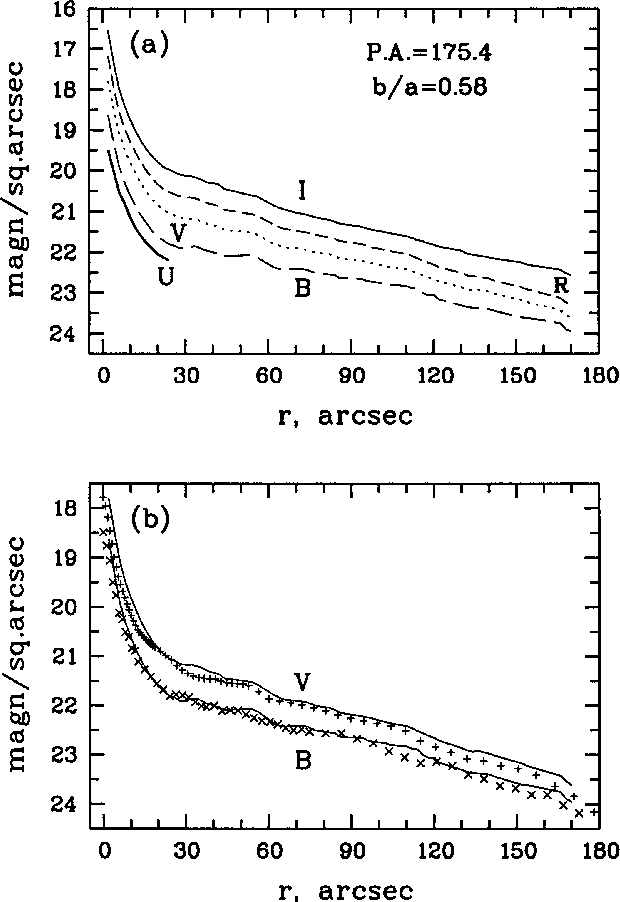 |
Figure 7: a) The radial light distribution dependence on the angular distance r from the center of NGC 2336, in the U (thick solid line), B (long dashed line), V (dotted line), R (short dashed line) and I (thin solid line) passbands. b) Comparison of our data (solid lines) with results from Boroson (1981) for the B passband (diagonal crosses), and with those from Heraudeau & Simien (1996) for the V passband (vertical crosses). |
| Open with DEXTER | |
In general, the disk of NGC 2336 becomes bluer towards the periphery (Figs. 6a-d); the color indices decrease from 0.5 to 0.4 mag in V-R. However, B-V and R-I do not vary significantly with distance from the galaxy center (Figs. 6a, b).
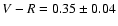
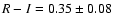
The spiral arms of NGC 2336 are the bluest regions in the galaxy;
this is clearly seen in Figs. 6b, d.
The color indices in the spiral arm regions are:
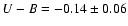 mag,
mag,
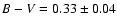 mag,
mag,
 mag, and
 mag. The star
formation regions have still bluer colors (see
Sect. 3.5).
mag. The star
formation regions have still bluer colors (see
Sect. 3.5).
Strong variations in the R-I color index are observed between the
arm and interarm regions. R-I can be as high as
 mag in the interarm regions (Figs. 6b, d). On the contrary, the V-R color index is
approximately the same for both arm and interarm regions
(Fig. 6d); this is a typical result for spiral
galaxies. There are two competing effects involved here: firstly,
both the V and R passbands are sensitive to the presence of a
young stellar population in the spiral arms, whereas the I
passband has relatively little such sensitivity. Secondly, there is
wavelength-dependent dust absorption, which "reddens'' the
radiation more effectively for the shorter wavelengths; so the
intrinsic color contrast variations between blue and red stellar
populations will tend to be "washed out'' or "smoothed'' by the
reddening from the intervening dust.
mag in the interarm regions (Figs. 6b, d). On the contrary, the V-R color index is
approximately the same for both arm and interarm regions
(Fig. 6d); this is a typical result for spiral
galaxies. There are two competing effects involved here: firstly,
both the V and R passbands are sensitive to the presence of a
young stellar population in the spiral arms, whereas the I
passband has relatively little such sensitivity. Secondly, there is
wavelength-dependent dust absorption, which "reddens'' the
radiation more effectively for the shorter wavelengths; so the
intrinsic color contrast variations between blue and red stellar
populations will tend to be "washed out'' or "smoothed'' by the
reddening from the intervening dust.
Regions located along the major axis of NGC 2336, at angular distances
 to the south, and for
 -
-
 to the north from the galaxy center, are among the dimmest parts of
the galaxy, and so are difficult to investigate with any confidence
(see Figs. 1, 2a, 2b).
to the north from the galaxy center, are among the dimmest parts of
the galaxy, and so are difficult to investigate with any confidence
(see Figs. 1, 2a, 2b).
The eastern (furthermost) part of NGC 2336 is redder than the
western part (Figs. 5c,
6c, 6d). The B-V and V-R color
indices of the western part are smaller by 0.1 mag and
0.03 mag, respectively, than those of the eastern part, at
apparent angular distances of
 from the
center (i.e. 0.45 mag (W) vs. 0.55 mag (E) for B-V, and 0.42 mag
(W) vs. 0.45 mag (E) for V-R,
respectively).
from the
center (i.e. 0.45 mag (W) vs. 0.55 mag (E) for B-V, and 0.42 mag
(W) vs. 0.45 mag (E) for V-R,
respectively).
Color asymmetry is observed along both the major and the minor axes
of NGC 2336 (Figs. 5b-d,
6a-d). This results from the
structural asymmetry of the galaxy. Numerous spiral arms, without
large star formation regions, are found in the northern part of
NGC 2336, and one spiral arm with a large star formation complex
exists in the southern part. The photometric profiles along the
minor axis of the galaxy are crossed by the spiral arms at different
distances to the east and west of the galaxy center (compare the
profiles at distances of
 -
-
 in both
directions from the center, in Figs. 2c, 2d, 6c, 6d). Moreover, the
dust reddening tends to "smooth'' the profile in the eastern
(furthermost) part of NGC 2336.
in both
directions from the center, in Figs. 2c, 2d, 6c, 6d). Moreover, the
dust reddening tends to "smooth'' the profile in the eastern
(furthermost) part of NGC 2336.
The radial light distributions of NGC 2336, evaluated in steps of
,
are presented in Fig. 7a, assuming the
PA and b/a obtained for the galaxy as a whole (in
Sect. 3.1). We compared our data with the
results from Boroson (1981) for the B passband, and with
those of Heraudeau & Simien (1996) for the V passband
(Fig. 7b). The relatively small discrepancies between
ours and their previous results are due to the different values of
PA and b/a used.
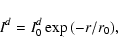
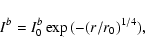
The disk and bulge parameters, derived from the decomposition of
the radial light distribution profiles in the B, V, R and Ipassbands, are presented in Table 4. An exponential
model for the disk:
![\begin{figure}
\par\includegraphics[width=14.6cm]{aa2054f8.eps}\end{figure}](/articles/aa/full/2003/40/aa2054/img182.gif) |
Figure 8:
Two-color diagrams: a) (U-B)0i vs. (B-V)0i,
b) (B-V)0i vs. (V-R)0i, and c)
(B-V)0i vs. (V-I)0i for different regions in NGC 2336.
The boxes enclose the observed positions of the integrated
color indices for galaxies which follow the normal color sequence
(NCS), as calculated in Buta & Williams (1995). The dashed
curves in a) represent evolutionary tracks for stellar
systems with: constant star formation rate (long dashed curve), and
an instantaneous starburst (short dashed curve), with the
objects ageing (and reddening) from 1 Myr to 15 Gyr during their
approach to the NCS (the small vertical crosses indicate ages of:
10 Myr, 100 Myr, 1 Gyr and 10 Gyr). These tracks were calculated
using the PEGASE2 code (see Fioc & Rocca-Volmerange 1997).
The dotted curve towards the top right of a) shows the color
change resulting from a starburst in an old stellar system
(age 15 Gyr), from Fioc & Rocca-Volmerange (1997),
with the young (age 1 Myr) population mass fraction changing from
 (bottom) to
 (top). The short
dashed arrows in the bottom left of each plot show the direction of
the correction for internal absorption due to dust in the galaxy.
The vertical and horizontal bars show the color index measurement
errors for each region of the galaxy. The numbers denoting these
regions are explained in the text (see
Sect. 3.4).
(top). The short
dashed arrows in the bottom left of each plot show the direction of
the correction for internal absorption due to dust in the galaxy.
The vertical and horizontal bars show the color index measurement
errors for each region of the galaxy. The numbers denoting these
regions are explained in the text (see
Sect. 3.4). |
| Open with DEXTER | |
The disk component of NGC 2336 is by far the dominant one for
angular distances
.
However, we can visually
distinguish three disk regions in Fig. 7a:
 ,
,
 ,
and
,
and
 .
The slightly irregular radial light
distributions in the innermost region (
)
arise from the chance distribution of bright spiral arms in the disk
of NGC 2336. Similar irregularities in the middle region
(
)
are due to the influence of the
largest star formation complex, which resides in the southern
galactic spiral arm (Fig. 3a).
.
The slightly irregular radial light
distributions in the innermost region (
)
arise from the chance distribution of bright spiral arms in the disk
of NGC 2336. Similar irregularities in the middle region
(
)
are due to the influence of the
largest star formation complex, which resides in the southern
galactic spiral arm (Fig. 3a).
In spite of these small deviations from the standard profile, the
exponential disk parameters were derived from the I light
distribution for the distance range
 ;
the light of the southern star formation complex is not so apparent
in the I passband, and nor is that from the other regions with
young stellar populations. The I light distribution is expected to
follow the radial mass distribution, and so it has a clear physical
interpretation. For completeness, the disk parameters derived from
the B, V and R light profiles are also presented in
Table 4.
;
the light of the southern star formation complex is not so apparent
in the I passband, and nor is that from the other regions with
young stellar populations. The I light distribution is expected to
follow the radial mass distribution, and so it has a clear physical
interpretation. For completeness, the disk parameters derived from
the B, V and R light profiles are also presented in
Table 4.
The bulge component in NGC 2336 is dominant over angular distances
of
 from the galaxy center. The derived
values of the effective bulge radius, in the different passbands,
agree to within the estimated photometric errors (see
Table 4).
from the galaxy center. The derived
values of the effective bulge radius, in the different passbands,
agree to within the estimated photometric errors (see
Table 4).
The NGC 2336 bulge-disk luminosity ratio is
 in the I passband. This value
agrees with those given in Boroson (1981), Grosbol
(1985) and Wilke et al. (1999).
in the I passband. This value
agrees with those given in Boroson (1981), Grosbol
(1985) and Wilke et al. (1999).
The data in this section have been additionally corrected for the internal dust absorption due to the inclination of NGC 2336; so the color indices in this section are bluer than those in Sect. 3.2, after applying both of the corrections listed in Table 3.
The intensities of the studied regions have not been corrected for the light from the surrounding background areas. The integrated color indices of the galactic components were obtained using the radial light distribution data (Fig. 7a).
In Figs. 8a-8c, the numbers denote
the following regions of the galaxy:
1 is the integrated color of the galaxy as a whole, within
28 kpc (
 )
of the center;
2 is the total color index of the galaxy, from the LEDA
Database;
3 is the integrated color of the nucleus, within 0.3 kpc
(
)
of the center;
4 is the integrated color of the bulge, at distances of
0.6-2.5 kpc (
)
of the center;
2 is the total color index of the galaxy, from the LEDA
Database;
3 is the integrated color of the nucleus, within 0.3 kpc
(
)
of the center;
4 is the integrated color of the bulge, at distances of
0.6-2.5 kpc (
 )
from the center;
5, 6 and 7 are the color indices of the bar,
at distances of:
)
from the center;
5, 6 and 7 are the color indices of the bar,
at distances of:
 ,
,
 and
and
 from
the center, respectively (corresponding to deprojected distances
of: 3.2 kpc, 4.4 kpc and 5.5 kpc, respectively);
8 is the integrated color of the ring, at distances
of 5.0-5.6 kpc (
from
the center, respectively (corresponding to deprojected distances
of: 3.2 kpc, 4.4 kpc and 5.5 kpc, respectively);
8 is the integrated color of the ring, at distances
of 5.0-5.6 kpc (
 )
from the center;
9 is the integrated color of the inner part of the disk, at
distances of 10.6-16.3 kpc (
)
from the center;
9 is the integrated color of the inner part of the disk, at
distances of 10.6-16.3 kpc (
 )
from
the center;
10 is the integrated color of the outer part of the disk, at
distances of 16.3-25.9 kpc (
)
from
the center;
10 is the integrated color of the outer part of the disk, at
distances of 16.3-25.9 kpc (
 )
from the
center;
11 is the color index of the spiral arms; and
12, 13 are the colors of the interarm regions, for the
western and eastern parts of the disk, respectively.
)
from the
center;
11 is the color index of the spiral arms; and
12, 13 are the colors of the interarm regions, for the
western and eastern parts of the disk, respectively.
Most of the points in the two-color diagrams lie along the normal
color sequence (NCS) for galaxies
(Figs. 8a-c); this is supporting evidence
for a uniform history of star formation in NGC 2336 (or, in general,
for any history with local
SFE = constant). There appears to be a small
displacement of the points in the (U-B)0i vs. (B-V)0i
two-color diagram; this may be the result of additional internal
dust absorption in NGC 2336. The color indices of the galaxy as a
whole are typical of Sbc type spiral galaxies (points 1,
2 in Figs. 8a-c).
There is no current star formation activity, either in the nucleus, or in the bulge, of the galaxy (the locations of points 3 and 4 are typical for old stellar systems without recent star formation activity).
The bar of NGC 2336 becomes bluer towards the edges (points 5-7 in Figs. 8a-c); so the luminosity contribution from young stars increases towards the ends of the bar. The offset of these points to the left of the NCS in the (U-B)0i vs. (B-V)0i two-color diagram may be the result of a complex stellar population content (i.e. a mixture of both young and old stars) in the bar (Gusev 2000).
In general, the fraction of young stellar populations increases with distance from the galaxy center. The most active star formation regions occur in the outer parts of the disk and spiral arms (see points 10-13 in Figs. 8a-c). Nevertheless, the star formation history in the disk appears to differ from that in the spiral arms; the colors of the spiral arms (point 11) are characteristic of a stellar system with constant SFE (Figs. 8b, c), whereas the colors of the outer disk of NGC 2336 (point 10) are typical for a stellar system with a relatively small contribution from a young stellar population (Figs. 8a, c).
The color difference between the western and eastern parts of the disk of NGC 2336 (points 12 and 13, respectively) can be explained by the reddening expected from the internal dust absorption due to the inclination of the galaxy (see Figs. 8a-c and Table 3), as well as by the concentration of dust in the inner borders of the spiral arms.
We studied the properties of the 34 largest star formation regions in NGC 2336 (including 5 in the southern star formation complex). The results of our investigations are presented in Figs. 9, 10a-c, 11a-c and in Table 5; listed in this table are the positions, color indices, diameters, ages, intrinsic reddenings and distances to the galaxy center, which we determined for each of these star formation regions.
In contrast to the previous subsections, and Figs. 8a-c, the "true'' color indices of the star formation regions were considered in this subsection; these "true'' intensities were obtained by subtracting the background intensity of the spiral arms from the integrated intensities in the areas occupied by the star formation regions.
The diameter of each star formation region was determined from the FWHM for regions having a starlike profile, or else by the distance between the points of maximal light gradient for regions having extended profiles. The diameter for a non-spherical region was determined along its minor axis.
The ages and intrinsic reddenings of the star formation regions were estimated from their positions in the two-color diagrams, using evolutionary tracks of synthetically aged stellar systems generated by the PEGASE2 code (Fioc & Rocca-Volmerange 1997). Kennicutt's (1983) initial mass function (IMF) and a simple stellar population (SSP) model were used. A graphical description of the method used to estimate the ages and reddenings is shown in Fig. 9 for a typical star formation region, plotted in the (U-B)0i vs. (B-V)0i two-color diagram.
![\begin{figure}
\par\includegraphics[width=7.9cm]{aa2054f9.eps}\end{figure}](/articles/aa/full/2003/40/aa2054/img198.gif) |
Figure 9: Graphical description of the method used to estimate the ages and intrinsic reddenings for star formation regions, by their positions in the two-color diagram. Evolutionary tracks of synthetically aged stellar systems with Z = 0.008 (dotted curve), 0.02 (solid curve), and 0.05 (long dashed curve), are shown. The numbers (106 and 107) are the ages of the synthetic systems in years. The arrow gives the direction of the correction for dust absorption, and its length corresponds to an extinction of A(V) = 0.5 mag. Color index error bars are shown for a typical star formation region. |
| Open with DEXTER | |
The area surrounded by the short dashed lines in Fig. 9 shows possible real positions for the star formation region indicated in the (U-B)0i vs. (B-V)0i two-color diagram. The uncertainties are the result of observational errors and unknown intrinsic reddening. This intrinsic reddening is due to the dust absorption in star formation regions; it is an additional local absorption to the general Galactic absorption, and to the absorption due to the inclination of NGC 2336.
The symbols t1 - t6 in Fig. 9 denote the intersection points of the model evolutionary tracks with the perimeter of the area enclosing the possible real positions of the indicated star formation region. So, t1, t2 and t3 are the minimum possible ages of this region, for the models with Z = 0.05, 0.008 and 0.02, respectively; and t4, t5 and t6 are the corresponding maximum possible ages.
In our estimation method, we proceeded in two steps. Firstly, we
estimated a minimum (
 )
and a maximum
(
)
and a maximum
(
 )
possible age for the star formation region, using
the (U-B)0i vs. (B-V)0i two-color diagram:
)
possible age for the star formation region, using
the (U-B)0i vs. (B-V)0i two-color diagram:
 )
and a maximum
(
)
and a maximum
(
 )
possible intrinsic absorption was carried
out in an analogous way. For the chosen (typical) star formation
region, we obtained the following results:
)
possible intrinsic absorption was carried
out in an analogous way. For the chosen (typical) star formation
region, we obtained the following results:
 Myr,
Myr,
 Myr,
Myr,
 mag,
mag,
 mag.
mag.
This first step is also used for independently estimating these parameters from the (B-V)0i vs. (V-R)0i and (B-V)0i vs. (V-I)0i two-color diagrams.
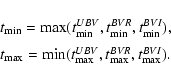
The second step yields the final estimated parameters from
combining the results derived from each of the three two-color
diagrams:
The estimated parameters of the star formation regions are presented
in Table 5. Successive columns of this table present the
following properties for each of the 34 regions:
(1) assigned sequence number, (2) apparent coordinates, in
arcseconds relative to the galaxy center, (3-6) (U-B)0i,
(B-V)0i, (V-R)0i and (V-I)0i color indices, (7)
characteristic diameter D in pc, (8) estimated age T in Myr,
(9) estimated value of the intrinsic reddening (or color excess)
E(B-V)
due to dust absorption in the star formation region, and
(10) deprojected distance r from the center of NGC 2336 to the
star formation region, in kpc.
The ages T and the intrinsic reddening values E(B-V) of the star formation regions, as estimated by their positions in the two-color diagrams, are consistent with each other, with the exception of seven regions (10, 11, 17, 18, 21, 27d, and 28), whose ages were estimated with relatively large errors.
Most of the NGC 2336 star formation regions are located within compact areas in the two-color diagrams (Figs. 10a-c), with the exception of several very young regions (e.g. 14, 15, 23), and those with large intrinsic reddening (e.g. 20, 27).
![\begin{figure}
\par\includegraphics[width=6.8cm]{aa2054f10.eps}\end{figure}](/articles/aa/full/2003/40/aa2054/img210.gif) |
Figure 10: Two-color diagrams: a) (U-B)0i vs. (B-V)0i, b) (B-V)0i vs. (V-R)0i, and c) (B-V)0i vs. (V-I)0i, for the NGC 2336 star formation regions. Evolutionary tracks of synthetically aged stellar systems, with Z = 0.008 (short dashed curves), 0.02 (solid curves), and 0.05 (long dashed curves), are shown. Small vertical crosses indicate system ages of: 1, 10, 100 Myr and 1 Gyr. The numbers are the base 10 logarithms of the system ages in years. The color index error bars are shown. Short dashed arrows give the direction of the correction for internal dust absorption in the galaxy. |
| Open with DEXTER | |
Table 5: Parameters of star formation regions in NGC 2336 (available in electronic form).
The positions of six star formation regions (5, 9, 13, 14, 18 and 29) in the (B-V)0i vs. (V-R)0i diagram do not lie on any of the synthetic evolutionary tracks (see Fig. 10b). However, we estimated their ages and intrinsic reddening values from their positions in the other two-color diagrams (i.e. (U-B)0i vs. (B-V)0i and (B-V)0i vs. (V-I)0i); we obtained mutually consistent results for five of these six regions. Four have typical parameters for star formation regions in NGC 2336, with the exception of the (V-R)0i color index (see 5, 9, 13 and 29 in Table 5); we are unable to explain the positions of these four outliers in the (B-V)0i vs. (V-R)0i diagram, in terms of the PEGASE2 stellar evolutionary models that we used. The parameters of the sixth region (18) were estimated using only the (B-V)0i vs. (V-I)0i diagram.
The positions of the NGC 2336 star formation regions in the two-color diagrams are displaced from the evolutionary tracks for synthetically aged systems (see Figs. 10a, c); this is due to the varying amounts of dust absorption "intrinsic'' to each of the regions. As estimated from the two-color diagrams, this absorption is in the range AV = 0.3 - 1.5 mag for the star formation regions in NGC 2336.
Most of the star formation regions identified in this paper have
diameters in the range 250-500 pc (Fig. 11a). Since
the atmospheric seeing during our observations was
(corresponding to a linear scale of  300 pc), we cannot detect
star formation regions smaller than this limit. Five out of the six
regions with diameters D > 500 pc are complex (the exception is
region 28 with D = 565 pc). Apart from this particular case,
there is no simple (i.e. non-complex) star formation region with
diameter D > 500 pc in NGC 2336.
300 pc), we cannot detect
star formation regions smaller than this limit. Five out of the six
regions with diameters D > 500 pc are complex (the exception is
region 28 with D = 565 pc). Apart from this particular case,
there is no simple (i.e. non-complex) star formation region with
diameter D > 500 pc in NGC 2336.
Both observational selection effects and the chosen age estimation method influence the age histogram we derived for the star formation regions in NGC 2336 (Fig. 11b). The ages for these regions are our best estimates, given the observed data and evolutionary tracks available to us. In general, evolutionary models for synthetic stellar systems consistently predict a maximum in emitted B luminosity in the age range 2-4 Myr, irrespective of the mass of the system. Nevertheless, the age histogram shows no evidence for any recent star formation burst in the galaxy (i.e. within the past 6 Myr); recent star formation in NGC 2336 appears to have proceeded continuously, rather than intermittently.
Three out of five star formation regions older than 5.5 Myr are located in the southern star formation complex of NGC 2336; it seems that active, recent, star formation in this complex began about 6 Myr ago.
![\begin{figure}
\par\includegraphics[width=6.7cm]{aa2054f11.eps}\end{figure}](/articles/aa/full/2003/40/aa2054/img214.gif) |
Figure 11: Number distribution histograms of the star formation regions in NGC 2336, by: a) diameter, b) age, and c) deprojected distance from the galaxy center. |
| Open with DEXTER | |
A concentration of star formation regions towards the ring, in the range 12-16 kpc radius, was found (Fig. 11c). The outer part of the southern star formation complex is located at the same distance from the galaxy center. The radius of this star formation ring coincides with that of the molecular (H2) ring (at 13.6 kpc, see Sect. 1) in the galaxy. This clearly indicates that these star formation regions are concentrated in the molecular ring of NGC 2336.
NGC 2336 is a typical intermediate type spiral galaxy, having
properties of both early and late type galaxies. The large bulge
of this galaxy, with
 ,
is typical
of early type galaxies. On the other hand, the short,
exponential-like light profile of the bar is more typical of late
type galaxies (Elmegreen & Elmegreen 1985).
,
is typical
of early type galaxies. On the other hand, the short,
exponential-like light profile of the bar is more typical of late
type galaxies (Elmegreen & Elmegreen 1985).
It is likely that exponential-like bars in late type galaxies
extend out only to the inner Lindblad resonance
(Elmegreen & Elmegreen 1985). We estimated a corotation
resonance radius for NGC 2336, using the method given in Canzian
(1998). The galaxy has an approximately flat rotation curve
(Biviano et al. 1991; Keel 1996). If
 and
and
 are the observed values of the innermost and outermost
radii of the spiral structure, respectively, then following
Canzian (1998), the corotation resonance radius
are the observed values of the innermost and outermost
radii of the spiral structure, respectively, then following
Canzian (1998), the corotation resonance radius
 can
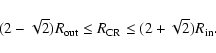
be limited to the range:
can
be limited to the range:
 kpc, and
 kpc, thus yielding
 kpc from
Eq. (7). This value is approximately equal to both the
radius of the star formation ring, and that of the molecular ring.
We suspect that the most active star formation takes place at the
corotation resonance radius.
kpc from
Eq. (7). This value is approximately equal to both the
radius of the star formation ring, and that of the molecular ring.
We suspect that the most active star formation takes place at the
corotation resonance radius.
Boroson (1981), Grosbol (1985), and Baggett et al.
(1998) measured a disk scale length for NGC 2336 in the
optical, but they obtained contradictory results: a scale length of
 was found by Grosbol (1985) and
Baggett et al. (1998), versus
by Boroson
(1981). This is likely to be due to the different radial
ranges used in these studies. In their statistical investigations of
large samples of spiral galaxies, Grosbol (1985) and
Baggett et al. (1998) included the inner disk regions in their
determinations of the disk scale lengths; they measured the disks
from the galaxy center out to a radial angular distance of
.
However, this approach is incorrect, as chance
distributions of the brightest spiral arms and star formation
regions distort the radial light distribution function (see
Fig. 7a). In addition, the slope of the radial light
distribution (and the value of the disk scale length) depends on the
observational passbands used for the inner parts of the disk of
NGC 2336.
was found by Grosbol (1985) and
Baggett et al. (1998), versus
by Boroson
(1981). This is likely to be due to the different radial
ranges used in these studies. In their statistical investigations of
large samples of spiral galaxies, Grosbol (1985) and
Baggett et al. (1998) included the inner disk regions in their
determinations of the disk scale lengths; they measured the disks
from the galaxy center out to a radial angular distance of
.
However, this approach is incorrect, as chance
distributions of the brightest spiral arms and star formation
regions distort the radial light distribution function (see
Fig. 7a). In addition, the slope of the radial light
distribution (and the value of the disk scale length) depends on the
observational passbands used for the inner parts of the disk of
NGC 2336.
Our results show that NGC 2336 is a galaxy with active star formation in the disk, with a star formation rate typical of late type spirals. The recent star formation in this galaxy has proceeded continuously, not intermittently (i.e. without distinct star formation bursts). The colors of the outer disk are typical of an old stellar system with a small fractional contribution from a young stellar population, as judged from the two-color diagrams. We suspect that this results from a mixture of the relatively old stellar population in the outer disk, with the young population residing in numerous star formation regions.
From the multicolor surface photometry analysis of NGC 2336, we conclude that:
1. An exponential-like disk, with a scale length of
 kpc
(
kpc
(
 )
and a large bulge with an effective
radius of
)
and a large bulge with an effective
radius of
 kpc (
kpc (
 )
have been
observed in NGC 2336. The bulge has a de Vaucouleurs radial light
distribution profile. The bulge-disk luminosity ratio is
)
have been
observed in NGC 2336. The bulge has a de Vaucouleurs radial light
distribution profile. The bulge-disk luminosity ratio is
 in the I passband.
2. Corrected for inclination, the semi-length of the bar in NGC 2336
is 5.9 kpc (
). The bar has an exponential-like intensity
profile. The scale length of the eastern part of the bar is
kpc (
)
in the
I passband.
3. NGC 2336 is a galaxy with active star formation ongoing in the disk. There is no current star formation activity either in nucleus or in the bulge. Recent star formation in NGC 2336 has proceeded continuously, not intermittently (i.e. without distinct star formation bursts).
4. The color difference between the western and eastern parts of the disk in NGC 2336 can be explained by the internal dust absorption due to the inclination of the galaxy, as well as by the concentration of the dust to the inner borders of the spiral arms.
5. The star formation regions are concentrated towards the molecular ring in NGC 2336. With the sole exception of one region, there is no simple (i.e. non-complex) star formation region larger than 500 pc in diameter.
6. Active, recent, star formation in the southern complex of NGC 2336 began about 6 Myr ago.
Acknowledgements
ASG was supported by a grant of the Postdoctoral Program at Kyungpook National University (2000-2001), and by grants No. 01-02-16800 and No. 01-02-17597 from the Russian Foundation for Basic Research. MGP was supported by grant No. R01-1999-00023 from the Korea Science and Engineering Foundation (KOSEF). The authors are grateful to B.-C. Lee (Bohyunsan Optical Astronomy Observatory) for assistance with the observations, and to A. B. Fletcher (Korea Astronomy Observatory) for help with editing this paper. ASG would like to thank A. V. Zasov (Sternberg Astronomical Institute) for helpful discussions. The authors thank the anonymous referee for valuable remarks.
Table 2: Journal of observations of NGC 2336.
Table 5: Parameters of star formation regions in NGC 2336.
![\begin{displaymath}\begin{array}{l}
t_{\min}^{UBV} = \min(t_1,t_2,t_3) \\
\mi...
..._6) \equiv \max[t_{Z=0.05},t_{Z=0.008},t_{Z=0.02}].
\end{array}\end{displaymath}](/articles/aa/full/2003/40/aa2054/img201.gif)
![\begin{displaymath}\begin{array}{l}
A_{\min}(V) = \max[A_{\min}^{UBV}(V),A_{\mi...
...x}^{UBV}(V),A_{\max}^{BVR}(V),
A_{\max}^{BVI}(V)].
\end{array}\end{displaymath}](/articles/aa/full/2003/40/aa2054/img209.gif)