 |
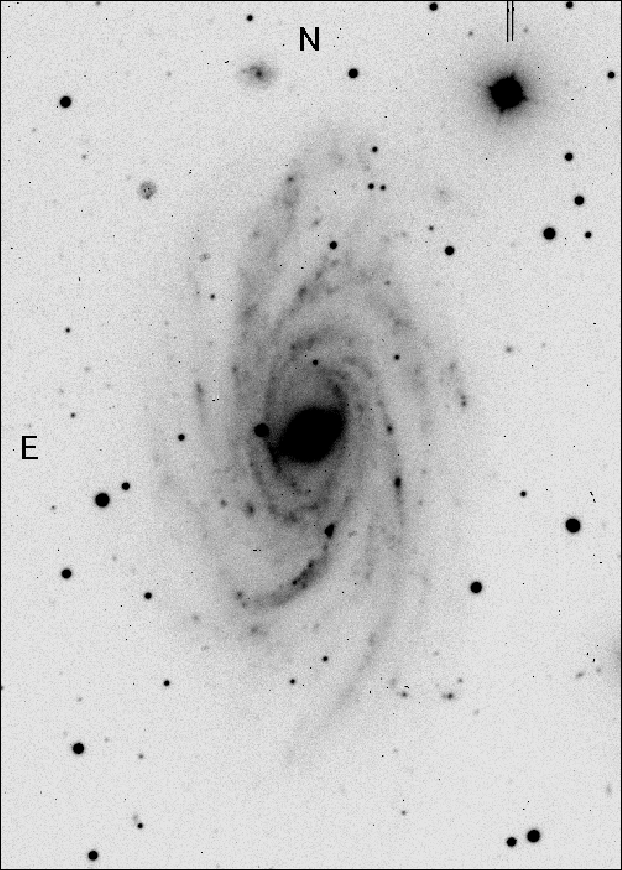
Figure 1:
 CCD image of NGC 2336
in the V passband.
CCD image of NGC 2336
in the V passband. |
| Open with DEXTER | |
In the text
![\begin{figure}
\par\includegraphics[width=16.2cm]{aa2054f2.eps}\end{figure}](/articles/aa/full/2003/40/aa2054/img90.gif) |
Figure 2:
NGC 2336 photometric profiles (in mag arcsec-2) along
the major axis of the galaxy (
 )
( a), b)), and
along the major axis of the bar ( )
( a), b)), and
along the major axis of the bar (
 )
( c), d)), in
the U (dotted line), B (dashed line), V (solid
line) ( a), c)), and V (solid line), R (dashed line), and
I (dotted line) ( b), d)) passbands. Negative angular distances correspond
to the southern ( a), b)) and the eastern ( c), d)) parts of
NGC 2336. These profiles cut across the galactic components at
the following locations: ( a), b)) nucleus
( )
( c), d)), in
the U (dotted line), B (dashed line), V (solid
line) ( a), c)), and V (solid line), R (dashed line), and
I (dotted line) ( b), d)) passbands. Negative angular distances correspond
to the southern ( a), b)) and the eastern ( c), d)) parts of
NGC 2336. These profiles cut across the galactic components at
the following locations: ( a), b)) nucleus
(
 ), bulge
( ), bulge
(
 ), ring
( ), ring
(
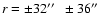 ), external disk
( ), external disk
(
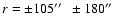 ), spiral arms
( ), spiral arms
(
 );
( c), d)) nucleus (
), bulge
( );
( c), d)) nucleus (
), bulge
(
 ), bar
( ), bar
(
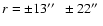 ), ring ( ), ring (
 ),
spiral arms ( ),
spiral arms (
 ). The two sharp-peaked maxima
in ( a), b)) at radii of ). The two sharp-peaked maxima
in ( a), b)) at radii of
 and
and
 are field stars. The coordinate accuracy is
 . . |
| Open with DEXTER | |
In the text
![\begin{figure}
\par\includegraphics[width=12.5cm]{aa2054f3.eps}\end{figure}](/articles/aa/full/2003/40/aa2054/img93.gif) |
Figure 3: Isophotal map of NGC 2336 in the a) B and b) I passbands. The isophotal contour levels a) 20.0, 21.0, 21.5, 22.0, 22.5, 23.5, 24.5 B mag arcsec-2, and b) 19.5, 20.0, 20.5, 21.0, 21.5, 22.0, 22.5 I mag arcsec-2, are shown. |
| Open with DEXTER | |
In the text
![\begin{figure}
\par\includegraphics[width=7.7cm]{aa2054f4.eps}\end{figure}](/articles/aa/full/2003/40/aa2054/img105.gif) |
Figure 4:
The dependence of a) position angle and b)
ellipticity (
 )
of the smoothed isophotes of
NGC 2336, on the angular distance r from the galaxy center, in the
U (thick solid line), B (long dashed line), V (dotted line),
R (short dashed line) and I (thin solid line) passbands. )
of the smoothed isophotes of
NGC 2336, on the angular distance r from the galaxy center, in the
U (thick solid line), B (long dashed line), V (dotted line),
R (short dashed line) and I (thin solid line) passbands. |
| Open with DEXTER | |
In the text
![\begin{figure}
\par\includegraphics[width=7.2cm]{aa2054f5.eps}\end{figure}](/articles/aa/full/2003/40/aa2054/img106.gif) |
Figure 5: NGC 2336 color index maps in a) U-B, b) B-V, c) V-R, and d) R-I. Contours of constant color index are shown, with levels set at: a) U-B = 0.2, 0.4, 0.6 mag, b) B-V = 0.45, 0.6, 0.75 mag, c) V-R = 0.35, 0.42, 0.5 mag, and d) R-I = 0.4, 0.5 mag. Redder regions are shaded darker than bluer ones. Regions with SNR < 5 are indicated by the white areas. |
| Open with DEXTER | |
In the text
![\begin{figure}
\par\includegraphics[width=15.7cm]{aa2054f6.eps}\end{figure}](/articles/aa/full/2003/40/aa2054/img165.gif) |
Figure 6:
NGC 2336 color profiles along the major axis
of the galaxy (
)
( a), b)), and along the major
axis of the bar (
)
( c), d)), in the ( a), c)) U-B (solid
line), B-V (dashed line), V-R (solid line), and
R-I (dashed line) ( b), d)) color indices. Only profiles for regions
having
 are shown. Negative angular distances
correspond to the southern ( a), b)) and eastern
parts ( c), d)) of NGC 2336. These profiles cut across the galactic
components at the following locations: ( a), b)) nucleus
(
), bulge
(
), ring
(
), external disk
(
), spiral arms
(
);
( c), d)) nucleus (
), bulge
(
), bar
(
), ring (
),
spiral arms (
). The coordinate accuracy is
.
are shown. Negative angular distances
correspond to the southern ( a), b)) and eastern
parts ( c), d)) of NGC 2336. These profiles cut across the galactic
components at the following locations: ( a), b)) nucleus
(
), bulge
(
), ring
(
), external disk
(
), spiral arms
(
);
( c), d)) nucleus (
), bulge
(
), bar
(
), ring (
),
spiral arms (
). The coordinate accuracy is
. |
| Open with DEXTER | |
In the text
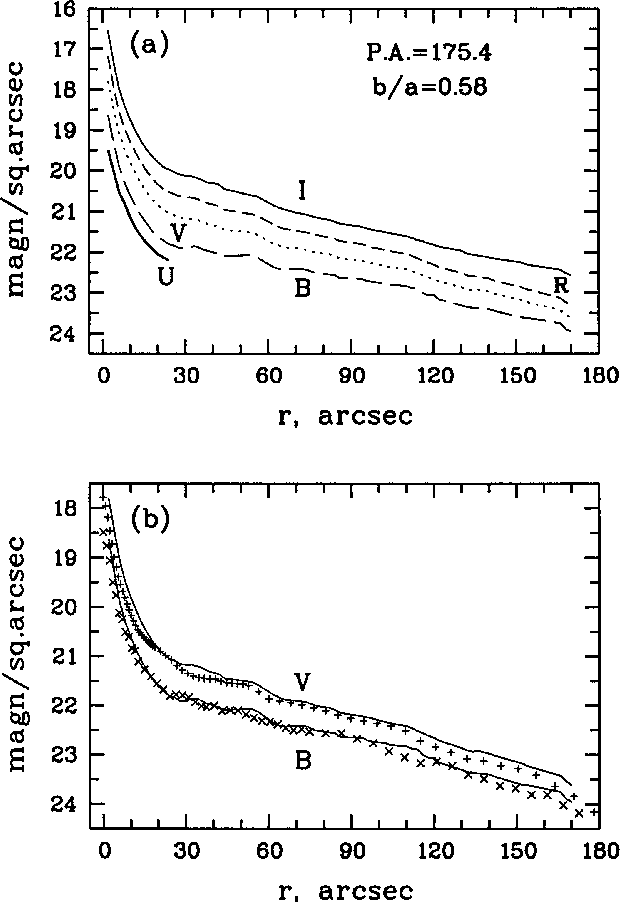 |
Figure 7: a) The radial light distribution dependence on the angular distance r from the center of NGC 2336, in the U (thick solid line), B (long dashed line), V (dotted line), R (short dashed line) and I (thin solid line) passbands. b) Comparison of our data (solid lines) with results from Boroson (1981) for the B passband (diagonal crosses), and with those from Heraudeau & Simien (1996) for the V passband (vertical crosses). |
| Open with DEXTER | |
In the text
![\begin{figure}
\par\includegraphics[width=14.6cm]{aa2054f8.eps}\end{figure}](/articles/aa/full/2003/40/aa2054/img182.gif) |
Figure 8:
Two-color diagrams: a) (U-B)0i vs. (B-V)0i,
b) (B-V)0i vs. (V-R)0i, and c)
(B-V)0i vs. (V-I)0i for different regions in NGC 2336.
The boxes enclose the observed positions of the integrated
color indices for galaxies which follow the normal color sequence
(NCS), as calculated in Buta & Williams (1995). The dashed
curves in a) represent evolutionary tracks for stellar
systems with: constant star formation rate (long dashed curve), and
an instantaneous starburst (short dashed curve), with the
objects ageing (and reddening) from 1 Myr to 15 Gyr during their
approach to the NCS (the small vertical crosses indicate ages of:
10 Myr, 100 Myr, 1 Gyr and 10 Gyr). These tracks were calculated
using the PEGASE2 code (see Fioc & Rocca-Volmerange 1997).
The dotted curve towards the top right of a) shows the color
change resulting from a starburst in an old stellar system
(age 15 Gyr), from Fioc & Rocca-Volmerange (1997),
with the young (age 1 Myr) population mass fraction changing from
 (bottom) to
 (top). The short
dashed arrows in the bottom left of each plot show the direction of
the correction for internal absorption due to dust in the galaxy.
The vertical and horizontal bars show the color index measurement
errors for each region of the galaxy. The numbers denoting these
regions are explained in the text (see
Sect. 3.4).
(top). The short
dashed arrows in the bottom left of each plot show the direction of
the correction for internal absorption due to dust in the galaxy.
The vertical and horizontal bars show the color index measurement
errors for each region of the galaxy. The numbers denoting these
regions are explained in the text (see
Sect. 3.4). |
| Open with DEXTER | |
In the text
![\begin{figure}
\par\includegraphics[width=7.9cm]{aa2054f9.eps}\end{figure}](/articles/aa/full/2003/40/aa2054/img198.gif) |
Figure 9: Graphical description of the method used to estimate the ages and intrinsic reddenings for star formation regions, by their positions in the two-color diagram. Evolutionary tracks of synthetically aged stellar systems with Z = 0.008 (dotted curve), 0.02 (solid curve), and 0.05 (long dashed curve), are shown. The numbers (106 and 107) are the ages of the synthetic systems in years. The arrow gives the direction of the correction for dust absorption, and its length corresponds to an extinction of A(V) = 0.5 mag. Color index error bars are shown for a typical star formation region. |
| Open with DEXTER | |
In the text
![\begin{figure}
\par\includegraphics[width=6.8cm]{aa2054f10.eps}\end{figure}](/articles/aa/full/2003/40/aa2054/img210.gif) |
Figure 10: Two-color diagrams: a) (U-B)0i vs. (B-V)0i, b) (B-V)0i vs. (V-R)0i, and c) (B-V)0i vs. (V-I)0i, for the NGC 2336 star formation regions. Evolutionary tracks of synthetically aged stellar systems, with Z = 0.008 (short dashed curves), 0.02 (solid curves), and 0.05 (long dashed curves), are shown. Small vertical crosses indicate system ages of: 1, 10, 100 Myr and 1 Gyr. The numbers are the base 10 logarithms of the system ages in years. The color index error bars are shown. Short dashed arrows give the direction of the correction for internal dust absorption in the galaxy. |
| Open with DEXTER | |
In the text
![\begin{figure}
\par\includegraphics[width=6.7cm]{aa2054f11.eps}\end{figure}](/articles/aa/full/2003/40/aa2054/img214.gif) |
Figure 11: Number distribution histograms of the star formation regions in NGC 2336, by: a) diameter, b) age, and c) deprojected distance from the galaxy center. |
| Open with DEXTER | |
In the text