A&A 409, 1085-1095 (2003)
DOI: 10.1051/0004-6361:20031037
Torsional magnetic tube waves in stellar convection zones
I. Analysis of wave generation and application to the Sun
M. W. Noble 1 - Z. E. Musielak 1,2 -
P. Ulmschneider 2
1 - Department of Physics, University of Texas
at Arlington, Arlington, TX 76019, USA
2 -
Institut für Theoretische
Astrophysik der Universität
Heidelberg, Tiergartenstr. 15,
69121 Heidelberg, Germany
Received 15 April 2003 / Accepted 1 July 2003
Abstract
An analytic approach to the generation of torsional magnetic
tube waves in stellar convection zones is presented. The waves
are produced in a thin, vertically oriented magnetic flux tube
embedded in a magnetic field-free, turbulent and compressible
external medium and are excited by external turbulent flows. A
theory for this interaction is developed and used to compute the
wave energy spectra and fluxes carried by torsional tube waves
in the solar atmosphere. We find that these tube waves have a
characteristic cutoff frequency.
Key words: methods: numerical -
Sun: chromosphere -
Sun: corona -
Sun: magnetic fields -
MHD -
waves
In the magnetic regions of the solar and stellar atmospheres, isolated
small-scale magnetic structures (flux tubes) are present (e.g.,
Solanki 1993; Saar 1996). These tubes are rooted in the solar and
stellar convection zones where they interact with the external turbulent
motions. This interaction leads to the generation of waves that carry
energy along the tubes to the overlying atmosphere (Spruit & Roberts
1983). It has been shown that three different types of waves can be
supported by these flux tubes, namely, longitudinal, transverse and
torsional tube waves (see Spruit 1981, 1982). These waves can dissipate
the carried energy and heat the atmosphere to temperatures higher than
those corresponding to the radiative equilibrium. As a result of this
heating, the Sun and other late-type stars are sources of chromospheric
activity (e.g., Linsky 1991).
Significant theoretical and observational efforts have been made to
estimate the amount of energy carried by longitudinal (Musielak et al.
1989, 1995; Ulmschneider & Musielak 1998; Ulmschneider et al. 2001) and
transverse (Muller et al. 1989, 1994; Choudhuri et al. 1993a,b; Huang et al. 1995; Musielak & Ulmschneider 2001) tube waves. Analytical studies
are based on the Lighthill-Stein theory of sound generation (Lighthill
1952; Stein 1967), which has been modified to include the magnetic flux
tube structure, and also its treatment of turbulence has been improved
(Musielak et al. 1994). Among the three different tube waves, only the
generation of longitudinal and transverse tube waves have been analytically
investigated (Musielak et al. 1995; Musielak & Ulmschneider 2001), and
the resulting stellar wave energy spectra and fluxes have been calculated
(Musielak et al. 2000, 2002; Musielak & Ulmschneider 2002a,b). To
complement this series of analytical studies, we now investigate the
efficiency of the generation of torsional tube waves in the solar and
stellar convection zones.
Recently, Ulmschneider et al. (2001) and Fawzy et al. (2002a,b) have
shown that longitudinal and transverse tube waves do not carry enough
energy to heat the upper chromospheric layers of active and moderately
active stars, and suggested that the energy carried by torsional tube
waves must be taken into account. These authors have constructed
theoretical models of stellar chromospheres based on the heating
of non-magnetic regions by acoustic waves and magnetic regions by
longitudinal and transverse tube waves (see also Buchholz et al. 1998;
Cuntz et al. 1998, 1999). The models have been used to predict
theoretically the level of chromospheric activity. By comparing the
theoretical predictions with observations, the authors concluded that
other heating mechanisms must be included in their models. Among many
different heating mechanisms (e.g., Narain & Ulmschneider 1996), the
most promising additional heating mechanisms are those that heat
by reconnection events and by torsional
tube waves. In order to include dissipation of torsional tube waves into
these theoretical chromospheric models, the initial wave energy fluxes
carried by these waves into the solar and stellar atmospheres must be
known. The main goal of this series of papers is therefore to calculate the
spectra and wave energy fluxes of torsional Alfvén waves in
magnetic flux tubes.
We consider a thin magnetic flux tube that is embedded in a non-magnetic,
compressible and convectively unstable (turbulent) medium. We assume that
the tube is oriented vertically and that there are no turbulent motions inside
the tube. This means that the only source of torsional tube waves is the
turbulent flow outside the tube; the flow is assumed to be subsonic, so
that the generated waves have small amplitudes. The fact that the
tube is vertical and the generated waves are linear allows us to separate
the excitation of torsional tube waves from the other two tube wave modes.
It must be also mentioned that our approach automatically includes the
correlation effects of cancellation and amplification that are always
present when the magnetic flux tube is excited at many points along its
length. As a result of the interaction between the flux tube and the
external turbulent motions torsional tube waves are excited and the wave
energy carried by these waves propagates outward where it is dissipated
in the overlying atmosphere. The processes of the wave propagation and
dissipation will be discussed in separate papers.
In this paper, we develop a theory describing the generation of torsional
tube waves in solar and stellar convection zones, and apply it to the
Sun; the wave energy spectra and fluxes for other late-type stars of Population
I and II will be presented in two forthcoming papers. Our approach is
analytical and its first step is to derive and solve the inhomogeneous
wave equation, and then obtain the basic expressions for the wave energy
spectra and fluxes (see Sect. 2). Application of the obtained results to
the Sun and their discussion are given in Sect. 3. The main conclusions of
the paper are summarized in Sect. 4.
We consider an isolated magnetic flux tube, which is assumed to
be thin and with a circular cross-section. The tube is embedded in a
magnetic field-free, turbulent, compressible and isothermal external
medium. The tube is in temperature equilibrium with the external medium
and it remains vertically oriented under the assumption that there are
strong buoyancy forces in the upper layers of the convection zones.
Because of this vertical orientation, the three fundamental (longitudinal,
transverse and torsional) tube wave modes can be separated and, as a result,
the generation of torsional tube waves can be treated independently
from the other two tube waves. It is assumed that the torsional waves
are excited only by the external turbulent motions and that there are
no fluid motions inside the tube that could affect the generation and
propagation of these waves. Our approach is limited to subsonic turbulence,
which means that the turbulent Mach number
 ,
where
,
where
 is the rms turbulent velocity and
  is the sound speed both inside
and outside the flux tube.
This subsonic turbulence leads to the generation of linear torsional waves,
which show negligible coupling to other tube wave modes in the region of
wave excitation. However, this coupling may become much more effective in
higher atmospheric layers where nonlinear effects are important (e.g.,
Ulmschneider et al. 1991; Hollweg et al. 1982).
is the sound speed both inside
and outside the flux tube.
This subsonic turbulence leads to the generation of linear torsional waves,
which show negligible coupling to other tube wave modes in the region of
wave excitation. However, this coupling may become much more effective in
higher atmospheric layers where nonlinear effects are important (e.g.,
Ulmschneider et al. 1991; Hollweg et al. 1982).
To describe torsional tube waves, we adopt a cylindrical coordinate system
(
 )
and determine the height dependence of the internal tube
parameters by using the thin flux tube approximation. This allows us to
write the magnetic field strength, gas density and gas pressure inside the tube
as
)
and determine the height dependence of the internal tube
parameters by using the thin flux tube approximation. This allows us to
write the magnetic field strength, gas density and gas pressure inside the tube
as
 ,
,
 and
and
 ,
respectively, where the subscript "o'' indicates internal parameters and
,
respectively, where the subscript "o'' indicates internal parameters and
 is the unit vector in the z-direction. Outside the tube,
the magnetic field is zero,
is the unit vector in the z-direction. Outside the tube,
the magnetic field is zero,
 ,
the gas density and pressure are
expressed as
,
the gas density and pressure are
expressed as
 and
and
 ,
respectively, with
the subscript "e'' denoting external parameters. A plane-parallel and
isothermal atmosphere is assumed with uniform gravitational acceleration
given by
,
respectively, with
the subscript "e'' denoting external parameters. A plane-parallel and
isothermal atmosphere is assumed with uniform gravitational acceleration
given by
 .
.
By assuming that the tube axis is always oriented along the z-axis, the torsional
waves are completely described by perturbations of the magnetic field
 and tube wave velocity given by
 with
with  being the unit vector in the
 -direction; note that the tube is being twisted by the external turbulent
motions, however, no fluid motions in the external medium are due to torsional
oscillations of the tube. This makes the total magnetic field for the purely
torsional mode
-direction; note that the tube is being twisted by the external turbulent
motions, however, no fluid motions in the external medium are due to torsional
oscillations of the tube. This makes the total magnetic field for the purely
torsional mode
 .
Because the
considered torsional tube waves are linear, the turbulent density and
pressure perturbations associated with these waves can be neglected
(
.
Because the
considered torsional tube waves are linear, the turbulent density and
pressure perturbations associated with these waves can be neglected
(
 ). This allows the internal total gas
density
). This allows the internal total gas
density  and total gas pressure p to be replaced with their
equilibrium values
and total gas pressure p to be replaced with their
equilibrium values
 and
and  ,
and the waves to be considered
incompressible, which means that
,
and the waves to be considered
incompressible, which means that
 .
.
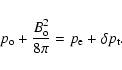
If the magnetic flux tube is to remain stable there must be a balance of
the internal and external pressures across the tube boundary. The sum of the internal
gas and magnetic pressures must be equal to the external gas pressure at the
interface:
 ,
where
,
where
 and
and
 are pressure fluctuations in the external medium due to
turbulence and external acoustic waves. Since the latter are compressible
waves, we neglect their contribution to the generation of purely incompressible
torsional tube waves by taking
are pressure fluctuations in the external medium due to
turbulence and external acoustic waves. Since the latter are compressible
waves, we neglect their contribution to the generation of purely incompressible
torsional tube waves by taking
 which also implies that
 (Spruit 1982; Musielak & Ulmschneider 2001).
Thus, the horizontal pressure balance can be written as
(Spruit 1982; Musielak & Ulmschneider 2001).
Thus, the horizontal pressure balance can be written as
 |
(1) |
The momentum equation for a magnetic flux tube oscillating with velocity  is given by
 |
(2) |
where the link between fluid equations and electromagnetic equations is
 ,
and where c
is the light speed. For linear waves,
Eq. (2) can be expanded and written as
,
and where c
is the light speed. For linear waves,
Eq. (2) can be expanded and written as
![\begin{displaymath}\rho_{\rm o}\frac{\partial \vec v}{\partial t}=-\nabla\left(p...
...bla
\times \vec b)\times \vec B_{\rm o}\right]+\rho_0\vec g.
\end{displaymath}](/articles/aa/full/2003/39/aah4457/img47.gif) |
(3) |
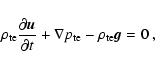
Using the conditions specified above, the linearized momentum equation for the
external medium with velocity  is
is
 |
(4) |
where
 and
and
 contain
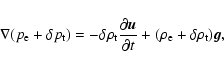
fluctuating components caused by the turbulence. Again, since the tube is
twisted but does not move horizontally, no motion is due to the tube in
the external medium and Eq. (4) can be written in the following form:
contain
fluctuating components caused by the turbulence. Again, since the tube is
twisted but does not move horizontally, no motion is due to the tube in
the external medium and Eq. (4) can be written in the following form:
 |
(5) |
with
 because the external medium is
in dynamical steady-state.
because the external medium is
in dynamical steady-state.
Combining Eqs. (1), (3) and (5), yields
![\begin{displaymath}\rho_{\rm o}\frac{\partial \vec v}{\partial t}-\delta\rho_{\r...
...s \vec b+(\nabla
\times \vec b)\times \vec B_{\rm o}\right].
\end{displaymath}](/articles/aa/full/2003/39/aah4457/img54.gif) |
(6) |
Since
 is a function of z only, taking the -component of
Eq. (6) gives
is a function of z only, taking the -component of
Eq. (6) gives
![\begin{displaymath}\rho_{\rm o}\left(\frac{\partial \vec v}{\partial t}\right)_\...
...c b+(\nabla
\times \vec b)\times \vec B_{\rm o}\right]_\phi.
\end{displaymath}](/articles/aa/full/2003/39/aah4457/img56.gif) |
(7) |
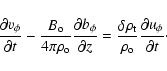
Defining
 and
and
 ,
and rearranging the
terms, Eq. (7) can be written as
,
and rearranging the
terms, Eq. (7) can be written as
 |
(8) |
To eliminate  from the above equation, it is necessary to take the
induction equation into consideration. Assuming that Ohm's law holds and
displacements current are negligible when compared to conduction currents, we
obtain
from the above equation, it is necessary to take the
induction equation into consideration. Assuming that Ohm's law holds and
displacements current are negligible when compared to conduction currents, we
obtain
![\begin{displaymath}\left(\frac{\partial \vec b}{\partial t}\right)_\phi-\left[\nabla\times
(\vec v\times \vec B_{\rm o})\right]_\phi=0,
\end{displaymath}](/articles/aa/full/2003/39/aah4457/img61.gif) |
(9) |
where only linear terms are kept. From Eq. (9), we find
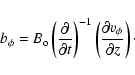 |
(10) |
Combining Eqs. (8), (10), and taking
 of the
result yields
of the
result yields
![\begin{displaymath}\frac{\partial^2 v_\phi}{\partial t^2}-c_{\rm A}^2\frac{\part...
...m o}}\left(\frac{\partial u_\phi}
{\partial t}\right)\right],
\end{displaymath}](/articles/aa/full/2003/39/aah4457/img64.gif) |
(11) |
where
 and
and
 |
(12) |
which remains constant along the tube because of the thin flux tube
approximation.
The physical properties of torsional tube waves and the fact that their
characteristic velocity  is the same as the Alfvén velocity clearly
imply that these waves are very similar to Alfvén waves in ideal MHD
with uniform magnetic fields. There are also similarities between
transverse tube waves and Alfvén waves, however, the propagation
velocity of the former is affected by the presence of the external
medium (see Spruit 1981) and, therefore, it differs from the Alfvén
velocity. Longitudinal tube waves are essentially acoustic waves
guided by the tube magnetic field lines, so they resemble slow MHD
waves propagating along the field lines; note that no mode of the flux
tube geometry corresponds to fast MHD waves.
is the same as the Alfvén velocity clearly
imply that these waves are very similar to Alfvén waves in ideal MHD
with uniform magnetic fields. There are also similarities between
transverse tube waves and Alfvén waves, however, the propagation
velocity of the former is affected by the presence of the external
medium (see Spruit 1981) and, therefore, it differs from the Alfvén
velocity. Longitudinal tube waves are essentially acoustic waves
guided by the tube magnetic field lines, so they resemble slow MHD
waves propagating along the field lines; note that no mode of the flux
tube geometry corresponds to fast MHD waves.
From the definition of the Alfvén velocity (see Eq. (12)) and
the fact that
 in the approach considered here, we obtain
 |
(13) |
where
 .
In addition, we have
.
In addition, we have
 |
(14) |
with H being the density (pressure) scale height of the internal and
external atmosphere. Hence, Eq. (11) can be written as
![\begin{displaymath}\left[\frac{\partial^2}{\partial t^2}-c_{\rm A}^2\frac{\parti...
...}\frac{\partial }{\partial z}\right]v_\phi(z,t)= S_\phi(z,t),
\end{displaymath}](/articles/aa/full/2003/39/aah4457/img72.gif) |
(15) |
and the source function is
![\begin{displaymath}S_\phi(z,t)=\frac{\partial}{\partial t}\left[\frac{\delta\rho...
...}
\left(\frac{\partial u_\phi}{\partial t}\right)\right]\cdot
\end{displaymath}](/articles/aa/full/2003/39/aah4457/img73.gif) |
(16) |
In the case of no turbulent external motions, the source function is zero
and the wave equation describes freely propagating torsional tube waves.
Now, it must be noted that the derived inhomogeneous wave Eq. (15)
has similar form to that obtained for transverse tube waves (see Musielak &
Ulmschneider 2001, and their Eq. (12)). The presence of the first order derivative
of  with respect to height implies that a cutoff frequency can be
introduced for torsional tube waves propagating along a diverging magnetic flux
tube (see Sect. 2.3). As shown by Eqs. (11), (13) and (14),
the existence of this cutoff is caused by the gradient of the magnetic field
with respect to height implies that a cutoff frequency can be
introduced for torsional tube waves propagating along a diverging magnetic flux
tube (see Sect. 2.3). As shown by Eqs. (11), (13) and (14),
the existence of this cutoff is caused by the gradient of the magnetic field
 .
Obviously, this cutoff frequency would not be present if a
homogeneous slab would be considered instead of a flux tube with exponentially
diverging magnetic fields.
.
Obviously, this cutoff frequency would not be present if a
homogeneous slab would be considered instead of a flux tube with exponentially
diverging magnetic fields.
To derive the cutoff frequency for torsional tube waves, we cast Eq. (15) into its Klein-Gordon form by using the following
transformation:
 |
(17) |
which yields
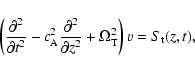 |
(18) |
where
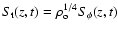 and the cutoff frequency
 for torsional tube waves is defined as
 |
(19) |
In order to avoid conflicting notations compared to our previous
work (e.g. Musielak et al. 1995), the cutoff frequency of
longitudinal tube waves, sometimes called Defouw frequency,
instead of termed
 is from now on denoted by
 .
Since both the propagation velocity
of
torsional waves and the scale height H are constant along the
tube, the cutoff frequency
is a global cutoff as it
is the same along the entire length of the (exponentially
spreading) tube. Torsional waves are propagating waves when their frequency
.
Since both the propagation velocity
of
torsional waves and the scale height H are constant along the
tube, the cutoff frequency
is a global cutoff as it
is the same along the entire length of the (exponentially
spreading) tube. Torsional waves are propagating waves when their frequency
 satisfies the condition
 ,
and they are
evanescent when
,
and they are
evanescent when
 .
It is interesting to note that
in the previous work (e.g., Spruit 1981, 1982; also Roberts & Ulmschneider
1997, and references therein), the cutoff frequency for torsional waves has
not been explicitly introduced. Our results clearly show that this cutoff
must always be taken into account when magnetic flux tube structures
embedded in the solar and stellar atmospheres are considered.
.
It is interesting to note that
in the previous work (e.g., Spruit 1981, 1982; also Roberts & Ulmschneider
1997, and references therein), the cutoff frequency for torsional waves has
not been explicitly introduced. Our results clearly show that this cutoff
must always be taken into account when magnetic flux tube structures
embedded in the solar and stellar atmospheres are considered.
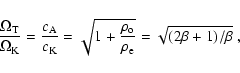
The definitions of the cutoff frequency for torsional,
,
and
transverse (kink),
 (Spruit 1981; also Musielak & Ulmschneider
2001), tube waves are very similar in form, however, the ratio of these
cutoffs is
(Spruit 1981; also Musielak & Ulmschneider
2001), tube waves are very similar in form, however, the ratio of these
cutoffs is
 |
(20) |
where
 .
Here
.
Here
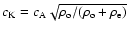 is the kink speed. For
 ,
we have
,
we have
 ,
and for
,
and for
 ,
one finds
,
one finds
 .
This clearly shows that torsional
tube waves always propagate faster than transverse tube waves, and also
that the cutoff frequency for the former is higher than for the latter
(see Fig. 2); the higher cutoff implies that the wave energy spectra
for torsional tube waves are not as broad as those for transverse tube
waves (see Sect. 3).
.
This clearly shows that torsional
tube waves always propagate faster than transverse tube waves, and also
that the cutoff frequency for the former is higher than for the latter
(see Fig. 2); the higher cutoff implies that the wave energy spectra
for torsional tube waves are not as broad as those for transverse tube
waves (see Sect. 3).
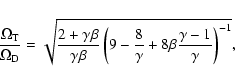
We may also compare the torsional and longitudinal,
(see
Defow 1976; also Musielak et al. 1995), cutoff frequencies. The ratio
of these two cutoffs is
 |
(21) |
with
 when
when
and
 when
.
when
.
This shows that the ratio is very sensitive to
the value of plasma  ;
for typical values of
considered
here
is always lower than
(see Fig. 2), which
implies that the wave energy spectra for torsional tube waves are
always broader than those obtained for longitudinal tube waves
(Musielak et al. 1995). Finally, the comparison of the cutoff frequency
for torsional and acoustic,
;
for typical values of
considered
here
is always lower than
(see Fig. 2), which
implies that the wave energy spectra for torsional tube waves are
always broader than those obtained for longitudinal tube waves
(Musielak et al. 1995). Finally, the comparison of the cutoff frequency
for torsional and acoustic,
 (Lamb 1908), waves shows that
is always marginally lower than
and, therefore,
the generated acoustic wave energy spectra are broader (e.g.,
Ulmschneider et al. 1996).
(Lamb 1908), waves shows that
is always marginally lower than
and, therefore,
the generated acoustic wave energy spectra are broader (e.g.,
Ulmschneider et al. 1996).
We now consider the source function given by
![\begin{displaymath}S_{\rm t}(z,t)=\rho_{\rm o}^{1/4}\frac{\partial}{\partial t}\...
...}}\left(\frac{\partial u_\phi}{\partial t}\right)\right]\cdot
\end{displaymath}](/articles/aa/full/2003/39/aah4457/img99.gif) |
(22) |
The continuity equation for the external medium allows
 to be
expressed as a function of uz alone. Thus, we have
to be
expressed as a function of uz alone. Thus, we have
 |
(23) |
which is completely known when the external velocity field is specified.
The derived source function depends on both the z and components
of the turbulent velocity but does not depend explicitly on the x and ycomponents of this velocity; however, the 3-D nature of turbulence is
formally accounted for by using a 3-D turbulent energy spectrum to calculate
the spectral tensors (see Sect. 3.7). This one-dimensional approach is
consistent with the thin flux tube approximation considered in this paper.
As a result of this approximation, the ratio of the tube diameter to a
characteristic length scale of the turbulence is not explicitly present
in the expression for the source function.
Comparison of the source function derived here to that obtained by Musielak
& Ulmschneider (2001, see their Eq. (20)) for the generation of transverse
tube waves shows that gravity is not present in Eq. (23). This simply means
that the generation of torsional tube waves is not effected by the presence
of the fluctuating buoyancy force (Goldreich & Kumar 1988). From a physical
point of view, this is obvious as torsional oscillations of the tube are not
directly effected by gravity; however, the propagation of these waves depends
indirectly on gravity through stratification, which requires the tube magnetic
field to diverge and, as shown in Sect. 2.3, this field divergence is responsible
for the existence of the cutoff frequency. The comparison also shows that the
terms depending on the second derivative of the turbulent velocity with respect
to time are missing in the expression for the source function derived by
Musielak & Ulmschneider for transverse tube waves. Since these terms are of
the same order of magntitude as the terms proportional to the first derivative
of the turbulent velocity with respect to time, they cannot be neglected. By
retaining these terms, all wave energy spectra and fluxes given by Musielak
& Ulmschneider (2001, 2002a,b) must be multiplied by a factor of 4; the
correction is already taken into account in the transverse wave energy
fluxes presented in Table 1 of this paper.
The dependence of the source function on the -component of the
turbulent velocity clearly implies that torsional tube waves are
generated by turbulent motions in the
direction. The underlying
assumption here is that these motions twist the tube magnetic field
at the tube surface and that once this twist occurs all remaining
magnetic field lines across the tube become twisted in the same way.
Here our picture is that the external turbulence occurring at all
scales will not allow the tube surface to be smooth but have a
rough appearance on which tangential flows will work to twist
the surface field lines. This rugosity is assumed to extend into
the tube such that the field lines in the tube are also twisted
together with the surface fields.
To simplify our analysis, we therefore assume that the turbulent
motions twist the magnetic field lines at the surface without "slipping",
which means that at the tube boundary
 (for more
discussion see Sect. 2.6). The resulting torsional waves are fully
described by the inhomogeneous wave Eq. (18) with the source
function given by Eq. (23). By specifying the turbulent motions,
we determine the form of the source function, solve the wave equation,
and calculate the generation rate for torsional tube waves (see below).
(for more
discussion see Sect. 2.6). The resulting torsional waves are fully
described by the inhomogeneous wave Eq. (18) with the source
function given by Eq. (23). By specifying the turbulent motions,
we determine the form of the source function, solve the wave equation,
and calculate the generation rate for torsional tube waves (see below).
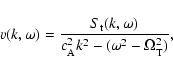
Since the inhomogeneous wave Eq. (18) has constant coefficients,
a space and time Fourier transform can be used to obtain its solutions. By
defining angular temporal, ,
and spatial, k, frequencies, we get
 |
(24) |
where k is the wave number in the z-direction, and
 |
(25) |
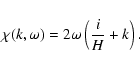
is the Fourier transform of the source function. Using Eq. (23), we may
write Eq. (25) in the following form:
 |
(26) |
where
 |
(27) |
Note that when
 the dispersion relation [
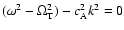 ]
for torsional tube waves is obtained from Eq. (24).
According to this relation, the lower bound of the frequency domain for freely
propagating torsional tube waves is the cutoff
;
we will use this
result to compute the wave energy spectra and fluxes carried by torsional tube
waves.
]
for torsional tube waves is obtained from Eq. (24).
According to this relation, the lower bound of the frequency domain for freely
propagating torsional tube waves is the cutoff
;
we will use this
result to compute the wave energy spectra and fluxes carried by torsional tube
waves.
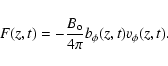
The general expression for the MHD wave energy flux carried by Alfvén waves
is
 (e.g., Anderson 1963;
Musielak
& Rosner 1987). Because of the similarities between Alfvén waves and torsional
tube waves (see Sect. 2.2), the wave energy flux for the latter in the z-direction
can be written as
(e.g., Anderson 1963;
Musielak
& Rosner 1987). Because of the similarities between Alfvén waves and torsional
tube waves (see Sect. 2.2), the wave energy flux for the latter in the z-direction
can be written as
 |
(28) |
Substituting Eq. (10) into Eq. (28) and taking the time average yields
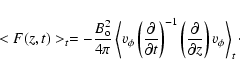 |
(29) |
Using the transformation given by Eq. (17), the mean wave energy flux is
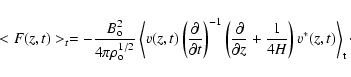 |
(30) |
The results found here are very similar in form to those obtained by Musielak
& Ulmschneider (2001) for transverse tube waves. For the benefit of readers
who are unaware of the mathematical treatment previously used to derive the
mean wave energy generation rate, an outline of the method is now presented.
Expressing v and its complex conjugate v* in terms of Fourier transforms
and taking the time average over time scale  yields
The time-integration is performed by using the  -function
and then the
 -integration is also performed
analytically.
-integration is also performed
analytically.
Since
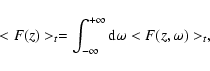 |
(32) |
the wave energy flux for a given atmospheric height z and wave
frequency
is
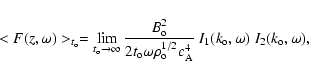 |
(33) |
where
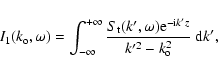 |
(34) |
and
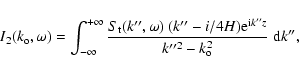 |
(35) |
with
 |
(36) |
where for the propagating waves
 is always positive. It is also seen
that the wave energy flux must be real, therefore, the term (-i/4H) is
dropped from the calculations.
is always positive. It is also seen
that the wave energy flux must be real, therefore, the term (-i/4H) is
dropped from the calculations.
The fact that the asymptotic Fourier transforms I1 and I2 can be
evaluated analytically for both longitudinal and transverse tube waves
has been shown by Musielak et al. (1995) and Musielak & Ulmschneider
(2001), respectively. Here, we use the latter results to write
 |
(37) |
where
 |
(38) |
with
 |
(39) |
and
 |
(40) |
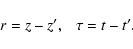
Following Stein (1967), we average position and time by using
 |
(41) |
and the relative separation and time interval quantities
 |
(42) |
Integrating over  and
yields
and
yields
 |
(43) |
Based on the properties of isotropic and homogeneous turbulence, the
fourth-order velocity correlations can be reduced to the torsional
(
 )
and longitudinal (
)
and longitudinal (
 )
second order-correlations (see Batchelor 1960; Hinze 1975). So far, the
derived wave energy flux and source function are given in the cylindrical
coordinate system introduced in Sect. 2.1 to describe torsional tube waves.
Now, we introduce a Cartesian coordinate system (x, y, z) and use it to
describe the external turbulence and calculate the second-order velocity
correlations. In this new coordinate system, the turbulent velocity
)
second order-correlations (see Batchelor 1960; Hinze 1975). So far, the
derived wave energy flux and source function are given in the cylindrical
coordinate system introduced in Sect. 2.1 to describe torsional tube waves.
Now, we introduce a Cartesian coordinate system (x, y, z) and use it to
describe the external turbulence and calculate the second-order velocity
correlations. In this new coordinate system, the turbulent velocity
 can be expressed as
 ,
where
,
where  is the polar angle and the tube cross-section is
assumed to be circular with radius
is the polar angle and the tube cross-section is
assumed to be circular with radius  (see Fig. 1a). Because of the
full symmetry between the x and y-directions, we may assume that
(see Fig. 1a). Because of the
full symmetry between the x and y-directions, we may assume that
 and that
 and
and
 .
Hence, we have
.
Hence, we have
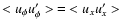 and the evaluation of the
second-order velocity correlations for torsional tube waves becomes
similar to that discussed by Musielak & Ulmschneider (2001) for
transverse tube waves. In Fig. 1, we show typical settings for
calculating the correlation
and the evaluation of the
second-order velocity correlations for torsional tube waves becomes
similar to that discussed by Musielak & Ulmschneider (2001) for
transverse tube waves. In Fig. 1, we show typical settings for
calculating the correlation
 for the
generation of both torsional and transverse tube waves.
for the
generation of both torsional and transverse tube waves.
![\begin{figure}
\par\includegraphics[width=8.5cm]{h4457f1.eps}
\end{figure}](/articles/aa/full/2003/39/aah4457/Timg146.gif) |
Figure 1:
Typical settings for calculating the velocity correlation
 for the generation of torsional a)
and transverse b) tube waves.
for the generation of torsional a)
and transverse b) tube waves. |
| Open with DEXTER |
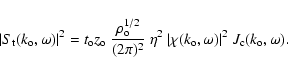
Taking the Fourier transforms of the second-order velocity
correlations defines the convolution integral
 |
(44) |
where the correlation tensors are given by
 |
(45) |
and
 |
(46) |
This allows writing the source function in the following form:
 |
(47) |
Since only propagating waves are considered in this paper, it is necessary to
examine the source function's dependency on  ,
which has been defined as
the condition for freely propagating torsional tube waves (see Eq. (36)).
Upon the condition
,
which has been defined as
the condition for freely propagating torsional tube waves (see Eq. (36)).
Upon the condition
 ,
it is seen that
,
it is seen that
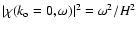
 and the waves are evanescent. However, even for
 the source function is formally not zero because
 and
and
 .
This implies that
.
This implies that
 and that some wave energy is being generated at the cutoff
frequency. Clearly, this energy cannot propagate to the overlying atmospheric
layers and, therefore, it must be removed (see Sect. 3.2).
and that some wave energy is being generated at the cutoff
frequency. Clearly, this energy cannot propagate to the overlying atmospheric
layers and, therefore, it must be removed (see Sect. 3.2).
Finally, we combine Eqs. (37) and (47), and derive the mean
wave energy generation rate [in units of erg cm-2 s-1 Hz-1]
 |
(48) |
where
 is the thickness of the turbulent region in the solar
convection zone. In deriving this expression, we have taken into account
the fact that only half of the total generated flux propagates upward.
In Sect. 3, we use Eq. (48) to compute the wave energy spectra carried
by torsional tube waves propagating upward along a given flux tube embedded
in the solar atmosphere.
is the thickness of the turbulent region in the solar
convection zone. In deriving this expression, we have taken into account
the fact that only half of the total generated flux propagates upward.
In Sect. 3, we use Eq. (48) to compute the wave energy spectra carried
by torsional tube waves propagating upward along a given flux tube embedded
in the solar atmosphere.
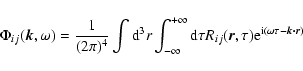
The correlation tensor Rij is defined as
 |
(49) |
where the average is taken over all points  of a large volume,
which can be considered infinite, and over all times t, which are long
compared to all other time scales, and thus can also be considered infinite.
A situation in which Rij is independent of
and t is called
time-independent homogeneous turbulence. Introducing the spectral tensor,
of a large volume,
which can be considered infinite, and over all times t, which are long
compared to all other time scales, and thus can also be considered infinite.
A situation in which Rij is independent of
and t is called
time-independent homogeneous turbulence. Introducing the spectral tensor,
 ,
and the Fourier transform
,
and the Fourier transform
 ,
gives
,
gives
 |
(50) |
and its inverse transform
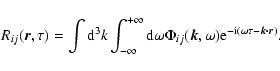 |
(51) |
For homogeneous and isotropic turbulence,
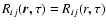 and
and
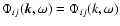 .
The correlation tensors can
be evaluated when the corresponding spectral tensors are known. The spectral tensors
for homogeneous and isotropic turbulence can be expressed by a 3-D turbulent energy
spectrum
.
The correlation tensors can
be evaluated when the corresponding spectral tensors are known. The spectral tensors
for homogeneous and isotropic turbulence can be expressed by a 3-D turbulent energy
spectrum
 ,
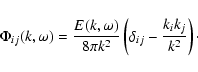
given by (Batchelor 1960)
,
given by (Batchelor 1960)
 |
(52) |
Performing the integration yields
 |
(53) |
and
 |
(54) |
Clearly, the correlation tensors can only be calculated when the turbulent energy
spectrum
is known. In the following, we discuss the procedure
of specifying
.
In general, there is no completely accepted theory of turbulence within the
stellar convection zones. In order to describe turbulence at or below a stellar
surface it is assumed that a turbulent energy spectrum, which is the distribution
of energy per unit mass that is stored in eddies of different wave numbers, must
be chosen (e.g., Musielak et al. 1994). The description of turbulence for our
analysis is primarily phenomenological and based on two-point, two-time velocity
correlation functions. Energy supplied at the largest eddy scale is dissipated
by the smallest eddies thereby cascading energy through the medium size eddies.
Constraining the turbulent flow to be isotropic and homogeneous, which is an
idealization that may not describe correctly real flows, allow the correlation
tensors (Eqs. (45) and (46)) to be computed once the form of the
turbulent energy spectrum is established. For the specific purpose of this work
it is a requirement to factor the turbulent energy spectrum
into
spatial and temporal parts (Stein 1967)
 |
(55) |
where the average eddy velocity is given by
![\begin{displaymath}u_k=\left[\int_k^{2k}E(k^{\prime}) {\rm d}k^{\prime} \right]^{1/2}.
\end{displaymath}](/articles/aa/full/2003/39/aah4457/img173.gif) |
(56) |
The specific forms of E(k) and
 are then prescribed and
used to determine the source function (Eq. (45)). Therefore, the problem
of describing the external turbulent motions is reduced here to choosing the
correct form of the turbulent energy spectrum.
are then prescribed and
used to determine the source function (Eq. (45)). Therefore, the problem
of describing the external turbulent motions is reduced here to choosing the
correct form of the turbulent energy spectrum.
As discussed thoroughly by Musielak et al. (1994), some modifications are needed
to apply the Kolmogorov hypothesis to the turbulent motions in the solar and
stellar convection zones. Defining  as the wave number of the energy-containing
eddies and
as the wave number of the energy-containing
eddies and  as the wave number of the eddies at scales where viscous effect
become important (in other words, where the turbulent cascading ends), the spatial
turbulent energy spectrum E(k) is given by
as the wave number of the eddies at scales where viscous effect
become important (in other words, where the turbulent cascading ends), the spatial
turbulent energy spectrum E(k) is given by
 |
(57) |
where the factor a = 0.758 is determined by the normalization condition
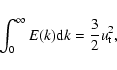 |
(58) |
and
is the rms turbulent velocity defined as
 |
(59) |
The temporal part of the turbulent energy spectrum
is motivated by the Prandtl mixing length picture. This flow field is an
idealization in which the turbulent eddies are in a superposition (Musielak
et al. 1994). Each eddy is at a well-defined spatial scale l such that the
power of all eddies in that scale contribute to the power spectrum at wave
number  .
If the eddy lifetime can be approximated by a timescale
such that
.
If the eddy lifetime can be approximated by a timescale
such that
 ,
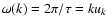
where uk is the characteristic
velocity of the eddy with wave number k determined by Eq. (56),
then the eddy has a unique characteristic frequency associated with it
and described by
,
where uk is the characteristic
velocity of the eddy with wave number k determined by Eq. (56),
then the eddy has a unique characteristic frequency associated with it
and described by
 .
The temporal turbulent energy
spectrum would be a delta function centered at this characteristic frequency
.
The temporal turbulent energy
spectrum would be a delta function centered at this characteristic frequency
 |
(60) |
However, it is more realistic to assume that eddies of wave number k have
different lifetimes. This implies that there is a distribution of eddy
lifetimes. Examining the limiting behavior of Eq. (60) it is seen that
the modified Gaussian turbulent frequency factor described by Musielak et al.
(1994) is physically appropriate and given by
![\begin{displaymath}\Delta(\omega/ku_k)=\frac{b}{\sqrt{\pi}\vert ku_k\vert} {\rm e}^{-[(\vert\omega\vert-\vert ku_k\vert)/\vert ku_k\vert]^2}
\end{displaymath}](/articles/aa/full/2003/39/aah4457/img184.gif) |
(61) |
where b=1.78 and is a normalization factor determined by
 |
(62) |
The results computed and presented in Sect. 3 utilize the above assumptions
as well as the described spatial and temporal forms of the turbulent energy
spectrum.
The computer code for the solar convection zone model is a modified version
of stellar envelope code used originally by Bohn (1981, 1984) and Ulmschneider
et al. (1996). It is assumed that the main energy-containing eddies are comparable
in size to the local pressure scale height H given from a mixing-length
description of convection. The mixing length parameter
 ,
where
,
where
 is the mixing-length, is
assumed to be of order unity. The best current value for the
solar convection zone presently is
is the mixing-length, is
assumed to be of order unity. The best current value for the
solar convection zone presently is
 (Trampedach et al. 1997). However, to investigate the dependence of the
torsional wave generation on the mixing-length we have
selected three values of the mixing-length parameter,
(Trampedach et al. 1997). However, to investigate the dependence of the
torsional wave generation on the mixing-length we have
selected three values of the mixing-length parameter,
 ,
1.5
and 2.0 in our present work.
,
1.5
and 2.0 in our present work.
The code also requires that the surface gravity g and
effective temperature
 are specified. In all
calculations, they are taken to be
are specified. In all
calculations, they are taken to be
 K, and
 cm s-2. Hydrogen molecule formation
is included and a gray radiation transport is used. The turbulent
velocity scale
is identified with the convective velocity
of the model. Finally, it is important to note that all
presented results are obtained for a single magnetic flux tube
embedded in the solar convection zone. The number of magnetic
flux tubes on the solar surface, or the so-called filling
factor, that is, the ratio of the area covered by magnetic
fields to the total surface area of the Sun, is not discussed
here.
cm s-2. Hydrogen molecule formation
is included and a gray radiation transport is used. The turbulent
velocity scale
is identified with the convective velocity
of the model. Finally, it is important to note that all
presented results are obtained for a single magnetic flux tube
embedded in the solar convection zone. The number of magnetic
flux tubes on the solar surface, or the so-called filling
factor, that is, the ratio of the area covered by magnetic
fields to the total surface area of the Sun, is not discussed
here.
It has been shown observationally (Stenflo 1978; Solanki 1993) that at the
solar surface magnetic field strengths are of the order
 G. However,
the equipartition magnetic field strength
G. However,
the equipartition magnetic field strength
 ,
where
,
where
 is the fluid pressure outside the tube. With
 dyn cm-2 (Vernazza et al. 1981) one finds the field strength
 G.
The ratio
G.
The ratio
 therefore indicates a typical
strength for solar magnetic flux tubes. To investigate the dependence of the
wave generation rate on the magnetic field, we consider three different values
of the field strength, namely,
therefore indicates a typical
strength for solar magnetic flux tubes. To investigate the dependence of the
wave generation rate on the magnetic field, we consider three different values
of the field strength, namely,
 ,
0.85 and 0.95.
,
0.85 and 0.95.
The cutoff frequency
for torsional tube waves was derived for an
isothermal atmosphere inside and outside the tube (see Sect. 2.1). However,
models of the solar convection zone are not isothermal and the cutoff frequency
does change with depth. The problem is treated here by formally dividing the
tube into layers that can be considered isothermal and where H and the
characteristic wave velocity
are constant. This allows
to
be considered locally as a constant.
![\begin{figure}
\par\includegraphics[width=8.5cm,clip]{h4457f2.eps}
\end{figure}](/articles/aa/full/2003/39/aah4457/Timg197.gif) |
Figure 2:
Cutoff periods  for torsional,
  for transverse,
  for longitudinal and for longitudinal and  for acoustic waves are plotted as a
function of height in the an isothermal solar atmosphere model
with
K. The magnetic field strength is taken
to be
G at the bottom. The tube geometry is of a
"wineglass'' shape, spreading exponentially up to a height of 500 km
and then expanding to a constant tube radius of 300 km. The tube
radius R and magnetic field strength
for acoustic waves are plotted as a
function of height in the an isothermal solar atmosphere model
with
K. The magnetic field strength is taken
to be
G at the bottom. The tube geometry is of a
"wineglass'' shape, spreading exponentially up to a height of 500 km
and then expanding to a constant tube radius of 300 km. The tube
radius R and magnetic field strength  are indicated.
|
| Open with DEXTER |
So far in the paper we have always assumed an exponentially spreading
magnetic flux tube where one has horizontal pressure balance
according to Eq. (1) where in the stable photospheric layers above the
convection zone the external turbulent pressure fluctuations
become zero.
It is interesting to illustrate flux tube models which extend to the chromosphere
where the horizontal pressure balance after Eq. (1) is no longer valid because
neighboring flux tubes exert an additional external magnetic pressure to constrain the
tube to a constant cross-section determined by the magnetic filling factor.
Figure 2 shows such "wineglass'' shaped magnetic tube model which
spreads exponentially
up to a height of 500 km and thereafter approaches a constant tube radius
of 300 km. Such tubes are thought to exist in the chromospheric network at the
boundary of supergranulation cells.
We have computed the acoustic
 ,
longitudinal
,
torsional
and transverse
,
longitudinal
,
torsional
and transverse
 cutoff frequencies by taking
 and plotted in Fig. 2 the corresponding
cutoff periods
and plotted in Fig. 2 the corresponding
cutoff periods
 ,
,
 ,
,
 and
and
 as a function of
height. It is seen that below 500 km height the four cutoff
periods are constant because of the height-independent values of
the sound speed
and the Alfvén speed
in this
exponentially spreading range. Here it is seen that
and
are essentially identical because
as a function of
height. It is seen that below 500 km height the four cutoff
periods are constant because of the height-independent values of
the sound speed
and the Alfvén speed
in this
exponentially spreading range. Here it is seen that
and
are essentially identical because
 cm s-1
 cm s-1. The kink wave cutoff period
is
largest and the torsional wave cutoff period
is
intermediate. This is because the height-independent kink speed
cm s-1. The kink wave cutoff period
is
largest and the torsional wave cutoff period
is
intermediate. This is because the height-independent kink speed
 cm s-1 is smaller than
which in turn is
smaller that
cm s-1 is smaller than
which in turn is
smaller that
 .
The scale height
.
The scale height
 cm
remains constant over the entire tube.
cm
remains constant over the entire tube.
In the constant cross-section part of the tube, the magnetic
field strength at
 G becomes independent of height,
while the density decreases rapidly with height leading to a
rapidly increasing Alfvén speed and kink speed, while and
G becomes independent of height,
while the density decreases rapidly with height leading to a
rapidly increasing Alfvén speed and kink speed, while and  remain constant. At 2000 km height one has
 cm s-1 and
 cm s-1. This
decreases both the the torsional wave cutoff period
cm s-1. This
decreases both the the torsional wave cutoff period
 (see Eq. (19)) and the kink cutoff period
 .
For some frequencies these tube waves could
become trapped. Because
is lower than
and
also lower than
,
the wave energy spectra of torsional
tube waves are broader than those obtained for acoustic (e.g.,
Ulmschneider et al. 1996) and longitudinal (Musielak et al.
2000) waves.
.
For some frequencies these tube waves could
become trapped. Because
is lower than
and
also lower than
,
the wave energy spectra of torsional
tube waves are broader than those obtained for acoustic (e.g.,
Ulmschneider et al. 1996) and longitudinal (Musielak et al.
2000) waves.
Torsional tube waves are considered propagating waves if their frequencies
are above the cutoff
.
As already discussed in Sect. 2.6, the
source function given by Eq. (47) is not equal to zero as
.
This implies that energy is being generated in the
form of non-propagating (evanescent) waves. Since the non-propagating waves
are not treated in this model, we eliminate them from the total energy spectrum
by introducing the factor
 ;
this factor reduces
the contribution of evanescent waves to zero as
.
We utilize this factor in all computed wave energy spectra and fluxes. This
guarantees that the generated torsional tube waves are always propagating
and that they carry their energy away from the convection zone.
;
this factor reduces
the contribution of evanescent waves to zero as
.
We utilize this factor in all computed wave energy spectra and fluxes. This
guarantees that the generated torsional tube waves are always propagating
and that they carry their energy away from the convection zone.
The dependence of the computed wave energy spectra on the mixing-length
parameter  is shown in Fig. 3. It is clearly seen that the torsional
wave energy spectrum's overall shape is not greatly effected by the choice
of this parameter, as there is no significant shift in the
primary wave generation frequency domain and also the maximum remains the
same.
is shown in Fig. 3. It is clearly seen that the torsional
wave energy spectrum's overall shape is not greatly effected by the choice
of this parameter, as there is no significant shift in the
primary wave generation frequency domain and also the maximum remains the
same.
![\begin{figure}
\par\includegraphics[width=8.5cm,clip]{h4457f3.eps}
\end{figure}](/articles/aa/full/2003/39/aah4457/Timg217.gif) |
Figure 3:
Torsional tube wave energy spectra computed for different mixing-length
parameters
,
1.5 and 2.0. The magnetic field strength is
taken as
in all models. |
| Open with DEXTER |
The dependence of the wave energy spectra on the strength of the tube
magnetic field is shown in Fig. 4. The presented results were obtained
by taking
,
0.85 and 0.95, and for a fixed value of
.
It is seen that the spectra are much broader for weak fields
than for strong fields, and that the maximum shifts toward higher
frequencies as the field strength
increases. Both effects can
be attributed to an increase in the cutoff frequency for stronger fields.
![\begin{figure}
\par\includegraphics[width=8.5cm,clip]{h4457f4.eps}
\end{figure}](/articles/aa/full/2003/39/aah4457/Timg218.gif) |
Figure 4:
Torsional tube wave energy spectra computed for three different field
strengths
 .
The mixing-length parameter .
The mixing-length parameter  is the same
for all three cases.
is the same
for all three cases. |
| Open with DEXTER |
Finally, it is of some interest to compare the wave energy spectra generated
by torsional tube waves to those generated by transverse and longitudinal
tube waves. This comparison is shown in Fig. 5. It is seen that the rate
of generation of transverse tube waves significantly exceeds that for torsional
tube waves, especially, for low frequency waves. The transverse wave energy
spectrum is also broader than the torsional wave and is a result of the
lower cutoff frequency of the transverse tube wave (see Fig. 2). The main reason
for this significant difference in the efficiency of the wave excitation is the
lack of contributions from the fluctuating buoyancy force to the generation of
torsional tube waves. According to Musielak & Ulmschneider (2001), this force
plays the dominant role in generating transverse tube waves in the solar
convection zone. It is seen that this force does not make any contribution
to the excitation of torsional tube waves because these waves are not influenced
(at least, in the first-order approximation) by the presence of gravity.
![\begin{figure}
\par\includegraphics[width=8.5cm,clip]{h4457f5.eps}
\end{figure}](/articles/aa/full/2003/39/aah4457/Timg219.gif) |
Figure 5:
Transverse, longitudinal and torsional tube wave energy spectra computed
for field strengths
and the mixing-length parameter .
All spectra were obtained by using analytical methods only. |
| Open with DEXTER |
The results presented in Fig. 5 also show that the efficiency of generation
for torsional tube waves is much higher than that for longitudinal tube waves.
In addition, it is seen that the torsional wave energy spectrum is broader
than the longitudinal one; again, the main difference exists for low frequency
waves because the cutoff period for torsional tube waves is lower than the
corresponding one for longitudinal tube waves (see Fig. 2). The differences
become important when the role played by each one of these waves in the
atmospheric heating is investigated; we briefly discuss this problem in
the following subsection.
Considering a single magnetic flux tube, the total torsional wave energy flux
is computed by integrating the wave energy spectra over the range
 .
The results are presented in Table 1, which shows
that for the same value of
and
transverse tube waves
are two times more efficiently generated than torsional tube waves; however,
the efficiency of the excitation of the latter is one order of magnitude higher
than longitudinal tube waves. These are expected results as it is much easier
for the external turbulent motions to shake and twist the tube than to twist
it (e.g., Spruit & Roberts 1983; Musielak & Ulmschneider 2001).
.
The results are presented in Table 1, which shows
that for the same value of
and
transverse tube waves
are two times more efficiently generated than torsional tube waves; however,
the efficiency of the excitation of the latter is one order of magnitude higher
than longitudinal tube waves. These are expected results as it is much easier
for the external turbulent motions to shake and twist the tube than to twist
it (e.g., Spruit & Roberts 1983; Musielak & Ulmschneider 2001).
From the results presented in Table 1, one also finds that the -dependence
scales with the efficiency of the wave generation process: the higher the efficiency
the stronger is the -dependence. Since higher values of
give larger
convective velocities, the effect is stronger for the waves that are easier to
generate. It is seen that the wave energy flux for a mixing-length parameter,
is 4.4 times larger than for
;
this increase is caused
by much higher convective velocities in the former case than in the latter. The
approximate dependence on the parameter
is found to be
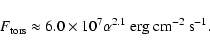 |
(63) |
This -dependence can be compared to that obtained for transverse
(
 )
and longitudinal (
)
and longitudinal (
 )
tube waves
by Musielak et al. (2001) and Musielak et al. (2000), respectively.
)
tube waves
by Musielak et al. (2001) and Musielak et al. (2000), respectively.
Table 1:
Total wave energy fluxes
 (erg/ cm2 s) generated as torsional
waves in a single magnetic flux tube embedded in the solar convection
zone are compared to the fluxes for transverse tube waves,
(erg/ cm2 s) generated as torsional
waves in a single magnetic flux tube embedded in the solar convection
zone are compared to the fluxes for transverse tube waves,
 and
longitudinal tube waves,
and
longitudinal tube waves,
 ;
note that the factor 4 (see discussion
below Eq. (23)) was included in the computation of the wave energy fluxes for
transverse tube waves. All presented fluxes were computed by using analytical
methods only.
;
note that the factor 4 (see discussion
below Eq. (23)) was included in the computation of the wave energy fluxes for
transverse tube waves. All presented fluxes were computed by using analytical
methods only.
According to the results given in Table 1, one sees that the torsional wave
energy flux decreases with increasing magnetic field strength .
An
approximate fitting to these data yields the following -dependence
 |
(64) |
By comparing this dependence to that previously derived for transverse
(
 )
and longitudinal waves (
)
and longitudinal waves (
 ), one clearly
sees that the efficiency of the generation of longitudinal tube waves depends
very strongly on the strength of the tube magnetic field. The affect is
also important for the generation of torsional tube waves and transverse
tube waves, however transverse waves are the least effected.
), one clearly
sees that the efficiency of the generation of longitudinal tube waves depends
very strongly on the strength of the tube magnetic field. The affect is
also important for the generation of torsional tube waves and transverse
tube waves, however transverse waves are the least effected.
The fact that the efficiency of generation of different tube waves depends
so differently on the strength of the tube magnetic field can easily be
explained by the role played by "stiffness'' of magnetic flux tubes in
the wave generation. This "stiffness'' is obviously greater for stronger
magnetic field strength (for example, it is much greater for
 than for
). The "stiffer'', the more resistant
the tube becomes to external motions. The fact that the longitudinal wave
generation is more affected than the other processes is directly related
to the amount of gas inside the tube: the stronger the field, the less
gas one has inside and the more difficult it is to excite the wave. In the
case of torsional
waves, the strength of the field determines how difficult it is for the
external motions to twist the tube. This is similar in the generation
of transverse tube waves where stiffer fields inhibit bending by the same weak
external turbulent flows. However, because of their high efficiency of
generation they are less effected. In summary, it is harder to twist
the magnetic flux tubes than shake them but it is easier to twist the
tube than to squeeze it. In other words, one finds that the lower the
efficiency of the wave generation the stronger the dependence on the
tube magnetic field.
than for
). The "stiffer'', the more resistant
the tube becomes to external motions. The fact that the longitudinal wave
generation is more affected than the other processes is directly related
to the amount of gas inside the tube: the stronger the field, the less
gas one has inside and the more difficult it is to excite the wave. In the
case of torsional
waves, the strength of the field determines how difficult it is for the
external motions to twist the tube. This is similar in the generation
of transverse tube waves where stiffer fields inhibit bending by the same weak
external turbulent flows. However, because of their high efficiency of
generation they are less effected. In summary, it is harder to twist
the magnetic flux tubes than shake them but it is easier to twist the
tube than to squeeze it. In other words, one finds that the lower the
efficiency of the wave generation the stronger the dependence on the
tube magnetic field.
We have computed the wave energy spectra and fluxes carried by
torsional tube waves in the solar atmosphere, and compared them
to those previously obtained for longitudinal and transverse
tube waves. Our approach is analytical, which means that the
calculated fluxes represent only lower bounds for the realistic
fluxes. The obtained results show that torsional tube waves
propagating in the solar atmosphere carry less energy than
transverse tube waves but more energy than longitudinal tube
waves. This implies that torsional tube waves could significantly
contribute to the atmospheric heating and that the energy fluxes
carried by these waves must be included into theoretical models
of stellar chromospheres and coronae.
The problem of heating stellar chromospheres and coronae is not
yet fully understood despite significant observational and
theoretical progress (e.g., Narain & Ulmschneider 1996, and
references therein). As already mentioned in Sect. 1, recent
results obtained by Ulmschneider et al. (2001) and Fawzy et al.
(2002a,b) clearly show that the wave heating mechanism based on
longitudinal and transverse tube waves can explain the
observed level of stellar activity in late-type stars only up to
the level of the Ca II H and K line formation, while to explain
the emission of the higher chromospheric layers, where the Mg II h and k lines originate, another non-wave magnetic (e.g.,
reconnective) heating mechanism seems to be required.
The results presented in this paper demonstrate that the
contribution of torsional tube waves to solar and stellar
atmospheric heating can be important because the amount of
energy carried by these waves significantly exceeds the amount
of energy dissipated by longitudinal tube waves. Even though,
torsional waves, carrying more energy than longitudinal waves
but appreciably less than transverse waves, are found to be
difficult to damp similarly as the transverse waves. However, for
both wave modes energy dissipation can occur via nonlinear
mode-coupling to longitudinal tube waves (for transverse waves,
see Zhugzhda et al. 1995, and for torsional waves, see Hollweg
et al. 1982). These mode-couplings
are particularly efficient when in the transverse wave case kink
shocks and in the torsional wave case switch-on shocks occur.
Therefore, the amount of energy carried by torsional and
transverse tube waves should be included into the theoretical
models of stellar chromospheres, and the efficiency of mode-coupling
studied.
The following conclusions can be drawn from the analytic study
of linear torsional wave generation in magnetic flux tubes embedded
in the solar convection zone.
- 1.
- Torsional magnetic tube waves have a cutoff frequency
 where
the Alfvén velocity and H the
scale height. Typical values of the cutoff periods
are 100 to 300 s. Long period torsional
waves could show trapping due to this cutoff frequency.
where
the Alfvén velocity and H the
scale height. Typical values of the cutoff periods
are 100 to 300 s. Long period torsional
waves could show trapping due to this cutoff frequency.
- 2.
- The typical wave energy flux carried by torsional tube waves in
the solar atmosphere is approximately
 erg/cm2s.
This is one order of magnitude more than the longitudinal wave energy
flux and 2 times less than the transverse wave energy flux. This
comparison is based on the wave energy fluxes obtained by using
analytical methods only.
erg/cm2s.
This is one order of magnitude more than the longitudinal wave energy
flux and 2 times less than the transverse wave energy flux. This
comparison is based on the wave energy fluxes obtained by using
analytical methods only.
- 3.
- For different values of the mixing length parameter ,
the
shapes of the computed wave energy spectra remain practically the same.
However, the amount of generated wave energy strongly increases with
increasing .
- 4.
- The computed wave energy spectra and fluxes are sensitive
to the strength of the tube magnetic field. For weak fields, the spectra
are much broader than for strong fields - this is caused by the cutoff
frequency dependence of the magnetic field. The total amount of energy
carried by torsional tube waves decreases when the strength of the tube
magnetic field is increased.
- 5.
- The total amount of energy carried by torsional tube waves does not
depend as strongly on the strength of the tube magnetic field as the
longitudinal wave energy fluxes. The difference can be easily explained
due to the role played by the "stiffness'' of flux tubes in the process of
wave excitation.
- 6.
- Our results are only valid for linear generation of torsional tube
waves. Therefore, the presented wave energy fluxes must be regarded as
lower bounds for realistic energies carried by these waves. Despite
this, the fluxes carried by torsional tube waves are likely to play
important role in solar and stellar atmospheric heating.
Acknowledgements
This work was supported by NSF under grant ATM-0087184 (Z.E.M., M.N.
and P.U.), by the DFG grant Ul57/25-3, and by NATO under grant CRG-910058
(P.U. and Z.E.M.). Z.E.M. also acknowledges the support of this work by
the Alexander von Humboldt Foundation.
- Anderson, J. E. 1963, Magnetohydrodynamic Shock Waves
(Cambridge: MIT Press), 50
In the text
- Batchelor, G. K. 1960, Theory of Homogeneous Turbulence
(Cambridge: Cambridge University Press), 49
In the text
- Buchholz, B., Ulmschneider, P., & Cuntz, M. 1998,
ApJ, 494, 700
In the text
NASA ADS
- Bohn, H. U. 1981, Ph.D. Thesis, Univ. Würzburg,
Germany
In the text
- Choudhuri, A. R., Auffret, H., & Priest, E. R. 1993a, Sol. Phys.,
143, 49
In the text
NASA ADS
- Choudhuri, A. R., Dikpati, M., & Banerjee, D. 1993b, ApJ, 413,
811
NASA ADS
- Cuntz M., Rammacher W., Ulmschneider P., Musielak Z. E., &
Saar S. H. 1999, ApJ, 522, 1053
In the text
NASA ADS
- Cuntz M., Ulmschneider P., & Musielak Z. E. 1998, ApJ, 493,
L117
In the text
NASA ADS
- Defouw, R. J. 1976, ApJ, 209, 266
In the text
NASA ADS
- Fawzy, D. E., Rammacher, W., Ulmschneider, P., Musielak, Z. E.,
& Stepien, K. 2002a, A&A, 386, 971
In the text
NASA ADS
- Fawzy, D.E., Ulmschneider, P., Stepien, K., Musielak, Z.E.,
& Rammacher, W. 2002b, A&A, 386, 983
NASA ADS
- Goldreich, P., & Kumar, P. 1988, ApJ, 326, 462
In the text
NASA ADS
- Hinze, J. O. 1975, Turbulence (New York: McGraw Hill), 61,
202
In the text
- Hollweg, J. V., Jackson, S., & Galloway, D. 1982, Sol. Phys., 75, 35
In the text
NASA ADS
- Huang P., Musielak, Z. E., & Ulmschneider, P. 1995, A&A, 279,
579
In the text
- Lighthill, M. J. 1952, Proc. Roy. Soc. London A, 211, 564
In the text
- Muller, R. 1989, in Solar and Stellar Granulation,
ed. R. J. Rutten & G. Severino (Dordrecht: Kluwer Academic
Publ.), 101
In the text
- Muller, R., Roudier, Th., Vigneau, J., & Auffret, H. 1994,
A&A, 283, 232
In the text
NASA ADS
- Musielak, Z. E., & Rosner, R. 1987, ApJ, 315, 371
In the text
NASA ADS
- Musielak, Z. E., Rosner, R., Gail, H. P., & Ulmschneider, P.
1995, ApJ, 448, 865
In the text
NASA ADS
- Musielak, Z. E., Rosner, R., Stein, R. F., & Ulmschneider, P.
1994, ApJ, 423, 474
In the text
NASA ADS
- Musielak, Z. E., Rosner, R., & Ulmschneider, P. 1989, ApJ, 337,
470
In the text
NASA ADS
- Musielak, Z. E., Rosner, R., & Ulmschneider, P. 2000, ApJ, 541,
410
In the text
NASA ADS
- Musielak, Z. E., Rosner, R., & Ulmschneider, P. 2002, ApJ, 573,
418
In the text
NASA ADS
- Musielak, Z. E., & Ulmschneider, P. 2001, A&A, 370, 541
In the text
NASA ADS
- Musielak, Z. E., & Ulmschneider, P. 2002a, A&A, 386, 606
NASA ADS
- Musielak, Z. E., & Ulmschneider, P. 2002b, A&A, 386, 615
NASA ADS
- Narain U., & Ulmschneider, P. 1996, Space Sci. Rev., 75, 453
In the text
NASA ADS
- Roberts, B., & Ulmschneider, P. 1997, in Solar and Heliospheric
Plasma Physics, ed. G. M. Simett, C. E. Alissandrakis, & L. Vlahos
(Berlin: Springer Verlag), 75
In the text
- Saar, S. H. 1996, in Stellar Surface Structure,
ed. K. Strassmeier, & J. L. Linsky (Kluwer), IAU Symp., 176, 237
In the text
- Solanki, S. K. 1993, Space Sci. Rev., 63, 1
In the text
NASA ADS
- Spruit, H. C. 1981, A&A, 98, 155
In the text
NASA ADS
- Spruit, H. C. 1982, Sol. Phys., 75, 3
In the text
NASA ADS
- Spruit, H. C., & Roberts, B. 1983, Nature, 304, 401
In the text
NASA ADS
- Stein, R. F. 1967, Sol. Phys., 2, 385
In the text
NASA ADS
- Trampedach, R., Christensen-Dalsgaard, J., Nordlund, A., &
Stein, R. 1997, 73
In the text
- Ulmschneider P., Zähringer K., & Musielak, Z. E. 1991,
A&A, 241, 625
In the text
NASA ADS
- Ulmschneider, P., Theurer, J., & Musielak, Z. E. 1996, A&A,
315, 212
In the text
NASA ADS
- Ulmschneider, P., & Musielak, Z. E. 1998, A&A, 338, 311
In the text
NASA ADS
- Ulmschneider, P., Musielak, Z. E., & Fawzy, D. E. 2001, A&A, 374, 662
In the text
NASA ADS
- Ulmschneider, P., Fawzy, D. E., Musielak, Z. E., & Stepien,
K. 2001, ApJ, 559, L167
NASA ADS
- Vernazza, J. E., Avrett, E. H., & Loeser, R. 1981, ApJS, 45,
635
In the text
NASA ADS
- Zhugzhda, Y. D., Bromm, V., & Ulmschneider, P. 1995, A&A, 300, 302
In the text
NASA ADS
Copyright ESO 2003


![\begin{figure}
\par\includegraphics[width=8.5cm]{h4457f1.eps}
\end{figure}](/articles/aa/full/2003/39/aah4457/img146.gif)
![\begin{figure}
\par\includegraphics[width=8.5cm,clip]{h4457f2.eps}
\end{figure}](/articles/aa/full/2003/39/aah4457/img197.gif)
![\begin{figure}
\par\includegraphics[width=8.5cm,clip]{h4457f3.eps}
\end{figure}](/articles/aa/full/2003/39/aah4457/img217.gif)
![\begin{figure}
\par\includegraphics[width=8.5cm,clip]{h4457f4.eps}
\end{figure}](/articles/aa/full/2003/39/aah4457/img218.gif)
![\begin{figure}
\par\includegraphics[width=8.5cm,clip]{h4457f5.eps}
\end{figure}](/articles/aa/full/2003/39/aah4457/img219.gif)