A&A 409, 1007-1015 (2003)
DOI: 10.1051/0004-6361:20031160
The enigmatic outburst of V445 Puppis - A possible helium nova?
N. M. Ashok - D. P. K. Banerjee
Physical Research Laboratory, Navrangpura,
Ahmedabad 380 009, India
Received 22 January 2003 / Accepted 16 July 2003
Abstract
JHK spectroscopic and photometric observations are reported for the
enigmatic, nova-like, variable V445 Puppis which erupted at the end of
2000.
The near-IR spectra are hydrogen-deficient and unusually rich in CI lines. The
important CI lines are found to be positioned at 1.133, 1.166, 1.175,
1.189, 1.26 and 1.689  m.
Model calculations for the CI lines are done to make the identification
of the lines secure. Photometric data, taken on January 2.90 UT, 2001
shortly after
the outburst, show the formation of an optically thin dust shell around V445
Puppis. The temperature and upper limit for the mass of the dust
shell are estimated to be 1800 K and
m.
Model calculations for the CI lines are done to make the identification
of the lines secure. Photometric data, taken on January 2.90 UT, 2001
shortly after
the outburst, show the formation of an optically thin dust shell around V445
Puppis. The temperature and upper limit for the mass of the dust
shell are estimated to be 1800 K and
 respectively. A subsequent episode of massive dust formation
- indicated by the observed, deep visual dimming - is also seen
in JHK images of early November 2001. V445 Puppis has shown two unusual
properties for a nova: (i) the hydrogen-deficiency and He/C enrichment of the object as seen from
optical and IR data and (ii) synchrotron radio emission which was detected
nearly a year after its outburst by other workers. The strange nature of the
object is discussed and it is shown that it is difficult to place it in the
known categories of eruptive variables viz. novae (classical, recurrent or
symbiotic); born-again AGB stars; the new class of eruptive variables like
V838 Mon; and RCB/HdC stars. Tentative evidence for an accretion disk and
binarity of the V445 Puppis system is presented. It is debated whether
V445 Puppis is a rare helium nova or a unique object.
respectively. A subsequent episode of massive dust formation
- indicated by the observed, deep visual dimming - is also seen
in JHK images of early November 2001. V445 Puppis has shown two unusual
properties for a nova: (i) the hydrogen-deficiency and He/C enrichment of the object as seen from
optical and IR data and (ii) synchrotron radio emission which was detected
nearly a year after its outburst by other workers. The strange nature of the
object is discussed and it is shown that it is difficult to place it in the
known categories of eruptive variables viz. novae (classical, recurrent or
symbiotic); born-again AGB stars; the new class of eruptive variables like
V838 Mon; and RCB/HdC stars. Tentative evidence for an accretion disk and
binarity of the V445 Puppis system is presented. It is debated whether
V445 Puppis is a rare helium nova or a unique object.
Key words: stars: individual: V445 Puppis - infrared:
stars - stars: novae, cataclysmic variables - techniques: spectroscopic
V445 Puppis - a nova like object - was first reported to be in outburst on
30 December 2000 by Kanatsu (Kato & Kanatsu 2000). The exact
time of the object's eruption is not
certain - an aspect that is discussed in Sect. 3.1. Spectra in the
visible region, taken in the early stages after the detection, showed many
permitted lines of FeII, CaI, CaII, OI and NaI (Fujii 2001; Liller 2001a,b;
Shemmer et al. 2001; Wagner et al. 2001a,b). A striking feature of
the optical spectra was the absence of hydrogen lines in the spectra.
Near-IR spectra reported here also confirm the absence of Paschen and Brackett
hydrogen lines in the JHK bands. The deficiency of hydrogen in V445 Puppis
shows that it is not a usual nova and shows the strangeness of the object.
This point is also made by Wagner et al. (2001a) who state that the
optical spectrum of V445 Puppis is not typical of classical FeII type novae, recurrent novae or
symbiotic novae. Mid-IR (3-14
 m) spectroscopy by Lynch
et al. (2001) reveal only a smooth featureless continuum deviating
significantly from a black-body distribution and which can be explained by
invoking the presence of dust. Another interesting development in
the evolution of V445 Puppis was the detection at radio wavelengths almost a year after
the outburst (Rupen et al. 2001a). Radio emission has been seen in a few
novae (Seaquist 1989) but such emission has the characteristics
of thermal bremsstrahlung radiation emitted by ionized gas. In V445 Puppis, non-thermal synchrotron radiation is seen which is rather
rare (another example of this being the old nova remnant GK Persei).
Thus V445 Puppis has all the hallmarks of being a very interesting object.
m) spectroscopy by Lynch
et al. (2001) reveal only a smooth featureless continuum deviating
significantly from a black-body distribution and which can be explained by
invoking the presence of dust. Another interesting development in
the evolution of V445 Puppis was the detection at radio wavelengths almost a year after
the outburst (Rupen et al. 2001a). Radio emission has been seen in a few
novae (Seaquist 1989) but such emission has the characteristics
of thermal bremsstrahlung radiation emitted by ionized gas. In V445 Puppis, non-thermal synchrotron radiation is seen which is rather
rare (another example of this being the old nova remnant GK Persei).
Thus V445 Puppis has all the hallmarks of being a very interesting object.
In this work, we mainly present spectroscopic results (and also some
photometric data) from JHK observations of V445 Puppis made
at five fairly evenly spaced epochs. These should help in following the
temporal evolution of V445 Puppis and understanding its puzzling nature.
From our results it would appear that V445 Puppis is a unique object
and could be a helium nova. A helium nova is believed to occur due to a
thermo-nuclear runaway on the surface of a degenerate white dwarf accreting
helium from its helium-rich companion (Kato et al. 1989). The nova ejecta,
in such an outburst, are expected to be hydrogen-deficient as found
in V445 Puppis.
![\begin{figure}
\par\includegraphics[width=16.4cm,clip]{h4263f1.eps}
\end{figure}](/articles/aa/full/2003/39/aah4263/Timg7.gif) |
Figure 1:
The V-band lightcurve of V445 Puppis between 1994 to
2001 based on IAU circulars and VSNET reports. The small dots
represent visual/photographic estimates and the circles represent
photo-electric/CCD values. The triangles give upper limits on the magnitudes. |
| Open with DEXTER |
Near-IR JHK spectra at a resolution of  1000 were obtained at the
Mt. Abu 1.2 m telescope using a Near Infrared Imager/Spectrometer
with a
1000 were obtained at the
Mt. Abu 1.2 m telescope using a Near Infrared Imager/Spectrometer
with a
 HgCdTe NICMOS3 array. We present here the spectroscopic
observations of five days viz. January 1.63 UT, January 20.81 UT,
February 1.73 UT, February 18.70 UT
and March 1.66 UT, 2001.
In each of the J, H and K-bands a set of at least two spectra were
taken. In each set the star was offset to two
different positions of the slit (slit width =2''). The
signal-to-noise ratio of the spectra, as determined using IRAF, is moderate
and ranges between 30 to 60 in the JHK-bands.
The exposure times for the spectra were typically between 60 to 120 s.
Spectral calibration was done using the OH sky lines
that register with the spectra. The comparison star HR 2988 was used for
dividing the spectra in all cases. We believe the telluric
lines, present in the spectra, have been well removed in the process of
division. This is because of (i) the close proximity of
HR 2988 to V445 Puppis and (ii) also the small time gap (typically 10-15 min)
between observing the spectra of V445 Puppis and HR 2988 in any of
the JHK-bands. This ensures thatboth the stars were at a similar airmass.
The dividing process should thereforeremove the telluric lines reasonably
well.
HgCdTe NICMOS3 array. We present here the spectroscopic
observations of five days viz. January 1.63 UT, January 20.81 UT,
February 1.73 UT, February 18.70 UT
and March 1.66 UT, 2001.
In each of the J, H and K-bands a set of at least two spectra were
taken. In each set the star was offset to two
different positions of the slit (slit width =2''). The
signal-to-noise ratio of the spectra, as determined using IRAF, is moderate
and ranges between 30 to 60 in the JHK-bands.
The exposure times for the spectra were typically between 60 to 120 s.
Spectral calibration was done using the OH sky lines
that register with the spectra. The comparison star HR 2988 was used for
dividing the spectra in all cases. We believe the telluric
lines, present in the spectra, have been well removed in the process of
division. This is because of (i) the close proximity of
HR 2988 to V445 Puppis and (ii) also the small time gap (typically 10-15 min)
between observing the spectra of V445 Puppis and HR 2988 in any of
the JHK-bands. This ensures thatboth the stars were at a similar airmass.
The dividing process should thereforeremove the telluric lines reasonably
well.
Photometry in the JHK-bands was performed on January 2.90 UT and
November 1.96 UT, 2001 using
the NICMOS3 array, mentioned above, in the imaging mode.
The sky was photometric on both days with a typical seeing of 1''. Several frames in 4 dithered positions, offset
from each other by 30'', were obtained in all the filters. The
times for all the individual frames was 100 ms on 2 Jan. 01 and
ranged between 30 to 60 s on 1 Nov. 01. The total integration times
in each of the dithered positions are as follows (i) 400 ms in each of the JHK-bands for 2 Jan. 01 and (ii)
3 min in J and 90 s in H on 1 Nov. 01.
The sky frames were generated using these dithered frames. The mean
air-mass at the time of observations for V445 Puppis was 1.79 on 2 Jan. 01 and
1.59 on 1 Nov. 01. The UKIRT standard star HD 77281 was used for photometric
calibration on 2 Jan. 01 and observed soon after V445 Puppis. As a
crosscheck, HR 2956 (V= 6.50, spectral type B7V) was also
observed. The adopted JHKmagnitudes for HR 2956 were taken from the 2MASS survey to be
J = 6.642, H = 6.723 and K = 6.686. For the 1 Nov. 01 observations, FS 13
(
J = 10.517,
H = 10.189 and
K = 10.137) was used as the standard star
(Hunt et al. 1998). The atmospheric extinction corrections were done assuming
average values of k
J = 0.15, k
H = 0.15 and
k
K = 0.1 mag for the Mt. Abu Observatory site. The
results from the photometry are presented below (Table 2). The
near-IR photometric and spectroscopic data were all reduced using IRAF.
![\begin{figure}
\par\includegraphics[width=8.1cm,clip]{h4263f2.eps}
\end{figure}](/articles/aa/full/2003/39/aah4263/Timg10.gif) |
Figure 2:
The J-band spectra of V445 Puppis are shown at different epochs.
The spectra have been offset from each other for clarity. The identified lines
are marked and numbered - their details are given in Table 1. |
| Open with DEXTER |
![\begin{figure}
\par\includegraphics[width=7.9cm,clip]{h4263f3.eps}
\end{figure}](/articles/aa/full/2003/39/aah4263/Timg11.gif) |
Figure 3:
The H-band spectra of V445 Puppis are shown at different epochs.
The spectra have been offset from each other for clarity.
The identified lines are numbered and marked - their details are given
in Table 1. |
| Open with DEXTER |
The outburst date of V445 Puppis is uncertain but can be constrained from
the VSNET reports. This part of the sky has been monitored by Takamizawa
between March 1994 and December 1999 and he does not find any object brighter
than 14 mag on his photographic plates (IAUC 7552).
Subsequent photographic records from VSNET
(http://www.kusastro.kyoto-u.ac.jp.vsnet) show that the object
was fainter than 12th mag
on 26 September 2000 and had brightened to 8.8 mag by 23 November 2000.
Thus the outburst occurred between 26 Sept. and 23 Nov. 2000. Lynch et al.
(2001) have concluded, possibly by mistake, that the outburst occurred
between 3 and 31 December
2000. The progenitor of V445 Puppis has been identified by Platais et al.
(2001) as a 13.6 mag star (identification number 22727221) in the
US Naval Observatory CCD Astrograph Catalog (UCAC1). In
the USNO A2.0 catalog, the corresponding identification
number is 0600-06937901 with the blue and red magnitudes
listed as 13.8 and 13.2 respectively.
Figure 1 shows the evolution of the light curve for V445 Puppis. While the
decline of the light curve is similar to that of a slow nova, the outburst
amplitude of approximately six magnitudes is small for a classical nova. Other
differences between the object and classical novae are discussed in Sect. 4.
![\begin{figure}
\par\includegraphics[width=8.1cm,clip]{h4263f4.eps}
\end{figure}](/articles/aa/full/2003/39/aah4263/Timg12.gif) |
Figure 4:
The K-band spectra of V445 Puppis are shown at different epochs.
The spectra have been offset from each other for clarity. |
| Open with DEXTER |
The main thrust of this work has been in the JHK spectroscopy of V445 Puppis.
The object was observed at regular intervals between 1 Jan. to 1 March 2001.
The JHK spectra are
shown in Figs. 2-4. Of these, the more interesting spectra are in
the J-band where several emission lines can be seen. The emission lines that
are seen in the J and H spectra are numbered in Figs. 2 and 3.
Their identification and other relevant details, are listed in Table 1.
Almost all the lines that are present appear to be due to neutral carbon.
The identification of the CI lines is done on two bases. First we have
compared the strengths and positions of these lines with the laboratory IR
spectra of CI as given by Johansson & Litzen (1965) and Johansson (1966)
and a good match is found. Furthermore, we have
computed a simple model spectrum that should arise from CI emission from
the shell. For this spectrum, we have selected 170 of the
strongest CI lines between 1.08 and 2.5
m
with their transition probabilities, from the atomic line list compiled by
Kurucz (http://kurucz.harvard.edu/linelists.html). The strength
of any line is computed as follows.
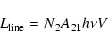
If the line originates in a downward transition from level 2 to 1 then,
the luminosity of the line L
 is given by:
 |
(1) |
where N is the number density of CI atoms in the
excited state 2,
A
is the number density of CI atoms in the
excited state 2,
A is the Einstein coefficient of spontaneous emission,
h
is the Einstein coefficient of spontaneous emission,
h is the energy of the emitted photon and V is the volume of the
emitting gas.
is the energy of the emitted photon and V is the volume of the
emitting gas.
From Eq. (1), it is seen that, the strength of any line will essentially
depend only on A
and N.
If the populations of the
upper level (N)
for the
different CI lines are temporarily assumed to be the same, then the line
strength depends basically only on A.
Knowing the transition
probabilities, we have computed the relative line strengths from Eq. (1).
We assume that the shape of each line can be reasonably represented by a
Gaussian whose FWHM has been chosen to be approximately 1500 km s-1 -
representative of the
observed linewidths in V445 Puppis. Co-addition of all the Gaussians -
corresponding to all the lines - yields a model spectrum which is shown
in Fig. 5 (labeled as model 1). The observed J-band spectrum of 1 Jan. 01,
in which the emission lines are most prominent, is also shown in the same
figure for comparison. A more accurate
calculation has taken into account the population of the upper levels
N
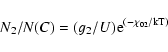
in calculating the relative line strengths. Assuming the
emitting gas to be in local thermal equilibrium, N
will be given
by a Boltzmann distribution viz.
 |
(2) |
where U is the partition function, T is the temperature of the gas,

 is the energy difference between the ground state
and level 2, g
is the statistical weight of the upper level
and N(C) is
the total number density of the carbon atoms. The energy level values for the
different states (to compute )
and g
values have
been taken from Kurucz's line list. The partition function values, for
different temperatures, have been taken from Allen (1976) and Aller (1963).
is the energy difference between the ground state
and level 2, g
is the statistical weight of the upper level
and N(C) is
the total number density of the carbon atoms. The energy level values for the
different states (to compute )
and g
values have
been taken from Kurucz's line list. The partition function values, for
different temperatures, have been taken from Allen (1976) and Aller (1963).
![\begin{figure}
\par\includegraphics[width=8.1cm,clip]{h4263f5.eps}
\end{figure}](/articles/aa/full/2003/39/aah4263/Timg21.gif) |
Figure 5:
Model spectra compared with the J-band spectra of
1 Jan. 01. Thedetails are available in the text of Sect. 3.2. |
| Open with DEXTER |
Nova shell ejecta have temperatures typically in the range 4000-5000 K
(Williams 1994). However we find that slightly higher temperatures reproduce the
observed spectra better.
In particular, the model spectrum computed for T = 8000 K (labeled as model 2)
isalso shown in Fig. 5. Changes in the adopted temperature do change the
relative strengthof the different lines, but marginally, and not in any
drastic fashion. However, the primary purpose of the simulated spectra
of Fig. 5 is only to secure the identification of the CI
lines. Figure 5 only shows graphically the expected positions of the CI lines and
gives a rough simulation of their expected strengths. As may be seen, all the
strong CI lines are reproduced, and to a large extent even the weaker lines.
Based on the results of Fig. 5, it would appear
reasonable to identify most of the observed lines in the J-band with CI.
The model spectra for H and K have also been computed but are
not shown here.
The model results for the H-band show the strongest CI line to be at
1.69
m which matches what is observed at that wavelength. A few
other lines between 1.7 to 1.8
m are predicted as well (weaker
than the
1.69
m line). Their positions have been marked in the H-band
spectra of Fig. 3 and these lines are also seen in our data. In the K-band
no line of any significant strength is predicted. This agrees with the rather
featureless K-band spectra that we observe (Fig. 4).
In Table 1, we have given the equivalent
widths for the emission features seen in the spectra
of 1 Jan. 01 where the lines are the
strongest. Since some of the features are blended, we have given
the combined equivalent width of the blend. In particular,
combined equivalent widths have been given in Table 1 for
features 3 to 5 and 6 to 10 which are blended. The reality of the
features can be judged by comparing their equivalent widths with
those of modulations in the continuum due to noise. The
equivalent width values for
such modulations are in the range of 3 to 7
 in the J and
H-band spectra. In comparison, on 1 March 2001, when the lines
were the weakest, the equivalent widths for the features which are
clearly discernible viz. 1, 2 , 3-5, 6-10, 11 and 12 are 25, 39, 102, 27, 22 and 41
respectively. The modulations
in the
continuum have similar equivalent widths as on 1 Jan. 01. In general,
the
H-band features are a little noisy except for the 1.689
m
line.
in the J and
H-band spectra. In comparison, on 1 March 2001, when the lines
were the weakest, the equivalent widths for the features which are
clearly discernible viz. 1, 2 , 3-5, 6-10, 11 and 12 are 25, 39, 102, 27, 22 and 41
respectively. The modulations
in the
continuum have similar equivalent widths as on 1 Jan. 01. In general,
the
H-band features are a little noisy except for the 1.689
m
line.
Table 1:
A list of the lines identified from the J and H spectra shown
in Figs. 2 and 3. Please refer to the text for greater details on the
equivalent widths listed below for 1 January 2001. (u.i = unidentified).
While it appears that CI is the main contributor to
the JHK spectra, it is possible that there is some contribution
from CII also. This is specially so because CII lines have been seen in
the optical spectra, as will be discussed shortly. We have
determined some of the stronger CII lines (based primarily on
their transition probabilities) in the JHK region from Kurucz's line list. It will need a detailed model - beyond the scope of
this work - to calculate the absolute strengths of these CII lines
vis-a-vis the CI lines. But their expected wavelength positions
should give some indication whether they are present in
the JHK spectra or not. The expected CII lines are found to lie at
wavelengths of 1.093, 1.144, 1.158, 1.674, 1.700 and 2.222
m. There is a line at 1.09
m which is
consistently seen in theobserved spectra - this could be due to CII. Of the
other CII lines the 1.144, 1.158 and 1.700
m lines may be present
in theobserved spectra. The 1.144 and 1.158
m CII lines could be lying onthe wings of the observed 1.133 and 1.165
m CI lines - giving these a slightly broader
appearance. Similarly, the expected 1.700
m CII
line may be blended with the 1.689
m CI line. Thus
there is someevidence for the presence of CII in the JHK spectra.
It must be mentioned that in an earlier IAU circular (Ashok
& Banerjee 2001) we had attributed some of the
CI lines reported here to CIII and CIV. This
was because some CIII and CIV lines do occur at similar
wavelengths as CI - e.g. as seen in the spectra of Wolf-Rayet
stars (Eenens et al. 1991). But some of these strong CIII and CIV
lines are not seen here. Furthermore, since lines from low-ionization
species have been definitely identified in the optical spectra of V445 Puppis, it is more consistent to attribute the observed
emission lines to CI (with some contribution from CII possibly),
rather than high-ionization species like CIII or CIV.
It may be seen from the JHK spectra that V445 Pup is
hydrogen-deficient. In the K-band there is no sign of the
Brackett gamma (Br )
line at 2.1656
m.
Similarly other Brackett series lines (Brackett 10 to 19) which
are commonly seen in the H-band in the spectra of classical
novae are missing. Paschen beta (Pa
)
line at 2.1656
m.
Similarly other Brackett series lines (Brackett 10 to 19) which
are commonly seen in the H-band in the spectra of classical
novae are missing. Paschen beta (Pa )
at 1.2818
m is also not present in the J-band spectrum. The
only possible indication for the presence of hydrogen is the 1.09
m line which coincides with Paschen gamma
(Pa). However, Pa
is expected to be weaker than Pa
which, in the present data, is completely absent.
Hence it is difficult to attribute this line to hydrogen Pa
and it is more likely to be due to CII as
discussed earlier.
)
at 1.2818
m is also not present in the J-band spectrum. The
only possible indication for the presence of hydrogen is the 1.09
m line which coincides with Paschen gamma
(Pa). However, Pa
is expected to be weaker than Pa
which, in the present data, is completely absent.
Hence it is difficult to attribute this line to hydrogen Pa
and it is more likely to be due to CII as
discussed earlier.
We do not find the signature of helium lines in the JHK spectra. However, the presence of He is more conclusively seen in
the optical spectra wherein several HeI lines are prominently seen
(Wagner et al. 2001c) while at the same time the
hydrogen deficiency is manifested by the weakness/absence of the
Balmer hydrogen lines. It is also important to note that many
carbon lines are also strongly seen in the optical spectra (Kamath
& Anupama 2002; Wagner's site at
http://vela.as.arizona.edu/~rmw/v445pup.html) at different
epochs after the outburst. In fact in a sample spectrum by M.
Fujii, Bisei Observatory, taken soon after the outburst, the
strongest optical line that is seen is the CII 6582
line
(http://www1.harenet.ne.jp/aikow/0113pnp.gif). The Fujii spectrum
also shows the presence of the HeI lines. Thus it would be fair to
qualitatively say that the IR and optical evidence indicate that
not only is V445 Puppis a hydrogen-deficient object but also that
it is rich in carbon and helium.
We briefly discuss the distance and reddening towards V445 Pup since these
parameters enter the photometric calculations described in the next
subsection. The distance to V445 Pup is poorly known. The only estimate for
the distance d is by Wagner (2001) who gives an upper limit of 3 kpc
based on the
strength of an interstellar absorption line at 5780
(http://vela.as.arizona.edu/~rmw/v445pup.html). For such an adopted upper
limit for d, the
extinction maps by Neckel et al. (1980) give a value of
 in the
direction of V445 Puppis. This value is derived by converting Neckel et al.'s
(1980) values of AV using the relation
A V = 3.1 E(B-V) (Koornneef 1983).
As an additional confirmation for E(B-V), we also
used UBV photometric data for 110 stars by Wooden (1970) in an
approximately
in the
direction of V445 Puppis. This value is derived by converting Neckel et al.'s
(1980) values of AV using the relation
A V = 3.1 E(B-V) (Koornneef 1983).
As an additional confirmation for E(B-V), we also
used UBV photometric data for 110 stars by Wooden (1970) in an
approximately  degree field around V445 Puppis. Since the spectral
type is known, and hence the intrinsic (B-V)
degree field around V445 Puppis. Since the spectral
type is known, and hence the intrinsic (B-V) color, the
excess color E(B-V) can be found from the observed (B-V) color.
AV can hence be found. The distance can then be determined by the
standard relation
mV - MV = 5log d - 5 + AV. The values
for the
intrinsic (B-V)
colors and absolute magnitudes, for
different spectral types, were taken
from Lang (1991) and Allen (1976). We have plotted in Fig. 6 the AVversus
distance relation based on the Wooden (1970) data. Since
a
degree
field is rather large and extinction can vary considerably along any line of
sight in it, we have also shown in Fig. 6 the extinction for stars within a
smaller, 1 degree field of V445 Puppis. Based on the results of
Fig. 6 and also on the Neckel et al. (1980) data, we feel it reasonable to
adopt a value of
E(B-V) = 0.25 for V445 Puppis, unless the distance to it
is much greater than 3 kpc. It may be noted, that the extinction in this
direction is generally low.
color, the
excess color E(B-V) can be found from the observed (B-V) color.
AV can hence be found. The distance can then be determined by the
standard relation
mV - MV = 5log d - 5 + AV. The values
for the
intrinsic (B-V)
colors and absolute magnitudes, for
different spectral types, were taken
from Lang (1991) and Allen (1976). We have plotted in Fig. 6 the AVversus
distance relation based on the Wooden (1970) data. Since
a
degree
field is rather large and extinction can vary considerably along any line of
sight in it, we have also shown in Fig. 6 the extinction for stars within a
smaller, 1 degree field of V445 Puppis. Based on the results of
Fig. 6 and also on the Neckel et al. (1980) data, we feel it reasonable to
adopt a value of
E(B-V) = 0.25 for V445 Puppis, unless the distance to it
is much greater than 3 kpc. It may be noted, that the extinction in this
direction is generally low.
![\begin{figure}
\par\includegraphics[width=8cm,clip]{h4263f6.eps}
\end{figure}](/articles/aa/full/2003/39/aah4263/Timg28.gif) |
Figure 6:
An AV versus distance plot for stars in a
degree
field around V445 Puppis based on data from Wooden (1970). The stars within
a smaller, 1 degree field of V445 Puppis are plotted by
filled circles, the other stars by empty circles. |
| Open with DEXTER |
The details and results of the photometry are given in Table 2.
The JHK magnitudes listed are the observed magnitudes.
We have used Koornneef's (1983) relations viz.
AV = 3.1 E(B-V),
A J = 0.265 A V,
AH = 0.155 AV and
AK = 0.090 AV to correct for interstellar
extinction.
Absolute flux calibration was done by adopting zero magnitude
fluxes from Koornneef (1983).
Table 2:
JHK photometry of V445 Puppis.
We have plotted the spectral energy distribution (SED) of V445 Puppis for
2 Jan. 01, aftercorrecting for
E(B-V) = 0.25,
in the upper panel of Fig. 7. In this figure
the JHK fluxes are from the
present work
whereas the UBVR values are taken from Gilmore (2001). It may be
noted that Gilmore's (2001) observations are for Jan. 6.58 UT, 2001 and
slightly separated in
time from our 2 Jan. 01 JHK observations. However, since both sets of
observations are almost simultaneous, no significant error is expected to
be introduced in the results of Fig. 7. This is especially so, since as seen
from the light curve of Fig. 1, V445 Puppis was not showing strong photometric
changes around this time.
The SED of 2 Jan. 01 could not be fit by a single
black-body curve as it shows a significant IR excess. Accordingly it has been
fit
by a 7500 K black-body component (corresponding to V455 Puppis proper) and a
cooler component of temperature 1800 K. The cooler component arises from dust
that has formed around V445 Puppis. The presence of dust could give an
additional extinction apart from the interstellar extinction corresponding to
the adopted value of
E(B-V) = 0.25. In view of this we have calculated
various combinations of the SED that result for variations of E(B-V) from 0.25 to 0.5; the hot blackbody component from 6000 to 12 000 K
and the cool blackbody component (dust) from 1200-2200 K. We find
that
still continues to give an optimal fit to
the data,
indicating that there is no significant extinction from the dust.
We also find that almost equally good fits to the data
are found for a hot component temperature in the range
7500-8500 K combined with dust temperature in the range 1750-1850 K.
We believe a dust temperature of 1800 K is fairly representative
of the observed data and
adopt this value for subsequent calculations for the mass of the
dust shell.
![\begin{figure}
\par\includegraphics[width=8.8cm,clip]{h4263f7.eps}
\end{figure}](/articles/aa/full/2003/39/aah4263/Timg33.gif) |
Figure 7:
The post-outburst energy distribution of V445 Puppis
on 2 Jan. 01 is shown in the top panel. It has been matched by the
sum of 2 black-body
curves - one at 7500 K and the other for a dust component at 1800 K. The bottom
panel shows the pre-outburst flux distribution based on 2MASS data. A 6500 K
black-body fit is shown to this and also the expected distribution from an
accretion disk following a
 relation.
For greater details see text.
relation.
For greater details see text. |
| Open with DEXTER |
Lynch et al. (2001) have also found evidence for the presence of dust
from their 3-14
m LMN band spectroscopy of 31 January 2001.
However, they conclude that the dust most likely existed before the
outburst ratherthan having been created post-outburst. The premise for
this inference is that
dust could not have formed so early after the outburst. But, as mentioned
earlier in Sect. 3.1, Lynch et al. (2001) have placed the outburst date a month
later than what we believe to be correct. In classical novae, the time scale
for dust to form is typically 50-70 days after outburst (Gehrz 1988).
However there are cases like V838 Her
(Chandrasekhar et al. 1992 and references therein) when dust formed as
early as eight
days after outburst. In the case of V445 Puppis, we feel that sufficient time
after the outburst may have elapsed for dust to form and that the dust
that is
seen here has been created post-outburst. This view is bolstered by looking
at the pre-outburst SED of V445 Puppis shown in the lower panel of Fig. 7.
Here, the pre-outburst fluxes are given by the filled circles which are
derived from the B and R magnitudes (from the USNO A2.0 database) and the JHK magnitudes from the 2MASS survey. As may be noted
there is no sign of a pronounced IR excess in the pre-outburst SED of V445 Puppis. Discussion of the other plots in the lower panel of Fig. 7 is
deferred to Sect. 4.
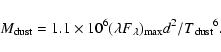
The mass of the dust shell can be inferred from the infrared excess that is
seen in the data of 2 Jan. 01. Following Woodward et al. (1993),
the mass of the dust shell (in units of M )
is given by
)
is given by
 |
(3) |
In the above equation,
 is the black-body temperature of the
dust in units of
is the black-body temperature of the
dust in units of
 K, d is the distance to the object in kpc and
 is the flux, in W cm
 ,
measured at the peak of the SED for the
dust. Equation (3) assumes the dust is composed of carbon particles of size
,
measured at the peak of the SED for the
dust. Equation (3) assumes the dust is composed of carbon particles of size
 1
m and having a density 2.25 gm/cm
1
m and having a density 2.25 gm/cm
 .
The assumption that the dust is made of carbon particles may be quite
valid in the case of V445 Puppis because of the strong presence of carbon
in the optical/IR spectra. Further, the mid-IR spectra of
Lynch et al. (2001) show a featureless continuum which is generally
attributable to dust in the form of carbon/graphite.
From the data for 2 Jan. 01 we get
.
The assumption that the dust is made of carbon particles may be quite
valid in the case of V445 Puppis because of the strong presence of carbon
in the optical/IR spectra. Further, the mid-IR spectra of
Lynch et al. (2001) show a featureless continuum which is generally
attributable to dust in the form of carbon/graphite.
From the data for 2 Jan. 01 we get
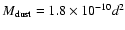 for
for
 K and
K and
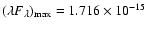 W cm
.
For a maximum
value of d = 3 kpc, the upper limit of the mass of the dust shell is
found to be
W cm
.
For a maximum
value of d = 3 kpc, the upper limit of the mass of the dust shell is
found to be
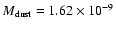 M.
M.
Regarding the photometric data for 1 Nov. 01, an accurate estimate could not
be made of the K-band magnitude because of inadequate S/N in the images.
However the object is clearly seen in the K-band, and also in the H-band,
whereas it is not visible in the J-band images. This
can be seen from Fig. 8 showing the J and H-band images (which have
lost a little in reproduction). The position of V445 Pup is circled.
Due to its absence in the J-band, only a lower limit could be put
for the J magnitude by
comparing the faintest, detected star in our J image with its corresponding
2MASS J magnitude. The limiting magnitude of the J-band
image of 1 Nov. 2001 is 15.5. Our JHK images/magnitudes confirm that
the object was shrouded in thick dust shell by then.
A similar conclusion was drawn earlier by Henden et al. (2001) based on
observations of September-October 01. Henden et al. (2001) find that the
star is not detectable in the V and I-bands down to limiting magnitudes of 20 and 19.5
respectively - in the K'-band
the reported magnitude is 9.15. The light curve of Fig. 1 also shows the
steep decline in brightness, at around this time, indicating the
onset of a heavy dust formation phase.
![\begin{figure}
\par\includegraphics[width=8.6cm,clip]{h4263f8.eps}
\end{figure}](/articles/aa/full/2003/39/aah4263/Timg46.gif) |
Figure 8:
J and H-band images ( arcmin) of V445 Puppis of
1 Nov. 2001. The object, which is circled in the H-band image, is not seen
in the J-band. North is on the top and East is to the right. arcmin) of V445 Puppis of
1 Nov. 2001. The object, which is circled in the H-band image, is not seen
in the J-band. North is on the top and East is to the right. |
| Open with DEXTER |
The nature of V445 Puppis is rather enigmatic. Among eruptive variables that
show similar outbursts, one may first consider novae. V445 Puppis
differs from a classical nova in the amplitude of its outburst
and also the deficiency of hydrogen in its
spectrum. The strong presence of a large number of carbon lines in the IR spectra is again unusual for a nova. Further, novae are known to evolve with
time towards higher
temperatures which characterize the nebular and coronal phases. Such
behavior is not seen here. It also does not appear to be a recurrent nova
because no earlier outbursts have been recorded or reported.
In a symbiotic nova, one expects to see
high-excitation emission lines in the spectrum during the decline
phase - a feature which
is absent here (Kenyon 1986). Also, the light curves of symbiotic novae
decline much slower than what is observed in V445 Puppis. Most importantly,
hydrogen deficiency is not expected in recurrent or symbiotic novae.
Another possibility is that V445 Puppis is a
born-again AGB star. The nuclei of intermediate mass stars, evolving from
the AGB stage into planetary nebulae can experience a final
helium shell flash which lifts them into a high luminosity range again
(Iben et al. 1983). There are only 3 known examples of born-again AGB's
in the Galaxy viz. V605 Aql, FG Sge and
Sakurai's object. However there are a few arguments against V445 Puppis
being a born-again AGB. First, no nebulosity (caused by gas ionized by
the hot nuclei) has been seen around the object as has been found in the
other known cases. We have checked one of the H surveys covering
this region (Schwartz 1990) but the object is not listed as showing
signs of emission. Again, born-again AGB's - unlike
V445 Puppis - brighten very gradually to their peak brightness - a process
which can even take decades. For the actual timescales observed,
the reader may refer to Duerbeck et al. (2000) for Sakurai's object,
Harrison (1996) for V605 Aql and Fig. 1 of Blocker & Schonberner (1997)
for FG Sge.
surveys covering
this region (Schwartz 1990) but the object is not listed as showing
signs of emission. Again, born-again AGB's - unlike
V445 Puppis - brighten very gradually to their peak brightness - a process
which can even take decades. For the actual timescales observed,
the reader may refer to Duerbeck et al. (2000) for Sakurai's object,
Harrison (1996) for V605 Aql and Fig. 1 of Blocker & Schonberner (1997)
for FG Sge.
There is a class of eruptive variables whose spectrum after the outburst
evolves into that of a cool M-type giant or supergiant. This spectral
evolution takes place rather rapidly - within a time of 1 to 2 months.
The first such object in this class is a luminous, red variable star
(M 31 RV) that erupted in M 31 (Rich
et al. 1989; Mould et al. 1990). Subsequently the eruptive variable V4332 Sgr
(Martini et al. 1999) and most recently V838 Mon (Banerjee & Ashok 2002a;
Munari et al. 2002) have been added to this
class. A consensus has not been reached on placing these objects in the same
category but what is certain is that after a nova-like outburst they quickly
evolve to a very cool M type (or even later type) absorption spectrum.
V838 Mon has, in fact, evolved at present to be similar to that of a
T type brown dwarf
(Banerjee & Ashok 2002b; Geballe et al. 2002). In the case of
V445 Puppis,
there is VSNET photometric data in the BVRI-bands for
more than 5 months after its outburst. We have checked these colors
and do not find an evolutionary trend towards M-type
giant/supergiant stage. For example on 2001, March 30.48 (more than 4 months
after the outburst) the observed magnitudes are
B = 10.66 and V = 10.13. For an adopted value of
E(B-V) = 0.25,
this results into an intrinsic (B-V) color of 0.29 which is very different
from 1.6 which is the expected value for a cool M giant/supergiant
star. Thus V445 Puppis does not appear to show an evolutionary trend
similar to the V838 Mon class of objects.
V445 Puppis also does not appear to be an RCB or hydrogen deficient carbon
star (HdC). RCB stars show episodic dimming due to ejection of dusty
carbon shells, subsequently followed by a rebrightening. But their spectra
are typically F type absorption spectra and
most of them are detected in IRAS and show an IR excess. V445 Puppis was
not detected previously by IRAS. Furthermore, no other outbursts
have been recorded for V445 Puppis. HdC stars share most of the
properties of RCB stars except that they do not show large
brightness
variations. Both groups of objects have absolute magnitudes MV in the range -3 to -5 (Brunner et al. 1998). Unless the extinction AV and distance d to V445 Puppis are grossly underestimated,
 .
This is inferred from
.
This is inferred from
 using adopted values of
 ,
an upper limit for d = 3 kpc and the pre-outburst magnitude value of
mV = 13.6. The object appears under luminous for an RCB star.
,
an upper limit for d = 3 kpc and the pre-outburst magnitude value of
mV = 13.6. The object appears under luminous for an RCB star.
The possibility that V445 Puppis is not a single star - but part of a binary
system with an accretion disk - has some supporting evidence. First,
the SED of the star in the pre-outburst stage (Fig. 7, lower panel)
is difficult to fit
with a black-body spectrum. We have tried several black-body fits
at different temperatures to the observed SED. While fitting, the observed
SED has itself been modified by choosing different E(B-V) values in case the
adopted value of
E(B-V) = 0.25 is grossly incorrect. However a good fit
is notfound and the closest fit to the data (T = 6500 K,
E(B-V) = 0.25)
is not satisfactory as can be seen from Fig. 7 (lower panel). It is
possible that
the observed continuum distribution from V445 Puppis is dominated by radiation
from an accretion disk surrounding the object. In the case of a steady-state
accretion disk around a white-dwarf, the continuum
radiation from the disk can be described by an
relation
(Mayo et al. 1980 and references therein).
A
dependence
falls off less steeply than the
 relation expected for a black-body in the Rayleigh-Jeans regime. We find
that such an
accretion disk spectrum fits the data of Fig. 7 much better than a black-body
fit.
relation expected for a black-body in the Rayleigh-Jeans regime. We find
that such an
accretion disk spectrum fits the data of Fig. 7 much better than a black-body
fit.
The radio data from Rupen et al. (2001a,b and their website
http://www.aoc.nrao.edu/mrupen/XRT/V445Pup) also
suggest the possibility of an accretion process in a binary system.
They state that theobserved synchrotron emission probably originates
either
in accretion onto a compact companion or in an asymmetric, clumpy shock at
the boundary between ejecta from a fresh outburst in September 2001 and
previous ejecta (the fresh outburst would be obscured by the thick dust
shell which had formed around this time). But they argue that the rapid
evolution of both the radio emission and the radio absorption - significant
flaring is seen in the object - favors the presence of an accretion process.
However, it must be pointed out, there is a lacuna in comparing the
observed radio emission with radiation from an accretion disk with
a
 spectra as discussed above. The latter does not constitute a
non-thermal source like the observed radio emission. But the present
radio detection was made well after the outburst. It may just be possible
that the physical conditions/mechanisms of the accretion process are different
in the pre- and post-outburst stages leading to a qualitative difference in
the radiation emitted. We are unable to judge on this aspect. The primary
aim of the present work was to look for any evidence - however
slight -
which would show whether V445 Puppis belongs to a binary system or not. Given
the strangeness of the object, this would help understand its nature. We feel
that the recent radio data and the pre-outburst SED seem to indicate a
binary nature for V445 Puppis.
spectra as discussed above. The latter does not constitute a
non-thermal source like the observed radio emission. But the present
radio detection was made well after the outburst. It may just be possible
that the physical conditions/mechanisms of the accretion process are different
in the pre- and post-outburst stages leading to a qualitative difference in
the radiation emitted. We are unable to judge on this aspect. The primary
aim of the present work was to look for any evidence - however
slight -
which would show whether V445 Puppis belongs to a binary system or not. Given
the strangeness of the object, this would help understand its nature. We feel
that the recent radio data and the pre-outburst SED seem to indicate a
binary nature for V445 Puppis.
From the arguments given above, we find that it is
difficult to place V445 Puppis into known categories of eruptive
variables. Kato et al. (1989) and Iben & Tutukov (1994), among other
workers, have investigated the case of Helium novae. Kato et al. (1989)
consider the case of a degenerate white dwarf accreting helium from its
helium-rich companion. For
appropriate mass accretion rates, an accretion-induced collapse of the white
dwarf into a neutron star need not occur. Instead a thermo-nuclear reaction
can occur on the surface of the white dwarf leading to a Helium nova outburst.
The ejecta of such an outburst, in the Kato et al. (1989) model, should
presumably be rich in helium and carbon and highly
hydrogen-deficient. This is based on the
assumed, pre-ignition, chemical composition of the envelope by mass, viz
X = 0, Y = 0.97 and Z = 0.03. Further, carbon in the ejecta is
expected to be additionally enhanced because the thermonuclear outburst
process itself converts helium to carbon. Such a scenario, or some close
variant of it, may apply to V445 Puppis and explain the hydrogen deficiency
(and He/C enrichment) of its optical and IR spectra. The tentative evidence
for binarity and accretion disk in V445 Puppis is also in conformity
with the requirements of
a Helium nova scenario. However, the predicted luminosity of the outburst
in a Helium nova is
 L
(Kato et al. 1989)
and X-rays are also predicted in
the post-outburst stage (Iben & Tutukov 1994). In the case of V445 Puppis,
there are no
reports on X-ray detection from the object, though it is uncertain whether
any attempt has been made in this direction. Further the thick dust
shell may attenuate any soft X-ray emission that takes place. The
outburst luminosity, if
approximated from the SED of 2 Jan. 01 (Fig. 7), is found to be closer to
L
(Kato et al. 1989)
and X-rays are also predicted in
the post-outburst stage (Iben & Tutukov 1994). In the case of V445 Puppis,
there are no
reports on X-ray detection from the object, though it is uncertain whether
any attempt has been made in this direction. Further the thick dust
shell may attenuate any soft X-ray emission that takes place. The
outburst luminosity, if
approximated from the SED of 2 Jan. 01 (Fig. 7), is found to be closer to
 L
i.e. slightly less than the theoretical estimate.
In view of this, it may be slightly speculative to identify V445 Puppis
as a Helium nova, but similarities exist. Given the interesting and
unique properties of the object, it is hoped that this work will prompt a
rigorous, theoretical study to explain the nature of V445 Puppis.
L
i.e. slightly less than the theoretical estimate.
In view of this, it may be slightly speculative to identify V445 Puppis
as a Helium nova, but similarities exist. Given the interesting and
unique properties of the object, it is hoped that this work will prompt a
rigorous, theoretical study to explain the nature of V445 Puppis.
Acknowledgements
The research work at Physical Research Laboratory is funded by
the Department of Space, Government of India. We thank A.Tej for help in
obtaining observations. We thank R. M. Wagner, the referee, for useful
and constructive comments that have helped improve the paper.
This work has made use of
data available from 2MASS data center and also from data/information
available at the following websites viz.
http://kurucz.harvard.edu/linelists.html;
http://vela.as.arizona.edu/~rmw/v445pup.html;
http://www.kusastro.kyoto-u.ac.jp.vsnet,
http://www.aoc.nrao.edu/~mrupen/XRT/V445Pup and
http://www1.harenet.ne.jp/~aikow/0113pnp.gif
-
Allen, C. W. 1976, Astrophysical Quantities
(London and Dover: Athlone Press)
In the text
-
Aller, L. H. 1963, The Atmospheres of the Sun and Stars
(New York: Ronald Press)
In the text
-
Ashok, N. M., & Banerjee, D. P. K.
2001, IAU Circ., 7559
In the text
-
Banerjee, D. P. K., & Ashok, N. M.
2002a, A&A, 395, 161
In the text
NASA ADS
-
Banerjee, D. P. K., & Ashok, N. M.
2002b, IAU Circ., 8036
-
Blocker, T., & Schonberner, D.
1997, A&A, 324, 991
In the text
NASA ADS
-
Brunner, A. R., Clayton, G. C., & Ayres, T. R.
1998, PASP, 110, 1412
In the text
NASA ADS
-
Chandrasekhar, T., Ashok, N. M., & Ragland, S.
1992, MNRAS, 255, 412
In the text
NASA ADS
-
Duerbeck, H. W., Liller, W., Sterken, C., et al.
2000, AJ, 119, 2360
In the text
NASA ADS
-
Eenens, P. R. J., Williams, P. M., & Wade, R.
1991, MNRAS, 252, 300
In the text
NASA ADS
-
Fujii, M.
2001, IAU Circ., 7556
In the text
-
Geballe, T. R., Smalley, B., Evans, A., & Rushton, M. T.
2002, IAU Circ., 8016
In the text
-
Gehrz, R. D.
1988, ARA&A, 26, 377
In the text
NASA ADS
-
Gilmore, A. C.
2001, IAU Circ., 7559
In the text
-
Harrison, T. E.
1996, PASP, 108, 1112
In the text
NASA ADS
-
Henden, A. A., Wagner, R. M., & Starrfield, S. G.
2001, IAU Circ., 7730
In the text
-
Hunt, L. K., Manucci, F., Testi, L., et al.
1998, AJ, 115, 2594
In the text
NASA ADS
-
Iben, I. Jr., Kaler, J. B., Truran, J. W., & Renzini, A.
1983, ApJ, 264, 605
In the text
NASA ADS
-
Iben, I. Jr., & Tutukov, A. V.
1994, ApJ, 431, 264
In the text
NASA ADS
-
Johansson, L., & Litzen, U.
1965, Ark. for Fysik Band 29, 13, 165
In the text
-
Johansson, L.
1966, Ark. for Fysik Band 31, 15, 201
In the text
-
Kamath, U. S., & Anupama, G. S.
1992, BASI, 30, 679
NASA ADS
-
Kenyon, S. J. 1976, The Symbiotic Stars
(Cambridge, UK: Cambridge Univ. Press)
-
Koornneef, J.
1983, A&A, 128, 84
In the text
NASA ADS
-
Kato, M., Saio, H., & Hachisu, I.
1989, ApJ, 340, 509
In the text
NASA ADS
-
Kato, T., & Kanatsu, K.
2002, IAU Circ., 7552
-
Lang, K. R. 1991, Astrophysical data: Planets and Stars
(New York: Springer-Verlag)
In the text
-
Liller, W.
2001a, IAU Circ., 7556
In the text
-
Liller, W.
2001b, IAU Circ., 7561
-
Lynch, D. K., Russel, R. W., & Sitko, M. L.
2001, AJ, 122, 3313
In the text
NASA ADS
-
Martini, P., Wagner, R., Tomaney, A., et al.
1999, AJ, 118, 1034
In the text
NASA ADS
-
Mayo, S. K., Wickramasinghe, D. T., & Whelan, J. A. J.
1980, MNRAS, 193 793
In the text
NASA ADS
-
Mould, J., Cohen, J., Graham, J. R., et al.
1990, ApJ, 353, L35
In the text
NASA ADS
-
Munari, U., Henden, A., Kiyota, S., et al.
2002a, A&A, 389, L51
In the text
NASA ADS
-
Neckel, Th., Klare, G., & Sarcander, M.
1980, A&AS, 42, 251
In the text
NASA ADS
-
Platais, I., Kozhurina-Platais, V., & Zacharias, M. I., et al.
2002, IAU Circ., 7556
-
Rich, R. M., Mould, J., Picard, A., Frogel, J. A., & Davies, R.
1989, ApJ, 341, L51
In the text
NASA ADS
-
Rupen, M. P., Dhawan, V., & Mioduszewski, A.
2001a, IAU Circ., 7717
In the text
-
Rupen, M. P., Dhawan, V., & Mioduszewski, A.
2001b, IAU Circ., 7728
-
Schwartz, R. D., Persson, S. E., & Hamann, F. W.
1990, AJ, 100, 793
In the text
NASA ADS
-
Seaquist, E. R.
1989, in Classical Novae, ed. M. F. Bode,
& A. Evans (Oxford: John Wiley)
In the text
-
Shemmer, O., Leibowitz, E., & Dan, J.
2001, IAU Circ., 7556
In the text
-
Wagner, R. M., Foltz, C. B., & Starrfield, S. G.
2001a, IAU Circ., 7556
In the text
-
Wagner, R. M., Schwarz, G., & Starrfield, S. G.
2001b, IAU Circ., 7571
-
Wagner, R. M., Schwarz, G., & Starrfield, S. G.
2001c, IAU Circ., 7717
-
Williams, R. E.
1994, ApJ, 426, 279
In the text
NASA ADS
-
Wooden, W. H. II.
1970, AJ, 75, 324
In the text
NASA ADS
-
Woodward, C. E., Lawrence, G. F., Gehrz, R. D., et al.
1993, ApJ, 408, L37
In the text
NASA ADS
Copyright ESO 2003
![\begin{figure}
\par\includegraphics[width=16.4cm,clip]{h4263f1.eps}
\end{figure}](/articles/aa/full/2003/39/aah4263/img7.gif)
![\begin{figure}
\par\includegraphics[width=8.1cm,clip]{h4263f2.eps}
\end{figure}](/articles/aa/full/2003/39/aah4263/img10.gif)
![\begin{figure}
\par\includegraphics[width=7.9cm,clip]{h4263f3.eps}
\end{figure}](/articles/aa/full/2003/39/aah4263/img11.gif)
![\begin{figure}
\par\includegraphics[width=8.1cm,clip]{h4263f4.eps}
\end{figure}](/articles/aa/full/2003/39/aah4263/img12.gif)
![\begin{figure}
\par\includegraphics[width=8.1cm,clip]{h4263f5.eps}
\end{figure}](/articles/aa/full/2003/39/aah4263/img21.gif)
![\begin{figure}
\par\includegraphics[width=8cm,clip]{h4263f6.eps}
\end{figure}](/articles/aa/full/2003/39/aah4263/img28.gif)
![\begin{figure}
\par\includegraphics[width=8.8cm,clip]{h4263f7.eps}
\end{figure}](/articles/aa/full/2003/39/aah4263/img33.gif)
![\begin{figure}
\par\includegraphics[width=8.6cm,clip]{h4263f8.eps}
\end{figure}](/articles/aa/full/2003/39/aah4263/img46.gif)