![[*]](/icons/foot_motif.gif)
A&A 409, 169-192 (2003)
DOI: 10.1051/0004-6361:20030938
J. Bouvier1 - K. N. Grankin2 - S. H. P. Alencar3 - C. Dougados1 - M. Fernández4 - G. Basri5 - C. Batalha6 - E. Guenther7 - M. A. Ibrahimov2 - T. Y. Magakian8 - S. Y. Melnikov2 - P. P. Petrov9 - M. V. Rud10 - M. R. Zapatero Osorio11
1 - Laboratoire d'Astrophysique, Observatoire de Grenoble, Université Joseph Fourier,
BP 53, 38041 Grenoble Cedex 9, France
2 -
Astronomical Institute of the Academy of Sciences of Uzbekistan, Astronomicheskaya 33,
Tashkent 700052, Uzbekistan
3 -
Departamento de Física - ICEx - UFMG,
Caixa Postal 702, 30161-970, Belo Horizonte, Brasil
4 -
Instituto de Astrofísica de Andalucía, CSIC, Apdo. 3004, 18080 Granada, Spain
5 -
Department of Astronomy, University of California at Berkeley, 601 Campbell Hall
3411, Berkeley, CA 94720, USA
6 -
Observatório Nacional/CNPq, Rua General José Cristino 77, Rio de Janeiro, RJ
20920-400, Brazil
7 -
Thüringer Landessternwarte Tautenburg, Karl-Schwarzschild-Observatorium, Sternwarte 5,
07778 Tautenburg, Germany
8 -
Byurakan Astrophysical Observatory, Aragatsotn prov., 378433 Armenia
9 -
Crimean Astrophysical Observatory and Isaac Newton Institute of Chile, Crimean Branch,
p/o Nauchny, Crimea 98409, Ukraine
10 -
Fessenkov Astrophysical Institute, 480068 Almaty, Kazakstan
11 -
LAEFF-INTA, PO Box 50727, 28080 Madrid, Spain
Received 14 May 2003 / Accepted 18 June 2003
Abstract
We report the results of a synoptic study of the photometric
and spectroscopic variability of the classical T Tauri star AA Tau on
timescales ranging from a few hours to several weeks. The AA Tau
light curve had been previously shown to vary with a 8.2 d period,
exhibiting a roughly constant brightness level, interrupted by
quasi-cyclic fading episodes, which we interpreted as recurrent
eclipses of the central star by the warped inner edge of its accretion
disk (Bouvier et al. 1999). Our observations show the system is
dynamic and presents non-stationary variability both in the photometry
and spectroscopy.
The star exhibits strong emission lines that show
substantial variety and variability in their profile shapes and
fluxes. Emission lines such as H and H
and H show both infall and
outflow signatures and are well reproduced by magnetospheric accretion
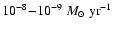
models with moderate mass accretion rates (
show both infall and
outflow signatures and are well reproduced by magnetospheric accretion
models with moderate mass accretion rates (
 )
and high inclinations (
)
and high inclinations (
 ).
The veiling shows variations that indicate the presence of 2 rotationally modulated hot spots corresponding to the two
magnetosphere poles. It correlates well with the He I line flux, with
B-V and the V excess flux. We have indications of a time delay between
the main emission lines (H,
H
and He I) and veiling, the
lines formed farther away preceding the veiling changes. The time
delay we measure is consistent with accreted material propagating
downwards the accretion columns at free fall velocity from a distance
of about 8
).
The veiling shows variations that indicate the presence of 2 rotationally modulated hot spots corresponding to the two
magnetosphere poles. It correlates well with the He I line flux, with
B-V and the V excess flux. We have indications of a time delay between
the main emission lines (H,
H
and He I) and veiling, the
lines formed farther away preceding the veiling changes. The time
delay we measure is consistent with accreted material propagating
downwards the accretion columns at free fall velocity from a distance
of about 8  .
In addition, we report periodic radial
velocity variations of the photospheric spectrum which might point
to the existence of a 0.02
.
In addition, we report periodic radial
velocity variations of the photospheric spectrum which might point
to the existence of a 0.02  object orbiting the star at a
distance of 0.08 AU.
object orbiting the star at a
distance of 0.08 AU.
During a few days, the eclipses
disappeared, the variability of the system was strongly reduced and
the line fluxes and veiling severely depressed. We argue that this
episode of quiescence corresponds to the temporary disruption of the
magnetic configuration at the disk inner edge. The smooth radial
velocity variations of inflow and outflow diagnostics in the H
profile yield further evidence for large scale variations of the
magnetic configuration on a timescale of a month. These results may
provide the first clear evidence for large scale instabilities
developping in T Tauri magnetospheres as the magnetic field lines
are twisted by differential rotation between the star and the inner
disk. The interaction between the inner accretion disk and the
stellar magnetosphere thus appears to be a highly dynamical and time
dependent process.
Key words: accretion, accretion disks - stars: pre-main sequence - stars: magnetic fields - stars: individual: AA Tau
T Tauri stars are low-mass stars with an age of a few million years at most, still contracting down their Hayashi tracks towards the main sequence. They are classified in two groups, the weak-line T Tauri stars (WTTS) which merely exhibit enhanced solar-type activity and the classical T Tauri stars (CTTS) which actively accrete material from a circumstellar disk (see, e.g., Ménard & Bertout 1999). Understanding the accretion process in young solar type stars, as well as the associated mass loss phenomenon, is one of the major goals in the study of T Tauri stars. Indeed, accretion has a significant and long lasting impact on the evolution of low mass stars by providing both mass and angular momentum, and the evolution and fate of circumstellar accretion disks around young stars has become an increasingly important issue since the discovery of extrasolar planets and planetary systems with unexpected properties. Deriving the properties of young stellar systems, of their associated disks and outflows is therefore an important step towards the establishment of plausible scenarios for star and planet formation.
Early models assumed that the accretion disk of CTTS extended all the
way down to the star.
However, the recognition that young stars have strong surface magnetic
fields of order of 1-3 kG (Johns-Krull et al. 1999, 2001; Guenther et al. 1999; Smith et al. 2003) raised the issue of the impact an
extended stellar magnetosphere might have on the structure of the
inner disk.
Assuming that the main component of the stellar magnetosphere on the
large scale is a dipole, Königl (1991) showed that, for typical mass
accretion rates in the disk (10-9 to 10-7 yr-1; Basri &
Bertout 1989; Hartigan et al. 1995; Gullbring et al. 1998), the
magnetic torque exerted by the field lines onto the gaseous disk was
comparable to the viscous torque due to turbulence in the disk at a
few stellar radii (see also Camenzind 1990). Hence, the inner disk is
expected to be truncated by the magnetosphere at a distance of a few
stellar radii above the stellar surface. From there, material is
channelled onto the star along the magnetic field lines, thus giving
rise to magnetospheric accretion columns filled with hot plasma. As
the accreted material in the funnel flow eventually hits the stellar
surface at free fall velocity, strong accretion shocks develop near
the magnetic poles.
Observational support for these predictions of the magnetospheric accretion
scenario in CTTS has been accumulating over the last decade (see Bouvier et al. 2003 for a recent review). Magnetospheric cavities with
inner radii in the range 3-8
are called for to account for the
near-IR properties of CTTS systems (Bertout et al. 1988; Meyer et al.
1997). Inverse P Cygni profiles observed in the Balmer and Pashen line
profiles of CTTS, with redshifted absorption components reaching velocities
of several hundred km s-1, point to hot gas free falling onto the star from
a distance of a few stellar radii (Edwards et al. 1994; Folha & Emerson
2001). Magnetospheric accretion models have indeed been successful in
reproducing the main characteristics of the emission line profiles of some CTTS, which suggest that at least part of the line emission arises in
accretion columns (Hartmann et al. 1994; Muzerolle et al. 2001). Finally,
hot spots covering about 1% of the stellar surface are thought to be
responsible for the rotational modulation of CTTS luminosity (Bouvier &
Bertout 1989; Vrba et al. 1993) and are identified with the accretion
shocks expected to develop near the magnetic poles in the magnetospheric
accretion scenario.
The observational evidence for magnetically channelled accretion in CTTS has led to the development of steady-state axisymmetric MHD models which describe the interaction between the inner disk and a stellar dipole. These models provide a framework to understand the physical connection between accretion and mass loss in CTTS, with the open magnetic field lines threading the disk carrying away part of the accretion flow while the remaining part is channelled onto the star (e.g. Shu et al. 1994; Ferreira 1997). Synoptic studies of a few CTTS systems have revealed correlated time variability of the inflow and outflow diagnostics, both being modulated on a rotation timescale. This has been interpreted as evidence for an inclined stellar magnetosphere disrupting the inner disk (Johns & Basri 1995a; Petrov et al. 1996; Oliveira et al. 2000; Petrov et al. 2001).
Magnetically mediated accretion in CTTS is presumably more complex and possibly much more time variable than depicted by axisymmetric, steady-state MHD models. Expanding upon earlier models (Aly & Kuijpers 1990; van Ballegooijen 1994; Lynden-Bell & Boily 1994), recent numerical simulations of the disk/magnetosphere interaction suggest that the magnetic field lines that connect the star to the disk can be substantially deformed by differential rotation on short timescales. One class of models thus predict that differential rotation between the footpoints of the field lines, one being anchored into the star the other into the disk, leads to field line expansion, opening and reconnection which eventually restores the initial (dipolar) configuration (e.g. Goodson et al. 1997; Goodson & Winglee 1999). This magnetospheric inflation process is thus expected to be cyclic on a timescale of a few rotation periods and to be accompanied by both episodic outflows during the opening of the magnetic structure and time dependent accretion onto the star (Hayashi et al. 1996; Romanova et al. 2002). Other models, however, suggest that under the action of differential rotation the field lines drift radially outwards in the disk leading to magnetic flux expulsion (Bardou & Heyvaerts 1996). The response of the magnetic configuration to differential rotation mainly depends upon magnetic diffusivity in the disk, a free parameter of the models which is unfortunately poorly constrained by current observations.
Table 1: Journal of observations.
Due mostly to the lack of intense monitoring of CTTS on proper timescales, the observational evidence for a time dependent interaction between the inner disk and the stellar magnetosphere is at present quite limited. Episodic high velocity outbursts, possibly connected with magnetospheric reconnection events predicted by recent numerical simulations, have been reported for a few systems based on the slowly varying velocity shift of blueshifted absorption components of emission line profiles on a timescale of hours to days (Alencar et al. 2001; Ardila et al. 2002). Possible evidence for magnetic field lines being twisted by differential rotation between the star and the disk has been reported for SU Aur by Oliveira et al. (2000). Another possible evidence for magnetic field lines being twisted by differential rotation thus leading to quasi-periodic reconnection processes has been reported for the embedded protostellar source YLW 15 based on the observations of quasi-periodic X-ray flaring (Montmerle et al. 2000).
Since magnetically dominated accretion occurs on a scale of a few
stellar radii ( 0.1 AU) which, at the distance of the nearest
star forming region cannot be resolved yet by current telescopes, one
of the most fruitful approach to probe the structure and evolution of
this compact region is to monitor the variations of the system over
several rotation timescales.
We therefore started synoptic campaigns on a number of CTTS a few
years ago. Results of previous campaigns have been reported by Chelli
et al. (1999) for DF Tau and by Bouvier et al. (1999, hereafter B99)
for AA Tau. The latter object proved to be ideally suited to probe
the inner few 0.01 AU of the system: due to its high inclination
(
0.1 AU) which, at the distance of the nearest
star forming region cannot be resolved yet by current telescopes, one
of the most fruitful approach to probe the structure and evolution of
this compact region is to monitor the variations of the system over
several rotation timescales.
We therefore started synoptic campaigns on a number of CTTS a few
years ago. Results of previous campaigns have been reported by Chelli
et al. (1999) for DF Tau and by Bouvier et al. (1999, hereafter B99)
for AA Tau. The latter object proved to be ideally suited to probe
the inner few 0.01 AU of the system: due to its high inclination
(
 ,
see B99), the line of sight to the star
intersects the region where the inner disk interacts with the stellar
magnetosphere. The peculiar orientation of this otherwise typical
CTTS maximizes the variability induced by the modulation of the
magnetospheric structure and thus provides the strongest constraints
on the inner disk and the magnetospheric cavity. During the first
campaign (B99), multicolor photometry was obtained with no
simultaneous spectroscopy. This led to the discovery of recurrent
eclipses of the central object with a period of 8.2 days. We
attributed these eclipses to the Keplerian rotation of a non
axisymmetric warp at the inner disk edge which periodically obscures
the line of sight to the star. We further proposed that the warped
inner disk edge directly resulted from the interaction of the disk
with an inclined magnetosphere, an expectation promptly confirmed by
Terquem & Papaloizou (2000, see also Lai 1999). While this first
campaign provided insight into the structure of the inner disk on a
scale of about 0.1 AU and constrained the large scale structure of AA Tau's magnetosphere, the lack of simultaneous spectroscopy prevented
us from investigating the accretion columns connecting the inner disk
to the star.
,
see B99), the line of sight to the star
intersects the region where the inner disk interacts with the stellar
magnetosphere. The peculiar orientation of this otherwise typical
CTTS maximizes the variability induced by the modulation of the
magnetospheric structure and thus provides the strongest constraints
on the inner disk and the magnetospheric cavity. During the first
campaign (B99), multicolor photometry was obtained with no
simultaneous spectroscopy. This led to the discovery of recurrent
eclipses of the central object with a period of 8.2 days. We
attributed these eclipses to the Keplerian rotation of a non
axisymmetric warp at the inner disk edge which periodically obscures
the line of sight to the star. We further proposed that the warped
inner disk edge directly resulted from the interaction of the disk
with an inclined magnetosphere, an expectation promptly confirmed by
Terquem & Papaloizou (2000, see also Lai 1999). While this first
campaign provided insight into the structure of the inner disk on a
scale of about 0.1 AU and constrained the large scale structure of AA Tau's magnetosphere, the lack of simultaneous spectroscopy prevented
us from investigating the accretion columns connecting the inner disk
to the star.
We therefore organized a new campaign on AA Tau during the fall of 1999 combining simultaneous photometric and spectroscopic monitoring over several rotation periods. One goal was to further investigate the magnetospheric accretion region and relate the inner disk warp to accretion columns and accretion shocks in a consistent way. Another goal was to investigate the stability of the magnetospheric accretion process on a month timescale, the duration of the campaign, as well as on much longer timescales by comparing the results of the 2 campaigns separated by 4 years.
The results of the campaign performed in 1999 are described in this paper. Section 2 briefly describes the aquisition of photometric and spectroscopic observations at various observatories, over a period of 5 months for photometry and simultaneously over a period of 1 month for spectroscopy. Section 3 presents the results of the spectroscopic and photometric variability observed on timescales ranging from hours to months. Section 4 discuss the origin of the variability of the system and its relevance to the magnetospheric accretion process. We argue that the main source of photometric variability is variable circumstellar extinction which is ascribed, as for the previous campaign, to the recurrent occultation of the central star by the warped inner disk. The spectroscopic variability provides evidence for magnetospheric accretion columns and associated hot spots. In addition, we find that the accretion process is time dependent and smoothly varies on a time scale of a month. We argue that the time dependent accretion rate onto the star results from the development of large scale instabilities in the magnetospheric structure, reminiscent of the magnetospheric inflation cycles predicted by recent numerical simulations. Section 5 concludes that the interaction between the inner disk and the star's magnetosphere is a highy dynamical and time dependent process and mentions a few implications of this result.
We describe in this section the multi-site campaign of observations. Due to the numerous observatories involved and to the variety of intrumentation we used, we provide only a brief account of the data aquisition and reduction procedures at each site. The journal of the observations is given in Table 1.
The photometric observations were carried out over a period extending from Aug. 9, 1999, to Jan. 4, 2000. AA Tau's light curve is best sampled in the BVRI filters over the period from Nov. 25 to Dec. 15, 1999, when several sites observed simultaneously (see Table 1).
CCD photometry was performed at all sites except for Mt Maidanak and
Assy-Turgen observatories where a photomultiplier tube was used. After
images were suitably reduced (bias and flat-field corrected), differential
photometry between AA Tau and two reference stars was obtained using the
IRAF/DAOPHOT PSF fitting package. The two reference stars are located less
than 2 away from AA Tau and recorded on the same images (these are
stars No. 1125-01689518 and 1125-01691043 in the USNO2 catalogue). At Mt
Maidanak observatory, absolute photometry of AA Tau was obtained in the UBVR filters, thus providing the required calibration of the differential
light curves derived from CCD photometry at other sites. The photometric
zero points of the differential UBVR light curves were thus derived from
measurements obtained simultaneously at Mt Maidanak and OHP. Since no
observations were performed in the I band at Mt Maidanak, the differential
I-band light curve cannot be calibrated this way. Instead, we assumed that
the average (V-I) color of AA Tau had not changed between 1995 (Bouvier et al. 1999) and these new observations. This assumption is supported by the
fact that the average (V-R) color of AA Tau has remained the same between
the two epochs (see Sect. 3.1). The resulting calibrated light curves
have an rms photometric error of order of 0.02 mag in the
away from AA Tau and recorded on the same images (these are
stars No. 1125-01689518 and 1125-01691043 in the USNO2 catalogue). At Mt
Maidanak observatory, absolute photometry of AA Tau was obtained in the UBVR filters, thus providing the required calibration of the differential
light curves derived from CCD photometry at other sites. The photometric
zero points of the differential UBVR light curves were thus derived from
measurements obtained simultaneously at Mt Maidanak and OHP. Since no
observations were performed in the I band at Mt Maidanak, the differential
I-band light curve cannot be calibrated this way. Instead, we assumed that
the average (V-I) color of AA Tau had not changed between 1995 (Bouvier et al. 1999) and these new observations. This assumption is supported by the
fact that the average (V-R) color of AA Tau has remained the same between
the two epochs (see Sect. 3.1). The resulting calibrated light curves
have an rms photometric error of order of 0.02 mag in the

 filters and up to 0.2 mag in the U-filter due to the system's faintness at
this wavelength. The I-band light curve might have a systematic photometric
error up to 0.05 mag due to the calibration method. The data are available
electronically at CDS Strasbourg via anonymous ftp to cdsarc.u-strasbg.fr (130.79.128.5) or via http://cdsweb.u-strasbg.fr/cgi-bin/qcat?J/A+A/409/169.
filters and up to 0.2 mag in the U-filter due to the system's faintness at
this wavelength. The I-band light curve might have a systematic photometric
error up to 0.05 mag due to the calibration method. The data are available
electronically at CDS Strasbourg via anonymous ftp to cdsarc.u-strasbg.fr (130.79.128.5) or via http://cdsweb.u-strasbg.fr/cgi-bin/qcat?J/A+A/409/169.
Diaphragm photometry was performed at Maidanak Observatory
(Uzbekistan) from Aug. 9 to Dec. 16, 1999, using the 48 cm telescope
equipped with a FEU-79 tube. Measurements were obtained in the UBVRbands with a diaphragm of 28
 .
Integration times ranged from 50 up to 120 s, depending on the filter. During one of the
photometric nights of the run, secondary standards were observed. The
data were reduced with standard procedures and assuming average
extinction coefficients for the site. The final photometric error is
about 0.01 mag.
.
Integration times ranged from 50 up to 120 s, depending on the filter. During one of the
photometric nights of the run, secondary standards were observed. The
data were reduced with standard procedures and assuming average
extinction coefficients for the site. The final photometric error is
about 0.01 mag.
UBVRI observations were collected from Nov. 29 to Dec. 15, 1999, at
Observatoire de Haute-Provence (France) on the 1.2 m telescope. The detector
was a 1k CCD camera yielding a field of view of 12.
The exposure
time ranged from 20 to 120 s depending on the filter and adapted to
seeing conditions in order to obtain a high signal to noise ratio on AA Tau
and the two comparison stars. CCD images were biased corrected and
flat-fielded with proper calibration images following a standard reduction
procedure.
Observations in the BVRI Johnson-Cousins system were carried out from Nov. 25 to Dec. 2, 1999 at the 1.5 m telescope at the EOCA (Estación de
Observación de Calar Alto, Almería, Spain) using a Tektronics
TK1024AB CCD,
 pixels with a field of view
 .
Integration times for the VRI filters were computed to maximize the S/Nratio while remaining well within the linear region of the CCD.
.
Integration times for the VRI filters were computed to maximize the S/Nratio while remaining well within the linear region of the CCD.
Additional BVRI broad-band photometry of AA Tau was collected with the 0.8 m IAC80 telescope at Teide Observatory (Spain) on thirteen nights of
November through December 1999 and January 2000. We used the Thomson
detector (
pixel) mounted at the Cassegrain focus of
the telescope, which provides a pixel size of 0.43
and a field of
view of
 .
Exposure times were typically 120-200 s in
the BV bands, and 60-100 s in the RI filters. Data were taken with a
seeing of 1.5-2.0
.
We processed raw frames with usual techniques
within the IRAF environment, which included bias subtraction, flat-fielding
and correction for bad pixels by interpolation with values from the
nearest-neighbour pixels.
.
Exposure times were typically 120-200 s in
the BV bands, and 60-100 s in the RI filters. Data were taken with a
seeing of 1.5-2.0
.
We processed raw frames with usual techniques
within the IRAF environment, which included bias subtraction, flat-fielding
and correction for bad pixels by interpolation with values from the
nearest-neighbour pixels.
BVR observations of AA Tau were conducted with the 1.0 m "Carl Zeiss"
Jena telescope at the Assy-Turgen Observatory (2600 m altitude) near
Almaty (Kazakstan) during four nights in September 1999. The single
channel photometer-polarimeter with the photocathode S20 operating in
photon counting mode was attached to the Cassegrain focus of the
telescope. Exposure times were 60s through a diaphragm of 20
.
Photometric observations in Byurakan (Armenia) were performed on 3 nights
between Nov. 30 and Dec. 8, 1999. The 2.6 m telescope was equipped with
the ByuFOSC-2 spectral camera, equipped with a
 CCD
(Movsessian et al. 2000) working in the imaging mode with a
CCD
(Movsessian et al. 2000) working in the imaging mode with a
 field of view. Images were obtained in VRI filters and
were bias subtracted and flat-field calibrated following a standard
procedure.
field of view. Images were obtained in VRI filters and
were bias subtracted and flat-field calibrated following a standard
procedure.
The spectroscopic observations were carried out from Nov. 25 to
Dec. 26, 1999, from 5 sites. We obtained 54 high-resolution echelle
spectra of AA Tau over this period in quasi-simultaneity with the
photometry (see Table 1). Integration times ranged between 3600 and 5400 s yielding an average
 on the red continuum.
We obtained 23 spectra at the 1.93 m OHP telescope with the ELODIE dual
fiber echelle spectrograph (Baranne et al. 1996) which yields 67 orders
covering the 3906 Å to 6811 Å domain at a mean spectral resolution of
 /
/
 ,
and records simultaneously the
object and the neighboring sky. Spectra were reduced with the automatic
on-line TACOS software (Queloz 1995). The reduction procedure includes
optimum extraction of the orders and flat-fielding achieved through a
tungstene lamp exposure, wavelength calibration with a thorium lamp
exposure, and removal of cosmic rays. Spectra are resampled every 0.03 Å
and corrected for the ELODIE transmission function. Cross-correlation
functions using the CORAVEL technique are also automatically computed.
,
and records simultaneously the
object and the neighboring sky. Spectra were reduced with the automatic
on-line TACOS software (Queloz 1995). The reduction procedure includes
optimum extraction of the orders and flat-fielding achieved through a
tungstene lamp exposure, wavelength calibration with a thorium lamp
exposure, and removal of cosmic rays. Spectra are resampled every 0.03 Å
and corrected for the ELODIE transmission function. Cross-correlation
functions using the CORAVEL technique are also automatically computed.
Spectroscopic observations were also carried out at La Silla using the
1.52 m ESO telescope with the FEROS spectrograph (Kaufer et al. 1998, 2000).
The mean resolution of the spectrograph is
 ,
the spectral coverage is from 3500 Å to 9200 Å and the
exposure times varied from 45 to 60 min. The reduction was
automatically performed on-line by the FEROS routines, which include
flatfielding, background subtraction, removal of cosmic rays, wavelength
calibration and barycentric correction. Radial velocity corrections are
applied and all the data shown are in the stellar rest frame. The spectra
are not flux calibrated, so each spectrum has been continuum normalized.
,
the spectral coverage is from 3500 Å to 9200 Å and the
exposure times varied from 45 to 60 min. The reduction was
automatically performed on-line by the FEROS routines, which include
flatfielding, background subtraction, removal of cosmic rays, wavelength
calibration and barycentric correction. Radial velocity corrections are
applied and all the data shown are in the stellar rest frame. The spectra
are not flux calibrated, so each spectrum has been continuum normalized.
Some observations were carried out at Lick Observatory, using either
the 3 m Shane reflector or the 0.6 m Coudé Auxiliary Telescope (CAT)
to feed the Hamilton Echelle Spectrograph (Vogt 1987) coupled
to a FORD
 CCD. We recorded
  92 orders covering
the optical spectrum from 3900 Å to 8900 Å. The
mean resolution of the spectra is
,
and the exposure times varied from 45 to 75 min, depending on
the telescope used. The reduction was performed in a standard way
described by Valenti (1994) which includes flatfielding with
an incandescent lamp exposure, background subtraction, and cosmic ray
removal. Wavelength calibration is made by observing a thorium-argon
comparison lamp and performing a 2D solution to the position of the
thorium lines as a function of order and column number. Radial and
barycentric velocity corrections have been applied, and all the data
shown here are in the stellar rest frame.
92 orders covering
the optical spectrum from 3900 Å to 8900 Å. The
mean resolution of the spectra is
,
and the exposure times varied from 45 to 75 min, depending on
the telescope used. The reduction was performed in a standard way
described by Valenti (1994) which includes flatfielding with
an incandescent lamp exposure, background subtraction, and cosmic ray
removal. Wavelength calibration is made by observing a thorium-argon
comparison lamp and performing a 2D solution to the position of the
thorium lines as a function of order and column number. Radial and
barycentric velocity corrections have been applied, and all the data
shown here are in the stellar rest frame.
Spectra were also obtained with the SOFIN echelle spectrograph (Tuominen et al. 1999) at the 2.56 m Nordic Optical Telescope (NOT). The 3rd camera was used, which provides a spectral resolution of about 12 km s-1 (R=26 000). The exposure time was 60 min. The useful spectral range was from 4800 to 9400 Å with some gaps in the red. The CCD images of the echelle spectra were reduced with the 4A software package (Ilyin 2000). The standard procedure involves bias subtraction, correction for the flat field, scattered light subtraction with the aid of 2D smoothing splines, elimination of cosmic spikes and correction for vignetting function. The wavelength calibration was done with a Th-Ar comparison spectrum.
Additional observation were carried out with the cross-dispersed Coudé
Echelle spectrograph of the 2-m-Alfred-Jensch telescope of the Thüringer
Landessternwarte Tautenburg on 6 nights between Nov. 27 and Dec. 21, 1999. A 2.0
slit was used together with the
 Tektronix CCD yielding a
spectral resolution of about
Tektronix CCD yielding a
spectral resolution of about
 over the
wavelength range from 4630 to 7370 Å. Standard IRAF routines were used
to flat-field and wavelength calibrate the spectra.
over the
wavelength range from 4630 to 7370 Å. Standard IRAF routines were used
to flat-field and wavelength calibrate the spectra.
![\begin{figure}
\par\includegraphics[width=17.2cm,clip]{ms3975.f1}
\end{figure}](/articles/aa/full/2003/37/aa3975/img30.gif) |
Figure 1: AA Tau light curve. The numbers on the x-axis are the reduced Julian dates JD-2451000. Top: Full V-band light-curve. Middle: V-band light curve from JD 505 to 550; the vertical lines above the light curve indicate the dates of spectroscopic observations. Bottom: B-V band light curve. |
| Open with DEXTER | |
AA Tau's V-band light curve recorded over 150 days is shown in
Fig. 1 (top panel). During these 5 months, the maximum
brightness level was roughly constant at  and the photometric
amplitude reached up to 1.0 mag. In the following, we mostly
concentrate on the part of the light curve which has been the most
heavily sampled by multi-site observations from JD 2 451 508 to 549,
which is also when simultaneous spectroscopic observations were
obtained.
and the photometric
amplitude reached up to 1.0 mag. In the following, we mostly
concentrate on the part of the light curve which has been the most
heavily sampled by multi-site observations from JD 2 451 508 to 549,
which is also when simultaneous spectroscopic observations were
obtained.
An enlargement of this section of the light curve is shown in Fig. 1 (middle panel). The photometric variations are nearly continously sampled over more than 3 weeks (from JD 508 to 533) and reveal large-scale brightness fluctuations occurring on a time scale of a few days with a maximum amplitude of 1.0 mag. This light curve bears some resemblance with the one we obtained in 1995 from a previous multi-site campaign (see Fig. 1 in Bouvier et al. 1999, hereafter B99). The maximum brightness level in the V-band is the same as in 1995 and is interrupted by luminosity dips lasting several days. Qualitatively similar dips were observed in 1995 with, however, a larger photometric amplitude (1.6 mag in 1995 compared to 1.0 mag in 1999).
Another similarity between the 1995 and 1999 light curves is the (B-V) color which exhibits little change as the system's brightness varies, except for a few transient flaring-like episodes. This is shown in Fig. 1 (bottom panel) where the (B-V) light curve is seen to remain essentially flat within about 0.1 mag while the star's brightness varies by more than one magnitude in the V-band. A few short-term episodes with an amplitude of about 0.2 mag appear on JD 512/513 and 516 where the system suddenly turns bluer and on JD 529 when it turns redder on a timescale of a few hours. The small amplitude (B-V) light curve which contrasts with the large luminosity variations had already been reported in the 1995 light curve, as well as the occurrence of transient blueing episodes (see B99, Fig. 2).
The photometric variations in the B, R, and I filters are similar
to those observed in the V-filter. Figure 2 illustrates
the observed correlation between the photometric variations in the
various filters. The U-band measurements are affected by large
photometric errors (of order of 0.2 mag due to the system's
faintness at this wavelength) and will not be considered further.
The slope of the linear least square fit to the observed
correlations is given in each panel of Fig. 2
together with the fit rms, and the slope expected from interstellar
reddening ("IS slope'') is indicated. The correlation is
particularly tight for the V and R filters. The B vs. V diagram
exhibits a well-defined upper envelope with some points
"dropping'' from this envelope, which corresponds to the blueing
episodes mentionned above. A noticeable feature of the I vs. V diagram is the apparent change of slope at
 .
.
A complementary representation of the color variations of the system is
given in Fig. 3 where the (B-V), (V-R) and (V-I) colors are
plotted against V magnitude. With the exception of the blueing episodes,
the near constancy within 0.1 mag of the (B-V) color is recovered in the
(V, B-V) diagram. The upper envelope of the points in this diagram
suggests a possible trend for the system to become slightly redder at
the lowest brightness levels, though with a much lower reddening slope
than expected from insterstellar extinction. The average (B-V) color of
the system is 1.42 in the 1999's light curve, while it was
1.25 in 1995, and the average (V-R) color has remained the same
between the two epochs. This probably indicates a slightly lower
accretion rate in 1999 than in 1995, thus decreasing the blue excess and
yielding a slightly redder (B-V) color without afecting much (V-R).
The (V, V-R) and (V, V-I) diagrams indicate that the system gets redder
when fainter up to ,
with a slope similar to that expected
for interstellar extinction. Past this point, however, as the system's
brightness further decreases the colors appear to saturate at a nearly
constant value. An interesting feature of the (V, V-I) diagram is the
evidence for two parallel tracks around  ,
where the system
appears to oscillate between two (V-I) color states. This phenomenon
occurs within a few hours on JD 511 at the start of a large luminosity
dip and will be discussed further below.
,
where the system
appears to oscillate between two (V-I) color states. This phenomenon
occurs within a few hours on JD 511 at the start of a large luminosity
dip and will be discussed further below.
Overall, the luminosity and color variations observed in AA Tau in 1999
are qualitatively similar to those reported by B99 for the 1995 light
curve. This leads us to believe that the dominant sources of
photometric variability have not changed between the two epochs. A major
difference, however, is that in 1995 the photometric variations were
quasi-periodic on a timescale of 8.3-8.6 days. A periodogram
analysis of the 1999's light curve reveals no significant period. Both
the periodogram analysis (Scargle 1982) and the string-length method
(Dworetsky 1983) suggest a best period of order of 16.5 days, but with a
low confidence level. Photometric periods previously reported for AA
Tau range from 8.2 days (Vrba et al. 1989; Shevchenko et al. 1991) to
8.3-8.6 days (B99). A periodogram analysis of AA Tau V-band light curve
over 14 years, from 1987 to 2000, built from Mt Maidanak data also
suggests a period of 8.1867 days (Grankin, priv. comm.). Additional
support to the existence a 8.2 d period in the system is reported in the
next section where we show that the radial velocity of the star appears
to smoothly vary over this period.
![\begin{figure}
\includegraphics[width=8.8cm,clip]{ms3975.f2}
\end{figure}](/articles/aa/full/2003/37/aa3975/img34.gif) |
Figure 2:
Correlated brightness variations in UBVRI filters. Small
open dots:
 ,
large filled dots: JD 505-550. Least-square
fits to the observed correlations are shown as a solid line. The
slope and rms of the fit are given in each panel, as well as the
expected slope for an interstellar reddening law ("IS slope'',
Savage & Mathis 1979). ,
large filled dots: JD 505-550. Least-square
fits to the observed correlations are shown as a solid line. The
slope and rms of the fit are given in each panel, as well as the
expected slope for an interstellar reddening law ("IS slope'',
Savage & Mathis 1979). |
| Open with DEXTER | |
![\begin{figure}
\par\includegraphics[width=8.8cm,clip]{ms3975.f3}
\end{figure}](/articles/aa/full/2003/37/aa3975/img35.gif) |
Figure 3:
Color-magnitude diagrams. The amplitude of the vertical scale is the same in
each panel. Reddening vectors are illustrated for AV=0.3 mag.
Small open dots:
,
large filled dots: JD 505-550. |
| Open with DEXTER | |
![\begin{figure}
\par\includegraphics[width=8.8cm,clip]{ms3975.f4}
\end{figure}](/articles/aa/full/2003/37/aa3975/img36.gif) |
Figure 4: AA Tau's V-band light curve. Part of the light curve between JD 511.5 and 519.5 ("cycle 1'') has been replicated assuming a period of 8.2 days (dotted line). The various brightness minima and maxima are labelled with letters (see text). |
| Open with DEXTER | |
Figure 4 shows AA Tau's V-band light curve with an
illustration of the expected photometric variations assuming a 8.2 d period. The variations observed from JD 511 to 519 have been replicated on the rest of the light curve assuming a 8.2 d period. Several brightness maxima and minima appear to occur
repeatedly on this timescale. This is the case for two main maxima
(labelled A, B) and possibly a third one (C) at
 ,
519,
and 528 as well as for two secondary maxima (A', B') and possibly a
third one (C)
on
,
519,
and 528 as well as for two secondary maxima (A', B') and possibly a
third one (C)
on
 ,
524, and 532. The two deepest
minima (a, c) are separated by 17 days, i.e., about twice the
assumed period, and two secondary minima (a,
b)
are in phase with
the 8.2 d period. Clearly, the phase coherence is lost prior to JD 511 and after JD 535. Hence, even though the light curve is not
periodic, we do find evidence for a characteristic timescale for
the photometric variations which is consistent with the period
reported previously by several authors.
,
524, and 532. The two deepest
minima (a, c) are separated by 17 days, i.e., about twice the
assumed period, and two secondary minima (a,
b)
are in phase with
the 8.2 d period. Clearly, the phase coherence is lost prior to JD 511 and after JD 535. Hence, even though the light curve is not
periodic, we do find evidence for a characteristic timescale for
the photometric variations which is consistent with the period
reported previously by several authors.
The major discrepancy between the expected 8.2 d period and the
observed light curve is the absence of a deep minimum around JD 521
(labelled "b'' in Fig. 4). The flux of the system
does decrease around this phase but only by about 0.2 mag,
i.e., much less than during the two deep minima observed 8.2 days
before and after this date, respectively. In the following, we will
refer to this part of the light curve between
 and
and
 as
the "photometric plateau''. Even more intringuing is the similar
shape and depth of the two deep minima on JD 512 and 529, both
being asymmetric with a rapid flux decrease and a more gradual
return to maximum brightness. Assuming that the 8.2 d period is
intrinsic to the system and probably reflects the rotational period
of the star, the light curve suggests that one of the major sources
of photometric variability has disappeared for one cycle but was
restored on the next one. We show in the next section that a
similar conclusion is reached from the analysis of the
spectroscopic data.
as
the "photometric plateau''. Even more intringuing is the similar
shape and depth of the two deep minima on JD 512 and 529, both
being asymmetric with a rapid flux decrease and a more gradual
return to maximum brightness. Assuming that the 8.2 d period is
intrinsic to the system and probably reflects the rotational period
of the star, the light curve suggests that one of the major sources
of photometric variability has disappeared for one cycle but was
restored on the next one. We show in the next section that a
similar conclusion is reached from the analysis of the
spectroscopic data.
AA Tau has been previously classified as a K7 dwarf (Kenyon & Hartmann
1995). Its spectrum is that of a moderately active classical T Tauri star
which exhibits clear photospheric lines and a few major emission lines,
e.g. EW(H)  10-20 Å. The Balmer lines are characterized by the
presence of a deep central absorption feature in the emission profiles
(e.g. Edwards et al. 1994).
10-20 Å. The Balmer lines are characterized by the
presence of a deep central absorption feature in the emission profiles
(e.g. Edwards et al. 1994).
We discuss below the analysis of the 54 high resolution spectra of AA Tau
obtained during the campaign. The projected rotational velocity of the star
was measured from a correlation analysis of the photospheric spectrum.
Veiling was measured on the 33 ELODIE and FEROS spectra from the comparison
with a K7 template. The S/N ratio of all spectra was high enough to
investigate both the shape and the flux variations of the emission line
profiles, most notably H,
H,
and He I.
We first derive estimates of the AA Tau projected rotational velocity
from 20 OHP spectra using the cross-correlation functions automatically
computed with the ELODIE spectrograph and the calibration relation given
in Queloz et al. (1998) for slow rotators. The derived v i values
range from 10.09 to 12.34 km s-1 with an average of 11.3 km
s-1 (rms: 0.7 km s-1). This value fully agrees with the
i values
range from 10.09 to 12.34 km s-1 with an average of 11.3 km
s-1 (rms: 0.7 km s-1). This value fully agrees with the
 of 11.4 km s-1 computed by Hartmann & Stauffer (1989).
We compute the veiling, defined as the ratio of continuum excess flux
over photospheric flux, using a  fit method on five spectral
intervals typically 50 Å-wide located between 5500 and 6500 Å
and centered at: 5450, 5600, 5860, 6110 and 6420 Å (see
Fig. 5). We exclude from the fit the strong
photospheric lines of NaD and CaI 6122 Å which Stout-Batalha et al.
(2000) have shown could be enhanced by the accretion process. We perform
veiling calculation on the 33 FEROS and ELODIE spectra alone. Both have
comparable high spectral resolution, sufficient signal to noise (S/N) on
the continuum level and sample the whole duration of the spectroscopic
observations. For each data set, we compute the veiling relative to a
reference AA Tau spectrum observed in the same instrumental
configuration (an average of three spectra observed on JD 519.47,
520.45, 520.52). The absolute veiling of this reference spectrum is then
calibrated using the template weak line T Tauri star V819 Tau observed
with ELODIE. V819 Tau (SpT = K7V) appears to be a very good spectral
match to AA Tau (Fig. 5). Uncertainties associated
with the relative variations of veiling, estimated from the rms of the
five individual measurements, range from 0.01 to 0.05. An additional
uncertainty of typically 0.1 is however present on the absolute level of
veiling.
fit method on five spectral
intervals typically 50 Å-wide located between 5500 and 6500 Å
and centered at: 5450, 5600, 5860, 6110 and 6420 Å (see
Fig. 5). We exclude from the fit the strong
photospheric lines of NaD and CaI 6122 Å which Stout-Batalha et al.
(2000) have shown could be enhanced by the accretion process. We perform
veiling calculation on the 33 FEROS and ELODIE spectra alone. Both have
comparable high spectral resolution, sufficient signal to noise (S/N) on
the continuum level and sample the whole duration of the spectroscopic
observations. For each data set, we compute the veiling relative to a
reference AA Tau spectrum observed in the same instrumental
configuration (an average of three spectra observed on JD 519.47,
520.45, 520.52). The absolute veiling of this reference spectrum is then
calibrated using the template weak line T Tauri star V819 Tau observed
with ELODIE. V819 Tau (SpT = K7V) appears to be a very good spectral
match to AA Tau (Fig. 5). Uncertainties associated
with the relative variations of veiling, estimated from the rms of the
five individual measurements, range from 0.01 to 0.05. An additional
uncertainty of typically 0.1 is however present on the absolute level of
veiling.
The derived veiling values are low, ranging from undetectable to 0.3,
and do not correlate with the photometry (see Fig. 6 top
panel, open circles). The main source of photometric variations is
therefore not related to the continuum excess flux. Two main
increases in veiling, lasting typically 3-4 days, occur at JD = 513.5
and JD = 516.5 during respectively the egress phase of the first large
photometric dip and just before the following small photometric dip
(see Fig. 10). The veiling also increases at the very
beginning and towards the end of the sampled light curve. During the
photometric "plateau'' (JD 519-525) the veiling is extremely weak. We
observe a strong correlation of veiling with (B-V) color and He I line
flux (see Figs. 6 and 11). We also combine
the measured veiling values with the V-band light curve to derive both
the underlying "de-veiled'' photospheric flux and the flux of the
continuum excess in the V band (Fig. 6). We included in
Fig. 6 only points where the photometry could be safely
interpolated at the time of the spectroscopic observations. The excess
flux variation closely follows the veiling one, with some scatter at
high veiling values which will be discussed below.
![\begin{figure}
\par\includegraphics[width=12cm,clip]{ms3975.f5}
\end{figure}](/articles/aa/full/2003/37/aa3975/img45.gif) |
Figure 5:
Samples of an ELODIE spectrum of AA Tau (upper curve) obtained on
JD 519.47. The spectrum of V819 Tau (lower curve), a K7 spectral
template, is shown for comparison. In each spectral order the
continuum has been normalized to unity and V819 Tau's spectrum has
been shifted for clarity. The spectral orders shown in this figure
were used to derive veiling (see text). The He I emission line (5876) appears in emission in AA Tau's spectrum. |
| Open with DEXTER | |
We also compute, in the same wavelength intervals used to calculated the veiling, the radial velocity of photospheric lines by cross-correlation with the template spectrum, with a typical accuracy of 500 m s-1 (both our observing procedure and the correlation algorithm were not optimized for precise radial velocity measurements).
From the combined ELODIE and FEROS spectra (33), we measure an average
heliocentric radial velocity of 17.1 km s-1 (rms of 0.9 km s-1) consistent with the previous derivation of
 km s-1 (Hartmann et al. 1986). The amplitude of variation of the
photospheric radial velocity is small (2 km s-1) but
significantly larger than the estimated measurement errors (0.5 km s-1). A string length analysis of the photospheric radial
velocity variations yielded a most likely period of 8.288 days which is
in agreement with the long term variability period found with the
photometry. Figure 7 displays the photospheric radial
velocity curve folded in phase with this period
km s-1 (Hartmann et al. 1986). The amplitude of variation of the
photospheric radial velocity is small (2 km s-1) but
significantly larger than the estimated measurement errors (0.5 km s-1). A string length analysis of the photospheric radial
velocity variations yielded a most likely period of 8.288 days which is
in agreement with the long term variability period found with the
photometry. Figure 7 displays the photospheric radial
velocity curve folded in phase with this period
A sample of the various residual line profiles discussed in the following
sections is shown in Fig. 8. Residual profiles were obtained
by continuum normalizing the AA Tau spectra and subtracting the normalized
and veiled K7 template star (V819 Tau) used in the veiling
measurements. We do not have veiling measurements for all spectra due
to the low S/N of some of the observations and in order to compute the
residual profiles we used the nearest available veiling value. Since the
observations are taken very close to each other and the highest measured
veiling value is only about 0.3, we should not be using unreasonable
values. We note in Fig. 8 that the emission line
profiles varied both in intensity and shape during our observations.
![\begin{figure}
\par\includegraphics[width=7.4cm,clip]{ms3975.f6}
\end{figure}](/articles/aa/full/2003/37/aa3975/img47.gif) |
Figure 6: Total flux in V-band (top panel open circles), de-veiled flux (top panel filled circles), excess flux (middle panel) and B-V (lower panel) vs. veiling. The fluxes were interpolated on the veiling dates and are presented in arbitrary units. |
| Open with DEXTER | |
The H
line presents double-peaked emission profiles, the blue
emission peak generally more intense than the red one, resembling
previously reported AA Tau profiles by Edwards et al. (1994),
Muzerolle et al. (1998) and Alencar & Basri
(2000). The H
profiles display both blueshifted and
redshifted absorptions at low velocities in most of the observations as
can be seen in Fig. 8.
The blueshifted absorption is more intense than the redshifted
absorption component and is also always present, while the
redshifted absorption once totally disappeared from our
observations for 2 days (Fig. 8d). The outer wings
of the H
profiles tend to be symmetric, but some profiles do
present asymmetries in the outer red wing either as a lack of
emission (most commonly, Figs. 8c, e) or as an extra
red emission (Fig. 8f). The H
line profiles
are also double-peaked but display most of the time a single
absorption component that is centered or slightly blueshifted. A
few H
profiles present an extra redshifted absorption at high
velocities (Figs. 8c, e) and these tend to
correspond to the asymmetric H
spectra that show a lack of
emission in the outer red wing. The He I line shows only a narrow
component (NC) that is slightly redshifted. It is clearly
asymmetric in some observations (Figs. 8a, c, h),
with more emission in the red than in the blue side of the
profile. Edwards et al. (1994) present AA Tau profiles of He I with broad and narrow components but at a much higher veiling
value (r=0.6) than we observed. The NaD lines (see
Fig. 5) match very well the template spectrum and
are basically photospheric.
We show in Fig. 9 the average residual line profiles of H
calculated with all the observations (left) and at different photometric
epochs: during the deep minima (middle) and the photometric "plateau'' (right). Also shown in the shaded area are the normalized variance
profiles as defined by Johns & Basri (1995b), which measure the
amount of variability of each velocity bin in the line. The total H
profile shows a rather uniform variability, the red wing presenting only a
slightly more extended variability than the blue wing. The profiles taken
during the photometric "plateau'' and the deep minima are quite different
from each other. The largest spectroscopic variations occur during the deep
photometric minima. In contrast, the line profile does not vary much during
the photometric "plateau'' and its intensity is also much weaker. In
agreement with the photometry, this behavior indicates that from JD = 518 to 526 a major source of variability of the system disappeared.
![\begin{figure}
\par\includegraphics[width=7.2cm,clip]{ms3975.f7}
\end{figure}](/articles/aa/full/2003/37/aa3975/img48.gif) |
Figure 7: Photospheric radial velocities folded in phase with a 8.288 day period. Different symbols represent successive cycles. |
| Open with DEXTER | |
![\begin{figure}
\par\includegraphics[width=14.4cm,clip]{ms3975.f8}
\end{figure}](/articles/aa/full/2003/37/aa3975/img49.gif) |
Figure 8:
Sample of residual line profiles. The profiles have been
shifted for clarity. The vertical dashed lines are the spectral
line center at the stellar rest frame and the horizontal dotted
lines show the continuum level. The H
blue wing has been
reflected with respect to line center over the red wing. The
numbers on the right are the dates of observation JD-2 451 000.0. |
| Open with DEXTER | |
![\begin{figure}
\par\includegraphics[width=17.4cm,clip]{ms3975.f9}
\end{figure}](/articles/aa/full/2003/37/aa3975/img50.gif) |
Figure 9:
Average H
line profiles (solid lines) and variance
profiles (grey shaded areas) calculated with residual spectra.
Left: all the H
observations. Middle: the H
observations
taken during the deep photometric minima. Right: the observations
taken during the photometric "plateau'' (from JD = 518 to JD = 526). |
| Open with DEXTER | |
![\begin{figure}
\par\includegraphics[width=15.1cm,clip]{ms3975.f10}
\end{figure}](/articles/aa/full/2003/37/aa3975/img51.gif) |
Figure 10:
V magnitude, H,
H,
He I line fluxes and veiling
(left panel) and V magnitude, photospheric radial velocity, He I radial velocity, and radial velocity of the blue and red absorption
components in the H
profile (right panel). The line fluxes are
in arbitrary units. |
| Open with DEXTER | |
We measured the total equivalent widths of the H,
H
and He I lines in order to compute line fluxes with the photometric measurements
as
 ,
,
 and
and
 ,
where const. is an arbitrary constant and mR,
mV and mB are the R, V and B-band magnitudes of the system,
respectively. The photometric and spectroscopic measurements were not
always simultaneous so we interpolated the light curves at the time of
the spectroscopic observations in order to get the correct values for
the magnitudes. No extrapolation was made. The line fluxes obtained are
presented in Fig. 10. We looked for periodicities in the
line flux variations using the Scargle (1982) periodogram
estimator as modified by Horne & Baliunas (1986) that is
appropriate to handle irregularly spaced data and the string-length
method (Dworetsky 1983). Both methods yielded similar results,
showing best period detections around 16 or 8.5 days but with rather
high false alarm probabilities (a few percent) of being created by
chance.
,
where const. is an arbitrary constant and mR,
mV and mB are the R, V and B-band magnitudes of the system,
respectively. The photometric and spectroscopic measurements were not
always simultaneous so we interpolated the light curves at the time of
the spectroscopic observations in order to get the correct values for
the magnitudes. No extrapolation was made. The line fluxes obtained are
presented in Fig. 10. We looked for periodicities in the
line flux variations using the Scargle (1982) periodogram
estimator as modified by Horne & Baliunas (1986) that is
appropriate to handle irregularly spaced data and the string-length
method (Dworetsky 1983). Both methods yielded similar results,
showing best period detections around 16 or 8.5 days but with rather
high false alarm probabilities (a few percent) of being created by
chance.
We observe a strong correlation of veiling with the He I line flux (see
Fig. 11). Two pairs of points however significantly
depart from the veiling-He I flux correlation at JD = 512.5 and 513.5, just
after the minimum in the first large photometric dip. We come back to
this in the discussion section. There is an indication of a weak
correlation with H
line flux but nothing with H.
We
looked for time-delayed correlations between the line fluxes and veiling
and found that H
presented a better correlation with veiling if its
variations occured 1.08 days before the veiling variations (Fig. 11). The H
results showed the best correlation is
obtained with a 0.44-day delay (Fig. 11) and the He I line is better correlated with the veiling with a time delay of 0.08 day
(Fig. 11). The time lag between line flux and veiling
variations is larger for lines that are formed farther away from the
photosphere as predicted by the magnetospheric accretion scenario.
![\begin{figure}
\par\includegraphics[width=15.6cm,clip]{ms3975.f11}
\end{figure}](/articles/aa/full/2003/37/aa3975/img55.gif) |
Figure 11:
Left panel: The H,
H
and He I line fluxes are
plotted against veiling. Right panel: Time delay between emission
line flux and veiling variations which provides the best
correlation between the two quantities (see text). From top to
bottom: He I (0.08 d), H
(0.44 d) and H (1.08 d). A positive
time delay means that the line flux varied before the veiling did. |
| Open with DEXTER | |
We calculated correlation matrices for the main emission lines in
order to investigate how the profile variations are correlated
across the line. Correlation matrices are 2D contour plots of
linear correlation coefficients (see Johns & Basri 1995b). The
coefficients are calculated, in this work, correlating the time
variation of each velocity bin of a spectral line with the time
variation of all the other velocity bins of the same line or of a
different line. Using all the observed H
profiles, the outer
blue and red wings correlated well with themselves but showed
almost no correlation with each other (Fig. 12),
which is rather unexpected since they are both thought to come from
the high-velocity regions of the accretion flow. However, if we
carefully select only the H
spectra with symmetric red wings,
taking away those that showed a lack or an excess of emission
compared to the blue wing, the outer wings do correlate (Fig. 13). This indicates that in addition to the low
velocity absorption in the red wing, there is also something going
on at high velocities that affects the H
profile and
consequently its correlations. Although a redshifted absorption
component is never clearly seen in the outer red wing of H,
it
is probably present and sometimes can be seen in outer red wings of H
(see
Fig. 8). Looking at the symmetric
profile matrix (Fig. 13), the regions that do not
correlate with the rest of the profile correspond to the blue and
red low-velocity absorptions. We notice that the redshifted
absorption at low velocities moves around much more accross the
profile than the blueshifted one, thus creating a larger region
with no correlation. No anti-correlated regions were found in the
matrices, as also noticed Johns & Basri (1995b) when they
calculated the H
correlation matrix of AA Tau.
The H
and H
lines display more than one component with different
characteristics and variability. In order to investigate the behavior of
each line component separately we decomposed the H
profiles using
three Gaussians, corresponding to a centered emission, a blueshifted
absorption and a redshifted absorption (see Fig. 14). We did
not make any attempt to fit the high velocity redshifted absorption
component that is conspicuous only in some H
profiles. The H
decomposition is not always straightforward since there are two
low-velocity absorption components superimposed on the main emission
profile. The equivalent width of the absorption components are most of
the time quite uncertain due to their proximity that makes it hard to
disentangle them at our present resolution. The radial velocities of
the three components however are well determined by the Gaussian
decomposition. The radial velocity of the emission component is very
well constrained by the profile wings and it surprisingly varied from
-45 km s-1 to +30 km s-1. The radial velocity of the blueshifted
absorption component varied from -38 km s-1 to -5 km s-1 and that of the
redshifted absorption component from 2 km s-1 up to 70 km s-1.
We found a very good correlation between the radial velocities of the H
blue and red absorption components (Fig. 15).
Except for the three points at the uppermost left side of the plot (JD 529.5, 530.5, 531.5), the radial velocity of the red absorption
component changes nearly twice as fast as the blue one, indicating that
they are not driven by the same processes. The blueshifted absorption
component is thought to come from a wind, while in general redshifted
absorption components are related to the accretion process. This result
is therefore a piece of evidence of a correlation between accretion and
outflow in AA Tau.
The H
line should have been easier to decompose than H
but the
low S/N of our spectra in this region prevents a reliable decomposition
most of the time. The He I line was decomposed with one Gaussian in
emission and it presented small radial velocity variations, from -4 km s-1 to 11 km s-1 (see Fig. 10).
AA Tau's exhibited a more complex pattern of photometric variability in 1999 than previously observed in 1995. There are qualitative similarities between the two light curves which suggests the main source of variability has remained the same between the two epochs. There are, however, major differences as well. The 1999 light curve does not appear as periodic as it was in 1995: the latter light curve exhibited well defined, large amplitude luminosity dips on a quasi-periodic timescale of 8.2 days while the new light curve exhibits two smaller amplitude and asymmetric dips on this timescale and one of the major luminosity dips disappeared during one cycle. A rich pattern of variability is also seen in the emission line profiles and fluxes. Combining the photometric and spectroscopic results we attempt below to outline a global model for the origin of AA Tau's variability.
The similarity of the light curve recorded for AA Tau in 1999 with that obtained in 1995 suggests that the same dominant mechanisms were reponsible for the observed photometric variability at the two epochs. B99 interpreted the photometric behaviour of this system as resulting from the obscuration of the stellar photosphere by circumstellar material orbiting the star at Keplerian velocity. The opacity screen responsible for the eclipses was tentatively identified with the warped inner edge of AA Tau's circumstellar disk close to the corotation radius where it interacts with the star's inclined magnetosphere. This interpretation has subsequently gained support from the physical modelling of the response of a circumstellar disk to an inclined dipole as the models predict the development of a non axisymmetric warp at the inner disk edge (Terquem & Papaloizou 2000; Lai 1999).
Arguments against alternative interpretations of AA Tau's light curve were given in B99. The new light curve and spectroscopic data provide additional ones that we summarize here briefly.
The detection of radial velocity variations with a period of 8.3 days and
an amplitude of order 2 km s-1 (see Fig. 7) may point to the
existence of a low-mass companion orbiting the star. B99 discussed this
possibility before uncovering the periodic radial velocity variations.
Using the newly derived amplitude of the radial velocity curve, we can
now derive a maximum mass (assuming a circular orbit) of 20 Jupiter
masses for the putative companion. However, it is unlikely that such an
orbiting companion could be responsible for the observed photometric
variability. The non-steady character of the photometric light curve
and, in particular, the temporary disappearance of one of the major
luminosity dips during one cycle, conflicts with the stability expected
from the orbital motion of a substellar companion. In addition, the
radial velocity variations are still present during the photometric
plateau, i.e., when the large luminosity dip has desappeared (cf.
Fig. 10). Hence, there seems to be no direct connection
between the source of the large scale photometric variability and the
source of the radial velocity variations.
![\begin{figure}
\par\includegraphics[width=7.8cm,clip]{ms3975.f12}
\end{figure}](/articles/aa/full/2003/37/aa3975/img56.gif) |
Figure 12:
H
vs. H
correlation matrix calculated with
all the observed profiles. |
| Open with DEXTER | |
![\begin{figure}
\par\includegraphics[width=7.9cm,clip]{ms3975.f13}
\par\end{figure}](/articles/aa/full/2003/37/aa3975/img57.gif) |
Figure 13:
H
vs. H
correlation matrix calculated without
the profiles that presented asymmetric red wings. |
| Open with DEXTER | |
![\begin{figure}
\includegraphics[width=7.4cm,clip]{ms3975.f14}
\par\end{figure}](/articles/aa/full/2003/37/aa3975/img58.gif) |
Figure 14:
Examples of the decomposition of the H
line profile using three
Gaussians. Thin solid line: observed spectrum, dashed lines:
individual components, thick solid line: all components added
together. |
| Open with DEXTER | |
![\begin{figure}
\par\includegraphics[width=7.5cm,clip]{ms3975.f15}
\end{figure}](/articles/aa/full/2003/37/aa3975/img59.gif) |
Figure 15:
Radial velocities of the H
red and blue absorption
components. A tight correlation is observed between the two
quantities. The three data points that strongly depart from this
correlation occurred on JD 529.5, 530.5 and 531.5. |
| Open with DEXTER | |
Interpreting the radial velocity variations of AA Tau as reflex motion induced by an orbiting low mass companion would imply that the orbital period of the companion (8.3 d) is similar to the stellar rotational period (8.2-8.5 d). This could possibly result from the companion having experienced type II inward migration in the disk which stops at the inner disk edge (Lin et al. 1996). In AA Tau, the disk truncation radius lies near or at the corotation radius (0.08 AU, see B99), thus leading to an orbital period at this radius similar to the stellar rotational period. In order to further investigate the possible existence of a substellar companion in close orbit around AA Tau, a new spectroscopic monitoring campaign is planned for the fall 2003 which will measure the star's radial velocity curve over several months.
Alternatively, cold surface spots may be responsible for the periodic
variations of the radial velocity. The 8.3 d period of the radial
velocity curve is consistent with the previously reported rotational
period of AA Tau in the range 8.2-8.5 d. We used Petrov et al.'s
(2001) model to compute the radial velocity variations induced by a
dark surface spot. We find that a 38 radius spot located at
a latitude of 55
would produce a periodic modulation of the
stellar radial velocity with an amplitude of 1.6 km s-1, slightly
smaller than observed. Hence, spots of at least this size would be
required to account for AA Tau's radial velocity amplitude. However,
such a single circular spot would also produce a modulation of the
stellar luminosity with an amplitude of about 0.26 mag in the
V-band. According to the phase of AA Tau's radial velocity curve, the
cold spot would be at maximum visibility around JD 515, 523 and 531. Brightness variations observed at these dates tend to be lower
than those predicted by the model. Hence, we failed to find a spot
model which consistently accounts for AA Tau's radial velocity and
brightness variations.
radius spot located at
a latitude of 55
would produce a periodic modulation of the
stellar radial velocity with an amplitude of 1.6 km s-1, slightly
smaller than observed. Hence, spots of at least this size would be
required to account for AA Tau's radial velocity amplitude. However,
such a single circular spot would also produce a modulation of the
stellar luminosity with an amplitude of about 0.26 mag in the
V-band. According to the phase of AA Tau's radial velocity curve, the
cold spot would be at maximum visibility around JD 515, 523 and 531. Brightness variations observed at these dates tend to be lower
than those predicted by the model. Hence, we failed to find a spot
model which consistently accounts for AA Tau's radial velocity and
brightness variations.
Independently of the radial velocity variations, ascribing the large
luminosity dips of AA Tau's light curve to photospheric cold spots would
require a projected spot area covering at least 50% of the visible
photosphere, i.e., a spot radius of about 45
if circular. For a
stellar rotation period of 8.2 d days, it would take at least a couple of
days for such a large spot to go from totally invisible to fully visible,
regardless of its shape. This is inconsistent with the sharp luminosity
decrease observed in the light curve where the system dims by 1 mag
on a timescale of a day or less. In addition, huge cold spots observed at
the surface of WTTS are stable on a timescale of several weeks at least and
up to several years (e.g. Petrov et al. 1994). The missing large
luminosity dip around JD 522 in AA Tau's light curve would conflict with
this expectation. One might assume that AA Tau's rotational period is 16.4 d
instead of 8.2 d to circumvent this problem, but this is ruled out from
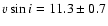 km s-1 (see above) which, with

 (B99), yields
 ,
i.e. a
maximum rotational period of about 8.5 days for an edge-on system.
,
i.e. a
maximum rotational period of about 8.5 days for an edge-on system.
Hence, we believe that large luminosity dips cannot be due to cold surface
spots. The smaller, secondary luminosity dips are also unlikely to be due
to cold spots since their duration does not exceed 2 or 3 days, while the
modulation by surface spots would be expected to produce at least 4-day
wide dips for a stellar rotation period of 8.2 days and
 1.
Furthermore, the small dips exhibit the same color behaviour as the large
ones (cf. Figs. 2, 3) which suggests a common
cause.
1.
Furthermore, the small dips exhibit the same color behaviour as the large
ones (cf. Figs. 2, 3) which suggests a common
cause.
Hot spots are also easily dismissed as a possibly dominant cause of AA Tau's photometric variability since one would then expect a correlation between the system brightness and veiling or excess flux due to the accretion shock. Such a correlation is not observed and the excess flux actually tends to be larger when the system is fainter (see Fig. 6).
Various aspects of AA Tau's photometric variations point to variable circumstellar extinction: the constant maximum brightness of the light curve over 150 days (see Fig. 1), the small amplitude of (B-V) color changes as the system dims except for transient events (see Fig. 3), the duration of the dips, their sharp ingress phase and asymmetric shape, and the lack of a strictly periodic behaviour can all be accounted for by the partial occultation of the stellar photosphere by orbiting circumstellar material. Moreover, Ménard et al. (2003) reported increased polarisation levels during the faintening episodes, as expected from the obscuration of the photosphere by circumstellar dust. While other minor sources of photometric variability might be present as well, neither stellar spots nor the orbital motion of a companion could account for all these features simultaneously.
Another supporting evidence for circumstellar extinction comes for the color behaviour of the system. We found above that the (B-V) color is not significantly affected during luminosity dips (apart from short timescale events discussed below) while in the (V-R) and (V-I) colors the system first reddens as it dims. Such a wavelength-dependent behaviour may result from extinction by dust particules slightly larger than the interstellar ones, producing opaque occultations at short wavelengths and interstellar-like reddening at longer ones. The change of the (V-R) and (V-I) color slopes as the system dims further (see Fig. 3) also suggests non uniform extinction properties of the occulting screen, which becomes more opaque as the occulation progresses.
Rapid color changes, best seen in the (B-V) color, are found to occur
at specific photometric phases. Two blueing episodes developped on a
timescale of a few hours around JD 512 and 516, while a rapid
reddening event occurred around JD 529. These events are associated to
the luminosity dips, though they can occur either at the start or in
the middle of the dips. The timescale associated with these events is
comparable to the duration of transit of circumstellar material across
the stellar photosphere (of order of 0.3 days if the occulting
material is located at the corotation radius, cf. B99). The transient
color excursions may thus be related to small-scale (0.01 AU)
structures in the absorbing material which would indicate that the
occulting screen is somewhat clumpy.
A third pattern of color changes is observed on a timescale of a few
hours. Figure 16 shows that the (V, V-I) color diagram
exhibits two parallel tracks separated by about 0.1 mag in luminosity
when the system is close to maximum brightness
(Fig. 16b). The tracks themselves are roughly parallel
to the reddening slope expected for extinction by small grains. On JD 511.5, at the very start of a large luminosity dip, the system was
first located on the upper track, becoming redder when fainter. It
then suddenly flipped onto the lower track at a slightly bluer color
before starting to redden again as it further dimmed
(Fig. 16c). The blueward transition from the upper to
lower (V, V-I) track took less than 3 hours on JD 511.5 and a
qualitatively similar behaviour is observed in the (V, V-R) and (V, B-V) color diagrams. Other data points on the lower (V, V-I) tracks
are from JD 516.5. This rapid variability is observed close to maximum
brightness, just before the occurrence of photometric dips, and
indicates the sudden appearance of a source of blue continuum excess
flux as the system starts to dim, possibly the accretion shock at the
stellar surface. The strong increase in veiling observed on JD 512.5-513.5 and 516.5-517.5 (see Fig. 10), i.e., within a
day after these blueing episodes supports this interpretation.
![\begin{figure}
\par\includegraphics[width=16cm,clip]{ms3975.f16.eps}
\end{figure}](/articles/aa/full/2003/37/aa3975/img66.gif) |
Figure 16: Panel a) AA Tau V-band light curve. At specific dates, measurements are represented by large square and triangle symbols for reference with panel b). Panel b) V versus V-I diagram: close to maximum brightness, the system follows 2 parallel color tracks. Symbols are the same as in panel a). Panel c) V versus V-I diagram: the path followed in this diagram by the system on JD 511 is shown by large empty circles. As it dimmed, the object suddenly flipped from the upper to the lower color track. The arrow in panels b) and c) indicates the color slope expected from interstellar extinction. |
| Open with DEXTER | |
B99 identified the obscuring material as the warped inner edge of AA Tau's circumstellar disk close to the corotation radius, as the disk
encounters the stellar magnetosphere. The characteristic timescale of
8.2 days is recovered in the new light curve, thus indicating that the
circumstellar material is still located close to the corotation radius
if in Keplerian rotation around the star (
 ,
cf. B99). This is also consistent with the short duration of the
ingress phases of the luminosity dips. However, the structure of the
occulting material appears more complex than it was in 1995. The
asymmetric shape of the major dips suggests a sharp leading edge for
the occulting material and a smoother trailing edge. Also, the light
curve indicates the occurrence of two occulation events per
photometric cycle (cf. Fig. 17) separated by about
0.4-0.5 in phase, suggestive of the presence of two occulting
structures located at nearly opposite azimuths around the star.
Finally, the depth of the eclipses is shallower in 1999 (1 mag)
than it was in 1995 (1.5 mag).
,
cf. B99). This is also consistent with the short duration of the
ingress phases of the luminosity dips. However, the structure of the
occulting material appears more complex than it was in 1995. The
asymmetric shape of the major dips suggests a sharp leading edge for
the occulting material and a smoother trailing edge. Also, the light
curve indicates the occurrence of two occulation events per
photometric cycle (cf. Fig. 17) separated by about
0.4-0.5 in phase, suggestive of the presence of two occulting
structures located at nearly opposite azimuths around the star.
Finally, the depth of the eclipses is shallower in 1999 (1 mag)
than it was in 1995 (1.5 mag).
Because the AA Tau system is suspected to be seen nearly edge-on (see B99), the occulting material has to lie close to the equatorial plane and is thus likely associated with the circumstellar dusty disk. A smooth azimuthal warp of the inner disk, as suggested by B99 to account for the 1995 light curve, does not produce two occultations per orbital cycle. Terquem & Papaloizou (2000) showed that the response of an accretion disk to an inclined stellar magnetosphere actually produces a warp with two vertical maxima on the upper side of the inner disk, located at opposite azimuths and having unequal amplitudes (see their Fig. 6). Such a warp can qualitatively account for the occurrence of two luminosity dips of unequal depth within one single orbital period of the inner disk edge. It is also worth noting that one of the magnetic configurations explored by Terquem & Papaloizou (2000) results in a vertical structure for the inner disk warp which mimics a trailing spiral pattern. Such a warp configuration would qualitatively account for the asymmetric shape of the main luminosity dips observed in AA Tau's light curve, with a sharp ingress phase and a slower return to maximum brightness. In any case, the differences between the '95 and '99 light curves indicate that the structure of the inner disk warp has changed between the two epochs.
![\begin{figure}
\par\includegraphics[width=15.8cm,clip]{ms3975.f17}
\end{figure}](/articles/aa/full/2003/37/aa3975/img68.gif) |
Figure 17: V magnitude, B-V and V-R (left), photospheric radial velocity, He I radial velocity and veiling (right) in phase with a 8.2 d period (JD0 = 516). Different symbols represent different orbital cycles. |
| Open with DEXTER | |
The light curve presented here, as well as that obtained in 1995, appears to be best interpreted in terms of recurrent occulations of the central star by circumstellar material located at the warped inner edge of AA Tau's accretion disk. A likely origin for the inner disk warp is the response of the disk to an inclined stellar magnetosphere. B99 proposed a model for AA Tau where the accretion disk is disrupted by the stellar magnetosphere at a distance of 0.08 AU, resulting in circumstellar material being channelled onto the star along magnetic accretion columns and eventually hitting the stellar surface to produce two opposite accretion shocks located at intermediate latitudes (see their Fig. 10). This model was able to account for the major characteristics of the luminosity and color variations of the system in 1995.
We have now an opportunity to further test this model from the observed spectroscopic variations of the system along the photometric cycle. Several aspects of the AA Tau spectroscopic analysis seem to confirm the general scenario of magnetospheric accretion.
The veiling shows two peaks occuring per 8.2-day cycle and which last 3 to 4 days with the highest value around 0.3 (see Fig. 17). The peaks suggest the presence of two rotationally modulated hot spots corresponding to the accretion shocks located around the magnetic poles at the stellar surface. The B-V color of the system shows some correlation with veiling and at least the bluest B-V values clearly correspond to the highest veiling values (Fig. 6). This confirms that blueing events are associated with veiling variations, both being produced by a hot source of continuum flux identified with the acretion shocks on the stellar surface.
One of the veiling maxima occur within one day of the center of the first deep photometric minima on JD 513 (see Fig. 10), which suggests that the hot spot faces the observer at this phase, in agreement with B99's geometrical model. Another veiling maximum occurs about 3-4 days later around JD 516-517, which would correspond to the maximum visibility of the second accretion shock, located on the opposite magnetic pole. Both episodes of increased veiling are preceeded by a sudden blueing of the system on JD 511.5 and 516.5 (see previous section) which may correspond to the appearance of the accretion spots on the stellar limb. Note that the veiling maxima seem to have disappeared during the photometric plateau (JD 519-525), which indicates that the mass accretion rate was much lower during that cycle. The third and highest veiling maximum is seen around JD 533 but the sparse sampling of both spectral and luminosity variations around this date prevent us from associating this event with a clear photometric pattern. Figure 17 nevertheless indicates that this last veiling maximum is in phase with the one which occured on JD 516-517.
The veiling also strongly correlates with the He I line flux (Fig. 11) which is expected in magnetospheric accretion models, since the He I emission line is thought to form at the base of the accretion column close to the accretion shock. It is interesting to note that two pairs of He I flux measurements, on JD 512.5 and 513.5, are weaker than expected from the overall correlation. Since these dates correspond to the center of a large luminosity dip, this indicates that the He I emission region close to the stellar surface is partly occulted at the same time as the photosphere. It should be pointed out, however, that the apparent veiling is likely overestimated on these dates due to the occulation of the photosphere. Since veiling measures the ratio between the excess flux and the photospheric flux, the partial occultation of the photosphere artificially enhances veiling even if the excess flux remains constant. Thus, the 1 mag drop in the photospheric flux between JD 511 and 512 would result in an increase from 0.04 to 0.12 for the veiling. This only partly accounts for data points that strongly deviate from the average correlation between line flux and veiling. The same effect is seen in the correlation between the veiling and the continuum excess flux (see Fig. 6). As noted by B99, the sudden increase of veiling as the system dims actually reinforces the interpretation of AA Tau's photometric variations as being due to the occultation of the stellar photosphere.
We see high velocity (150-300 km s-1) redshifted absorption
components in the wings of H
and H.
These occur most
clearly at JD = 513.5, simultaneously with the veiling peak, and at
JD = 525.5, with no increase of veiling associated to it. Redshifted
absorptions at high velocity are usually associated to material
free-falling onto the star along magnetospheric accretion
columns. They ought to be observed when the hot spot is seen
through the accretion columns along the line of sight. The
simultaneous occurrence on JD 513.5 of a high velocity redshifted
absorptions in the Balmer line profile and of maximum veiling is
consistent with the accretion column being projected onto the hot
spot facing the observer. This phase corresponds to the center a
the large luminosity dip which lasts from JD 511.5 to JD 515.5. The
other occurrence of a redshifted absorption component in the H
and H
profiles is seen on JD 525.5. Even though veiling is
weak on this date we argued above that this phase corresponds to
the maximum visibility of the second accretion shock. The weak
veiling and line fluxes on this date, located at the end of the
photometric plateau, are indicative of a strongly reduced mass
accretion rate onto the star (Fig. 10). According to
magnetospheric accretion models, high velocity redshifted
absorption components in the Balmer lines can still be seen for
mass accretion rates as low as 10
 and
actually become more conspicuous at lower accretion rate as the
line optical depth decreases (Muzerolle et al. 2001). Weak veiling
and the appearance of high velocity redshifted absorptions are
therefore not necessarily contradictory.
and
actually become more conspicuous at lower accretion rate as the
line optical depth decreases (Muzerolle et al. 2001). Weak veiling
and the appearance of high velocity redshifted absorptions are
therefore not necessarily contradictory.
![\begin{figure}
\par\includegraphics[width=8.8cm,clip]{ms3975.f18}
\end{figure}](/articles/aa/full/2003/37/aa3975/img71.gif) |
Figure 18:
Comparison between the observed H
(left) and H
(right) average profiles (solid lines) and profiles computed from
magnetospheric accretion models of Muzerolle et al. 2001 (dashed lines). The model profiles were computed for two
inclinations, 75
 (top) and 30
(bottom), a mass accretion
rate of 10
(top) and 30
(bottom), a mass accretion
rate of 10
 ,
a maximum temperature of 7000 K
in the accretion column and an inner and outer magnetospheric radii
of 5.2 and 6 ,
respectively, at the disk plane. Note that
profiles computed at high inclination provide a much better fit
than those computed at low inclination. ,
a maximum temperature of 7000 K
in the accretion column and an inner and outer magnetospheric radii
of 5.2 and 6 ,
respectively, at the disk plane. Note that
profiles computed at high inclination provide a much better fit
than those computed at low inclination. |
| Open with DEXTER | |
We compared the observed H
and H
average emission line profiles
with emission line profiles computed from the magnetospheric models of
Muzerolle et al. (2001). Figure 18 shows that although
none of the models perfectly reproduce the observed profiles, the best
fits are obtained for accretion rates in the range
10-8-10-9
 and large inclination angles (
).
The accretion rate is compatible with measured values for AA Tau,
and large inclination angles (
).
The accretion rate is compatible with measured values for AA Tau,
 and
and
 obtained by Gullbring et al. (1998) and Valenti et al. (1993)
respectively. The low inclination theoretical profiles are much more
intense and narrower than the observed ones at all phases. The fact that
only high inclination models fit the observed H
and H
profiles
suggests the inclination between the rotation and magnetospheric axis
cannot be very large. In general, the Balmer line profiles presented a
redward asymmetry (more emission in the blue than in the red wing) and
large variability of the red wings, which is overall in agreement with
the predictions of magnetospheric accretion models.
obtained by Gullbring et al. (1998) and Valenti et al. (1993)
respectively. The low inclination theoretical profiles are much more
intense and narrower than the observed ones at all phases. The fact that
only high inclination models fit the observed H
and H
profiles
suggests the inclination between the rotation and magnetospheric axis
cannot be very large. In general, the Balmer line profiles presented a
redward asymmetry (more emission in the blue than in the red wing) and
large variability of the red wings, which is overall in agreement with
the predictions of magnetospheric accretion models.
We noticed a time lag between the H,
H
and He I variations and
the veiling: the lines formed farther away precede those formed close to
the accretion shock, as expected for a perturbation propagating
downwards the magnetospheric accretion column. The measured time delays
are actually quite compatible with the timescale associated with
free-falling gas in the magnetic funnel. Assuming purely radial motion
from the disk's truncation radius (
 ,
see B99) towards the star, the 1.08 days delay between H
and
veiling variations would correspond to gas infall from a distance of
8.5
above the stellar surface, which compares well with the
size derived for AA Tau's magnetospheric cavity. The 0.44 days delay
measured between H
and veiling would correspond to a radial scale
of 6 ,
while the much shorter 0.08 days delay measured
for He I corresponds to about 1 .
This indicates, in agreement
with the predictions of magnetospheric accretion models, that H
is
produced in the bulk of the magnetospheric cavity, while H
arises
from a slightly more compact region and He I originates close to the
accretion shock slightly above the stellar surface.
,
see B99) towards the star, the 1.08 days delay between H
and
veiling variations would correspond to gas infall from a distance of
8.5
above the stellar surface, which compares well with the
size derived for AA Tau's magnetospheric cavity. The 0.44 days delay
measured between H
and veiling would correspond to a radial scale
of 6 ,
while the much shorter 0.08 days delay measured
for He I corresponds to about 1 .
This indicates, in agreement
with the predictions of magnetospheric accretion models, that H
is
produced in the bulk of the magnetospheric cavity, while H
arises
from a slightly more compact region and He I originates close to the
accretion shock slightly above the stellar surface.
We also found a tight correlation between the radial velocities of
the low-velocity red and blue absorption components in the H
profile (Fig. 15). This indicates a correlation
between accretion and ejection signatures, which is predicted by
the magnetospheric models, since the red absorption is generally
related to the accretion process and the blue absorption to
outflows and winds. However, if the wind originated in a region
spatially associated with the accretion funnel flow, one would
expect the blueshifted and redshifted velocities to be modulated on
a rotation timescale and to reach their extreme values
simultaneously. In contrast, the correlation indicates that the
largest blueshifted velocitites occur when the redshifted
velocities are the lowest and conversely. Furthermore, we do not
find evidence for a rotational modulation of the velocity of the
absorption components. Instead, Fig. 10 shows a
monotonic variation over two rotational cycles between JD 508 and 525. It is therefore quite unlikely that the radial velocity
variations could result from projection effects modulated along the
rotational cycle.
These variations might then reflect intrinsic changes in the
velocity fields of the inflow and outflow. A tentative explanation
for the observed correlation is that the location of the absorbing
regions moves radially in response to simultaneous changes in the
inflow and outflow optical depths. As the accretion rate and wind
density both increase, the line optical depth becomes larger and
the absorbing layers move upwards. This produces a lower
redshifted absorption velocity since it arises in the upper, lower
velocity part of the magnetic funnel flow, and a larger blueshifted
velocity since it forms higher up in the accelerating wind. In this
scenario, the comoving absorptions components of the H profile would simply reflect the opposite direction of acceleration
for the inflowing and outflowing material.
profile would simply reflect the opposite direction of acceleration
for the inflowing and outflowing material.
This interpretation, however, is not fully supported by the
observations. It would require that the largest optical depth and
thus accretion rate occurs around JD 524 when the lowest redshifted
velocities are observed. In contrast, the line fluxes and veiling
are the lowest on this date, indicative of a very weak accretion
rate. Hence, we fail to find a convincing explanation of the
observed correlation between the velocity of the blueshifted and
redshifted H
absorption components in the framework of a steady
magnetospheric accretion model. We will come back on the origin of
this correlation in the next section, when we discuss dynamical
effects associated with the interaction between the inner disk and
the stellar magnetic field.
The spectral and photometric variations of AA Tau, like those of most CTTS, are obviously more complex than would be expected from a naive axisymmetric and steady magnetospheric accretion model in which a stable stellar dipole aligned with the star's rotational axis disrupts the inner part of the accretion disk. While axial symmetry allows for the modelling of accretion-ejection structures (e.g. Shu et al. 1994; Ferreira 1997) and for the computation of line fluxes and line profiles arising in funnel flows (Muzerolle et al. 2001), the spectrophotometric monitoring of classical T Tauri stars reveals departures from these models.
Our previous study of the photometric variations of AA Tau already provided evidence for the accretion flow being channelled along the lines of a tilted instead of an aligned stellar dipole (B99). Since then, a surface magnetic field of order of 1-3 kG has been reported for AA Tau, with no clues however to its topology (Johns-Krull & Valenti 2000). Evidence for a tilted dipole had previously been reported for the classical T Tauri star SU Aurigae by Johns & Basri (1995a). The new photometric and spectroscopic data presented here are still globally consistent with the magnetospheric accretion scenario proposed for AA Tau by B99 based only on its photometric variations. However, some specific aspects of AA Tau's variability are difficult to account for by assuming a mere steady-state accretion flow along the lines of an inclined magnetosphere.
The most challenging feature in the observations reported here is the absence of a main luminosity dip around JD 521-522 (cf. Fig. 4). If these dips result from the occultation of the central star by the inner disk warp, as advocated above and in B99, how can the occulting screen disappear on a timescale of a week and reappear on the following cycle? At the time of the missing occultation, the system also exhibits little spectral variability, the veiling is minimal as are the line fluxes. All diagnostics thus suggest that the system's variability has suddenly shut off for a few days (JD 519-525, the photometric "plateau'') and that the accretion flow onto the star was severely depressed at these dates.
Remarkably enough, the object was quite active on both sides of the plateau, i.e., during the previous and the following 8.2-day cycles, exhibiting both large luminosity dips and strong line profile variability. Moreover, the pattern of variability after the plateau is strinkingly similar to what it was before, as if the occulting screen had been suppressed for about the duration of a cycle and had then reformed with optical and geometrical properties quite similar to those it had before. Such a repeatability of the variability pattern would be unlikely to happen if the occultations were produced by independent, free flying dusty blobs crossing the line of sight as they orbit the star. Instead, it suggests that the properties of the absorbing material are shaped by an organized underlying structure.
In B99, we have argued that the obscuring material is to be identified with the warped inner edge of the accretion disk. The non-axisymmetric warp itself results from the response of the disk to the inclined stellar dipole (cf. Terquem & Papaloizou 2000). The properties of the occulting screen are thus dictated by the topology of the stellar magnetic field at the disk inner edge. The stability of the warp configuration, and therefore of the observed eclipses, ultimately depends on the stability of the magnetic structure at the disk truncation radius. We thus propose that the "missing occultation'' results from the perturbation and subsequent restoration of the stellar magnetic field at the disk inner edge, leading to the temporary disappearance of the disk warp and of the associated eclipse as well as to a severe reduction of the accretion flow onto the star.
The dynamical evolution of a stellar magnetosphere interacting with an accretion disk has been investigated by several recent numerical models, with applications to T Tauri stars (e.g. Romanova et al. 2002; Goodson et al. 1997; Miller & Stone 1997). These models assume an initial dipolar configuration and predict that the stellar magnetic field lines threading the disk expand as they are twisted by differential rotation between the inner disk and the star. The inflation of stellar field lines also occurs when accreted material accumulates at the inner disk edge against the magnetosphere and builds up a pressure gradient that brings the disk truncation radius closer to the star (Romanova et al. 2002). In most models, twisted magnetic field lines eventually open, leading to an episode of strong mass outflow (e.g. Hayashi et al. 1996), and reconnect thus restoring the initial (dipolar) configuration and the associated accretion funnel flow onto the star. This evolution is found to repeat itself in a quasi-periodic manner as originally suggested by Aly & Kuijpers (1990) with an associated timescale of order of a few rotation periods (e.g. Uzdensky et al. 2002a, 2002b; Goodson & Winglee 1999; Romanova et al. 2002).
We propose that the quiescent phase of AA Tau's variability, which spans
the photometric plateau and associated weak veiling and line fluxes,
corresponds to a phase when the magnetosphere has expanded as described by
these models, thus reducing the accretion flow onto the star as the field
lines become sharply bent at the disk surface (e.g. Romanova et al. 2002).
Models predict that this phase is characterized by a stronger outflow (e.g.
Hayashi et al. 1996; Goodson et al. 1997), conceivably carrying away the
material accumulated at the inner disk edge and thus possibly partly
responsible for the disappearance of the occulting screen. The reduced
accretion rate into the funnel flow may also lower the optical thickness of
the absorbing material at the disk inner edge, thus producing a much
shallower eclipse. Although we do not have a quantitative measure of the
strength of the wind in the system, we note that the blueshifted absorption
component of the H
profile reaches below the stellar continuum during
the photometric plateau while it is shallower at all other phases. This may
be an indication that the outflow is indeed stronger when the accretion
flow is depressed. After the inflation phase, field lines reconnect and the
initial magnetic configuration is restored. A new major eclipse is thus
seen around JD 528 as line fluxes start to increase again
(Fig. 10). One of the differences between the major eclipses
on JD 511 and JD 528 is that during the latter the system reddens while it
exhibited blueing episodes during the former. This suggests that the
obscuring material was partially optically thin after the restoration of
the initial configuration.
![\begin{figure}
\par\includegraphics[angle=270,width=7.5cm,clip]{ms3975.f19}
\end{figure}](/articles/aa/full/2003/37/aa3975/img77.gif) |
Figure 19:
A sketch of the dynamical evolution of the stellar
magnetosphere interacting with the accretion disk. Top:
initial dipolar configuration; bottom: the magnetosphere has
expanded as magnetic field lines are twisted by differential
rotation (see text). The accretion funnel flow onto the star and
the nearly perpendicular outflow are schematically drawn. The line
of sight to the system is highly inclined (
,
shown
as the arrow on the right). The radial velocities of the inflow and
outflow are shown. In the initial configuration, the velocity field
of the absorbing layers in the accretion column is nearly parallel
to the line of sight, thus yielding the highest radial velocity of
the redshifted H
absorption component. In the expanded
magnetosphere configuration, the same absorbing layers make a large
angle with the line of sight, thus resulting in small observed
radial velocities. The outflow being nearly perpendicular to the
inflow, the opposite behaviour is observed for the radial velocity
of the blueshifted absorption component in the H
line profile. |
| Open with DEXTER | |
This dynamical scenario of the interaction between the inner disk and
the stellar magnetosphere may additionally offer an explanation to the
observed correlation between the radial velocities of the blueshifted
and redshifted absorption components of the H
profile
(Fig. 15). The qualitative interpretation we propose for
this correlation is schematically depicted in Fig. 19. In
the initial configuration, the H
absorbing layers located in the
upper part of the accretion funnel flow are nearly parallel to the line
of sight, thus yielding the highest projected redshifted velocities. In
the inflated phase, the field lines have strongly expanded and the same
layers are now at a large angle to the line of sight, thus yielding the
lowest projected redshifted velocities. In most accretion-ejection
models, the outflow is nearly perpendicular to the inflow in the
vicinity of the disk-magnetosphere boundary (e.g. Shu et al. 1994;
Ferreira 1997). Then, the lowest projected blueshifted velocities are
expected to occur in the initial configuration, when the outflow is
nearly perpendicular to the line of sight, while in the inflated phase
the outflow is bent towards the observer (assuming the angle between the
inflow and the base of the outflow has not changed significantly) and
thus yields the highest projected blueshifted velocities. Slowly
evolving projection effects resulting from the inflation of the
magnetosphere would thus account for the simultaneous radial velocity
variations of the blue and red absorption components in the H
profiles. This would provide a natural explanation for the fact that the
highest redshifted velocities are observed when the blueshifted
velocities are the lowest and conversely, an observational result which
had no straightforward explanation in the framework of a static
magnetospheric accretion model.
If this interpretation is correct, the radial velocity of the
redshifted H absorption component yields a direct measurement of
the expansion of the magnetic field lines close to the
disk-magnetosphere boundary, the velocity decreasing as the magnetic
field line inflates. We can thus use this diagnostics to trace the
evolution of the magnetospheric structure as it interacts with the disk.
The radial velocity curve of the redshifted absorption component is
shown in Fig. 10. As noted above, the timescale for its
radial velocity variations is longer than the rotation period of the
system. Figure 10 shows that the radial velocity first
steadily decreases from the start of the observations on JD 506 down to
its lowest value reached on JD 525, which would indicate that the
magnetosphere expands over at least this time span. From JD 525 on, the
radial velocity rapidly increases to reach its maximum value on JD 530
and then starts to decrease again. This phase would then correspond to
the restoration of the initial magnetic configuration over JD 525-530
and the beginning of a new inflation cycle starting on JD 530.
The dynamical evolution of the magnetosphere deduced from the projected
velocity of the redshifted H
absorption component alone is
globally consistent with the spectro-photometric evolution of the system: the phase of quiescent activity associated to a reduced accretion rate
onto the star (photometric plateau, lowest veiling, weakest line fluxes,
smallest line variability) is observed from JD 518 to 525, i.e., at the
end of the expansion phase (
 -525). The reapparition of the
eclipses, the increase of line fluxes and of veiling all happen between
JD 526 and JD 532, as the initial configuration is restored (JD 525-530). Note that three measurements strongly depart from the
correlation shown in Fig. 15. They occur on JD 529.5, 530.5, and 531.5 precisely at the time the initial configuration is
re-established. On JD 529.5, large variations of the radial velocity of
the blueshifted component are seen to occur on a timescale of a few
hours (see Fig. 10). This suggests that, superimposed onto
the slowly evolving magnetospheric structure, transient ejection events
occur as a new magnetospheric cycle starts.
-525). The reapparition of the
eclipses, the increase of line fluxes and of veiling all happen between
JD 526 and JD 532, as the initial configuration is restored (JD 525-530). Note that three measurements strongly depart from the
correlation shown in Fig. 15. They occur on JD 529.5, 530.5, and 531.5 precisely at the time the initial configuration is
re-established. On JD 529.5, large variations of the radial velocity of
the blueshifted component are seen to occur on a timescale of a few
hours (see Fig. 10). This suggests that, superimposed onto
the slowly evolving magnetospheric structure, transient ejection events
occur as a new magnetospheric cycle starts.
Thus, independent observational diagnostics of the magnetospheric accretion process can be consistently accounted for by a dynamical description of the interaction between the disk and the stellar magnetosphere. This result provides strong support to the recent numerical simulations which predict a time variable behaviour of the disk-magnetosphere interface and may have important implications for the origin of the spectro-photometric variability of classical T Tauri stars, for the regulation of their angular momentum, and for the origin and short-term variability of outflows in young objects.
We have shown that the photometric and spectroscopic variations of AA Tau on days to weeks timescales are globally consistent with the
concept of magnetospheric accretion in this system. Its inner
accretion disk is truncated at a distance of about 0.1 AU from the
stellar surface by the strong stellar magnetosphere. The large scale
magnetospheric structure is inclined relative to the disk plane which
leads to the developement of a non axisymmetric warp at the inner disk
edge. The warp corotates with the star and is responsible for the
occurrence of the eclipses observed in AA Tau's light curve. As the
eclipses proceed, high velocity inverse P Cygni profile are
episodically observed at H
and veiling is maximum, which suggest
accretion columns are seen against the hot accretion shock at this
phase. The size of the magnetospheric cavity, about 8
as deduced
by assuming Keplerian rotation at the inner disk edge, is consistent
with the time delay we measured between lines and veiling variations
as non steady accretion propagates downwards the accretion column,
from the inner disk edge to the stellar surface on a timescale of one day.
The global structure of the magnetospheric accretion region appears to vary
on a timescale of order of a month. We observed the sudden disappearance of
eclipses together with a strong reduction of line fluxes and veiling for a
few days. During this episode, the inner disk warp had apparently vanished
and the accretion flow onto the star was severely depressed which suggests
that the magnetic configuration at the inner disk edge has been disrupted.
A few days later, the initial magnetic configuration was restored as
indicated by eclipses resuming with a similar depth and shape as prior to
the disruption event and line fluxes and veiling increasing again. The
phase of reduced activity may correspond to a state where the field lines
had strongly expanded and perhaps opened under the action of differential
rotation between the inner disk and the star. In support to this
interpretation, we find a smooth variation of the radial velocity of
accretion and outflow diagnostics in the H
profile which is best
interpreted as reflecting the slowly inflating magnetosphere on a timescale
of a month, followed by its disruption and the restoration of the initial
magnetic configuration. Recent numerical simulations describe such a
magnetospheric inflation process and predict they are cyclic. The results
reported here may constitute the first clear evidence for the existence of
magnetospheric inflation processes occurring in CTTS on a timescale of a
month, though additional observations will be needed to assess their cyclic
nature.
The observed variability of AA Tau is thus a complex mixture of rotational modulation by hot spots, variable circumstellar extinction, non steady accretion and varying mass loss, all of which appear to be consistent with a dynamical view of the interaction between the inner disk and an inclined large-scale stellar magnetosphere. The magnetospheric accretion process appears to be time dependent on all scales, from hours for non steady accretion to weeks for rotational modulation and months for global instabilites of the magnetospheric structure. AA Tau exhibits clear signatures of these various processes mostly because is it seen at a high inclination which maximizes the amplitude of variability. However, since AA Tau has otherwise properties of a very typical classical T Tauri star it is very likely that the processes observed in AA Tau are also instrumental in other CTTS, though more difficult to diagnose when the systems are seen at a lower inclination (e.g. Chelli et al. 1999; DeWarf et al. 2003).
The highly dynamical and time dependent nature of the magnetospheric
accretion process may have implications which remain to be explored for a
number of issues. For instance, the transfer of angular momentum between
the star and the disk (and the wind) is certainly quite complex and time
variable (Agapitou & Papaloizou 2000). Whether this variability affects
the angular momentum evolution of CTTS on the long term is however unclear,
since it takes about 105 yr to the star to react to angular momentum
gains or losses which will presumably smooth out the effects of short term
variability. The dynamical nature of the magnetospheric accretion process
may also bring clues to the origin of the short-term variability of CTTS
outflows (Woitas et al. 2002; Lopez-Martin et al. 2003). It would be
interesting to search for wind or jet variability on a timescale of a
month, as could be expected from a cyclical evolution of the magnetospheric
structure. One of the important implications of the results reported here
is related to the origin of CTTS near infrared excess, which is often used
as a quantitative diagnostics of mass accretion in the disk and usually
modelled in the framework of standard -disk models. AA Tau's result
suggest that the structure of the inner disk is in fact strongly modified
from its interaction with the stellar magnetosphere. The development of a
disk warp can be expected to considerably increase the illuminated fraction
of the inner disk, possibly leading to high veiling values in the near-IR
as measured by Folha & Emerson (1999) and Johns-Krull & Valenti (2003).
Also, large scale instabilities of the magnetospheric structure at the
inner disk edge can be expected to produce rapid and large near infrared
variability, as observed in some systems (Carpenter et al. 2001; Eiroa et al. 2002).
Finally, most MHD models of magnetospheric accretion developped so far assume axisymmetry and steady-state inflows/outflows. These assumptions are clearly an oversimplification of the highly dynamical processes at work in the interaction between the inner disk and the stellar magnetic field. In view of these limitations, it may not be surprising that some of the basic predictions of these models are not always confirmed by snapshot observations which catch the systems at a particular phase of their short term evolution (e.g. Johns-Krull & Gafford 2002). Whether these models remain valid to describe the evolution of these systems on the long term, once the short term variability reported here has been smoothed out over much longer timescale, remains to be seen.
Acknowledgements
We thank J. Ferreira for discussions on MHD accretion-ejection models, M. Mouchet for providing us with bibliography on possibly related processes at work in cataclysmic variables, and J. Steinacker for discussing radiative transfer issues in the framework of the magnetospheric accretion model. This work was supported by a NATO Science Program grant (PST.CLG.976194). S.H.P.A. acknowledges support from CNRS and CAPES (PRODOC program). M.F. is partially supported by the Spanish grant AYA2001-1696.