 glow to latitude-dependent ionization rate
glow to latitude-dependent ionization rateM. Bzowski
Space Research Centre PAS, Bartycka 18A, 00-716 Warsaw, Poland
Received 25 February 2003 / Accepted 16 June 2003
Abstract
I study the model response of the latitudinal profile of the heliospheric
Lyman-
glow to various profiles of the ionization rate. The two
profiles are characterized by their range separately in
the north and south hemisphere, and by the contrast between the equator
values and north and south pole values. These parameters
define a mesh of the input ionization rate profiles, used to derive
the output heliospheric glow profiles. It is shown that in the crosswind
plane containing the Sun there exists a linear correlation between the
north and south ranges of the ionization profile and the corresponding
ranges of the glow profiles. This correlation does not depend on the
contrast of the ionization profile. The contrast of the
glow profile is almost linearly correlated with the contrast of the
ionization profile, but this correlation changes with the change of the
input profile width. Based on these correlations, a method to derive the
latitudinal profile of the solar ionization rate from observations
of the heliospheric glow at 1 AU is proposed.
Key words: interplanetary medium - solar wind - Sun: UV radiation - Ultraviolet: solar system
glow.
The paper presents results of model calculations of profiles of the heliospheric backscatter radiation intensity as a function of heliographic latitude for various profiles of the ionization rate.
The idea of modeling presented in this paper is to take a
latitudinal profile of the ionization rate similar to that observed by
Ulysses during the 1995 fast latitude scan
(Bzowski 2001a; Phillips et al. 1995, see Fig. 1)
and to calculate the latitudinal profile of the Lyman-
glow.
Ulysses observed a flat but noisy enhancement of the solar wind mass flux
(the "bulge''), straddling almost symmetrically the solar equator.
Accordingly, I adopted input ionization rate profiles featuring a flat,
symmetrical enhancement in the equatorial region.
From the calculation of a grid of such models, where the variable parameters
were the width and height of the input ionization profile, I obtained an
output grid of glow profiles which feature broad minima in equatorial
band of latitudes (the "groove''). With these profiles on hand, I studied correlation between the ionization and glow profiles. In
particular, I was looking for the correlation between the north and
south latitudinal range of the bulge on one hand and the latitudinal
range of the groove on the other hand, and for the correlation between
the depth of the groove and the height of the bulge.
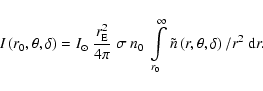
The approach for modeling of the intensities of heliospheric glow was
essentially the same as in the paper by Bzowski et al. (2002). The
intensities were calculated using the single-scattering, optically thin
model:
 is the intensity
of the backscattered radiation observed along a heliocentric line of
sight anchored at the distance r0 from the Sun in a point whose
radius vector
is the intensity
of the backscattered radiation observed along a heliocentric line of
sight anchored at the distance r0 from the Sun in a point whose
radius vector  in a heliocentric reference system makes angle
  with the upwind direction and
  with the solar equator
(that is,
is its heliographic latitude);
with the solar equator
(that is,
is its heliographic latitude);  is the solar
illuminating flux, assumed to be spherically symmetric;
is the solar
illuminating flux, assumed to be spherically symmetric;  is 1 AU
(
is 1 AU
(
 throughout);
  is the cross section for interaction
of solar Lyman-
photons with neutral hydrogen atoms, averaged over
the solar Lyman-
line width; n0 is the gas density at the
termination shock (formally: at infinity);
is the cross section for interaction
of solar Lyman-
photons with neutral hydrogen atoms, averaged over
the solar Lyman-
line width; n0 is the gas density at the
termination shock (formally: at infinity);
 is the local density of the gas, taken as a fraction of n0:
 ;
;
 is the local gas density in a point defined
by radius vector
is the local gas density in a point defined
by radius vector
 .
In the calculations
to follow, was always equal to
.
In the calculations
to follow, was always equal to
 and since the lines of
sight were directed radially away from the Sun, the latitude of each point on
a given line of sight was equal to one value, specific for this line
of sight. As it is evident from Eq. (1), the gas density at infinity n0 and the solar illumination of the gas
are multiplicative
factors that cancel when relative intensities are calculated.
and since the lines of
sight were directed radially away from the Sun, the latitude of each point on
a given line of sight was equal to one value, specific for this line
of sight. As it is evident from Eq. (1), the gas density at infinity n0 and the solar illumination of the gas
are multiplicative
factors that cancel when relative intensities are calculated.
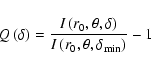
The relative intensities
 are defined as:
 is by definition the heliographic latitude of
the line of sight which returns the minimum intensity in the scan plane.
is by definition the heliographic latitude of
the line of sight which returns the minimum intensity in the scan plane.
The underlying density of the gas
was
calculated using the model developed by Bzowski et al. (2002). In this
model, which is based on the model by Rucinski & Bzowski (1995), the
density is calculated as a numerical integral of the distribution
function over the velocity phase space. The distribution function
 for velocity vector
  in a selected location in space,
determined by the heliocentric distance
,
is calculated as a product of the assumed distribution function at
the termination shock
in a selected location in space,
determined by the heliocentric distance
,
is calculated as a product of the assumed distribution function at
the termination shock
 for a velocity vector
 and of the ionization weight
 :
:
 is the (formally infinite) distance from the Sun, where one
must assume some form of the distribution function of the gas
is the (formally infinite) distance from the Sun, where one
must assume some form of the distribution function of the gas
 .
Basically, this
function is quite complicated since the hydrogen gas is heavily
processed by the heliospheric interface (Izmodenov et al. 2001). In
practice, it is assumed that the gas distribution function at
is a Maxwellian with a temperature
.
Basically, this
function is quite complicated since the hydrogen gas is heavily
processed by the heliospheric interface (Izmodenov et al. 2001). In
practice, it is assumed that the gas distribution function at
is a Maxwellian with a temperature
 ,
travelling
with the bulk velocity vector
,
travelling
with the bulk velocity vector
 (see also Lallement et al. 1985; Thomas 1978; Wu & Judge 1979; Fahr 1978; and a review by
Rucinski & Bzowski 1996). The velocity vector
(see also Lallement et al. 1985; Thomas 1978; Wu & Judge 1979; Fahr 1978; and a review by
Rucinski & Bzowski 1996). The velocity vector  of the
atom at
is calculated numerically by back-tracking the atom
from its position
of the
atom at
is calculated numerically by back-tracking the atom
from its position
 inside the
heliosphere, where it has velocity vector equal to ,
to
.
In this particular embodiment of the density model I
assumed that the pressure of solar Lyman-
radiation is constant
in time, so the atoms were following hyperbolic trajectories.
inside the
heliosphere, where it has velocity vector equal to ,
to
.
In this particular embodiment of the density model I
assumed that the pressure of solar Lyman-
radiation is constant
in time, so the atoms were following hyperbolic trajectories.
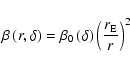
The ionization weight
 is the probability that the atom survives such a travel in the ionization
field, described by the equation
is the probability that the atom survives such a travel in the ionization
field, described by the equation
 is one of the profiles of the
ionization rate at 1 AU, presented below. The ionization weight is
calculated numerically by the following integration:
is one of the profiles of the
ionization rate at 1 AU, presented below. The ionization weight is
calculated numerically by the following integration:
 is the instantaneous heliographic
latitude of the test atom during its travel from the local point to
.
Since the atoms do not follow radial trajectories, it
usually changes considerably during the flight of the atom.
is the instantaneous heliographic
latitude of the test atom during its travel from the local point to
.
Since the atoms do not follow radial trajectories, it
usually changes considerably during the flight of the atom.
The calculations were performed for the bulk velocity and temperature of
the hydrogen gas at the nose of the termination shock similar to those
derived by Costa et al. (1999):
 km s-1,
 K. The ecliptic coordinates of the upwind direction were
assumed as
K. The ecliptic coordinates of the upwind direction were
assumed as
 and
and
 .
The values
of the ionization rate were assumed constant in time, and the value of
the radiation pressure was adopted as for the time of Ulysses fast
latitude scan in 1995:
.
The values
of the ionization rate were assumed constant in time, and the value of
the radiation pressure was adopted as for the time of Ulysses fast
latitude scan in 1995:
 .
For the verification modelling,
discussed in Paper II, the values of radiation pressure derived from the EUV'97 model by Tobiska et al. (1997) and presented by
Bzowski (2001b) were used.
.
For the verification modelling,
discussed in Paper II, the values of radiation pressure derived from the EUV'97 model by Tobiska et al. (1997) and presented by
Bzowski (2001b) were used.
![\begin{figure}
\par\resizebox{8.8cm}{!}{\includegraphics[clip]{modfig01bw.eps}}
\end{figure}](/articles/aa/full/2003/36/aah4346/img51.gif) |
Figure 1:
Definition of morphological features of the ionization bulge
profile. The range corresponds to half width at half maximum
and the height is the ratio
 .
The width of the profile is equal to the range. The range is
expressed in degrees of heliolatitude and the height is dimensionless. .
The width of the profile is equal to the range. The range is
expressed in degrees of heliolatitude and the height is dimensionless. |
| Open with DEXTER | |
As input to the modelling, I used a series of helio-latitudinal
profiles of the ionization rate that throughout this paper and Paper II
will be referred to as the ionization bulge. This is
because the model ionization rate at 1 AU, when rendered in 3D, appears as
a spherical surface with a bulge in a band of equatorial latitudes.
I checked extensively one class of models: symmetric about the solar
equator, characterized by the two large-scale morphological parameters defined
in Fig. 1.
They are the bulge width, defined precisely as half width at half maximum
of the profile, and the bulge height, defined as the ratio of the values
at the equator and at the poles. In the modelling, I used as the base value
the rate observed at the solar poles by Ulysses during the Fast Latitude
Scan in 1995 (Phillips et al. 1995), plus the photoionization rate
 s-1, inferred from the 10.7 cm proxy
(for discussion, see Bzowski 2001b). Since the adopted profile
is symmetric with respect to the equator, its north and south widths -
by assumption equal to each other - are also equal to its north and south
range. This is not the case, however, for profiles not symmetric with
respect to the equator, as those presented in Fig. 9, which
will be discussed in a further part of the paper.
s-1, inferred from the 10.7 cm proxy
(for discussion, see Bzowski 2001b). Since the adopted profile
is symmetric with respect to the equator, its north and south widths -
by assumption equal to each other - are also equal to its north and south
range. This is not the case, however, for profiles not symmetric with
respect to the equator, as those presented in Fig. 9, which
will be discussed in a further part of the paper.
![\begin{figure}
\par\resizebox{8.8cm}{!}{\includegraphics[clip]{modfig02bw.eps}}
\end{figure}](/articles/aa/full/2003/36/aah4346/img53.gif) |
Figure 2: Mesh of the ionization bulge parameters used in the modelling of the helioglow intensity groove profiles. |
| Open with DEXTER | |
The modelling was performed on a mesh of 7 widths and 6 heights of the
profiles, presented in Fig. 2.
For these profiles, I calculated intensities of the
heliospheric glow for lines of sight directed away from the Sun from 1 AU, located in the plane perpendicular to the gas inflow axis. The
sampling was every
 .
The scan plane is close to the Ulysses
orbit and comes close to but not precisely through the ecliptic and
solar poles.
.
The scan plane is close to the Ulysses
orbit and comes close to but not precisely through the ecliptic and
solar poles.
This was the baseline geometry of the input bulge profiles. Since the
observed profiles of the groove, presented in Paper II, suggest that
the ionization bulge is not always symmetric, I studied qualitatively
the following two additional cases: when the bulge is shifted slightly
(by
 )
and considerably (by
)
and considerably (by
 )
to the south. In these
two cases, calculated for all 7 widths, but for only one height of the
ionization bulge, the north and south ranges of the ionization profile
were no longer equivalent to its widths.
)
to the south. In these
two cases, calculated for all 7 widths, but for only one height of the
ionization bulge, the north and south ranges of the ionization profile
were no longer equivalent to its widths.
From the modelling performed I obtained a family of profiles of the groove whose morphological parameters I define as shown in Fig. 3.
![\begin{figure}
\par\resizebox{8.8cm}{!}{\includegraphics[clip]{modfig03BW.eps}}
\end{figure}](/articles/aa/full/2003/36/aah4346/img55.gif) |
Figure 3:
Morphology of the groove profile with respect to heliographic
latitude in the plane perpendicular to the inflow direction. The
vertical line marks the minimum of the profile which occurs a few
degrees to the south from the equator. The north (south) range
of the profile is defined as the latitude of its half-maximum
in the northern (southern) hemisphere. The north (south) width of the
profile is defined as the difference between the latitude of the north
(south) half-maximum and of the latitude of the minimum of the profile.
The north and south depths  , ,
 are the ratios of
the intensities at the poles and at the equator (see Eq. (2)).
The north-south asymmetry of the profile
are the ratios of
the intensities at the poles and at the equator (see Eq. (2)).
The north-south asymmetry of the profile
 is defined as the
ratio of the north depth to the south depth:
is defined as the
ratio of the north depth to the south depth:
 The widths and ranges are expressed in degrees of heliographic latitude,
and the depths and depth asymmetry are dimensionless. The widths and ranges are expressed in degrees of heliographic latitude,
and the depths and depth asymmetry are dimensionless. |
| Open with DEXTER | |
In this geometry, although the solar ionization rate is north-south symmetric, the resulting intensity profile is not. Consequently, I consider separately the north and south profile ranges, widths and depths, as indicated in the figure. I refer the north and south half-width of the profile to the minimum of the groove, marked with the vertical axis in the figure. The minimum does not occur at the heliographic equator. The groove range to the north and to the south in heliographic coordinates are taken with respect to the solar equator while the widths of the profile with respect to the latitude of the minimum.
In this section, I will discuss first the main features of the groove profiles created by the ionization symmetric about the solar equator. I will show the morphological features important for correct interpretation of the observed profiles of the glow and will point out the quantitative correlations that enable determining the parameters of the ionization profile from observed profiles of the glow. Then I will qualitatively show modifications of the glow profile when the ionization profile is no longer symmetric with respect to solar equator. Finally, I will define the procedure to determine the parameters of the ionization rate profile from the observed parameters of the glow intensity.
Example profiles of the groove for different widths of the ionization
bulge are presented in Fig. 4. With the increasing range of
the bulge, the groove profiles become flatter and flatter both in terms
of the poles-to-equator ratios and in terms of the flatness of the
bottom of the profile. However, there exists a threshold value of the
bulge width, below which the depth of the groove becomes to decrease
again: in Fig. 4 the groove is the deepest for the bulge
width equal to 
 .
.
![\begin{figure}
\par\resizebox{8.8cm}{!}{\includegraphics[clip]{modfig04bw.eps}}
\end{figure}](/articles/aa/full/2003/36/aah4346/img57.gif) |
Figure 4: Family of the (relative) groove profiles as function of heliographic latitude for the widths of the ionization rate indicated in the box and height of the bulge equal to 1.63. |
| Open with DEXTER | |
![\begin{figure}
\par\resizebox{8.8cm}{!}{\includegraphics[clip]{modfig05bw.eps}}
\end{figure}](/articles/aa/full/2003/36/aah4346/img58.gif) |
Figure 5:
Upper panel: N/S asymmetry of the groove depth as
function of the bulge width for the bulge height values indicated in
the box. For symmetric bulge, one does not expect more
than 10% asymmetry. The highest occurs for the bulge
width equal to about
 .
Lower panel: N/S asymmetry of the groove
depth as function of the ionization bulge height for bulge widths
indicated in the box. The dependence is almost linear, but the
slope varies with the width of the ionization bulge. .
Lower panel: N/S asymmetry of the groove
depth as function of the ionization bulge height for bulge widths
indicated in the box. The dependence is almost linear, but the
slope varies with the width of the ionization bulge. |
| Open with DEXTER | |
The north-south asymmetry of the profiles is defined as
,
where ,
are the north and south depths
of the groove, defined in Fig. 3. The behavior of
for various widths and heights of the ionization bulge is summarized
in Fig. 5.
The asymmetry is caused by the small inclination of the gas inflow axis
to the solar equator. Generally, it attains the maximum values for
medium widths and tallest heights of the ionization rate profile. The
most important here are the upper limits for the N/S asymmetry of the
groove for the whole family of symmetric bulge profiles. For the typical
groove widths and heights observed (
and 1.3,
respectively: see Paper II), the asymmetry should be just a few percent.
Hence any larger north/south ratio would most probably be due
to some physical reason and not to the effect of gas inflow geometry.
The north and south ranges of the groove depend linearly on the range of
the ionization rate profile. There is no dependence whatsoever of the range
of the groove on the depth of the bulge, as shown in Fig. 6.
![\begin{figure}
\par\resizebox{8.8cm}{!}{\includegraphics[clip]{modfig06bw.eps}}
\end{figure}](/articles/aa/full/2003/36/aah4346/img59.gif) |
Figure 6: Groove range north (N) and south (S) versus bulge range (here equivalent to the north and south width), as well as the latitude of the minimum of the groove and the arithmetic mean of its north and south range. The quantities shown are averaged over all bulge heights, but in the case of the north and south ranges the dispersion is smaller than the resolution of the figure. The dispersion of the two remaining parameters is just a few degrees. |
| Open with DEXTER | |
The position of minimum intensity (groove minimum) shows little
dependence on the depth of the bulge (if at all, then for large
widths), but it slowly moves towards southern latitudes with the
increasing width of the bulge. The mean position of the groove, defined
as the arithmetic mean of the north and south range, is practically
independent of the ionization profile width. For the assumed latitude of
the upwind direction, equal to
north (equivalent to about
 heliolatitude), it goes level at
 south
heliolatitude.
south
heliolatitude.
Hence, the observed position of the groove minimum should yield a clue on the symmetry of the north/south range of the ionization bulge. Another test would be to take the mean of the north and south groove range and see if they do not go too far away from the equator. Then, if these tests for symmetry of the ionization bulge are passed, one can infer the north and south range of the ionization bulge from the observed range (north and south) of the groove. With this information on hand, one can proceed to determine the height of the ionization bulge from the depth of the groove, which will be discussed in the next section.
![\begin{figure}
\par\resizebox{8.8cm}{!}{\includegraphics[clip]{modfig07bw.eps}}
\end{figure}](/articles/aa/full/2003/36/aah4346/img62.gif) |
Figure 7: Upper panel: height of the ionization bulge vs. depth of the intensity groove north for the bulge widths indicated in the box next to the drawing. For an individual width of the ionization bulge, the correlation between groove depth and bulge height is close to linear but the slope of the curve depends on the bulge width. Lower panel: as the upper panel but the quantities for the southern hemisphere are shown in the same scale - the slopes are somewhat different. |
| Open with DEXTER | |
The groove depth depends almost linearly on the bulge height, but some
dependence exists also on the width of the bulge. Separate correlations
occur for the north and south depths (see Fig. 7). The
highest slopes occur for the highest widths of the bulge.
The dependence of the groove depth on the ionization bulge width is not
linear, though regular (see Fig. 8). The largest depths of
the groove for a given height of the bulge occur for the bulge range
equal to
N and
 S.
S.
The modelling in this case was performed only on a qualitative basis.
The goal was to get some insight into the behavior of the groove profile
when the ionization bulge is shifted to the south of the Sun, as suggested
by some observations discussed in Paper II. I used the full range of the
widths, but only one value of the depth, equal to 1.64. I checked the
following two cases: one with the shift of the bulge to the south
by
(further on referred to as the "large shift''), and the other
one with the shift by just
(further on referred to as the
"small shift''). The bulge profiles used in both cases are presented in
Fig. 9
and the resulting groove profiles in Fig. 10.
Some of the ionization bulge profiles studied engulf at least partly the
south pole. Hence the morphology of the resulting groove profiles can be
quite different from the symmetric bulge case. The ionization bulge does
not need to swallow the pole in order to obtain the groove profiles
almost entirely flat in the southern hemisphere, but showing a
considerable gradient in the northern hemisphere. This happens, e.g.,
for the groove profile corresponding to the bulge shifted to the south
by
,
width
 (cf. the lower panels of Figs. 9 and 10). Of course, when the bulge does
engulf the south pole, that kind of groove morphology occurs even in a
greater extent (see the profiles for 51 through
(cf. the lower panels of Figs. 9 and 10). Of course, when the bulge does
engulf the south pole, that kind of groove morphology occurs even in a
greater extent (see the profiles for 51 through
 ).
).
![\begin{figure}
\par\includegraphics[width=17cm,clip]{modfig08bw.eps}
\end{figure}](/articles/aa/full/2003/36/aah4346/img66.gif) |
Figure 8: Left-hand panel: groove depth north vs. bulge range north. Right-hand panel: groove depth south vs. bulge range south. Corresponding bulge heights are displayed in the boxes. |
| Open with DEXTER | |
![\begin{figure}
\par\resizebox{8.8cm}{!}{\includegraphics[clip]{modfig09bw.eps}}
\end{figure}](/articles/aa/full/2003/36/aah4346/img67.gif) |
Figure 9:
Upper panel: family of ionization bulge profiles shifted by
to the south with respect to the solar equator.
Lower panel: family of ionization bulge profiles shifted by
to the south with respect to the solar equator. The widths of the profiles
are indicated in the box. Note that in this geometry, beginning from
the width equal to
the ionization bulge starts
to engulf the south pole. |
| Open with DEXTER | |
![\begin{figure}
\par\resizebox{8.8cm}{!}{\includegraphics[clip]{modfig10bw.eps}}
\end{figure}](/articles/aa/full/2003/36/aah4346/img68.gif) |
Figure 10: Heliospheric backscatter groove profiles for the bulge profiles as shown in Fig. 9. Upper panel: for the small shift to the south, lower panel: for the large shift to the south. The bulge widths, identical for the two shifts, are indicated in the box. |
| Open with DEXTER | |
![\begin{figure}
\par\resizebox{8.8cm}{!}{\includegraphics[clip]{modfig11bw.eps}}
\end{figure}](/articles/aa/full/2003/36/aah4346/img69.gif) |
Figure 11: N/S asymmetry of the groove depths as function of the ionization bulge width for the big, small and null shift of the ionization bulge to the south. |
| Open with DEXTER | |
Another striking change in comparison with the symmetric case is an
increase of the north-south depth asymmetry, even when the shift is
small. It is illustrated in Fig. 11.
The difference in the north-south asymmetry is almost two-fold for
typical depths of the bulge (1.1 compared with 1.06). In
the case of a big shift of the bulge the difference is immense but then
one can see the shift at a glance.
Despite the large differences in the N/S asymmetry (see
Fig. 12), the correlation between the range of the ionization
rate profile and the range of the groove is conserved: in the model
studied, the ionization rate profile is shifted by
to the south
and so is the groove. The same is valid even for the big shift of
.
This means that despite possible shifts of the bulge with
respect to the solar equator one is still able to read its north and
south range from the range of the groove, at least as long as the groove
does not engulf the south pole (notice the deviation from the straight
line of the bulge range south, shown in Fig. 12, at
about
 ).
).
![\begin{figure}
\par\resizebox{8.8cm}{!}{\includegraphics[clip]{modfig12bw.eps}}
\end{figure}](/articles/aa/full/2003/36/aah4346/img71.gif) |
Figure 12: Groove range to the north (N) and to the south (S) as function of the north and south range of the ionization bulge for the big, small and null shift of the bulge profile to the south. The cases of small and null shift are almost identical. |
| Open with DEXTER | |
A signature of the asymmetry of the range of the ionization bulge
profile with respect to the solar equator may be the heliolatitude of the
groove minimum (not to be confused with the mean value of the north and
south range of the groove). A large shift is of course telltale of a
shift of the bulge, but otherwise it is not clear without some analysis
whether the bulge is symmetric about the solar equator or not. In the
case of a small shift of the bulge, similarly as in the symmetric case,
the heliolatitude of the minimum decreases to the southern hemisphere
with the increase of the width of the ionization bulge, but in the case
of the ionization bulge pushed slightly to the south the minimum of the
groove profile is also pushed to the south. In the case studied the
shift is 1.5-fold higher than the shift in the symmetric case
(see Fig. 13).
![\begin{figure}
\par\resizebox{8.8cm}{!}{\includegraphics[clip]{modfig13bw.eps}}
\end{figure}](/articles/aa/full/2003/36/aah4346/img72.gif) |
Figure 13: Heliographic latitude of the minimum of the groove profile ("minim'' in the box) and of the arithmetic mean of the groove range north and south (marked "mean'' in the box) for the case of small and null shift of the ionization bulge to the south (marked "asym'' and "sym'' in the box). |
| Open with DEXTER | |
The correlation which existed between the groove range north and groove
depth north in the symmetric case now is changed (see
Fig. 14). This means that the groove profile is not suitable
for determination of the actual height of the ionization rate profile
from the extensive symmetric-case modelling we performed.
![\begin{figure}
\par\resizebox{8.8cm}{!}{\includegraphics[clip]{modfig14bw.eps}}
\end{figure}](/articles/aa/full/2003/36/aah4346/img73.gif) |
Figure 14: Groove depth north and south as function of the groove range north and south for the big, small, and null shift of the ionization bulge. The correlations exist but they are quite different for each of the shifts, which prevents one from using them to determine the ionization bulge height from observed depth of the groove if evidence exists that the ionization bulge is not symmetric about the solar equator. |
| Open with DEXTER | |
The procedure of determining of the ranges and heights of the ionization
bulge will be explained on example. Let us assume that an observed
groove profile passed the tests for symmetry of the underlying
ionization bulge profile, discussed in the preceding subsection, and that
from the northern limb of the groove profile we measured the range equal
to
 and depth equal to 1.3. The procedure to infer the bulge
parameters will be the following. From the linear relation between the
range of the bulge and the range of the groove (Fig. 6) we
immediately read off the bulge range equal to
and depth equal to 1.3. The procedure to infer the bulge
parameters will be the following. From the linear relation between the
range of the bulge and the range of the groove (Fig. 6) we
immediately read off the bulge range equal to
 and then,
using the relations presented in Fig. 7, we tabulate the
bulge heights as function of the bulge range for the groove depth
observed (Fig. 15). From this table we calculate by interpolation
that the bulge height is equal to 1.62.
and then,
using the relations presented in Fig. 7, we tabulate the
bulge heights as function of the bulge range for the groove depth
observed (Fig. 15). From this table we calculate by interpolation
that the bulge height is equal to 1.62.
![\begin{figure}
\par\resizebox{8.8cm}{!}{\includegraphics[clip]{modfig15bw.eps}}
\end{figure}](/articles/aa/full/2003/36/aah4346/img75.gif) |
Figure 15:
llustration of determination of the ionization profile
height from groove observations. The bulge range - bulge height
relation is tabulated as function of the groove range for the depth
of the groove observed. Then the bulge height value is calculated by
interpolation for the bulge range inferred from the groove range
(Fig. 6). The numerical values of the example groove
parameters are north range
and north depth 1.30. |
| Open with DEXTER | |
The southern limb of the groove is processed in a similar way to establish the parameters of the southern limb of the ionization bulge.
The method presented is simple and lacks sophistication needed to interpret more complicated groove profiles, observed by SWAN during solar maximum. It is useful for the cases when the groove is relatively narrow and close to the solar equator. Its application to actual observations brought the results presented in Paper II.
The geometry of observations adopted in Paper II (all lines of sight perpendicular to the inflow direction and either in or close to the upwind hemisphere, the observations point very close to the upwind or downwind axis at 1 AU) and the use of relative profiles instead of absolute intensities eliminate or strongly reduce most of the unwanted factors that could affect the results. These factors include:
photons on the
heliospheric gas;
less than
 ,
that is also for our lines of sight, the correction
is only a few percent. Since we use relative intensities constructed from
lines of sight with common angle, the small multiplicative
corrections cancel each other out.
,
that is also for our lines of sight, the correction
is only a few percent. Since we use relative intensities constructed from
lines of sight with common angle, the small multiplicative
corrections cancel each other out.
The heliospheric interface in the absence of magnetic field
is an axially symmetric structure, with the axis of symmetry coincident with
the upwind axis (Zank et al. 1996; Osterbart & Fahr 1992; Baranov et al. 1991).
Hence it does not change relations between densities of the hydrogen gas
in the planes perpendicular to the inflow direction, though it does
change the relations between the gas densities in other planes
(Quémerais & Izmodenov 2002). Therefore the influence of the interface
on the local gas distribution is not a factor in this study. One must keep in
mind, however, that the interface modelling performed so far has been done
under assumption that the solar wind is spherically symmetric. An
exception is a study by Pauls & Zank (1996), but their results are not
directly applicable to the region observed by Lyman-
photometers
located at 1 AU, because these instruments are not able to see the
heliospheric Lyman-
glow farther than 20 AU in the
crosswind plane. A departure from axial
symmetry can be, a priori, expected in the presence of an arbitrarily
directed extraheliospheric magnetic field. No quantitative analysis of
behavior of neutral hydrogen in such conditions is available, though,
and Quémerais et al. (1999) showed that the direction of flow of the
heliospheric hydrogen observed by SWAN is deflected at most by just a
few degrees from the upwind direction determined for the interstellar
helium by Witte et al. (1996) and Lallement & Bertin (1992).
Therefore I really do not expect any important error from this source in
the analysis.
Since I use the optically thin, single scattering model, the absolute intensity scales linearly with the absolute density of the gas at the termination shock, and since I analyze relative intensity profiles, the absolute intensity is eliminated. Hence also eliminated is the influence of uncertainty of the absolute calibration of the instrument.
The absolute intensity profiles show some dependence on the bulk
velocity and temperature of the gas at the termination shock. But I
analyze relative intensity profiles in the crosswind plane, that is for
constant offset angles .
As demonstrated by
Bzowski et al. (2002), such profiles show very little dependence on
these parameters. Further, I performed the calculations for the bulk
speed and temperature close to the currently best estimate of these
parameters (Lallement 1999; Costa et al. 1999), so the margin for error
is even more reduced.
Time dependent effects due to solar-cycle variations of the solar radiation pressure and ionization rate, studied in the context of this research by Bzowski et al. (2002), do not play a significant role because we restrict the lines of sight to the crosswind plane. This would not be the case in any other plane. This concession was verified by support modelling presented in Paper II, where the results obtained on the basis of the theory presented here were satisfactorily reproduced with the use of the full time- and latitude-dependent model of the gas distribution.
From the modelling discussed above I infer the existence of specific
correlations between the height and range of the ionization bulge on one hand and
the depth and north and south range of the groove in the heliospheric
Lyman-
glow on the other hand. Based on these correlations and keeping in mind the
observations of the groove presented in Paper II, the following
suggestions for the interpretation of the actual groove profiles are put
forward.
glow from 1 AU upwind and downwind from the Sun, making
 scans
in the plane perpendicular to the gas inflow axis. Render the results
as function of the heliographic latitude.
scans
in the plane perpendicular to the gas inflow axis. Render the results
as function of the heliographic latitude.
 S, then most probably the ionization rate profile is
symmetric about the solar equator. Based on the modelling discussed, it
will be possible to determine the range and height of the ionization rate
profile from the north and south depths and ranges of the groove profile.
If the ratio of intensity at the north solar pole to the intensity at the
south solar pole exceeds 1.1, then surely a large-scale
north/south asymmetry of the ionization field is expected. Further, if an
independent information on the photoionization rate of heliospheric hydrogen
is available, one can draw conclusions about possible north-south asymmetries
of the intensities of the fast solar wind emanating from the polar holes.
S, then most probably the ionization rate profile is
symmetric about the solar equator. Based on the modelling discussed, it
will be possible to determine the range and height of the ionization rate
profile from the north and south depths and ranges of the groove profile.
If the ratio of intensity at the north solar pole to the intensity at the
south solar pole exceeds 1.1, then surely a large-scale
north/south asymmetry of the ionization field is expected. Further, if an
independent information on the photoionization rate of heliospheric hydrogen
is available, one can draw conclusions about possible north-south asymmetries
of the intensities of the fast solar wind emanating from the polar holes.
and the depth is still large, then most probably
the ionization rate profile is slightly pushed to the south. It will
be possible to determine the north and south ranges of the ionization
bulge with a little bit larger error than in the former case.
Determination of the depths, however, will not be credible and hence
discussion of the north-south asymmetries of the flux of the solar wind
from the polar holes will not be possible. If the depth of the groove is
small, then a moderate southern shift of the groove minimum need not be
related to the shift of the ionization bulge but it rather occurs as a
consequence of the increased latitudinal range of the bulge.
Acknowledgements
I gratefully acknowledge discussions with Daniel Rucinski, Tuula Summanen, Erkki Kyrölä, and Rosine Lallement. I thank Erkki for reading the manuscript. This research was supported by the Polish State Committee for Scientific Research Grant 2P03C 005 19.

![\begin{displaymath}
w_{\rm ion} = \exp\left[-\int\limits_{t_0}^{t_1}\beta_0\left...
...ght)\right)~\left(\frac{r_{\rm E}}{r}\right)^2~{\rm d}t\right]
\end{displaymath}](/articles/aa/full/2003/36/aah4346/img44.gif)