![[*]](/icons/foot_motif.gif)
A&A 405, 753-762 (2003)
DOI: 10.1051/0004-6361:20030591
G. Israelian1 - N. C. Santos2,3 - M. Mayor2 - R. Rebolo1
1 - Insituto de Astrofisica de Canarias, 38205 La Laguna,
Tenerife, Spain
2 -
Observatoire de Genève, 51 ch. des
Maillettes, 1290 Sauverny, Switzerland
3 -
Centro de Astronomia e Astrofísica da Universidade de
Lisboa, Observatório Astronómico de Lisboa, Tapada da Ajuda,
1349-018 Lisboa, Portugal
Received 7 October 2002 / Accepted 14 April 2003
Abstract
The presence of possible blends in the spectral region of the Li resonance line at 6708 Å
in solar-type metal-rich stars is investigated using high resolution and high signal-to-noise
spectroscopic observations. Our analysis does not confirm the identification of a
weak absorption feature at 6708.025 Å with the low excitation Ti I line
proposed by Reddy et al. (2002). Our spectrum synthesis suggests that the
unidentified
absorption is most probably produced by a high excitation Si I line
originally proposed by Müller et al. (1975). Reanalysis of the 6Li/7Li
isotopic ratio in HD 82943 was performed by taking the Si I line into account
and using new VLT/UVES spectra of HD 82943 with a signal-to-noise ratio close to
1000.
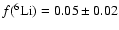
We confirm the presence of 6Li in the star's atmosphere while the updated
value for the isotopic ratio is
 .
.
Key words: stars: abundances - stars: chemically peculiar - line: identification - line: profiles
An interesting opportunity for testing the planet(s) ingestion scenario is offered by the 6Li test (Israelian et al. 2001). This approach is based on looking for an element that should not appear in the atmosphere of a normal star, but would be present in a star that has swallowed a planet. We have proposed recently that a light isotope, 6Li, is an excellent tracer of any planetary matter accretion. The detection of 6Li in HD 82943 by our group (Israelian et al. 2001) was considered as convincing observational evidence that stars may accrete planetary material, or even entire planets, during their main sequence (MS) lifetime. Other explanations (such as stellar flares or surface sports) of this phenomenon were ruled out (Israelian et al. 2001). It has been suggested (Sandquist et al. 2002) that 6Li can be used to distinguish between different giant planet formation theories.
Table 1: Observing log and stellar parameters adopted from the references listed in the last column: (1) Santos et al. (2002), (2) Santos et al. (2001), (3) Santos et al. (2003), (4) Mallik (1999), (5) this article, (6) Boesgaard et al. (2001). The S/N is calculated near 6706.5 Å.
Nuclear reactions destroy the lithium isotopes (6Li and 7Li) in stellar interiors at temperatures (6Li) and
 K (7Li).
Convection cleans the upper atmosphere of Li nuclei by transporting them to deeper,
hotter layers where they are rapidly destroyed. Young low mass stars are entirely
convective and most of the primordial Li nuclei are burned in their interiors
in a mere few million years. However, many solar-type
stars preserve a large fraction of their initial atmospheric 7Li nuclei.
According to standard models (Forestini 1994;
Montalbán & Rebolo 2002), at a given metallicity there is a mass
range, where 6Li but not 7Li is being destroyed. These models predict
that no 6Li can survive pre-MS mixing in metal-rich solar-type stars.
Observations seem to support this scenario since no clear detections of
6Li have been reported in solar-type solar-metallicity stars
(Andersen et al. 1984; Rebolo et al. 1986).
We note, however, that the mass and the depth of the convection zone
also depend on the metal content of the star, and for this reason several
old metal-poor stars have preserved a fraction of their initial 6Li nuclei
(Cayrel et al. 1999; Hobbs et al. 1999).
This suggests that any detected 6Li in a metal-rich solar-type star would most
probably signal an external source for this fragile isotope.
K (7Li).
Convection cleans the upper atmosphere of Li nuclei by transporting them to deeper,
hotter layers where they are rapidly destroyed. Young low mass stars are entirely
convective and most of the primordial Li nuclei are burned in their interiors
in a mere few million years. However, many solar-type
stars preserve a large fraction of their initial atmospheric 7Li nuclei.
According to standard models (Forestini 1994;
Montalbán & Rebolo 2002), at a given metallicity there is a mass
range, where 6Li but not 7Li is being destroyed. These models predict
that no 6Li can survive pre-MS mixing in metal-rich solar-type stars.
Observations seem to support this scenario since no clear detections of
6Li have been reported in solar-type solar-metallicity stars
(Andersen et al. 1984; Rebolo et al. 1986).
We note, however, that the mass and the depth of the convection zone
also depend on the metal content of the star, and for this reason several
old metal-poor stars have preserved a fraction of their initial 6Li nuclei
(Cayrel et al. 1999; Hobbs et al. 1999).
This suggests that any detected 6Li in a metal-rich solar-type star would most
probably signal an external source for this fragile isotope.
Observations of 6Li are extremely difficult for several reasons. First
of all, it is a weak component of a blend of the much stronger doublet
of 7Li with an isotopic separation 0.16 Å. In the case of metal-poor
halo stars with
![$\rm [Fe/H]< -1$](/articles/aa/full/2003/26/aa3161/img22.gif) ,
blending of the Li line with other weak
absorptions is not expected, and also the placement of
continuum does not pose serious problems. 6Li has been unsuccessfully
sought in many metal-poor stars but unambiguously detected in only few
(Hobbs et al. 1999; Cayrel et al. 1999; Nissen et al. 1999).
The methods used in the analysis of 6Li have
been widely discussed in the literature (e.g. Nissen et al. 1999;
Cayrel et al. 1999; Hobbs et al. 1999).
In metal-rich stars the identification of any possible weak blends in the
region of the Li absorption becomes crucial (King et al. 1997).
Recently Reddy et al. (2002) updated the
line list of Lambert et al. (1989) based on the analysis
of the solar spectrum of Kurucz et al. (1984) and Hinkle et al. (2000). They claimed that a previously noticed weak absorption
in the solar spectrum at 6708.025 Å (Müller et al. 1975) belongs to Ti I.
With this assumption their analysis of the Li feature in HD 82943 did not confirm the presence of 6Li.
,
blending of the Li line with other weak
absorptions is not expected, and also the placement of
continuum does not pose serious problems. 6Li has been unsuccessfully
sought in many metal-poor stars but unambiguously detected in only few
(Hobbs et al. 1999; Cayrel et al. 1999; Nissen et al. 1999).
The methods used in the analysis of 6Li have
been widely discussed in the literature (e.g. Nissen et al. 1999;
Cayrel et al. 1999; Hobbs et al. 1999).
In metal-rich stars the identification of any possible weak blends in the
region of the Li absorption becomes crucial (King et al. 1997).
Recently Reddy et al. (2002) updated the
line list of Lambert et al. (1989) based on the analysis
of the solar spectrum of Kurucz et al. (1984) and Hinkle et al. (2000). They claimed that a previously noticed weak absorption
in the solar spectrum at 6708.025 Å (Müller et al. 1975) belongs to Ti I.
With this assumption their analysis of the Li feature in HD 82943 did not confirm the presence of 6Li.
With the goal of establishing the nature of the absorption at 6708.025 Å and better understanding the line list near Li, we have obtained high resolution, high S/N spectra for several metal-rich stars with no detectable Li line. Our targets cover a wide range of effective temperature, allowing a more reliable identification of the lines in the spectral region of the Li feature. We have also obtained new spectra of HD 82943. Here we present new analysis of the 6Li/7Li ratio in HD 82943 and critically discuss the line list of the Li region. Our observations do not confirm the Ti I line of Reddy et al. (2002) and support our previous claim for detection of 6Li.
We used the 8.2 m VLT Kueyen (ESO, La Silla), the UVES spectrograph and an
EEV detector to obtain spectra of HD 82943 during the night of 2001
March 5. The 0.3
 slit yielded a resolving power of
 as measured from the FWHM of Th-Ar lamp lines.
The 4.2 m William Herschel Telescope on La Palma (Canary Islands,
Spain) and the UES spectrograph were used to observe several
solar-type stars with large Li depletions in their atmospheres.
Our first targets were HD 171888 (F8 V), HD 4747 (G8 V), HD 217580 (K4 V),
HD 217107 (G3 V) and HD 210277 (G4 V). These stars were observed
on 2000 July 8. The CCD SITE1 (2148  2148 pixel),
grating E31, slit width 1
(providing a resolving power of 55 000)
and the central wavelength of 5140 Å were used during this run. Our
spectra had an S/N ratio in the range 300-350, which was sufficient
to guarantee the detection of any spectral lines with a minimum
equivalent width of
2148 pixel),
grating E31, slit width 1
(providing a resolving power of 55 000)
and the central wavelength of 5140 Å were used during this run. Our
spectra had an S/N ratio in the range 300-350, which was sufficient
to guarantee the detection of any spectral lines with a minimum
equivalent width of  1.5 mÅ. These data were used by us
(Israelian et al. 2001)
in order to check the presence of blends near 6708 Å with the EW
larger than 1.5 mÅ. More targets (Table 1) have been observed
in order to reduce this limit to below 1 mÅ. The same configuration was
used in 2001 October to observe HD 16141, HD 22049, HD 75732A and HD 217107.
In the next observing run (2002 June 20), we used a
1.5 mÅ. These data were used by us
(Israelian et al. 2001)
in order to check the presence of blends near 6708 Å with the EW
larger than 1.5 mÅ. More targets (Table 1) have been observed
in order to reduce this limit to below 1 mÅ. The same configuration was
used in 2001 October to observe HD 16141, HD 22049, HD 75732A and HD 217107.
In the next observing run (2002 June 20), we used a
 2048-pixel EEV CCD
with a pixel size of 15
2048-pixel EEV CCD
with a pixel size of 15  m, the E31 grating, a slit width of 1
and a
central wavelength of 7215 Å. Ten exposures of HD 82943 were taken on
2001 February 5 with a mosaic of two EEVs, the E79 grating and a slit width of
0.7
in order to obtain a high quality of spectrum of this star.
m, the E31 grating, a slit width of 1
and a
central wavelength of 7215 Å. Ten exposures of HD 82943 were taken on
2001 February 5 with a mosaic of two EEVs, the E79 grating and a slit width of
0.7
in order to obtain a high quality of spectrum of this star.
The SARG high resolution echelle spectrograph at the 3.5 m Telescopio Nazionale
Galileo (La Palma) was used during two runs in 2001 August and 2002 May.
The spectra were obtained with the yellow grism and span the wavelength
range 4600-7820 Å at a resolving power of 57 000. The CCD was a
mosaic of two
 -pixel EEVs with a pixel size of 15 m.
All our VLT/UVES, WHT/UES and TNG/SARG spectra were reduced using
standard IRAF routines. Normalized flats created for each observing night were
used to correct the pixel-to-pixel variations and a Th-Ar lamp was used
to find a dispersion solution.
Some observations were made with the FEROS spectrograph
at the ESO 1.52 m telescope in La Silla. The mosaic of two
-pixel
EEV CCDs were used to observe HD 1461 and HD13 445 on 2000 November 10
and HD 192263 on 2001 October 31. The spectra were flatfielded,
calibrated with a Th-Ar lamp and reduced using MIDAS routines.
In this article we used models of atmospheres provided by Kurucz (1992) and the spectrum synthesis code MOOG (Sneden 1973). We have compared abundances of various elements computed with our atmospheric models and with those used by Reddy et al. (1999) (i.e. Kurucz 1995). We found that differences induced in the abundances by the two types of models are less than 0.01 dex and can therefore be neglected. Solar abundances of chemical elements were taken from Anders & Grevesse (1989). We have also made an extensive use of the VALD database (Kupka et al. 1999). The parameters of some of the planet host stars listed in Table 1 were slightly updated with respect to the values given in Santos et al. (2001, 2002). Three stars in our sample (HD 1461, HD 198084 and HD 200790) are not known to harbour planets and were observed because of the absence of Li. We have attempted to estimate the parameters of a cool subgiant, HD 137759, from the set of Fe lines used in our previous analysis (Santos et al. 2001). However, given the low temperature of this object, our final values had large error bars and we have decided to use the parameters based on colours and accurate parallax measurement from Hipparcos (Mallik 1999). Two Li-poor dwarfs, HD 198084 and HD 200790, were taken from Boesgaard et al. (2001). The parameters of HD 200790 were estimated in the same way as for the other stars in our sample. HD 198084 is a metal-rich F8IV-V (Boesgaard et al. 2001; Malagnini et al. 2000) spectroscopic binary (Griffin 1990). The iron lines in our spectrum were strongly blended owing to the presence of the second star and we did not make a new estimate of the stellar parameters.
Accurate measurements of the wavelengths and oscillator strengths of the Li lines
are available in the literature (Sansonetti et al. 1995).
Unidentified blends in the Li region of the Sun and other cool stars have been
discussed by several authors (Müller et al. 1975;
Lambert et al. 1989; Andersen et al. 1984;
King et al. 1997).
Müller et al. (1975) were the first to notice the weak feature at
6708.025
Å in the solar spectrum and attributed it to the Si I line with
 ,
,
 eV. The line list of Lambert et al. (1989) has
been extensively discussed and modified by King et al. (1997).
Following Müller et al. (1975),
these authors used a fictitious high excitation Si I line with
eV. The line list of Lambert et al. (1989) has
been extensively discussed and modified by King et al. (1997).
Following Müller et al. (1975),
these authors used a fictitious high excitation Si I line with
 eV in order to account for the weak absorption in the
spectrum synthesis.
eV in order to account for the weak absorption in the
spectrum synthesis.
The line was also considered by Nissen et al. (1999)
in their analysis of metal-poor disc stars. According to Nissen et al. (1999),
the equivalent width (EW) of the 6708.025 Å absorption is 0.6 mÅ in the solar
spectrum. Reddy et al. 's (2002) identification of this absorption with the
Ti line
(
 ,
,
 )
implies a slightly different value EW = 0.75 mÅ.
While this feature is too weak to affect the determination of the Li isotopic
ratio in metal-poor halo stars (where it certainly disappears), it may
cause problems in solar metallicity or more metal-rich stars.
Apart from this unidentified feature, there are other weak lines of
Cr I 6707.64 Å, Ce I 6707.74 Å and CN 6707.816 Å
with uncertain gf values. It is interesting that the best synthetic spectra fits
to the Li region of different stars can be achieved only by altering the gf values
of these weak lines by different amounts. This led King et al. (1997)
to propose
that various uncertainties in the analysis of the solar spectrum
allow Li isotopic ratios as high as 0.1.
)
implies a slightly different value EW = 0.75 mÅ.
While this feature is too weak to affect the determination of the Li isotopic
ratio in metal-poor halo stars (where it certainly disappears), it may
cause problems in solar metallicity or more metal-rich stars.
Apart from this unidentified feature, there are other weak lines of
Cr I 6707.64 Å, Ce I 6707.74 Å and CN 6707.816 Å
with uncertain gf values. It is interesting that the best synthetic spectra fits
to the Li region of different stars can be achieved only by altering the gf values
of these weak lines by different amounts. This led King et al. (1997)
to propose
that various uncertainties in the analysis of the solar spectrum
allow Li isotopic ratios as high as 0.1.
![\begin{figure}
\par\includegraphics[angle=270,width=13cm,clip]{Fig1.ps}\end{figure}](/articles/aa/full/2003/26/aa3161/img34.gif) |
Figure 1: High resolution and high S/N spectra of the Sun and Arcturus in the Li region. The unidentified feature is centred on 6708.025 Å in the Sun but appears at 6708.094 Å in the spectrum of Arcturus. |
| Open with DEXTER | |
Most of the lines in the list of Reddy et al. (2002) come from the original
compilation of Lambert et al. (1989). However, the Ti I 6707.752 Å
line was not listed in any of the references cited by Reddy et al. (2002).
On the other hand, the V I 6707.563 Å line in the list of Reddy et al. (2002)
appears under 6707.518 Å in the VALD-2 database (Kupka et al. 1999).
The gf values of many lines have been modified by Reddy et al. (2002)
in order to fit the solar spectra of Kurucz et al. (1984), Hinkle et al. (2000) and
16 Cyg B. In most cases there is a clear disagreement with the list
of King et al. (1997), who employed
the same spectrum synthesis code, model atmospheres and, as a matter of fact,
the same targets (i.e. the Sun and 16 Cyg B). Despite this, King et al. (1997)
found for CN 6707.816 Å
 while Reddy et al. (2002)
arrived at
while Reddy et al. (2002)
arrived at
 .
Futhermore, King et al. (1997) have
considerably increased the
.
Futhermore, King et al. (1997) have
considerably increased the  value of a Ce II line at 6707.74 Å and
obtained
value of a Ce II line at 6707.74 Å and
obtained
 while Reddy et al. (2002) decreased it to
-0.8 dex after
Lambert et al. (1993) and obtained a value
while Reddy et al. (2002) decreased it to
-0.8 dex after
Lambert et al. (1993) and obtained a value
 .
The V I
6708.07 Å line with
.
The V I
6708.07 Å line with
 from Lambert et al. (1989) appears
under V I 6708.094 Å with
from Lambert et al. (1989) appears
under V I 6708.094 Å with
 in the list of
Reddy et al. (2002).
The latter took it from the list available in the web site of R. Kurucz.
The gf values of the Cr I 6707.64 Å line in King et al. (1997) and
Reddy et al. (2002) differ by 0.14 dex. The source of these discrepances was not
investigated by Reddy et al. (2002).
in the list of
Reddy et al. (2002).
The latter took it from the list available in the web site of R. Kurucz.
The gf values of the Cr I 6707.64 Å line in King et al. (1997) and
Reddy et al. (2002) differ by 0.14 dex. The source of these discrepances was not
investigated by Reddy et al. (2002).
Our own synthesis of the solar spectrum suggests gf values close to those proposed
by King et al. (1997). For example, when doing a synthesis of 6Li in
HD 82943 (Israelian et al. 2001) we set
 for the CN 6707.816 Å line,
which is similar to
,
as found by King et al. (1997). In addition to these weak lines,
there is a Ti I line at 6707.964 Å with
eV and
for the CN 6707.816 Å line,
which is similar to
,
as found by King et al. (1997). In addition to these weak lines,
there is a Ti I line at 6707.964 Å with
eV and
 ,
which
appears in the VALD-2 database. This fact probably led Reddy et al. (2002) to assume that the feature at 6708.025 Å also belongs to Ti
and has a similar excitation energy but much larger oscillator strength. For some reason
Reddy et al. (2002) did not incorporate the Ti line at 6707.964 Å in their
final list. The two Ti I lines at 6708.025 and 6708.125 Å of Reddy et al. (2002) have never been tested in stars other than the Sun and 16 Cyg B.
,
which
appears in the VALD-2 database. This fact probably led Reddy et al. (2002) to assume that the feature at 6708.025 Å also belongs to Ti
and has a similar excitation energy but much larger oscillator strength. For some reason
Reddy et al. (2002) did not incorporate the Ti line at 6707.964 Å in their
final list. The two Ti I lines at 6708.025 and 6708.125 Å of Reddy et al. (2002) have never been tested in stars other than the Sun and 16 Cyg B.
It is clear that the Li line list in the solar spectrum is not well calibrated. Different authors obtain different adjusted gf values even when they use the same tools and spectra. Our goal is not to make a better fit to the solar Li region since this does not guarantee a unique identification of the spectral lines. Instead, we have decided to use the same list as Reddy et al. (2002) and see if we can explain observations of stars other than the Sun and 16 Cyg B.
Table 2:
Abundance of Ti (Col. 4) as derived from the EWs of two
Ti II
lines (Cols. 2 and 3) measured in our spectra. The EW of the unidentified feature
(Col. 5) at 6708.025 Å was computed assuming that it is due to the Ti line of
Reddy et al. (2002) with abundances from Col. 4. Observed EWs of
unidentified
line are listed in Col. 5 with 3  errors estimated using a Cayrel
formulae
(Cayrel 1988). Values in parentheses in Col. 6 indicate that the line
is not
centred on
errors estimated using a Cayrel
formulae
(Cayrel 1988). Values in parentheses in Col. 6 indicate that the line
is not
centred on
 Å. The last two columns provide the Si abundance in our
stars from
Bodaghee et al. (2003) and the EW of the unidentified feature assuming that it
belongs
to Si I with eV and
Å. The last two columns provide the Si abundance in our
stars from
Bodaghee et al. (2003) and the EW of the unidentified feature assuming that it
belongs
to Si I with eV and
 .
It is not clear if the
6708.025 Å feature in HD 200790 is real.
.
It is not clear if the
6708.025 Å feature in HD 200790 is real.
The unidentified line at 6708.025 Å is
clearly seen in the solar spectrum (Fig. 1).
In the same figure we show a small spectral window from McDonald's
atlas of a K III giant Arcturus observed with a resolving power
150 000 and
 (Hinkle et al. 2000). Most of the absorptions
in this small region appear in the spectra of both stars, which have very different
temperature, gravity and metallicity. It is interesting that the feature
at 6708.025 Å does not become stronger in Arcturus. It may still
exist in the spectrum but is severely blended with a strong absorption
centred at 6708.094 Å.
(Hinkle et al. 2000). Most of the absorptions
in this small region appear in the spectra of both stars, which have very different
temperature, gravity and metallicity. It is interesting that the feature
at 6708.025 Å does not become stronger in Arcturus. It may still
exist in the spectrum but is severely blended with a strong absorption
centred at 6708.094 Å.
The line at 6708.094 Å is certainly not a redshifted Ti I 6708.025 Å of Reddy et al. (2002). It also cannot be one of the TiO lines observed in much cooler stars (Luck 1977) and taken into account in our synthesis of three cool giants. The wavelength of this line corresponds to the V I at 6708.094 Å in the VALD-2 database and also appears in the list of Reddy et al. (2002) but with an oscillator strength that does not fit observations of Arcturus and other cool giants. Both wings of this line are disturbed by blends. The figure also demonstrates that blending is not the only problem in these studies. The exact location of the stellar continuum becomes a critical issue when we deal with absorption features as small as 1 mÅ.
We know that echelle spectra are not calibrated in the absolute flux scale, and that, therefore, the placement of local continuum levels is either visually estimated after fitting the extracted spectra with polynomials, or results from a detailed spectral synthesis. We have marked several points (C1-C6) in Fig. 1. which indicate very narrow windows theoretically free from spectral lines. These windows are used in metal-poor stars to make a fine tuning of the continuum and estimate the S/N. Points C1, C2, C5 and C6 mark the solar continuum fitted by Kurucz et al. (1984). We do not know how the continuum was placed in Arcturus but it appears from the figure that only C5 and C6 can be considered as continuum points. Neither is it clear whether C2 and C4 are continuum points in the solar spectrum. The point C3 lies on the continuum in those stars that do not have CN and Li absorptions at 6707.78 Å. The strength of the unknown line at 6708.025 Å and the V I absorption at 6708.28 Å define whether or not C4 is placed on the local continuum. The region between C2 and the Si I line at 6707.01 Å is depressed in the solar spectrum as well as in the spectra of many other stars probably owing to some weak, still unknown, blends that start to appear in cool and very metal-rich stars (e.g. HD 145675 in Fig. 2). Depending on the exact location of the points C1-C6 one may derive different EW values for the unidentified feature at 6708.025 Å. However, as we will show below, even this uncertainty does not smear the huge differences between observations and spectrum synthesis when the Ti line of Reddy et al. (2002) is considered.
![\begin{figure}
\par\includegraphics[angle=270,width=8.8cm,clip]{Fig2.ps}\end{figure}](/articles/aa/full/2003/26/aa3161/img48.gif) |
Figure 2: Observed (filled small squares) and synthetic spectra of three metal-rich stars: HD 217107, HD 75732A and HD 145675. The Ti abundances were computed for [Ti/H] = 0 (thin continuous), 0.2 (dashed), 0.4 (thick continuous) in HD 217107, [Ti/H] = 0 (thin continuous), 0.15 (dashed), 0.3 (thick continuous) in HD 75732A and [Ti/H] = 0 (thin continuous), 0.2 (dashed), 0.4 (thick continuous) in HD 145675. |
| Open with DEXTER | |
 (Santos et al. 2000).
In any case, even if we suppose that
our Ti abundances are uncertain by up to 0.3 dex (which is very unlikely, given
the errors considered in this work), this will not change our final
conclusion regarding the reliability of the line proposed by Reddy et al. (2002).
(Santos et al. 2000).
In any case, even if we suppose that
our Ti abundances are uncertain by up to 0.3 dex (which is very unlikely, given
the errors considered in this work), this will not change our final
conclusion regarding the reliability of the line proposed by Reddy et al. (2002).
Using the abundances from the Ti II lines, we have estimated
the EW of the feature at 6708.025 Å, assuming that it belongs to the line
proposed by Reddy et al. (2002). Predicted and observed EWs of the Ti line
are listed in Table 2. We see an obvious disagreement at low
:
the predicted line is much stronger than the observed one. In Fig. 2 we show spectrum
synthesis for three metal-rich stars with different parameters. The abundances of
V, C, Si and other elements were scaled with Fe and then modified by small
amounts (always less than 0.1 dex) in order to fit the observations.
HD 217107, with
 K, is more similar to the Sun
than the two other stars and apparently for this reason the agreement between
predicted and observed profiles of 6708.025 Å is good. There is small room
for making adjustments in continuum level in order to accommodate [Ti/H] = 0.3 and
fit the observations. This plot alone cannot be used to argue against the
identification proposed by Reddy et al. (2002). As a matter of fact,
the observed and predicted EWs of the Ti line agree within errors in HD 217107
(Table 2). The discrepancy is larger in cooler objects HD 145675 and HD 75732A.
K, is more similar to the Sun
than the two other stars and apparently for this reason the agreement between
predicted and observed profiles of 6708.025 Å is good. There is small room
for making adjustments in continuum level in order to accommodate [Ti/H] = 0.3 and
fit the observations. This plot alone cannot be used to argue against the
identification proposed by Reddy et al. (2002). As a matter of fact,
the observed and predicted EWs of the Ti line agree within errors in HD 217107
(Table 2). The discrepancy is larger in cooler objects HD 145675 and HD 75732A.
![\begin{figure}
\par\includegraphics[angle=270,width=8.8cm,clip]{Fig3.ps}\end{figure}](/articles/aa/full/2003/26/aa3161/img50.gif) |
Figure 3: Observed (filled small squares) and synthetic spectra of the Arcturus, HD 177830 and HD 137759. The Ti abundances were computed for [Ti/H] = -0.2 (thin continuous), -0.3 (dashed), -0.5 (thick continuous) in Arcturus, [Ti/H] = -0.2 (thin continuous), 0.0 (dashed), 0.3 (thick continuous) in HD 177830 and [Ti/H] = -0.4 (thin continuous), 0.0 (dashed), 0.4 (thick continuous) in HD 137759. |
| Open with DEXTER | |
= 5000-5400 K.
It should be possible to separate them in very high resolution and high
S/N spectra of stars with intrinsically narrow absorption lines.
When estimating the EW of the Ti line in HD 82943 we found another disagreement with Reddy et al. (2002), who state that the combined strength of the two Ti I lines (6708.025 and 6708.125 Å) in the spectrum of HD 82943 is 2.2 mÅ, while our analysis using exactly the same tools and parameters shows 1.1 mÅ, in which the 6708.125 Å line contributes only 0.2 mÅ. The same disagreement appears when we consider the solar spectrum. Using the list of Reddy et al. (2002), we found that the EWs of the Ti I lines at 6708.025 and 6708.125 Å are 0.75 and 0.17 mÅ, respectively. Thus, the combined EW = 0.92 mÅ is at odds with the 1.5 mÅ claimed by Reddy et al. (2002).
![\begin{figure}
\par\includegraphics[angle=270,width=8.8cm,clip]{Fig4.ps}\end{figure}](/articles/aa/full/2003/26/aa3161/img51.gif) |
Figure 4: The unidentified feature at 6708.025 Å has EW < 1 mÅ in HD 198084 and HD 200790. |
| Open with DEXTER | |
We have attempted a new identification of the 6708.025 Å feature knowing that the strength of the line does not increase towards cooler temperatures. It is clear that any molecular or a low excitation line from a neutral metal will behave like the Ti line of Reddy et al. (2002). Since this is not observed, we are left with two possibilities. Either the transition belongs to an ion, or it is produced by a neutral element with a high excitation energy of the lower level.
The most abundant ions at these temperatures belong to Fe, Si, Mg, Ca and Ti. Reliable
experimental line lists exist for all of these ions and are available
in VALD-2. Most of the Si II lines in the Li region have very high excitation
energies of between 10-16 eV. The same is true for Mg II
( = 11-13 eV) and Ca II (
= 7-9.7 eV). Ti II has
several transitions with
= 1.9-3.1 eV. A Ti II line with
= 1.9 eV
and
= 11-13 eV) and Ca II (
= 7-9.7 eV). Ti II has
several transitions with
= 1.9-3.1 eV. A Ti II line with
= 1.9 eV
and
 will reproduce the solar feature with EW = 0.75 mÅ.
This line will also fit the spectra of the coolest objects in our sample, such
as HD 137759 and HD 177830, where it will be weaker than 2 mÅ. In HD 82943
it will have EW = 1.1 mÅ, which is not really different from the strength of
the neutral Ti line (0.9 mÅ). However, small discrepancies may appear in hotter
stars. For example, given the Ti abundance in HD 200790, we anticipate about
1 mÅ absorption which we think is not observed in the high S/N spectrum
(Fig. 4).
The marginal feature observed at 6708.028 Å is about 0.6 mÅ and it is hard to
judge by eye if it is real. On the upper panel of the same graph we show the
spectrum of HD 198084. Unfortunately, this star is in a binary
system and we cannot make any strong statements regarding the strength of
the unidentified absorption. However, we would still expect to see the blend
of two unidentified lines at 6708.025 Å. In fact, there is a broad absorption
around 6708.0 Å, most probably caused by the shifted unidentified lines but its
EW does not exceed 1 mÅ.
will reproduce the solar feature with EW = 0.75 mÅ.
This line will also fit the spectra of the coolest objects in our sample, such
as HD 137759 and HD 177830, where it will be weaker than 2 mÅ. In HD 82943
it will have EW = 1.1 mÅ, which is not really different from the strength of
the neutral Ti line (0.9 mÅ). However, small discrepancies may appear in hotter
stars. For example, given the Ti abundance in HD 200790, we anticipate about
1 mÅ absorption which we think is not observed in the high S/N spectrum
(Fig. 4).
The marginal feature observed at 6708.028 Å is about 0.6 mÅ and it is hard to
judge by eye if it is real. On the upper panel of the same graph we show the
spectrum of HD 198084. Unfortunately, this star is in a binary
system and we cannot make any strong statements regarding the strength of
the unidentified absorption. However, we would still expect to see the blend
of two unidentified lines at 6708.025 Å. In fact, there is a broad absorption
around 6708.0 Å, most probably caused by the shifted unidentified lines but its
EW does not exceed 1 mÅ.
We have studied a spectrum of the hot Li-poor star
HR 7697 (
 K,
K,  = 4,24, [Fe/H] = 0.01) with
 kindly provided by Ann Boesgaard (Boesgaard et al. 2001).
The ionized line of Ti in this object would produce about 1 mÅ absorption, which
we could not find in the data. These tests make the idea of an ionized Ti line
less attractive, although, given the errors in the data and our analysis, we
still cannot completely rule out this possibility. We also note that it will be
much harder to identify the line if it belongs to an ion of an element
whose abundance does not scale with Fe.
kindly provided by Ann Boesgaard (Boesgaard et al. 2001).
The ionized line of Ti in this object would produce about 1 mÅ absorption, which
we could not find in the data. These tests make the idea of an ionized Ti line
less attractive, although, given the errors in the data and our analysis, we
still cannot completely rule out this possibility. We also note that it will be
much harder to identify the line if it belongs to an ion of an element
whose abundance does not scale with Fe.
Rare Earth elements were also considered. The best candidates are perhaps
two Ce II lines listed in the DREAM database
(http://www.umh.ac.be/ astro/dream.shtml)
with wavelengths 6708.077 and 6708.099 Å. The lines are weak (
 and
and
 )
and have excitation energies
)
and have excitation energies  = 2.25 and 0.7 eV,
respectively.
Let us suppose that the 6708.077 Å line is responsible for the feature at
6708.025 Å.
The 6708.077 Å absorption is absolutely negligible in the solar spectrum, and in
order to produce 0.7 mÅ it must have
= 2.25 and 0.7 eV,
respectively.
Let us suppose that the 6708.077 Å line is responsible for the feature at
6708.025 Å.
The 6708.077 Å absorption is absolutely negligible in the solar spectrum, and in
order to produce 0.7 mÅ it must have
 .
This very large correction
is not
allowed by accurate radiative lifetime measurements (Zhang et al. 2001). If we
still suppose that the adjustment is possible, these two lines will produce about
4 mÅ absorption in Arcturus. However, the synthetic spectra will not reproduce
the observed profile at 6708.094 Å unless we modify the wavelengths. In brief,
we can hardly force these two lines of Ce II to explain observations.
.
This very large correction
is not
allowed by accurate radiative lifetime measurements (Zhang et al. 2001). If we
still suppose that the adjustment is possible, these two lines will produce about
4 mÅ absorption in Arcturus. However, the synthetic spectra will not reproduce
the observed profile at 6708.094 Å unless we modify the wavelengths. In brief,
we can hardly force these two lines of Ce II to explain observations.
Our synthetic spectra also demonstrate that the gf values of V I lines at 6708.094 and 6708.280 Å in the list of Reddy et al. (2002) do not explain observations of HD 137759, HD 177830 and Arcturus (Fig. 3) assuming that the abundance of V scales with Fe (Sadakane et al. 2002). Our tests show that even adopting [V/Fe] = -0.5 in these stars, we still cannot fit the feature at 6708.280 Å. Such low abundances of V are excluded from the analysis of other spectral lines. On the other hand, the fit to the same line in HD 82943 was achieved by boosting the abundance to [V/H] = 0.8. This high value is ruled out from a synthesis of different V I lines. We faced similar problem for the line at 6708.094 Å but in the opposite direction. The newly added Ti I line at 6708.125 Å in the list of Reddy et al. (2002) cannot salvage the situation as it appears too weak in our targets. We also note that the V I line at 6708.280 Å does not appear in the VALD-2 database (Kupka et al. 1999).
Table 3:
Mean abundance [Si/H] = 0.27  0.02 was computed from 11 Si lines
observed in
VLT/UVES and WHT/UES spectra
of HD 82943.
0.02 was computed from 11 Si lines
observed in
VLT/UVES and WHT/UES spectra
of HD 82943.
Given the large number of high excitation Si lines in the Li region
(see VALD-2 database), we have decided to test if the Si line at 6708.025 Å
proposed by
Müller et al. (1975) can explain our observations. In fact,
the high excitation Si line that appears at 6707.01 Å (Fig. 1) is very
similar to the one proposed by Müller et al. (1975). It behaves exactly
in the same way in stars with different temperatures as the absorption at
6708.025 Å.
Given the EW (= 0.75 mÅ) of the 6708.025 Å feature in the solar spectrum,
we have estimated
for the Si I line with
eV proposed
by Müller et al. (1975). Our gf value is slightly different from that
of Müller et al. (1975) owing to the differences in the model atmospheres
and the adopted abundance of Si (Anders & Grevesse 1989),
which is 0.05 larger
than the value used by Müller et al. (1975). We have computed the Si
abundance in our stars using the lines from Bodaghee et al. (2003) listed in Table 3.
The new list is an
extended and improved version of the one considered by Santos et al. (2000).
The abundance errors were always less than 0.07 dex and do not affect our
analysis. Predicted EWs of the Si line are listed in the last column. As we can
see, there is good agreement between observations and synthesis.
In conclusion, we think it is more likely that the spectral feature at 6708.025 Å belongs to a high excitation transition of some neutral atom. The small spectral window near 6708 Å contains many high excitation Si lines; therefore, the identification proposed by Müller et al. (1975) seem to be the best choice. However, we cannot rule out the possibility that the 6708.025 Å line belongs to an ion or to a rare element. More high quality observations are necessary to tackle this problem.
HD 82943 was newly observed at VLT/UVES with a resolving power 105 000 and a
signal-to-noise ratio close to 1000. Reanalysis of the 6Li/7Li ratio
has been carried out using the same tools as in Israelian et al. (2001) and the
line list of Reddy et al. (2002). The only change we have made in this
list is a replacement of the Ti I line at 6708.025 Å by the high excitation
Si I line with
and
= 6 eV. This change does not
help in giving a higher 6Li/7Li ratio in HD 82943 since the EW of the
Si I line in HD 82943 is even larger than that of the Ti
of Reddy et al. 2002 (see Table 2). Furthermore, an accurate
abundance of Si in HD 82943 needs to be calculated. For this purpose we have
used eleven Si lines from Table 3 and computed their EWs using
very high S/N spectra obtained with VLT/UVES and WHT/UES. In Table 3
we list the lines, measurements and resulting abundances. We found
![$\rm [Si/H] = 0.27 \pm 0.02$](/articles/aa/full/2003/26/aa3161/img60.gif) in excellent agreement with the value given by
Sadakane et al. (2002) after accounting for differences in stellar
parameters.
in excellent agreement with the value given by
Sadakane et al. (2002) after accounting for differences in stellar
parameters.
The identification of the chemical element is also important, although Reddy et al. (2002) have ignored this point by stating that the identification of the pair as Ti I is not critical to the analysis. The EWs of the Ti line of Reddy et al. (2002) are 0.45 and 0.9 mÅ in HD 82943 for [Ti/H] = 0 and [Ti/H] = 0.3, respectively. This factor of 2 difference in the EWs is equal to 0.05 correction in 6Li/7Li ratio if the total EW of the Li line is 10 mÅ. This is a significant difference, and given the fact that in many stars [Ti/H] can be larger than 0.3, the abundance correction may affect the 6Li/7Li ratios by at least 0.03 dex, depending on the strength of the 7Li line.
![\begin{figure}
\par\includegraphics[angle=270,width=8.8cm,clip]{Fig5.ps}\end{figure}](/articles/aa/full/2003/26/aa3161/img61.gif) |
Figure 5:
The spectrum of HD 82943 (small filled squares) and two synthetic spectra
computed without Li. The first synthesis (solid line) is computed without CN,
and assuming [Si/H] = 0.1 and [V/H] = 0.3. Computations with [C/H] = [N/H] = 0.35,
[Si/H] = 0.27 and
![$\rm [V/H] = 0.8$](/articles/aa/full/2003/26/aa3161/img8.gif) are presented with a dashed line. The position of the
6Li line is indicated.
are presented with a dashed line. The position of the
6Li line is indicated. |
| Open with DEXTER | |
To demonstrate the blending of the Si and CN lines in the Li feature
of HD 82943, we have computed synthetic spectra without considering
any of the Li isotopes. Figure 5 shows that CN and Si make a significant
contribution to the total EW of the Li line. Given the high C and N
content of HD 82943 (Santos et al. 2000; Sadakane et al. 2002)
one may consider the abundances of these elements as free parameters in the
 analysis.
The strength of the Si line may affect the synthesis as well. It is
also important to realize that this line cannot exactly mimic the 6Li
component at 6708.0728 Å because their wavelengths differ by 0.05 Å.
analysis.
The strength of the Si line may affect the synthesis as well. It is
also important to realize that this line cannot exactly mimic the 6Li
component at 6708.0728 Å because their wavelengths differ by 0.05 Å.
In obtaining the broadening parameters we used the same Fe I lines
as in our first paper (Israelian et al. 2001). From the
analysis of
two Fe lines (Fig. 6) we obtained a mean
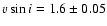 km s-1 and
 km s-1, in good agreement with our previous results
and also with those of Reddy et al. (2002). The synthetic spectra were
also convolved with a
Gaussian function representing the instrumental profile. Given the low
rotational velocity in HD 82943, it is possible to obtain fits using simple
Gaussian functions.
As we have noticed before (Israelian et al. 2001, see also
Reddy et al. 2002), the final values of 6Li/7Li
are not affected by using a pure Gaussian broadening function. Average
broadening parameters obtained from the Fe lines were used to derive
the 6Li/7Li ratio.
km s-1, in good agreement with our previous results
and also with those of Reddy et al. (2002). The synthetic spectra were
also convolved with a
Gaussian function representing the instrumental profile. Given the low
rotational velocity in HD 82943, it is possible to obtain fits using simple
Gaussian functions.
As we have noticed before (Israelian et al. 2001, see also
Reddy et al. 2002), the final values of 6Li/7Li
are not affected by using a pure Gaussian broadening function. Average
broadening parameters obtained from the Fe lines were used to derive
the 6Li/7Li ratio.
![\begin{figure}
\par\includegraphics[width=7.65cm,clip]{Fig6.ps}\end{figure}](/articles/aa/full/2003/26/aa3161/img64.gif) |
Figure 6:
Observed and computed profiles of two Fe lines and results of
analysis. Filled dots in the upper panel are observations and continuous lines are
synthetic spectra derived from the
analysis. Dashed and solid lines in
the lower panel are the
analysis of Fe I 6703.6 and 6705.1 Å
lines, respectively. |
| Open with DEXTER | |
analysis of the 6Li/7Li ratio
in HD 82943 were the total abundance of Li, the wavelength shift,
the 6Li fraction and the position of the continuum.
The final 6Li/7Li ratio is not strongly affected by the blue CN absorption,
and after few a iterations we fixed the CN abundance equal to [C/H] = [N/H] = 0.35.
Small adjustments of the continuum level not exceeding 0.2% (given the S/N
of the spectrum) were allowed to optimize the fits. The abundance of the Si line was
also considered as a free parameter in the range [Si/H] = 0.27
0.1 but after a few
iterations it was fixed to [Si/H] = 0.27. Additional computations
were carried out allowing for large variations of  and
and
 exceeding the 3
limit derived from the Fe lines. We found that these
effects do not change our final results. The minimum
was derived by
optimizing all free parameters for each value. The new analysis using
Reddy et al.'s (2002) line list and the Si line yields
(Fig. 8, left panel).
The best fit for f(6Li) = 0 has an rms of 2.869
10-3, which is significantly
larger than the rms (
exceeding the 3
limit derived from the Fe lines. We found that these
effects do not change our final results. The minimum
was derived by
optimizing all free parameters for each value. The new analysis using
Reddy et al.'s (2002) line list and the Si line yields
(Fig. 8, left panel).
The best fit for f(6Li) = 0 has an rms of 2.869
10-3, which is significantly
larger than the rms (
 )
of the best fit with f(6Li) = 0.05.
Wavelength offsets in the best fits for
)
of the best fit with f(6Li) = 0.05.
Wavelength offsets in the best fits for
 and f(6Li) = 0.05
were -0.65 km s-1 and -0.44 km s-1, respectively. These values
agree perfectly with those reported by Cayrel et al. (1999) in their 6Li/7Li analysis
of the halo star HD 84937. The synthetic and the observed profiles for two cases
are shown in Fig. 7. Given the strength of the Li line (about 50 mÅ), these shifts are
consistent with observations of Fe lines in the solar spectrum
(Allende Prieto & García López 1998). Since the scatter of the velocity
shifts of Fe lines in the solar spectrum is large (ranging from
-0.8 to 0.2 km s-1), one cannot make any predictions for the blueshifts
of the Li lines based on a statistical trend observed for the solar Fe lines.
So the best option still remains to keep the wavelength shift of the Li line
as a free parameter.
and f(6Li) = 0.05
were -0.65 km s-1 and -0.44 km s-1, respectively. These values
agree perfectly with those reported by Cayrel et al. (1999) in their 6Li/7Li analysis
of the halo star HD 84937. The synthetic and the observed profiles for two cases
are shown in Fig. 7. Given the strength of the Li line (about 50 mÅ), these shifts are
consistent with observations of Fe lines in the solar spectrum
(Allende Prieto & García López 1998). Since the scatter of the velocity
shifts of Fe lines in the solar spectrum is large (ranging from
-0.8 to 0.2 km s-1), one cannot make any predictions for the blueshifts
of the Li lines based on a statistical trend observed for the solar Fe lines.
So the best option still remains to keep the wavelength shift of the Li line
as a free parameter.
![\begin{figure}
\par\includegraphics[width=7.8cm,clip]{Fig7.ps}\end{figure}](/articles/aa/full/2003/26/aa3161/img69.gif) |
Figure 7: Comparison of the observed (filled large dots) and synthetic spectra of HD 82943 corresponding to 6Li/7Li = 0.05 (continuous) and 6Li/7Li = 0 (dotted) isotopic ratios. They correspond to the best fits with f(6Li) = 0 and a wavelength offset of -0.65 km s-1 (small dots) and to the f(6Li) = 0.05 with a wavelength offset of -0.44 km s-1 (continuous line). Fits to the blue wing of the Li profile can be improved if we adopt the wavelengths of CN lines from Brault & Müller (1975). The CN lines observed in the arc spectrum by these authors appear at 6707.55 Å while Reddy et al. (2002) and Lambert et al. (1993) list them between 6707.464 and 6707.529 Å. The residuals (O-C) of the observations after subtraction of the synthetic spectra are shown. |
| Open with DEXTER | |
![\begin{figure}
\par\includegraphics[width=8.8cm,clip]{Fig8.ps}\end{figure}](/articles/aa/full/2003/26/aa3161/img70.gif) |
Figure 8:
Results from the
analysis for the 6Li/7Li ratio.
 ,
and 9 correspond to 1,2 and 3
confidence
limit is (dotted lines). Continuum adjustments were allowed
within 0.2 ,
and 9 correspond to 1,2 and 3
confidence
limit is (dotted lines). Continuum adjustments were allowed
within 0.2 (left panel) and 0.5
(right panel).
(left panel) and 0.5
(right panel). |
| Open with DEXTER | |
The minimum
is not affected by large variations in the continuum either.
Relaxing the upper limit of continuum change from 0.2 to 0.5% does not change
our conclusion (Fig. 8, right panel). The final value of f(6Li) is also not
sensitive to the Si abundance. If we repeat the analysis fixing the continuum but
changing the abundance of Si, we will find that the best fit to the observed
profile is achieved for [Si/H] = 0.27 (Fig. 9, right panel). The same analysis for
f(6Li) = 0 yields [Si/H] = 0.51 (Fig. 9, left panel). Such a high abundance of Si
is ruled out by our data. However, even if we assume that it is possible,
the quality of the fit when f(6Li) = 0.05 and [Si/H] = 0.27 is about 4 times better
(i.e.
is smaller) compared with the case when f(6Li) = 0.0 and
[Si/H] = 0.51. On the other hand, the Si I line may suffer from convective
blueshifts as well. To account for this effect, we have repeated the
analysis considering the wavelength of the Si line as another free parameter.
We found that the effect is very small. For example, when f(6Li) = 0.05, the
-8 mÅ wavelength shift will introduce a negligible change in
of about
5%. This would also imply a small increase in the Si abundance equal to [Si/H] = 0.31.
These changes do not affect our final results.
![\begin{figure}
\par\includegraphics[width=8.7cm,clip]{Fig9.ps}\end{figure}](/articles/aa/full/2003/26/aa3161/img71.gif) |
Figure 9:
Results from the
analysis for the abundance of Si. |
| Open with DEXTER | |
Reddy et al. (2002) noted in
their paper that the Ti lines contribute 2.2 mÅ (while
our own estimate is EW = 1.1 mÅ) into the 50 mÅ Li line, which, according to
these authors, corresponds to 6Li/
 .
Given that
without this blend the ratio was 6Li/
.
Given that
without this blend the ratio was 6Li/
 (Israelian et al. 2001),
one should wonder what is causing the remaining 0.06 contribution.
If the contribution of the blend is only 0.06, then we are still
left with another 6Li/
.
The blended line is not
strong enough to completely eliminate the contribution from 6Li.
Although Reddy et al. (2002) have stated that our spectra agree
very well, they did not explore this puzzle.
(Israelian et al. 2001),
one should wonder what is causing the remaining 0.06 contribution.
If the contribution of the blend is only 0.06, then we are still
left with another 6Li/
.
The blended line is not
strong enough to completely eliminate the contribution from 6Li.
Although Reddy et al. (2002) have stated that our spectra agree
very well, they did not explore this puzzle.
In order to judge the validity of our spectral synthesis and the
placement of the stellar continuum, we have synthesized spectra of  Cen A and
HD 82943 in the 7 Å region near the Li doublet (Fig. 10). Observations of
Cen A with a resolving power of 105.000 are taken from Rebolo et al. (1986)
and have S/N >500 in the Li region. As stellar parameters for
Cen A we
have adopted
Cen A and
HD 82943 in the 7 Å region near the Li doublet (Fig. 10). Observations of
Cen A with a resolving power of 105.000 are taken from Rebolo et al. (1986)
and have S/N >500 in the Li region. As stellar parameters for
Cen A we
have adopted
 K,
K,
 ,
,
 km s-1,
![$\rm [Fe/H] = 0.24$](/articles/aa/full/2003/26/aa3161/img77.gif) (Chmielewski et al. 1992) and abundances were taken from the literature
(Abia et al. 1988; Santos et al. 2000; Chmielewski et al. 1992; King et al. 1997).
(Chmielewski et al. 1992) and abundances were taken from the literature
(Abia et al. 1988; Santos et al. 2000; Chmielewski et al. 1992; King et al. 1997).
![\begin{figure}
\par\includegraphics[width=8.8cm,clip]{Fig10.ps}\vspace*{3mm}
\includegraphics[width=8.8cm,clip]{Fig10b.eps}\end{figure}](/articles/aa/full/2003/26/aa3161/img78.gif) |
Figure 10:
Upper panel: comparison of the observed (filled squares) and synthetic spectra of
HD 82943 and
Cen A. Lower panel: comparison of the observed (filled squares,
Kurucz et al. 1984) and synthetic spectra of the Sun using the list of Reddy et al. with
the wavelengths of CN lines from Brault & Müller (1975) and the Si line discussed in
this article. There are missing lines at 6707.2 with a total EW< 0.3 mÅ
(see also Reddy et al. 2002; Nissen et al. 1999; Müller et al. 1975), which are clearly
seen for the first time in the spectrum of a very metal rich cool star HD 145675 (Fig. 2).
These weak lines do not affect our analysis (i.e. the continuum placement) as they disappear
in stars with
> 5900 K. |
| Open with DEXTER | |
Given that we are not able to make a unique identification
of the chemical element responsible for the blend, the 6Li/7Li
found from the analysis cannot not be considered to be a final value.
The abundance of Si usually scales with Fe in planet host stars
(see for example Santos et al. 2000; Gonzalez et al. 2001;
Sadakane et al. 2002; Takeda et al. 2001). However, if the spectral
line belongs to an element which is under- or overabundant with respect
to Fe, then the 6Li/7Li ratio will be different. In most cases
the elemental abundances are not very different from that of Fe (typically within 0.1 dex)
and therefore the overall effect on the 6Li/7Li ratio will not be large.
High quality observations of metal-rich stars with undetectable Li have
essential consequences, first for the identification of weak lines in
the Li 6708 Å region, and second for the analysis of the 6Li/7Li isotopic
ratio.
Our results clearly rule out the Ti I line at 6708.025 Å suggested by
Reddy et al. (2002). Alternatively, we propose that this feature can be
attributed to the Si I line of Müller et al. (1975).
The identification and the presence of another Ti I line at 6708.125 Å in Reddy et al. (2002) line list is also not justified and cannot be
verified with our dataset as this line is
extremely weak in all our targets. We also find that two lines of V I
at 6708.094 and 6708.280 Å from the same list have incorrect parameters.
However, these V I lines and the Ti I line at 6708.125 Å cannot
strongly affect the 6Li/7Li ratio in stars with
 K.
K.
Our analysis of the new VLT/UVES spectra (S/N=1000), taking into consideration the
Si I line at 6708.025, gives an isotopic ratio 6Li/
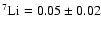 in HD 82943. This implies a contribution to the total absorption
in the Li region of 1.3 mÅ and 2.7 mÅ due to Si I and 6Li, respectively.
If no Si I blend is considered in the analysis
we obtain
in HD 82943. This implies a contribution to the total absorption
in the Li region of 1.3 mÅ and 2.7 mÅ due to Si I and 6Li, respectively.
If no Si I blend is considered in the analysis
we obtain
 ,
which is 33% smaller than the value
obtained in our first analysis (Israelian et al. 2001) based on a spectrum with S/N=500.
Since 6Li can be construed as a fossil record of rocky matter accretion during
planetary system formation, further high quality observations of this fragile
isotope may offer us a unique and invaluable insight into the past dynamical history
of extra-solar planetary systems.
,
which is 33% smaller than the value
obtained in our first analysis (Israelian et al. 2001) based on a spectrum with S/N=500.
Since 6Li can be construed as a fossil record of rocky matter accretion during
planetary system formation, further high quality observations of this fragile
isotope may offer us a unique and invaluable insight into the past dynamical history
of extra-solar planetary systems.
Acknowledgements
We would like to thank Drs Roger Cayrel, Yoichi Takeda, Poul Eric Nissen, Johannes Andersen, Eric Sandquist, Lew Hobbs, Eswar Reddy and David Lambert for several helpful discussions. Ann Boesgaard has kindly provided us with her spectra of Li-poor stars. We also thank Jonay Gonzalez Hernandez for reducing several WHT/UES spectra used in this article and Carlos Allende Prieto for providing us with the McDonald Atlas of Arcturus. We are grateful to the referee Dr Ruth Peterson for several helpful comments and suggestions.