![[*]](/icons/foot_motif.gif)
A&A 405, 627-637 (2003)
DOI: 10.1051/0004-6361:20030645
R. Tylenda1 - N. Siódmiak1 - S. K. Górny1 - R. L. M. Corradi2 - H. E. Schwarz3
1 - N. Copernicus Astronomical Center, Department for Astrophysics,
Rabianska 8, 87-100 Torun, Poland
2 - Isaac Newton Group of Telescopes,
Apartado de Correos 321,
38700 Sta. Cruz de La Palma, Spain
3 - CTIO/NOAO, Casilla 603, La Serena, Chile
Received 28 May 2002 / Accepted 23 April 2003
Abstract
We have measured angular dimensions of 312 planetary
nebulae from their images obtained in H (or
H + [NII]). We have applied three methods of measurements: direct
measurements at the 10% level of the peak surface brightness, Gaussian
deconvolution and second-moment deconvolution. The results from the three
methods are compared and analysed. We propose a simple deconvolution
of the 10% level measurements which significantly improves the reliability
of these measurements for compact and partially resolved nebulae. Gaussian
deconvolution gives consistent but somewhat underestimated diameters compared
to the 10% measurements. Second-moment deconvolution gives results in poor
agreement with those from the other two methods, especially for poorly
resolved nebulae. From the
results of measurements and using the conclusions of our analysis we derive
the final nebular diameters which should be free from systematic differences
between small (partially resolved) and extended (well resolved) objects
in our sample.
(or
H + [NII]). We have applied three methods of measurements: direct
measurements at the 10% level of the peak surface brightness, Gaussian
deconvolution and second-moment deconvolution. The results from the three
methods are compared and analysed. We propose a simple deconvolution
of the 10% level measurements which significantly improves the reliability
of these measurements for compact and partially resolved nebulae. Gaussian
deconvolution gives consistent but somewhat underestimated diameters compared
to the 10% measurements. Second-moment deconvolution gives results in poor
agreement with those from the other two methods, especially for poorly
resolved nebulae. From the
results of measurements and using the conclusions of our analysis we derive
the final nebular diameters which should be free from systematic differences
between small (partially resolved) and extended (well resolved) objects
in our sample.
Key words: planetary nebulae: general
The angular dimensions belong to the most fundamental observational data for planetary nebulae (PNe). They are required if one wants to study important PN parameters such as linear dimensions, lifetimes, surface brightnesses. Several methods for determining distances or estimating nebular masses rely on observational measurements of the PN diameters. Also studies of the observed evolution of PNe and their central stars often use the angular PN diameters as one of the crucial observational data.
PN dimensions have been measured since the very begining of research interest in these objects and the list of papers with resultant values is very long. Consequently, for almost all the known PNe we have information about their angular dimensions, see e.g. the ESO-Strasbourg Catalogue (Acker et al. 1992). However the data from many existing catalogues and databases should be used with caution. They have usually been compiled from numerous different sources based on different observational techniques and methods. Therefore the resulting data for different objects are not always comparable. For many PNe the diameters taken from different observational sources can differ by a factor of a few.
The problem is that different observational techniques and/or different methods for measuring dimensions give different results for many PNe. In the case of well resolved and fairly symmetric nebulae with a well defined outer rim the problem is simple and different methods give consistent results. Most of the PNe have, however, complex structures, soft outer boundaries, and low surface brightness emission extending to large distances. If one measures the maximum extension of the nebular emission in an image, as it has often been done while determining PN dimensions, than the result depends on how deep the image has been made. A reasonable solution in order to get results comparable for all objects is to measure nebular extension at a given level of surface brightness, e.g. at 10% of the maximum value.
Another problem arises in the case of small PNe when the nebular diameter is comparable to the angular resolution of the instrument. The observed image is then a convolution of an intrinsic nebular image and the instrumental profile. It has to be deconvolved in order to get a meaningful result. It is usually done using the so-called Gaussian deconvolution. The disadvantage of this method is that one has to adopt a shape of the intrinsic surface brightness distribution and the result depends on this assumption. The problem of determining dimensions of partially resolved nebulae has recently been discussed by van Hoof (2000). He has made a thorough model analysis of different methods for measuring partially resolved nebulae.
The question that arises, and which is important for using the measured dimensions in extensive, systematic studies of PNe, is to what extent the results from different methods are comparable. For instance, do the results from direct measurements at the 10% contour for extended nebulae mean the same as the values from a deconvolution method for compact objects? If the PNe were close to model nebulae studied by van Hoof (2000) the answer would be: yes, they measure more or less the same. However, real nebulae are often much different from the model ones and the answer is not a priori clear. We attempt to answer the above question in this paper.
In recent years, a number of observational surveys for studying PN structures and dimensions have been done. As surveys in radio wavelengths those of Aaquist & Kwok (1990) and Zijlstra et al. (1989) should be mentioned. Over 400 PNe have been observed in these two surveys, mostly at 5 GHz. PN diameters have been determined either from a 10% contour level (for well resolved nebulae) or from a Gaussian deconvolution (for partially resolved objects). Recent optical surveys can be found in Schwarz et al. (1992), Manchado et al. (1996), and Górny et al. (1999) where about 600 PNe have been observed. However, the PN dimensions given in these three catalogues usually refer to the maximum extension of the recorded emission. As the ratio of the maximum to faintest recorded surface brightness can vary by a large factor from one image to another these diameters do not measure the same for all the objects in the catalogues.
We have measured angular dimensions for 312 PNe. One of the goals is to provide a homogeneous set of PN diameters, i.e. values which mean the same, as much as possible, for all the objects in the sample. We have applied direct measurements at 10% of the peak surface brightness as well as deconvolution methods. The results have been used to investigate reliability of the methods and for comparative studies of the results from different methods. This helped us to obtain a homogeneous set of the PN diameters for the whole sample without important systematic differences between compact and extended nebulae.
The observational material used in this paper is, in principle, the same as in
Schwarz et al. (1992) and Górny et al. (1999). These are
images of mostly southern PNe taken with the NTT and other telescopes at the
ESO. For our measurements we have used only images in H
(or
H + [NII]). This has been done in order to have a uniform set of
data and to avoid possible ionization stratification effects in the results
which could have appeared if we had used, for instance, [OIII] images.
We have applied three methods of measuring PN dimensions. First one is a
direct measurement of the nebular diameter at a level of 10% of the peak
surface brightness,
 ,
from the PN image.
As the nebulae in majority are not
spherically symmetric we have measured two diameters along perpendicular
axes. One of the axes was directed along the longest
extension of the nebular emission.
,
from the PN image.
As the nebulae in majority are not
spherically symmetric we have measured two diameters along perpendicular
axes. One of the axes was directed along the longest
extension of the nebular emission.
Second method is the Gaussian deconvolution. The full width at half-maximum
(FWHM) values,  ,
have been obtained from a two-dimensional Gaussian fitting to the observed
PN image. Before fitting the background has been subtracted from the image.
The same applied to field stars allowed us to
derive the FWHM of the resolution profile,
,
have been obtained from a two-dimensional Gaussian fitting to the observed
PN image. Before fitting the background has been subtracted from the image.
The same applied to field stars allowed us to
derive the FWHM of the resolution profile,
 .
The deconvolved FWHM diameter,
.
The deconvolved FWHM diameter,
 ,
can then be obtained from
,
can then be obtained from
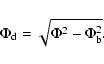 |
(1) |
has
to be multiplied by a conversion factor which is a function of the
observational resolution,
 ,
and the adopted
intrinsic surface brightness distribution of the nebula. Details of
calculating the conversion factor for a constant surface brightness disc and
constant emissivity shells can be found in van Hoof (2000).
,
and the adopted
intrinsic surface brightness distribution of the nebula. Details of
calculating the conversion factor for a constant surface brightness disc and
constant emissivity shells can be found in van Hoof (2000).
Third method is the so-called second-moment deconvolution. This is an analogous method to the Gaussian deconvolution but the FWHM is determined from the second moment of the surface brightness distribution. The advantage of this method is that, unlike Gaussian deconvolution, the conversion factor is independent of the resolution of the observations. Details of applying second-moment deconvolution can be found in van Hoof (2000).
It is well known that the first method fails for small objects and therefore it is usually applied to well resolved nebulae. The deconvolution methods, on the contrary, are usually applied to small, partially resolved nebulae. In this paper we have, however, attempted to apply all the three methods to all the PNe in our sample. This has been done in order to be able to compare different methods and to study systematic differences between results from them.
Table 1 presents the results of direct measurements done on our PN images.
Following suggestions of
van Hoof (2000) we give raw data from the deconvolution methods,
i.e. the deconvolved FWHM,
,
and the image resolution,
.
Our final angular diameters of the PNe are
given in Table 2. They are based on the measurements reported in Table 1 as
well as on the discussion of the results from different methods presented in
Sect. 5.
Column (1) in Table 1 gives the PNG
number of the object while its usual name is in Col. (2). Column (3) gives
the number of a figure showing the PN image in the original papers: "s'' and
"g'' stand for Schwarz et al. (1992) and Górny et al. (1999),
respectively. The deconvolved FWHM,
,
and the resolution size,
,
from the Gaussian
fit are in Cols. (4) and (5), respectively. The same but from the
second-moment method can be found in Cols. (6) and (7). The results of
direct measuremets at 10% level are given in Col. (8). Some PNe have
relatively deep images and the nebular emission extends well beyond the 10% contour. In this cases we have also measured the dimensions of the  emission level above the background. The results are in Col. (9). Column (10)
gives the percentage of the
level in the peak surface brightness.
All the measurement results are in arcsec.
emission level above the background. The results are in Col. (9). Column (10)
gives the percentage of the
level in the peak surface brightness.
All the measurement results are in arcsec.
For some objects the deconvolution methods do not work well and Table 1 does not give results in these cases. It has usually happened when the nebula was extended with complex structures and/or had a strong central star or several field stars superimposed on the PN image. In these cases the numerical procedure fitting Gaussian or calculating moments either has failed or has given spurious results, or has just measured a star (central or one of the field stars). Note that the Gaussian fit fails more often that the second-moment method, particularly for larger nebulae.
Not all the objects published in Schwarz et al. (1992) and Górny et al. (1999) appear in Table 1. Some PNe were too faint in the images or larger than the image frame so meaningful measurements have not been possible. On the other hand, images for a few objects (those with no entry in Col. (3) in Table 1) have not been published. For most of these objects their images (although obtained with different equipement) can be found in Manchado et al. (1996).
For a few objects we had two images from independent observations. We give results from both images separately in two consecutive rows in Table 1 in these cases.
In this section we compare the results from the three methods used to measure the PN dimensions. The aim is to study systematic effects between different methods. This will allow us to work out a procedure for deriving a consistent set of PN dimensions for all the objects, i.e. those well resolved as well as partially resolved, in our sample.
As discussed above, both, Gaussian fitting and second-moment calculations
have been applied to
measure the FWHM of the resolution profile,
,
on our images.
The results are given in Cols. (5) and (7) of Table 1.
Both methods should give the same result if the instrumental profile is
Gaussian. As can be seen from Table 1 this is essentially the case.
The mean value and the standard deviation of the ratio
 (s-m) calculated from
the data in Table 1 is 0.965
(s-m) calculated from
the data in Table 1 is 0.965 0.094. Thus the basic assumption of
the deconvolution methods, namely Gaussian resolution profile, is
satisfied in our observational material.
0.094. Thus the basic assumption of
the deconvolution methods, namely Gaussian resolution profile, is
satisfied in our observational material.
![\begin{figure}
\par\resizebox{8.3cm}{!}{\includegraphics[clip]{figure1.eps}} \end{figure}](/articles/aa/full/2003/26/aa2743/img14.gif) |
Figure 1:
Comparison of the results from the Gaussian deconvolution and
the second-moment deconvolution. The ratio of the angular
diameters,  ,
derived from the two methods is plotted versus
the ratio of the deconvolved FWHM,
,
to
the resolution size,
,
obtained from the Gaussian
fit. A constant emissivity sphere model has been adopted
while deriving
in both methods. ,
derived from the two methods is plotted versus
the ratio of the deconvolved FWHM,
,
to
the resolution size,
,
obtained from the Gaussian
fit. A constant emissivity sphere model has been adopted
while deriving
in both methods. |
| Open with DEXTER | |
The final results of the Gaussian and second-moment
deconvolution methods are compared in Fig. 1.
The figure plots the ratio of the angular diameters, ,
derived from
the two methods versus the ratio of the deconvolved FWHM,
,
to
the resolution size,
,
(i.e. parameter  in van Hoof
2000) obtained from the Gaussian fit.
The values plotted in Fig. 1 are geometric means of the values
obtained from the two-dimensional measurements reported in Table 1.
While deriving
a surface brightness distribution from
a constant emissivity sphere model (shell 0.0 in van Hoof's notation) has been
adopted for calculating the conversion factors. Note,
however, that the diagram shown in Fig. 1 depends only weakly
on the adopted surface brightness distribution.
in van Hoof
2000) obtained from the Gaussian fit.
The values plotted in Fig. 1 are geometric means of the values
obtained from the two-dimensional measurements reported in Table 1.
While deriving
a surface brightness distribution from
a constant emissivity sphere model (shell 0.0 in van Hoof's notation) has been
adopted for calculating the conversion factors. Note,
however, that the diagram shown in Fig. 1 depends only weakly
on the adopted surface brightness distribution.
As can be seen from Fig. 1, the two deconvolution methods
do not give the same result
for the bulk of objects. The second-moment method tends to give larger
diameters than the Gaussian deconvolution. In the case of compact nebulae,
i.e. when the Gaussian deconvolution gives
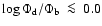 ,
the difference becomes particularly important and increases with
decreasing PN size (as measured from the Gaussian deconvolution).
Note that the vertical scatter of the points in Fig. 1,
tends to become larger for more extended nebulae.
On average
,
the difference becomes particularly important and increases with
decreasing PN size (as measured from the Gaussian deconvolution).
Note that the vertical scatter of the points in Fig. 1,
tends to become larger for more extended nebulae.
On average
 for objects with
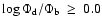 is
is
 (mean and standard deviation).
When adopting a shell-like model this value would go down and
for an infinitely thin shell (limit 1.0 in van Hoof's
notation) it would become
(mean and standard deviation).
When adopting a shell-like model this value would go down and
for an infinitely thin shell (limit 1.0 in van Hoof's
notation) it would become
 .
If a constant surface brightness disc is adopted the figures would be
.
If a constant surface brightness disc is adopted the figures would be
 .
.
Figure 2 compares the results from the Gaussian deconvolution with the
10% contour measurements. Similarly as Fig. 1, it shows
the ratio of the PN diameters versus the
Gaussian
ratio.
Again, the plotted values are geometric means from
the measurements in Table 1.
While obtaining the diameters
from the Gaussian method the constant emissivity sphere model has been adopted.
Note that the diagram in Fig. 2 depends on the adopted surface
brightness distribution more significantly than Fig. 1.
The general pattern of the diagram remains the same but
the points can shift vertically.
![\begin{figure}
\par\resizebox{8.3cm}{!}{\includegraphics[clip]{figure2.eps}} \end{figure}](/articles/aa/full/2003/26/aa2743/img22.gif) |
Figure 2:
Comparison of the results from the 10% contour measurements and
the Gaussian deconvolution. The ratio of the angular
diameters, ,
derived from the two methods is plotted versus
the ratio of the deconvolved FWHM,
,
to
the resolution size,
,
obtained from the Gaussian
fit. A constant emissivity sphere model has been adopted
while deriving
in the Gaussian deconvolution. |
| Open with DEXTER | |
Figure 2 shows an increasing discrepancy between the 10% diameter
and the diameter from the Gaussian deconvolution with
the decreasing value of
.
This is an expected effect and is due to an overestimate of the PN diameter
from the direct measurements for partially resolved PNe.
Note, however, that a tight correlation seen in Fig. 2
for
is partly spurious.
For
approaching
the y-axis in Fig. 2 tends
to plot a reversal of the value plotted in the x-axis.
For small nebulae the diameters from the 10% contour would be more accurate
if determined from deconvolved images. We have not attempted to apply this
rather cumbersome procedure to our images. Instead we have found that a
significant improvement of the 10% diameter can be obtained using a formula
analogous to the standard FWHM Gaussian deconvolution (Eq. (1))
but relevant to a 10% level of the maximum, i.e.
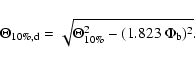 |
(2) |
 the deconvolved 10% diameter.
![\begin{figure}
\par\resizebox{8.35cm}{!}{\includegraphics[clip]{figure3.eps}} \end{figure}](/articles/aa/full/2003/26/aa2743/img24.gif) |
Figure 3:
The same as Fig. 2 but using the deconvolved 10%
diameter,
,
calculated from Eq. (2). |
| Open with DEXTER | |
Figure 3 shows the same as Fig. 2 but
using
instead of
.
Unlike in Fig. 2, the
distribution of the points in Fig. 3 does not show
any significant trend with
.
This demonstrates that Eq. (2) allows to significantly
improve the reliability of the PN dimension estimate from
the 10% contour measurements for small, partially resolved nebulae.
seems to be an estimate of compact PN diameters as
reliable as that from the Gaussian deconvolution.
However, as can be seen from Fig. 3, the Gaussian deconvolution tends to underestimate the PN dimensions compared to the 10% deconvolved diameters. Note that the value of this systematic difference depends on the surface brightness distribution adopted in the Gaussian method. It is smallest for the constant emissivity sphere, i.e. for the case presented in Fig. 3, and largest for the infinitely thin shell model.
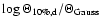
Figure 3 suggests that the two methods give the most consistent
results for rather compact but not too small nebulae, i.e. having
 .
The mean value of
.
The mean value of
 for these
objects in Fig. 3 is
for these
objects in Fig. 3 is
 .
For an
infinitely thin shell (limit 1.0 in van Hoof's notation)
and a constant surface brightness disc the result would be
.
For an
infinitely thin shell (limit 1.0 in van Hoof's notation)
and a constant surface brightness disc the result would be
 and
and
 ,
respectively.
,
respectively.
A greater discrepancy of the results for
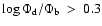 can be seen from Fig. 3.
The mean values of
derived
for these objects are: 0.0520.062 (sphere), 0.1950.062 (thin
shell), and 0.1150.062 (disc). These nebulae show resolved structures
on the images and their surface brightness distributions are usually far
from a Gaussian. Therefore a Gaussian fitting to such objects gives
uncertain, sometimes even spurious, results.
can be seen from Fig. 3.
The mean values of
derived
for these objects are: 0.0520.062 (sphere), 0.1950.062 (thin
shell), and 0.1150.062 (disc). These nebulae show resolved structures
on the images and their surface brightness distributions are usually far
from a Gaussian. Therefore a Gaussian fitting to such objects gives
uncertain, sometimes even spurious, results.
Because of low statistics, no meaningful analysis can be done for the region
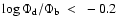 .
A large scatter of the points
is certainly due to increasing sensitivity
of the results to the observational uncertainties
(quadratic subtraction of two nearly equal values).
.
A large scatter of the points
is certainly due to increasing sensitivity
of the results to the observational uncertainties
(quadratic subtraction of two nearly equal values).
Figures 4 and 5 compare the results from the 10% level measurements and the second-moment deconvolution. Figure 4 is analogous to Fig. 2 and uses "raw'' measurements from the 10% contour. A tendency of overestimating diameters for compact PNe from the 10% measurements can be seen in Fig. 4. It is, however, much less conspicuous than in Fig. 2. The reason is that, as discussed in Sect. 5.1, for partially resolved PNe the second-moment deconvolution results in larger diameters than the Gaussian deconvolution.
![\begin{figure}
\par\resizebox{8.3cm}{!}{\includegraphics[clip]{figure4.eps}} \end{figure}](/articles/aa/full/2003/26/aa2743/img32.gif) |
Figure 4:
Comparison of the results from the 10% contour measurements and
the second-moment deconvolution. The ratio of the angular
diameters, ,
derived from the two methods is plotted versus
the ratio of the deconvolved FWHM,
,
to
the resolution size,
,
obtained from the moment
calculations. A constant emissivity sphere model has been adopted
while deriving
in the second-moment deconvolution. |
| Open with DEXTER | |
The deconvolved 10% diameter, using Eq. (2) and
from the second-moment calculations, have been applied in the diagram shown
in Fig. 5. As the deconvolution of the 10% diameter most
affects the results for compact nebulae the positions of these objects are
significantly shifted down in Fig. 5 comparing to
Fig. 4.
Figure 5 shows that the second-moment deconvolution usually
overestimates the PN size compared to the 10% contour measurements.
For rather large nebulae, i.e. having
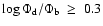 in Fig. 5,
 is
is
 .
The discrepancy increases for less resolved nebulae and
for
.
The discrepancy increases for less resolved nebulae and
for
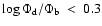 ,
is
,
is
 .
.
As the conversion factors in the second-moment deconvolution are independent
of
adopting the infinitely thin shell model would
shift all the points in Fig. 5 upwards by factor 0.111.
For the uniform disc model the shift would be of factor 0.048. By the
same factors would respectively increase the mean values of
(obviously, the standard
deviations would remain the same).
One of the main problems in the present study is to find which method(s) gives
reliable diameter estimates for partially resolved nebulae.
The analysis discussed in the previous subsections shows that the
deconvolved 10% diameter and the Gaussian deconvolution give relatively
consistent results down to rather poorly resolved objects, although
the Gaussian deconvolution
systematically underestimates the PN diameter compared to the measurements
of the 10% contour. The value of this underestimate depends on the model nebula
adopted in the Gaussian deconvolution. On the other hand,
the second-moment deconvolution seems
to become unstable for compact objects as suggested by an increasing scatter
of points in Fig. 5 for less and less resolved nebulae. However,
we cannot be sure that this interpretation is correct. Nor we can
say which method and when breaks to give reliable results. The reason is
that we can compare only the results from different methods but we do not
know what real diameters of poorly resolved nebulae are.
![\begin{figure}
\par\resizebox{8.35cm}{!}{\includegraphics[clip]{figure5.eps}} \end{figure}](/articles/aa/full/2003/26/aa2743/img38.gif) |
Figure 5:
The same as Fig. 4 but using the deconvolved 10%
diameter,
,
calculated from Eq. (2). |
| Open with DEXTER | |
We have attempted to clarify the above problems by applying the methods of diameter measurements to some of our images artificially degraded to worse and worse seeing conditions, i.e. convolved with a larger and larger Gaussian profile. From the original images we know the true PN sizes so we can compare them to the results from different methods applied to less and less resolved PN images.
Although the idea is simple it could have been applied to a limited number of our images only. Obviously we have to consider rather well resolved nebulae but not too much. The object has to be several times smaller than the image size. Otherwise the image frame can impose an important cutoff when the image is convolved with a Gaussian having FWHM comparable to the PN size. The nebula has to be well exposed so its image keeps a good contrast while beeing spread over larger and larger surface. There cannot be too many bright field stars, otherwise they merge with the PN image in the convolution process. It is also desirable that among the objects investigated different morphologies are represented.
We present the results of the procedure applied to images of 5 PN, i.e. (in paranthesis usual names and morphological descriptions are given) 021.8-00.4 (M 3-28; bipolar, butterfly-like), 174.2-14.6 (H 3-29; ring-like but strongly asymmetric with one strong blob), 285.7-14.9 (IC 2448; round with a halo), 286.3-04.8 (NGC 3211; ring-like with two blobs), and 345.2-08.8 (Tc 1; round with an irregular halo). The selected objects have diameters between 10 and 20 arcsec. The original images have been obtained with a seeing varying from 0.5 to 2.5 arcsec. We have used our deconvolved 10% diameters from original images as true PN diameters for comparison with the results from degraded images (note that the deconvolution has introduced only minor corrections to the 10% contour measurements in these cases). The original images have been convolved with a Gaussian having FWHM increasing from 2.5 to 20.0 arcsec. Then our three methods have been applied to the resulting images.
We note that the results from measurements on the degraded images reproduce very well the general trends seen in Figs. 1-5.
![\begin{figure}
\par\resizebox{7.7cm}{!}{\includegraphics[clip]{figure6.eps}} \end{figure}](/articles/aa/full/2003/26/aa2743/img39.gif) |
Figure 6:
Results of the 10% contour measurements on the degraded PN images.
and
are the deconvolved 10%
diameter and the seeing size, respectively, measured from the
degraded images.
 is the deconvolved 10%
diameter from the original (non-degraded) images. is the deconvolved 10%
diameter from the original (non-degraded) images. |
| Open with DEXTER | |
In Fig. 6 the results of the deconvolved 10% diameter
method applied to the degraded images are compared to the deconvolved 10%
diameter from the original (non-degraded) images (
). From
this figure we can conlude that the deconvolved 10% diameter
measures very well the PN size down to
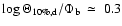 .
This limit is
practically equivalent to
.
This limit is
practically equivalent to
 .
Below this value the method becomes unstable.
.
Below this value the method becomes unstable.
![\begin{figure}
\par\resizebox{7.5cm}{!}{\includegraphics[clip]{figure7.eps}} \end{figure}](/articles/aa/full/2003/26/aa2743/img42.gif) |
Figure 7:
The same as Fig. 6 but for the Gaussian
deconvolution adopting a constant emissivity sphere model.
is the deconvolved 10%
diameter from the original (non-degraded) images. |
| Open with DEXTER | |
Results of the Gaussian deconvolution applied to the degraded images are
presented in Fig. 7. A constant emissivity sphere model
has been adopted. We see that for well resolved nebulae the Gaussian
deconvolution underestimates the PN diameter. This is consistent with the
trend seen in Fig. 3. For
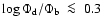 the underestimate is smaller, again similar as in Fig. 3.
For all the points with
in Fig. 7 the
mean value and the standard deviation of
the underestimate is smaller, again similar as in Fig. 3.
For all the points with
in Fig. 7 the
mean value and the standard deviation of
 are
are
 .
This result is very close to the value
.
This result is very close to the value
 of
of
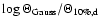 found in Sect. 5.2 for objects having
in Fig. 3.
For
found in Sect. 5.2 for objects having
in Fig. 3.
For
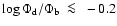 in Fig. 7
the scatter increases which
suggests that the Gaussian deconvolution becomes then unstable. Comparison
of Figs. 7 and 6 seems to indicate that
the Gaussian deconvolution gives somewhat more stable results than the
deconvolved 10% diameter for objects having
in Fig. 7
the scatter increases which
suggests that the Gaussian deconvolution becomes then unstable. Comparison
of Figs. 7 and 6 seems to indicate that
the Gaussian deconvolution gives somewhat more stable results than the
deconvolved 10% diameter for objects having
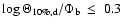 or,
equivalently,
or,
equivalently,
 .
A better
statistics would be required to clarify this point.
.
A better
statistics would be required to clarify this point.
![\begin{figure}
\par\resizebox{7.5cm}{!}{\includegraphics[clip]{figure8.eps}} \end{figure}](/articles/aa/full/2003/26/aa2743/img51.gif) |
Figure 8:
The same as Fig. 6 but for the second-moment
deconvolution adopting a constant emissivity sphere model.
is the deconvolved 10%
diameter from the original (non-degraded) images. |
| Open with DEXTER | |
The results of the test of the second-moment deconvolution are presented in
Fig. 8. A constant emissivity sphere model
has been adopted. The figure shows that the second-moment deconvolution
gives uncertain estimates of the PN diameters, especially for partially
resolved nebulae (
). Adopting a
shell or disc model in the deconvolution would decrease the systematic
difference between
 and
in Fig. 8
but the uncertainity (scatter of the points) would remain the same. Our
experience suggests that this method is sensitive to faint outer structures
(halo, outer butterfly-like filaments) particularly in partially resolved
nebulae.
and
in Fig. 8
but the uncertainity (scatter of the points) would remain the same. Our
experience suggests that this method is sensitive to faint outer structures
(halo, outer butterfly-like filaments) particularly in partially resolved
nebulae.
Table 2: Nebular diameters (in arcsec).
One of the primary goals of our work is to obtain a homogeneous set of
PN dimensions, a set of results which have, as far as possible, the same
physical meaning for all the objects in our sample. As a primary method for
deriving the PN dimensions we have adopted the direct measurements at the
10% level of the peak surface brightness. This seems to be the only reasonable
method for well resolved nebulae. In order to account for the finite
resolution in the case of smaller objects we have used the deconvolved 10%
diameters,
,
instead of
.
As discussed in
Sect. 5.4
is reliable down to
.
For the smallest objects when results from any method become more and
more uncertain we have used
 and the results from
the Gaussian deconvolution.
Following discussion in Sect. 5.4 we have prefered not to use
the results from the second-moment deconvolution.
In more detail our prescription is as follows.
and the results from
the Gaussian deconvolution.
Following discussion in Sect. 5.4 we have prefered not to use
the results from the second-moment deconvolution.
In more detail our prescription is as follows.
For all the objects with
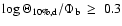 we have adopted
.
We have used
from Gaussian fit.
For more compact objects, i.e.
when
we have adopted
.
We have used
from Gaussian fit.
For more compact objects, i.e.
when
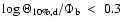 we have adopted a mean
value from
and
resulting from the Gaussian
deconvolution adopting the constant emissivity sphere model. In order to
correct for the systematic underestimate of the Gaussian method, as discussed
in Sects. 5.2 and 5.4, the Gaussian
have been multiplied by factor
1.06 before deriving the mean value.
we have adopted a mean
value from
and
resulting from the Gaussian
deconvolution adopting the constant emissivity sphere model. In order to
correct for the systematic underestimate of the Gaussian method, as discussed
in Sects. 5.2 and 5.4, the Gaussian
have been multiplied by factor
1.06 before deriving the mean value.
The results are presented in Table 2. Columns 1 and 2 give the PNG
numbers and the usual names, respectively. The diameters derived according
to the above prescription are given in Col. 3. In the case of partially
resolved objects having
only one value is given which is the
geometric mean from the two dimension measurements.
A colon indicates compact
objects for which the Gaussian deconvolution resulted in a diameter
different by more than 30% from the deconvolved 10% diameter. Objects
practically unresolved in our images are marked with "stellar''. For a few
objects having two independent measurements in Table 1 mean values
derived from them are given in Table 2.
![\begin{figure}
\par\resizebox{8.3cm}{!}{\includegraphics[clip]{figure9.eps}} \end{figure}](/articles/aa/full/2003/26/aa2743/img56.gif) |
Figure 9: Comparison of the PN diameters from the literature compilation (see text) with the diameters from this work (geometric means from the two dimensions given in Table 2). Solid line: 1 to 1 relation. |
| Open with DEXTER | |
We have compared the results from Table 2 with the diameters from our data base resulting from a compilation of the data published in the literature. This data base has originally been made for purposes of the Strasbourg-ESO catalogue (Acker et al. 1992). Its updated version has been described and used in Siódmiak & Tylenda (2001). The results of the comparison are shown in Fig. 9. In most cases the agreement is quite good although our measurements tend to give somewhat larger diameters than the values adopted from the literature. The mean value of the ratio of our diameters (from Table 2) to the compiled diameters is 1.24 with a standard deviation of 0.71. In some cases, however, the discrepancy is significant. For small nebulae a large scatter of the points in Fig. 9 is not surprising. Any measurement, VLA or optical, of a partially resolved nebulae gives an uncertain result. Significant discrepancies in the case of larger nebulae usually concern bipolar nebulae having a compact core, e.g. IC 4634 (000.3+12.2), M 3-28 (021.8-00.4), M 2-48 (062.4-00.2), He 2-104 (315.4+09.4), Hb 5 (359.3-00.9). The published diameters from VLA or optical measurements apparently referred to the core whereas the 10% contour from our images encompassed a significant portion of the outer bipolar structures.
![\begin{figure}
\par\resizebox{8.3cm}{!}{\includegraphics[clip]{figure10.eps}} \end{figure}](/articles/aa/full/2003/26/aa2743/img57.gif) |
Figure 10: Comparison of the PN diameters from Aaquist & Kwok (1990) (crosses) and Zijlstra et al. (1989) (full circles - from 10% contour, open circles - from Gaussian deconvolution) with the diameters from this work (geometric means from the two dimensions given in Table 2). Solid line: 1 to 1 relation. |
| Open with DEXTER | |
In Fig. 10 we have compared the diameters from
Table 2 with the results of VLA surveys of
Aaquist & Kwok (1990) and Zijlstra et al. (1989).
Aaquist & Kwok observed mainly compact PNe. They have applied three methods
for deriving the PN diameters but it is not clear which method(s) has been
used to measure a particular object. As can be seen from Fig. 10, our
diameters are systematically larger than those of Aaquist & Kwok, on
average by factor 1.7. The agreement of our results with those of Zijlstra
et al. is better especially if nebulae greater than  10 arcsec are
considered and the diameter of Zijlstra et al. resulted from their 10%
contour (full circles in the figure).
In four cases the discrepancy is larger than factor 2. All the
cases concern bipolar nebulae. For three of them, i.e already mentioned
M 3-28, M 2-48, as well as NGC 2440 (234.8+02.4), our diameters are
larger and the reason has been explained above. In the case of M 2-9 our
diameter is significantly smaller and it seems that Zijlstra et al. measured
the angular extend of the elongated, bipolar lobes whereas our value is a
geometric mean from the major and minor axis measurements.
10 arcsec are
considered and the diameter of Zijlstra et al. resulted from their 10%
contour (full circles in the figure).
In four cases the discrepancy is larger than factor 2. All the
cases concern bipolar nebulae. For three of them, i.e already mentioned
M 3-28, M 2-48, as well as NGC 2440 (234.8+02.4), our diameters are
larger and the reason has been explained above. In the case of M 2-9 our
diameter is significantly smaller and it seems that Zijlstra et al. measured
the angular extend of the elongated, bipolar lobes whereas our value is a
geometric mean from the major and minor axis measurements.
We have measured angular dimensions for 312 PNe. As a primary definition of the PN size we have adopted the extension of nebular emission up to the 10% level of the maximum surface brightness. This seems to be a reasonable choice for extended, well resolved nebulae. For partly resolved objects deconvolution methods have to be used. So far the Gaussian deconvolution has primarily been applied.
We have, however, found that for compact nebulae the 10% contour measurements
can also give satisfactory results provided that they are
corrected for the finite resolution using Eq. (2).
As has been shown in Sects. 5.2 and 5.4 this simple deconvolution of the 10%
contour measurments makes the resulting diameters reliable down to nebulae
as compact as
(or
equivalently
).
The derivation of
has several
advantages over the deconvolution methods. It is simpler to apply.
No assumption has to be made about the surface brightness distribution.
It is a more universal method as it can be applied to compact and
partially resolved PNe as well as to
extended and well resolved nebulae where the deconvolution methods
usually fail in practice.
The Gaussian deconvolution gives fairly reliable and stable results for partly resolved nebulae. However it systematically underestimates the diameters compared to the 10% contour measurements. The difference depends on the model nebula adopted in the Gaussian deconvolution. It is only 5-7% for the constant emissivity sphere but increases up to 45% for a thin shell. This result means that in catalogues and data bases the dimensions of compact PNe, usually derived from the Gaussian deconvolution, are probably underestimated compared to those of extended nebulae. It is difficult to estimate this systematic difference. The deconvolution procedures used in observational surveys, like in Aaquist & Kwok (1990) or Zijlstra et al. (1989), were significantly simplified compared to that of van Hoof (2000). Usually the same value of the conversion factor has been used for all the objects. This certainly introduced additional uncertainties in the final results.
The second-moment deconvolution appeared to give results often uncertain and in poor agreement with the results from the other two methods, in particular for compact nebulae.
Our study does not solve definitevely the problem of measuring the PN dimensions. It makes however an important step in the field in the sense that it gives a quantity which means physically the same and is comparable for all the objects in our sample. One has, however, to remember that the (faint) nebular emission can extend well beyond the diameters given in Table 2. This can be seen for many objects in our sample by comparing Cols. (9) and (8) in Table 1.
Acknowledgements
We are very grateful to the referee (J.J. Condon) whose comments resulted in a significant improvement of the work reported in this paper. This work has partly been supported from a grant No. 2.P03D.020.17 financed by the Polish State Committee for Scientific Research.
Table 1: Results of measurements (see text for explanation of the columns).