

The results of the full sample confirm the former findings for the 17 sources reported in Paper I. Therefore, we do not repeat here the discussion in Paper I, but rather concentrate on a few topics, on which the higher quality and better statistics of the larger sample has an impact.
![\begin{figure}
\par\includegraphics[width=8.8cm,clip]{3053_f3.ps}
\end{figure}](/articles/aa/full/2003/16/aa3053/img79.gif) |
Figure 3:
Infrared luminosity (from 3 to 1000  m in the object restframe) against redshift.
The symbols are: m in the object restframe) against redshift.
The symbols are:  = based on detections, = based on detections,  = based on upper limits. = based on upper limits. |
The spectra shown in Fig. 1 provide an impressive confirmation
of the fact that the SED of an optically selected quasar contains
a mid-far infrared bump due to thermal emission by dust. The thermal infrared
luminosities of our sample span three orders of magnitude, from luminous 10
 ,
to ultraluminous 10
,
to ultraluminous 10 ,
to hyperluminous 10
,
to hyperluminous 10 -10
-10 objects
(Table 2).
The most luminous objects lie at the highest redshift (Fig. 3),
which is typical for flux limited samples (like the PG catalog).
For those
quasars for which we could establish only upper limits
the possible far-infrared dust emission exceeds 10 ,
except for the low luminosity quasar PG 0003+199 (Mrk 335).
As indicated in Fig. 1,
a luminous dust component could also be placed underneath the SED of
the flat spectrum radio-loud source PG 0007+106 which does not show any thermal bump.
Since the PG quasars were selected optically, the high IR detection rate
suggests that every quasar, irrespective of being optically
visible or dust obscured, has a high inherent dust luminosity.
objects
(Table 2).
The most luminous objects lie at the highest redshift (Fig. 3),
which is typical for flux limited samples (like the PG catalog).
For those
quasars for which we could establish only upper limits
the possible far-infrared dust emission exceeds 10 ,
except for the low luminosity quasar PG 0003+199 (Mrk 335).
As indicated in Fig. 1,
a luminous dust component could also be placed underneath the SED of
the flat spectrum radio-loud source PG 0007+106 which does not show any thermal bump.
Since the PG quasars were selected optically, the high IR detection rate
suggests that every quasar, irrespective of being optically
visible or dust obscured, has a high inherent dust luminosity.
We have decomposed the IR emission into the NIR (3-10 m),
MIR (10-40 m), FIR (40-150m) and submm (150-1000m)
regimes
(Table 2).
Figure 4 shows that for each of these regimes
the IR luminosity is correlated with the blue luminosity
(Table 2).
While the correlation is of similar quality for the
NIR and MIR ranges and also
for the FIR (Table 4),
the larger scatter for the submm regime (Table 4)
might also be due to
the lack of enough data points to constrain
m), FIR (40-150m) and submm (150-1000m)
regimes
(Table 2).
Figure 4 shows that for each of these regimes
the IR luminosity is correlated with the blue luminosity
(Table 2).
While the correlation is of similar quality for the
NIR and MIR ranges and also
for the FIR (Table 4),
the larger scatter for the submm regime (Table 4)
might also be due to
the lack of enough data points to constrain
 well,
which therefore in most cases is just the blackbody extrapolation from the FIR.
Also of interest is, that the soft X-ray luminosity
correlates
to some extent
with the NIR, MIR and FIR luminosity
(Fig. 4, Table 4),
whereby the scatter is partly caused by
some extinguished sources with steep
well,
which therefore in most cases is just the blackbody extrapolation from the FIR.
Also of interest is, that the soft X-ray luminosity
correlates
to some extent
with the NIR, MIR and FIR luminosity
(Fig. 4, Table 4),
whereby the scatter is partly caused by
some extinguished sources with steep 
 (e.g. PG 1001+054, PG 1411+442, PG 2112+059,
Laor et al. 1997; Wang et al. 2000; Gallagher et al. 2001),
and in the restframe of the quasar the
X-ray window shifts according to z
(for the high redshift sources like PG 1247+267, PG 1634+706, PG 1718+481).
An analysis of 2-10 keV ASCA spectra (George et al. 2000) indicates that
the relative decline of X-ray (to optical) luminosity with z is probably due to both
intrinsic properties of the sources
(as favoured by Bechtold et al. 1994; Wilkes et al. 1994)
and observational effects (proposed by Yuan et al. 1998).
Because of the observational X-ray window limitation and in view of several other effects,
we do not investigate the correlations in more detail.
For the scope of our discussion
we conclude, that the IR luminosities
are correlated over four orders of magnitude
with both the blue and the soft X-ray luminosity,
which provide the primary measure of the AGN strength.
But these correlations show also a considerable scatter
with a factor of about three and five for
(e.g. PG 1001+054, PG 1411+442, PG 2112+059,
Laor et al. 1997; Wang et al. 2000; Gallagher et al. 2001),
and in the restframe of the quasar the
X-ray window shifts according to z
(for the high redshift sources like PG 1247+267, PG 1634+706, PG 1718+481).
An analysis of 2-10 keV ASCA spectra (George et al. 2000) indicates that
the relative decline of X-ray (to optical) luminosity with z is probably due to both
intrinsic properties of the sources
(as favoured by Bechtold et al. 1994; Wilkes et al. 1994)
and observational effects (proposed by Yuan et al. 1998).
Because of the observational X-ray window limitation and in view of several other effects,
we do not investigate the correlations in more detail.
For the scope of our discussion
we conclude, that the IR luminosities
are correlated over four orders of magnitude
with both the blue and the soft X-ray luminosity,
which provide the primary measure of the AGN strength.
But these correlations show also a considerable scatter
with a factor of about three and five for
 and
and  ,
respectively.
,
respectively.
|
 |
 |
 |
 |
|
|
0.83 | ||||
|
|
0.80 | 0.97 | |||
|
|
0.79 | 0.94 | 0.98 | ||
|
|
0.79 | 0.89 | 0.93 | 0.96 | |
|
|
0.60 | 0.66 | 0.71 | 0.74 | 0.87 |
The dust masses derived from the blackbodies shown in Fig. 1
lie between 10 and
and

 (Table 2), i.e. are
comparable to those in Seyfert 1 galaxies (from the 12 m AGN sample of
Spinoglio et al. 2002) and ULIRGs (from Klaas et al. 2001).
Figure 5 illustrates
the distribution of FIR luminosities and dust masses.
We used a dust emissivity
(Table 2), i.e. are
comparable to those in Seyfert 1 galaxies (from the 12 m AGN sample of
Spinoglio et al. 2002) and ULIRGs (from Klaas et al. 2001).
Figure 5 illustrates
the distribution of FIR luminosities and dust masses.
We used a dust emissivity  throughout.
If in the hyperluminous quasars due to the higher dust temperature
throughout.
If in the hyperluminous quasars due to the higher dust temperature  changed,
e.g.
changed,
e.g.  ,
then their dust mass would be lower by a factor of about 2.
But this has no significant impact on the observed dust mass range.
Rather the dust mass depends essentially on the
temperature of the coldest component.
This is uncertain in the case of upper limits for the FIR fluxes,
so that the dust mass could be lower or - if the dust
temperature is much colder - also higher (by up to
an order of magnitude) than the estimates
listed in Table 2.
,
then their dust mass would be lower by a factor of about 2.
But this has no significant impact on the observed dust mass range.
Rather the dust mass depends essentially on the
temperature of the coldest component.
This is uncertain in the case of upper limits for the FIR fluxes,
so that the dust mass could be lower or - if the dust
temperature is much colder - also higher (by up to
an order of magnitude) than the estimates
listed in Table 2.
![\begin{figure}
\par\includegraphics[width=8.8cm,clip]{3053_f5.ps}
\end{figure}](/articles/aa/full/2003/16/aa3053/img90.gif) |
Figure 5:
Dust mass against FIR luminosity.
The symbols are: = based on detections, = based on upper limits.
Note, that in case of FIR flux upper limits the dust mass does not necessarily drop,
because the temperature could be lower than assumed; therefore no arrows are plotted.
Also other samples are shown for comparison
(with dust mass recalculated exactly as for the PG quasars):
 = ULIRGs from Klaas et al. (2001), + = Seyfert 1s from Spinoglio et al. (2002),
 = HyLIGs from Verma et al. (2002, based on upper limits).
 |
For those sources with flux density upper limits
at  > 60 m, it
is not only of interest, how well the FIR luminosity and the temperature
of the cold dust component are constrained, but also how well it is actually approximated.
Therefore we consider firstly the cases with good detections in at least 8 ISO filters
(e.g. PG 0157+001, PG 1426+015, PG 1700+518, PG 1704+608,
PG 2130+099):
a visual inspection of the SED shapes shows that they run smoothly without any
abrupt bents,
suggesting that this is a general feature of a quasar SED.
Now we consider both the height of the upper limits around the peak wavelength and how far
the cold component could become even colder.
If in the case of upper limits the sources at low/intermediate redshift (z<0.4)
possess SED shapes similar to the sources with FIR detections,
then a visual inspection indicates that the measured 60-100 m upper limits
are not far above the expectations
(pictured by the cold blackbody in Fig. 1).
For example, comparing the pairs PG 0804+761 - PG 1116+215 (at
> 60 m, it
is not only of interest, how well the FIR luminosity and the temperature
of the cold dust component are constrained, but also how well it is actually approximated.
Therefore we consider firstly the cases with good detections in at least 8 ISO filters
(e.g. PG 0157+001, PG 1426+015, PG 1700+518, PG 1704+608,
PG 2130+099):
a visual inspection of the SED shapes shows that they run smoothly without any
abrupt bents,
suggesting that this is a general feature of a quasar SED.
Now we consider both the height of the upper limits around the peak wavelength and how far
the cold component could become even colder.
If in the case of upper limits the sources at low/intermediate redshift (z<0.4)
possess SED shapes similar to the sources with FIR detections,
then a visual inspection indicates that the measured 60-100 m upper limits
are not far above the expectations
(pictured by the cold blackbody in Fig. 1).
For example, comparing the pairs PG 0804+761 - PG 1116+215 (at
 )
or
PG 1444+407 - PG 1512+370 (at
)
or
PG 1444+407 - PG 1512+370 (at
 ),
suggests that the peak of the flux density lies at a
wavelength of about 60-80 m and reaches a value
close to the upper limits measured.
Otherwise, the SEDs of PG 1116+215 or PG 1512+370 would exhibit an abrupt decline
longwards of 25 m or a broad FIR flux plateau,
which would also be unusual, because it is not seen in (other brighter) sources with detections.
Hence, we suggest that the FIR luminosity is in fact approximated within a
factor of about 2 or better,
i.e. the "<'' sign in column
of Table 2 can actually
be replaced by a "
),
suggests that the peak of the flux density lies at a
wavelength of about 60-80 m and reaches a value
close to the upper limits measured.
Otherwise, the SEDs of PG 1116+215 or PG 1512+370 would exhibit an abrupt decline
longwards of 25 m or a broad FIR flux plateau,
which would also be unusual, because it is not seen in (other brighter) sources with detections.
Hence, we suggest that the FIR luminosity is in fact approximated within a
factor of about 2 or better,
i.e. the "<'' sign in column
of Table 2 can actually
be replaced by a " '' sign.
At high redshift (0.9<z<2.0) the complete ISO PG sample contains 12 sources,
out of which 6 (PG 1718+481 and 5 sources in Paper I) show a clear SED
maximum at about 60-80 m in the observer's frame.
Among the remaining 6 sources 2 SEDs are poorly constrained
and omitted from the discussion (PG 1248+401 and PG 1338+416).
For 2 sources (PG 1008+133 and PG 1407+265) the SED flattens,
suggesting actually a maximum around 60 m (in the observers frame).
And for 2 sources (PG 1630+377 and PG 1715+535) the 170 m upper limit restricts
the range of the cold dust component:
If it is warmer than the 75 K component shown in Fig. 1,
e.g. 100 K, then
the MIR/FIR luminosity ratio becomes unusually high
(as discussed below in Sect. 4.2.2);
if it is colder, e.g. 50 K, resulting in a peak around 170 m,
then the MIR luminosity declines, but (due to the 170 m upper limit) the
FIR luminosity remarkably remains about the same as for a 75 K component.
Again, as for the low/intermediate redshifted sources, we conclude that
the FIR luminosity might be approximated by a factor of about 2 or better.
The uncertainty in the temperature of the cold dust component of the z>0.9 sources
is certainly higher.
Molecular gas masses (or upper limits) have been published by Barvainis
et al. (1989),
Solomon et al. (1997), Barvainis et al.
(1998), Evans et al. (2001) from
CO observations for some of our quasars. They are listed in
Table 5.
Comparing, for the good CO detections, the gas and dust masses
yields a mean (median) gas-to-dust mass ratio of about  (270).
Since for the gas mass determination these authors used
a CO-to-H
(270).
Since for the gas mass determination these authors used
a CO-to-H conversion factor of about
4
(K km s
conversion factor of about
4
(K km s pc
pc ),
i.e. about a factor of 2 higher than the average galactic value,
the mean (median) gas-to-dust mass ratio of the quasars can be
considered as consistent with the canonical value of about 150 for
normal spiral galaxies (e.g. Stickel et al. 2000).
Note that this argues also in favour of the thermal nature
of the IR emission and against a synchrotron origin.
If we adopt this
canonical value in general, then good upper limits of the gas mass could,
in principle, also constrain the dust mass (and the temperature of the cold component).
However, the available CO limits are not yet stringent enough.
Concerning the mass and luminosity estimates for the cases of upper
FIR flux limits, we conclude that
the true FIR luminosities are approximated by a factor of about 2,
while the dust mass estimates in Table 2
may be less constrained up to an order of magnitude.
),
i.e. about a factor of 2 higher than the average galactic value,
the mean (median) gas-to-dust mass ratio of the quasars can be
considered as consistent with the canonical value of about 150 for
normal spiral galaxies (e.g. Stickel et al. 2000).
Note that this argues also in favour of the thermal nature
of the IR emission and against a synchrotron origin.
If we adopt this
canonical value in general, then good upper limits of the gas mass could,
in principle, also constrain the dust mass (and the temperature of the cold component).
However, the available CO limits are not yet stringent enough.
Concerning the mass and luminosity estimates for the cases of upper
FIR flux limits, we conclude that
the true FIR luminosities are approximated by a factor of about 2,
while the dust mass estimates in Table 2
may be less constrained up to an order of magnitude.
The power-law rise of the IR SEDs indicates a well ordered dependence
between the dust components at different temperatures.
It suggests that the dust is heated by the central AGN
(and not by sources which have an extended irregular spatial distribution),
resulting in a smooth temperature gradient from inside to outside.
While there is broad consensus that the strong MIR emission of PG quasars
is due to the AGN, the debate is still on
whether the FIR emission is mainly powered by the AGN,
or whether starbursts are required as an additional energy source.
Decisive arguments implying starbursts as the main FIR power
source are still searched for.
We shall first consider, how far our data
might strengthen the starburst case,
and then see how they compare with the most actual AGN dust models.
| PG |
 | M (H) | M (H)
/ | PG |
 |
 /
/ | |
10 | 10 |
| [mJy] |
| |||
| 0007+106 | 18 | <350 | <1940 | 0003+199 | <25 | <0.55 | |
| 0050+124 | 983 | 1400 | 142 | 0050+124 | <30 | <0.88 | |
| 0157+001 | 943 | 4000 | 424 | 0157+001 | <50 | <0.08 | |
| 0838+770 | 266 | 840 | 316 | 0804+761 | <12 | <0.24 | |
| 1206+459 | 723 | <4500 | <622 | 1226+023 | <24 | <0.18 | |
| 1241+176 | 77 | <2800 | <3640 | 1501+106 | <30 | <0.38 | |
| 1247+267 | 65 | <4500 | <6920 | 1613+658 | <10 | <0.13 | |
| 1254+047 | 167 | <4500 | <2690 | 1700+518 | <20 | <0.55 | |
| 1351+640 | >49 | 520 | <1060 | 1704+608 | <25 | <1.66 | |
| 1402+261 | 180 | <490 | <272 | 2130+099 | <18 | <0.33 | |
| 1415+451 | 274 | 610 | 223 | ||||
| 1440+356 | 292 | 800 | 274 | ||||
| 1613+658 | 2013 | 2000 | 99 | ||||
| 1634+706 | 1002 | <2200 | <220 |
4.2.1.1. Cool dust and starburst knots
Since the large amount of dust must have been produced by stars,
quasars are accompanied or preceeded by starbursts.
Coeval starburst activity in quasars appears in some cases plausible from the
detection of large amounts of molecular gas via CO observations
(Table 5),
since the vast dense gas reservoirs might be expected to be definitely converted into stars.
For the luminous and ultraluminous quasars
(but not for the hyperluminous ones discussed in Sect. 4.2.2)
the temperature of the coolest dust component
lies at about 30-50 K, which is also the range found for nearby
ultraluminous starburst galaxies (Klaas et al. 2001).
Furthermore, some hosts of the - low luminosity - quasars show knotty
morphological distortions (e.g. Surace et al. 2001) which are
attributed to starbursts acting in the cooler or outer regions of these quasars.
4.2.1.2. Constraints from PAHs?
There is general agreement that PAHs (Polycyclic Aromatic Hydrocarbonates,
review by Léger & Puget 1989),
are distributed thoughout the galaxies and mixed with their ISM and dust (e.g. Haas et al. 2002
and references therein),
and that they are destroyed (or transformed) in
the hard radiation field of an AGN.
If the FIR (and submm) emission of quasars is mainly powered by starbursts, then a large fraction of the dusty volume is not effectively hit by the hard AGN radiation field. Then the PAH carriers mixed with the FIR emitting dust clouds should not be destroyed, hence this FIR emission should be accompanied by PAH emission to an extent typical for starburst galaxies.
Therefore, we searched for PAH signatures in the MIR spectra of PG quasars
taken with ISOPHOT-S and ISOCAM-CVF.
The MIR spectra are dominated by the strong
continuum of hot dust.
Although the spectra
show small bumps at some of the predicted positions
(Fig. 6),
the flux levels below 100 mJy are too low to allow for a reliable detection.
Thus, only upper limits for the PAH 7.7 m feature are derived
(at the order of at least 10% of the continuum level).
These upper limits, however, are still quite high, resulting in
 /
ratios between
0.1 and 1 (Table 5).
This is clearly above the typical ratios of about 0.05-0.1 we find for
ULIRGs and normal spiral galaxies (using the PAH 7.7 m peak fluxes
and the FIR fluxes listed in Klaas et al. 2001).
/
ratios between
0.1 and 1 (Table 5).
This is clearly above the typical ratios of about 0.05-0.1 we find for
ULIRGs and normal spiral galaxies (using the PAH 7.7 m peak fluxes
and the FIR fluxes listed in Klaas et al. 2001).
In conclusion, the current high upper limits allow for PAH emission in PG quasars the strength of which is consistent to that of starburst galaxies. In order to find (via the PAHs) decisive arguments in favour of or against starbursts, more stringent detections or limits have to be provided, hence more sensitive MIR spectra with an accuracy of better than 1% are required.
![\begin{figure}
\par\includegraphics[width=8.8cm,clip]{3053_f7a.ps}\par\includegraphics[width=8.8cm,clip]{3053_f7b.ps}
\end{figure}](/articles/aa/full/2003/16/aa3053/img102.gif) |
Figure 7: Comparison of IR and Radio luminosities. Filled and open symbols refer to detections and upper limits, respectively. Circles and squares denote sources with 1.4 GHz fluxes measured and extrapolated from 5 GHz, respectively. The dotted lines indicate the FIR-radio correlation for starburst galaxies from Condon (1992). |
4.2.1.3. Constraints from the radio-FIR correlation
In starburst galaxies
the FIR and radio luminosities are proportional to each other over many
orders of magnitude (Condon 1992). A natural explanation for this
correlation is that the radio emission is mostly due to supernovae. Its rate
is proportional to the massive star formation rate, and thereby
also to the FIR luminosity, provided that much of the radiation from massive
stars is absorbed and reradiated by dust.
Figure 7 (top)
shows the relation between the FIR and radio luminosities for the PG quasars.
Strikingly, the radio-quiet quasars in our sample (50%)
lie close to the relation for starburst galaxies.
The other half shows a clear radio excess,
being obviously radio-intermediate or radio-loud.
This radio-loudness is attributed to AGN and jet activity.
The radio loudness in our sample varies over
six orders of magnitude, with no apparent correlation with the infrared or
optical luminosity.
Although the range of the radio luminosities is
large, the Condon relation appears to present a lower limit to the radio flux.
Such a limit could not be understood, if the radio emission arose
exclusively from AGN jets, whose activity has no obvious relation to the
cold dust component.
The fact that the Condon relation forms a lower limit may be a
fortuitous coincidence unrelated to star formation, though we cannot imagine
a natural explanation for such a limit for AGN without starbursts.
This suggests that
in the low FIR luminosity range of about 10
starbursts of that power accompany the quasar phenomenon.
However, for objects with high FIR luminosities above 10
the
SEDs typically peak in the MIR so that the far-infrared luminosity could just be the
Rayleigh-Jeans tail contribution of the warm AGN heated dust
(as discussed in more detail in Sect. 4.2.2).
In this case the actual starburst contribution to
may be only 10% and
if we relate this FIR luminosity stemming from starbursts
(

 0.1
0.1  )
with the radio supernova luminosity,
in Fig. 7 (top) the high
end would move down
by a factor of about ten, leading effectively to a deviation from the Condon relation.
)
with the radio supernova luminosity,
in Fig. 7 (top) the high
end would move down
by a factor of about ten, leading effectively to a deviation from the Condon relation.
Next we probe the following assumptions:
(1) If starburst activity were important in quasars, then one would expect those quasars
with a high
/
ratio (i.e. a relatively strong
starburst component)
to concentrate in a regime of the
 /
ratio similar
to that of starburst galaxies.
(2) If, on the other hand, in the radio-loud quasars with a high
/
ratio the AGN and
jet activity traced a later state of evolution (with less starbursts),
then they should show a lower
/
ratio than the radio-quiet
quasars (unless jet triggered starbursts become important).
As a test for these possibilities,
Fig. 7 (bottom) shows the distribution of
/
versus
/
.
The lack of any trend, however, does not allow to argue simply
against the importance of starbursts,
rather it means that one or both of the "if'' conditions above are not fulfilled.
Most likely the radio emission of radio-loud quasars is independent of the dust
emission properties,
since
/
is not correlated with
/
ratio similar
to that of starburst galaxies.
(2) If, on the other hand, in the radio-loud quasars with a high
/
ratio the AGN and
jet activity traced a later state of evolution (with less starbursts),
then they should show a lower
/
ratio than the radio-quiet
quasars (unless jet triggered starbursts become important).
As a test for these possibilities,
Fig. 7 (bottom) shows the distribution of
/
versus
/
.
The lack of any trend, however, does not allow to argue simply
against the importance of starbursts,
rather it means that one or both of the "if'' conditions above are not fulfilled.
Most likely the radio emission of radio-loud quasars is independent of the dust
emission properties,
since
/
is not correlated with  (Fig. 11 discussed in Sect. 4.3.2).
 = 1 PG quasars
As shown in Fig. 8 (top)
the hyperluminous sources have a higher MIR/FIR luminosity ratio
than the bulk of the PG quasars.
This ratio even is increased for the cases of FIR upper limits.
For many hyperluminous sources
reaches only one third or less of
,
suggesting that the AGN dominates even at FIR wavelengths.
![\begin{figure}
\par\includegraphics[width=8.8cm,clip]{3053_f8a.ps}\par\includegraphics[width=8.8cm,clip]{3053_f8b.ps}
\end{figure}](/articles/aa/full/2003/16/aa3053/img107.gif) |
Figure 8:
Top: FIR/MIR luminosity ratio against IR luminosity.
Bottom: FIR luminosity per dust mass against MIR luminosity.
The symbols are: = based on detections, = based on upper limits.
For comparison also:
= ULIRGs from Klaas et al. (2001), + = Seyfert 1s from Spinoglio et al. (2002),
= HyLIGs from Verma et al. (2002, based on upper limits, and
is recalculated exactly as for the PG quasars). |
 10 .
This conservative estimate will be lower considering further arguments below.
10 .
This conservative estimate will be lower considering further arguments below.
In order to be independent of dust models, we proof the AGN dominance by a statistical comparison of our full quasar sample with properties of other galaxy classes:
Figure 8 shows
also the nearby Seyfert 1s (from the 12 m AGN sample of
Spinoglio et al. 2002), the nearby (z<0.3) ULIRGs (from Klaas et al. 2001)
and four IR selected hyperluminous IR galaxies
(HyLIGs) at  (from Verma et al. 2002).
Both classes, the Seyfert 1s and the ULIRGs, have (despite some scatter) on average
a lower MIR/FIR luminosity ratio than the PG quasars,
indicating a relatively low AGN and a high starburst contribution to the IR luminosity.
The faintest one of the four HyLIGs actually seems to be similar to the nearby ULIRGs,
but three HyLIGs lie close to the hyperluminous PG quasars.
The PG quasars of more moderate luminosity lie just between the
low luminosity Seyfert 1s and the hyperluminous quasars.
This is consistent with the picture,
that as a general trend the role of the AGN increases with total luminosity.
This fact is well known for lower luminosity ranges
(Fig. 4 in Miley et al. 1985; Fig. 8
in the review by Soifer et al. 1987),
but here it is established observationally also for the hyperluminous range.
(from Verma et al. 2002).
Both classes, the Seyfert 1s and the ULIRGs, have (despite some scatter) on average
a lower MIR/FIR luminosity ratio than the PG quasars,
indicating a relatively low AGN and a high starburst contribution to the IR luminosity.
The faintest one of the four HyLIGs actually seems to be similar to the nearby ULIRGs,
but three HyLIGs lie close to the hyperluminous PG quasars.
The PG quasars of more moderate luminosity lie just between the
low luminosity Seyfert 1s and the hyperluminous quasars.
This is consistent with the picture,
that as a general trend the role of the AGN increases with total luminosity.
This fact is well known for lower luminosity ranges
(Fig. 4 in Miley et al. 1985; Fig. 8
in the review by Soifer et al. 1987),
but here it is established observationally also for the hyperluminous range.
The trend of a
/
ratio increase with total IR luminosity
shows up also via the higher cut-off temperature
of the thermal spectrum
in the hyperluminous sources
(Fig. 1, Table 2).
For temperatures of 70-130 K, the far-infrared luminosity could just be the
Rayleigh-Jeans tail of the warm dust, the emission of which peaks in the MIR.
For example, the SED of a modified blackbody with emissivity

 and T=100 K
peaks at 30 m,
resulting in
/
0.1.
Even if a colder
and T=100 K
peaks at 30 m,
resulting in
/
0.1.
Even if a colder
 K dust component is present,
the FIR+submm luminosity cannot raise significantly, say by at most 25%,
leaving
/
clearly below 0.5
(Table 2).
Hence, even if cold dust mass has escaped our detection,
any starburst luminosity will be less than 10
estimated above.
K dust component is present,
the FIR+submm luminosity cannot raise significantly, say by at most 25%,
leaving
/
clearly below 0.5
(Table 2).
Hence, even if cold dust mass has escaped our detection,
any starburst luminosity will be less than 10
estimated above.
Next, we consider the heating efficiency, i.e. the FIR luminosity normalised by dust mass.
For a single blackbody
/
is related to its
temperature. But for a real mixture of several dust components
the bulk of the dust mass is determined by the coldest component,
while the bulk of the luminosity
comes from a relatively small amount of the warm active dust (as long as it radiates in the FIR
wavelength regime).
Despite some possibly missed cold dust mass,
the heating efficiency may provide clues to recognise AGN and starburst contributions:
Certainly, for starbursts
/
is expected to lie below
a maximum threshold,
since increasing the starburst power would require also more dust, i.e. interstellar matter
out of which the stars are formed.
On the other hand, energy production
via a black hole is less restricted.
The dust mass is comparable for all classes (Fig. 5),
even if different dust properties are assumed as mentioned
in Sect. 4.1.
If the AGN had only little impact on
the FIR luminosity in hyperluminous quasars,
then
/
should be similar to that of ULIRGs (and perhaps some less luminous quasars)
where the FIR luminosity is starburst dominated.
Figure 8 (bottom)
shows the
/
distribution
against the MIR luminosity (as tracer for the
AGN strength).
The hyperluminous quasars clearly lie around and outside
the high end of the distribution of all three comparison classes,
(1) the Seyfert 1s, (2) the ULIRGs and (3) the luminous and ultraluminous PG quasars.
This trend would be amplified, if the dust emissivity changed from
= 2
to
= 1 at the higher dust temperatures.
To conclude, the MIR/FIR luminosity ratio - and with some reservation also
the
/
distribution -
argue in favour of a strongly dominating AGN contribution
to the FIR emission of our z=1 hyperluminous quasars. For most of them
the temperature of the cold end of the thermal spectrum seems to be higher than 70 K.
In these sources the starburst power is likely to be less
than 10
,
i.e. it is clearly not hyperluminous.
The low optical extinction of the quasars indicates that the dust is
distributed in a disk/torus geometry seen face-on or moderately inclined.
The MIR and FIR as well as the blue luminosities are correlated
over three to four orders of magnitude (Fig. 4).
Since the total UV to optical luminosity is about ten times ,
we get
 >
>
 ,
hence the hot AGN core, in principle,
can provide by far sufficient energy to heat all the dust.
Also striking is the
correlation between soft X-ray and FIR luminosity
(Fig. 4, Table 4).
But the problem is to find a scenario in which
the central luminosity can efficiently be transported
to reradiate from cooler outer regions.
Most of the former AGN dust models
(for example the torus study by Pier & Krolik 1992, 1993),
ran into difficulties, when trying to explain
(1) the broad range of dust temperatures between about 1000 K and a few
tens of Kelvin, and
(2) a FIR/MIR luminosity ratio
,
hence the hot AGN core, in principle,
can provide by far sufficient energy to heat all the dust.
Also striking is the
correlation between soft X-ray and FIR luminosity
(Fig. 4, Table 4).
But the problem is to find a scenario in which
the central luminosity can efficiently be transported
to reradiate from cooler outer regions.
Most of the former AGN dust models
(for example the torus study by Pier & Krolik 1992, 1993),
ran into difficulties, when trying to explain
(1) the broad range of dust temperatures between about 1000 K and a few
tens of Kelvin, and
(2) a FIR/MIR luminosity ratio  0.3 found for many quasars (at z<0.4).
Recently, interesting progress has been achieved in modelling AGN heated IR SEDs: basically the models use a clumpy torus as proposed by Krolik & Begelman (1988). All these findings complement each other in an ideal way for a pure AGN heating scenario:
Firstly, a promising physical model was presented by Zier
 Biermann (2001, 2002), where
merging binary black holes create the dusty torus which, in addition, is
patchy with gaps blown by strong stellar winds.
Since a patchy torus tends to smear out after some time
resulting in a homogeneous dust torus,
a mechanism (namely stellar winds) is provided to explain, how to maintain the clumpiness.
Biermann (2001, 2002), where
merging binary black holes create the dusty torus which, in addition, is
patchy with gaps blown by strong stellar winds.
Since a patchy torus tends to smear out after some time
resulting in a homogeneous dust torus,
a mechanism (namely stellar winds) is provided to explain, how to maintain the clumpiness.
Secondly, Nenkova et al. (2002) approximated a clumpy torus by
a toroidal distribution of dense dusty clouds which are illuminated from one side by an AGN.
Under reasonable assumptions their 1D-calculations (with the DUSTY code)
yield SEDs with a broad temperature range, which also peak
between 60 and 100 m, similar to those observed
(e.g. for 3C405 = Cyg A from Haas et al. 1998).
Despite the simplification this investigation strongly suggests that starbursts are not
required to provide the bulk of the FIR luminosity.
Thirdly, Thiele
Camenzind (2002) developed a 3D-code for
calculating the radiative transfer for a proper dust model of silicates and graphites.
They show that the temperature range can be broad even for
exclusive AGN heating, if the total AGN power is not too high.
While in the past the FIR luminosity of quasars had challenged
AGN models as well as the observational search for starburst tracers,
now a somehow converse situation has been entered:
the progress of the AGN dust torus models suggests that
starbursts are not required as additional energy sources for the FIR emission of quasars, but
the observations seem to provide more and more evidence for their
presence in many quasars of our PG sample.
That the starburst power is on average related to the AGN power could be understood,
if both were caused by the supply of gas during the process of galaxy merging.
However, the strength of the starbursts relative to that of the AGN
decreases with increasing total IR luminosity. While for some of our PG quasars
at the lower end of the IR luminosity distribution the dust power of the starburst
(measured as
)
may reach that of the AGN,
our data leave no doubt, that, at least for the hyperluminous PG quasars at z=1,
the AGN is the main power source for the dust emission also at FIR wavelengths.
The physical reason for this trend could be that in our PG quasar sample
 ...10
...10
 ,
but they cannot exceed this value,
...10
,
but they cannot exceed this value,
...10
 .
.
In the picture of AGN heated dust the IR emission depends on the power supplied by the AGN as well as on the amount and spatial distribution of the reprocessing dust around the illuminating AGN. In this section we consider the variety of the observed SED shapes, which turns out to be essentially inherent to the quasars, i.e. cannot entirely be explained by observational effects like inclination dependent extinction. We find that the SED shapes can be sorted so that they fit expectations about evolution of the quasars' dust emission, providing a natural understanding of the SED variety.
![\begin{figure}
\par\includegraphics[width=8.8cm,clip]{3053_f9.ps}
\end{figure}](/articles/aa/full/2003/16/aa3053/img117.gif) |
Figure 9:
Observed   for 10 selected quasars (frequency shifted to the quasar's restframe).
The left and right columns contain sources at low and medium
redshifts (z<0.4), respectively.
Data as in Fig. 1, upper limits are excluded, if not meaningful.
The sources are sorted along the criteria proposed in Sect. 4.3.4:
For comparison the first row contains two warm ULIRGs MK 231 and IRAS 23515-2917 (from Klaas et al. 2000).
The IR slopes are steep for the FIR loud objects in the third row and
then flatten in the fourth row. The fifth row shows the giant elliptical
M 87 (for comparison from Haas et al.2003, in prep.).
The optical slope is blue from the second to the fourth row,
but is redder in the fifth row.
The vertical bar indicates the position of the 1 m dip.
for 10 selected quasars (frequency shifted to the quasar's restframe).
The left and right columns contain sources at low and medium
redshifts (z<0.4), respectively.
Data as in Fig. 1, upper limits are excluded, if not meaningful.
The sources are sorted along the criteria proposed in Sect. 4.3.4:
For comparison the first row contains two warm ULIRGs MK 231 and IRAS 23515-2917 (from Klaas et al. 2000).
The IR slopes are steep for the FIR loud objects in the third row and
then flatten in the fourth row. The fifth row shows the giant elliptical
M 87 (for comparison from Haas et al.2003, in prep.).
The optical slope is blue from the second to the fourth row,
but is redder in the fifth row.
The vertical bar indicates the position of the 1 m dip.
|
![\begin{figure}
\par\includegraphics[width=8.8cm,clip]{3053_f10.ps}
\end{figure}](/articles/aa/full/2003/16/aa3053/img118.gif) |
Figure 10:
Observed
for those 10 quasars of high redshift z>0.9 (frequency shifted to the quasar's restframe)
for which sufficient optical and IR data are available.
Data as in Fig. 1, upper limits are excluded, if not meaningful.
The vertical bar at 1 m indicates where the dip is expected. This dip is shifted
towards longer wavelengths for the quasars PG 1206+459 and PG 1241+176 (in row 1),
both having also a slightly reddened optical slope.
The other sources are sorted along IR slope being steep in rows 2, 3 and 4,
and flat in row 5.
The optical slope of these hyperluminous objects is generally blue in rows 2, 3 and 4, but is redder
for the objects in row 5; for details see Sect. 4.3.4. |
Firstly, we consider some SED examples:
Figs. 9 and 10 show the SEDs
in
representation in which the optical to MIR wavelengths
are best exposed.
The 1 m dip between optical and IR wavelengths is clearly visible.
We include here the optical wavelength range as a rough tracer for AGN properties.
We fitted the optical and the near- to mid-infrared SEDs by power-laws,
as indicated by the lines.
The SEDs exhibit a diversity which may be described by the following characteristics:

 (Definition in Table 2).
Examples for sources with steep slopes are PG 0157+001, PG 1543+210 and PG 1008+133
(at low, medium and high redshifts).
Examples for sources with flat slopes are PG 1229+204, PG 1545+210 and PG 1718+481
(at low, medium and high redshifts of
,
0.3 and 1
respectively).
(Definition in Table 2).
Examples for sources with steep slopes are PG 0157+001, PG 1543+210 and PG 1008+133
(at low, medium and high redshifts).
Examples for sources with flat slopes are PG 1229+204, PG 1545+210 and PG 1718+481
(at low, medium and high redshifts of
,
0.3 and 1
respectively).
peak in the MIR at
10 m
or FIR at 40 m.
Examples for "MIR peakers'' are PG 1001+054, PG 1444+407 and PG 1008+133
(at low, medium and high redshifts).
Examples for "FIR peakers'' are PG 0157+001, PG 1543+489 (peaking at 30-40 m)
and (to some extent) PG 1206+459
(at low, medium and high redshifts).

 (Definition in Table 2).
Examples for sources with blue slopes are PG 1001+054, PG 1545+210, and PG 1008+133
(at low, medium and high redshifts).
Examples for sources with red slopes are PG 1404+226
(Table 2), PG 1700+518 and PG 1206+459
(at low, medium and high redshifts).
(Definition in Table 2).
Examples for sources with blue slopes are PG 1001+054, PG 1545+210, and PG 1008+133
(at low, medium and high redshifts).
Examples for sources with red slopes are PG 1404+226
(Table 2), PG 1700+518 and PG 1206+459
(at low, medium and high redshifts).
/
ratio decreases with luminosity,
as mentioned in Sect. 4.2.2.
Furthermore, the few radio-loud sources in our sample do not show any preference for steep or flat slopes, etc. Examples can be seen in Fig. 1 and taken from Table 2: PG 1545+210 and PG 1704+608 have blue and red optical slopes, respectively; PG 1100+772 has a quite flat IR slope, and PG 1718+481 has a red optical and flat IR slope. They are all at intermediate and high redshifts, and "MIR peakers'', too. (PG 0007+106 and PG 1226+023 are not considered, since they have a quite flat radio spectrum, and PG 2308+098 which has only a sparse optical filter coverage.)

Before we will consider physical explanations for the SED variety in the next sections,
we will have a look at statistical properties of our sample.
In the past the various IR data were noisier with sparse wavelength sampling
which allowed only for crudely investigating
and
.
Now the ISO data provide templates of sufficient quality to
allow, for the first time, the study of
for a statistically meaningful quasar sample.
Figure 11 illustrates relations
between the IR slope and other quantities:
and
 are randomly distributed, hence independent.
Similarly, the distribution of
and
are randomly distributed, hence independent.
Similarly, the distribution of
and  looks random.
has been determined for a small PG subsample
in common with ours from ASCA observations
in the soft to hard 2-10 keV X-ray range by George et al. (2000).
Note that
does not show any trend with
.
Neither does the spectral index from the optical to the soft X-ray regime
looks random.
has been determined for a small PG subsample
in common with ours from ASCA observations
in the soft to hard 2-10 keV X-ray range by George et al. (2000).
Note that
does not show any trend with
.
Neither does the spectral index from the optical to the soft X-ray regime
 (Laor et al. 1997) show any
correlation with
for their sample in common with ours.
Hence, if central extinction inside the quasars dominated the variation
of
,
this should show up in
or ,
too,
contrary to what is observed.
(Laor et al. 1997) show any
correlation with
for their sample in common with ours.
Hence, if central extinction inside the quasars dominated the variation
of
,
this should show up in
or ,
too,
contrary to what is observed.
![\begin{figure}
\par\includegraphics[width=5.8cm,clip]{3053_f11a.ps}\hspace*{0.2c...
...ps}\hspace*{0.2cm}
\includegraphics[width=5.8cm,clip]{3053_f11f.ps}
\end{figure}](/articles/aa/full/2003/16/aa3053/img124.gif) |
Figure 11:
Statistical relations of the spectral slope
=
with other observables from Table 2.
The uncertainty in the slopes is about  0.2.
(
=
,
= 0.2.
(
=
,
=
 .)
The symbols are: = based on detections,
= based on upper limits (squares are as in Fig. 7). .)
The symbols are: = based on detections,
= based on upper limits (squares are as in Fig. 7). |
shows a considerable dispersion,
but also a marginal trend with
the ratio of MIR-to-blue luminosity.
A high MIR 10-40 m luminosity (with respect to )
requires, that between 1 and 10 m the IR flux grows,
and this is exactly what is represented by .
Therefore, the marginal correlation between
and
/
is expected.
and
the radio/FIR luminosity ratio are randomly distributed, hence independent.
The width of the
distribution is similar for the radio-loud and the
radio-quiet quasars, the latter lying close to Condon's relation (dotted horizontal line).
also shows (despite a considerable dispersion)
a marginal trend with the NIR luminosity.
This trend just means: if there is much warm and hot dust showing up as high
,
then naturally the SED must grow from the 1 m dip up to the 10 m MIR wavelength range.
The distribution, however, appears completely random, if we exclude the 5 hyperluminous sources
with
10
and
 .
.
/
seems
to be largly independent of .
A marginal trend may be caused by the hyperluminous quasars,
which lie towards the left and upper half of the diagram.
Note that
/
can also be interpreted
as a kind of infrared spectral index,
 ranging between say 20 and 100 m, but we maintain the terminology
/
,
because between the MIR and FIR the emission does not generally follow
a power-law, as is found for the NIR-to-MIR or optical wavelengths.
and other quantities essentially confirmed
the diversity and independence of the SED components, i.e.
the hard and soft X-rays and the optical wavelengths tracing the AGN,
the radio properties associated with a jet, and the
near-, mid- and far-infrared emission tracing the dust around it.
ranging between say 20 and 100 m, but we maintain the terminology
/
,
because between the MIR and FIR the emission does not generally follow
a power-law, as is found for the NIR-to-MIR or optical wavelengths.
and other quantities essentially confirmed
the diversity and independence of the SED components, i.e.
the hard and soft X-rays and the optical wavelengths tracing the AGN,
the radio properties associated with a jet, and the
near-, mid- and far-infrared emission tracing the dust around it.
In this section we consider reddening of the optical AGN continuum and contributions from the host galaxy, and what can we learn from our IR data.
The optical photometry as presented by Neugebauer et al. (1987)
includes correction for galactic foreground reddening according to Burstein & Heiles (1982)
as listed in Elvis et al. (1994).
We have also considered the data as dereddened by Elvis et al. and, in addition, we
performed a dereddening according to the most actual COBE/DIRBE data
by Schlegel et al. (1998, with values listed in the NED)
and the extinction curves by Cardelli et al. (1989).
In general, the AV values are small (<0.3)
and occasional differences between the Burstein & Heiles and the
Schlegel et al. reddening are small, too.
Consequently, the choice between foreground reddening values
has only a minor impact on
,
also if one considers the uncertainty
due to fitting.
For comparison, choosing an AV value which is erroneous by 0.1
results in a fitted slope
modified by 0.1.
Thus the dereddening differences are within the
uncertainties of the slopes of about 0.2.
Therefore, we conclude that
the variety of optical slopes (ranging between 0.6 and -1.0) cannot be attributed to an
improper correction of galactic foreground reddening.
Stellar light from the host galaxies could affect the slopes and the correlations of
Sect. 4.3.2.
But this effect is probably small, in particular for high luminosities,
as was already suggested by Neugebauer et al. (1987) on the basis of their
random distributions in optical and NIR properties.
Furthermore, on high resolution images
of 15 nearby PG quasars Surace et al. (2001, their Table 3) find a
B-, I- and H-band nuclear luminosity fraction of 80 10%, 67 15%, and 60 15%
respectively.
Assuming that the host galaxy is represented by a blackbody of T=4000 K,
then even a host contribution of 30% at 1 m to the observed SEDs
does not significantly change the SED shapes in the log-log plots of
Figs. 9 and 10.
If for the 12 sources of Surace, Sanders & Evans in common with our sample,
which are all low luminosity quasars,
we use the non-nuclear fraction as a measure for the relative host contribution
and subtract a T=4000 K host
from the observed SEDs, on average the optical and IR slopes can change by +0.23 and -0.1, respectively.
For some low luminosity quasars like PG 0838+770 or PG 1415+451,
which show also a curvature in their optical spectra
(being redder at longer wavelength), the 1 m
dip becomes more pronounced after such a host subtraction.
Nevertheless, the impact of the host galaxy turns out
to be too small to explain the dispersion of the SED shapes as well as
the wide distribution of
and, in particular, .
Also, any shift of the 1 m dip due to the contribution of a cool host galaxy
might be small, in particular for the hyperluminous hot quasars.
The diversity of
has long been recognized (Neugebauer et al. 1987),
and is still puzzling, together with the diversity of X-ray properties (e.g. Laor et al. 1997;
George et al. 2000).
Standard models predict
0.3
for the thermal optical/UV continuum of a centrally irradiated
accretion disk (review by Koratkar & Blaes 1999).
Consequently,
the observed range between 0.5 and -1.0 for
may partly be explained by
super-Eddington accretion rates, but also extinction of the central region could play a role.
As reviewed e.g. by Mac Alpine (1985)
the determination of reddening towards an AGN either from
line ratios or from continuum properties is far from being trivial.
Since the quasars were optically identified via their blue colours (UV excess),
one would expect, if at all, only moderate intrinsic extinction (
 ).
For most of the quasars such low extinction is indicated by the current observational status,
unless blue light from the AGN is scattered into the line of sight
(review by Koratkar & Blaes 1999).
).
For most of the quasars such low extinction is indicated by the current observational status,
unless blue light from the AGN is scattered into the line of sight
(review by Koratkar & Blaes 1999).
The shape of the optical and IR SEDs could be influenced by our viewing angle of the system. In the picture of the dust torus, an inclination of the torus axis with respect to the line of sight, so that the torus edge is grazed, will hide the hottest central regions. Then the NIR emission will be suppressed, resulting in
m dip towards longer wavelengths,
,
and
will be reddened, unless scattering plays a role.
-0.4 and -0.7, respectively)
show such signatures of reddening (Fig. 10).
It could correspond to
 ...1.0,
if the intrinsic slope is
= 0.3
(adopting AV=0.1 corresponds to a change in
by -0.1).
Also PG 1718+481 could be inclined, since it
shows a quite red optical slope, and
the 1 m dip is shifted, but
is flat.
Noteworthy, these three sources all are hyperluminous quasars, where the
IR emission is clearly dominated by the hot and warm dust.
In this case the absorbing and emitting
dust may be "coupled'', i.e. the dust may be distributed in a
relatively simple geometry like a dense torus with a sharp edge,
so that (beside the optical reddening)
the suppression of the hottest central regions may become observable
in our near- to mid-infrared spectra.
The majority of our quasars do not show such signatures of reddening.
The lack of correlations (e.g. between
and )
in Fig. 11 argues against extinction by
a simple dust torus seen inclined.
If the dust geometry is less regular without any sharp torus edge, then
the emission of the entire dust surrounding the AGN is manifold as may be
indicated in the ISO data,
and it is "decoupled'' from the dust column along our line of sight towards
the nuclear optical emission.
In this case our IR spectra cannot exclude that the observed
range of
is partly caused by dust extinction,
with a possible minor contribution of scattered light.
However, it is difficult to imagine, that dust extinction
is the only reason for the variety of the optical slopes.
Also concerning the variety of the IR slopes, the discussion here shows that it
cannot simply be explained by extinction effects or host galaxy contributions.
Rather we suggest that for most of our quasars
the status of the central accretion disk mainly controls the optical emission,
while the amount and distribution of the absorbing and reemitting dust may be
more complex.
...1.0,
if the intrinsic slope is
= 0.3
(adopting AV=0.1 corresponds to a change in
by -0.1).
Also PG 1718+481 could be inclined, since it
shows a quite red optical slope, and
the 1 m dip is shifted, but
is flat.
Noteworthy, these three sources all are hyperluminous quasars, where the
IR emission is clearly dominated by the hot and warm dust.
In this case the absorbing and emitting
dust may be "coupled'', i.e. the dust may be distributed in a
relatively simple geometry like a dense torus with a sharp edge,
so that (beside the optical reddening)
the suppression of the hottest central regions may become observable
in our near- to mid-infrared spectra.
The majority of our quasars do not show such signatures of reddening.
The lack of correlations (e.g. between
and )
in Fig. 11 argues against extinction by
a simple dust torus seen inclined.
If the dust geometry is less regular without any sharp torus edge, then
the emission of the entire dust surrounding the AGN is manifold as may be
indicated in the ISO data,
and it is "decoupled'' from the dust column along our line of sight towards
the nuclear optical emission.
In this case our IR spectra cannot exclude that the observed
range of
is partly caused by dust extinction,
with a possible minor contribution of scattered light.
However, it is difficult to imagine, that dust extinction
is the only reason for the variety of the optical slopes.
Also concerning the variety of the IR slopes, the discussion here shows that it
cannot simply be explained by extinction effects or host galaxy contributions.
Rather we suggest that for most of our quasars
the status of the central accretion disk mainly controls the optical emission,
while the amount and distribution of the absorbing and reemitting dust may be
more complex.
The variety of the optical and IR SEDs could just be the consequence of evolution among the PG quasars. In this picture the dust emission acts as a tracer for the evolutionary history of the quasars. The starting point of this scenario assumes that quasars are preceeded by a dusty ULIRG phase as proposed by Sanders et al. (1988a,b). If quasars contain dust, preferentially during their earliest phases, then this dust might not disappear at once, rather its signatures should tell us about dedicated stages during the quasars' evolution. While former IR data did not allow the recognition of definite detailed signatures (due to limited sensitivity, wavelength coverage or sample size), we suggest that the sensitive ISO data identifies such signatures for the first time in our large PG quasar sample. Therefore we worked out, what would be expected for the evolution of the dust distribution and emission, and compared it with the observations.
Firstly, we consider the physical processes acting on an
initially irregular dust distribution.
Dissipative cloud collisions and angular momentum constraints lead to
the organisation of dust clouds into a torus/disk like configuration.
On the other hand, injection of kinetic energy via supernova explosions or
radiative pressure and jets from the AGN tend to
increase the turbulence and to destroy any organised structures.
As a net result, however, they will only delay the settling of the irregular dust distribution
into the dusty torus/disk.
The time scale for the whole sequence may roughly be estimated from the extent
of the initial dust distribution (in the order of kpc)
and the typical sound speed of clouds (in the order of 100 km s-1), leading to 10 years,
consistent with the time scale derived from merger simulations (e.g. Mihos & Hernquist 1996;
Naab & Burkert 2001).
Thus, the time scale of dedicated quasar phases
(identified below) might be in the order of 10
years.
years,
consistent with the time scale derived from merger simulations (e.g. Mihos & Hernquist 1996;
Naab & Burkert 2001).
Thus, the time scale of dedicated quasar phases
(identified below) might be in the order of 10
years.
With regard to the emission, the dust which is initially heated by starbursts will be powered more and more by the AGN, until the black hole (BH) begins to starve. Since the PG quasars are practically not extinguished, for the discussion here we will not consider extinction effects due to the aspect angle, i.e. within the unified schemes we assume a nearly face-on view onto the quasar. During the evolution both the optical and the IR luminosity will grow and finally decline, although not necessarily simultaneously. The large luminosity dispersion in our flux limited sample could be just due to the existence of powerful "big'' and less powerful "small'' quasars, hence it does not permit an interpretation of the increase in luminosity as a pure consequence of evolution: an old big quasar and a small young quasar in an active phase could both show the same luminosity. Important is, that the relative contribution of the warm and cool dust components change during the evolution, and that this is expected to show up in the shapes of the observed SEDs.
| class | 0 | 1 | 2 | 3 a,b | 3 c | 4 | 5 | |
| ULIRG | ULIRG | QSO | QSO | QSO | QSO | QSO / radio galaxy | ||
| cool | warm | young | evolved | inclined | evolved-old | old | dead, BH starved | |
|
|
red | medium | blue | blue | blue | medium | red host galaxy | |
|
flat | steep | steep | medium | flat | flat | dto | |
| 1 m dip |
not seen | shallow | medium | deep | >2 m |
medium | shallow | - |
| covering angle | sphere | large | medium | medium/low | medium/low | low | - | |
|
/
|
high | medium | medium | low | low | medium | medium/high | |
| T (cold) [K] | 20-40 | 20-40 | 30-50 | 50 |
30 |
30 |
20-40 | |
| examples | ||||||||
| low z ( 0.1) |
17208-0014* | MK 231* | PG 0157+001 | PG 1001+054 | PG 1229+204 | M 87 | ||
| medium z ( 0.3) |
23515-2917* | PG 1543+489x | PG 1444+407 | PG 1545+210 | PG 1700+518 | |||
| high z ( 1) |
PG 1008+133 | PG 1206+459 | PG 1630+377 | |||||
| PG 1247+267 | PG 1241+176 | PG 1718+481+ | ||||||
| PG 1254+047 | ||||||||
| PG 1338+416 | ||||||||
| PG 1407+265 | ||||||||
| PG 1634+706 |
|
* From Klaas et al. (2001). x Could also belong to class 3 a. +
appears red and 1 m dip shallow, but if it is shifted towards 2 m,
then PG 1718+481 could also be inclined. |
We have arranged the expected dust geometries and SEDs for such an evolution in a graphical scheme of idealised observational classes as illustrated in Fig. 12, with their properties summarized in Table 6. These classes are
and
are red and flat, respectively.
may become slightly bluer, but is still quite red.
The contribution of warm dust increases resulting in a higher
/
ratio
and
steepens.
gets blue.
The 1 m dip becomes prominent.
The IR slope is controlled by the
covering angle and the density of the dust distribution.
A decline of covering angle or density will make
flatter.
Since we cannot decide which of both processes dominates, we sketched only the
case of a declining covering angle in Fig. 12.
Starbursts are becoming outshone by the AGN.
/
may still increase further.
is steep (cases a and b),
but could also become flat, depending on
the amount of dust illuminated by the AGN (case c).
is clearly blue.
This phase comprises the most luminous objects.
gets red again.
The relative contribution of AGN heated warm dust declines,
as does the
/
ratio, and
gets flat.
(Fig. 10) all of
the examples might belong to evolved quasars (class 3),
consistent with the fact that they are hyperluminous.
The first row contains inclined ones with some signatures of extinction;
the three middle rows of Fig. 10
contain evolved quasars of type 3 b
(having
 K),
while the last row shows two quasars resembling type 3 c
(with some possible extinction for PG 1718+481).
The proposed class assignments for all examples shown in
Figs. 9 and 10 are listed in
Table 6, and for the entire PG sample (where possible)
they are listed in
Table 2.
In this evolutionary scheme, our PG quasars populate the classes 2 and 3,
and some even the late phase 4, whereby we choose the terminology young - evolved - old
with respect to the dust signatures.
The radio galaxy M 87 (=3C 274, IR SED from Haas et al. in prep.),
which we assign class 5, illustrates
further a "dead quasar'' with a starved black hole with a faint jet,
and giant elliptical host and a faint dust emission.
K),
while the last row shows two quasars resembling type 3 c
(with some possible extinction for PG 1718+481).
The proposed class assignments for all examples shown in
Figs. 9 and 10 are listed in
Table 6, and for the entire PG sample (where possible)
they are listed in
Table 2.
In this evolutionary scheme, our PG quasars populate the classes 2 and 3,
and some even the late phase 4, whereby we choose the terminology young - evolved - old
with respect to the dust signatures.
The radio galaxy M 87 (=3C 274, IR SED from Haas et al. in prep.),
which we assign class 5, illustrates
further a "dead quasar'' with a starved black hole with a faint jet,
and giant elliptical host and a faint dust emission.
The interpretation of the SED classes as part of an evolutionary sequence provides a new issue and it will have to be investigated, how far every quasar of class 2 needs to evolve along all the steps of the sequence. Nevertheless, going the other way round and considering a quasar of a given SED class, a quasar of say class 3b does not exist ad hoc, rather when asking "what was the precursor of this object type?'', a plausible candidate is one like class 3a in the proposed scheme. Moreover, in the picture of quasars as merger remnants, the amount and distribution of dust could also depend on the parent galaxies or distortions of an evolved quasar by a second merger event with a dust-rich galaxy, leading to deviations from simple straight forward expectations like in the proposed scheme. Larger data samples in the future may find further clues to this topic.
In principle, stellar light from bright host galaxies could also affect the SED shapes.
As discussed in Sect. 4.3.3 host effects could be present to some extent
in the optical wavelength range, but it is negligible in the IR range, in particular longwards of 5 m.
Furthermore, it is worth to note that
in the IR guided sequence shown in Fig. 12,
as well as indicated in the observational data in Figs. 9
and 10,
the optical slope appears red at the beginning (class 0 and 1),
then becomes blue during the phase of a clear view towards the AGN (class 2 and 3),
and finally seems to become redder again - at least for some quasars in class 4.
Whether this IR guided sequence reflects also a sequence of AGN/black hole activity
is beyond the scope of this paper and is left to future studies.
(We do not consider, how big the BHs are at the beginning;
just worth mentioning is that the typical growth rate of the BH mass with time,
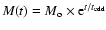 with initial BH mass
 10
and
Eddington time
10
and
Eddington time
 years, in principle,
would provide a quasar-like BH of 10
years, in principle,
would provide a quasar-like BH of 10
 during
10
years without difficulty.)
during
10
years without difficulty.)
So far the classification of the SED shapes was based on visual inspection,
guided by the features FIR bump, MIR bump, steepness of the NMIR slope
and - to a lesser degree - also the value of
 and the
steepness of the optical slope.
It is desirable to provide also quantitative measures
for the sorting procedure.
As an attempt for such an approach, Fig. 13 shows
the distribution of our classes
in the parameter space of
/
,
and
.
The classes, in fact, concentrate on
different regions in the three diagrams, although they are not clearly disjoint.
For example in the diagram
/
versus :
class 3a lies in the middle of the diagram,
class 3b extends towards the upper left,
while class 3c lies more toward the righthand side.
In view of the complexity of the objects, it would be overdone to expect
a clear separation of the classes with only three parameters.
One reason for the overlaps may be that during the anticipated evolution the parameters
move "up'' and then "down'', for example
/
grows and finally declines.
Nevertheless,
the trends found in the diagrams (Fig. 13) indicate that
our eyeball SED classifications basically match these formal quantities.
Future studies may be able to refine the classification,
perhaps considering also the total luminosity (which is yet indefinite as mentioned above).
As a vision, they may find evolutionary tracks for quasars in such diagrams - in analogy
to those for the pre-main-sequence stellar birthlines and the giants' branches
in the Hertzsprung-Russel diagram.
and the
steepness of the optical slope.
It is desirable to provide also quantitative measures
for the sorting procedure.
As an attempt for such an approach, Fig. 13 shows
the distribution of our classes
in the parameter space of
/
,
and
.
The classes, in fact, concentrate on
different regions in the three diagrams, although they are not clearly disjoint.
For example in the diagram
/
versus :
class 3a lies in the middle of the diagram,
class 3b extends towards the upper left,
while class 3c lies more toward the righthand side.
In view of the complexity of the objects, it would be overdone to expect
a clear separation of the classes with only three parameters.
One reason for the overlaps may be that during the anticipated evolution the parameters
move "up'' and then "down'', for example
/
grows and finally declines.
Nevertheless,
the trends found in the diagrams (Fig. 13) indicate that
our eyeball SED classifications basically match these formal quantities.
Future studies may be able to refine the classification,
perhaps considering also the total luminosity (which is yet indefinite as mentioned above).
As a vision, they may find evolutionary tracks for quasars in such diagrams - in analogy
to those for the pre-main-sequence stellar birthlines and the giants' branches
in the Hertzsprung-Russel diagram.
The coarse difference between the SEDs of ULIRGs and quasars, combined with the high bolometric luminosities, led Sanders et al. (1988a,b) to propose the general evolutionary link between these two galaxy types. The diversity of the quasar IR SEDs was already noticed for IRAS samples with sparse wavelength coverage and limited sensitivity (e.g. Barvainis 1990; Elvis et al. 1994) or for the small ISO sample of 17 sources in Paper I, but without allowing stringent interpretations like evolution among PG quasars. The sensitive ISO data of a sufficiently large sample of 64 PG quasars allow for the first time to establish the details of the SED variety and to classify them. Combining now the SED diversity with the idea of sorting along evolutionary expectations, provides the main new result here, which may stimulate future studies.
To conclude, the observed variety of SEDs can be associated with and sorted into physically meaningful classes, which reflect the amount and distribution of the reprocessing dust around the AGN. These classes can naturally be understood as a consequence of evolution of the quasars' dust distribution and heating.
If quasars are merger remnants in a post-ULIRG phase, then one would expect that - compared with older relaxed and more evolved quasars - the younger quasars are those which show both (1) more ULIRG-like cool dust and (2) more distortions in the (optical or NIR) morphology of their host galaxy.
In order to test this prediction,
we collected host galaxy information for 34 of our 64 PG quasars in the literature.
Table 2 lists a
compilation of several data sets compiled by Clements (2000) and observed by
Surace et al. (2001).
As in Clements (2000), we distinguish simply between distorted and undistorted hosts.
Figure 14 shows the distribution of
the
/
ratio
and the FIR luminosity for these 34 PG quasars. They are indistinguishable for those
with and without host distortions, respectively.
Also, the distributions of
or the histograms of SED classes (2, ... 4) look
indistinguishable for disturbed and regular hosts.
Furthermore, no trend of predominant spiral or elliptical hosts with the IR properties
can be found.
Notably, we cannot confirm the claim by Clements (2000), that those
PG quasars, which are luminous in the IRAS 60 m band,
are more distorted than the faint ones, a result which might be an artefact produced by
the numerous IRAS upper limits. Also, the youth of a quasar may be better identified by the
/
ratio than by the absolute 60 m luminosity.
![\begin{figure}
\par\includegraphics[width=7cm,clip]{3053_f13a.ps}\par\includegra...
...ip]{3053_f13b.ps}\par\includegraphics[width=7cm,clip]{3053_f13c.ps}
\end{figure}](/articles/aa/full/2003/16/aa3053/img137.gif) |
Figure 13:
Locus of the SED classes in the
/
-
-
parameter space.
Although the SED classes were visually determined,
they concentrate at distinct regions in the three diagrams.
(The data are as in Fig. 11.) |
![\begin{figure}
\par\includegraphics[width=7.3cm,clip]{3053_f14.ps}
\end{figure}](/articles/aa/full/2003/16/aa3053/img138.gif) |
Figure 14:
/
ratio versus
for PG quasars with undisturbed ()
and disturbed ()
host morphology. The arrows indicate upper limits for
. |
Here we will not discuss cosmological effects within our PG quasar sample, although it is striking that - as already known from many optical investigations - at low redshift (z<0.4) no hyperluminous quasars are present (Fig. 3). Different redshift bins of our flux limited PG sample contain sources of different luminosities, hence the bins probably do not contain representatives of comparable luminosity or type which are seen just at different cosmic epochs. Also, any physical evolution from a hyperluminous z=1 quasar into a less luminous one at z<0.4 would just be speculative.
Of special interest, however, is to compare sources of similar luminosity,
but from different cosmic epochs.
Very high redshift (z=4) quasars have been discovered in the
Digitized Palomar Sky Survey (PSS quasar catalog, e.g. Kennefick et al. 1995)
and from the Sloan Digital Sky Survey (SDSS quasar samples, e.g. Fan et al. 2000).
These quasars have  estimates between -26 and -29 mag,
comparable to our
hyperluminous PG quasars at z=1 with
estimates between -26 and -29 mag,
comparable to our
hyperluminous PG quasars at z=1 with
 mag and
 .
Due to the K-correction the
z=4 quasars are sufficiently bright to be detected also in (sub-)millimetre surveys.
In this section we compare our
z=1 PG quasars with z=4 quasars
from the PSS and SDSS, in order to study
the influence of cosmic epoch on the amount of dust and its heating sources.
.
Due to the K-correction the
z=4 quasars are sufficiently bright to be detected also in (sub-)millimetre surveys.
In this section we compare our
z=1 PG quasars with z=4 quasars
from the PSS and SDSS, in order to study
the influence of cosmic epoch on the amount of dust and its heating sources.
For such a comparison between our "local'' z=1 hyperluminous quasars and those at very high redshifts, the influence of two observational differences has to be checked:
Firstly, the optical selection of the local PG quasars is based on the intrinsic
UV-blue continuum, while the z=4 quasars are identified via the Lyman break using
two-colour diagrams.
Actually, the two-colour criteria seem to be so strict, that only
sources with a strong Ly line and low extinction are selected.
Nevertheless, while the PG quasars definitely contain objects with a blue continuum,
the high z quasar samples could, in principle, contain also objects, which exhibit
a red intrinsic continuum, hence would be different from the PG quasars. Such a difference,
however, is not supported by the current observational status of the z=4 quasars:
The mean restframe UV slope of the SDSS z=4 quasars lies in the range around -0.67 and -0.79
(Fan et al. 2000, 2001), and the mean restframe optical slope lies around -0.5
(determined from J, H, K photometry by
Pentericci et al. 2002, in preparation, private communication by H.W. Rix & L. Pentericci).
These values are similar to that of the PG sample (mean
-0.5,
Fig. 11).
Therefore, with respect to the z=1 PG quasars, we do not expect a bias in favor of or
against cool dust emission from (presumably reddened) hyperluminous starbursts
in the PSS and SDSS z=4 quasars.
line and low extinction are selected.
Nevertheless, while the PG quasars definitely contain objects with a blue continuum,
the high z quasar samples could, in principle, contain also objects, which exhibit
a red intrinsic continuum, hence would be different from the PG quasars. Such a difference,
however, is not supported by the current observational status of the z=4 quasars:
The mean restframe UV slope of the SDSS z=4 quasars lies in the range around -0.67 and -0.79
(Fan et al. 2000, 2001), and the mean restframe optical slope lies around -0.5
(determined from J, H, K photometry by
Pentericci et al. 2002, in preparation, private communication by H.W. Rix & L. Pentericci).
These values are similar to that of the PG sample (mean
-0.5,
Fig. 11).
Therefore, with respect to the z=1 PG quasars, we do not expect a bias in favor of or
against cool dust emission from (presumably reddened) hyperluminous starbursts
in the PSS and SDSS z=4 quasars.
Secondly, the part of the rest frame dust emission, which is well constrained, differs:
for the local sources it is the mid- and far-infrared
range (i.e. the warm side of the dust emission)
and for the distant ones it is the (sub-)millimetre range,
i.e. the cold end of the thermal spectrum.
While the warm side provides conclusions about the AGN-starburst relation from
energy considerations (like the MIR/FIR luminosity ratio adopting it as indicator for
 /
),
the cold side provides constraints from temperature and mass of the coldest dust in
these sources.
/
),
the cold side provides constraints from temperature and mass of the coldest dust in
these sources.
= 4 quasars
Several millimetre and sub-millimetre surveys with MAMBO and SCUBA
detected dust emission from about 30% of the PSS and SDSS z=4 quasars observed
(e.g. Omont et al. 2001; Carilli et al. 2001a,b; Bertoldi & Cox 2002).
The FIR to mm luminosity of the z=4 quasars is suggested to be
starburst driven, and not AGN-powered.
Remarkably, the inferred starbursts are hyperluminous
(
 ).
Before we accept these hyperluminous starbursts for the cosmological comparison
(in Sect. 4.4.3), we address some caveats:
).
Before we accept these hyperluminous starbursts for the cosmological comparison
(in Sect. 4.4.3), we address some caveats:
1. Although the PSS and SDSS quasars contain a huge amount of dust, the central AGN of these quasars is very little extinguished with typical AV<0.3 (Fan et al. 2001). The optical selection from a total population of very luminous dusty objects could pick out just those "exotic'' objects, which - perhaps by chance - provide optical paths of low extinction towards the center. Since it is hard to believe that a chaotic dusty system can provide such a path, the dust distribution should follow a disk-like geometry seen face-on. However, hyperluminous starbursts - in particular if they are produced by a merging galaxy group - may be expected to disturb any somehow ordered disk-like dust distribution. This complication could be lessened, if the dusty starbursts were more moderate.
2. The conclusions about the starburst dominance in the z=4 quasars
are essentially based on the dust temperature of about 50 K adopted for
most of the sources. This average temperature is determined
only for few sources with several measured SED points, e.g. by Benford et al. (1999) and
Priddey & Mc Mahon (2001).
It could be biased towards rather low values, since it
is derived exclusively from those sources detected at mm wavelengths, while warmer
( K) sources
of a given MIR-FIR luminosity would provide mainly upper limits at 1.2 mm
(Fig. 2 in Omont et al. 2001), hence no definite
temperature estimate.
Actually, dust temperatures of about 80 K have
been found for some
K) sources
of a given MIR-FIR luminosity would provide mainly upper limits at 1.2 mm
(Fig. 2 in Omont et al. 2001), hence no definite
temperature estimate.
Actually, dust temperatures of about 80 K have
been found for some  quasars (Chini & Krügel 1994), and
 K
for IRAS F10214+4724, the lensed z=2.2 AGN-SB HyLIG (Manning & Spinrad 2001).
This temperature range is more
similar to that of hyperluminous PG quasars at z=1.
One of our PG quasars (PG 1247+267) at z=2 has the highest temperature
of more than 120 K (Fig. 10), whereby the data allow for an additional
cooler (
K
for IRAS F10214+4724, the lensed z=2.2 AGN-SB HyLIG (Manning & Spinrad 2001).
This temperature range is more
similar to that of hyperluminous PG quasars at z=1.
One of our PG quasars (PG 1247+267) at z=2 has the highest temperature
of more than 120 K (Fig. 10), whereby the data allow for an additional
cooler ( K), but by far less luminous dust component.
Therefore the hyperluminous z=4 quasars likely exhibit a range of dust
temperatures between say 50 and 120 K, certainly not unexpected
in view of the variety of dust emission properties discussed in Sect. 4.3.
K), but by far less luminous dust component.
Therefore the hyperluminous z=4 quasars likely exhibit a range of dust
temperatures between say 50 and 120 K, certainly not unexpected
in view of the variety of dust emission properties discussed in Sect. 4.3.
3. The fit of the FIR to mm SEDs by a modified blackbody is not unique.
Instead of a single component with T=50 K and emissivity index
 used for the z=4 quasars, two temperature
components of emissivity index
could be a better physical description
of the dust content in complex interacting galaxy systems,
as was shown by Klaas et al. (2001) for the detailed IR-to-mm SEDs of nearby ULIRGs.
The current SED sampling of the z=4 quasars is too sparse to establish such
a two component decomposition, but the one component fit yielding
an "effective''
already
indicates that two
components could be present, say a warm hyperluminous
AGN dominated one of
used for the z=4 quasars, two temperature
components of emissivity index
could be a better physical description
of the dust content in complex interacting galaxy systems,
as was shown by Klaas et al. (2001) for the detailed IR-to-mm SEDs of nearby ULIRGs.
The current SED sampling of the z=4 quasars is too sparse to establish such
a two component decomposition, but the one component fit yielding
an "effective''
already
indicates that two
components could be present, say a warm hyperluminous
AGN dominated one of
 K and a clearly less luminous
cool starburst component of
K and a clearly less luminous
cool starburst component of
 K.
K.
4. Some z=4 quasars show also huge H
gas masses (10 )
derived from CO detections (e.g. Cox et al. 2002; Carilli et al. 2002).
The gas-to-dust mass ratio appears consistent with that for nearby galaxies and ULIRGs,
supporting the correctness of the dust mass estimates.
However, the determination of a high dust mass consistent with the H
gas mass
is not unique; it could be achieved via the adopted dust temperature of 50 K using ,
or two
dust components as mentioned above.
5. The use of a single blackbody with T =50 K leads to
a hyperluminous object with
 of some 10
which is completely ascribed to starbursts.
The derived radio/FIR luminosity ratio seems to be consistent with that of starburst galaxies
(e.g. Carilli et al. 2001b).
However, the MIR luminosity is not known, so that any Rayleigh-Jeans-tail
contribution from an AGN dust component to the FIR-mm luminosity is ignored.
Here, a decomposition into a two temperature component model could provide a more
realistic picture.
of some 10
which is completely ascribed to starbursts.
The derived radio/FIR luminosity ratio seems to be consistent with that of starburst galaxies
(e.g. Carilli et al. 2001b).
However, the MIR luminosity is not known, so that any Rayleigh-Jeans-tail
contribution from an AGN dust component to the FIR-mm luminosity is ignored.
Here, a decomposition into a two temperature component model could provide a more
realistic picture.
6. Some of the caveats on hyperluminous starbursts inferred from a 50 K dust component could be alleviated, if the z=4 quasars were gravitationally lensed, certainly not an unexpected possibility in view of the huge distance. For example, a z=4 quasar lensed by a factor of about 5 would intrinsically be more similar to the normal luminous to ultraluminous PG quasars which typically show a cold thermal end of about 50 K. However, for a few examined cases the evidence for lensing is low, and in view of the high detection rate of about 30% the probability that most of the (sub-)millimetre detected quasars are strongly lens-amplified is low, too. Further clues to these puzzles have to be left to future investigations.
To conclude, about 30% of the z=4 PSS and SDSS quasars observed show (sub-)millimetre signatures which could be due to hyperluminous starbursts. However, these signatures have to be considered with caution. The main uncertainty lies in the dust temperature and the unknown AGN contribution to the FIR luminosity.
The comparison of hyperluminous quasars from the PG sample at z=1 with those from PSS and SDSS at very high redshift (z=4) yields:
The selection criteria for the z=4 PSS and SDSS quasars and their restframe UV slopes measured so far (compared with those of the PG quasars) do not suggest a bias in favor of or against dust emission from hyperluminous starbursts.
At early cosmic epochs (z=4) quasars appear accompanied by starbursts which in some cases may reach hyperluminous strength. At later epoch (z=1) in the local universe the starbursts which accompany quasars obviously do not reach that high power and are clearly outshone by the AGN.
If the low and high incidence of hyperluminous starbursts at z=1 and z=4, respectively, can be further established, then the reason for this difference could be a much denser early universe with stronger and more frequent merger events. This supports the hypothesis of coeval formation of massive black holes and galaxy spheroids via merging galaxies at high redshifts, in order to explain the relation between black hole mass and velocity dispersion of the galaxy bulge (e.g. Gebhardt et al. 2000).
Copyright ESO 2003
![\begin{figure}
\par\mbox{\includegraphics[width=6cm,clip]{3053_f4a.ps}\includegr...
...,clip]{3053_f4e.ps}\includegraphics[width=6cm,clip]{3053_f4f.ps} }\end{figure}](/articles/aa/full/2003/16/aa3053/img80.gif)
![\begin{figure}
\par\includegraphics[width=8.8cm,clip]{3053_f6.ps}
\end{figure}](/articles/aa/full/2003/16/aa3053/img100.gif)
![\begin{figure}
\par\includegraphics[width=13.5cm,clip]{3053_f12coul.eps}
\end{figure}](/articles/aa/full/2003/16/aa3053/img130.gif)
 and shows up in the SEDs by the optical slope.