A&A 401, 959-974 (2003)
DOI: 10.1051/0004-6361:20030188
New neighbours
V. 35 DENIS late-M dwarfs
between 10 and 30 parsecs
N. Phan-Bao
1,2 -
F. Crifo
2 -
X. Delfosse
3 -
T. Forveille
3,4 -
J. Guibert
1,2 -
J. Borsenberger
5 -
N. Epchtein
6 -
P. Fouqué
7,8 -
G. Simon
2 -
J. Vetois
1,9
1 - Centre d'Analyse des Images, GEPI, Observatoire de Paris,
61 avenue de l'Observatoire, 75014 Paris, France
2 -
GEPI, Observatoire de Paris, 5 place J. Janssen, 92195
Meudon Cedex, France
3 -
Laboratoire d'Astrophysique de Grenoble, Université J.
Fourier, BP 53, 38041 Grenoble, France
4 -
Canada-France-Hawaii Telescope Corporation, 65-1238 Mamalahoa
Highway, Kamuela, HI 96743, USA
5 -
SIO, Observatoire de Paris, 5 place J. Janssen, 92195
Meudon Cedex, France
6 -
Observatoire de la Côte d'Azur, Département Fresnel, BP 4229,
06304 Nice Cedex 4, France
7 -
LESIA, Observatoire de Paris, 5 place J. Janssen, 92195
Meudon Cedex, France
8 -
European Southern Observatory, Casilla 19001, Santiago 19, Chile
9 -
École Normale Supérieure de Cachan, 61 avenue du
Président-Wilson, 94230
Cachan, France
Received 15 July 2002 / Accepted 31 January 2003
Abstract
This paper reports updated results on our systematic mining of the DENIS
database for nearby very cool M-dwarfs (M 6V-M 8V,
 ,
photometric distance within 30 pc), initiated by Phan-Bao et al.
(2001, hereafter Paper I). We use M dwarfs with well measured
parallaxes (HIP, GCTP, ...) to calibrate the DENIS (MI, I-J)
colour-luminosity relationship. The resulting distance error for single
dwarfs is about 25%.
Proper motions, as well as B and R magnitudes, were measured on archive
Schmidt plates for those stars in the DENIS database that meet the
photometric selection criteria.
We then eliminate the giants by a Reduced Proper Motion cutoff, which is
significantly more selective than a simple proper motion cutoff. It
greatly reduces the selection bias against low tangential velocity
stars, and results in a nearly complete sample.
Here we present new data for 62 red dwarf candidates selected
over 5700 square degrees in the DENIS database. 26 of those originate
in the 2100 square degrees analysed in Paper I, with improved parameters
here, and 36 were found in 3600 additional square degrees. 25 of those
are new nearby dwarfs.
We determine from that sample of 62 stars a stellar density for
,
photometric distance within 30 pc), initiated by Phan-Bao et al.
(2001, hereafter Paper I). We use M dwarfs with well measured
parallaxes (HIP, GCTP, ...) to calibrate the DENIS (MI, I-J)
colour-luminosity relationship. The resulting distance error for single
dwarfs is about 25%.
Proper motions, as well as B and R magnitudes, were measured on archive
Schmidt plates for those stars in the DENIS database that meet the
photometric selection criteria.
We then eliminate the giants by a Reduced Proper Motion cutoff, which is
significantly more selective than a simple proper motion cutoff. It
greatly reduces the selection bias against low tangential velocity
stars, and results in a nearly complete sample.
Here we present new data for 62 red dwarf candidates selected
over 5700 square degrees in the DENIS database. 26 of those originate
in the 2100 square degrees analysed in Paper I, with improved parameters
here, and 36 were found in 3600 additional square degrees. 25 of those
are new nearby dwarfs.
We determine from that sample of 62 stars a stellar density for
 of
of
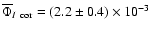 stars pc-3 mag-1.
This value is consistent with photometric luminosity functions measured
from deeper and smaller-field observations, but not with the nearby star
luminosity function.
In addition we cross-identified the NLTT and DENIS catalogues to
find 15 similar stars, in parts of the sky not yet covered by the
colour-selected search.
We present distance and luminosity estimates for these 15 stars, 10 of which are newly recognized nearby dwarfs.
A similar search in Paper I produced 4 red dwarf candidates, and
we have thus up to now identified a total of 35 new nearby late-M dwarfs.
stars pc-3 mag-1.
This value is consistent with photometric luminosity functions measured
from deeper and smaller-field observations, but not with the nearby star
luminosity function.
In addition we cross-identified the NLTT and DENIS catalogues to
find 15 similar stars, in parts of the sky not yet covered by the
colour-selected search.
We present distance and luminosity estimates for these 15 stars, 10 of which are newly recognized nearby dwarfs.
A similar search in Paper I produced 4 red dwarf candidates, and
we have thus up to now identified a total of 35 new nearby late-M dwarfs.
Key words: astrometry - stars: low mass, brown dwarfs - solar neighbourhood
The stellar content of the solar neighbourhood is once again a very active
research field, revived in large part by the vast amounts of new data from
the near-Infrared surveys DENIS (Epchtein 1997) and 2MASS
(Skrutskie et al. 1997) and the optical Sloan Digital Sky Survey
(York et al. 2000; Hawley et al. 2002).
These surveys have identified much fainter and cooler objects, and
required the extension of the spectral classification system by two
new spectral classes, the L and T dwarfs (Martín et al. 1997;
Kirkpatrick et al. 1999). As expected, the surveys also
detect large numbers of less extreme late-M dwarfs. As shown by Gliese
et al. (1986) the census of the solar neighbourhood is rather
incomplete for late M dwarfs, and their actual number density is not very
well established.
In Paper I (Phan-Bao et al. 2001), we
presented 30 nearby (
 pc) late-M dwarfs
(
,
M 6-M 8)
with high proper motions: 26,
a few of which were previously known from other sources, were photometrically
selected from 2100 square degrees of DENIS data, and 4 were identified by
cross-identifying the LHS (Luyten 1979) and DENIS catalogues
over a larger sky area.
Here we repeat the analysis of Paper I with an improved (I-J, MI)
relation, calibrated specifically for the DENIS filter set, and extend
the colour selection to a further 3600 square degrees.
We also use an improved dwarf/giant discrimination criterion, based on the
reduced proper motion rather than the simple
proper motion cutoff which is commonly used for that purpose (e.g. Scholz et al. 2001; and Paper I). This allows us to dig down to significantly
lower proper motions, and thus to identify additional dwarf candidates.
Finally, we systematically search the DENIS database for southern NLTT
stars (Luyten 1980) that have colours in the same
(
pc) late-M dwarfs
(
,
M 6-M 8)
with high proper motions: 26,
a few of which were previously known from other sources, were photometrically
selected from 2100 square degrees of DENIS data, and 4 were identified by
cross-identifying the LHS (Luyten 1979) and DENIS catalogues
over a larger sky area.
Here we repeat the analysis of Paper I with an improved (I-J, MI)
relation, calibrated specifically for the DENIS filter set, and extend
the colour selection to a further 3600 square degrees.
We also use an improved dwarf/giant discrimination criterion, based on the
reduced proper motion rather than the simple
proper motion cutoff which is commonly used for that purpose (e.g. Scholz et al. 2001; and Paper I). This allows us to dig down to significantly
lower proper motions, and thus to identify additional dwarf candidates.
Finally, we systematically search the DENIS database for southern NLTT
stars (Luyten 1980) that have colours in the same
(
 )
range.
)
range.
Section 2 presents the DENIS colour-magnitude relation, and Sect. 3 reviews
the sample selection. Section 4 discusses the proper motion
measurements and the calibration of the B and R photographic photometry.
Section 5 presents the giant/dwarf discrimination from Reduced Proper Motion
plots, and Sect. 7 a rough estimation of effective temperatures.
We discuss the completeness of the sample in Sect. 6 and indicate future
directions in Sect. 8.
The DEep Near Infrared Survey (DENIS) (Epchtein 1997)
systematically surveyed the southern sky in two near-infrared
(J and  )
and one optical (I) band. Its extensive sky
coverage, broad wavelength baseline, and moderately deep exposures
(I=18.5, J=16,
)
and one optical (I) band. Its extensive sky
coverage, broad wavelength baseline, and moderately deep exposures
(I=18.5, J=16,
 )
make it a very efficient tool
at identifying faint and cool nearby stars.
)
make it a very efficient tool
at identifying faint and cool nearby stars.
In Paper I, we estimated distances to potential DENIS red dwarfs using the
Cousins-CIT (
 ,
MI) relation for M dwarfs
of Delfosse (1997b).
We also noted that for red stars the DENIS photometric system and the standard
Cousins-CIT system differ by
,
MI) relation for M dwarfs
of Delfosse (1997b).
We also noted that for red stars the DENIS photometric system and the standard
Cousins-CIT system differ by  0.1 mag for the K band, but by less
than 0.05 mag for the I and J bands (Delfosse 1997b). The
Delfosse (1997b) I-J relation therefore applies reasonably well
to DENIS photometry, but with progress in the DENIS data reduction it
has now become possible, and preferable, to directly calibrate a DENIS
colour-magnitude relation.
Of the three colours that can be formed from DENIS photometry, J-K is a
very poor spectral type diagnostic for M dwarfs, while I-J and I-K are
both excellent. From a practical point of view, DENIS is significantly
more sensitive to M dwarfs at J than at K. We therefore chose to
calibrate the (I-J, MI) relation.
0.1 mag for the K band, but by less
than 0.05 mag for the I and J bands (Delfosse 1997b). The
Delfosse (1997b) I-J relation therefore applies reasonably well
to DENIS photometry, but with progress in the DENIS data reduction it
has now become possible, and preferable, to directly calibrate a DENIS
colour-magnitude relation.
Of the three colours that can be formed from DENIS photometry, J-K is a
very poor spectral type diagnostic for M dwarfs, while I-J and I-K are
both excellent. From a practical point of view, DENIS is significantly
more sensitive to M dwarfs at J than at K. We therefore chose to
calibrate the (I-J, MI) relation.
We searched the following trigonometric parallax catalogues
for reference M dwarfs
with a DENIS counterpart fainter than the I saturation limit
of I=9 and with I-J>1.0:
- .
- the Hipparcos catalogue (ESA 1997) for 63 relatively
bright stars. As the limiting magnitude of the HIP catalogue is
 ,
it contains few very red dwarfs;
,
it contains few very red dwarfs;
- .
- the GCTP catalogue (van Altena et al. 1995)
for 29 mostly fainter stars;
- .
- 6 faint stars from Tinney et al. (1995),
Tinney (1996);
one from Henry et al. (1997)
and one late M dwarf from Deacon & Hambly (2001).
We excluded known doubles as well as large amplitude variables, but had
to accept a number of low amplitude flare stars, with peak visible
light amplitude of 0.1 to 0.3 mag.
We did not correct the resulting absolute magnitudes for the Lutz-Kelker
bias, since the complex selection pedigree of our sample makes a quantitative
analysis of that bias almost impossible. Arenou & Luri (1999)
conclude that it is preferable to apply no correction in such cases.
The errors on the parallaxes are fortunately small, so that neglecting
that correction does not appreciably contribute to the overall errors.
![\begin{figure}
\par\includegraphics[angle=-90,width=8.8cm,clip]{ms2905f1.ps}\end{figure}](/articles/aa/full/2003/15/aa2905/Timg22.gif) |
Figure 1:
(
MI, I-J) HR diagram for single M dwarfs with known
trigonometric parallaxes (data in Table 1). |
| Open with DEXTER |
Figure 1 shows the resulting (I-J, MI) plot,
and the corresponding 4th order polynomial fit:
| MI = a0+a1(I-J)+a2(I-J)2+a3(I-J)3
+a4(I-J)4 |
|
|
(1) |
where
a0=11.370,
a1=-19.175,
a2=21.587,
a3=-7.877,
a4=0.9710, valid for
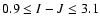 .
.
Table 1:
continued.
| Stars |
 |
 |
DENIS |
I |
I-J |
J-K |
errI |
errJ |
errK |
 |
 |
MI |
Ref. |
| |
|
|
epoch |
|
|
|
|
|
|
mas |
mas |
|
|
| LHS 2477 |
11 55 49.22 |
-38 16 49.7 |
2001.104 |
9.88 |
1.12 |
0.75 |
0.03 |
0.07 |
0.09 |
42.8 |
3.0 |
8.04 |
a |
| LHS 2509 |
12 04 36.61 |
-38 16 25.2 |
2000.233 |
9.74 |
1.15 |
0.87 |
0.04 |
0.08 |
0.05 |
37.3 |
4.9 |
7.60 |
a |
| LP 794-30 |
12 11 11.78 |
-19 57 38.1 |
1999.148 |
9.48 |
1.57 |
0.89 |
0.03 |
0.05 |
0.08 |
78.1 |
3.1 |
8.94 |
a |
| LP 852-57 |
12 13 32.93 |
-25 55 24.5 |
1999.153 |
9.48 |
1.08 |
0.84 |
0.03 |
0.06 |
0.08 |
42.1 |
2.5 |
7.60 |
a |
| LHS 2587 |
12 36 49.29 |
-76 57 17.8 |
1998.197 |
9.37 |
0.96 |
0.85 |
0.02 |
0.07 |
0.07 |
27.8 |
1.7 |
6.59 |
a |
| LHS 2595 |
12 38 47.34 |
-04 19 17.0 |
1999.414 |
10.80 |
1.46 |
0.86 |
0.02 |
0.06 |
0.08 |
50.7 |
3.1 |
9.33 |
b |
| LP 617-37 |
13 20 24.96 |
-01 39 26.3 |
1999.211 |
9.57 |
1.23 |
0.85 |
0.03 |
0.06 |
0.09 |
48.2 |
2.9 |
7.98 |
a |
| LP 855-14 |
13 27 53.95 |
-26 57 01.8 |
2001.151 |
9.60 |
1.25 |
0.88 |
0.03 |
0.08 |
0.09 |
48.0 |
2.9 |
8.01 |
a |
| LHS 2770 |
13 38 24.73 |
-02 51 51.9 |
1999.279 |
12.54 |
1.43 |
0.95 |
0.04 |
0.07 |
0.07 |
26.3 |
6.7 |
9.64 |
b |
| LP 912-26 |
13 53 19.76 |
-30 46 37.6 |
2000.364 |
10.02 |
1.06 |
0.97 |
0.03 |
0.06 |
0.09 |
27.0 |
3.8 |
7.18 |
a |
| LHS 2876 |
14 12 12.17 |
-00 35 16.2 |
1999.444 |
15.59 |
2.50 |
1.01 |
0.05 |
0.08 |
0.08 |
32.7 |
4.1 |
13.16 |
c |
| T* 868-110639 |
15 10 16.86 |
-02 41 07.4 |
1999.384 |
15.73 |
3.09 |
1.32 |
0.05 |
0.07 |
0.09 |
57.5 |
1.9 |
14.53 |
b |
| LHS 392 |
15 11 50.60 |
-10 14 17.8 |
2000.277 |
11.24 |
1.47 |
0.90 |
0.04 |
0.09 |
0.12 |
67.4 |
3.1 |
10.38 |
b |
| LP 915-16 |
15 17 21.16 |
-27 59 49.8 |
1996.422 |
9.58 |
1.27 |
0.91 |
0.02 |
0.08 |
0.12 |
41.2 |
3.7 |
7.66 |
a |
| LHS 3092 |
15 36 34.53 |
-37 54 22.3 |
1999.211 |
9.91 |
1.47 |
0.79 |
0.03 |
0.05 |
0.06 |
81.6 |
13.7 |
9.47 |
b |
| LHS 3093 |
15 36 58.69 |
-14 08 00.7 |
1998.373 |
10.02 |
1.63 |
0.88 |
0.02 |
0.05 |
0.05 |
74.9 |
3.8 |
9.39 |
b |
| LP 336-71 |
15 49 38.34 |
-47 36 33.8 |
1999.290 |
9.46 |
1.13 |
0.88 |
0.03 |
0.05 |
0.06 |
37.5 |
2.6 |
7.33 |
a |
| LP 744-46 |
16 02 35.07 |
-14 38 36.5 |
1996.359 |
9.71 |
1.16 |
0.85 |
0.03 |
0.06 |
0.09 |
31.4 |
4.1 |
7.19 |
a |
| LHS 412 |
16 08 15.03 |
-10 26 11.7 |
1998.323 |
11.78 |
1.51 |
0.81 |
0.03 |
0.07 |
0.09 |
47.1 |
2.7 |
10.15 |
b |
| LHS 3185 |
16 22 40.97 |
-48 39 19.7 |
1999.570 |
9.70 |
1.26 |
0.78 |
0.04 |
0.08 |
0.05 |
41.0 |
3.7 |
7.76 |
a |
| LP 625-34 |
16 40 05.98 |
+00 42 19.3 |
1999.625 |
10.67 |
1.57 |
0.84 |
0.02 |
0.06 |
0.06 |
89.0 |
2.3 |
10.42 |
b |
| LHS 3242 |
16 48 24.40 |
-72 58 33.9 |
2000.537 |
9.27 |
1.22 |
0.80 |
0.03 |
0.08 |
0.06 |
62.7 |
1.9 |
8.25 |
a |
| LHS 3272 |
17 13 40.46 |
-08 25 14.6 |
2000.573 |
9.54 |
1.39 |
0.83 |
0.04 |
0.07 |
0.27 |
52.8 |
4.2 |
8.15 |
a |
| HIP 86938 |
17 45 53.36 |
-13 18 22.1 |
2000.551 |
10.14 |
1.06 |
0.81 |
0.04 |
0.08 |
0.06 |
26.9 |
3.8 |
7.29 |
a |
| HIP 91644 |
18 41 19.73 |
-60 25 47.4 |
2000.381 |
9.45 |
1.01 |
0.76 |
0.02 |
0.06 |
0.09 |
27.5 |
2.5 |
6.65 |
a |
| LHS 3421 |
18 52 52.30 |
-57 07 38.1 |
2000.773 |
9.84 |
1.35 |
0.89 |
0.03 |
0.07 |
0.07 |
37.5 |
3.8 |
7.71 |
a |
| L 850-62 |
19 03 16.64 |
-13 34 05.4 |
2000.573 |
11.93 |
1.57 |
0.81 |
0.03 |
0.07 |
0.07 |
52.4 |
3.8 |
10.53 |
b |
| LTT 7598 |
19 12 25.27 |
-55 52 07.6 |
1999.512 |
9.47 |
1.19 |
0.87 |
0.02 |
0.05 |
0.06 |
50.0 |
2.5 |
7.97 |
a |
| LP 635-46 |
20 43 41.32 |
-00 10 41.3 |
1999.605 |
9.54 |
1.02 |
0.88 |
0.02 |
0.06 |
0.07 |
38.4 |
3.1 |
7.46 |
a |
| LP 211-96 |
20 59 51.36 |
-58 45 31.1 |
2001.359 |
9.71 |
1.14 |
0.85 |
0.04 |
0.08 |
0.07 |
32.0 |
2.9 |
7.24 |
a |
| LHS 3639 |
21 11 49.56 |
-43 36 48.8 |
1999.540 |
9.59 |
1.14 |
0.77 |
0.08 |
0.08 |
0.07 |
69.8 |
4.2 |
8.81 |
a |
| LHS 3666 |
21 24 18.32 |
-46 41 35.3 |
1999.559 |
10.20 |
1.20 |
0.86 |
0.03 |
0.06 |
0.07 |
37.2 |
4.8 |
8.05 |
a |
| HB 2124-4228 |
21 27 26.12 |
-42 15 18.1 |
1998.652 |
16.02 |
2.47 |
1.45 |
0.06 |
0.13 |
0.16 |
28.0 |
6.2 |
13.26 |
c |
| HIP 106043 |
21 28 44.42 |
-47 15 42.2 |
1998.501 |
10.36 |
1.04 |
0.98 |
0.05 |
0.11 |
0.12 |
26.7 |
4.0 |
7.49 |
a |
| LHS 513 |
21 39 00.66 |
-24 09 26.7 |
1996.638 |
10.68 |
1.55 |
0.74 |
0.04 |
0.06 |
0.08 |
73.3 |
12.0 |
10.01 |
b |
| LHS 5374 |
21 54 45.25 |
-46 59 34.5 |
2000.605 |
9.73 |
1.32 |
0.88 |
0.03 |
0.08 |
0.08 |
66.1 |
3.3 |
8.83 |
a |
| HIP 108523 |
21 59 08.30 |
-46 45 47.3 |
1998.679 |
9.74 |
1.10 |
1.03 |
0.03 |
0.11 |
0.11 |
37.8 |
3.8 |
7.63 |
a |
| LP 283-3 |
22 03 27.19 |
-50 38 39.2 |
2000.512 |
9.83 |
1.14 |
0.87 |
0.04 |
0.07 |
0.14 |
45.9 |
8.3 |
8.14 |
a |
| LHS 3776 |
22 13 42.90 |
-17 41 08.8 |
2000.504 |
10.65 |
1.70 |
0.84 |
0.08 |
0.06 |
0.06 |
96.0 |
3.9 |
10.56 |
b |
| T* 890-60235 |
22 23 05.56 |
+00 30 11.1 |
1999.614 |
16.62 |
2.43 |
1.18 |
0.07 |
0.10 |
0.14 |
19.4 |
2.2 |
13.06 |
c |
| HIP 110655 |
22 25 02.83 |
-33 12 16.2 |
2000.458 |
9.02 |
0.92 |
0.75 |
0.04 |
0.08 |
0.08 |
30.7 |
5.2 |
6.46 |
a |
| LHS 523 |
22 28 54.38 |
-13 25 17.8 |
1998.729 |
12.87 |
2.19 |
0.89 |
0.04 |
0.11 |
0.13 |
88.8 |
4.9 |
12.61 |
b |
| LHS 526 |
22 34 53.61 |
-01 04 58.0 |
1998.723 |
11.89 |
1.47 |
1.04 |
0.03 |
0.09 |
0.17 |
42.5 |
3.7 |
10.03 |
b |
| LHS 3850 |
22 46 26.28 |
-06 39 25.0 |
1998.474 |
12.62 |
1.94 |
0.80 |
0.02 |
0.10 |
0.12 |
53.3 |
4.6 |
11.25 |
b |
| HIP 114252 |
23 08 19.55 |
-15 24 35.8 |
1999.466 |
9.17 |
1.15 |
0.93 |
0.02 |
0.07 |
0.06 |
45.8 |
2.7 |
7.47 |
a |
| G 157-52 |
23 21 11.25 |
-01 35 44.9 |
2000.578 |
9.77 |
1.11 |
0.82 |
0.03 |
0.07 |
0.08 |
37.0 |
3.7 |
7.61 |
a |
| LHS 546 |
23 35 10.45 |
-02 23 19.9 |
1999.696 |
11.01 |
1.87 |
0.97 |
0.03 |
0.07 |
0.07 |
138.3 |
3.5 |
11.71 |
b |
| HIP 118180 |
23 58 22.03 |
-53 48 33.6 |
1999.874 |
9.21 |
0.97 |
0.68 |
0.03 |
0.07 |
0.07 |
29.7 |
3.0 |
6.57 |
a |
- T*
- TVLM.
- +
- Hipparcos, for LP 793-33.
- *
- BRI 0021-02. This object is also listed in the NLTT, as
LP 585-86. That name is clearly an NLTT typo: another star (the much brighter
HIP 3061) bears the same
name, with coordinates that are consistent
with the LP numbering sequence. The NLTT proper motion is on the other hand
valid: 0.212, 320 degrees.
Columns 1-4: object name, DENIS Position for equinox J2000 at
DENIS epoch, and DENIS epoch.
Columns 5-7; and 8-10: DENIS I-magnitude and colours; and
associated standard errors.
Columns 11, 12: trigonometric parallax and its standard error.
Column 13: MI absolute magnitude, calculated from DENIS I-magnitude
and parallax.
Column 14: parallax reference: (a) HIP; (b) GCTP; (c) Tinney et al.
(1995) and Tinney (1996); (d) Deacon & Hambly (2001); (e) Henry et al. (1997).
|
Reid & Cruz (2002) established a similar relation for the
Cousins/CIT colours, which only differ slightly from the DENIS colours.
That relation is illustrated in Fig. 1, together with
the theoretical prediction of Baraffe (1998).
In the [1.7,3.1] range we could collect 22 data points, significantly
more than the 14 objects that we count in Fig. 11 of Reid & Cruz
(2002).
In the [1.0,1.4] interval the three curves are very close, but
they then disagree over the intermediate [1.4,1.8] region where the
colour-luminosity relation steepens considerably.
Reid & Cruz (2002) choose to describe this difficult region by
discontinuities at I-J=1.45 and I-J=1.65, with a constant value
with large error bars (
 )
used in-between. The
discontinuities clearly are non-physical, but our polynomial fit, just
as clearly, runs the risk of smoothing out a steeper intrinsic slope
which could reflect a real physical change or transition in the
stellar structure.
)
used in-between. The
discontinuities clearly are non-physical, but our polynomial fit, just
as clearly, runs the risk of smoothing out a steeper intrinsic slope
which could reflect a real physical change or transition in the
stellar structure.
Which of the two description is preferable largely rests on a small
group of stars in this colour range: LHS 1855 (Gl 238), LP 794-30,
LHS 3093 (Gl 592), G 70-22, and to a lesser extend, LHS 3850 (GJ 4294).
If those stars are single, the polynomial fit is clearly preferable
to the Reid & Cruz prescription, but an alternative hypothesis is that
they are photometric binaries. Of the five, two have been examined
for companions (LHS 1855, Scholz et al. 2000; LHS 3093, Skrutskie
et al. 1989) and found single, but only with seeing-limited
resolution. LP 794-30 has a known companion, but at 85'', outside any
photometric diaphragm. We observed both G 70-22 and LHS 3850 with adaptive
optics at CFHT, and found the former resolved with
 at a
separation of 0.8''. For now we lack objective reasons to excise the other
4 stars from the list and have thus left them in,
but we did add them to the observing lists of our adaptive optics
and radial velocity programs (Delfosse et al. 1999).
at a
separation of 0.8''. For now we lack objective reasons to excise the other
4 stars from the list and have thus left them in,
but we did add them to the observing lists of our adaptive optics
and radial velocity programs (Delfosse et al. 1999).
In the I-J range of primary interest here ([2.0,3.0]) all three
relations again agree well with the data, as seen in Fig. 2
which plots the residuals of the observed data points from the three fits.
![\begin{figure}
\par\includegraphics[angle=-90,width=8.8cm,clip]{ms2905f2.ps}\end{figure}](/articles/aa/full/2003/15/aa2905/Timg30.gif) |
Figure 2:
Empirical MI absolute magnitudes compared with values
obtained from the theoretical tracks of Baraffe et al. (1998; top),
from the piecewise polynomial calibration of Reid & Cruz (2002; middle)
(except for
1.45 < I-J < 1.65), and from the calibration derived
in this paper (bottom). |
| Open with DEXTER |
Over the [1.9,3.1] range the rms dispersion of the data around our
fit is 0.26, corresponding to a 12% error on distances; it is respectively
0.30 and 0.31 for the Baraffe et al. (1998) and Reid & Cruz
(2002) relations. Over the [2.0,3.0] range the Eq. (1)
polynomial is therefore a small but significant improvement, and we use
it for the reminder of this paper.
We systematically search the DENIS database (available at the Paris Data
Analysis Center, PDAC) for potential members of the solar neighbourhood,
with simple and well defined criteria. Specifically, we start by selecting
all high galactic latitude DENIS sources (
 )
that
are redder than I-J=1.0 (approximately the colour of an M0 dwarf,
Leggett 1992).
We then compute photometric distances to retain stars with
)
that
are redder than I-J=1.0 (approximately the colour of an M0 dwarf,
Leggett 1992).
We then compute photometric distances to retain stars with
 pc. We used the Paper I colour-magnitude relation
for this selection since the colour-relation presented above was
not yet available when we queried the DENIS database, but later
recomputed all distances with the new relation.
pc. We used the Paper I colour-magnitude relation
for this selection since the colour-relation presented above was
not yet available when we queried the DENIS database, but later
recomputed all distances with the new relation.
When the search program was last run in mid-2001,
5700 square degrees (slightly over half of the southern
high galactic latitude sky) were available in the database
(Delfosse & Forveille
2001). 2100 of those 5700 square degrees had been considered
in Paper I and are reanalysed here with slightly improved tools, and 3600 square degrees are new. The number of potential early-M dwarfs (M 0 to M 6,
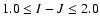 )
with photometric distances within 30 pc is
significantly larger (5000) than the total population expected for
the sampled volume (1400, Henry et al. 2002), and therefore
must be dominated by contamination from distant M-giants with similar
colours. Its analysis will require considerable follow-up,
which is beyond the scope
of the present work. Very late-M and L dwarfs (
)
with photometric distances within 30 pc is
significantly larger (5000) than the total population expected for
the sampled volume (1400, Henry et al. 2002), and therefore
must be dominated by contamination from distant M-giants with similar
colours. Its analysis will require considerable follow-up,
which is beyond the scope
of the present work. Very late-M and L dwarfs (
 )
will be
considered in a forthcoming paper (Delfosse et al., in preparation).
As in Paper I, we thus restrict the present analysis to stars in the
colour interval, or approximately
to spectral types M 6 to M 8.
)
will be
considered in a forthcoming paper (Delfosse et al., in preparation).
As in Paper I, we thus restrict the present analysis to stars in the
colour interval, or approximately
to spectral types M 6 to M 8.
At that stage in the selection, the candidate sample contains approximately
equal numbers of nearby dwarfs and distant giants. A cut in the
I-J/J-K colour-colour diagram (Fig. 3) rejects a sizeable
fraction of the giants,
![\begin{figure}
\par\includegraphics[angle=-90,width=8.8cm,clip]{ms2905f3.ps}\end{figure}](/articles/aa/full/2003/15/aa2905/Timg35.gif) |
Figure 3:
DENIS colour-colour diagram for all 62 late-M dwarf candidates
detected in the 5700 square degrees (Paper I and this paper) so far
examined in DENIS. Stars selected from the NLTT outside this area
are not shown. The (indicative) spectral type
labels on the top axis are adopted from Leggett (1992). |
| Open with DEXTER |
but the DENIS photometry is not sufficiently accurate
to eliminate all of them without losing some dwarfs. That step needs proper
motion information, and is discussed in Sect. 5.
To extend our search to lower galactic latitudes, we turned to known high
proper motion stars, and looked for faint NLTT (Luyten 1980) stars
with DENIS colours and magnitudes compatible with a nearby late M-dwarf.
As the brighter NLTT stars have usually been better characterised, we
restricted that search to NLTT stars fainter than
 and
redder than
and
redder than
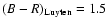 (approximately later than M1, Leggett
1992). The resulting 7424 stars were searched
for in the 14 000 square degrees of DENIS data that are presently
processed and available on-line at PDAC. This cross-identification is
made somewhat difficult by the interplay of crowded fields at low galactic
latitudes with the often poor coordinates of the southern stars in the NLTT
catalogue. We therefore expect to have missed some significant fraction
of the true matches. These NLTT stars were then handled as those extracted
directly from DENIS, except that they obviously were ignored during the
statistical analysis of the DENIS sample. We present here 15 candidates
matching our previous criteria (
;
and photometric
distance within 30 pc).
(approximately later than M1, Leggett
1992). The resulting 7424 stars were searched
for in the 14 000 square degrees of DENIS data that are presently
processed and available on-line at PDAC. This cross-identification is
made somewhat difficult by the interplay of crowded fields at low galactic
latitudes with the often poor coordinates of the southern stars in the NLTT
catalogue. We therefore expect to have missed some significant fraction
of the true matches. These NLTT stars were then handled as those extracted
directly from DENIS, except that they obviously were ignored during the
statistical analysis of the DENIS sample. We present here 15 candidates
matching our previous criteria (
;
and photometric
distance within 30 pc).
We searched for plates containing the dwarf candidates
in the collection of the Centre d'Analyse des Images (CAI,
http://www.cai-mama.obspm.fr/):
POSS I
( ),
SRC-J (
),
SRC-J (
 ), SRC-R (
 )
and
ESO-R (
)
and
ESO-R (
 ), depending on the declination.
We then used the MAMA microdensitometer (Berger et al. 1991) at
CAI to digitize the survey plates, and analysed the resulting images
with SExtractor (Bertin & Arnouts 1996).
We calibrated these measurements using the ACT (Urban et al. 1998)
and GSPC-2 (Postman et al.
1997; Bucciarelli et al. 2001) catalogues,
as respectively astrometric and photometric references.
), depending on the declination.
We then used the MAMA microdensitometer (Berger et al. 1991) at
CAI to digitize the survey plates, and analysed the resulting images
with SExtractor (Bertin & Arnouts 1996).
We calibrated these measurements using the ACT (Urban et al. 1998)
and GSPC-2 (Postman et al.
1997; Bucciarelli et al. 2001) catalogues,
as respectively astrometric and photometric references.
A least-square fit to the positions at the 3 to 4 available epochs
(including the DENIS survey epoch), determines absolute proper motion.
The time baseline spans 13 to 49 years, and results in proper motion
standard errors of 29 to 7 mas/year.
The photometric standard errors are
 mag for B and
  mag for R.
Tables 2a and 2c
respectively list the proper motion determinations for 24
high proper motions (high-PM,
mag for R.
Tables 2a and 2c
respectively list the proper motion determinations for 24
high proper motions (high-PM,
 yr-1)
in the 3600 square degrees and 11 lower proper motions
(low-PM,
yr-1)
in the 3600 square degrees and 11 lower proper motions
(low-PM,
 yr-1)
in the full 5700 square degrees.
Table 2b lists the proper motions for 15 high-PM candidates
initially selected from the NLTT catalog.
yr-1)
in the full 5700 square degrees.
Table 2b lists the proper motions for 15 high-PM candidates
initially selected from the NLTT catalog.
For some bright low-PM objects, we used B and R magnitudes available in
the USNO-A2.0 catalogue (Monet et al. 1998), as well as
more accurate proper motions from the UCAC1 (Zacharias et al.
2000) & Tycho-2 (Høg et al. 2000) catalogues.
In Paper I probable giants were rejected on a proper motion cutoff, by
requiring
 yr
yr .
This criterion, while effective,
is not optimal, in that it completely ignores the photometric
information: an apparently fainter star, everything else being equal,
is farther away than a brighter one, and is thus on average expected
to have a smaller proper motion. The combination of kinematic and
photometric information embodying that simple idea is the Reduced
Proper Motion (RPM), extensively used by Luyten and initially coined
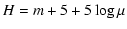
by Hertzsprung. The RPM is defined in terms of the observable parameters as:
.
This criterion, while effective,
is not optimal, in that it completely ignores the photometric
information: an apparently fainter star, everything else being equal,
is farther away than a brighter one, and is thus on average expected
to have a smaller proper motion. The combination of kinematic and
photometric information embodying that simple idea is the Reduced
Proper Motion (RPM), extensively used by Luyten and initially coined
by Hertzsprung. The RPM is defined in terms of the observable parameters as:
 |
|
|
(2) |
where m is the apparent magnitude in a given photometric band and
 is the total proper motion in arcsec yr.
Its usefulness
becomes more apparent after it is rephrased in terms of
intrinsic stellar parameters, to:
is the total proper motion in arcsec yr.
Its usefulness
becomes more apparent after it is rephrased in terms of
intrinsic stellar parameters, to:
 |
|
|
(3) |
where M is the absolute magnitude in the same photometric band and
 is the tangential velocity (km s-1). Under this form it is
clear that, unless it serendipitously has a very unusually
low tangential velocity, a dwarf will have a much larger RPM than any giant.
Subdwarfs have even larger RPMs than normal dwarfs, through a combination of
fainter magnitudes (at a given colour) and a larger velocity dispersion.
RPM vs. colour plots are therefore extremely effective at statistically
separating giants, dwarfs, subdwarfs, and white dwarfs.
is the tangential velocity (km s-1). Under this form it is
clear that, unless it serendipitously has a very unusually
low tangential velocity, a dwarf will have a much larger RPM than any giant.
Subdwarfs have even larger RPMs than normal dwarfs, through a combination of
fainter magnitudes (at a given colour) and a larger velocity dispersion.
RPM vs. colour plots are therefore extremely effective at statistically
separating giants, dwarfs, subdwarfs, and white dwarfs.
The largest possible
for a star bound to the Galaxy is that
of a retrograde star orbiting at the escape velocity, and located
in the direction of either the galactic center or anticenter:
 |
|
|
(4) |
where:
- [
 ]
]
 km s-1 is the escape velocity
in the solar neighbourhood (Leonard & Tremaine 1990;
Meillon 1999),
km s-1 is the escape velocity
in the solar neighbourhood (Leonard & Tremaine 1990;
Meillon 1999),
-

- 220 km s-1 (Kerr & Lynden-Bell 1986) is the
rotation velocity of the Local Standard of Rest,
-

- 5 km s-1 (Dehnen & Binney 1998) is the solar
velocity relative to the LSR.
Taking safe margins on all components,
 is thus at most
800 km s-1. For a given stellar luminosity, and in the I photometric
band, this translates into a maximum RPM of:
is thus at most
800 km s-1. For a given stellar luminosity, and in the I photometric
band, this translates into a maximum RPM of:
 |
|
|
(5) |
To estimate the maximum RPM for giants at a given colour, we fitted
polynomial functions to the V-I and I-J colours data from Thé et al.
(1990), Bessell & Brett (1988), and used Eq. (5) to obtain:
 |
|
|
(6) |
for V-I  [1.5, 5.0]
 |
|
|
(7) |
for I-J
[1.0, 3.0].
Figure 4 shows the resulting
 vs.
(V-I) and vs. (I-J) curves, and our candidates.
vs.
(V-I) and vs. (I-J) curves, and our candidates.
![\begin{figure}
\par\includegraphics[angle=-90,width=8.8cm,clip]{ms2905f4.ps}\\ [4mm]
\includegraphics[angle=-90,width=8.8cm,clip]{ms2905f5.ps}\end{figure}](/articles/aa/full/2003/15/aa2905/Timg65.gif) |
Figure 4:
I band reduced proper motions vs. V-I and I-J.
Dashed curve:
 for giants. Objects above this
curve must be dwarfs.
Solid circles: high-PM objects in this paper,
Tables 3a, 3b;
Triangles: late-M dwarf candidates from Paper I (Table 2); Squares:
low-PM objects,
Tables 3c
and 4. In the upper diagram, the many dots are HIPPARCOS
single giants with
for giants. Objects above this
curve must be dwarfs.
Solid circles: high-PM objects in this paper,
Tables 3a, 3b;
Triangles: late-M dwarf candidates from Paper I (Table 2); Squares:
low-PM objects,
Tables 3c
and 4. In the upper diagram, the many dots are HIPPARCOS
single giants with
 (28 022 stars), all of which are located
well below the dwarf/giant separation curve.
(28 022 stars), all of which are located
well below the dwarf/giant separation curve. |
| Open with DEXTER |
To produce the (HI, V-I) diagram, we interpolated a very
approximate V-magnitude from the the B and R photographic magnitudes.
This is obviously very crude, but nonetheless proves adequate:
the
vs. V-I curve for giants is fairly flat, so
that even large errors on V-I do not significantly affect the position
relative to the curve. As an illustration of the very effective
giant/dwarf separation in RPM plots, the diagram also displays
28 000 single Hipparcos giants with adequate colour information, which all do
lay well below the giants curve.
We divide the photometric candidates into 3 categories, plotted
in Fig. 4, according to their
position relative to the
curve:
- .
- Stars with
yr-1
are listed in Tables 2a and 3a (24 objects).
As
expected from the conservative limits used in Paper I, they are well
above the giants
curve, and have standard errors on HI of 0.1.
![\begin{figure}
\par\includegraphics[width=14.5cm,clip]{ms2905f6.eps}\end{figure}](/articles/aa/full/2003/15/aa2905/Timg66.gif) |
Figure 5:
I-band finding charts for the 9 new high-PM objects listed in
Table 2a. The charts are
 ,
with North up
and East to the left. No finding charts are provided for the lower proper
motion objects, which are easily identified from their accurate coordinates. ,
with North up
and East to the left. No finding charts are provided for the lower proper
motion objects, which are easily identified from their accurate coordinates. |
| Open with DEXTER |
Figure 5 gives finding charts for the 9 completely new objects;
- .
- Stars with
yr-1, but with
 ,
with
,
with  the uncertainty on HI (11 objects, Table 3c).
Their proper motions (Table 2c) have large relative
uncertainties, and, because of the logarithmic
dependency,
their RPM measurements are thus quite noisy. A few of the noisiest and/or
closest to the giants curve might possibly be giants, but the vast majority
are dwarfs. One, DENIS-P J2206227-204706, detected in
Paper I and ignored there because of its small proper motion,
was in fact independently recognized as a late-M dwarf by Gizis et al.
(2000);
the uncertainty on HI (11 objects, Table 3c).
Their proper motions (Table 2c) have large relative
uncertainties, and, because of the logarithmic
dependency,
their RPM measurements are thus quite noisy. A few of the noisiest and/or
closest to the giants curve might possibly be giants, but the vast majority
are dwarfs. One, DENIS-P J2206227-204706, detected in
Paper I and ignored there because of its small proper motion,
was in fact independently recognized as a late-M dwarf by Gizis et al.
(2000);
- .
- Stars with
 (Table 4),
are overwhelmingly giants, with a minor admixture of very low tangential
velocity dwarfs. The well known K5 dwarf Gl 710, for instance, lies outside
our spatial and colour coverage, but with
HI = 0.23 it otherwise lays
firmly within the "giants'' region of the RPM diagram. This list (52 objects)
includes a number of bright stars referenced as
giants in the SIMBAD database. Our measured proper motions for those stars
are usually not significant. This results in error bars on HI that
are occasionally so large (up to 5 mag) that some objects could
not be included in Fig. 4 without obliterating the diagram.
Whenever possible (i.e. for the brightest
objects), we therefore replaced our own measurements by the much better
proper motions available in the UCAC1 (Zacharias et al. 2000)
and Tycho-2 (Høg et al. 2000) catalogues.
(Table 4),
are overwhelmingly giants, with a minor admixture of very low tangential
velocity dwarfs. The well known K5 dwarf Gl 710, for instance, lies outside
our spatial and colour coverage, but with
HI = 0.23 it otherwise lays
firmly within the "giants'' region of the RPM diagram. This list (52 objects)
includes a number of bright stars referenced as
giants in the SIMBAD database. Our measured proper motions for those stars
are usually not significant. This results in error bars on HI that
are occasionally so large (up to 5 mag) that some objects could
not be included in Fig. 4 without obliterating the diagram.
Whenever possible (i.e. for the brightest
objects), we therefore replaced our own measurements by the much better
proper motions available in the UCAC1 (Zacharias et al. 2000)
and Tycho-2 (Høg et al. 2000) catalogues.
The 114 star sample identified by the photometric criteria
(
 ,
pc) within the 5700 square
degrees search area can therefore be divided into:
,
pc) within the 5700 square
degrees search area can therefore be divided into:
- .
50 new nearby late-M dwarfs, consisting of:
- +
18 stars already found in high-PM catalogues (NLTT, WT, ...) but
without previous distance estimate.
- +
32 completely new discoveries (13 in Paper I; 19 in this paper).
- .
12 previously known nearby stars (2 in Paper I; 10
in this one).
- .
52 probable giants, or dwarfs with very small PM.
The 50 new nearby late-M dwarfs represent a very significant addition
to the known sample of 12 in this part of the sky. Our setting of the
limiting distance to 30 pc rather than 25 pc (to avoid losing true
d<25 pc to distance errors) accounts for some but not most of this increase.
The 15 high-PM red dwarfs initially selected from NLTT are also listed in
Tables 2b and 3b.
- *
- A companion to HIP 57361.
- **
- Too faint for the Schmidt plates.
Columns 1, 2: object name in the DENIS data base, and other
identification if available.
Columns 3-5: DENIS Position with respect to equinox J2000 at DENIS
epoch, and DENIS epoch.
Columns 6, 7: B and R photographic magnitudes.
Columns 8-10: DENIS I-magnitude and colours.
Columns 11, 12: I band Reduced Proper Motion, and maximum RPM for
an M giant of the same I-J colour.
|
- *
- Previously listed by Gizis et al. (2000).
- **
- Too faint for the plate.
Columns 1-4: DENIS name, position with respect to equinox J2000
at DENIS epoch, and DENIS epoch.
Columns 5, 6: B and R photographic magnitudes.
Columns 7-9: DENIS I-magnitude and colours.
Columns 10, 11: HI I-band reduced proper, and its standard error.
Column 12: maximum RPM for a giant of the same I-J colour.
Column 13: references for the proper motion and the B and R photometry:
(a) our measurements;
(b) B and R from the USNO-A2.0 catalogue
(Monet et al. 1998) and proper motion from the UCAC1 catalogue
(Zacharias et al. 2000);
(c) B and R from the USNO-A2.0 catalogue (Monet et al. 1998) and
proper motion from the Tycho-2 catalogue (Høg et al. 2000).
|
- **
Too faint for the plate.
- g
Previously known giants.
|
Tables 5a and 5b summarize the available physical
parameters of the red dwarfs candidates listed in Tables 3a
and 3b (DENIS origin) and 3c (NLTT origin):
absolute magnitude MI, distance, tangential velocity, and the
approximate effective temperature derived from I-J (Sect. 7).
Two new late-M dwarfs have distance estimates
within 10 pc in this paper: DENIS-PJ1552237-033520 and LP 860-41
(DENIS-P J1552446-262313).
Five additional new stars are closer than 15 pc: DENIS-P J0306115-364753;
LP 851-346 (DENIS-P J1155429-222458); DENIS-P J1250526-212113; LP 788-1
(DENIS-P J0931223-171742)
and LP 911-56 (DENIS-P J1346460-314925).
Table 6 compares our distance determinations with
litterature values for the 10 stars with a previous measurement or
estimate.
The agreement is generally good, except for a slight systematic
discrepancy with Cruz & Reid 2002: for the 5 stars in common
the Cruz & Reid distances are significantly larger. For
the one star with three determinations, LP 655-48, our estimate and that of
McCaughrean et al. (2002) agree and are both smaller than
the Cruz & Reid distance.
Since the stars which were initially fetched from proper motion catalogues
have a very different (and poorly controlled) selection function, we restrict
the discussion in this section to the colour-selected dwarf candidates in
the full 5700 square degrees (this paper and Paper I). We also ignore the
52 probable giants of Table 4, which are of a different
physical nature, and therefore use a sample of 62 late-M dwarfs
in the density calculation:
- .
- 26 colour-selected high-PM stars from
the 2100 square degrees explored in Paper I (Table 2, excluding
4 stars fetched from the LHS outside this area);
- .
- 25 colour-selected high-PM stars from
the additional 3600 square degrees explored here
(Table 3a). This includes
the colour-selection of LHS 5165, identified in Paper I from
the LHS catalog and which happens to lay within
the additional sky coverage;
- .
- 11 colour-selected lower proper motion probable dwarfs,
found
over the full 5700 square degrees (Table 3c).
The differential photometric distance distribution of that sample
(Fig. 6) is well fitted by a d2 distribution,
![\begin{figure}
\par\includegraphics[angle=-90,width=8.8cm,clip]{ms2905f8.ps}\end{figure}](/articles/aa/full/2003/15/aa2905/Timg70.gif) |
Figure 6:
Number of red dwarf candidates per 2.5 pc photometric distance bin
over 5700 square degrees. The errorbars are Poissonian 1
errors
and the curve is the expected d2 distribution, normalized at 18 pc. |
| Open with DEXTER |
as expected for a constant-density population, out to 22-25 pc.
The
difference from the initial 30 pc selection cutoff reflects the slightly
different colour-magnitude relations used in the selection and in the final
photometric distance estimate. We conservatively adopt 22 pc as the
completeness limit of our sample, and use the 45 stars within that
distance to determine the local density of late-M dwarfs.
Using the Reid & Cruz (2002) (I-J, MI) relation
would give slightly larger distances and change the completeness
distance to 25 pc.
A sample limited by photometric distance is effectively a magnitude-limited
sample, with a colour-dependent magnitude limit. As such, and since the
colour-luminosity relation has significant dispersion, it is subject
to the well-know Malmquist bias (Malmquist 1936), through two
separate but interrelated effects (e.g. Stobie et al. 1989
and Kroupa 1998):
- .
- The average luminosity at a given colour is brighter for a
magnitude-limited sample than for a volume-limited sample, since
the brighter stars are included to larger distances, hence in larger
numbers, than the fainter ones. This is the classical Malmquist bias;
- .
- A magnitude-limited sample includes more stars at a given
colour than the equivalent volume-limited sample for the average
colour-luminosity relation: since the volume grows as d3, the additional
volume from which brighter stars get included is larger that the missing
volume from which fainter stars are lost.
Here we are only interested in the colour-integrated stellar density over
(or
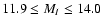 ). The first
component
of the Malmquist bias is therefore irrelevant, since a) we do not look
for any significant luminosity resolution, and b) the luminosity function
is sufficiently flat over the M 6-M 8 spectral range (Delfosse & Forveille
2000) that a small shift in the average luminosity will not
measurably affect the resulting density. The second component of the bias,
on the other hand, is significant. For a Gaussian dispersion of the
colour-luminosity relation it can be computed analytically
(Stobie et al. 1989):
). The first
component
of the Malmquist bias is therefore irrelevant, since a) we do not look
for any significant luminosity resolution, and b) the luminosity function
is sufficiently flat over the M 6-M 8 spectral range (Delfosse & Forveille
2000) that a small shift in the average luminosity will not
measurably affect the resulting density. The second component of the bias,
on the other hand, is significant. For a Gaussian dispersion of the
colour-luminosity relation it can be computed analytically
(Stobie et al. 1989):
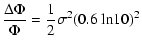 |
|
|
(8) |
where  is the luminosity function and
is the intrinsic rms
scatter in the colour-luminosity relation. The scatter in the MI vs.
I-J relation is
is the luminosity function and
is the intrinsic rms
scatter in the colour-luminosity relation. The scatter in the MI vs.
I-J relation is
 mag (Fig. 1), which
corresponds to a 4% overestimate of the stellar density.
mag (Fig. 1), which
corresponds to a 4% overestimate of the stellar density.
Table 5:
b) Estimated distances and other parameters for the 15
DENIS red
dwarf candidates initially selected from NLTT of
Tables 2b and 3b (same
Cols. as Table 5a).
| DENIS objects |
MI |
D |
|
 |
Ref. |
| |
|
[pc] |
[km s-1] |
[K] |
|
| J0002061+011536 |
13.25 |
20.4 |
46.3 |
2440 |
|
| J0410480-125142 |
12.07 |
15.3 |
29.0 |
2740 |
d |
| J0440231-053009 |
13.39 |
9.8 |
15.3 |
2400 |
d, e |
| J0520293-231848 |
12.72 |
18.2 |
28.8 |
2600 |
|
| J0931223-171742 |
12.84 |
12.7 |
19.0 |
2570 |
|
| J1346460-314925 |
12.65 |
13.3 |
23.5 |
2620 |
|
| J1504161-235556 |
13.53 |
17.3 |
26.7 |
2360 |
f |
| J1546115-251405 |
12.20 |
23.8 |
42.8 |
2710 |
|
| J1552446-262313 |
12.65 |
9.8 |
24.4 |
2620 |
|
| J1553571-231152 |
12.07 |
20.6 |
29.6 |
2740 |
f |
| J1625503-240008 |
12.97 |
19.2 |
14.7 |
2530 |
|
| J1641430-235948 |
12.39 |
22.3 |
22.8 |
2670 |
|
| J1645282-011228 |
12.36 |
24.2 |
25.2 |
2680 |
|
| J1917045-301920 |
12.27 |
20.3 |
27.0 |
2700 |
|
| J2151270-012713 |
11.96 |
17.8 |
18.6 |
2760 |
d |
The mean surface density of our sample,
 objects per 100 square degrees out to 22 pc, corresponds to an uncorrected luminosity
function of
objects per 100 square degrees out to 22 pc, corresponds to an uncorrected luminosity
function of
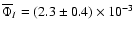 stars
MI-1 pc-3.
After correcting
for the Malmquist bias, this becomes
stars
MI-1 pc-3, averaged
over
.
Using relations from Leggett
(1992) and Dahn et al. (2002) to translate to MV,
this gives
stars
MI-1 pc-3.
After correcting
for the Malmquist bias, this becomes
stars
MI-1 pc-3, averaged
over
.
Using relations from Leggett
(1992) and Dahn et al. (2002) to translate to MV,
this gives
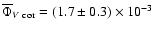 stars
MV-1 pc-3,
averaged over
stars
MV-1 pc-3,
averaged over
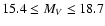 .
.
Stellar luminosity functions for the solar neighborhood come in two kinds:
photometric luminosity functions, with somewhat uncertain distances and
luminosities estimated from colour-luminosity relations, and nearby star
luminosity functions, with distances (mostly) from trigonometric parallaxes
but with typically smaller samples and sometimes an uncertain completeness.
Figure 7 compares the above stellar density measurement with
the photometric luminosity functions of Kroupa (1995a) and
Zheng et al. (2001),
![\begin{figure}
\par\includegraphics[angle=-90,width=8.8cm,clip]{ms2905f9.ps}\end{figure}](/articles/aa/full/2003/15/aa2905/Timg79.gif) |
Figure 7:
The MV luminosity function. Open symbols are photometric
luminosity function (triangles and squares are two Galactic models
from Zheng et al. 2001; polygons are from Kroupa 1995a).
Filled symbol represent nearby star luminosity functions (triangles from Reid et al. 2002, and polygons from Kroupa 1995a).
The filled grey area shows our stellar density estimate for M 6 to M 8 stars,
which is in excellent agreement with other photometric luminosity functions. |
| Open with DEXTER |
as well as with the nearby star luminosity
functions of Kroupa (1995a) and Reid et al.
(2002). We measure the stellar density from a nearby sample,
as the nearby luminosity functions do, but with the distance method from
photometric luminosity functions. Our measurement is thus of
interest to the long-standing discrepancy between the two measurement
techniques. Our value of
stars
MV-1 pc-3 turns out to be in
excellent agreement with all recent measurements of the photometric
luminosity function (e.g. Fig. 7 and caption). The nearby
star luminosity function is, by contrast, over an order of magnitude larger.
This clearly excludes that a local faint star overdensity can explain the
discrepancy, as sometimes suggested in spite of serious kinematic
difficulties.
The true explanation most likely will have to be found in a bias of
the photometric luminosity function methodology, such as the neglecting of
unresolved binary systems (Kroupa 1995b), or potentially the
use of an incorrect colour-luminosity relation (Reid & Gizis 1997;
Delfosse & Forveille, in preparation).
For a constant-density population, a systematic error in the stars luminosity
function of  results in a luminosity function
that is incorrect by:
results in a luminosity function
that is incorrect by:
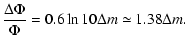 |
|
|
(9) |
In the (I-J) range of interest here, Fig. 1 shows
that the dispersion of the calibration stars around our adopted relation
is 0.25 mag. Similarly, the rms difference between our relation
and that of Reid & Cruz (2002) is only 0.13 mag, and the
maximum difference is below 0.2 mag. A 0.2 mag error on the
color-luminosity relation is thus a conservative upper bound. This
would affect the luminosity function at the 25-30% level at most, well
below the difference between photometric and nearby stars luminosity
functions. We obtain a more realistic estimate of the probable star density
error stemming from colour-luminosity uncertainties by using the Reid
& Cruz (2002) calibration (Fig. 1) instead of
our own. The completeness limit is then 25 pc, with 51 stars within that
distance, for a luminosity function of
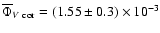 stars
MV-1 pc-3. This is just 10% smaller than our best estimate,
and actually well below its Poisson probable error.
stars
MV-1 pc-3. This is just 10% smaller than our best estimate,
and actually well below its Poisson probable error.
Since parallaxes out to 30 pc can be measured very
accurately (Dahn et al. 2002; Henry et al. 1997),
though certainly with significant efforts, true distances could
be measured for the present well understood sample, and would certainly
help clarifying the source of this discrepancy.
The effective temperature
of a star is one of its basic
physical parameters, and we felt that a convenient rough estimate would
be useful.
We compiled
the data from Leggett et al. (1996, 2000,
2001); Basri et al. (2000); Tinney et al.
(1993), Bessell (1991), transformed when necessary to
the CIT system with the relations from Leggett (1992) and
Casali & Hawarden 1992), and adjusted the following
cubic relation (Fig. 8):
![\begin{figure}
\par\includegraphics[angle=-90,width=8.8cm,clip]{ms2905f7.ps}\end{figure}](/articles/aa/full/2003/15/aa2905/Timg84.gif) |
Figure 8:
The polynomial (I-J,
)
relation, fitted to data
from Leggett, Basri et al., Tinney et al., and Bessell, see text. |
| Open with DEXTER |
 |
|
|
(10) |
where
b0=5297.3,
b1=-1926.3,
b2=400.0,
b3=-33
.3 valid for
 .
.
It strictly speaking is only valid for CIT photometry, but
Fig. 1 shows that the DENIS and CIT systems are
sufficiently close that it provides an acceptable determination of
from DENIS photometry.
Tables 5a and 5b lists the effective temperatures
derived from the DENIS I-J colour index with this formula.
Compared with the cruder proper motion cutoff, selection on reduced proper
motion contributes 11 additional probable dwarfs in a sample of 62. This
18% fraction, which may be a lower limit if a few additional dwarfs hide
amongst the probable giants, is much larger than the 6% loss estimated
in Paper I.
It is therefore important to obtain spectroscopy to make sure that all 11
low-PM dwarf candidates are really dwarfs,
and to determine which, if any, of the
52 probable giants are actually very low tangential velocity dwarfs.
We additionally plan to extend the systematic search to the rest of the DENIS
data, as they become available, as well as to the much more numerous early
M-dwarfs candidates (
 ,
M 0-M 6). A larger fraction of those
is probably already known however.
,
M 0-M 6). A larger fraction of those
is probably already known however.
Acknowledgements
We are grateful to René Chesnel for scanning and pre-reducing the
photographic plates. The long-term loan of POSS I plates
by the Leiden Observatory to Observatoire de Paris is gratefully acknowledged.
This research has made an intensive use of the Simbad and Vizier databases,
operated at CDS, Strasbourg, France.
We thank the referee for many valuable comments and suggestions.
-
Arenou, F., & Luri, X. 1999, in Harmonizing Cosmic Distance scales
in a Post-Hipparcos Era, ed. D. Egret, & A. Heck, ASP Conf. Ser., 107, 13
In the text
-
Baraffe, I., Chabrier, G., Allard, F., & Hauschildt, P. H. 1998, A&A, 337, 403
In the text
NASA ADS
-
Basri, G., Mohanty, S., Allard, F., et al. 2000, ApJ, 538, 363
In the text
NASA ADS
-
Berger, J., Cordoni, J.-P., Fringant, A.-M., et al. 1991, A&AS, 87, 389
In the text
NASA ADS
-
Bertin, E., & Arnouts, S. 1996, A&AS, 117, 393
In the text
NASA ADS
- Bessell, M. S., & Brett, J. M. 1988,
PASP, 100, 1134
In the text
NASA ADS
-
Bessell, M. S. 1991, AJ, 101, 662
In the text
NASA ADS
-
Bucciarelli, B., García Yus, J., Casalegno, R., et al. 2001, A&A, 368, 335
In the text
NASA ADS
-
Casali, M., & Hawarden, T. G. 1992, UKIRT Newsletter, 4, 33
In the text
-
Cruz, K. L., & Reid, I. N. 2002, AJ, 123, 2828
In the text
NASA ADS
-
Dahn, C. C., Harris, H. C., Vrba, F. J., et al. 2002, AJ, 124, 1170
In the text
NASA ADS
-
Deacon, N. R., & Hambly, N. C. 2001, A&A, 380, 148
In the text
NASA ADS
-
Dehnen, W., & Binney, J. J. 1998, MNRAS, 298, 387
In the text
NASA ADS
-
Delfosse, X. 1997b, Ph.D. Thesis, Fig. 2.9, Grenoble University, 43
In the text
-
Delfosse, X., Forveille, T., Beuzit, J. L., et al. 1999, A&A, 344, 897
In the text
NASA ADS
- Delfosse, X., & Forveille, T. 2000, in Very
Low-mass Stars and Brown Dwarfs, ed. R. Rebolo, &
M. R. Zapatero-Osorio (Cambridge: Cambridge University Press), 84
In the text
- Delfosse, X., & Forveille, T. 2001, in
SF2A-2001, EDP Sciences, Conf. Ser., 91
In the text
- Epchtein, N. 1997, in
the 2nd DENIS Euroconference,
The impact of large scale near-infrared surveys,
ed. F. Garzon et al. (Dordrecht: Kluwer), 15
In the text
-
ESA 1997, The Hipparcos and Tycho Catalogues, ESA SP-1200
In the text
-
Gizis, J. E., Monet, D. G., Reid, I. N., et al. 2000, AJ, 120, 1085
In the text
NASA ADS
-
Gliese, W., Jahreiß, H., & Upgren, A. R. 1986, in The galaxy and the solar system,
ed. R. Schmoluchowski, J. N. Bahcall, & M. S. Matthews (The University of Arizona Press), 13
In the text
-
Gliese, W., & Jahreiß, H. 1991, Preliminary Version of the Third Catalogue
of Nearby Stars, as available at CDS Strasbourg
In the text
-
Hawley, S. L., Covey, K. R., Knapp, G. R., et al. 2002, AJ, 123, 3409
In the text
NASA ADS
-
Henry, T. J., Ianna, P. A., Kirkpatrick, J. D., & Jahreiss, H.,
AJ, 114, 388
In the text
NASA ADS
-
Henry, T. J., Walkowicz, L. M., Barto, T. C., & Golimowski, D. A. 2002,
AJ, 123, 2002
In the text
NASA ADS
-
Høg, E., Fabricius, C., Makarov, V. V., et al. 2000, A&A, 355, L27
In the text
NASA ADS
-
Kerr, F. J., & Lynden-Bell, D. 1986, MNRAS, 221, 1023
In the text
NASA ADS
-
Kirkpatrick, J. D., Henry, T. J., & Irwin, M. J. 1997, AJ, 113, 1421
In the text
NASA ADS
-
Kirkpatrick, J. D., Reid, I. N., Liebert, J., et al. 1999, ApJ, 519, 802
In the text
NASA ADS
-
Kroupa, P. 1995a, ApJ, 453, 350
In the text
NASA ADS
-
Kroupa, P. 1995b, ApJ, 453, 358
In the text
NASA ADS
- Kroupa, P. 1998, in Brown Dwarf and Extrasolar
Planets Workshop, ed. Rebolo, Martín, Zapatero Osorio, ASP Conf.
Ser., 134, 483
In the text
-
Leggett, S. K. 1992, ApJS, 82, 531
In the text
-
Leggett, S. K., Allard, F., Berriman, G., Dahn, C. C., & Hauschildt, P. H. 1996, ApJS, 104, 117
In the text
NASA ADS
-
Leggett, S. K., Allard, F., Dahn, C. C., et al. 2000, ApJ, 535, 965
In the text
NASA ADS
-
Leggett, S. K., Allard, F., Geballe, T. R., Hauschildt, P. H., & Schweitzer, A. 2001, ApJ, 548, 908
In the text
NASA ADS
-
Leonard, P. J. T., & Tremaine, S. 1990, AJ, 353, 486
In the text
-
Luyten, W. J. 1979, Catalogue of stars with proper motions exceeding
 annually (LHS) (Minneapolis: University of Minnesota)
In the text
annually (LHS) (Minneapolis: University of Minnesota)
In the text
-
Luyten, W. J. 1980, New Luyten catalog of stars with proper motions
larger than Two Tenths of an arcsecond (NLTT) (Minneapolis: University of Minnesota)
In the text
- Malmquist K. G. 1936, Stockholm Obs. Medd. 26
In the text
-
Martín, E. L., Basri, G., Delfosse, X., & Forveille, T. 1997, A&A, 327, L29
In the text
NASA ADS
-
McCaughrean, M. J., Scholz, R.-D., & Lodieu, N. 2002, A&A, 390, L27
In the text
NASA ADS
-
Meillon, L. 1999, Ap&SS, 265, 179
In the text
NASA ADS
-
Monet, D., Bird, A., Canzian, B., et al. 1998, USNO-A2.0 Catalogue, available on-line in Vizier (CDS, Strasbourg)
In the text
-
Phan-Bao, N., Guibert, J., Crifo, F., et al. 2001, A&A, 380, 590
In the text
NASA ADS
-
Postman, M., Bucciarelli, B., Sturch, C., et al. 1997, IAU Symp., 179, 379
In the text
-
Reid, I. N., & Gizis, J. E. 1997, AJ, 113, 2246
In the text
NASA ADS
-
Reid, I. N., & Cruz, K. L. 2002, AJ, 123, 2806
In the text
NASA ADS
-
Reid, I. N., Gizis, J. E., & Hawley, S. L. 2002, AJ, 124, 2721
In the text
NASA ADS
-
Scholz, R.-D., Irwin, M., Ibata, R., Jahreiß, H., & Malkov, O. Yu. 2000, A&A, 353, 958
In the text
NASA ADS
-
Scholz, R.-D., Meusinger, H., & Jahreiß, H. 2001, A&A, 374, L12
In the text
NASA ADS
-
Skrutskie, M. F., Forrest, W. J., & Shure, M. 1989, AJ, 98, 1409
In the text
NASA ADS
-
Skrutskie, M. F., Schneider, S. E., Stiening, R., et al. 1997, in the 2nd DENIS Euroconference,
The impact of large scale near-infrared surveys, ed. F. Garzon et al. (Dordrecht: Kluwer), 25
In the text
-
Stobie, R. S., Ishida, K., & Peacock, J. A. 1989, MNRAS, 238, 709
In the text
NASA ADS
-
Thé, P. S., Thomas, D., Christensen, C. G., & Westerlund, B. E. 1990, PASP, 102, 565
In the text
NASA ADS
-
Tinney, C. G., Mould, J. R., & Reid, I. N. 1993, AJ, 105, 1045
In the text
NASA ADS
-
Tinney, C. G., Reid, I. N., Gizis, J., & Mould, J. R. 1995, AJ, 110, 3014
In the text
NASA ADS
-
Tinney, C. G. 1996, MNRAS, 281, 644
In the text
NASA ADS
-
Urban, S. E., Corbin, T. E., & Wycoff, G. L. 1998, AJ, 115, 2161
In the text
NASA ADS
-
van Altena, W. F., Lee, J. T., & Hoffleit, E. D. 1995, The General Catalogue of Trigonometric
Stellar Parallaxes, Fourth Edition (New Haven, CT: Yale University Observatory)
In the text
-
York, D. G., Adelman, J., & Anderson, J. E. Jr. 2000, AJ, 120, 1579
In the text
NASA ADS
-
Zacharias, N., Urban, S. E., Zacharias, M. I., et al. 2000, AJ, 120, 2131
In the text
NASA ADS
-
Zheng, Z., Flynn, C., Gould, A., Bahcall, J. N., & Salim, S. 2001, ApJ, 555, 393
In the text
NASA ADS
Copyright ESO 2003
![\begin{figure}
\par\includegraphics[angle=-90,width=8.8cm,clip]{ms2905f1.ps}\end{figure}](/articles/aa/full/2003/15/aa2905/img22.gif)
![\begin{figure}
\par\includegraphics[angle=-90,width=8.8cm,clip]{ms2905f2.ps}\end{figure}](/articles/aa/full/2003/15/aa2905/img30.gif)
![\begin{figure}
\par\includegraphics[angle=-90,width=8.8cm,clip]{ms2905f3.ps}\end{figure}](/articles/aa/full/2003/15/aa2905/img35.gif)


 yr-1]
yr-1]![\begin{figure}
\par\includegraphics[angle=-90,width=8.8cm,clip]{ms2905f4.ps}\\ [4mm]
\includegraphics[angle=-90,width=8.8cm,clip]{ms2905f5.ps}\end{figure}](/articles/aa/full/2003/15/aa2905/img65.gif)
![\begin{figure}
\par\includegraphics[width=14.5cm,clip]{ms2905f6.eps}\end{figure}](/articles/aa/full/2003/15/aa2905/img66.gif)
![\begin{figure}
\par\includegraphics[angle=-90,width=8.8cm,clip]{ms2905f8.ps}\end{figure}](/articles/aa/full/2003/15/aa2905/img70.gif)
![\begin{figure}
\par\includegraphics[angle=-90,width=8.8cm,clip]{ms2905f9.ps}\end{figure}](/articles/aa/full/2003/15/aa2905/img79.gif)
 0.4
0.4![\begin{figure}
\par\includegraphics[angle=-90,width=8.8cm,clip]{ms2905f7.ps}\end{figure}](/articles/aa/full/2003/15/aa2905/img84.gif)