![[*]](/icons/foot_motif.gif)
A&A 401, 639-654 (2003)
DOI: 10.1051/0004-6361:20030105
S. O. Kepler1 - R. E. Nather2 - D. E. Winget2 - A. Nitta3 - S. J. Kleinman3 - T. Metcalfe2,4 - K. Sekiguchi 5 - Jiang Xiaojun 6 - D. Sullivan 7 - T. Sullivan 7 - R. Janulis 8 - E. Meistas 8 - R. Kalytis 8 - J. Krzesinski 9 - W. Og oza9 - S. Zola 10 - D. O'Donoghue 11 - E. Romero-Colmenero 11 - P. Martinez 11 - S. Dreizler 12 - J. Deetjen 12 - T. Nagel 12 - S. L. Schuh 12 - G. Vauclair 13 - Fu Jian Ning 13 - M. Chevreton 14 - J.-E. Solheim 15 - J. M. Gonzalez Perez 15 - F. Johannessen 15 - A. Kanaan 16 - J. E. Costa 1 - A. F. Murillo Costa 1 - M. A. Wood 17 - N. Silvestri 17 - T. J. Ahrens 17 - A. K. Jones
 - A. E. Collins
 - M. Boyer
 - J. S. Shaw 21 - A. Mukadam 2 - E. W. Klumpe 22 - J. Larrison 22 - S. Kawaler 23 - R. Riddle 23 - A. Ulla 24 - P. Bradley 25
1 - Instituto de Física da UFRGS, Porto Alegre, RS - Brazil
2 - Department of Astronomy & McDonald Observatory, University of Texas, Austin, TX 78712, USA
3 - Sloan Digital Sky Survey, Apache Pt. Observatory, PO Box 59, Sunspot, NM 88349, USA
4 - Harvard-Smithsonian Center for Astrophysics, 60 Garden Street, Cambridge, MA 02138, USA
5 - Subaru National Astronomical Observatory of Japan
6 - Beijing Astronomical Observatory, Academy of Sciences, Beijing 100080, PR China
7 - University of Victoria, Wellington, New Zealand
8 - Institute of Theoretical Physics and Astronomy, Gostauto 12, Vilnius 2600, Lithuania
9 - Mt. Suhora Observatory, Cracow Pedagogical University, Ul. Podchorazych 2, 30-084 Cracow, Poland
10 - Jagiellonian University, Krakow, Poland
11 - South African Astronomical Observatory
12 - Universitat Tübingen, Germany
13 - Université Paul Sabatier, Observatoire Midi-Pyrénées, CNRS/UMR5572, 14 av. E. Belin, 31400 Toulouse, France
14 - Observatoire de Paris-Meudon, DAEC, 92195 Meudon, France
15 - Institutt for fysikk, 9037 Tromso, Norway
16 - Departamento de Física, Universidade Federal de Santa Catarina, CP 476, CEP 88040-900, Florianópolis, Brazil
17 - Dept. of Physics and Space Sciences & The
SARA Observatory, Florida Institute of Technology,
Melbourne, FL 32901, USA
18 - University of Florida, 202 Nuclear Sciences Center Gainesville, FL 32611-8300,
USA
19 - Johnson Space Center, 2101 NASA Road 1, Mail Code GT2, Houston, TX 77058, USA
20 - University of Minnesota, Department of Physics & Astronomy, 116 Church St. S.E.,
Minneapolis, MN 55455, USA
21 - University of Georgia at Athens, Department of Physics and Astronomy, Athens, GA 30602-2451, USA
22 - Middle Tennessee State University, Department of Physics and Astronomy Murfreesboro, TN 37132,
USA
23 - Department of Physics and Astronomy, Iowa State University, Ames, IA 50011, USA
24 - Universidade de Vigo, Depto. de Fisica Aplicada, Facultade
de Ciencias, Campus Marcosende-Lagoas, 36200 Vigo (Pontevedra), Spain
25 - Los Alamos National Laboratory, X-2, MS T-085 Los Alamos, NM 87545, USA
Received 6 December 2002 / Accepted 21 January 2003
Abstract
We report 323 hours of
nearly uninterrupted time series photometric observations of the DBV
star GD 358
acquired with the Whole Earth Telescope (WET) during May 23rd to
June 8th, 2000.
We acquired more than 232 000 independent measurements.
We also report on 48 hours of time-series photometric observations
in Aug 1996.
We detected the non-radial g-modes consistent with degree  and
radial order 8 to 20 and their linear combinations up to 6th order.
We also detect, for the first time, a high amplitude
and
radial order 8 to 20 and their linear combinations up to 6th order.
We also detect, for the first time, a high amplitude
 mode, with a period of 796 s.
In the 2000 WET data, the largest amplitude modes are similar to
those detected with the
WET observations of 1990 and 1994, but
the highest combination order previously detected was 4th order.
At one point during the
1996 observations, most of the pulsation energy was transferred into the
radial order k=8 mode, which
displayed a sinusoidal pulse shape
in spite of the large amplitude.
The multiplet structure of the individual modes changes from
year to year, and during the 2000 observations only the k=9 mode
displays clear normal triplet structure.
Even though the pulsation amplitudes change on timescales of days and years,
the eigenfrequencies remain essentially the same,
showing the stellar structure is not changing on
any dynamical timescale.
mode, with a period of 796 s.
In the 2000 WET data, the largest amplitude modes are similar to
those detected with the
WET observations of 1990 and 1994, but
the highest combination order previously detected was 4th order.
At one point during the
1996 observations, most of the pulsation energy was transferred into the
radial order k=8 mode, which
displayed a sinusoidal pulse shape
in spite of the large amplitude.
The multiplet structure of the individual modes changes from
year to year, and during the 2000 observations only the k=9 mode
displays clear normal triplet structure.
Even though the pulsation amplitudes change on timescales of days and years,
the eigenfrequencies remain essentially the same,
showing the stellar structure is not changing on
any dynamical timescale.
Key words: stars: white dwarfs - stars: variables: general - stars: oscillations - stars: individual: GD 358 - stars: evolution
GD 358, also called V777 Herculis, is the prototype of the DBV class of white dwarf pulsators. It was the first pulsating star detected based on a theoretical prediction (Winget et al. 1985), and is the pulsating star with the largest number of periodicities detected after the Sun. Detecting as many modes as possible is important, as each periodicity detected yields an independent constraint on the star's structure. The study of pulsating white dwarf stars has allowed us to measure the stellar mass and composition layers, to probe the physics at high densities, including crystallization, and has provided a chronometer to measure the age of the oldest stars and consequently, the age of the Galaxy.
Robinson et al. (1982) and Kepler (1984) demonstrated that
the variable white dwarf stars pulsate in non-radial gravity modes.
Beauchamp et al. (1999) studied the spectra of the pulsating DBs
to determine their instability strip at
 K, and found
 K,
K,
 for
the brightest DBV,
GD 358 (V= 13.85),
assuming no photospheric H, as confirmed by Provencal et al. (2000).
Provencal et al. studied the HST and EUVE spectra, deriving
for
the brightest DBV,
GD 358 (V= 13.85),
assuming no photospheric H, as confirmed by Provencal et al. (2000).
Provencal et al. studied the HST and EUVE spectra, deriving
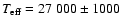 K, finding traces of
carbon in the atmosphere [
K, finding traces of
carbon in the atmosphere [
![$\log({{\rm C/He}})=-5.9\pm 0.3]$](/articles/aa/full/2003/14/aa3375/img13.gif) and
a broadening corresponding to
and
a broadening corresponding to
 km s-1. They also detected Ly
 that is probably interstellar.
Althaus & Benvenuto (1997) demonstrated that the
Canuto et al. (1996, hereafter CGM) self consistent theory of
turbulent convection is consistent with the
that is probably interstellar.
Althaus & Benvenuto (1997) demonstrated that the
Canuto et al. (1996, hereafter CGM) self consistent theory of
turbulent convection is consistent with the
 K
determination,
as GD 358 defines the blue edge of the DBV instability strip.
Shipman et al. (2002) extended the blue edge of the DBV instability strip
by finding that the even hotter star PG0112+104 is a pulsator.
K
determination,
as GD 358 defines the blue edge of the DBV instability strip.
Shipman et al. (2002) extended the blue edge of the DBV instability strip
by finding that the even hotter star PG0112+104 is a pulsator.
Winget et al. (1994) reported
on the analysis of 154 hours of nearly continuous time series
photometry on GD 358, obtained during
the Whole Earth Telescope (WET) run of May 1990. The Fourier
temporal spectrum
of the light curve is dominated by periodicities in the range
1000-2400  Hz,
with more than 180 significant peaks.
They identify all of the triplet frequencies as
having degree
and, from
the details of their triplet (k) spacings, from which
Bradley & Winget (1994)
derived the total stellar mass
as
Hz,
with more than 180 significant peaks.
They identify all of the triplet frequencies as
having degree
and, from
the details of their triplet (k) spacings, from which
Bradley & Winget (1994)
derived the total stellar mass
as

 ,
the mass of the outer helium envelope as
,
the mass of the outer helium envelope as
 M*, the luminosity as
 and,
deriving a temperature and bolometric correction,
the distance as
and,
deriving a temperature and bolometric correction,
the distance as  pc.
Winget et al. (1994) found changes in the m spacings among the
triplet modes, and by assuming the rotational splitting coefficient
pc.
Winget et al. (1994) found changes in the m spacings among the
triplet modes, and by assuming the rotational splitting coefficient
 depends only on
radial overtone k and the
rotation angular velocity
depends only on
radial overtone k and the
rotation angular velocity
 ,
interpret the
observed spacing as strong evidence of radial differential rotation,
with the outer envelope rotating some 1.8 times faster than the core.
However, Kawaler et al. (1999) find that the core rotates
faster than the envelope when they perform rotational splitting
inversions of the observational data. The apparently contradictory
result is due to the presence of mode trapping and the behavior of the
rotational splitting kernel in the core of the model.
Winget et al. also found
significant power at the sums and differences of the dominant frequencies,
indicating that non-linear processes are significant, but with
a richness and complexity that rules out
resonant mode coupling as a major cause.
,
interpret the
observed spacing as strong evidence of radial differential rotation,
with the outer envelope rotating some 1.8 times faster than the core.
However, Kawaler et al. (1999) find that the core rotates
faster than the envelope when they perform rotational splitting
inversions of the observational data. The apparently contradictory
result is due to the presence of mode trapping and the behavior of the
rotational splitting kernel in the core of the model.
Winget et al. also found
significant power at the sums and differences of the dominant frequencies,
indicating that non-linear processes are significant, but with
a richness and complexity that rules out
resonant mode coupling as a major cause.
We show that in the WET data set reported here
(acquired in 2000), only 12 of the periodicities can be identified as
independent g-mode pulsations,
probably all different radial overtones (k) with same spherical
degree ,
plus the azimuthal m components for k=8 and 9.
The high amplitude with a period of 796 s is identified as an
mode; it was not present in the previous data sets.
Most, if not all, of the
remaining periodicities are linear
combination peaks of these pulsations.
Considering there are many more observed combination frequencies
than available eigenmodes,
we interpret the linear
combination peaks as caused by non-linear effects, not real pulsations.
This interpretation is consistent with the proposal by Brickhill
(1992) and Wu (2001) that the combination frequencies appear by the non-linear
response of the medium.
Recently, van Kerkwijk et al. (2000) and Clemens et al. (2000) show that
most linear combination peaks for the DAV G29-38 do not show any
velocity variations, while the eigenmodes do.
However, Thompson et al. (2003)
argue that some combination peaks do show velocity variations.
As a clear demonstration of the power of asteroseismology,
Metcalfe et al. (2001)
and Metcalfe et al. (2002)
used GD 358 observed periods from Winget et al. (1994)
and a genetic algorithm to search for
the optimum theoretical model
with static diffusion envelopes,
and constrained the
 cross section, a crucial parameter for many fields in astrophysics
and difficult to constrain in terrestrial laboratories.
Montgomery et al. (2001)
also used the observed pulsations
to constrain the diffusion of
cross section, a crucial parameter for many fields in astrophysics
and difficult to constrain in terrestrial laboratories.
Montgomery et al. (2001)
also used the observed pulsations
to constrain the diffusion of
 in white dwarf stars.
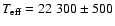
They show their best model for GD 358 has O/C/
in white dwarf stars.
They show their best model for GD 358 has O/C/
 structure,
 K,
K,
 ,
a thick He layer,
,
a thick He layer,
 ,
distinct from the thin layer,
,
distinct from the thin layer,
 ,
proposed by
Bradley & Winget (1994).
Montgomery, Metcalfe, & Winget's
model had
,
proposed by
Bradley & Winget (1994).
Montgomery, Metcalfe, & Winget's
model had
 ,
but Wolff et al. (2002) did not detect any
in the spectra of all the DBs they observed.
On the other hand,
Dehner & Kawaler (1995),
Brassard & Fontaine (2002), and
Fontaine & Brassard (2002) show that a thin helium
envelope is consistent with the evolutionary models starting
at PG1159 models and ending as DQs, as diffusion is still
ongoing around 25 000 K and lower temperatures.
Therefore there could be two transition
zones in the envelope, one between the He envelope and the He/C/O layer,
where diffusion is still separating the elements, and another
transition between this layer and the C/O core.
,
but Wolff et al. (2002) did not detect any
in the spectra of all the DBs they observed.
On the other hand,
Dehner & Kawaler (1995),
Brassard & Fontaine (2002), and
Fontaine & Brassard (2002) show that a thin helium
envelope is consistent with the evolutionary models starting
at PG1159 models and ending as DQs, as diffusion is still
ongoing around 25 000 K and lower temperatures.
Therefore there could be two transition
zones in the envelope, one between the He envelope and the He/C/O layer,
where diffusion is still separating the elements, and another
transition between this layer and the C/O core.
Gautschy & Althaus (2002) calculated nonadiabatic pulsation
properties of DB pulsators using evolutionary
models including the CGM full-spectrum
turbulence theory of convection and time-dependent element diffusion.
They show that up to 45 dipole modes should be excited, with periods
between 335 s and 2600 s depending on the mass of the star, though
their models did not include pulsation-convection coupling.
They obtain a trapping-cycle length of
 ,
and the quadrupole modes showed instabilities comparable to the
dipole modes.
,
and the quadrupole modes showed instabilities comparable to the
dipole modes.
Buchler et al. (1997) show that if there is a resonance between pulsation modes, even if the mode is stable, its amplitude will be necessarily nonzero. They also point out that in case of amplitude saturation, it is the smaller adjacent modes that show the largest amplitude variation, not the main modes. However, if the combination peaks are not real modes in a physical sense, just non-linear distortion by the medium, it is not clear that one would have resonant (mode-coupling) between the combination peaks and real modes.
When the Whole Earth Telescope observed GD 358 in 1990, 181
periodicities were detected, but only modes from radial order k=8to 18 were identified, most of them showing triplets, consistent with
the degree
identification.
In fact, the observed period spacing is consistent with the
measured parallax only if the
observed pulsations have degree
(Bradley & Winget 1994).
Vuille et al. (2000) studied the 342 hours of Whole Earth Telescope data obtained in 1994, showing again modes with k=8 to 18, and discovered up to 4th-order cross-frequencies in the power spectra. They compared the amplitudes and phases observed with those predicted by the pulsation-convection interaction proposed by Brickhill (1992), and found reasonable agreement.
Note that the number of nodes in the radial direction k cannot be determined observationally and rely on a detailed comparison of the observed periods with those predicted by pulsation models.
![\begin{figure}
\par\includegraphics[width=15cm,clip]{2000dft.ps}
\end{figure}](/articles/aa/full/2003/14/aa3375/img33.gif) |
Figure 1:
Fourier transform of the 2000 data set. The main power is
concentrated
in the region between 1000 Hz and 2500 Hz. The marks on top of the
graph are the asymptotic equally spaced periods prediction, and the numbers
represent the radial order k value, with Winget et al. (1994)
identification.
The vertical scale on each panel are adjusted to accommodate the large range
of amplitudes shown, and the noise level which decreases from 0.29 mma
up to 3000 Hz to 0.19 mma upwards. |
| Open with DEXTER | |
We report here two data sets: 48 hr of time series photometry acquired in August 1996, with the journal of observations presented in Table 1. The second data set consists of 323 hours acquired in May-June 2000 (see Tables 2 and 3 for the observing log). Both of these data sets were obtained simultaneously with time resolved spectroscopy with the Hubble Space Telescope, which will be reported elsewhere.
In 1996, the observations were obtained with three channel time series photometry using bi-alkali photocathodes (Kleinman et al. 1996), in Texas, China, and Poland. During 23 May to 23 June, 2000, we observed GD 358 mainly with two and three channel time series photometers using bi-alkali photocathodes and a time resolution of 5 s. The May-June 2000 run used 13 telescopes composing the Whole Earth Telescope. The telescopes, ranging from 60 cm to 256 cm in diameter, were located in Texas, Arizona, Hawaii, New Zealand, China, Lithuania, Poland, South Africa, France, Spain, Canary Islands, and Brazil. As the pulsations in white dwarf stars are in phase at different wavelengths (Robinson et al. 1982), we used no filters, to maximize the detected signal.
Each run was reduced and analyzed as described by Nather et al. (1990) and Kepler (1993), correcting for extinction through an estimated local coefficient, and sky variations measured continuously on three channel and CCD observations, or sampled frequently on two channel photometers. The second channel of the photometer monitored a nearby star to assure photometric conditions or correct for small non-photometric conditions. The CCD measurements were obtained with different cameras which are not described in detail here. At least two comparison stars were in each frame and allowed for differential weighted aperture photometry. The consecutive data points were 10 to 30 s apart, depending if the CCDs were frame transfer or not.
After this preliminary reduction, we brought the data to the same fractional amplitude scale and converted the middle of integration times to Barycentric Coordinated Time TCB (Standish 1998). We then computed a Discrete Fourier Transform (DFT) for the combined 2000 data, shown in Fig. 1. Due to poor weather conditions during the run, our coverage is not continuous, causing gaps in the observed light curve; these gaps produce aliases in the Fourier transform. At the bottom of Fig. 1 we present the spectral window, the Fourier transform of a single sinusoid sampled exactly as the real data. It shows the pattern of peaks each individual frequency in the data introduces in the DFT.
![\begin{figure}
\par\includegraphics[width=14.85cm,clip]{yearlydft.ps}\end{figure}](/articles/aa/full/2003/14/aa3375/img34.gif) |
Figure 2: Fourier transform of the GD 358 data, year by year. |
| Open with DEXTER | |
![\begin{figure}
\par\includegraphics[width=8cm,clip]{423amp.ps}\end{figure}](/articles/aa/full/2003/14/aa3375/img35.gif) |
Figure 3: The amplitude modulation of GD 358 423 s mode observed in the optical in August, 1996. The timescale of this change is surprisingly short. We have never observed such a fast amplitude modulation in any of the pulsating white dwarf stars. |
| Open with DEXTER | |
The Fourier spectra displayed in Fig. 1 looks similar to the ones obtained in 1990 and 1994 (see Fig. 2), but the amplitude of all the modes changed significantly. As we describe in more detail later, the most striking feature of the 2000 data is the absence of triplets, except for k=9. The 1996 data are even more unusual than the WET runs due to the observation of amplitude changes over an unprecedented short time. We describe these observations in more detail in Sect. 3. We then describe the 2000 observations and our interpretations of them in Sects. 4 through 7.
We observed GD 358 in August 1996 to provide simultaneous observations to compare to HST time resolved spectroscopy made on August 16. The 1996 data covers 10 days of the most remarkable amplitude behavior ever seen in a pulsating white dwarf. Observing this behavior is serendipitous, as individual observers and the WET have observed GD 358 off and on for 20 years without seeing this sort of behavior.
Figure 3 shows how the amplitude of the k=8 P=423 s mode changed with time during our observations in August 1996. The amplitude changes we saw in our optical data are unprecedented in the observations of pulsating white dwarf stars; no report has been made of such a large amplitude variation in such a short amount of time. Here we describe what we found in our data.
The lightcurves acquired in August 1996 are displayed in Fig. 4 and the Fourier transform for two lightcurves is shown in Fig. 5. Those in the first and second panels of Fig. 4 look very different from each other. The Fourier transform of the lightcurve from the first panel is similar to that from the 1994 WET data where we identified over 100 individual periodicities, while the Fourier transform of the second panel is dominated by only a single periodicity (Fig. 5); this represents a complete change in the mode structure, as well as the period of the dominant mode, in about one day!
In run an-0034, the k=8 P= 423 s mode's amplitude is 170 mma, which is the largest amplitude we have ever seen for this mode. To check for additional pulsation power (perhaps lower amplitude pulsations dwarfed by the 423 s mode power), we prewhitened the an-0034 lightcurve by the 423 s mode. Prewhitening subtracts a sinusoid with a specified amplitude, phase and period from the original lightcurve, and it helps us look for smaller amplitude pulsations by eliminating the alias pattern of the dominant pulsation mode from the Fourier transform. In Fig. 6, we show the Fourier transform of the an-0034 lightcurve both before and after prewhitening. We see now that GD 358 was indeed dominated entirely by a single mode at a different period from the dominant mode a day earlier. We refer to this event by the musical term "forte'', or more informally as the "whoopsie''.
Given the spectacular behavior of GD 358 in August 1996, we obtained follow-up observations in September 1996 and April 1997. Table 4 shows the journal of observations for the September 1996 and April 1997 data. The lightcurve and the power spectrum during these observations (Fig. 7) seem to have returned to the more or less normal state seen in the past (Fig. 2), not the unusually high amplitude state it was in in August 1996 (Fig. 5).
We show the lightcurves of GD 358 at three different times in Fig. 8. The middle panel shows the lightcurve when the amplitude of the 423 s mode was at its largest. The lightcurve looks almost sinusoidal, with the single 423 s mode in the power spectrum. The result of this is that we obtain similar values for the peak-to-peak semi-amplitudes and the FT amplitude of the 423 s mode; this implies that a single spherical harmonic is a good representation of the stellar pulsation at this time. The other two lightcurves, however, each containing several pulsation modes, are less sinusoidal. If the non-sinusoidal nature of a lightcurve comes from the fact that many modes are present simultaneously, then one would expect the shape of the lightcurve to be sinusoidal only when it is pulsating in a single mode. On the other hand, in the August 1996 sinusoidal lightcurve, the peak-to-peak light variation was about 44% of the star's average light in the optical. We would expect such a large light variation to introduce nonlinear effects into the lightcurve, even if the star is pulsating in a single mode, causing the lightcurve to look nonsinusoidal. Thus, the nearly sinusoidal shape of our lightcurves (Fig. 8) is a mystery, except for the theoretical models of Ising & Koester (2001), which predict sinusoidal shapes for large amplitude modes even with the nonlinear response of the envelope.
After the P=423 s mode reached its highest amplitude in run an-0034,
the k=9 P=464 s mode started to grow and the 423 s became smaller,
but there was still very little sign of the usually dominant k=17P=770 s
mode.
In Fig. 2, we present the Fourier amplitude spectra of
the light curves obtained each year, 2000 on top, 1996, 1994, and 1900
on the bottom, on the same vertical scale. Note that the 1996 data set is low
resolution, because of its smaller amount of data.
It is clear that the periodicities change amplitude from
one data set to the other.
It is important to notice that the periodicities,
when present, have similar frequencies over the years. The amplitudes
change, and even subcomponents (different m values) may appear and
disappear, but when they are present, they have basically the same
frequencies (typically to within 1 Hz).
![\begin{figure}
\par\includegraphics[height=17cm,width=14.3cm,clip]{4opt.ps}\end{figure}](/articles/aa/full/2003/14/aa3375/img36.gif) |
Figure 7: GD 358 Fourier transform at four different times along with their spectral windows. The 1994 and 1997 Fourier transforms look similar (within the observed frequency resolution, that is). The September 1996 data look similar as well to these two data sets, but the highest amplitude modes have shorter frequencies (longer period). Obviously, the August 1996 Fourier transform looks very different from the other Fourier transforms. |
| Open with DEXTER | |
In the September 1996 data, the Fourier transform shows that GD 358 is pulsating
in periods similar to what we are familiar with from the WET data of 1990,
although
the highest peaks are at  Hz,
Hz,  Hz and
  Hz.
The very limited data set and the complex pulsating structure of the
star makes interpretation of these peaks difficult
(Fig. 7). It is
not until the data taken in April 1997 when we observe the 770 s mode as
the highest amplitude mode in the Fourier transform, as in 1990 and 1994.
We do not have data to fill in the gap between September
1996 and April 1997 to see how the amplitude changed, but even by
August 19th, the modes at k=15 and 18 were already starting to
appear. The time scale
which the star took to change from its normal multi-mode state to
a single mode pulsator was very short, about one day.
The reverse transition started one week after the event.
An estimate of the total energy observed in pulsations is best
obtained by measuring the peak-to-peak amplitudes in the light
curves directly, instead of adding the total power from all the modes.
For the largest amplitude run in 1996, an-0034, observed with the 2.1 m telescope at McDonald, we estimate a peak-to-peak semi-amplitude of
220 mma.
For comparison, the measured Fourier amplitude for the k=8 mode for that run
is 170 mma.
For two runs at the same telescope in 2000, we obtain a peak-to-peak
semi-amplitude of 120 mma. Again for comparison, the Fourier amplitudes of the
large
modes present are 30 mma, but there are several modes, and many
combination
peaks. As the observed pulsation
energy is quadratic in the amplitudes and the frequencies,
it corresponds to an
increase of around 34% in the radiated energy by pulsations,
from the amplitudes, plus a factor of 2.8 from the frequency.
Just two days after the "forte'', the peak-to-peak
amplitude decreased
by a factor of 5, but during our observations a month later, it had already
increased to its pre-"forte'' value.
It is important to notice that the observed amplitude is not directly
a measurement of the physical amplitude, as there are several factors
that typically depend on
Hz.
The very limited data set and the complex pulsating structure of the
star makes interpretation of these peaks difficult
(Fig. 7). It is
not until the data taken in April 1997 when we observe the 770 s mode as
the highest amplitude mode in the Fourier transform, as in 1990 and 1994.
We do not have data to fill in the gap between September
1996 and April 1997 to see how the amplitude changed, but even by
August 19th, the modes at k=15 and 18 were already starting to
appear. The time scale
which the star took to change from its normal multi-mode state to
a single mode pulsator was very short, about one day.
The reverse transition started one week after the event.
An estimate of the total energy observed in pulsations is best
obtained by measuring the peak-to-peak amplitudes in the light
curves directly, instead of adding the total power from all the modes.
For the largest amplitude run in 1996, an-0034, observed with the 2.1 m telescope at McDonald, we estimate a peak-to-peak semi-amplitude of
220 mma.
For comparison, the measured Fourier amplitude for the k=8 mode for that run
is 170 mma.
For two runs at the same telescope in 2000, we obtain a peak-to-peak
semi-amplitude of 120 mma. Again for comparison, the Fourier amplitudes of the
large
modes present are 30 mma, but there are several modes, and many
combination
peaks. As the observed pulsation
energy is quadratic in the amplitudes and the frequencies,
it corresponds to an
increase of around 34% in the radiated energy by pulsations,
from the amplitudes, plus a factor of 2.8 from the frequency.
Just two days after the "forte'', the peak-to-peak
amplitude decreased
by a factor of 5, but during our observations a month later, it had already
increased to its pre-"forte'' value.
It is important to notice that the observed amplitude is not directly
a measurement of the physical amplitude, as there are several factors
that typically depend on  ,
including: geometrical
cancellation, inclination effects,
kinetic energies associated with the oscillatory mass motions,
together with a term that depends on the frequency of pulsation
squared.
If we assume that the inclination angle of the pulsation axis to
our line of sight does not change, and that the values of the
dominant modes do not change, then it must be the
distribution of the
combination frequencies that changes and produces a difference in the
peak-to-peak variations in the light curve, if the total energy
is conserved. This is plausible, as
relatively small variations in the amplitudes of the dominant periods
can dramatically change the amplitudes of the linear combination
frequencies, but not necessary.
,
including: geometrical
cancellation, inclination effects,
kinetic energies associated with the oscillatory mass motions,
together with a term that depends on the frequency of pulsation
squared.
If we assume that the inclination angle of the pulsation axis to
our line of sight does not change, and that the values of the
dominant modes do not change, then it must be the
distribution of the
combination frequencies that changes and produces a difference in the
peak-to-peak variations in the light curve, if the total energy
is conserved. This is plausible, as
relatively small variations in the amplitudes of the dominant periods
can dramatically change the amplitudes of the linear combination
frequencies, but not necessary.
![\begin{figure}
\par\includegraphics[height=17.5cm,width=8.8cm,clip]{lc.ps}\end{figure}](/articles/aa/full/2003/14/aa3375/img41.gif) |
Figure 8: GD 358 lightcurves over time. The shape of the lightcurve was sinusoidal when the amplitude was highest. The 1994 and September 1996 data exhibit similar pulse shapes and their corresponding power spectra also look similar (Fig. 7). |
| Open with DEXTER | |
We observed GD 358 as the primary target in May-June of 2000 to
provide another "snapshot'' of the behavior of GD 358 with minimal
alias problems. For the period May 23rd to June 8th, this run provided coverage ( 80%)
that was intermediate between the 1994 run
(86% coverage) and the 1990 run (with 69% coverage).
The 2000 WET run had several objectives: 1) look for additional
modes besides the known
k=8 through 18 modes;
2) investigate the multiplet splitting structure of the pulsation modes;
3) look for amplitude changes of the known modes;
4) determine the structure of the "combination peaks'', including
the maximum order seen; and 5) provide simultaneous observations for
HST time resolved spectroscopy.
80%)
that was intermediate between the 1994 run
(86% coverage) and the 1990 run (with 69% coverage).
The 2000 WET run had several objectives: 1) look for additional
modes besides the known
k=8 through 18 modes;
2) investigate the multiplet splitting structure of the pulsation modes;
3) look for amplitude changes of the known modes;
4) determine the structure of the "combination peaks'', including
the maximum order seen; and 5) provide simultaneous observations for
HST time resolved spectroscopy.
Before we can start interpreting the peaks in the FT, we need to
select an amplitude limit for what constitutes a "real'' peak
versus a "noise'' peak.
Kepler (1993) and Schwarzenberg-Czerny (1991, 1999), following
Scargle (1982), demonstrated that non-equally spaced data sets
and multiperiodic light curves, as
all the Whole Earth Telescope data sets are, do not have a normal
noise distribution, because the residuals are correlated.
The probability that a peak
in the Fourier transform has a 1/1000 chance of being due
to noise, not a real signal, for our large frequency range of
interest,
requires at least peaks above
 ,
where the
average amplitude
,
where the
average amplitude
 is the square root
of the power average (see also Breger et al. 1993 and
Kuschnig et al. 1997 for a similar estimative).
is the square root
of the power average (see also Breger et al. 1993 and
Kuschnig et al. 1997 for a similar estimative).
| Year |
 |
|
| (days) | (mma) | |
| 1990 | 244 8031.771867 | 0.62 |
| 1994 | 244 9475.001705 | 0.58 |
| 1996 | 245 0307.617884 | 1.44 |
| 2000 | 245 1702.402508 | 0.29 |
Table 5 shows that the noise,
represented by
,
for the 2000 data set is
the smallest to date, allowing us to detect smaller amplitude
peaks. Several peaks in the multi-frequency fits are below the
limit and therefore should be
considered only as upper limits to the components.
The present mode identification follows that of the 1990 data set,
published by Winget et al. (1994).
They represent the pulsations in terms of spherical harmonics
 ,
with each eigenmode described by three quantum
numbers: the radial overtone number k, the degree ,
also called the angular momentum quantum number, and the
azimuthal number m, with
,
with each eigenmode described by three quantum
numbers: the radial overtone number k, the degree ,
also called the angular momentum quantum number, and the
azimuthal number m, with  possible values, from
 to
to  .
For a perfectly spherical star, all
.
For a perfectly spherical star, all
 eigenmodes with the same values of k and
should
have the same frequency, but rotation
causes each eigenmode to have a frequency also dependent on m.
Magnetic fields also lift the m degeneracy.
The assigned radial order k value
are the outcome of a comparison with model calculations presented
in Bradley & Winget (1994), and are consistent with the observed mass and
parallax, as discussed in their paper. Vuille et al. (2000) determinations
followed the above ones.
In the upper part of Fig. 1, we placed a mark for
equally spaced periods (correct in the asymptotic limit),
using the 38.9 s spacing derived by Vuille et al., starting with
the k=17 mode. The observed period spacings in the FT are
very close to equal, consistent with previous observations.
eigenmodes with the same values of k and
should
have the same frequency, but rotation
causes each eigenmode to have a frequency also dependent on m.
Magnetic fields also lift the m degeneracy.
The assigned radial order k value
are the outcome of a comparison with model calculations presented
in Bradley & Winget (1994), and are consistent with the observed mass and
parallax, as discussed in their paper. Vuille et al. (2000) determinations
followed the above ones.
In the upper part of Fig. 1, we placed a mark for
equally spaced periods (correct in the asymptotic limit),
using the 38.9 s spacing derived by Vuille et al., starting with
the k=17 mode. The observed period spacings in the FT are
very close to equal, consistent with previous observations.
| k | Frequency | Amplitude |
 |
 |
(mma) | (s) | |
| 18 |
 |
 |
 |
| 17+ |
 |
 |
 |
| 17 |
 |
 |
 |
| 17- |
 |
 |
 |
| 16+ |
 |
 |
 |
| 16 |
 |
 |
 |
| 16- |
 |
 |
 |
| 15+ |
 |
 |
 |
| 15 |
 |
 |
 |
| 15- |
 |
 |
 |
| 14+ |
 |
 |
 |
| 14 |
 |
 |
 |
| 14- |
 |
 |
 |
| 13+ |
 |
 |
 |
| 13 |
 |
 |
 |
| 13- |
 |
 |
 |
| 12 |
 |
 |
 |
| 11+ |
 |
 |
 |
| 11 |
 |
 |
 |
| 11- |
 |
 |
 |
| 10+ |
 |
 |
|
| 10 |
 |
 |
 |
| 10- |
 |
 |
 |
| 9+ |
 |
 |
 |
| 9 |
 |
 |
 |
| 9- |
 |
 |
 |
| 8+ |
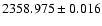 |
 |
 |
| 8 |
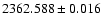 |
 |
 |
| 8- |
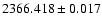 |
 |
 |
| k | Frequency | Amplitude |
|
|
|
(mma) | (s) | |
| 18+ |
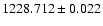 |
 |
 |
| 18 |
 |
 |
 |
| 18- |
 |
 |
 |
| 17+ |
 |
 |
 |
| 17 |
 |
 |
 |
| 17- |
 |
 |
 |
| 16+ |
 |
 |
 |
| 16 |
 |
<0.89 | |
| 16- |
 |
 |
 |
| 15+ |
 |
 |
 |
| 15 |
 |
 |
 |
| 15a |
 |
 |
 |
| 15- |
 |
 |
 |
| 14 |
 |
 |
 |
| 13+ |
 |
 |
 |
| 13 |
 |
 |
 |
| 13- |
 |
 |
 |
| 12 |
 |
 |
 |
| 11 |
 |
<0.71 | |
| 10 |
 |
<0.46 | |
| 9+ |
 |
 |
 |
| 9 |
 |
 |
 |
| 9- |
 |
 |
 |
| 8+ |
 |
 |
 |
| 8 |
 |
 |
 |
| 8- |
 |
 |
 |
| k | Frequency | Amplitude |
|
|
|
(mma) | (s) | |
| 19 |
 |
 |
 |
| 18 |
 |
< 2.1 | |
| 17+ |
 |
 |
 |
| 170 |
 |
 |
 |
| 17- |
 |
 |
 |
| 16+ |
 |
< 1.9 | |
| 160 |
 |
 |
 |
| 16- |
 |
|
 |
| 150 |
 |
< 2.2 | |
| 15- |
 |
 |
 |
| 14 |
 |
 |
 |
| 13+ |
 |
 |
 |
| 130 |
 |
 |
 |
| 13- |
 |
< 2.2 | |
| 12 |
 |
|
 |
| 11 |
 |
 |
 |
| 10 |
 |
 |
 |
| 9+ |
 |
 |
 |
| 90 |
 |
 |
 |
| 9- |
 |
 |
 |
| 8+ |
 |
 |
 |
| 80 |
 |
 |
 |
| 8- |
 |
 |
 |
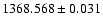
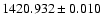
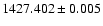
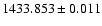
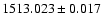
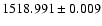
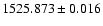
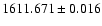
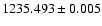
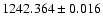
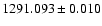
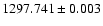
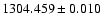
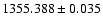
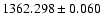
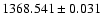
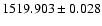
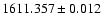
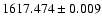
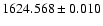
For a more self-consistent comparison, we took the data from the 1990, 1994 WET runs and the August 1996 run and derived the periods of the dominant modes via a nonlinear least squares fit. In Tables 6, 7 and 8 we present the results of a non-linear simultaneous least squares fit of 23 to 29 sinusoids, representing the main periodicities, to the 1990, 1994 and 1996 data sets. We use the nomenclature ka, for example 15-, to represent a subcomponent with m=-1 of the k=15 mode in these tables. The difference in the frequencies reported in this paper compared to the previous ones is due to our use of the simultaneous non-linear least-squares frequency fitting rather than using the Fourier Transform frequencies.
We note that both the Fourier analysis and multi-sinusoidal fit assume the signal is composed of sinusoids with constant amplitudes, which is clearly violated in the 1996 data set. The changing amplitudes introduce spurious peaks in the Fourier transform. This will not affect the frequency of the modes, but the inferred amplitude will be a poor match to the (non-sinusoidal) light curve amplitude.
In Table 5 we present the
average amplitude of the data sets, from 1000 to 3000 Hz,
after the main periodicities, all above
,
have been subtracted. For the 2000 data set, the initial
for the frequency range from 0
to 10 000 Hz, is 0.69 mma. For the high frequency range above
3000 Hz,
 mma.
mma.
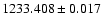
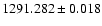
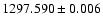
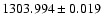
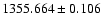
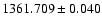
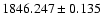
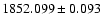
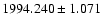
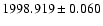
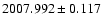
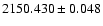
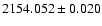
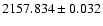
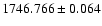
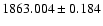
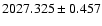
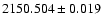
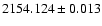
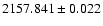
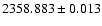
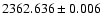
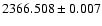
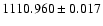
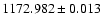
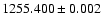
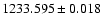
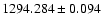
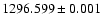
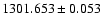
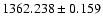
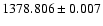
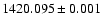
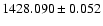
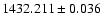
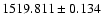
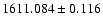
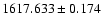
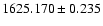
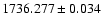
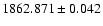
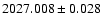
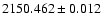
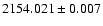
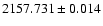
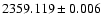
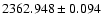
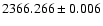
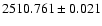
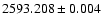
To provide the most accurate frequencies possible, we rely on a non-linear least squares fit of sinusoidal modes with guesses to the observed periods, since these better take into account contamination or slight frequency shifts due to aliasing. In Table 9 we present the results of a simultaneous non-linear least squares fit of 29 sinusoids, representing the main periodicities of the 2000 data set, simultaneously. All the phases have been measured with respect to the barycentric Julian coordinated date BCT 2 451 702.402 508.
| k | Frequency | Period | Amplitude |
|
|
|
(s) | (mma) | (s) | |
| 20 |
 |
 |
 |
 |
| 19 |
 |
 |
 |
 |
|
 |
 |
 |
 |
| 18 |
 |
 |
 |
 |
| 17+ |
 |
 |
 |
 |
| 17 |
 |
 |
 |
 |
| 17- |
 |
 |
 |
 |
| 16 |
 |
 |
 |
 |
| 16- |
 |
 |
 |
 |
| 15+ |
 |
 |
 |
 |
| 15 |
 |
 |
 |
 |
| 15- |
 |
 |
 |
 |
| 14 |
 |
 |
 |
 |
| 13+ |
 |
 |
 |
 |
| 13 |
 |
 |
 |
 |
| 13- |
 |
 |
 |
 |
| 12 |
 |
 |
 |
 |
| 11 |
 |
 |
 |
 |
| 10 |
 |
 |
 |
 |
| 9+ |
 |
 |
 |
 |
| 9 |
 |
 |
 |
 |
| 9- |
 |
 |
 |
 |
| 8+ |
 |
 |
 |
 |
| 8 |
 |
 |
 |
 |
| 8- |
 |
 |
 |
 |
 |
 |
 |
 |
 |
 |
 |
 |
 |
 |
| 7 |
 |
 |
 |
 |
 |
 |
 |
 |
 |
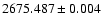
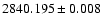
Armed with the new frequencies in Table 9, we comment
on regions of particular interest in the FT.
First, we identify several newly detected modes at
P=373.76 s,
 Hz, amp = 8.43 mma;
P=852.52 s,
Hz, amp = 8.43 mma;
P=852.52 s,
 Hz, amp = 2.74 mma; and
P=900.13 s,
Hz, amp = 2.74 mma; and
P=900.13 s,
 Hz, amp = 2.03 mma.
Based on the mode assignments of Bradley & Winget (1994) we identify
these modes as k=7, 19, and 20.
The mode identification is based on the proximity of
the detected modes with those predicted by the models, or even the
asymptotical period spacings, but also because of resonant mode coupling,
i.e., a stable mode will be driven to visibility if a coupled mode
falls near its frequency, as it happens for k=7, which is very close to
the combination of
k=17 and k=16; and k=20, which falls near
the resonance of the 8- and the
mode at
Hz, amp = 2.03 mma.
Based on the mode assignments of Bradley & Winget (1994) we identify
these modes as k=7, 19, and 20.
The mode identification is based on the proximity of
the detected modes with those predicted by the models, or even the
asymptotical period spacings, but also because of resonant mode coupling,
i.e., a stable mode will be driven to visibility if a coupled mode
falls near its frequency, as it happens for k=7, which is very close to
the combination of
k=17 and k=16; and k=20, which falls near
the resonance of the 8- and the
mode at  Hz
(see next paragraph).
It is important to note that these modes appear in combination peaks
with other modes, as shown in Table 11.
This reinforces our belief that these modes are physical modes, and not
just erroneously identified combination peaks.
We note that Bradley (2002) analyzed single site data taken over several
years, and found peaks at 1172 or
Hz
(see next paragraph).
It is important to note that these modes appear in combination peaks
with other modes, as shown in Table 11.
This reinforces our belief that these modes are physical modes, and not
just erroneously identified combination peaks.
We note that Bradley (2002) analyzed single site data taken over several
years, and found peaks at 1172 or  Hz in
April 1985, May 1986, and June 1992 data, lending additional credence to
the detection of the k=19 mode or its alias.
Hz in
April 1985, May 1986, and June 1992 data, lending additional credence to
the detection of the k=19 mode or its alias.
![\begin{figure}
\par\includegraphics[width=8.8cm,clip]{k18.ps}\end{figure}](/articles/aa/full/2003/14/aa3375/img395.gif) |
Figure 9: Peaks around k=18 in the 1990 (solid line) and 2000 (dashed line) transforms. |
| Open with DEXTER | |
The first previously known region of interest surrounds the k=18 mode,
which lies
near  Hz, according to previous observations.
In the 2000 data, the largest amplitude peak in this region lies at
Hz, which is over
Hz, according to previous observations.
In the 2000 data, the largest amplitude peak in this region lies at
Hz, which is over  Hz from the previous location.
Given that other modes (especially the one at k=17) has shifted by
less than
Hz from the previous location.
Given that other modes (especially the one at k=17) has shifted by
less than  Hz, we are inclined to rule out the possibility that
the k=18 mode shifted by Hz.
One possible solution is offered by seismological models of GD 358,
which predict an
mode near Hz.
For example, the best ML2 fit to the 1990 data (from
Metcalfe et al. 2002, Table 3), has an
mode
at
Hz, we are inclined to rule out the possibility that
the k=18 mode shifted by Hz.
One possible solution is offered by seismological models of GD 358,
which predict an
mode near Hz.
For example, the best ML2 fit to the 1990 data (from
Metcalfe et al. 2002, Table 3), has an
mode
at
 Hz (P= 798.3 s).
This would also be consistent with the larger number of subcomponents
detected, although they may be caused only by amplitude changes during
the observations. Figure 9 shows the region of the k=18 mode
in the FT for the 1990 data set (solid) and the 2000 data set (dashed);
it is consistent with the k=18 mode being the Hz for both data
sets, and they even have similar amplitudes.
While we avoided having to provide an explanation for why only
the k=18 mode would shift by Hz, we have introduced another
problem, as geometrical cancellation for an
mode
introduces a factor of 0.26 in relation to unity for an
mode. Thus, the identification of the Hz
as an
mode, which has a measured amplitude of 14.86 mma,
implies a physical amplitude higher than that of the highest
amplitude
mode, around 30 mma.
Hz (P= 798.3 s).
This would also be consistent with the larger number of subcomponents
detected, although they may be caused only by amplitude changes during
the observations. Figure 9 shows the region of the k=18 mode
in the FT for the 1990 data set (solid) and the 2000 data set (dashed);
it is consistent with the k=18 mode being the Hz for both data
sets, and they even have similar amplitudes.
While we avoided having to provide an explanation for why only
the k=18 mode would shift by Hz, we have introduced another
problem, as geometrical cancellation for an
mode
introduces a factor of 0.26 in relation to unity for an
mode. Thus, the identification of the Hz
as an
mode, which has a measured amplitude of 14.86 mma,
implies a physical amplitude higher than that of the highest
amplitude
mode, around 30 mma.
Kotak et al. (2003), analyzing time-resolved spectra obtained at the
Keck in 1998, show the velocity variations of the k=18 mode
at Hz is similar to those for the k=15 and k=17 modes,
concluding all modes are .
They did not detect a mode
at Hz.
In Fig. 10 we show the pre-whitened results; pre-whitening
was done by subtracting from the observed light curve a synthetic light
curve constructed with a single sinusoid with frequency, amplitude
and phase that minimizes the Fourier spectrum at the frequency of the
highest peak. A new Fourier spectrum is calculated and the next dominant
frequency is subtracted, repeating the procedure until no significant
power is left.
It is important to notice that with pre-whitening, the order of
subtraction matters. As an example, in the 2000 data set, if we
subtract the largest peak in the region of the k=18 mode, at 1255.41 Hz, followed by the next highest peak at 1256.26 Hz
and the next at 1254.44 Hz, we are left with a peak at only
1.3 mma at 1232.76 Hz. But if instead we subtract only the
1255.41 Hz
followed by the peak left at 1233.24 Hz, its amplitude is
around 3.1 mma, i.e., larger. Pre-whitening assumes the frequencies are
independent in the observed, finite, data set.
If they were, the order of subtraction would not affect the result.
Because the order of subtraction matters, the basic assumption
of pre-whitening does not apply.
We attempt to minimize this effect by noting that the frequencies
change less than the amplitudes, and use the FT frequencies in a
simultaneous non-linear least squares fit of all the eigenmode
frequencies.
But even the simultaneous
non-linear least squares fit uses the values of the Fourier
transform as starting points, and could converge to a local
minimum of the variance instead of the global minimum.
The modes with periods between 770 and 518 s (k=17 through 13) are
present in the 2000 data, though with different amplitudes than in
previous years.
Another striking feature of the peaks in 2000 is that one multiplet
member of each mode has by far the largest amplitude, so that without
data from previous WET runs, we would not know that the modes are
rotationally split.
The frequencies of these modes are stable to about  Hz
or less with the exception of the 16- mode, where the frequency
jumped from about
Hz
or less with the exception of the 16- mode, where the frequency
jumped from about
 Hz in 1990 and 1994 to about
  Hz
in 1996 and 2000 (see Fig. 11).
Most of these frequency changes are larger than the formal frequency
uncertainty from a given run (typically less than
Hz
in 1996 and 2000 (see Fig. 11).
Most of these frequency changes are larger than the formal frequency
uncertainty from a given run (typically less than  Hz), so
there is some process in GD 358 that causes the mode frequencies to
"wobble'' from one run to the next.
We speculate that this may be related to non-linear mode coupling
effects.
Whatever the origin of the frequency shifts, it renders these modes
useless for studying evolutionary timescales through rates of period
change.
Hz), so
there is some process in GD 358 that causes the mode frequencies to
"wobble'' from one run to the next.
We speculate that this may be related to non-linear mode coupling
effects.
Whatever the origin of the frequency shifts, it renders these modes
useless for studying evolutionary timescales through rates of period
change.
The k=12 through 10 modes deserve separate mention because their
amplitudes are always small; between 1990 and 2000, the largest amplitude
peak was only 1.6 mma.
The small amplitudes can make accurate frequency determinations
difficult, and all three modes have frequency shifts of 13 to  Hz
between the largest amplitude peaks in a given mode.
The k=10 mode shows the largest change with the 1990 data showing
the largest peaks at
Hz
between the largest amplitude peaks in a given mode.
The k=10 mode shows the largest change with the 1990 data showing
the largest peaks at
 Hz and
 Hz, while the 2000
data has one peak dominating the region at
Hz, while the 2000
data has one peak dominating the region at
 Hz.
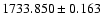
An examination of the data in Bradley (2002) shows that the k=12 mode
seems to consistently show a peak near 1733 to
Hz.
An examination of the data in Bradley (2002) shows that the k=12 mode
seems to consistently show a peak near 1733 to  Hz, and that
only the 1994 data has the peak shifted to
Hz, and that
only the 1994 data has the peak shifted to
 Hz, suggesting
that 1994 data may have found an alias peak or that the Hz
mode could be the m=+1 member and the
Hz mode is the
m=-1 member. The data in Bradley (2002) do not show convincing
evidence for the k=11 or 10 modes, so we cannot say anything else
about them.
Hz, suggesting
that 1994 data may have found an alias peak or that the Hz
mode could be the m=+1 member and the
Hz mode is the
m=-1 member. The data in Bradley (2002) do not show convincing
evidence for the k=11 or 10 modes, so we cannot say anything else
about them.
It is interesting to note that the k=8 and
k=9 modes are always seen as a triplet,
with 3.58 Hz separation for k=9, even in the 1996 data set.
Our measured spacings are 3.54 and 3.69 Hz, from m=-1 to m=0 and
m=0 to m=1.
The k=8 mode
in 2000 shows an m=0 component below our statistical
detection limit (A= 0.41 mma, when the local
 mma),
but the m=1 and m=-1 modes
remain separated by
mma),
but the m=1 and m=-1 modes
remain separated by
 Hz. All the higher k modes
are seen as singlets in the 2000 data set.
We also note that the k=8 and 9 modes have by far the most
stable frequencies.
The frequencies are always the same to within
Hz. All the higher k modes
are seen as singlets in the 2000 data set.
We also note that the k=8 and 9 modes have by far the most
stable frequencies.
The frequencies are always the same to within  Hz, and in
some cases better than
Hz, and in
some cases better than  Hz.
However, the frequency shifts are large enough to mask any possible
signs of evolutionary period change, as Fig. 12 shows.
Thus, we are forced to conclude that GD 358 is not a stable enough
"clock'' to discern evolutionary rates of period change.
Hz.
However, the frequency shifts are large enough to mask any possible
signs of evolutionary period change, as Fig. 12 shows.
Thus, we are forced to conclude that GD 358 is not a stable enough
"clock'' to discern evolutionary rates of period change.
As pointed out by Winget et al. (1994) and Vuille et al. (2000),
the observed triplets in the 1900 and 1994 data sets had
splittings ranging from 6.5 Hz from the "external'' modes
(such as k=17) to 3.6 Hz for the "internal'' modes
k=8 and 9.
Winget et al. interpreted these splittings to be the result of
radial differential rotation, and Kawaler et al. (1999) examined
this interpretation in more detail.
An examination of the frequencies found in the 2000 data set,
shown in Table 9, shows that the multiplet structure
is much harder to discern, since the k=10 through 20 modes typically
have only one multiplet member with a large amplitude.
The obvious multiplet members have frequencies that agree with the
1990 data, except for the 16- mode, where there is a
 Hz
shift in the 2000 data.
Hz
shift in the 2000 data.
![\begin{figure}
\par\includegraphics[width=8.8cm,clip]{k10.ps}\end{figure}](/articles/aa/full/2003/14/aa3375/img415.gif) |
Figure 13: Peaks around k=10 in the 1990 (solid line) and 2000 (dashed line) transforms. |
| Open with DEXTER | |
Note that the k=10 mode identified at
 is different than the
 identified by Winget et al. (1994) in the 1990 data.
However, the
peak they identified is not the highest peak in that region of the Fourier
transform (see Fig. 13).
Our analysis of the 1990 data has statistically significant k=10peaks close to
identified by Winget et al. (1994) in the 1990 data.
However, the
peak they identified is not the highest peak in that region of the Fourier
transform (see Fig. 13).
Our analysis of the 1990 data has statistically significant k=10peaks close to  Hz and 2008 Hz.
The only modes with obvious multiplet structure
are the k=9 mode, which still shows an obvious
3.6 Hz split triplet, and
the k=8 mode, which shows two peaks that are
consistent with
 Hz separation.
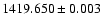
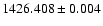
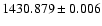
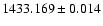
In Table 11 we have a peak 3.3 Hz from the k=15, m=1mode that we have not seen before; we call it the 15b mode.
We are not certain whether this is another member of the k=15 multiplet
(analogous to the 15a mode in the 1994 WET data) or if it is
something else.
The 1994 data set also presented a large peak 4.4 Hz
from k=15, m=0, which we call the 15a mode, in addition to the
 components. We have not seen this 15a mode in any other
data set other than the 1994 WET run.
The identity of the "extra subcomponents'' remains an unsolved mystery.
components. We have not seen this 15a mode in any other
data set other than the 1994 WET run.
The identity of the "extra subcomponents'' remains an unsolved mystery.
Winget et al. (1994) and Vuille et al. (2000) show that most of the
periodicities are in fact linear combination peaks of the main
peaks (eigenmodes).
Combination peaks are what we call peaks in the FT whose frequencies
are equal to the sum or difference of two (or more) the the
or 2
mode frequencies.
The criteria for selection of the combination peaks was that the
frequency difference between the combination peak and the sum of the
"parent mode'' frequencies
must be smaller than our resolution, which is typically around 1 Hz.
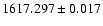
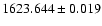
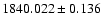
The last column of Table 11 shows the frequency difference.
![\begin{figure}
\par\includegraphics[width=14.8cm,clip]{2000pk.ps}\end{figure}](/articles/aa/full/2003/14/aa3375/img421.gif) |
Figure 14: Pre-whitened peaks in the 2000 transform. |
| Open with DEXTER | |
For example, only 28 of the more than 180 peaks in Winget et al.
(1994) are
modes; the rest are combination peaks up to
third order (i.e., three modes are involved).
The
modes lie in the region 1000 to 2500 Hz, and are
identified as modes k=18 to 8. In the 1994 data set analyzed
by Vuille et al., combination peaks up to 4th order were detected.
In the 2000 data set we identify combination peaks up to 6th order, and
most if not all remaining peaks are in fact linear combination peaks,
as demonstrated in Table 11 and is shown in the pre-whitened
FT of the 2000 data (see Fig. 14).
Here too, we use the nomenclature ka, for example 15-, to
represent a subcomponent with m=-1 of the k=15 mode.
The so-called
mode at Hz,
as well as k=17 and k=15 modes, have subcomponents, but
probably they are not different m value components,
and are caused, most likely, by amplitude modulation.
We say this because the frequency splittings are drastically
different than in previous data, and for the
mode, there
are more than 5 possible subcomponent peaks present.
We did not do an exhaustive search for
all of the possible combination peaks up to 6th order in the Fourier
transform, as we only took into account
the peaks that had a probability smaller than 1/1000
of being due to noise, and studied if they could
be explained as combination peaks.
Brickhill's (1992) pulsation-convection interaction model
predicts, and the observations reported by Winget et al. and
Vuille et al. agree, that a combination peak involving
two different modes always has a larger relative amplitude
than a combination involving twice the frequency of a given mode
(also called a harmonic peak).
Wu's (2001) analytical expression leads to a factor of 1/2
difference between a combination peak with two modes versus a
harmonic peak, assuming that the
amplitudes of both eigenmodes are the same.
Vuille et al. claim that the relatively small amplitude of
the k=13 mode in 1994 is affected by
destructive beating of the
nonlinear peak (
 )
and that the k=16 mode amplitude
is affected by the (15+18-17) combination peak.
It is noteworthy that the peak at 1423.62 Hz is only 3.52 Hz
from k=15, so it might be the 15- mode.
However, the previously identified
15- was 6.7 Hz from it, and we consider the
)
and that the k=16 mode amplitude
is affected by the (15+18-17) combination peak.
It is noteworthy that the peak at 1423.62 Hz is only 3.52 Hz
from k=15, so it might be the 15- mode.
However, the previously identified
15- was 6.7 Hz from it, and we consider the
 Hz peak
to be either a result of amplitude modulation of the k=15 mode or yet
another combination peak.
Hz peak
to be either a result of amplitude modulation of the k=15 mode or yet
another combination peak.
We note that the wealth of combination peaks and their relative amplitude offers insight into the amplitude limiting mechanism and would be worthy of the considerable theoretical and numerical effort required to understand it.
One of the major goals of our observations of GD 358 was to discover additional modes to help refine our seismological model fits. We were also interested in how much the globally optimal model parameters would change due to the slight shifts in the observed periods. With these goals in mind, we repeated the global model-fitting procedure of Metcalfe, Winget & Charbonneau (2001) on several subsets of the new observations.
Our model-fitting method uses the parallel genetic algorithm described by
Metcalfe & Charbonneau (2003) to minimize the root-mean-square (rms)
differences between the observed and calculated periods (Pk) and
period spacings (
 )
for models with effective
temperatures (
)
for models with effective
temperatures (
 )
between 20 000 and 30 000 K, total stellar
masses (M*) between 0.45 and 0.95 ,
helium
layer masses with
)
between 20 000 and 30 000 K, total stellar
masses (M*) between 0.45 and 0.95 ,
helium
layer masses with
 between 2.0 and 7.0, and an internal C/O
profile with a constant oxygen mass fraction (
between 2.0 and 7.0, and an internal C/O
profile with a constant oxygen mass fraction ( )
out to some
fractional mass (q) where it then decreases linearly in mass to zero
oxygen at
0.95 m/M*. This technique has been shown to find the globally
optimal set of parameters consistently among the many possible
combinations in the search space, but it requires between 200 and
4000 times fewer model evaluations than an exhaustive search of the
parameter-space to accomplish this, and has a failure rate <10-5.
)
out to some
fractional mass (q) where it then decreases linearly in mass to zero
oxygen at
0.95 m/M*. This technique has been shown to find the globally
optimal set of parameters consistently among the many possible
combinations in the search space, but it requires between 200 and
4000 times fewer model evaluations than an exhaustive search of the
parameter-space to accomplish this, and has a failure rate <10-5.
We attempted to fit the 13 periods and period spacings defined by the
m=0 components of the 14 modes identified as k=7 to k=20 in
Table 9. Because of our uncertainty about the proper
identification of
k=18(see Sect. 4) we performed fits under two different assumptions: for Fit
a we assumed that the frequency near 1233 Hz was k=18 (similar to
the frequency identified in 1990), and for Fit b we assumed that the
larger amplitude frequency near 1255 Hz was k=18. The results of
these two fits led us to prefer the identification for k=18 in Fit a,
and we included this in an additional fit using only the 11 modes from
k=8 to k=18, which correspond to those identified in 1990 (Fit c).
We performed an additional fit (Fit d) that included the same 13 periods
used for Fit a, but ignored the period spacings.
The optimal values for the five model parameters, and the root-mean-square
residuals between the observed and computed periods ( )
and
period spacings (
)
and
period spacings (
 )
for the four fits are shown in
Table 10.
)
for the four fits are shown in
Table 10.
| Parameter | Fit a | Fit b | Fit c | Fit d |
 |
24 300 | 23 500 | 24 500 | 22 700 |
 |
0.61 | 0.60 | 0.625 | 0.630 |
 |
-2.79 | -5.13 | -2.58 | -4.07 |
|
0.81 | 0.99 | 0.39 | 0.37 |
| q (m/M*) | 0.47 | 0.47 | 0.83 | 0.42 |
 |
2.60 | 3.65 | 2.12 | 1.72 |
 |
4.07 | 4.92 | 2.21 |  |
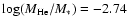
Our preferred solution from Table 10 is Fit a, because it
includes our favored identification for the k=18 mode and the additional
pulsation periods. The larger
in Fit a compared to
Fit c is dominated by the large period spacings between the k=19 and
20 modes (47.6 s) and the k=7 and 8 modes (49.4 s). Fit a has a
mass and effective temperature that are essentially the same as the fit of
Bradley & Winget (1994), and are consistent with the spectroscopic
values derived by Beauchamp et al. (1999). The other structural parameters
are otherwise similar to those found by Metcalfe et al. (2001)
(
 K,
K,
 ,
,
 ,
,
 ,
and q = 0.49). We caution, however, that the large
values of
and
for Fit a imply that our
model may not be an adequate representation of the real white dwarf star.
New and unmodeled physical circumstances may have arisen between 1994 and
2000 (e.g. whatever caused the forte in 1996), which may account for
the diminished capacity of our simple model to match the observed periods.
,
and q = 0.49). We caution, however, that the large
values of
and
for Fit a imply that our
model may not be an adequate representation of the real white dwarf star.
New and unmodeled physical circumstances may have arisen between 1994 and
2000 (e.g. whatever caused the forte in 1996), which may account for
the diminished capacity of our simple model to match the observed periods.
Before embarking on our discussion, we recap the highlights of our
observations.
First, the 2000 WET data shows eigenmodes from at least
k=8 through k=19. We may also have detected the k=7 and k=20modes. However, their frequencies are similar to that of unrelated
combination peaks, so their identification is less secure.
For the first time, we have also found an
mode in the
GD 358 data; it is at
 Hz.
Second, we see relatively few multiplet modes for a given k, with
the exception of the k=8 and 9 modes.
While the multiplet structure of the
modes is muted, the
combination peaks are enhanced to the point that we see combination
modes up to 6th order. Combined with the previous WET runs, we see
evidence for anticorrelation between the presence of multiplet
structure and combination peaks.
The presence of amplitude variability of the
mode continues.
In the August 1996 data, we saw the most extreme example yet, where
all of the observed light was in a single (k=8 mode) for one night
(which we call the "forte''). Data before and after the run show
power in the nights before and after in other pulsation modes besides
the k=8 and a much lower amplitude.
The periods from the 1996 data are consistent with the 2000 data set,
although there are differences in the details.
Hz.
Second, we see relatively few multiplet modes for a given k, with
the exception of the k=8 and 9 modes.
While the multiplet structure of the
modes is muted, the
combination peaks are enhanced to the point that we see combination
modes up to 6th order. Combined with the previous WET runs, we see
evidence for anticorrelation between the presence of multiplet
structure and combination peaks.
The presence of amplitude variability of the
mode continues.
In the August 1996 data, we saw the most extreme example yet, where
all of the observed light was in a single (k=8 mode) for one night
(which we call the "forte''). Data before and after the run show
power in the nights before and after in other pulsation modes besides
the k=8 and a much lower amplitude.
The periods from the 1996 data are consistent with the 2000 data set,
although there are differences in the details.
Using the k=7, 19, and 20 modes in seismological fits produces a best-fitting model that is similar to that derived from only the k=8 through 18 modes, indicating that the new modes do not deviate drastically from the expected mode pattern.
The reappearance of modes with frequencies similar to those obtained
before the mode disappeared (true of all modes from k=8 through 19),
shows that the stellar structure sampled by these modes remained the
same for almost 20 years. This is in spite of rapid amplitude change
events like the "forte'' one observed in August 1996. Our
observations, coupled with guidance from the available theories of
Brickhill (1992) and Wu & Goldreich (2001) suggest that the "forte''
event was probably an extreme manifestation of a nonlinear mode-coupling event
that did not materially affect the structure of the star other than
possibly the driving region. The appearance and disappearance of modes is
similar to the behavior observed in the ZZ Ceti star G 29-38
by Kleinman et al. (1998), and we note that "ensemble'' seismology
works for GD 358 as well as for the cool ZZ Ceti stars.
The one caveat is that the Hz frequency "wobbles'' will
place a limit on the accuracy of the seismology.
We also appear to have discovered an
mode (at
Hz)
in GD 358 for the first time, based on the match of the observed
period to that of
modes from our best fitting model. Our
model indicates that this is the k=34 mode. This mode has a relatively
large amplitude of 14.9 mma, which combined with the increased
geometric cancellation (about  )
of an
mode,
implies that it has the largest amplitude of any mode observed in 2000.
We note the existence of several linear combination peaks
involving the Hz mode, that also show complex structures.
This lends credence to the Hz mode being a real mode,
and that the complex structure is associated with the real mode
(such as amplitude modulation),
as opposed to being some sort of combination peak.
The amplitude of the Hz mode changed during the WET run,
so we suspect that the many subcomponents observed are most likely
due to amplitude modulation.
)
of an
mode,
implies that it has the largest amplitude of any mode observed in 2000.
We note the existence of several linear combination peaks
involving the Hz mode, that also show complex structures.
This lends credence to the Hz mode being a real mode,
and that the complex structure is associated with the real mode
(such as amplitude modulation),
as opposed to being some sort of combination peak.
The amplitude of the Hz mode changed during the WET run,
so we suspect that the many subcomponents observed are most likely
due to amplitude modulation.
The period structure of the 1990 and 1994 WET data sets are similar, but
show that the amplitude of the modes, and even the fine structure,
changes with time. In August 1996, the period structure changed
rapidly and dramatically,
with essentially all the observed pulsation power going to the k=8mode.
In spite of the large amplitude, the light curve was surprisingly
sinusoidal, with a small contribution from the k=9 mode.
Single site observations
one month earlier (June 1996) and one month later (September 1996)
show a period structure similar to those present in the 1990
and 1994 data sets. For the 2000 data set, the period structure shows
close to equal frequency splittings,
and the fine structure is different than observed before. Only the
k=9 mode show the same clear triplet observed in 1990 and 1994,
with the same frequency splitting. The k=8 mode shows the m=-1 and
m=1 modes, while the central m=0 mode is below our
significance level.
The other modes do not show clearly the triplet structure
previously observed.
The 1990 and 1994 data sets show the m-splitting
expected by rotational splitting, but the change of the splitting
frequency difference from 6 Hz to 3 Hz from k=17 to k=8was interpreted as indicating differential rotation.
The apparent anticorrelation between the abundance of multiplet structure and the highest order of combination frequencies seen is a puzzle. As we do not expect the differential rotation profile of GD 358 changed in the last 10 years (and the splittings we do see in 2000 support this contention), the anticorrelation must be telling something about what is going on with rotation in the convection zone. We say this because the combination peaks are believed to be caused by the nonlinear response of the depth varying convection zone, and thus the increased order of combination peaks implies that the convection zone is more "efficient'' at mixing eigenmodes to observable amplitudes. The k=8 and 9 modes continue to show obvious multiplet structure and little, if any, change in splitting. These modes are the most "internal'' of the observed modes of GD 358, and we speculate that this must have some bearing on their multiplet structure's ability to persist. We do not see any obvious pattern in the dominant amplitude multiplet member with overtone number, so there is not an obvious pattern of rotational coupling to the convection zone for determining mode amplitude. We will need theoretical guidance to make sense of these observations.
A related puzzle is the presence of extra multiplet members and/or
apparent large frequency shifts of modes in the k=15 and 16 multiplets.
The k=15 mode shows an extra component at
 Hz in the
1994 data and a peak at
Hz in the 2000 data that have
not been seen before or since.
Some possible explanations include: rapid amplitude modulation of a
k=15 multiplet member that the FT interprets as an extra peak;
the 2000 peak is about the right frequency to be another mode, if we use the
Hz mode as a reference point;
it could be an unattributed combination peak involving sums and
differences of known modes; or it could be something else entirely.
The large peak at about Hz in 1996 and 2000 is also something
of a mystery. It is possible that the k=16, m=-1 component
really changed by
Hz in the
1994 data and a peak at
Hz in the 2000 data that have
not been seen before or since.
Some possible explanations include: rapid amplitude modulation of a
k=15 multiplet member that the FT interprets as an extra peak;
the 2000 peak is about the right frequency to be another mode, if we use the
Hz mode as a reference point;
it could be an unattributed combination peak involving sums and
differences of known modes; or it could be something else entirely.
The large peak at about Hz in 1996 and 2000 is also something
of a mystery. It is possible that the k=16, m=-1 component
really changed by
 from the
  Hz observed in 1990,
although we would have to explain why only this large amplitude multiplet
member suffered this large a frequency change.
Other possibilities include: the peak is a 1 cycle per day alias of
another mode; the peak is a combination peak -- the combination
Hz observed in 1990,
although we would have to explain why only this large amplitude multiplet
member suffered this large a frequency change.
Other possibilities include: the peak is a 1 cycle per day alias of
another mode; the peak is a combination peak -- the combination
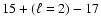 is a perfect frequency match; or possibly an mode, based on period spacing arguments.
Further observations, data analysis with tools like wavelet analysis,
and further model fitting may help determine which explanation fits the
data best.
is a perfect frequency match; or possibly an mode, based on period spacing arguments.
Further observations, data analysis with tools like wavelet analysis,
and further model fitting may help determine which explanation fits the
data best.
Brickhill (1992) proposed that the combination frequencies result from mixing
of the eigenmode signals by a depth-varying surface convection zone when
undergoing pulsation.
He pointed out that the convective turnover time in DA and DB variable
white dwarf stars occurs on a timescale much shorter than the pulsation
period. As a consequence, the convective region adjusts almost
instantaneously during a pulsation cycle. Brickhill demonstrated
that the flux leaving the convective zone depends on the depth
of the convective zone, which changes during the pulsation cycle,
distorting the observed flux. This distortion introduces combination
frequencies, even if the pulsation at the bottom of the convection zone
is linear, i.e., a single sinusoidal frequency.
Wu (2001) analytically calculated the amplitude and phases expected
of such combination frequencies, and concluded that the convective
induced distortion was roughly in agreement with GD358's 1994 observations,
provided that the inclination of the pulsation axis to the
line of sight is between
 and
and
 .
Wu also calculated that the harmonics for
modes should be much
higher than for .
However the theory overpredicts the amplitude
of the
harmonics. She also predicts that
geometrical cancellation will, in principle, allow a determination of
if both frequencies sums and differences are observed.
These predictions still need testing.
.
Wu also calculated that the harmonics for
modes should be much
higher than for .
However the theory overpredicts the amplitude
of the
harmonics. She also predicts that
geometrical cancellation will, in principle, allow a determination of
if both frequencies sums and differences are observed.
These predictions still need testing.
While Wu & Goldreich (2001) discuss parametric instability mechanisms
for the amplitude of the pulsation modes, they only discuss the case
where the parent mode is unstable and the daughter modes are stable.
However, with GD 358, we have a different situation. The highest frequency
k=8 and 9 modes can have as a daughter mode one of the lower frequency
(k=17, 18, or 19)
modes and an  higher mode. One or
both or these daughter modes are actually pulsationally unstable as well,
which we believe would require coupling to still lower frequency
granddaughter modes that are predicted to be stable by our models and
the calculations of Brickhill (1990, 1991) and Goldreich & Wu (1999a,b).
We suggest that occasionally the nonlinear coupling of the granddaughter
and daughter modes with the k=8 and 9 modes can allow the k=8 and
9 modes to suffer abrupt amplitude changes when everything is "just
right''. In the meantime, the granddaughter modes will couple to the
excited daughter modes (k=13 through 19 in general) to produce the
observed amplitude instability of these modes. We need a quantitative
theoretical treatment of this circumstance worked out to see if the
predicted behavior matches what we observe in GD 358.
higher mode. One or
both or these daughter modes are actually pulsationally unstable as well,
which we believe would require coupling to still lower frequency
granddaughter modes that are predicted to be stable by our models and
the calculations of Brickhill (1990, 1991) and Goldreich & Wu (1999a,b).
We suggest that occasionally the nonlinear coupling of the granddaughter
and daughter modes with the k=8 and 9 modes can allow the k=8 and
9 modes to suffer abrupt amplitude changes when everything is "just
right''. In the meantime, the granddaughter modes will couple to the
excited daughter modes (k=13 through 19 in general) to produce the
observed amplitude instability of these modes. We need a quantitative
theoretical treatment of this circumstance worked out to see if the
predicted behavior matches what we observe in GD 358.
Observations of GD 358 have been both rewarding and vexing. We have been
rewarded with enough
modes being present to decipher the mode
structure and perform increasingly refined asteroseismology of this star,
starting with Bradley & Winget (1994) up to the latest paper of Metcalfe
et al. (2002). One thing asteroseismology has not provided us with is the
structure of and/or the depth of the surface convection zone. This would
help us test the "convective driving'' mechanism introduced by Brickhill
(1991) and elaborated on by Goldreich & Wu (1999a,b).
Our observations point out the need for further refinements of the
parametric instability mechanism described by Wu & Goldreich (2001)
to better cover the observed mode behavior. The observational data set
is quite rich, and coupled with more detailed theories, offers the
promise of being able to unravel the mysteries of amplitude variation
seen in the DBV and DAV white dwarfs. This in turn, may offer us the
insights needed to ascertain why only some of the predicted modes are
seen at any one time.
Acknowledgements
MAW, AKJ, AEC, and MLB acknowledge support by the National Science Foundation through the Research Experiences for Undergraduates Summer Site Program to Florida Tech.
| Telescope | Run | Date (UT) | Start Time (UT) | Length (s) |
| Suhora 60 cm | suh-55 | Aug. 10 | 23:28:00 | 8890 |
| Suhora 60 cm | suh-56 | Aug. 12 | 20:26:40 | 14 730 |
| McDonald 210 cm | an-0036 | Aug. 13 | 3:06:30 | 13 840 |
| Suhora 60 cm | suh-57 | Aug. 13 | 19:12:10 | 22 050 |
| McDonald 210 cm | an-0038 | Aug. 14 | 3:14:10 | 12 920 |
| BAO 85 cm | bao-0026 | Aug. 14 | 13:10:00 | 13 610 |
| Suhora 60 cm | suh-58 | Aug. 14 | 23:19:10 | 5370 |
| McDonald 210 cm | an-0040 | Aug. 15 | 3:04:30 | 15 780 |
| McDonald 96 cm | an-0041 | Aug. 16 | 2:54:00 | 15 700 |
| BAO 85 cm | bao-0027 | Aug. 16 | 13:01:50 | 1250 |
| BAO 85 cm | bao-0028 | Aug. 16 | 13:42:30 | 9330 |
| McDonald 96 cm | an-0042 | Aug. 17 | 5:01:50 | 6420 |
| McDonald 96 cm | an-0043 | Aug. 18 | 4:05:30 | 3930 |
| Suhora 60-cm | suh-59 | Aug. 18 | 21:02:10 | 13 010 |
| McDonald 96 cm | an-0042 | Aug. 18 | 4:05:30 | 3930 |
| McDonald 96 cm | an-0043 | Aug. 19 | 2:44:40 | 2100 |
| McDonald 96 cm | an-0044 | Aug. 19 | 2:44:40 | 2100 |
| McDonald 96 cm | an-0044 | Aug. 19 | 3:47:00 | 4250 |
| McDonald 96 cm | an-0045 | Aug. 19 | 3:47:00 | 4250 |
| McDonald 96 cm | an-0046 | Aug. 19 | 4:58:30 | 7160 |
| Suhora 60 cm | suh-60 | Aug. 19 | 20:28:00 | 15 290 |
| Suhora 60 cm | suh-61 | Aug. 20 | 21:04:00 | 10 670 |
| Run Name | Telescope | Date (UT) | Start Time | Length | |
| (UT) | (s) | ||||
| jr0523 | Moletai 1.65m | May 23 00 | 22:15:49 | 6360 | |
| tsm-0074 | McDonald 2.1m | May 24 | 4:59:00 | 20 050 | |
| jr0524 | Moletai 1.65m | May 24 | 20:24:35 | 10 255 | |
| tsm-0075 | McDonald 2.1m | May 25 | 3:25:00 | 25 440 | |
| suh-089 | SUHORA 0.6m | May 25 | 23:58:30 | 4715 | |
| tsm-0076 | McDonald 2.1m | May 26 | 3:18:30 | 25 350 | |
| suh-090 | Suhora 0.6m | May 26 | 20:07:20 | 18 995 | |
| jr0526 | Moletai 1.65m | May 26 | 20:26:00 | 12 545 | |
| teide02 | Tenerife IAC 0.8m | May 27 | 01:25:20 | 13 270 | |
| tsm-0077 | McDonald 2.1m | May 27 | 03:00:00 | 26 100 | |
| suh-091 | Suhora 0.6m | May 27 | 19:56:20 | 15 240 | |
| sa-et1 | SAAO 0.75m | May 28 | 00:18:30 | 15 220 | |
| teide04 | Tenerife IAC 0.8m | May 28 | 0:37:10 | 14 870 | |
| tsm-0078 | McDonald 2.1m | May 28 | 2:51:00 | 29 040 | |
| teide05 | Tenerife IAC 0.8m | May 28 | 21:53:20 | 24 700 | |
| jr0528 | Moletai 1.65m | May 28 | 20:28:20 | 9550 | |
| tsm-0079 | McDonald 2.1m | May 29 | 2:50:00 | 27 300 | |
| calto2905 | Calar Alto 1.23m | May 29 | 21:20:00 | 6000 | CCD |
| teide06 | Tenerife IAC 0.8m | May 29 | 22:01:50 | 4375 | |
| gv-2905 | OHP | May 29 | 22:06:00 | 15 530 | |
| teide07 | Tenerife IAC 0.8m | May 29 | 23:28:00 | 11 460 | |
| teide08 | Tenerife IAC 0.8m | May 30 | 2:50:50 | 6850 | |
| tsm-0080 | McDonald 2.1m | May 30 | 3:00:00 | 28 200 | |
| suh-092 | Suhora 0.6m | May 30 | 20:39:30 | 14 880 | |
| gv-2906 | OHP 1.93m | May 30 | 20:44:00 | 4340 | |
| teide09 | Tenerife IAC 0.8m | May 30 | 21:58:50 | 25 270 | |
| sjk-0401 | Hawaii UH 0.6m | May 31 | 7:19:00 | 26 615 | |
| gv-2907 | OHP, 1.93 m | May 31 | 20:44:00 | 20 400 | |
| teide10 | Tenerife IAC 0.8m | May 31 | 22:25:20 | 8195 | |
| calto3105 | Calar Alto 1.23m | May 31 | 21:30:00 | 5560 | CCD |
| sa-od033 | SAAO 0.75m | May 31 | 22:31:00 | 4000 | |
| sjk-0402 | Hawaii UH 0.6m | Jun. 1 | 6:05:00 | 31 265 | |
| jxj-0103 | BAO 0.85m | Jun. 1 | 13:18:20 | 6950 | |
| suh-093 | Suhora 0.6m | Jun. 1 | 19:55:30 | 19 310 | |
| jr0601 | Moletai 1.65m | Jun. 1 | 20:12:00 | 13 145 | |
| sa-od035 | SAAO 0.75m | Jun. 1 | 20:22:00 | 10 600 | |
| calto0106 | Calar Alto 1.23m | Jun. 1 | 20:46:00 | 4845 | CCD |
| gv-2908 | OHP 1.93m | Jun. 1 | 20:48:00 | 19 650 | |
| teide11 | Tenerife IAC 0.8m | Jun. 1 | 22:38:40 | 2230 | |
| teide12 | Tenerife IAC 0.8m | Jun. 1 | 23:16:20 | 12 460 | |
| tsm-0081 | McDonald 2.1m | Jun. 2 | 2:50:00 | 24 000 | |
| teide13 | Tenerife IAC 0.8m | Jun. 2 | 3:00:20 | 7180 | |
| sara030 | Sara 0.9m | Jun. 2 | 8:30:00 | 14 400 | CCD |
| sjk-0403 | Hawaii UH 0.6m | Jun. 2 | 6:04:00 | 32 505 | |
| jxj-0003 | BAAO 0.85m | Jun. 2 | 15:24:50 | 11 030 | |
| suh-094 | Suhora 0.6m | Jun. 2 | 19:53:00 | 19 530 | |
| gv-2909 | OHP 1.93m | Jun. 2 | 21:40:00 | 16 750 | |
| jr0602 | Moletai 1.65m | Jun. 2 | 22:03:45 | 4740 | |
| calto0602 | Calar Alto 1.23m | Jun. 2 | 23:20:00 | 4030 | CCD |
| teide15 | Tenerife IAC 0.8m | Jun. 3 | 00:22:40 | 16 630 |
| Run Name | Telescope | Date (UT) | Start Time | Length | |
| (UT) | (s) | ||||
| calto0602.2 | Calar Alto 1.23 m | Jun. 3 | 00:35:00 | 2800 | |
| tsm-0082 | McDonald 2.1 m | Jun. 3 | 3:03:30 | 22 110 | |
| sara031 | Sara 0.9 m | Jun. 3 | 4:15:00 | 26 100 | CCD |
| sjk-0404 | Hawaii UH 0.6 m | Jun. 3 | 5:59:30 | 31 270 | |
| jxj-0105 | BAO 0.85 m | Jun. 3 | 13:27:50 | 4185 | |
| sjk-0405 | Hawaii UH 0.6 m | Jun. 3 | 14:42:30 | 1465 | |
| jxj-0106 | BAO 0.85 m | Jun. 3 | 16:00:20 | 8725 | |
| suh-095 | Suhora 0.6 m | Jun. 3 | 20:02:50 | 19 055 | |
| jr0603 | Moletai 1.65 m | Jun. 3 | 20:24:55 | 12 305 | |
| sa-od037 | SAAO 0.75 m | Jun. 3 | 20:49:00 | 10 655 | |
| teide17 | Tenerife IAC 0.8 m | Jun. 4 | 00:26:00 | 16 760 | |
| sara032 | Sara 0.9 m | Jun. 4 | 4:08:00 | 26 940 | CCD |
| sjk-0406 | Hawaii UH 0.6 m | Jun. 4 | 5:37:00 | 34 055 | |
| tsm-0083 | McDonald 2.1 m | Jun. 4 | 7:46:30 | 11 310 | |
| jxj-0107 | BAO 0.85 m | Jun. 4 | 12:32:50 | 25 280 | |
| suh-096 | Suhora 0.6 m | Jun. 4 | 20:21:00 | 16 775 | |
| sa-od039 | SAAO 0.75 m | Jun. 4 | 21:42:00 | 7110 | |
| calto0604 | Calar Alto 1.23 m | Jun. 4 | 23:06:37 | 4290 | CCD |
| teide19 | Tenerife IAC 0.8 m | Jun. 5 | 0:14:30 | 17 270 | |
| tsm-0084 | McDonald 2.1 m | Jun. 5 | 3:00:00 | 6150 | |
| sara034 | Sara 0.9 m | Jun. 5 | 4:47:00 | 24 720 | CCD |
| jxj-0108 | BAO 0.85 m | Jun. 5 | 12:33:20 | 25 295 | |
| suh-097 | Suhora 0.6 m | Jun. 5 | 20:04:00 | 18 545 | |
| jr0605_1 | Moletai 1.65 m | Jun. 5 | 20:58:25 | 5555 | |
| sa-od042 | SAAO 0.75 m | Jun. 5 | 21:49:00 | 8005 | |
| jr0605_2 | Moletai 1.65 m | Jun. 5 | 22:52:55 | 3925 | |
| teide20 | Tenerife IAC 0.8 m | Jun. 6 | 1:08:00 | 13 685 | |
| tsm-0085 | McDonald 2.1 m | Jun. 6 | 2:55:00 | 28 800 | |
| sara035 | Sara 0.9 m | Jun. 6 | 4:08:00 | 10 080 | CCD |
| edjoh01 | NOT | Jun. 6 | 21:33:40 | 10 150 | |
| edjoh02 | NOT | Jun. 7 | 1:33:10 | 13 025 | |
| teide22 | Tenerife IAC 0.8 m | Jun. 7 | 0:16:40 | 16 850 | |
| teide23 | Tenerife IAC 0.8 m | Jun. 7 | 21:00:00 | 28 800 | |
| edjoh03 | NOT 2.5 m | Jun. 7 | 22:23:40 | 15 755 | |
| suh-098 | Suhora 0.6 m | Jun. 8 | 20:05:10 | 17 065 | |
| sara036 | Sara 0.9 m | Jun. 10 | 4:41:00 | 7800 | CCD |
| sara037 | Sara 0.9 m | Jun. 11 | 4:01:00 | 9780 | CCD |
| sara038 | Sara 0.9 m | Jun. 12 | 3:57:00 | 10 600 | CCD |
| sara039 | Sara 0.9 m | Jun. 20 | 7:09:00 | 14 700 | CCD |
| sara040 | Sara 0.9 m | Jun. 21 | 3:36:00 | 28 920 | CCD |
| sara041 | Sara 0.9 m | Jun. 22 | 3:29:00 | 22 020 | CCD |
| sara042 | Sara 0.9 m | Jun. 23 | 3:23:00 | 28 680 | CCD |
| Telescope | Run | Date (UT) | Time(UT) | Length (s) |
| PdM 2 m | gv-0480 | 1996 Sep. 10 | 20:29:01 | 5670 |
| Suhora 60 cm | suh-62 | 1996 Sep. 11 | 18:11:00 | 10 790 |
| PdM 2 m | gv-0484 | 1996 Sep. 14 | 21:22:02 | 2330 |
| Suhora 60 cm | suh-63 | 1996 Sep. 18 | 18:45:00 | 15 860 |
| Suhora 60 cm | suh-65 | 1996 Sep. 19 | 18:06:20 | 13 380 |
| McD 2.1 m | an-0061 | 1997 Apr. 1 | 06:54:20 | 415 |
| McD 2.1 m | an-0066 | 1997 Apr. 7 | 06:52:50 | 1763 |
![\begin{figure}
\par\includegraphics[height=17.5cm,angle=-90,width=13.2cm,clip]{gd358lc1.ps}\end{figure}](/articles/aa/full/2003/14/aa3375/img449.gif) |
Figure 4: First half of the ground-based optical lightcurve of GD 358 in August 1996. Each panel is one day long. |
| Open with DEXTER | |
![\begin{figure}
\par\includegraphics[height=17.5cm,width=14.1cm,clip]{dftchange.ps}\end{figure}](/articles/aa/full/2003/14/aa3375/img450.gif) |
Figure 5: Fourier transforms of GD 358 observed one day apart. The top panel shows the Fourier transform of the data taken on the 1st day of the 3-site campaign (suh-55: taken in Poland with start time at 23:28:00 UT on August 10), and the bottom panel shows the data taken about one day later from McDonald (an-0034: taken with start time at 2:48:20 UT on August 12). The observed power has shifted completely and dramatically, both in frequency and amplitude. |
| Open with DEXTER | |
![\begin{figure}
\par\includegraphics[totalheight=15cm,angle=270]{an-0034dpft.ps}\end{figure}](/articles/aa/full/2003/14/aa3375/img451.gif) |
Figure 6: Fourier transform of an-0034 before (dotted line) and after (solid line) it was prewhitened by the 423 s mode. After prewhitening, there is little significant power left. The lightcurve was dominated by one mode, a possible explanation for why the lightcurve looked so linear (sinusoidal) in Fig. 4. |
| Open with DEXTER | |
![\begin{figure}
\par\includegraphics[width=15cm,clip]{pkh.ps}\end{figure}](/articles/aa/full/2003/14/aa3375/img452.gif) |
Figure 10: Results of pre-whitening for the 1990, 1994, August 1996, and 2000 data sets. |
| Open with DEXTER | |
![\begin{figure}
\par\includegraphics[width=15.4cm,clip]{k16.ps}\end{figure}](/articles/aa/full/2003/14/aa3375/img453.gif) |
Figure 11: Peaks around k=16 in the 1990 (solid line) and 2000 (dashed line) transforms. |
| Open with DEXTER | |
![\begin{figure}
\par\includegraphics[width=16cm,clip]{deltap8.ps}\end{figure}](/articles/aa/full/2003/14/aa3375/img455.gif) |
Figure 12:
Search for  :
The periods of the msubcomponents of even the most stable mode,
k=8, change significantly, from year to year. The same
behavior is detected for all pulsations. :
The periods of the msubcomponents of even the most stable mode,
k=8, change significantly, from year to year. The same
behavior is detected for all pulsations. |
| Open with DEXTER | |
| k | Period | Amp. |
 |
Combination |
 |
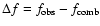 |
| (s) | (mma) | (Hz) |
(Hz) |
(Hz) |
||
| 8096.02 | 3.518 | 123.52 | 15- 17 | 123.49 | 0.02 | |
| '' | '' | '' | '' |  |
123.38 | 0.14 |
| '' | '' | '' | '' | 17- 19 | 123.61 | -0.09 |
| 6078.39 | 2.169 | 164.52 | 15- 18 | 164.68 | -0.17 | |
| 6032.23 | 1.340 | 165.78 | 15-18f | 165.65 | 0.12 | |
| 5669.64 | 1.152 | 176.38 | ||||
| 1765.91 | 1.738 | 566.28 | 11- 17 | 566.27 | 0.01 | |
| 1539.52 | 1.009 | 649.56 | ||||
| 1450.02 | 2.140 | 689.64 | 11- 19 | 689.88 | -0.23 | |
| 1369.15 | 3.584 | 730.38 | 10- 17 | 730.40 | -0.02 | |
| 1289.88 | 0.881 | 775.26 | 90- 16 | 775.23 | 0.03 | |
| 1166.29 | 2.876 | 857.42 | 90- 17 | 857.42 | 0.00 | |
| 1064.99 | 3.162 | 938.97 | 8+- 15 | 939.02 | -0.04 | |
| 1056.84 | 1.121 | 946.22 | 8-- 15 | 946.17 | 0.04 | |
| 959.37 | 0.977 | 1042.35 | 90- 20 | 1043.07 | -0.72 | |
| 941.28 | 0.895 | 1062.39 | 8+- 17 | 1062.51 | -0.12 | |
| 900.84 | 1.401 | 1110.07 |
 |
1110.03 | 0.05 | |
| 20 | 900.13 | 2.029 | 1110.95 |
 |
1110.86 | 0.10 |
| 853.57 | 1.816 | 1171.55 | ||||
| 19 | 852.52 | 2.740 | 1172.99 | |||
 |
798.80 | 3.662 | 1251.87 |
 Hz Hz |
||
 |
797.63 | 5.858 | 1253.72 | |||
 |
797.17 | 5.330 | 1254.44 | |||
|
796.55 | 14.870 | 1255.41 | not 1235 Hz |
||
 |
796.02 | 7.508 | 1256.24 | |||
 |
795.73 | 1.280 | 1256.71 | |||
 |
795.36 | 3.277 | 1257.29 |
 Hz Hz |
||
 |
794.75 | 2.433 | 1258.26 | 18
 Hz Hz |
||
 |
793.88 | 1.568 | 1259.63 | 18
 Hz Hz |
||
| 782.89 | 1.546 | 1277.31 | ||||
| 781.92 | 1.350 | 1278.90 | ||||
| 17a | 771.68 | 1.221 | 1295.87 | |||
| 17 | 771.25 | 27.940 | 1296.60 | |||
| 17b | 770.80 | 1.604 | 1297.36 | |||
| 759.39 | 1.205 | 1316.85 | ||||
| 725.70 | 1.286 | 1377.98 | 7-17b | 1378.13 | -0.15 | |
| 16 | 725.27 | 5.157 | 1378.80 |
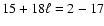 |
1378.76 | 0.03 |
| 724.78 | 2.688 | 1379.73 | ||||
| 709.03 | 1.185 | 1410.38 | ||||
| 15+ | 704.18 | 29.720 | 1420.10 | |||
| 15a | 702.44 | 3.003 | 1423.62 | 15+3.52 Hz |
||
| 690.99 | 1.123 | 1447.21 | ||||
| 12 | 575.94 | 1.030 | 1736.29 | |||
| 11 | 536.81 | 0.830 | 1862.87 | |||
| 10 | 493.34 | 1.280 | 2027.00 | |||
| 9+ | 465.01 | 2.980 | 2150.49 | 9+3.54 Hz |
||
| 90 | 464.25 | 5.300 | 2154.03 | |||
| 9- | 463.45 | 2.510 | 2157.72 | 9-3.69 Hz |
||
| 447.30 | 0.968 | 2235.66 | 17+8+-15+ | 2235.61 | 0.08 | |
| 439.08 | 0.989 | 2277.50 | 15++9-17 | 2277.53 | -0.02 |
| k | Period | Amp. |
|
Combination |
|
|
| (s) | (mma) | (Hz) |
(Hz) |
(Hz) |
||
| 8+ | 423.89 | 5.640 | 2359.11 | |||
| 8- | 422.61 | 5.620 | 2366.27 |
 Hz Hz |
||
| 415.34 | 1.030 | 2407.65 | 20+ 17 | 2407.56 | 0.09 | |
| 405.15 | 1.388 | 2468.21 | 19+ 17a | 2468.86 | -0.65 | |
| 404.89 | 1.091 | 2469.83 | 19+ 17 | 2469.60 | 0.24 | |
| 398.57 | 1.249 | 2508.96 |
 |
2508.89 | 0.08 | |
| 398.29 | 1.423 | 2510.74 |
 |
2510.83 | -0.09 | |
| 398.15 | 2.052 | 2511.65 |
 |
2512.49 | -0.84 | |
| 392.10 | 1.670 | 2550.34 |
 |
2550.32 | 0.01 | |
| 392.00 | 1.737 | 2551.04 |
 |
2551.08 | -0.04 | |
| '' | '' | '' | '' |
 |
2551.05 | 0.00 |
| '' | '' | '' | '' |
 |
2551.28 | -0.24 |
| 391.85 | 3.703 | 2552.02 | 19+ 16 | 2551.79 | 0.23 | |
| '' | '' | '' | '' |
 |
2551.80 | 0.22 |
| '' | '' | '' | '' |
 |
2552.02 | 0.00 |
| '' | '' | '' | '' |
 |
2552.11 | -0.09 |
| 391.72 | 2.007 | 2552.83 |
 |
2552.77 | 0.05 | |
| '' | '' | '' | '' |
 |
2552.85 | -0.02 |
| '' | '' | '' | '' |
 |
2552.58 | 0.24 |
| '' | '' | '' | '' |
 |
2553.32 | -0.49 |
| '' | '' | '' | '' |
 |
2553.16 | -0.34 |
| 391.56 | 1.159 | 2553.88 |
 |
2553.60 | 0.28 | |
| '' | '' | '' | '' |
 |
2554.07 | -0.19 |
| '' | '' | '' | '' |
|
2553.90 | -0.02 |
| '' | '' | '' | '' |
 |
2554.65 | -0.77 |
| '' | '' | '' | '' |
 |
2554.13 | -0.25 |
| 385.62 | 7.759 | 2593.21 |
|
2593.21 | 0.00 | |
| 379.48 | 0.928 | 2635.16 |
 |
2634.21 | 0.95 | |
| '' | '' | '' | '' |
 |
2635.04 | 0.12 |
| '' | '' | '' | '' |
 |
2635.51 | -0.35 |
| 374.24 | 1.576 | 2672.05 | 19a+ 15 | 2671.97 | 0.08 | |
| 374.00 | 3.459 | 2673.81 |
 |
2673.82 | -0.01 | |
| 373.89 | 3.498 | 2674.56 |
 |
2674.54 | 0.02 | |
| '' | '' | '' | '' | 17a+ 16 | 2674.67 | -0.10 |
| 7 | 373.76 | 8.430 | 2675.49 | 17+ 16 | 2675.40 | 0.09 |
| 373.64 | 4.254 | 2676.40 |
 |
2676.34 | 0.06 | |
| '' | '' | '' | '' |
 |
2676.81 | -0.41 |
| '' | '' | '' | '' | 17b+ 16 | 2676.15 | 0.25 |
| 373.50 | 1.827 | 2677.38 |
 |
2677.34 | 0.04 | |
| '' | '' | '' | '' |
 |
2677.39 | -0.01 |
| 373.38 | 1.193 | 2678.22 |
|
2678.06 | 0.16 | |
| '' | '' | '' | '' |
 |
2678.35 | -0.13 |
| 373.16 | 0.870 | 2679.78 |
 |
2679.03 | 0.75 | |
| '' | '' | '' | '' |
 |
2679.86 | -0.08 |
| '' | '' | '' | '' |
 |
2680.33 | -0.55 |
| 372.83 | 0.932 | 2682.18 |
 |
2681.87 | 0.30 | |
| 368.09 | 5.653 | 2716.71 | 17+ 15 | 2716.70 | 0.01 | |
| 367.62 | 0.840 | 2720.17 | 17a+ 15a | 2719.49 | 0.68 | |
| '' | '' | '' | '' | 17+ 15a | 2720.22 | -0.05 |
| 357.29 | 1.731 | 2798.86 | 16+ 15 | 2798.89 | -0.03 | |
| 357.16 | 0.877 | 2799.88 | 16a+ 15 | 2799.83 | 0.05 |
| k | Period | Amp. |
|
Combination |
|
|
| (s) | (mma) | (Hz) |
(Hz) |
(Hz) |
||
| 352.09 | 4.260 | 2840.20 |
|
2840.19 | 0.01 | |
| 351.66 | 1.054 | 2843.68 | 15+ 15a | 2843.71 | -0.03 | |
| 293.60 | 0.992 | 3405.99 |
 |
3405.91 | 0.09 | |
| '' | '' | '' | '' |
 |
3406.74 | -0.74 |
| '' | '' | '' | '' | 16+ 10 | 3405.79 | 0.20 |
| 289.80 | 1.929 | 3450.64 | 17a+ 90 | 3449.90 | 0.74 | |
| '' | '' | '' | '' | 17+ 90 | 3450.63 | 0.01 |
| '' | '' | '' | '' | 15a+ 10 | 3450.62 | 0.02 |
| 279.78 | 1.393 | 3574.19 | 15+90 | 3574.12 | 0.07 | |
| '' | '' | '' | '' | 15a+9+ | 3574.11 | 0.08 |
| 279.50 | 1.118 | 3577.77 | 15+9- | 3577.82 | -0.05 | |
| '' | '' | '' | '' | 15a+90 | 3577.65 | 0.13 |
| 276.66 | 1.550 | 3614.54 |
 |
3614.53 | 0.01 | |
| 276.10 | 0.960 | 3621.85 |
 |
3621.68 | 0.17 | |
| 273.54 | 1.284 | 3655.77 | 17+ 8+ | 3655.72 | 0.05 | |
| 273.01 | 1.382 | 3662.91 | 17+8- | 3662.87 | 0.03 | |
| 264.60 | 1.523 | 3779.25 | 15+8+ | 3779.21 | 0.04 | |
| 264.11 | 3.649 | 3786.37 | 15+8- | 3786.37 | 0.00 | |
| '' | '' | '' | '' | 20+7 | 3786.44 | -0.07 |
| 259.84 | 1.569 | 3848.54 | 19+ 7 | 3848.48 | 0.06 | |
| 259.78 | 0.885 | 3849.36 |
 |
3848.61 | 0.75 | |
| 257.08 | 3.204 | 3889.80 |
 |
3889.81 | -0.02 | |
| 254.51 | 1.744 | 3929.10 |
 |
3929.21 | -0.11 | |
| '' | '' | '' | '' |
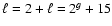 |
3929.22 | -0.12 |
| '' | '' | '' | '' |
 |
3929.06 | 0.04 |
| 254.42 | 1.140 | 3930.46 |
 |
3929.93 | 0.53 | |
| '' | '' | '' | '' |
 |
3929.84 | 0.62 |
| '' | '' | '' | '' |
 |
3930.83 | -0.37 |
| 254.34 | 2.986 | 3931.77 |
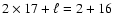 |
3931.76 | 0.00 | |
| 251.82 | 1.015 | 3971.17 |
 |
3970.41 | 0.75 | |
| '' | '' | '' | '' |
 |
3970.44 | 0.73 |
| '' | '' | '' | '' |
 |
3971.14 | 0.03 |
| 251.76 | 2.242 | 3972.03 |
 |
3972.12 | -0.08 | |
| '' | '' | '' | '' |
 |
3972.01 | 0.03 |
| '' | '' | '' | '' | 17+ 7 | 3972.09 | -0.06 |
| 251.70 | 1.395 | 3972.93 |
 |
3973.01 | -0.07 | |
| '' | '' | '' | '' | 15+ 17a+16 | 3972.92 | 0.01 |
| 249.17 | 1.822 | 4013.33 |
 |
4013.31 | 0.02 | |
| 246.59 | 0.948 | 4055.26 |
 |
4055.26 | 0.00 | |
| 244.27 | 1.462 | 4093.91 |
|
4093.90 | 0.01 | |
| 244.22 | 1.576 | 4094.67 |
 |
4094.64 | 0.03 | |
| '' | '' | '' | '' | 17a+ 16+15 | 4094.73 | -0.06 |
| '' | '' | '' | '' |
 |
4094.66 | 0.02 |
| 244.16 | 3.487 | 4095.59 |
 |
4095.61 | -0.02 | |
| '' | '' | '' | '' | 17+ 16+15 | 4095.47 | 0.12 |
| '' | '' | '' | '' | 15+ 7 | 4095.58 | 0.01 |
| 244.11 | 1.722 | 4096.45 | 17+ 15+16a | 4096.48 | -0.03 | |
| '' | '' | '' | '' | 16+ 17a+16 | 4096.50 | -0.05 |
| 210.65 | 1.196 | 4747.23 |
 |
4747.24 | -0.01 | |
| 198.63 | 1.272 | 5034.61 |
 |
5034.64 | -0.03 | |
| 198.34 | 1.451 | 5041.82 |
 |
5041.95 | -0.14 |
| k | Period | Amp. |
|
Combination |
|
|
| (s) | (mma) | (Hz) |
(Hz) |
(Hz) |
||
| 196.74 | 0.992 | 5082.98 | 17+ 15+8- | 5082.97 | 0.00 | |
| 192.81 | 1.319 | 5186.46 |
 |
5186.42 | 0.04 | |
| '' | '' | '' | '' |
 |
5185.88 | 0.59 |
| '' | '' | '' | '' |
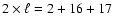 |
5187.18 | -0.72 |
| 192.07 | 1.641 | 5206.47 |
 |
5206.47 | 0.00 | |
| 189.81 | 1.171 | 5268.55 |
 |
5267.77 | 0.78 | |
| '' | '' | '' | '' |
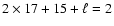 |
5268.64 | -0.09 |
| 186.94 | 1.153 | 5349.20 |
|
5349.33 | -0.12 | |
| 186.85 | 2.004 | 5351.84 |
 |
5350.97 | 0.87 | |
| '' | '' | '' | '' |
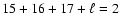 |
5351.86 | -0.02 |
| 185.46 | 0.842 | 5392.02 |
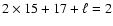 |
5392.13 | -0.11 | |
| 181.30 | 0.609 | 5515.65 |
 |
5515.69 | -0.04 | |
| 165.46 | 0.533 | 6043.85 |
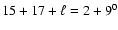 |
6043.83 | 0.01 | |
| 162.72 | 0.584 | 6145.42 | 8++8-+ 15 | 6145.48 | -0.07 | |
| 158.96 | 0.554 | 6290.83 |
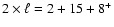 |
6290.02 | 0.81 | |
| '' | '' | '' | '' |
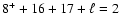 |
6290.88 | -0.05 |
| 154.76 | 0.958 | 6461.78 |
 |
6462.08 | -0.30 | |
| '' | '' | '' | '' |
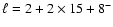 |
6461.88 | -0.10 |
| '' | '' | '' | '' | 16+15+17+8- | 6461.77 | 0.01 |
| 147.67 | 0.761 | 6771.90 |
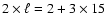 |
6771.06 | 0.84 | |
| '' | '' | '' | '' |
 |
6771.94 | -0.04 |
| 129.69 | 0.438 | 7710.99 |
 |
7710.93 | 0.06 | |
| '' | '' | '' | '' |
 |
7710.95 | 0.04 |
| '' | '' | '' | '' |
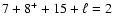 |
7710.10 | 0.89 |
| 129.61 | 0.410 | 7715.61 |
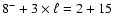 |
7715.47 | 0.14 | |
| 126.87 | 0.502 | 7881.92 |
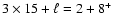 |
7881.87 | 0.05 | |
| 125.87 | 0.410 | 7944.98 |
 |
7944.07 | 0.91 | |
| 124.56 | 0.401 | 8028.10 |
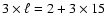 |
8027.31 | 0.78 | |
| '' | '' | '' | '' |
 |
8027.31 | 0.78 |