![[*]](/icons/foot_motif.gif)
A&A 401, 215-226 (2003)
DOI: 10.1051/0004-6361:20030103
E. Rollinde 1 - P. Boissé 1,2 - S. R. Federman 3 - K. Pan 3
1 - Institut d'Astrophysique de Paris, 98 bis boulevard
d'Arago, 75014 Paris, France
2 -
Radioastronomie, UA CNRS 336, École Normale Supérieure, 24
rue Lhomond, 75231 Paris Cedex 05, France
3 -
Department of Physics and Astronomy, University of Toledo,
Toledo, OH 43606, USA
Received 22 November 2002 / Accepted 15 January 2003
Abstract
We present spectroscopic observations of the runaway reddened star
HD 34078 acquired during the last three years at Observatoire de Haute
Provence and McDonald Observatory as well as other spectra obtained
since 1990. The drift of the line of sight through the foreground
cloud due to the large transverse velocity of HD 34078 allows us to
probe the spatial distribution of CH, CH+, CN and DIBs carriers
at scales ranging from about 1 AU up to 150 AU. In particular, time
variations in the equivalent width of absorption lines are examined. A
few past and recent high resolution observations of CH and CH+ absorption
are used to search for line profile variations and to convert equivalent
widths into column densities.
The data set reveals a 20% increase in CH column density over the past 10 years
with no corresponding variation in the column density of CH+
or in the strengths of the 5780 and 5797 Å DIBs. CN observations indicate that its excitation temperature
has significantly increased from <3.1 K in
1993 to 3.6  0.17 K in 1998 while the CN column shows only a
modest rise of
0.17 K in 1998 while the CN column shows only a
modest rise of 
 %. The data also strongly
suggest the existence of weak correlated variations in CH and
CH+ columns over periods of 6-12 months (or 10 AU).
%. The data also strongly
suggest the existence of weak correlated variations in CH and
CH+ columns over periods of 6-12 months (or 10 AU).
These results are discussed in relation to CH+ production mechanisms. A dense newly intervening clump is considered in order to explain the long-term increase in the column density of CH, but such a scenario does not account for all observational constraints. Instead, the observations are best described by CH+ production in a photodissociation region, like that suggested for the Pleiades and IC 348.
Key words: ISM: molecules - stars: individual: HD 34078 - ISM: structure
While the existence of AU-scale structure is relatively well established in atomic gas (see e.g., Dieter et al. 1976; Diamond et al. 1989; Frail et al. 1994; Lauroesch et al. 1999; Faison & Goss 2001; Welty & Fitzpatrick 2001), the reality of such tiny fluctuations within molecular gas is still questionable. Indeed, only minor species can be easily observed towards molecular clouds and their spatial distribution might not reflect that of 2 if "chemical structure'' were present. H2CO, HCO+ and OH apparently display column density fluctuations reaching 5 to 15% along lines of sight separated by about 10 AU (Marscher et al. 1993; Moore & Marscher 1995; Liszt & Lucas 2000), while dust grains appear to be more smoothly distributed (Thoraval et al. 1996). At larger scales (about 10 000 AU), Pan et al. (2001) find significant differences in CN, CH and CH+ absorption lines.
If marked enough, small scale structure within molecular gas might notably affect its time evolution, fragmentation and then utimately, star formation. It is therefore important to characterise the properties of such media, identify the parameters displaying fluctuations and quantify their amplitude and scalelength. To this aim, we have selected a bright O9.5 runaway star, HD 34078 (AE Aur), seen through a translucent cloud with E(B-V) = 0.52 (Diplas & Savage 1994). Thanks to its large transverse velocity, about 100 km s-1 for an assumed distance of 530 pc, the comparison of spectra taken at one year intervals provides a measurement of column density variations at a scale of 17 AU (assuming a cloud distance of 400 pc: Brown et al. 1995). To complement ongoing FUSE observations designed to investigate in a direct way small scale variations of the 2 column density (and then study density structure within molecular gas), we have undertaken repeated ground-based observations of CH, CH+and CN absorption lines and diffuse interstellar bands (DIBs) towards HD 34078.
These optical spectra complement the FUSE UV data in several important respects:
- since CH is seen to correlate well with H2 over large scales (e.g., Federman 1982), it should be a good indicator of cloud structure. On the other hand, the abundance of CH+ is largely independent of H2 column density, N(2); the large abundance of this species is still poorly understood and hot pockets of gas (e.g., shocks or vortices as proposed by Falgarone & Puget 1995) could be the formation site. Then, CH+ observations may reveal the structure of these presumably very small regions where energy is actively dissipated. Finally, CN depends nonlinearly on H2 and is thus an indicator of gas density (Federman et al. 1994).
- Given the brightness of HD 34078, high S/N spectra can be obtained easily to search for very small fluctuations which would be difficult to detect in FUSE spectra.
- Spectral data in the visible range can be acquired much more easily than in the far UV, and therefore, it is possible to control the time (i.e., spatial) sampling and to accumulate a larger number of spectra. Moreover, several visible observations of HD 34078 have been performed in the past 10 years, thus giving access to large scale variations. A broad range of scales can then be explored through visible observations.
- High resolution observations providing information on the velocity distribution and its possible variations are feasible in the visible, but not in the FUSE range.
In this paper, we present observations made specifically for this project together with a comparison with older data. The whole set of spectra is used to search for time variable absorption and infer the structure implied for CH, CH+, CN and diffuse bands carriers. Section 2 presents the observations and the methods used to analyse the data. In Sect. 3, we give the results obtained for CH, CH+, CN and some selected DIBs. Since most observations have been obtained at low resolution, we mainly consider equivalent width variations. High resolution observations of CH and CH+ are then used to infer velocity distributions and translate variations in equivalent width into column density variations for these two species. The implication of our results for the existence of AU-scale structure in the distribution of these tracers is discussed in Sect. 4.
The analysis of Cycle 1 and Cycle 2 FUSE data will be presented in a separate paper (Boissé et al. 2002; see also Boissé et al. 2001 and Le Petit et al. 2001 for a preliminary report). Our ultimate goal is to correlate the variations seen for 2 and those of other tracers like CH, CH+ and CN in order to improve the description of the structure.
Spectra acquired at various observatories have been used for this
study. In the following, these are named according to the observer
and year of data taking. We obtained specifically for this
project a series of nine spectra at the Observatoire de Haute
Provence (OHP) (R99-02). In addition, high
resolution spectra were recently recorded at McDonald
Observatory (F02). The motivation was twofold. First, as we
are interested in column density variations, we need to translate
the observed changes in
equivalent width,
 ,
into changes in N (i.e., determine N and
dN/d
). Since the lines are not optically thin,
the conversion requires a good
knowledge of the velocity distribution. This point is especially important
for CH
,
into changes in N (i.e., determine N and
dN/d
). Since the lines are not optically thin,
the conversion requires a good
knowledge of the velocity distribution. This point is especially important
for CH  4300 because this feature is in fact a blend of two transitions and
the analysis can be notably affected by the splitting if the b parameter is
less than 2 km s-1 (Lien 1984). Second, only high resolution
observations allow us to determine whether or not line shapes have
changed, and they possibly reveal profile variations not associated with
equivalent width changes.
4300 because this feature is in fact a blend of two transitions and
the analysis can be notably affected by the splitting if the b parameter is
less than 2 km s-1 (Lien 1984). Second, only high resolution
observations allow us to determine whether or not line shapes have
changed, and they possibly reveal profile variations not associated with
equivalent width changes.
HD 34078 was observed several times since 1991 by one of us (S. Federman at McDonald Observatory: F93a, F93b). Spectra of HD 34078 were also acquired by M. Allen (KPNO: A91), P. Jenniskens and F.X. Désert (at OHP: J91), J. Krelowski, G. A. Galazutdinov & F. A. Musaev (at Terskol Observatory: K97a, K97b) and G. Herbig (at the Keck telescope: H98) who kindly provided their data, so that we could analyze them in the same way as our own and search for variations by direct comparison of the spectra. Note that in his study, Herbig (1999) searched for changes in line position with respect to the spectrum obtained by Adams (1949) and thus investigated the velocity structure of the foreground gas; no significant variation was observed.
Table 1 summarises all these observations
and gives the date, resolution and signal-to-noise ratio.
The transitions (from CH, CH+, CN or DIBs) contained in the
observed wavelength range are indicated. These data altogether
provide a sort of 1D cut through the
cloud, the sampling of which is illustrated by Fig. 1.
Below, we give some details concerning the observations of HD 34078
used in this paper and not previously published.
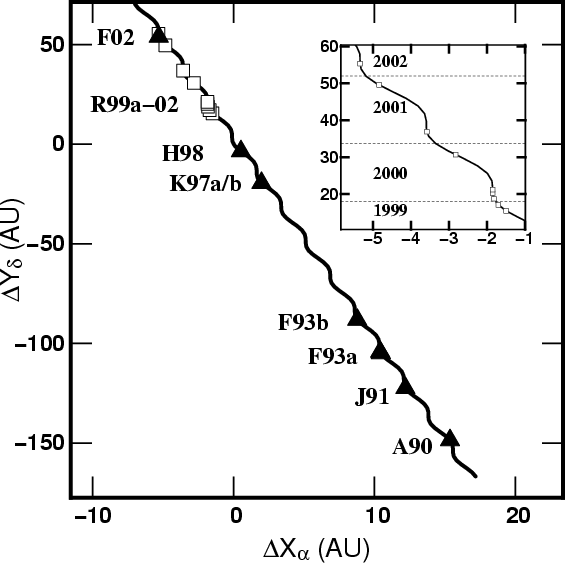 |
Figure 1: The impact point of the line of sight towards HD 34078 onto the foreground cloud versus time. The motions of the earth, the sun and HD 34078 have been taken into account. Markers specify the position of the star for each epoch at which spectra were obtained (cf. Table 1). Note that the X and Y scales are not identical. The insert focuses on the recent observations made for this project (R99a-R02, F02) that probe the smallest scales. |
| Open with DEXTER | |
The spectra were obtained using the fiber-fed echelle spectrograph Elodie (Baranne et al. 1996) mounted on the 1.93 m telescope (R99-02). The resolution is about 32 000. Initially, a spectrum was taken each month in order to probe very small scales. Since this series did not reveal significant variations, only two spectra were taken during the next winters. The range covered is 3906 Å-6811 Å and includes lines from CH (4300 Å), CH+ (3957 and 4232 Å) and DIBs. For all spectra, the integration time is about 1 hour, split in 2 to 3 successive exposures of 30 or 20 minutes each in order to check the stability of the instrument and robustness of our analysis on independent spectra. The corresponding S/N ratio is typically 150 per resolution element. Some examples of CH and CH+ lines detected in OHP spectra are shown in Fig. 2. The spectra have been extracted and wavelength calibrated using the automatic on-line data reduction program attached to the instrument (see Baranne et al. 1996 for details); the wavelength calibration is based on thorium lamp spectra.
![\begin{figure}
\par\includegraphics[angle=-90,width=8.8cm,clip]{H4125F2.ps}\end{figure}](/articles/aa/full/2003/13/aah4125/img20.gif) |
Figure 2: The CH+ lines at 3957 and 4232 Å a,b) and CH line at 4300 Å c) in the OHP spectrum recorded in December 1999. The raw spectrum has just been divided by a constant to scale the mean intensity to 1. Note the broad Fe II stellar feature blended with the 4232 Å line. The S/N is 230 per 0.03 Å pixel around 4300 Å. |
| Open with DEXTER | |
Three data sets were acquired since the last published results (Federman
et al. 1994) by one of us (S.R.F.). Two of the new sets utilized the
6 foot camera and the 2dcoude spectrograph on the 2.7 m telescope. A
standard observing strategy, with bias frames, flat fields, and a Th-Ar
comparison spectrum, was employed (see Knauth et al. 2001 for details of
similar measurements). Individual orders containing CH+ 4232
and CH 4300 were imaged with the 6 foot camera in 1993.
The nominal resolution was 1.5 km s-1. In 2002, spectra
of CN, CH and CH+ were acquired at a single setting
of the 2dcoude spectrograph. Here, the resolution was about 1.9 km s-1.
Also in 1993, the Sandiford echelle spectrograph on the 2.1 m
telescope (McCarthy et al. 1993) was used for measurements on various
species in a similar fashion. One setting, centered on 3990 Å, provided
data on CN, CH
 3878,3886,3890 and CH+ 3957. The second setup at 4300 Å measured absorption from CH+ 4232 and CH 4300.
The widths of Th-Ar lines indicated a resolution of
3878,3886,3890 and CH+ 3957. The second setup at 4300 Å measured absorption from CH+ 4232 and CH 4300.
The widths of Th-Ar lines indicated a resolution of  7.5 km s-1for these spectra. All data were reduced and analyzed with the IRAF
package.
7.5 km s-1for these spectra. All data were reduced and analyzed with the IRAF
package.
In most of the available HD 34078 spectra, the profiles are
not resolved. We shall then look primarily for variations in
.
We have been particularly careful in placing the
continuum in a consistent manner for all epochs and also in
estimating properly the uncertainty in
.
For some species, several lines are observed, e.g., at 3957 Å and
4232 Å for CH+. Similarly, a few observations of the CH lines at
3878, 3886 and 3890 Å are available for comparison with the
4300 Å results. This redundancy is useful as a means
to assess the robustness of our analysis and validate
the error estimates.
We have developed an automatic procedure based on the MIDAS
package alice in order to fit
the continuum in a user-independent way and to measure
values.
Several "clean'' windows (generally two, located on both sides of the line)
are selected; a polynomial fit with a degree ranging from
1 to 3 and depending on the shape of the spectrum is then performed.
This provides a good estimate of the continuum in the interval covered
by the absorption feature (see Fig. 2).
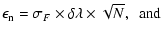
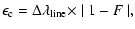
One  uncertainties in
can be estimated as the quadratic sum of
uncertainties in
can be estimated as the quadratic sum of
 and
and
 ,
the pixel-to-pixel noise and
the uncertainty in the continuum level in the normalised spectrum
respectively. The latter are given by
,
the pixel-to-pixel noise and
the uncertainty in the continuum level in the normalised spectrum
respectively. The latter are given by
 is the total width of the absorption
feature,
is the total width of the absorption
feature,
 is the pixel size and N the number of
pixels covered by the line (
is the pixel size and N the number of
pixels covered by the line (
 ).
The average (Eq. (2)) and the rms (Eq. (1)) of the normalised
flux, F,
are computed along the windows adjacent to the line.
The robustness of the fitting procedure and the estimates for uncertainty
have also been checked against synthetic spectra including absorption
lines with known
,
a signal-to-noise ratio comparable to that in
our data, and various continuum shapes.
).
The average (Eq. (2)) and the rms (Eq. (1)) of the normalised
flux, F,
are computed along the windows adjacent to the line.
The robustness of the fitting procedure and the estimates for uncertainty
have also been checked against synthetic spectra including absorption
lines with known
,
a signal-to-noise ratio comparable to that in
our data, and various continuum shapes.
Some transitions present difficulties. CH+4232 is blended
with a shallow stellar feature (from Fe II, see Fig. 2b)
and the above procedure cannnot be applied. Similar problems are
encountered with the R(0) CN line at 3876 Å. In such cases, the
is
measured using the command integrate/line
from MIDAS (an order 2-3 is chosen for the polynomial used to fit the
spectrum immediately adjacent to the line) and the uncertainties are
determined from successive measurements.
The high resolution profiles have been fitted using VPFIT (Carswell et al. 1987). No attempt was made to look for velocity shifts (the question addressed by Herbig 1999).
We now present the results obtained for CH, CH+, CN and some selected DIBs. For CH and CH+, we first discuss the homogeneous set of data obtained after November 1999 which probe time scales ranging from one month to 2.5 years (corresponding to 1.5-40 AU). The whole set of available observations made in the past 11 years are presented next. Finally, we discuss the high resolution data and their implications for velocity structure and column density variations.
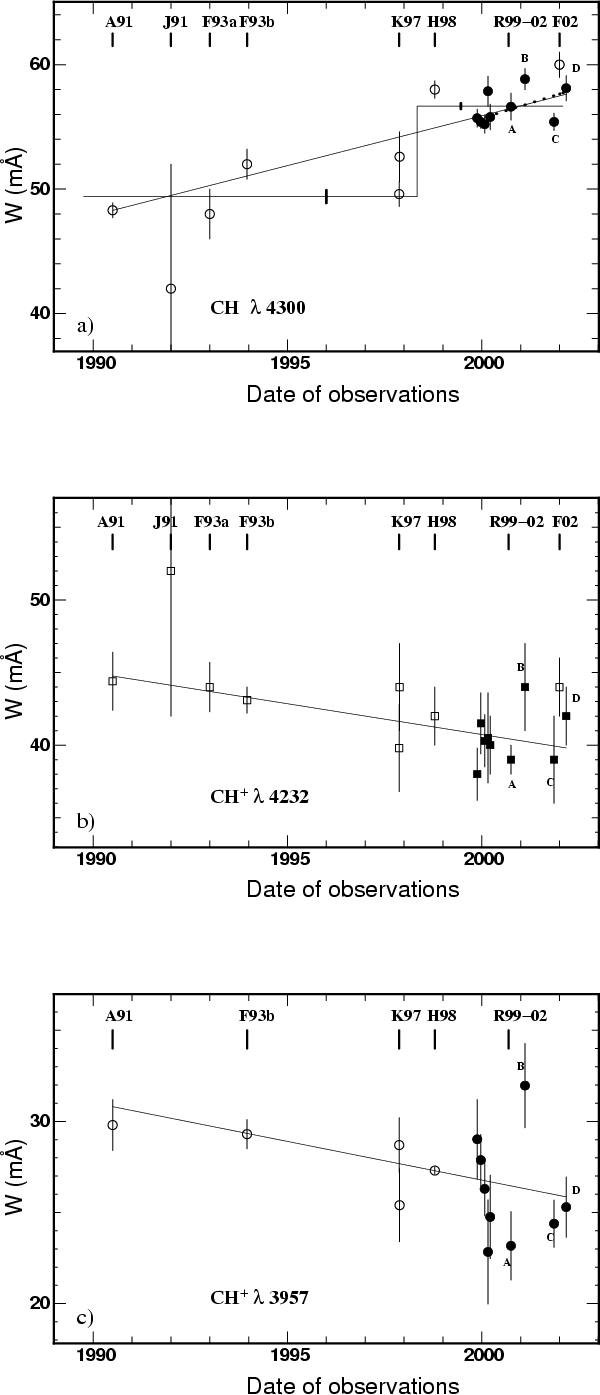 |
Figure 3:
The equivalent width of CH and CH+ lines versus time.
Top panel: CH 4300; middle panel: CH
 4232,
bottom panel: CH
3957. Solid markers show recent
closely-spaced OHP observations. A linear
fit is performed on the whole data set
(solid lines). For recent OHP/F02 data on CH 4300, a separate
linear fit is given (dotted line on top panel). A fit by a step
function is also shown for the CH data, with errors for
the upper and lower values indicated by the small vertical bars.
Note the similarity between CH and CH+ variations from October
2000 to March 2002 (points labelled A, B, C and D), suggesting the
reality of correlated erratic fluctuations. Such fluctuations are
also suggested by the McDonald data of F02. 4232,
bottom panel: CH
3957. Solid markers show recent
closely-spaced OHP observations. A linear
fit is performed on the whole data set
(solid lines). For recent OHP/F02 data on CH 4300, a separate
linear fit is given (dotted line on top panel). A fit by a step
function is also shown for the CH data, with errors for
the upper and lower values indicated by the small vertical bars.
Note the similarity between CH and CH+ variations from October
2000 to March 2002 (points labelled A, B, C and D), suggesting the
reality of correlated erratic fluctuations. Such fluctuations are
also suggested by the McDonald data of F02. |
| Open with DEXTER | |
Figure 3a displays the evolution of the
equivalent width as a function of time for the 4300 Å line.
The variation since 1999 is fitted with a linear
form
 where
where
 is the median of observing times (December 2000).
The data points are weighted according to signal-to-noise ratio in all
fits performed in this paper.
The contours of the reduced
is the median of observing times (December 2000).
The data points are weighted according to signal-to-noise ratio in all
fits performed in this paper.
The contours of the reduced
 are plotted in
Fig. 4a (dashed lines) for the linear case.
A constant value is rejected only at the 1
level.
The best fit,
W0 = 56.6 mÅ and
are plotted in
Fig. 4a (dashed lines) for the linear case.
A constant value is rejected only at the 1
level.
The best fit,
W0 = 56.6 mÅ and
 mÅ yr-1
corresponds to
mÅ yr-1
corresponds to
 2.2 mÅ between November 1999 and February 2002.
It is overplotted in Fig. 3a (dotted line).
Large variations at this scale are excluded since
2.2 mÅ between November 1999 and February 2002.
It is overplotted in Fig. 3a (dotted line).
Large variations at this scale are excluded since
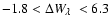 mÅ at
the 3
level.
mÅ at
the 3
level.
The linear fit is not fully satisfactory since residuals correspond to
 .
This suggests that small additional erratic variations in
may be
present. The observed amplitude is 1.50 mÅ (rms) about the linear fit
(and 1.56 mÅ about a constant value; the maximum difference is 4.8 mÅ). A Kolmogorov-Smirnov test (Miller 1956)
shows that these values are too small compared to
observational errors to indicate with certainty that we are detecting
fluctuations in
(CH). However, the reality of the latter
is supported by the fact that similar
variations are observed for CH+ lines (see below).
.
This suggests that small additional erratic variations in
may be
present. The observed amplitude is 1.50 mÅ (rms) about the linear fit
(and 1.56 mÅ about a constant value; the maximum difference is 4.8 mÅ). A Kolmogorov-Smirnov test (Miller 1956)
shows that these values are too small compared to
observational errors to indicate with certainty that we are detecting
fluctuations in
(CH). However, the reality of the latter
is supported by the fact that similar
variations are observed for CH+ lines (see below).
Results for the full set of observations are given
in Table A.2 and shown also in Fig. 3a.
A significant increase is apparent. Fitting again with a linear variation
(with
= April 1996)
gives a total increase of
 = 8 mÅ or 16% between 1992 and
November 2001, consistent with the slope derived from the small scale
data alone (see Fig. 4). The 3
limit is
= 8 mÅ or 16% between 1992 and
November 2001, consistent with the slope derived from the small scale
data alone (see Fig. 4). The 3
limit is
 mÅ.
However, the fit is even less satisfactory than for the recent
data alone since the minimum
mÅ.
However, the fit is even less satisfactory than for the recent
data alone since the minimum  is larger than
  .
The assumption of a linear increase is somewhat arbitrary and visual
inspection of Fig. 3 suggests that a step function might
also provide an acceptable fit. The minimum
is not
significantly
lowered,
.
The assumption of a linear increase is somewhat arbitrary and visual
inspection of Fig. 3 suggests that a step function might
also provide an acceptable fit. The minimum
is not
significantly
lowered,  .
The date at which the step
occurs is well constrained by K97 and H98 measurements.
The amplitude (
.
The date at which the step
occurs is well constrained by K97 and H98 measurements.
The amplitude (
 mÅ) is similar to the total
increase inferred from the linear fit. To assess the reality of an
increase in
(4300) regardless of any assumption on its form, we
performed a Pearson test to investigate the correlation between
and time. An uncorrelated evolution of CH 4300 with time is
rejected at the 4
level.
mÅ) is similar to the total
increase inferred from the linear fit. To assess the reality of an
increase in
(4300) regardless of any assumption on its form, we
performed a Pearson test to investigate the correlation between
and time. An uncorrelated evolution of CH 4300 with time is
rejected at the 4
level.
![\begin{figure}
\par\includegraphics[width=8.8cm,clip]{H4125F4.ps} \end{figure}](/articles/aa/full/2003/13/aah4125/img42.gif) |
Figure 4:
Linear fit of
 for CH 4300 a) and
CH
4232 b) (
for CH 4300 a) and
CH
4232 b) (
 ).
Solid line:
linear fit to the whole set of data (with
= April 1996).
Dashed line: linear fit
to the recent data (
= December 2000). The best fits are shown in Fig. 3.
Contours represent the levels 1, 2 and 3 of the reduced
( ).
Solid line:
linear fit to the whole set of data (with
= April 1996).
Dashed line: linear fit
to the recent data (
= December 2000). The best fits are shown in Fig. 3.
Contours represent the levels 1, 2 and 3 of the reduced
(
 ). ). |
| Open with DEXTER | |
Other CH lines at 3886 and 3890 Å have been observed in 1990, 1993
and 1998. Their variation should be consistent with the increase seen
in CH 4300. Given the weakness of these lines and the S/N attained, we
find that even the strongest feature at 3886 Å does not bring useful additional constraints.
![\begin{figure}
\par\includegraphics[angle=-90,width=8.8cm,clip]{H4125F5.ps} \end{figure}](/articles/aa/full/2003/13/aah4125/img43.gif) |
Figure 5: High resolution observation (F02) of the CH line. Solid line: fit with VPFIT. Dotted lines: the three components of the fit. |
| Open with DEXTER | |
We first discuss the highest signal-to-noise ratio observation of CH 4300,
performed in 2002 at McDonald (F02). The profile was fitted
using VPFIT, taking into account the doublet structure of the
CH ground level (Lien 1984). Both levels are assumed to have the
same column density.
Three components are needed: two narrow ones reproduce
the slightly asymmetric core of the absorption line and a much broader and
fainter one accounts for the wings which are present on both sides of
the core. The resulting fit and the three components are shown in
Fig. 5 and the parameters of the fit are given in Table 1.
There is no doubt about the reality of the broad component since it is
clearly seen in all spectra with the appropriate S/N ratio (A91,
F93a, F02) and for both the 3886 and 4300 Å lines
(H98). It is noteworthy that, although barely noticeable, it contains
no less than 28% of the total CH column density. As a consistency
check, we verified that
values measured for all CH lines
detected in Herbig's spectrum are consistent with the velocity
distribution derived from the F02 spectrum.
We note, however, that different 3-component solutions
for the latter are also acceptable (in particular, one in
which the strongest narrow component is the red one).
Nevertheless, since the optical depth remains moderate, this
degeneracy does not result in larger uncertainties on N(CH).
Moreover, very recent observations of the CO(2 - 1) emission
line at 1.3 mm towards HD 34078 performed at the 30 m IRAM telescope give a
velocity profile in excellent agreement with that shown in
Fig. 5 (E. Roueff & M. Gerin, private communication).
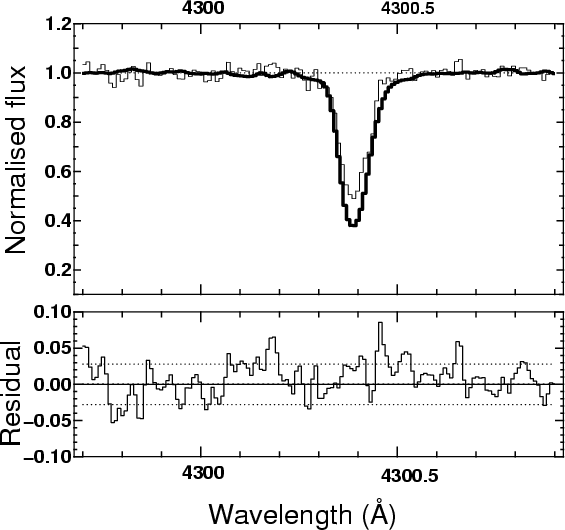 |
Figure 6:
Variation of the CH profile. Top panel:
F93a and F02 spectra are overplotted as thick and solid line
respectively. Bottom panel: the optical depth of F93a
is multiplied by 1.34 and the resulting spectrum is subtracted from F02. The residual (solid line) is compared to the 1
noise of
F93a (dotted line). |
| Open with DEXTER | |
| CH 4300 |
|||
 (km s-1)
 |
b (km s-1) |
 |
|
| 5.0 +0.5-0.5 | 2.0 -0.3+0.4 | 13.58 -0.06+0.06 | |
| 1993 | 6.2 +0.8-0.8 | 2.6 -0.6+1.5 | 13.20 -0.17+0.12 |
| 5.5 +1.3-2.0 | 5.9 -2.2+2.5 | 13.19 -0.17+0.12 | |
| 5.4 | 3.0 | 13.85 | |
| 5.6 -0.15+0.25 | 1.90 -0.09+0.08 | 13.68 -0.01+0.03 | |
| 2002 | 7.6 -0.15+0.25 | 2.40 -0.35+0.10 | 13.55 -0.02+0.04 |
| 7.0 -0.5+0.5 | 7.5 -0.7+0.8 | 13.16 -0.05+0.04 | |
| 6.4 | 3.0 | 13.98 | |
| CH
4232 |
|||
|
(km s-1) |
b (km s-1) |
|
|
| 7.5 -0.2+0.2 | 2.5 -0.2+0.2 | 13.58 -0.02+0.04 | |
| 1993 | 5.5 -0.2+0.2 | 2.7 -0.4+0.2 | 13.41 -0.03+0.04 |
| - | - | - | |
| 6.7 | 3.0 | 13.80 | |
| 7.0 -0.3+0.3 | 2.2 -0.3+0.2 | 13.55 -0.03+0.04 | |
| 2002 | 4.6 -0.3+0.3 | 2.3 -0.4+0.4 | 13.30 -0.05+0.05 |
| 7.8 -2.5+2.5 | 10 -3+4 | 13.00 -0.12+0.10 | |
| 6.2 | 3.0 | 13.82 | |
If we now fit independently the F93a profile, a slightly
different solution is obtained. The parameters are less accurate due
to the lower signal-to-noise ratio - see Table 1. The reality of
profile variations is difficult to assess from comparison of the F93a
and F02 parameters because the decomposition is not unique; we
give in Table 1 solutions with the lowest
but relatively
different solutions cannot be rejected. We then perform a more direct
comparison of profiles and find that multiplication of the F93a
optical depth by 1.34 provides an acceptable fit to the F02 profile
(Fig. 6; the slightly different spectral resolutions of the
two spectra have been taken into account). Therefore, we conclude that
the velocity distribution has remained roughly constant between 1993
and 2002 and that the observed line variation is essentially due to
an increase by the same factor of the column density for each of the
three components.
For the velocity profile obtained above, the ratio (
 )/(
)/(
 )
needed to
translate equivalent width variations into N variations
increases from
1.37 to 1.50
between
)
needed to
translate equivalent width variations into N variations
increases from
1.37 to 1.50
between
 and
and
 mÅ.
For a single component profile, these ratios equal 1.36 and 1.49
respectively, showing that in our optical depth regime, (
)/(
)
depends very weakly on the exact model chosen to fit the profiles.
This implies an increase of
mÅ.
For a single component profile, these ratios equal 1.36 and 1.49
respectively, showing that in our optical depth regime, (
)/(
)
depends very weakly on the exact model chosen to fit the profiles.
This implies an increase of
 % in either the step
function fit or in the linear fit (between 1992 and 2001).
In this latter case, bounds of 12%
% in either the step
function fit or in the linear fit (between 1992 and 2001).
In this latter case, bounds of 12%
 % are obtained
at the 3
level.
The higher (34%) increase in N(CH) between F93a and F02
corresponds to a 12 mÅ increase in
.
% are obtained
at the 3
level.
The higher (34%) increase in N(CH) between F93a and F02
corresponds to a 12 mÅ increase in
.
CH+ transitions are observed at 3957 Å and 4232 Å in the OHP data; some additional lines are detected at shorter wavelengths in G. Herbig's spectrum. The absorption line at 3957 Å is free of blending and the continuum can be accurately determined. Although the 4232 Å line is more difficult to measure, the S/N ratio in this region is higher and thus comparable accuracy is obtained for the two lines.
Both lines appear to be roughly constant in equivalent width
(Figs. 3b, c).
Erratic variations still seem to be present, although
the larger errors yield an acceptable value of
 for the best fit.
In particular, the pattern characterising the time
variations is similar for both CH+ lines
and for the CH 4300 transition.
This is especially clear for the last four OHP measurements, marked
with letters A to D in Fig. 3. We also note that the
F02 measurement, which has been made in completely independent
conditions, apparently displays this coherent CH/CH+ behavior.
Finally, it appears in Figs. 3a and 3b
that closely-spaced measurements (made during winter 1999-2000)
display relatively smaller scatter, indicating a possible cut-off
in the structure at scales below 1-2 AU.
for the best fit.
In particular, the pattern characterising the time
variations is similar for both CH+ lines
and for the CH 4300 transition.
This is especially clear for the last four OHP measurements, marked
with letters A to D in Fig. 3. We also note that the
F02 measurement, which has been made in completely independent
conditions, apparently displays this coherent CH/CH+ behavior.
Finally, it appears in Figs. 3a and 3b
that closely-spaced measurements (made during winter 1999-2000)
display relatively smaller scatter, indicating a possible cut-off
in the structure at scales below 1-2 AU.
Such a coherent variation could be an artefact due to
instrumental effects (e.g., if changes in the background
were not taken into account properly). We searched for any
dependence on the observing conditions (e.g., high or low sky
background) and found none. We also selected a few narrow stellar
lines near 4300 Å for which the continuum level is well
defined and measured their equivalent width; no significant variations of the kind
observed for CH or CH+ are observed. Finally, we checked that
the depth of the stellar H absorption is stable as it should
be in the absence of uncontroled variations of the zero level.
absorption is stable as it should
be in the absence of uncontroled variations of the zero level.
We therefore strongly suspect that stochastic correlated
fluctuations of N(CH) and N(CH+) are present, although more
accurate measurements (especially for CH+) would be useful to
establish more firmly their reality and to characterise their properties.
Among measurements performed after November 1999, the rms fluctuation of
(4300) is 1.5 mÅ while that of
(4232)
is 1.8 mÅ (the corresponding fluctuations in N are discussed below).
Figure 4b shows the result of a linear fit to the whole set of data
for CH
4232. The minimum
is again close to 1.
Although the best fit is a slow decrease,
 mÅ yr-1,
a constant value,
mÅ yr-1,
a constant value,
 mÅ, cannot be rejected at the
1.5
level. We obtain the following 3
bounds:
mÅ, cannot be rejected at the
1.5
level. We obtain the following 3
bounds:
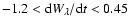 mÅ yr-1. Clearly, the variation observed for CH+ is quite different from that seen for CH.
Consistent results are obtained from CH
3957. The ratio of the two total CH+
equivalent widths,
(3957)/
(4232), is found to be constant
at a value of 0.65  ,
indicating that these
lines are nearly optically thin (ratio of 0.60). The best linear fit is also decreasing, although a constant
value for both
(3957) or
(4232) cannot be ruled out.
,
indicating that these
lines are nearly optically thin (ratio of 0.60). The best linear fit is also decreasing, although a constant
value for both
(3957) or
(4232) cannot be ruled out.
CH
4232 has been observed twice at high resolution (F93a
and F02). To fit these profiles, we first remove the blended
stellar line using a specific Gaussian profile.
The CH+ line in F02 is asymmetric, as was the CH 4300 one,
but now it is the blue wing which is more extended. A good fit is
obtained with 3 components; parameters are summarised in Table 1
and shown in Fig. 7.
![\begin{figure}
\par\includegraphics[angle=-90,width=8.8cm,clip]{H4125F7.ps} \end{figure}](/articles/aa/full/2003/13/aah4125/img59.gif) |
Figure 7:
High resolution observation ( F02) of the CH+ 4232
line ( dotted lines: the three
components of the fit and the stellar line; solid line:
resulting fit). |
| Open with DEXTER | |
The F93a and F02 profiles are almost identical.
The same components fit both observations
with a residual less than 1.5 and 1.0 ,
respectively.
If the F93a spectrum is analysed separately, a good fit
is obtained with two narrow components only, but this is just
due to the lower signal-to-noise ratio.
The third broad component is also apparent in the H98
spectrum for both the CH+ lines at 3957 and 4232 Å.
In summary, the CH+ line profiles have been stable
between 1990 and 2002. For the model derived from the F02
profile and the CH
4232 data, one gets
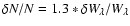 in the range
 =
=
 mÅ.
We then derive an upper limit for
the annual variation of the column density from 1990 to 2002 of
mÅ.
We then derive an upper limit for
the annual variation of the column density from 1990 to 2002 of
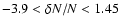 % per year at the 3 level. Tighter
constraints can be obtained by combining CH
3957 and CH
4232 measurements. For all epochs, we derive N(CH+) and
% per year at the 3 level. Tighter
constraints can be obtained by combining CH
3957 and CH
4232 measurements. For all epochs, we derive N(CH+) and  from each transition; estimates drawn from CH
4232 appear to be, in
average, slightly lower than those inferred from CH
3957, presumably
because the blend with the stellar feature induces an underestimate
of
(4232). We thus apply a small positive and constant offset to
(4232) measurements in order to get the same <N> for both
transitions and finally compute the (
from each transition; estimates drawn from CH
4232 appear to be, in
average, slightly lower than those inferred from CH
3957, presumably
because the blend with the stellar feature induces an underestimate
of
(4232). We thus apply a small positive and constant offset to
(4232) measurements in order to get the same <N> for both
transitions and finally compute the (
 weighted)
average for each epoch. The best fit corresponds to
weighted)
average for each epoch. The best fit corresponds to
 % per year and the 3
bounds are -1.5 and 0.27% per year (a non varying N(CH+) is rejected at the 2 level);
these values clearly exclude an increase as large as that seen for CH.
% per year and the 3
bounds are -1.5 and 0.27% per year (a non varying N(CH+) is rejected at the 2 level);
these values clearly exclude an increase as large as that seen for CH.
![\begin{figure}
\par\includegraphics[width=8.4cm,clip]{H4125F8.ps} \end{figure}](/articles/aa/full/2003/13/aah4125/img67.gif) |
Figure 8:
Comparison of optical depth profiles for
high resolution observations (F02) of CH 4300 ( solid
line) and CH
4232 ( dashed line). Thick lines correspond to
observed profiles while thin ones represent individual components. |
| Open with DEXTER | |
Let us now compare the velocity profiles of CH and CH+ absorptions.
Figure 8 shows the apparent optical depth versus velocity for both
species. It can be seen that no systematic shift is present; observed
profiles are quite similar although the asymmetry of CH and CH+ lines is reversed. This is clearly seen when comparing the two narrow
components needed to fit the profiles. (A comparison of the broad
components would be meaningless because the CH+ one is ill-defined
due to blending with the adjacent stellar absorption.) The CH and
CH+ components have the same velocities but different CH+/CH ratios,
as often observed (see e.g., Crawford 1989 and the  Per
profiles given by Crane et al. 1995).
Per
profiles given by Crane et al. 1995).
Because CN is expected to respond strongly to density changes, the behavior of this species can give useful clues concerning the nature of the CH variations (Pan et al. 2001). The available observations were taken in 1993 (F93b), 1998 (H98) and 2002 (F02). Unfortunately, when seen towards hot stars, the R(0) line is blended with stellar features from O II and C II (Fig. 9; see Meyer & Jura 1985). As a result of the possibility of blending, we remeasured the line in a consistent manner. In practice, this is not easy because the resolution differs from one spectrum to another and further, the broad stellar feature appears to vary in time. Results are given in Table A.2; the larger value quoted by Herbig (1999) for the R(0) line is likely due to inclusion of the stellar feature.
Since the Keck data have the highest S/N ratio, we first discuss this spectrum and its implication on the CN column density, velocity distribution and excitation. The R(0), R(1) and P(1) lines are clearly detected, as shown in Fig. 9.
![\begin{figure}
\par\includegraphics[angle=-90,width=8.8cm,clip]{H4125F9.ps}\end{figure}](/articles/aa/full/2003/13/aah4125/img69.gif) |
Figure 9:
The CN (0,0) lines in the F93b, H98 and F02
spectra. In the
H98 spectrum, the S/N ratio is 700 per 0.07 Å pixel. R(0) lines
have been aligned at the rest wavelength. The three spectra have been
normalised to 1 at
 and shifted in y for
clarity. Note the broad stellar feature on the blue side of the R(0) lines.
and shifted in y for
clarity. Note the broad stellar feature on the blue side of the R(0) lines. |
| Open with DEXTER | |
To our knowledge, there exist no high resolution observation with
adequate S/N of the CN lines towards HD 34078 that would allow us
to measure their optical depth and investigate saturation effects in a
direct way. Classically, the latter are estimated by comparing the
relative strengths of the R(1) and P(1) lines (Meyer & Jura 1985).
However, these CN absorptions are quite weak in the HD 34078
spectrum (
= 2.6
0.1 mÅ and
= 1.5 0.1 mÅ
respectively, while for the R(0) line,
= 5.7
0.2 mÅ), and
the equivalent width ratio poorly constrains the bvalue. Indeed, only values smaller than 0.1 km s-1 can be rejected
(at the 2
level); thus, within errors, the equivalent width ratio is
consistent with CN lines being optically thin.
Another way to estimate the optical depth of the 3874.6 Å R(0)
line is to compare its equivalent width to that of the R(0) line from the
(1,0) vibrational band at 3579.96 Å (Meyer et al. 1989).
In Herbig's spectrum, a weak feature is present at the
expected position with
= 0.55
0.15 mÅ; in the
optically thin limit, a value
= 0.50
0.02 mÅ would
be expected. Again, within
errors, the relative strengths of the two R(0) features are consistent
with the assumption that these two lines are thin and only a lower
limit on b can be obtained: b > 0.2 km s-1 (2
limit).
In the optically thin limit, the observed
ratio for R(0) and R(1) implies
an excitation temperature
 = 3.6
0.2 K (following the same
method as Meyer & Jura 1985) , significantly above
the value expected
=
= 3.6
0.2 K (following the same
method as Meyer & Jura 1985) , significantly above
the value expected
=
 = 2.73 K if the excitation
were due only to interaction with CMB radiation. As discussed above,
the available data yield only loose constraints on b(CN) and if the
latter were small enough, saturation effects might affect the
determination of
.
To assess the importance of these effects,
we compute
assuming b = 1, 0.5, 0.25, 0.20 km s-1 and get
= 3.5, 3.4, 3.0 and 2.8 K respectively. For lines of sight
with similar
extinction, b(CN) is observed to be about 1 km s-1 and values as
low as 0.2 km s-1 appear unlikely in comparison with available
determinations (Crawford 1995).
Such low values for b would also be at odds with the results for
CH 4300 ; no component in CH, that is associated with CN, has such a low
b-value.
We conclude that
very likely exceeds
,
implying that
collisions with electrons contribute significantly
in populating the N = 1 level (Black & van Dishoeck 1991). If b(CN) = 1 km s-1,
would be among the highest values quoted by
Black & van Dishoeck (1991).
= 2.73 K if the excitation
were due only to interaction with CMB radiation. As discussed above,
the available data yield only loose constraints on b(CN) and if the
latter were small enough, saturation effects might affect the
determination of
.
To assess the importance of these effects,
we compute
assuming b = 1, 0.5, 0.25, 0.20 km s-1 and get
= 3.5, 3.4, 3.0 and 2.8 K respectively. For lines of sight
with similar
extinction, b(CN) is observed to be about 1 km s-1 and values as
low as 0.2 km s-1 appear unlikely in comparison with available
determinations (Crawford 1995).
Such low values for b would also be at odds with the results for
CH 4300 ; no component in CH, that is associated with CN, has such a low
b-value.
We conclude that
very likely exceeds
,
implying that
collisions with electrons contribute significantly
in populating the N = 1 level (Black & van Dishoeck 1991). If b(CN) = 1 km s-1,
would be among the highest values quoted by
Black & van Dishoeck (1991).
Very recently, the CN (0,0) lines have been reobserved at McDonald (R = 170 000) (Fig. 9). The stellar feature around the R(0) line is
not well defined due to limited signal to noise; apparently, it is
weaker than in Herbig's spectrum. The R(0) and R(1) lines are clearly
detected with
= 6.3
0.5 mÅ and
= 2.6
0.4 mÅ
respectively. These values are compatible with the 1998 ones. On the
other hand, the 1993 (F93b) spectrum yields
= 5.1
0.2 mÅ and
< 2.0 mÅ (2 limit)
for the R(0) and R(1) lines, implying
 K.
Altogether, the data suggest that both the N = 0 and N = 1 CN column
densities have increased, even if the variation is only marginally
significant (
K.
Altogether, the data suggest that both the N = 0 and N = 1 CN column
densities have increased, even if the variation is only marginally
significant (
 6%). Therefore, the CN variation
could be as high as that for CH, but not much larger.
6%). Therefore, the CN variation
could be as high as that for CH, but not much larger.
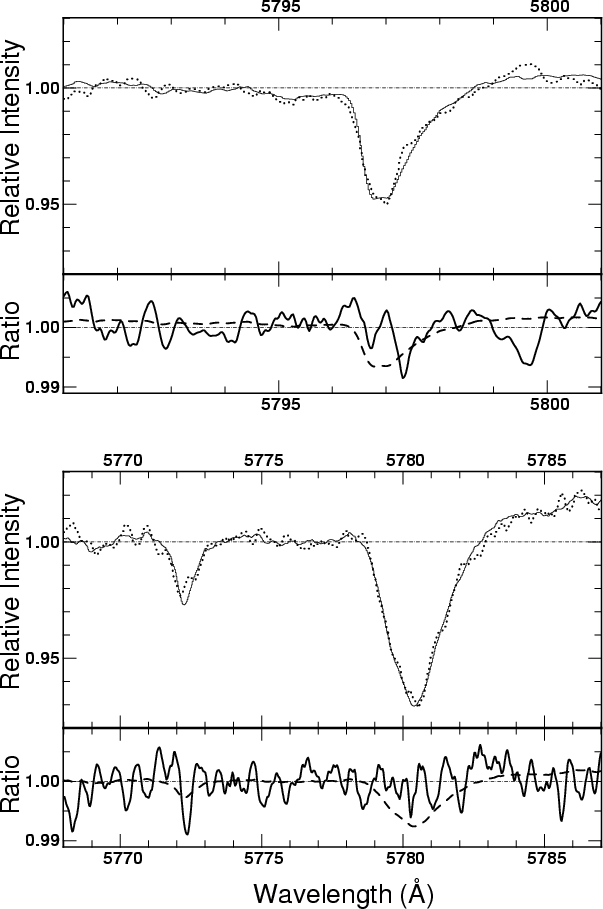 |
Figure 10: Time variation of the 5780 Å and 5797 Å DIBs. Upper panels: the average of all OHP spectra (solid line) is compared to the spectrum obtained by Jenniskens et al. (1992) (dotted line). Lower panels: the ratio of the OHP and J92 spectra (solid line) is compared to the ratio obtained after artificially increasing by 10% and 15% the respective strengths of the 5780 and 5797 Å DIBs in the OHP spectrum (dashed line). |
| Open with DEXTER | |
The OHP spectra acquired for our study of CH and CH+ contain several strong DIBs. We now use these data together with older spectra to investigate the spatial distribution of DIBs carriers. Some of them are known to behave differently with respect to the abundance of CH (Krelowski et al. 1999). Then, an immediate goal is to determine whether the kind of small and large scale variations seen for CH are also present for DIBs.
Among all detected DIBs, we initially selected those at 5780, 5797, 6196, 6284 and 6614 Å which are relatively strong (opacity reaching 6%) and narrow. For broader ones, the continuum level and shape is difficult to determine and only large variations could be seen. Among the five features quoted above, we find that the sensitivity needed to detect variations with an amplitude comparable to that of the observed CH changes can be obtained only for the 5780 and 5797 Å features. We then focus on these two DIBs. Since they are fully resolved (except possibly for some substructure), we can perform a direct comparison of the absorption profiles, once the spectra have been brought to a common wavelength scale. Equivalent width measurements would not be appropriate due to large continuum placement errors.
We first discuss variations at the scale of 0.5-1 year
( 10 AU) among the spectra taken at OHP. Since the latter have
been taken with the same instrument, the shape of the continuum
adjacent to the DIBs considered is very stable, rendering the
intercomparison much easier. We selected pairs of spectra
(October 2000/March 2002 and February 2001/October 2001) in
which
(4300)
measurements show the largest difference (about 5.3% which
corresponds to relative variations in N(CH) of 7.2%). No significant
variation is detected at the level of 10 and 15% for the 5780 and
5797 Å DIBs, respectively. To derive these upper limits, we
artificially increase/decrease the strength of the DIB considered in
the epoch 1 spectrum and then compare the latter to epoch 2 data.
Then, the sensitivity reached is not large enough to detect variations
as faint as those displayed by N(CH) over a period of about one year.
10 AU) among the spectra taken at OHP. Since the latter have
been taken with the same instrument, the shape of the continuum
adjacent to the DIBs considered is very stable, rendering the
intercomparison much easier. We selected pairs of spectra
(October 2000/March 2002 and February 2001/October 2001) in
which
(4300)
measurements show the largest difference (about 5.3% which
corresponds to relative variations in N(CH) of 7.2%). No significant
variation is detected at the level of 10 and 15% for the 5780 and
5797 Å DIBs, respectively. To derive these upper limits, we
artificially increase/decrease the strength of the DIB considered in
the epoch 1 spectrum and then compare the latter to epoch 2 data.
Then, the sensitivity reached is not large enough to detect variations
as faint as those displayed by N(CH) over a period of about one year.
To study variations at larger scales, we use the spectrum obtained by Jenniskens et al. (1992) and compare it to the average of all our OHP spectra. The ratio of the two smoothed spectra is computed, and to ensure a good "relative normalisation'', we fit values taken by this ratio in a few windows adjacent to each DIB with a polynomial of order 1 or 2. We then divide the first spectrum by this relative normalisation. The spectra thus obtained are shown in Fig. 10 and show no variation of the 5780 and 5797 Å DIBs at respective levels of 10 and 15%. Since both DIBs are optically thin, these upper limits are to be compared to the relative variation in N(CH) which is estimated to be 20% over the same period. We then conclude that the 5780 Å DIB at least has varied less than CH.
The main results that emerge from observations are the following:
- Over the past 12 years (or scales of 100-200 AU in the foreground
cloud), the CH column density has increased by 12-38%. A
linear form (with
 = 1.4% yr-1) or a step function
(
= 1.4% yr-1) or a step function
(
 = 22% in 1998) can both fit this overall variation. Over the
same period, the CH+ column density displays a markedly different
behavior (a slow decrease with
= -0.65% yr-1).
= 22% in 1998) can both fit this overall variation. Over the
same period, the CH+ column density displays a markedly different
behavior (a slow decrease with
= -0.65% yr-1).
- On the scale of a few months (5 AU), correlated fluctuations in
N(CH) and N(CH+) are strongly suggested by the data. A rough estimate of
their amplitude over the period November 99-March 02 can be inferred
from the rms scatter of
measurements:
(N(CH))/N(CH)
3.6% and
(N(CH+))/N(CH+)
5.8%.
- CH and CH+ velocity profiles show no significant time variation.
- CN observations indicate a moderate increase of N(CN) but a higher
excitation temperature in 1998 and 2002, as compared to 1993. The
recent
value is significantly above that expected from
excitation by CMB radiation alone.
- The 5780 and 5797 Å DIBs have been stable and the former has varied by no more than half that seen in CH.
We now discuss structure in the gas containing CH and CH+ at the 1-10 AU scale as probed by the homogeneous observations performed since 1999. We found indications for fluctuations of CH and CH+ absorptions: first, the scatter is relatively large and second, CH and CH+ fluctuations are apparently correlated. Nevertheless, it should be stressed that these variations are quite small. Indeed, part of the observed scatter can be attributed to measurement errors and the real scatter in N(CH) or N(CH+) cannot exceed a few %. This is much smaller than the H2CO variations described by Moore & Marscher (1995), which attain 17% and smaller than N(H I) fluctuations seen in the atomic phase over similar scales. In a simple model where most of the CH or CH+ gas is comprised of identical discrete entities, the number of such "clumps'' must exceed 103 to get fluctuations that weak.
If the erratic variations seen since 1999 reflect the geometry of
localised regions where CH+ molecules are produced, then it is natural to
detect associated variations of CH since
about 30% of the CH molecules in a given sight line form from CH+
but the fraction approaches 100% for gas with densities less than
about 100 cm-3 (Gredel et al. 2002). Presently, it is
difficult to check the consistency of this picture because
the relative amplitudes of the CH and CH+ fluctuations are poorly
constrained by the available data. Alternatively, in a picture where
CH+ is produced throughout the low density medium
(e.g., Draine & Katz 1986; Pineau des Forêts et al. 1986;
Spaans 1995; Federman et al. 1996), the correlation
between CH and CH+ could be due to a physical mechanism which
induces local density enhancements for all species. For instance,
compression in regions where chaotic flows happen to converge has
been invoked to account for the AU-scale structure in atomic
gas (Jenkins & Tripp 2001; Hennebelle & Pérault 1999) and could also be effective
in molecular gas. If the lifetime of these transient fragments is
small enough, such a process would lead to comparable values for
(CH) and
(CH+); otherwise, the higher
density might result in efficient CH+ destruction through reactions
with 2 and rather produce an anticorrelation.
One way to disentangle the above two scenarios in which small scale
structure is either related to chemically active regions or just to pressure
fluctuations would be to study the behavior of other species whose
chemistry is not directly linked to that of CH and CH+.
=
12
6%) between 1993 and 1998, but the data strongly suggest a
change in excitation
from
< 3.1 K in 1993 to
= 3.6
0.17 K in 1998.
The 1998 value is quite high in comparison with results quoted
by Black & van Dishoeck (1991) for other lines of sight, implying a high
electron density. The fact that the ratio
N(CN)/N(CH) has remained roughly constant
while N(CH) and N(CN) have increased, indicates that
little change in gas density has accompanied the fluctuations
in columns (see Pan et al. 2001).
Consider a model in which the increase in N(CH) by about 20%
over a time interval of 1 to 10 years is due to a newly intervening
clump. N(CH) is known to vary linearly with N(2) with a ratio
N(CH)/N(2)
4.0  10-8 (Federman 1982; Roueff 2001),
Towards HD 34078, a value larger by a factor of four is inferred (see
Fig. 2 from Roueff 2001). Assuming that such a ratio is still valid at the
scales considered here, one can easily compute the associated increase
in N(2): 1.1
1020 cm-2.
Assuming an intermediate value of 50 AU for the transverse scale
[N(CH) has remained at its "high'' value at least for 4 years] and
a comparable size along the
line of sight, the implied density for that hypothetical fragment
is around 1.5
105 cm-3. In such a dense
fragment, very little CH+ is expected
to be present due to reactions with 2, accounting for the absence
of an associated increase in N(CH+). Similarly, the stability of
the 5780 and 5797 Å DIBs can be understood in this scenario since
DIBs carriers are known to lie preferentially in diffuse media.
However, the CN/CH ratio is expected to be large at these
densities and the relative
increase of N(CN) should be much larger than that of CH,
contrary to what is observed. The density quoted above could be lowered if the
structure were elongated along the line of sight (cf. the model proposed
by Heiles (1997) for atomic gas), but a very large (and unrealistic!) aspect
ratio would be needed to bring it to values typical for that kind
of material (a few times 102 cm-3). In
particular, Federman et al. (1994)
estimated
10-8 (Federman 1982; Roueff 2001),
Towards HD 34078, a value larger by a factor of four is inferred (see
Fig. 2 from Roueff 2001). Assuming that such a ratio is still valid at the
scales considered here, one can easily compute the associated increase
in N(2): 1.1
1020 cm-2.
Assuming an intermediate value of 50 AU for the transverse scale
[N(CH) has remained at its "high'' value at least for 4 years] and
a comparable size along the
line of sight, the implied density for that hypothetical fragment
is around 1.5
105 cm-3. In such a dense
fragment, very little CH+ is expected
to be present due to reactions with 2, accounting for the absence
of an associated increase in N(CH+). Similarly, the stability of
the 5780 and 5797 Å DIBs can be understood in this scenario since
DIBs carriers are known to lie preferentially in diffuse media.
However, the CN/CH ratio is expected to be large at these
densities and the relative
increase of N(CN) should be much larger than that of CH,
contrary to what is observed. The density quoted above could be lowered if the
structure were elongated along the line of sight (cf. the model proposed
by Heiles (1997) for atomic gas), but a very large (and unrealistic!) aspect
ratio would be needed to bring it to values typical for that kind
of material (a few times 102 cm-3). In
particular, Federman et al. (1994)
estimated
 200 cm-3 from N(CN)/N(CH) and
C2 observations, at a time when N(CH) had its low value, but the
column density ratio has not changed appreciably since then. While it
is not clear which CH component contains CN as well, the current version
of the chemical model (Knauth et al. 2001; Pan et al. 2001) gives
similar densities.
200 cm-3 from N(CN)/N(CH) and
C2 observations, at a time when N(CH) had its low value, but the
column density ratio has not changed appreciably since then. While it
is not clear which CH component contains CN as well, the current version
of the chemical model (Knauth et al. 2001; Pan et al. 2001) gives
similar densities.
Another problem with this model (in addition to understanding how the
large overpressure inside the clump can be generated and maintained
long enough) is related to
the change in the excitation of CN suggested by the data. Since the
variation in N(CN) has been quite limited (at most 20 to 30%), the
higher
value estimated for the whole gas in 1998 and 2002
implies an even larger
in the clump if the rest of the gas has
remained at
2.7 K. Again, this points towards a large
clump density or electron fraction.
A last difficulty involves the observed velocity distribution. The presence of an additional fragment on the 2002 line of sight should have resulted in a new velocity component, but the whole distribution (in particular the two narrow components) has varied globally, without any noticeable change in shape. One could imagine that the additional component is very narrow and does not show up at R = 200 000, but such a feature would be atypical with respect to profiles observed at very high resolution.
The difficulties encountered above when attempting to account for
the CH - CN variations might be related to several
peculiarities of the HD 34078 line of sight: i) the large amount of
highly excited 2, ii) the large CH/2 and CH+/2 ratios (note
however that the CH/CH+ ratio is in good agreement with the
CH - CH+ correlation observed by Gredel 1997),
and iii) the large
value for CN.
Since point i) is attributed to the
influence of the UV bright star upon nearby material (Le Petit et al. 2001; Boissé et al. 2002), one might
wonder whether the properties observed for CH, CH+ and CN could also
be the result of this interaction. In this model, CH, CH+ and CN are
expected to be largely photodissociated in the PDR where 2 is
excited to high energies.
Then, to account for the observed
CH and CH+ amounts, one may imagine that CH+ production occurs
in the PDR itself, as has been suggested for the Pleiades
(White 1984) and IC 348 (Snow 1993).
In this scenario, CH+ is the result of reactions between C+ and H2in gas at elevated temperatures caused by enhanced H2 photodissociation.
The large amount of CH then arises from the synthesis of CH+and the
increase in
occurs because there is enhanced ionization
produced by the star's UV radiation. One potential difficulty involves
the velocity distribution which appears to be quite
narrow (except for
the broad component) and stable (cf. Herbig 1999). This
suggests quiescent absorbing material rather than gas located near a
bow shock around a O9 star moving at more than 100 km s-1.
Possibly, we are seeing "composite absorption'' from both pieces of gas,
one located close to HD 34078 and strongly influenced by it, and
the other consisting of more
distant material where the radiation field is enhanced by only a
factor of a few relative to the average galactic field.
To date, FUSE observations have provided 4 spectra, all taken after 1999; their analysis indicates that N(2) variations - if any - are smaller than about 5% (Boissé et al. 2002). If N(CH) keeps increasing, we shall be able to verify whether the CH - 2 correlation still holds at the 10-100 AU scales since the expected increase in N(2) will exceed our detection limit.
The behavior of other species like C I and CO can be investigated also using these spectra. However, this can be done with better sensitivity with HST thanks to higher S/N and spectral resolution. HST/STIS spectra would provide invaluable information on the density via C I fine structure transitions and C2 lines and allow us to follow with improved accuracy the small and large scale variations of many species (C I, H I, excited H2, CO, C2...). Repeating the C2visible observations reported by Federman et al. (1994) could also give direct evidence for the high clump density quoted above.
Acknowledgements
We thank the astronomers and staff who obtained the OHP spectra, M. Allen, F.X. Désert, G. Herbig, J. Krelowski, G. Galazutdinov and F. Musaev who kindly provided their data, and E. Roueff and M. Gerin for obtaining an IRAM CO spectrum. We acknowledge fruitful discussions with J. Black, P. Hennebelle and G. Pineau des Forêts and thank S. Thoraval for his initial participation in this program. S.R.F. was supported in part by NASA LTSA grant NAG5-4957.
| Date | Observatory | S/N | Ra | Transitionb | References | |
| 9-89 ->1-91 | KPNOc | 135 | 85 000 | CH, CH+ | Allen (1994) | A91 |
| 06-12/1991 | OHP (Aurélie) | >100 | 14 300 | CH, CH+(4232), DIBs | Jenniskens et al. (1992) | J91 |
| 11-14-97 | Terskol | 50-80 | 45 000 | CH, CH+ | Krelowski et al. (1999) | K97a |
| 11-19-97 | Terskol | 50-80 | 45 000 | CH, CH+ | Krelowski et al. (1999) | K97b |
| 01-93 | McDonald echelle | 45-65 | 200 000 | CH, CH+(4232) | F93a | |
| 12-93 | McDonald Sandiford | 100-150 | 60 000 | CH, CH+, CN | F93b | |
| 02-02 | McDonald echelle | 100-150 | 170 000 | CH, CH+(4232), CN | F02 | |
| 10-98 | Keck | 600 | 45 000 | CH, CH+, CN | Herbig (1999) | H98 |
| 11-18-99 | 135-140 | R99a | ||||
| 12-22-99 | 310-360 | R99b | ||||
| 1-27-00 | 120-200 | R00a | ||||
| 2-27-00 | OHP (Elodie) | 105-115 | 32 000 | CH, CH+, DIBs | R00b | |
| 3-18-00 | 125-150 | R00c | ||||
| 10-01-00 | 120-155 | R00d | ||||
| 2-10-01 | 105-145 | R01a | ||||
| 10-2-01 | 105-145 | R01b | ||||
| 3-4-02 | 150-160 | R02 |
| CH a | CH+ | CH+b | CNb | CNb | |
| 4300 Å | 3957 Å | 4232 Å | R(0) | R(1) | |
| A91 | 48.30.6 | 29.81.4 | 44.42.0 | ... | ... |
| J91 | 42.010.0 | ... | 52.0 10.0 b | ... | ... |
| F93a | 48.02.0 | ... | 44.01.7 | ... | ... |
| F93b | 52.01.2 | 29.30.8 | 43.10.9 | 5.10.2 |  |
| K97a | 49.61.0 | 28.71.5 | 39.83.0 | ... | ... |
| K97b | 52.62.0 | 25.42.0 | 44.03.0 | ... | ... |
| H98 | 58.00.7 | 27.30.2 | 42.02.0 | 5.70.2 | 2.60.1 |
| R99a | 55.70.7 | 29.02.2 | 38.02.0 | ||
| R99b | 55.40.5 | 27.91.4 | 41.52.0 | ||
| R00a | 55.20.7 | 26.31.5 | 40.32.0 | ||
| R00b | 57.81.2 | 22.82.8 | 40.53.0 | ||
| R00c | 55.81.0 | 24.72.3 | 40.02.0 | ||
| R00d | 56.61.1 | 23.21.9 | 39.02.0 | ||
| R01a | 58.80.8 | 31.92.3 | 44.03.0 | ||
| R01b | 55.40.7 | 24.41.3 | 39.03.0 | ||
| F02 | 60.01.0 | ... | 44.02.0 | 6.30.2 | 2.60.4 |
| R02 | 58.11.0 | 25.31.6 | 42.02.0 |
 owski, J., Ehrenfreund, P., Foing, B. H., et al. 1999, A&A, 347, 235
In the text
NASA ADS
owski, J., Ehrenfreund, P., Foing, B. H., et al. 1999, A&A, 347, 235
In the text
NASA ADS
 .
b Interstellar lines that have been
included in this study. CH stands for
CH
.
b Interstellar lines that have been
included in this study. CH stands for
CH
 and CH
 ,
unless specified; CN for CN
,
unless specified; CN for CN
 (Table