

Our analysis described in Sect. 3 indicates that the GRB host galaxies are characterized by rather blue colours (see Fig. 4), sub-L* luminosities in the K band and low masses (see Fig. 5). Their morphology is moreover consistent with that of compact, irregular or merging systems (Bloom et al. 2002b). Their spectra clearly exhibit prominent emission lines such as [OII], [NeIII] and the Balmer hydrogen lines (e.g., Djorgovski et al. 1998; Le Floc'h et al. 2002), and their optical SED is similar to that of starburst galaxies observed in the local Universe (Sokolov et al. 2001). All together, our results and those already published in the literature are therefore in agreement with GRBs tracing star-forming sources at cosmological distances.
We may now wonder whether the GRB-selected objects are actually representative of the whole ensemble of starburst galaxies at high redshift, or in other words, whether GRBs can really be used as unbiased probes of star formation.
Our results indicate that the GRB host galaxies significantly differ from the luminous and dusty starbursts which were discovered in the infrared and submillimeter deep surveys with ISO and SCUBA. This is clearly illustrated in Fig. 5 which shows that, contrary to the GRB hosts, these dusty star-forming objects are also luminous at optical and NIR wavelengths. As can be seen in Fig. 4, they moreover appear statistically much redder, indicating either the presence of underlying old stellar populations or an evidence for dust obscuration. Is this distinction between these galaxies and the GRB hosts simply due to the limited size of our sample, or does it reveal other biases affecting the GRB-selection?
The ISO starbursts have been shown to resolve  50% of the
total energy produced by the Cosmic Infrared Background
(CIRB, Elbaz et al. 2002). They trace therefore a significant fraction
of the global activity of star formation which occured in the
Universe. Within the
50% of the
total energy produced by the Cosmic Infrared Background
(CIRB, Elbaz et al. 2002). They trace therefore a significant fraction
of the global activity of star formation which occured in the
Universe. Within the
 redshift range
where the ISO sources and most of the GRB host galaxies are located,
we estimated the fraction of GRBs which should be observed toward
these dusty galaxies assuming GRBs trace the star formation. To this
purpose, we assumed that the respective contributions to the CIRB and
the Optical Extragalactic Background (OEB) produced at this epoch
roughly originate from two distinct populations of star-forming
sources, namely the faint blue galaxies and the luminous dusty
starbursts (e.g., Rigopoulou et al. 2002). Given that the CIRB and the
OEB are more or less equivalent in terms of bolometric luminosity
(e.g., Hauser & Dwek 2001), and taking into account the contribution of
the ISO sources to the CIRB, we found that approximately 25 % of the
GRB host galaxies should belong to the class of infrared dusty
starbursts such as those detected with ISO. Within the sub-sample of
GRB hosts observed in the K-band and located at
,
5-6 sources would thus be
expected to exhibit K luminosities
redshift range
where the ISO sources and most of the GRB host galaxies are located,
we estimated the fraction of GRBs which should be observed toward
these dusty galaxies assuming GRBs trace the star formation. To this
purpose, we assumed that the respective contributions to the CIRB and
the Optical Extragalactic Background (OEB) produced at this epoch
roughly originate from two distinct populations of star-forming
sources, namely the faint blue galaxies and the luminous dusty
starbursts (e.g., Rigopoulou et al. 2002). Given that the CIRB and the
OEB are more or less equivalent in terms of bolometric luminosity
(e.g., Hauser & Dwek 2001), and taking into account the contribution of
the ISO sources to the CIRB, we found that approximately 25 % of the
GRB host galaxies should belong to the class of infrared dusty
starbursts such as those detected with ISO. Within the sub-sample of
GRB hosts observed in the K-band and located at
,
5-6 sources would thus be
expected to exhibit K luminosities  0.5 L*, while none
of them actually satisfies this criterion.
0.5 L*, while none
of them actually satisfies this criterion.
Further evidence supporting the lack of GRB-detections in reddened dusty
starbursts is suggested by the very blue colours of GRB hosts. It has
been recently shown that a significant fraction of the Extremely Red
Objects (EROs,  )
should be composed of dust-reddened
sources responsible for a star formation density greater than the
estimates from UV-selected galaxies at
)
should be composed of dust-reddened
sources responsible for a star formation density greater than the
estimates from UV-selected galaxies at  (Smail et al. 2002b).
With a similar argument as aforementioned, we would expect to
find several EROs among the GRB host sample, while all of the GRB host
galaxies display R-K colours bluer than 4.
(Smail et al. 2002b).
With a similar argument as aforementioned, we would expect to
find several EROs among the GRB host sample, while all of the GRB host
galaxies display R-K colours bluer than 4.
This lack of luminous (L
L*) and red ( )
galaxies among the GRB hosts could be explained by the existence of
the so-called "dark'' bursts. Lacking counterparts at optical/NIR
wavelengths in spite of a rapid and deep search of afterglows during
the few hours following their detection at high energy, a fraction of
these bursts could be hidden behind optically-thick columns of dust
and gas, and thus would be obscured in the visible. Indeed, the
spatial scale of dust-enshrouded regions of star formation in luminous
infrared galaxies can easily reach 1 kpc (Soifer et al. 2001).
Even if the beamed emission of GRBs can destroy dust grains on
distances up to 100 pc from the burst location
(Fruchter et al. 2001b), the resulting column density on the GRB line of
sight would still be high enough to prevent the production of a
detectable afterglow in the visible. Such GRBs could thus only be
observed via the emission of their afterglows in the X-rays and,
possibly, through their synchrotron emission at radio wavelengths.
Since most of the currently known GRB hosts were selected using GRB
optical transients, it may therefore indicate that the sample is
likely biased toward galaxies harbouring unobscured star-forming
activity.
)
galaxies among the GRB hosts could be explained by the existence of
the so-called "dark'' bursts. Lacking counterparts at optical/NIR
wavelengths in spite of a rapid and deep search of afterglows during
the few hours following their detection at high energy, a fraction of
these bursts could be hidden behind optically-thick columns of dust
and gas, and thus would be obscured in the visible. Indeed, the
spatial scale of dust-enshrouded regions of star formation in luminous
infrared galaxies can easily reach 1 kpc (Soifer et al. 2001).
Even if the beamed emission of GRBs can destroy dust grains on
distances up to 100 pc from the burst location
(Fruchter et al. 2001b), the resulting column density on the GRB line of
sight would still be high enough to prevent the production of a
detectable afterglow in the visible. Such GRBs could thus only be
observed via the emission of their afterglows in the X-rays and,
possibly, through their synchrotron emission at radio wavelengths.
Since most of the currently known GRB hosts were selected using GRB
optical transients, it may therefore indicate that the sample is
likely biased toward galaxies harbouring unobscured star-forming
activity.
In this hypothesis, we would have the rough picture in which most of
GRBs with detectable optical transients mainly probe the dust-free
starbursts hosted in sub-luminous blue galaxies, while the bursts
occuring within the most dusty sources appear optically dark.
Naturally, intermediate cases should also exist, as illustrated by the
VLA detection of the GRB 980703 host galaxy
(Berger et al. 2001b). Assuming that the radio/far-infrared correlation
still holds for high redshift sources, this host pinpointed by an
optical transient of a GRB occuring at z=0.97 could be indeed a
dusty galaxy luminous in the infrared. In fact, we note that its
R-K colour 2.8 and its absolute K magnitude
 would be consistent with this source being similar to the NIR
counterparts of the ISO dusty starbursts (see Figs. 4
and 5). Other intermediate examples of dusty galaxies
probed with optically bright GRB afterglows were also reported from
the faint detections of the GRB 000418 and GRB 010222 hosts at
submillimeter wavelengths (Berger et al. 2001a; Frail et al. 2002).
would be consistent with this source being similar to the NIR
counterparts of the ISO dusty starbursts (see Figs. 4
and 5). Other intermediate examples of dusty galaxies
probed with optically bright GRB afterglows were also reported from
the faint detections of the GRB 000418 and GRB 010222 hosts at
submillimeter wavelengths (Berger et al. 2001a; Frail et al. 2002).
A possible method to reliably probe the dusty star formation with GRBs could be the use of optically-dark bursts yet harbouring detectable afterglows at radio wavelengths. However, the observations of four sources pinpointed with such optically-dark and radio-bright GRBs by Barnard et al. (2003) have not revealed these galaxies to be especially bright in the submillimeter. These particular bursts do not seem therefore to preferentially select obscured sources. This indicates that GRBs occuring within dust-enshrouded star-forming regions could probably be dark at both optical/NIR and radio wavelengths, which might be understood if GRB radio transients can not be easily generated within the densest environments of dusty galaxies (Barnard et al. 2003).
It is therefore likely that the census of dust-enshrouded star
formation with GRBs will require a follow-up of the bursts
characterized by both optically- and radio-dark transients. The use of
their X-ray afterglows will thus be needed to correctly localize these
GRBs on the sky. To this purpose, the forthcoming GRB-dedicated SWIFT
mission will enable to derive the positions of hundreds of GRBs with a
sub-arcsecond error box from the sole detections of their afterglows
in the X-rays. This should ultimately provide a
statistically-significant sample of star-forming galaxies selected
from high energy transients of GRBs, thus less affected by dust
extinction than the current sample of GRB hosts. The study of these
sources with the Space InfraRed Telescope Facility (SIRTF)
will moreover allow to characterize their dust content by directly
observing the thermal emission of these galaxies in the mid-infrared.
Since the SIRTF instruments will be able to detect the rest-frame
infrared emission of dusty starbursts up to  ,
the
parallel use of SWIFT and SIRTF will therefore open new perspectives
to use GRBs as probes of the dusty star formation at high redshift.
,
the
parallel use of SWIFT and SIRTF will therefore open new perspectives
to use GRBs as probes of the dusty star formation at high redshift.
On the other hand, we note that this apparent selection effect toward blue and sub-luminous sources may simply reflect an intrinsic property of the GRB host galaxies themselves. For example, GRBs could be preferentially produced within young systems experiencing their first episode of massive star formation, thus explaining the low mass of their underlying stellar populations and their apparent blue colors. A larger statistics and a better understanding of the possible observational bias associated with the GRB selection, as previously mentioned, will be however required to further investigate this hypothesis.
In the previous section, we have argued that the current sample of GRB hosts could be biased toward unobscured star-forming galaxies, and that such a bias could be related to the existence of the dark bursts. Since the long-duration GRBs are believed to trace the star-forming activity at high redshift, this sample of dust-free GRB-selected sources should be therefore more or less representative of the population of faint blue galaxies which were discovered in the optical deep surveys.
These faint blue sources in the field are indeed believed to produce the bulk of the OEB (Madau & Pozzetti 2000) and to be responsible for most of the unobscured star formation in the early Universe. Since the B-band emission is a good tracer of star-forming activity in dust-free sources, the absolute B magnitude histogram of the GRB host sample, in this case, should closely follow the function of the B-band luminosity weighted by luminosity for blue galaxies at high redshift. The latter may indicate indeed, for a given bin of magnitude, the relative fraction of total star formation to which galaxies in this range of luminosity contributed as a whole. It should be therefore proportional to the fraction of GRB occurence emerging from such galaxies.
![\begin{figure}
\resizebox{\hsize}{!}{\includegraphics[clip]{3369.f6.eps}}\end{figure}](/articles/aa/full/2003/11/aa3369/img65.gif) |
Figure 6:
Histogram of the absolute B magnitudes for the sample of GRB
host galaxies, estimated following the method described in Appendix A
and assuming a  CDM Universe with CDM Universe with  = 0.3 and = 0.3 and
 .
Various functions of the B-band
luminosity weighted by luminosity at high redshift have been
overplotted in arbitrary units for comparison. They were taken from
Wolf et al. (2003) for the .
Various functions of the B-band
luminosity weighted by luminosity at high redshift have been
overplotted in arbitrary units for comparison. They were taken from
Wolf et al. (2003) for the
 redshift range
( dashed line), and Kashikawa et al. (2003) for sources at
redshift range
( dashed line), and Kashikawa et al. (2003) for sources at
 ( dotted line) and
 ( dashed-dotted line). The thick
solid line is also taken from Wolf et al. (2003) but restricted to
galaxies bluer than Sbc type objects. The vertical dashed line
depicts the M* parameter of this last Schechter parametrization.
( dashed-dotted line). The thick
solid line is also taken from Wolf et al. (2003) but restricted to
galaxies bluer than Sbc type objects. The vertical dashed line
depicts the M* parameter of this last Schechter parametrization. |
Such a comparison is shown in Fig. 6. We computed the
absolute magnitudes of the GRB host galaxies in the rest-frame
B-band following the method described in Appendix A. To estimate
the contribution of distant sources to the overall star-forming
activity at similar redshifts, we used the results of the COMBO-17
Survey by Wolf et al. (2003), who derived the Schechter-parametrized
luminosity functions for various types of galaxies up to  ,
in a CDM Universe with
,
in a CDM Universe with
 and
.
We also used the observations of
Kashikawa et al. (2003) from the Subaru Deep Survey who constrained the
global function of the B-band luminosity for sources up to
and
.
We also used the observations of
Kashikawa et al. (2003) from the Subaru Deep Survey who constrained the
global function of the B-band luminosity for sources up to
 ,
in a flat Universe with
,
in a flat Universe with
 .
As
explained in Sect. 3.3, the comoving distance
variations between the two different cosmologies do not affect that
much our comparisons. Assuming
.
As
explained in Sect. 3.3, the comoving distance
variations between the two different cosmologies do not affect that
much our comparisons. Assuming
 for the blue galaxies at
(Wolf et al. 2003), it is clear
that the GRB host galaxies are sub-luminous sources in the
B-band. There is however an apparent and surprising trend for the
GRB hosts to be, on average, even less luminous than the blue galaxies
which mostly contributed to the energy density in the rest-frame
B-band at .
This apparent shift is unlikely due to the
weak constraint which has been obtained so far on the faint end slope
(usually refered to as the parameter
for the blue galaxies at
(Wolf et al. 2003), it is clear
that the GRB host galaxies are sub-luminous sources in the
B-band. There is however an apparent and surprising trend for the
GRB hosts to be, on average, even less luminous than the blue galaxies
which mostly contributed to the energy density in the rest-frame
B-band at .
This apparent shift is unlikely due to the
weak constraint which has been obtained so far on the faint end slope
(usually refered to as the parameter  in the Schechter
parametrization) of the B-band luminosity function at high
redshift. There are indeed noticeable discrepancies in this slope
between the results of Kashikawa et al.
in the Schechter
parametrization) of the B-band luminosity function at high
redshift. There are indeed noticeable discrepancies in this slope
between the results of Kashikawa et al.
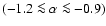 and those by Wolf et al.
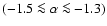 ,
but the implied variations on the B-band luminosity
function weighted by luminosity are not that significant (see
Fig. 6). To quantify the observed shift, we performed
a Kolmogorov-Smirnov test on the data sets of GRB hosts and high
redshift sources bluer than Sbc type objects. We obtained only a
rather small probability (17%) that the two distributions
originate from the same population of galaxies. Could this shift be
due to intrinsic properties of GRB host galaxies, and reveal that only
particular environments favour the formation of GRB events?
,
but the implied variations on the B-band luminosity
function weighted by luminosity are not that significant (see
Fig. 6). To quantify the observed shift, we performed
a Kolmogorov-Smirnov test on the data sets of GRB hosts and high
redshift sources bluer than Sbc type objects. We obtained only a
rather small probability (17%) that the two distributions
originate from the same population of galaxies. Could this shift be
due to intrinsic properties of GRB host galaxies, and reveal that only
particular environments favour the formation of GRB events?
In the "collapsar'' scenario, GRBs are produced by the accretion of a helium core onto a black hole resulting from the collapse of a rapidly-rotating iron core. Since a low metallicity in the stellar enveloppe reduces the mass loss and inhibits the loss of angular momentum by the star, the formation of GRBs could be favoured in metal-poor environments (MacFadyen & Woosley 1999). As such, we could expect GRBs to be preferentially observed toward starbursts with very low luminosities. Interestingly, evidence for a low-metallicity host galaxy has been in fact recently reported toward the X-Ray Flash XRF 020903 (Chornock & Filippenko 2002). The influence of such intrinsic parameters could therefore not only explain the trend observed in Fig. 6, but it would also provide further arguments for the lack of GRB host detections toward luminous reddened starbursts as discussed in the previous section.
Of course, one must remain very cautious regarding this interpretation, because of the small size of our sample. Moreover, the influence of metallicity in the formation of a GRB should be only localized in the close vicinity of the burst, whereas important gradients in the chemical composition of galaxies are commonly observed. However, we note that such gradients of metallicity are not present in local dwarfs (see Hidalgo-Gámez et al. 2001 and references therein), which suggests that the average metallicity observed toward the sub-luminous GRB hosts should give a good estimation of the chemical properties characterizing the environments where the GRBs occured. A detailed investigation of the gas metallicity within GRB host galaxies compared to other optically-selected sources has never been performed so far. Such a study will be definitely required to better address this issue.
Copyright ESO 2003