A&A 400, 393-396 (2003)
DOI: 10.1051/0004-6361:20021686
Imaging capabilities of hypertelescopes with a pair of micro-lens arrays
S. Gillet1 - P. Riaud1,2 - O. Lardière1,4 - J. Dejonghe1,4 - J. Schmitt3 - L. Arnold3 - A. Boccaletti2 - D. Horville5 - A. Labeyrie1,4
1 - LISE-Observatoire de Haute-Provence, 04870 St Michel l'Observatoire, France
2 -
LESIA, Observatoire de Paris-Meudon, 5 Pl. J. Janssen, 92195 Meudon, France
3 -
Collège de France, 11 Pl. M. Berthelot, 75321 Paris, France
4 -
GEPI - Observatoire de Paris, 61 avenue de l'Observatoire, 75014 Paris, France
Received 29 May 2002 / Accepted 15 November 2002
Abstract
We verify the imaging performance of hypertelescopes on
the sky, using a new scheme for pupil densification. To avoid
seeing limitations, we used a miniature version with a 10 cm
aperture containing 78 sub-apertures of 1 mm size, arrayed
periodically as a square grid. The pupil densification is achieved
with a pair of micro-lens arrays, where each pair of facing lenses
behaves like a tiny demagnifying telescope. We have tested the
direct snapshot performance with laboratory-simulated multiple
stars and observed the binary star Castor ( Gem). We
measured a separation of 3.8
Gem). We
measured a separation of 3.8
 and a magnitude difference
of 0.85 which is in agreement with current orbital data. This
verified the theoretical expectations for hypertelescopes in terms
of field of view and fluxes and qualified the new optical
implementation for future arrays at the scale of meters and
beyond.
and a magnitude difference
of 0.85 which is in agreement with current orbital data. This
verified the theoretical expectations for hypertelescopes in terms
of field of view and fluxes and qualified the new optical
implementation for future arrays at the scale of meters and
beyond.
Key words: instrumentation: interferometers - techniques:
high angular resolution - stars: binaries: visual -
methods:
observational
Very large telescopes are needed for imaging stellar disks or
exo-planets but it will be difficult to expand the size beyond
that of current "Extremely Large Telescope'' projects such as the
30 m CELT and the 100 m OWL (Gilmozzi et al. 1998), for
technological and cost reasons. Interferometry can provide various
trade-offs between angular resolution and collecting area, but
snapshot imaging is often desirable to observe short-lived
phenomena. In 1996, Labeyrie (1996) described the possibility of
making snapshot images with multi-aperture interferometers, using
a densified pupil. This optical architecture allows direct
high-resolution imaging with high contrast. A miniature
instrument, using a diffractive approach to pupil densification,
has been successfully tested by Pedretti et al. (2000) on bright
binary stars. Now, we present results similarly obtained with an
improved optical scheme for achieving the pupil densification. In Sects. 2 and 3 we describe the principle of hypertelescopes and
the experimental setup. Section 4 presents the results obtained on
the sky. And finally, the optical schemes are further discussed in Sect. 5.
The principle of densified-pupil multi-aperture imaging
interferometers, called hypertelescopes, was previously described
(Labeyrie 1996; Gillet et al. 2001; Riaud et al. 2002).
![\begin{figure}
\par\includegraphics[width=8.8cm,clip]{h3943f1.eps}\end{figure}](/articles/aa/full/2003/10/aah3943/Timg8.gif) |
Figure 1:
Hypertelescope principle.
Positive (left) and negative (right) pupil densification, using
respectively a diverging and a converging lens array, followed in each case
by a longer-focus array of converging lenses. A tilted incoming
wavefront from an off-axis star is densified
with two confocal lens arrays (ML1 and ML2), thus producing a densified
wavefront which focuses to a single narrow interference peak within the broader diffraction pattern from each sub-pupil.
It becomes stair-shaped since the slope of each wavefront
segment is reduced by the pair of micro-lenses. The stair's
average shape remains flat and parallel to the incoming
wavefront since all pairs of micro-lenses introduce identical
propagation delays. But each wavefront segment, arriving with a slope
angle ,
emerges with an angle
 where f1and f2 are the micro-lens's focal lengths of ML1 and ML2. The
resulting wavefront is finally a stair-shaped wavefront with the same
average slope as at the entrance of the densifier.
where f1and f2 are the micro-lens's focal lengths of ML1 and ML2. The
resulting wavefront is finally a stair-shaped wavefront with the same
average slope as at the entrance of the densifier. |
| Open with DEXTER |
Let us consider light beams coming from N small mirrors arrayed
periodically in two dimensions with period s. Beams from these
mirrors are initially combined according to a Fizeau
interferometer geometry. At the combined focus, the image has a
central peak surrounded by many secondary dispersed peaks.
Densifying the entrance pupil, shrinks and intensifies the
combined image, thus attenuating or suppressing the secondary
peaks. The densified pupil increases the limiting magnitude but
limits the field of view to a non-aliased field of the interferometer.
The white central peak, in the densified-pupil image, appears only
for stars within a small region of the sky. Following
Gillet et al. (2001), we call ZOF (Zero Order Field) this narrow usable
field and HOF (High Order Field) the peripheral sky field of size
 where d is the size of one sub-aperture (1 mm):
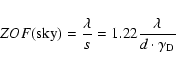 |
(1) |
where
 the densification ratio. This
densification ratio is defined by:
the densification ratio. This
densification ratio is defined by:
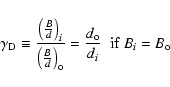 |
(2) |
where di and  are the entrance mirror and exit
sub-pupil diameters respectively, and Bi and
are the entrance mirror and exit
sub-pupil diameters respectively, and Bi and  the entrance
and exit baselines in the pupil densifier. In the
configuration considered here (Fizeau interferometer), both
baselines are equal. But in case of a Michelson interferometer,
the entrance baseline Bi is different from the output baseline .
the entrance
and exit baselines in the pupil densifier. In the
configuration considered here (Fizeau interferometer), both
baselines are equal. But in case of a Michelson interferometer,
the entrance baseline Bi is different from the output baseline .
The number of resolution elements in the ZOF is given by:
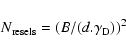 |
(3) |
B is the baseline of the interferometer (here 10 cm).
Following the initial sky testing achieved by Pedretti et al.
(2000), using a diffractive mode of pupil densification, we have
tried to improve the densification technique. Among a wide range
of possibilities, we have chosen to use a pair of micro-lens
arrays. The hypertelescope's scheme is represented in Fig. 2. Instead of a true array of mirror elements, we
have used a 40 cm Newtonian telescope at Observatoire de Haute
Provence as collecting optics. In order to have nearly
diffraction-limited image quality without adaptive optics, the
hypertelescope exploits only 10 cm of the aperture. The rest of
the aperture served for auto-guiding with a SBIG ST4 CCD camera.
![\begin{figure}
\par\includegraphics[width=8.8cm,clip]{h3943f2.eps}\end{figure}](/articles/aa/full/2003/10/aah3943/Timg17.gif) |
Figure 2:
Hypertelescope experimental setup. The incoming light
beam from a Newtonian telescope is collimated by lens L1. A
Fizeau mask installed for convenience in the pupil plane following
L1, rather than at the primary mirror, has N=78 holes of
 m size each. It defines in the entrance aperture a virtual
"diluted giant mirror'' of 10 cm size with s=1 mm
sub-apertures. The densification is achieved with two micro-lens
arrays (ML m size each. It defines in the entrance aperture a virtual
"diluted giant mirror'' of 10 cm size with s=1 mm
sub-apertures. The densification is achieved with two micro-lens
arrays (ML and ML
 ). ). |
| Open with DEXTER |
The lens L1 produces a pupil image, 10 times smaller than the
entrance aperture, which is masked by a grid of 78 holes of
0.1 mm size, centered 1 mm apart. The virtual grid thus
defined in the entrance aperture has 1 mm holes spaced 10 mm
apart. Two arrays of convergent and confocal micro-lenses (ML1and ML2), having a short and a long focal length respectively
(20 mm and 120 mm), achieve the pupil densification. The
front focal plane of the first array is located close to the grid,
so as to provide a pupil plane close to the second array.
Collimated beams from each sub-pupil become recollimated and
widened when transmitted through the facing pair of micro-lenses.
The densification factor, ratio of ML2 and ML1's focal
lengths, amounts to 6, providing 80% filling (diameter) in
the exit pupil. The micro-lens arrays utilized were fabricated by
one of us (DH) at Observatoire de Paris (Bensammar et al. 2000), with
enough lens-to-lens uniformity of thickness to keep piston errors
within Rayleigh's tolerance, as required for a highly constructive
interference, providing a high Stehl ratio, in the star's
"high-resolution'' image. The rather faint star images thus formed
with less than 1 cm2 of total collecting area were recorded
on a CCD camera with 9  m pixels (0.62 pixel/
 image sampling). With its aperture size of 10 cm and equivalent
mirrors of 1 mm diameter, the ZOF extent is
image sampling). With its aperture size of 10 cm and equivalent
mirrors of 1 mm diameter, the ZOF extent is
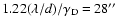 at
at
 nm and the
angular resolution is
nm and the
angular resolution is
 .
.
![\begin{figure}
\par\includegraphics[width=5cm]{h3943f5.eps}\includegraphics[width=4.9cm]{h3943f4.ps}\includegraphics[width=4.9cm]{h3943f3.ps}\end{figure}](/articles/aa/full/2003/10/aah3943/Timg23.gif) |
Figure 3:
a) Image of Castor, showing the resolved binary A-B,
spaced 3.8 arcsec. The half ZOF is about
 arcsec
wide. b) Image of Pollux, obtained with a 10 min exposure. It
matches the theoretical pattern, with the residual side-peaks due
to incomplete pupil densification. With respect to the laboratory
images and the numerical simulation, the peaks are however
somewhat widened by seeing and exceed the theoretical arc-second
resolution limit of the 10 cm array. c) Numerical simulation
of a point source's monochromatic image with the 78-aperture
hypertelescope.
arcsec
wide. b) Image of Pollux, obtained with a 10 min exposure. It
matches the theoretical pattern, with the residual side-peaks due
to incomplete pupil densification. With respect to the laboratory
images and the numerical simulation, the peaks are however
somewhat widened by seeing and exceed the theoretical arc-second
resolution limit of the 10 cm array. c) Numerical simulation
of a point source's monochromatic image with the 78-aperture
hypertelescope. |
| Open with DEXTER |
We first tested the imaging capabilities of the hypertelescope
with laboratory-simulated single or multiple point sources. Figure 4 shows the laboratory images obtained. The
classical limitation of interferometers regarding field crowding
also arises in hypertelescopes. With a periodic array of Nelements, field crowding occurs when the ZOF contains more than 4N stars. The image is aliased by dispersed higher-order peaks from
those stars located in the HOF but outside of the ZOF, thus
affecting the information retrieval. No such degradation occurs
here with the numerous apertures and the few stars.
In a second step, we verified the hypertelescope's imaging
properties on bright stars. Figure 3b shows an image
of Pollux (
 ,
,
 )
exposed 10 min. The
four residual peaks of order 1 surrounding the central
zero-order peak result from the incomplete densification utilized.
Their measured intensity relative to the central peak is 1/16,
close to the theoretical value 1/20. In October 2001, we have
obtained images of binary star Castor A-B (
)
exposed 10 min. The
four residual peaks of order 1 surrounding the central
zero-order peak result from the incomplete densification utilized.
Their measured intensity relative to the central peak is 1/16,
close to the theoretical value 1/20. In October 2001, we have
obtained images of binary star Castor A-B (
 ,
,
 ), for which the magnitude difference is
 .
Exposures were taken with and without Wratten filters W25(R),
W58(G) and W80A(B) during 10 to 30 min. In Fig. 3c
the companion
B appears clearly, in spite of seeing
affecting the image's sharpness. We measured for JD = 2 452 193.67 a
separation
.
Exposures were taken with and without Wratten filters W25(R),
W58(G) and W80A(B) during 10 to 30 min. In Fig. 3c
the companion
B appears clearly, in spite of seeing
affecting the image's sharpness. We measured for JD = 2 452 193.67 a
separation
 arcsec and a position angle
 ,
close to the expected values
(Heintz 1988),
,
close to the expected values
(Heintz 1988),  arcsec and
 .
The
theoretical number of resolution elements inside the ZOF is 312 (4N). We measured in Figs. 3b and 3c,
.
The
theoretical number of resolution elements inside the ZOF is 312 (4N). We measured in Figs. 3b and 3c,
 resolutions elements (see Eq. (3)), due to
uncertainly of ZOF diameter (
resolutions elements (see Eq. (3)), due to
uncertainly of ZOF diameter (
 arcsec) mesurement.
![\begin{figure}
\par\includegraphics[width=4.3cm]{h3943f6.eps}\hspace*{0.5mm}
\includegraphics[width=4.3cm]{h3943f7.eps}\end{figure}](/articles/aa/full/2003/10/aah3943/Timg35.gif) |
Figure 4:
Laboratory simulated triple (left) and quintuple (right) stars
observed with the hypertelescope. The image is a color composite of three images taken through R, G and B filters. |
| Open with DEXTER |
The intensity profile of Castor A contaminates the flux of Castor
B by about 20%. After appropriate subtraction, the magnitude
difference between Castor A and Castor B is
 .
The significant magnitude inaccuracy is due to a nearly 2.7
FWHM seeing.
.
The significant magnitude inaccuracy is due to a nearly 2.7
FWHM seeing.
Several optical schemes are possible for the pupil densifier. With
respect to the diffractive mode of pupil densification tested by
Pedretti et al. (2000), using a single micro-lens array, the
present optical scheme adopted here, with two micro-lens arrays,
is more flexible and gives a better control of sub-pupil filling.
The densified pupil seen from the camera, although only 80%
densified in this experiment, can in principle be more completely
filled to obtain a rather uniform
wavefront with very narrow gaps, of interest for coronagraphy.
![\begin{figure}
\par\includegraphics[width=8.5cm,clip]{h3943f8.ps}\end{figure}](/articles/aa/full/2003/10/aah3943/Timg37.gif) |
Figure 5:
Profile of the image of Castor A-B, showing the resolved
companion. The Strehl ratio is degraded by seeing. |
| Open with DEXTER |
The alignment however is more difficult than with a single
micro-lens array. The pair of micro-lens arrays indeed requires a
careful rotational alignment of both arrays relative to the
aperture grid within  .
Misalignment causes a novel form
of aberration: the main rays from sub-pupils define a series of
co-axial single-sheet hyperboloids, instead of co-axial cylinders.
This is evidenced as a rotation of the image when the camera is
moved in and out of focus. Both micro-lens arrays had rotating
mounts for this adjustment. The final image must appear (in white
light) as a central white peak, surrounded by symmetrical
secondary dispersed peaks if densification is incomplete.
.
Misalignment causes a novel form
of aberration: the main rays from sub-pupils define a series of
co-axial single-sheet hyperboloids, instead of co-axial cylinders.
This is evidenced as a rotation of the image when the camera is
moved in and out of focus. Both micro-lens arrays had rotating
mounts for this adjustment. The final image must appear (in white
light) as a central white peak, surrounded by symmetrical
secondary dispersed peaks if densification is incomplete.
We used converging micro-lenses for the first array although
diverging ones in principle provide a wider ZOF since the image's
diffractive envelope then moves in the same direction as the
interference peak. Indeed, with diverging lenses, a point source
located at field angle ,
gives a central interference peak
which is off-set as
 (Fig. 1).
With converging lenses instead, the off-set goes as
(Fig. 1).
With converging lenses instead, the off-set goes as
 .
The difference however becomes
vanishingly small with increasing values of the densification
factor. With the densification value adopted here, the converging
lenses of the first array only cause a minor reduction of field
size. Two points are indeed critical for direct imaging.
First of all, it is not possible to image more than 4N sources
(for our configuation) corresponding to the number of resolution
elements contained in the ZOF. Second of all, any object outside
the ZOF (28
in diameter), but within the HOF (2
.
The difference however becomes
vanishingly small with increasing values of the densification
factor. With the densification value adopted here, the converging
lenses of the first array only cause a minor reduction of field
size. Two points are indeed critical for direct imaging.
First of all, it is not possible to image more than 4N sources
(for our configuation) corresponding to the number of resolution
elements contained in the ZOF. Second of all, any object outside
the ZOF (28
in diameter), but within the HOF (2
 42
in diameter) appears in the ZOF owing to its dispersed
higher-order peaks. This effect, called confusion noise, reduces
the signal to noise ratio. If the sources density is weak, it
becomes possible to reconstruct an image, using multi-spectra
exposures (three wavelengths or more) in order to determine the
position of objects outside the ZOF. This would increase the field
of view of a densified pupil interferometer. The confusion noise
induces errors in the determination of the source positions. With
312 resels, we can observe a density of 54 sources per squared
arcmin.
42
in diameter) appears in the ZOF owing to its dispersed
higher-order peaks. This effect, called confusion noise, reduces
the signal to noise ratio. If the sources density is weak, it
becomes possible to reconstruct an image, using multi-spectra
exposures (three wavelengths or more) in order to determine the
position of objects outside the ZOF. This would increase the field
of view of a densified pupil interferometer. The confusion noise
induces errors in the determination of the source positions. With
312 resels, we can observe a density of 54 sources per squared
arcmin.
The sky testing with the new densification scheme confirmed the
high-resolution imaging capabilities of hypertelescopes and their
applicability to observing methods highly sensitive to the exit
pupil shape, such as phase-mask coronagraphy. The image quality
has been noticeably improved. The filling and uniformity of the
exit pupil is indeed easily controllable, and the densifier system
can be a compact package installed at the Fizeau focus of a large
multi-mirror array. Its use is straightforward if adaptive optics
provides the required piston phasing and also phasing within each
sub-aperture if their size exceeds Fried's parameter. Un-phased
images can be exploited by speckle interferometry. Direct imaging
occurs within the unaliased narrow field of view (ZOF) and the
images are usable for spectroscopic, spectro-imaging and also
coronagraphic uses with a focal mask such as Roddier's phase dot
or Rouan's Four Quadrant Phase Mask (Riaud et al. 2001). A
hypertelescope coupled to a coronagraph has been proposed for
NASA's Terrestrial Planet Finder project (Riaud et al. 2002). The
concept is being further explored in our group. At given
collecting area, more apertures of smaller size indeed enlarge the
direct field (ZOF) and more sources are tolerable within the HOF
(the size of which increases). Thus, current designs of Extremely
Large Telescopes can be "exploded'' for higher resolution with the
same limiting magnitude, while retaining their deep-field imaging
capability: this announces ground and space interferometric
instruments with powerful observing characteristics.
-
Bensammar, S., Gex, F., Horville, D., et al. 2000, Next Generation Space Telescope Science and Technology, ASP Conf. Ser., 207, 412
In the text
-
Gillet, S., et al. 2001, CR. Acad. Sci. Paris, t. 2, Serie IV, 27
In the text
-
Gilmozzi, R., et al. 1998, SPIE, 3352, 778
In the text
-
Heintz, W. D. 1988, PASP, 100, 834
In the text
NASA ADS
-
Labeyrie, A. 1996, A&AS, 118, 517
In the text
NASA ADS
-
Pedretti, E., Labeyrie, A., Arnold, L., et al. 2000, A&AS, 147, 285
In the text
NASA ADS
-
Riaud, P., Boccaletti, A., Rouan, D., Lemarquis, F., & Labeyrie, A. 2001, PASP, 113, 1145
In the text
NASA ADS
-
Riaud, P., Gillet, S., Labeyrie, A., et al. 2001, Proc. From Optical to Millimetric Interferometry, Liège Int. Astroph. Coll.
In the text
-
Riaud, P., Boccaletti, A., Gillet, S., et al. 2002, A&A, 396, 345
In the text
NASA ADS
Copyright ESO 2003
![\begin{figure}
\par\includegraphics[width=8.8cm,clip]{h3943f1.eps}\end{figure}](/articles/aa/full/2003/10/aah3943/img8.gif)
![\begin{figure}
\par\includegraphics[width=8.8cm,clip]{h3943f2.eps}\end{figure}](/articles/aa/full/2003/10/aah3943/img17.gif)
![\begin{figure}
\par\includegraphics[width=5cm]{h3943f5.eps}\includegraphics[width=4.9cm]{h3943f4.ps}\includegraphics[width=4.9cm]{h3943f3.ps}\end{figure}](/articles/aa/full/2003/10/aah3943/img23.gif)
![\begin{figure}
\par\includegraphics[width=4.3cm]{h3943f6.eps}\hspace*{0.5mm}
\includegraphics[width=4.3cm]{h3943f7.eps}\end{figure}](/articles/aa/full/2003/10/aah3943/img35.gif)
![\begin{figure}
\par\includegraphics[width=8.5cm,clip]{h3943f8.ps}\end{figure}](/articles/aa/full/2003/10/aah3943/img37.gif)