![[*]](/icons/foot_motif.gif)
A&A 399, 1083-1099 (2003)
DOI: 10.1051/0004-6361:20021826
C. R. Kerton1 - C. M. Brunt1,2
1 - National Research Council of Canada, Herzberg Institute of
Astrophysics, Dominion Radio Astrophysical Observatory, PO Box
248, Penticton, BC V2A 6J9 Canada
2 - Department of Physics and Astronomy, University of Calgary, 2500
University Dr. NW, Calgary, AB T2N 1N4 Canada
Received 7 October 2002 / Accepted 9 December 2002
Abstract
We have revisited the question of the association of CO emission with
IRAS sources in the outer Galaxy using data from the FCRAO Outer
Galaxy Survey (OGS). The availability of a large-scale
high-resolution CO survey allows us to approach the question of
IRAS-CO associations from a new direction - namely we examined
all of the IRAS sources within the OGS region for associated
molecular material. By investigating the association of molecular
material with random lines of sight in the OGS region we were able to
construct a quantitative means to judge the likelihood that any given IRAS-CO
association is valid and to disentangle multiple emission components along the
line of sight. The paper presents a list of all of the IRAS-CO
associations in the OGS region. We show that, within the OGS region,
there is a significant increase ( 22%) in the number of probable star
forming regions over previous targeted CO surveys towards IRAS sources.
As a demonstration of the utility of the IRAS-CO association table we
present the results of three brief studies on candidate zone-of-avoidance
galaxies with IRAS counterparts, far outer Galaxy CO
clouds, and very bright CO clouds with no associated IRAS sources. We
find that 25% of such candidate ZOAGs are Galactic objects. We have
discovered two new far outer Galaxy star-forming regions, and have
discovered six bright molecular clouds that we believe are ideal targets for the investigation of the earliest stages of sequential
star formation around H II regions.
Finally, this paper provides readers with the necessary data to
compare other catalogued data sets with the OGS data.
22%) in the number of probable star
forming regions over previous targeted CO surveys towards IRAS sources.
As a demonstration of the utility of the IRAS-CO association table we
present the results of three brief studies on candidate zone-of-avoidance
galaxies with IRAS counterparts, far outer Galaxy CO
clouds, and very bright CO clouds with no associated IRAS sources. We
find that 25% of such candidate ZOAGs are Galactic objects. We have
discovered two new far outer Galaxy star-forming regions, and have
discovered six bright molecular clouds that we believe are ideal targets for the investigation of the earliest stages of sequential
star formation around H II regions.
Finally, this paper provides readers with the necessary data to
compare other catalogued data sets with the OGS data.
Key words: ISM: molecules - infrared: ISM - radio lines: ISM - catalogs - Galaxy: general
Due to the overwhelming amount of time
required to conduct a large-scale survey of the molecular gas distribution in
our Galaxy previous high-resolution (1') molecular line surveys
necessarily made pointed observations toward secondary tracers
of molecular gas such as IRAS sources selected on the basis of their
colour, flux density quality, and brightness (e.g., Yang et al. 2002; Wouterloot & Brand 1989, WB89 hereafter). While such surveys provide a
wealth of information on star formation and the distribution of
molecular material in the Galaxy they are clearly biased by the
pre-selection of target locations. For example, in the WB89 survey
region there are 44 454 IRAS point sources. Application of colour and
flux criteria reduce the number of objects examined to 1302 (3%) and it is not unreasonable to expect that some of the 43152 other
objects are also associated with CO. Now that large-scale, unbiased,
high-resolution CO surveys are becoming available it is important to
revisit the question of the association of IRAS sources and CO.
From 1994-1997 the FCRAO Outer Galaxy Survey
(Heyer et al. 1998, OGS hereafter) mapped out the distribution of CO within the Galaxy
from
 ,
,
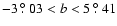 ,
at 45'' spatial resolution sampled every
,
at 45'' spatial resolution sampled every
 and 0.98 km s-1 velocity resolution (1.39 km s-1 for
 )
sampled every 0.81 km s-1.
Recently the OGS data were reprocessed (see
Sect. 2) and a new high-resolution CO cloud catalogue
(Brunt et al. 2003, BKP hereafter) was constructed. The BKP catalogue
provides a concise description of the OGS data and thus facilitates
the comparison of the OGS data with other catalogued data sets. With
the availability of the OGS and the BKP catalogue we were able to
approach the question of IRAS-CO associations from a new direction -
namely we examined all of the IRAS sources within the OGS
region for associated molecular material. The resulting IRAS-CO
association table is presented in this paper and should be of
widespread utility for a number of studies.
)
sampled every 0.81 km s-1.
Recently the OGS data were reprocessed (see
Sect. 2) and a new high-resolution CO cloud catalogue
(Brunt et al. 2003, BKP hereafter) was constructed. The BKP catalogue
provides a concise description of the OGS data and thus facilitates
the comparison of the OGS data with other catalogued data sets. With
the availability of the OGS and the BKP catalogue we were able to
approach the question of IRAS-CO associations from a new direction -
namely we examined all of the IRAS sources within the OGS
region for associated molecular material. The resulting IRAS-CO
association table is presented in this paper and should be of
widespread utility for a number of studies.
In Sect. 2 we first present the data used and the techniques we applied to obtain the IRAS-CO associations. The full table of IRAS-CO associations is provided in the form of an electronic machine-readable table available through the CDS (see Table 1). In an appendix to the paper we explain how one can use the techniques developed for the IRAS-CO comparison to compare any catalogued data set with the OGS-BKP data. Section 3 compares the IRAS-CO associations found in this study to the extensive targeted study of WB89. In Sect. 4 we describe three brief studies which demonstrate the utility of the new IRAS-CO association table. Finally, conclusions are presented in Sect. 5.
As part of the incorporation of the OGS into the Canadian Galactic
Plane Survey (CGPS, Taylor et al. 2003) the original OGS was reprocessed
(Brunt & Ontkean 2003, in preparation). This reprocessing removed
correlated noise signals (see Heyer et al. 1998), suppressed the effects
of unclean reference positions and corrected incorrectly placed
spectra from the first OGS release. The OGS data were convolved
to 100
 44 resolution and converted onto a standard CGPS
coordinate grid prior to release as a CGPS data product.
The typical sensitivity of the
reprocessed OGS data is 0.17 K at 100
44 resolution.
The reprocessed OGS data cubes, along
with all of the other CGPS data sets, are publicly available through
the Canadian Astronomy Data Centre
(CADC).
44 resolution and converted onto a standard CGPS
coordinate grid prior to release as a CGPS data product.
The typical sensitivity of the
reprocessed OGS data is 0.17 K at 100
44 resolution.
The reprocessed OGS data cubes, along
with all of the other CGPS data sets, are publicly available through
the Canadian Astronomy Data Centre
(CADC).
As a cursory inspection of
any of the OGS data cubes will reveal, the CO emission in the outer
Galaxy is highly structured and quite extensive.
To facilitate the comparison of the
OGS data with other large databases a cloud catalogue was constructed
(BKP) that describes the OGS data in terms of discrete lbv
structures (i.e. CO "clouds''). BKP used the 100
44 resolution
data on the original OGS 50
22 grid but after conversion onto
the 0.824 km s-1 CGPS spectroscopic grid. The BKP catalogue was generated
using a two-phase object identification algorithm.
In the first phase, all contiguous lbvstructures consisting of at least 4 voxels over which the
observed radiation temperature exceeded 0.8 K were identified.
The second phase of the algorithm further decomposed these
(sometimes very large) structures into smaller regions of localized
CO emission enhancements, using an enhanced version of the
CLUMPFIND algorithm (Williams et al. 1994).
This procedure leads to a high resolution
discretization of the data which is critical for accurately
associating CO emission with specific sources seen at other wavelengths.
There are 14 592 objects contained in the BKP catalogue.
The IRAS point source catalogue (PSC) was used to obtain positional information on all of the IRAS PSC sources ("IRAS sources'' hereafter) in the OGS survey region. In total there are 6698 IRAS sources in the OGS region of which 4315 have detectable CO along the line of sight as accounted for in the BKP catalogue. Even in the outer Galaxy, the widespread distribution of CO emission means that for any given IRAS source there is a chance that non-associated CO emission could be detected along the line of sight and that multiple emission components along the line of sight will occur. The latter problem was recognized in WB89 and qualitative criteria were developed to determine which of the multiple CO components along the line of sight were more likely associated with the IRAS source. However, since full maps of the CO distribution around the IRAS source position were not available there was no way to quantitatively rank the quality of a given IRAS-CO association.
BKP developed a statistical source association method
that exploits the spatial information in the
OGS in order to discriminate between multiple
CO detections. They examined the frequency
with which 106 randomly chosen
lines of sight within the OGS region coincided
with CO emission incorporated into the BKP
catalogue, and occurred
within an angular offset of  arcminutes
from an object with peak temperature
exceeding
arcminutes
from an object with peak temperature
exceeding  kelvins. From the observed number of associations,
 ,
they defined the expected number of associations,
,
they defined the expected number of associations,
 ,
that would be made towards a random position within
the OGS boundaries:
,
that would be made towards a random position within
the OGS boundaries:

 = 106.
BKP showed that 52% of lines of sight through the
OGS region will encounter CO emission in excess of 0.8 K,
so it is useful to evaluate the quality of an
IRAS-CO association using BKP's derived
= 106.
BKP showed that 52% of lines of sight through the
OGS region will encounter CO emission in excess of 0.8 K,
so it is useful to evaluate the quality of an
IRAS-CO association using BKP's derived  values.
As one would expect, large
- low
"associations'' are
more likely (i.e. have higher )
in the random sample than low
- high
associations. For IRAS sources,
we can examine the spatial offset and peak temperature
of all possible CO associations and assign an
value
accordingly.
Chance associations will generally have high ,
while
the close spatial coincidence (low )
of a cloud
with high
would have low ,
and
indicate a physically interesting association.
values.
As one would expect, large
- low
"associations'' are
more likely (i.e. have higher )
in the random sample than low
- high
associations. For IRAS sources,
we can examine the spatial offset and peak temperature
of all possible CO associations and assign an
value
accordingly.
Chance associations will generally have high ,
while
the close spatial coincidence (low )
of a cloud
with high
would have low ,
and
indicate a physically interesting association.
The OGS data at each IRAS source position was examined for
CO emission that is accounted for by the BKP catalogue.
For each IRAS-CO coincidence, the -
values were determined and an
value
was assigned. For IRAS sources with only one possible
CO association, the
value provides a quantitative
measure of the likelihood of a true association.
Multiple associations along a given line of sight
were ranked by their
value and the
cloud with the lowest
was taken to be the most likely true
IRAS-CO association (see e.g., Fig. 1).
We did not discard the other
possibilities; these were retained in an -ordered
list for each IRAS source.
![\begin{figure}
\par\includegraphics[width=17.8cm,clip]{H4022F1.ps}
\end{figure}](/articles/aa/full/2003/09/aah4022/img29.gif) |
Figure 1:
Multiple CO emission components. The upper left panel shows
the CO spectrum towards IRAS 01522+6611 along with the
ranking
of each of the three components along this line of sight. The other
three panels show the corresponding CO maps at the velocity indicated
above each panel. The white cross indicates the position of IRAS
01522+6611.
values are 0.0065, 0.3454, and 0.4877 for rank 1, 2, and 3 respectively. |
| Open with DEXTER | |
Determining the absolute level of the
values where one would
consider the IRAS-CO association to be true is more ambiguous and will
often vary depending upon the sort of object one is
looking at (e.g. Kerton 2002).
Often additional information can be utilized to help
determine the level at which the majority of the associations are
non-random. Section 4.1 in this paper provides a concrete
example of this for the case of an investigation of candidate zone-of-avoidance
galaxies (ZOAGs).
In addition to the difficulty in establishing a useful absolute
level, there are three sources of confusion in this
scheme. First a "type 0'' error arises when no CO detection is made
towards an IRAS source due to the CO emission being either weak or
very small in extent (e.g., WB89 298, see Sect. 3).
A "type 1'' error arises when a spuriously low
value is assigned to a cloud that is not physically associated with
the IRAS source; this will be of particular concern if a true physical
association with a different cloud is masked. As an example of a type
1 error, consider a true physical association of an IRAS source with a
far outer Galaxy molecular cloud. Since emission from the distant cloud is
often weak, a chance association with a nearby cloud at comparably low
but higher
will result in the nearby cloud achieving
a higher rank in the -ordered list. A "type 2'' error occurs
when a true physical association of an IRAS source and a molecular
cloud is assigned a spuriously high
value. The thresholding scheme used
by BKP identified emission enhancements in the OGS data only if they
were distinguishable from their surroundings by at least 0.8 K. This
threshold is relatively high (4.7 )
compared
with the noise level in the data to avoid inclusion of spurious clouds
in the catalog.
However, such a high threshold can result in lack of precision on
small scales, arising from less pronounced emission enhancements being
incorporated into larger, composite structures; a particular example
of this is given in Sect. 3. Since we retain all possible
IRAS-CO associations in our list, no true associations are discarded
but they may be hidden by the influence of type 1 and 2 errors on the
assigned
and relative rank.
)
compared
with the noise level in the data to avoid inclusion of spurious clouds
in the catalog.
However, such a high threshold can result in lack of precision on
small scales, arising from less pronounced emission enhancements being
incorporated into larger, composite structures; a particular example
of this is given in Sect. 3. Since we retain all possible
IRAS-CO associations in our list, no true associations are discarded
but they may be hidden by the influence of type 1 and 2 errors on the
assigned
and relative rank.
Table 1 contains the main result of this paper - an
ordered list of all the IRAS-CO associations within the OGS.
The first column of the table contains a running number of IRAS-CO
associations followed by the IRAS source name (Cols. 2 and 3),
position in Galactic coordinates (Cols. 4 and 5) and flux density
information (flux densities in Cols. 6-9 for 12, 25, 60
and 100  m respectively; percentage errors for the respective flux
densities in Cols. 10-13). Column 14 indicates if the
following offsets refer to the CO cloud peak or centroid
position. Columns 15 to 21 contain information about the CO cloud. The
CO peak/centroid position in Galactic coordinates and the
m respectively; percentage errors for the respective flux
densities in Cols. 10-13). Column 14 indicates if the
following offsets refer to the CO cloud peak or centroid
position. Columns 15 to 21 contain information about the CO cloud. The
CO peak/centroid position in Galactic coordinates and the
 is
given in Cols. 15-17, followed by the peak temperature (;
Col.
18), the CO temperature at the IRAS source position (Col. 19), the
angular offset between the IRAS position and the CO peak (Col. 20)
and the BKP number of the cloud (Col. 21). The BKP number can be
used to access the BKP catalogue where more detailed information
about the CO cloud can be found. Finally Cols. 22-24 provide the
value
(Col. 22) the relative
ranking (Col. 23) and the WB89
catalogue number if applicable (Col. 24). Note that the WB89 number
is indicated only if CO was detected towards the IRAS source by WB89.
A more detailed description of the format and contents of the
machine-readable table is given in the header of the electronic version.
is
given in Cols. 15-17, followed by the peak temperature (;
Col.
18), the CO temperature at the IRAS source position (Col. 19), the
angular offset between the IRAS position and the CO peak (Col. 20)
and the BKP number of the cloud (Col. 21). The BKP number can be
used to access the BKP catalogue where more detailed information
about the CO cloud can be found. Finally Cols. 22-24 provide the
value
(Col. 22) the relative
ranking (Col. 23) and the WB89
catalogue number if applicable (Col. 24). Note that the WB89 number
is indicated only if CO was detected towards the IRAS source by WB89.
A more detailed description of the format and contents of the
machine-readable table is given in the header of the electronic version.
| This table is available only in electronic form at the CDS |
| http://cdsweb.u-strasbg.fr/cgi-bin/qcat?J/A+A/399/1083 |
Also provided in this paper is a listing of the IRAS sources within the OGS that do not have associated CO as accounted for by the BKP catalogue (see Table 2). The columns in Table 2 are the same as the first 13 columns of Table 1.
| This table is available only in electronic form at the CDS |
| http://cdsweb.u-strasbg.fr/cgi-bin/qcat?J/A+A/399/1083 |
The IRAS-CO association table contains a comprehensive account of the star-forming molecular ISM in the OGS region of the Galaxy that can be examined by itself or as a starting point for other investigations. In the next section we analyze the contents of the table and compare it to the results of the extensive WB89 targeted survey.
It is not the intent of the paper to attempt to examine in detail
every IRAS-CO source in Table 1. Rather in this
section we conduct a general analysis of the objects contained in the
table in terms of their IRAS colours and their
values to give
the reader some appreciation for the overall content. In
Table 3 some basic properties of the IRAS-CO sample
are summarized.
An obvious question that can be raised is how do the results of this
study differ from the targeted WB89 study within the OGS
region? Within the OGS region (completely encompassed by the WB89
survey region) WB89 examined 292 IRAS sources of which 255 had CO
detected along the line of sight. Of the 255 WB89 associations, 244
are matched by a rank = 1 BKP association (96%). In 6 of the
other cases (WB89 200, 287, 321, 376, 392, and 460) the BKP catalogue
does include the WB89 associated CO but we assign it a lower ranking
based upon the relative
values of the various CO clouds along
the line of sight. For the remaining 5 cases (WB89 298, 365, 378,
398, and 439) there is no BKP cloud associated with the WB89 CO
component, because it is either too faint or has too small a spatial
extent (see Sect. 2 of BKP for details of the cloud selection
criteria). For four of these sources (WB89 365, 378, 398, and 439) we
associate, with
 in all cases, another CO cloud along the line
of sight with the IRAS source.
This leaves us with 4061
other IRAS-CO objects to investigate - what are these objects? A
histogram showing the distribution of
values for these objects
is shown in Fig. 2 in comparison with the histogram for the
254 WB89 sources included in the BKP catalogue. The bins for all of the histograms shown in this paper are evenly
distributed in log space from 10-3.5 to 10-0.5.
Clearly some of our 4061 IRAS-CO sources are spurious IRAS-CO
associations as suggested by the much larger high
tail seen in
our sample. However it is also clear that there is a
substantial population of previously unexamined low
value
IRAS-CO sources where a true IRAS-CO association is highly probable.
in all cases, another CO cloud along the line
of sight with the IRAS source.
This leaves us with 4061
other IRAS-CO objects to investigate - what are these objects? A
histogram showing the distribution of
values for these objects
is shown in Fig. 2 in comparison with the histogram for the
254 WB89 sources included in the BKP catalogue. The bins for all of the histograms shown in this paper are evenly
distributed in log space from 10-3.5 to 10-0.5.
Clearly some of our 4061 IRAS-CO sources are spurious IRAS-CO
associations as suggested by the much larger high
tail seen in
our sample. However it is also clear that there is a
substantial population of previously unexamined low
value
IRAS-CO sources where a true IRAS-CO association is highly probable.
What sorts of objects would be missed
by a targeted survey like WB89? The IRAS sources examined in WB89 were
selected to have no upper limits at 25, 60 and 100 m and have
colours typical of star-forming regions:
 ,
,
 ,
and
,
and
 .
The two general categories of IRAS sources that
avoid these criteria are those IRAS sources with no upper limits that
lie outside the WB89 colour cuts, and those IRAS sources with upper limits
at 25, 60 and/or 100 m. The next two subsections investigate
these two subsets in more detail.
.
The two general categories of IRAS sources that
avoid these criteria are those IRAS sources with no upper limits that
lie outside the WB89 colour cuts, and those IRAS sources with upper limits
at 25, 60 and/or 100 m. The next two subsections investigate
these two subsets in more detail.
| Number | Notes |
| 6698 | IRAS sources in the OGS region |
| 4315 | IRAS sources associated with CO emission (IRAS-CO) |
| 2547 | 1 CO component |
| 1237 | 2 CO components |
| 411 | 3 CO components |
| 102 | 4 CO components |
| 17 | 5 CO components |
| 1 | 6 CO components |
| 4025 | CO clouds (from BKP) associated with IRAS sources |
| 384 | IRAS-CO sources with no IRAS upper limits |
| 541 | IRAS-CO sources with one IRAS upper limit |
In total there are 384 IRAS-CO sources (including 214 WB89 sources)
with no IRAS flux density upper limits in any of the four bands.
Figure 3 shows
the distribution of
values for the 170 IRAS-CO objects defined
in this study and the 214 WB89 objects. More of the non-targeted sample is found in the high
bins compared with the targeted WB89 sample; 77% of the
WB89 sample is found in the first four bins compared with 50% for the
non-targeted sample. The number of IRAS-CO sources in the high bins (
 )
is higher for the non-targeted sample (85 objects) compared with the WB89 survey (50 objects). This is due to the targeted nature of the WB89 survey which reduces the number of probably spurious IRAS-CO associations at high .
)
is higher for the non-targeted sample (85 objects) compared with the WB89 survey (50 objects). This is due to the targeted nature of the WB89 survey which reduces the number of probably spurious IRAS-CO associations at high .
![\begin{figure}
\par\includegraphics[width=8.8cm,clip]{H4022F2.eps} \end{figure}](/articles/aa/full/2003/09/aah4022/img36.gif) |
Figure 2:
Histogram showing the distribution of
for IRAS-CO
sources. WB89 sources are shown by the dot-dash line and non-WB89 IRAS-CO
sources are indicated by the solid line. Note the comparable
numbers at low
and the large increase in non-WB89 sources at
higher
presumably due to false IRAS-CO associations. |
| Open with DEXTER | |
![\begin{figure}
\par\includegraphics[width=8.8cm,clip]{H4022F3.eps} \end{figure}](/articles/aa/full/2003/09/aah4022/img37.gif) |
Figure 3:
Histogram for IRAS-CO sources having no IRAS flux density
upper limits. The solid line shows the distribution of
for the 170 IRAS-CO sources defined in this study, and the dot-dash line shows the
214 WB89 sources. |
| Open with DEXTER | |
![\begin{figure}
\par\includegraphics[width=8.8cm,clip]{H4022F4.eps} \end{figure}](/articles/aa/full/2003/09/aah4022/img38.gif) |
Figure 4:
Distribution of objects in the IRAS 12-25-60 m colour
plane. The boxes show the main concentrations of a variety of
different astronomical objects:
a - carbon stars, b - blue planetary nebulae, c - red planetary
nebulae, d - T Tauri stars, e - quasars, f - Seyferts, g - blue
reflection nebulae, h - red reflection nebulae, i - red galaxies, j -
blue galaxies, k - embedded intermediate-mass stars, l - H II
regions. a-j from Walker et al. (1989); k from Kerton (2002), l from
Hughes & MacLeod (1989). |
| Open with DEXTER | |
Since we have four well-defined IRAS fluxes for these objects the IRAS
colours can be used to make a rough identification of the types of objects.
For reference, Fig. 4 shows the main regions of the IRAS
12-25-60 m colour-colour plane occupied by various astronomical
objects. As one can see in most cases the identification cannot be
exact since there can be substantial overlap of objects at a given
position of the plane. In Figs. 5 and 6
we show the positions in the IRAS 12-25-60 m colour-colour plane of the
non-targeted sample of 170 IRAS-CO sources for the various
bins,
along with the applicable WB89 colour constraints shown as solid
lines. There is a population of
objects, especially in the low
bins, that lies in and around the
WB89 colour criteria.
These low
objects are almost
certainly associated with star-forming regions. As
increases
more of the objects move away from the star-forming region area the
colour-colour plane.
![\begin{figure}
\par\includegraphics[width=8.8cm,clip]{H4022F5.eps} \end{figure}](/articles/aa/full/2003/09/aah4022/img40.gif) |
Figure 5:
IRAS 12-25-60 m colour plane. IRAS-CO sources with no IRAS
flux density upper limits and not included in the WB89 study
are plotted for the four lowest
bins. Bins are indicated by the number
in the upper left of each panel: 1-
 ,
2- ,
2-
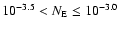 ,
3- ,
3-
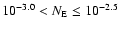 , 4-
, 4-
 .
The solid lines indicate the WB89 colour
criteria representative of star forming regions. .
The solid lines indicate the WB89 colour
criteria representative of star forming regions. |
| Open with DEXTER | |
![\begin{figure}
\par\includegraphics[width=8.8cm,clip]{H4022F6.eps} \end{figure}](/articles/aa/full/2003/09/aah4022/img41.gif) |
Figure 6:
IRAS 12-25-60 m colour plane. As Fig. 5
for the four highest
bins. Bins are indicated by the number
in the upper left of each panel: 5-
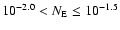 ,
6- ,
6-
 ,
7- ,
7-
 ,
8- ,
8-
 . . |
| Open with DEXTER | |
Since the non-targeted sample was of a manageable size we searched the SIMBAD
database for any known cross-identifications along with any previous
observations and/or detections of the IRAS sources with other tracers. The results of this
search are summarized in Table 4. In the two lowest
bins
the majority of the objects are either unstudied or poorly studied,
however the two known objects are both Galactic - the H II region GLMP 1072 (Garcia-Lario et al. 1997) and the PP1
nebula (Parsamian & Petrosian 1979). As you move to higher
values one starts to see more stellar sources entering the
sample - these are in most cases spurious associations, as will be
discussed below, but there are also a few known Galactic H II regions
in the sample confirming that some true IRAS-CO associations can be found
at the
 level. It is at this level that the first
known extragalactic sources start to appear. If we just take the
objects in the two lowest bins (
level. It is at this level that the first
known extragalactic sources start to appear. If we just take the
objects in the two lowest bins (
 )
as being likely
star-forming regions (because of their low
and the fact
their IR colours are very close to the WB89 colours) we obtain a
sample of 18 new objects, an increase
of 21% over the 84 WB89 sources found in the same two
bins. Alternatively, since most of the non-stellar known
Galactic objects are associated with star forming regions, for each
bin we can use the ratio of the number of known Galactic objects:total
number of known objects to select the same fraction of unknown objects
as likely star forming regions. Doing this we obtain a sample of 55
objects (assuming the
)
as being likely
star-forming regions (because of their low
and the fact
their IR colours are very close to the WB89 colours) we obtain a
sample of 18 new objects, an increase
of 21% over the 84 WB89 sources found in the same two
bins. Alternatively, since most of the non-stellar known
Galactic objects are associated with star forming regions, for each
bin we can use the ratio of the number of known Galactic objects:total
number of known objects to select the same fraction of unknown objects
as likely star forming regions. Doing this we obtain a sample of 55
objects (assuming the
 for both of the lowest
bins), an
increase of 22% over the entire WB89 sample. We note that
while such an analysis does not identify the star-forming regions in
question explicitly it does single out a subsample of IRAS sources
where star forming regions are likely to be discovered and as such can
provide a good starting point for further studies.
for both of the lowest
bins), an
increase of 22% over the entire WB89 sample. We note that
while such an analysis does not identify the star-forming regions in
question explicitly it does single out a subsample of IRAS sources
where star forming regions are likely to be discovered and as such can
provide a good starting point for further studies.
To gain further insight into the range of the quality of the IRAS-CO
associations spanned by this sample we examined the contents of the highest and
lowest
bins in more detail (see Table 5). For the
highest bin (number 8, see Fig. 7) there is one
unambiguous random IRAS-CO association - IRAS 02381+5923 (topmost
point in the Bin 8 panel of Fig. 6) is emission
associated with the galaxy Maffei 2. Inspection of the full catalogue
entry for this object shows that the IRAS-CO association is indeed
very poor - the "associated'' CO is a local cloud (
 )
and the offset between the IRAS coordinates and the CO
position
is
)
and the offset between the IRAS coordinates and the CO
position
is
 .
.
Three of the IRAS-CO sources in Bin 8 are stars, IRAS 02473+5738, IRAS
03008+5637 and IRAS 22197+6028 (the three leftmost points in the Bin 8
panel of Fig. 6). This fact does not immediately
mean that the IRAS-CO association is spurious as CO emission has been
observed towards AGB stars where it originates from an expanding circumstellar
shell of material (Kwok 2000). However, the CO lines associated with
AGB stars are observed to be very broad 30 km s-1 due to the
expansion motions and, since they originate in a circumstellar shell,
very good positional correspondence between the CO peak
position and the IRAS source is expected. IRAS 02473+5738 is a
M2Iab star with a measured radial velocity of -30.9 km s-1. In
this case the CO association is clearly random as the radial
velocity of the associated CO cloud is only -12.2 km s-1. In
addition the CO cloud (BKP 4486) has a linewidth of only
1.54 km s-1. IRAS 03008+5637 is a known M9 AGB star. It has an
"E-type'' IRAS-LRS spectrum where the 9.7 m
silicate dust feature is in emission thus implying the star is an
oxygen-rich AGB with a relatively optically thin circumstellar
envelope (Kwok et al. 1997). The cloud associated with IRAS 03008+5637,
BKP 12070, has a linewidth of only 1.78 km s-1 and thus is also
a spurious association. Finally for IRAS 22197+6028 the
linewidth of the associated CO cloud is again too narrow (3.2 km s-1) to be a believable CO association. We conclude that
all of the stellar CO associations here are spurious.
|
Bina |
Known Objects | Unknown Objects | ||||
| Low | High | Starb | Galacticc | Extragal. | No det.d | Not Studied |
| 10-3.5 | 0 | 0 | 0 | 3 | 3 | |
| 10-3.5 | 10-3.0 | 0 | 2 | 0 | 5 | 7 |
| 10-3.0 | 10-2.5 | 2 | 6 | 1 | 11 | 10 |
| 10-2.5 | 10-2.0 | 4 | 5 | 0 | 11 | 15 |
| 10-2.0 | 10-1.5 | 4 | 3 | 1 | 6 | 13 |
| 10-1.5 | 10-1.0 | 13 | 2 | 0 | 4 | 13 |
| 10-1.0 | 10-0.5 | 10 | 1 | 0 | 6 | 3 |
| 10-0.5 | 3 | 0 | 1 | 1 | 1 | |
| All Bins | 36 | 19 | 3 | 47 | 65 | |
a Bins cover Low
 High.
High. |
||||||
| b Star refers primarily to AGB stars. | ||||||
| c E.g., H II regions, reflection nebulae. | ||||||
| d Examined for other gas tracers but no detections made. |
![\begin{figure}
\par\includegraphics[width=17.9cm,clip]{H4022F7.ps} \end{figure}](/articles/aa/full/2003/09/aah4022/img48.gif) |
Figure 7:
Maps of CO emission for the IRAS-CO sources having no flux
density upper limits and
 (Bin 8). The greyscale shows CO
emission (K) in the peak channel (the
(km s-1) for the
channel is indicated in parentheses above each panel). The white
crosses indicate the position of the IRAS source identified above each panel.
(Bin 8). The greyscale shows CO
emission (K) in the peak channel (the
(km s-1) for the
channel is indicated in parentheses above each panel). The white
crosses indicate the position of the IRAS source identified above each panel. |
| Open with DEXTER | |
The remaining two sources, IRAS 00040+6645 and IRAS 03118+6058, are
more curious. IRAS 03118+6058 (lowest point in the Bin 8 panel of
Fig. 6) was examined by Wouterloot et al. (1993) for H2O, OH,
CH3OH emission with no detections. There is no 21 cm
continuum emission visible in CGPS images of the region. DSS images of
the object show that there is nothing exactly at the position of the IRAS
source but the carbon star Kiso C5- 65 (Maehara & Soyano 1991) is just within the
error ellipse of the position of IRAS 03118+6058 (
 at
68
at
68
 ). Based upon the highly negative
 colour and
the proximity of a known carbon star, we conclude that IRAS 03118+6058 is
the carbon star Kiso C5- 65 and that the IRAS-CO association
is spurious. Finally, IRAS 00040+6645 falls within the WB89
12-25-60 m colour criteria and has associated extended Midcourse
Space Experiment (MSX, Price et al. 2001) Band A (8.3 m)
emission (see Fig. 8). The associated CO cloud has
colour and
the proximity of a known carbon star, we conclude that IRAS 03118+6058 is
the carbon star Kiso C5- 65 and that the IRAS-CO association
is spurious. Finally, IRAS 00040+6645 falls within the WB89
12-25-60 m colour criteria and has associated extended Midcourse
Space Experiment (MSX, Price et al. 2001) Band A (8.3 m)
emission (see Fig. 8). The associated CO cloud has
 km s-1 which is consistent with it being associated
with the nearby Sh 2-171 region (Yang & Fukui 1992). We conclude this object
is a photodissociation region (PDR) found at the edge of a CO
cloud related to Sh 2-171. This object is a good example of
the "type 2'' error (a false high )
discussed previously in
Sect. 2. As is clear in Fig. 8 the
associated CO cloud has peaks. The contrast between the two peaks is
very low however and the algorithm did not break the cloud into
separate structures. Since the IRAS source position is then compared
to the more distant maximum peak of the cloud a large
value
results. We expect this sort of error to occur primarily in some of
the local, more extended, clouds. At larger distances a cloud such as
this one would be a much more compact object and the
would
be significantly smaller.
km s-1 which is consistent with it being associated
with the nearby Sh 2-171 region (Yang & Fukui 1992). We conclude this object
is a photodissociation region (PDR) found at the edge of a CO
cloud related to Sh 2-171. This object is a good example of
the "type 2'' error (a false high )
discussed previously in
Sect. 2. As is clear in Fig. 8 the
associated CO cloud has peaks. The contrast between the two peaks is
very low however and the algorithm did not break the cloud into
separate structures. Since the IRAS source position is then compared
to the more distant maximum peak of the cloud a large
value
results. We expect this sort of error to occur primarily in some of
the local, more extended, clouds. At larger distances a cloud such as
this one would be a much more compact object and the
would
be significantly smaller.
| IRAS | Notes | |
|
|
03062+5742 | 0 references |
| 03083+5618 | WBF93 - no detection | |
| 22451+5906 | WBF93, WWH88, WW86 - no det. | |
| 22460+6341 | 0 references | |
| 23089+5914 | WWH88, WW86 - no detection | |
| 23369+6142 | 0 references | |
|
|
00040+6645 | 0 references , Kiso C5-65 |
| 02381+5923 | Maffei 2 galaxy | |
| 02473+5738 | HD 237010 M2Iab star | |
| 03118+6058 | WBF93 - no detection, PDR | |
| 03008+5637 | M9 AGB star | |
| 22197+6028 | V662 Cep - S star | |
WBF93 |
Wouterloot et al. (1993) - H2O, OH, CH3OH | |
| WWH88 | Wouterloot et al. (1988) - NH3 | |
| WW86 | Wouterloot & Walmsley (1986) - H2O. | |
In contrast, now consider the six objects found in the low bin (see Fig. 9). In this case the SIMBAD search reveals
no other known cross-identifications. Three of the sources have not
been investigated before and the other three have been examined for a
variety of high density gas tracers but with no detections. Inspection
of the IRAS colour-colour plots show that all of these objects are
very close to the original WB89 colour criteria and just missed being
included in their sample. Given their position in the colour-colour
plane and the very good association with CO they most likely represent
a sample of star-forming regions. The lack of detections in the high
density gas tracers suggest they may be slightly evolved regions.
Four of the objects, IRAS 22451+5906, IRAS 22460+6341,
IRAS 23089+5914, and IRAS 03083+5618 have been identified as likely
embedded intermediate-mass stars (Kerton 2002).
![\begin{figure}
\par\includegraphics[width=8.8cm,clip]{H4022F8.ps} \end{figure}](/articles/aa/full/2003/09/aah4022/img53.gif) |
Figure 8:
IRAS 00040+6645 and Sh 2-171. Greyscale shows 21-cm radio
continuum emission (K) from the eastern portion of Sh 2-171. MSX
Band A (8.3 m) emission (black contours at 1.5 and
 W m-2 sr-1) and integrated CO emission (white
contours at 5 and 7 K km s-1; integrated from -9.3 to -15.1 km s-1 (
)) are overlayed. The position of
IRAS 00040+6645 is indicated by the cross, and the centroid of the
associated CO cloud is indicated by the asterisk. The location of the
IRAS source at the edge of the CO cloud and the H II region
suggests that it is a PDR. W m-2 sr-1) and integrated CO emission (white
contours at 5 and 7 K km s-1; integrated from -9.3 to -15.1 km s-1 (
)) are overlayed. The position of
IRAS 00040+6645 is indicated by the cross, and the centroid of the
associated CO cloud is indicated by the asterisk. The location of the
IRAS source at the edge of the CO cloud and the H II region
suggests that it is a PDR. |
| Open with DEXTER | |
The remainder of the sample (3931 IRAS-CO sources) have
a flux density upper limit in at least one of the IRAS bands, this
includes 40 sources with upper limits in the IRAS 12 m band
included in the WB89 sample. Table 6 summarizes the
distribution of this sample.
![\begin{figure}
\par\includegraphics[width=18cm,clip]{H4022F9.ps} \end{figure}](/articles/aa/full/2003/09/aah4022/img54.gif) |
Figure 9:
IRAS-CO sources with no IRAS flux density upper limits and
.
The white crosses indicate the position of each
IRAS source. The greyscale shows the CO emission (K) in the peak
channel, and the velocity of the channel (
(km s-1)) is
shown in parentheses above each panel. |
| Open with DEXTER | |
bins that there is potentially a very large number of
interesting objects in this sample. For this paper we will limit our
analysis to the 68 sources in the
bin. We first
queried the SIMBAD database
for these 68 sources. Seven of the IRAS sources were previously known
objects - three H II regions, one reflection nebula, and three
star-forming cores. Twenty-one of the objects had been included in
other surveys for dense gas tracers but with no detections, and 40 of the IRAS sources had not been studied at all beyond their
catalogue identification.
|
Bina |
||||
| Low | High | Non-Targeted | WB89 | Total |
| 10-3.5 | 68 | 0 | 68 | |
| 10-3.5 | 10-3.0 | 110 | 3 | 113 |
| 10-3.0 | 10-2.5 | 272 | 5 | 277 |
| 10-2.5 | 10-2.0 | 468 | 5 | 473 |
| 10-2.0 | 10-1.5 | 739 | 6 | 745 |
| 10-1.5 | 10-1.0 | 988 | 11 | 999 |
| 10-1.0 | 10-0.5 | 992 | 10 | 1002 |
| 10-0.5 | 254 | 0 | 254 | |
| All Bins | 3891 | 40 | 3931 | |
|
a Bins cover Low
High. |
Because of the upper limits on the IRAS flux densities one cannot use
the IRAS colour-colour plane to effectively look at the
sources. However if we limit ourselves only to those objects with a
single flux density upper limit then some progress can be made.
Objects with upper limits at either 12 or 100 m can be
unambiguously placed on the 25-60-100 or 12-25-60 colour plane
respectively. On the other colour plane one colour can be fixed while
the other will be a limit. The situation is somewhat more poor for
sources with only upper limits at either 25 or 60 m. In this case
the source will have a limit in both colors and the allowed position
of the point will be along a diagonal line in the colour-colour plane
- not ideal but at least certain regions of the plane can be eliminated.
For the 68 very low
sources, 19 have a single upper limit: 3 at
12 m, 4 at 60 m, and 12 at 100 m. Table 7
shows details of the objects based upon the results of a SIMBAD query
and Fig. 10 shows this subsample of IRAS-CO sources in
both IRAS colour planes. Examining the 12-25-60 m plane in more
detail we see that 11 of the 12 sources with good colours in this
plane (i.e., with 100 m upper limits) lie within the WB89 region
and the other source is just outside of the WB89 region. Eight of the
objects are known to be associated with star forming regions and we
think it is highly likely that all twelve of these objects are associated with
star-forming regions. One of the 3 12 m upper limit sources lies
within the WB89 region and all of these sources have
 colours consistent with the WB89 criteria. Given their close
association with CO it is likely these are also all
associated with star-forming regions. The sources with 60 m upper
limits are slightly harder to interpret. Unfortunately there are no known
cross-identifications for these objects, but all of them could be
associated with star formation if the upper limits are not too far off
the true flux densities.
colours consistent with the WB89 criteria. Given their close
association with CO it is likely these are also all
associated with star-forming regions. The sources with 60 m upper
limits are slightly harder to interpret. Unfortunately there are no known
cross-identifications for these objects, but all of them could be
associated with star formation if the upper limits are not too far off
the true flux densities.
| IRAS | Limita | Notesb |
| 00206+6555 | 100 | UCHII region - BNM96 CS(2-1) det. |
| 02157+6053 | 100 | K01 - submm sources |
| 02227+6127 | 100 | K02 - embedded B star |
| 02570+6028 | 100 | CHS00 - embedded cluster |
| 03054+6407 | 100 | |
| 22111+5845 | 100 | S00 - no det. |
| 22163+5555 | 100 | K02 - embedded B star |
| 22333+5744 | 100 | K02 - embedded B star |
| 23033+5951 | 100 | UCHII region - BNM96 CS(2-1) det. |
| 23140+6042 | 100 | WWH88, WW86 - no det |
| 23377+6059 | 100 | |
| 23483+6325 | 100 | K02 - embedded B star |
| 22510+6153 | 60 | WBF93, WWH88, WW86 - no det. |
| 22521+6205 | 60 | WBF93, WWH88, WW86 - no det. |
| 00153+6532 | 60 | |
| 03116+5951 | 60 | |
| 00510+6550 | 12 | |
| 02366+5845 | 12 | WBF93 no det. |
| 02499+5752 | 12 |
a IRAS band ( m) with flux
density upper limit. |
||
| b Blank indicates unstudied object; | ||
| BNM96 - Bronfman et al. (1996), | ||
| K01 - Kerton et al. (2001), | ||
| K02 - Kerton (2002), | ||
| S00 - Szymczak et al. (2000), | ||
| other abbreviations as in Table 5. |
The 25-60-100 m colour plane confirms these observations. There
is not much of a surprise with the 100 m upper limit sources
since we already knew that they had
colours consistent
with WB89. We see that all of these sources could lie within or close
to the WB89 region, again depending upon the true
value of the 100 m flux density. One of the 3 12 m upper limit
sources lies inside of the WB89 region and the other two lie just
outside of the region and could again easily be star forming regions. As
with the other colour plane the identity of the 60 m upper limit
sources depends critically upon how far off the upper limit is from the true
60 m flux density.
![\begin{figure}
\par\includegraphics[width=8.8cm,clip]{H4022F10.eps}
\end{figure}](/articles/aa/full/2003/09/aah4022/img56.gif) |
Figure 10:
IRAS colour-colour planes showing IRAS-CO sources with
and one IRAS flux
density upper limit. The solid lines show the WB89 colour criteria
representative of star forming regions. Arrows indicate the effect of
the single flux density upper limit on the IRAS colour. |
| Open with DEXTER | |
As mentioned in Sect. 2 there are 2383 IRAS sources in the OGS that are not associated with any CO emission as accounted for in the BKP catalogue. Because of the lack of associated CO we expect that most of these sources will either be stars or extragalactic sources. This idea is supported when one examines the average flux densities of the associated and non-associated IRAS sample (see Table 8). The average flux densities for the non-associated IRAS sample are significantly lower than the IRAS-CO sample.
Of the non-associated IRAS sources, only 41 have good IRAS
colours in all four IRAS bands and thus can be placed on the IRAS
colour plane unambiguously. Figure 11 shows these 41
objects on the 12-25-60 m IRAS colour plane. A search of SIMBAD
reveals that 15 of the objects are stars, and 2 are known planetary
nebulae. Also, even though a number of these objects occupy regions of
the colour-colour plane consistent with star forming regions, the
SIMBAD search reveals no known star forming regions in this sample.
These objects are most likely galaxies or red reflection nebulae (see
Fig. 4). For the former we do not expect to observe
associated CO in the
range of the survey while the latter
objects are fairly evolved objects where a CO association is not
highly probable. In this region of the colour-colour plane the lack
of associated CO is thus a very useful means to remove the degeneracy
present in the IRAS colour identification. Section 4.1
provides an example of using the presence or lack of a CO association
to clarify the true nature of an object.
| Average Flux Density | ||
| IRAS Band | IRAS-CO Samplea | No CO Associationb |
|
<F12> |
 |
 |
| <F25> |
 |
 |
| <F60> |
 |
 |
| <F100> |
 |
 |
| a 4315 IRAS sources. | ||
| b 2383 IRAS sources. | ||
| c standard error of the mean. |
![\begin{figure}
\par\includegraphics[width=8.8cm,clip]{H4022F11.eps} \end{figure}](/articles/aa/full/2003/09/aah4022/img65.gif) |
Figure 11:
IRAS sources with no flux density upper limits and no CO
associations. Many of the objects plotted in this 12-25-60 m
colour plane are obviously stellar objects where one does not expect
associated CO. For objects near and within the WB89 colour criteria
(shown as the solid lines) the lack of CO emission indicates that the
objects are most likely not star forming regions in
our Galaxy. |
| Open with DEXTER | |
In this section we present the results of three studies that made extensive use of the IRAS-CO association table (Table 1). The purpose of this section is twofold - first it will give the reader a sense of how Table 1 can be utilized in practice, and second it presents some interesting results from our initial application of the table to some astronomical studies.
The Galactic zone-of-avoidance (ZOA) is the low galactic latitude
portion of the sky where extinction due to dust in our Galaxy makes
the optical detection of galaxies very difficult. A common, and
surprisingly productive, way to detect galaxies in this region is to
visually inspect the Palomar Observatory Sky Survey (POSS) plates for
non-stellar objects at low galactic latitude. As a result of such
studies there now exists a large compilation of optically identified
zone-of-avoidance galaxies (ZOAGs) in the literature
(Weinberger et al. 1999; Seeberger & Saurer 1998, and references therein). It has been recognized though
that the observed nebulosities cannot be easily differentiated from
Galactic nebulosities (Weinberger et al. 1999) thus the possibility that the ZOAG
identification is spurious is more likely when there is an associated
IRAS source (expected for a Galactic star forming region). To investigate the
occurrence of false ZOAG identifications we compiled a list of all of
the ZOAGs with IRAS sources contained in the OGS survey region. From
this list we looked at which of the ZOAGs had associated CO. In total
there are 56 ZOAGs with IRAS associations in the OGS region. Each of
the objects was investigated using SIMBAD to determine if there was
any more information on the object beyond the optical identification
on the POSS plates. We found that 17 of the ZOAGs had another
identification; four of the ZOAGs were definitively shown to be Galactic
regions and 13 of the ZOAGs were definitively shown to be
extra-galactic (primarily from a measured H I velocity). This extra piece
of information allowed us to calibrate the
values for the
remaining objects. All of the known Galactic objects have
 while all of the known extra-galactic objects have
 (see Table 9).
Of the remaining 39 objects (see Tables 10 and 11), 12 have no CO
associations and thus we conclude they are good ZOAG candidates.
The remaining 27 objects with CO associations were sorted by
.
Seven of these putative ZOAGs
had
and are probably Galactic nebulae, while 17 ZOAGs had
and are probably correctly identified as
extragalactic objects. Three of the
objects fell between these two limits defined by the known object
sample. While their
values tend to be closer to the Galactic
sample we looked for further information from other datasets to help
decide if the objects were Galactic or not.
First we looked at whether or not the 56 ZOAGs were MSX Band A (8.3 m) sources and if they had any
associated 21 cm radio continuum emission using the continuum images
from the CGPS. All of the known Galactic
sources were strong MSX sources with no 21 cm continuum emission
except for some weak emission from the distant H II region IRAS
02421+6233. In contrast all of the known extragalactic sources have
associated 21cm continuum emission and all but one (the nearby
Maffei 2 galaxy) have either no or very weak MSX Band A emission.
This criterion (no MSX but 21 cm continuum emission) is seen in
all but one of the 17 probable extragalactic sources lending weight to the
conclusion that these objects are indeed extragalactic. The pattern is
also seen in most of the 12 objects that had no CO association to start with
and thus were automatically assumed to be extragalactic. The three
intermediate
sources have MSX and 21 cm continuum emission
properties consistent with them being Galactic objects.
In summary, of the 56 original ZOAGs 14 (25%) of them are Galactic
objects (4 previously known, 10 identified as such from the analysis), and 42 (75%) of them are extragalactic (13 previously
known and 29 identified in this
analysis).
| ZOAG | IRAS | BKP | |
MSX | C21 | Notes |
| Galactic | ||||||
| 131.86+01.33 | 02071+6235 | 10684 | 0.0028 | Y | N | H II Region (1) |
| 135.63+02.77 | 02421+6233 | 10578 | 0.0009 | Y | Y | H II Region (1) |
| 136.39+02.27 | 02461+6147 | 7537 | 0.0003 | Y | N | -42.4 (2) |
| 118.97+01.89 | 00117+6412 | 6687 | 0.0002 | Y | N | -36.2 (2) |
| Extragalactic with CO association | ||||||
|
136.50-00.33 |
02381+5923 | 12354 | 0.4952 | Y | Y | -17, Maffei 2 |
| 132.78+03.68 | 02217+6430 | 11399 | 0.3833 | N | Y | +12145 (3) |
| 129.83+03.28 | 01542+6500 | 11733 | 0.2389 | N | Y | +10493 (3) |
| 134.22+04.05 | 02354+6418 | 11680 | 0.1590 | N | Y | +5306 (3) |
| 136.27-01.91 | 02317+5801 | 12271 | 0.1267 | N | Y | +5650, Wein 20 (4) |
| 133.83+03.40 | 02297+6351 | 11872 | 0.1228 | N | Y | +4202 (3) |
| 138.96+02.66 | 03067+6055 | 12924 | 0.0921 | Y(weak) | Y | +2350 (5) |
| 127.05-02.58 | 01211+5946 | 13339 | 0.0663 | N | Y | +17678 (3) |
| 107.13+03.41 | 22287+6137 | 2088 | 0.0253 | Y (weak) | Y | +3503 (6) |
| Extragalactic without CO association | ||||||
|
129.64+02.58 |
01509+6423 | ... | ... | N | Y | +10461 (3) |
| 130.20+03.90 | 01591+6531 | ... | ... | N | Y | +9593 (3) |
| 135.64+02.43 | 02410+6215 | ... | ... | Y (weak) | Y | +13191 (1) Seyfert 1 |
| 138.52-00.11 | 02530+5843 | ... | ... | N | Y | Dwingeloo 1 |
| (1) - Rudolph et al. (1996). | ||||||
| (2) - Bronfman et al. (1996), CS(2-1) LSR velocity shown. | ||||||
| (3) - Nakanishi et al. (1997), redshift (cz, in km s-1) shown. | ||||||
| (4) - Pfleiderer et al. (1981), redshift (cz, in km s-1) shown. | ||||||
| (5) - Hau et al. (1995), redshift (cz, in km s-1) shown. | ||||||
| (6) - Weinberger et al. (1995), redshift (cz, in km s-1) shown. |
| ZOAG | IRAS | BKP | |
MSX | C21 | Notes |
| No CO Association - Probable Extragalactic | ||||||
|
102.24-01.89 |
22184+5432 | ... | ... | N | Y | Wein 7 (1) |
| 124.21-02.87 | 00585+5942 | ... | ... | N | N | ... |
| 129.90-01.32 | 01455+6031 | ... | ... | N | Y | ... |
| 131.18+03.40 | 02068+6445 | ... | ... | N | N | ... |
| 131.42+05.27 | 02146+6627 | ... | ... | ... | Y | ... |
| 131.48+02.72 | 02075+6401 | ... | ... | N | Y | ... |
| 135.90-02.25 | 02280+5751 | ... | ... | N | Y | ... |
| 137.17-02.92 | 02348+5644 | ... | ... | N | N | ... |
| 139.52+04.53 | 03189+6213 | ... | ... | N | Y | ... |
| 141.52+02.97 | 03256+5949 | ... | ... | N | Y | ... |
| 141.85+04.95 | 03370+6115 | ... | ... | N | Y | ... |
| 141.96-02.65 | 03061+5450 | ... | ... | N | Y | ... |
|
CO Association - Probable extragalactic from
value |
||||||
| 134.02+04.67 | 02359+6457 | 11606 | 0.5307 | N | Y | ... |
| 131.32+04.61 | 02115+6552 | 11749 | 0.4935 | N | Y | ... |
| 140.41-00.39 | 03046+5733 | 12063 | 0.4813 | N | Y | ... |
| 133.19+02.76 | 02222+6330 | 11422 | 0.4493 | N | Y | ... |
| 125.95+02.72 | 01170+6509 | 11765 | 0.3921 | N | Y | ... |
| 123.99+04.29 | 00590+6652 | 11301 | 0.3444 | N | Y | ... |
| 129.98+04.96 | 01599+6636 | 11216 | 0.3042 | N | Y | ... |
| 133.39+04.10 | 02283+6440 | 11345 | 0.2862 | N | Y | ... |
| 129.93+03.60 | 01559+6518 | 11697 | 0.2528 | N | Y | ... |
| 139.30+04.83 | 03188+6236 | 12987 | 0.2410 | N | Y | ... |
| 125.73-02.19 | 01111+6018 | 13334 | 0.2012 | N | N | ... |
| 138.24+04.06 | 03074+6230 | 13181 | 0.1748 | N | Y | ... |
| 121.84-02.76 | 00397+5949 | 5954 | 0.1532 | N | Y | ... |
| 115.43+05.10 | 23319+6633 | 11157 | 0.1418 | N | Y | ... |
| 126.16-00.37 | 01159+6203 | 13272 | 0.0740 | Y (weak) | Y | ... |
| 135.92-01.66 | 02299+5823 | 12277 | 0.0563 | N | Y | ... |
| 138.62-00.86 | 02510+5759 | 7866 | 0.0338 | N | Y | ... |
| (1) - Pfleiderer et al. (1981). |
| ZOAG | IRAS | BKP | |
MSX | C21 | Notes |
|
CO Association - Probable Galactic from
value |
||||||
| 130.17+00.49 | 01511+6213 | 8175 | 0.0140 | Y | N | ... |
| 116.77+01.56 | 23527+6328 | 9536 | 0.0089 | Y | N | Wein 8 (1) |
| 137.06+03.12 | 02546+6214 | 8779 | 0.0050 | Y (weak) | Y (weak) | ... |
|
CO Association - Galactic from
value |
||||||
| 139.97+02.59 | 03134+6021 | 8437 | 0.0027 | Y | N | ... |
| 134.27-01.90 | 02175+5845 | 8120 | 0.0026 | Y | N | ... |
| 130.29+01.65 | 01546+6319 | 9296 | 0.0023 | Y | Y (weak) | Wein 17 (1) |
| 118.44+01.25 | 00080+6329 | 7063 | 0.0019 | Y | N | Wein 9 (1) |
| 133.88+02.53 | 02272+6302 | 6403 | 0.0009 | Y | N | ... |
| 118.63-00.40 | 00117+6153 | 8501 | 0.0005 | Y | N | |
| 137.24+05.36 | 03054+6407 | 6073 | 0.0002 | ... | N | ... |
| (1) - Pfleiderer et al. (1981). |
The study of molecular clouds and star formation in the far outer
Galaxy is
intriguing as it allows us to examine a region of the Galaxy
with different properties (metallicity, pressure) than our local
region. It is not within the scope of this paper to perform a detailed
analysis of all of the far outer Galaxy molecular clouds within the
OGS so for purposes of illustration we will restrict the analysis to
those clouds with
 km s-1. Over the range of the OGS this
corresponds to Galactocentric distances ranging from >20 kpc at the
high longitude end to 16 kpc at the low longitude end
(e.g., see Fig. 4 of Heyer et al. 1998). We find a total of 24 BKP
clouds meeting this criteria, five of which have associated IRAS
sources. Included in this sample are Clouds 1 and 2 of Digel et al. (1994)
and the molecular cloud associated with WB89 288, mapped in various CO
lines by Brand & Wouterloot (1994). In Table 12 we list the basic
properties of the clouds and Fig. 12 shows some
representative images of the BKP clouds. Most of the more massive
clouds in our sample have associated IRAS sources and thus have been
previously investigated; however, BKP 10873 appears to be a previously
unexamined large far outer Galaxy molecular cloud with
km s-1. Over the range of the OGS this
corresponds to Galactocentric distances ranging from >20 kpc at the
high longitude end to 16 kpc at the low longitude end
(e.g., see Fig. 4 of Heyer et al. 1998). We find a total of 24 BKP
clouds meeting this criteria, five of which have associated IRAS
sources. Included in this sample are Clouds 1 and 2 of Digel et al. (1994)
and the molecular cloud associated with WB89 288, mapped in various CO
lines by Brand & Wouterloot (1994). In Table 12 we list the basic
properties of the clouds and Fig. 12 shows some
representative images of the BKP clouds. Most of the more massive
clouds in our sample have associated IRAS sources and thus have been
previously investigated; however, BKP 10873 appears to be a previously
unexamined large far outer Galaxy molecular cloud with
 .
There is clearly sufficient mass in this object that
star-formation is certainly possible and BKP 10873 would make a
worthwhile target for further higher resolution and sensitivity
observations in both the millimeter and infrared.
.
There is clearly sufficient mass in this object that
star-formation is certainly possible and BKP 10873 would make a
worthwhile target for further higher resolution and sensitivity
observations in both the millimeter and infrared.
| BKP |
 a a |
lb | bb |
 |
|
 c c |
 c c |
Md | Notes |
 |
|
(km s-1) | (K) | (kpc) | (kpc) | (103  ) ) |
|||
| 10872 | 86 | 114.338 | 0.780 | -101.22 | 3.54 | 11.8 | 17.15 | 2 | IRAS 23338+6207 WB89 288 |
| 10873 | 37 | 114.212 | 0.836 | -102.05 | 1.83 | 12.0 | 17.32 | 10 | |
| 10877 | 5 | 131.162 | 1.394 | -101.22 | 1.09 | 15.3 | 21.85 | 0.2 | D94 Cloud 1 |
| 10878 | 27 | 109.288 | 2.078 | -101.22 | 1.72 | 11.7 | 16.67 | 0.7 | |
| 10879 | 5 | 107.726 | 2.943 | -101.05 | 1.01 | 11.8 | 16.51 | 0.1 | |
| 10880 | 6 | 105.243 | 3.012 | -100.22 | 1.02 | 11.7 | 16.17 | 0.1 | |
| 10881 | 10 | 137.286 | -1.159 | -101.22 | 1.21 | 19.7 | 26.58 |
0.6 | assoc. with D94 Cloud 2 |
| 10882 | 7 | 114.282 | 0.655 | -101.22 | 1.13 | 11.9 | 17.24 | 0.2 | |
| 10883 | 7 | 123.489 | 1.478 | -102.05 | 1.04 | 13.1 | 19.15 | 0.2 | |
| 10884 | 4 | 121.690 | 2.050 | -101.22 | 1.01 | 12.6 | 18.54 | 0.1 | |
| 10885 | 74 | 137.760 | -0.963 | -103.70 | 2.83 | 21.5 | 28.37 |
8 | D94 Cloud 2, IRAS 02450+5816 = YSO
B star (KT00) |
| 10886 | 27 | 137.774 | -1.061 | -102.87 | 1.83 | 20.9 | 27.79 |
2 | D94 Cloud 2, IRAS 02447+5811 = PDR (KT00) |
| 10887 | 4 | 122.289 | 1.687 | -102.87 | 1.01 | 13.0 | 18.96 | 0.1 | |
| 10888 | 18 | 122.373 | 1.771 | -102.87 | 1.14 | 13.0 | 18.96 | 0.5 | |
| 10889 | 16 | 104.991 | 3.305 | -102.87 | 1.97 | 12.1 | 16.49 | 0.5 | IRAS 22143+6023 |
| 10890 | 34 | 123.364 | 1.659 | -103.70 | 1.37 | 13.4 | 19.42 | 1 | |
| 10891 | 6 | 122.345 | 1.924 | -102.87 | 0.98 | 13.2 | 19.15 | 0.2 | |
| 10892 | 36 | 121.815 | 3.054 | -104.52 | 1.35 | 13.2 | 19.10 | 1 | |
| 10893 | 6 | 122.736 | 2.371 | -104.52 | 1.01 | 13.6 | 19.55 | 0.2 | |
| 10894 | 5 | 122.750 | 2.454 | -104.52 | 1.02 | 13.5 | 19.46 | 0.1 | |
| 10895 | 13 | 122.778 | 2.524 | -106.99 | 1.91 | 14.3 | 20.21 | 0.6 | |
| 10896 | 8 | 117.588 | 3.961 | -106.17 | 1.16 | 13.1 | 18.63 | 0.2 | |
| 10897 | 4 | 118.146 | 3.417 | -106.99 | 0.96 | 13.4 | 18.96 | 0.1 | |
| 10898 | 9 | 116.723 | 3.543 | -107.82 | 1.27 | 13.3 | 18.73 | 0.3 | IRAS 23482+6524 |
| a Total number of lbv pixels in the cloud. | |||||||||
| b Refers to CO cloud peak. | |||||||||
c Kinematic distances using
 kpc and kpc and
 km s-1.
 |
|||||||||
d Calculated using
 (Strong & Mattox 1996).
 |
|||||||||
e Smartt et al. (1996) suggest 15 kpc <
 kpc. kpc. |
|||||||||
| D94 - Digel et al. (1994); KT00 - Kobayashi & Tokunaga (2000). |
Of particular interest are two distant CO clouds that have associated
IRAS sources and have not been previously studied (see
Fig. 12). IRAS 22143+6023 is associated with BKP 10889 and has a
kinematically derived Galactocentric distance of
 kpc. The IRAS-CO association is very good with
 ,
and the cloud is the only significant CO emission along this line of
sight. The IRAS flux densities are low as one would expect for a
distant source: 0.22, 0.25, 1.45 and 14.27 Jy at 12, 25, 60 and
100 m respectively. While there are upper limits at 25 and
100 m, the 12 and 60 m flux densities do indicate that the
spectrum is rising into the far-infrared. We thus identify IRAS
22143+6023 as a new far outer Galaxy star forming region.
,
and the cloud is the only significant CO emission along this line of
sight. The IRAS flux densities are low as one would expect for a
distant source: 0.22, 0.25, 1.45 and 14.27 Jy at 12, 25, 60 and
100 m respectively. While there are upper limits at 25 and
100 m, the 12 and 60 m flux densities do indicate that the
spectrum is rising into the far-infrared. We thus identify IRAS
22143+6023 as a new far outer Galaxy star forming region.
![\begin{figure}
\par\includegraphics[width=18cm,clip]{H4022F12.ps} \end{figure}](/articles/aa/full/2003/09/aah4022/img83.gif) |
Figure 12: Far outer Galaxy molecular clouds with and without IRAS sources. Each panel shows CO emission at the peak emission channel of the cloud (indicated in parentheses above each panel). Contours are also CO emission at the following levels: BKP 10890 - 1, 2, and 3 K; BKP 10873 - 2, 4, and 6 K; BKP 10898 - 1 and 2 K; BKP 10889 - 1, 2, and 4 K. In the two right-hand panels the crosses indicate the position of the associated IRAS source: IRAS 23482+6524 for BKP 10898, and IRAS 22143+6023 for BKP 10889. |
| Open with DEXTER | |
IRAS 23482+6524 is another possible far outer Galaxy star forming
region. In this case there are no IRAS flux density upper limits and
the spectrum is rising through to 100 m: 0.37, 0.35, 4.04, and 32.16 Jy
at 12, 25, 60 and 100 m respectively. The association with
BKP 10898 has an
of 0.0035. There is also another possible CO
association at -60 km s-1 but with a very high
 .
.
In brief, our initial exploration of the BKP catalog and the IRAS-CO association table has led to the discovery of two new candidate far outer Galaxy star forming regions and a large distant molecular cloud that shows no signs of massive star formation.
 K. This is a
very small subset of the CO clouds we find in the outer
Galaxy. Of the 14592 BKP CO clouds only 120 (0.8%) have
K and, of these, 114 (95%) have IRAS associations at the
K. This is a
very small subset of the CO clouds we find in the outer
Galaxy. Of the 14592 BKP CO clouds only 120 (0.8%) have
K and, of these, 114 (95%) have IRAS associations at the
 (111 clouds) or
 (three clouds) level. This is clearly a special
population as only 28% of the entire BKP sample have associated IRAS
sources at any rank. The properties of the six very bright clouds with
no IRAS sources are tabulated in Table 13. The cloud
masses range from a few hundred to a few thousand .
(three clouds) level. This is clearly a special
population as only 28% of the entire BKP sample have associated IRAS
sources at any rank. The properties of the six very bright clouds with
no IRAS sources are tabulated in Table 13. The cloud
masses range from a few hundred to a few thousand .
A careful examination of the positions of these sources reveals that
they are not randomly distributed in the OGS region, rather we find
that these objects are found at the edges of H II regions and are
thus associated with PDRs. BKP 7782 is found at the edge of the large
W4 continuum loop, BKP 11016 and 11018 are both found at the edge of
the western part of Sh 2-171, BKP 13900 is on the edge of Sh
2-159, BKP 12547 is near Sh 2-155 and BKP 12127 is near
Sh 2-140 (FG S140 18) (Falgarone & Gilmore 1991). High resolution (20'') MSX
Band A images were inspected to search for any signs of point-like
infrared emission. In all six cases none was found; rather, clearly
elongated structures associated with the ionized-molecular gas
interface were seen. We suggest that these six clouds are CO
clouds that are being externally heated by the nearby H II region
and do not have an internal source of heat as would be suggested by
the presence of an IRAS point source. We note that if
is
substantially raised in this manner then the masses in
Table 13 will be overestimates of the true mass. The location
of these clouds, at the edge of various H II regions, makes
them ideal targets to examine the earliest stages of star
formation induced by the expansion of H II regions.
We have investigated the association of all of the IRAS sources contained within the OGS survey region with molecular material.
(1) Since we do not apply any constraints to the IRAS sources we have
discovered a substantial number of previously unexamined IRAS
sources that are likely to be star forming regions. For IRAS
sources with no flux density upper limits we estimate that there
are 55 IRAS sources not previously identified as possible star
forming regions. This is an increase of 22% over previous
targeted CO surveys towards IRAS sources in the OGS.
(2) By investigating the association of random lines of sight with CO
emission in the OGS we were able to provide a quantitative means
to judge the likelihood that any given IRAS-CO association is
valid and to disentangle multiple emission components along the
line of sight. The
table presented in this paper can be used
as the basis of, or the starting point for, a number of
investigations as demonstrated in Sect. 4.
(3) Our investigation of ZOAGs with associated IRAS sources has shown that about 25% of ZOAGs with IRAS associations are probably Galactic nebulae.
(4) Two new candidate far outer Galaxy star forming regions have been
identified from an examination of those IRAS-CO sources associated
with CO emission at
km s-1.
(5) Six bright CO clouds with no associated IRAS sources have been identified. All of these clouds appear to be associated with PDRs and are thus ideal targets for the investigation of the earliest stages of triggered star formation associated with H II regions.
(6) The techniques developed here to construct the IRAS-CO association
table can be applied to any catalogued dataset. In the appendix we
provide instructions and the necessary data to do this. We believe these
techniques will only increase in applicability in the future with
the continuing expansion of molecular line surveys and the increase
in the number of large on-line catalogues of Galactic surveys.
| BKPa | l | b |
|
|
Maj. | Min. | FWHM | b |
Mc |
| (
) |
(
) |
(km s-1) | (K) | (') | (') | (km s-1) | (kpc) | (103 ) |
|
| 7782 | 135.221 | -0.015 | -44.33 | 10.46 | 5.10 | 2.88 | 1.91 | 2.0 | 0.5 |
| 11016 | 117.937 | 4.854 | -14.65 | 13.97 | 5.66 | 3.65 | 3.98 | 1.3 | 0.4 |
| 11018 | 118.104 | 4.686 | -16.30 | 11.08 | 3.59 | 3.36 | 2.16 | 1.5 | 0.2 |
| 12127 | 107.140 | 4.965 | -7.24 | 11.18 | 11.12 | 4.84 | 2.27 | 0.9 | 0.3 |
| 12547 | 109.860 | 2.203 | -9.71 | 11.11 | 6.02 | 5.12 | 2.33 | 1.0 | 0.3 |
| 13900 | 111.785 | 0.362 | -54.23 | 12.58 | 8.12 | 3.88 | 3.41 | 3.0 | 5.0 |
|
a All cloud properties except
and M are from the BKP catalogue. |
|||||||||
| b Based upon association with H II region. | |||||||||
| c Calculated using
(Strong & Mattox 1996). |
![\begin{figure}
\par\includegraphics[width=18cm,clip]{H4022F13.ps} \end{figure}](/articles/aa/full/2003/09/aah4022/img88.gif) |
Figure 13: Bright CO clouds with no associated IRAS sources. Greyscale shows 21 cm radio continuum emission (K) from the CGPS; contours show CO emission in the peak channel (at 2, 6, and 10 K, peak channel velocity is shown in parentheses above each panel), and crosses indicate the CO cloud peak position. All of the clouds are found close to known H II regions as indicated above each panel. |
| Open with DEXTER | |
Acknowledgements
The Canadian Galactic Plane Survey is a Canadian project with international partners, and is supported by the Natural Sciences and Engineering Research Council (NSERC).
This research has made use of the SIMBAD database, operated at CDS, Strasbourg, France.
C.B. is supported by a grant from NSERC.
 values to other catalogues
Obviously the IRAS catalogue is only one data set that can be compared
with the distribution of molecular material in the outer Galaxy as
seen in the OGS. To facilitate the comparison of other data sets with
the OGS data we provide here a machine-readable table containing values for -
pairs at  and 0.5 K spacing
respectively. This table is a subset of the data used to create the
contour plots in BKP (see their Fig. 17). We have
used two different ways to associate a given object with a CO
cloud. First, there is the technique we used in this paper to
determine IRAS-CO associations (the "on cloud'' method). This tests
the chosen position to see if there is emission associated with CO
clouds along the line of sight. As this requires access to the OGS
data and the data cube defining the extent of each cloud we have
developed an alternative association method that makes use only of
data tabulated in the BKP catalogue - the "in box'' method. In this
case the chosen position is examined to see if it falls within a box
that defines the lb boundaries of the CO clouds. As was demonstrated
in Sect. 5 of BKP although the specific values of
are
different the results of analyses using either technique are similar.
and 0.5 K spacing
respectively. This table is a subset of the data used to create the
contour plots in BKP (see their Fig. 17). We have
used two different ways to associate a given object with a CO
cloud. First, there is the technique we used in this paper to
determine IRAS-CO associations (the "on cloud'' method). This tests
the chosen position to see if there is emission associated with CO
clouds along the line of sight. As this requires access to the OGS
data and the data cube defining the extent of each cloud we have
developed an alternative association method that makes use only of
data tabulated in the BKP catalogue - the "in box'' method. In this
case the chosen position is examined to see if it falls within a box
that defines the lb boundaries of the CO clouds. As was demonstrated
in Sect. 5 of BKP although the specific values of
are
different the results of analyses using either technique are similar.
| This table is available only in electronic form at the CDS |
| http://cdsweb.u-strasbg.fr/cgi-bin/qcat?J/A+A/399/1083 |
Column 1 of Table A.1 is the peak CO temperature of
the cloud
given in steps of 0.5 K; Col. 2 contains the offset
between the objects position and the CO cloud position
given in steps of ,
Col. 3 contains the
value if you are
using the "in box'' technique, and Col. 4 contains
the
value for the "on cloud'' technique. To use the table,
determine first if a given object is associated with any CO (using
either the "in box'' or "on cloud'' technique). If there is an
association use the BKP catalogue to obtain a -
pair
and use the table to obtain an
value for the association. To
obtain
values at -
values not listed we recommend
that the user linearly interpolates in log space. Variation in is very smooth so this should be sufficiently accurate.