A&A 399, 337-342 (2003)
DOI: 10.1051/0004-6361:20021785
Testing general relativity by micro-arcsecond global astrometry
A. Vecchiato 1,3,4
- M. G. Lattanzi 2
- B. Bucciarelli 2
- M. Crosta 2,3,4
- F. de Felice 1,3,4
- M. Gai 2
1 - Istituto di Fisica "G. Galilei'', Via Marzolo 8, 35100 Padova, Italy
2 - INAF, Osservatorio Astronomico di Torino, 10025 Pino Torinese TO, Italy
3 - Istituto Nazionale di Fisica Nucleare (INFN), Sezione di Padova
4 - Centro per gli Studi e le Attività Spaziali "G. Colombo'' (CISAS), Padova
Received 24 October 2002 / Accepted 27 November 2002
Abstract
The global astrometric observations of a GAIA-like
satellite were modeled within the PPN formulation of
Post-Newtonian gravitation. An extensive experimental campaign
based on realistic end-to-end simulations was conducted to
establish the sensitivity of global astrometry to the PPN
parameter  ,
which measures the amount of space curvature
produced by unit rest mass. The results show that, with just a few
thousands of relatively bright, photometrically stable, and
astrometrically well behaved single stars, among the
,
which measures the amount of space curvature
produced by unit rest mass. The results show that, with just a few
thousands of relatively bright, photometrically stable, and
astrometrically well behaved single stars, among the  109 objects that will be observed by GAIA,
can be estimated
after 1 year of continuous observations with an accuracy of
10-5 at the
109 objects that will be observed by GAIA,
can be estimated
after 1 year of continuous observations with an accuracy of
10-5 at the  level. Extrapolation to the full 5-year mission
of these results based on the scaling properties of the adjustment procedure
utilized suggests that the accuracy of
level. Extrapolation to the full 5-year mission
of these results based on the scaling properties of the adjustment procedure
utilized suggests that the accuracy of 
 ,
at the same
level,
can be reached with 106 single stars, again chosen as the most astrometrically stable
among the millions available in the magnitude range V=12-13.
These accuracies compare quite favorably with recent findings of scalar-tensor
cosmological models, which predict for
a present-time
deviation,
,
at the same
level,
can be reached with 106 single stars, again chosen as the most astrometrically stable
among the millions available in the magnitude range V=12-13.
These accuracies compare quite favorably with recent findings of scalar-tensor
cosmological models, which predict for
a present-time
deviation,
 ,
from the General
Relativity value between 10-5 and 10-7.
,
from the General
Relativity value between 10-5 and 10-7.
Key words: astrometry - relativity - gravitation - space vehicles: instruments
Since General Relativity's (GR) first appearance, many alternative
gravity theories have been proposed. Experiments were then needed not
only to test the validity of GR against Newton's theory, but also every
alternative theory of gravity against all the others (Will 1993,
2001).
The Parametrized Post-Newtonian formalism (PPN) takes the slow-motion,
post-Newtonian limit of all the metric theories and exploits their
similarities to give them a unique, coherent framework by introducing a
set of 10 PPN parameters. Each theory is then characterized by a particular
value for each of the PPN parameters.
The validity of the post-Newtonian expansion is confined to those
physical situations in which the energy density, regardless to its
specific form, is small. Considering the various physical cases,
this means that gravity fields (U), velocities (v), pressure
to matter density ratios ( ), and internal specific energy
densities
), and internal specific energy
densities  ,
are all small quantities so that (Ciufolini
& Wheeler 1995; Will 1993)
,
are all small quantities so that (Ciufolini
& Wheeler 1995; Will 1993)
where
 is the "smallness parameter''. The
slow-motion hypothesis also implies that, for any quantity A,
its time derivative is much smaller than its space derivative, so
that (Misner et al. 1973)
is the "smallness parameter''. The
slow-motion hypothesis also implies that, for any quantity A,
its time derivative is much smaller than its space derivative, so
that (Misner et al. 1973)
this makes the PPN framework particularly convenient for Solar
System experiments (where e.g.
 ).
Each experiment allows one to measure the values of some PPN
parameters, so that the theories that do not match those values
are ruled out.
).
Each experiment allows one to measure the values of some PPN
parameters, so that the theories that do not match those values
are ruled out.
The most investigated among the PPN parameters are
and  ,
which measure respectively the amount of space-curvature
produced by unit rest mass and the amount of non-linearity in the
superposition law of gravity.
,
which measure respectively the amount of space-curvature
produced by unit rest mass and the amount of non-linearity in the
superposition law of gravity.
In GR the parameters
and
are both equal to 1, while other theories aiming at the
formulation of a unified theory predict small deviations from the GR value. The most promising of
such theories consider the existence of a scalar field which, along with the usual metric tensor,
participates in the generation of gravity. For this reason, such theories are usually called scalar-tensor theories. As a consequence, the value of
predicted by the scalar-tensor
theories of gravity deviates from 1, and it is generally an adjustable value. Moreover, Damour &
Nordtvedt (1993) showed that scalar-tensor cosmological models contain a sort of
attractor mechanism toward GR. In practice the value of
changes with time and, whatever
the value at the birth of the universe, it tends to 1 as
 .
The present-time value of
.
The present-time value of
 (i.e. its deviation from GR) depends on the efficiency of the attractor mechanism,
and Damour and Nordtvedt calculate a value between 10-5 and 10-7. More recently,
Damour et al. (2002a,b) have given a new estimation of
,
within the framework compatible with string theory and modern cosmology, which basically confirms
the previous result
(i.e. its deviation from GR) depends on the efficiency of the attractor mechanism,
and Damour and Nordtvedt calculate a value between 10-5 and 10-7. More recently,
Damour et al. (2002a,b) have given a new estimation of
,
within the framework compatible with string theory and modern cosmology, which basically confirms
the previous result![[*]](/icons/foot_motif.gif) .
.
Although optical astrometry provided the first direct test of
GR by measuring the amount of light bending due to
the gravitational pull of the Sun (Dyson et al.
1920), observing conditions from the ground have severely limited
the possibility of this technique to contribute to the search for
a scalar component of gravity. Radio astrometry has been able to
achieve significantly better results, however it is again the
observing conditions (especially the effects of ionosphere and
troposphere) which are ultimately limiting its accuracy in
measuring gravitational light deflection from the ground. Presently, is known to an accuracy of
10-3-10-4 (Will 2001), therefore
well above the level necessary to detect the scalar component
predicted by Damour and Nordtvedt.
The success of the mission Hipparcos has proven that going into
space is the way for increasing the accuracy of astrometric
measurements to more interesting values. By utilizing the
measurements of Hipparcos, Froeschlé et al. (1997; see also Mignard
2001) were able to derive
with an accuracy comparable to
that of the best radio experiment (Lebach et al. 1995). Therefore,
expectations are that the micro-arcsec ( -arcsec) accuracy
targeted by the space missions SIM, approved by NASA, and GAIA,
approved by ESA, will be able to measure
with a precision
of 10-5-10-6 (Danner & Unwin 1999) or
better (ESA 2000; de Felice et al. 2000),
positioning optical astrometry at the fore front of experimental
gravitation.
-arcsec) accuracy
targeted by the space missions SIM, approved by NASA, and GAIA,
approved by ESA, will be able to measure
with a precision
of 10-5-10-6 (Danner & Unwin 1999) or
better (ESA 2000; de Felice et al. 2000),
positioning optical astrometry at the fore front of experimental
gravitation.
In this article we focus our attention on the GAIA project, a
space astrometry mission that has recently been confirmed as a
Cornerstone mission of the ESA program of scientific satellites.
GAIA is expected to be launched not later than 2012, with a
possible window of opportunity in 2010. For this reason ESA has
devised a mission implementation plan that will be able to cope
with a 2010 launch.
GAIA is a scanning astrometric satellite which builds on the
successful concept of the Hipparcos mission, but with
order-of-magnitude improvements in, e.g., the number of objects
observed and measurement precision. It will be essential for the
scientific advancement in many branches of astronomy, and
especially in the fields of stellar astrophysics and galactic
astronomy (Perryman et al. 2001). Here we report on the
first thorough attempt at determining the accuracy with which GAIA
could measure the parameter .
This is done through a
realistic end-to-end simulation which considers the satellite most
relevant modes of observation, the relativistic environment in
which such observations take place, and the expected single-measurement errors.
Using the Eddington-Robertson form of the PPN formalism (where only the parameters
and
are considered),
we have developed a model based on the assumptions that the only
source of gravity is a spherical and non-rotating Sun and the
observer is moving on a circular orbit. This scenario is
consistent with that discussed in our previous papers (de Felice
et al. 1998, 2001; hereafter Papers I and II, respectively), where a non-perturbative approach was
developed as a first attempt at modeling the GAIA observations in
a rigorous relativistic environment. Therefore, the results discussed in
this paper can directly be compared with the findings reported in
those earlier works.
Under the above hypotheses the PPN metric becomes (Misner et al.
1973)
![$\displaystyle {\rm d}s^{2}= -\left[ 1 - 2\frac{M}{r} + 2\beta \left( \frac{M}{r...
...2}\left( {\rm d}\theta ^{2} + \sin ^{2}\theta ~ {\rm d}\phi ^{2}\right) \right]$](/articles/aa/full/2003/07/aa3222/img29.gif) |
|
|
(1) |
where r,  ,
and
,
and  are spherical coordinates centered
on the Sun, t is coordinate time, and M is the geometrized mass
of the Sun.
are spherical coordinates centered
on the Sun, t is coordinate time, and M is the geometrized mass
of the Sun.
As observable we consider the cosine of the angle  between two stars; it can be expressed as
 |
(2) |
where
 and
and
 are the
four-velocities of the photons reaching the observer (i.e. the
four-vectors tangent to the photons' null-geodesics) and
are the
four-velocities of the photons reaching the observer (i.e. the
four-vectors tangent to the photons' null-geodesics) and
 is a
tensor which projects to the rest frame of the observer, i.e., the GAIA satellite. Here
is a
tensor which projects to the rest frame of the observer, i.e., the GAIA satellite. Here
 and
and
 are the space-time metric and the observer's
four-velocity, respectively.
are the space-time metric and the observer's
four-velocity, respectively.
As expected, the expression we found for the four-velocities of
the photons
 depends on both
and ;
then, they could be made part of the data reduction process as
unknown parameters, in addition to those describing position and
velocity of the stars. However,
enters the
as a second order term compared to
(see also
Eq. (1)); therefore, it was decided not to
consider
in the derivation of the observation equations
(see below) but to set it to 1, namely to its value in GR.
depends on both
and ;
then, they could be made part of the data reduction process as
unknown parameters, in addition to those describing position and
velocity of the stars. However,
enters the
as a second order term compared to
(see also
Eq. (1)); therefore, it was decided not to
consider
in the derivation of the observation equations
(see below) but to set it to 1, namely to its value in GR.
Following the method developed in Papers I and II, and after a lengthy
calculation, we then obtained the linearized observation equation as
function of the astrometric parameters (i.e., angular coordinates,
parallaxes, and proper motions), and of
in the form (Vecchiato
2000)
where the coefficients are derived from the differentiation of the
right-hand side of Eq. (2) with respect to each of the
unknowns.
As in Paper II, parallax and (angular) proper motions are defined as
here  is the Earth's mean orbital radius, r is the
coordinate radial distance of the star from the Sun and t is the
coordinate time.
is the Earth's mean orbital radius, r is the
coordinate radial distance of the star from the Sun and t is the
coordinate time.
The simulation follows the procedure used in the previous
non-perturbative works (Papers I and II), the main change being the
presence of the new unknown
that modifies the design
matrix of the system of condition equations.
First, we generate the set of true quantities, which define initial location and temporal
evolution of the stellar positions on the celestial sphere and the true value of .
This
was set to its GR value, i.e.,
 .
The corresponding catalog values
are calculated, as usual, by adding suitable root-mean-square (rms) errors to the true values. Next,
we find the stellar pairs which can be observed by a satellite that sweeps the sky following a
Hipparcos-like scanning law. Once the stellar pairs are known the true angular distances (from the
true coordinates) are calculated, and the satellite observations are generated by perturbing these
true arcs with the observational error in Table 1. The catalog arcs (from the
catalog coordinates) are also computed at this stage. Only arcs joining stars lying in different
fields of view (FOVs) were counted without degeneration.
.
The corresponding catalog values
are calculated, as usual, by adding suitable root-mean-square (rms) errors to the true values. Next,
we find the stellar pairs which can be observed by a satellite that sweeps the sky following a
Hipparcos-like scanning law. Once the stellar pairs are known the true angular distances (from the
true coordinates) are calculated, and the satellite observations are generated by perturbing these
true arcs with the observational error in Table 1. The catalog arcs (from the
catalog coordinates) are also computed at this stage. Only arcs joining stars lying in different
fields of view (FOVs) were counted without degeneration.
The result of these two steps is the generation of the measured quantity,
 ,
and of the coefficients in Eq. (3) for the construction of the linearized condition
equations for all of the pairs observed during the mission lifetime we decided to simulate. Finally,
the least-squares solution of the system is found by means of a conjugate-gradient method, suitable
for large and sparse matrices like ours, and the errors are computed by direct comparison
to the true values.
,
and of the coefficients in Eq. (3) for the construction of the linearized condition
equations for all of the pairs observed during the mission lifetime we decided to simulate. Finally,
the least-squares solution of the system is found by means of a conjugate-gradient method, suitable
for large and sparse matrices like ours, and the errors are computed by direct comparison
to the true values.
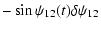
The least-squares solution returns the estimates of the adjustments to the catalog values of the
unknowns in Eq. (3), i.e.,
 ,
,
 ,
,
 ,
,
 ,
,
 ,
and
,
and
 .
For the
adjustment to the
parameter, the corresponding rms error is indicated with the symbol
.
For the
adjustment to the
parameter, the corresponding rms error is indicated with the symbol
 .
Notice that this error is the same as the error of ,
.
Notice that this error is the same as the error of ,
 ,
as
,
as
 ,
where
,
where
 is the simulated catalog
value of the deflection parameter. The symbols
and
are both
used in the reminder of this article.
is the simulated catalog
value of the deflection parameter. The symbols
and
are both
used in the reminder of this article.
Before going into the details of our experimental campaign it is
useful to show, through a simple order-of-magnitude calculation,
what kind of accuracy can be expected for
with GAIA-like
observations. This calculation starts from the consideration that
the satellite measurements for the estimation of
can be
thought of as "Eddington-like'' measurements of very high precision
but with the stars at some tens of degrees from the solar limb.
Each observation contributes to the determination of
with a
precision of
 . If N is the number of
such observations, the final accuracy will be approximately
. If N is the number of
such observations, the final accuracy will be approximately
 .
For a period of,
say, 1.5 years of continuous operations and 6500 of the stars in
the magnitude range V=12-13 mag, GAIA would provide (see below)
about 450 000 observations, thus
.
For a period of,
say, 1.5 years of continuous operations and 6500 of the stars in
the magnitude range V=12-13 mag, GAIA would provide (see below)
about 450 000 observations, thus
 .
In the calculation above we have disregarded the facts that the geometry
of the GAIA observations is different (the gravitational deflection
is "seen" through its differential effect along the arcs joining the star
pairs) and that
is not the only unknown to be estimated. Therefore,
that value of
is clearly representative of a best case scenario, and
it is used only for comparison in the following discussion.
.
In the calculation above we have disregarded the facts that the geometry
of the GAIA observations is different (the gravitational deflection
is "seen" through its differential effect along the arcs joining the star
pairs) and that
is not the only unknown to be estimated. Therefore,
that value of
is clearly representative of a best case scenario, and
it is used only for comparison in the following discussion.
The simulation campaign was split in two parts. The first part was
devoted to test the new code written for the PPN model and to make
sure that the results were compatible with those in Papers I and II, and with the empirical prediction for
derived above. The second set
of experiments was destined to establish the relation describing
the GAIA sensitivity to
as function of the number of
stars. Such a relation can then be used to make predictions on the
accuracy of
for any given number of stars.
Table 1 lists the values of the input parameters
which were common to all of the simulation runs. The main difference with our
earlier work is in the single-observation error
 ,
which
is set here to 10 arcsec. This is the value expected for the error of
one arc joining pairs of equal-magnitude stars, approximately 5 mag
brighter than those utilized in our previous experiments, i.e.,
,
which
is set here to 10 arcsec. This is the value expected for the error of
one arc joining pairs of equal-magnitude stars, approximately 5 mag
brighter than those utilized in our previous experiments, i.e.,  mag.
The 10-arcsec error is compatible with current estimates of the GAIA error
budget for stars brighter than V=12-13 (ESA 2000).
mag.
The 10-arcsec error is compatible with current estimates of the GAIA error
budget for stars brighter than V=12-13 (ESA 2000).
As for the
parameter, the starting (catalog) value for the PPN
parameter is generated from the true value by adding an error of
 ,
which is comparable with current best estimates.
,
which is comparable with current best estimates.
The new code was tested on different sets of 50 simulations,
and each Monte-Carlo set was run with the same values of the input parameters to have
statistically significant results. The results of this series of experiments is
summarized in Table 2.
The first row is representative of the runs with a "static sphere", i.e., the ideal situation where all the
stars have no intrinsic motions and are located at such a large (infinite) distance that the
parallactic motion due to the observer is also null. In this case, the location on the celestial sphere
of the simulated stars is completely specified by their angular coordinates (
and ).
Therefore, each linearized observation equation, Eq. (3), has only five unknowns,
the four corrections to the angular coordinates of each star pair, and the adjustment to the parameter.
The second row presents the results of the simulations with a "dynamical sphere", i.e., the case
where the stars move with time. For simplicity, only the parallax motion was simulated; the stars
were generated within a uniform density sphere of 500 pc centered on the Sun, i.e., with parallaxes
 mas (200 times the measurement error), and, as for the static case, with no intrinsic
(cosmic) motion. Notice that the mission duration was increased to 2 years. According to the findings
in Paper II, this is the minimum observation period required for a reliable reconstruction of the
dynamical parameters.
mas (200 times the measurement error), and, as for the static case, with no intrinsic
(cosmic) motion. Notice that the mission duration was increased to 2 years. According to the findings
in Paper II, this is the minimum observation period required for a reliable reconstruction of the
dynamical parameters.
As expected, the true errors of the astrometric parameters given in Table 2 compare quite
well with what was obtained in Papers I and II after taking into account the differences in the values
of Q and the factor of 10 in measurement errors, consistent with the 5-mag difference of the stars
considered in the new experiments. In particular, the results reported in the last row of Table 2 of Paper II,
reproduce very closely what shown in our Table 2 for a mission duration of T=2 years.
Of much greater interest is the fact that the errors of
after the sphere reconstructions shown
in Table 2 are considerably close to the best-case value of
 derived
at the onset of this section (see also Table 4 in de Felice et al. 2000).
derived
at the onset of this section (see also Table 4 in de Felice et al. 2000).
This encouraging result brought us to consider a new set of simulations with the intent to study the
accuracy of
for larger samples of stars. Indeed, the all-sky survey nature of the GAIA
observations ensures that all of the objects in the magnitude range of interest will be observed during
the operational life of the satellite. This means that, although the actual number will considerably reduce
because of the stringent requirements on the intrinsic astrometric stability of the sources, millions of
potential targets will be available for the " experiment".
Unfortunately, the computing power needed to perform a data reduction simulation of such a size is beyond
our present resources, therefore we had to resort to an alternative schema to find the desired answer.
We generated 11 simulations of a static sphere, each consisting, as before, of 50 runs with the same initial
conditions and the mission duration set to 1 yr. The number of stars was increased from n*=5000 to the
maximum extent possible, i.e., n*=15000. The results are listed in Table 3.
A single simulation, of the 50 comprising each Monte-Carlo set, yields one value of the difference
 (true
(true  minus estimated );
each simulation is then a measure of
minus estimated );
each simulation is then a measure of  affected only by random errors, and the sample of
50
affected only by random errors, and the sample of
50
 's has a Gaussian distribution. The standard deviation of this distribution,
,
is the measure of the error on
of each Monte-Carlo group of
simulations (Table 3). For example, if a difference of
's has a Gaussian distribution. The standard deviation of this distribution,
,
is the measure of the error on
of each Monte-Carlo group of
simulations (Table 3). For example, if a difference of
 from
the GR value,
from
the GR value,
 ,
is measured for
with an error of
,
is measured for
with an error of
 ,
this would be interpreted as a 5-
,
this would be interpreted as a 5- detection of a
deviation from General Relativity.
detection of a
deviation from General Relativity.
![\begin{figure}
\par\includegraphics[angle=-90,width=8.8cm,clip]{MS3222f1.eps}\end{figure}](/articles/aa/full/2003/07/aa3222/Timg111.gif) |
Figure 1:
Number of
observations versus number of stars. The solid curve represents the interpolated law
 ,
k=0.0071264. ,
k=0.0071264. |
| Open with DEXTER |
Figure 1 shows the relation
we derived from
interpolating the data in Table 3. Also, simple statistical considerations suggest
to fit the results in Cols. 2 and 3 of Table 3 to the
 relation, and the result is shown in
Fig. 2.
relation, and the result is shown in
Fig. 2.
![\begin{figure}
\par\includegraphics[angle=-90,width=8.8cm,clip]{MS3222f2.eps}\end{figure}](/articles/aa/full/2003/07/aa3222/Timg113.gif) |
Figure 2:
versus number of observations. The solid curve represents the fit
to the relation
 , ,
 . . |
| Open with DEXTER |
We are now in a position to make realistic predictions on the
error of
for a much larger number of stars
(observations), comparable to the size of the stellar
sample expected to be surveyed by the satellite at the magnitude
limit of interest here. For 106 stars (
 observations), the value of
estimated from the curve in Fig. 2 is
observations), the value of
estimated from the curve in Fig. 2 is
 .
This means that a 1 yr-long GAIA-like mission could measure a
value of
.
This means that a 1 yr-long GAIA-like mission could measure a
value of
 for
,
which would then represent
a
detection of the deviation of the actual gravitation from GR.
And at the end of the satellite lifetime, after 5 years of continuous observations,
the sensitivity to a
detection will further improve by a
factor of
for
,
which would then represent
a
detection of the deviation of the actual gravitation from GR.
And at the end of the satellite lifetime, after 5 years of continuous observations,
the sensitivity to a
detection will further improve by a
factor of
 to
.
These numbers imply that GAIA could reach the lower bound of the interval of possible deviations
predicted by Damour & Nordtvedt (1993) and by Damour et al.
(2002b).
to
.
These numbers imply that GAIA could reach the lower bound of the interval of possible deviations
predicted by Damour & Nordtvedt (1993) and by Damour et al.
(2002b).
A Monte-Carlo experiment analogous to those above but with the relevant mission parameters set to
the values of the Hipparcos mission was also conducted. We deemed it as quite important to compare our
findings to the work of Froeschlé et al. (1997), who attempted the first direct determination
of
by means of the global astrometric data taken with the Hipparcos satellite.
Indeed, this would add confidence on the ability of our simulation to make realistic predictions on
the possibility to derive a very accurate value for
with GAIA.
As "reference" experiment we adopted the case with 44 000 stars in Table 1 of Froeschlé et al.
(1997), which resulted in an error on the deflection parameter of
 .
.
We first simulated
n*=15 000 stars and an observing period of 1 year; the observational
and catalog errors were set to the values used in the Hipparcos experiments, i.e.,
 milli-arcsec and
 ,
respectively. The analysis of the usual 50 Monte-Carlo runs resulted in
.
We then scaled this value to the duration of the
Hipparcos mission, 3 yr, and to the number of observations expected for 44 000 stars
(from the empirical law in Fig. 1); this yielded
,
respectively. The analysis of the usual 50 Monte-Carlo runs resulted in
.
We then scaled this value to the duration of the
Hipparcos mission, 3 yr, and to the number of observations expected for 44 000 stars
(from the empirical law in Fig. 1); this yielded
 .
.
That our experiment resulted in a much better value of
should not come as a
surprise, simply because we put ourselves in a more favorable situation: the instrument and
satellite attitude were both assumed perfect in the simulation. In particular, having assumed a
perfect astrometric instrument (optics, focal plane, and detectors) we disregarded any possible
unmodeled systematic effect that could bias the estimation of ,
e.g., effects which would
mimic a parallax zero-point error, as it has been the case for Hipparcos (Lindegren et al. 1992;
Froeschlé et al. 1997). In fact, in the observation equation derived from the
reduction model used in the Hipparcos
experiment, one can see that the unknown which represents
the parallax zero-point (common to all stars) is strongly correlated with the
parameter.
It can be shown that, for the Hipparcos mission parameters, such correlation amounts
to
 (Mignard 2001). A correlation of this magnitude, in turn, increases
the error in the estimate of
by a factor of
(Mignard 2001). A correlation of this magnitude, in turn, increases
the error in the estimate of
by a factor of
 . Therefore, the simulated "replica" of the
Hipparcos experiment is to be considered consistent within a factor of 1.5,
and not a factor of 4, with the published results based on the real data; quite an encouraging
agreement given the quasi-ideal assumptions of our simulation.
. Therefore, the simulated "replica" of the
Hipparcos experiment is to be considered consistent within a factor of 1.5,
and not a factor of 4, with the published results based on the real data; quite an encouraging
agreement given the quasi-ideal assumptions of our simulation.
The global astrometric observations of a GAIA-like satellite were modeled within the PPN formulation
of Post-Newtonian gravitation. Although simplified (a spherical and non-rotating Sun is the
only source of gravity), this PPN model has allowed, through extensive end-to-end simulations,
a realistic evaluation of GAIA's sensitivity to the direct estimation of the light deflection
parameter. The results show that the satellite could measure
to 10-7( )
after 5 years of continuous observations, and using a subset of approximately
106 stars chosen as the most astrometrically stable among the millions available in the
magnitude range V=12-13 of the GAIA survey. Notice that after just one full year of observations
could be estimated with an error only a factor of
)
after 5 years of continuous observations, and using a subset of approximately
106 stars chosen as the most astrometrically stable among the millions available in the
magnitude range V=12-13 of the GAIA survey. Notice that after just one full year of observations
could be estimated with an error only a factor of  worse than the value above.
A comparison with the Hipparcos results has provided a way to gauge the degradation factor to be expected
in going from an ideal instrument to the real astrometric payload and satellite. The factor of 1.5 we found
in that case is very encouraging; however, moving from the "milli-" to the "micro-"arcsec regime
required by GAIA, the degradation might become larger. Future work will have to deal with the fact that
the accuracy of 10-7 sets a goal for both the observational model, which will have to include
all the details and the implications of Solar System gravitation, and instrument development and
modeling, which will have to concentrate in identifying and, possibly, remove (through hardware
improvements and/or calibration procedures), all relevant systematic error sources.
This work has provided quantitative evidence that the micro-arcsecond global astrometry of GAIA appears
capable of testing general relativity to unprecedented levels. It will do so directly by accurately
measuring the amount of light bending produced by gravity; a modern rendition, about a century
later, of the experiment of Dyson, Eddington, and Davidson, then the first proof of Einstein's theory.
Acknowledgements
We thank the referee for the valuable comments and for pointing us to the more recent
literature.
Work partially supported by the Italian Space Agency (ASI) under contracts ASI I/R/32/00 and ASI
I/R/117/01, and by the Italian Ministry for Research (MIUR) through the COFIN 2001 program.
-
Ciufolini, I., & Wheeler, J. A. 1995, Gravitation and Inertia (Princeton
Series in Physics)
In the text
-
Danner, R., & Unwin, S. 1999, SIM: Space Interferometry
Mission. Taking the Measure of the Universe
In the text
-
Damour, T., & Nordtvedt, K. 1993, Phys. Rev. Lett., 70, 2217
In the text
NASA ADS
-
Damour, T., Piazza, F., & Veneziano, G. 2002a, Phys. Rev. Lett., 89, 081601
In the text
-
Damour, T., Piazza, F., & Veneziano, G. 2002b, Phys. Rev. D, 66, 046007
In the text
-
de Felice, F., & Clarke, C. J. S. 1990, Relativity on curved manifolds
(Cambridge University Press)
-
de Felice, F., Lattanzi, M. G., Vecchiato, A., & Bernacca, P. L. 1998,
A&A, 332, 1133 (Paper I)
In the text
NASA ADS
-
de Felice, F., Vecchiato, A., Bucciarelli, B., Lattanzi, M. G., & Crosta, M.
2000, IAU Colloq. 180, ed. K. Johnston, D. D. McCarthy, B. J. Luzum,
& G. H. Kaplan, 314
In the text
-
de Felice, F., Bucciarelli, B., Lattanzi, M. G., & Vecchiato, A. 2001,
A&A, 373, 336 (Paper II)
In the text
NASA ADS
-
Dyson, F. W., Eddington, A. S., & Davidson, C. 1920,
Philo. Trans. of the Royal Society of London 220A, 291
NASA ADS
-
ESA 2000, GAIA: Composition, Formation and Evolution of
the Galaxy, Technical Report ESA-SCI(2000)4 (scientific
case on-line at In the text
http://astro.estec.esa.nl/GAIA)
-
Froeschlé, M., Mignard, F., & Arenou, F. 1997, Proc. of the ESA Symposium Hipparcos -
Venice '97, 13-16 May, Venice, Italy, ESA SP-402 (July 1997)
In the text
-
Lebach, D. E., Corey, B. E., Shapiro, I. I., et al. 1995, Phys. Rev. Lett., 75, 1439
In the text
NASA ADS
-
Lindegren, L., van Leeuwen, F., Petersen, C., Perryman, M. A. C., & Söderhjelm, S. 1992, A&A,
258, 134
In the text
NASA ADS
-
Mignard, F. 2001, GAIA: A European Space Project, ed. O. Bienaymé, & C. Turon,
EAS Publication Series, 2, 107
In the text
-
Misner, C. W., Thorne, K. S., & Wheeler, J. A. 1973, Gravitation
(Freeman)
In the text
-
Perryman, M. A. C., de Boer, K. S., Gilmore, G., et al. 2001, A&A, 369, 339
In the text
NASA ADS
-
Vecchiato, A. 2000, General Relativistic Astrometry from Space. Theoretical
Modeling and Software Implementation for Data Reduction, Ph.D. Thesis
In the text
-
Will, C. M. 1993, Theory and experiment in gravitational physics
(Cambridge University Press)
In the text
-
Will, C. M. 2001, Living Rev. Relativity 4 (2001), 4. [Online article]: cited on 19 Nov. 2002
http://www.livingreviews.org/Articles/Volume4/2001-4will/
In the text
Copyright ESO 2003




 m
m )
)


 mag stars


 is the mean number of observations for the 50 simulations.


![\begin{figure}
\par\includegraphics[angle=-90,width=8.8cm,clip]{MS3222f1.eps}\end{figure}](/articles/aa/full/2003/07/aa3222/img111.gif)
![\begin{figure}
\par\includegraphics[angle=-90,width=8.8cm,clip]{MS3222f2.eps}\end{figure}](/articles/aa/full/2003/07/aa3222/img113.gif)