

For general reviews and definitions on the subject of
spectroscopic techniques see Mason & Monsignori Fossi (1994) and
Del Zanna et al. (2002).
The intensity
 ,
of an optically thin
spectral line of wavelength
,
of an optically thin
spectral line of wavelength
 can be written:
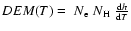 ,
Ab(X) is the element abundance, and
,
Ab(X) is the element abundance, and
 and
and
 (cm-3) are the electron and hydrogen number densities.
The contribution function
(cm-3) are the electron and hydrogen number densities.
The contribution function
 of each line
contains all the atomic parameters and is
peaked in temperature, confining the emission to a limited temperature range.
of each line
contains all the atomic parameters and is
peaked in temperature, confining the emission to a limited temperature range.
The temperature dependence of the C(T) is mainly provided by the ion fraction term. The conditions in the `quiet' solar corona are such that ionization equilibrium normally holds, and the C(T)s are calculated using ionization balance calculations. These in turn therefore have a significant role not only in the derivation of the DEM, but also in obtaining the element abundances (see below). The ionization equilibrium calculations of Mazzotta et al. (1998) were used here. Note that while the values for the Fe ions are similar to those of Arnaud & Raymond (1992), for other elements the differences from the earlier calculations of Arnaud & Rothenflug (1985) are sometime substantial (see Del Zanna 1999, for examples).
The use of different ions from different isoelectronic sequences can help in assessing whether the atomic physics is in disagreement with the observations (e.g. Young et al. 1998). A large number of ions exhibit anomalous behaviour such that lines produced by these ions have theoretical intensities that are consistently under- or over-estimated by large factors. In particular, the anomalous behaviour of the ions of the Li and Na isoelectronic sequences has been known for more than 30 years (see the review of Del Zanna et al. 2002), but is still largely neglected. Until the reasons for this anomalous behaviour are understood, lines from ions such as: C IV, Si IV, N V, O VI, Ne VIII, Na IX, Mg X, Al XI, Si XII, S XIV should not be used for any DEM or element abundance analyses, contrary to what is current practice (e.g. Laming & Feldman 1999).
We have used the CHIANTI atomic database (Dere et al. 1997) to calculate the contribution functions of the observed lines. In particular, Version 3.01 of the database (Dere et al. 2001) was used in this paper for the temperature estimates and for the analysis of the Skylab plume (Sect. 2.2). For the DEM analysis of the plume in Sect. 3.3.1 Version 4.0 of the database (Young et al. 2002) was used. This version, compared to the previous one, includes updates concerning the following ions: O V, Si XI, Mg VI, AL VII, Si VIII. These updates typically only change the emissivities of 10-20% at maximum, for the lines used here. For the estimates of the electron densities, the new Version 4.0 has been used (see below).
The DEM analysis was performed using a modified version of the Arcetri inversion code (Monsignori Fossi & Landini 1991). It should be mentioned that the determination of the DEM distribution is an ill-posed problem (see, e.g. Craig & Brown 1986). However, improvements in the conditioning are made with a careful selection of lines (cf. McIntosh 2000).
In principle, from any observed intensity ratio
 it is possible to derive a relative element abundance
 of two elements X1 and X2:
The approach adopted in this paper is to
derive a DEM curve for each element, and to
determine relative element
abundances, by normalising the DEM curves of the different
elements, as described, for example, in Del Zanna & Bromage
(1999b).
On the other hand,
when investigating relative abundances,
most authors have used (and still use)
a "standard approach'', which is to use ratios of lines
that have contribution functions with similar temperature dependence
and which may therefore be assumed to come from the same emitting
volume. Then a mean value for the DEM over the temperature range of
the lines is used in Eq. (2), so that it may be
cancelled from the
fraction, leaving:
 :
:
 is the observed intensity of the line.
Their method
(referred to here as the
method) is to plot
the
 values
and derive the relative element abundances by adjusting
them in order to have all the
points of the various ions lie along a
common smooth curve.
The above is actually justified only when:
values
and derive the relative element abundances by adjusting
them in order to have all the
points of the various ions lie along a
common smooth curve.
The above is actually justified only when:
To study the FIP effect, ratios of lines from low-FIP and high-FIP elements such as Mg VI/Ne VI and Ca IX/Ne VII are commonly used. In particular, the Mg VI/Ne VI ratios of the lines around 400 Å (Mg VI: 399.28, 400.67, 403.31 Å; Ne VI 399.82, 401.14, 403.25, 401.93 Å) have been widely used in solar physics (cf. Sheeley 1996).
There are a number of effects that may result in the abundance ratio not being proportional to the observed intensity ratio or that are potential sources of uncertainties. For example: 1) the DEM effect; 2) the ionization balance or non-equilibrium effects; 3) the use of lines of particular isoelectronic sequences; 4) the density dependence of the lines used.
Considering the first case, if for example the DEM(T) has a steep gradient in one temperature range, any small differences between C1and C2 in that range would be amplified and Eq. (5) would not hold. For example, it is well known that the Mg VI contribution functions are slightly skewed toward higher temperatures, when compared to those of Ne VI (Phillips 1997). The difference is at a maximum just where (log T = 5.9) the DEM gradient is large for plumes. Neglecting the shape of the DEM curves when calculating the Ne/Mg relative abundances using Ne VI and Mg VI ions therefore has the effect of underestimating the Ne/Mg relative abundance. Del Zanna et al. (2001b) have used the Elephant's Trunk low-latitude plume DEM to show that if Mg VI and Ne VI lines are used, the FIP effect can be substantially overestimated, up to a factor of 3. This DEM effect is even more pronounced when other line ratios such as Ca IX / Ne VII and Mg VII / Ne VII are considered, because the differences in their C(T) are even larger. Section 2.2 below provides a clear example of this problem. Since observations of different solar regions can have very different DEM distributions, it is impossible to know a priori when the approximation proposed by Widing & Feldman (1989) is valid.
Finally, a few words about other sources of uncertainties.
As already mentioned, the major one is related to the
ionization equilibrium calculations. Any inaccuracy could
easily amplify the DEM effect. Also, lines of anomalous
behaviour should not be used.
Nonequilibrium ionization effects can also be non-negligible
in some cases, as shown by Edgar & Esser (2000).
Density variations can also affect element abundances
if, as in the case of the Mg VI / Ne VI ratios, some
of the lines are slightly density-dependent (Mg VI,
see Del Zanna et al. 2001b).
Transition region densities at temperatures where Mg VI lines
form are difficult to measure, and usually different line ratios
produce different results, with average values
 cm-3
(see e.g. Widing & Feldman 1993;
Del Zanna & Bromage 1999a).
Another source of uncertainty is the unknown
density vs. temperature variation along the line of sight.
Ideally, if enough density estimates at different temperatures
are available, one could calculate the emissivities with the
appropriate density-temperature
model, although other effects can still come into play
(see Doschek 1984).
cm-3
(see e.g. Widing & Feldman 1993;
Del Zanna & Bromage 1999a).
Another source of uncertainty is the unknown
density vs. temperature variation along the line of sight.
Ideally, if enough density estimates at different temperatures
are available, one could calculate the emissivities with the
appropriate density-temperature
model, although other effects can still come into play
(see Doschek 1984).
We now show the importance of the
DEM effect in the derivation of the FIP effect for the
plume observed by Widing & Feldman (1992).
A DEM analysis was performed on the calibrated data tabulated in
Widing & Feldman.
The line emissivities have been calculated using CHIANTI version 3.01,
and the same constant density
(
 cm-3) adopted by Widing & Feldman.
The main difference compared with their work is the use of the
more recent ionization equilibrium calculations of
Mazzotta et al. (1998).
As a starting point, the photospheric abundances of
Grevesse & Anders (1991) have been used.
cm-3) adopted by Widing & Feldman.
The main difference compared with their work is the use of the
more recent ionization equilibrium calculations of
Mazzotta et al. (1998).
As a starting point, the photospheric abundances of
Grevesse & Anders (1991) have been used.
Figure 1 shows the
values for the Skylab
plume. Following the
method, the
points are displayed at the temperatures
 ,
defined as the temperature where C(T) has a maximum.
First, we note that the use of
can be misleading since,
in some cases, this can be quite different from the
temperature at which most of the emission occurs.
It is often more informative to use the "effective temperature"
,
defined as the temperature where C(T) has a maximum.
First, we note that the use of
can be misleading since,
in some cases, this can be quite different from the
temperature at which most of the emission occurs.
It is often more informative to use the "effective temperature"
 ,
defined as
log
,
defined as
log
 log
log
 ).
Figure 1 clearly shows that, in order to align the
DEML points on a smooth curve, it is necessary to modify the
adopted Mg/Ne relative abundances by a large factor, consistent with
the FIP effect found by Widing and Feldman.
).
Figure 1 clearly shows that, in order to align the
DEML points on a smooth curve, it is necessary to modify the
adopted Mg/Ne relative abundances by a large factor, consistent with
the FIP effect found by Widing and Feldman.
A DEM analysis has now been performed on the dataset, and the result
displayed as a dashed line in Fig. 1. It is clear
that there is a
large difference between the
points and the DEM values.
Table A.1
in the Appendix shows the results in detail.
The agreement between theory and observations is good,
with the exception of the Ne VII line.
It should be kept in mind that the DEM is not
constrained at low and high temperatures, due to the lack
of observational data.
However, the DEM analysis shows that the plume had a
near isothermal distribution, similar to
that derived by Del Zanna & Bromage (1999a) for
an equatorial plume, with a peak at log T = 5.9, and that
the use of photospheric abundances results in a good fit to the data,
in contrast to the FIP factor of 10 found by Widing & Feldman.
The large difference between our result and
that of Widing & Feldman is mainly due to the fact
that the DEM exhibits a steep gradient where the C(T) functions of the
Ne VI and Mg VI lines differ most.
Our results are confirmed by using another emission
measure method
(see Del Zanna et al. 2002 and references
therein for details).
This consists of plotting the ratio
 for each line
as a function of temperature and using the envelope of these curves
to constrain the shape of the emission measure distribution
and the element abundances.
The
curves for the plume, calculated with
photospheric abundances, are displayed in Fig. 2.
They clearly show that the plasma
is nearly isothermal, since all the curves are crossing
at one point (with the exception of the Ne VII 465.2 Å resonance
line, which clearly departs from this behaviour and requires further
investigation). Figure 2 also shows that the observed Mg VI and Ne VI
intensities are consistent with photospheric abundances.
for each line
as a function of temperature and using the envelope of these curves
to constrain the shape of the emission measure distribution
and the element abundances.
The
curves for the plume, calculated with
photospheric abundances, are displayed in Fig. 2.
They clearly show that the plasma
is nearly isothermal, since all the curves are crossing
at one point (with the exception of the Ne VII 465.2 Å resonance
line, which clearly departs from this behaviour and requires further
investigation). Figure 2 also shows that the observed Mg VI and Ne VI
intensities are consistent with photospheric abundances.
![\begin{figure}
\par\includegraphics[angle=90,width=8.8cm,clip]{H3924f2.eps}
\end{figure}](/articles/aa/full/2003/05/aah3924/img53.gif) |
Figure 2:
The
 curves for the Skylab plume, assuming
photospheric abundances. The data indicate an isothermal
distribution at log T=5.9 and are consistent with no FIP effect present.
The emission measure EM(0.1) values (see Del Zanna et al. 2002,
for the definition), calculated with the DEM of
Fig. 1 and a
curves for the Skylab plume, assuming
photospheric abundances. The data indicate an isothermal
distribution at log T=5.9 and are consistent with no FIP effect present.
The emission measure EM(0.1) values (see Del Zanna et al. 2002,
for the definition), calculated with the DEM of
Fig. 1 and a
 are also shown
(filled circles).
are also shown
(filled circles). |
The CDS wavelength range is rich in density diagnostics (see Mason et al. 1997), but they are mainly confined to high-temperature lines that are not emitted by plumes. The principal exceptions are a few cases. Lower transition region densities have been obtained from O IV lines, while upper transition region - coronal densities have been obtained here from Mg VII, Mg VIII, and Si IX lines, which are good density diagnostics for coronal holes (see e.g. Del Zanna & Bromage 1999b and Fludra et al. 1999).
We have used the new Version 4.0 of the CHIANTI database for the calculation of electron densities. This version includes collisional proton excitation in the calculation of the level balance. Proton excitation has a non-negligible effect in the level population calculations of some ions, including Mg VIII, and Si IX.
This in turn affects the emissivities of EUV lines so that to lower the derived densities. Photoexcitation also starts to be non-negligible at some height in the corona, but not at the low heights of the plume bases examined here, so it has been neglected.
The Mg VII, Mg VIII, and Si IX line ratios used here are only marginally sensitive to temperature variations. However, we have calculated the emissivities at the appropriate temperatures derived from line ratios.
Estimates of coronal temperatures (averages over the line of sight) are obtained here from ratios of lines emitted by ions of the same element and close ionization stage, assuming that the plasma is isothermal. The use of different line ratios has been complemented by DEM analyses.
Copyright ESO 2003


![\begin{figure}
\par\includegraphics[angle=90,width=8.8cm,clip]{H3924f1.eps}
\end{figure}](/articles/aa/full/2003/05/aah3924/img45.gif)