![[*]](/icons/foot_motif.gif) - B. J. I. Bromage2 - H. E. Mason1
- B. J. I. Bromage2 - H. E. Mason1
G. Del Zanna1,
- B. J. I. Bromage2 - H. E. Mason1
1 - Department of Applied Mathematics and Theoretical Physics,
University of Cambridge, UK
2 -
Centre for Astrophysics, University of Central Lancashire, Preston, UK
Received 14 August 2002 / Accepted 5 November 2002
Abstract
Extreme ultraviolet
observations of plumes in polar coronal holes
are presented and their spectroscopic signatures discussed.
The study focuses on the base of plumes seen on the disk of the Sun
with the Coronal Diagnostic Spectrometer (CDS)
on the Solar and Heliospheric Observatory (SOHO) satellite.
Spectroscopic diagnostic techniques are applied
to characterise the plumes in terms of density,
temperature, emission measure and element abundance.
Attention is drawn to the
particular limitations of some of the techniques when applied to plume
structures. In particular, we revisit the Widing & Feldman (1992)
findings of a plume having a large first ionization potential (FIP)
effect of 10, showing that instead the Skylab data are
consistent with no FIP effect.
We present for the first time CDS-GIS (grazing incidence
spectrometer) observations of a plume. These observations have
been used to confirm the results obtained from
normal incidence (NIS) observations.
We find that polar plumes exhibit the same characteristics
as the Elephant's Trunk equatorial plume.
The most striking characteristic of the plume bases is that they are
near-isothermal with a peak emission measure at transition
region temperatures 
 K.
At these temperatures, plumes have averaged densities
K.
At these temperatures, plumes have averaged densities
 cm-3, about
twice the value of the surrounding coronal hole region.
Element abundances
in the plumes are found to be close to photospheric, with the exception of
neon which appears to be depleted by 0.2 dex relative to oxygen.
The absence of a significant FIP effect in plumes is consistent with
fast solar wind plasma, although it is not sufficient to prove a link
between the two.
Finally, we present a
comparison between GIS spectra and the SOHO EIT (EUV Imaging Telescope)
broad-band images, showing that temperatures derived from
the EIT ratio technique are largely overestimated, for
plumes and coronal holes. This is partly due to the fact that
the so called "Fe XII 195 Å'' and "Fe XV 284 Å'' filters are not
isothermal, and in coronal holes and plumes lower-temperature
lines dominate the EIT signal.
cm-3, about
twice the value of the surrounding coronal hole region.
Element abundances
in the plumes are found to be close to photospheric, with the exception of
neon which appears to be depleted by 0.2 dex relative to oxygen.
The absence of a significant FIP effect in plumes is consistent with
fast solar wind plasma, although it is not sufficient to prove a link
between the two.
Finally, we present a
comparison between GIS spectra and the SOHO EIT (EUV Imaging Telescope)
broad-band images, showing that temperatures derived from
the EIT ratio technique are largely overestimated, for
plumes and coronal holes. This is partly due to the fact that
the so called "Fe XII 195 Å'' and "Fe XV 284 Å'' filters are not
isothermal, and in coronal holes and plumes lower-temperature
lines dominate the EIT signal.
Key words: Sun: corona - techniques: spectroscopic - Sun: transition region - Sun: abundances
Plumes are an intrinsic feature of polar coronal holes.
They appear in white-light coronagraph and eclipse images as ray-like
structures, extending up to many solar radii above the limb of the Sun
(see e.g. Van de Hulst 1950; Saito 1965).
From their morphology they appear to be tracing the open field lines
emerging from the coronal holes. The characteristic comet-like shape
at the base of the plumes is best seen in the polar holes where the
geometry is most favourable. Here, they can be
observed in extreme ultraviolet (EUV) images and easily identified
from their shape and enhanced intensity relative to the coronal hole
(e.g. Ahmad & Withbroe 1977; Widing & Feldman 1992;
Walker et al. 1993). They are also seen at
X-ray wavelengths (Ahmad & Webb 1978).
By tracing plume structures from the lower corona up to 15  ,
DeForest et al. (1997, 2001)
have argued that the plumes seen in
white-light and in the EUV are different parts of the same structure.
In this paper, we only discuss the base of the plumes as observed in
EUV, projected against the solar disk or very close
(
,
DeForest et al. (1997, 2001)
have argued that the plumes seen in
white-light and in the EUV are different parts of the same structure.
In this paper, we only discuss the base of the plumes as observed in
EUV, projected against the solar disk or very close
(
 )
to the limb.
)
to the limb.
Although more difficult to identify at low latitude where the plume may be viewed more or less "end-on'', masking the plume-like shape, there have been some tentative reports of possible identifications in low-latitude holes viewed near the limb (Wang & Sheeley 1995; Woo 1996). Del Zanna & Bromage (1999b) reported the first detection by SOHO of a low-latitude plume visible on the disk, seen in the Elephant's Trunk equatorial coronal hole of 1996. This plume was identified by its spectroscopic characteristics, rather than its morphology. Here, we present observations of polar plumes, showing that they exhibit similar characteristics to the low-latitude plume seen in the Elephant's Trunk.
Before the advent of SOHO, it was not possible to distinguish clearly
between the plasma characteristics of plumes and those of the
surrounding coronal hole (inter-plume) regions because of the
limitations of the observations.
Density and temperature measurements in plumes
were mostly based on coronagraph or Skylab data from just above the limb
(e.g. Ahmad & Webb 1978). Using white light coronagraph
observations and
applying the Van de Hulst (1950) technique, the plume
densities were estimated to be 3-5 times higher than the
surrounding coronal hole.
Widing & Feldman (1992) used a Mg VIII density diagnostic ratio
on Skylab data but were not able to obtain consistent density values
for plumes, due to insufficient spectral resolution.
Temperatures were estimated from intensity gradients of EUV
emission lines,
assuming hydrostatic equilibrium and ionization equilibrium
(Widing & Feldman 1992).
Ahmad & Webb (1978) derived a mean temperature of
K (at 1.07 )
for some polar plumes observed by the Skylab S-054 experiment.
At this time there was no concensus on the subject of the temperature of
plumes; it was not clear whether they were cooler or hotter than the
inter-plume regions.
The confusion may be due in part to the fact that plumes are sometimes
seen to have a very bright base, where the density and temperature are
enhanced relative to those in the ambient coronal hole and the main
body of the plume (Bromage et al. 1997,
2000;
Young et al. 1999). In other
cases (including the examples presented here), the plumes appear more
diffuse overall, with a near-isothermal temperature which is lower
than that in the surrounding coronal hole (e.g. Del Zanna & Bromage
1999b).
This variation in the nature of the plumes probably represents
two different stages in the evolution of the structure, with a magnetic
reconnection event occurring initially at the base, increasing the
density and temperature there. Subsequently a more diffuse structure
develops which may fade over a timescale of about a day. Lamy et al. 1997) have shown a tendency for plumes to recur at the same location
after disappearing for a time.
It is now firmly established that coronal holes are the source of the fast solar wind, as already pointed out by Noci (1973) and Krieger et al. (1973). The question now is how it is generated and whether plumes might be the source.
The SOHO spectroscopic instruments (CDS, SUMER and UVCS) have provided improved spatial and spectral resolution, allowing more detailed analyses to be made in the plume/interplume regions. Hassler et al. (1999) reported finding blue-shifts in SUMER (Solar Ultraviolet Measurements of Emitted Radiation) spectra from the coronal hole network junctions, while Giordano et al. (2000) and Patsourakos & Vial (2000) have found evidence from UVCS (Ultraviolet Coronagraph Spectrometer) and SUMER observations, respectively, that the fast solar wind is accelerated in the interplume regions. Similar results were recently found by Teriaca et al. (2002), also using UVCS and SUMER observations.
Solar wind models depend heavily on the density and temperature of the source region. The uncertainty in these quantities obtained from the early observations of plumes is reflected in the variety of different theoretical solar wind-plume models which have been proposed (e.g. Wang 1994; Velli et al. 1994; Del Zanna et al. 1997; Casalbuoni et al. 1999). More direct measurements of electron densities have now become possible, using spectral line ratios from SOHO data. Densities derived in this way are more accurate, although it should be kept in mind that these are averaged values (for the emitting plasma along the line of sight).
Wilhelm et al. (1998) presented
off-limb (in the range
1.03-1.6 )
SUMER spectroscopic observations of plume and interplume regions.
Densities of both plume and interplume regions were estimated using
Si VIII line ratios, and found to
start at
 cm-3 and then decrease
with height, with plumes having shallower density gradients.
A limitation of this study was that the plume and
interplume observations were not simultaneous, but were separated in time by
about six months.
They also determined plume and interplume temperatures, using a Mg IX line
ratio, finding
temperature profiles in the plumes which initially appeared
constant at around
cm-3 and then decrease
with height, with plumes having shallower density gradients.
A limitation of this study was that the plume and
interplume observations were not simultaneous, but were separated in time by
about six months.
They also determined plume and interplume temperatures, using a Mg IX line
ratio, finding
temperature profiles in the plumes which initially appeared
constant at around
 K but decreased further out,
while in interplume regions the
temperature tended to increase steadily with height.
SUMER and UVCS
off-limb observations (cf. Hassler et al. 1997;
Noci et al. 1997)
have shown broader spectral line widths in the interplume lanes
than in the plumes, indicating lower temperatures in the plumes.
Such off-limb spectral observations may suffer from contamination
by foreground or background emission, in particular, plume emission
behind the coronal hole (interplume) regions can affect measurements
of densities and temperatures. Similarly, in the "plume'' regions observed
off-limb, there
may be contamination from "interplume'' plasma, or from other plumes present
along the line of sight.
K but decreased further out,
while in interplume regions the
temperature tended to increase steadily with height.
SUMER and UVCS
off-limb observations (cf. Hassler et al. 1997;
Noci et al. 1997)
have shown broader spectral line widths in the interplume lanes
than in the plumes, indicating lower temperatures in the plumes.
Such off-limb spectral observations may suffer from contamination
by foreground or background emission, in particular, plume emission
behind the coronal hole (interplume) regions can affect measurements
of densities and temperatures. Similarly, in the "plume'' regions observed
off-limb, there
may be contamination from "interplume'' plasma, or from other plumes present
along the line of sight.
DeForest et al. (1997) used EIT images to
estimate plume temperatures. They found them to be in the range
 K, while the interplume
temperatures appeared higher (by no more than 30%).
Problems with this technique are discussed in detail below (Sect. 4).
Del Zanna & Bromage (1999b) found the Elephant's Trunk plume
to be cooler than the surrounding coronal hole, with a temperature of
about
K, while the interplume
temperatures appeared higher (by no more than 30%).
Problems with this technique are discussed in detail below (Sect. 4).
Del Zanna & Bromage (1999b) found the Elephant's Trunk plume
to be cooler than the surrounding coronal hole, with a temperature of
about
 K.
K.
Another parameter which can be determined spectroscopically is the
composition of the coronal plasma.
This can provide a link between the fast solar wind and regions which
might be its source.
Coronal abundances have been found to differ from photospheric values
in a way which appears to be related to the
first ionization potential (FIP) of the various elements
(see the reviews of Feldman 1992, and
Raymond et al. 2001). The degree of this "FIP effect'' can
vary depending on the coronal structure being observed.
Early observations revealed that the slow solar wind had a FIP effect
of about 4,
with low-FIP ( 10 eV) elements more abundant than the
high-FIP ones.
On the other hand, the fast solar wind exhibited abundances
closer to photospheric values.
A recent study (Von Steiger et al. 2000),
based on a re-analysis of the Ulysses data
has confirmed that the fast solar wind has photospheric
abundances, but suggests an average FIP effect of about 2 for the slow
solar wind.
10 eV) elements more abundant than the
high-FIP ones.
On the other hand, the fast solar wind exhibited abundances
closer to photospheric values.
A recent study (Von Steiger et al. 2000),
based on a re-analysis of the Ulysses data
has confirmed that the fast solar wind has photospheric
abundances, but suggests an average FIP effect of about 2 for the slow
solar wind.
The only pre-SOHO measurement of plume abundances is that of Widing & Feldman (1992), who studied the brightest polar plume observed by the Skylab S082A EUV spectroheliograph, in December 1973. They derived one of the largest FIP biases reported (a factor of 10). Since then, it has long been thought that plumes have a large FIP effect. If this is the case, then plumes cannot be the major contributors to the fast solar wind. However, a new analysis of the Skylab data is presented here (Sect. 2.2), which shows the FIP effect to be very small or even absent in the plume.
More recent studies using SOHO-CDS data indicate that plumes exhibit only a small FIP effect (Del Zanna & Bromage 1999a; Del Zanna 1999; Del Zanna & Bromage 1999b; Young et al. 1999). However, problems with the instrument calibration led to uncertainties of about a factor of two in the derived abundances. The CDS calibration has now been substantially improved (see Del Zanna et al. 2001a and Del Zanna 2002) thus allowing a more accurate determination of the FIP effect in plumes.
We have observed a large number of polar plumes with CDS, during solar minimum conditions in 1996, and in 1997. In this paper, we present CDS observations of two "typical'' polar plumes seen on the disk. These were chosen in order to focus attention on the base of plumes, and to avoid problems of contamination associated with off-limb measurements. The principal aims of this paper are:
(a) to identify the characteristic signature of a plume in CDS
spectra;
(b) to demonstrate that plumes can also be characterised spectroscopically
in terms of their density, temperature and composition;
(c) to show that polar plumes, identified from EIT
images, exhibit the same spectral characteristics as the
low-latitude plume seen in the Elephant's Trunk coronal hole of 1996;
(d) to examine the spectroscopic diagnostic techniques applied to the
CDS spectra in order to determine the above quantities, high-lighting
the problems encountered, in particular when deducing element abundances
(see Sect. 2); and
(e) to explain how it is that polar plumes (which are cool objects)
may be seen in the EIT 195 Å and 284 Å images which generally
reveal plasma
emitting at a temperature of more than
 K.
In Sect. 4 we present the first in-flight direct study of
the emission that contributes to the EIT filters, based on a
comparison between EIT and CDS near-simultaneous observations,
and we discuss the validity of the EIT filter ratio estimates of
temperature.
K.
In Sect. 4 we present the first in-flight direct study of
the emission that contributes to the EIT filters, based on a
comparison between EIT and CDS near-simultaneous observations,
and we discuss the validity of the EIT filter ratio estimates of
temperature.
For general reviews and definitions on the subject of
spectroscopic techniques see Mason & Monsignori Fossi (1994) and
Del Zanna et al. (2002).
The intensity
 ,
of an optically thin
spectral line of wavelength
,
of an optically thin
spectral line of wavelength
 can be written:
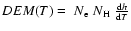 ,
Ab(X) is the element abundance, and
,
Ab(X) is the element abundance, and
 and
and
 (cm-3) are the electron and hydrogen number densities.
The contribution function
(cm-3) are the electron and hydrogen number densities.
The contribution function
 of each line
contains all the atomic parameters and is
peaked in temperature, confining the emission to a limited temperature range.
of each line
contains all the atomic parameters and is
peaked in temperature, confining the emission to a limited temperature range.
The temperature dependence of the C(T) is mainly provided by the ion fraction term. The conditions in the `quiet' solar corona are such that ionization equilibrium normally holds, and the C(T)s are calculated using ionization balance calculations. These in turn therefore have a significant role not only in the derivation of the DEM, but also in obtaining the element abundances (see below). The ionization equilibrium calculations of Mazzotta et al. (1998) were used here. Note that while the values for the Fe ions are similar to those of Arnaud & Raymond (1992), for other elements the differences from the earlier calculations of Arnaud & Rothenflug (1985) are sometime substantial (see Del Zanna 1999, for examples).
The use of different ions from different isoelectronic sequences can help in assessing whether the atomic physics is in disagreement with the observations (e.g. Young et al. 1998). A large number of ions exhibit anomalous behaviour such that lines produced by these ions have theoretical intensities that are consistently under- or over-estimated by large factors. In particular, the anomalous behaviour of the ions of the Li and Na isoelectronic sequences has been known for more than 30 years (see the review of Del Zanna et al. 2002), but is still largely neglected. Until the reasons for this anomalous behaviour are understood, lines from ions such as: C IV, Si IV, N V, O VI, Ne VIII, Na IX, Mg X, Al XI, Si XII, S XIV should not be used for any DEM or element abundance analyses, contrary to what is current practice (e.g. Laming & Feldman 1999).
We have used the CHIANTI atomic database (Dere et al. 1997) to calculate the contribution functions of the observed lines. In particular, Version 3.01 of the database (Dere et al. 2001) was used in this paper for the temperature estimates and for the analysis of the Skylab plume (Sect. 2.2). For the DEM analysis of the plume in Sect. 3.3.1 Version 4.0 of the database (Young et al. 2002) was used. This version, compared to the previous one, includes updates concerning the following ions: O V, Si XI, Mg VI, AL VII, Si VIII. These updates typically only change the emissivities of 10-20% at maximum, for the lines used here. For the estimates of the electron densities, the new Version 4.0 has been used (see below).
The DEM analysis was performed using a modified version of the Arcetri inversion code (Monsignori Fossi & Landini 1991). It should be mentioned that the determination of the DEM distribution is an ill-posed problem (see, e.g. Craig & Brown 1986). However, improvements in the conditioning are made with a careful selection of lines (cf. McIntosh 2000).
In principle, from any observed intensity ratio
 it is possible to derive a relative element abundance
 of two elements X1 and X2:
The approach adopted in this paper is to
derive a DEM curve for each element, and to
determine relative element
abundances, by normalising the DEM curves of the different
elements, as described, for example, in Del Zanna & Bromage
(1999b).
On the other hand,
when investigating relative abundances,
most authors have used (and still use)
a "standard approach'', which is to use ratios of lines
that have contribution functions with similar temperature dependence
and which may therefore be assumed to come from the same emitting
volume. Then a mean value for the DEM over the temperature range of
the lines is used in Eq. (2), so that it may be
cancelled from the
fraction, leaving:
 :
:
 is the observed intensity of the line.
Their method
(referred to here as the
method) is to plot
the
 values
and derive the relative element abundances by adjusting
them in order to have all the
points of the various ions lie along a
common smooth curve.
The above is actually justified only when:
values
and derive the relative element abundances by adjusting
them in order to have all the
points of the various ions lie along a
common smooth curve.
The above is actually justified only when:
To study the FIP effect, ratios of lines from low-FIP and high-FIP elements such as Mg VI/Ne VI and Ca IX/Ne VII are commonly used. In particular, the Mg VI/Ne VI ratios of the lines around 400 Å (Mg VI: 399.28, 400.67, 403.31 Å; Ne VI 399.82, 401.14, 403.25, 401.93 Å) have been widely used in solar physics (cf. Sheeley 1996).
There are a number of effects that may result in the abundance ratio not being proportional to the observed intensity ratio or that are potential sources of uncertainties. For example: 1) the DEM effect; 2) the ionization balance or non-equilibrium effects; 3) the use of lines of particular isoelectronic sequences; 4) the density dependence of the lines used.
Considering the first case, if for example the DEM(T) has a steep gradient in one temperature range, any small differences between C1and C2 in that range would be amplified and Eq. (5) would not hold. For example, it is well known that the Mg VI contribution functions are slightly skewed toward higher temperatures, when compared to those of Ne VI (Phillips 1997). The difference is at a maximum just where (log T = 5.9) the DEM gradient is large for plumes. Neglecting the shape of the DEM curves when calculating the Ne/Mg relative abundances using Ne VI and Mg VI ions therefore has the effect of underestimating the Ne/Mg relative abundance. Del Zanna et al. (2001b) have used the Elephant's Trunk low-latitude plume DEM to show that if Mg VI and Ne VI lines are used, the FIP effect can be substantially overestimated, up to a factor of 3. This DEM effect is even more pronounced when other line ratios such as Ca IX / Ne VII and Mg VII / Ne VII are considered, because the differences in their C(T) are even larger. Section 2.2 below provides a clear example of this problem. Since observations of different solar regions can have very different DEM distributions, it is impossible to know a priori when the approximation proposed by Widing & Feldman (1989) is valid.
Finally, a few words about other sources of uncertainties.
As already mentioned, the major one is related to the
ionization equilibrium calculations. Any inaccuracy could
easily amplify the DEM effect. Also, lines of anomalous
behaviour should not be used.
Nonequilibrium ionization effects can also be non-negligible
in some cases, as shown by Edgar & Esser (2000).
Density variations can also affect element abundances
if, as in the case of the Mg VI / Ne VI ratios, some
of the lines are slightly density-dependent (Mg VI,
see Del Zanna et al. 2001b).
Transition region densities at temperatures where Mg VI lines
form are difficult to measure, and usually different line ratios
produce different results, with average values
 cm-3
(see e.g. Widing & Feldman 1993;
Del Zanna & Bromage 1999a).
Another source of uncertainty is the unknown
density vs. temperature variation along the line of sight.
Ideally, if enough density estimates at different temperatures
are available, one could calculate the emissivities with the
appropriate density-temperature
model, although other effects can still come into play
(see Doschek 1984).
cm-3
(see e.g. Widing & Feldman 1993;
Del Zanna & Bromage 1999a).
Another source of uncertainty is the unknown
density vs. temperature variation along the line of sight.
Ideally, if enough density estimates at different temperatures
are available, one could calculate the emissivities with the
appropriate density-temperature
model, although other effects can still come into play
(see Doschek 1984).
We now show the importance of the
DEM effect in the derivation of the FIP effect for the
plume observed by Widing & Feldman (1992).
A DEM analysis was performed on the calibrated data tabulated in
Widing & Feldman.
The line emissivities have been calculated using CHIANTI version 3.01,
and the same constant density
(
 cm-3) adopted by Widing & Feldman.
The main difference compared with their work is the use of the
more recent ionization equilibrium calculations of
Mazzotta et al. (1998).
As a starting point, the photospheric abundances of
Grevesse & Anders (1991) have been used.
cm-3) adopted by Widing & Feldman.
The main difference compared with their work is the use of the
more recent ionization equilibrium calculations of
Mazzotta et al. (1998).
As a starting point, the photospheric abundances of
Grevesse & Anders (1991) have been used.
![\begin{figure}
\par\includegraphics[angle=90,width=8.8cm,clip]{H3924f1.eps}
\end{figure}](/articles/aa/full/2003/05/aah3924/img45.gif) |
Figure 1:
The
values for the Skylab plume.
The Ne and Mg values indicate the need
to modify the adopted Ne/Mg photospheric abundance ratio, in order to obtain a
smooth distribution of
values.
The DEM(T) derived from
the same data is plotted for comparison (dashed line). |
| Open with DEXTER | |
Figure 1 shows the
values for the Skylab
plume. Following the
method, the
points are displayed at the temperatures
 ,
defined as the temperature where C(T) has a maximum.
First, we note that the use of
can be misleading since,
in some cases, this can be quite different from the
temperature at which most of the emission occurs.
It is often more informative to use the "effective temperature"
,
defined as the temperature where C(T) has a maximum.
First, we note that the use of
can be misleading since,
in some cases, this can be quite different from the
temperature at which most of the emission occurs.
It is often more informative to use the "effective temperature"
 ,
defined as
log
,
defined as
log
 log
log
 ).
Figure 1 clearly shows that, in order to align the
DEML points on a smooth curve, it is necessary to modify the
adopted Mg/Ne relative abundances by a large factor, consistent with
the FIP effect found by Widing and Feldman.
).
Figure 1 clearly shows that, in order to align the
DEML points on a smooth curve, it is necessary to modify the
adopted Mg/Ne relative abundances by a large factor, consistent with
the FIP effect found by Widing and Feldman.
A DEM analysis has now been performed on the dataset, and the result
displayed as a dashed line in Fig. 1. It is clear
that there is a
large difference between the
points and the DEM values.
Table A.1
in the Appendix shows the results in detail.
The agreement between theory and observations is good,
with the exception of the Ne VII line.
It should be kept in mind that the DEM is not
constrained at low and high temperatures, due to the lack
of observational data.
However, the DEM analysis shows that the plume had a
near isothermal distribution, similar to
that derived by Del Zanna & Bromage (1999a) for
an equatorial plume, with a peak at log T = 5.9, and that
the use of photospheric abundances results in a good fit to the data,
in contrast to the FIP factor of 10 found by Widing & Feldman.
The large difference between our result and
that of Widing & Feldman is mainly due to the fact
that the DEM exhibits a steep gradient where the C(T) functions of the
Ne VI and Mg VI lines differ most.
Our results are confirmed by using another emission
measure method
(see Del Zanna et al. 2002 and references
therein for details).
This consists of plotting the ratio
 for each line
as a function of temperature and using the envelope of these curves
to constrain the shape of the emission measure distribution
and the element abundances.
The
curves for the plume, calculated with
photospheric abundances, are displayed in Fig. 2.
They clearly show that the plasma
is nearly isothermal, since all the curves are crossing
at one point (with the exception of the Ne VII 465.2 Å resonance
line, which clearly departs from this behaviour and requires further
investigation). Figure 2 also shows that the observed Mg VI and Ne VI
intensities are consistent with photospheric abundances.
for each line
as a function of temperature and using the envelope of these curves
to constrain the shape of the emission measure distribution
and the element abundances.
The
curves for the plume, calculated with
photospheric abundances, are displayed in Fig. 2.
They clearly show that the plasma
is nearly isothermal, since all the curves are crossing
at one point (with the exception of the Ne VII 465.2 Å resonance
line, which clearly departs from this behaviour and requires further
investigation). Figure 2 also shows that the observed Mg VI and Ne VI
intensities are consistent with photospheric abundances.
![\begin{figure}
\par\includegraphics[angle=90,width=8.8cm,clip]{H3924f2.eps}
\end{figure}](/articles/aa/full/2003/05/aah3924/img53.gif) |
Figure 2:
The
 curves for the Skylab plume, assuming
photospheric abundances. The data indicate an isothermal
distribution at log T=5.9 and are consistent with no FIP effect present.
The emission measure EM(0.1) values (see Del Zanna et al. 2002,
for the definition), calculated with the DEM of
Fig. 1 and a
curves for the Skylab plume, assuming
photospheric abundances. The data indicate an isothermal
distribution at log T=5.9 and are consistent with no FIP effect present.
The emission measure EM(0.1) values (see Del Zanna et al. 2002,
for the definition), calculated with the DEM of
Fig. 1 and a
 are also shown
(filled circles).
are also shown
(filled circles). |
| Open with DEXTER | |
The CDS wavelength range is rich in density diagnostics (see Mason et al. 1997), but they are mainly confined to high-temperature lines that are not emitted by plumes. The principal exceptions are a few cases. Lower transition region densities have been obtained from O IV lines, while upper transition region - coronal densities have been obtained here from Mg VII, Mg VIII, and Si IX lines, which are good density diagnostics for coronal holes (see e.g. Del Zanna & Bromage 1999b and Fludra et al. 1999).
We have used the new Version 4.0 of the CHIANTI database for the calculation of electron densities. This version includes collisional proton excitation in the calculation of the level balance. Proton excitation has a non-negligible effect in the level population calculations of some ions, including Mg VIII, and Si IX.
This in turn affects the emissivities of EUV lines so that to lower the derived densities. Photoexcitation also starts to be non-negligible at some height in the corona, but not at the low heights of the plume bases examined here, so it has been neglected.
The Mg VII, Mg VIII, and Si IX line ratios used here are only marginally sensitive to temperature variations. However, we have calculated the emissivities at the appropriate temperatures derived from line ratios.
Estimates of coronal temperatures (averages over the line of sight) are obtained here from ratios of lines emitted by ions of the same element and close ionization stage, assuming that the plasma is isothermal. The use of different line ratios has been complemented by DEM analyses.
CDS observations of two polar plumes are presented here. The first was observed on the 23rd August 1996. The second plume was visible during the second week of October 1997. Both plumes were stable structures which lasted for several days in the north polar coronal hole during solar minimum conditions.
CDS (Harrison et al. 1995) consists of two instruments: a Normal Incidence Spectrometer (NIS) and a Grazing Incidence Spectrometer (GIS), which cannot both operate at the same time. The NIS detectors observe two spectral ranges simultaneously (NIS 1: 308 - 379 Å and NIS 2: 513 - 633 Å), and with the rastering of a long slit can provide monochromatic images of the solar field of view. The GIS produces astigmatic spectra with its four detectors (GIS 1: 151 - 221 Å, GIS 2: 256 - 341 Å, GIS 3: 393 - 492 Å and GIS 4: 659 - 785 Å). GIS spectra are normally recorded using a pinhole slit and it is not usually used for imaging. The CDS observes many emission lines from a large number of highly ionised ions of the most abundant elements, covering a large range of temperatures, and therefore provides a new opportunity to study in detail the transition region and coronal plasma.
The CDS instrument is well suited to the study of element abundances, because
the lines observed by CDS are produced by a variety of ions,
covering a large temperature range and different isoelectronic sequences.
All the low temperature lines (
 K) observed by CDS/NIS are from high-FIP elements
(N, O, Ne) while all the high temperature lines (
K) observed by CDS/NIS are from high-FIP elements
(N, O, Ne) while all the high temperature lines (
 K) are from low-FIP elements
(Mg, Ca, Fe, Si, Al). It is therefore possible to deduce the relative abundances
among these two groups of lines.
The scaling between the high and low-FIP elements can be achieved
using low-FIP, low-temperature lines and high-FIP, high-temperature lines
which overlap in temperature.
Unfortunately, NIS observes only a few such lines
(one Mg VI line at 349.2 Å, which is a complex blend of lines,
three Mg VII lines and a few Ne VI and Ne VII lines).
It is important to complement the NIS observations with ones made at
about the same time with the GIS instrument, as
has been done here, since GIS observes many other
lines and ions that extend the overlapping region between the high-FIP
and the low-FIP ions observed.
K) are from low-FIP elements
(Mg, Ca, Fe, Si, Al). It is therefore possible to deduce the relative abundances
among these two groups of lines.
The scaling between the high and low-FIP elements can be achieved
using low-FIP, low-temperature lines and high-FIP, high-temperature lines
which overlap in temperature.
Unfortunately, NIS observes only a few such lines
(one Mg VI line at 349.2 Å, which is a complex blend of lines,
three Mg VII lines and a few Ne VI and Ne VII lines).
It is important to complement the NIS observations with ones made at
about the same time with the GIS instrument, as
has been done here, since GIS observes many other
lines and ions that extend the overlapping region between the high-FIP
and the low-FIP ions observed.
A series of standard corrections was applied to the raw NIS data. These include de-biasing, flat-fielding, corrections for the burn-in of a few lines, nonlinear corrections, cosmic ray removal and correction for the tilt of the spectra (details may be found in Del Zanna et al. 2001a). A few minor corrections were applied to the GIS data, as described in Landi et al. (1999). Among the various detector effects, ghosting is one which can have a major impact on the validity of the derived intensity of an emission line. Although the GIS observations presented here were not badly affected by ghosts, some were present, and only in some of the cases was it possible to reconstruct the original spectra, i.e. add to each line the intensity lost by ghosting. In order to reduce the fixed patterning, the GIS spectra have been smoothed by applying a gaussian convolution. Line intensities were obtained by using multiple Gaussian line-fitting routines (see Haugan 1997) removing the "background'' intensity, which is mostly detector-dependent.
The line intensities have been calibrated using the consistent NIS and GIS calibration of Del Zanna et al. (2001a), with an adjustement of the absolute values that takes into account the long term effects of the use of the NIS wide slit (W. Thompson, priv. comm.). The accuracy of the radiometric calibration of the CDS detector can currently be estimated to be of the order of 30%.
A Joint Operation Programme (JOP 48) was organised to observe this plume. During this programme, a number of SOHO instruments carried out simultaneous observations. Figure 3 shows the EIT images of this plume.
![\begin{figure}
\par\includegraphics[angle=90,width=8.7cm,clip]{H3924f3.eps}
\end{figure}](/articles/aa/full/2003/05/aah3924/img56.gif) |
Figure 3:
EIT negative images - 23rd
August 1996, showing the presence of a few polar plumes.
That one observed by CDS was aligned almost N-S, at Solar
 ,
with its base centre at about Solar ,
with its base centre at about Solar
 .
The bottom right panel shows the signal in the
three EIT filters along the region shown in the images. .
The bottom right panel shows the signal in the
three EIT filters along the region shown in the images. |
| Open with DEXTER | |
![\begin{figure}
\par\includegraphics[width=8.3cm,clip]{H3924f4.eps}
\end{figure}](/articles/aa/full/2003/05/aah3924/img57.gif) |
Figure 4: Monochromatic images (negative) of the NIS observation - 23rd August 1996. The plume is seen best in Mg VII and Mg IX, with its base near the centre of the raster and the "plume'' extending up to the limb (and above). The three selected areas are shown (lower region: coronal hole; centre: base of the plume; profile along the N-S direction). |
| Open with DEXTER | |
An analysis of the CDS observations has shown
that this feature was stable during the whole observing period (a few hours).
The NIS observations presented here contained a large selection of lines
covering a wide range of temperatures. The area of the raster was
 ,
formed by scanning with the
,
formed by scanning with the
 slit, over a period of
about an hour. Monochromatic images obtained from these data are shown in
Fig. 4.
This plume presents the typical characteristics of plumes
as observed by CDS.
The peak of the emission in the plume is seen in upper transition region lines
such as Mg VII. It is less visible in the high-FIP Ne lines, and
cannot be seen in the high-temperature (e.g. Fe XII) lines.
Since the plume was aligned at an angle to the line of sight, the peak of the emission
appears at different spatial locations when lines emitted at different
temperatures are examined.
slit, over a period of
about an hour. Monochromatic images obtained from these data are shown in
Fig. 4.
This plume presents the typical characteristics of plumes
as observed by CDS.
The peak of the emission in the plume is seen in upper transition region lines
such as Mg VII. It is less visible in the high-FIP Ne lines, and
cannot be seen in the high-temperature (e.g. Fe XII) lines.
Since the plume was aligned at an angle to the line of sight, the peak of the emission
appears at different spatial locations when lines emitted at different
temperatures are examined.
In order to increase the signal-to-noise ratio, averaged spectra of three regions, shown in Fig. 4, have been extracted: a profile along the plume, in the N-S direction; a region at the base of the plume; and a coronal hole region, to the SW of the plume. Figure 5 shows the intensity ratios of some selected lines. The O/Ne and Mg/Ne ratios clearly show an enhancement in the region of the plume base at Solar Y=850, and also indicate a possible second plume in the line of sight at Solar Y=890.
| Plume | C. hole | |
|
(O IV 625.8/608.4 Å) |
[7.5 4] | [7.1 1] |
|
(Mg VIII 315.0/317.0 Å) |
[1.1 0.8] | [0.6 0.3] |
|
(Mg VIII 315.0/313.7 Å) |
[0.7 0.4] | [0.6 0.3] |
|
(Si IX 349.9/341.9 Å) |
[1.1 0.7] | [0.5 0.5] |
|
(Si IX 349.9/345.1 Å) |
[0.9 0.5] | [0.3 0.3] |
![\begin{figure}
\par\includegraphics[width=5.8cm,clip]{H3924f5.eps}
\end{figure}](/articles/aa/full/2003/05/aah3924/img60.gif) |
Figure 5: Intensity ratios along the N-S direction - 23rd August 1996. The O/Ne and Mg/Ne ratios clearly show the presence of the plume base at Solar Y=850, and also indicate a possible second plume in the line of sight at Solar Y=890. |
| Open with DEXTER | |
![\begin{figure}
\par\includegraphics[angle=90,width=7.6cm,clip]{H3924f6a.eps}\vspace*{4mm}
\includegraphics[angle=90,width=7.6cm,clip]{H3924f6b.eps}
\end{figure}](/articles/aa/full/2003/05/aah3924/img61.gif) |
Figure 6:
Top:
isothermal temperatures along the plume as derived
from the EIT 195 Å/171 Å filter ratio.
Bottom:
isothermal temperatures derived from CDS along the N-S profile
- 23rd August 1996. Note that the plume lies along this direction, above
about Solar
 .
This is the region where the
temperature profiles become coincident, indicating isothermal
plasma. .
This is the region where the
temperature profiles become coincident, indicating isothermal
plasma. |
| Open with DEXTER | |
Figure 6 (lower plot) shows the average isothermal
temperatures derived with the line ratio technique.
Note that the three different line ratios produce different temperatures
in the coronal hole region, while in the plume region they are in close agreement,
another indication of the plumes bases being quasi-isothermal, with lower
temperatures
 K, rising slightly with distance
along the plume. Note that these results are very different from
those obtained with the EIT filter ratio technique (upper plot in
Fig. 6), obtained with the SolarSoft routine
K, rising slightly with distance
along the plume. Note that these results are very different from
those obtained with the EIT filter ratio technique (upper plot in
Fig. 6), obtained with the SolarSoft routine
eit_temp.pro. This routine, written by J. Newmark, uses a
default set of parameters, the EIT effective areas and the
CHIANTI database to infer isothermal temperatures from the EIT
count rates.
Table 1 shows the values of the densities deduced from
the averaged spectra of the plume base and the nearby coronal hole region.
Although the results have a relatively large scatter and
large errors, the indication is that
the density in the plume area was slightly higher than the
nearby
coronal hole region, which had a very low density,
 cm-3.
cm-3.
Figure 7 displays a sequence of EIT 171 Å images, showing the presence of a plume near the NW limb, and its stability over a period of few days. A series of CDS observations of this plume was performed during this period.
![\begin{figure}
\par\includegraphics[angle=90,width=8.5cm,clip]{H3924f7.eps}
\end{figure}](/articles/aa/full/2003/05/aah3924/img64.gif) |
Figure 7: Sequence of SOHO EIT 171 Å negative images of the north polar coronal hole, showing the persistence of a polar plume for many days. |
| Open with DEXTER | |
On 1997 October 10, a large
 region (see
Fig. 8)
was rastered three times with the NIS.
The three rasters have been averaged, to
increase the signal-to-noise (temporal variations
within the two-hour observation were small).
A few areas (see Fig. 8) have been
selected for subsequent averaging of the spectra.
They include: a coronal hole (CH), the polar plume (PL),
a region of quiet Sun (QS) and a bright point (BP) - the smallest
region (see Del Zanna & Bromage 1999c for details).
The bright point was selected for comparison since
from the EIT images it might be confused with a bright plume.
Figure 9 shows the spectra
of these regions for a few of the observed lines.
The spectral characteristics of the various regions
are quite different. The most striking feature is
the large difference in the Mg VII/Mg IX ratio,
clearly indicating the different temperature structure
of the regions.
The plume exhibits the same spectral characteristics
as the Elephant's Trunk low-latitude plume
(Del Zanna & Bromage 1999b).
region (see
Fig. 8)
was rastered three times with the NIS.
The three rasters have been averaged, to
increase the signal-to-noise (temporal variations
within the two-hour observation were small).
A few areas (see Fig. 8) have been
selected for subsequent averaging of the spectra.
They include: a coronal hole (CH), the polar plume (PL),
a region of quiet Sun (QS) and a bright point (BP) - the smallest
region (see Del Zanna & Bromage 1999c for details).
The bright point was selected for comparison since
from the EIT images it might be confused with a bright plume.
Figure 9 shows the spectra
of these regions for a few of the observed lines.
The spectral characteristics of the various regions
are quite different. The most striking feature is
the large difference in the Mg VII/Mg IX ratio,
clearly indicating the different temperature structure
of the regions.
The plume exhibits the same spectral characteristics
as the Elephant's Trunk low-latitude plume
(Del Zanna & Bromage 1999b).
![\begin{figure}
\par\includegraphics[angle=-90,width=7.5cm,clip]{H3924f8.eps}
\end{figure}](/articles/aa/full/2003/05/aah3924/img66.gif) |
Figure 8: Negative images in a few NIS lines - 10th October 1997, 18:26-19:43 UT - with the selected areas indicated: plume (PL); bright point (BP); quiet sun (QS); coronal hole (CH). |
| Open with DEXTER | |
| PL | CH | QS | BP | |
|
(O IV) (1010) |
[0.7 0.1] | [0.6 0.2] | [1.3 0.3] | [1.9 0.4] |
|
(Mg VII) (109) |
[1.2 0.2] | [0.5 0.2] | [2.0 0.5] | [0.9 0.5] |
|
(Si IX) (108) |
[1.7 0.8] | [1.4 0.9] | [3.3 0.9] | [5 2] |
 (Mg X/Mg IX)
 |
[8.1 0.1] | [9.4 0.1] | [11 1] | [9.8 0.1] |
|
(Mg IX/Mg VII) |
[7.7 0.1] | [8.2 0.1] | [9.4 0.1] | [8.6 0.1] |
![\begin{figure}
\par\includegraphics[width=7.2cm,clip]{H3924f9a.eps}\vspace*{3mm}
\includegraphics[width=7.2cm,clip]{H3924f9b.eps}
\end{figure}](/articles/aa/full/2003/05/aah3924/img68.gif) |
Figure 9: Spectra in a few NIS windows of the selected areas - 10th October 1997. Note the large variations of the Mg VII/Mg IX ratio (right column). The Mg VII lines in these figures have been used for density measurements. |
| Open with DEXTER | |
![\begin{figure}
\par\includegraphics[width=5.3cm,clip]{H3924f10.eps}
\end{figure}](/articles/aa/full/2003/05/aah3924/img69.gif) |
Figure 10: EIT 195 Å negative images of the plume during the times of the NIS and GIS observations - 11th October 1997. All images are plotted with the same intensity scale, showing that the plume has changed very little over this period. |
| Open with DEXTER | |
Densities and temperatures of the various areas are presented
in Table 2.
Although the plume is not visible in the lower transition region line
O IV, the density at its base can be measured and is found to be
similar to the average coronal hole density,
 cm-3.
In the quiet sun area, the density derived from O IV
is about 2 times higher than in the coronal hole region.
At upper transition region temperatures, the plume was bright,
so it was possible to derive an accurate density,
cm-3.
In the quiet sun area, the density derived from O IV
is about 2 times higher than in the coronal hole region.
At upper transition region temperatures, the plume was bright,
so it was possible to derive an accurate density,
 cm-3, from the Mg VII 319 Å line. Note that the
quiet Sun region has a higher density, while
the coronal hole area has a much lower density.
cm-3, from the Mg VII 319 Å line. Note that the
quiet Sun region has a higher density, while
the coronal hole area has a much lower density.
On the 11th October 1997, CDS was in high-telemetry mode (twice
the usual rate, giving good temporal resolution), and
special observing sequences were designed to observe the plume
with both NIS and GIS.
The NIS study included a large number of
lines, this time scanning a
 area with
the
slit, from west to east.
The NIS observation started at 15:00 UT.
The GIS high-telemetry observations consisted
of a west to east scan across the plume using the
area with
the
slit, from west to east.
The NIS observation started at 15:00 UT.
The GIS high-telemetry observations consisted
of a west to east scan across the plume using the
 slit.
At each of 15 positions, 100 exposures of 5s each were taken, covering a
slit.
At each of 15 positions, 100 exposures of 5s each were taken, covering a
 region in a total time of nearly 3 hours. The GIS
observations followed the NIS ones, starting at
16:05 UT and ending at 18:54 UT, so that the time between
observing the plume itself with the two instruments was about two hours.
region in a total time of nearly 3 hours. The GIS
observations followed the NIS ones, starting at
16:05 UT and ending at 18:54 UT, so that the time between
observing the plume itself with the two instruments was about two hours.
The October 11 observations are important because they include the first GIS observations of a plume. This allows the GIS data to be used to confirm the results (in particular the abundances) obtained using NIS data.
The stability of the plume during the time of the NIS and GIS observations was examined: Fig. 10 shows EIT images in the 195 Å band spanning the times of the NIS and GIS observations of the plume. It shows very little variability in the intensity of this faint plume during this period, justifying the combination of the NIS and GIS data in the analysis. Small offsets between the recorded pointing of the EIT, NIS and GIS observations were found and corrected for. Direct comparisons of the line intensities also show good agreement (see Table A.2). A preliminary time analysis of the GIS observations confirmed that the intensity variations in the brightest lines were small. They were higher in the plume area (with indications of wave motions), but still within 20-30%.
Figure 11 shows monochromatic images of the region rastered by the NIS. The intensities of the NIS lines have been determined from NIS spatially-averaged spectra over the region shown in Fig. 11, the same area rastered by the GIS. Figure 12 shows the intensity profiles of a sample of GIS and NIS lines. Figure 12 also shows how most of the lines have similar profiles (e.g. Mg IX, visible in both GIS and NIS) confirming the validity of the spatial alignment and the small time variability. Only the transition region lines present some differences, as expected. Figure 13 shows some intensity ratios derived from the GIS and NIS observation.
![\begin{figure}
\par\includegraphics[width=7.8cm,bb=26 446 534 661,clip]{H3924f11...
...}
\includegraphics[width=7.8cm,bb=26 92 534 308,clip]{H3924f11.eps}
\end{figure}](/articles/aa/full/2003/05/aah3924/img75.gif) |
Figure 11: Monochromatic images of the plume in a few NIS lines (negative) - 11th October 1997. |
| Open with DEXTER | |
![\begin{figure}
\par\includegraphics[angle=90,width=7cm,clip]{H3924f12a.eps}\vspace*{3mm}
\includegraphics[angle=90,width=7cm,clip]{H3924f12b.eps}
\end{figure}](/articles/aa/full/2003/05/aah3924/img76.gif) |
Figure 12: Intensities of few selected GIS and NIS lines across the plume - 11th October 1997. Note that the intensities of the upper transition region lines increase by factors of 3-4 in the plume area. |
| Open with DEXTER | |
![\begin{figure}
\par\includegraphics[width=4cm,clip]{H3924f13a.eps}\hspace*{3mm}
\includegraphics[width=4cm,clip]{H3924f13b.eps}
\end{figure}](/articles/aa/full/2003/05/aah3924/img77.gif) |
Figure 13: Intensity ratios of few selected GIS and NIS lines across the plume - 11th October 1997. Note the large increase in the low- vs. high-FIP ratios. |
| Open with DEXTER | |
Inspection of Figs. 12 and 13 shows that this plume exhibits the same characteristics as both the polar plume of 23 August 1996, and the low-latitude plume in the Elephant's Trunk. In particular, it has maximum visibility in the upper transition region lines such as Mg VII, Ca X, Mg VIII (with an increase by a factor of about 4), while it is not seen in the high-FIP Ne lines, nor in high-temperature lines. The Mg VI/Ne VI, Ca IX/Ne VII Fe VIII/Ne VI ratios are clearly enhanced in the plume area. Although this is suggestive of a large FIP effect, it is shown in Sect. 3.3.1 below that this is not in fact the case.
| Plume | C. hole | |
|
(Mg VII [319.0 Å/367.7 Å]) |
[38 20] | [7 7] |
|
(Mg VIII [315.0 Å/ 317.0 Å]) |
[0.7 0.3] | [0.4 0.3] |
|
(Si IX [349.9 Å/341.9 Å]) |
[2.6 1] | [0.6 0.3] |
|
(Si IX [349.9 Å/ 345.1 Å]) |
[1.0 0.8] | [0.8 0.5] |
![\begin{figure}
\par\includegraphics[angle=90,width=12cm,clip]{H3924f14.eps}
\end{figure}](/articles/aa/full/2003/05/aah3924/img78.gif) |
Figure 14: GIS spectra in selected wavelength regions, for the coronal hole (above) and plume (below) areas - 11th October 1997. |
| Open with DEXTER | |
Two spatial positions have been selected as representative of the coronal hole and plume areas, at Solar X = 298 and 335, respectively. Figure 14 shows a comparison between the GIS spectra of the two areas, while Table 3 presents the densities.
The main features of the plume are: a large increase in the intensity of upper transition region lines (e.g. Mg VI, Mg VII, Mg VIII), with a small decrease in the high-temperature lines (e.g. Fe XV), and an enhancement of certain Mg/Ne and Ca/Ne ratios, as already discussed. In particular the regions around 402 Å and 277 Å show how different the spectra are. Other regions of the GIS spectra are shown in Figs. 19 and 20 (see Sect. 4, where the GIS-EIT comparison is presented). These also stress the different temperature structure between the coronal hole and the plume area examined. Lower temperature lines (such as Fe VIII and Fe IX) are greatly enhanced inside the plume.
A DEM analysis of the combined intensities
was performed, in order to
better describe the thermal structure of the plume and to determine element
abundances.
A constant pressure of
 cm-3 K was adopted when
calculating the contribution functions. As a starting point, we
adopted the photospheric
abundances of Grevesse and Sauval (1998), with a
correction of 0.1 dex in the oxygen abundance, as suggested by
recent measurements (N. Grevesse, priv. comm.).
cm-3 K was adopted when
calculating the contribution functions. As a starting point, we
adopted the photospheric
abundances of Grevesse and Sauval (1998), with a
correction of 0.1 dex in the oxygen abundance, as suggested by
recent measurements (N. Grevesse, priv. comm.).
The results are shown in Fig. 16 and in
Table A.2.
The DEM peaks at upper transition region temperatures (Mg VII, Ca X),
 K with a quasi-isothermal distribution at
these heights.
Table A.2
shows that there is good agreement between most of the NIS and GIS
lines, at least when lines close in temperature are considered.
It should be noted that the lines from the Li-like ions are
underestimated or overestimated by large factors (as already
discussed), and are not shown. Moreover, a number of other
important ions such as Fe VIII presented similar problems and
are also not shown.
K with a quasi-isothermal distribution at
these heights.
Table A.2
shows that there is good agreement between most of the NIS and GIS
lines, at least when lines close in temperature are considered.
It should be noted that the lines from the Li-like ions are
underestimated or overestimated by large factors (as already
discussed), and are not shown. Moreover, a number of other
important ions such as Fe VIII presented similar problems and
are also not shown.
The result is that of all the elements, only the Ne abundance needed to be changed (lowered by 0.2 dex). This is well constrained at low transition region temperatures, where bright O III, Ne III, O IV, Ne IV, O V, Ne V lines are observed. This result appears quite surprising, and deserves a more detailed examination in the future. We only note here that there are many other reported cases of Ne abundance variations (compared to both high and low FIP elements, see Schmelz et al. 1996) in different solar structures, but none for coronal plumes.
In order to confirm the DEM results of this plume, we
have performed the same DEM analysis on the 23 August
plume and on the Elephant's trunk low-latitude plume.
Figure 17 shows the DEM of the latter.
In both cases, similar results were found; i.e.
a DEM peaking at
K, and photospheric
abundances, with the exception of Ne, where a lower
(by about a 0.2 dex) abundance was required.
![\begin{figure}
\par\includegraphics[angle=90,width=7cm,clip]{H3924f15a.eps}\vspace*{3mm}
\includegraphics[angle=90,width=7cm,clip]{H3924f15b.eps}
\end{figure}](/articles/aa/full/2003/05/aah3924/img83.gif) |
Figure 15:
Isothermal temperatures as derived from the
EIT 195 Å/171 Å filter ratio
(above, see Fig. 18 for the extraction region)
and CDS lines (below).
The CDS line ratios indicate isothermality (
 K) in the plume region.
Note that the plume DEM peaks at K) in the plume region.
Note that the plume DEM peaks at
 K. K. |
| Open with DEXTER | |
![\begin{figure}
\par\includegraphics[angle=90,width=10.5cm,clip]{H3924f16.eps}
\end{figure}](/articles/aa/full/2003/05/aah3924/img85.gif) |
Figure 16:
The DEM distribution of the plume area (solid line)
with the observed points.
Each experimental data point is plotted
at the effective temperature
 and
at a value equal to the product
and
at a value equal to the product
 .
The error bars refer to the combination of
observational and theoretical (10%) errors and give an idea of the
uncertainties in the derived DEM values. .
The error bars refer to the combination of
observational and theoretical (10%) errors and give an idea of the
uncertainties in the derived DEM values. |
| Open with DEXTER | |
![\begin{figure}
\par\includegraphics[angle=90,width=8cm,clip]{H3924f17.eps}
\end{figure}](/articles/aa/full/2003/05/aah3924/img86.gif) |
Figure 17: The DEM distribution of the Elephant's trunk equatorial plume, showing similar characteristics to that one in Fig. 16. The Ne abundance was lowered by 0.25 dex, compared to the photospheric value. |
| Open with DEXTER | |
The EIT instrument (Delaboudiniere et al. 1995) observes the Sun in four EUV filters, centred around 171, 195, 284, and 303 Å. The first two are the principal ones, since the filter at 284 Å has a lower sensitivity, and the filter at 303 Å includes in the bandpass both the chromospheric line He II 303.8 Å and the coronal line Si XI 303.3 Å. The first two filters are often referred to as the Fe IX/X and the Fe XII images, because it is thought that these are the ions that contribute most to the emission. Ratios of these filters have been used widely to derive temperatures. In particular, DeForest et al. (1997) used the EIT filter-ratio method to show that plumes are about 30% cooler than the surrounding coronal hole regions.
Here we test the validity of such an approach by applying the EIT ratio technique to the plume observed with GIS, which was described above in Sect. 3. A comparison between the GIS scan and the EIT 171 Å and 195 Å images was performed, using full-resolution EIT images taken just after the GIS spectra. A direct comparison is possible because GIS spectrally resolves the emission lines observed by the EIT filters. Average intensity profiles in the two EIT filters, over the region observed by GIS are shown in Fig. 18.
The observed and calibrated GIS spectra were then convolved with the EIT effective areas (Dere et al. 2000), to simulate the observed EIT count rates, at each spatial position. The count rates were then integrated over the passband, and the results are shown in Fig. 18. The agreement between the observed and simulated EIT counts is quite good, in particular for the 171 and 195 Å filters, considering all the uncertainties in the absolute calibrations of both EIT and GIS.
On the other hand, no true diagnostic ratio can be inferred from the
EIT count rates. For example,
the real Fe XII 195.1 Å/Fe IX 171.07 Å ratio as
measured by GIS is lower
than the value of the corresponding EIT filter ratio at the plume base,
and higher in the coronal hole region.
In terms of temperatures, we have already given two examples above
(Figs. 6 and 15)
where the results inferred from the EIT on-disk measurements are
quite different (both in terms of absolute and relative values)
from those that are directly measured by CDS.
![\begin{figure}
\par\includegraphics[angle=90,width=11.5cm,clip]{H3924f18.eps}
\end{figure}](/articles/aa/full/2003/05/aah3924/img87.gif) |
Figure 18: Top: EIT images of the 11th of October 97 (19:00:14 UT - 171 Å; 19:12:30 UT - 195 Å; 19:05:56 UT - 284 Å), with a selected area across the plume overlaid. Bottom: intensity profiles of the selected area in EIT 171 Å (crosses) with superimposed the observed CDS intensity filtered (triangles). The bottom figures indicate problems in the EIT/GIS cross-calibration for the 195 and 284 Å filters. |
| Open with DEXTER | |
![\begin{figure}
\par\includegraphics[angle=90,width=11.5cm,clip]{H3924f19.eps}
\end{figure}](/articles/aa/full/2003/05/aah3924/img88.gif) |
Figure 19: Top: GIS 1 spectra of plume, coronal hole and quiet sun. Bottom: same as above, but multiplied by the EIT 171 Å filter response. The EIT is dominated by Fe IX and Fe X lines, while the Fe VIII lines, very strong in the plume, are not observed by the EIT filter. Note, however, that any small error in the EIT passband can have a considerable effect. |
| Open with DEXTER | |
![\begin{figure}
\par\includegraphics[angle=90,width=12cm,clip]{H3924f20.eps}
\end{figure}](/articles/aa/full/2003/05/aah3924/img89.gif) |
Figure 20: Top: GIS 1 spectra of plume, coronal hole and quiet sun. Bottom: same as above, but multiplied by the EIT 195 Å filter response. Note that while in the quiet Sun the EIT signal is dominated by Fe XII lines, in the coronal hole lower temperature lines become significant. In the plume, the signal is dominated by Fe VIII lines. The 195 Å filter is therefore not isothermal. |
| Open with DEXTER | |
To illustrate in more detail how the observed EIT intensity changes depending on the type of solar structure observed, GIS spectra of the two previously selected regions, chosen as representative of coronal hole and plume areas, are plotted in Figs. 19-21 with the same spectra multiplied by the EIT filter response. A quiet sun GIS observation has been added for comparison. Although the three spectra presented should not be regarded as canonic spectra of such solar features, they do show how different lines, formed at different temperatures, contribute to the emission seen by the EIT filters. Considering first the EIT 171 Å filter, Fig. 19 shows that in the coronal hole and plume regions the main intensity is from Fe IX and Fe X lines, with Fe IX dominating, while in the quiet sun spectrum the Fe IX 171 Å becomes weaker and Fe X is the main contributor. The EIT 171 Å filter therefore records in any of these three cases plasma emission produced by a restricted temperature range, and can be regarded as almost isothermal, although a weak O VI line complicates the picture.
In the EIT 195 Å filter, the situation is not quite the same, as Fig. 20 shows. While in the quiet sun spectrum the main contribution is from Fe XII lines, mixed with some Fe X, Fe XI and Fe XIII emission, in the coronal hole and plume spectra the cooler lines (Fe VIII, Fe X, Fe XI) become increasingly important, compared to the Fe XII lines, as one would expect. This shows that it is incorrect to assume that the observed emission in the EIT 195 Å filter is predominantly from Fe XII, and explains why plumes are visible in the EIT 195 Å images. Furthermore, since the lines observed in the EIT 195 Å filter are formed over a wide range of temperatures, it is strictly inappropriate to use this filter for temperature diagnostics.
It is therefore not surpising that the isothermal temperatures derived from the EIT filters produce incorrect results. A similar result applies to the EIT 284 Å filter, that is not isothermal. In fact, the emission is a mix of Fe XV and much cooler lines (Si VII, Mg VII), as Fig. 21 shows. This lack of isothermality, together with an offset in the absolute calibration (see Fig. 18) results in the fact that the combination of the 284 Å filter with the 195 Å one produces much higher (by a factor of about 2) temperatures than the 171/195 Å ratio.
In order to look for an explanation to the high temperatures derived
from the EIT filter ratios, we have calculated the EIT temperatures
by assuming photospheric abundances, a pressure of
 cm-3 K and the latest version 4 of the CHIANTI database,
but the results did not change significantly.
We have also applied a correction to
the absolute values of the EIT effective areas to match the
observed GIS intensities with the EIT count rates.
This correction improves the results, in the sense that
the temperatures derived from the two EIT
filter ratios become lower, but still higher then the values obtained
spectroscopically.
A rigorous GIS/EIT cross-calibration is in progress (in collaboration
with J. Newmark) which might lead to the possibility of inferring
more reliable temperatures from EIT images.
We note that any filter ratio technique
should include a DEM analysis and checks on the consistency
between all the EIT filters.
cm-3 K and the latest version 4 of the CHIANTI database,
but the results did not change significantly.
We have also applied a correction to
the absolute values of the EIT effective areas to match the
observed GIS intensities with the EIT count rates.
This correction improves the results, in the sense that
the temperatures derived from the two EIT
filter ratios become lower, but still higher then the values obtained
spectroscopically.
A rigorous GIS/EIT cross-calibration is in progress (in collaboration
with J. Newmark) which might lead to the possibility of inferring
more reliable temperatures from EIT images.
We note that any filter ratio technique
should include a DEM analysis and checks on the consistency
between all the EIT filters.
![\begin{figure}
\par\includegraphics[angle=90,width=12cm,clip]{H3924f21.eps}
\end{figure}](/articles/aa/full/2003/05/aah3924/img91.gif) |
Figure 21: Top: GIS 3 spectra of plume, coronal hole and quiet sun. Bottom: same as above, but multiplied by the EIT 284 Å filter response. Note that it is only in the quiet Sun that the EIT signal is dominated by Fe XV, while in the plume base the main contributions are from lines that are formed at much lower temperatures. The 284 Å filter is therefore not isothermal. |
| Open with DEXTER | |
CDS spectroscopic observations made on the solar disk have been used
to characterise polar plumes, comparing them with earlier observations
of a low-latitude plume, seen in the Elephant's Trunk coronal hole near
disk-centre (Del Zanna & Bromage 1999b). These plumes are all
diffuse, quasi-stable structures, rather than the category of plume
which has a bright, hot footpoint. The latter may in fact be an
earlier stage in the evolution of the plume. Here, we have presented
the results from two plumes, typical of the many such diffuse
structures to be seen in the polar coronal holes around solar minimum.
They exhibit the same characteristic signature as the low-latitude
plume, namely, enhancement of the cool, upper transition region lines
such as Mg VII, no emission in the hotter coronal lines (formed above
 K) and an order-of-magnitude increase in ratios of
high-FIP to low-FIP lines (e.g. Mg VII/Ne VII).
K) and an order-of-magnitude increase in ratios of
high-FIP to low-FIP lines (e.g. Mg VII/Ne VII).
We have presented the first GIS observations of the base of a plume, and used them to confirm the results obtained from NIS observations. In particular, we have used them to better define the DEM and the elemental abundances. We have shown that the DEM technique, combined with the large number of observed lines and a good instrument calibration, is extremely useful for obtaining information on relative element abundances and on the temperature distribution along the line of sight. We have shown that other methods, widely used, can lead to inaccurate results. However, the results of the DEM analysis depend critically on the ionization fractions adopted. We have pointed out that the currently available ionization equilibrium calculations for a significant number of ions lead to large inconsistencies. Unfortunately, it has been common practice to use lines from ions with anomalous behaviour for diagnostic studies of solar and stellar atmospheres. This has had serious consequences in the derivation of densities and element abundances from stellar EUV spectra as shown by Del Zanna et al. (2002). Any previous results on the solar atmosphere based on the use of these ions should therefore be taken with caution. More refined emission measure and element abundance studies will only be possible when the problems in the ionization equilibria have been solved.
Both line ratio techniques and DEM analysis have shown plume
plasma to be close to isothermal, with a temperature
 K, a little cooler than the surrounding coronal hole region.
This was found using a number of different line-ratios and was also
the temperature at which a sharp peak in emission measure can be seen
in the DEM curve.
The less isothermal emission from the surrounding coronal hole region
can be seen as a broader peak in the DEM, close to, or just below,
K, a little cooler than the surrounding coronal hole region.
This was found using a number of different line-ratios and was also
the temperature at which a sharp peak in emission measure can be seen
in the DEM curve.
The less isothermal emission from the surrounding coronal hole region
can be seen as a broader peak in the DEM, close to, or just below,
 K.
K.
For any theoretical modelling, it would be important to study in detail any temperature variations across and along the length of the plumes. The observations presented here indicate a small increase in temperature with height along the plumes and no variation across them. A more detailed study will be the subject of a future paper. Here we only mention that Del Zanna (1999) has shown that plumes have shallower radial temperature gradients compared to the inter-plume regions, and that these temperature differences tend to disappear with distance, as all the coronal hole plasma becomes almost isothermal.
Accurate
density measurements are difficult to obtain, because of the weakness of the
density-sensitive lines.
At lower-coronal heights
(
 K; e.g., Mg VIII, Si IX) they have
rarely shown significant differences between plume and inter-plume
regions (
K; e.g., Mg VIII, Si IX) they have
rarely shown significant differences between plume and inter-plume
regions (
 cm-3).
However, due to low signal, the uncertainties are large and do
not exclude the possibility of slightly higher density in plumes.
At lower temperatures (
cm-3).
However, due to low signal, the uncertainties are large and do
not exclude the possibility of slightly higher density in plumes.
At lower temperatures (
 K), where plumes have their
maximum emission measure and visibility,
the density (Mg VII) is
(cm-3),
higher than in the coronal hole
regions, but similar to quiet sun values.
At even lower temperatures (
K), where plumes have their
maximum emission measure and visibility,
the density (Mg VII) is
(cm-3),
higher than in the coronal hole
regions, but similar to quiet sun values.
At even lower temperatures (
 K),
in the lower transition region (O IV), plumes are not visible, but O
IV emission at the base of the plume indicates densities which are the
same as in the
nearby coronal hole network regions (
K),
in the lower transition region (O IV), plumes are not visible, but O
IV emission at the base of the plume indicates densities which are the
same as in the
nearby coronal hole network regions (
 cm-3).
It has been shown that the characteristic line intensities in the plume are mainly a result of their quasi-isothermal temperature structure. In particular, the large enhancement of some intensity ratios (such as Mg VII/Ne VII) seen at the base of the plumes can largely be explained by this temperature effect, rather than implying large changes in abundance.
We have not found any strong evidence for an FIP effect in plumes, contrary to earlier reports. We have shown that the Skylab plume observations can similarly be explained by the plume's temperature characteristics. However, in the plumes we observed, we have found a consistent small reduction in Ne abundance (relative to photospheric values). The result that plumes do not after all exhibit any significant FIP effect means that the previous deduction (see the introduction), that plumes could not be the source of the fast solar wind, is no longer valid. However, our result does not prove that they are the source of the fast wind. Indeed, as described in the introduction, other recent studies suggest that the source region is more likely to be between the plumes.
We have used the plume GIS observations to show that the EIT filter response is not isothermal. In particular, we have shown that, in the case of plumes, the low-temperature lines provide the dominant contribution to the EIT filter images. As a result, these filters cannot be reliably used for temperature estimates without an in-depth analysis. We note that similar arguments apply to other broad-band filter ratio techniques such as those based on Transition Region And Coronal Explorer (TRACE) data, that have been widely used in the last few years. This is because TRACE filters have similar responses to the EIT ones. All the above shows the importance of complementing any intensity measurements with spectroscopic observations in order to determine the physical parameters of various solar coronal features. Care must also be taken that the analysis technique adopted is appropriate for the conditions of the observation.
Acknowledgements
G. Del Zanna and H.E. Mason acknowledge support from PPARC. The authors thank Jeff Newmark for providing EIT images and effective areas, and the CDS team for support in the observations. GDZ was also supported by a University of Central Lancashire studentship for part of this work. SOHO is a project of international collaboration between ESA and NASA.
| Ion |
 |
 |
 |
 / / |
+/- | Det | log | log | % |
| (Å) | (Å) |
|
|
 |
|||||
| C III | 538.313 | 538.3 | 35.2 | 1.07 | 0.12 | N 2 | 4.87 | 4.96 | 0.39 |
| O II | 538.320 | 4.86 | 0.27 | ||||||
| C III | 538.150 | 4.96 | 0.23 | ||||||
| C III | 459.628 | 459.8 | 23.1 | 1.01 | 0.11 | G 3 | 4.94 | 4.97 | 0.46 |
| C III | 459.515 | 4.97 | 0.25 | ||||||
| C III | 459.467 | 4.97 | 0.11 | ||||||
| N III | 685.816 | 685.8 | 64.2 | 1.16 | 0.13 | G 4 | 4.94 | 4.98 | 0.72 |
| N III | 685.515 | 4.98 | 0.28 | ||||||
| N III | 684.998 | 684.8 | 10.2 | 1.05 | 0.22 | G 4 | 4.94 | 4.98 | |
| O III | 702.895 | 702.7 | 83.8 | 0.97 | 0.10 | G 4 | 4.97 | 5.01 | 0.39 |
| O III | 702.821 | 5.01 | 0.30 | ||||||
| O III | 702.890 | 5.01 | 0.24 | ||||||
| O III | 703.850 | 703.7 | 146.1 | 0.88 | 0.09 | G 4 | 4.99 | 5.01 | 0.75 |
| O III | 703.845 | 5.01 | 0.25 | ||||||
| S IV | 748.393 | 748.9 | 11.7 | 0.86 | 0.15 | G 4 | 5.02 | 5.06 | |
| S IV | 753.760 | 753.9 | 5.8 | 0.93 | 0.27 | G 4 | 5.02 | 5.06 | |
| O III | 525.808 | 525.9 | 43.5 | 1.04 | 0.12 | N 2 | 5.03 | 5.05 | |
| S IV | 661.396 | 661.8 | 26.8 | 1.09 | 0.14 | G 4 | 5.03 | 5.07 | 0.90 |
| S IV | 661.455 | 5.06 | 0.10 | ||||||
| Ne III | 489.495 | 489.1 | 18.2 | 1.17 | 0.14 | G 3 | 5.11 | 5.06 | 0.47 |
| Ne III | 488.093 | 5.06 | 0.16 | ||||||
| Ne III | 488.851 | 5.06 | 0.13 | ||||||
| Ne III | 490.295 | 5.06 | 0.12 | ||||||
| S V | 663.126 | 663.3 | 3.1 | 1.12 | 0.57 | G 4 | 5.21 | 5.21 | |
| O IV | 554.521 | 554.6 | 290.5 | 0.94 | 0.10 | N 2 | 5.22 | 5.23 | |
| O IV | 555.264 | 555.4 | 59.5 | 0.94 | 0.10 | N 2 | 5.22 | 5.23 | |
| O IV | 553.337 | 553.4 | 55.0 | 0.99 | 0.11 | N 2 | 5.23 | 5.23 | |
| O IV | 608.399 | 608.4 | 42.8 | 0.99 | 0.12 | N 2 | 5.24 | 5.23 | |
| Ne IV | 542.071 | 542.2 | 6.0 | 1.33 | 0.27 | N 2 | 5.29 | 5.29 | |
| Ne IV | 469.831 | 470.1 | 12.4 | 1.10 | 0.13 | G 3 | 5.30 | 5.31 | 0.58 |
| Ne IV | 469.875 | 5.31 | 0.38 | ||||||
| Ne IV | 543.887 | 544.0 | 10.8 | 1.13 | 0.18 | N 2 | 5.31 | 5.29 | |
O V |
760.444 | 760.5 | 40.0 | 0.98 | 0.11 | G 4 | 5.37 | 5.38 | 0.84 |
| O V | 760.225 | 5.38 | 0.16 | ||||||
| O V | 629.730 | 629.8 | 662.9 | 1.04 | 0.10 | N 2 | 5.38 | 5.38 | |
| Ne V | 569.837 | 569.9 | 5.0 | 1.04 | 0.23 | N 2 | 5.50 | 5.48 | 0.76 |
| Ne V | 569.759 | 5.48 | 0.24 | ||||||
| Ne V | 416.210 | 416.1 | 9.3 | 0.98 | 0.12 | G 3 | 5.51 | 5.48 | |
| Ne VI | 562.798 | 562.9 | 20.4 | 1.01 | 0.13 | N 2 | 5.71 | 5.62 | |
| Ne VI | 401.928 | 402.1 | 33.3 | 0.86 | 0.09 | G 3 | 5.72 | 5.62 | |
| Ne VI | 558.592 | 558.7 | 14.7 | 0.92 | 0.13 | N 2 | 5.75 | 5.62 | 0.78 |
| Ne VII | 558.609 | 5.71 | 0.22 | ||||||
| Mg VI | 403.307 | 403.3 | 50.0 | 1.24 | 0.13 | G 3 | 5.83 | 5.67 | 0.90 |
| Ne VI | 403.270 | 5.62 | 0.10 | ||||||
| Mg VI | 349.163 | 349.2 | 23.0 | 1.56 | 0.49 | N 1 | 5.84 | 5.66 | 0.52 |
| Mg VI | 349.124 | 5.66 | 0.39 |
| Ion |
|
|
|
/ |
+/- | Det | log | log | % |
| (Å) | (Å) |
|
|
|
|||||
| Ne VII | 564.528 | 564.7 | 2.5 | 1.10 | 0.45 | N 2 | 5.85 | 5.71 | |
| Ne VII | 561.728 | 561.7 | 6.9 | 1.24 | 0.25 | N 2 | 5.85 | 5.71 | |
| Ne VII | 465.220 | 465.4 | 232.7 | 0.98 | 0.10 | G 3 | 5.85 | 5.71 | |
| Ar VIII | 519.440 | 519.2 | 0.3 | 0.98 | 0.89 | N 2 | 5.85 | 5.62 | |
| Mg VII | 434.906 | 434.9 | 101.9 | 0.71 | 0.07 | G 3 | 5.88 | 5.81 | 0.85 |
| Mg VII | 434.708 | 5.81 | 0.13 | ||||||
| Si VII | 275.353 | 275.4 | 103.8 | 0.98 | 0.10 | G 2 | 5.89 | 5.78 | |
| Mg VII | 367.659 | 367.7 | 55.0 | 1.45 | 0.22 | N 1 | 5.89 | 5.81 | 0.76 |
| Mg VII | 367.672 | 5.81 | 0.24 | ||||||
| Mg VII | 431.305 | 431.3 | 61.0 | 0.80 | 0.08 | G 3 | 5.89 | 5.81 | 0.78 |
| Mg VII | 431.191 | 5.81 | 0.22 | ||||||
| Mg VII | 429.123 | 429.1 | 22.8 | 0.73 | 0.08 | G 3 | 5.89 | 5.81 | |
| Mg VII | 365.221 | 365.2 | 39.5 | 1.22 | 0.24 | N 1 | 5.89 | 5.81 | 0.37 |
| Mg VII | 365.163 | 5.81 | 0.35 | ||||||
| Mg VII | 365.235 | 5.81 | 0.27 | ||||||
| Mg VII | 278.393 | 278.3 | 106.2 | 0.91 | 0.09 | G 2 | 5.89 | 5.82 | 0.66 |
| Si VII | 278.443 | 5.78 | 0.33 | ||||||
| Na VIII | 411.166 | 411.2 | 25.9 | 1.22 | 0.13 | G 3 | 5.89 | 5.86 | |
| Mg VII | 363.750 | 363.8 | 14.6 | 1.07 | 0.42 | N 1 | 5.89 | 5.81 | |
| Fe IX | 171.073 | 171.1 | 1891.3 | 0.99 | 0.10 | G 1 | 5.89 | 5.85 | |
| Si VIII | 277.057 | 276.9 | 120.6 | 0.97 | 0.10 | G 2 | 5.90 | 5.92 | 0.36 |
| Mg VII | 276.993 | 5.82 | 0.33 | ||||||
| Si VII | 276.839 | 5.78 | 0.14 | ||||||
| Si VIII | 276.850 | 5.90 | 0.14 | ||||||
| Mg VIII | 436.734 | 436.9 | 121.1 | 1.05 | 0.11 | G 3 | 5.90 | 5.90 | 0.89 |
| Mg VIII | 436.661 | 5.91 | 0.11 | ||||||
| Mg VIII | 315.016 | 315.2 | 172.6 | 1.17 | 0.12 | G 2 | 5.90 | 5.90 | |
| Mg VIII | 315.016 | 315.0 | 129.7 | 1.55 | 0.26 | N 1 | 5.90 | 5.90 | |
| Mg VIII | 430.455 | 430.4 | 80.9 | 1.02 | 0.10 | G 3 | 5.90 | 5.91 | |
| Ca X | 557.765 | 557.8 | 12.8 | 1.29 | 0.20 | N 2 | 5.92 | 5.86 | |
| Fe X | 184.543 | 184.5 | 129.3 | 0.80 | 0.08 | G 1 | 5.92 | 5.99 | |
| Fe X | 174.534 | 174.7 | 623.2 | 0.77 | 0.08 | G 1 | 5.92 | 5.99 | |
| Si IX | 345.124 | 345.1 | 26.5 | 1.10 | 0.35 | N 1 | 5.95 | 6.06 | 0.71 |
| Si IX | 344.951 | 6.07 | 0.24 | ||||||
| Si IX | 349.873 | 349.8 | 15.5 | 1.43 | 0.57 | N 1 | 5.95 | 6.04 | 0.82 |
| Si IX | 349.794 | 6.06 | 0.18 | ||||||
| Fe XI | 352.662 | 352.7 | 12.1 | 1.15 | 0.54 | N 1 | 5.98 | 6.06 | |
| Fe XI | 369.153 | 369.3 | 4.5 | 0.92 | 0.73 | N 1 | 5.98 | 6.06 | |
| Fe XI | 180.408 | 180.5 | 205.1 | 0.86 | 0.09 | G 1 | 5.98 | 6.07 | 0.79 |
| Fe X | 180.407 | 5.99 | 0.17 | ||||||
| Fe XII | 352.106 | 352.1 | 19.9 | 0.96 | 0.34 | N 1 | 5.99 | 6.14 | 0.43 |
| Al VII | 352.159 | 5.82 | 0.32 | ||||||
| Na VII | 352.302 | 5.78 | 0.12 | ||||||
| Mg V | 352.201 | 5.47 | 0.10 | ||||||
| Fe XI | 188.232 | 188.4 | 147.4 | 0.63 | 0.07 | G 1 | 6.01 | 6.07 | 0.71 |
| Fe XI | 188.299 | 6.07 | 0.25 | ||||||
| Fe XII | 193.521 | 193.6 | 67.5 | 0.96 | 0.11 | G 1 | 6.12 | 6.14 | |
| Fe XII | 364.467 | 364.5 | 7.8 | 1.55 | 1.09 | N 1 | 6.13 | 6.14 | |
| Fe XII | 195.118 | 195.3 | 102.7 | 0.97 | 0.11 | G 1 | 6.13 | 6.14 | |
| Fe XII | 192.393 | 192.4 | 14.7 | 1.43 | 0.29 | G 1 | 6.13 | 6.14 | |
| Fe XIV | 274.203 | 274.2 | 40.3 | 0.86 | 0.09 | G 2 | 6.20 | 6.27 | 0.71 |
| Si VII | 274.174 | 5.76 | 0.29 | ||||||
| Fe XIII | 348.183 | 348.2 | 10.4 | 1.24 | 0.76 | N 1 | 6.22 | 6.20 | |
| Fe XIII | 202.044 | 202.2 | 135.8 | 0.87 | 0.09 | G 1 | 6.23 | 6.21 | |
| Fe XIV | 211.317 | 211.3 | 43.2 | 1.02 | 0.14 | G 1 | 6.29 | 6.27 | |
| Fe XV | 284.160 | 284.3 | 130.3 | 1.02 | 0.10 | G 2 | 6.35 | 6.32 | |
| Fe XV | 417.258 | 417.2 | 6.1 | 0.65 | 0.08 | G 3 | 6.35 | 6.32 |


![\begin{table}\par\includegraphics[clip]{tablea1.eps}\par\end{table}](/articles/aa/full/2003/05/aah3924/img100.gif)
 (log10 values);
(9)
(log10 values);
(9)
 (log10 values);
(10) the contribution of each transition to the total
calculated intensity of the line.
(log10 values);
(10) the contribution of each transition to the total
calculated intensity of the line.