from SN 2002ap
![[*]](/icons/foot_motif.gif)
A&A 397, 1011-1018 (2003)
DOI: 10.1051/0004-6361:20021576
F. K. Sutaria1 - P. Chandra2, 3 - S. Bhatnagar4, 5 - A. Ray2
1 - Department of Physics and Astronomy, The Open University, Milton Keynes, UK
2 - Tata Institute of Fundamental Research, Bombay 400 005, India
3 - Joint Astronomy Programme, Indian Institute of Science, Bangalore 560 012, India
4 - National Centre for Radio Astrophysics, Pune 411 007, India
5 - National Radio Astronomy Observatory, Socorro, NM 87801, USA
Received 3 July 2002 / Accepted 30 October 2002
Abstract
We report on the combined X-ray and radio observations of the type Ic
SN 2002ap, using XMM-Newton TOO observation of M 74 and the Giant
Metrewave Radio Telescope (GMRT). We account for the
presence of a nearby source in the pre-supernova Chandra field of view
in our measurements of the X-ray flux (
0.3 - 10 KeV) 5.2 days
after the explosion. The X-ray spectrum is well fitted by a
power law spectrum with photon index
 .
Our results
suggest that the prompt X-ray emission originates from
inverse Compton scattering of photospheric thermal emission
by energetic electrons. Radio observations with the GMRT at 610 MHz
(8 days after the explosion) and 1420 MHz (70 days after the explosion)
are combined with the high frequency VLA observations
of SN 2002ap reported by Berger et al. (2002),
and the early radiospheric properties of SN 2002ap are compared
with similar data from two other supernovae. Finally,
the GMRT radio map reveals
four other X-ray
sources in the field of view of M 74 with radio counterparts.
.
Our results
suggest that the prompt X-ray emission originates from
inverse Compton scattering of photospheric thermal emission
by energetic electrons. Radio observations with the GMRT at 610 MHz
(8 days after the explosion) and 1420 MHz (70 days after the explosion)
are combined with the high frequency VLA observations
of SN 2002ap reported by Berger et al. (2002),
and the early radiospheric properties of SN 2002ap are compared
with similar data from two other supernovae. Finally,
the GMRT radio map reveals
four other X-ray
sources in the field of view of M 74 with radio counterparts.
Key words: supernovae: individual: SN 2002ap - supernovae: general -
radiation mechanisms: non-thermal -
circumstellar matter
 ,
found in "normal" supernovae. The spatial and temporal
near-coincidence of type Ic SN 1998bw with the long duration GRB980425 has
provided further impetus to observational and theoretical studies of type Ib/Ic
SNe and their progenitors (MacFadyen et al. 2001; Meszaros et al. 1993).
,
found in "normal" supernovae. The spatial and temporal
near-coincidence of type Ic SN 1998bw with the long duration GRB980425 has
provided further impetus to observational and theoretical studies of type Ib/Ic
SNe and their progenitors (MacFadyen et al. 2001; Meszaros et al. 1993).
During a supernova explosion the interaction of the outer parts of the stellar ejecta with the circumstellar matter gives rise to a high energy density shell. X-ray emission is expected from both shocked circumstellar matter and the shocked supernova matter (see e.g. Chevalier 1982; Chevalier & Fransson 2001). In addition, the interaction region may also accelerate electrons to relativistic energies and amplify pre-existing magnetic fields which gives rise to nonthermal synchrotron emission seen in many supernovae. The radio and the X-ray emission give information on a region of the supernova which may be far removed from the optical photosphere (which has a smaller radius), although the conditions in the optical photosphere may determine the X-ray emission characteristics in some instances. In general, X-ray and radio observations in early stages of a supernova can be used to determine (1) the total mass lost from the pre-supernova star before explosion and (2) constrain various physical processes leading to X-ray and radio emission.
The type Ic SN 2002ap was discovered on Jan. 29.4, 2002 (Y. Hirose as
reported by Nakano et al. 2002) in NGC 628 (M 74), at a distance of only 7.3 Mpc.
Based on spectral analysis
of the early observations, the epoch of explosion was estimated at
Jan.
 2002 UT (Mazzali et al. 2002). For the purpose of the
analysis presented in this paper, we will regard Jan. 28.0 as the date of
explosion. The broad spectral features (Kinugasa et al. 2002; Meikle et al. 2002;
Gal-Yam et al. 2002), and a subsequent modeling of its spectroscopic and photometric
data (Mazzali et al. 2002), suggested that this was an energetic event with
explosion energy
2002 UT (Mazzali et al. 2002). For the purpose of the
analysis presented in this paper, we will regard Jan. 28.0 as the date of
explosion. The broad spectral features (Kinugasa et al. 2002; Meikle et al. 2002;
Gal-Yam et al. 2002), and a subsequent modeling of its spectroscopic and photometric
data (Mazzali et al. 2002), suggested that this was an energetic event with
explosion energy
 erg.
In this paper, we discuss our analysis of the XMM-Newton observation in
the X-ray (0.1-15 keV) bands (Sect. 2), accounting for the
presence of a nearby object in the pre-supernova X-ray field, observed
earlier by the Chandra X-ray Observatory (Sect. 2.1). We also
observed SN 2002ap in the 0.61 GHz and 1.4 GHz radio bands
(see Sect. 3), and the implications of the GMRT upper
limits in the context of VLA observations at the same epoch (Berger et al. 2002)
are discussed in Sect. 4.
erg.
In this paper, we discuss our analysis of the XMM-Newton observation in
the X-ray (0.1-15 keV) bands (Sect. 2), accounting for the
presence of a nearby object in the pre-supernova X-ray field, observed
earlier by the Chandra X-ray Observatory (Sect. 2.1). We also
observed SN 2002ap in the 0.61 GHz and 1.4 GHz radio bands
(see Sect. 3), and the implications of the GMRT upper
limits in the context of VLA observations at the same epoch (Berger et al. 2002)
are discussed in Sect. 4.
We also summarize the explosion parameters that we derived from the optical observations and modeling reported by Mazzali et al. (2002), as this is used as input for later sections (Sect. 4). We have also combined the GMRT data with the VLA data (Berger et al. 2002) to derive conditions near the radiosphere. A combined analysis of the early X-ray and radio observations is presented in Sect. 5, which attempts to constrain the multiple physical processes (thermal and non-thermal) that are responsible for the early X-ray emission. We also compare SN 2002ap with 2 other SNe (1998bw (Ic) and 1993J (IIb) for which early multi frequency data is available. Finally, in Sect. 6 we discuss these results in the context of the presupernova star and its evolution.
XMM-Newton observed the field of view of SN 2002ap in the full-frame,
thin filter mode, for the EPIC-PN and the two EPIC-MOS
cameras. Simultaneously, it also observed M 74 with the Optical
Monitor in the UVW1. The full exposure in the
EPIC CCDs was  37.4 ks.
Since Chandra X-ray observatory also observed the same field on
June 19, 2001 and October 19, 2001 for a total of 47 ks, we
present our analysis, based on both the presupernova and post-supernova
exposures.
37.4 ks.
Since Chandra X-ray observatory also observed the same field on
June 19, 2001 and October 19, 2001 for a total of 47 ks, we
present our analysis, based on both the presupernova and post-supernova
exposures.
Early analysis of the XMM-Newton TOO observations of SN 2002ap showed that the
supernova is rather faint in X-rays with a flux of 10-14 erg cm-2 s-1.
Because the psf of the XMM EPIC-CCDs is rather large (
 to
enclose 90% of the energy at 10 keV), it was necessary to verify the
absence of, or to account for the presence of any other sources, however
faint, within the spectral extraction region on the EPIC CCDs.
to
enclose 90% of the energy at 10 keV), it was necessary to verify the
absence of, or to account for the presence of any other sources, however
faint, within the spectral extraction region on the EPIC CCDs.
In order to check if there were any other sources present in the vicinity
of the optical position of SN 2002ap (
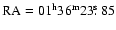 ,
,
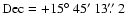 ), we examined the archival
Chandra observations of M 74,
carried out on 19th Oct. 2001. In the net 46.2 ksec of exposure time with
Chandra-ACIS, we did not see any source at the position of the supernova.
However, we did find a bright source at RA
), we examined the archival
Chandra observations of M 74,
carried out on 19th Oct. 2001. In the net 46.2 ksec of exposure time with
Chandra-ACIS, we did not see any source at the position of the supernova.
However, we did find a bright source at RA
 and
and
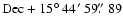 ,
which, being only 14.9
,
which, being only 14.9 away
from the SNe, was well within the region of
XMM spectral extraction. Comparing the positions of bright, point-like sources
seen in both the Chandra and XMM fields of view, we found that the relative
astrometric shift between
Chandra and XMM is at most
away
from the SNe, was well within the region of
XMM spectral extraction. Comparing the positions of bright, point-like sources
seen in both the Chandra and XMM fields of view, we found that the relative
astrometric shift between
Chandra and XMM is at most
 .
Thus, this object
(hereafter, CXU J013623.4+154459) would
have been detected within the 40
circle used to extract the XMM-EPIC
spectra.
.
Thus, this object
(hereafter, CXU J013623.4+154459) would
have been detected within the 40
circle used to extract the XMM-EPIC
spectra.
Level-2 pipeline processed Chandra
data was used for spectral analysis, since
a check on the calibration files used in the archived level-2 processed data
showed that no improvement would be made by re-calibrating the data. The
spectrum was extracted using the CIAO software,
and the spectral analysis was carried out using the SHERPA software.
The source was located on ACIS-S6 chip, and a light curve was extracted
from a source free region of the ACIS-S6 chip to
check that the observation was not contaminated by background flares.
We also extracted a light curve for the source, to check
for flaring, or any periodic variation, but the object is too faint
for any such variability to be noted. Since no sources are seen within
 of this object,
we used a region of radius
of this object,
we used a region of radius
 to extract the spectrum.
As a measure of the PSF at the source location, a radial region of
to extract the spectrum.
As a measure of the PSF at the source location, a radial region of

 would enclose 50% of the energy at 1.49 keV.
CXU J013623.4+154459 is very faint, and the higher energy ( keV)
spectrum is
seen to be strongly dominated by the background - possibly due to
high energy particles, rather than X-ray events. Because of the problems
associated with accurately modeling the high energy component of the
background spectra, we used background subtracted data and restricted
our analysis to the energy range
0.3-10.0 keV. The background subtracted
count rate in this energy band is
keV)
spectrum is
seen to be strongly dominated by the background - possibly due to
high energy particles, rather than X-ray events. Because of the problems
associated with accurately modeling the high energy component of the
background spectra, we used background subtracted data and restricted
our analysis to the energy range
0.3-10.0 keV. The background subtracted
count rate in this energy band is
 s-1.
Fixing the column density at
s-1.
Fixing the column density at
 cm2,
(obtained from online hydrogen column density generator
of High Energy Astrophysics Archive (HEASARC), in the direction of the SN)
and using the
cm2,
(obtained from online hydrogen column density generator
of High Energy Astrophysics Archive (HEASARC), in the direction of the SN)
and using the  -Gehrels statistic, we found that the source was well
fitted by a power-law spectrum with a photon index
0.6+0.6-0.35, implying a
0.3-10.0 keV flux of
-Gehrels statistic, we found that the source was well
fitted by a power-law spectrum with a photon index
0.6+0.6-0.35, implying a
0.3-10.0 keV flux of
 ergs cm-2 s-1. The
goodness-of-fit parameter was Q=0.899, where Q measures the
probability of obtaining the observed (or larger) value of ,
if
the data was well represented by the fitted parameters. For an ideal fit,
Q=1.
ergs cm-2 s-1. The
goodness-of-fit parameter was Q=0.899, where Q measures the
probability of obtaining the observed (or larger) value of ,
if
the data was well represented by the fitted parameters. For an ideal fit,
Q=1.
SN 2002ap was observed by the XMM instruments from Feb. 2.03 to Feb. 2.42 UT,
2002 (estimated
5 days after the
explosion), for a duration of 37.4 ksec. Both EPIC-MOS and EPIC-PN
observations were carried out in the "Thin1'' filter mode.
The data was pipeline processed and calibrated using the XMM-Science Analysis
Software (SAS) version 5.2,
and the latest available versions of the calibration files.
The events in the EPIC-MOS1,
EPIC-MOS2 and EPIC-PN data sets were filtered using the
SAS-xmmselect task, using the appropriate flags and event selection criteria to
account for event pile-up. We followed the analysis procedure recommended
in "Users Guide to the XMM-Newton Science Analysis System" (2001), with
the exception of allowing patterns  4 in the case of EPIC-PN, to account
for any pile-up, however negligible it may be.
A time series analysis of the entire EPIC-PN, MOS1 and MOS2 data,
shows that there are times of large, random fluctuation over the entire field
of view of both EPIC-PN and MOS CCDs. Filtering out these intervals of highly
fluctuating background reduced the exposure time to 25.5 ks in EPIC-PN and
30 ks in each of EPIC-MOS1 and MOS2.
4 in the case of EPIC-PN, to account
for any pile-up, however negligible it may be.
A time series analysis of the entire EPIC-PN, MOS1 and MOS2 data,
shows that there are times of large, random fluctuation over the entire field
of view of both EPIC-PN and MOS CCDs. Filtering out these intervals of highly
fluctuating background reduced the exposure time to 25.5 ks in EPIC-PN and
30 ks in each of EPIC-MOS1 and MOS2.
SN 2002ap was identified on the EPIC-CCDs using the optical
coordinates (
,
). The EPIC-PN spectra was extracted using a circle of radius
 ,
within which almost 80% of the source
photons in the energy range
10.5 - 1.5 keV would be enclosed, with the
extraction region remaining on a single CCD chip. The EPIC-MOS1 and
EPIC-MOS2 spectra were extracted using a psf of radius
,
which
encloses 90% of the total energy. The response matrices and ancillary
response files were generated using the SAS-rmfgen and SAS-arfgen tasks, and
the appropriate line number for the PN-CCD. The data was grouped and analysed
using the XSPEC software.
,
within which almost 80% of the source
photons in the energy range
10.5 - 1.5 keV would be enclosed, with the
extraction region remaining on a single CCD chip. The EPIC-MOS1 and
EPIC-MOS2 spectra were extracted using a psf of radius
,
which
encloses 90% of the total energy. The response matrices and ancillary
response files were generated using the SAS-rmfgen and SAS-arfgen tasks, and
the appropriate line number for the PN-CCD. The data was grouped and analysed
using the XSPEC software.
![\begin{figure}
\par\includegraphics[angle=270,width=8.8cm,clip]{h3813_fig1.ps}
\end{figure}](/articles/aa/full/2003/03/aah3813/img33.gif) |
Figure 1:
EPIC-PN spectrum and the fitted power law model
(see Sect. 2.3) of SN 2002ap.
The model fitted here consists of an absorbed powerlaw of photon
 with an additional constant absorbed power law component
to account for CXU J013623.4+154459.
with an additional constant absorbed power law component
to account for CXU J013623.4+154459.
 was fixed at 20.68.
The residuals are plotted in the lower panel.
was fixed at 20.68.
The residuals are plotted in the lower panel. |
| Open with DEXTER | |
The 0.3-12 keV, background subtracted, count rate in XMM EPIC-PN is
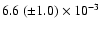 s-1. In the same energy range,
the EPIC-MOS1
count rate is
s-1. In the same energy range,
the EPIC-MOS1
count rate is
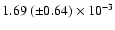 s-1 and the EPIC-MOS2
count rate is
s-1 and the EPIC-MOS2
count rate is
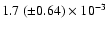 s-1.
s-1.
In order to account for the presence of the Chandra source discussed above
in the XMM
spectral extraction region, all models fitted to the data had an additive
absorbed power-law component, with parameters derived from fits to the Chandra
data, as discussed above. Since the SN is very faint, and the spectra
rather sparse (Fig. 1),
we kept
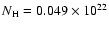 cm-2 as constant for all fits. In general, we found that letting
 vary can often result in unphysically low values of
 cm-2, while providing little improvement in the value
of reduced .
In Table 1, we have quoted the parameters from the best
fitted models in our analysis -
the 0.3-10 keV flux quoted there is corrected for the presence of the
Chandra source. The data is rather sparse, hence -fitting is unable to
distinguish between thermal bremsstrahlung and the simple power law models.
The power law distribution (Fig. 1)
fits the data well with
,
as does the
thermal bremsstrahlung model with temperature
cm-2, while providing little improvement in the value
of reduced .
In Table 1, we have quoted the parameters from the best
fitted models in our analysis -
the 0.3-10 keV flux quoted there is corrected for the presence of the
Chandra source. The data is rather sparse, hence -fitting is unable to
distinguish between thermal bremsstrahlung and the simple power law models.
The power law distribution (Fig. 1)
fits the data well with
,
as does the
thermal bremsstrahlung model with temperature
 keV.
Using the powerlaw model, we find that the total flux in the EPIC-PN extraction
region is
keV.
Using the powerlaw model, we find that the total flux in the EPIC-PN extraction
region is
 ergs cm-2 s-1. Correcting for the
presence of CXU J013623.4+154459, the
0.3-10.0 keV flux
from SN 2002ap is
ergs cm-2 s-1. Correcting for the
presence of CXU J013623.4+154459, the
0.3-10.0 keV flux
from SN 2002ap is
 ergs cm-2 s-1.
Adding an extra power-law, or a cutoff power-law component to the
bremsstrahlung, or Raymond-Smith or blackbody models did not improve the fit,
and resulted in poorly constrained values of temperatures with an
unusually high
photon index
 ,
and hence these models were discarded.
,
and hence these models were discarded.
| Model | |
 |
kT |
 |
f|0.3-10 |
| 1021 cm-2 | keV | 10-14 erg cm-2 s-1 | |||
| Power-law | 0.49 | 2.60.50.6 | - | 1.2/20 | 1.07 |
| > | 0.42 | 2.50.50.6 | - | 1.2/20 | 1.0 |
Thermal |
0.49 | - | 0.84-0.3+0.9 | 1.2/20 | 0.81 |
| Brems. | |||||
Raymond- |
0.49 | - | 2.31-0.8+1.9 | 1.58/20 | 1.04 |
| Smith | |||||
Blackbody |
0.49 | - | 0.21-.06+0.1 | 1.4/20 | 0.6 |
Because of the low count rate in EPIC-MOS CCDs, it was decided to fit to the
combined MOS1 and MOS2 data, allowing only the relative normalisations to vary.
As discussed for EPIC-PN data, each model incorporates an absorbed
power-law component to account for the Chandra source. Thus, the data was
well fitted by an absorbed thermal bremsstrahlung, with
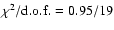 and
kT =
0.4-0.221.28. The 0.3-10 keV flux (corrected for CXU J013623.4+154459) was
and
kT =
0.4-0.221.28. The 0.3-10 keV flux (corrected for CXU J013623.4+154459) was
 ergs cm-2 s-1.
SN 2002ap was too faint to be detected by either of the RGS detectors.
The XMM-Newton Optical Monitor observed SN 2002ap in the 4-frame
(ENG-2) mode with UVW1 filter for a duration of 2.5 ks. The UVW1filter peaks at
 nm, and spans the
range
nm, and spans the
range
 310 nm.
The frames were combined and the data was pipeline processed using SAS
version 5.3 with the latest available calibration files. A source list
was compiled. We find that the optical monitor count rate for SN 2002ap
was
310 nm.
The frames were combined and the data was pipeline processed using SAS
version 5.3 with the latest available calibration files. A source list
was compiled. We find that the optical monitor count rate for SN 2002ap
was
 s-1, with the background count rate being
0.8 s-1. This corresponds to a UVW1 flux of
s-1, with the background count rate being
0.8 s-1. This corresponds to a UVW1 flux of
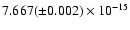 erg cm-2 s-1 Å-1.
![\begin{figure}
\par\includegraphics[width=8.8cm,clip]{h3813_fig2.ps}
\end{figure}](/articles/aa/full/2003/03/aah3813/img51.gif) |
Figure 2:
GMRT image of the field at 610 MHz containing SN 2002ap
overlayed on the X-Ray image from XMM. X-ray image is on a grey scale
while the radio image is the contour map with lowest level of 1.2 mJy.
The image resolution is
 .
Four X-ray
sources having radio counterparts are seen in this figure.
They are numbered according to their decreasing RA in Table 4.
Position of the SN on the map is marked with
a cross. .
Four X-ray
sources having radio counterparts are seen in this figure.
They are numbered according to their decreasing RA in Table 4.
Position of the SN on the map is marked with
a cross. |
| Open with DEXTER | |
The radio observations of SN 2002ap were made with the Giant Metrewave Radio Telescope in aperture synthesis mode on 2002 February 5.56 in the 610 MHz band and on 2002 April 8.22 in the 1420 MHz band.
For both the observations at 610 as well as 1420 MHz, the pointing centre
was chosen to be the position of supernova i.e.
and
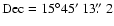 .
In the 610 MHz observations the time on
source was around 2 hours and 3C48 was used as the flux, phase and the
bandpass calibrator. It was also used as bandpass calibrator. 3C48 was
observed for approximately 10 min after every 30 min. It's
flux at 610 MHz was derived from the best fit spectra given in VLA calibrator manual.
Out of a total of 30 antennas, we had 22 good
antennas. The full band of 16 MHz was used, resulting in 128 frequency
channels of width 125 kHz. For the observations in 1420 MHz band, the
number of antennas used were 24. The time on the source was 3.5 hours.
3C48 was again used as a flux calibrator and it was observed at the
beginning and at the end of the observations. The flux of 3C48 was assumed
to be 16.15 Jy from VLA calibrator manual. Compact sources 0119+321
and 0238+166 were used as the phase
calibrator with fluxes 2.6 Jy and 1.26 Jy respectively. 3C48 was also used
as a bandpass calibrator. The full band of 16 MHz resulting in 128 channels
of width 125 kHz was used.
.
In the 610 MHz observations the time on
source was around 2 hours and 3C48 was used as the flux, phase and the
bandpass calibrator. It was also used as bandpass calibrator. 3C48 was
observed for approximately 10 min after every 30 min. It's
flux at 610 MHz was derived from the best fit spectra given in VLA calibrator manual.
Out of a total of 30 antennas, we had 22 good
antennas. The full band of 16 MHz was used, resulting in 128 frequency
channels of width 125 kHz. For the observations in 1420 MHz band, the
number of antennas used were 24. The time on the source was 3.5 hours.
3C48 was again used as a flux calibrator and it was observed at the
beginning and at the end of the observations. The flux of 3C48 was assumed
to be 16.15 Jy from VLA calibrator manual. Compact sources 0119+321
and 0238+166 were used as the phase
calibrator with fluxes 2.6 Jy and 1.26 Jy respectively. 3C48 was also used
as a bandpass calibrator. The full band of 16 MHz resulting in 128 channels
of width 125 kHz was used.
The data was analysed using AIPS (Astronomical Image Processing Software) of National Radio Astronomy Observatory. Interference in some of the frequency channels, spikes and dropouts due to electronics etc. were flagged using the AIPS task FLGIT. FLGIT was run on the calibrator scans and 10 times the expected noise per channel was used as the flagging criterion. In this manner 15% of the data was flagged. Then one clean channel was looked at and antenna and baseline based flagging was done. Approximately 20% of the data was lost in the flagging process. After computing the single channel antenna-based complex gains for the flux calibrator and phase calibrator with the time resolution of 20 s, bandpass calibration was done using 3C48 to apply the single channel calibration to all the channels. To get rid of the effect of the band smearing at low frequency (610 MHz), a pseudo-continuum data base of 6 frequency channels was made from the central 100 channels of 16 MHz bandwidth. Field maps were made by Fourier transformation and cleaning. Iterative self-calibration rounds were run for phase correction. Details of GMRT data analysis procedures are given in (Bhatnagar 2000).
| Source | Date in | RA | Dec. |  |
Flux |
| 2002 | J2000 | J2000 | MHz | Jy | |
| 3C48 | 5 Feb. | 01 37 41.3 | 33 09 35 | 610 | 29.4 |
| 3C48 | 8 Apr. | 01 37 41.3 | 33 09 35 | 1420 | 16.2 |
| 0119+321 | 8 Apr. | 01 19 35.0 | 32 10 50 | 1420 | 2.9 |
| 0238+166 | 8 Apr. | 02 38 38.9 | 16 36 59 | 1420 | 1.0 |
In neither of the observations carried out on 2002 February 5 (day 8.56) and on 2002 April 8 (day 42), SN 2002ap was detected by GMRT. The upper limits of the fluxes from the region of the SN are given in Table 3. The GMRT 610 MHz contour map shows several extended sources, which are likely associated with the spiral arms of the galaxy. Superposition of the 610 MHz contour map on the X-ray EPIC-PN image (Fig. 2), reveals the existence of 4 X-ray sources with radio counterparts. These are listed in Table 4 with their radio flux densities and X-ray 0.3-10.0 keV count rates. Spectral analysis to determine the nature of these sources is being done separately.
| Date in | |
Resolution | 2 Flux
Flux |
rms |
| 2002 | (MHz) | (arcsec) | (mJy) | mJy/ beam |
5 Feb. |
610 |
 |
<0.34 | 0.17 |
| 8 Apr. | 1420 |
 |
<0.18 | 0.09 |
| Source | RA | Dec | Radio | EPIC-PN |
| No. | Flux | count-rate | ||
| J2000 | J2000 | (mJy) | 10-3 ct s-1 | |
| 1 | 01 36 47.2 | 15 47 45 |
 |
 |
| 2 | 01 36 46.1 | 15 41 17 |
 |
 |
| 3 | 01 36 24.9 | 15 48 58 |
 |
 |
| 4 | 01 36 30.5 | 15 45 17 |
 |
 |
The radio turn-on of supernovae are found to be wavelength dependent, with
the flux at shorter wavelengths peaking before that at longer
wavelengths (e.g. Berger et al. 2002). This decreasing absorption can be either
via free-free absorption (FFA) or synchrotron self-absorption (SSA) in the
expanding CSM.
We have fitted the VLA and GMRT data on 2002 Feb. 5.96 to a
SSA model, with spectral
 in the optically thin
limit, implying that the radius of the
radio photosphere on this day was
in the optically thin
limit, implying that the radius of the
radio photosphere on this day was
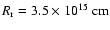 and the magnetic field in the shocked ejecta
was B = 0.29 G
(see Table 6).
We also note that that SSA prediction of flux at 610 MHz band is
consistent with the GMRT upper limit.
and the magnetic field in the shocked ejecta
was B = 0.29 G
(see Table 6).
We also note that that SSA prediction of flux at 610 MHz band is
consistent with the GMRT upper limit.
In order to compare the photospheric radii across wavebands, we
also compute the size of the optical photosphere at the same epoch.
Using the synthetic light curve best-fitted to the bolometric light curve on
day 5 (Mazzali et al. 2002), the bolometric magnitude was
 ,
and the
visual magnitude was
,
and the
visual magnitude was
 (using a distance modulus of
29.5 Sharina et al. 1996). This implies that the
radius of the optical photosphere on day 5 was
(using a distance modulus of
29.5 Sharina et al. 1996). This implies that the
radius of the optical photosphere on day 5 was
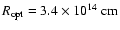 ,
and corresponding total flux
across UV, optical and IR bands was
,
and corresponding total flux
across UV, optical and IR bands was
 .
The inferred
conditions in the optical photosphere are listed in Table 5.
.
The inferred
conditions in the optical photosphere are listed in Table 5.
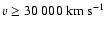
In contrast, the position of the radio photosphere on day 7 was
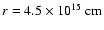 and its velocity
 (Berger et al. 2002). Scaling to day 5,
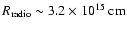 .
Thus, the radio photosphere is quite far outside the optical
photosphere.
The region of production of the X-rays is also outside the
optical photosphere radius (see Sect. 6).
This substantiates the inference from
the early spectrum (Meikle et al. 2002) that there was sufficient
material at
.
Thus, the radio photosphere is quite far outside the optical
photosphere.
The region of production of the X-rays is also outside the
optical photosphere radius (see Sect. 6).
This substantiates the inference from
the early spectrum (Meikle et al. 2002) that there was sufficient
material at
 .
.
| Mv |
 |
 |
 |
 |
 |
| K | cm | km s-1 |
 |
||
| -17.4 | -16.5 | 11 000 |
 |
8000 |
 |
The framework of spherical symmetry has been used to perform the above analysis. This is a reasonable assumption on the day of the XMM observation and shortly afterwards, since the month-long, early spectropolarimetric data of Wang et al. (2002) implied there was little distortion of the photosphere on 2002 February 3.
![\begin{figure}
\par\includegraphics[width=8.8cm,clip]{h3813_fig3.ps}
\end{figure}](/articles/aa/full/2003/03/aah3813/img83.gif) |
Figure 3: Comparison of spectrum of three SNe (SN1993J van Dyk et al. 1994; SN 1998bw Kulkarni et al. 1998; SN 2002ap Berger et al. 2002) near day 11 after explosion. Solid line, dashed line and long dashed lines show the best fit synchrotron self absorption model for SN 2002ap, 1993J and 1998bw respectively and dotted line, dot-dashed line and short-long dashed line show the corresponding free free absorption model. |
| Open with DEXTER | |
|
 |
 |
 |
B |
| GHz |  Jy Jy |
cm | G | |
| 0.8 | 2.45 | 397 |
 |
0.29 |
Finally, we compare the early radiospheric properties of SN 2002ap with those of other radio SNe, across type classification, using equipartition arguments. Theoretically, early radio emission from SNe is thought to originate from an envelope that is expanding at a substantially higher speed than the optical photosphere (Shklovsky 1985). It is only at early times after the explosion that the effect of Compton boosting by electrons to high energy bands producing nonthermal spectrum is potentially observable (Sect. 6). At such early times radio spectra of supernovae are relatively rare.
We have fitted models (Fig. 3) to the radio spectra obtained
from three supernovae: SN 1993J (a type IIb SN) on day 11.45,
SN 1998bw (a type Ic SN) on day 11.7 and SN 2002ap (another type Ic SN)
on day 11.0. Best fit parameter values for SSA model were obtained
by using a
fit.
While SN 1993J and SN 1998bw were much brighter at their
peaks compared to SN 2002ap, the synchrotron self-absorption peak for
SN 2002ap seems to occur at the lowest frequency among all three.
Best fit parameters values are listed in Table 7.
| SNe |
|
|
 |
 |
B0 | R0 |
 |
 |
|||||
| GHz | mJy | as |
erg | G | cm | |
| 2002ap | 2.45 | 0.48 | 39.0 | 0.69 | 0.47 | 4.80 |
| 1998bw | 5.5 | 50.4 | 112.4 | 3500 | 0.23 | 68.4 |
| 1993J | 30.5 | 22.3 | 17.6 | 0.50 | 3.54 | 1.08 |
 |
as)
while those for SN 1993J and SN 2002ap are comparable (18 and 39 as
respectively). Hence SN 1998bw which was not only coincident with a GRB
source but also very bright in the radio was rapidly expanding. It
was unusual compared to the more
ordinary SN like SN 2002ap (despite both supernova's identical type
classification), - the latter having similarity with SN 1993J in terms of
equipartition size, across type classification.
The early emission in X-ray and Radio bands allows us to estimate the density of the CSM along line of sight, and hence the mass loss rate from the presupernova star, if the terminal wind speed of the progenitor star is known or estimated.
The CSM density is related to the mass loss parameters as:
 .
The gas overlying the emission regions would itself serve as an absorber
of the radio and X-ray radiation.
An estimate of
.
The gas overlying the emission regions would itself serve as an absorber
of the radio and X-ray radiation.
An estimate of  can be made from the XMM data. The mass loss rate is
a measure of the column depth
can be made from the XMM data. The mass loss rate is
a measure of the column depth
 rather than the
 which appears in the radio (free-free) absorption.
The stellar wind would absorb the X-rays below 8 keV due to the
dominant photo-electric absorption of the metals.
The time at which
which appears in the radio (free-free) absorption.
The stellar wind would absorb the X-rays below 8 keV due to the
dominant photo-electric absorption of the metals.
The time at which
 is reached for photons of
energy
is reached for photons of
energy
 is (Chevalier & Fransson 1994):
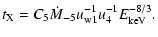 |
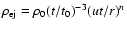 ). Using a
typical value of the profile index n=10.2,
the epoch of X-ray detection as day 5 and
). Using a
typical value of the profile index n=10.2,
the epoch of X-ray detection as day 5 and
 ,
we determine
,
we determine
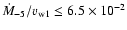 .
From optical
spectral measurements, the velocity of the pre-supernova wind
was 580 km s-1 (Leonard et al. 2002). This
implies that
.
From optical
spectral measurements, the velocity of the pre-supernova wind
was 580 km s-1 (Leonard et al. 2002). This
implies that
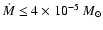 .
The above expression
assumes that the heavy elements contributing to the opacity are mostly
neutral - this upper limit would be less stringent if oxygen in the
undisturbed circumstellar medium is heavily ionised, in which case the
X-ray absorption is reduced.
.
The above expression
assumes that the heavy elements contributing to the opacity are mostly
neutral - this upper limit would be less stringent if oxygen in the
undisturbed circumstellar medium is heavily ionised, in which case the
X-ray absorption is reduced.
A similar mass loss rate can also be derived from the first radio detection
of SN 2002ap in the 1.4 GHz band on 2002 Feb. 1.93 (i.e. on day 5) when
the optical depth in the radio frequency band would have been 1.
At this time the dominant opacity source for radio radiation is
the free-free opacity from fully ionised wind (Chevalier 1982):
from the radio data, we estimate the upper limit on the mass loss rate as
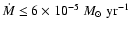 .
.
Our spectral modeling of XMM observation of SN 2002ap shows that both power-law and thermal bremsstrahlung models give acceptable fits to early X-ray data. Since multiwaveband data from UV, optical and radio are also available from this supernova, these can be additionally utilised to restrict models of prompt emission. Among the possible mechanisms invoked in the context of radio loud X-ray supernovae are: a) direct synchrotron emission from radio to X-ray band, b) free-free emission from the hot gas consisting of swept up mass behind the blast wave (circumstellar) shock and that behind the reverse shock, and c) inverse Compton scattering of optical photons emitted by the supernova by the hot electrons.
Case (a): as in the case of SN 1980K (Canizares et al. 1982), the direct synchrotron
radiation
mechanism for SN 2002ap prompt emission can be eliminated.
The power law spectrum in frequency for the radio flux observed from
SN 2002ap is:
 (unabsorbed flux from Berger et al. 2002). If the same ambient magnetic
field (
(unabsorbed flux from Berger et al. 2002). If the same ambient magnetic
field (
 Gauss) implied by equipartition arguments
were to hold, to generate
X-ray energies (1 keV) by synchrotron mechanism, would imply the presence
of highly relativistic electrons (
Gauss) implied by equipartition arguments
were to hold, to generate
X-ray energies (1 keV) by synchrotron mechanism, would imply the presence
of highly relativistic electrons (
 ).
On day 5, a straight extrapolation of the radio spectrum with the above
flux would imply a flux of only 58 picoJansky at 1 keV.
Since the
).
On day 5, a straight extrapolation of the radio spectrum with the above
flux would imply a flux of only 58 picoJansky at 1 keV.
Since the  energy bandwidth for a power law distribution of energy
index -1.6 in the
XMM band is 3.7 keV, this would imply an X-ray flux of about
energy bandwidth for a power law distribution of energy
index -1.6 in the
XMM band is 3.7 keV, this would imply an X-ray flux of about
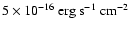 .
This is far less than what
is observed by XMM. Thus a direct radio to X-ray synchrotron radiation
mechanism is unviable, or produces an insignificant part of the observed
X-rays. Therefore, different populations of electrons appear to
be responsible for the radio and X-ray fluxes that are seen.
.
This is far less than what
is observed by XMM. Thus a direct radio to X-ray synchrotron radiation
mechanism is unviable, or produces an insignificant part of the observed
X-rays. Therefore, different populations of electrons appear to
be responsible for the radio and X-ray fluxes that are seen.
Case (b): the circumstellar gas is heated to high temperatures
( 100 keV) by the shock
resulting from the piston-like expanding supernova envelope.
This shocked gas cools by free-free emission and/or Compton cooling.
The free-free luminosity from
the circumstellar (blast-wave) and reverse shocks
(Fransson 1982; Chevalier & Fransson 2001) is:
100 keV) by the shock
resulting from the piston-like expanding supernova envelope.
This shocked gas cools by free-free emission and/or Compton cooling.
The free-free luminosity from
the circumstellar (blast-wave) and reverse shocks
(Fransson 1982; Chevalier & Fransson 2001) is:
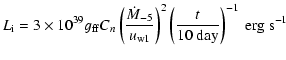 |
 is the Gaunt factor.
With
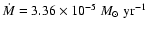 and with a wind velocity
 km s-1 (i.e.
 ), at t=5 days, the
X-ray flux at 7.3 Mpc would be:
), at t=5 days, the
X-ray flux at 7.3 Mpc would be:
 erg cm-2 s-1.
This flux would have been near the observed flux that has been
detected from SN 2002ap by XMM. However,
with the reported high ejecta velocities and the implied temperature
of the shocked ejecta and CSM along with the limited
cool absorbing shell at this early stage, one would expect a flat tail
of high energy photons up to about 100 keV (Fransson 1982).
Since the XMM spectrum
on day 5 is not so hard (see Table 1 where
the thermal bremsstrahlung temperature is quite modest), the free free
emission is also an insignificant part of the early
radiative budget.
Thermal X-ray emission (i.e. bremsstrahlung) will however become more
dominant compared to the inverse Compton process (case c below)
as the supernova ages.
erg cm-2 s-1.
This flux would have been near the observed flux that has been
detected from SN 2002ap by XMM. However,
with the reported high ejecta velocities and the implied temperature
of the shocked ejecta and CSM along with the limited
cool absorbing shell at this early stage, one would expect a flat tail
of high energy photons up to about 100 keV (Fransson 1982).
Since the XMM spectrum
on day 5 is not so hard (see Table 1 where
the thermal bremsstrahlung temperature is quite modest), the free free
emission is also an insignificant part of the early
radiative budget.
Thermal X-ray emission (i.e. bremsstrahlung) will however become more
dominant compared to the inverse Compton process (case c below)
as the supernova ages.
Case (c): the dominant cooling and radiative mechanism at early stages
when the optical photospheric temperature
 K, is Compton cooling (Fransson 1982).
Optical photons from the photosphere can undergo repeated scattering off
the hot electrons in the shocked region (notably the shocked CSM)
and a power law
photon distribution (in energy) can result even if the electron distribution
is not a power law, and even
if the electron scattering depth
K, is Compton cooling (Fransson 1982).
Optical photons from the photosphere can undergo repeated scattering off
the hot electrons in the shocked region (notably the shocked CSM)
and a power law
photon distribution (in energy) can result even if the electron distribution
is not a power law, and even
if the electron scattering depth
 remains small.
Pozdnyakov et al. (1977) reported Monte Carlo calculations
and their analytical approximations of the emergent Compton
scattered spectrum. The spectrum depends on the optical depth
and the
temperature T of the electron plasma.
For photons
undergoing electron scattering with cross-section
remains small.
Pozdnyakov et al. (1977) reported Monte Carlo calculations
and their analytical approximations of the emergent Compton
scattered spectrum. The spectrum depends on the optical depth
and the
temperature T of the electron plasma.
For photons
undergoing electron scattering with cross-section
 in the shocked gas is:
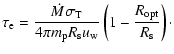 |
 originating from
Comptonization are (Fransson 1982):
originating from
Comptonization are (Fransson 1982):
 |
![$\displaystyle \gamma (\gamma + 3) = -{m_{\rm e}c^2\over kT_{\rm e}} \rm ln\left[{\tau_{\rm e}\over
2}(0.9228- \rm ln \tau_{\rm e})
\right]$](/articles/aa/full/2003/03/aah3813/img124.gif) |
 is the peak frequency in the (optical) input spectrum,
and
is the peak frequency in the (optical) input spectrum,
and  the optical flux density.
is the radius of photosphere.
the optical flux density.
is the radius of photosphere.
 is the position of the plasma element.
We note that on day 5 the unabsorbed (or dereddened) X-ray
and optical flux densities derived from XMM and ground based
observations (Sect. 4) imply an optical
to X-ray power law of
 and a logarithm of the ratio of flux densities of
  7.4.
The optical to X-ray power law index is consistent with the
XMM results
(see Table 1). We determine the optical depth
and temperature conditions of the Comptonizing plasma for
7.4.
The optical to X-ray power law index is consistent with the
XMM results
(see Table 1). We determine the optical depth
and temperature conditions of the Comptonizing plasma for  in Table 8.
The presupernova scenarios typical for type Ic SNe, for which the
optical depths are reported in Table 8 are discussed
in the next section.
The plasma
has the maximum optical depth at twice
the optical photosphere radius. The latter was taken
as
in Table 8.
The presupernova scenarios typical for type Ic SNe, for which the
optical depths are reported in Table 8 are discussed
in the next section.
The plasma
has the maximum optical depth at twice
the optical photosphere radius. The latter was taken
as
 .
Since most of the X-ray
emission would take place at
.
Since most of the X-ray
emission would take place at
 ,
the relevant
plasma outflows with a velocity of approximately
16 000 km s-1.
,
the relevant
plasma outflows with a velocity of approximately
16 000 km s-1.
| Scenario |
 |
 |
|
 |
 |
10 km s-1 | 109 K | ||
| Wolf-Rayet | 1.5 | 58 |
 |
2 |
| 3 | 100 |
 |
2 | |
| Interacting | 10 | 58 |
 |
1.5 |
| Binary | ||||
| Case-BB | 10 | 10 |
 |
1.1 |
In this paper, we presented an analysis of the XMM data of the SN 2002ap field and have obtained spectral model fits to the prompt X-ray emission. We compare the X-ray image with the GMRT 610 MHz radio image obtained three days apart. While we find no radio counterpart of the SN at such low frequencies, several sources in the field have radio and X-ray counterparts.
We compare the radio data obtained from three different supernovae in their early phases and model these using the synchrotron self absorption model. SN 1998bw(Ic) with a GRB counterpart had very different radiosphere radius and equipartition angular sizes at approximately the same time in their evolution compared to two other SNe: SN 2002ap(Ic) and SN 1993J(IIb).
We model the early X-ray emission with inputs from optical photometry and light curve and find that the inverse Compton scattering of optical photons from the supernova photosphere by hot electron plasma can account for the observed early X-ray flux and the spectrum for modest electron temperatures and optical depths. Thermal processes are inefficient initially and would be important only as the supernova ages.
Mass loss rates and stellar wind velocities of the progenitor stars determine the optical depth of shock heated matter due to electron scattering - a key parameter in the production of the X-ray flux from the lower energy photons. These in turn depend upon the scenario and progenitor configuration giving rise to type Ic SNe, e.g.:
1. Massive Wolf-Rayet (WR) stars which have lost their hydrogen and helium
envelope before the explosion (Langer et al. 1999)
have an empirically determined
mass loss rate of
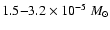 (after taking into account
effects due to clumpy medium), (Hamann et al. 1998; Willis 1998) and terminal
wind velocities 1000 km s-1 depending
upon the type of the WR star.
(after taking into account
effects due to clumpy medium), (Hamann et al. 1998; Willis 1998) and terminal
wind velocities 1000 km s-1 depending
upon the type of the WR star.
2. Interacting binaries - in particular, in a case BB mass transfer
from a helium star overflowing its Roche-lobe, to a companion
removes most of the helium rich layers before
the type Ic SN.
Habets (1985) finds
that a 2.5  helium star
during carbon shell burning stage expands to
a red giant dimension of 18
helium star
during carbon shell burning stage expands to
a red giant dimension of 18  and sustains an
average mass transfer rate of
and sustains an
average mass transfer rate of
 lasting about 3000 years.
During this time, the terminal wind speed
of the mass losing
star would be typically 100 km s-1.
lasting about 3000 years.
During this time, the terminal wind speed
of the mass losing
star would be typically 100 km s-1.
Using the relevant parameters in the above two scenarios, we derive
electron optical depth encountered by the intermediate energy
photons as listed in Table 8.
It is evident that both ranges of electron optical depths
for the Compton boosting process
remain viable
alternatives. For the case of the interacting binary model
where the optical depths are somewhat larger, the implied
electron temperatures required for the plasma would be lower
than in the single star WR model. Such temperatures are well
within the range expected for hot circumstellar gas
(
 K)
even for modest velocities of
16 000 - 20 000 km s-1for the hot electron plasma moving above the optical photosphere.
K)
even for modest velocities of
16 000 - 20 000 km s-1for the hot electron plasma moving above the optical photosphere.
Acknowledgements
This work made use of XMM Target of Opportunity data. F. K. Sutaria would like to thank the XMM-Newton helpdesk for many useful communications during the pipeline processing of raw data. We acknowledge the use of Chandra archival data on M 74. We thank the staff of the GMRT that made the radio observations possible. We also thank the NRAO staff for providing the Astronomical Image Processing Software (AIPS) for radio data analysis.
 ,
and the maximum value
of bolometric correction was used (Allen
,
and the maximum value
of bolometric correction was used (Allen  with
with  cm.
cm.