

The spectra of all 139 datasets have been fitted with the
above-described DISKBB+REFSCH model. Two example model spectra are
shown in Fig. 3. These spectra have the extreme values of
 and R, revealing the spectral differences between different
 -state observations.
The best fit parameters for the -states of GRS 1915+105 are shown in
Fig. 4 and Table 2, respectively. The upper
two panels in Fig. 4 show the strong variability of the
source in the 1.5-12 keV (RXTE All Sky Monitor (ASM)) and
2.25 GHz (GBI) bands from JD 2450300-2451900. Irregular
outburst and relatively quiet phases alternate in X-ray and radio
without any obvious coupling.
The lower six panels of Fig. 4 show the PCU0 count rate
and the fit parameters of the -state observations. The red and
black data points mark two groups of observations with different
(
 )
behavior (see Fig. 5).
)
behavior (see Fig. 5).
Between the -states, the PCU0 count rate varies, with some
exceptions, by a factor of 2 at most. Only during the long continuous
-state at
 and at JD
  2451750
recurrent variability in the X-ray count rate is observed. The model
parameters of DISKBB+REFSCH are variable. The power law slope,
,
varies between 2.4 and 3.5 with a long-term periodicity of
590 days (Rau & Greiner 2002, in preparation). No correlation
of
and PCU0 count rate is seen, except around
2451750
recurrent variability in the X-ray count rate is observed. The model
parameters of DISKBB+REFSCH are variable. The power law slope,
,
varies between 2.4 and 3.5 with a long-term periodicity of
590 days (Rau & Greiner 2002, in preparation). No correlation
of
and PCU0 count rate is seen, except around
 and
and
 .
The power law normalization
behaves similarly to the slope.
.
The power law normalization
behaves similarly to the slope.
The reflection component, R, is variable between different
-state observations and shows a long-term variability similar to
the power law slope. It varies between 0 and 10 (upper limit of our model) with rather large
uncertainties when R>4. Except for five observations when R<1,
this rules out an isotropically sandwiching corona above the entire accretion disk.
![\begin{figure}
\par\includegraphics[width=10cm,clip]{MS2456f4.ps}
\end{figure}](/articles/aa/full/2003/02/aa2456/img46.gif) |
Figure 4:
1.5-12 keV ASM count rate (1st panel from top) and 2.25 GHz GBI
flux (2nd) from November 1996 to September 2000. ( GBI
was off-line some time before
 and following
 .
The lower panels show the 3-20 keV PCU0
count rate (3rd), the power law slope, ,
(4th) and
power law normalization,
,
(5th), the reflection
amplitude, R, (6th), the accretion disk temperature, .
The lower panels show the 3-20 keV PCU0
count rate (3rd), the power law slope, ,
(4th) and
power law normalization,
,
(5th), the reflection
amplitude, R, (6th), the accretion disk temperature,
 ,
(7th) and the inner disk radius (determined from
the disk normalization), ,
(7th) and the inner disk radius (determined from
the disk normalization),  ,
(8th) for all analysed
-states of GRS 1915+105. Error bars are 1 ,
(8th) for all analysed
-states of GRS 1915+105. Error bars are 1 for one parameter of interest. The observations of the two different branches in the (
)
behavior are marked with red (steep) and black (flat) as in Fig. 5.
for one parameter of interest. The observations of the two different branches in the (
)
behavior are marked with red (steep) and black (flat) as in Fig. 5. |
| Obs-ID(1) | GD | JD | Exposure(2) | PCU0(3) | HEXTE0(4) |
(5) |
 (6) (6) |
(7) |
R(8) |
| (-2400000) | [s] | [cts/s] | [cts/s] | [keV] | |||||
| K-02-01 | 14.11.1996 | 50401.12 | 2688 | 995 | 70 | 2.60 +4.81-0.49 | 1.67 +4.90-1.60 | 2.89 +0.05-0.07 | 1.37 +0.55-0.86 |
| K-06-00 | 11.12.1996 | 50428.86 | 8656 | 587 | 60 | 2.50 +0.35-0.30 | 2.52 +1.46-1.45 | 2.69 +0.02-0.02 | 2.40 +0.40-0.44 |
| K-07-00 | 19.12.1996 | 50436.74 | 8992 | 598 | 61 | 2.21 +0.36-0.21 | 3.42 +3.25-2.32 | 2.70 +0.01-0.03 | 2.25 +0.20-0.56 |
| . | . | . | . | . | . | . | . | . | . |
| . | . | . | . | . | . | . | . | . | . |
| P-28-00 | 21.09.2000 | 51808.70 | 2384 | 706 | 69 | 2.70 +1.39-0.73 | 1.14 +8.85-1.01 | 2.84 +0.03-0.06 | 3.11 +1.42-2.64 |
| P-28-01 | 21.09.2000 | 51808.77 | 2400 | 651 | 66 | 3.15 +3.59-1.05 | 0.38 +0.21-0.37 | 2.83 +0.08-0.04 | 2.74 +0.22-1.29 |
| P-28-02 | 21.09.2000 | 51808.83 | 2336 | 645 | 44 | 2.00 +1.72-0.28 | 6.65 +23.43-6.47 | 2.87 +0.05-0.03 | 3.24 +0.24-2.29 |
| Obs-ID |
(9) |
 (10) (10) |
c(11) |  (12) (12) |
| [Pho/keV/cm2/s] | ||||
| K-02-01 | 43.5 +2.0-2.6 | 4999 +1-3521 | 0.82 | 0.69 |
| K-06-00 | 15.6 +1.2-0.3 | 5000 +0-4421 | 0.78 | 1.00 |
| K-07-00 | 16.3 +1.1-0.4 | 996 +4004-338 | 0.79 | 1.01 |
| . | . | . | . | . |
| . | . | . | . | . |
| P-28-00 | 34.1 +0.7-5.0 | 2902 +2098-2902 | 0.82 | 0.94 |
| P-28-01 | 29.8 +0.1-2.1 | 462 +4538-461 | 0.81 | 0.84 |
| P-28-02 | 27.2 +2.8-0.8 | 34 +2900-34 | 0.52 | 0.77 |
The significance of the accretion disk component varies through the
-states. For some observations the disk is more or less absent
(e.g. JD 50400-50600; relatively low disk temperature and large
inner disk radius (small normalization)), for other observations the
disk component provides a non-negligible contribution to the X-ray
flux (e.g. JD 51500-51600; high temperature and small inner
radius). In order to be consistent and to fit all -state
observations with the same model, we included the DISKBB component in
all of our fits, although it could be excluded for several observations.
![\begin{figure}
\par\includegraphics[width=7cm,clip]{MS2456f5.ps}
\end{figure}](/articles/aa/full/2003/02/aa2456/img49.gif) |
Figure 5:
Power law slope, ,
as a function of power law
normalization,
.
Each RXTE observation is
represented by one data point. The upper branch presents the red points in Fig. 4 and the lower
branch the black points, respectively. The dotted lines
represent the fitted correlation functions (see text). |
The accretion disk component shows a variable disk temperature of
1-4 keV. Sometimes, large uncertainties due to the small
contribution of the DISKBB component to the total flux are seen. The
inner disk radius, which can be determined from the disk
normalization, varies between 1 and 20 km. For a non-rotating black
hole of mass 14  (as measured for GRS 1915+105, Greiner et al. 2001b)
the Schwarzschild radius is 40 km. It is known that the DISKBB
model underestimates the inner disk radius by a factor of 1.7-3 due
to Doppler blurring and gravitational redshift (Merloni et al.
2000). Also the neglect of comptonization in the surface layers of the
disk leads to unphysical values when using then DISKBB model
(Zdziarski et al. 2001). But even a maximally rotating black hole
(where the inner disk radius reaches the Schwarzschild radius) cannot
account for the majority of the parameter values. This problem has to
be kept in mind when discussing the absolute values of the parameters.
(as measured for GRS 1915+105, Greiner et al. 2001b)
the Schwarzschild radius is 40 km. It is known that the DISKBB
model underestimates the inner disk radius by a factor of 1.7-3 due
to Doppler blurring and gravitational redshift (Merloni et al.
2000). Also the neglect of comptonization in the surface layers of the
disk leads to unphysical values when using then DISKBB model
(Zdziarski et al. 2001). But even a maximally rotating black hole
(where the inner disk radius reaches the Schwarzschild radius) cannot
account for the majority of the parameter values. This problem has to
be kept in mind when discussing the absolute values of the parameters.
Another free physical parameter of the REFSCH model is the ionization
parameter, .
It has huge uncertainties because no Fe K line could be fitted but has a negligible influence on the hard X-ray
continuum and our model parameters. Therefore we will not plot or
discuss
further. Theoretically, the reflection in the hard
spectrum should depend on the ionization parameter because higher
ionization means lower absorption and therefore higher reflection
probability. But the REFSCH model includes a simple 1-ionization zone
model only, which is very unlikely to be present in the disk and does
not show any dependence of reflection and ionization at all.
line could be fitted but has a negligible influence on the hard X-ray
continuum and our model parameters. Therefore we will not plot or
discuss
further. Theoretically, the reflection in the hard
spectrum should depend on the ionization parameter because higher
ionization means lower absorption and therefore higher reflection
probability. But the REFSCH model includes a simple 1-ionization zone
model only, which is very unlikely to be present in the disk and does
not show any dependence of reflection and ionization at all.
The model fits reveal an increasing power law normalization,
,
with a steepening power law component (Fig. 5) suggesting a pivoting behavior. Two branches with different slopes are seen in the correlation. No correlation of the power law slope with the X-ray count rate in ASM and/or PCU is observed.
The strength of the correlation can be tested using a Spearman
rank-order correlation test (Press et al. 1992). Both branches show
strong correlations (steeper:
 ,
flatter:
,
flatter:
 ). (Note, this statistical method does not take into
account the particular uncertainties of the data points.)
). (Note, this statistical method does not take into
account the particular uncertainties of the data points.)
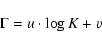
The best descriptions of the correlations are
functions of the type
 |
(1) |
 and
and
 for the lower branch and
 and
for the upper branch.
and
for the upper branch.
The pivoting has been tested in more detail by schematically plotting the obtained power law spectra. The two different branches consequently show different pivoting behavior (Fig. 6). Whereas the upper branch from Fig. 5 shows a pivoting energy of 4-8 keV (gray), the lower branch pivots at around 20-30 keV (black).
![\begin{figure}
\par\includegraphics[width=9cm,clip]{MS2456f6.ps}
\end{figure}](/articles/aa/full/2003/02/aa2456/img56.gif) |
Figure 6: Schematic power law spectra for the upper (top) and lower (bottom) branch of Fig. 5, the red and black points from Fig. 4, respectively, artificially offset by a factor of 100. The pivoting happens at different energies (4-8 keV & 20-30 keV). |
Due to the known uncertainties of the PCA below 6 keV (Jahoda et al. 1996) and the low energy resolution, stringent conclusions about the behavior of an iron line in the RXTE spectra at 6.4-7 keV not can be drawn. For the analysis of the reflection, therefore, only the continuum radiation can be used, manifesting itself in the reflection hump from 10-30 keV.
The reflection amplitude in GRS 1915+105 as a function of
is shown
in Fig. 7 together with that of three black hole
candidates (Cyg X-1, GX 339-4 and GS 1354-644; Gilfanov et al.
2000). Although R shows large uncertainties for the -states of
GRS 1915+105, a similar correlation is seen as in the other X-ray
binaries. The steeper the power law component, the higher is the
reflected fraction of photons. Figure 7 contains the
confidence intervalls of R for three observations to clarify the
influence of the model on the R()-correlation. Although the
contours are elongated similiar to the correlation (higher has higher R), they are intrinsically steeper compared to the
overall correlation. Thus, the existence of the
R()-correlation in the -states of GRS 1915+105 is no artifact
of the model.
A group of observations at high
(3.3-3.5) and small R(0-2) behaves remarkably differently. These points belong to five
datasets from JD 2451497 and JD 2451513 showing very high PCU0 count
rates (1300-2100 cts/s) and are short duration -states between
different high variability states.
The correlation of R and
is tested using a Spearman
rank-order correlation test. The correlation is distinct
(
 )
but not strong.
)
but not strong.
For a quantitative description of the correlation, a phenomenological
function was fitted to the data. The best-fitting model is a power law
 |
(2) |
 and
and
 (solid line
in Fig. 7).
(solid line
in Fig. 7).
No obvious correlation between the soft X-ray component and the radio emission is seen. Neither the soft X-ray flux, the temperature of the accretion disk nor the inner disk radius show a correlation with the 15 GHz radio flux from RT and/or GBI .
An unexpected result is found when plotting
vs.  (Fig. 8). The power law slope correlates positively
with the radio flux at 2.25 GHz and 15 GHz. Observations with high
radio emission show a softer X-ray spectrum (steeper power law
component). Note that no bimodality in the radio emission
exists. Instead, a continuous spread is observed. A strict separation
of radio loud and radio quiet -states, as done before
(e.g. Muno et al. 2001; Trudolyubov 2001) seems therefore
unsubstantiated.
(Fig. 8). The power law slope correlates positively
with the radio flux at 2.25 GHz and 15 GHz. Observations with high
radio emission show a softer X-ray spectrum (steeper power law
component). Note that no bimodality in the radio emission
exists. Instead, a continuous spread is observed. A strict separation
of radio loud and radio quiet -states, as done before
(e.g. Muno et al. 2001; Trudolyubov 2001) seems therefore
unsubstantiated.
The correlation of
and FR is most obvious for simultaneous
(
 hrs) observations. Datasets with radio observations
 5 hrs offset also show the correlation (Fig. 8
upper panel) but with significant scattering. Usually, no statement
about the variability state before and after the RXTE exposure
can be made, because the source may have had several state
alterations. Thus, non-simultaneity is the likely reason for the
strong scattering of the correlation for
5 hrs offset also show the correlation (Fig. 8
upper panel) but with significant scattering. Usually, no statement
about the variability state before and after the RXTE exposure
can be made, because the source may have had several state
alterations. Thus, non-simultaneity is the likely reason for the
strong scattering of the correlation for
 hrs in
comparison to
hrs.
hrs in
comparison to
hrs.
To determine the strength of the correlation a Spearman rank-order
correlation test was made for the RT data with
h. The correlation is strong (
 ). No test was made
for GBI due to the small number of simultaneous GBI/RXTE datasets.
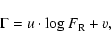
The next step was to fit a phenomenological function (dotted line in
Fig. 8) to the correlation. The best model functions
are of the form
). No test was made
for GBI due to the small number of simultaneous GBI/RXTE datasets.
The next step was to fit a phenomenological function (dotted line in
Fig. 8) to the correlation. The best model functions
are of the form
 |
(3) |
 and
and
 for RT and
 and
and
 using GBI data.
Besides the ()-correlation we also investigated the
relation between
and the X-ray flux of the power law
component. This introduces some freedom as to at which lower energy
the power law is "chosen''. Figure 9 shows the X-ray flux
from 20-200 keV and 1-200 keV, respectively, over the radio flux.
With increasing radio emission, the X-ray flux in the power law
component between 20-200 keV decreases (neglecting reflection). The
total 1-200 keV X-ray flux in the power law component is more or less
constant. No correlation with the radio flux is seen. This is because
the flux in the 1-20 keV range by far dominates, thus washing out
the correlation. Muno et al. (1999) did not find a correlation of
 (50-100 keV) with the 15 GHz radio flux. But they used a model
consisting only of DISKBB and a broken power law (BKNPO) for the X-ray
spectra and RT data with 12 hrs offset.
(50-100 keV) with the 15 GHz radio flux. But they used a model
consisting only of DISKBB and a broken power law (BKNPO) for the X-ray
spectra and RT data with 12 hrs offset.
A Spearman rank-order correlation test for (20-200) gives
 ,
thus showing a strong anti-correlation. For
(1-200 keV) the test results in
,
thus showing a strong anti-correlation. For
(1-200 keV) the test results in
 and ratifies the
lack of a correlation between the 1-200 keV non-thermal X-ray flux
and .
and ratifies the
lack of a correlation between the 1-200 keV non-thermal X-ray flux
and .
| correlation between: | type(1) | ref. | |
|
|
+ | |
|
|
+ | |
|
R | + | |
| (20-200 keV) |
|
- | |
 (0.5-10 Hz)(2) (0.5-10 Hz)(2) |
|
- | Muno et al. (2001) |
|
(0.5-10 Hz) |
|
+ | Muno et al. (1999) |
|
(1):
direction of correlation ("+" = positive, "-" = negative),
(2): frequency of the 0.5-10 Hz QPO. |
Copyright ESO 2003
![\begin{figure}
\par\includegraphics[width=7cm,clip]{MS2456f3.ps}
\end{figure}](/articles/aa/full/2003/02/aa2456/img42.gif)
 (09.10.1997),
 (30.03.2000) and reflection
(
(30.03.2000) and reflection
(
 (09.10.1997),
 (30.03.2000) behavior. Note the obvious reflection hump for the
09.10.1997 spectra at
(30.03.2000) behavior. Note the obvious reflection hump for the
09.10.1997 spectra at 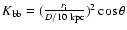 ), (7):
power law slope, (8): reflection amplitude, (9): power law
normalization (photons/keV/cm2/s at 1 keV), (10): ionization
parameter, (11): factor for normalization of PCU0 and HEXTE cluster 0,
(12): reduced
), (7):
power law slope, (8): reflection amplitude, (9): power law
normalization (photons/keV/cm2/s at 1 keV), (10): ionization
parameter, (11): factor for normalization of PCU0 and HEXTE cluster 0,
(12): reduced ![\begin{figure}
\par\includegraphics[width=7cm,clip]{MS2456f7.ps}
\end{figure}](/articles/aa/full/2003/02/aa2456/img57.gif)
 and
and
 behaving remarkably different.
![\begin{figure}
\par\includegraphics[width=8.8cm,clip]{MS2456f8.ps}
\end{figure}](/articles/aa/full/2003/02/aa2456/img63.gif)
![\begin{figure}
\par\includegraphics[width=8.8cm,clip]{MS2456f9.ps}
\end{figure}](/articles/aa/full/2003/02/aa2456/img70.gif)