![[*]](/icons/foot_motif.gif)
A&A 395, 663-667 (2002)
DOI: 10.1051/0004-6361:20021279
L. V. Tóth1,2,3 - Cs. Kiss4 - M. Juvela1 - M. Stickel3 - U. Lisenfeld5 - S. Hotzel3
1 - Helsinki University Observatory, PO Box 14,
00014 University of Helsinki, Finland
2 -
Department of Astronomy, Loránd Eötvös University,
Pázmány Péter sétány 1/a, 1117 Budapest, Hungary
3 -
Max-Planck-Institut für Astronomie, Königstuhl 17,
69117 Heidelberg, Germany
4 -
Konkoly Observatory, Budapest, PO Box 67, 1525, Hungary
5 -
IRAM, Avenida Divina Pastora 7, N.C., 18012 Granada, Spain
Received 1 March 2002 / Accepted 2 September 2002
Abstract
Small isolated clouds were discovered by the ISOPHOT 170  m
Serendipity Survey (ISOSS) as faint
m
Serendipity Survey (ISOSS) as faint
 MJy sr-1
FIR sources.
One of them is ISOSS J20246+6540, a cold (
MJy sr-1
FIR sources.
One of them is ISOSS J20246+6540, a cold (
 K)
pointlike ISOSS source without an IRAS pointsource counterpart.
In the Digitized Sky Survey B band it is seen as a 3
K)
pointlike ISOSS source without an IRAS pointsource counterpart.
In the Digitized Sky Survey B band it is seen as a 3 size
bipolar nebulosity with an average excess DSS blue band surface
brightness of 8% of the background's photographical density.
The CO column density distribution determined by multi-isotopic,
multi-level CO measurements with the IRAM-30 m telescope
agrees well with the optical appearance.
An average hydrogen column density of
size
bipolar nebulosity with an average excess DSS blue band surface
brightness of 8% of the background's photographical density.
The CO column density distribution determined by multi-isotopic,
multi-level CO measurements with the IRAM-30 m telescope
agrees well with the optical appearance.
An average hydrogen column density of  1021 cm-2
was derived from both the FIR and CO data.
Using a kinematic distance estimate of 400 pc
the NLTE modelling of the CO, HCO+, and CS measurements gives a
peak density of 104 cm-3.
The multiwavelength data characterise
ISOSS 20246+6540 as a representative of a class of globules which has not
been discovered so far due to their small angular size and low 100 m
brightness.
A significant overabundance of 13CO is found
X(13CO
1021 cm-2
was derived from both the FIR and CO data.
Using a kinematic distance estimate of 400 pc
the NLTE modelling of the CO, HCO+, and CS measurements gives a
peak density of 104 cm-3.
The multiwavelength data characterise
ISOSS 20246+6540 as a representative of a class of globules which has not
been discovered so far due to their small angular size and low 100 m
brightness.
A significant overabundance of 13CO is found
X(13CO
 C18O). This is likely due to isotope
selective chemical processes.
C18O). This is likely due to isotope
selective chemical processes.
Key words: ISM: clouds - dust, extinction - ISM: molecules - Infrared: ISM: - Surveys
Bok globules were originally detected in absorption against HII regions by
Bok & Reilly (1947), and are known as small, dense interstellar clouds in
the solar neighbourhod (
 pc). They were identified
optically, and mostly the nearby ones have been catalogued so far.
It is expected that they are similarily common elsewhere in
the Galactic disk and in fact a few distant ones have already been
investigated e.g. by Launhardt & Henning (1997).
Their FIR properties were determined by Clemens & Barvainis (1988) based on IRAS
data. They emphasized the importance of finding FIR faint cold globules
since these are representatives of the inactive (i.e. non-starforming)
interstellar medium. Starless globules with small apparent size and
low temperature (thus also very low 100 m brightness) can be seen
only by good sensitivity at wavelengths over 100 m.
An ISOPHOT study of pre-stellar cores in dark clouds with low
100 m brightness was recently reported by Ward-Thompson et al. (2002).
The ISOPHOT 170 m Serendipity Survey (ISOSS) (Bogun et al. 1996)
can be used to locate cold galactic objects even without
any preliminary identification.
This raises the possibility of detection of the "missing'' globules via ISOSS.
Our preceeding papers on ISOSS observations of interstellar
clouds discussed cold cores in the well known Chamaeleon
cloud complex (Tóth et al. 2000)
and in the known B 68 globule (Hotzel 2001).
We present our results on ISOSS J20246+6540 proving that it
is, a small and cold isolated
molecular cloud - one of the so far missed population.
pc). They were identified
optically, and mostly the nearby ones have been catalogued so far.
It is expected that they are similarily common elsewhere in
the Galactic disk and in fact a few distant ones have already been
investigated e.g. by Launhardt & Henning (1997).
Their FIR properties were determined by Clemens & Barvainis (1988) based on IRAS
data. They emphasized the importance of finding FIR faint cold globules
since these are representatives of the inactive (i.e. non-starforming)
interstellar medium. Starless globules with small apparent size and
low temperature (thus also very low 100 m brightness) can be seen
only by good sensitivity at wavelengths over 100 m.
An ISOPHOT study of pre-stellar cores in dark clouds with low
100 m brightness was recently reported by Ward-Thompson et al. (2002).
The ISOPHOT 170 m Serendipity Survey (ISOSS) (Bogun et al. 1996)
can be used to locate cold galactic objects even without
any preliminary identification.
This raises the possibility of detection of the "missing'' globules via ISOSS.
Our preceeding papers on ISOSS observations of interstellar
clouds discussed cold cores in the well known Chamaeleon
cloud complex (Tóth et al. 2000)
and in the known B 68 globule (Hotzel 2001).
We present our results on ISOSS J20246+6540 proving that it
is, a small and cold isolated
molecular cloud - one of the so far missed population.
 ,
,
 ,
where the
ISOSS survey has over 50% coverage.
ISOSS 170 m data were smoothed to the
IRAS ISSA (Wheelock et al. 1994) resolution, and
processed according to Tóth et al. (2000) and Hotzel (2001).
Sources were selected using the following criteria: a size
,
where the
ISOSS survey has over 50% coverage.
ISOSS 170 m data were smoothed to the
IRAS ISSA (Wheelock et al. 1994) resolution, and
processed according to Tóth et al. (2000) and Hotzel (2001).
Sources were selected using the following criteria: a size
 ,
a 170 m source surface brightness
,
a 170 m source surface brightness
 MJy sr-1, and a background corrected colour parameter
 ,
no associations in the IRAS Point Source Catalogue,
or in the IRAS Faint Source Catalogue within 5
,
no associations in the IRAS Point Source Catalogue,
or in the IRAS Faint Source Catalogue within 5
 ,
and no excess in the IRAS ISSA maps above 0.6 MJy sr-1.
We located 50 objects fullfilling our criteria.
ISOSS J20246+6540 was also detected as an
,
and no excess in the IRAS ISSA maps above 0.6 MJy sr-1.
We located 50 objects fullfilling our criteria.
ISOSS J20246+6540 was also detected as an
 MJy sr-1 (>
 )
pointlike
source at RA(2000
)
pointlike
source at RA(2000
 24
24 36
36 Dec(2000
 40
(
40
(
 ,
,
 ).
with an unsmoothed
).
with an unsmoothed
 .
We note that the unsmoothed ISOSS point-spread function is
nearly Gaussian with
.
We note that the unsmoothed ISOSS point-spread function is
nearly Gaussian with
 .
.
| ISOSS name | l | b |  |
nearest |
[
 ] ] |
[
] |
[
] |
neighbour | |
| ISOSS J20180+6345 | 97.71 | 15.29 |  |
8'CB88 #219 |
| ISOSS J20215+6820 | 102.00 | 17.34 |  |
45'YDM97 #4 |
| ISOSS J20246+6540 | 99.79 | 15.69 |  |
20'YDM97(*) |
| ISOSS J20380+6352 | 99.05 | 13.51 |  |
12'CB88 #224 |
| ISOSS J20474+6014 | 96.72 | 10.46 |  |
14'LM99 #349 |
Further 8 sources were associated with complexes of reflecting clouds. Detailed optical study of the 5 globule like clouds and a study of statistical issues will be given elsewhere. As an example we present results on ISOSS J20246+6540 which was studied using DSS2 blue and red images. In order to make surface brightness maps of ISOSS J20246+6540, stars were removed from the optical images by substituting the average surrounding photographical density value.
 region centered on ISOSS 20246+6540
was mapped in on-the-fly mode
in 12CO(1-0), 12CO(2-1) and 13CO(1-0)
with angular resolutions
of 22
region centered on ISOSS 20246+6540
was mapped in on-the-fly mode
in 12CO(1-0), 12CO(2-1) and 13CO(1-0)
with angular resolutions
of 22
 ,
11
,
22
respectively.
Pointed measurements
were performed in all the above mentioned transitions at the
13CO(1-0) peak position
(22
,
11
,
22
respectively.
Pointed measurements
were performed in all the above mentioned transitions at the
13CO(1-0) peak position
(22 2446,
65
2446,
65 4001
).
Spectral resolutions of 0.1, 0.05 and 0.03 km s-1 were used.
These spectra are shown in
Fig. 1.
4001
).
Spectral resolutions of 0.1, 0.05 and 0.03 km s-1 were used.
These spectra are shown in
Fig. 1.
![\begin{figure}
\par\includegraphics[width=18cm,clip]{H3949F1.ps}
\end{figure}](/articles/aa/full/2002/44/aah3949/img42.gif) |
Figure 1: CO spectra at the 13CO(1-0) peak, (2-1) lines are overlaid as filled histograms. a) 12CO(1-0) and (2-1) spectra. b) 13CO(1-0) and (2-1) spectra. c) C18O(1-0) and (2-1) spectra. |
| Open with DEXTER | |
 0.5 km s-1.
The results of the 1998 C18O pointed measurements
were confirmed in Sep. 2000 when also the
CS(2-1) and (3-2) as well as the HCO+(1-0) and (2-1) transitions
were observed with the IRAM-30 telescope. The C18O, CS(2-1) and
HCO+(1-0) lines were detected with S/N>5 and well resolved with
the 0.03 km s-1 spectral channels.
The data were calibrated to the scale of corrected antenna temperature,
0.5 km s-1.
The results of the 1998 C18O pointed measurements
were confirmed in Sep. 2000 when also the
CS(2-1) and (3-2) as well as the HCO+(1-0) and (2-1) transitions
were observed with the IRAM-30 telescope. The C18O, CS(2-1) and
HCO+(1-0) lines were detected with S/N>5 and well resolved with
the 0.03 km s-1 spectral channels.
The data were calibrated to the scale of corrected antenna temperature,
 ,
by observing loads at ambient and cold temperature, as in the
conventional "chopper-wheel'' calibration for millimetre wavelength
observations.
The data were converted to the main-beam scale by
applying the relation
,
by observing loads at ambient and cold temperature, as in the
conventional "chopper-wheel'' calibration for millimetre wavelength
observations.
The data were converted to the main-beam scale by
applying the relation
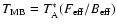 .
The values for the main-beam efficiency,
.
The values for the main-beam efficiency,
 ,
are 0.70 and 0.42 (July 1998), and 0.75 and 0.53 (September 2000),
and the values for the forward efficiency,
,
are 0.70 and 0.42 (July 1998), and 0.75 and 0.53 (September 2000),
and the values for the forward efficiency,
 ,
are
0.92 and 0.85 for CO(1-0) and CO(2-1), respectively.
We checked the calibration by observing the standard sources
DR 21 and W3OH and found it always to be better than 20%.
Results are listed in Table 2.
,
are
0.92 and 0.85 for CO(1-0) and CO(2-1), respectively.
We checked the calibration by observing the standard sources
DR 21 and W3OH and found it always to be better than 20%.
Results are listed in Table 2.
| line |
 |
FWHM |
 |
| [K] | [km s-1] | [km s-1] | |
| 12CO(1-0) | 6.7* (0.11) | 0.43 (0.01) | -2.70 (0.01) |
| 12CO(2-1) | 5.41 (0.17) | 0.47 (0.01) | -2.69 (0.01) |
| 13CO(1-0) | 4.3* (0.14) | 0.32 (0.03) | -2.68 (0.01) |
| 13CO(2-1) | 3.60 (0.08) | 0.31 (0.01) | -2.70 (0.01) |
| C18O(1-0) | 0.11 (0.02) | 0.25 (0.02) | -2.68 (0.01) |
| C18O(2-1) | 0.10 (0.03) | 0.24 (0.03) | -2.76 (0.02) |
| CS(2-1) | 0.09 (0.02) | 0.25 (0.02) | -2.69 (0.01) |
| HCO+(1-0) | 0.20 (0.03) | 0.29 (0.03) | -2.70 (0.01) |
ISOSS J20246+6540 is a faint FIR source with an upper limit on
the I100 brightness of about 0.5 MJy sr-1 derived from
the "raw'' (IRDS format) IRAS data.
Comparison of ISOSS and ISSA data (Wheelock et al. 1994) was made
as described by Tóth et al. (2000). An upper limit of the colour
temperature of 14.5 K was estimated from the bisector slope of the
I170 vs. I100 scatter plot.
Assuming a dust temperature of 14.5 K, an average
dust column density of
 g cm-2 was derived
following Hildebrand (1983).
This corresponds to an average hydrogen column density of
N(HI+2H
g cm-2 was derived
following Hildebrand (1983).
This corresponds to an average hydrogen column density of
N(HI+2H
 cm-2 where a
hydrogen-to-dust mass ratio of 110 (Launhardt & Henning 1997) was assumed.
cm-2 where a
hydrogen-to-dust mass ratio of 110 (Launhardt & Henning 1997) was assumed.
ISOSS J20246+6540 appears as a faint, isolated reflection cloud west
of the L1155/L1157 cloud complex (Lynds 1962). When smoothed to 15
the excess diffuse surface brightness distribution of ISOSS 20246+6540
shows a "bright'' lobe at the NE and a fainter fragmented one at SE.
The
 standard deviation of photographical density
outside the globule on the star-removed, smoothed image was 1.3%
of the average background value in the blue band image.
The POSS blue band diffuse surface brightness is shown in
Fig. 2a, where the lowest contour is drawn at
an excess of three times
.
standard deviation of photographical density
outside the globule on the star-removed, smoothed image was 1.3%
of the average background value in the blue band image.
The POSS blue band diffuse surface brightness is shown in
Fig. 2a, where the lowest contour is drawn at
an excess of three times
.
![\begin{figure}
\par\includegraphics[width=17.2cm,clip]{H3949F2.ps}
\end{figure}](/articles/aa/full/2002/44/aah3949/img52.gif) |
Figure 2:
Dust and gas in ISOSS 20246+6540,
reference coordinate (0, 0):
RA =
 Dec =
Dec =
 .
a) DSS-2 blue band diffuse surface brightness, contours are drawn
at photograpic density values of 4, 8 and 12% above the background level.
b) W(12CO (1-0)), contours are from 1.5 K km s-1 with
1.5 K km s-1 steps;
c)13CO (1-0), contours are from 1.0 K km s-1 with
1.0 K km s-1 steps;
CO isotopomer line intensities are integrated in the velocity interval
-5 km s .
a) DSS-2 blue band diffuse surface brightness, contours are drawn
at photograpic density values of 4, 8 and 12% above the background level.
b) W(12CO (1-0)), contours are from 1.5 K km s-1 with
1.5 K km s-1 steps;
c)13CO (1-0), contours are from 1.0 K km s-1 with
1.0 K km s-1 steps;
CO isotopomer line intensities are integrated in the velocity interval
-5 km s
 km s-1. km s-1. |
| Open with DEXTER | |
8% of the background photographic density value in the
DSS blue band. The same morphology is shown by
the B and R surface brightness distributions, except that the
SE lobe is slightly more red than the NW lobe.
The lack of a dark core indicates an average visual
extinction below 1.5 mag.
All observed lines show a LSR velocity of -2.7 km s-1. The FWHM widths of the 12CO lines are around 0.4 km s-1, and around 0.3 km s-1 for all the other detected lines. The 12CO and 13CO integrated intensity distributions are shown in Figs. 2b and c. The bipolar shape is well seen and the CO line intensities are in accordance with the excess surface brightness distribution, the NE lobe being much brighter. The two lobes show the same radial velocity.
The 12CO and 13CO lines trace the ISM well over most of the cloud. A comparison of C18O to 13CO lines (both 1-0 and 2-1) at the centre of the NE lobe indicates an underabundance of C18O by a factor of 4. This effect is expected in cold clouds with moderate density, exposed to UV radiation (Glassgold et al. 1985). A more careful modelling may account for it as we show in Sect. 4.2.
The distance of ISOSS 20246+6540 can be estimated, relating it
to its neighbours. Its nearest neighbours are L1122
(Lynds 1962), and the YDM97 CO1 (Yonekura 1997).
The 13CO survey of Cepheus by Yonekura (1997) covers the
position of ISOSS J20246+6540 and
their Fig. 6a indicates a few small clouds around ISOSS J20246+6540
(i.e. YDM97 CO1, YDM97 CO2, YDM97 CO3)
and one even smaller unnumbered peak
very close to ISOSS J20246+6540 at

 .
All the listed Yonekura clouds
have
.
All the listed Yonekura clouds
have
 km s-1, and they are counted into the
"close group'' of clouds, which on the other hand is associated
with extended FIR features around ISOSS J20246+6540.
The nearest molecular clouds with negative
are
YDM97 CO7, CO9, CO10 at
km s-1, and they are counted into the
"close group'' of clouds, which on the other hand is associated
with extended FIR features around ISOSS J20246+6540.
The nearest molecular clouds with negative
are
YDM97 CO7, CO9, CO10 at

 0
0
 7.
ISOSS 20246+6540 itself has
7.
ISOSS 20246+6540 itself has
 km s-1.
It probably belongs to one of the ISM layers of the nearby Cepheus Flare GMC,
and is located at about 400 pc (Kun 1998).
We note that applying the size-linewidth relation of
Larson (1981) the globule may be between 100 and 400 pc.
km s-1.
It probably belongs to one of the ISM layers of the nearby Cepheus Flare GMC,
and is located at about 400 pc (Kun 1998).
We note that applying the size-linewidth relation of
Larson (1981) the globule may be between 100 and 400 pc.
We have modelled the NE lobe of the bipolar globule with spherically
symmetric cloud models, although the NE clump shows some
deviations from spherical symmetry in both 12CO and 13CO
(see Figs. 2b and c).
With RA = 202444
Dec = +65
40
04
 as the
centre position, we have averaged spectra in concentric rings
with radii increasing by 10
intervals up to a radius of 90
.
The effective resolution of the averaged spectra
is 40
for the J=1-0
lines and 20
for the J=2-1 lines.
as the
centre position, we have averaged spectra in concentric rings
with radii increasing by 10
intervals up to a radius of 90
.
The effective resolution of the averaged spectra
is 40
for the J=1-0
lines and 20
for the J=2-1 lines.
We set the cloud parameters as follows.
(1) We assume a density distribution
 with a density ratio
20 between the centre and the cloud surface.
with a density ratio
20 between the centre and the cloud surface.
(2) The kinetic temperature is assumed to rise linearly from the cloud
centre. This is a crude
approximation of the actual temperature structure of for a
small, spherically symmetric globule without internal heating sources
(e.g. Leung 1985; Nelson & Langer 1999)
but will suffice for the present purposes.
The temperature gradient, i.e. the difference between the
outermost and innermost shells
 K, 6 K or 10 K. Higher contrast than 10 K
means too high a temperature for the outer cloud, in contradiction with
the observed small linewidth.
K, 6 K or 10 K. Higher contrast than 10 K
means too high a temperature for the outer cloud, in contradiction with
the observed small linewidth.
(3) Extinction-dependent relative molecular abundances
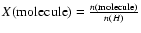 were
estimated according to Warin et al. (1996).
The cloud is cold, exposed to UV radiation and it has a peak
visual extinction between 1 and 2 mag.
In these conditions isotope selective processes
result in a relative overabundance of 13CO and relative
underabundance of C18O according to Bally & Langer (1982).
When applying the Warin et al. (1996) relative abundances, we
introduced an intrinsic extinction at the cloud boundary since the
12CO lines are not vanishing at the boundary of the NE lobe.
This assumption is supported by the presence of surrounding
extended cirrus-like emission seen at 100 m on the ISSA image.
were
estimated according to Warin et al. (1996).
The cloud is cold, exposed to UV radiation and it has a peak
visual extinction between 1 and 2 mag.
In these conditions isotope selective processes
result in a relative overabundance of 13CO and relative
underabundance of C18O according to Bally & Langer (1982).
When applying the Warin et al. (1996) relative abundances, we
introduced an intrinsic extinction at the cloud boundary since the
12CO lines are not vanishing at the boundary of the NE lobe.
This assumption is supported by the presence of surrounding
extended cirrus-like emission seen at 100 m on the ISSA image.
(4). Distance: 100, 200, 400, 600, 800, 1000, and 2000 pc
were tested.
When the density, temperature, relative abundance distributions and
the distance are set to a value allowed by the above constrains, the
free model parameters are the central density ( ), the
intrinsic linewidth (
), the
intrinsic linewidth ( )
and the angular diameter (D) of
the model cloud.
The radiative transfer problem is solved with Monte Carlo simulation
(Juvela 1997). The computed spectra are convolved to the
resolution of the observed spectra and the quality of the fit between
the two is estimated with a weighted
)
and the angular diameter (D) of
the model cloud.
The radiative transfer problem is solved with Monte Carlo simulation
(Juvela 1997). The computed spectra are convolved to the
resolution of the observed spectra and the quality of the fit between
the two is estimated with a weighted  value.
The model cloud is divided into 31 shells of equal thickness and the
free parameters are optimized separately for 12CO and 13CO.
We then select the set of parameters which provides the best fits for both.
Since the 12CO observations only probe the outer layers
of the cloud, the 12CO based estimate of the column density
is uncertain.
Modelling based on the 13CO line,
however, gives surprisingly similar results when the appropriate average
relative abundance value X(13CO
value.
The model cloud is divided into 31 shells of equal thickness and the
free parameters are optimized separately for 12CO and 13CO.
We then select the set of parameters which provides the best fits for both.
Since the 12CO observations only probe the outer layers
of the cloud, the 12CO based estimate of the column density
is uncertain.
Modelling based on the 13CO line,
however, gives surprisingly similar results when the appropriate average
relative abundance value X(13CO
 is selected.
The models are not sensitive to 20% changes in the average molecular
abundances or density, although similar changes of the kinetic
temperature or size are, critical (see Fig. 3).
is selected.
The models are not sensitive to 20% changes in the average molecular
abundances or density, although similar changes of the kinetic
temperature or size are, critical (see Fig. 3).
![\begin{figure}
\par\includegraphics[width=8.8cm,clip]{H3949F3.ps}
\end{figure}](/articles/aa/full/2002/44/aah3949/img67.gif) |
Figure 3:
Results of the radiative transfer modelling of the northern lobe
assuming distances: 100 pc (yellow), 200 pc (lilac), 400 pc (red),
1000 pc (blue). The relative
minimum regions are plotted
as shaded regions in selected planes of the parameter space.
Two further contours of the relative
of 1.14 & 1.29 are overlaid.
(Extinction dependent relative molecular
abundances were used.)
a) Density versus kinetic temperature (left);
b) density versus size (right). |
| Open with DEXTER | |
Synthetic spectra for C18O CS and HCO+ were generated
with the NLTE model using the best parameter sets (lowest )
from the 12CO 13CO analysis. The relative abundances were
varied up to 100% and the other parameters up to 30%.
The C18O lines were best reproduced
assuming an average relative abundance of
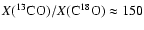 ,
an extreme but
possible underabundance by factor of 28 (Glassgold et al. 1985).
The pointed
measurements supported the density and temperature results shown in
Fig. 3.
The derived NLTE kinetic temperature is around 11 K and assuming a
distance of 400 pc
the peak hydrogen density and the size of the NE lobe are
,
an extreme but
possible underabundance by factor of 28 (Glassgold et al. 1985).
The pointed
measurements supported the density and temperature results shown in
Fig. 3.
The derived NLTE kinetic temperature is around 11 K and assuming a
distance of 400 pc
the peak hydrogen density and the size of the NE lobe are
 cm-3 and 0.12 pc respectively.
The column density estimate is
cm-3 and 0.12 pc respectively.
The column density estimate is
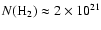 cm-2. This result is in agreement
with the column density derived from the FIR data.
The total gas mass would be
cm-2. This result is in agreement
with the column density derived from the FIR data.
The total gas mass would be
 .
.
With
 cm-2, the visual extinction
towards the cloud centre is
cm-2, the visual extinction
towards the cloud centre is
 (Bohlin et al. 1978)
and the cloud is optically thick for UV photons unless it is very clumpy.
External heating, however, is reduced by the
surrounding ISM, which is represented by the nonvanishing 12CO
lines. This may be the reason that a moderate 6 K temperature contrast was
found to be more likely than a 10 K contrast. A
similar temperature profile was found by Ciardi et al. (2000) in one of the
dense cloud cores of L 1082.
(Bohlin et al. 1978)
and the cloud is optically thick for UV photons unless it is very clumpy.
External heating, however, is reduced by the
surrounding ISM, which is represented by the nonvanishing 12CO
lines. This may be the reason that a moderate 6 K temperature contrast was
found to be more likely than a 10 K contrast. A
similar temperature profile was found by Ciardi et al. (2000) in one of the
dense cloud cores of L 1082.
Although the SW clump is clearly elongated similar modelling was
carried out for that part of the cloud. Observed spectra were
averaged over annuli at radii up to 50
from the clump
centre. Assuming a model where the kinetic temperature increases
linearly from the centre, we obtain a peak column density of
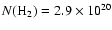 cm-2 based on the CO
spectra.
cm-2 based on the CO
spectra.
In the Yonekura (1997) data 13CO spectra were found for
one of the 5 clouds. ISOSS J20215+6820 appeared as a small
(
 )
isolated molecular cloud with
)
isolated molecular cloud with
 when
when
 K and
a distance of d=400 pc was assumed (Yonekura 2002).
The 2 ISOSS sources without opaque cores
have their nearest cloud neighbours outside a
K and
a distance of d=400 pc was assumed (Yonekura 2002).
The 2 ISOSS sources without opaque cores
have their nearest cloud neighbours outside a
 search radius.
The 3 opaque cloudlets are separated from their companions
by about
search radius.
The 3 opaque cloudlets are separated from their companions
by about
 (see also Table 1).
All the 5 globule like sources were found inside the fainter half of the
studied region, i.e. in
 ,
,
where the
ISOSS slew coverage was above 70%, and the
average 170 m sky brightness is 30 MJy sr-1.
This kind of sources may be similarly common in other galactic regions.
However detecting them by ISOSS may be more difficult at regions with higher
FIR background/foreground brightness values.
,
,
where the
ISOSS slew coverage was above 70%, and the
average 170 m sky brightness is 30 MJy sr-1.
This kind of sources may be similarly common in other galactic regions.
However detecting them by ISOSS may be more difficult at regions with higher
FIR background/foreground brightness values.
m emission i the unbiased ISO Serendipity Survey.
 K, n(H2)=7000 cm-3.
Acknowledgements
We acknowledge the numerous valuable comments by Kalevi Mattila, suggestions by an anonymous referee, and important notes by Mark Rawlings. The ISOPHOT project and Postoperation Phase was funded by the Deutsche Agentur für Raumfahrtangelegenheiten (DARA, now DLR), the Max-Planck-Gesellschaft, the Danish, British and Spanish Space Agencies and several European and American institutes. Members of the Consortium on the ISOPHOT Serendipity Survey (CISS) are MPIA Heidelberg, ESA ISO SOC Villafranca, AIP Potsdam, IPAC Pasadena, Imperial College, London.
This research was partly supported by the OTKA F-022566 grant and by the Academy of Finland grants Nos. 158300, 173727, 174854 and by "The Jenny and Antti Wihuri Foundation''.
This research has made use of the Digitized Sky Survey, produced at the Space Telescope Science Institute, NASA's Astrophysics Data System Abstract Service, the Simbad Database, operated at CDS, Strasbourg, France.
 is given in parentheses after