![[*]](/icons/foot_motif.gif)
I. F. Mirabel 1,2 -
R. Mignani 3 -
I. Rodrigues 1 -
J. A. Combi 4 -
L. F. Rodríguez 5 -
F. Guglielmetti 6,7
1 - Service d'Astrophysique / CEA-Saclay, 91191 Gif-sur-Yvette, France
2 -
Instituto de Astronomía y Física del Espacio/Conicet, Argentina
3 -
European Southern Observatory, Karl-Schwarzschils-Strasse 2,
Garching bei München, 85740, Germany
4 -
Instituto Argentino de Radioastronomía, C.C.5, (1894) Villa
Elisa, Buenos Aires, Argentina
5 -
Instituto de Astronomía, UNAM, Apartado Postal 3-72, 58089
Morelia, Michoacán, México
6 -
Max Planck Institute für Extraterrestrische Physik, Giessenbachstrasse, Postfach 1312, 85748, Garching, Germany
7 -
Max Planck Institute für Plasmaphysik,
Boltzmannstrasse 2, 85748, Garching, Germany
Received 15 July 2002 / Accepted 23 September 2002
Abstract
We have used the Hubble Space Telescope to measure the
motion in the sky and compute the galactocentric orbit of the black hole
X-ray binary GRO J1655-40. The system moves with a runaway space velocity
of  km s-1 in a highly eccentric (
 )
orbit. The black hole was formed in the disk at a distance greater
than 3 kpc from the Galactic centre and must have been shot to
such an eccentric orbit by the explosion of the progenitor star.
The runaway linear momentum and kinetic energy of this black hole binary
are comparable to those of solitary neutron stars and
millisecond pulsars. GRO J1655-40 is the first black hole for which
there is evidence for a runaway motion imparted by a natal kick
in a supernova explosion.
)
orbit. The black hole was formed in the disk at a distance greater
than 3 kpc from the Galactic centre and must have been shot to
such an eccentric orbit by the explosion of the progenitor star.
The runaway linear momentum and kinetic energy of this black hole binary
are comparable to those of solitary neutron stars and
millisecond pulsars. GRO J1655-40 is the first black hole for which
there is evidence for a runaway motion imparted by a natal kick
in a supernova explosion.
Key words: stars: individual: GRO J1655-40 - black hole physics - X-rays: binaries - astrometry
Neutron stars are known to have large transverse motions on the plane of the sky which are believed to result from natal kicks imparted by supernova explosions. Energetic explosions have also been invoked in models of the core collapse of massive stars onto black holes. However, there have been few observations that constrain models of the physical processes by which stellar-mass black holes are formed. The measurement of a large radial velocity for the centre of mass of the black hole X-ray binary GRO J1655-40 (Orosz & Bailyn 1997; Shahbaz et al. 1999), together with chemical elements found by Israelian et al. (1999) on the surface of the donor star, provided observational support to the idea that black holes - as neutron stars- may form in supernova explosions that impart strong natal kicks to the collapsed objects.
If a black hole is accompanied by a mass-donor star, it is possible to determine the radial velocity, proper motion, and distance of the system, from which one can derive the space velocity, track the path to the site of birth, and constrain the strength of the natal kick. Presently, the most accurate proper motions of X-ray binaries are obtained following at radio wavelengths with Very Long Baseline Interferometry (VLBI) the motion in the sky of the associated compact microquasar jets, as done recently for the halo black hole binary XTE J1118+480 (Mirabel et al. 2001). This has not been possible for GRO J1655-40 because there is no VLBI calibrator nearby, and in recent years the radio counterpart faded away below the detection limit. In this context, we carried out relative astrometry of the secondary star using optical images obtained with the Hubble Space Telescope 6.3 years apart. Here we report the proper motion of GRO J1655-40 which, together with the radial velocity, allows us - taking into account the uncertainties in the distance - to determine the parameters of its runaway kinematics and galactocentric orbit.
On April 1996 the field of GRO J1655-40 was observed for the first
time with the WFPC2 on the Hubble Space Telescope (Tavani et al. 1996). In
quiescence, the secondary star has an apparent magnitude of mV 17.2. The target had been placed at the center of the
Planetary Camera (PC) chip, with a pixel size of
17.2. The target had been placed at the center of the
Planetary Camera (PC) chip, with a pixel size of
 .
Observations were obtained through the 675W filter (
.
Observations were obtained through the 675W filter (
 Å;
Å;
 Å). A total of 16 exposures of 40 s each were acquired on April 26th and the same sequence was
repeated on April 27th but with a different telescope roll angle.
Both sets of exposures were taken in groups of 4 and each group was
dithered by a few pixels in both Right Ascension and Declination with
respect to the others.
Å). A total of 16 exposures of 40 s each were acquired on April 26th and the same sequence was
repeated on April 27th but with a different telescope roll angle.
Both sets of exposures were taken in groups of 4 and each group was
dithered by a few pixels in both Right Ascension and Declination with
respect to the others.
On June 20th 2001 a total of 18 exposures of 40 s each were acquired by us, with the same observational set-up as in April 1996, but without any dithering between single exposures. After a pre-reduction with the standard HST pipeline reduction (debiasing, dark removal, flatfielding), groups of well-aligned exposures (i.e. with relative shift smaller than 0.01 pixel) were combined with a median filter, stacked and cosmic ray hits filtered out.
We finally ended up with 4 images for each of the two April 1996
observations and one image for the June 2001 one. All the 1996 images
were then registered on the 2001 one, previously aligned in Right
Ascension and Declination, by fitting the coordinate transformation
between grids of reference objects. The correction for the WFPC2
geometrical distortions, optimized for the filter used (Trauger et al. 1995)
was taken into account. The whole procedure was iterated until the
transformation residuals were all below 
 .
We
finally computed the relative displacements of our target for each of
the 8 independent pairs of 1996/2001 images and we averaged the
results. The computed proper motion is
.
We
finally computed the relative displacements of our target for each of
the 8 independent pairs of 1996/2001 images and we averaged the
results. The computed proper motion is
 mas yr-1 and
 mas yr-1,
corresponding to an overall yearly displacement
mas yr-1,
corresponding to an overall yearly displacement
 mas yr-1 along a Position Angle of
 .
At a distance D(kpc) this proper motion corresponds to
a transverse velocity on the plane of the sky of (25
.
At a distance D(kpc) this proper motion corresponds to
a transverse velocity on the plane of the sky of (25  3) D(kpc)
km s-1. In Fig. 1 we show the path of the black
hole binary on a
R-band image of the Digitized Palomar Observatory Sky Survey II
(POSS II). NGC 6242 is a well-studied open cluster at a distance of
3) D(kpc)
km s-1. In Fig. 1 we show the path of the black
hole binary on a
R-band image of the Digitized Palomar Observatory Sky Survey II
(POSS II). NGC 6242 is a well-studied open cluster at a distance of
 pc from the Sun (Glushkova et al. 1997). Figure 1
shows that GRO J1655-40 is close to the boundary of a dark cloud
(cataloged as DC344.9+2.6 in Hartley et al. 1986), which could explain the
relatively large reddening of the secondary star in GRO J1655-40.
pc from the Sun (Glushkova et al. 1997). Figure 1
shows that GRO J1655-40 is close to the boundary of a dark cloud
(cataloged as DC344.9+2.6 in Hartley et al. 1986), which could explain the
relatively large reddening of the secondary star in GRO J1655-40.
In order to use our proper motion measurement to constrain the space velocity of the black hole, we need to know its distance. Unfortunately, as for most X-ray binaries, the distance to GRO J1655-40 is rather uncertain. In the following we discuss the observational constrains to the distance of this source.
It is widely believed that the distance of GRO J1655-40 was well
determined solely from the kinematics of the two-sided radio jets. This is
not true. The relativistic time delay of the motion of the ejecta in the
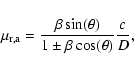
sky is given by the two equations (Mirabel & Rodríguez 1994):
where
 and
and
 are the proper motions of the
receding and approaching jets. In this system of two equations there
are three unknowns: the angle with the line of sight of the jet axis
are the proper motions of the
receding and approaching jets. In this system of two equations there
are three unknowns: the angle with the line of sight of the jet axis
 ,
the velocity of the jets
,
the velocity of the jets
 ,
and the
distance D. We point out that using solely
the observations at radio wavelengths by
Hjellming & Rupen (1995) it is not possible to solve these equations,
unless one assumes a value for one of the three variables ,
,
and the
distance D. We point out that using solely
the observations at radio wavelengths by
Hjellming & Rupen (1995) it is not possible to solve these equations,
unless one assumes a value for one of the three variables ,
 ,
or D. Hjellming & Rupen (1995) assumed
,
or D. Hjellming & Rupen (1995) assumed
 ,
from which one derives
,
from which one derives
 and D = 3.2 kpc. As already noticed by Orosz & Bailyn (1997), in this case
the axis of the jet and the axis of the orbital plane differ by
and D = 3.2 kpc. As already noticed by Orosz & Bailyn (1997), in this case
the axis of the jet and the axis of the orbital plane differ by
 .
.
We point out that the assumption that
the jet axis is parallel to the axis of the orbital
plane is equally consistent
with the observations at radio wavelengths. The jet axis and the
orbital plane must be coupled, since the period
of rotation of the jets about the jet axis (Hjellming & Rupen 1995) is
- within the uncertainties -, the same as the 2.6 day orbital period of
the binary (Orosz & Bailyn 1997). If one assumes that the twin jets are
perpendicular to the orbital plane of the binary, from
 45 mas/day and
 mas/day (Hjellming & Rupen 1995),
 (Greene et al. 2001) result
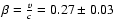 (where v is the velocity of the jets
and c the speed of light) and a distance
(where v is the velocity of the jets
and c the speed of light) and a distance
 pc. Under this assumption, the distance would be a factor 3.5 closer
than commonly assumed, the jet velocity would be
similar to that in SS433, and GRO J1655-40 would not be a
superluminal source.
pc. Under this assumption, the distance would be a factor 3.5 closer
than commonly assumed, the jet velocity would be
similar to that in SS433, and GRO J1655-40 would not be a
superluminal source.
In summary, from the data at radio wavelengths and the system of two
Eq. (1) with three unknowns one can only derive
with certainty a relativistic upper limit (Mirabel & Rodríguez 1999)
given by
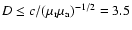 kpc.
kpc.
A distance for GRO J1655-40 was proposed on the basis of optical
(Bailyn et al. 1995) and X-ray (Greiner et al. 1995; Ueda et al. 1998a,b) measurements of
the column of interstellar matter in the line of sight, under the
assumption that the absorbing material is distributed homogeneously
between the source and the observer. However, GRO J1655-40 is at
relatively high Galactic latitude (Galactic longitude and latitude
 ,
,
 )
in the Scorpius region of the
sky which contains rather clumpy optical dark clouds in the foreground
(see Fig. 1), that have
)
in the Scorpius region of the
sky which contains rather clumpy optical dark clouds in the foreground
(see Fig. 1), that have  m and
m and  m IRAS
counterparts of dust emission. From a study of the reddening undergone
by the stars that are at distances between 700 pc and 1900 pc, it is
known that most of the reddening in this region of the sky occurs in
the local arm within 700 pc from the Sun (Crawford et al. 1989).
m IRAS
counterparts of dust emission. From a study of the reddening undergone
by the stars that are at distances between 700 pc and 1900 pc, it is
known that most of the reddening in this region of the sky occurs in
the local arm within 700 pc from the Sun (Crawford et al. 1989).
On the other hand, a kinematic distance was proposed from the radial
velocity of absorption features in the HI  21 cm line spectrum
(Tingay et al. 1995). However, it is known that in this region of the sky
at distances
21 cm line spectrum
(Tingay et al. 1995). However, it is known that in this region of the sky
at distances  1900 pc there are clouds with anomalous velocities
of up to -50 km s-1(Crawford et al. 1989). Therefore, it is not possible to derive the distance
of GRO J1655-40 only from the column density and/or kinematics of the
interstellar matter in the line of sight.
1900 pc there are clouds with anomalous velocities
of up to -50 km s-1(Crawford et al. 1989). Therefore, it is not possible to derive the distance
of GRO J1655-40 only from the column density and/or kinematics of the
interstellar matter in the line of sight.
The main argument in favor of the canonical distance of 3.2 kpc
is based on the flux, color and size of the secondary. The radius is
inferred from the photometric light curves which provide evidence that
the secondary fills its Roche lobe (Orosz & Bailyn 1997; Shahbaz et al. 1999; Soria et al. 2000; van der Hooft et al. 1997, 1998; Phillips et al. 1999). From the optical spectrum
(Orosz & Bailyn 1997) and interstellar absorption
(Horne et al. 1996) a temperature is derived, which together
with the radius provides an intrinsic luminosity. In the most recent
model by Beer & Podsiadlowski (2002) the secondary would have a luminosity of 21 6.0  ,
which is consistent with a distance
,
which is consistent with a distance  2 kpc.
These authors estimate masses for the black hole
2 kpc.
These authors estimate masses for the black hole
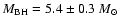 and for the donor star
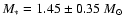 .
.
We point out that the secondary star in quiescence has an apparent
magnitude
mV = 17.12, it has been classified as an F3 IV-F6 IV
sub-giant (Orosz & Bailyn 1997), and along the line of sight there is an interstellar
absorption
 mag
(Horne et al. 1996). A sub-giant star of this spectral type has a mean
intrinsic magnitude
mag
(Horne et al. 1996). A sub-giant star of this spectral type has a mean
intrinsic magnitude
 0.2 mag
(Popper 1980; Aller et al. 1982), and it would be at a distance
0.2 mag
(Popper 1980; Aller et al. 1982), and it would be at a distance
 pc. Alternatively, if the secondary were a
main sequence star of spectral type F5 V star (Regos et al. 1998), for an
absorption AV in the range of 3.3-4.3 mag the distance would be in
the range of 800-1250 pc. However, it may be incorrect to attribute the
absolute magnitudes of isolated stars to secondary stars in X-ray
binaries with the same spectral type.
pc. Alternatively, if the secondary were a
main sequence star of spectral type F5 V star (Regos et al. 1998), for an
absorption AV in the range of 3.3-4.3 mag the distance would be in
the range of 800-1250 pc. However, it may be incorrect to attribute the
absolute magnitudes of isolated stars to secondary stars in X-ray
binaries with the same spectral type.
![\begin{figure}
\par\includegraphics[width=14.4cm,clip]{MS2903f1.eps}
\end{figure}](/articles/aa/full/2002/44/aa2903/img49.gif) |
Figure 1:
Position of GRO J1655-40
on a R band image from the Digitized Palomar Observatory Sky Survey II
(POSS II), in Galactic coordinates. The arrow shows the direction of
the motion at
a rate of 5.2
0.5 mas yr-1 measured with the Hubble Space
Telescope. Most of the stars around
l = 345.44 ,
b = + 2.43
belong to
the open cluster NGC 6242 which is at a distance of 1
0.1 kpc
from the sun. Because of the uncertainty in the distance to GRO J1655-40
the association with the cluster cannot be assessed. ,
b = + 2.43
belong to
the open cluster NGC 6242 which is at a distance of 1
0.1 kpc
from the sun. Because of the uncertainty in the distance to GRO J1655-40
the association with the cluster cannot be assessed. |
| Open with DEXTER | |
![\begin{figure}
\par\includegraphics[width=5.4cm,clip]{MS2903f2a.eps}\hspace*{2mm}
\includegraphics[width=5.4cm,clip]{MS2903f2b.eps}
\end{figure}](/articles/aa/full/2002/44/aa2903/img50.gif) |
Figure 2: Galactocentric orbits of GRO J1655-40 viewed from above the Galactic plane. The orbital plane is almost parallel to the Galactic disk and the source never reaches heights greater than 150 pc. On the left is shown the orbit obtained for an heliocentric distance D = 0.9 kpc, and on the right, for D = 3.2 kpc. GRO J1655-40 never penetrates the Galactic bulge. Plotted in dashed blue line is 1 Gyr of backwards integration, and in red the past 230 Myrs. |
| Open with DEXTER | |
It was pointed out by Beer & Podsiadlowski (private communication) that the
lower luminosity and temperature implied by a distance of 1 kpc
would require a higher mass ratio with much reduced masses for the
compact object (3.2  )
and secondary star (0.1 ). But the absorption spectrum of the secondary seems to rule out
an M type star of such low mass or a K-type star with mass
0.6 .
The spectra of stars with
)
and secondary star (0.1 ). But the absorption spectrum of the secondary seems to rule out
an M type star of such low mass or a K-type star with mass
0.6 .
The spectra of stars with
 5000 K have
different signatures, such as strong molecular bands. This was the case
in GRS 1915+105 where K band spectroscopy (Greiner et al. 2001) revealed CO molecular bands rendering invalid the classification of the donor as
a main sequence star.
5000 K have
different signatures, such as strong molecular bands. This was the case
in GRS 1915+105 where K band spectroscopy (Greiner et al. 2001) revealed CO molecular bands rendering invalid the classification of the donor as
a main sequence star.
We point out that there have been analogous uncertainties about the nature of the secondary in the X-ray binary LMX-3; the proposition that it is a main sequence star (Cowley et al. 1983; van der Klis et al. 1985) has recently been challenged by Soria et al. (2001) who argue that it is a sub-giant. Furthermore in GRO J1655-40, the contribution to the optical flux from: 1) the accretion disk detected in the X-rays at times when it was believed that the source was in optical quiescence (Garcia et al. 2001), and 2) possible non-thermal processes (e.g. synchrotron jets) that may be associated with the polarization observed in the optical flux (Gliozzi et al. 1998) is not known. In this context, for the scope of the present study we leave as an open question the issue of the distance of GRO J1655-40.
As shown below, the parameters of the
runaway motion and galactocentric orbit of GRO J1655-40 are
essentially the same for
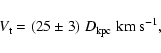
distances in the range of 0.9-3.2 kpc. The tangential velocity is
 |
(2) |
where
 is the distance in kpc. The radial velocity
with respect to the Sun is -142.4
1.5 km s-1 (Orosz & Bailyn 1997; Shahbaz et al. 1999).
is the distance in kpc. The radial velocity
with respect to the Sun is -142.4
1.5 km s-1 (Orosz & Bailyn 1997; Shahbaz et al. 1999).
Using values of the position, distance, proper motion and radial
velocity, the Galactic orbit of GRO J1655-40 can be computed using a
Galactic gravitational potential model (Johnston et al. 1995). The velocity
components U, V, and W directed to the Galactic centre, rotation
direction, and north Galactic pole are derived using Johnson & Soderblom (1987)'s
equations of transformation, and assuming the sun moves
( ,
, ,
, ) = (9, 12, 7) km s-1relative to the local standard of rest (lsr) (Mihalas & Binney 1981). Two
different orbits were computed for two extreme values of the distance:
for D = 0.9 kpc we obtain (U,V,W) =
(
) = (9, 12, 7) km s-1relative to the local standard of rest (lsr) (Mihalas & Binney 1981). Two
different orbits were computed for two extreme values of the distance:
for D = 0.9 kpc we obtain (U,V,W) =
(
 )
and for D = 3.2 kpc, (U,V,W) =
(
)
and for D = 3.2 kpc, (U,V,W) =
(
 ). These two sets of values are rather different
from the mean values that characterize the kinematics of stars that belong
to the halo, and the thin and thick disk of the Galaxy (Chiba & Beers 2000).
The runaway velocities
). These two sets of values are rather different
from the mean values that characterize the kinematics of stars that belong
to the halo, and the thin and thick disk of the Galaxy (Chiba & Beers 2000).
The runaway velocities
 were
computed for the two possible extreme distances of 0.9 kpc and 3.2 kpc
(see Table 1), after
subtracting the Galactic differential rotation given by the model for
the corresponding position of the source in the Galactic disk.
were
computed for the two possible extreme distances of 0.9 kpc and 3.2 kpc
(see Table 1), after
subtracting the Galactic differential rotation given by the model for
the corresponding position of the source in the Galactic disk.
| D [kpc] | 0.9 | 3.2 |
|
[km s-1] |
130 | 93 |
| e | 0.39 | 0.29 |
 [kpc]
[kpc] |
0.05 | 0.15 |
 [kpc]
[kpc] |
13.8 | 7.2 |
 [kpc]
[kpc] |
6.0 | 3.9 |
| p [
km s-1] |
430 | 637 |
 [erg]
[erg] |
5.6
 |
5.9
|
The runaway linear momentum p and kinetic energy
were
computed assuming
 = 5.4
0.3
and M* =
1.45
0.3
for a distance D = 3.2 kpc (Beer & Podsiadlowski 2002),
and
= 3.2
and M* = 0.1
for a
distance D = 0.9 kpc (Beer & Podsiadlowski, private communication).
= 5.4
0.3
and M* =
1.45
0.3
for a distance D = 3.2 kpc (Beer & Podsiadlowski 2002),
and
= 3.2
and M* = 0.1
for a
distance D = 0.9 kpc (Beer & Podsiadlowski, private communication).
The parameters of the runaway motion and galactocentric orbit of GRO J1655-40 are given in Table 1. In Fig. 2 are represented the Galactocentric orbits. For a given Galactic potential the orbital parameters do not change as a function of time. The selection of different Galactic potentials from the current models introduce a scatter in the values of the orbital parameters smaller than 10%. In fact, the errors in the parameters listed in Table 1 are largely dominated by the uncertainty in the distance. For the range of distances 0.9-3.2 kpc, the galactocentric orbit is highly eccentric (e = 0.29-0.39), the source always moves within a maximum height of 150 pc from the Galactic plane, and since the minimum perigalactic distance is 3.9 kpc it never reaches the Galactic bulge.
Clearly, GRO J1655-40 does not move in a halo orbit as XTE J1118+480 (Mirabel et al. 2001).
GRO J1655-40 must have been born in the Galactic
plane at a galactocentric distance 3.8 kpc. The runaway linear
momentum and kinetic energy of the binary system are comparable to
those of solitary neutron stars and millisecond pulsars
(Toscano et al. 1999).
From the proper motion and radial velocity of GRO J1655-40 - irrespective of the uncertainties in the distance - we conclude the following:
18 km s-1,
probably imparted by a natal explosion during the formation of the black hole.
100 km s-1, which is comparable to that found
in solitary neutron stars and millisecond pulsars. This suggests that the
relatively low-mass black hole (6 )
in GRO J1655-40
may have been formed through a neutron star phase.
0.4)  1047 ergs, namely, 6
10-4, that of a typical supernova.
1047 ergs, namely, 6
10-4, that of a typical supernova.
3 kpc, which indicates that the
black hole in GRO J1655-40 is the remnant of a massive star born
in the Galactic disk.
Acknowledgements
We thank J. Casares, P. Podsiadlowski, M.E. Beer, J.-P. Lasota, S. Corbel, P. Benaglia, A. Piatti, and E. Gourgoulhon for help and discussions on different aspects of this work. J.A.C. and I.F.M. are members of the Consejo Nacional de Investigaciones Científicas y Técnicas of Argentina, and I.R. is a fellow of the Conselho Nacional de Desenvolvimento Cienífico e Tecnológico of Brazil. I.F.M. acknowledges support from PIP 0049/98 and Fundación Antorchas.
 is the maximal height above the
Galactic plane, and
is the maximal height above the
Galactic plane, and