![[*]](/icons/foot_motif.gif)
A&A 395, 573-585 (2002)
DOI: 10.1051/0004-6361:20021334
S. Maret1 - C. Ceccarelli2,3 - E. Caux1 - A. G. G. M. Tielens4 - A. Castets2
1 - Centre d'Étude Spatiale des Rayonnements, CESR/CNRS-UPS, BP
4346, 31028 Toulouse Cedex 04, France
2 - Observatoire de
Bordeaux, BP 89, 33270 Floirac, France
3 - Laboratoire
d'Astrophysique, Observatoire de Grenoble, BP 53, 38041
Grenoble Cedex 09, France
4 - Space Research Organization of the
Netherlands, PO Box 800, 9700 AV Groningen, The Netherlands
Received 27 May 2002 / Accepted 5 September 2002
Abstract
We report ISO-LWS far infrared observations of CO, water and
oxygen lines towards the protobinary system IRAS 4 in the NGC 1333
cloud. We detected several water, OH, CO rotational lines, and
two [OI] and [CII] fine structure lines. Given the relatively
poor spectral and spatial resolution of these observations,
assessing the origin of the observed emission is not
straightforward. In this paper, we focus on the water line
emission and explore the hypothesis that it originates in the
envelopes that surround the two protostars, IRAS 4 A and B, thanks
to an accurate model. The model reproduces quite well the
observed water line fluxes, predicting a density profile, mass
accretion rate, central mass, and water abundance profile in
agreement with previous works. We hence conclude that the
emission from the envelopes is a viable explanation for the
observed water emission, although we cannot totally rule out the
alternative that the observed water emission originates in the
outflow. The envelopes are formed by a static envelope where the
density follows the r-2 law, at
 AU, and a
collapsing envelope where the density follows the r-3/2 law.
The density of the envelopes at 1500 AU from the center is
AU, and a
collapsing envelope where the density follows the r-3/2 law.
The density of the envelopes at 1500 AU from the center is 
 cm-3 and the dust temperature is 30 K,
i.e. about the evaporation temperature of CO-rich ices. This may
explain previous observations that claimed a factor of 10 depletion of CO in IRAS 4, as those observations probe the outer
cm-3 and the dust temperature is 30 K,
i.e. about the evaporation temperature of CO-rich ices. This may
explain previous observations that claimed a factor of 10 depletion of CO in IRAS 4, as those observations probe the outer
 30 K region of the envelope. The water is
 less abundant than H2 in the outer and cold envelope,
whereas its abundance jumps to
less abundant than H2 in the outer and cold envelope,
whereas its abundance jumps to
 in the
innermost warm region, at
in the
innermost warm region, at  AU where the dust
temperature exceeds 100 K, the evaporation temperature of
H2O-rich ices. We derive a mass of 0.5
AU where the dust
temperature exceeds 100 K, the evaporation temperature of
H2O-rich ices. We derive a mass of 0.5
 for each
protostar, and an accretion rate of
for each
protostar, and an accretion rate of

 ,
implying an age of about 10000 years, if the
accretion rate remains constant. We finally discuss the
difference between IRAS 4 and IRAS 16293-2422, where a similar
analysis has been carried out. We found that IRAS 4 is probably a
younger system than IRAS 16293-2422. This fact, coupled with the
larger distance of IRAS 4 from the Sun, fully explains the apparent
difference in the molecular emission of these two sources, which
is much richer in IRAS 16293-2422.
,
implying an age of about 10000 years, if the
accretion rate remains constant. We finally discuss the
difference between IRAS 4 and IRAS 16293-2422, where a similar
analysis has been carried out. We found that IRAS 4 is probably a
younger system than IRAS 16293-2422. This fact, coupled with the
larger distance of IRAS 4 from the Sun, fully explains the apparent
difference in the molecular emission of these two sources, which
is much richer in IRAS 16293-2422.
Key words: stars: formation - stars: circumstellar matter - ISM: molecules -
ISM: abundances -
stars: individual: NGC 1333-IRAS 4
 .
Interferometric observations
(Lay et al. 1995; Looney et al. 2000) have shown further multiplicity of the two
sources. IRAS 4A is itself a binary system with a separation of
10
.
Interferometric observations
(Lay et al. 1995; Looney et al. 2000) have shown further multiplicity of the two
sources. IRAS 4A is itself a binary system with a separation of
10
 ,
and there is some evidences that IRAS 4B could also be a
multiple system, with a separation of 0.5
.
,
and there is some evidences that IRAS 4B could also be a
multiple system, with a separation of 0.5
.
The distance of the NGC 1333 cloud is much debated. Herbig & Jones (1983)
found a distance of 350 pc for the Perseus OB2 association
(a more recent estimate based on the Hipparcos data gives  ;
de Zeeuw et al. 1999), but extinction observations towards NGC1333
itself (Cernis 1990) suggest that it may be as close as 220 pc.
Assuming a distance of 350 pc, Sandell et al. (1991) measured a system
total luminosity of 28
;
de Zeeuw et al. 1999), but extinction observations towards NGC1333
itself (Cernis 1990) suggest that it may be as close as 220 pc.
Assuming a distance of 350 pc, Sandell et al. (1991) measured a system
total luminosity of 28
 (11
at 220 pc) equally
shared between IRAS 4A and B. They derived an envelope mass of 9 and 4
respectively (3.5 and 1.5
at 220 pc). This
relatively large mass, together with the low bolometric luminosity
suggest that both sources are deeply embedded and probably very young.
They have been classified as Class 0 sources (Andre et al. 1993).
IRAS 4A and B are both associated with molecular outflows, detected in
CO, CS (Blake et al. 1995) and SiO (Lefloch et al. 1998) millimeter
transitions. The outflow originating from IRAS 4A is very highly
collimated, whereas that originating from IRAS 4B is rather compact and
unresolved in single dish observations (Knee & Sandell 2000). The dynamical
ages of both outflows are a few thousands years.
(11
at 220 pc) equally
shared between IRAS 4A and B. They derived an envelope mass of 9 and 4
respectively (3.5 and 1.5
at 220 pc). This
relatively large mass, together with the low bolometric luminosity
suggest that both sources are deeply embedded and probably very young.
They have been classified as Class 0 sources (Andre et al. 1993).
IRAS 4A and B are both associated with molecular outflows, detected in
CO, CS (Blake et al. 1995) and SiO (Lefloch et al. 1998) millimeter
transitions. The outflow originating from IRAS 4A is very highly
collimated, whereas that originating from IRAS 4B is rather compact and
unresolved in single dish observations (Knee & Sandell 2000). The dynamical
ages of both outflows are a few thousands years.
In the past years, many observational studies have been focused on the
continuum emission of IRAS 4. Recent works include maps of the region
obtained with IRAM at 1.3 mm (Lefloch et al. 1998) and with SCUBA at 450
and 850  m (Sandell & Knee 2001). An accurate modeling of the
continuum emission has been very recently carried out by
Jørgensen et al. (hereafter JSD02, 2002), who reconstructed the dust temperature
and density profiles across the two envelopes.
m (Sandell & Knee 2001). An accurate modeling of the
continuum emission has been very recently carried out by
Jørgensen et al. (hereafter JSD02, 2002), who reconstructed the dust temperature
and density profiles across the two envelopes.
The molecular line emission is probably a better and certainly a
complementary tool to probe the dynamical, chemical and physical
structure of the envelopes of IRAS 4. The last decade has seen
flourishing several studies of molecular line profiles
(e.g. Gregersen et al. 1997; Evans 1999) and line spectra (Blake et al. 1995),
all having in common the goal of reconstructing the physical structure
of the protostellar envelopes. Specifically, Blake et al. (1995) carried
out a multifrequency study of several molecules in IRAS 4, including
H2CO and CH3OH. Their two major results regarding the structure
of the IRAS 4 envelopes are: 1) a large depletion, around a factor
10-20, of CO and all molecules in the envelope, and 2) the presence of
a region with an increased abundance of CS, SiO and CH3OH, that
the authors attribute to mantles desorption caused by grain-grain
collisions induced by the outflows originating from the two
protostars. More recently interferometric observations by
Di Francesco et al. (2001, see also, Choi et al. 1999) detected an inverse
P-cygni profile of the H2CO
32,1-21,1 line on a 2''scale towards both IRAS 4A and B, providing the least ambiguous
evidence of infall motion towards a protostar ever. From a simple
two-layer modeling, they derived an accretion rate of
 and
and
 ,
an inner mass of 0.7 and 0.2
,
and an age of 6500 and 6200 yr (assuming constant
accretion rate) for IRAS 4A and IRAS 4B respectively.
,
an inner mass of 0.7 and 0.2
,
and an age of 6500 and 6200 yr (assuming constant
accretion rate) for IRAS 4A and IRAS 4B respectively.
In this paper we concentrate on the far infrared (FIR) line spectrum,
and in particular the water line spectrum observed with the Long
Wavelength Spectrometer (Clegg et al. 1996, herein after LWS) on board
ISO (Kessler et al. 1996) in the direction of IRAS 4. The goal of this
study is to check whether the observed water line emission can be
attributed to the thermal emission of the envelopes surrounding the
IRAS 4 protobinary system. Water lines have in fact been predicted to
be a major coolant of the gas in the collapsing envelopes of low-mass
protostars (Ceccarelli et al. 1996, hereafter CHT96; Doty & Neufeld
1997). Given the relatively large range of level energies (from 100 to 500 K) and spontaneous emission coefficients (from
10-2 to 1 s-1) of the water transitions observed by
ISO-LWS, the observed lines can in particular probe the innermost
regions of the envelope. This makes the analysis of the ISO-LWS water
lines a precious and almost unique tool (when considering the water
abundance across the envelope). The reverse of the coin is that
assessing the actual origin of the water emission is somewhat
difficult and still debated, as the spectral and spatial resolutions
of ISO-LWS are relatively poor to disentangle the various components
falling into the beam. For example, strong molecular line emission is
often associated with the outflows emanating from young protostars
(e.g. Bachiller & Perez Gutierrez 1997). As already mentioned, the line emission
from CO, CS and other molecules are certainly contaminated by the
outflowing gas in IRAS 4. Nonetheless, low lying lines seem to be more
affected than high lying lines in first instance, and different
molecules suffer differently from this "contamination'', as proved by
the Di Francesco et al. (2001) observations. Although water has been
predicted to be very abundant in shocked gas, the published ISO
observations show that the water emission is usually stronger towards
the central sources and weaker, if detected at all, in the direction
of the peaks of the outflows powered by low mass protostars
(see Ceccarelli et al. 2000a, for a review). When water lines are
detected in clear-cut shocked regions, the water abundance seems to be
lower than that predicted by the models, like in the case of HH54
(Liseau et al. 1996) or HH7-11 (Molinari et al. 1999; Molinari et al. 2000), or in the
outflows of IRAS 4 (see next section). Finally, SWAS observations seem
to support the evidence that the water abundance in the shocked
regions is a few times 10-6 (Neufeld et al. 2000). These facts,
together with the apparent correlation between the observed water
emission and the 1.3 mm continuum, and the lack of correlation with
SiO emission in low mass protostars
(Ceccarelli et al. 1999) play in favor of a relatively low contamination
of the ISO-LWS observed water emission by the outflow and encourage us
to explore in detail this hypothesis for the IRAS 4.
In the specific case of IRAS 4, the Submillimiter Wavelengths
Astronomical Satellite (SWAS; Melnick et al. 2000) observed the ground
o-H2O line at 557 GHz (Neufeld et al. 2000; Bergin et al. 2002).
Given its relatively large linewidth (18 km s-1) the 557
GHz line is certainly dominated by the outflow emission. Nonetheless,
this does not imply that the ISO FIR water lines also originate in the
outflow, and this for two reasons. First, the beamwidth (4')
of the SWAS observations, being about 3 times that of ISO-LWS,
encompasses the entire outflow, whereas the ISO observations do not
encompass the two emission peaks of the outflow (see also 3.1), but only the envelope. Second, the 557 GHz transition,
being the water ground transition, is more easily excited than the FIR
water lines, and therefore the latter probably probe different
regions. In fact, Bergin et al. (2002) find that most of the 557 GHz
line must originate in a component colder, hence different, by that
probed by the FIR water lines, even under the assumption that they
probe the outflow. To summarize, decicing whether the observed FIR
water emission in IRAS 4 originates in the outflow or in the envelope
remains an open question, based on the available present observations. In
this article we explore in detail the latter hypothesis and submit it
to the scrutiny of an accurate modeling, trying hence to answer to the
question on a theoretical basis. At this scope we used the CHT96
model, already successfully applied to the solar type protostar
IRAS 16293-2422 which allowed to explain more than two dozen observed
ISO-LWS water lines and ground-based millimeter SiO and H2CO lines
(Ceccarelli et al. 2000a; Ceccarelli et al. 2000b). One of the major results of that
work is the prediction of the existence of a hot core like region in
the innermost part of the envelope of IRAS 16293-2422, in which the
dust temperature exceeds the evaporation temperature of interstellar
ice ( 100 K). These studies have been confirmed by the recent
analysis by Schöier et al. (2002) of several other molecular transitions.
Such hot cores are well studied around massive protostars where -
driven by reactions among the evaporated ice molecules in the warm gas
- their chemical composition differs substantially from that of
quiescent clouds (Walmsley 1989; Charnley et al. 1992). Hot cores around low
mass protostars may actually have a different chemical composition
(Ceccarelli et al. 2000b). This molecular complexity may be of
prime interest on account of a possible link to the chemical history
of the solar nebula and hence the molecular inventory available to the
forming Earth and other solar system planets and satellites.
100 K). These studies have been confirmed by the recent
analysis by Schöier et al. (2002) of several other molecular transitions.
Such hot cores are well studied around massive protostars where -
driven by reactions among the evaporated ice molecules in the warm gas
- their chemical composition differs substantially from that of
quiescent clouds (Walmsley 1989; Charnley et al. 1992). Hot cores around low
mass protostars may actually have a different chemical composition
(Ceccarelli et al. 2000b). This molecular complexity may be of
prime interest on account of a possible link to the chemical history
of the solar nebula and hence the molecular inventory available to the
forming Earth and other solar system planets and satellites.
In order to understand the physical and chemical processes that take place during the first stages of star formation, it would be necessary to undertake a work similar to that the one done on IRAS 16293-2422 on a larger sample of protostars. In this paper we present a study of the structure of the envelope of NGC 1333-IRAS 4, obtained using ISO-LWS observations of the H2O far-infrared lines. A preliminary analysis of the same set of data has already been presented in Ceccarelli et al. (1999) and Caux et al. (1999a). Here we revisit the data using a new calibration and compare the observations with the CHT96 model predictions, testing a large range of model parameters. This study is part of a large project aimed to model the water emission in several low mass protostars. The water observations are complemented with formaldehyde and methanol ground based observations, to have a complete budget of the most abundant molecules in the innermost regions of the protostellar envelopes (Maret et al. in preparation). Finally, the structure obtained by the analysis of these observations will be compared with that independently obtained by continuum observations by JSD02.
The outline of the article is the following. In Sect. 2 we present the data, in Sect. 3 we describe the modeling of the observed lines and in Sect. 4 we discuss the physical and chemical structure of the envelope, namely the density and temperature profiles, as well as the abundances of the major species across the envelope. Besides, the central mass of the protostar and its accretion rate can also be constrained by these observations and modeling, yielding an alternative method to measure these two key parameters. In Sect. 4 we compare the results of the present study with previous studies of IRAS 4. Finally, we discuss the similarities and differences between IRAS 4 and IRAS 16293-2422, and highlight the importance of complementary ground-based, higher spatial and spectral resolution observations to understand the physical and chemical processes taking place in the innermost regions of low-mass envelopes.
m) of the IRAS 4 region was
performed using LWS. The observations were obtained on three positions
in LWS grating mode, with a spectral resolution of about 200 (AOT
LO1). The first position was centered in between IRAS 4A and IRAS 4B
(
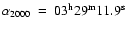 ,
,
 ), and hence LWS80
beam includes both sources. The two other positions aimed
to the lobe peaks of the outflow powered by IRAS 4: NE-red,
), and hence LWS80
beam includes both sources. The two other positions aimed
to the lobe peaks of the outflow powered by IRAS 4: NE-red,
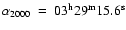 ,
,
 ), and SW-blue,
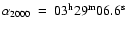 ,
,
 ). These
observations, performed during revolution 847, are made of 30 scans on
the central position and 10 scans on the two other positions. The
sampling rate was 1/4 of the grating resolution element (0.29 m
in the 43-92 m range, and 0.15 m in the 84-196 m
range). The integration time for each sampled point was 12 s on the
central position, and 4 s on the outflow positions.
). These
observations, performed during revolution 847, are made of 30 scans on
the central position and 10 scans on the two other positions. The
sampling rate was 1/4 of the grating resolution element (0.29 m
in the 43-92 m range, and 0.15 m in the 84-196 m
range). The integration time for each sampled point was 12 s on the
central position, and 4 s on the outflow positions.
![\begin{figure}
\par\includegraphics[width=16cm,clip]{2736f1.eps}
\end{figure}](/articles/aa/full/2002/44/aa2736/img34.gif) |
Figure 1: ISO-LWS spectra observed towards IRAS 4 on source (top line), NE-red (middle line) and SW-blue (bottom line). |
| Open with DEXTER | |
Figure 1 shows the observed 60-200 m spectra in the
three observed positions, and Table 1 reports the measured line
fluxes. The errors quoted in this table include statistical errors,
errors due to the uncertainty of the baseline removal, and an absolute
calibration error of 30%. The first striking result of these
observations is the dramatic difference within the three spectra:
while that including IRAS 4A and 4B is very rich in CO and water lines,
molecular emission is barely detected towards the outflow peaks (where
the millimeter CO emission is the brightest). On the contrary, the
fine structure [OI] 63 m and [CII] 157 m lines have comparable
fluxes in the three observed positions. Finally, we wish to comment
our results with respect to previous published data reductions. The
present line flux determination agrees with that quoted by
Ceccarelli et al. (1999) when considering the uncertainties. However, we
note several differences with respect to the values quoted in
GNL01. While there is a relatively good agreement between their fluxes
of the strongest lines and ours (see Table 1), there is a
noticeable discrepancy between our respective reductions regarding the
weakest lines. We think that this is probably due to a too optimistic
evaluation of the noise in GNL01. For example, in the NE-red position
we find a statistical error around 175 m of
 erg s-1 cm-2 m-1, while Giannini et al.
quote
erg s-1 cm-2 m-1, while Giannini et al.
quote
 erg s-1 cm-2 m-1 in
their Table 3. We do not confirm neither the detection of CO lines
with
erg s-1 cm-2 m-1 in
their Table 3. We do not confirm neither the detection of CO lines
with
 , nor the 125.4, 83.3, 66.4 and 58.7 m water lines on-source. As shown in our Fig. 1, we
only detected the 179.5 m 174.6 m and 108.0 m lines in
the outflow peak position NE-red, and the CO lines between
, nor the 125.4, 83.3, 66.4 and 58.7 m water lines on-source. As shown in our Fig. 1, we
only detected the 179.5 m 174.6 m and 108.0 m lines in
the outflow peak position NE-red, and the CO lines between
 and 17. We also do not confirm their detections of CO
 lines in the NE-red outflow peak position. Finally, in the
SW-blue position we only detected C+ and OI 63 m emission and
very marginally the H2O 179 m lines.
lines in the NE-red outflow peak position. Finally, in the
SW-blue position we only detected C+ and OI 63 m emission and
very marginally the H2O 179 m lines.
| Specie | Transition | Wavelength |
 |
Fluxes | ||
| (m) |
(cm-1) | On source | NE-red | SW-blue | ||
| o-H2O | 221-221 | 180.49 | 134.9 |
 |
<0.5 | <0.5 |
| 212-101 | 179.53 | 79.5 |
 |
 |
0.6  0.4
0.4 |
|
| 303-212 | 174.63 | 136.7 |
 |
|
< 0.5 | |
| 414-303 | 113.54 | 224.5 |
 |
<0.5 | <0.5 | |
| 221-110 | 108.07 | 134.9 |
 |
 |
<0.5 | |
| 505-414 | 99.48 | 325.3 |
 |
<0.5 | <0.5 | |
| 616-505 | 82.03 | 447.3 |
 |
<0.5 | <0.5 | |
| 423-312 | 78.74 | 300.5 |
|
<0.5 | <0.5 | |
| 321-212 | 75.38 | 212.1 |
 |
<0.5 | <0.5 | |
| p-H2O | 322-313 | 156.19 | 206.3 |
|
<0.5 | <0.5 |
| 313-202 | 138.53 | 142.3 |
|
<0.5 | <0.5 | |
| 220-111 | 100.98 | 136.2 |
 |
<0.5 | <0.5 | |
| 322-211 | 89.99 | 206.3 |
|
<0.5 | <0.5 | |
| 331-220 | 67.09 | 285.1 |
 |
<0.5 | <0.5 | |
| CO | 14-13 | 186.00 | 403.5 |
 |
 |
<0.5 |
| 15-14 | 173.63 | 461.1 |
 |
 |
<0.5 | |
| 16-15 | 162.81 | 522.5 |
|
 |
<0.5 | |
| 17-16 | 153.26 | 587.7 |
|
 |
<0.5 | |
| 18-17 | 144.78 | 656.8 |
|
<0.5 | <0.5 | |
| 19-18 | 137.20 | 729.7 |
|
<0.5 | <0.5 | |
| 20-19 | 130.37 | 806.4 |
|
<0.5 | <0.5 | |
| OH |
 - -
 |
119.33 | 83.7 |
|
<0.5 | <0.5 |
 - -
|
84.51 | 201.9 |
|
<0.5 | <0.5 | |
 - -
|
79.15 | 126.3 |
|
<0.5 | <0.5 | |
| [OI] | 3P1-3P0 | 145.48 | 227.7 | <0.5 | <0.5 | <0.5 |
| 3P2-3P2 | 63.17 | 158.7 |
 |
 |
|
|
| [CII] | 2P3/2-2P1/2 | 157.74 | 63.7 |
|
 |
|
 )
CO lines are detected on the NE-red position,
while no H2O or CO emission is clearly detected on the SW-blue
position. On the other hand, the observations of the CO 3-2 line show
that the high velocity gas (the fastest outflow component) peaks at
the NE-red and SW-blue positions (Blake et al. 1995). The lack of water
emission in these two outflow peak positions is not in favor of the
hypothesis that the on-source water emission originates in the
outflow. Although we cannot exclude a different origin and/or
contamination for example from the densest parts of the outflow
located in the ISO beam, in the following we explore the hypothesis of
the envelope thermal emission and interpret the observed water line
emission according to the CHT96 model. The first goal of our modeling
is to verify that the thermal emission from the surrounding envelope
can reproduce the water line observations, a necessary condition even
though not sufficient to test this hypothesis. A following section
will then address the possible origin of the CO and OH observed
emission.
)
CO lines are detected on the NE-red position,
while no H2O or CO emission is clearly detected on the SW-blue
position. On the other hand, the observations of the CO 3-2 line show
that the high velocity gas (the fastest outflow component) peaks at
the NE-red and SW-blue positions (Blake et al. 1995). The lack of water
emission in these two outflow peak positions is not in favor of the
hypothesis that the on-source water emission originates in the
outflow. Although we cannot exclude a different origin and/or
contamination for example from the densest parts of the outflow
located in the ISO beam, in the following we explore the hypothesis of
the envelope thermal emission and interpret the observed water line
emission according to the CHT96 model. The first goal of our modeling
is to verify that the thermal emission from the surrounding envelope
can reproduce the water line observations, a necessary condition even
though not sufficient to test this hypothesis. A following section
will then address the possible origin of the CO and OH observed
emission.
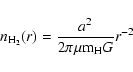
The initial state of the envelope is assumed to be an isothermal
sphere in hydrostatic equilibrium, which density is given by:
 is the hydrogen mass,
is
the mean molecular mass, r the distance from the center and G the
gravitational constant.
is the hydrogen mass,
is
the mean molecular mass, r the distance from the center and G the
gravitational constant.
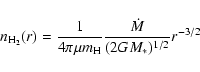
At t = 0 the equilibrium is perturbed and the collapse starts from
inside out, propagating with the sound speed. The density in the inner
collapsing region is given by the free-fall solution:
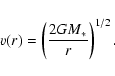
 is the accretion rate,
related to the sound speed by:
as free parameters.
is the accretion rate,
related to the sound speed by:
as free parameters.
The radiative transfer in the envelope is solved in the escape
probability approximation in presence of warm dust, following the
Takahashi et al. 1983 formalism. The CHT96 model assumes that the
initial chemical composition is that of a molecular cloud, and then it
solves the time dependent equations for the chemical composition of 44
species, as the collapse evolves. H2O, CO and O are of particular
importance since they are the main coolants of the gas, and hence we
study the chemistry of these species in detail. The CO molecule is
very stable, and its abundance results constant across the envelope.
H2O is mainly formed by dissociative recombination of the
H3O+ in the cold outer envelope, while, at dust temperature
above 100 K, icy grain mantles evaporate, injecting large amounts of
water into the gas phase. When the gas temperature exceeds 250 K, the H2O formation is dominated by the endothermic reactions O +
H OH + H followed by H2 + OH
  H2O + H, which
transform all the oxygen not locked in CO molecules into H2O.
H2O + H, which
transform all the oxygen not locked in CO molecules into H2O.
From the above equations and comments, the water line emission depends
on the mass of the central object, the accretion rate and the
abundance of H2O in the outer envelope and in the warm region,
where its abundance is dominated by the mantle evaporation. All these
quantities directly enter into the H2O line emission, and
specifically into the determination of the H2O column density. In
fact, the accretion rate sets the density across the protostellar
region (Eqs. (1) and (2)).
The central mass of the protostar affects the velocity field, and
hence indirectly the line opacity (Eq. (4)). This
parameter also sets the density in the free-fall region
(Eq. (2)) and therefore the gas column density in
this region. The water emission also depends indirectly on the O and
CO abundances, which enter in the thermal balance and hence in the gas
temperature determination. Several recent studies
(Baluteau et al. 1997; Caux et al. 1999b; Vastel et al. 2000; Lis et al. 2001) have shown that almost the totality of the
oxygen in molecular clouds is in atomic form. Accordingly, we assume
the oxygen abundance to be the standard interstellar value, i.e.
 with respect to H2. With regard to the CO
abundance, following Blake et al. 1995 we adopt a CO abundance of
10-5 with respect to H2, lower than the standard abundance
as this molecule is believed to be depleted on IRAS 4. We will comment
later on the influence of these parameters on our results. Finally,
the water abundance in the cold and in the warm parts of the envelope
are poorly known and are free parameters in our study.
with respect to H2. With regard to the CO
abundance, following Blake et al. 1995 we adopt a CO abundance of
10-5 with respect to H2, lower than the standard abundance
as this molecule is believed to be depleted on IRAS 4. We will comment
later on the influence of these parameters on our results. Finally,
the water abundance in the cold and in the warm parts of the envelope
are poorly known and are free parameters in our study.
To summarize, we applied the CHT96 model to IRAS 4, and to reproduce
the observations we varied the four following parameters: the mass of
the central object M*, the accretion rate ,
the water
abundance in the outer cold envelope
 ,
and the water abundance in
the region of mantle evaporation
,
and the water abundance in
the region of mantle evaporation
 .
The principal limitation to
the application of this model to IRAS 4 is that the ISO beam includes
both IRAS 4A and IRAS 4B envelopes. As a first approximation, we
assumed that the two envelopes contribute equally to the molecular
emission. Finally we assumed that the two envelopes touch each other,
namely they have a radius of 3000 AU (i.e. 30'' in diameter), in
agreement with millimeter continuum observations (Motte & André 2001). In
our computations we adopted a distance of 220 pc in agreement with
JSD02 and a luminosity of 5.5
for each
protostar, according to Sandell et al. (1991) when assuming such a
distance.
.
The principal limitation to
the application of this model to IRAS 4 is that the ISO beam includes
both IRAS 4A and IRAS 4B envelopes. As a first approximation, we
assumed that the two envelopes contribute equally to the molecular
emission. Finally we assumed that the two envelopes touch each other,
namely they have a radius of 3000 AU (i.e. 30'' in diameter), in
agreement with millimeter continuum observations (Motte & André 2001). In
our computations we adopted a distance of 220 pc in agreement with
JSD02 and a luminosity of 5.5
for each
protostar, according to Sandell et al. (1991) when assuming such a
distance.
,
the accretion rate from 10-5 to
10-4
,
the water abundance in the outer parts of the
envelope
between 10-7 and 10-6, and a water abundance
in the inner parts of the envelope
between 10-6 and
 respectively. In the following we discuss the results
of this modeling.
and M* (which affect the line emission in
the collapsing inner region). We therefore used the low-lying lines
to constrain the other two parameters, namely
and .
For
this we minimized the
respectively. In the following we discuss the results
of this modeling.
and M* (which affect the line emission in
the collapsing inner region). We therefore used the low-lying lines
to constrain the other two parameters, namely
and .
For
this we minimized the
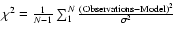 obtained considering only water lines
having a
lower than 142 cm-1, and where
obtained considering only water lines
having a
lower than 142 cm-1, and where  is the
error associated with each line flux. Figure 2 shows the
is the
error associated with each line flux. Figure 2 shows the
 surface as a function of
and for M* = 0.5
.
We obtained a similar plot for M* = 0.3
and the result is basically the same. As suspected, the chosen lines
constrain relatively efficiently the two parameters
and .
The minimum
is obtained for a water abundance
surface as a function of
and for M* = 0.5
.
We obtained a similar plot for M* = 0.3
and the result is basically the same. As suspected, the chosen lines
constrain relatively efficiently the two parameters
and .
The minimum
is obtained for a water abundance
 and an accretion rate
 .
.
![\begin{figure}
\par\includegraphics[width=8.8cm,clip]{2736f2.eps} \end{figure}](/articles/aa/full/2002/44/aa2736/img80.gif) |
Figure 2:
surface as function of the water abundance in
the outer envelope
and the mass accretion rate .
The
has been obtained considering the lines with an
upper level energy
lower than 142 cm-1 and for a
central mass of 0.5
. |
| Open with DEXTER | |
using the high-lying lines. In
fact to be excited, these lines require relatively high temperatures
and densities which are likely to be reached only in the innermost
parts of the envelope. Their intensities depend hence on the water
abundance
in these parts and on the central mass M*. The
surface as function of these two parameters is shown in
Fig. 3, obtained considering the lines having an upper level
energy
larger than 142 cm-1, and assuming =
and
=
.
In this case the has a minimum around M* = 0.5
and
=
.
Specifically, if we adopt a constant H2O abundance of
(
)
across the entire envelope, the model
predicts intensities a factor between two and five lower than those
observed (high lying lines, i.e. with
 K). In other
words, the observed emission can only be accounted for if a jump in
the water abundance is introduced when the dust temperature exceeds
100 K, the sublimation temperature of icy mantles. This jump has to
be larger than about a factor 10.
K). In other
words, the observed emission can only be accounted for if a jump in
the water abundance is introduced when the dust temperature exceeds
100 K, the sublimation temperature of icy mantles. This jump has to
be larger than about a factor 10.
![\begin{figure}
\par\includegraphics[width=8.8cm,clip]{2736f3.eps}
\end{figure}](/articles/aa/full/2002/44/aa2736/img82.gif) |
Figure 3:
surface as function of the central mass M* and water abundance in the innermost parts of the envelope
.
The
has been obtained considering the lines with an
upper level energy
larger than 142 cm-1 and assuming =
and
=
.
Note
that we did not include the 82 and 99.5 m lines, which
seems underestimated by our model (see text). We did not
include the 113 m line either, because of the blending with
the CO
 line, which makes the estimate of the flux
rather uncertain.
line, which makes the estimate of the flux
rather uncertain. |
| Open with DEXTER | |
,
accreting at
(Table 2).
| Parameter | IRAS 4 | IRAS 16293-2422 |
| Mass (
) |
0.5 | 0.8 |
| Accretion rate (
) |
|
 |
| Water abundance
|
|
 |
| Water abundance
|
|
 |
Radius (
 K) (AU) K) (AU) |
1500 | 4000 |
Radius (
 K) (AU) K) (AU) |
80 | 150 |
| Age (yr) |
 |
 |
Assuming a constant accretion rate, this gives an age of 10 000 years,
close to the dynamical age of the outflows. The abundance of water in
the outer parts of the envelope is
and it is
enhanced by a factor 10 in the innermost regions of the envelope,
where grain mantles evaporate. Figure 4 shows the ratio
between the observed and predicted line fluxes as function of the
upper level energy of the transition. The model reproduces reasonably
well the observed water emission, with the exception of the lines at
99.5 m and 82.0 m that seems to be underestimated (by a
factor 10) by our model.Since, on the contrary, lines in a comparable
range of
are well reproduced by our model, we think that this
discrepancy is likely due to a rough baseline removal. Specifically,
the estimate of both the 99.5 and 82.0 m line fluxes may suffer
of an incorrect baseline removal, as the lines lie on the top of a
strong dust feature, which covers the 80-100 m range (Ceccarelli et al. in preparation). Higher spectral resolution
observations are required to confirm this explanation. Finally some
unexplained discrepancy between the model and the observations may
exist at the higher values of
.
![\begin{figure}
\par\includegraphics[width=8.8cm,clip]{2736f4.eps} \end{figure}](/articles/aa/full/2002/44/aa2736/img90.gif) |
Figure 4:
Ratio between the line fluxes predicted by our best fit
model and observed ones as function of the upper level energy of
the transition
.
Triangles represent ortho H2O
transitions, and squares represent para H2O transitions.
Note that the model assumes an ortho to para ratio equal to 3.
|
| Open with DEXTER | |
 erg s-1 cm-2 and a
linewidth of 1 km s-1 for the ground water line at 557
GHz, equivalent to an antenna temperature of 30 mK in the SWAS
beam (4'). SWAS detected a
erg s-1 cm-2 and a
linewidth of 1 km s-1 for the ground water line at 557
GHz, equivalent to an antenna temperature of 30 mK in the SWAS
beam (4'). SWAS detected a
 mK line, which linewidth
is 18 km s-1, and self-absorbed at the rest velocity (Bergin et al. 2002). The observed line is undoubtedly dominated by the outflow
emission, and only a small fraction of its intensity can be attributed to
the envelope emission, in agreement with our model predictions.
mK line, which linewidth
is 18 km s-1, and self-absorbed at the rest velocity (Bergin et al. 2002). The observed line is undoubtedly dominated by the outflow
emission, and only a small fraction of its intensity can be attributed to
the envelope emission, in agreement with our model predictions.
![\begin{figure}
\par\includegraphics[width=8.8cm,clip]{2736f5.eps} \end{figure}](/articles/aa/full/2002/44/aa2736/img93.gif) |
Figure 5:
Predicted intensity of various lines as function
of the radius. The upper panel shows the water lines at 179 m (solid line), 108 m (dotted line), 75 m (dashed
line) and 82 m (dash-dotted line). The lower panel shows the
CO
 (solid line), CO
(dashed line) and C18O
(dash-dotted line).
(solid line), CO
(dashed line) and C18O
(dash-dotted line). |
| Open with DEXTER | |
m and [CII] 157 m emission is widespread, and
probably associated with the cloud. A plausible explanation is that
the two lines are emitted in the PDR resulting from the UV and/or
X-ray illumination of this cloud from the several young stars that it
harbors. The comparison of the observed fluxes with the model by
Kaufman et al. (1999) suggests a PDR with a density of about 104 cm-3 and a incident FUV of 5 G0. This PDR would
account for the total observed flux of the [CII] 157 m line and
OI. The parameters we derive are in agreement with those quoted by
Molinari et al. (2000), who studied the region around SVS13.
The thermal emission from the envelope predicts no C+ emission, of
course, as no source of ionization is considered in the CHT96 model.
The atomic oxygen, on the contrary, is present all along the envelope
and it is predicted to emit
 erg s-1 cm-2. This is similar to the observed [OI] 63 m flux. The
fact that we do not see any [OI] 63 m enhancement towards the
source with respect to the surroundings can be explained if IRAS 4 is
well embedded in the parental cloud. Being the ground transition, the
[OI] 63 m line is relatively easily optically thick, and an
emission from an embedded source can be totally absorbed by the
foreground material (Poglitsch et al. 1996; Baluteau et al. 1997; Caux et al. 1999b; Vastel et al. 2000).
erg s-1 cm-2. This is similar to the observed [OI] 63 m flux. The
fact that we do not see any [OI] 63 m enhancement towards the
source with respect to the surroundings can be explained if IRAS 4 is
well embedded in the parental cloud. Being the ground transition, the
[OI] 63 m line is relatively easily optically thick, and an
emission from an embedded source can be totally absorbed by the
foreground material (Poglitsch et al. 1996; Baluteau et al. 1997; Caux et al. 1999b; Vastel et al. 2000).
Finally, our model predicts OH and CO
 line fluxes
more than ten times lower than those observed. Note that the FIR CO
lines predicted by the CHT96 model are optically thick and not
sensitive to the adopted abundance, and therefore increasing the CO
abundance would not change the result. An extra heating mechanism is
evidently responsible for the excitation of the FIR CO lines observed
in the central position. Shocks have been invoked in the literature
(e.g. Ceccarelli et al. 1998; Nisini et al. 1999; Giannini et al. 2001), but this
hypothesis has its own drawbacks and flaws (see Introduction).
Another possibility is that the FIR CO lines are emitted in a
superheated layer of gas at the surface of a flaring disk, as seen in
the protostar El 29 (Ceccarelli et al. 2002), and/or at the inner
interface of the envelope itself (Ceccarelli, Hollenbach, Tielens et al. in preparation). In the first case (disk surface), the gas is
"super-heated'' because the grain absorptivity in the visible exceeds
the grain emissivity in the infrared (e.g. Chiang & Goldreich 1997). In the
latter case (envelope inner interface) the extra heating is provided
by the X-ray photons from the central source. A full discussion
about the FIR CO emission origin is beyond the scope of this article
and we refer the interested reader to the above mentioned articles.
line fluxes
more than ten times lower than those observed. Note that the FIR CO
lines predicted by the CHT96 model are optically thick and not
sensitive to the adopted abundance, and therefore increasing the CO
abundance would not change the result. An extra heating mechanism is
evidently responsible for the excitation of the FIR CO lines observed
in the central position. Shocks have been invoked in the literature
(e.g. Ceccarelli et al. 1998; Nisini et al. 1999; Giannini et al. 2001), but this
hypothesis has its own drawbacks and flaws (see Introduction).
Another possibility is that the FIR CO lines are emitted in a
superheated layer of gas at the surface of a flaring disk, as seen in
the protostar El 29 (Ceccarelli et al. 2002), and/or at the inner
interface of the envelope itself (Ceccarelli, Hollenbach, Tielens et al. in preparation). In the first case (disk surface), the gas is
"super-heated'' because the grain absorptivity in the visible exceeds
the grain emissivity in the infrared (e.g. Chiang & Goldreich 1997). In the
latter case (envelope inner interface) the extra heating is provided
by the X-ray photons from the central source. A full discussion
about the FIR CO emission origin is beyond the scope of this article
and we refer the interested reader to the above mentioned articles.
1500 AU, that covers a substantial range of
radii and is flatter than r-3/2. The absolute density is
relatively large,
cm-3 at 1500 AU.
![\begin{figure}
\par\includegraphics[width=8.8cm,clip]{2736f6.eps}
\end{figure}](/articles/aa/full/2002/44/aa2736/img96.gif) |
Figure 6: Density and temperature profiles of the envelope as computed by the best fit model. In the lower panel the dashed line refers to the dust temperature, while the solid line refers to the gas temperature. |
| Open with DEXTER | |
 AU, dust and
gas decouple. This is caused by the evaporation of the icy mantles
when the dust temperature reaches 100 K, which injects large amounts
of water in the gas phase (about a factor ten more) increasing the
cooling efficiency of the gas. The gas temperature drops by about 20
K and remains lower than the dust temperature until at
AU, dust and
gas decouple. This is caused by the evaporation of the icy mantles
when the dust temperature reaches 100 K, which injects large amounts
of water in the gas phase (about a factor ten more) increasing the
cooling efficiency of the gas. The gas temperature drops by about 20
K and remains lower than the dust temperature until at  AU
the dust FIR pumping of the water molecules counterbalances the water
line cooling and couples again the gas and dust temperatures. The
heating and cooling of the gas in the envelope follow the general
properties discussed in CHT96 (see also Ceccarelli et al. 2000a). The
heating is dominated by the NIR water pumping, gas-grains collisions
and the compression of the gas in the innermost regions, while
gas-dust collisions are the main heating factor in the outer parts of
the envelope and when the dust and gas decouple at
AU.
The gas cooling is dominated by the line emission of water, oxygen and
CO. In the outer parts of the envelope the cooling is dominated by the
CO line emission, while in the intermediate region the cooling is
dominated by the oxygen and water lines, as the CO lines become
rapidly thick. At
AU, the cooling by the water lines
takes over, due to the icy mantle evaporation, and dominates the
cooling by orders of magnitude with respect to O and CO. Note that
before the ices evaporation (i.e. at
AU
the dust FIR pumping of the water molecules counterbalances the water
line cooling and couples again the gas and dust temperatures. The
heating and cooling of the gas in the envelope follow the general
properties discussed in CHT96 (see also Ceccarelli et al. 2000a). The
heating is dominated by the NIR water pumping, gas-grains collisions
and the compression of the gas in the innermost regions, while
gas-dust collisions are the main heating factor in the outer parts of
the envelope and when the dust and gas decouple at
AU.
The gas cooling is dominated by the line emission of water, oxygen and
CO. In the outer parts of the envelope the cooling is dominated by the
CO line emission, while in the intermediate region the cooling is
dominated by the oxygen and water lines, as the CO lines become
rapidly thick. At
AU, the cooling by the water lines
takes over, due to the icy mantle evaporation, and dominates the
cooling by orders of magnitude with respect to O and CO. Note that
before the ices evaporation (i.e. at  AU), the heating is
dominated by the gas compression and the cooling by the H2O line
emission. The increase of the gaseous water abundance by a factor ten
causes an increase of about the same amount in the gas cooling rate,
whereas the compression heating rate just increases by 20%. The gas
heating becomes hence dominated by the gas-grains collisions, which
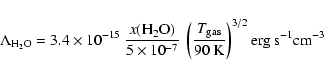
tend to couple dust and gas. In the specific case of IRAS 4, the water
cooling rate
AU), the heating is
dominated by the gas compression and the cooling by the H2O line
emission. The increase of the gaseous water abundance by a factor ten
causes an increase of about the same amount in the gas cooling rate,
whereas the compression heating rate just increases by 20%. The gas
heating becomes hence dominated by the gas-grains collisions, which
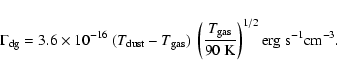
tend to couple dust and gas. In the specific case of IRAS 4, the water
cooling rate
 and gas-grains collisions heating
rates
and gas-grains collisions heating
rates
 can be approximated by the following expressions,
at the radius just before the evaporation (for the details see CHT96):
can be approximated by the following expressions,
at the radius just before the evaporation (for the details see CHT96):
 |
(6) |
 |
(7) |
20 K.
The CO and atomic oxygen abundances are constant across the envelope,
within the studied range, i.e. 30 to 3000 AU. We will discuss in the
next paragraph the effect of varying the CO abundance across the
envelope to take into account the CO depletion when the dust
temperature is below the CO-rich ice evaporation temperature. As
widely discussed previously, the water abundance undergoes a jump of
about a factor ten at
AU, when H2O-rich ices evaporate
(dust temperature larger than 100 K).
One interesting prediction of this study is the existence of a hot
core like region in the innermost parts of the envelope, where the
dust temperature reaches the sublimation temperature of the grain
mantles.
 ,
i.e. a factor five lower than the "canonical''
value. Their explanation is that CO molecules freeze out on the grain
mantles and the gas phase CO results therefore depleted across the
envelope. This result has been recently confirmed by JSD02, who quote
CO/H
,
i.e. a factor five lower than the "canonical''
value. Their explanation is that CO molecules freeze out on the grain
mantles and the gas phase CO results therefore depleted across the
envelope. This result has been recently confirmed by JSD02, who quote
CO/H
 in the outer envelope of IRAS 4. The question
arises whether the CO is depleted across the entire envelope or not,
as also remarked by JSD02. We checked with our model if the
millimeter observations would be sensitive to higher abundances of CO
in regions where the dust temperature exceeds the CO-rich ice
evaporation temperature, i.e. 25-30 K. We found that if the
C18O J = 3-2 line is optically thin, the bulk of the J = 3-2 line
is emitted at 3000 AU. This is because of the excitation of the
CO J = 3-2 line itself. In the optically thin and thermalized line
approximation it is possible to derive the following approximate
analytical expression (strictly speaking, valid only for the CO
millimeter lines):
in the outer envelope of IRAS 4. The question
arises whether the CO is depleted across the entire envelope or not,
as also remarked by JSD02. We checked with our model if the
millimeter observations would be sensitive to higher abundances of CO
in regions where the dust temperature exceeds the CO-rich ice
evaporation temperature, i.e. 25-30 K. We found that if the
C18O J = 3-2 line is optically thin, the bulk of the J = 3-2 line
is emitted at 3000 AU. This is because of the excitation of the
CO J = 3-2 line itself. In the optically thin and thermalized line
approximation it is possible to derive the following approximate
analytical expression (strictly speaking, valid only for the CO
millimeter lines):
![\begin{displaymath}I_J \propto \int \frac{{\rm exp}[-E_J/k{T_{\rm gas}}]}{T_{\rm gas}} {\rm d}r.
\end{displaymath}](/articles/aa/full/2002/44/aa2736/img106.gif) |
(8) |
 K,
does not vary by more than 20% with temperatures between 20 K and 40 K, and decreases for temperatures larger than 40 K. As a
result, the line intensity in the outer envelope is linearly
proportional to the radius of the emitting gas, and therefore
increases going outward, i.e. the emission is dominated by the outer
envelope where CO is depleted.
We run a case in which there is no CO depletion across the envelope,
(i.e. the CO abundance is constant and equal to 10-4), a case
where CO is depleted on the entire envelope (i.e. the CO abundance is
constant and equal to
), and a third case where CO
is depleted only in the outer envelope (i.e. the CO abundance is
K,
does not vary by more than 20% with temperatures between 20 K and 40 K, and decreases for temperatures larger than 40 K. As a
result, the line intensity in the outer envelope is linearly
proportional to the radius of the emitting gas, and therefore
increases going outward, i.e. the emission is dominated by the outer
envelope where CO is depleted.
We run a case in which there is no CO depletion across the envelope,
(i.e. the CO abundance is constant and equal to 10-4), a case
where CO is depleted on the entire envelope (i.e. the CO abundance is
constant and equal to
), and a third case where CO
is depleted only in the outer envelope (i.e. the CO abundance is
 when
when
 K and 10-4 in the
rest of the envelope). The last two cases give the same intensity
(within 15%) on both C18O J = 3-2 and J = 2-1 lines, while the
first one gives an intensity larger by about a factor 3. Therefore,
the last two cases, CO depletion across the entire envelope and
depletion in the outer envelope only, are not distinguishable by the
C18O J = 3-2 and J = 2-1 observations. In this sense, we think
that the
K and 10-4 in the
rest of the envelope). The last two cases give the same intensity
(within 15%) on both C18O J = 3-2 and J = 2-1 lines, while the
first one gives an intensity larger by about a factor 3. Therefore,
the last two cases, CO depletion across the entire envelope and
depletion in the outer envelope only, are not distinguishable by the
C18O J = 3-2 and J = 2-1 observations. In this sense, we think
that the
 observations cannot probe the innermost
regions and that it is possible that the measured CO depletion is only
relative to the external regions of the envelope.
observations cannot probe the innermost
regions and that it is possible that the measured CO depletion is only
relative to the external regions of the envelope.
This situation would be similar to what has been claimed to occur
in IRAS 16293-2422 (Ceccarelli et al. 2001), based on the indirect evidence
provided by the D2CO emission. The D2CO molecule is considered
a grain mantle product, as gas phase reactions seem unable to form an
appreciable amount of this molecule. Ceccarelli et al. showed that in
IRAS 16293-2422 the D2CO emission originates in the region of the
envelope where
 K. The proposed
interpretation is that D2CO is trapped in CO-rich ices that
evaporate when the dust temperature exceeds 30 K. Hence, in
IRAS 16293-2422 there is an outer region of the envelope where CO is
frozen onto the grain mantles (
K), and a
regions with
K where CO is released into the
gas phase and has the standard 10-4 abundance. A similar
scenario has been also suggested by JSD02 for other
Class 0 sources that show CO depletion.
K. The proposed
interpretation is that D2CO is trapped in CO-rich ices that
evaporate when the dust temperature exceeds 30 K. Hence, in
IRAS 16293-2422 there is an outer region of the envelope where CO is
frozen onto the grain mantles (
K), and a
regions with
K where CO is released into the
gas phase and has the standard 10-4 abundance. A similar
scenario has been also suggested by JSD02 for other
Class 0 sources that show CO depletion.
m maps
simultaneously) and assuming a single power law index. They found a
power law index equal to 1.8 and 1.3 for 4A and 4B respectively,
consistent with the Shu inside-out solution adopted in our model. At
1000 AU they estimate a density equal to 6 (4A) and 2 (4B)
 cm-3, which are quite comparable with our estimate:
 cm-3. We emphasize that the two methods, their
and our, are totally independent, and use different data, continuum
and line observations respectively. The fact that both predict
approximately the same density structure in a certain way validate
both methods, or at least increases the probability that both models
describe reasonably well IRAS 4.
cm-3. We emphasize that the two methods, their
and our, are totally independent, and use different data, continuum
and line observations respectively. The fact that both predict
approximately the same density structure in a certain way validate
both methods, or at least increases the probability that both models
describe reasonably well IRAS 4.
Apart from the density and temperature profiles, our model also constrains
the water abundance profile. It is reasonable to ask whether our
predicted water abundance in the innermost and outer regions of the
envelope are realistic and if they have any support from different
observations. The situation here is somewhat complicated by the fact
that there aren't many other independent ways to measure the water
abundance. From a theoretical point of view the abundance in the
outer envelope,
,
can be very well compared with chemistry
model predictions (e.g. Lee et al. 1996). In this respect, the value
that we derive is certainly not extraordinary and rather plausible.
From an observational point of view Bergin et al. (2002)
succeeded to detect the 557 GHz water line in the NGC1333 molecular
cloud. They estimate the water abundance in the region to be 10-7, with unfortunately a relatively large error (10) due
to the many uncertainties in the excitation of the line.
Moneti et al. (2001) derived a water abundance of
in
the clouds in the line of sight of the galactic center. These authors
claim that this is very likely the abundance of standard molecular
clouds. In summary, the water abundance that we find for the cold
region of the IRAS 4 envelope is consistent with other studies.
Regarding the abundance in the inner region,
,
the
value that we obtain seem to be lower than what expected if all the
water ice is injected in the gas phase and a large fraction of the
oxygen is locked in this ice. A typical water ice abundance is
estimated around 10-4 (Tielens et al. 1991). However, SWAS
observations of IRAS 4 and other low mass protostars suggest that the
water abundance in their outflows is around 10-6 (Neufeld et
al. 2001; Bergin et al. 2002), i.e. similar to the value that we find.
Those estimates are very rough and could easily be off by a factor ten
(Neufeld et al. 2000), as they are based on one transition only, but
nevertheless have the advantage that the observed emission is
certainly dominated by the outflow (the spectral resolution of these
observations is 1.2 km s-1) so there are no doubts on its
origin. Since the water abundance in the outflow would be probably
dominated by the grain mantles released in the gas phase, these
observations probably measure the water content in the mantles, very
much as our observations measure (indirectly) the water content
mantles in the inner hot like region. The two measurements seem to be
consistent in giving a rather low value. Whether this validates both
measures is less certain than the density profile case: it certainly
does not discredit the two measures. Finally, even the comparison of
our estimate of the accretion rate and central mass are in good
agreement with the previous estimates, based on a different method (line
profile and molecule H2CO), by Di Francesco et al. (2001). We derived =
against the
 quoted by Di Francesco et al. (2001), and M* =
0.5
against the
0.23-0.71
.
quoted by Di Francesco et al. (2001), and M* =
0.5
against the
0.23-0.71
.
To conclude, these studies show that the values we derive of the four parameters of our model are plausible and nothing of particularly surprising, with the possible exception of the water abundance in the innermost regions. In other words, if we had to choose a priori those values we would have chosen exactly what we found. The conclusion is that it is very probable that at least most of the observed water emission in IRAS 4 originates in the envelopes. If any, just a small fraction should therefore be associated with the outflow. Our final comment is therefore that care should be taken when interpreting the observed water emission towards low mass, Class 0 protostars as due to shocks (e.g. Ceccarelli et al. 1998; Nisini et al. 1999, GNL01), as we showed in two out two cases that the massive envelopes surrounding these sources dominate the water emission, just because of the large total column density. As a matter of fact, Class I sources, which are characterized by less massive envelopes, do not show up strong water emission (Ceccarelli et al. 2000a).
The mass and accretion rate we derived for IRAS 4A and B are of the
same order of magnitude of those found in IRAS 16293-2422
(Ceccarelli et al. 2000a). IRAS 16293-2422 seems more massive (0.8
) than IRAS 4A (0.5
), and accreting at a slightly
lower accretion rate (3 against 5
 ).
Assuming a constant accretion rate, those values give an age of 10 000
years and 27 000 for IRAS 4 and IRAS 16293-2422 respectively. Hence
IRAS 16293-2422 seems more evolved than IRAS 4. Moreover, IRAS 4
possesses an hot core like region about two times smaller than
IRAS 16293-2422 (80 AU against 150 AU). Ground-based H2CO and
CH3OH observations (Blake et al. 1995; Maret et al. in
preparation) confirm that IRAS 4 is in fact colder, and therefore less
bright in these molecular transitions than IRAS 16293-2422, and that
indeed the IRAS 4 hot core like region is very small. This fact
coupled with the larger distance of IRAS 4 from the Sun may explain the
apparent difference in the molecular emission of these two sources,
which is much richer in IRAS 16293-2422. This conclusion is also in
agreement with the relatively higher millimeter continuum observed in
IRAS 4, which implies a larger amount of cold dust surrounding this
source than IRAS 16293-2422. In addition, the region where the dust
temperature is higher than 30 K is smaller in IRAS 4 (1500 AU)
than in IRAS 16293-2422 (4000 AU), i.e. the CO depleted part of
the envelope is relatively larger in IRAS 4 than in IRAS 16293-2422.
This may explain why the CO depletion has been observed towards IRAS 4
and not in IRAS 16293-2422 (van Dishoeck et al. 1995; Ceccarelli et al. 2000b).
).
Assuming a constant accretion rate, those values give an age of 10 000
years and 27 000 for IRAS 4 and IRAS 16293-2422 respectively. Hence
IRAS 16293-2422 seems more evolved than IRAS 4. Moreover, IRAS 4
possesses an hot core like region about two times smaller than
IRAS 16293-2422 (80 AU against 150 AU). Ground-based H2CO and
CH3OH observations (Blake et al. 1995; Maret et al. in
preparation) confirm that IRAS 4 is in fact colder, and therefore less
bright in these molecular transitions than IRAS 16293-2422, and that
indeed the IRAS 4 hot core like region is very small. This fact
coupled with the larger distance of IRAS 4 from the Sun may explain the
apparent difference in the molecular emission of these two sources,
which is much richer in IRAS 16293-2422. This conclusion is also in
agreement with the relatively higher millimeter continuum observed in
IRAS 4, which implies a larger amount of cold dust surrounding this
source than IRAS 16293-2422. In addition, the region where the dust
temperature is higher than 30 K is smaller in IRAS 4 (1500 AU)
than in IRAS 16293-2422 (4000 AU), i.e. the CO depleted part of
the envelope is relatively larger in IRAS 4 than in IRAS 16293-2422.
This may explain why the CO depletion has been observed towards IRAS 4
and not in IRAS 16293-2422 (van Dishoeck et al. 1995; Ceccarelli et al. 2000b).
Finally, despite this difference in the age, the water abundance in the envelope is remarkably similar in the two sources, both in the outer part of the envelope and in the inner ones, where ice mantles are predicted to evaporate. This is an important piece of information, suggesting that the ice mantle formation in the two sources underwent a similar process, despite the macroscopic difference between the two molecular clouds which the two sources belong to. In the case of IRAS 16293-2422, the cloud seems very quiescent, shielded from strong UV and/or X-ray radiation (e.g. Castets et al. 2001) and with even evidence of large CO depletion (Caux et al. 1999b). In the other case, IRAS 4, the cloud presents cavities excavated by the several young stars of the region (e.g. Lefloch et al. 1998), and it is probably permeated by the X-rays emitted by them. A forthcoming study will allow to measure the H2CO and CH3OH abundances in the inner hot core like region of IRAS 4 (Maret et al. in preparation) and make comparisons with that found in IRAS 16283-2422 (Ceccarelli et al. 2000b). This study will hence help to understand in more detail how apparently different conditions in the parental clouds affect the grain mantle composition.
m
and CII [157] m lines, that likely originate in the PDR
associated with the parental cloud. On the contrary, water emission is
only detected towards the on-source position, whereas no significant
water emission is detected towards the NE-red and SW-blue positions.
This suggests that the bulk of the water emission is due to the
thermal emission of the protostellar envelopes around the two
protostars. Using an accurate model of the chemistry, thermal balance
and radiative transfer in protostellar envelopes (CHT96), we modeled
the water line emission due to two identical envelopes surrounding
IRAS 4A and B respectively. We found that the observations are
consistent with the CHT96 model, which implicitly assumes the
"inside-out'' theory (Shu 1977). The best fit of the model allows
us to estimate the four main model parameters: the accretion rate,
,
the central mass, 0.5
,
the
water abundance in the outer envelope,
,
and in the
inner envelope,
(this last parameter is the least
constrained with about a factor 3 of uncertainty). This gives an age
of 10 000 years, assuming that the accretion rate remains constant
during the collapse. Based on this model, we derived the density and
temperature profiles of the gas in the envelopes. We also reviewed
the suggestion by Blake et al. (1995) that CO is depleted by about a
factor ten in the envelope of IRAS 4. We could not confirm or rule out
this hypothesis but caution that the transitions used by this study,
C18O 3-2 and 2-1, can hardly probe the inner regions, where the
CO abundance may be "canonical''.
A comparison with several previous studies of the same source (Blake et al. 1995; Neufeld et al. 2000; DiFrancesco et al. 2001, JSD02) shows that the derived parameters are reasonable and consistent with the available literature, hence re-enforcing the thesis that the observed water emission is indeed due to the thermal emission from the envelopes. A by-product of the present study is the prediction of the existence of a hot core like region in the inner parts of the envelope, where grain mantles evaporate, releasing large amounts of water (about a factor ten) in the gas phase. Such a hot core has already been proposed to exist around IRAS 16293-2422, where a similar study as been carried out (Ceccarelli et al. 2000a; Ceccarelli et al. 2000b). Comparison between the two protostars, show that IRAS 4 is younger and surrounded by a more massive envelope. This explains the larger continuum emission and the larger depletion factors observed in IRAS 4. Finally, this study emphasis the necessity of ground based observations, where higher spatial and spectral resolutions are achievable. H2CO and CH3OH are of particular interest as they are among the most abundant components of grain mantles, and are therefore expected to evaporate in the inner parts of the envelope. Appropriate transitions can hence be used to constrain the physical and chemical conditions in the innermost part of protostellar envelopes (see Ceccarelli et al. 2000b).
Acknowledgements
We wish to thank Edwin A. Bergin for frank and constructive discussions on the SWAS data. We thank Edwin A. Bergin and Jes K. Jø rgensen for providing us with their papers prior to publication. The referee Neal Evans is thanked for his useful comments. Most of the computations presented in this paper were performed at the Service Commun de Calcul Intensif de l'Observatoire de Grenoble (SCCI).