 Co
Co  -ray emission from SN1998bu
A&A 394, 517-523 (2002)
DOI: 10.1051/0004-6361:20021133
Co -ray emission from SN1998buR. Georgii1,2 - S. Plüschke1 - R. Diehl1 - G. G. Lichti1 - V. Schönfelder 1 - H. Bloemen3 - W. Hermsen3 - J. Ryan4 - K. Bennett5
1 - Max-Planck-Institut für extraterrestrische Physik, Postfach 1312, 85741 Garching, Germany
2 - FRM-II, Technische Universität München, Lichtenbergstr. 1, 85747 Garching, Germany
3 - SRON Institute for Space Research, Sorbonnelaan 2, 3584 CA Utrecht, The Netherlands
4 - Space Science Center, University of New Hampshire, Durham, NH 03824, USA
5 - Science Division, ESTEC, ESA, 2200 AG Noordwijk, The Netherlands
Received 20 February 2002 / Accepted 1 August 2002
Abstract
Supernova 1998bu in the galaxy M 96 was observed by COMPTEL for a total of 88 days starting
17 days after the explosion. We searched for a signal in the 847 keV and 1238 keV lines of
radioactive 56Co from this type Ia supernova. Using several different analysis methods,
we did not detect SN1998bu. Our measurements should have been sensitive enough to detect
60Co gamma-rays as predicted from supernova models.
Our  flux limit is
 photons cm-2 s-1;
this would correspond to 0.35
photons cm-2 s-1;
this would correspond to 0.35  of ejected 56Ni, if SN1998bu
were at a distance of 11.3 Mpc
and transparent to MeV gamma rays for the period of our measurements.
We discuss our measurements in the context of common supernova models,
and conclude disfavoring a supernova event with large mixing and major parts of the
freshly-generated radioactivity in outer layers.
of ejected 56Ni, if SN1998bu
were at a distance of 11.3 Mpc
and transparent to MeV gamma rays for the period of our measurements.
We discuss our measurements in the context of common supernova models,
and conclude disfavoring a supernova event with large mixing and major parts of the
freshly-generated radioactivity in outer layers.
Key words: stars: supernovae: individual: SN1998bu - gamma-rays: observations - nucleosynthesis
 0.5
of 56Ni
synthesized in such explosions is considered the driver of all types of observed light
from these objects.
The nearby SN1998bu supernova was a unique opportunity to directly measure
gamma-rays from the 56Ni decay chain with the Compton Observatory.
0.5
of 56Ni
synthesized in such explosions is considered the driver of all types of observed light
from these objects.
The nearby SN1998bu supernova was a unique opportunity to directly measure
gamma-rays from the 56Ni decay chain with the Compton Observatory.
The dynamics of a white dwarf explosion are
difficult to model due to the range of scales
involved in flame ignition and propagation (Iwamoto et al. 1999).
Theories which are most successful in describing observations of type Ia supernovae include
empirical components for key aspects.
Observationally type Ia supernovae are a fairly homogeneous phenomenon (Branch 1998),
suggesting a narror range of synthesized 56Ni masses.
Constraints from models of the bolometric light curve of type Ia supernovae
imply that typically 0.3-0.5
of radioactive 56Ni energy are needed (Höflich & Khoklov 1996).
Observations of the supernova light curve's
peak magnitude or of NIR lines of Fe[II] and Co[II] have mostly been used to derive 56Ni masses; the rather wide range of inferred 56Ni (0.1-1.14 )
(Contardo et al. 2001) is difficult
to understand if a single well-tuned process is held responsible for the supernovae of type Ia and
in particular their "standard candle'' characteristics.
Among different types of models, a rather wide range of 56Ni masses of
0.1 up to 0.8
is discussed (see "Discussion'' section below).
Critical parameters of the explosion models are the ignition density of the white dwarf at its core, and the transition from the early deflagration stage (sub-sonic flame propagation) into a detonation (super-sonic flame propagation) (e.g. Leibundgut 2000; Livio 2000). The former is estimated from evolutionary models of the (uncertain) progenitor and the effective binary accretion rate, involving uncertain issues such as steady or flash-like nuclear burning of the accreted H and He material, or modulation of the accretion flow from the companion through the wind of the white dwarf (at the higher accretion rates required by the lower ignition densities preferred from otherwise excessive production of neutron-rich Fe group isotopes (Nomoto et al. 1997)). The acceleration of the flame speed can only be treated as a purely empirical parameter of models at present, but critically determines the final 56Ni mass and the Fe group to lighter element ratio (Iwamoto et al. 1999). Three-dimensional model treatments of this flame "micro-physics'' is promising, but still a challenging problem (Reinecke et al. 1999).
The fact that type Ia supernovae are rather homogeneous (Branch 1998) suggests a clear evolutionary path towards a well-definied presupernova star and a robust ignition condition. This led to the model of binary accretion of H and He rich matter onto a CO white dwarf at a well-tuned accretion rate such that H and especially He nuclear burning proceeds non-catastrophically and the white dwarf C mantle grows in mass until the Chandrasekhar mass limit is reached; the thermonuclear runaway explosion ensues from fast nuclear burning of carbon ignited at the core due to heating from gravitational pressure and H and He shell-burning heat conduction (Nomoto 1982). Sub-Chandrasekhar mass white dwarfs could also explode as type Ia supernovae (Livne 1990): The merging of two white dwarfs would disrupt the lighter of the two into a C-O envelope accreting onto the more massive white dwarf ("double-degenerate'' model). As the accretion proceeds to exceed the Chandrasekhar limit, the white dwarf ignites C centrally as above (Iben & Tutukov 1984). There are some doubts if the merging process will avoid core collapse of the merged object and produce a thermonuclear supernova; e.g. transport of rotational energy is critical (Livio 2000). Alternatively, a single-degenerate sub-Chandrasekhar model has been proposed: A He layer built up from accretion and steady hydrogen burning as above may ignite in a flash and thus send a shock wave into the white dwarf core, adding to the gravitational heat and thus also igniting carbon in the center for a lower-mass white dwarf (Nomoto 1982; Livne 1995). In this scenario much of the radioactive material would be produced towards the outside, resulting in different evolution of radioactivity-derived supernova light. Recent constraints on early spectra and the absence of intermediate-mass elements in the outer fast ejecta disfavor this scenario somewhat (Livio 2000).
A deflagration model was recently favored for SN1998bu on purely spectroscopic arguments (Vinko et al. 2001). And the occurrence near or in a spiral arm and the observation of a light-echo (Cappellaro et al. 2001) may suggest that the progenitor system could be younger than those of the average type Ia supernovae, therefore anomalous and igniting at a particularly low density.
With such diversity of models and the difficulties of detailed physics modeling, observations of a variety of aspects of type Ia supernovae are a key to clarify the true nature of these events. Observations of a large sample of supernovae in UV, optical and infrared bands have been made and discussed widely. But this radiation originates from driving processes deep inside the object, the bolometric light curve and its evolution reflect the supernova envelope structure, with much less information on the core. Spectral information tells us about material mixing and the total kinetic energy. However optical photons are created long after the initial explosion; most information from the early stage of the supernova event is lost. This makes it difficult to discriminate between different explosion models or model parameters.
Observations of -rays promise more direct information from
the core of the supernova and the explosion mechanism.
The radioactivity produced in the initial event decays and produces
gamma-ray lines, which can be observed directly once the supernova is
transparent to gamma-rays (after about 30-100 days). Even in the early stages, -rays
from radioactivity will escape from outer layers, their intensity depending on ejecta mixing.
Differences in the predicted -ray spectra have been suggested as the key observation to
discriminate between models and the extent of mixing (Höflich et al. 1998; Pinto et al. 2001).
This is best observed at early times; at times later
than 30 days, differences in total 56Ni masses can mimic differences
between sub- and Chandrasekhar models (Pinto et al. 2001).
The sensitivity of the -ray instruments on-board CGRO
(OSSE and COMPTEL) limits the observations of type Ia
supernovae to events within about 15 Mpc.
To date, only one event, SN1991T, was marginally detected
with COMPTEL (Morris et al. 1997). SN1998bu provides a second
opportunity for line searches in type Ia supernovae.
Some theoretical models predict -ray line
fluxes well above the sensitivity limits of COMPTEL and OSSE for
an assumed distance of 11 Mpc. Although COMPTEL lacks the spectral resolution
to provide unique and decisive -ray line shape diagnostics,
an independent proof of the radioactive 56Ni mass origin through detection
of the corresponding -ray line fluxes was attempted, and is important given
the complexity and unknowns of conversion of radioactive energy in a supernova envelope.
![\begin{figure}
\par\mbox{
\includegraphics[width=\textwidth,bb= 5 8 185 190]{H35...
...\includegraphics[width=\textwidth, bb= 5 8 185 190]{H3503F1b.eps} }
\end{figure}](/articles/aa/full/2002/41/aah3503/img10.gif) |
Figure 1: The total energy spectrum (left) and the background subtracted spectrum (right) for a sample position on the grid around SN1998bu. |
| Open with DEXTER | |
On May 9.9 UT in 1998 supernova SN1998bu was discovered in the galaxy M 96 (NGC 3368)
(Villi 1998). From wide-band spectrograms it was classified as type Ia
(Ayani et al. 1998; Meikle et al. 1998). From an earlier
observation (Faranda & Skiff 1998) and an estimate of
the maximum blue light at
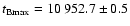 TJD (i.e. May 19), Meikle et al. (1998) inferred the
date of the explosion to be May
TJD (i.e. May 19), Meikle et al. (1998) inferred the
date of the explosion to be May
 UT (i.e. TJD
 ). The distance to M 96 had been known from HST Cepheid measurements as
 Mpc (Hjorth & Tanvir 1997), though another value of
 Mpc had been
derived from measurements of planetary nebulae (Feldmeier et al. 1997).
SN1998bu appears to be a typical type Ia event (Jah et al. 1999), its reddening can be
attributed to dust in the host galaxy. From its
dereddened brightness it was concluded
(using the methods described in Nomoto et al. 1997
and Iwamoto et al. 1999) that the total ejected Ni mass was rather typical. A value of 0.77
has been derived
from analysis of the bolometric light curve (Leibundgut 2000; Contardo et al. 2001).
Mpc had been
derived from measurements of planetary nebulae (Feldmeier et al. 1997).
SN1998bu appears to be a typical type Ia event (Jah et al. 1999), its reddening can be
attributed to dust in the host galaxy. From its
dereddened brightness it was concluded
(using the methods described in Nomoto et al. 1997
and Iwamoto et al. 1999) that the total ejected Ni mass was rather typical. A value of 0.77
has been derived
from analysis of the bolometric light curve (Leibundgut 2000; Contardo et al. 2001).
 d) at 750 keV
and 812 keV. 56Co, the daughter nucleus of 56Ni,
has a mean life of
d) at 750 keV
and 812 keV. 56Co, the daughter nucleus of 56Ni,
has a mean life of
 d and decays to stable
56Fe. In this decay two -ray lines are emitted at 847 keV
and 1238 keV. The COMPTEL observations spanned a total duration of 88 days,
ending at TJD 11 071, 136 days after the explosion.
d and decays to stable
56Fe. In this decay two -ray lines are emitted at 847 keV
and 1238 keV. The COMPTEL observations spanned a total duration of 88 days,
ending at TJD 11 071, 136 days after the explosion.
The COMPTEL telescope detects -rays through a Compton scatter interaction
in its upper plane of liquid-scintillation detectors ("D1''), followed by
detection of another interaction in the lower plane of NaI(Tl) scintillation
detectors ("D2''), ideally totally absorbing the scattered -ray.
Imaging information is provided by the Compton scatter kinematics through
energy deposit and interaction location measurements.
(For a detailed description of COMPTEL
see Schönfelder et al. 1993.)
Spectra were derived for a 
 FWHM beam on a grid around the SN position
with a grid spacing of
FWHM beam on a grid around the SN position
with a grid spacing of  .
Figure 1 shows an example for the
direction covering the SN position.
The beam size was chosen through the selections of events from within a
.
Figure 1 shows an example for the
direction covering the SN position.
The beam size was chosen through the selections of events from within a  wide range around the
pivot direction, performed near the cone-shaped response in the COMPTEL data space.
Background spectra were constructed from the
same direction, selecting a ring-like -
wide range around the
pivot direction, performed near the cone-shaped response in the COMPTEL data space.
Background spectra were constructed from the
same direction, selecting a ring-like - wide region around the
same pivot direction.
Background-subtracted spectra were then analyzed for the relevant Co decay lines
(see Fig. 1). Gaussian-shaped lines with instrumental resolution
are fitted to the data to determine line intensities.
This analysis and in particular the background determination may include unknown
systematic effects that could mimic lines. To account for these uncertainties
(in addition to the statistical uncertainties), we determined the variance of the
fitted line intensities across our measured sample empirically:
We histogrammed the fitted line intensities from all spatial grid points and
used the width of this distribution to estimate uncertainties and significances,
for both -ray lines of interest (see Fig. 2).
The exposure and effective detector area were used to convert line intensities
and uncertainties into source photon flux units.
wide region around the
same pivot direction.
Background-subtracted spectra were then analyzed for the relevant Co decay lines
(see Fig. 1). Gaussian-shaped lines with instrumental resolution
are fitted to the data to determine line intensities.
This analysis and in particular the background determination may include unknown
systematic effects that could mimic lines. To account for these uncertainties
(in addition to the statistical uncertainties), we determined the variance of the
fitted line intensities across our measured sample empirically:
We histogrammed the fitted line intensities from all spatial grid points and
used the width of this distribution to estimate uncertainties and significances,
for both -ray lines of interest (see Fig. 2).
The exposure and effective detector area were used to convert line intensities
and uncertainties into source photon flux units.
No significant difference between the spectra of the supernova and off-supernova
positions was found.
We obtained a
upper flux limit of
 photons cm-2 s-1
for the 847 keV line and
photons cm-2 s-1 for the 1238 keV
line.
photons cm-2 s-1
for the 847 keV line and
photons cm-2 s-1 for the 1238 keV
line.
![\begin{figure}
\par\includegraphics[width=11.2cm,clip]{H3503F2.eps}\end{figure}](/articles/aa/full/2002/41/aah3503/img23.gif) |
Figure 2:
The result of the spectral analysis. The derived
upper limits are
photons cm-2 s-1 for the 847 keV line and
photons cm-2 s-1
for the 1238 keV line. |
| Open with DEXTER | |
![\begin{figure}
\par\mbox{
\includegraphics[width=\textwidth,bb= 45 45 440 250,cl...
...degraphics[width=\textwidth,bb= 45 45 440 250,clip]{H3503F3a.eps} }
\end{figure}](/articles/aa/full/2002/41/aah3503/img24.gif) |
Figure 3:
Improvement of the sensitivity with the low-threshold mode response function (left) for 3 day of Crab data compared
to the sensitivity with the standard response function (right). Shown is a significance map based on a maximum-likelihood method.
 contour lines are plotted. The position of Crab is marked with a star.
 |
| Open with DEXTER | |
Instrument imaging response functions were derived for our analysis from simulations, where each D2 module was treated with its effective hardware threshold. The full-instrument data were analyzed in two different ways: We first used a summed response function for both lines, but for the 847 keV line we also analyzed separately for "mini-telescopes'' and composed the individual results.
We demonstrate the difference between standard analysis and our more complex
"low-energy-threshold-mode'' response function on
3 days of Crab low-threshold data, fortuitously collected during an observation of
Geminga. Using the low-mode response we clearly detect Crab with 4.5at 847 keV, compared to only 3.0
with the
standard response (see Fig. 3). For the 1238 keV line the
values are 1.6and 0.63,
respectively. This
shows that most D2 modules are now sensitive below the
650 keV analysis threshold used for the standard analysis,
resulting in a larger sensitivity mainly for the 847 keV line.
Unfortunately, due to the strong background line at 511 keV,
we did not obtain the theoretically-achievable sensitivity at the 847 keV line.
To reduce the impact of this background via its scattering pattern,
we applied a cut of  in the angle between
the incident and the scattered -ray (the so-called
in the angle between
the incident and the scattered -ray (the so-called
 angle (see Schönfelder et al. 1993)). This sacrifices a fraction of source events.
Using these simulated summed responses and the
cut,
maps for the two -ray energies (shown on the left side in Fig. 4) are produced through a maximum-likelihood method.
There is no detectable signal from the supernova.
![\begin{figure}
\par\includegraphics[width=16cm,bb= 0 0 670 510,clip]{H3503F4.eps}\end{figure}](/articles/aa/full/2002/41/aah3503/img27.gif) |
Figure 4: Flux maps of the SN1998bu region in 847 keV (top left) and 1238 keV (bottom left). No significant excess is seen around the position of the SN, which is marked with a star. The contour levels are in units of 10-6 photons cm-2 s-1. Right to each map its flux distribution and a Gaussian fit to it is shown. The distortion of the distributions around small flux values is due to the method applied. |
| Open with DEXTER | |
For determination of an upper limit on the flux in the -ray lines we estimated
statistical and systematic uncertainties. In a histogram of flux values for all pixels
in the maps of Fig. 4,
the flux variances provide a global measure of the uncertainty.
Using the Bayesian method described in
Georgii et al. (1997), which accounts for the systematic
and statistical uncertainties, 2
upper limits of
 photons cm-2 s-1 for the 847 keV line and of
 photons cm-2 s-1 for the 1238 keV line were determined.
The less constraining limit for the 847 keV line is a result of the
cut for background
suppression.
photons cm-2 s-1 for the 1238 keV line were determined.
The less constraining limit for the 847 keV line is a result of the
cut for background
suppression.
Therefore another analysis method was applied to the 847 keV line, only.
Here separate maximum-likelihood imaging of the SN1998bu region was made for each mini-telescope
(the combination of one single D2 module with all D1 modules) by applying the specific response for each D2 module.
With energy cuts at 650 keV, but no
cut, 511 keV background suppression retains better 847 keV sensitivity than above. Since the likelihood values are additive (probabilities) we combined these results
to derive a 2
upper limit of
 10-5 photons cm-2 s-1 (see Fig. 5).
upper limit of
 photons cm-2 s-1 for the 847 keV line and
photons cm-2 s-1for the 1238 keV line. Spectral analysis yields
photons cm-2 s-1 for the 847 keV line and
photons cm-2 s-1
for the 1238 keV line, respectively. The reason for the different values for both lines in the spectral
analysis lies in the steep decrease of the background with the energy. In contrast, in imaging
analysis the background on the sky around the source is not much different for both lines.
photons cm-2 s-1 for the 847 keV line and
photons cm-2 s-1for the 1238 keV line. Spectral analysis yields
photons cm-2 s-1 for the 847 keV line and
photons cm-2 s-1
for the 1238 keV line, respectively. The reason for the different values for both lines in the spectral
analysis lies in the steep decrease of the background with the energy. In contrast, in imaging
analysis the background on the sky around the source is not much different for both lines.
![\begin{figure}
\includegraphics[angle=90,width=9cm,clip]{H3503F5r.eps}\end{figure}](/articles/aa/full/2002/41/aah3503/img31.gif) |
Figure 5:
The flux limit for the 847 keV line, derived from combined imaging
results per each minitelescopes.
We fix a source flux at the position of the SN, and determine the
maximum log-likelihood ratio value for each detector subset. We can
add these, as derived from independent data. We normalize to the
log-likelihood ratio of our best-fit flux value of
0 photons cm-2 s-1.
Varying adopted fluxes, we derive the parabolic behavior near the
minimum (see stars). For our 11 independently-varied parameters
(one per each detector subset) we obtain a 2
SN flux limit
by increasing the likelihood by 22 units above the minimum
(i.e.,
photons cm-2 s-1). |
| Open with DEXTER | |
upper limit flux by 12% compared to the narrow-line assumption.
This changes the flux upper limits only marginally and we therefore neglected it.
![\begin{figure}
\par\mbox{
\includegraphics[width=\textwidth,bb= 25 10 440 280,cl...
...degraphics[width=\textwidth,bb= 25 10 440 280,clip]{H3503F6b.eps} }
\end{figure}](/articles/aa/full/2002/41/aah3503/img32.gif) |
Figure 6: The model fluxes for the 847 keV (left) and for the 1238 keV (right) line for different models versus time after the explosion for a distance of 11.3 Mpc. The upper limits from the spectral and imaging analysis are also shown. The solid line represents the more sensitive value from both methods for each line. Note that for the 847 keV line the imaging analysis and for the 1238 keV line the spectral analysis is more sensitive. |
| Open with DEXTER | |
-ray upper limits with theoretical Ni mass predictions, the distance to the SN
plays an essential role. The host galaxy M 96 had
a HST-Cepheid-determined distance of
 Mpc
(Tanvir et al. 1995), later revised to
Mpc
(Tanvir et al. 1995), later revised to
 Mpc by
Hjorth & Tanvir (1997). This makes SN1998bu one of seven SN
observed in galaxies with a distance set by Cepheid measurements. We adopt this distance of 11.3 Mpc for our analysis.
Mpc by
Hjorth & Tanvir (1997). This makes SN1998bu one of seven SN
observed in galaxies with a distance set by Cepheid measurements. We adopt this distance of 11.3 Mpc for our analysis.
A second key factor is the transparency of the supernova to -rays. This is a key issue
determining how much radioactive energy is converted into kinetic energy and supernova light.
The maximum of the optical light curve (about 10 days after the explosion) is set by a maximum of
the product of (declining) energy deposition and (rising) -ray energy escape (Pinto & Eastman 2001).
Furthermore, the Compton scattering optical depth to 1 MeV -rays is below unity beyond about 50 days
after explosion (Pinto et al. 2001), but absorption corrections to observed line -rays
are probably significant for typical models up to about 100 days after explosion
(see e.g. Fig. 11 in Höflich et al. 1998, calculated for energies down to 10 keV, however).
This illustrates clearly the importance of -ray measurements with high spectral resolution and
at those early times, in order to directly address the explosion mechanism: the line shapes and the
ratio of the different line intensities from the 56Ni decay chain can reveal the ratio between
deposited and directly radiated radioactive energy (e.g. Höflich & Khoklov 1996).
For illustrative purposes and simplification, we may simply assume as an extreme case that the
supernova was transparent for our observation of the
gamma-rays from 56Co decay over days 17-136 with emphasis on the late part;
in this case we directly convert our flux
limits into 56Co (and therefore original 56Ni) masses.
Our lowest upper limit for the 1238 keV line of
photons cm-2 s-1 then constrains the visible 56Ni mass to below 0.35 .
If we then want to reconcile this with the 0.77
of total 56Ni determined bolometrically (Leibundgut 2000),
more than half of the -ray energy would be deposited in the supernova over this time window.
We therefore do have to look in detail at the energy deposition efficiency around peak optical luminosity and/or
effectiveness of -ray escape soon thereafter.
For several model classes (detonation, delayed detonation, and sub-Chandrasekhar), -ray light curves have been
calculated through detailed Monte-Carlo photon transport in the expanding supernova
(Höflich et al. 1998; Kumagai 1998; Isern 1997; Pinto et al. 2001). Considerable variety in the
gamma-ray flux by factors up to 5 arises from the different explosion models, envelope structures, and photon transport
treatments employed in such calculations.
In Fig. 6, expected -ray light curves for a few typical models
(Isern 1998; Kumagai 1998)
are shown, re-scaled for a distance of 11.3 Mpc.
In Table 1 we list the 56Ni mass for each of these models, together with time-averaged fluxes
over the observation time for each -ray line. We see that the predicted 56Co -ray flux
does not follow the straightforward scaling to the amount of 56Ni, the explosion mechanism and
the envelope photon transport determine the time-dependent -ray fluxes.
For the same type of explosion model, predicted 56Ni masses vary within a factor of two: For the delayed-detonation
class of models, values between 0.55
and 0.96
have been published
(Iwamoto et al. 1999; Woosley 1986; Isern 1997), as a result of differences in the
point at which the initially-slow nuclear burning (deflagration) is assumed to turn into a detonation.
This typical intrinsic variability within an explosion type of a factor of two, which
directly translates into the -ray flux scaling,
indicates the systematics which typically remains, within an explosion type.
In fact, any of the SNe Ia scenarios (sub-Chandrasekhar, deflagration,
delayed detonations, and pulsating delayed detonation models) has been shown to be able to
produce a wide variety of 56Ni masses
ranging from 0.1 to
1 (e.g. Nomoto et al. 1984;
Höflich & Khoklov 1996;
Höflich et al. 1998).
On the other hand, Fig. 6 illustrates that, for approximately the same amount of total 56Ni,
pure deflagration or detonation models are about a factor of two dimmer in -rays, while the sub-Chandrasekhar
model with substantial 56Ni sitting further outside reaches a -ray flux about twice as large as
the typical delayed-detonation model.
| Model | 56Ni mass |
 |
 |
| [] |
[ph cm-2s-1] | [ph cm-2s-1] | |
| W7a | 0.58 | 4.2 | 3.0 |
| W7DTa | 0.77 | 5.8 | 4.1 |
| HeCDa | 0.72 | 8.2 | 5.5 |
| WDD2a | 0.58 | 3.9 | 2.8 |
| Deflag.b | 0.50 | 1.5 | 1.0 |
| Del. Det.b | 0.80 | 4.3 | 2.7 |
| Det.b | 0.70 | 4.0 | 2.7 |
| SubCH.b | 0.60 | 2.7 | 1.5 |
| a Kumagai (1998). | |||
| b Isern (1998). | |||
In Table 1 we also list the time-averaged 56Co -ray
fluxes of each model.
Our SN1998bu flux limits are well below the "HeCD''
and the "W7DT'' model predictions for both lines.
The "W7'', "WDD2'', delayed detonation and detonation model fluxes are marginally
consistent with our flux limits, while the fluxes predicted from the sub-Chandrasekhar model
and the deflagration model are
consistent with our limits for both line energies at the adopted distance.
This comparison illustrates that with a 56Ni mass in
the "typical'' range derived for SN1998bu, around
0.7-0.8
(Leibundgut 2000),
we should have seen 56Co -rays at least due to those models
which turn more rapidly from deflagration into
detonation (W7DT) or partially-produce radioactivity in their outer
ejecta (HECD). Yet, within Chandrasekhar-type
models of the presently-favored type of a delayed
transition from deflagration into detonation, a total 56Ni mass as high as
about 1
may still be consistent with our measurement.
At a distance of
Mpc (Feldmeier et al. 1997) based on planetary nebulae (PN) all
models would be inconsistent with our 1238 keV and 847 keV flux limits, indicating either this distance
is incorrect (see Maoz et al. 1999 for a discussion on a possible correction in the distance
ladder scale) or that model treatments generally overestimate the 56Ni masses.
It will require time-resolved measurements of the -ray flux (hence a brighter/more nearby supernova or a
more sensitive instrument), or exploitation of spectral-shape details as promised by the spectrometer aboard INTEGRAL
(see discussion in Isern 1997), to decide among explosion models from
gamma-ray line measurements alone.
Acknowledgements
The COMPTEL project is supported by the German government through DLR grant 50 QV 90968, by NASA under contract NAS5-26645, and by The Netherlands Organization for Scientific Research (NWO).