 photometry of young open clusters
A&A 394, 479-488 (2002)
DOI: 10.1051/0004-6361:20021200
photometry of young open clusters Persei
![[*]](/icons/foot_motif.gif)
G. Capilla1 - J. Fabregat1,2
1 - Observatorio Astronómico,
Universidad de Valencia, 46100 Burjassot,
Spain
2 -
GEPI/FRE K2459 du CNRS, Observatoire de Paris-Meudon, 92195
Meudon Principal Cedex, France
Received 29 March 2002 / Accepted 6 August 2002
Abstract
We present CCD
photometry for stars in the nuclei of the
young double cluster h and
Persei. We find that the reddening
is highly variable through the h Per nucleus, increasing from west to
east, with values ranging from
 in the
western part to
in the
western part to
 in the south-east. Towards
Per the reddening is fairly constant, with
in the south-east. Towards
Per the reddening is fairly constant, with
 .
Both clusters share a common distance modulus of
.
Both clusters share a common distance modulus of
 mag, and an age of
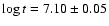 years.
Key words: techniques: photometric - stars: early-type - Galaxy: open
clusters and associations: individual: NGC 869,
NGC 884
The precise determination of the main physical parameters of galactic open clusters plays a central role in the study of the stellar structure and evolution. With accurate photometric data, and once the external variables such as reddening are corrected for, the cluster distances, ages and chemical abundances can be inferred from the study of the photometric colour-magnitude and colour-colour diagrams.
The usual way to obtain the cluster age is by means of isochrone fitting to the main sequence in a colour-magnitude diagram. In the case of young clusters - younger than 50 Myr - isochrone fitting is made difficult by the usual presence of differential reddening across the cluster face, which widens the observed main sequence. Moreover, the presence of emission line stars, like Be o PMS stars, which occupy anomalous positions in the photometric diagrams, additionally contributes to a further main sequence widening. Hence, the fit of a particular isochrone can be a very uncertain process, and it is not difficult to find recent age determinations with very diverging values for a given young cluster.
In a recent paper, Fabregat & Torrejón (2000) propose the use of isochrone fitting in the V0 - c0 plane of the uvbyphotometric system as an adequate tool to obtain accurate cluster ages. The range of variation of the c0 index along the B-type sequence amounts to more than 1 mag, being significantly larger than most commonly used photometric colours. Moreover, the c0 index is less affected by reddening, and allows an efficient segregation of emission-line stars.
In order to produce accurate and homogeneous dating for a sample of young
galactic clusters, we have undertaken an observational programme to
obtain CCD
photometry. In this paper we present the first
results, related to the clusters h and
Persei.
The double cluster h and
Persei is one of the
richest young open clusters in the Galaxy, and also one of the brightest
and closest to us. On a clear night, far from light pollution, it can
be easily seen with the naked eye, distinctly shining in the Milky Way
between the Perseus and Cassiopeia constellations. h and
Persei
(NGC 869 and NGC 884 respectively) are often considered
to be the core of the broader Per OB1 association, although
recent studies cast doubts on this fact (e.g. Slesnick et al. 2002)
The published work on h and
Persei is very extensive. A summary
of the key papers and discussion on the past work is given by Waelkens et al. (1990). Within the literature there is no convergence on
the fundamental parameters of the clusters, such as their distances and
ages. The discrepancies in the cluster distance moduli are well in excess
of 0.5 mag, while there is no agreement about both clusters being of the
same or different ages.
The determination of the accurate physical parameters of the double
cluster is of particular importance for many galactic and extragalactic
stellar structure and evolution studies. As h and
Persei are the
main northern clusters containing early-type B stars, the calibration of
the colour-absolute magnitude relations for the most luminous stars in
several photometric systems heavily rely on them (e.g. Crawford
1978; Balona & Shobbrook 1984). Given their relative
richness and young age, they are specially well suited and hence widely
used to observationally test the stellar evolutionary models for massive
stars.
For all these reasons, the double cluster has attracted the attention of
research groups in the last years, and several modern studies
based on CCD photometry and spectroscopy have been recently published.
Keller et al. (2001) and Slesnick et al. (2002) have
obtained CCD wide band photometry in a large area centered on the
clusters, and the latter also presented spectroscopy for several
hundred stars. Marco & Bernabeu (2001) presented
CCD-
photometry for stars in the clusters nuclei. In addition,
membership probabilities based on positions and proper motions have
been obtained by Uribe el al. (2002).
All the above studies converge to a
common distance modulus of about
 mag for both clusters, but
still present controversial results regarding their ages. Keller et al. (2001) and Slesnick et al. (2002) find
a common age of log t = 7.1 years for both clusters and the surrounding
population, while Marco & Bernabeu (2001) claim the existence of
at least three different episodes of star formation. To clarify this issue
is one of the objectives of the present paper.
mag for both clusters, but
still present controversial results regarding their ages. Keller et al. (2001) and Slesnick et al. (2002) find
a common age of log t = 7.1 years for both clusters and the surrounding
population, while Marco & Bernabeu (2001) claim the existence of
at least three different episodes of star formation. To clarify this issue
is one of the objectives of the present paper.
CCD photometry of the central regions of h and
Persei was
obtained on the nights 20 to 22 November 1998 at the 1.52 m telescope of
the Observatorio Astronómico Nacional, located at the Calar Alto
Observatory (Almería, Spain). The chip employed was the Tektronics
TK 1024 AB, with a size of
 pixels. The
 unbinned
pixels provide a field size of
unbinned
pixels provide a field size of
 ,
which almost
entirely covers the cluster's "nuclei'' area, as defined by Maps 2 and 4
in Oosterhoff (1937).
,
which almost
entirely covers the cluster's "nuclei'' area, as defined by Maps 2 and 4
in Oosterhoff (1937).
Observations were done through the four Strömgren uvby and
Crawford narrow and wide H filters, every field being
sequentially measured through the six filters. Two different
exposure times were used with each filter, in order to ensure a wide
range of stellar magnitudes. Exposure times in each filter were
selected so as a B type star produces approximately equal count rates
through all filters. Employed exposure times are presented in Table 1.
filters, every field being
sequentially measured through the six filters. Two different
exposure times were used with each filter, in order to ensure a wide
range of stellar magnitudes. Exposure times in each filter were
selected so as a B type star produces approximately equal count rates
through all filters. Employed exposure times are presented in Table 1.
| Filter | short | large |
| y | 10 | 50 |
| b | 12 | 60 |
| v | 35 | 175 |
| u | 120 | 600 |
H
 |
12 | 60 |
H
 |
30 | 150 |
In order to ensure the atmospheric extinction and standard transformation determination, three additional fields centered on the open clusters NGC 1039, NGC 6910 and NGC 6913 were also observed at different airmasses. The list of all observations is presented in Table 2.
| NGC | JD | date | airmass | int. time |
| 869 | 51138 | 20-11-98 | 1.06 | short |
| 869 | 51138 | 20-11-98 | 1.07 | long |
| 869 | 51138 | 20-11-98 | 1.83 | short |
| 869 | 51139 | 21-11-98 | 1.07 | short |
| 869 | 51139 | 21-11-98 | 1.07 | long |
| 869 | 51140 | 22-11-98 | 1.07 | short |
| 869 | 51140 | 22-11-98 | 1.63 | short |
| 884 | 51138 | 20-11-98 | 1.10 | short |
| 884 | 51138 | 20-11-98 | 1.12 | long |
| 884 | 51138 | 20-11-98 | 1.98 | short |
| 884 | 51139 | 21-11-98 | 1.11 | short |
| 884 | 51139 | 21-11-98 | 1.13 | long |
| 884 | 51140 | 22-11-98 | 1.06 | short |
| 884 | 51140 | 22-11-98 | 1.70 | short |
| 1039 | 51138 | 20-11-98 | 1.57 | short |
| 1039 | 51140 | 22-11-98 | 1.55 | short |
| 6910 | 51138 | 20-11-98 | 1.11 | short |
| 6910 | 51138 | 20-11-98 | 1.77 | short |
| 6910 | 51138 | 20-11-98 | 1.14 | long |
| 6910 | 51138 | 20-11-98 | 1.83 | long |
| 6910 | 51140 | 22-11-98 | 1.14 | short |
| 6910 | 51140 | 22-11-98 | 1.66 | short |
| 6913 | 51138 | 20-11-98 | 1.25 | short |
| 6913 | 51138 | 20-11-98 | 1.30 | long |
| 6913 | 51140 | 22-11-98 | 1.18 | short |
| 6913 | 51140 | 22-11-98 | 1.81 | short |
Images were processed using IRAF.
A sizeable sample of bias and sky flat frames were obtained at the
beginning and at the end of every night. The images were subjected to the
usual overscan, bias and flat field corrections.
Photometry was performed using the DAOPHOT package (Stetson 1987). In each frame we selected interactively a sizeable number of sufficiently clean stars, checking carefully the absence of faint close neighbours. Aperture photometry was obtained for them, through a constant 14 pixel radius which was chosen to contain virtually all the stellar flux in all images, as indicated by a growth curve analysis. Subsequently, we proceed to the automatic identification of all stars in each frame, and performed PSF-fitting photometry for all identified stars. A constant PSF provided a good representation of the stellar profiles through each frame.
For each individual frame, and for the stars selected for aperture photometry, we obtained the mean difference between the aperture and PSF-fitting based instrumental magnitudes. PSF instrumental magnitudes for all stars in the frame were then transformed to the instrumental system defined by the aperture photometry by adding the mean difference value.
The atmospheric extinction was determined by the multi-night, multi-star method described by Manfroid (1993). Computations were done by using the RANBO2 package, written by J. Manfroid. The implementation of this reduction procedure allows the construction of a consistent natural system, which contains the extra-atmospheric instrumental magnitudes of all constant stars included in the computation procedure. Stars from all observed fields were included in the building of the natural system.
The value of the extinction coefficient was determined for each individual frame. For the stars in common, the mean difference between the observed and natural magnitudes was obtained, and divided by the airmass to obtain the corresponding extinction coefficient.
| D | |||||||||||
| star | V | (b-y) | m1 | c1 | |
V | (b-y) | m1 | c1 | |
N |
| 0869-0837 | 14.090 | - | - | - | - | -0.010 | - | - | - | - | 4 |
| 0869-0843 | 9.317 | 0.286 | -0.065 | 0.172 | 2.593 | 0.003 | -0.009 | 0.015 | -0.006 | -0.026 | 2 |
| 0869-0922 | - | 0.304 | -0.066 | 0.130 | - | - | 0.006 | -0.016 | 0.001 | - | 3 |
| 0869-0963 | - | 0.286 | -0.044 | 0.191 | - | - | -0.003 | -0.010 | -0.003 | - | 5 |
| 0869-0978 | - | 0.301 | -0.033 | 0.167 | 2.627 | - | 0.004 | -0.006 | 0.010 | -0.016 | 4 |
| 0869-0980 | - | 0.284 | -0.042 | 0.178 | - | - | 0.006 | -0.012 | -0.011 | - | 3 |
| 0869-0991 | - | 0.328 | -0.055 | 0.255 | - | - | 0.001 | -0.007 | 0.020 | - | 5 |
| 0869-1004 | - | 0.305 | -0.051 | 0.204 | - | - | 0.013 | -0.010 | 0.010 | - | 5 |
| 0869-1181 | - | 0.350 | -0.049 | 0.374 | 2.730 | - | 0.022 | 0.015 | 0.005 | 0.012 | 5 |
| 0869-1187 | 10.857 | 0.334 | -0.046 | 0.205 | 2.618 | -0.037 | 0.014 | -0.017 | 0.007 | -0.030 | 5 |
| 0884-2167 | 13.401 | 0.346 | -0.057 | 0.604 | 2.762 | -0.041 | 0.006 | 0.001 | 0.023 | 0.010 | 4 |
| 0884-2196 | 11.538 | - | - | - | 2.666 | 0.032 | - | - | - | 0.004 | 5 |
| 0884-2200 | - | - | - | - | 2.721 | - | - | - | - | 0.016 | 5 |
| 0884-2232 | 11.102 | - | - | - | 2.639 | 0.008 | - | - | - | -0.012 | 4 |
| 0884-2235 | 9.361 | 0.330 | -0.095 | 0.134 | 2.608 | -0.001 | -0.014 | 0.007 | 0.016 | 0.003 | 3 |
| 0884-2246 | 9.930 | 0.291 | -0.058 | 0.124 | 2.625 | -0.030 | -0.004 | -0.004 | 0.005 | 0.002 | 4 |
| 0884-2251 | 11.560 | 0.315 | -0.051 | 0.371 | 2.708 | 0.000 | -0.013 | 0.009 | -0.022 | 0.001 | 5 |
| 0884-2296 | 8.499 | 0.323 | -0.104 | 0.136 | - | 0.031 | -0.032 | 0.032 | -0.003 | - | 1 |
| 0884-2311 | 9.363 | 0.299 | -0.074 | 0.146 | 2.601 | 0.017 | -0.017 | 0.010 | 0.014 | -0.020 | 3 |
| 0884-2330 | 11.446 | 0.273 | -0.070 | 0.268 | 2.630 | -0.026 | -0.006 | 0.020 | 0.009 | 0.010 | 5 |
| 1039-0226 | 10.482 | - | - | - | - | -0.002 | - | - | - | - | 2 |
| 1039-0267 | 11.940 | 0.296 | 0.133 | 0.505 | 2.683 | 0.020 | 0.007 | 0.005 | -0.024 | 0.005 | 2 |
| 1039-0274 | 9.745 | 0.092 | 0.159 | 0.994 | 2.876 | -0.005 | -0.006 | 0.017 | -0.021 | -0.014 | 2 |
| 1039-0278 | 11.789 | 0.146 | 0.202 | 0.911 | 2.857 | 0.031 | -0.002 | -0.004 | -0.011 | 0.002 | 2 |
| 1039-0284 | 10.741 | 0.151 | 0.185 | 0.898 | 2.862 | 0.019 | 0.000 | 0.009 | -0.004 | 0.014 | 2 |
| 1039-0294 | 11.185 | 0.186 | 0.195 | 0.782 | - | 0.035 | -0.010 | 0.009 | 0.014 | - | 2 |
| 1039-0301 | 10.041 | 0.040 | 0.185 | 1.014 | 2.887 | -0.011 | 0.026 | -0.033 | -0.001 | -0.029 | 2 |
| 1039-0303 | 9.951 | 0.055 | 0.169 | 1.023 | - | -0.001 | 0.000 | -0.006 | -0.002 | - | 2 |
| 6910-0010 | 10.782 | - | - | - | 2.941 | -0.032 | - | - | - | 0.032 | 5 |
| 6910-0021 | 11.763 | 0.582 | -0.099 | 0.234 | 2.678 | -0.033 | 0.008 | -0.001 | -0.014 | 0.026 | 5 |
| 6910-0024 | 11.710 | - | - | - | 2.637 | 0.010 | - | - | - | -0.010 | 5 |
| 6910-0028 | 12.243 | - | - | - | - | -0.023 | - | - | - | - | 5 |
| 6910-0041 | 12.803 | 0.759 | -0.166 | 0.319 | 2.674 | 0.007 | -0.009 | 0.026 | -0.029 | 0.006 | 5 |
| 6913-0001 | 8.842 | 0.726 | -0.159 | 0.166 | 2.596 | 0.018 | 0.004 | -0.011 | 0.004 | 0.007 | 3 |
| 6913-0002 | 8.912 | 0.644 | -0.148 | 0.112 | 2.625 | -0.002 | -0.014 | 0.008 | 0.008 | 0.029 | 3 |
| 6913-0003 | 8.942 | 0.699 | -0.186 | 0.165 | 2.639 | 0.038 | -0.019 | 0.026 | -0.035 | 0.045 | 3 |
| 6913-0004 | 10.199 | 0.621 | -0.115 | 0.157 | 2.632 | -0.019 | -0.001 | -0.005 | 0.013 | 0.015 | 4 |
| 6913-0008 | 12.190 | 0.546 | -0.062 | 0.365 | 2.618 | -0.020 | 0.024 | -0.028 | -0.025 | -0.044 | 4 |
| 6913-0009 | 11.747 | 0.587 | -0.069 | 0.297 | - | 0.033 | 0.033 | -0.041 | 0.013 | - | 4 |
| 6913-0010 | - | - | - | - | 2.678 | - | - | - | - | 0.015 | 2 |
| 6913-0026 | 13.230 | 0.694 | -0.102 | 0.778 | - | -0.010 | -0.014 | 0.002 | 0.042 | - | 4 |
| Mean: | 0.000 | 0.000 | 0.000 | 0.000 | 0.001 | ||||||
| rms: | 0.023 | 0.014 | 0.017 | 0.017 | 0.021 |
transformations
The choice of an adequate set of
standard stars for CCD
photometry is a critical issue. On the one hand, the primary standard
stars of the uvby and H
systems (Crawford & Mander
1966; Crawford & Barnes 1970; Perry et
al. 1987) are all bright enough to saturate the CCD chip, even
with short exposures. On the other hand, most of the observed stars are
reddened B type stars. Manfroid & Sterken (1987), Delgado &
Alfaro (1989) and Crawford (1994) have shown that
transformations made only with unreddened stars introduce large
systematic errors when applied to reddened stars, even if the colour
range of the standard brackets that of the programme stars. No such
reddened early type stars are included in the primary standard lists.
Our standard list is composed of stars in young open clusters with
photometry published by Crawford et al. (1970) for
h and
Persei, Canterna et al. (1979) for NGC 1039 and
Crawford et al. (1977) for NGC 6910 and NGC 6913. All these
photometric lists were obtained with the same telescopes, instrumentation
and reduction procedures used to define the standard Crawford & Barnes
(1966) and Crawford & Mander (1970)
systems, and so the photometric values are in the standard system. As the
V values for h and
Persei are not included in the corresponding
uvby photometric list, we have used the values given by Johnson &
Morgan (1955). The final standard star list is presented in
Table 3. For cluster stars we have adopted the numbering system in
the WEBDA database (Mermilliod
1999). Note that these numbers may not correspond with the
numbering in the referred to photometric papers.
Individual stars in each list were selected so as to insure as large
as possible a range in all photometric indices. However, as the main
purpose of this paper is to study the cluster's upper main sequence, and
in particular the B type spectral range, no late type stars were included in
the standard star list. A few intrinsically red field stars have been
observed, and their values have been included in the photometry tables for
completeness, but it should be noted that photometry for stars redder
than
 is likely to be affected by systematic
errors. This
is also the case for the
index of emission-line stars, which reach a
very low value. As no emission line star was included in the standard
list due to their well know variability, there is no way to avoid
extrapolation.
is likely to be affected by systematic
errors. This
is also the case for the
index of emission-line stars, which reach a
very low value. As no emission line star was included in the standard
list due to their well know variability, there is no way to avoid
extrapolation.
Transformations were computed from the natural system to the standard
system defined by the standard star list described above. The
obtained transformation equations are the following:
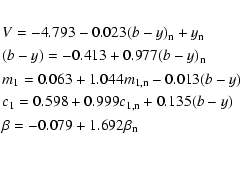 transformation, where the scale coefficient is
larger. This may be due to the wide filter used being significantly
narrower than the standard one defined by Crawford & Mander
(1966).
transformation, where the scale coefficient is
larger. This may be due to the wide filter used being significantly
narrower than the standard one defined by Crawford & Mander
(1966).
A measure of the photometric accuracy is the standard deviation of the mean catalogue minus transformed values for the standard stars. These values are presented in Table 3, bottom line.
Although precise astrometry is beyond the scopes of this paper, we have transformed the instrumental pixel coordinates into equatorial coordinates in order to facilitate the identification of all observed stars and their cross-correlation with other photometric lists.
Astronomical coordinates in the field of h Per where derived from
13 stars from the Positions and Proper Motions Catalogue (PPM, Roeser &
Bastian 1988). In the field of Per there are only 7 stars
with positions in the PPM Catalogue, which are grouped at the eastern
part. We complemented this list with four more stars with positions given
by Abad & García (1995). Transformation equations were
computed by means of the Starlink program ASTROM (Wallace
1998). The final astrometric accuracy, measured as the RMS of
the mean catalogue minus transformed values for the stars used in the
transformation, is within
.
Equatorial coordinates and mean photometric magnitudes, colours and
indices for stars in the h and
Persei nuclei are presented in
Tables 6 and 7. Only frames obtained at airmasses lower than 1.5
were considered to compute the final photometric values. For this reason,
small differences of up to a few millimagnitudes may appear between values
in Table 3 and Tables 6 and 7 for the stars in common.
In the photometry tables we have also adopted the cluster star numbering
system from the WEBDA database. For cluster numbers lower than 3000, WEBDA
numbers are coincident with Oosterhoff (1937) numbers, which we
will refer to as "Oo'' hereafter. A few observed stars have no entry in
WEBDA. We have introduced new numbering for them, starting with 7000 in
h Per and with 8000 in
Per.
![\begin{figure}
\par\includegraphics[width=8.8cm,clip]{MS2525f1.eps}\end{figure}](/articles/aa/full/2002/41/aa2525/img22.gif) |
Figure 1:
Color-magnitude diagram for h and
Persei. Filled
and open circles denote stars considered as cluster members and nonmembers
respectively. |
| Open with DEXTER | |
![\begin{figure}
\par\includegraphics[width=8.8cm,clip]{MS2525f2.eps}\end{figure}](/articles/aa/full/2002/41/aa2525/img23.gif) |
Figure 2: V-c1 photometric diagrams. Symbols as in Fig. 1. |
| Open with DEXTER | |
Colour-magnitude diagrams of all observed stars in both cluster regions are presented in Fig. 1, and photometric V-c1 diagrams in Fig. 2. To obtain the intrinsic colours we first classified the stars as belonging to the early (earlier than A0), intermediate (A0-A3) or late (A3 onwards) groups defined by Strömgren (1966). The classification was performed by means of the algorithm described by Figueras et al. (1991).
Cluster membership were assigned from the position of each star in the
different
photometric diagrams. Stars considered as members
are marked in the last column of Tables 6 and 7, and are represented with
a different symbol (filled circle) in Figs. 1 and 2. To
check the reliability of our criteria, we have compared our assigned
membership with those recently obtained from positions and proper motions
by Uribe et al. (2002). Among the 151 stars in common in both
studies, we have classified 134 as cluster members. Out of them, all but
three are also considered members from the proper motion study. The three
stars with diverging classification are Oo 804, 2203 and
2332. All of them are rather faint stars (
 )
and
are placed well inside the cluster sequences in the photometric
diagrams.
)
and
are placed well inside the cluster sequences in the photometric
diagrams.
Among the 17 stars we classified as nonmembers, 13 are considered members from their proper motions. We have carefully reconsidered their membership, and concluded that most of them can be safely excluded with photometric criteria. To give two examples, stars Oo 2007 and 2140 are considered cluster members in the proper motion study. They are respectively the bluest and the brightest stars presented as nonmembers (open circles) in Fig. 1, bottom panel. It is apparent that they lie significantly outside the cluster sequence locus, and, unless they are very peculiar objects (and their colours and indices do not indicate so) they cannot be considered as cluster members.
From the above comparison we can be confident that our photometric sequences are not significantly contaminated with the inclusion of nonmember field stars, and, conversely, very few, if any, actual members have been excluded from them.
Reddening values and intrinsic colours and indices were obtained for stars
in the early group by means of the procedure described by Crawford
(1978). We have used the standard
(b-y)0 - c0 relation given
in Table VI of Perry et al. (1987), and the following
reddening relations:
| AV = 4.3 E(b-y) | |||
| E(c1) = 0.2 E(b-y) | |||
| E(m1) = -0.32 E(b-y). |
For h Per we obtained a mean reddening value of
 ,
from 127 stars. The large value of the standard deviation
indicates the presence of variable reddening across the cluster
nucleus. In Fig. 3 we have represented the reddening values for
individual stars as a function of their position. A trend of increasing
reddening from west to east, and a heavily obscured region in the
south-eastern part of the cluster center are apparent. In Fig. 3 we
have divided the cluster nucleus area into three regions of different
reddening. Mean reddening values in these regions are presented in Table 4.
,
from 127 stars. The large value of the standard deviation
indicates the presence of variable reddening across the cluster
nucleus. In Fig. 3 we have represented the reddening values for
individual stars as a function of their position. A trend of increasing
reddening from west to east, and a heavily obscured region in the
south-eastern part of the cluster center are apparent. In Fig. 3 we
have divided the cluster nucleus area into three regions of different
reddening. Mean reddening values in these regions are presented in Table 4.
The large absorption in the south-east part has been previously pointed out by Waelkens et al. (1990) from photoelectric photometry in the Geneva system, but surprisingly has not been accounted for in recent CCD studies. On the other hand, the low reddening value in the western part was already noted by Fabregat et al. (1996). They considered the Be stars Oo 146, 245 and 566 as probable nonmembers, due to their reddening values ( E(b-y) = 0.313, 0.346 and 0.308 respectively), which are much lower than the cluster average reddening. From the present result we can conclude that the low reddening values are consistent with the position of these stars in the low absorption region at the western part of the cluster.
The mean value of the reddening for
Per is
,
from 82 stars. In Fig. 4 we have also represented the
individual reddening values as a function of the star's position. In this
case no trend is present. The standard deviation of the mean reddening
value is only slightly larger than the deviation of the reddening
computation method (namely 0.018, cf. Perry & Johnston 1982;
Franco 1989), and we conclude that the interstellar absorption
is constant towards the
Per nucleus, within the accuracy of our
photometry.
The different reddening characteristics towards both cluster nuclei are
apparent in the photometric diagrams presented in Figs. 1 and 2. In the V-(b-y) plane, the h Per sequence is much broader
than the
Per one, due to the strongly variable reddening in the
former. Assuming that both clusters are at the same distance (see below),
the higher mean reddening in h Per causes its observed sequence to
end at earlier spectral types. This is apparent in Fig. 1, yet
much more remarkable in the V-c1 plane in Fig. 2: in
Per
the lower branch of the cluster sequence is almost complete until
c1 =
0.45 (spectral type around F5), while in h Per it ends at
c1 = 0.85(around A7).
![\begin{figure}
\par\includegraphics[width=8.8cm,clip]{MS2525f3.eps}\end{figure}](/articles/aa/full/2002/41/aa2525/img28.gif) |
Figure 3:
Reddening spatial distribution for B stars in the h Per
nucleus. Positions are relative to star Oo 1057
(02 19 19
 , ,
 ,
J2000). ,
J2000). |
| Open with DEXTER | |
![\begin{figure}
\par\includegraphics[width=8.8cm,clip]{MS2525f4.eps}\end{figure}](/articles/aa/full/2002/41/aa2525/img31.gif) |
Figure 4:
Reddening spatial distribution for B stars in the
Per
nucleus. Positions are relative to star Oo 2227
(0222
 , ,
 ,
J2000). ,
J2000). |
| Open with DEXTER | |
| Region | E(b-y) | stars |
| A |
 |
12 |
| B |
 |
81 |
| C |
 |
34 |
In Fig. 5 we present the intrinsic V0 - c0 diagram for B stars
in both cluster nuclei.
Per stars have been dereddened by using the
mean cluster value of
E(b-y) = 0.398. For h Per, each star has been
dereddened on the basis of its position within Fig. 3, and using
the reddening values in Table 4. The loci of both sequences are
undistingishable, indicating that both clusters are at the same
distance, and have also the same age, as we will discuss in the next
section. The sequence of h Per is somewhat broader, most likely due to
the variable reddening.
To obtain the distance we have fitted to the V0 - c0 diagram of each
cluster the ZAMS as presented in Table VI of Perry et al.
(1987). Results are shown in Fig. 6. We found the best
fit at a distance modulus of 11.7 mag To estimate the error of this
determination we have also represented in Fig. 6, as dotted lines,
the ZAMS shifted by distance moduli of 11.5 and 11.9 respectively. We
find that the 11.7 value produces a distinctly better fit that the two
latter ones, and hence we give the value of
mag as the
distance modulus of h and
Persei. This value is in good agreement
with the recent determinations based on CCD photometry by Keller et al.
(2001), Marco & Bernabeu (2001) and Slesnick et al. (2002).
![\begin{figure}
\par\includegraphics[width=8.8cm,clip]{MS2525f5.eps}\end{figure}](/articles/aa/full/2002/41/aa2525/img35.gif) |
Figure 5:
Intrinsic V0 - c0 diagram for B stars in h and
Per
nuclei. |
| Open with DEXTER | |
Finally, an indication of the validity of the dereddening procedure and the conformity between our photometry and the standard system can be obtained by comparing the resulting m0 and (u-b)0 indices with those of nearby, unreddened stars as given by Perry et al. (1987). The results are shown in Figs. 7 and 8. As can be seen, the obtained indices are coincident with the mean intrinsic relations, and hence we can conclude that our photometry is in the standard system, and free of systematic effects. This is in turn a proof of the validity of our reduction methods and the adequacy of the standard star selection.
![\begin{figure}
\par\includegraphics[width=8.8cm,clip]{MS2525f6.eps}\end{figure}](/articles/aa/full/2002/41/aa2525/img36.gif) |
Figure 6:
ZAMS fitting to the h and
Per B star sequences. The
solid line represents the ZAMS at a distance modulus of 11.7 mag. Dashed
lines are for distance moduli of 11.5 and 11.9 respectively. |
| Open with DEXTER | |
Determination of the cluster ages will be done by isochrone fitting to the upper main sequence. In the uvby system and for stars in the early group, the (b-y)0 colour and the c0 index are temperature indicators, and hence both V0 - (b-y)0 and V0 - c0 planes are observational HR diagrams. Following the discussion in Fabregat & Torrejón (2000) we consider as more precise and reliable the isochrone fitting to the V0 - c0 diagram, for the following reasons: i) the range of variation of the c0 index along the B-type sequence is more than ten times larger than the range of variation of (b-y)0, providing much better discrimination between isochrones of similar ages; ii) the c0 index is less affected, by a factor of 5, by interstellar reddening; iii) the V0 - c0 plane allows an efficient segregation of emission line stars.
![\begin{figure}
\par\includegraphics[width=8.8cm,clip]{MS2525f7.eps}\end{figure}](/articles/aa/full/2002/41/aa2525/img37.gif) |
Figure 7:
m0 - (b-y)0 diagram for B type stars in h and Per nuclei, with the mean relation for nearby stars. |
| Open with DEXTER | |
![\begin{figure}
\par\includegraphics[width=8.8cm,clip]{MS2525f8.eps}\end{figure}](/articles/aa/full/2002/41/aa2525/img38.gif) |
Figure 8:
(u-b)0 - c0 diagram for B type stars in h and Per nuclei, with the mean relation for nearby stars. |
| Open with DEXTER | |
In Fig. 9 we present the V0 - c0 sequences of h and Per, together with isochrones with ages of
 ,
7.1 and 7.2
years. The isochrones have been computed with the evolutionary models of
Schaller et al. (1992), and transformed to the observational
plane by means of the relations obtained by Torrejón (1997).
The best fitting in both clusters is obtained for
,
7.1 and 7.2
years. The isochrones have been computed with the evolutionary models of
Schaller et al. (1992), and transformed to the observational
plane by means of the relations obtained by Torrejón (1997).
The best fitting in both clusters is obtained for
 ,
with
most of the stars at the turnoff point lying between the
and 7.2 isochrones. Hence we propose
as the common
age of both clusters, in good agreement with the recent results of Keller
et al. (2001) and Slesnick et al. (2002).
,
with
most of the stars at the turnoff point lying between the
and 7.2 isochrones. Hence we propose
as the common
age of both clusters, in good agreement with the recent results of Keller
et al. (2001) and Slesnick et al. (2002).
![\begin{figure}
\par\includegraphics[width=8.8cm,clip]{MS2525f9.eps}\end{figure}](/articles/aa/full/2002/41/aa2525/img41.gif) |
Figure 9:
Isochrone fitting to the h and
Per B star
sequences, in the V0 - c0 plane. |
| Open with DEXTER | |
In a recent paper Marco & Bernabeu (2001, hereinafter referred to
as MB01) claimed that h Per is significantly older than
Per, and
go further to propose three epochs of star formation within the double
cluster at ages of log t = 7.0, 7.15 and 7.3 years. This is in clear
disagreement with our results in the previous section. Their study is also
based on CCD uvby photometry, and they use the same methods and
techniques that we do in the present paper. Hence, it is worth comparing
both studies in order to ascertain the reasons for the diverging results.
When comparing both sets of data, it should be noted that: i) our
standard photometry is at least twice as accurate as the MB01 one
(cf. Table 9 in MB01 and Table 3 in this paper), and ii) our CCD
frames cover a larger area than the MB01 ones, and hence our photometric
sequences are more populated.
MB01 find an age of
 -7.15 years for
Per, in
agreement with our value of
obtained in the previous
section. For h Per they obtain a significantly older age. In their
Fig. 10 they show the log t = 7.3 isochrone fitting a clump of stars at
about
c0 = 0.12, which they consider as the main sequence turnoff. This
clump is also present in our data, as can be seen in Fig. 10 where
we present the V0 - c0 plane and the the
-7.15 years for
Per, in
agreement with our value of
obtained in the previous
section. For h Per they obtain a significantly older age. In their
Fig. 10 they show the log t = 7.3 isochrone fitting a clump of stars at
about
c0 = 0.12, which they consider as the main sequence turnoff. This
clump is also present in our data, as can be seen in Fig. 10 where
we present the V0 - c0 plane and the the
 and 7.3
isochrones. However, the distribution of stars in our Fig. 10 near
the turnoff point is different. The clump at
c0 = 0.12 is less
conspicuous, it only contains at most six stars, and significantly
leftwards of the fitting
and 7.3
isochrones. However, the distribution of stars in our Fig. 10 near
the turnoff point is different. The clump at
c0 = 0.12 is less
conspicuous, it only contains at most six stars, and significantly
leftwards of the fitting
 isochrone there are at least eight
main sequence cluster stars, which should have a younger age. We consider
the latter as defining the actual cluster main sequence turnoff, which is
well fitted by the
isochrone.
isochrone there are at least eight
main sequence cluster stars, which should have a younger age. We consider
the latter as defining the actual cluster main sequence turnoff, which is
well fitted by the
isochrone.
The possibility of two distinct populations with
and 7.3
years seems very unlikely. The occurrence of stars slightly above the main
sequence can be justified by several reasons, including binarity, high
rotational velocity, or photometric errors. Other small clump above
the main sequence is apparent at c0 = 0.3, and it is also most likely
caused by the abovementioned reasons.
MB01 also propose the presence of a population younger than
 in the h Per region. This claim is based on the position in the V0 -
c0 plane of six supergiant B stars observed by Crawford et al. (1970). In Fig. 10 we have also represented these
stars (filled triangles), which clearly fall at the left of the
isochrone.
in the h Per region. This claim is based on the position in the V0 -
c0 plane of six supergiant B stars observed by Crawford et al. (1970). In Fig. 10 we have also represented these
stars (filled triangles), which clearly fall at the left of the
isochrone.
Yet this argument is wrong. The c1 index of the uvby system is defined to be a measure of the Balmer discontinuity depth, which for OB stars is related to the effective temperature. For this reason, the V0 - c0 photometric plane can be considered as an observational Hertzsprung-Russell diagram. However, this is only true for stars of luminosity classes III to V, and not for supergiants. Crawford et al. (1970) already noted that Ia type supergiants do not follow the mean (b-y)0 - c0 calibration. Schild & Chaffee (1975) showed that the Balmer continuum of early type supergiants is affected by an emission or absorption contribution of circumstellar origin, and hence the Balmer discontinuity depth is not correlated with spectral types or effective temperature. Kilkenny & Whittet (1985) present (b-y)0 - c0 intrinsic relations for early type supergiants. There is a different relation for each luminosity class (Ia, Iab, Ib and II), and all of them are in turn different to the mean relation for III-V classes. If we assume that (b-y)0 is a good temperature indicator for all luminosity classes (see below), this implies that the c0 index cannot define a unique temperature scale valid for all luminosities.
The case is much the same as for classical Be stars. Be stars also have continuum emission or absorption of circumstellar origin at the Balmer discontinuity, and hence their c0 indices are anomalous (Fabregat et al. 1996, and references therein). For comparison, in Fig. 10 we have represented the four Be stars in the cluster nucleus (filled circles). They also occupy anomalous positions at the left of the isochrones, and even below the ZAMS. Neither supergiants nor Be stars should be used in a V0 - c0 diagram when it is intended to be an observational HR diagram for isochrone fitting purposes, because their c0 index is not related to effective temperature.
![\begin{figure}
\par\includegraphics[width=8.8cm,clip]{MS2525f10.eps}\end{figure}](/articles/aa/full/2002/41/aa2525/img46.gif) |
Figure 10: V0 - c0 diagram for B type stars in h Per. Open circles are main sequence stars, filled circles Be stars and triangles supergiant stars. |
| Open with DEXTER | |
![\begin{figure}
\par\includegraphics[width=8.8cm,clip]{MS2525f11.eps}\end{figure}](/articles/aa/full/2002/41/aa2525/img47.gif) |
Figure 11: V0 - (b-y)0 plane for B type stars in h Per. Symbols as in Fig. 10. |
| Open with DEXTER | |
In order to study the age of the supergiant star population in the h Per area, in Fig. 11 we have represented the V0 - (b-y)0photometric diagram. (b-y) is a measure of the Paschen continuum slope, which is correlated with effective temperature for stars of all luminosity classes. Be stars, however, also deviate due to additional reddening of circumstellar origin (e.g. Fabregat et al. 1996). Two supergiant stars, Oo 1057 and 1162, lie in the cluster nucleus, and have been dereddened as a function of their position in Fig. 3. The other four, Oo 3, 16, 612 and 662, are placed at the west of the cluster nucleus. Following the discussion in Sect. 3, we have used the value of E(b-y) = 0.328 in Table 4 to obtain their intrinsic colours. In order to check the reliability of this value, we have calculated the individual reddening for all supergiant stars using the standard relations given by Kilkenny & Whittet (1985). Results are presented in Table 5. All reddening values for the western stars are compatible with the mean reddening for the west region given in Table 4.
| Oo | E(b-y) |
| 3 | 0.306 |
| 16 | 0.340 |
| 612 | 0.350 |
| 662 | 0.357 |
| 1057 | 0.411 |
| 1162 | 0.473 |
In Fig. 11 it is apparent that most supergiants lie
close to the
isochrone, giving further support to this value
as the actual age of h Per. There are no stars significantly leftwards
of this isochrone, indicating that no younger population is present in the
cluster area.
MB01 also presented the V0 - (b-y)0 plane for h Per (their Fig. 9). In their figure most supergiant stars are placed leftwards of the log t = 7.0 isochrone, and even leftwards of the ZAMS, indicating that these stars may not be members of the cluster. This is due to a reddening overcorrection. They used their mean cluster value, E(b-y) = 0.44, to calculate the intrinsic colours. The deviating supergiants are placed at the west of the cluster nucleus, where we have demonstrated that the reddening is lower by more than a tenth of magnitude. With the proper reddening values, supergiants are placed close to the cluster isochrone.
We can conclude that there are no different epochs of star formation
within the h and
Persei clusters area, and that both clusters
and the surrounding field stars share the same age of
years, as determined in the previous sections. We propose
that the wrong results obtained by MB01 are due to a number of factors,
including the low accuracy of their photometry, the neglect of the
strongly variable reddening across the h Per cluster, the incorrect use
of supergiant stars in the V0 - c0 plane for isochrone analysis, and
to a large extent the overinterpretation of the data at their disposal.
As discussed in Sect. 4, and in more detail in Fabregat & Torrejón (2000), the isochrone fitting in the V0 - c0 plane is an excellent tool for accurate age determination in young open clusters. With accurate photometry, the main sequence turnoff is very well defined, allowing a precise discrimination between isochrones of slightly different ages. But its applicability is limited to the range of spectral types and luminosity classes for which the c0 index is a good temperature indicator. This is restricted to OB stars of luminosity classes III to V, and beyond these limits its use can conduct to misleading results.
We have presented CCD
photometry for stars in the nuclei of
the young open clusters h and
Per. We have shown that our
photometry is free of systematic effects and well linked to the standard
uvby system.
We have obtained the cluster
astrophysical parameters from the analysis of the B type star range.
The reddening is highly variable through the h Per nucleus, increasing
from west to east. Its value ranges from
in the
western part to
in the south-east. Towards
Per the reddening is fairly constant, with
.
Both clusters share a common distance modulus of
mag, and an age of
years.
The physical parameters we have obtained are coincident, within the
errors, with those recently presented by Keller et al. (2001) and
Slesnick et al. (2002). With most of the modern studies
converging to similar values, we can consider that the longstanding
controversy about the distances and ages of h and
Persei is
coming to an end.
Acknowledgements
We would like to thank Dr. J. Manfroid for providing us with his RANBO2 code to compute atmospheric extinction and photometric natural system. We are grateful to the Observatorio Astronómico National for the allocation of observing time in the 1.5 m telescope, and for support during observations. This research has made use of the WEBDA database, developed and maintained by J.C. Mermilliod, the SIMBAD database, operated at CDS, Strasbourg, France, and the NASA's Astrophysics Data System Abstract Service. The authors acknowledge the data analysis facilities provided by the IRAF data reduction and analysis system, and by the Starlink Project which is run by CCLRC on behalf of PPARC. This work has been partially supported by the Plan Nacional de Investigación Científica, Desarrollo e Innovación Tecnológica del Ministerio de Ciencia y Tecnología and FEDER, through contract AYA2000-1581-C02-01. JF acknowledges grants from the Conselleria de Cultura i Educació de la Generalitat Valenciana and the Secretaría de Estado de Educación y Universidades of the Spanish Governement.