 Hya
Hya![[*]](/icons/foot_motif.gif)
A&A 394, L5-L8 (2002)
DOI: 10.1051/0004-6361:20021281
HyaS. Frandsen 1 - F. Carrier2 - C. Aerts3 - D. Stello1 - T. Maas3 - M. Burnet2 - H. Bruntt1 - T. C. Teixeira4,1 - J. R. de Medeiros5 - F. Bouchy2 - H. Kjeldsen1,6 - F. Pijpers1,6 - J. Christensen-Dalsgaard1,6
1 - Institut for Fysik og Astronomi, Aarhus Universitet,
Universitetsparken, 8000 Aarhus C, Denmark
2 -
Observatoire de Genève, 51 chemin de Maillettes,
1290 Sauverny, Switzerland
3 -
Katholieke Universiteit Leuven,
Instituut voor Sterrenkunde, Celestijnenlaan 200 B, 3001 Leuven, Belgium
4 -
Centro de Astrofísica da Universidade do Porto, Portugal
5 -
Departamento de Física,
Universidade Federal do Rio Grande do Norte, 59072-970
Natal, RN, Brazil
6 -
Teoretisk Astrofysik Center, Danmarks Grundforskningsfond
Received 17 June 2002 / Accepted 3 September 2002
Abstract
We report the firm discovery of solar-like oscillations in a
giant star. We monitored the star Hya (G7III) continuously during one
month with the CORALIE spectrograph attached to the 1.2 m Swiss Euler
telescope. The 433 high-precision radial-velocity measurements clearly reveal
multiple oscillation frequencies in the range 50-130  Hz, corresponding
to periods between 2.0 and 5.5 hours. The amplitudes of
the strongest modes are
slightly smaller than
Hz, corresponding
to periods between 2.0 and 5.5 hours. The amplitudes of
the strongest modes are
slightly smaller than
 .
Current model calculations are compatible with
the detected modes.
.
Current model calculations are compatible with
the detected modes.
Key words: asteroseismology - solar type oscillations - giant stars
Doppler studies with high-precision instruments and reduction algorithms have
been refined dramatically, mainly in the framework of the search for
exoplanets. These refinements have led to a breakthrough in the
observations of solar-type oscillations, which have now been found repeatedly
(Procyon, Martic et al. 1999;  Hyi, Bedding et al. 2001;
  Cen A, Bouchy & Carrier 2001;
 Eri, Carrier et al. 2002). The signal-to-noise ratio
(S/N) in the oscillation frequency spectra is, for each of these cases, so
good that the resemblance with the solar oscillation spectrum is obvious.
Eri, Carrier et al. 2002). The signal-to-noise ratio
(S/N) in the oscillation frequency spectra is, for each of these cases, so
good that the resemblance with the solar oscillation spectrum is obvious.
Observations of solar-like oscillations in the giant star  UMa have
been claimed by Buzasi et al. (2000), based upon space photometry
gathered with the star tracker of the WIRE satellite. However, the
interpretation of these reported oscillations frequencies is not
straightforward. Guenther et al. (2000) find a possible solution
in terms of a sequence of radial modes with a few missing orders for a star
of 4.0-4.5
UMa have
been claimed by Buzasi et al. (2000), based upon space photometry
gathered with the star tracker of the WIRE satellite. However, the
interpretation of these reported oscillations frequencies is not
straightforward. Guenther et al. (2000) find a possible solution
in terms of a sequence of radial modes with a few missing orders for a star
of 4.0-4.5  .
The interpretation is not supported by theoretical
calculations by Dziembowski et al. (2001).
Velocity observations of Arcturus provide evidence for solar-type
oscillations with periods from 1.7 to 8.3 days and a frequency separation of
evenly spaced modes of
.
The interpretation is not supported by theoretical
calculations by Dziembowski et al. (2001).
Velocity observations of Arcturus provide evidence for solar-type
oscillations with periods from 1.7 to 8.3 days and a frequency separation of
evenly spaced modes of
 Hz (Merline 1999).
WIRE data (Retter et al. 2002), however, points to an excess
power at 4.1 Hz and a frequency spacing of
Hz (Merline 1999).
WIRE data (Retter et al. 2002), however, points to an excess
power at 4.1 Hz and a frequency spacing of
 Hz.
Hz.
In this Letter, we provide clear evidence for the
presence of solar-type oscillations in the giant star Hya (mV=3.54).
This star has a mass close to
 ,
and is thus considerably heavier
than the Sun. Moreover, its luminosity amounts to
,
and is thus considerably heavier
than the Sun. Moreover, its luminosity amounts to
 and its
effective temperature
and its
effective temperature
 K, which places the star among the giants.
In the current Letter we present the first results of our study.
Detailed modelling will be presented, when completed, in a subsequent paper.
K, which places the star among the giants.
In the current Letter we present the first results of our study.
Detailed modelling will be presented, when completed, in a subsequent paper.
![\begin{figure}
\par\includegraphics[width=8.8cm,clip]{Ef171_f1.eps}
\end{figure}](/articles/aa/full/2002/40/aaef171/img19.gif) |
Figure 1:
Radial-velocity measurements of Hya. The dispersion
reaches
 .
a) The whole time string; b) zoom of a small
part of the time series. .
a) The whole time string; b) zoom of a small
part of the time series. |
| Open with DEXTER | |
The Hya observations were made during one full month (2002 February 18 -
March 18) with CORALIE, the high-resolution fiber-fed echelle
spectrograph (Queloz et al. 2001) mounted on the 1.2-m Swiss telescope
at La Silla (ESO, Chile). During the stellar exposures, the spectrum of a
thorium lamp carried by a second fiber is simultaneously recorded in order to
monitor the spectrograph's stability and thus to obtain high-precision
velocity measurements. The spectra were extracted at the telescope, using the
INTER-TACOS (INTERpreter for the Treatment, the Analysis and the COrrelation of
Spectra) software package developed by D. Queloz and L. Weber at the Geneva
Observatory (Baranne et al. 1996). The wavelength coverage of these
spectra is 3875-6820 Å, recorded on 68 orders. By taking about 2 measurements
every hour, a total of 433 optical spectra was collected. The exposure times
were typically 180 s and the S/N ratio for all spectra was in the
range of 110-230 at 550 nm.
By the use of the optimum-weight procedure (Bouchy et al. 2001),
radial velocities are computed for each night relative to the highest S/N spectrum obtained in the middle of the night. This method requires a Doppler
shift that remains small compared to the line-width (smaller than
 )
(Bouchy & Carrier 2001). Since the Earth's motion can introduce a
Doppler shift larger than
)
(Bouchy & Carrier 2001). Since the Earth's motion can introduce a
Doppler shift larger than
 during a whole night, each spectrum is first
corrected for the Earth's motion before deriving the radial velocities. This is
achieved by shifting all spectra with the Earth's velocity at the time of
observation and by subsequent rebinning, so that the spectra all have the same
wavelength values. From each rebinned spectrum a velocity is derived.
The mean radial velocity for each night is then subtracted.
The resulting velocities are shown in
Fig. 1.
The rms scatter of the time series is
during a whole night, each spectrum is first
corrected for the Earth's motion before deriving the radial velocities. This is
achieved by shifting all spectra with the Earth's velocity at the time of
observation and by subsequent rebinning, so that the spectra all have the same
wavelength values. From each rebinned spectrum a velocity is derived.
The mean radial velocity for each night is then subtracted.
The resulting velocities are shown in
Fig. 1.
The rms scatter of the time series is
 and is
largely due to the oscillations. The mean error on each measurement
is
and is
largely due to the oscillations. The mean error on each measurement
is
 .
.
![\begin{figure}
\includegraphics[width=8.8cm,clip]{Ef171_f2.eps}
\end{figure}](/articles/aa/full/2002/40/aaef171/img24.gif) |
Figure 2:
Power spectrum for Hya. Modes are clearly present in the
range 50-130 Hz, corresponding to periods of 2.0-5.5 hours.
Panel a) is the power spectrum of the time series using one
single spectrum as
the reference. Panel b) is for the time series derived using one
reference spectrum per night.
The insert in Panel b) shows the window function. The
frequency scale is made similar to the main plot to facilitate
comparison. |
| Open with DEXTER | |
The power spectrum of the 433 data points is presented in Fig. 2. In
order to show that the excess power in the lower panel in the range 50-130 Hz is not due to elimination of power at low frequencies by the reduction
procedure, we show a power spectrum in the upper panel where no correction for
drift has been applied. Although more noisy the increase in power between
50 Hz and 130 Hz is also evident in the upper panel. A set of
oscillation modes is clearly present, with a power distribution that is
remarkably similar to that seen in the Sun and other stars on or near the main
sequence, although obviously at much lower frequency. We will show
the spectrum displays the characteristic near-uniform spacing of
the dominant peaks.
To characterize this pattern we have calculated the autocorrelation of the power
spectrum. In order to eliminate the effect of the noise, we have ignored all
points with amplitudes below a given threshhold (1.2
 ). In Fig. 3
the alias at 1 c/d stands out clearly, but in addition a spacing
). In Fig. 3
the alias at 1 c/d stands out clearly, but in addition a spacing
 Hz is present in the power spectrum. This is consistent with
the visual impression of a regular pattern present in the the power spectrum
(Fig. 2).
Hz is present in the power spectrum. This is consistent with
the visual impression of a regular pattern present in the the power spectrum
(Fig. 2).
The expected velocity amplitude for solar-like oscillations scales as L/Maccording to Kjeldsen & Bedding (1995). Using the stellar parameters
from Sect. 4 and a mass of 3.0 (Sect. 4) we find
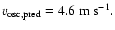 The observed amplitudes in Fig. 2 are only about one
third of this prediction. Recent calculations by Houdek & Gough (2002),
however, indicate that the simple scaling law of Kjeldsen & Bedding
(1995) does indeed not apply. They predict a velocity amplitude
The observed amplitudes in Fig. 2 are only about one
third of this prediction. Recent calculations by Houdek & Gough (2002),
however, indicate that the simple scaling law of Kjeldsen & Bedding
(1995) does indeed not apply. They predict a velocity amplitude
 ,
slightly higher than the ones observed by us for Hya.
,
slightly higher than the ones observed by us for Hya.
The stochastic nature of solar-like oscillations implies that a timestring of
radial velocities cannot be expected to be a set of coherent oscillations and
can therefore not be reproduced perfectly by a sum of sinusoidal terms. As a
starting point it is nevertheless a good assumption to try to fit the
radial-velocity data of Hya by such a set of functions, as the lifetimes
are expected to exceed the length of the observing run (Houdek & Gough
2002). We have performed an iterative fit using different methods, among which
Period98 (Sperl 1998) and a procedure by Frandsen et al.
(2001). An oscillation with a S/N above 4 is detected at 9 frequencies.
When a fit based upon these 9 frequencies is removed from the time series, 5 additional peaks still occur but with a too low S/N to accept them without
additional confirmation (hence we do not list them). After removing the 14 frequencies, only a noise spectrum is left. The results for the 9 frequencies
are presented in Table 1, where the S/N indicated is calculated from
the remaining noise in the amplitude spectrum at the position of each mode. The
noise is slightly higher in the range of the modes than at high frequencies,
where
 .
The frequencies of the modes with amplitudes above
.
The frequencies of the modes with amplitudes above
 ,
i.e., of the five highest-amplitude modes, are unambiguous.
Dividing the dataset in two, four out of five modes with S/N > 5.0 are
present in each set. For lower S/N the alias problems lead to a risk that false
detections are made. Modes with S/N < 5 must be considered with some caution.
Confirmation of these frequencies is needed by additional observations. What is stated above has been verified by the analysis of several sets
of simulated data assuming a variety
of lifetimes in order to check the validity of the identified modes. The
details of such simulations will be published in a subsequent paper.
,
i.e., of the five highest-amplitude modes, are unambiguous.
Dividing the dataset in two, four out of five modes with S/N > 5.0 are
present in each set. For lower S/N the alias problems lead to a risk that false
detections are made. Modes with S/N < 5 must be considered with some caution.
Confirmation of these frequencies is needed by additional observations. What is stated above has been verified by the analysis of several sets
of simulated data assuming a variety
of lifetimes in order to check the validity of the identified modes. The
details of such simulations will be published in a subsequent paper.
![\begin{figure}
\par\includegraphics[width=8.8cm,clip]{Ef171_f3.eps}
\end{figure}](/articles/aa/full/2002/40/aaef171/img31.gif) |
Figure 3:
Autocorrelation
of the power spectrum for Hya. A
ll points with amplitude v < 1.2
have been set to zero. The dash-dot-dot-dot vertical lines mark the position
of the 11.574 Hz daily alias and half of it, and the dash-dot line
indicates the peak pointing to a frequency spacing of 6.8 Hz. |
| Open with DEXTER | |
| ID | Frequency | Amplitude | S/N |
 |
|
| c/d | Hz |
|
Hz |
||
| F1 | 5.1344(26) | 59.43 | 1.85(23) | 6.6 | 0.77 |
| F2 | 6.8366(27) | 79.13 | 1.84(23) | 5.8 | -0.86 |
| F3 | 7.4265(29) | 85.96 | 1.76(23) | 5.3 | -1.14 |
| F4 | 8.2318(32) | 95.28 | 1.65(23) | 5.1 | 1.07 |
| F5 | 9.3507(33) | 108.22 | 1.59(23) | 6.0 | -0.21 |
| F6 | 8.7399(36) | 101.16 | 1.36(22) | 4.5 | -0.16 |
| F7 | 10.0287(43) | 116.07 | 1.25(23) | 5.0 | 0.53 |
| F8 | 9.0831(44) | 105.13 | 1.24(24) | 4.3 | |
| F9 | 8.5339(40) | 98.77 | 1.23(23) | 4.1 | |
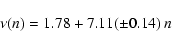
The first seven modes can be ordered in a sequence of modes, which
fits the straight line
 |
(1) |
Hz (Table 1).
The regularity seen is similar to the results reported for Arcturus (Merline 1999)
and UMa (Guenther et al. 2000).
The first seven modes could all be radial modes, although we
cannot rule out the possibility of alternating degree
 and
and  modes. This, however, is not consistent
with the model presented in Sect. 4.
modes. This, however, is not consistent
with the model presented in Sect. 4.
From the present data, we cannot firmly exclude that frequency F8 in Table 1 corresponds to the same mode as F7. The two modes are resolved, but if the damping time is short, they might be different realizations of the same mode.
In order to study the nature of the oscillations detected in Hya, it is
necessary to compare the observed frequency spectrum with model predictions,
taking into account the constraints on the three observational stellar
parameters
 ,
L and Z. We have redetermined the atmospheric
parameters and use
,
L and Z. We have redetermined the atmospheric
parameters and use
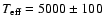 K,
K,

 ,
,
 ,
[M/H] =
,
[M/H] =
 (
(
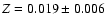 )
and
)
and
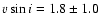
 .
Details of how these values were obtained
will be reported in a subsequent paper.
.
Details of how these values were obtained
will be reported in a subsequent paper.
Using the evolution code of
Christensen-Dalsgaard (1982), evolutionary tracks were produced, spanning the
error box defined by the uncertainties of
,
L and Z.
The model tracks were computed using the EFF equation of state
(Eggleton et al. 1973), OPAL opacities (Iglesias et al. 1992),
Bahcall & Pinsonneault (1992) nuclear cross sections, and the mixing-length
formalism (MLT) for convection.
The evolutionary track passing through the observed (
,
L)
corresponds to a mass of
 for Z = 0.019(Fig. 4). Oscillation frequencies were calculated for the model in
that track closest to the observed location of Hya in the HR diagram. The
average separation between radial modes in the range 50-100 Hz is
for Z = 0.019(Fig. 4). Oscillation frequencies were calculated for the model in
that track closest to the observed location of Hya in the HR diagram. The
average separation between radial modes in the range 50-100 Hz is
 Hz in agreement with the observational value.
The model frequencies fit a linear relation for orders
5 < n < 17 or
Hz in agreement with the observational value.
The model frequencies fit a linear relation for orders
5 < n < 17 or
 Hz given by
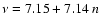 with absolute values only 1-2 Hz from the observed frequencies.
The maximum deviation of the model frequencies from the line is
with absolute values only 1-2 Hz from the observed frequencies.
The maximum deviation of the model frequencies from the line is 
 Hz.
Hz.
Radial modes are expected to dominate the spectrum for giant stars (cf.
Dziembowski et al. 2001, Fig. 2). Further analysis of the spectrum
is beyond the scope of the current discovery paper and will be done
in a forthcoming paper, dealing in detail with the issue of modelling and
considering also the possibility that Hya could be a core
helium burning star with a smaller mass.
![\begin{figure}
\par\includegraphics[width=8.8cm,clip]{Ef171_f4.eps}
\end{figure}](/articles/aa/full/2002/40/aaef171/img52.gif) |
Figure 4:
Hertzsprung-Russell diagram with evolutionary tracks for Z =
0.019 for masses
(solid line), 2.93 and
 (lower and upper dashed lines, respectively). The location of Hya in
the diagram is given by the error box.
(lower and upper dashed lines, respectively). The location of Hya in
the diagram is given by the error box. |
| Open with DEXTER | |
The main conclusions of this study are as follows. Solar-like oscillations have
been firmly discovered in the bright G7III star Hya. The amplitudes of the
strongest modes are somewhat below
.
The observed frequency distribution
of the modes detected (Table 1) is in agreement with theoretically calculated
frequencies both in terms of the spacing and the absolute values. The modes
with the largest amplitudes can be well matched with radial modes that have an
almost equidistant separation around 7.1 Hz.
A most important and exciting result of our study is the confirmation of the
possibility, suggested by the results reported on UMa and Arcturus, to
observe solar-like oscillations in stars on the red giant branch. This opens the
red part of the HR diagram for detailed seismic studies. The latter require an
accuracy within the range of current and future ground-based instruments. Such
future studies will only be successful if an extremely high stability of the
instrument is achieved and if one performs multisite observing campaigns
covering several months in order to resolve the frequency spectrum of the
oscillations and to eliminate the aliasing problems.
Acknowledgements
CA and TM acknowledge the Fund for Scientific Research of Flanders under project G.0178.02 for its financial support of the Leuven contribution to the CORALIE observations of