

 115 = Renson 1470)
341 = Renson 2470)
144 = Renson 3130)
624 = Renson 5560)
973 = Renson 10880)
1579 = Renson 15000)
1851 = Renson 15430)
1105 = Renson 17910)
2165 = Renson 20510 = Praesepe KW 279)
3344A = Renson 28310)
2423 = Renson 30570)
4088 = Renson 39420)
3471 = Renson 50890)
2807 = Renson 52220)
3256 = Renson 55830)
2497 = Renson 59810)
115 = Renson 1470)
341 = Renson 2470)
144 = Renson 3130)
624 = Renson 5560)
973 = Renson 10880)
1579 = Renson 15000)
1851 = Renson 15430)
1105 = Renson 17910)
2165 = Renson 20510 = Praesepe KW 279)
3344A = Renson 28310)
2423 = Renson 30570)
4088 = Renson 39420)
3471 = Renson 50890)
2807 = Renson 52220)
3256 = Renson 55830)
2497 = Renson 59810)
115 = Renson 1470)
This star had originally not been included in the CORAVEL sample because
its photometric effective temperature exceeds 10 000 K. On the other hand, it
was included in the sample measured with ELODIE for the survey of surface
magnetic fields, which allowed us to discover its SB2 nature.
The CORAVEL data show that it is a short period binary, and allow us to obtain
the orbital parameters. The SB2 nature of this star is
not visible with the CORAVEL instrument while it is clear with
ELODIE. In addition to the better resolution of ELODIE,
this might be due to the fact that CORAVEL covers only
the blue wavelength range, while ELODIE is rather sensitive to the red.
The star visible with CORAVEL is the less massive one (see Fig. A.1),
so if significantly redder, the invisible
companion could only be a red giant. This
is forbidden by the short orbital period: the shortest orbital period for
systems hosting a red giant is about 40 days (Mermilliod, private
communication). Therefore, the more massive component must be also the hotter
one, and its visibility with ELODIE is
probably linked with the mask used for the correlation, which had been
specifically defined for Ap stars, while the CORAVEL mask was designed from
the spectrum of Arcturus. This raises the interesting possibility that
both companions might be Ap stars (or possibly Am), since otherwise their
metallicity would not have been sufficient to yield correlation dips.
Another favorable circumstance is the rather low inclination of the system,
since for an assumed mass
 (for the most massive
component), the inclination
(for the most massive
component), the inclination
 only, so that the projected
rotational velocity is only 35 percent of the equatorial value.
The CORAVEL data then do not allow
to obtain the radial-velocity curve of the primary; on the other hand,
they yield the systemic velocity which, together with the two ELODIE
spectra, allow a fairly good estimate of the mass ratio (see Table A.1).
only, so that the projected
rotational velocity is only 35 percent of the equatorial value.
The CORAVEL data then do not allow
to obtain the radial-velocity curve of the primary; on the other hand,
they yield the systemic velocity which, together with the two ELODIE
spectra, allow a fairly good estimate of the mass ratio (see Table A.1).
![\begin{figure}
\par\includegraphics[width=16cm,clip]{carrierf10.eps} %
\end{figure}](/articles/aa/full/2002/40/aa2702/img117.gif) |
Figure A.1: Phase-folded radial-velocity curves of the first eight binaries listed in Table 1. Full dots: CORAVEL observations; triangles: ELODIE observations. |
This star is remarkable, because it is only the fifth SB2 system known among magnetic Ap stars, after HD 55719 (Bonsack 1976), HD 98088 (Abt et al. 1968; Wolff 1974), HD 59435 (Wade et al. 1996) and HD 174016-7 (Ginestet et al. 1999); HD 59435 had also been studied in the course of this survey, while a sixth case (HD 22128, see below) was discovered with ELODIE. Although HgMn stars are frequently seen in SB2 systems, this is exceptional among Si and SrCrEu stars.
341 = Renson 2470)
The duplicity of this B9 CrEuSi (Osawa 1965) star has first been detected by Preston & Wolff (1970) who found an orbital period of 273 days. They did not attempt to determine the orbital elements because of the poverty of the data. Scholz (1978) tried to determine the orbital elements, but the shape of the velocity curve in the vicinity of the maximum remained ill-defined. The 43 CORAVEL measurements (Table 1) confirm the 273-day period (see Fig. A.1). Thanks to the precision and homogeneity of the data, our velocity curve is more precise than the one based on the data gathered by Preston & Wolff (1970) and Scholz (1978), so that a satisfactory determination of the orbital elements is possible.
The rather large rms scatter of the residuals (1.24 km s-1) is due to the small depth of the
correlation dip (3 percent).
Rotation is not important, the  value of the visible component is very small
(<2 km s-1, see Tables 2 and A.4) and has no effect on the correlation-peak width;
this is confirmed by the very long rotational period of the primary
(
value of the visible component is very small
(<2 km s-1, see Tables 2 and A.4) and has no effect on the correlation-peak width;
this is confirmed by the very long rotational period of the primary
( 21 years, Rice 1988), so that even highly contrasted
abundance spots could not distort the radial-velocity curve.
21 years, Rice 1988), so that even highly contrasted
abundance spots could not distort the radial-velocity curve.
144 = Renson 3130)
This star was classified A2 CrSi by Osawa (1965). Its rotational period,
known from its magnetic variability, is 34.79 days
(Mathys et al. 1997). Thirty-one observations were obtained over an
interval of 5949 days (Table 1), which represents about 4 orbital periods
(
 d). The radial-velocity curve is shown in Fig. A.1.
The projected rotational velocity estimated from the width of
the autocorrelation dip is moderate but significant (Tables 2, A.4), but should not
be considered as reliable because the effect of the magnetic field is not
taken into account in this estimate. Since the Zeeman effect will always
widen the dip, the
values listed in Tables 2 and A.4 must be considered as
upper limits to the true projected rotational velocity. If considered with this
caution in mind, they are very useful.
d). The radial-velocity curve is shown in Fig. A.1.
The projected rotational velocity estimated from the width of
the autocorrelation dip is moderate but significant (Tables 2, A.4), but should not
be considered as reliable because the effect of the magnetic field is not
taken into account in this estimate. Since the Zeeman effect will always
widen the dip, the
values listed in Tables 2 and A.4 must be considered as
upper limits to the true projected rotational velocity. If considered with this
caution in mind, they are very useful.
| Star name | P |  (HJD
(HJD |
e |  |
 |
K1,2 |
 |
 |
N | (O-C) |
| (days) | -2 400 000) | (
 ) ) |
() |
(
) |
f1( ) ) |
(106 km) | (
) |
|||
| HD 5550 | 6.82054 | 50988.70 | 0.00 | -11.70 | - | 24.60 | 0.1081 | 2.307 | 2 | 1.13 |
| 0.00020 | 0.011 | fixed | 0.28 | - | 0.82 | 0.0045 | 0.077 | |||
| - | 38.43 | 0.0692 | 3.605 | 22 | ||||||
| - | 0.46 | 0.0036 | 0.043 | |||||||
| HD 9996 | 272.88 | 44492.34 | 0.532 | 0.97 | 20.17 | 11.12 | 0.0237 | 35.34 | 43 | 1.33 |
| 0.20 | 2.24 | 0.023 | 0.22 | 3.35 | 0.29 | 0.0022 | 1.11 | |||
| HD 12288 | 1546.99 | 44480.5 | 0.337 | -53.15 | 120.84 | 9.01 | 0.0982 | 180.5 | 31 | 0.84 |
| 7.29 | 15.8 | 0.024 | 0.16 | 5.49 | 0.26 | 0.0089 | 5.5 | |||
| HD 22128 | 5.085564 | 50116.7656 | 0.00 | 15.30 | - | 68.40 | 0.786 | 4.784 | 20 | 1.25 |
| 0.000070 | 0.0043 | fixed | 0.21 | - | 0.37 | 0.012 | 0.026 | |||
| - | 73.69 | 0.729 | 5.153 | 18 | ||||||
| - | 0.55 | 0.010 | 0.038 | |||||||
| HD 40711 | 1245.6 | 49591.7 | 0.834 | -11.69 | 314.3 | 7.88 | 0.0106 | 74.5 | 31 | 0.51 |
| 4.4 | 6.3 | 0.013 | 0.12 | 2.1 | 0.46 | 0.0022 | 5.1 | |||
| HD 54908 | 17.9233 | 46469.96 | 0.286 | -0.15 | 213.45 | 27.09 | 0.0326 | 6.40 | 21 | 2.58 |
| 0.0017 | 0.36 | 0.034 | 0.61 | 6.47 | 1.19 | 0.0044 | 0.29 | |||
| HD 56495 | 27.37995 | 48978.40 | 0.1651 | -7.57 | 224.7 | 44.30 | 1.641 | 16.45 | 32 | 2.45 |
| 0.00080 | 0.23 | 0.0097 | 0.35 | 3.2 | 0.74 | 0.055 | 0.27 | |||
| 44.7 | 57.75 | 1.259 | 21.44 | 28 | ||||||
| 3.2 | 0.81 | 0.044 | 0.30 | |||||||
| HD 65339 | 2422.04 | 27723.6 | 0.718 | -2.10 | 5.22 | 12.08 | 0.149 | 280.0 | 181 | 1.72 |
| (RV only) | 2.42 | 14.3 | 0.012 | 0.14 | 1.64 | 0.45 | 0.019 | 11.7 | ||
| HD 73709 | 7.220263 | 49996.5352 | 0.00 | 36.51 | - | 30.84 | 0.02200 | 3.062 | 45 | 0.89 |
| 0.000017 | 0.0093 | fixed | 0.13 | - | 0.19 | 0.00041 | 0.019 | |||
| HD 98088 | 5.905111 | 34401.387 | 0.1796 | -8.45 | 314.46 | 73.29 | 1.733 | 5.854 | 88 | 2.34 |
| 0.000004 | 0.023 | 0.0039 | 0.23 | 1.44 | 0.36 | 0.030 | 0.029 | |||
| 134.46 | 99.46 | 1.277 | 7.940 | 19 | ||||||
| 1.44 | 0.90 | 0.020 | 0.070 | |||||||
| HD 105680 | 70.0795 | 45991.19 | 0.3798 | -5.13 | 192.6 | 30.75 | 0.1676 | 27.42 | 42 | 0.76 |
| 0.0087 | 0.38 | 0.0055 | 0.13 | 1.1 | 0.20 | 0.0034 | 0.19 | |||
| HD 138426 | 11.34474 | 48690.398 | 0.512 | -14.63 | 121.37 | 44.02 | 0.0636 | 5.90 | 20 | 2.04 |
| 0.00029 | 0.052 | 0.020 | 0.52 | 2.81 | 1.46 | 0.0068 | 0.21 | |||
| HD 184471 | 429.17 | 46857.06 | 0.2017 | -26.16 | 86.99 | 15.59 | 0.1585 | 90.09 | 36 | 0.51 |
| 0.42 | 3.01 | 0.0081 | 0.12 | 2.81 | 0.15 | 0.0045 | 0.86 | |||
| HD 188854 | 8.480322 | 46394.223 | 0.2262 | -29.61 | 23.84 | 41.76 | 0.05926 | 4.743 | 34 | 0.40 |
| 0.000025 | 0.014 | 0.0024 | 0.07 | 0.64 | 0.10 | 0.00045 | 0.012 | |||
| HD 200405 | 1.635255 | 46999.9766 | 0.00 | -0.974 | 0.00 | 8.44 | 0.0001021 | 0.190 | 34 | 0.63 |
| 0.000006 | 0.0058 | fixed | 0.12 | fixed | 0.18 | 0.0000064 | 0.004 | |||
| HD 216533 | 1413.1 | 43752.5 | 0.437 | -4.05 | 182.8 | 5.04 | 0.0137 | 88.1 | 48 | 0.71 |
| 4.6 | 17.4 | 0.026 | 0.11 | 4.9 | 0.22 | 0.0019 | 4.0 |
624 = Renson 5560)
This A7 SrEuMn star (Renson 1991) was found to be an SB2 system during the
survey for magnetic fields carried out with ELODIE. We do not have Geneva photometry
for that star, but only Strömgren photometry![[*]](/icons/foot_motif.gif) given by Olsen (1983, 1994).
The average physical
parameters obtained from the
given by Olsen (1983, 1994).
The average physical
parameters obtained from the  values compiled by Mermilliod et al.
(1997) (assuming both components
are identical) and using the calibration of
Moon & Dworetsky (1985) are listed in Table A.3.
From the physical parameters we obtain a typical mass
values compiled by Mermilliod et al.
(1997) (assuming both components
are identical) and using the calibration of
Moon & Dworetsky (1985) are listed in Table A.3.
From the physical parameters we obtain a typical mass
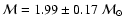 ,
according to the models of
Schaller et al. (1992). The inclination angle i may be estimated close to
48.
,
according to the models of
Schaller et al. (1992). The inclination angle i may be estimated close to
48.
Notice, in Fig. A.1, that the radial-velocity curve is very close to a circular
orbit (
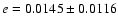 ). Therefore, the test of Lucy & Sweeney (1971)
was applied in order to see whether this small eccentricity is significant or not.
The probability p is equal to 0.69 in our case, which is much greater than the
limit of 0.05 determined by Lucy & Sweeney.
Thus this eccentricity of 0.0145 is not significant and is fixed to zero.
). Therefore, the test of Lucy & Sweeney (1971)
was applied in order to see whether this small eccentricity is significant or not.
The probability p is equal to 0.69 in our case, which is much greater than the
limit of 0.05 determined by Lucy & Sweeney.
Thus this eccentricity of 0.0145 is not significant and is fixed to zero.
973 = Renson 10880)
Bidelman & McConnell (1973) classified this object Ap SrCrEu. Geneva
photometry clearly confirms the peculiarity with
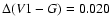 (the photometric data in the GENEVA system are collected in the General
Catalogue - Rufener 1988 - and its up-to-date database - Burki
2002). The
radial velocities are represented in Fig. A.1. The periastron was observed
again only recently, which allowed a precise estimate of the orbital
period. The eccentricity is high and relatively well defined, though the exact
shape of the RV curve in the vicinity of the periastron remains unknown
because of the 7-weeks gap in the observations. The depth of the dip varies,
while its width only shows rather marginal changes.
(the photometric data in the GENEVA system are collected in the General
Catalogue - Rufener 1988 - and its up-to-date database - Burki
2002). The
radial velocities are represented in Fig. A.1. The periastron was observed
again only recently, which allowed a precise estimate of the orbital
period. The eccentricity is high and relatively well defined, though the exact
shape of the RV curve in the vicinity of the periastron remains unknown
because of the 7-weeks gap in the observations. The depth of the dip varies,
while its width only shows rather marginal changes.
1579 = Renson 15000)
HD 54908 is a poorly studied Ap star classified A0 Si by Bidelman & McConnell
(1973). In spite of a large
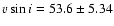 km s-1,
the variation of the radial velocity is too large to be caused by spots and
rotation (
km s-1,
the variation of the radial velocity is too large to be caused by spots and
rotation (
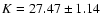 km s-1). However we can see the effect of a large
rotational velocity on the scatter of the residuals. The twenty-one
observations were obtained over an interval of 4084 days. The shape of
the radial-velocity curve (Fig. A.1) is not very well defined in the
vicinity of the minimum, but the period of 17.92 days is quite well determined.
km s-1). However we can see the effect of a large
rotational velocity on the scatter of the residuals. The twenty-one
observations were obtained over an interval of 4084 days. The shape of
the radial-velocity curve (Fig. A.1) is not very well defined in the
vicinity of the minimum, but the period of 17.92 days is quite well determined.
| Star name | P |
(HJD |
e | |
|
K1,2 |
|
|
N | (O-C) |
| (days) | -2 400 000) | (
) |
() |
(
) |
f1() |
106 km |
|
|||
| HD 191654 | 2121. | 48692. | 0.48 | -15.72 | 88. | 2.11 | 0.00140 | 54.0 | 27 | 0.91 |
| 27. | 50. | 0.10 | 0.23 | 17. | 0.24 | 0.00055 | 7.1 |
| Star | Photometry |
![$T_{\rm eff} [K]$](/articles/aa/full/2002/40/aa2702/img132.gif) |
 [cgs]
[cgs] |
[M/H] |
 |
 |
Mv |
 |
 |
| HD 22128 | |
6900 | 3.65 | 0.57 | 0.95 | 2.10 | 2.29 | 2.26 | -0.052 |
| HD 56495 | |
7179 | 4.00 | 0.42 | 0.77 | 1.58 | 2.77 | 2.72 | -0.032 |
| Geneva | 7044  56
56 |
4.26
0.09 |
0.26
0.08 |
| HD |
upper limits |
mV | Hz |
 |
E(B2-G) |
| (km s-1) | (KG) | (K) | |||
| 5550 |
 |
5.967 | - | 11000 | 0.046 |
| 9996 | 2.0 | 6.379 | -1.2 to 0.3 | 9700 | 0.017 |
| 12288 |
 |
7.748 | -1.2 to -0.2 | 9378 | 0.175 |
| 22128A |
 |
7.595 | - | 7000 | 0* |
| 22128B |
 |
- | |||
| 40711 | 2.0 | 8.581 | - | 9328 | 0.192* |
| 54908 |
 |
7.968 | - | 7483 | 0.031 |
| 56495A |
 |
7.654 | 0.21 to 0.57 | 7044 | 0* |
| 56495B |
 |
7.654 | - | ||
| 65339 |
 |
6.031 | -5.4 to 4.2 | 8250 | 0.012 |
| 73709 |
 |
7.687 | - | 7831 | 0* |
| 98088A |
 |
6.42 | 0.48 to 0.94 | 8043 | 0* |
| 98088B |
 |
7.62 | 7532 | 0* | |
| 105680 |
 |
8.060 | - | 7154 | 0* |
| 138426 | 2.0 | 8.546 | - | 8694 | 0.142 |
| 184471 | 2.0 | 8.980 | - | 8114 | 0.116 |
| 188854 |
 |
7.634 | - | 7005 | 0.069* |
| 200405 |
 |
8.908 | - | 9624 | 0.101 |
| 216533 |
 |
7.907 | -0.7 to 0.1 | 9000 | 0.120 |
1851 = Renson 15430)
This star was classified A3p Sr by Bertaud (1959), which motivated its
inclusion in our sample, but Bertaud & Floquet (1967) classified it
A2-F2 (Am). Its classification remains ambiguous, and it would be interesting
to know its  index in Maitzen's (1976) photometry. Its
peculiarity index in Geneva photometry is
index in Maitzen's (1976) photometry. Its
peculiarity index in Geneva photometry is
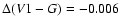 only, which
is typical of normal stars, but the efficiency of this index is known to be low
for such cool Ap stars. This is an excentric SB2 system, whose inclination
angle i remains unknown. We secured 60 points (Fig. A.1) and obtained
the orbital elements listed in Table A.1.
only, which
is typical of normal stars, but the efficiency of this index is known to be low
for such cool Ap stars. This is an excentric SB2 system, whose inclination
angle i remains unknown. We secured 60 points (Fig. A.1) and obtained
the orbital elements listed in Table A.1.
A rough estimate of the inclination angle i and of the masses of the
components can be done
using
photometry and the calibration by
Moon & Dworetsky (1985). The physical parameters obtained are listed in
Table A.3. Combining these results with the models of
Schaller et al. (1992), one
finds an approximate mass
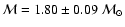 and an
inclination i close to 75.
and an
inclination i close to 75.
| Epoch |  |
 |
Source |
| (frac. year) | (arcsec) | (
 ) ) |
|
| 1980.1561 | 0.044 | 336.4 | McAlister et al. (1983) |
| 1984.0526 | 0.093 | 299.6 | McAlister et al. (1987) |
| 1984.8463 | 0.091 | 307.3 | Balega2 (1987) |
| 1985.1830 | 0.091 | 306.3 | Balega2 (1987) |
| 1985.1858 | 0.088 | 308.7 | Balega2 (1987) |
| 1986.7039 | 0.045 | 328.6 | Balega et al. (1989) |
| 1986.8894 | 0.0339 | 332.44 | Hartkopf et al. (1996) |
| 1989.2267 | 0.063 | 283.1 | McAlister et al. (1990) |
| 1990.2755 | 0.089 | 293.1 | Hartkopf et al. (1992) |
| 1991.3265 | 0.086 | 303.8 | Hartkopf et al. (1994) |
| 1991.8943 | 0.085 | 306.7 | Hartkopf et al. (1994) |
| 1992.3124 | 0.080 | 310.7 | Hartkopf et al. (1994) |
1105 = Renson 17910)
53 CAM is a very well studied A3 SrEuCr star (Osawa 1965). It is known as
a binary by both spectroscopy and speckle interferometry.
The speckle orbit was published by Hartkopf et al. (1996) and a
radial-velocity curve was published by Scholz & Lehmann (1988).
Combining our 46 measurements (Table 1) with those published by
Scholz & Lehmann (1988), we determine the orbital
parameters listed in Table A.1. The scatter of the residuals of
Scholz's measurements
are similar to those of CORAVEL observations alone, which appears surprising
at first sight. Examining the depth and width of the correlation dip as
a function of the rotational phase (
P = 8.0267 days), one clearly sees
a significant variation of both quantities (see Fig. 4). The residuals
around the fitted RV curve also show a variation, which is related, therefore,
to the spots associated with a non-negligible .
53 Cam is then a nice
example of an object displaying two variations simultaneously, one due to
rotation (with an amplitude of up to 7 km s-1 peak-to-peak) and the other due to
a binary companion.
Thanks to a code made available by T. Forveille and developed in Grenoble,
we have fitted
simultaneously the radial velocities, the speckle measurements and the
Hipparcos parallax (
 ), leaving not only K1 but also K2 as an adjustable
parameter in spite of the lack of RV data for the companion. The speckle
measurements retained for the
fit are given in Table A.5, while the results are shown in
Table A.6. The "visual'' orbit is shown in Fig. A.3.
), leaving not only K1 but also K2 as an adjustable
parameter in spite of the lack of RV data for the companion. The speckle
measurements retained for the
fit are given in Table A.5, while the results are shown in
Table A.6. The "visual'' orbit is shown in Fig. A.3.
![\begin{figure}
\par\includegraphics[width=16cm,clip]{carrierf11.eps} %
\end{figure}](/articles/aa/full/2002/40/aa2702/img162.gif) |
Figure A.2: Phase-folded radial-velocity curves of the last eight binaries listed in Table 1. Full dots: CORAVEL observations; triangles: ELODIE observations. |
This is the first time that such a solution
is attempted for this system. The results are surprising, in that both
companions appear to have the same mass, contrary to what
Scholz & Lehman (1988) had found (2.5
 and
1.6
for the primary and the secondary respectively) by
combining the separate RV and speckle orbits (they used a photometric mass
for the primary, since there was no good parallax value at the time). On the
other hand, they are compatible with the small
and
1.6
for the primary and the secondary respectively) by
combining the separate RV and speckle orbits (they used a photometric mass
for the primary, since there was no good parallax value at the time). On the
other hand, they are compatible with the small  required for speckle
observations. They also differ from the
mass estimate done by Martin & Mignard (1998) on the basis of
Hipparcos results, which has a large error, however. The uncertainty is very
large and could be substantially reduced if the spectrum of the secondary
could be observed. We could not see it on our ELODIE spectra, but this is not
surprising since they were taken when both companions had almost the same
radial velocity.
required for speckle
observations. They also differ from the
mass estimate done by Martin & Mignard (1998) on the basis of
Hipparcos results, which has a large error, however. The uncertainty is very
large and could be substantially reduced if the spectrum of the secondary
could be observed. We could not see it on our ELODIE spectra, but this is not
surprising since they were taken when both companions had almost the same
radial velocity.
2165 = Renson 20510 = Praesepe KW 279)
HD 73709 was classified A2-A5-F0 (Am) by Gray & Garrison (1989), but was
found photometrically Ap by Maitzen & Pavlovski (1987) according to the
index (
 ). The Geneva peculiarity index gives an
ambiguous answer:
). The Geneva peculiarity index gives an
ambiguous answer:
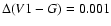 is a few thousands of magnitude larger
than the average of normal stars, but is not conspicuous. It has been put lately
in our programme because of its photometric peculiarity, first for magnetic
field measurements, second for radial-velocity monitoring.
is a few thousands of magnitude larger
than the average of normal stars, but is not conspicuous. It has been put lately
in our programme because of its photometric peculiarity, first for magnetic
field measurements, second for radial-velocity monitoring.
Two ELODIE data were taken in the course of the survey for magnetic fields, while a third one has kindly been obtained for us by Mr. Dominique Naef (Geneva Observatory) during a planet-search programme.
HD 73709 is extremely interesting because of its reliable Am classification
and positive :
it was generally accepted that Am stars never show
enhanced
values (Maitzen 1976; Maitzen et al. 1998) which are
characteristic of magnetic Ap stars only. Conversely, large-scale magnetic
fields are generally not found in Am stars, with the probable exception of
the hot Am star o Peg (Mathys 1988; Mathys & Lanz 1990). The three spectra
taken with the ELODIE spectrograph consistently show a surface magnetic field
of about 7.5 kG which seems very significant, in spite of a relatively large
projected rotational velocity
 km s-1 (Babel & North, in
preparation).
km s-1 (Babel & North, in
preparation).
The orbit of this star was published by Debernardi et al. (2000). However, we have 12 additional data, so we have redetermined the orbit using both published and new data (note that the data published by Debernardi et al. have not been put into the ELODIE RV system (Udry et al. 1999), so that the RV values used here are very slightly different from those published by these authors). The orbit is slightly improved.
3344A = Renson 28310)
This is a well-known SB2 binary hosting a magnetic Ap star of the type SrCr
according to Osawa (1965). Its binary nature has been discovered by
Abt (1953),
who saw it only as an SB1, and the complete orbital solution of the SB2 system
was given by Abt et al. (1968). These authors have shown that the spectral
variations have the same period as the orbital one and that the system must,
therefore, be synchronized. According to them, the spectral type of the primary
is A3Vp while that of the secondary is A8V. In spite of the binary nature of
this star, the Geneva photometric system "sees'' its peculiarity, with
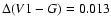 ,
and Maitzen's (1976) photometry is even more efficient,
with
,
and Maitzen's (1976) photometry is even more efficient,
with
 .
Therefore, the primary is a rather extreme Ap star.
.
Therefore, the primary is a rather extreme Ap star.
| Star name | P |
(HJD |
e | |
 |
|
i | K1,2 |
 |
a1,2 |  |
| (days) | -2 400 000) | (
) |
() |
() |
() |
(
) |
(
) |
(106 km) | (mas) | ||
| HD 65339 | 2418.9 | 27738.8 | 0.742 | -1.94 | 116.80 | 7.30 | 134.3 | 12.33 | 1.49 | 275.1 | 10.2 |
| (RV+speckle) | 2.41 | 15.6 | 0.013 | 0.13 | 1.31 | 1.37 | 4.4 | 0.41 | 0.66 | 1.0 | |
| 12.13 | 1.52 | 270.5 | |||||||||
| 3.25 | 0.33 |
A very interesting feature of HD 98088 is that,
in spite of its relatively short orbital period, it has a significant
eccentricity, so that one may expect an apsidal motion to take place.
According to Wolff (1974), only marginal evidence for such a motion could be
found over a time base of 20 years, and new observations should be done 20 to
30 years later to settle the question, the expected period of the apsidal motion
being 500 to 700 years. Because of this expectation, we reobserved the system
with CORAVEL in the spring of 1998. Bad weather prevented us to obtain a dense
coverage of all phases, but 17 observations of the primary and 8 of the
secondary could be done. The period could be refined to
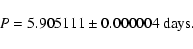 |
(A.1) |
 angle has not changed in a significant way since about 30 years,
since we find
angle has not changed in a significant way since about 30 years,
since we find
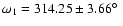 ,
while the combined literature
data for the epochs 1953-1973 give
,
while the combined literature
data for the epochs 1953-1973 give
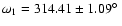 according to
Wolff (1974). We verified this result with our code, which gives
practically the same value but a larger uncertainty
(
according to
Wolff (1974). We verified this result with our code, which gives
practically the same value but a larger uncertainty
(
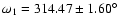 ,
for the primary RV curve alone).
If the period of the apsidal motion was 700 years as suggested by Wolff
(1974), then the argument of the periastron should have changed by
,
for the primary RV curve alone).
If the period of the apsidal motion was 700 years as suggested by Wolff
(1974), then the argument of the periastron should have changed by
 in 35 years, so we should have found
 .
This is five
.
This is five  away from our result, so we conclude that the apsidal
motion can only be much slower, with a period probably longer than a millenium.
If one imposes
away from our result, so we conclude that the apsidal
motion can only be much slower, with a period probably longer than a millenium.
If one imposes
 ,
the fit of the CORAVEL observations is
clearly worse, with an rms scatter of the residuals of 3.83 km s-1 instead of
2.74 km s-1 (for both components); the difference is more visible on the RVcurve of the primary (
,
the fit of the CORAVEL observations is
clearly worse, with an rms scatter of the residuals of 3.83 km s-1 instead of
2.74 km s-1 (for both components); the difference is more visible on the RVcurve of the primary (
 km s-1 instead of 2.35).
Combining all published data with the CORAVEL ones, and after a correction
km s-1 instead of 2.35).
Combining all published data with the CORAVEL ones, and after a correction
 km s-1 to the latter for a better consistency, we
obtain a very good curve with
km s-1 to the latter for a better consistency, we
obtain a very good curve with
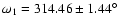 (Fig. A.2).
| Parameter | primary | secondary |
| MV | 0.87 | 2.07 |
 |
 |
 |
 |
 |
 |
M ( ) ) |
 |
 |
R ( ) ) |
 |
 |
|
(cgs) |
 |
 |
 ()
() |
 |
 |
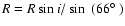 |
 |
 |
| d (pc) |  |
|
Fortunately, this system has a rather good Hipparcos parallax of
 mas, so that the radii of its components can be estimated.
From the observed apparent magnitude
V1+2=6.107 (Rufener 1988) and
from the magnitude difference
mas, so that the radii of its components can be estimated.
From the observed apparent magnitude
V1+2=6.107 (Rufener 1988) and
from the magnitude difference
 (Abt et al. 1968) one gets
the individual apparent magnitudes V1=6.42 and V2=7.62 which give the
absolute magnitudes
MV1=0.87 and
MV2=2.07 using the Hipparcos
parallax. From the spectral types A3 and A8 proposed by Abt et al. (1968),
a first guess of the effective temperatures is given by the calibration of
Hauck (1994):
(Abt et al. 1968) one gets
the individual apparent magnitudes V1=6.42 and V2=7.62 which give the
absolute magnitudes
MV1=0.87 and
MV2=2.07 using the Hipparcos
parallax. From the spectral types A3 and A8 proposed by Abt et al. (1968),
a first guess of the effective temperatures is given by the calibration of
Hauck (1994):
 K and
K and
 K.
Another guess can be done from the (B2-G) index of Geneva photometry,
according to the calibration of Hauck & North (1993): one has first to
subtract the typical Geneva colours of the companion (assuming an A8V star) to
the observed ones in order to get
(B2-G)1=-0.455, which corresponds to
K.
Another guess can be done from the (B2-G) index of Geneva photometry,
according to the calibration of Hauck & North (1993): one has first to
subtract the typical Geneva colours of the companion (assuming an A8V star) to
the observed ones in order to get
(B2-G)1=-0.455, which corresponds to
 K. Note that (B2-G)1 is not very sensitive to the
assumption made on the companion, since it differs by only 0.023 mag from the
observed value
(B2-G)1+2=-0.432. Adopting this effective temperature for
the primary, an interpolation in the evolutionary tracks of Schaller et al.
(1992) for an overall solar metallicity yields the physical
parameters listed in Table A.7. It is interesting to notice that the
mass ratio obtained in this way is
K. Note that (B2-G)1 is not very sensitive to the
assumption made on the companion, since it differs by only 0.023 mag from the
observed value
(B2-G)1+2=-0.432. Adopting this effective temperature for
the primary, an interpolation in the evolutionary tracks of Schaller et al.
(1992) for an overall solar metallicity yields the physical
parameters listed in Table A.7. It is interesting to notice that the
mass ratio obtained in this way is
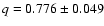 ,
which is compatible to
better than one sigma with the dynamical mass ratio
,
which is compatible to
better than one sigma with the dynamical mass ratio
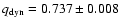 .
.
Also listed in Table A.7 are the radii estimated from the CORAVEL
projected rotational velocities assuming a negligible Zeeman broadening, from
the spin period (synchronization makes it equal to the orbital one) and from
 .
The latter value is obtained from
.
The latter value is obtained from
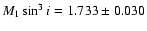 with the mass of the primary interpolated in the
evolutionary tracks. It is almost
identical with
with the mass of the primary interpolated in the
evolutionary tracks. It is almost
identical with
 proposed by Abt et al. (1968). The radii
obtained through the projected rotational velocities are compatible with those
obtained from the Hipparcos luminosity and photometric effective temperatures,
in the sense that error bars overlap. The agreement is perfect for the
secondary, but much less satisfactory for the primary, even though the
difference is less than twice the largest sigma.
An attempt has been made to impose the dynamical mass ratio
proposed by Abt et al. (1968). The radii
obtained through the projected rotational velocities are compatible with those
obtained from the Hipparcos luminosity and photometric effective temperatures,
in the sense that error bars overlap. The agreement is perfect for the
secondary, but much less satisfactory for the primary, even though the
difference is less than twice the largest sigma.
An attempt has been made to impose the dynamical mass ratio
 and
interpolate in the evolutionary tracks the pair of stars whose magnitude
difference
is compatible with it. Maintaining the assumption of an A8V companion, we get in
this way
and
interpolate in the evolutionary tracks the pair of stars whose magnitude
difference
is compatible with it. Maintaining the assumption of an A8V companion, we get in
this way
 and
and
 ,
,
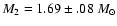 ,
,
 ,
,
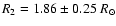 .
The magnitude difference
appears a bit large compared with the estimate of Abt et al. (1968) and
the radius of the primary turns out to be even larger, making the discrepancy
more severe compared to the radius estimated from the rotational velocity.
.
The magnitude difference
appears a bit large compared with the estimate of Abt et al. (1968) and
the radius of the primary turns out to be even larger, making the discrepancy
more severe compared to the radius estimated from the rotational velocity.
The number of CORAVEL measurements is too small to conclude about the possible variability of the depth and width of the correlation dip of the primary.
2423 = Renson 30570)
This star was listed A3p SrSi? by Bertaud (1959), which motivated its
inclusion in the sample, and as A3-F2 by Bertaud & Floquet (1967). The
radial-velocity curve is very well defined (see Fig. A.2). We secured 42 points
over an interval of 2966 days. In spite of a relatively large
,
the rms scatter of the residuals is small. Unfortunately, the
classification remains ambiguous;
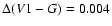 suggests a mild
peculiarity, but it is not large enough to exclude that it may be an Am star
instead of an Ap.
suggests a mild
peculiarity, but it is not large enough to exclude that it may be an Am star
instead of an Ap.
4088 = Renson 39420)
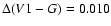 )
and it is clearly an SB1 binary with a relatively
short period. The
is very small (<2.4 km s-1) and neither the depth
nor the width of the correlation dip seems to vary. Figure A.2 shows a
phase diagram of the radial velocities. The residual scatter is rather large,
but the most discrepant points (at phases 0.48 and 0.56) were observed in the
run of March 1997 where technical problems prevented the data to be registered
on tape, so that it has not been possible to evaluate their quality.
)
and it is clearly an SB1 binary with a relatively
short period. The
is very small (<2.4 km s-1) and neither the depth
nor the width of the correlation dip seems to vary. Figure A.2 shows a
phase diagram of the radial velocities. The residual scatter is rather large,
but the most discrepant points (at phases 0.48 and 0.56) were observed in the
run of March 1997 where technical problems prevented the data to be registered
on tape, so that it has not been possible to evaluate their quality.
3471 = Renson 50890)
This star was classified A9 SrCrEu by Bertaud & Floquet (1974). A total of 36
measurements have been made over almost 3500 days (Table 1),
which clearly define a 429-day period (see Fig. A.2). The residuals are very
small thanks to a small
(<2 km s-1) and a well contrasted dip.
2807 = Renson 52220)
Ap or Am, according to different authors, its spectral type is not well
determined. HD 188854 was listed as A7 CrEu by Bertaud & Floquet (1974), but
also as A5-F0 (Bertaud & Floquet 1967). No
photometry has been
published for it, and the Geneva index
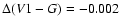 does not allow us
to conclude, especially as it is among the coolest existing Ap stars.
The radial-velocity curve is well determined with a
does not allow us
to conclude, especially as it is among the coolest existing Ap stars.
The radial-velocity curve is well determined with a
 of 0.51 km s-1 only (see Fig. A.2).
3256 = Renson 55830)
This A2 SrCr (Osawa 1965) star had already been announced as having the shortest
orbital period known among all Bp and Ap stars (North 1994), with a period of
only 1.635 days. A survey of the literature has not denied this claim: the few
binaries with a period shorter than 3 days in Renson's (1991) catalogue either
owe their spectral peculiarity to another physical cause like in situ
nucleosynthesis (HD 93030, an "OBN" star according to
Schönberner et al. 1988
and HD 49798, an O6 He star), or are misclassified (HD 25833, a normal B4V star
according to Gimenez & Clausen 1994), or do not have a typical Bp, Ap
peculiarity (HD 124425, F7 MgCaSr in Renson's catalogue; HD 159876, F0IIIp in
the Hipparcos Input Catalogue but A5-F1  Del? in Renson's, and
Am, A7/A9/F3 according to Abt & Morrell 1995); finally, the A2 CrEu star
HD 215661B is not a binary: only the A component of this visual system is an
Algol-type binary.
Del? in Renson's, and
Am, A7/A9/F3 according to Abt & Morrell 1995); finally, the A2 CrEu star
HD 215661B is not a binary: only the A component of this visual system is an
Algol-type binary.
HD 200405 is a bona fide Ap star also from the photometric point of view:
Geneva photometry shows it is peculiar, with
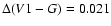 ,
and Maitzen's
peculiarity index
,
and Maitzen's
peculiarity index
 on average (Schnell & Maitzen 1995).
The inclination angle i of the orbital plane of HD 200405 must be very small,
according to the value of
 and of the mass function
(Table A.1), unless the companion is a brown dwarf.
The radial-velocity curve is shown in Fig. A.2. The orbit is circular (e = 0).
This object is especially interesting, since it is exceptional: all other
binaries with a magnetic Ap component have orbital periods longer than 3 days.
If tidal effects tend to wash out the chemical peculiarity of the components,
as suggested by this lower limit, then one has to explain how HD 200405 has been
able to remain an Ap star in spite of significantly large tides.
and of the mass function
(Table A.1), unless the companion is a brown dwarf.
The radial-velocity curve is shown in Fig. A.2. The orbit is circular (e = 0).
This object is especially interesting, since it is exceptional: all other
binaries with a magnetic Ap component have orbital periods longer than 3 days.
If tidal effects tend to wash out the chemical peculiarity of the components,
as suggested by this lower limit, then one has to explain how HD 200405 has been
able to remain an Ap star in spite of significantly large tides.
Another way to interpret this radial-velocity curve would be to assume that
HD 200405 has a very small, highly contrasted spot with enhanced abundance of
iron-peak elements (whose lines are selected by the CORAVEL mask); in such a
case, rotation alone might be responsible for a sinusoidal curve, if both the
inclination i of the rotational axis and the angle between the rotation and
spot axes are such that the spot remains visible during the whole cycle.
However, such a situation appears extremely improbable, since one does not see
any variation in the intensity of the correlation dip, nor in its width or
depth, which should occur because of the varying aspect of the spot. Likewise,
the radial velocity of the H line measured once with ELODIE is
compatible with the CORAVEL RV curve, while one would rather expect it to
remain at the "systemic" velocity. Furthermore, the spot hypothesis would imply
an apparent
line measured once with ELODIE is
compatible with the CORAVEL RV curve, while one would rather expect it to
remain at the "systemic" velocity. Furthermore, the spot hypothesis would imply
an apparent
 km s-1 (the radial velocity of every point
in the spot being practically the same), while we obtain
km s-1 (the radial velocity of every point
in the spot being practically the same), while we obtain
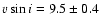 and
and
 km s-1 using respectively CORAVEL and ELODIE: a small spot could
never give rise to such a high value (the effect of the magnetic field has been
removed in the ELODIE estimate). Therefore, HD 200405 holds the record of the
shortest orbital period known.
km s-1 using respectively CORAVEL and ELODIE: a small spot could
never give rise to such a high value (the effect of the magnetic field has been
removed in the ELODIE estimate). Therefore, HD 200405 holds the record of the
shortest orbital period known.
2497 = Renson 59810)
This A1 SrCr star (Osawa 1965) was already known as an SB1 system. Floquet (1979) found an orbital period of 16.03 days, using the radial velocity of the Ca II K line.
A total of 48 measurements have been made over almost 6225 days. The 16.03-day period does not fit at all our radial velocities. We find a much longer period P = 1413 days (see Fig. A.2), which should be considered as more reliable. It seems that Floquet was too confident in her assumption of an homogeneous distribution of ionized calcium on the surface of the star, and that the RV variation she observed was in fact due to a spot. The rotational period of this star, 17.2 days, is indeed very close to the "orbital'' one found by Floquet (1979), although not identical.
Acknowledgements
This work was supported in part by the Swiss National Fondation for Scientific Research. The reduction of the data were made by the late Dr. Antoine Duquennoy and by SU. We thank the numerous observers who have contributed to this survey, especially Dr. J.-C. Mermilliod and Mr. Bernard Pernier. We also thank Dr. Noël Cramer, who had initiated the CORAVEL measurements of some bright Ap stars. We thank Dr. Thierry Forveille for having shared his ORBIT code for orbital elements determination from visual and RV data. This research has made use of the SIMBAD database, operated at CDS, Strasbourg, France. It was supported by the Swiss National Science Foundation.
Copyright ESO 2002
 has been
assumed on the separation and position angle respectively.
has been
assumed on the separation and position angle respectively.![\begin{figure}
\par\resizebox{8cm}{!}{\includegraphics[angle=-90,width=9.5cm]{carrierf12.eps}}\end{figure}](/articles/aa/full/2002/40/aa2702/img173.gif)