

Our sample is composed of all Ap stars known as spectroscopic binaries. The
catalogue of Renson (1991) gives us the Ap stars. However, some stars
considered as Am by Renson, have been considered in this work as Ap (HD 56495,
HD 73709 and HD 188854).
Among these stars, the spectroscopic binaries have been selected from the
following sources. Fourteen orbits were determined
thanks to the CORAVEL scanner (this paper and North et al. 1998).
Lloyd et al. (1995) determined a new orbit for
 (HD 93030) and
Stickland et al. (1994) for HD 49798. Recently, Leone & Catanzaro (1999)
have published the orbital elements of 7 additional CP stars, two of which are
He-strong, two are He-weak, one is Ap Si, one Ap HgPt and one Ap SrCrEu.
Wade et al. (2000) provided the orbital elements of HD 81009.
Other data come from the Batten et al. (1989) and
Renson (1991) catalogues. Among all Ap, we kept 78 stars with known
period and eccentricity, 74 of them having a published mass function.
(HD 93030) and
Stickland et al. (1994) for HD 49798. Recently, Leone & Catanzaro (1999)
have published the orbital elements of 7 additional CP stars, two of which are
He-strong, two are He-weak, one is Ap Si, one Ap HgPt and one Ap SrCrEu.
Wade et al. (2000) provided the orbital elements of HD 81009.
Other data come from the Batten et al. (1989) and
Renson (1991) catalogues. Among all Ap, we kept 78 stars with known
period and eccentricity, 74 of them having a published mass function.
The statistical test of Lucy & Sweeney (1971) has been applied to all
binaries with moderate eccentricity, in order to see how far the latter is
significant. The eccentricity was put to zero whenever it was found
insignificant.
We can notice the effect of tidal interactions (Zahn 1977, 1989;
Zahn & Bouchet 1989) on the orbits of Ap stars (see Fig. 8a).
Indeed, all orbits with P less than a given value (
 )
are
circularized. According to the third Kepler law, a short period implies a
small orbit where tidal forces are strong.
The period-eccentricity diagram for the Ap stars does not show a well marked
transition from circular to eccentric orbits, in the sense that circular as well
as eccentric systems exist in the whole range of orbital periods between
)
are
circularized. According to the third Kepler law, a short period implies a
small orbit where tidal forces are strong.
The period-eccentricity diagram for the Ap stars does not show a well marked
transition from circular to eccentric orbits, in the sense that circular as well
as eccentric systems exist in the whole range of orbital periods between
 days to a maximum of about 160 days. The wider circular orbits
probably result from systems where the more massive companion once went through
the red giant phase; the radius of the former primary was then large enough
to circularize the orbit in a very short time. This is quite consistent with the
synchronization limit for giant stars of 3 to 4
days to a maximum of about 160 days. The wider circular orbits
probably result from systems where the more massive companion once went through
the red giant phase; the radius of the former primary was then large enough
to circularize the orbit in a very short time. This is quite consistent with the
synchronization limit for giant stars of 3 to 4
 days,
Mermilliod & Mayor 1996).
days,
Mermilliod & Mayor 1996).
An upper envelope seems well-defined in the e vs.  diagram,
especially for
diagram,
especially for
 ,
although four points lie above it.
The leftmost of these, with (,e) = (0.69, 0.52) has a rather
ill-defined orbit
,
although four points lie above it.
The leftmost of these, with (,e) = (0.69, 0.52) has a rather
ill-defined orbit![[*]](/icons/foot_motif.gif) . Whether this envelope has
any significance remains to be confirmed with a larger sample than presently
available.
. Whether this envelope has
any significance remains to be confirmed with a larger sample than presently
available.
![\begin{figure}
\par\resizebox{8cm}{!}{\includegraphics[width=9.0cm]{carrierf8.eps}}\end{figure}](/articles/aa/full/2002/40/aa2702/img82.gif) |
Figure 8:
a) Diagram eccentricity versus period (in days) for the 78 Ap stars.
The symbols are according to the type of Ap:  HgMn, HgMn,
 He weak, He weak,  SrCrEu, SrCrEu,
 Si.
b) Diagram eccentricity versus period (in days) for G dwarf stars
(Duquennoy & Mayor 1991).
Si.
b) Diagram eccentricity versus period (in days) for G dwarf stars
(Duquennoy & Mayor 1991). |
It is interesting to compare our  diagram with that established by
Debernardi (2002) for his large sample of Am stars. For these stars,
the limit between circular and eccentric orbits is much steeper, many systems
having
diagram with that established by
Debernardi (2002) for his large sample of Am stars. For these stars,
the limit between circular and eccentric orbits is much steeper, many systems
having  at P=10 d only. The difference might be due to the wider
mass distribution of the Bp-Ap stars (roughly 2 to 5
at P=10 d only. The difference might be due to the wider
mass distribution of the Bp-Ap stars (roughly 2 to 5  )
compared to that
of Am stars (1.5 to 2-2.5 ),
)
compared to that
of Am stars (1.5 to 2-2.5 ),
 being different for each mass.
One might also speculate that the lack of very eccentric and short periods is
linked with the formation process of Ap stars, which for some reason (e.g.
pseudo-synchronization in the PMS phase, leading to excessive equatorial
velocities?) forbid this region.
being different for each mass.
One might also speculate that the lack of very eccentric and short periods is
linked with the formation process of Ap stars, which for some reason (e.g.
pseudo-synchronization in the PMS phase, leading to excessive equatorial
velocities?) forbid this region.
Qualitatively, Ap stars behave roughly like normal G-dwarfs (Duquennoy & Mayor
1991) in the eccentricity-period diagram. There is also a lack of
low eccentricities at long periods (here for
 ), and the upper
envelope is similar in both cases for
), and the upper
envelope is similar in both cases for
 .
One difference is the
presence of moderate eccentricities for periods shorter than 10 days among
Ap binaries, and another is the complete lack of very short orbital periods
(
.
One difference is the
presence of moderate eccentricities for periods shorter than 10 days among
Ap binaries, and another is the complete lack of very short orbital periods
( days) among them, if one excepts HD 200405. The latter feature,
already mentioned in the past (e.g. by GFH85) is especially striking because
it does not occur for the Am binaries. The physical cause for it is probably
that synchronization will take place rather early and force the components to
rotate too fast to allow magnetic field and/or abundance anomalies to subsist.
However, even an orbital period as short as one day will result in an equatorial
velocity of only 152 km s-1 for a 3
days) among them, if one excepts HD 200405. The latter feature,
already mentioned in the past (e.g. by GFH85) is especially striking because
it does not occur for the Am binaries. The physical cause for it is probably
that synchronization will take place rather early and force the components to
rotate too fast to allow magnetic field and/or abundance anomalies to subsist.
However, even an orbital period as short as one day will result in an equatorial
velocity of only 152 km s-1 for a 3  star, while single Bp or
Ap stars rotating at this speed or even faster are known to exist
(e.g.
HD 60435, Bp SiMg,
star, while single Bp or
Ap stars rotating at this speed or even faster are known to exist
(e.g.
HD 60435, Bp SiMg,
 d; North et al. 1988).
The detection
of one system with
d; North et al. 1988).
The detection
of one system with
 d further complicates the problem, even
though it remains an exceptional case as yet.
d further complicates the problem, even
though it remains an exceptional case as yet.
The shorter
value can be explained by the following effects:
 instead of
 (see e.g.
Zahn 1977), a being the semi-major axis of the relative orbit and Rthe stellar radius;
is shorter in these systems than in those hosting G dwarfs.
(see e.g.
Zahn 1977), a being the semi-major axis of the relative orbit and Rthe stellar radius;
is shorter in these systems than in those hosting G dwarfs.
The mass function contains the unknown orbital inclination i.
Therefore, neither the individual masses
nor the mass ratio can be calculated from it. However the orbital inclination of
Ap stars can be assumed to be randomly oriented on the sky.
Thus, we can compare the observed cumulative distribution of the mass functions
(for our 74 stars) with a simulated distribution (see Fig. 9), where
we assume random orbit orientations.
We approximated the observed relative distribution of Ap masses
(North 1993) by the function given below, then multiplied it by Salpeter's
law (
 )
in order
to obtain the simulated distribution of the primary masses
)
in order
to obtain the simulated distribution of the primary masses
 :
:
![\begin{displaymath}%
f_{\rm Ap} {=} \left[ 0.3623 + 0.8764 \cdot {\cal M} + 8.48...
...ot {\rm e}^{-({\cal M} - 3.5)^2}\right]
\cdot {\cal M}^{-2.35}
\end{displaymath}](/articles/aa/full/2002/40/aa2702/img97.gif) |
(9) |
 and a maximum mass of
 .
.
![\begin{figure}
\par\resizebox{8cm}{!}{\includegraphics[width=8cm,clip]{carrierf9.eps}}\end{figure}](/articles/aa/full/2002/40/aa2702/img100.gif) |
Figure 9: a) Distributions of the masses of the secondary (left) and of the primary (right) used in simulation (100 000 dots). The dotted and dashed lines represent the distributions of the primary masses of 60 stars of the sample respectively with and without applying the Lutz-Kelker correction (1973). b) Observed and simulated cumulative distribution of the mass functions (including the He-weak and He-strong stars). |
In order to check the simulated distribution of masses of primaries, we
estimated directly the masses of 60 primaries in systems having Geneva and
uvby photometric measurements, as well as Hipparcos parallaxes. The estimation
was done by interpolation through the evolutionary tracks of Schaller et al.
(1992), using the method described by North (1998). The mass
estimate was complicated by the binary nature of the stars under study. In the
case of SB2 systems, the V magnitude was increased by up to 0.75, depending on
the luminosity ratio, and the adopted effective temperature was either the
photometric value or a published spectroscopic value. In the case of SB1
systems, only a fixed, statistical correction
 was brought to the
V magnitude, following North et al. (1997), which is valid for a
magnitude difference of 1.7 between the components. The effective temperatures
corresponding to the observed colours
were increased by 3.5%, to take into account a cooler companion with the same
magnitude difference (assuming both companions are on the main sequence). In
general
was brought to the
V magnitude, following North et al. (1997), which is valid for a
magnitude difference of 1.7 between the components. The effective temperatures
corresponding to the observed colours
were increased by 3.5%, to take into account a cooler companion with the same
magnitude difference (assuming both companions are on the main sequence). In
general
 was obtained from Geneva photometry, using the
reddening-free X and Y parameters for stars hotter than about 9700 K and the
dereddened (B2-G) index for cooler stars. The recipe used is described by North
(1998). Existing
was obtained from Geneva photometry, using the
reddening-free X and Y parameters for stars hotter than about 9700 K and the
dereddened (B2-G) index for cooler stars. The recipe used is described by North
(1998). Existing  photometry was used to check the validity
of the
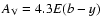
estimates and the E(b-y) colour excess was used to
estimate roughly the visual absorption through the relation
photometry was used to check the validity
of the
estimates and the E(b-y) colour excess was used to
estimate roughly the visual absorption through the relation
 .
The latter may be underestimated in some cases because the b-y index of Ap
stars is bluer than that of normal stars with same effective temperature, but
only exceptionally by more than about 0.1 mag. Reddening maps by
Lucke (1978) where used for consistency checks.
.
The latter may be underestimated in some cases because the b-y index of Ap
stars is bluer than that of normal stars with same effective temperature, but
only exceptionally by more than about 0.1 mag. Reddening maps by
Lucke (1978) where used for consistency checks.
The resulting distribution of masses is represented, with an appropriate scaling, in Fig. 9a, together with the simulated distribution of primary masses. The agreement is reasonably good, justifying the expression used above for the distribution of primary masses.
For the distribution of secondary masses, we use the
distribution of Duquennoy & Mayor (1991) for the mass ratio
 of nearby G-dwarfs. We assume that the
companions of the Ap stars are normal. The distribution of the mass ratio is a
Gaussian:
of nearby G-dwarfs. We assume that the
companions of the Ap stars are normal. The distribution of the mass ratio is a
Gaussian:
 |
(10) |
 and
and
 .
Knowing the mass of the primary and the mass ratio, we can determine the mass of
the secondary. We assume a minimal companion mass of
.
Knowing the mass of the primary and the mass ratio, we can determine the mass of
the secondary. We assume a minimal companion mass of
 .
Using the test of Kolmogorov-Smirnov (Breiman 1973), we find a
confidence-level for the observed and simulated cumulative distributions of
92%. After elimination of the He-strong and He-weak stars, the KS test gives
a confidence-level of 98%. In other words, there is only a 2%
probability that the observed distribution differs from the simulated one.
This indicates that spectroscopic binaries with an Ap primary have the
same distribution of mass ratios as binaries with normal components
(Duquennoy & Mayor 1991).
.
Using the test of Kolmogorov-Smirnov (Breiman 1973), we find a
confidence-level for the observed and simulated cumulative distributions of
92%. After elimination of the He-strong and He-weak stars, the KS test gives
a confidence-level of 98%. In other words, there is only a 2%
probability that the observed distribution differs from the simulated one.
This indicates that spectroscopic binaries with an Ap primary have the
same distribution of mass ratios as binaries with normal components
(Duquennoy & Mayor 1991).
The sample used for estimating the binary percentage among cool Ap stars is only
composed of the CORAVEL programme Ap stars described in the observation section,
namely 119 stars. Including the stars HD 59435, HD 81009 and HD 137909 which
have been published elsewhere and are not in Tables 1 and 2, the total number
of programme stars is 122. However, 6 of them have only one measurement, so
they are not relevant here; in addition, about 3 stars have very large errors
on their RV values (
 km s-1), so they are not reliable. Thus there
are 113 objects on which statistics can be done. We chose, as variability
criterion, the probability
km s-1), so they are not reliable. Thus there
are 113 objects on which statistics can be done. We chose, as variability
criterion, the probability
 that the variations of velocity are only due to the internal
dispersion. A star will be considered as double or intrinsically variable
if
is less than 0.01 (Duquennoy & Mayor 1991). However,
this test can not say anything about the nature of the variability.
that the variations of velocity are only due to the internal
dispersion. A star will be considered as double or intrinsically variable
if
is less than 0.01 (Duquennoy & Mayor 1991). However,
this test can not say anything about the nature of the variability.
For fast rotators, it is difficult to know whether the observed dispersion
is just due to spots or betrays an orbital motion. Among the
sample, 34 stars are assumed to be binaries, namely 30%. Nevertheless, this
figure has to be corrected for detection biases; we have attempted to estimate
the rate of detection through a simulation. For this, a
sample of 1000 double stars was created. The mass distributions explained
above are used again. The orbital elements
 ,
,
 and i are selected from uniform distributions, while the
eccentricity is fixed to zero for period less than 8 days and is distributed following
a Gaussian with a mean equal to 0.31 and
and i are selected from uniform distributions, while the
eccentricity is fixed to zero for period less than 8 days and is distributed following
a Gaussian with a mean equal to 0.31 and
 (cases with negative
eccentricity were dropped and replaced) for periods less than 1000 days and
larger than 8 days,
and following a distribution
f(e) = 2 e for longer periods. The period
is distributed according to a Gaussian distribution with a mean equal to
(cases with negative
eccentricity were dropped and replaced) for periods less than 1000 days and
larger than 8 days,
and following a distribution
f(e) = 2 e for longer periods. The period
is distributed according to a Gaussian distribution with a mean equal to
 and
and
 (Duquennoy & Mayor 1991), where P is given in days. A cutoff at 2 and
5000 days was
imposed. In a second step, the radial velocities of the created sample are
computed at the epochs of observation of the real programme stars and with
the real errors. Finally the
value of each star is computed.
We obtain a simulated detection rate of 69%.
(Duquennoy & Mayor 1991), where P is given in days. A cutoff at 2 and
5000 days was
imposed. In a second step, the radial velocities of the created sample are
computed at the epochs of observation of the real programme stars and with
the real errors. Finally the
value of each star is computed.
We obtain a simulated detection rate of 69%.
After correction, we find a rate of binaries among Ap stars of about 43% in excellent agreement with the one determined by GFH85 for the cool Ap stars of 44%. Our sample is however more homogeneous and reliable.
Copyright ESO 2002