

Deep surveys carried out by future infrared missions (such as SIRTF, SOFIA, ASTRO-F,
or Herschel) will sample infrared bright galaxies over a
wide range of redshifts and luminosities.
Quantitative spectroscopy of mid-infrared emission lines will
be an important diagnostic tool for determining the detailed properties of
distant, dusty galaxies, the source of the extragalactic background, and
the origin of nuclear activity in galaxies.
Many of
the fundamental questions of galaxy formation and evolution depend
substantially on the fraction of the total energy output of distant
sources that is produced by star formation rather than AGN activity.
A large
energy contribution from hidden AGNs would complicate the deduction of
the star formation history of the Universe from galaxy luminosity
functions.
In the past, optical line ratios have been used as a tool
for distinguishing between the
different possible excitation
mechanisms and energy sources in galaxies (e.g. Baldwin et al. 1981;
Veilleux & Osterbrock 1987). This works very
well for objects with dust extinction less than
 ,
but
becomes unreliable for heavily obscured objects (see, e.g., Veilleux et al. 1995; Veilleux et al. 1999). Hence, mid-infrared analogues of the classical optical
diagrams are highly desirable.
,
but
becomes unreliable for heavily obscured objects (see, e.g., Veilleux et al. 1995; Veilleux et al. 1999). Hence, mid-infrared analogues of the classical optical
diagrams are highly desirable.
 |
Figure 9:
A MIR diagnostic diagram to distinguish starbursts and AGNs in
dusty galaxies - here: [S IV] 10  m/Br m/Br versus [Si II] 34 m/Br.
AGNs are shown as diamonds, starburst galaxies (Verma et al., in prep.)
as stars. The shock source RCW 103 is shown as triangle. Composite objects are
encircled. For three AGNs Br
was
calculated from other Brackett lines (see Table 4).
The numbering of the AGNs is taken from Table 1, for the starbursts it is as follows:
1: M 82, 2: IC 342, 3: IIZw 40, 4: NGC 253, 5: NGC 3256, 6: NGC 3690A, 7: NGC 4038/39, 8: NGC 4945, 9: NGC 5236, 10: NGC 5253, 11: NGC 7552.
versus [Si II] 34 m/Br.
AGNs are shown as diamonds, starburst galaxies (Verma et al., in prep.)
as stars. The shock source RCW 103 is shown as triangle. Composite objects are
encircled. For three AGNs Br
was
calculated from other Brackett lines (see Table 4).
The numbering of the AGNs is taken from Table 1, for the starbursts it is as follows:
1: M 82, 2: IC 342, 3: IIZw 40, 4: NGC 253, 5: NGC 3256, 6: NGC 3690A, 7: NGC 4038/39, 8: NGC 4945, 9: NGC 5236, 10: NGC 5253, 11: NGC 7552. |
 |
Figure 10:
Another example of MIR diagnostic diagrams - here:
[O IV] 26 m/Br
versus [Si II] 34 m/Br.
Symbols and numbering as in Fig. 9. The ULIRG Arp 220
(Sturm et al. 1996) is shown as a square, the SN remnant RCW 103
(Oliva et al. 1999) as triangle. |
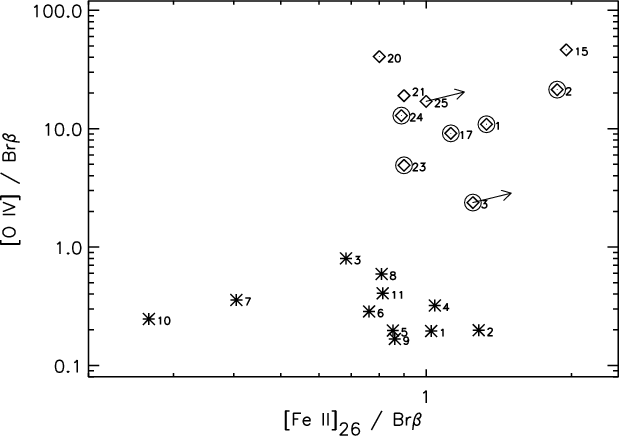 |
Figure 11:
Another example of MIR diagnostic diagrams - here:
[O IV] 26 m/Br
versus [Fe II] 26 m/Br.
Symbols and numbering as in Fig. 9. |
m/[Ne II].
Those active galaxies in our sample with the lowest ratios in Figs. 7 and 8
are the ones we have identified earlier as composite sources (encircled in the figures),
i.e. AGNs with a significant contribution from
star formation to their spectra.
On the right hand y-axes of Figs. 7 and 8
we have denoted a simple linear "mixing'' model to read off the
AGN contribution to the bolometric luminosity. This model will be further discussed in
Sect. 8.
Perhaps the best optical
discriminator between photoionization by power-law spectra and by OB stars
is the diagram in Fig. 3 of Veilleux & Osterbrock (1987). It employs a
moderately ionized line ([O III]) on one axis and a line of [O I], normalized
to hydrogen recombination lines.
Our data set allows the construction of MIR analogues of this "VO diagram'' which are
much less prone to extinction.
We have selected
[S IV]10.5 m instead of [O III], which has an almost identical ionization potential,
[Si II]34 m instead of [O I], i.e. a line with an
ionization potential below 13.6 eV, and Br
for normalization.
For comparison we have used the ISO-SWS starburst data set of Verma et al.
(in prep.). Starbursts and AGNs are clearly separated in this diagram (Fig. 9),
not only
because [S IV] is stronger in AGNs than in normal starbursts, but also because [Si II]
is
(on average) stronger, due to the higher importance of partially ionized
zones in AGNs. Low metallicity starbursts, like IIZw40 and NGC 5253, have much harder radiation fields
than normal starburst galaxies. In these cases [S IV] can be as strong as in AGNs, but [Si II]
is much weaker. The overall appearance of Fig. 9 is thus very similar to the optical
VO diagram. In contrast to its optical counterpart our mid-IR version also includes Seyfert 1
galaxies, since we did not detect any broad line components in the Br
lines.
For a complete comparison of the optical and mid-IR
diagrams our data set is missing galaxies of the LINER type. Their position in the mid-IR diagram
is expected in the lower right corner, but remains to be tested in future infrared missions.
Several other versions of mid-IR diagnostic diagrams (with lines at different wavelengths)
are similarly well
suited for a distinction of excitation mechanisms. This allows
to cover different redshift ranges or to adjust the method to the wavelength coverage
of different detectors.
For instance, it is possible to replace
[S IV]10.5 m with [O IV]26 m,
and [Si II]34 m with [Fe II]26 m (Figs. 10 and 11).
Similar diagnostic diagrams, based on theoretical modelling, with different sets of
(mostly weaker) lines
have been proposed by Spinoglio & Malkan (1992) and Voit (1992).
In contrast to the optical VO diagrams, the mid-IR versions can be applied to
dusty systems with much higher extinctions, such as Ultraluminous Infrared Galaxies (ULIRGs).
ULIRGs are believed to be local analogues of those distant dusty galaxies, which are (and will be)
found in great numbers in deep infrared galaxy surveys. As discussed above, the identification
of their energy source will be a major task for future infrared missions.
In Fig. 10 we show the position of the well known ULIRG Arp 220
(Sturm et al. 1996).
Its position in the diagram is consistent with predominant powering
by intense star formation, which is in accordance with earlier studies
(e.g. Sturm et al. 1996; Genzel et al. 1998).
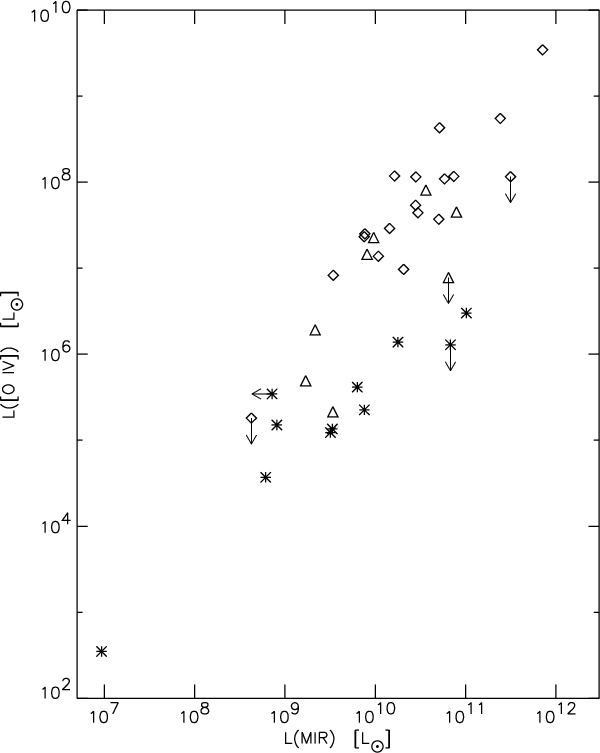 |
Figure 12: [O IV] luminosity vs. MIR luminosity for AGNs (diamonds) and starburst galaxies (stars). Composite sources (see text) are indicated as triangles. |
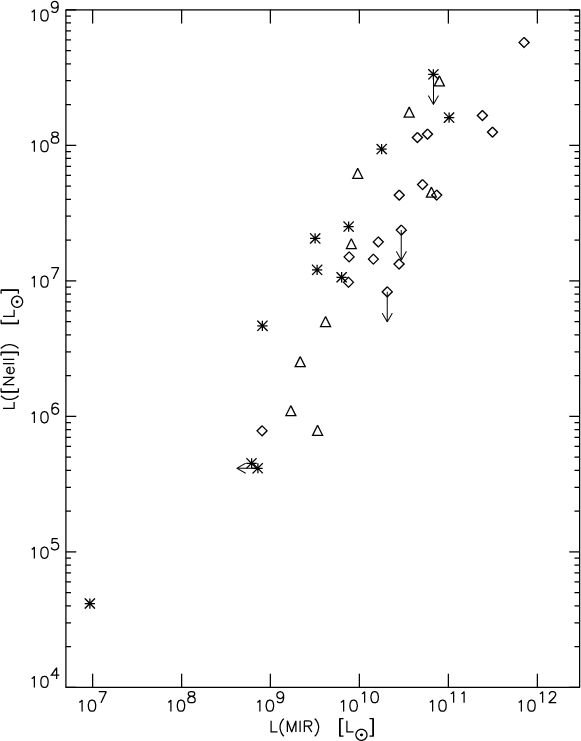 |
Figure 13: [Ne II] luminosity vs. MIR luminosity for AGNs (diamonds) and starburst galaxies (stars). Composite sources (see text) are indicated as triangles. |
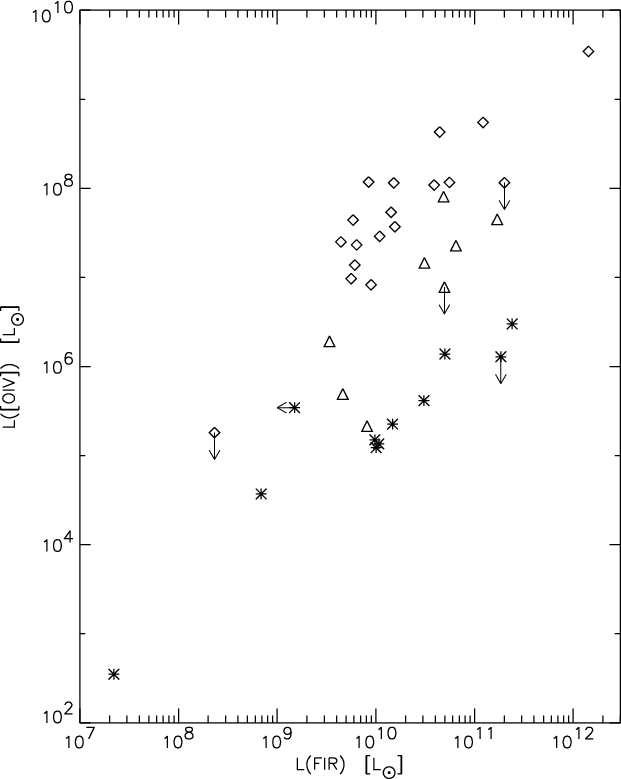 |
Figure 14: [O IV] luminosity vs. FIR luminosity for AGNs (diamonds) and starburst galaxies (stars). Composite sources (see text) are indicated as triangles. |
Copyright ESO 2002