6716, 6731 density diagnostic applies to low
ionization species that may not be representative of the higher excitation
regions and may be contaminated by non-AGN emission. The [O III]
6716, 6731 density diagnostic applies to low
ionization species that may not be representative of the higher excitation
regions and may be contaminated by non-AGN emission. The [O III]
 temperature diagnostic
includes a weak and blended line that is notoriously difficult
to measure. Combining infrared fine-structure lines with
optical lines provides additional options. Given the large observing
apertures for mid-IR instruments like ISO-SWS, their use should be
restricted mainly to high
excitation species that are not contaminated by spatially
extended starburst emission.
temperature diagnostic
includes a weak and blended line that is notoriously difficult
to measure. Combining infrared fine-structure lines with
optical lines provides additional options. Given the large observing
apertures for mid-IR instruments like ISO-SWS, their use should be
restricted mainly to high
excitation species that are not contaminated by spatially
extended starburst emission.
 m and [Ne III] 15.55/36.01 m.
The perhaps most interesting ratio is [Ne V] 14.3/24.3 m.
These lines are not diluted by starburst contributions, since they have
a lower ionization potential of 97 eV and are undetected
in ISO spectra of starburst galaxies (Genzel et al. 1998). Their ratio
is largely insensitive to electron temperature and to
extinction variations (see T. Alexander et al. 1999, their Fig. 3,
for the theoretical [Ne V] ratio as function of density).
m and [Ne III] 15.55/36.01 m.
The perhaps most interesting ratio is [Ne V] 14.3/24.3 m.
These lines are not diluted by starburst contributions, since they have
a lower ionization potential of 97 eV and are undetected
in ISO spectra of starburst galaxies (Genzel et al. 1998). Their ratio
is largely insensitive to electron temperature and to
extinction variations (see T. Alexander et al. 1999, their Fig. 3,
for the theoretical [Ne V] ratio as function of density).
All objects with measurable [Ne V] in our sample have [Ne V] ratios
indicating a low density
(
 few 100 to a few 1000 cm-3), well below the critical densities
(
few 100 to a few 1000 cm-3), well below the critical densities
(
 and
and
 cm-3), see Fig. 1.
The average ratio is
cm-3), see Fig. 1.
The average ratio is  for the (4) Seyfert 1s, and
  for the (6) Seyfert 2s,
i.e. NLR densities for the two types agree for this fairly small
sample, consistent with unification.
for the (6) Seyfert 2s,
i.e. NLR densities for the two types agree for this fairly small
sample, consistent with unification.
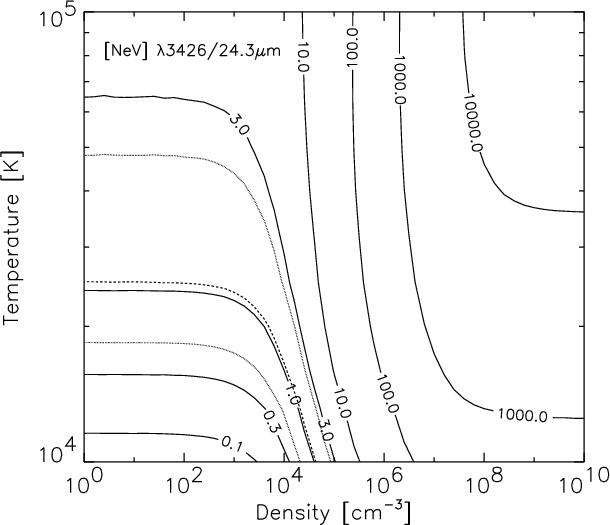
One interesting species is [Ne V] (lower ionisation potential 97 eV) which
has very bright optical and mid-infrared transitions. Figure 2 shows
the ratio predicted for the 3426 Å and 24.3 m lines, using the atomic data
of Lennon & Burke (1994) and Nussbaumer & Rusca (1979). The range of
allowed values for NGC 1068 (combining our data with optical data of Marconi
et al. 1996 and adopting AV=0.71) is also indicated, adding a
20% measurement error for each line, and a 0.25 mag uncertainty in AV
to produce the maximum deviation.
These uncertainties (particularly the one on extinction) lead to a wide
range of electron temperatures ( 17 000-45 000 K) being consistent with the
NGC 1068 data for its density of 2000 cm-1.
17 000-45 000 K) being consistent with the
NGC 1068 data for its density of 2000 cm-1.
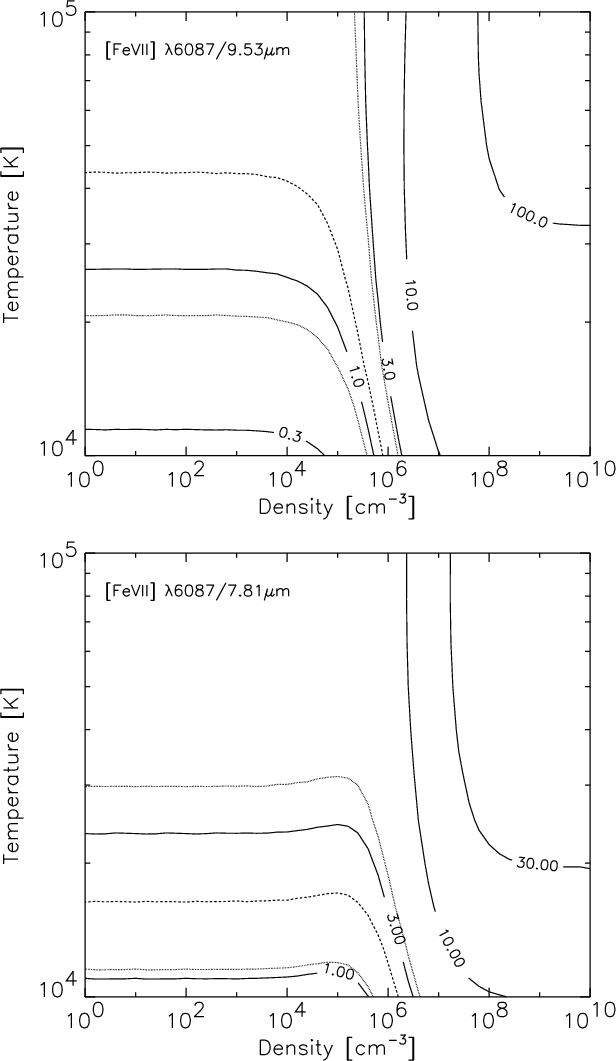
Another high excitation species offers the potential of reducing the
extinction effects. The brightest optical line of [Fe VII]
is found at the longer wavelength of 6087 Å. With a lower ionisation
potential of 99 eV, [Fe VII] samples a region similar to
[Ne V]. The ratio of the optical [Fe VII] 6087 Å line
to the mid-infrared [Fe VII] lines is little sensitive to electron
density in the regime determined above, and
forms a diagnostic of electron temperature in the NLR. Figure 3
shows the ratios from solving the rate
equation using the atomic data of Berrington et al. (2000, and priv.
communication![[*]](/icons/foot_motif.gif) ).
We have observed the mid-IR [Fe VII] lines in NGC 1068 and Circinus. The
extinction corrected line ratios for NGC 1068 lead to very different electron
temperatures: 43 000 K from 6087 Å/9.53 m but 16 000 K from
6087 Å/7.81 m. This discrepancy is also reflected in the extinction
corrected ratio of the 9.53 m and 7.81 m lines which is 1.4,
significantly different from the 3-3.5 expected for a wide range of
conditions from the atomic data. For Circinus, the extinction corrected
ratio of the 9.53 m and 7.81 m lines is similarly low, about 1.1.
There is no immediate explanation for
this inconsistency between mid-IR FeVII fluxes that is observed independently
in two sources. An explanation by extinction uncertainties is unlikely,
since 10 mag of additional visual extinction would be needed to
selectively weaken the 9.53 m line which is inside the silicate feature.
Uncertainties in the atomic data might be another possibility but are
only partially supported by observations of the same lines in the planetary
nebula NGC 7027: Salas et al. (2001) observe a ratio of 1.84 for the two mid-IR
lines, closer to the value of 2.73 expected for the conditions in this nebula.
We summarize that, while there are indications for high (20 000-30 000 K) electron
temperatures in the part of the narrow line region sampled by
).
We have observed the mid-IR [Fe VII] lines in NGC 1068 and Circinus. The
extinction corrected line ratios for NGC 1068 lead to very different electron
temperatures: 43 000 K from 6087 Å/9.53 m but 16 000 K from
6087 Å/7.81 m. This discrepancy is also reflected in the extinction
corrected ratio of the 9.53 m and 7.81 m lines which is 1.4,
significantly different from the 3-3.5 expected for a wide range of
conditions from the atomic data. For Circinus, the extinction corrected
ratio of the 9.53 m and 7.81 m lines is similarly low, about 1.1.
There is no immediate explanation for
this inconsistency between mid-IR FeVII fluxes that is observed independently
in two sources. An explanation by extinction uncertainties is unlikely,
since 10 mag of additional visual extinction would be needed to
selectively weaken the 9.53 m line which is inside the silicate feature.
Uncertainties in the atomic data might be another possibility but are
only partially supported by observations of the same lines in the planetary
nebula NGC 7027: Salas et al. (2001) observe a ratio of 1.84 for the two mid-IR
lines, closer to the value of 2.73 expected for the conditions in this nebula.
We summarize that, while there are indications for high (20 000-30 000 K) electron
temperatures in the part of the narrow line region sampled by
 eV
species, there is considerable uncertainty on extinction corrections and
atomic data which prevents firm conclusions.
eV
species, there is considerable uncertainty on extinction corrections and
atomic data which prevents firm conclusions.
 |
Figure 4:
Line ratio diagram of typical NLR tracers.
Diamonds: Seyfert 1s. Stars: Seyfert 2s, Plus signs: NLXGs.
Numbering of galaxies as in Fig. 1.
The supernova remnant RCW103 (Oliva et al. 1999) is shown as a triangle.
The [Ne VI]/[O IV] values for three additional sources are indicated as horizontal
arrows on the right hand y-axis (from top to bottom: 3C120, Mkn 509, Mkn 573).
To constrain ionization parameter and density we have overplotted a model
grid by Spinoglio et al. (2000) for a power law ionizing continuum of index
 :
solid lines are log U = -2.5, -2, and -1.5,
dashed lines are for n = 102, 103, and 104. :
solid lines are log U = -2.5, -2, and -1.5,
dashed lines are for n = 102, 103, and 104.
|
| Class I | Class II | Class IIIa | Class IIIb | |
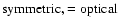
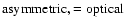
| optical [O III] profile | symmetric | asymmetric | asymmetric | asymmetric |
| MIR [O IV] profile |
 |
symmetric |
 |
asym./non-gauss.,
 |
| examples | 3C 1201, PKS 20482 | Mkn 5092, NGC 56432 | NGC 37832,NGC 4151,3 | NGC 10683,Mkn 11, Mkn 33, |
| NGC 74691, To l01092 | Mkn 4632, NGC 55063 |
|
1 Optical line profile from Vrtilek & Carleton (1985).
2 Optical line profile from Whittle (1985). 3 Optical line profile from Veilleux (1991). |
Varying relative line strengths of low and high ionizaton lines, e.g. of the Neon sequence, seem to indicate a large variation in excitation among the galaxies in our sample. Line ratios from ions in different stages of excitation along with a photoionization model can be used to reconstruct the NLR radiation field produced by the central ionizing source. Mid-Infrared lines are particularly suited because they are little sensitive to extinction and electron temperature, and because they span a wide range of ionization potentials. In detailed studies we have analyzed three nearby Seyfert nuclei of our sample with elaborate photoionization models: Circinus (Seyfert 2 plus starburst), NGC 4151 (Seyfert 1.5) and NGC 1068 (Seyfert 2), see Moorwood et al. (1996), and T. Alexander et al. (1999, 2000). These models were able to reconstruct the intrinsic spectral energy distribution (SED) of the ionizing source in the extreme UV, where a "Big UV Bump'' around 100 eV is expected as a signature from a hot thin accretion disk. The results are consistent with such a "Big UV Bump'', but also suggest for some sources of both types (Seyfert 1 and 2) the presence of neutral absorbers between the AGN's extreme ultraviolet emitting source and the NLR. Such (UV) absorbers have been suggested independently by studies of UV absorption lines (Kriss et al. 1992; Kraemer et al. 1999, 2001). This detailed photoionization modeling requires a large number of mid-IR lines (of good S/N) supplemented with UV/optical/near-IR lines. For most of the galaxies in our sample the compilation of lines from ISO and the literature is not as complete as for the three examples given above. Hence, we do not attempt a similar modeling for them. Instead, we try to constrain the NLR excitation by directly comparing our observations to standard photoionization models from the literature.
The main input parameters for photoionization models are the electron density  and the ionization parameter U, i.e. the number of ionizing photons per hydrogen
atom at the inner face of the ionized cloud. The ratio of lines from ions of similar
ionization potential but with different critical densities (e.g. the [Ne V] 14/24 ratio)
are good tracers of the electron densities (see Sect. 5.1).
Vice versa, the ratio of lines with similar
critical density but from ions of different ionization potential (like [Ne VI]/[O IV])
is sensitive to the ionization parameter. In Fig. 4 we have used this to construct
a diagram to constrain
and U. We have chosen the lines of [Ne V], [Ne VI] and [O IV]
because they are not affected by photoionization by stars and because they are generally
among the brightest high ionization lines.
For comparison we show in Fig. 4
the location of the supernova remnant RCW103
(Oliva et al. 1999), as an example for a strong shock source, and
a photoionization model grid taken from Spinoglio
et al. (2000). This model grid was computed for a power law with an ionizing continuum
of index
and for various ionization parameters and electron densities.
We draw two conclusions from this comparison: firstly,
all galaxies are consistent with these standard photoionization models, with average ionization
parameters log U between -1.5 and -2 and (as seen already in Sect. 5.1)
average densities between a few 100 and a few 1000 cm-3.
Such a simple comparison can not, however, distinguish between
simple power laws and more complex "Big UV Bump'' models. As noted earlier, the detailed modeling
of single sources required for such an analysis is outside the scope of this paper.
Secondly, within our (small) sample, we do not see significant differences
between the AGN sub-types.
and the ionization parameter U, i.e. the number of ionizing photons per hydrogen
atom at the inner face of the ionized cloud. The ratio of lines from ions of similar
ionization potential but with different critical densities (e.g. the [Ne V] 14/24 ratio)
are good tracers of the electron densities (see Sect. 5.1).
Vice versa, the ratio of lines with similar
critical density but from ions of different ionization potential (like [Ne VI]/[O IV])
is sensitive to the ionization parameter. In Fig. 4 we have used this to construct
a diagram to constrain
and U. We have chosen the lines of [Ne V], [Ne VI] and [O IV]
because they are not affected by photoionization by stars and because they are generally
among the brightest high ionization lines.
For comparison we show in Fig. 4
the location of the supernova remnant RCW103
(Oliva et al. 1999), as an example for a strong shock source, and
a photoionization model grid taken from Spinoglio
et al. (2000). This model grid was computed for a power law with an ionizing continuum
of index
and for various ionization parameters and electron densities.
We draw two conclusions from this comparison: firstly,
all galaxies are consistent with these standard photoionization models, with average ionization
parameters log U between -1.5 and -2 and (as seen already in Sect. 5.1)
average densities between a few 100 and a few 1000 cm-3.
Such a simple comparison can not, however, distinguish between
simple power laws and more complex "Big UV Bump'' models. As noted earlier, the detailed modeling
of single sources required for such an analysis is outside the scope of this paper.
Secondly, within our (small) sample, we do not see significant differences
between the AGN sub-types.
Structures and velocity fields in the NLR can be studied by an analysis of line profiles. Numerous studies of the emission line profiles in Seyfert galaxies have shown that in many cases the lines exhibit blueward asymmetries and are blueshifted with respect to the galaxies systemic velocity. The common interpretation for these profile asymmetries is that they are caused by differential extinction in an outflow or inflow of clouds with a modest amount of mixed-in dust. Observations in the infrared can obviously test these scenarios, because infrared lines suffer more than an order of magnitude less extinction than in the optical. Hence, they should not or only marginally show asymmetries. Sturm et al. (1999) and Lutz et al. (2000b) have presented the first such studies of optical-to-mid-IR line profile comparisons for NGC 4151 and NGC 1068. In these two sources the outflow-plus-dust scenario seems to be (at least partially) wrong, since the MIR lines show asymmetries similar to their optical counterparts.
 |
Figure 5:
Comparisons between optical and MIR
line profiles (continuum subtracted and normalized to peak flux density),
for four different cases as discussed in the text. Solid lines show
the MIR [O IV] 26 m line, taken from the ISO-SWS data set. Dashed lines are optical
[O III]5007 Å lines, smoothed to the SWS resolution. References for the optical
line profiles are given in Table 5. The velocity scale on
the x-axis (in [km s-1]) is relative to the systemic velocities given in
Table 1. |
Optical [O III] line profile information exists for many objects in our data set. These can be used for a comparison with the MIR [O IV] line, as described in Sturm et al. (1999). We have convolved the optical line profiles with the SWS instrumental profile (Gauss profiles with FWHM as given in Table 2) in order to smooth these profiles to the resolution of SWS. Four such examples of an optical-MIR comparison are shown in Fig. 5. The objects in our sample can be grouped roughly into three different classes in terms of line profile asymmetries and agreement of MIR lines with their optical counterparts, as summarized in Table 5. In some cases (Class I) the optical line profile of [O III] is quite symmetric and of Gaussian shape. In these cases, not surprisingly, the MIR and optical line profiles match each other very well. Another group of objects (Class II) shows strong blueward asymmetries in the optical, while the MIR lines are rather symmetric. This is exactly what scenarios with infall our outflow of NLR clouds with mixed-in dust predict. We only found two such cases in our sample. The third class of objects has asymmetric optical lines, but MIR lines which are inconsistent with these scenarios. This class can be further divided into two sub-classes: in Class IIIa the MIR lines are asymmetric, too, and agree well with the optical lines. This case has been studied in more detail in an analysis of NGC 4151 by Sturm et al. (1999), and can be explained, for instance, by a true asymmetry in the distribution of the NLR clouds, or, in the case of NGC 4151, by a central, optically very thick, but geometrically thin absorber on parsec scales. In Class IIIb the NIR lines are asymmetric (or symmetric but with non-Gaussian profiles), but different from their optical counterparts. One member of this class is NGC 1068, which has been analyzed by Lutz et al. (2000b). This suggests that parts of the NLR are significantly obscured in the optical, but not enough to also block the MIR lines. Similar to Class IIIa, the remaining MIR profile asymmetries may be either due to an intrinsic asymmetry of the NLR, or due to a very high density obscuring component which is hiding part of the NLR even from infrared view. We note that for some of the objects with MIR lines of good S/N (Cen A, M 51, MKN 573, NGC 1365, and NGC 7582) there is, to our knowledge, no (suitable) optical line profile information available in the literature.
Many objects in our sample exhibit differences in the profiles of lines with different ionization potential. For instance, the Circinus galaxy shows symmetric low ionization lines, but asymmetric high ionization lines with the typical blueward asymmetries. Vice versa, in NGC 7582 high ionization lines are very symmetric, while the low ionization lines are strongly asymmetric. Correlations, as well as anti-correlations, of line asymmetries with critical density and/or ionization potential have been claimed in many publications. For NGC 7582 a contribution to the low ionization lines from a starburst component with asymmetric spatial distribution could be an additional/alternative solution. For the Circinus galaxy the situation is even more complex, since Oliva et al. (1994) reported asymmetric low ionization lines. Finally, for some objects in our sample all MIR line profiles appear to be quite similar. For instance, the profiles of Cen A, M 51, MKN 573, NGC 1365 (for which no optical counterparts exist) are quite symmetric and of Gaussian shape, regardless of ionization potential or critical density.
It appears that there is no unique answer to what causes the line profile asymmetries in Seyfert galaxies. Extinction by dust on different spatial scales and with varying column densities, sub-structure and true asymmetries in the spatial distribution of NLR clouds may all play a role with varying degrees of importance. For some objects the assignment to a certain group is not unique and depends also on S/N. We use this classification purely to obtain an overview of this complex issue. We refrain from a more detailed analysis of line profiles in this paper because it requires a careful study of the effects of aperture differences (spatial resolutions) between the optical and MIR observations, and, in many cases, a larger data set of high ionization lines with good S/N.
 |
Figure 6: The ratio [Ne VI]/[O IV] vs. [Ne VI]/[Ne II]. Same symbols and numbering as in Fig. 1. A typical error bar (according to a 20% individual line flux error) is shown in the upper left corner. An empirical dividing line is drawn as dashed line. Composite sources according to their PAH spectra are encircled. For galaxies #26, 28 and 29 no ISO PAH spectra exist. |
Copyright ESO 2002