![[*]](/icons/foot_motif.gif)
A&A 393, L103-L106 (2002)
DOI: 10.1051/0004-6361:20021260
S. Hony1 - J. Bouwman2 - L. P. Keller3 - L. B. F. M. Waters1,4
1 - Astronomical Institute "Anton Pannekoek'', University of Amsterdam,
Kruislaan 403, 1098 SJ Amsterdam, The Netherlands
2 -
CEA, DSM, DAPNIA, Service d'Astrophysique, CEN Saclay, 91191
Gif-sur-Yvette Cedex, France
3 -
Mail Code SR, NASA Johnson Space Center, Houston, Texas 77058, USA
4 -
Instituut voor Sterrenkunde, Katholieke Universiteit Leuven,
Celestijnenlaan 200B, 3001 Heverlee, Belgium
Received 9 July 2002 / Accepted 29 August 2002
Abstract
We present and discuss the detection, through mid IR
spectroscopy, of iron sulfides in the carbon rich ejecta of evolved
stars. We find the spectroscopic signature of iron sulfides at 23  m. We also find weak features at
  34, 38 and 44 m.
The positions of these features correspond well with the resonances
of the iron sulfide troilite. However, the relative strength of the
23 m versus the other bands does not match the laboratory
measurements, which suggests the presence of other iron sulfides
besides troilite. The same broad feature around 23 m has been
found in young stellar objects. This detection may imply a carbon
star origin for part of the iron sulfides found in meteorites and
interplanetary dust particles.
34, 38 and 44 m.
The positions of these features correspond well with the resonances
of the iron sulfide troilite. However, the relative strength of the
23 m versus the other bands does not match the laboratory
measurements, which suggests the presence of other iron sulfides
besides troilite. The same broad feature around 23 m has been
found in young stellar objects. This detection may imply a carbon
star origin for part of the iron sulfides found in meteorites and
interplanetary dust particles.
Key words: circumstellar matter - Planetary Nebulae: individual: PN M2-43, PN K3-17 - stars: mass-loss
Infrared (IR) spectroscopy is an important tool to study the composition of the circumstellar envelopes (CSEs) around stars at various stages of evolution. Evolved stars shed their envelopes. The composition of their CSE reflects the physical and chemical conditions in the extended atmosphere of these stars. The CSE of young stellar objects (YSOs) holds information on the molecular cloud composition, the material which formed the stars and possibly their planetary systems. The building blocks of our solar system can also be studied through different methods. Most notably by studying meteorites, comets and interplanetary dust particles (IDPs). These solar system objects contain materials which are believed to be unaltered during the formation of our solar system. Iron sulfides are an important constituent of all these solar-system building blocks (e.g. Kerridge 1976; Lawler et al. 1989; Dai & Bradley 2001).
We are studying the IR spectra of planetary nebulae (PNe) to measure
which materials are produced in the outflows around evolved stars and
fed into the interstellar medium (ISM). In this Letter we
present and discuss the detection of a broad feature at 23 m and
weaker features at 34, 38 and 44 in two C-rich PNe. A similar broad
feature is found in the spectra of YSOs (Keller et al. 2002). Based
on the correspondence with the laboratory spectrum of the iron sulfide
troilite we claim iron sulfides to be a constituent of these PNe. The
spectroscopic match is not perfect and we present possible
explanations for the observed discrepancies.
m) are systematically too low compared
to the neighbouring sub-bands. We have shifted sub-band 3A by +7 Jy.
The detection of the feature we discuss here is not influenced by this
shifting.
![\begin{figure}
\par\includegraphics[width=8.8cm,clip]{eg091f1.eps}
\end{figure}](/articles/aa/full/2002/39/aaeg091/img4.gif) |
Figure 1:
The SWS spectra of the nebulae exhibiting the 23 m
feature are shown in panel b). Panel a shows a typical C-rich PN
without the 23 m feature. The model continua are indicated in
the panels a) and b) by dotted lines. The spectrum of M2-43 is
offset for clarity. We show the feature found in AB Aur for
comparison (solid grey line). Panel c) shows the ratio of the
excess flux to the continuum flux. The excess of K3-17 is offset
for clarity and the zero level is indicated by the dashed line.
Panel d) shows the normalised
 of FeS (black
line) and FeO (grey line) particles with a CDE shape
distribution.
of FeS (black
line) and FeO (grey line) particles with a CDE shape
distribution. |
| Open with DEXTER | |
We show the SWS spectrum of the prototypical C-rich PN NGC
7027 in Fig. 1a. We show the spectra of M2-43
and K3-17 from 10 to 45 m in Fig. 1b. The
mid IR spectra of these nebulae are typified by two broad emission
features: one centred on 23 m, and the other at 34 m.
The spectrum of M2-43 shows some weak structures on top of both these
features with local maxima at 15.5, 20, 22.3, 38 and 44 m. The
structure near 28-29 m is unreliable. We construct a simple
model continuum by fitting a modified blackbody (
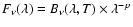 ,
where
,
where
 is the Planck function) to continuum points
around 9-10, 16 and 45 m. We keep the power (p) fixed at 1.0,
a value which in general fits the mid IR spectra of C-rich PNe well.
These continua are shown in Figs. 1a, b and the
excess emission above the continuum is shown in
Fig. 1c.
is the Planck function) to continuum points
around 9-10, 16 and 45 m. We keep the power (p) fixed at 1.0,
a value which in general fits the mid IR spectra of C-rich PNe well.
These continua are shown in Figs. 1a, b and the
excess emission above the continuum is shown in
Fig. 1c.
A very broad emission feature extending from 25-45 m is
abundantly detected in IR spectra of a variety of C-rich evolved
objects ranging from intermediate mass loss AGB stars to PNe
(Forrest et al. 1981). The feature is attributed to MgS
(e.g. Nuth et al. 1985; Goebel & Moseley 1985; Hony et al. 2002). In
the PNe this feature usually peaks near 34 m, see
Fig. 1a for a clear example of the feature. The
broad feature in M2-43 and K3-17 strongly resembles the feature found
in other PNe except for the weak substructures in the 30-45 m
range detected in M2-43.
The feature peaking near 23 m is not found in other PNe. A broad
feature like this is however found in the CSE of YSOs where it had
previously been ascribed to FeO (Bouwman et al. 2000). However,
we identified this feature with iron sulfides (Keller et al. 2002).
We show for comparison the feature of the YSO; AB Aur in
Fig. 1b. The feature is obtained after
subtracting a radiative transfer model from the SWS spectrum. The
feature found in the YSO is very close to the feature found in the
PNe, which shows that M2-43 and K3-17 contain the same solid state
component as is found around the YSOs and which causes the 23 m
feature in both environments.
Begemann et al. (1994) measured the IR reflectance of troilite (FeS). These authors find four strong resonances in the wavelength
range we discuss here, a broad feature peaking at 23 m and
narrower features at 33, 38 and 43 m. We show the emission from FeS in a continuous distribution of ellipsoids (CDE) shape
distribution in Fig. 1c. The feature at 23 m matches well with the emission excess found in M2-43 and K3-17, also the signatures of the sharper features at 38 and 43 m
match well to the weak features found in M2-43. The presence of the
33 m feature is not obvious from the SWS spectrum. We show in
Fig. 2a our attempt to remove the contribution of MgS. We have modelled the emission due to MgS in a optically thin CDE calculation using the optical constants from
Begemann et al. (1994). We vary the strength and temperature of
the MgS feature in order to match most of the 34 m component. We
find a temperature of 150 K. This temperature appears very reasonable
given the fitted continuum temperature of 165 K.
Figure 2b shows the residue after removing both the
continuum contribution and the emission due to the MgS component. In
the residue a feature near 34 m is also present.
Based on the correspondence in feature positions between the
laboratory spectrum and the astrophysical spectra we identify FeS as
the carrier of the 23 m feature. However it is clear from a
comparison between Fig. 1 panels b and c that
the band strength ratio (BSR) for FeS and the nebular spectra do not
correspond well. In the laboratory spectrum the narrow long
wavelength features are much stronger than observed in these nebulae.
Below we discuss possible effects, that influence the BSRs.
Firstly, the temperature of the emitting grains influences the
observed BSRs. Warmer grains emit stronger towards shorter
wavelengths, thereby increasing the strength of the 23 m band
relative to the other bands. However, increasing the temperature to
720 K makes the 23 m band only equally strong in peak strength to
the 38 m band. The evaporation temperature of FeS is 720 K.
Increasing the temperature much beyond the typical continuum
temperature of 200 K, enhances the blue side of the broad 23 m
band contrarily to what is observed in the nebular spectra. We
conclude that a simple temperature effect cannot explain the
differences in the BSRs.
![\begin{figure}
\par\includegraphics[width=8.8cm,clip]{eg091f2.eps}
\end{figure}](/articles/aa/full/2002/39/aaeg091/img7.gif) |
Figure 2:
The mid IR spectrum M2-43. We show in panel a the modelled
continuum (dashed), the modelled emission of MgS at a temperature
of 150 K (black) and the composite modelled spectrum (grey drawn).
In panel b) we show the residue after subtracting the composite
model from the observed spectrum. In a comparison with FeS (CDE)
at T=150 (grey line) we recognise the major resonances of FeS at 23, 34 and 38 m. |
| Open with DEXTER | |
Secondly, the BSRs may be influenced by the particle shape. We compare
in Fig. 3a the mass absorption coefficient (
)
of spherical particles and from a CDE-shape
distribution. As can be seen the resonances are slightly shifted but
the BSRs are hardly affected.
Thirdly, the particle might not be homogeneous. We simulated the
absorption by a FeS grain embedded in a layer of MgS in the
electrostatic approximation following Bohren & Huffman (1983, chapter 5). The simulated
from FeS grain
with a MgS coating of 10 and 50 per cent by volume are shown in
Fig. 3a. The shortest wavelength resonance is
strongly enhanced compared to the longer wavelength bands also the
23 m band shifts towards longer wavelength. This behaviour is due
to the strong resonance of MgS at 26 m. The grain with a 50 per
cent by volume MgS coating shows only a single broad resonance at
25 m.
Lastly, the BSRs can be affected if the material measured in the
laboratory does not have the exact same lattice structure or
composition as the material emitting in these nebulae. The material
measured by Begemann et al. (1994) is troilite (FeS), however the
iron sulfides most commonly found in cometary material and
interplanetary dust particles is pyrrhotite (Fe(1-x)S)
(Tomeoka & Buseck 1984). Unfortunately there are no published
optical constants for pyrrhotite that cover the whole wavelength range
of interest. We show the absorbance of pyrrhotite and iron sulfide
inclusion from an IDP to 26 m in Fig. 3b.
Both spectra show a broad resonance at 23 m. In order to further
examine the effects of differences due to composition and lattice
structure we have used the published optical constants for pyrite
(FeS2) (Verble & Wallis 1969). The emission from pyrite grains
is shown by the grey line in Fig. 3b. The
dominant band is at 24 m. There are some weaker but sharp
resonances at 28.5 and 34 m. As can be seen by comparing the FeS
and the FeS2 spectra the resonance around 23 m due to the Fe-S
stretch is observed in all these iron sulfides. The longer wavelength
bands vary more. One might speculate that the 23 m band is
generic to all Fe-S bearing materials while the longer wavelength
bands are more sensitive to the lattice structure and may be supressed
in case the lattice is disorded.
![\begin{figure}
\par\includegraphics[width=8.8cm,clip]{eg091f3.eps}
\end{figure}](/articles/aa/full/2002/39/aaeg091/img8.gif) |
Figure 3:
The effect of particle shape, coating and composition on
the optical properties of iron sulfide grains. We show in panel a
the normalized
of spherical FeS grains
(black line), FeS in a CDE shape distribution (grey line),
spherical FeS grains with a coating of MgS of 10 per cent by
volume (dashed line) and 50 per cent by volume (dotted line). In
panel b) we show
,
normalized at 23 m for
different types of iron sulfides: FeS (black line), FeS2 (grey
line), Fe(1-x)S (dashed line) and the IDP iron sulfide
(dotted line). All calculations are done in the Rayleigh limit
when the particle radius is much smaller than the wavelength. The
temperature of the grains is 200 K. |
| Open with DEXTER | |
The fact that we find the 23 m feature in the spectra of PNe
and YSOs may have implications for the origin of the iron
sulfide in our solar system and it puts constraints on the carrier: it
must be a plausible component in these chemically very different
environments.
Previously it has been suggested that the 23 m feature in YSOs is
carried by FeO (Bouwman et al. 2000). FeO exhibits a single
sharp resonance at 20 m. This resonance broadens and shifts to 23 m in a CDE shape distribution (Begemann et al. 1995)
(e.g. Fig. 1). This indentification relieves
the problem with the long wavelength resonances of FeS. Against this
identification argues the thermo-dynamical unstablity of FeO.
Moreover, FeO is not expected to form in a C-rich environment. The
SWS spectra of M2-43 and K3-17 shown no evidence for O-rich dust like
silicates. Instead they show all the typical C-rich dust components:
the "30'' m feature and the emission due to polycyclic aromatic
hydrocarbons (Allamandola et al. 1989) at 3.3, 6.2, 7.7 and 11.3 m. Iron
sulfides are predicted to form in a reducing environment like the
outflows of C-rich evolved stars (Lodders & Fegley 1999).
Similarly, our simulations of the coated FeS cores with MgS mantles
demonstrate a possible way to circumvent the problems with the weak or
absent long wavelength resonances, however MgS is not stable in an the
O-rich circumstellar disk of a YSO. Therefore, these calculations are
more a proof of concept rather than a direct candidate for carrier
identification. A mantle material which has a strong resonance near
23 m enhances the 23 m feature of the iron sulfide core
compared to the longer wavelength resonances and brings the BSRs
closer to the observed ones. Of course, this material may well be an
iron sulfide like pyrrhotite. Such a coated grain is a special case
of the mixture of iron sulfide phases discussed above.
An important question concerns the production of FeS in the outflow
around carbon stars. Model calculations show that in carbon star
atmospheres Fe condenses into metallic iron at high temperatures
(Lattimer et al. 1978). At lower temperatures S condenses into MgS. At even lower temperatures iron sulfides may form through a
gas-solid interaction between H2S and the metallic iron. Because
the number ratio of S to Mg is close to unity, S is effectively locked
up. Based on these calculations iron sulfides are not expected to form
abundantly. However these predictions are based on thermochemical
equilibrium calculations without taking the dynamics of the outflow
into account. One could envision that if the gas cools rapidly during
the outflow the condensation of MgS might not be complete and S in the
form of H2S could still be available to react with the metallic
iron. Within this scenario we would conclude that the outflows in M2-43 an K3-17 have cooled more rapidly than those nebulae which do
not exhibit the 23 m feature. The fact that we detect the
"30'' m feature, which is due to MgS at a strength which is not
less than in other C-rich PNe indicates that the MgS condensation
cannot have been very suppressed.
Secondly, the presence of iron sulfide in these nebulae may be due to an unusually high S/Mg ratio. However, this is unlikely since neither S nor Mg are produced during the evolution of these objects requiring these peculiar abundance patterns to be present throughout the material from which these stars formed.
Thirdly, the difference between "normal'' C-rich PNe and those
exhibiting the 23 m feature could be the particle size. 1 m
sized iron sulfide particles are opaque in the mid IR leaving them
undetectable.
Iron sulfides are abundantly found in meteoritic material, in which they are actually the most important S bearing component. Previously iron sulfides have not been detected around evolved stars. This had led to the understanding that all the iron sulfides in our solar system have been produced during the formation of our solar system. The amount of iron sulfides found in meteorites excludes the carbon star atmospheres as their sole production place, but these new finding imply that there may be a presolar source of iron sulfides in our solar system.
Acknowledgements
SH and LBFMW acknowledge financial support from NWO Pionier grant 616-78-333.