in the Inner Galaxy
![[*]](/icons/foot_motif.gif) ,
,
,
,
,
,
A&A 393, 115-128 (2002)
DOI: 10.1051/0004-6361:20021017
,
,
,
M. Messineo 1 - H. J. Habing 1 - L. O. Sjouwerman 2 - A. Omont 3 - K. M. Menten 4
1 - Leiden Observatory, PO Box 9513, 2300 RA Leiden, The Netherlands
2 -
National Radio Astronomy Observatory, PO Box 0, Socorro NM 87801, USA
3 -
Institut d'Astrophysique de Paris, CNRS, 98bis boulevard Arago, 75014 Paris, France
4 -
Max-Planck-Institut für Radioastronomie, Auf dem Hügel 69, 53121 Bonn, Germany
Received 28 May 2002 / Accepted 20 June 2002
Abstract
We present 86 GHz (
 )
SiO maser line
observations with the IRAM 30-m telescope
of a sample of 441 late-type stars in the Inner Galaxy (
)
SiO maser line
observations with the IRAM 30-m telescope
of a sample of 441 late-type stars in the Inner Galaxy (
 ).
These stars were selected on the basis of their infrared magnitudes
and colours from the ISOGAL and MSX catalogues.
SiO maser emission was detected in 271 sources, and their
line-of-sight velocities indicate that the stars are
located in the Inner Galaxy.
These new detections double the number
of line-of-sight velocities available from previous SiO and OH
maser observations
in the area covered by our survey and are, together with other samples
of e.g. OH/IR stars, useful for kinematic studies of the
central parts of the Galaxy.
).
These stars were selected on the basis of their infrared magnitudes
and colours from the ISOGAL and MSX catalogues.
SiO maser emission was detected in 271 sources, and their
line-of-sight velocities indicate that the stars are
located in the Inner Galaxy.
These new detections double the number
of line-of-sight velocities available from previous SiO and OH
maser observations
in the area covered by our survey and are, together with other samples
of e.g. OH/IR stars, useful for kinematic studies of the
central parts of the Galaxy.
Key words: stars: AGB and post-AGB -
stars: late-type -
stars: circumstellar matter -
surveys -
masers -
Galaxy: kinematics and dynamics
There has been a growing interest in studies characterizing the kinematics
and the spatial distribution of stars in the Inner Galaxy (
 ). Many recent studies attempt to determine
the parameters
that describe the dynamics and structure of the Inner Galaxy, i.e. its
central bar and/or its bulge tri-axial mass distribution.
). Many recent studies attempt to determine
the parameters
that describe the dynamics and structure of the Inner Galaxy, i.e. its
central bar and/or its bulge tri-axial mass distribution.
One approach is to map the spatial density of a stellar population. This has been done, e.g., for stars detected by IRAS toward the Galactic bulge (Nakada et al. 1991; Weinberg 1992), bulge Mira variables (Whitelock 1992), bulge red clump stars (Stanek et al. 1994) and giant stars seen in fields at symmetric longitudes with respect to the Galactic centre (Unavane & Gilmore 1998).
Optical studies of the Inner Galaxy are much hindered by the high
interstellar extinction, which can exceed
 (e.g. Schultheis et al. 1999), and thus are limited to
small optical windows (Holtzman et al. 1998; Zhao et al. 1994).
At infrared and radio wavelengths however,
interstellar extinction is much less severe, or even absent.
Extensive infrared point source catalogues have recently become available
from the ground based DENIS (Epchtein et al. 1994) and 2MASS (Beichman et al. 1998)
near-infrared (nIR) surveys, the mid-infrared (mIR) ISO satellite
survey (ISOGAL: Omont et al. 1999; Omont & the ISOGAL collaboration 2002),
and the Midcourse Space Experiment
(MSX: Egan et al. 1999; Price et al. 1997). These data have given new
insights into the spatial stellar density
distribution in the Inner Galaxy.
To interpret the information given by the recent observations,
detailed models all include some kind of tri-axiality: a tri-axial
Galactic bulge or bar
(e.g. Alard 2001; Debattista et al. 2002; López-Corredoira et al. 2001a,b; Ortwin 2002).
However, the bar characteristics such as length, pattern
speed, and position angle, are still poorly constrained.
(e.g. Schultheis et al. 1999), and thus are limited to
small optical windows (Holtzman et al. 1998; Zhao et al. 1994).
At infrared and radio wavelengths however,
interstellar extinction is much less severe, or even absent.
Extensive infrared point source catalogues have recently become available
from the ground based DENIS (Epchtein et al. 1994) and 2MASS (Beichman et al. 1998)
near-infrared (nIR) surveys, the mid-infrared (mIR) ISO satellite
survey (ISOGAL: Omont et al. 1999; Omont & the ISOGAL collaboration 2002),
and the Midcourse Space Experiment
(MSX: Egan et al. 1999; Price et al. 1997). These data have given new
insights into the spatial stellar density
distribution in the Inner Galaxy.
To interpret the information given by the recent observations,
detailed models all include some kind of tri-axiality: a tri-axial
Galactic bulge or bar
(e.g. Alard 2001; Debattista et al. 2002; López-Corredoira et al. 2001a,b; Ortwin 2002).
However, the bar characteristics such as length, pattern
speed, and position angle, are still poorly constrained.
Spatial density studies often neglect an important measurable
dimension of phase space: the stellar line-of-sight velocity.
In contrast to the large number of data points in the spatial domain of
phase-space, the available data on the line-of-sight velocities of the stars
is sparse because it is still difficult to measure velocities
from optical or infrared studies.
Asymptotic Giant Branch (AGB) stars with large mass-loss are a valuable
exception, since their envelopes often harbour masers which are strong
enough to be detected
throughout the Galaxy and thereby reveal the
line-of-sight velocity of the star to within a few km s-1; frequently
detected maser lines are from OH at 1.6 GHz, H2O at 22 GHz, and SiO at
43 GHz and 86 GHz (for a review see Habing 1996).
Previous SiO and OH maser surveys in the Galaxy
have demonstrated that locating the circumstellar masers is an effective
way to measure line-of-sight velocities of the AGB stars
(e.g. Baud et al. 1979; Blommaert et al. 1994; Deguchi et al. 2000a,b; Izumiura et al. 1999; Lindqvist et al. 1992; Sevenster et al. 1997a,b, 2001; Sjouwerman et al. 1998).
Until recently, only a few hundred stellar line-of-sight velocities
were known toward the inner regions of the Milky Way (
and |b| < 1), mainly from OH/IR stars,
AGB stars with OH maser emission in
the 1612 MHz line, mostly undetected at visual wavelengths.
This number is too
small to allow for a good quantitative multicomponent
analysis of the Galactic structure and dynamics (Vauterin & Dejonghe 1998).
Obtaining more line-of-sight velocities therefore remains an issue
of prime importance.
However, masers are rare among stars, because
sustaining a maser requires a special physical
environment.
Most of the mid-infrared brightest OH/IR stars close to the Galactic
plane were probably already detected
in the blind OH surveys or in the targeted OH or 43 GHz SiO maser observations
of colour-selected sources from the
IRAS survey (e.g. van der Veen & Habing 1988).
H2O surveys (e.g. Levine 1995) are probably incomplete
because the H2O masers are strongly variable.
SiO maser emission is detected from several transitions towards
oxygen-rich AGB stars and red supergiants.
On the basis of the shape and the amplitude of their visual light curve
AGB stars have been classified as semi-regular
(SR) stars and Mira stars.
Variable AGB stars may also be classified as
long period variable (LPV) stars, when their periods are longer than
100 days (Habing 1996).
Almost all OH/IR stars are variable
and have periods longer than 500 days.
In the IRAS color-color diagram the oxygen-rich AGB stars
are distributed on a well-defined sequence of
increasing shell opacity and stellar
mass-loss rate (e.g. Olnon et al. 1984, van der Veen & Habing 1988),
which goes from Miras with the bluest
colors and the 9.7  m silicate
feature in emission, to OH/IR stars with the reddest colors
and the 9.7 m silicate feature in absorption.
The relative strengths of different SiO maser lines are observed
to vary with AGB type (Bujarrabal et al. 1996; Nyman et al. 1993, 1986),
indicating that the SiO maser properties depend
on the stellar mass loss rate and on the stellar variability.
The ratio of the SiO maser intensities of 43 over 86 GHz is found
to be much lower in Mira stars and in
supergiants than in OH/IR stars. This implies that the 86 GHz (v = 1)
SiO maser transition is a good tool to
measure stellar line-of-sight velocities of Mira-like stars.
Another advantage is that Mira stars are far more numerous
than OH/IR stars.
However, these conclusions are based on small number statistics,
and have neglected effects of variability.
m silicate
feature in emission, to OH/IR stars with the reddest colors
and the 9.7 m silicate feature in absorption.
The relative strengths of different SiO maser lines are observed
to vary with AGB type (Bujarrabal et al. 1996; Nyman et al. 1993, 1986),
indicating that the SiO maser properties depend
on the stellar mass loss rate and on the stellar variability.
The ratio of the SiO maser intensities of 43 over 86 GHz is found
to be much lower in Mira stars and in
supergiants than in OH/IR stars. This implies that the 86 GHz (v = 1)
SiO maser transition is a good tool to
measure stellar line-of-sight velocities of Mira-like stars.
Another advantage is that Mira stars are far more numerous
than OH/IR stars.
However, these conclusions are based on small number statistics,
and have neglected effects of variability.
To significantly enlarge the number of known stellar line-of-sight velocities
we have conducted a targeted survey for the
86 GHz SiO (
)
maser line toward an infrared selected sample of late-type stars.
Here we describe the selection of sources
and the observational results. A detailed discussion of the
kinematic and physical properties of the detected stars will be addressed in a
forthcoming paper (Messineo et al. 2002a, in preparation).
All velocities in this paper refer to line-of-sight
velocities, measured with respect to the Local Standard of Rest (LSR).
The stars to be searched for maser emission were
selected from a preliminary version of the
combined ISOGAL-DENIS catalogue
and from the MSX catalogue. The search was limited to the Galactic plane between
 and
and
 and
and
 ;
the lower limit in longitude is imposed by the
northern latitude of the IRAM 30-m telescope.
;
the lower limit in longitude is imposed by the
northern latitude of the IRAM 30-m telescope.
ISOGAL is a 7 and 15 m survey made with ISOCAM on board of ISO
of  16 deg2, in selected
fields along the Galactic plane, mostly toward the Galactic centre.
The 7 and 15 m observations were generally taken at different
epochs.
With a sensitivity of 10 mJy (two orders of magnitude deeper than IRAS)
and a resolution of 3-6
16 deg2, in selected
fields along the Galactic plane, mostly toward the Galactic centre.
The 7 and 15 m observations were generally taken at different
epochs.
With a sensitivity of 10 mJy (two orders of magnitude deeper than IRAS)
and a resolution of 3-6
 ISOGAL detected over 100 000 objects. The
combination of the mIR data with the I, J, and
KS-band DENIS photometric catalogue (Epchtein et al. 1994) allows for a
good determination of the nature of these sources. ISOGAL has sampled the
AGB population in the Galactic bulge ranging from the highly obscured, mIR
luminous OH/IR stars, to the lower mass-loss Mira and SR stars near the tip of
Red Giant Branch, at
ISOGAL detected over 100 000 objects. The
combination of the mIR data with the I, J, and
KS-band DENIS photometric catalogue (Epchtein et al. 1994) allows for a
good determination of the nature of these sources. ISOGAL has sampled the
AGB population in the Galactic bulge ranging from the highly obscured, mIR
luminous OH/IR stars, to the lower mass-loss Mira and SR stars near the tip of
Red Giant Branch, at
 8.2 at the adopted
distance of 8.0 kpc to the
Galactic centre (Alard et al. 2001; Omont et al. 1999; Ortiz et al. 2002).
The Midcourse Space Experiment (MSX) is a survey at five mIR wavelengths
(from 4.3 m [B1 band], to 21.4 m [E band]) which covers the
entire Galactic plane to
8.2 at the adopted
distance of 8.0 kpc to the
Galactic centre (Alard et al. 2001; Omont et al. 1999; Ortiz et al. 2002).
The Midcourse Space Experiment (MSX) is a survey at five mIR wavelengths
(from 4.3 m [B1 band], to 21.4 m [E band]) which covers the
entire Galactic plane to
 Galactic latitude
(Egan et al. 1999). With a sensitivity of 0.1 Jy in band A (8.28 m)
and a spatial resolution of 18.3
,
the MSX Galactic plane
survey detected more
than 300 000 objects.
Galactic latitude
(Egan et al. 1999). With a sensitivity of 0.1 Jy in band A (8.28 m)
and a spatial resolution of 18.3
,
the MSX Galactic plane
survey detected more
than 300 000 objects.
Since the ISOGAL survey only covered a limited number of small fields, the MSX survey was used to obtain a more even distribution of candidate maser sources in the area of interest. Figure 1 shows the location of the observed sources.
![\begin{figure}
\par\includegraphics[width=\textwidth,height=0.4\textwidth]{2744.f1.ps}
\end{figure}](/articles/aa/full/2002/37/aa2744/img25.gif) |
Figure 1: Location of the observed sources, irrespective of detection and non-detections, in Galactic coordinates. The MSX sources are shown as open squares and the ISOGAL sources as filled circles. |
| Open with DEXTER | |
In the selection of targets, three important earlier observations were taken into account as a guideline:
7-12 m) mIR continuum flux density
(Bujarrabal 1994). The mIR and maser intensities vary together
during the stellar cycle. Measuring the respective flux densities at
the maximum, Bujarrabal et al. (1987) found that the
IR
 /SiO
/SiO
 ratio is 5 in
O-rich Mira stars.
The IR
ratio is 5 in
O-rich Mira stars.
The IR
 /SiO
/SiO
 ratio
was found to be 10, albeit with a large scatter, by Bujarrabal et al. (1996)
in a sample of O-rich late-type stars.
ratio
was found to be 10, albeit with a large scatter, by Bujarrabal et al. (1996)
in a sample of O-rich late-type stars.
These observations provided us with criteria for our target selection, such as a lower IR flux density limit in order to detect the maser and IR colours to exclude the high mass-loss AGB stars. To avoid OH/IR stars, for which kinematic data is already known, we compiled a list of known OH/IR stars by combining the catalogues of Sevenster et al. (1997a,b, 2001), Sjouwerman et al. (1998) and Lindqvist et al. (1992).
m
in magnitudes, here indicated as [7] and [15], respectively.
The magnitudes of the sources in the ISOGAL-DENIS catalogue were
corrected for extinction using an extinction map derived from the
DENIS data by Schultheis et al. (1999) and using the extinction ratios
(AV : AI : AJ : AK : A7 : A15) =
(1 : 0.469 : 0.256 : 0.089 : 0.020 : 0.025)
(Glass 1999; Hennebelle et al. 2001; Teyssier et al. 2002).
We cross-referenced the Galactic centre LPV positions
(Glass et al. 2001, 0.5
accuracy) with the ISOGAL-DENIS catalogues
and found 180 possible
counterparts out of 194 variables located in fields observed by ISOGAL.
The missing sources can be explained by blending
with other sources or by high background emission
(the complete description of this cross-correlation
will be the subject of a forthcoming paper). Analyzing the
locations of the LPV stars in the different
ISOGAL-DENIS colour-magnitude diagrams (e.g. Figs. 2 and 3), where
extinction corrected values are indicated by the suffix "o'',
we found that in the
![$(K_{\rm o}{ -} [15]_{\rm o})$](/articles/aa/full/2002/37/aa2744/img13.gif) versus
versus
![$[15]_{\rm o}$](/articles/aa/full/2002/37/aa2744/img1.gif) colour-magnitude diagram the
LPVs without OH
masers separate well from the OH/IR stars
(at
colour-magnitude diagram the
LPVs without OH
masers separate well from the OH/IR stars
(at
![$(K_{\rm o} - [15]_{\rm o}) \approx 4$](/articles/aa/full/2002/37/aa2744/img31.gif) ;
Fig. 2).
;
Fig. 2).
The OH/IR stars, having
 times higher mass-loss rates than Mira stars,
are the brightest objects
at 15 m and have
colour redder than 4 mag
(Ortiz et al. 2002).
This colour is an excellent indicator of infrared emission by the
stellar envelope (Omont et al. 1999).
times higher mass-loss rates than Mira stars,
are the brightest objects
at 15 m and have
colour redder than 4 mag
(Ortiz et al. 2002).
This colour is an excellent indicator of infrared emission by the
stellar envelope (Omont et al. 1999).
We selected sources from the ISOGAL catalogue by their
[15] magnitude, and their
and (
magnitude, and their
and (
![$[7]_{\rm o} {-} [15]_{\rm o}$](/articles/aa/full/2002/37/aa2744/img3.gif) )
colours.
See the search boxes in Figs. 2 and 3.
We excluded the brightest 15 m
sources, [15]
)
colours.
See the search boxes in Figs. 2 and 3.
We excluded the brightest 15 m
sources, [15]
 ,
and those with ([7]
,
and those with ([7]
![$_{\rm o}-[15]_{\rm o}) < 0.7$](/articles/aa/full/2002/37/aa2744/img35.gif) and with
(
and with
(
![$K_{\rm o}-[15]_{\rm o}) < 1.95$](/articles/aa/full/2002/37/aa2744/img36.gif) ,
since they are likely to be foreground stars. We
further excluded sources with
,
since they are likely to be foreground stars. We
further excluded sources with
![$[15]_{\rm o} > 3.4$](/articles/aa/full/2002/37/aa2744/img37.gif) since they are - given the
general correlation of SiO maser emission and IR luminosity - likely
to show SiO maser emission fainter than our
detection limit of 0.2 Jy. Sources with (
since they are - given the
general correlation of SiO maser emission and IR luminosity - likely
to show SiO maser emission fainter than our
detection limit of 0.2 Jy. Sources with (
![$[7]_{\rm o}-[15]_{\rm o}) > 2.3 $](/articles/aa/full/2002/37/aa2744/img38.gif) were excluded since
they are likely to be compact HII #1560#> regions or young stellar objects
(Felli et al. 2000; Schuller & the ISOGAL collaboration 2002), and those with (
were excluded since
they are likely to be compact HII #1560#> regions or young stellar objects
(Felli et al. 2000; Schuller & the ISOGAL collaboration 2002), and those with (
![$K_{\rm o}-[15]_{\rm o}) > 4.85$](/articles/aa/full/2002/37/aa2744/img39.gif) because they are likely to be OH/IR stars with a high mass-loss rate
(Fig. 2) or young stellar objects.
To conservatively avoid duplicating the
OH maser line-of-sight data points,
sources near (50
)
a known OH maser were excluded.
because they are likely to be OH/IR stars with a high mass-loss rate
(Fig. 2) or young stellar objects.
To conservatively avoid duplicating the
OH maser line-of-sight data points,
sources near (50
)
a known OH maser were excluded.
As the final photometry of ISO has changed slightly from the preliminary input catalogue, 16 of the selected sources no longer obey the selection criteria strictly. 253 objects were observed from the selected ISOGAL-DENIS sources.
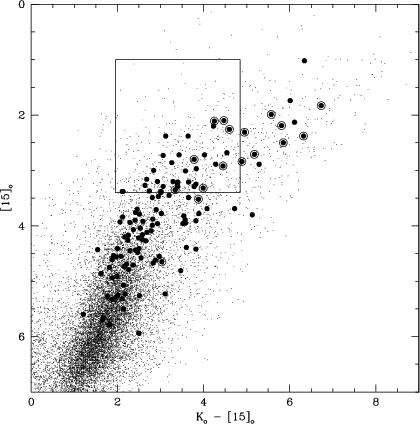 |
Figure 2:
versus (
![$K_{\rm o} {-} [15]_{\rm o}$](/articles/aa/full/2002/37/aa2744/img2.gif) )
ISOGAL-DENIS colour-magnitude diagram; extinction correction has been applied.
LPV stars from Glass et al. (2001) are shown as big dots of which
the encircled ones mark the variables with known OH maser emission.
For comparison, the numerous small dots indicate all the ISOGAL sources
within 5 degrees from the Galactic centre. The rectangular
box defines the region of our sample.
Note that the very red variables without OH emission to the right
of the box in this figure correspond to outliers without OH emission
in Fig. 3. )
ISOGAL-DENIS colour-magnitude diagram; extinction correction has been applied.
LPV stars from Glass et al. (2001) are shown as big dots of which
the encircled ones mark the variables with known OH maser emission.
For comparison, the numerous small dots indicate all the ISOGAL sources
within 5 degrees from the Galactic centre. The rectangular
box defines the region of our sample.
Note that the very red variables without OH emission to the right
of the box in this figure correspond to outliers without OH emission
in Fig. 3. |
| Open with DEXTER | |
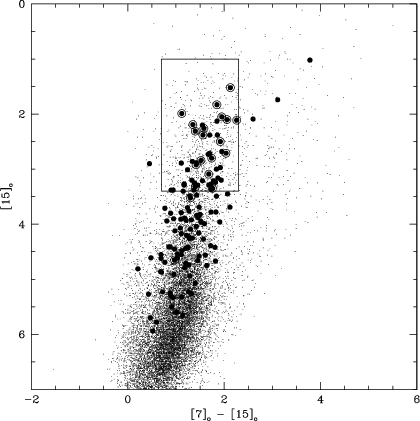 |
Figure 3:
versus (
)
ISOGAL-DENIS colour-magnitude diagram; symbols as in Fig. 2.
Note that a  is not known for all plotted sources,
and they thus are missing in Fig. 2.
is not known for all plotted sources,
and they thus are missing in Fig. 2. |
| Open with DEXTER | |
Since the MSX catalogue gives the source flux density, F, in Jy,
here we use this unit. Magnitudes are obtained
adopting as zero points: 58.55 Jy in A (8.26 m) band,
26.51 Jy in C (12.12 m) band, 18.29 Jy in D (14.65 m) band
and 8.75 Jy in E (21.41 m) band.
NIR data from DENIS or 2MASS was not available for the MSX sources
at the time of our observations.
For the source selection we used flux densities in the A and
D bands which have wavelength ranges similar to
the ISOGAL 7 and 15 m bands.
We selected those not-confused, good quality sources in band A and D(flag > 3), which show variability in band A. We avoided the
reddest,
FD/FA >2.29, sources, which are likely to be OH/IR
stars or young stellar objects, and the bluest and most luminous
(likely foreground) stars with
FD/FA< 0.63 and FD >6 Jy.
Furthermore, following the work of Kwok et al. (1997) on IRAS sources with
low-resolution spectra, we used the C to E
band ratio to discard very red (
FE/FC > 1.4) sources,
which are likely to be young stellar objects or OH/IR stars with
thick envelopes.
Moreover, sources within 50 arcsec of a known OH maser
were discarded, as the kinematic data are already known.
We observed 188 sources from this MSX-selected sample.
The observations were carried out with the IRAM 30-m telescope (Pico
Veleta, Spain) between August 2000 and September 2001 (Table
1). Two receivers were used to observe the two orthogonal linear
polarizations of the SiO (v = 1,
 )
transition at
86.24335 GHz. For each receiver we used one quarter of the low resolution, 1 MHz
1024 channel analog filter bank (3.5 km s-1 spectral resolution, and 890 km s-1 total
velocity coverage), and in parallel the AOS autocorrelator
at a resolution of 312.5 kHz (1.1 km s-1) with a bandwidth of 280 MHz
(973 km s-1 total velocity coverage).
The telescope pointing errors were typically 2-4
,
which is small compared to the beam FWHM of 29
.
The observations
were made in wobbler switching mode, with the wobbler throw varying
between 100 and 200 arcsec.
The on-source integration time was between 5 and
20 min per source, depending on the system temperature
which varied between 100 and
300 K because of the weather,
source elevation (typically 10 to 30
)
transition at
86.24335 GHz. For each receiver we used one quarter of the low resolution, 1 MHz
1024 channel analog filter bank (3.5 km s-1 spectral resolution, and 890 km s-1 total
velocity coverage), and in parallel the AOS autocorrelator
at a resolution of 312.5 kHz (1.1 km s-1) with a bandwidth of 280 MHz
(973 km s-1 total velocity coverage).
The telescope pointing errors were typically 2-4
,
which is small compared to the beam FWHM of 29
.
The observations
were made in wobbler switching mode, with the wobbler throw varying
between 100 and 200 arcsec.
The on-source integration time was between 5 and
20 min per source, depending on the system temperature
which varied between 100 and
300 K because of the weather,
source elevation (typically 10 to 30 ),
and amount of continuum emission in the beam.
),
and amount of continuum emission in the beam.
Flux calibration was done in a standard way from regular observations of a hot (ambient) and cold (liquid nitrogen) load. A sky-opacity-correction was computed from measuring the blank sky emissivity and using a model of the atmosphere structure. The conversion factor from antenna temperature to flux density changed from 6.0 to 6.2 Jy K-1 on December 12th 2000.
| Period No. | Dates | JD-2 450 000 |
| 1 | 26-27 August 2000 | 1782-1783 |
| 2 | 04-17 December 2000 | 1882-1895 |
| 3 | 22-24 January 2001 | 1931-1933 |
| 4 | 09-24 February 2001 | 1949-1964 |
| 5 | 23-28 May 2001 | 2052-2057 |
| 6 | 15 August-04 September 2001 | 2136-2156 |
 20%).
20%).
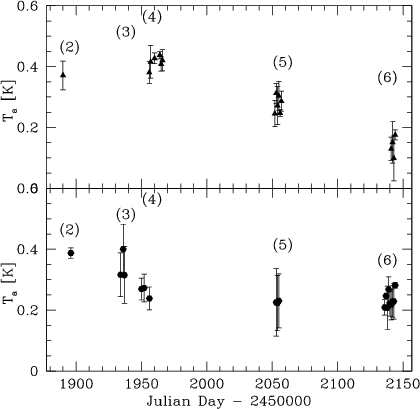 |
Figure 4:
Antenna temperatures versus time for the 2 "reference'' lines:
sources #265
plotted with filled hexagons (bottom) and
#163
with triangles (top).
The observing date on the horizontal axis is expressed in Julian day
minus 2 450 000.
The labels refer to the observing periods in Table 1.
The measurements of a single period agree within 20%.
A long term intrinsic variation (up to a factor of 2 in  )
is apparent in both sources. )
is apparent in both sources. |
| Open with DEXTER | |
The data were reduced using the CLASS software package. The spectra
taken with the two receivers were combined, yielding a typical rms of
15 mK (100 mJy) in the AOS channels. The
line width (FWHM) and the integrated antenna temperature were
determined by fitting the data from the autocorrelator with a Gaussian
after subtracting a linear baseline.
Bad channels were eliminated by comparing the analog filter bank and
autocorrelator spectra.
We considered as a detection
only lines with peak antenna temperature greater than three times the
rms noise level in the autocorrelator spectrum at the original
resolution.
Because of possible confusion with H CN lines, a problem discussed in the
following subsection, single component emission lines detected at
line-of-sight velocity less than -30 km s-1 were interpreted as SiO maser lines only if their line width is smaller than 7.5 km s-1.
CN lines, a problem discussed in the
following subsection, single component emission lines detected at
line-of-sight velocity less than -30 km s-1 were interpreted as SiO maser lines only if their line width is smaller than 7.5 km s-1.
 CN emission
The total autocorrelator spectral bandwidth is 280 MHz, centered at the 86243.350 MHz rest
frequency of the (v = 1,
)
SiO maser transition.
This observing band also includes the three (
 )
hyperfine transitions
of HCN at 86338.767, 86340.184, and 86342.274 MHz.
The HCN lines show up at velocity offsets of
about -335 km s-1 (-329, -336, -343 km s-1)
relative to the SiO line.
)
hyperfine transitions
of HCN at 86338.767, 86340.184, and 86342.274 MHz.
The HCN lines show up at velocity offsets of
about -335 km s-1 (-329, -336, -343 km s-1)
relative to the SiO line.
The HCN line was observed in many interstellar clouds
and also in the direction of Sgr A (e.g. Fukui et al. 1977; Hirota et al. 1998).
In our spectra this HCN line was also detected in the direction of
the Galactic centre, at
 ,
in 55% of our pointings.
HCN spectra generally have multiple broad components and
appear in absorption as well as in emission,
depending on the line intensity in the on- and off-target position
(Fig. 5).
The (l, b) distribution of the
spectra that contain the HCN (
)
line
is similar to that of the Galactic centre molecular
clouds, confirming that the origin is interstellar
(see for example the 13CO distribution in Fig. 2
of Bally et al. 1988). The HCN line has been detected also from
circumstellar envelopes of carbon stars (e.g. Dayal & Bieging 1995),
but will not be detectable in AGB stars at
the distance of the Galactic centre (e.g. Olofsson et al. 1998).
,
in 55% of our pointings.
HCN spectra generally have multiple broad components and
appear in absorption as well as in emission,
depending on the line intensity in the on- and off-target position
(Fig. 5).
The (l, b) distribution of the
spectra that contain the HCN (
)
line
is similar to that of the Galactic centre molecular
clouds, confirming that the origin is interstellar
(see for example the 13CO distribution in Fig. 2
of Bally et al. 1988). The HCN line has been detected also from
circumstellar envelopes of carbon stars (e.g. Dayal & Bieging 1995),
but will not be detectable in AGB stars at
the distance of the Galactic centre (e.g. Olofsson et al. 1998).
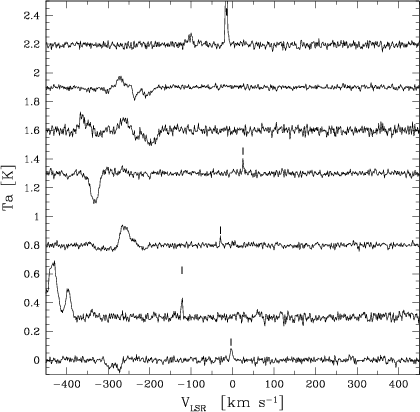 |
Figure 5:
Some spectra with interstellar HCN
emission, shown for clarity with arbitrary antenna temperature offsets.
The small thick vertical bars indicate the detected SiO
maser line. The HCN and SiO lines are usually clearly distinct. |
| Open with DEXTER | |
Considering that the maximum gas velocity observed in the Galactic
centre is less than 300 km s-1, for example in the CO distribution (e.g. Dame et al. 2001),
and considering the frequency differences between
the three HCN (
)
hyperfine transitions and the
SiO (
)
transition,
the HCN (
)
line may be confused with SiO
(
)
lines at velocities
below -30 km s-1. All lines detected at those velocities are
therefore suspect and their line widths were examined in
order to distinguish between SiO maser and HCN lines.
The typical line width of the HCN and SiO emission is very
different (Fig. 5).
From the SiO lines detected at velocities
larger than -30 km s-1, i.e. where no confusion is
expected, the SiO line width distribution
ranges between 1.7 and 16.3 km s-1 with a peak at
 4 km s-1 (Fig. 6);
the HCN line is much wider and can be up to 100 km s-1 wide.
With the spectral resolution of the AOS, 1 km s-1, in case the
HCN emission is not spatially extended,
one should be able to resolve two or three of the hyperfine components,
which are separated by 7 km s-1.
We therefore identify a spectral line at velocity
below -30 km s-1 as an SiO maser only if it is a single emission component and if its line
width (FWHM) is narrower than 7.5 km s-1. For an unambiguous SiO
identification further observations would be required,
e.g. by searching for the 43 GHz
SiO maser lines, or by using interferometric 86 GHz observations
to locate the position and
to determine the extent of the emission.
4 km s-1 (Fig. 6);
the HCN line is much wider and can be up to 100 km s-1 wide.
With the spectral resolution of the AOS, 1 km s-1, in case the
HCN emission is not spatially extended,
one should be able to resolve two or three of the hyperfine components,
which are separated by 7 km s-1.
We therefore identify a spectral line at velocity
below -30 km s-1 as an SiO maser only if it is a single emission component and if its line
width (FWHM) is narrower than 7.5 km s-1. For an unambiguous SiO
identification further observations would be required,
e.g. by searching for the 43 GHz
SiO maser lines, or by using interferometric 86 GHz observations
to locate the position and
to determine the extent of the emission.
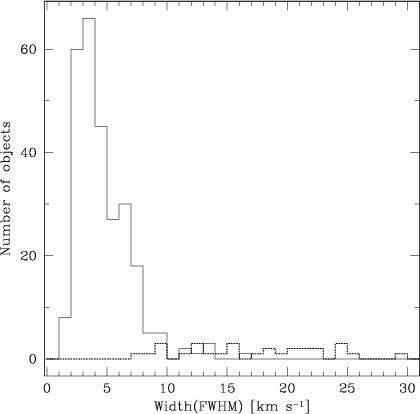 |
Figure 6:
Histogram of the line widths.
The solid line shows the distribution of the SiO line widths;
the dashed line shows the distribution of the lines with a single component
in emission which we classified as HCN emission. |
| Open with DEXTER | |
We have probably rejected a few SiO lines because of suspected confusion
with HCN.
Of the 202 SiO lines detected at velocities larger than -30 km s-1 25 (12%) have widths larger than 7.5 km s-1.
Within 3
from the Galactic centre, we found 75 SiO lines
at velocities larger than -30 km s-1; while
at velocities smaller than -30 km s-1
we found 51 emission line sources with widths <7.5 km s-1 (SiO lines)
and 29 emission lines with widths >7.5 km s-1 and with single component
which we conservatively classified as HCN.
Considering the above 12%,
we estimate that we could have eliminated about 7 real SiO lines.
Only one spectrum taken at a position
away from the central molecular complex
shows a line which is classified as HCN emission
(at
 for source #423); this is further discussed
in Sect. 4.6.
for source #423); this is further discussed
in Sect. 4.6.
However, our stellar SiO maser survey is little
affected by confusion with this interstellar SiO
emission for several reasons.
First, we have targeted mIR sources. The bulk of the
interstellar SiO emission in the Galactic centre is not associated
with mIR radiation (Martin-Pintado et al. 1997). Furthermore, our SiO maser
lines are generally narrower than the 10-50 km s-1 found for shocked and
energetic outflows associated with young stars.
Young stellar objects would also be located in a different region
of the colour-magnitude diagrams of Figs. 2 and 3 (Felli et al. 2000).
Finally, follow-up observations with the
Very Large Array (VLA) at 43 GHz have shown that 38 of
39 sources for which we detected 86 GHz SiO emission
do also show unresolved 43 GHz SiO emission (Sjouwerman et al. 2002b, in preparation).
It is therefore unlikely that any of this emission arises from
interstellar molecular clouds.
|
We have also analyzed the 7 SiO lines
(from Table 2) which have widths larger
than 10 km s-1 (#113, #117, #129, #135, #173, #203, #223). They
represent 2.5% of our total number of detections and are located at longitudes
between 2 and 18 degrees.
The corresponding seven targeted mIR objects were all detected
in the DENIS Kband and some in the J band, and their IR colours are typical of
late-type stars.
Towards two of the sources, #113 and #117, we also detected HCN emission
with a difference in radial velocity between the HCN and the 86 GHz
SiO line of -42 and -22 km s-1, respectively.
The fit of the width of #113 is however noisy and can very well be less
than 10 km s-1 or a blend of two lines.
For #117 it could be a molecular cloud line, since a difference
in radial velocity
between the HCN and the SiO lines up to 25 km s-1 has been already
observed towards molecular outflows (Martin-Pintado et al. 1992). However, #117 is
clearly a 7 km s-1 wide, 43 GHz (v = 1 and
 )
SiO maser point source in our VLA follow-up observations (Sjouwerman et al. 2002b, in preparation).
We conclude that the mIR emission, and 43 and 86 GHz SiO lines are all
related to an AGB star, although we cannot completely rule out interstellar
HCN emission for source #117.
)
SiO maser point source in our VLA follow-up observations (Sjouwerman et al. 2002b, in preparation).
We conclude that the mIR emission, and 43 and 86 GHz SiO lines are all
related to an AGB star, although we cannot completely rule out interstellar
HCN emission for source #117.
Two SiO emission features are probably of interstellar origin; see comments in Sect. 4.6 for remarks on the individual sources #94 and #288.
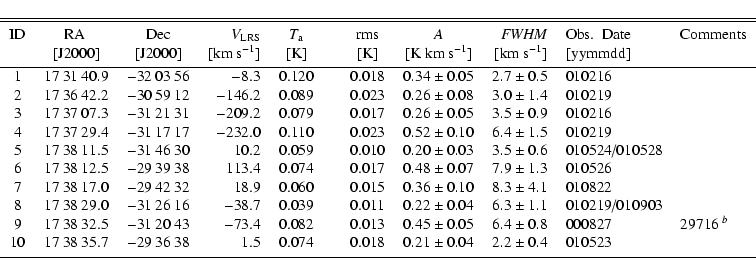
Tables 2 and 3 summarize,
in order of RA,
our 271 SiO maser detections and 173 non-detections, respectively.
The columns of Table 2 are as follows:
an identification number (ID), followed by the Right Ascension (RA),
and Declination (Dec),
(in J2000) of the telescope pointing, the velocity
of the peak intensity (
 ), as well as the peak antenna temperature
()
and the rms noise (rms), the integrated flux density
(A) plus its formal error and the line
width (FWHM) with its formal error, and finally the observing date (Obs. Date).
If appropriate, comments are added in
an extra column. The line width was calculated using a Gaussian fit.
Table 3, with the non-detections,
lists only an identification number (ID),
the RA and Dec of the telescope pointing, the achieved noise (rms) and the observing date (Obs. Date).
An additional column is used for comments on individual pointings.
), as well as the peak antenna temperature
()
and the rms noise (rms), the integrated flux density
(A) plus its formal error and the line
width (FWHM) with its formal error, and finally the observing date (Obs. Date).
If appropriate, comments are added in
an extra column. The line width was calculated using a Gaussian fit.
Table 3, with the non-detections,
lists only an identification number (ID),
the RA and Dec of the telescope pointing, the achieved noise (rms) and the observing date (Obs. Date).
An additional column is used for comments on individual pointings.
Figure 7 shows the spectra of the detected
SiO (
 )
lines. In each panel the
spectrum obtained with the autocorrelator (lower spectrum) and
the one obtained with the filter bank (upper spectrum) is given.
The latter is shifted arbitrarily upwards for clarity.
)
lines. In each panel the
spectrum obtained with the autocorrelator (lower spectrum) and
the one obtained with the filter bank (upper spectrum) is given.
The latter is shifted arbitrarily upwards for clarity.
The Table with all the additional IR measurements (from DENIS-ISOGAL and from MSX data) will follow in the next paper where the physical properties of the sources will be discussed (Messineo et al. 2002a, in preparation).
![\begin{figure}
\par\includegraphics[angle=90,width=18cm,height=22.75cm]{2744.f7_1.ps}
\end{figure}](/articles/aa/full/2002/37/aa2744/img57.gif) |
Figure 7:
Spectra of SiO (
). Each panel
shows the spectrum obtained with the autocorrelator
(lower spectrum) and the one obtained with the filter
bank (upper spectrum).
The latter is shifted arbitrarily upwards for clarity.
The full figure shows 271 spectra and is only available
in electronic form at http://www.edpsciences.org. |
| Open with DEXTER | |
We have observed 441 positions, and detected SiO (
)
maser lines in 268 of them. Since 3 spectra show two SiO lines at
different velocities ( #21 and #22; #64 and #65; #77 and #78)
the total number of detected lines is 271 (see Table 2
for the detections and 3 for non-detections).
The total detection rate is  .
.
The spectra with two detections in one single beam are most probably
detections of another AGB masing star by chance in the beam (29
)
of our targeted sources (see Sect. 4.6).
The number of these detections is a function of the stellar density:
the three chance detections are located within
 from the Galactic centre.
Considering that chance detections are distributed
randomly among the overall detections and non-detections
of targeted sources, we deduce 6 as the number of
chance detections within one degree from the Galactic centre.
This corresponds to 5% of the 123 observations performed in that region,
which in total cover 86 square arcmin.
The obtained spatial density of chance detections is consistent
with the 43 GHz SiO maser density, 360 sources per square degree
(8.5 sources in 86 square arcmin), obtained in the Galactic centre
by Miyazaki et al. (2001).
This indicates that any blind survey will be less efficient than a targeted survey
even in the central few degrees of our Galaxy.
from the Galactic centre.
Considering that chance detections are distributed
randomly among the overall detections and non-detections
of targeted sources, we deduce 6 as the number of
chance detections within one degree from the Galactic centre.
This corresponds to 5% of the 123 observations performed in that region,
which in total cover 86 square arcmin.
The obtained spatial density of chance detections is consistent
with the 43 GHz SiO maser density, 360 sources per square degree
(8.5 sources in 86 square arcmin), obtained in the Galactic centre
by Miyazaki et al. (2001).
This indicates that any blind survey will be less efficient than a targeted survey
even in the central few degrees of our Galaxy.
The SiO maser detection rate tends to slightly
increase with the mIR flux density at 7 and 15 m.
In Fig. 8 we show the detection rate as function
of the (ISOGAL) magnitude at 15 m, [15], or the MSX D band magnitude
if no 15 m ISOGAL magnitude is available.
The detection rate is 71% for the bright mIR sources at magnitude
![$[15] \sim 1.8$](/articles/aa/full/2002/37/aa2744/img60.gif) (3.8 Jy), and
decreases to 53% for the less bright mIR sources at magnitude
(3.8 Jy), and
decreases to 53% for the less bright mIR sources at magnitude
![$[15] \sim 3.2$](/articles/aa/full/2002/37/aa2744/img61.gif) (1 Jy).
(1 Jy).
We detected SiO maser emission in 143 out of 253 targets observed
from the ISOGAL catalogue (57%).
The MSX targets give a higher
detection rate: 125 detections out of 188 sources (66%).
This is due to the correlation between the mIR flux density and the detection rate
and to the different sensitivity of the ISOGAL and MSX surveys.
In fact, the ISOGAL sources were selected to have
magnitude at 15 m lower than 3.4, i.e., flux density larger than 800 mJy,
while most of the MSX targets have a flux density in the
D band higher than 1.5 Jy.
If we restrict our analysis to the brightest ISOGAL sources
(
F15 > 1.5 Jy,
[15] < 2.75), we find similar results for
both samples.

|
Our sample of ISOGAL-DENIS sources also includes 19 sources from a list of
Schultheis et al. (2000) of candidate variable stars, which were selected on the basis
of repeated observations within the DENIS survey. We detected SiO maser emission
in 8 of those stars. The low detection rate in these
candidate variable stars may be due to their
low mIR brightness,
![$[15] \sim$](/articles/aa/full/2002/37/aa2744/img63.gif) 3.2 (see Figs. 9 and 8),
and the uncertain indication of variability.
3.2 (see Figs. 9 and 8),
and the uncertain indication of variability.
For the rest of our sources the only available information on
variability is given by the photometric flag in the MSX catalogue
(Egan et al. 1999).
The sources we selected from the MSX catalogue all have an indication
of variability in band A. Of the ISOGAL-selected sources
with a MSX counterpart (Messineo et al. 2002a, in preparation),
about half show variability in at least one MSX band.
The ISOGAL catalogue does not contain any variability information.
Alard et al. (2001) have combined ISOGAL and
MACHO data in Baade's Windows and found
that 90% of the objects detected in the MACHO and
ISOGAL show well-defined variability (SR and Mira stars);
however, for most SRs the amplitude of the variation is small.
The Mira stars among these are generally the most luminous dust
emitters (Fig. 1 in Alard et al. 2001).
With
[15] < 3.4, our sources are brighter than the Mira stars
in Baade's Windows, the latter having shorter
periods than the Galactic centre LPVs and lower luminosity
(Blum et al. 1996; Glass et al. 2001).
Thus, most of our sources are probably strongly variable long period AGB stars.
Follow-up variability studies are recommended.
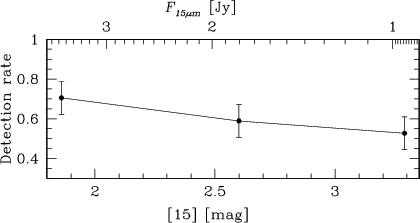 |
Figure 8:
Detection rate as a function
of the magnitude at 15 m (ISOGAL [15] or MSX D band).
Each bin contains 145 sources. |
| Open with DEXTER | |
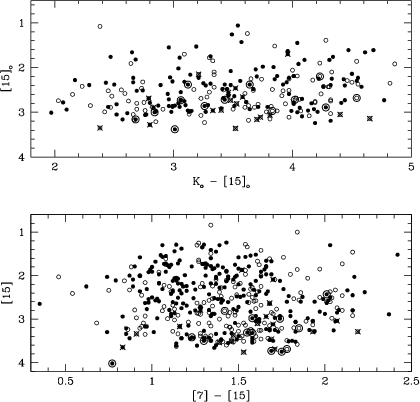 |
Figure 9:
Lower panel:
[15] versus
([7] - [15]) colour-magnitude diagram;
where ISOGAL magnitudes, or the A and D MSX magnitudes
if no ISOGAL magnitude is available, are used.
Upper panel:
versus
ISOGAL-DENIS
extinction corrected colour-magnitude diagram.
Detections are shown as filled circles; non detections as
open circles. The LPVs from Glass et al. (2001)
are marked with a larger open circle, whereas the
sources from Schultheis et al. (2000) are marked with crosses.
Note that two points fall outside the figure.
|
| Open with DEXTER | |
In spite of the many observational studies of SiO maser
emission, its pumping mechanism is still unclear.
Previous 43 GHz SiO maser and mIR observations show a linear
correlation between the respective flux densities
(Bujarrabal et al. 1996,1987; Jiang 2002; Nyman et al. 1993).
This correlation argues
in favor of radiative pump of the SiO masers,
and against collisional pumping models.
The average ratio between the 86 GHz
SiO (v = 1) maser peak intensity and the
12 m IRAS flux density is
0.1, though with a large scatter (Bujarrabal et al. 1996).
The dotted line in
Fig. 10 is the best fit found
by Jiang (2002) between the 43 GHz SiO maser intensity
and the MSX band A flux density.
Our results do not constrain the
linear relation between the SiO maser and the mIR
flux densities.
Unfortunately, our data are not suitable to study
this relation because the SiO intensity distribution is
limited by sensitivity and the data span less than one order
of magnitude of the mIR flux density,
which is narrower than the data of previous work.
The scatter is caused partly by the intrinsic source variability
and the non-simultaneity of the mIR and SiO
maser observations, and partly by a wide range of source distances.
We looked at the distance effects considering the magnitudes
log(
 and log(
 ,
which are independent of
the distance, and we obtained a similar scattered diagram.
,
which are independent of
the distance, and we obtained a similar scattered diagram.
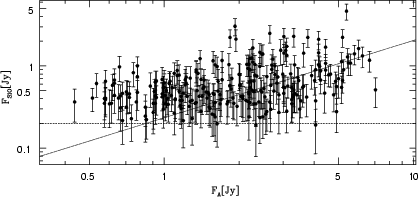 |
Figure 10:
86 GHz SiO peak intensity as a function of
MSX A band or ISOGAL 7 m flux density.
The dashed horizontal line
shows the average 3 detection limit.
The dotted line shows the relation
obtained by Jiang (2002) from 43 GHz data.
detection limit.
The dotted line shows the relation
obtained by Jiang (2002) from 43 GHz data. |
| Open with DEXTER | |
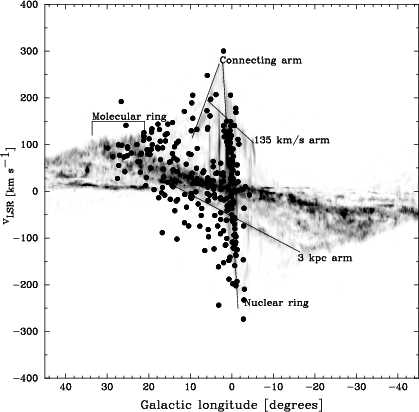 |
Figure 11: Stellar longitude-velocity diagram overlayed on the grayscale CO (l-v) diagram from Dame et al. (2001). The SiO 86 GHz masers are shown as dots. |
| Open with DEXTER | |
 .
Around
longitude
.
Around
longitude
 the stellar distribution follows the high
velocity gas component of the nuclear disk.
Similar results were found by Sevenster et al. (2001).
We defer a more detailed analysis of the
kinematic properties of the new SiO maser sample to a future paper.
the stellar distribution follows the high
velocity gas component of the nuclear disk.
Similar results were found by Sevenster et al. (2001).
We defer a more detailed analysis of the
kinematic properties of the new SiO maser sample to a future paper.
In Fig. 12 we have marked, as open circles,
the location of the HCN lines we
detected at velocities smaller than -30 km s-1 with
widths wider than 7.5 km s-1.
Their distribution mostly follows the central gas distribution,
confirming their interstellar origin and the validity of the adopted
classification criteria based on the line width.
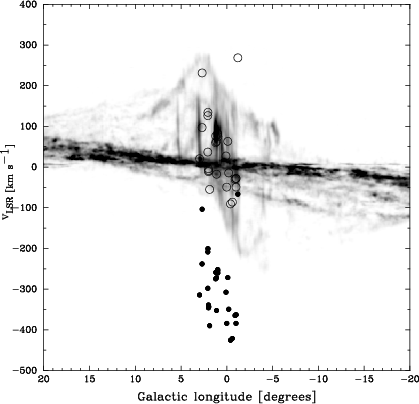 |
Figure 12:
The grayscale is the CO (l-v)
diagram from Dame et al. (2001). The open circles indicate
HCN lines, their location is in agreement with the CO distribution.
The dots represent the
position of the same lines if considered as SiO lines. The (l-v) diagram
confirms the interstellar origin of those lines. The open circle
located above the CO distribution at l=-1.2 (source #288) is discussed in Sect. 4.6. |
| Open with DEXTER | |
All OH/IR stars from the catalogues by Sevenster et al. (1997a,b, 2001), Sjouwerman et al. (1998) and Lindqvist et al. (1992) were excluded from our target list since their velocities are already known from the OH maser lines. Besides, previous studies (Nyman et al. 1993,1986) anticipate a low detectability of 86 GHz SiO masers in OH/IR stars toward the Galactic centre, which also seems to be consistent with the results of our recent 30-m IRAM survey for 86 GHz SiO masers in Galactic center OH/IR stars Messineo et al. (2002b), in preparation.
There is a small overlap between the regions observed for
the Japanese 43 GHz SiO maser surveys of IRAS
point sources (Deguchi et al.2000a,b; Izumiura et al. 1999)
and the region observed for our survey.
Using a search radius of 25
around each of our sources,
which is about half the 43 GHz main beam at the Nobeyama telescope
and almost the full 86 GHz beam of the IRAM 30-m,
we found 19 matches between our positions and the IRAS sources
positions (Table 4).
The velocities at 86 and 43 GHz of 7 sources detected
in both lines agree within a few km s-1.
Source #256 (IRAS 18301-0900) shows a difference of 8 km s-1
between the SiO maser line at 43 GHz and at 86 GHz, but this
source clearly has a double peak in the 43 GHz spectrum and the 86 GHz
peak corresponds to one of the 43 GHz peaks. The low number of
sources which are detected in both surveys needs further study, but
can partially be due to source variability.
Considering those 19 sources in common between the two surveys,
the SiO maser detection rate appears higher at 43 GHz (68%)
than at 86 GHz (52%). However, this small
sample of sources is not
representative of our full sample and of our 86 GHz SiO maser detection rate
(66% for MSX); it is biased toward redder A-D colour
(higher mass-loss rate).

|
To avoid saturation of the detector, the very centre of the Galaxy was not observed by ISOGAL (see Ortiz et al. 2002). Therefore, none of our sources is located in the regions centered on SgrA, which were mapped at 43 GHz by Miyazaki et al. (2001) and Deguchi et al. (2002).
Imai et al. (2002) report 43 GHz SiO maser detections towards LPV stars found by Glass et al. (2001). Seven LPV stars detected at 43 GHz coincide with sources in our 86 GHz SiO maser survey (#48 = g23-5, #49 = g23-8, #52 = g21-39, #56 = g22-11, #73=g6-25, #80=g14-2, #332=g12-21). In 4 cases there is a corresponding SiO maser detection in the 86 GHz spectrum at a velocity consistent with the 43 GHz line. Sources #80 and #49 were both detected at 86 GHz, but there is a significant difference between the 86 and 43 GHz velocities of 7 and 17 km s-1, respectively. The reason for this is unclear because the 43 GHz spectra were not published in Imai et al (2002). Finally, #332 was detected at 43 but not at 86 GHz, which is probably due to source variability.
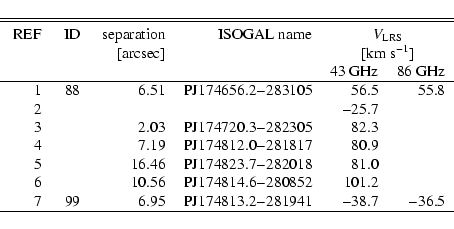
|
in all cases, and from their
mIR colours, we confirm that those seven detections are
stellar maser sources in the line-of-sight of the giant molecular cloud Sgr B2.
Two of those ISOGAL sources were observed in our 86 GHz survey, and
for both sources the 43 and 86 GHz line velocities are consistent
(see Table 5).
#21 and #22
Sources #21 and #22 were detected in the same beam. The peak
intensity of #21 is only 3 times the noise rms and we list the line as a
marginal detection. However, a second ISOGAL source,
ISOGAL-PJ174232.9-294124, happened to fall inside the beam, at
15.6
from the position we targeted. This source is less bright at 15
m
(
[15] = 4.73) than the targeted ISOGAL-PJ174232.5-294110
(
[15] = 3.17) and this suggests that the original targeted
ISOGAL-PJ174232.5-294110 is the
mIR counterpart of the stronger SiO line, #22, while
ISOGAL-PJ
174232.9-294124 is probably the counterpart of #21.
Observations at 86 GHz and/or both of the 43 GHz SiO lines, at both stellar
positions, may confirm our conclusion.
#64 and #65
Two very narrow SiO line sources #64 and #65 were detected in the
same spectrum. Both
lines have the same peak intensity, but different velocities, 53.7
and -7.2 km s-1, respectively. This
suggests that the two lines are generated in the envelopes of two different AGB stars.
The ISOGAL
catalogue does not give another source within 30
of the position of targeted ISOGAL-PJ174528.8-284734, neither does
inspection of the ISOGAL images at 7 and 15 m. However, at that
position there is
strong background emission which may have limited detection of
fainter stellar mIR sources.
#77 and #78
Sources #77 and #78 were
detected in the same spectrum at velocities
of 141.6 and 27.6 km s-1, respectively. The targeted ISOGAL source,
ISOGAL-PJ174618.9-284439, is separated by 12.5
from
ISOGAL-PJ174619.5-284448. However, the latter is a weak mIR source
only detected at 7
![$\mu{\rm m}\ ([7] = 8.73)$](/articles/aa/full/2002/37/aa2744/img75.gif) by ISOGAL.
Again, observing at 86 or 43 GHz at both stellar positions
may resolve the mIR counterpart associated with the SiO maser line.
by ISOGAL.
Again, observing at 86 or 43 GHz at both stellar positions
may resolve the mIR counterpart associated with the SiO maser line.
#94
This double peaked source is located in the Sgr B2 region.
The two lines have similar intensities and are at velocities
-36.6 and -28.8 km s-1 with respect to SiO (or 299.4 and 307.2 with respect to HCN),
with widths of 5 and 3 km s-1, respectively. The small velocity separation between
the peaks suggests that the two emissions are related.
The velocity separation is also consistent with two different
HCN hyperfine transitions, but one of the two peaks has a velocity larger than -30km s-1 and does not fall in our HCN classification criteria. The location of this source on the (l-v)
diagram agrees with the CO distribution when considered
as an SiO line. Thus the source is listed here among the
SiO line detections.
In Sgr B2, other double peaked profiles have been seen in SiO emission
with line widths of 100 km s-1 and at velocities
from -25 to 100 km s-1 (Martin-Pintado et al. 1997).
The SiO emission in #94 may not be associated
with the circumstellar envelope close to the star as in all
other cases, as its profile may be more typical to that
of bipolar molecular outflows.
#117
See the discussion in Sect. 3.4.
#288
We detected a 14.7 km s-1 wide line at a velocity of -66.6 km s-1 with
respect to SiO (or 269.4 with respect to HCN), which we classified as likely being an HCN line.
However, Fig. 12 shows that the point if regarded as HCN is far from any CO emission.
The source,
 ,
is located in the region
of the X-ray transient (EXS17379-2952), a region of interest
to many other observers.
In that region, Durouchoux et al. (1998) detect a few dense CO molecular clouds, of which one at
a velocity of -60 km s-1.
We suggest that the SiO line at the position of #288
has an interstellar origin and is associated with the CO cloud of
Durouchoux et al. (1998).
,
is located in the region
of the X-ray transient (EXS17379-2952), a region of interest
to many other observers.
In that region, Durouchoux et al. (1998) detect a few dense CO molecular clouds, of which one at
a velocity of -60 km s-1.
We suggest that the SiO line at the position of #288
has an interstellar origin and is associated with the CO cloud of
Durouchoux et al. (1998).
#423
At the position of #423 we detected a line which according to our
criteria is an HCN line. This is the only detection outside the
Galactic centre region, at a longitude of 23 degrees,
that is found at high negative velocity, -204.7 km s-1 (with respect to SiO)
and with a fairly wide line width (22 km s-1).
Its position as SiO line does not fit the velocity-longitude diagram (it
does fit when regarded as HCN emission, then at velocity 131.3 km s-1), and
Izumiura et al. (1999) searched for 43 GHz SiO maser without any success.
The MSX maps do not show any extended mIR emission or dark region at that
position that could suggest the presence of a cloud, however CO maps
show a strong concentration of molecular matter (Dame et al. 2001).
Also IRAS detected a mIR source, IRAS18302-0848, within 10
from the MSX position, and with IRAS flux densities consistent with the
MSX flux densities.
For this highly reddened source, Stephenson (1992) found a strong excess
(4-5 mag) in the R-I colour and absence of molecular bands in the
I-spectrum, and concluded that any intrinsic contribution to the redness
should be small.
Following his conclusion, that IRAS 18302-0848 is a distant luminous star
(which has also been supported by Creese et al. 1995),
we conclude that #423 is not an 86 GHz SiO maser emitter and that
the origin of reddening of this star is also the origin of the HCN
emission we detected.
 and |b| mostly <1), in the SiO
(
)
maser transition and detected 271 lines.
We thereby obtained 255 new line-of-sight velocities which doubles the number
of maser line-of-sight velocities known in the region we surveyed.
To search for 86 GHz (v = 1) SiO maser lines in colour-selected mIR sources
has proven to be an efficient way to obtain stellar radial velocities in the Inner Galaxy.
In the central 2 degrees we notice some confusion with interstellar HCN emission,
but usually the interstellar HCN and the stellar SiO line
can be separated well by using their radial velocities and line widths.
The SiO maser emission was detected towards 61% of our
sources, objects which lie in a transition region of the IR-colour space between
Mira and OH/IR stars.
The SiO maser detectability decreases with decreasing mIR flux density.
We observed 15 sources from the sample of LPV stars by Glass et al. (2001)
and found 86 GHz SiO maser emission in 11 of them (73 %),
while only 23% of the LPV stars which follow our selection criteria
show OH maser emission.
Therefore 86 GHz SiO maser emission is more
frequent than OH maser emission.
In a later study we will use our new catalogue of
stellar line-of-sight velocities
for a quantitative analysis of stellar kinematics
and SiO maser properties in the Inner Galaxy.
and |b| mostly <1), in the SiO
(
)
maser transition and detected 271 lines.
We thereby obtained 255 new line-of-sight velocities which doubles the number
of maser line-of-sight velocities known in the region we surveyed.
To search for 86 GHz (v = 1) SiO maser lines in colour-selected mIR sources
has proven to be an efficient way to obtain stellar radial velocities in the Inner Galaxy.
In the central 2 degrees we notice some confusion with interstellar HCN emission,
but usually the interstellar HCN and the stellar SiO line
can be separated well by using their radial velocities and line widths.
The SiO maser emission was detected towards 61% of our
sources, objects which lie in a transition region of the IR-colour space between
Mira and OH/IR stars.
The SiO maser detectability decreases with decreasing mIR flux density.
We observed 15 sources from the sample of LPV stars by Glass et al. (2001)
and found 86 GHz SiO maser emission in 11 of them (73 %),
while only 23% of the LPV stars which follow our selection criteria
show OH maser emission.
Therefore 86 GHz SiO maser emission is more
frequent than OH maser emission.
In a later study we will use our new catalogue of
stellar line-of-sight velocities
for a quantitative analysis of stellar kinematics
and SiO maser properties in the Inner Galaxy.
Acknowledgements
We thank D. Levine and M. Morris for sharing their experience about preliminary observations of SiO masers with the IRAM 30 m telescope. We are grateful to Ute Lisenfeld, Frank Bertoldi, and the IRAM staff for their support in the observations, most of which were made possible only through the flexible observing mode recently introduced at the 30 m telescope. We thank Frederic Schuller for his help with the ISOGAL data. Many thanks to Martin Bureau for fruitful discussions on stellar galactic dynamics. This work was carried out in the context of EARA, the European Association for Research in Astronomy. LOS acknowledges support from the European Commission under contract HPRI-CT-1999-00045. The work of MM is funded by the Netherlands Research School for Astronomy (NOVA) through a netwerk 2, Ph.D. stipend.
![\begin{figure}
\includegraphics[angle=90,width=18cm,height=22.75cm]{2744.f7_3.ps}\end{figure}](/articles/aa/full/2002/37/aa2744/img78.gif)
![\begin{figure}
\includegraphics[angle=90,width=18cm,height=22.75cm]{2744.f7_3.ps}\end{figure}](/articles/aa/full/2002/37/aa2744/img79.gif)
![\begin{figure}
\includegraphics[angle=90,width=18cm,height=22.75cm]{2744.f7_4.ps}\end{figure}](/articles/aa/full/2002/37/aa2744/img80.gif)
![\begin{figure}
\includegraphics[angle=90,width=18cm,height=22.75cm]{2744.f7_5.ps}\end{figure}](/articles/aa/full/2002/37/aa2744/img81.gif)
![\begin{figure}
\includegraphics[angle=90,width=18cm,height=22.75cm]{2744.f7_6.ps}\end{figure}](/articles/aa/full/2002/37/aa2744/img82.gif)
![\begin{figure}
\includegraphics[angle=90,width=18cm,height=22.75cm]{2744.f7_7.ps}\end{figure}](/articles/aa/full/2002/37/aa2744/img83.gif)
![\begin{figure}
\includegraphics[angle=90,width=18cm,height=22.75cm]{2744.f7_8.ps}\end{figure}](/articles/aa/full/2002/37/aa2744/img84.gif)
![\begin{figure}
\includegraphics[angle=90,width=18cm,height=22.75cm]{2744.f7_9.ps}\end{figure}](/articles/aa/full/2002/37/aa2744/img85.gif)
![\begin{figure}
\includegraphics[angle=90,width=18cm,height=22.75cm]{2744.f7_10.ps}\end{figure}](/articles/aa/full/2002/37/aa2744/img86.gif)
![\begin{figure}
\includegraphics[angle=90,width=18cm,height=22.75cm]{2744.f7_11.ps}\end{figure}](/articles/aa/full/2002/37/aa2744/img87.gif)
 .
The conversion factor from antenna temperature to flux density is
6.2 Jy K-1.
.
The conversion factor from antenna temperature to flux density is
6.2 Jy K-1. 
