and NGC 4395
![[*]](/icons/foot_motif.gif)
A&A 391, 809-821 (2002)
DOI: 10.1051/0004-6361:20020588
B. Cedrés1 - J. Cepa1,2
1 - Instituto de Astrofísica de Canarias, 38205 La Laguna, Tenerife, Spain
2 - Departamento de Astrofísica, Facultad de Física, Universidad de La Laguna, 38071 La Laguna, Tenerife, Spain
Received 19 November 2001 / Accepted 16 April 2002
Abstract
Using CCD observations in the narrow band filters in H ,
H
,
H ,
[O II], [O III], [S II] and [S III] lines
we have compiled a catalogue of 338 H II regions for the inner parts of NGC 5457 and 158 for NGC 4395. The
extinction, equivalent widths, distributions, excitations, ionization hardness, ionization parameters and metallicities for these regions, a distinction being made between arm and
inter-arm zones, are presented here with the first results of a
study of stellar formation.
,
[O II], [O III], [S II] and [S III] lines
we have compiled a catalogue of 338 H II regions for the inner parts of NGC 5457 and 158 for NGC 4395. The
extinction, equivalent widths, distributions, excitations, ionization hardness, ionization parameters and metallicities for these regions, a distinction being made between arm and
inter-arm zones, are presented here with the first results of a
study of stellar formation.
Key words: H II regions - galaxies: individual: NGC 4395, NGC 5194 - galaxies: abundances
As part of a work to evaluate the differences in the stellar formation
occurring in the arm and inter-arm regions of
grand design galaxies and to compare this type of star formation with that
in flocculent galaxies, we have obtained images using
narrow band filters for the wavelengths H,
H,
[O II]
 ,
[O III]
,
[O III]
 ,
[S II]
,
[S II]
 and [S III]
 and their respective continua. We present
here the distribution, extinctions, equivalent widths, excitations, ionization hardness, ionization parameters and metallicities
of the H II regions observed.
and their respective continua. We present
here the distribution, extinctions, equivalent widths, excitations, ionization hardness, ionization parameters and metallicities
of the H II regions observed.
For this study we have selected NGC 5457 (a grand design spiral galaxy) and NGC 4395 (a flocculent spiral galaxy). NGC 5457 is a type 9 galaxy (from Elmegreen & Elmegreen 1987, classification). It has been previously studied (together with other galaxies) by Searle (1971) and Smith (1975), who established the existence of metallicity gradients in discs. Other spectrophotometric observations have been carried out by van Zee et al. (1998), Kennicutt & Garnett (1996), Scowen et al. (1992) and others cited by these workers. NGC 5457 has been studied in the X-ray regime by Williams & Chu (1995), who discovered that several of the detected sources were giant H II regions and explained this emission as a mixture of X-ray binaries and supernova remnants (SNRs). This galaxy was selected due its size and number of bright H II regions.
NGC 4395 is a type 1 galaxy (Elmegreen & Elmegreen 1987) and is the complete opposite to NGC 5457 in terms of its properties. It has chaotic, fragmented and asymmetric arms, but hosts intense star formation processes, with bright H II regions.
NGC 4395 has been studied in detail by Roy et al. (1996), who have discovered that there is no global O/H abundance gradient across the disc. They explained this in terms of a large scale redistribution of interstellar matter over a timescale of a few galactic rotations. However, van Zee et al. (1998), taking into account new spectroscopic results, suggest there is a shallow gradient. These authors also confirm that the nucleus of this galaxy harbours a dwarf Seyfert, as was claimed by Ho et al. (1995).
All the previous works have been limited by the low number of regions (i.e. Kennicutt & Garnett 1996) because of either the spectroscopic technique or the few lines studied (i.e. Roy et al. 1996 or Scowen et al. 1992) by direct imaging. In this paper we aim to complete these earlier studies by observing a significant number of H II regions in several emission lines in order to be able to extract statistical conclusions about the star formation trends that occur in spiral galaxies.
, wher
we obtained the H,
H,
[O II] and [O III] images and their
continua. We used the ALFOSC instrument in direct imaging mode, with a 2 k Loral CCD (2048  2048 pixels) and with a
scale of 0.189
2048 pixels) and with a
scale of 0.189
 /pix.
/pix.
The second run was during 1999 March 21-24 on the 2.2 m telescope located at Calar Alto Observatory, where we obtained the
[S II] images and its continua. We used CAFOS in direct imaging mode, with an SITe#1 d CCD (
 2048 pixels), with a scale of 0.4996
/pix.
2048 pixels), with a scale of 0.4996
/pix.
In the last run, 2000 July 5-7, on the Calar Alto 3.5 m telescope, we obtained [S III]
images and continua for NGC 5457. We used MOSCA in direct imaging mode, with an SITe-16a CCD (4096
4096 pixels) with a scale of 0.32
/pix.
Table 1 summarizes the main parameters of the observed galaxies.
| Galaxy | Morphological | Arm | R25 | V | i | PA |
| type | class | ' | km s-1 |  |
|
|
| (1) | (2) | (3) | (4) | (3) | (3) | |
| NGC 4395 | SA(s)m | 1 | 6.58 | 318 | 18 | 147 |
| NGC 5457 | SAB(rs)cd | 9 | 14.41 | 241 | 18 | 37 |
|
(1) De Vaucouleurs et al. (1991).
(2) Elmegreen & Elmegreen (1987). (3) van Zee et al. (1998). (4) http://nedwww.ipac.caltech.edu/ |
| Filter |
 (Å)
(Å) |
FWHM (Å) | Exp. time (s) |
| [O II] cont. | 3500 | 330 | 1800 |
| [O II] | 3725 | 29 |
 |
| H
cont. |
4685 | 170 | 1800 |
| H |
4864 | 26 |
 |
| [O III] | 5012 | 30 |
|
| [O III] cont. | 5470 | 220 | 1800 |
| H |
6571 | 47 | 1800 |
| H
cont. |
6803 | 50 | 1800 |
| [S II] | 6737 | 66 |
 |
| [S II] cont. | 7157 | 140 |
|
| [S III] cont. | 8510 | 105 |
(1) |
| [S III] | 9150 | 350 |
 (1)
(1) |

package. The reduction consists in bias
correction using bias images (taken at the beginning of each night) and overscan zones in each image; flatfield
correction using from 3 to 6 sky flats per filter taken every night of observation; sky subtraction using 21
21
pixel boxes in image zones not affected by the galaxy, cosmic rays or field stars; and cosmic ray elimination using the
IRAF COSMICRAYS task when we only have one or two images per filter, or combining and extracting the median image when
we have more than two images. With this last method we also get a better signal to noise for the resultant image.
To calibrate the data we used Oke & Gunn's (1983) and Oke's (1990) spectrophotometric standards. The calibration was carried out following Barth et al. (1994).
To subtract the continuum, all the continuum images were multiplied by factors close to unity. These factors were determined assuming that the inter-arm emission was null after the subtraction. This is preferred to the field star method, because these stars may present different spectral energy distributions from that of the stellar population of the galaxy, and also they may present strong absorption lines, so the correction factors will be underestimated or overestimated. Moreover, using this method we are able to correct every line for diffuse background emission.
To separate arm and inter-arm regions in the grand design galaxy (NGC 5457), we used broad band images in the Johnson Ifilter. We fitted a surface for inter-arm zones and then we subtracted it from the galaxy image. In this way, only the arm zones remained with positive values. With this new image we can trace the arms of the galaxy and distinguish with a very high level of confidence if an H II region belongs to the arm or to the inter-arm. Figure 1 shows the location of the arms in NGC 5457. The filled dots are the detected arm regions, open circles are the inter-arm regions.
![\begin{figure}
\par\includegraphics[angle=90,width=80mm,clip]{h3309f1.eps}\end{figure}](/articles/aa/full/2002/33/aah3309/img18.gif) |
Figure 1: Deprojected arms for NGC 5457. Filled dots are arm regions. Open circles are inter-arm regions. Continuum lines mark the limits of the arms. The radius is expressed in arcmin. |
| Open with DEXTER | |
(continuum-substracted). From Figs. 3 to 7 we show the
obtained emission line images for NGC 5457 in H,
[O II],
[O III], [S II] and [S III] respectively (all continuum-substracted). In Fig. 8 we show
the detected regions for NGC 4395 in H
continuum-substracted. From
Figs. 9 to 12 we show the emission line images for NGC 4395 in H,
[O II],
[O III] and [S II] respectively (all continuum-substracted).
 |
Figure 2:
NGC 5457 H
image, continuum substracted. Green dots are the detected regions. |
| Open with DEXTER | |
 |
Figure 3:
NGC 5457 H
image, continuum substracted. |
| Open with DEXTER | |
 |
Figure 4: NGC 5457 [O II] image, continuum substracted. |
| Open with DEXTER | |
 |
Figure 5: NGC 5457 [O III] image, continuum substracted. |
| Open with DEXTER | |
 |
Figure 6: NGC 5457 [S II] image, continuum substracted. |
| Open with DEXTER | |
 |
Figure 7: NGC 5457 [S III] image, continuum substracted. |
| Open with DEXTER | |
 |
Figure 8:
NGC 4395 H
image, continuum substracted. Green dots are the detected regions. |
| Open with DEXTER | |
 |
Figure 9:
NGC 4395 H
image, continuum substracted. |
| Open with DEXTER | |
 |
Figure 10: NGC 4395 [O II] image, continuum substracted. |
| Open with DEXTER | |
 |
Figure 11: NGC 4395 [O III] image, continuum substracted. |
| Open with DEXTER | |
 |
Figure 12: NGC 4395 [S II] image, continuum substracted. |
| Open with DEXTER | |
 |
Figure 13: Deprojected position of the H II regions for NGC 5457. Each circle represents a H II region with the size proportional to the region area. Radius is expressed in arcmin. Angles measured counterclockwise from the west. |
| Open with DEXTER | |
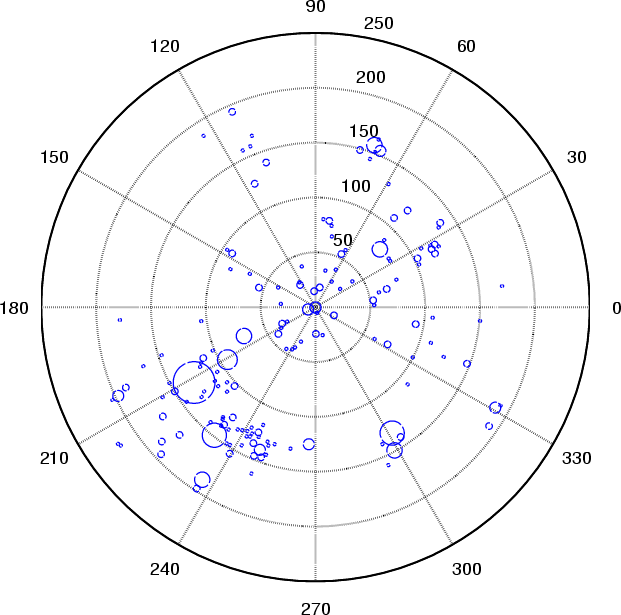 |
Figure 14: Deprojected position of the H II regions for NGC 4395. Each circle represents a H II region with the size proportional to the region area. Radius is expressed in arcmin. Angles measured counterclockwise from the west. |
| Open with DEXTER | |
and Hrate, assuming the B case with an electronic density of 100 cm-3 and 10 000 K (James & Puxley 1993). We also used the
extinction law given by Seaton (1979),
The underlying absorption due massive stars in H II regions could be an important source of errors when fluxes are
calculated. It is possible to obtain reductions on H
equivalent widths of about 50% (McCall et al. 1985), which
leads to overestimation of the absorption. To correct for this effect, we use the method defined by McCall et al. (1985), which
allows us to correct for the underlying absorption effect using the equivalent widths of the H
and Hlines. Since the internal (non-atmospheric) extinction is different in the line and the continuum due to the different
central wavelengths of the filters used, it is necessary to apply an iterative process to correct for underlying
absorption and to derive extinctions: initially the H
and H
equivalent widths uncorrected for extinction
are calculated. From these we evaluate the absorption-corrected H
fluxes before deriving the internal
extinction. This internal extinction is used to correct the H
and H
line and continuum fluxes. Using
these first order extinction-corrected fluxes, we calculate the equivalent widths again, and the H
flux is later
corrected for underlying absorption, which allows the determination of the extinction, etc. This procedure is repeated
until convergence is obtained, which takes only few iterations.
Due to H
width the H
fluxes are contaminated by the [NII]
 6548, 6584 lines. To correct for
this effect we used the data given by McCall et al. (1985) assuming a linear gradient for the behaviour of
[NII]/H.
6548, 6584 lines. To correct for
this effect we used the data given by McCall et al. (1985) assuming a linear gradient for the behaviour of
[NII]/H.
The continuum H
and H
fluxes of H II regions were also contaminated by the emission from the underlying galactic
disc. To avoid this effect, we applied a box median filter to the continuum image. We selected the size of the box wider
enough to avoid sampling the H II regions but narrower than the arms size to sample them. With this process we
obtained an image of the galactic disk, including the arms. After this, we substracted this image from the continuum
image and then we calculated the extinctions and equivalent widths.
The fluxes were extracted using the FOCAS task. With this program we created limiting isophotes for each region defined
where the flux for the region was under 3 of the background. After that, we created a mask for each region using
this isophote as the limiting border, and we multiplied this mask for the line image, getting the emission flux for this
new image easily using only the IRAF IMSTATISTICS task.
of the background. After that, we created a mask for each region using
this isophote as the limiting border, and we multiplied this mask for the line image, getting the emission flux for this
new image easily using only the IRAF IMSTATISTICS task.
.
Table 3 summarizes the properties of the H II region sample for NGC 5457. Column 1 is the region identification
number. Columns 2 and 3 are the position of the region in the galaxy, in arcsec, with respect to the nucleus with east
and north positive. Column 4 lists the deprojected galactocentric radius,
R, in arcminutes, assuming
an inclination of 18
and a position angle of 37
(van Zee et al. 1998). Column 5 lists the visual
extinction in magnitudes for each region. Column 6 lists the
extinction-corrected H
flux in units of
10-13 erg cm-2 s-1. Column 7 lists the base 10 logarithm of H
equivalent width, with the equivalent width expressed in Å. Column 8 lists the extinction corrected H
flux in units of 10-13 erg cm-2 s-1. Column 9 lists the base 10 logarithm of H
equivalent width, with the
equivalent width expressed in Å. Column 10 indicates whether
the region belongs to the arm (A) or interarm (I)
zones.
Table 6 summarizes the properties of the H II regions for NGC 4395. The distribution of the columns are the same
as for Table 3, but without Col. 10.
Table 4 summarizes the flux for several emission lines for NGC 5457. Column 1 lists the identification number of the region. Columns 2-5 list the [O II], [O III], [S II] and [S III] ratios.
All the quantities are relative to H and extinction corrected. We have assumed the theoretical relations:
I([O III]
and extinction corrected. We have assumed the theoretical relations:
I([O III]
 ) = 1.34I([O III]
 )
and I([S III]
)
and I([S III]
 ) = 3.43I([S III]
 ).
).
Table 7 gives the same as Table 4 but for NGC 4395. In this case, there is no Col. 5 because we did not obtain [S III] images for this galaxy.
In Table 5 we summarize several quatities derived for line ratios for NGC 5457. Column 1 is the region
identification number, Col. 2 is the R23 parameter defined in Eq. (2),
 4363 are unavaliable.
Column 3 is the oxygen abundance derived from Zaritsky et al.'s (1994) calibration, defined in Eq. (3),
 .
.
 parameter defined in Eq. (4).
 |
(5) |
 |
(6) |
 ,
and it is assumed the low-density limit and no temperature fluctuations.
,
and it is assumed the low-density limit and no temperature fluctuations.
Table 8 summarizes the same as Table 5 but for NGC 4395. In this case there is no Col. 4.
Figure 15 shows the number of region with different extinction using a histogram for NGC 5457. Figure 16 shows the extinction also but for arm (upper panel) and inter-arm (bottom panel) regions. We obtained a mean value of AV=0.79 for all the regions and 0.71 for arm and 0.91 for inter-arm regions.
 |
Figure 15: Histogram for extinction in NGC 5457. |
| Open with DEXTER | |
 |
Figure 16: Histogram for extinction in NGC 5457. Top panel, arm regions; down panel inter-arm regions. |
| Open with DEXTER | |
Figure 17 shows the numbers of regions with different extinction for NGC 4395.
There is a clear difference in extinction between the flocculent galaxy and the grand design galaxy. For the flocculent
one there are many regions with values for extinction equal to or close to 0,
whereas for NGC 5457 the mean is closer to 1
and is distributed in a somewhat Gaussian style.
 |
Figure 17: Histogram for extinction in NGC 4397. |
| Open with DEXTER | |
equivalent width provides a measure of the ratio of ionizing photons from massive stars and continuum
photons from the embedded stars and gas. Therefore, it is sensitive to variations in the initial mass function (IMF), the stage of evolution of
ionizing stars and the metallicity (Leitherer et al. 1999; Kennicutt et al. 1989; Martin & Friedli 1999; Bresolin &
Kennicutt 1997). Generally, the EW(H)
in disc galaxies goes
from 100 Å to 1500 Å, with a mean value of
400 Å.
equivalent width for NGC 5457. The mean
value for this galaxy is  (
(
![$EW\rm [H\alpha])=3.22$](/articles/aa/full/2002/33/aah3309/img52.gif) ,
which is equivalent to an age of between 1.6 and 4 Myr,
depending on the IMF selected (using Leitherer et al. 1999 models).
,
which is equivalent to an age of between 1.6 and 4 Myr,
depending on the IMF selected (using Leitherer et al. 1999 models).
 |
Figure 18:
Histogram for log of H
equivalent width in NGC 5457. |
| Open with DEXTER | |
equivalent width for the arm zones (upper panel) and for the inter-arm zones (lower panel). The arm zones and inter-arm zones too yield a mean value of
![$\log~(EW[\rm H\alpha])=3.22$](/articles/aa/full/2002/33/aah3309/img54.gif) .
.
 |
Figure 19:
Histogram for log of H
equivalent width in NGC 5457. Top panel, arm regions; down panel inter-arm regions. |
| Open with DEXTER | |
equivalent width as a function of galactocentric radius for NGC 5457. Filled dots are arm regions, open circles are inter-arm regions.
 |
Figure 20:
H
equivalent width as a function of galactocentric radius for NGC 5457. Filled dots are arm regions, open circles are inter-arm regions. |
| Open with DEXTER | |
Figure 21 shows the H
equivalent width for NGC 4395. We obtain a mean value of log
![$(EW[\rm H\alpha])=2.99$](/articles/aa/full/2002/33/aah3309/img57.gif) ,
which is equivalent ot an age of 4 Myr.
,
which is equivalent ot an age of 4 Myr.
Figure 22 shows the H
equivalent width as a function of galactocentric radius for NGC 4395. Although for this galaxy we have less regions, the distribution is somewhat simillar to NGC 5457 with no clear tendence with the radius.
 |
Figure 21:
Histogram for log of H
equivalent width in NGC 4395. |
| Open with DEXTER | |
 |
Figure 22:
H
equivalent width as a function of galactocentric radius for NGC 4395. |
| Open with DEXTER | |
The H II regions can be categorized as "high excitation'' or "low excitation'' in terms of large or small values of the ratio [O III]/H
 5007, 4959)/I(4861) (Aller 1942; Searle 1971). Empirically, strong [O III] lines are related with low oxygen abundance, high gas temperature and a large
value in <
5007, 4959)/I(4861) (Aller 1942; Searle 1971). Empirically, strong [O III] lines are related with low oxygen abundance, high gas temperature and a large
value in <
 >, where <X> is a nebular average (Searle 1971; Smith 1975; Shields 1990).
Figure 23 shows the excitation as a function of galactocentric radius for NGC 5457. Filled dots represent arm regions and open circles represent inter-arm regions. The figure shows that the excitation increases with the radius and there are not clear differences between arm and inter-arm zones. This increase in the excitation can be explained as a effect of the metallicity gradient that will be discussed in Sect. 3.5
 |
Figure 23: Excitation as a function of galactocentric radius for NGC 5457. Arm regions are represented by filled dots. Inter-arm regions are represented by open circles. |
| Open with DEXTER | |
)
and the logarithm of excitation for NGC 5457. Our data
are represented by the filled dots for arm regions and the open circles for the inter-arm regions. It is also
represented comparison data by others authors: Kennicutt & Garnett (1996), crosses; van Zee et al. (1998), asterisks and
McCall et al. (1985), diamonds.
 |
Figure 24:
Correlation between log([O II]/H)
and the logarithm of excitation. Our data are: filled dots, arm
regions; open circles, inter-arm regions. Comparison data: crosses, Kennicutt & Garnett (1996); asterisks, van Zee et al. (1998); diamonds, McCall et al. (1985). The error bars were obtained as a mean of the differences between our data
and the comparison data for the same regions. For accurate error calculation see the tables of this article at CDS. |
| Open with DEXTER | |
 .
.
According with McCall et al. (1985), the clear correlation between log ([O II]/H)
and
([O III]/H)
and the low dispersion of the data means that the majority of the H II regions are
ionization bounded.
In this galaxy there is not a excitation gradient as Fig. 25 shows, probably due to the absence of a metallicity gradient (or at least there is not a steep one) as we will see in Sect. 3.5. These results agree with the obtained by Roy et al. (1996).
 |
Figure 25: Excitation as a function of galactocentric radius for NGC 4395. |
| Open with DEXTER | |
)
and log ([O III]/H)
for
NGC 4395. Our data are the filled dots. The asterisks are data from van Zee et al. (1998) and the open diamonds are from McCall et al. (1985). There is a good coincidence between our data and the comparison ones. As for NGC 5457, we have a relation between the two quatities, although is not as clear as for the grand design galaxy and it has a smaller range of excitation. It is clear also that all NGC 4395 regions are high excitation ones, including the regions for the inner parts. This is clearer in Fig. 27 where we have represented the regions from NGC 5457 (open circles for our data; crosses for Kennicutt & Garnnett 1996 data; asterisks for van Zee et al. 1988 data; and triangles for McCall et al. 1985 data) and the regions from NGC 4395 (filled dots for our data; open stars for van Zee et al. 1998 data; and open squares for McCall et al. 1985 data).
 |
Figure 26:
Correlation between log([O II]/H)
and the logarithm of excitation. Our data are filled
dots.Comparison data: asterisks are from van Zee et al. (1998) and the open diamonds are form McCall et al. (1985). Error bars as in Fig. 24. |
| Open with DEXTER | |
 |
Figure 27:
Correlation between log([O II]/H)
and the logarithm of excitation for NGC 5457 and NGC 4395. For
NGC 5457: open circles are our data, crosses are data from Kennicutt & Garnnett (1996), asterisks are data from van Zee
et al. (1988) and triangles are data from McCall et al. (1985). For NGC 4395: filled dots are our data, open stars are
data from van Zee et al. (1998) and open squares are data from McCall et al. (1985). |
| Open with DEXTER | |
 ,
which creates more uncertainties in metallicity determination in regions with a value of log R23 near that zone. However, only a few of our regions present a value higher than 0.85 in
.
,
which creates more uncertainties in metallicity determination in regions with a value of log R23 near that zone. However, only a few of our regions present a value higher than 0.85 in
.
 to
to
 .
However, this tendency changes around
.
However, this tendency changes around
 for the data from van Zee et al. (1998)
and Kennicutt & Garnett (1996), and it seems that there is an increasing in the oxygen abundance. As van Zee et al. (1998)
have pointed out and as we noted in the present section, this happens because the analytical form of the calibration does not explicitly take into account the
turnover in R23, so it can result in artificially high abundances for the outer H II regions.
for the data from van Zee et al. (1998)
and Kennicutt & Garnett (1996), and it seems that there is an increasing in the oxygen abundance. As van Zee et al. (1998)
have pointed out and as we noted in the present section, this happens because the analytical form of the calibration does not explicitly take into account the
turnover in R23, so it can result in artificially high abundances for the outer H II regions.
 |
Figure 28: Metallicity for NGC 5457. Symbols and error bars as in Fig. 24. |
| Open with DEXTER | |
As we have pointed out in Sect. 3.4.2, in general terms, oxygen abundance for NGC 4395 is smaller than the oxygen abundance in the inner parts of NGC 5457. This can explain the higher excitation that presents the H II
regions of NGC 4395 and the lack of an evident abundance gradient can also explain the lack of gradient in the excitation.
 |
Figure 29: Metallicity for NGC 4395. Filled dots are our data. Asterisks are data from van Zee et al. (1998), open diamonds are data from McCall et al. (1985). Error bars as in Fig. 24. |
| Open with DEXTER | |
,
can be use to
determine trends in the temperature of the ionizing clusters, because there is a direct relation between
and the temperature. The actual relationship depends on stellar model atmosphere calculation (Christensen et al. 1997).
To derive this parameter we have to obtain at least the [S III]9069 line. However, this emission line is
rather weak and it is in a region where the sensitivity of the CCD cameras starts to drop. Moreover, the existence of
narrow band filters in that wavelenght is scarce, and the climatical conditions to obtain the images are very
strict. So we only have avaliables [S III] lines for only a few regions with enough signal-to-noise in
NGC 5457. Fortunately, our fluxes are free of telluric absorption effects because the recession velocity of this galaxy
make the [S III] line fall in 9076 Å where an atmospheric window is present (Hinkle et al. 2000).
In Fig. 30 we have represented this parameter as a function of galactocentric radius for NGC 5457. Our data are
the filled dots. Comparison data, extracted form Kennicutt & Garnett (1996), are the open circles.
 |
Figure 30: Ionization hardness as a function of galactocentric radius for NGC 5457. Our data are filled dots. Open circles are data from Kennicutt & Garnett (1996). |
| Open with DEXTER | |
There is a clear dependence between the two quantities with a decreasing
with increasing radius. These
kind of gradients have been previously found for this galaxy and others by Vílchez & Pagel (1988) or Zaritsky et al. (1994). This can be interpreted as a tendence in the effective temperature of ionizing stars: the temperature is
lower in the inner zones of the galaxy and higher in the outer ones, as was previously pointed out by Christensen et al. (1997), Bresolin et al. (1999) or Garnett (1989).
In Fig. 31 we have represented the logarithm of ionization hardness parameter as a function of the logarithm of
the abundance parameter R23. Our data are represented by the filled dots. Open circles represent the data from Kennicutt & Garnett (1996).
 |
Figure 31:
Relation between log
and log R23 for NGC 5457. Our data are represented by filled
dots. Comparison data from Kennicutt & Garnett (1996) are represeted by open circles. |
| Open with DEXTER | |
,
H,
[O II], [O III], [S II] and [S III] filters. We have
separated the regions in NGC 5457 into arm and inter-arm zones.
We have obtained the extinction for both galaxies using the
H/H
ratio. We have found that arm and
inter-arm regions for NGC 5457 have similar values for extinction. However, the inter-arm regions have slightly higher
extinction. In NGC 4395, there are a large number of regions with extinction equal or close to zero.
We also have obtained the H
equivalent widths for both galaxies. In NGC 5457, arm and inter-arm zones have
the same values for the equivalent width.
We have obtained also the excitation for both galaxies. For NGC 5457 this quantity presents a clear gradient. There are no differences between arm and inter-arm regions and there is a very good coincidence with the previously published data. For NGC 4395 there is no gradient in the excitation and almost all regions in this galaxy are into the high excitation regime. There is also a good agreement with the literature data.
Using a semiempirical calibration proposed by Zaritsky et al. (1994), we have derived the metallicity using oxygen lines. In NGC 5457 there is no difference in metallicity for the arm and inter-arm regions and again we achieve a good agreement with previous spectroscopy works. We have also obtained a clear gradient for the inner parts of this galaxy. For NGC 4395 there is no trace of a gradient.
We can confirm that direct imaging studies permit to obtain emission line fluxes with at least the same precision as in spectroscopy but for any region in the field.
The new generation of tunable filter spectrophotometry will allow to easily extend these kind of works with higher sensitivity and accuracy, for example: the OSIRIS instrument at the 10.4 m Spanish GTC telescope (http://www.iac.es/project/OSIRIS).
Acknowledgements
We thank the anonymous referee for helpful comments and suggestions. We also thank Dr. Jorge Iglesias and Dr. Akihiko Tomita for their suggestions to improve this paper. Part of this work was supported by the Spanish DGES, project number PB97-0218.

![\begin{displaymath}{R}_{23}=\frac{I([\mbox{\rm O\,{\sc ii}}]\lambda3727)+I([\mbo...
...O\,{\sc iii}}]\lambda\lambda4959,5007)}{I({\rm H}\beta)} \cdot
\end{displaymath}](/articles/aa/full/2002/33/aah3309/img40.gif)

![\begin{displaymath}\eta^{\prime}=\frac{[\mbox{O\,{\sc ii}}]\lambda\lambda3726,29...
...mbda6717,31/[\mbox{S\,{\sc iii}}]\lambda\lambda9069,9532}\cdot
\end{displaymath}](/articles/aa/full/2002/33/aah3309/img44.gif)