

Tables 3 and 4 show the physical and dynamical parameters for the Mars-crossing
and the Near-Earth asteroids, respectively. Columns 2 and 3 of both tables
show, for each asteroid, the diameter and the albedo, Cols. 4 to 6 show the
osculating semi-major axis, eccentricity and inclination, and Cols. 7 to 9
show the taxonomic classification according to Tholen (1989) (a), Bus (1999)
(b), and the present work (c). The values of the diameters were
taken either from IRAS (Tedesco et al. 2002)
for those indicated by an asterisk, or were calculated through the relation
(
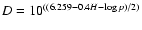 )
(Bowell et al. 1989) using the
absolute magnitude H and an average visual albedo p. The adopted value
of the albedo is the median value for each class, as defined by Bus (1999): 0.21 for A and S
asteroids, 0.07 for B asteroids, 0.06 for C asteroids, 0.23 for V asteroids, and 0.10 for X
asteroids. In Table 4, the values of the diameter and albedo of 1685 Toro and 1943
Anteros are from Veeder et al. (1989), and those for 1980
Tezcatlipoca are from Harris & Davies (1999).
)
(Bowell et al. 1989) using the
absolute magnitude H and an average visual albedo p. The adopted value
of the albedo is the median value for each class, as defined by Bus (1999): 0.21 for A and S
asteroids, 0.07 for B asteroids, 0.06 for C asteroids, 0.23 for V asteroids, and 0.10 for X
asteroids. In Table 4, the values of the diameter and albedo of 1685 Toro and 1943
Anteros are from Veeder et al. (1989), and those for 1980
Tezcatlipoca are from Harris & Davies (1999).
The obtained reflectance spectra for the Mars-crossing and Near-Earth objects are shown in the Appendices A and B, respectively. The classification of the spectra has been made following the taxonomic system developed by Bus (1999) and implemented by our group (Carvano 2002). Twenty-four asteroids of our whole sample (thirteen Mars-crossers and eleven Near-Earth objects) have also been observed by SMASS (Small Main Belt Asteroid Spectroscopic Survey). The results of the SMASS survey are available in numerous publications, whose references are grouped in Binzel et al. (2001). In what follows we will use always the acronym SMASS to refer to any of these publications. Only minor differences are observed, in general, between our spectra and the SMASS ones. A curious case is that of the Mars-crosser 1139 Atami, which will be discussed later.
Most of our observed objects (27 out of 34) have been classified as belonging to the S-complex (including the S, Sa, Sk, Sl, Sq and A classes), as introduced by Bus (1999), but some asteroids of the C complex (Ch and B classes) are also present, in addition to the Ld, V and X classes, showing the diversity present in a such small sample.
In the following subsections we present the results by grouping the asteroids in the several taxonomic classes.
Ten asteroids have been classified as S-type: six Mars-crossers - 323, 1750, 3267, 4558, 7002 and 1994NL2 - and four NEAs - 1036, 1685, 4954 and 7480. Among these asteroids, one Mars-crosser, 4558 Janesick, and all four NEAs have already been observed by SMASS, and both classifications agree, as can be seen in Tables 3 and 4. The Mars-crossers 323 Brucia and 1750 Eckert, and the NEA 1036 Ganymed have been previously classified in the Tholen taxonomy (Tholen 1989) also as S-type asteroids.
Nine objects of our sample have been classified as Sl - Mars-crossers 391,
1656, 1660, 2577, 3343, 3635 and 5230, and NEAs 1943 and 4957.
Among them, five objects - Mars-crossers 391, 1660, 3635 and 5230, and NEA 4957 - had already been classified by SMASS as S-types. Three objects had also been classified by Tholen (1989), two in the S class, 391 Ingeborg and 1656 Suomi, and one in the EU class (2577 Litva).
Regarding the NEA 1943 Anteros, the classification by SMASS is
as a L-type, but our spectrum shows an indication of the 1  m absorption
band (see Appendix B), which places this object in better agreement with a
Sl-type.
m absorption
band (see Appendix B), which places this object in better agreement with a
Sl-type.
We have classified three objects of our sample as Sa: Mars-crossers 2074 and 3873, and NEA 7482. All three objects have been classified as S-type by SMASS. Two objects of our sample have been classified as Sk, the Mars-crossers 699 Hela and 3198 Wallonia. The SMASS classifications are Sk-type for the first object and S-type for the second one. All our three spectra of 3198 Wallonia, obtained on three different nights, are better matched by a Sk-type.
Only two objects have been
classified as Sq-type in our sample. Both are NEAs - 3352 McAuliffe and
3753 Cruithne - that have been previously
classified by SMASS as A-type (3352) and Q-type (3753). Both objects had
already been observed by Lazzarin et al. (1997), whose spectra were
also compatible with a classification in the S class. For 3352 McAuliffe,
all our three spectra are much less red than the template of the A class. In
addition, in the spectra of the object 3753 Cruithne we observe the presence of a
0.6 m band (see Appendix B).
Finally, one object of our sample has been classified as A-type, the NEA 1980 Tezcatlipoca, already classified as SU by Tholen (1989) and as Sl by SMASS. Concerning this object, all our three spectra are much redder than the template of the Sl class and are more compatible with a classification in the A class.
We compared, in the visible range, our spectra of the S-complex asteroids
(Mars-crossers and NEAs) with the spectra of some ordinary chondrite
meteorites measured by Gaffey (1976). From Fig. 1 we see that most of the
asteroid spectra are significantly redder than the OC spectra. In Fig. 1b,
the spectra
situated in the extreme lower part of the S-complex distribution are that of
the Sq-types (3352 McAuliffe and 3753 Cruithne), which show the
better spectral matches with the spectra of the OC meteorites. The correction
factor of +0.025 m is applied to the original spectra of Gaffey (1976)
in order to take into account a calibration offset (Gaffey 1984).
![\begin{figure}
\par\includegraphics[width=10cm,clip]{2578f1.eps} \end{figure}](/articles/aa/full/2002/32/aa2578/img10.gif) |
Figure 1: Spectra of the Mars-crossers a) and NEAs b) classified in the S-complex compared with three ordinary chondrites' spectra Saratov (L4), Soko-Banja (LL4) and Nanjemoy (H6) (Gaffey 1976). The spectra are normalized around 5500 Å and are fitted by a polynomial for clarity. |
With the adopted values of albedo, the diameters of the asteroids classified in the S complex range from 1.1 km to 35.8 km, both for NEAs and Mars-crossers. No relations were found between the reflectivity gradients of the spectra and the diameters of these asteroids.
All objects classified in the C complex are Mars-crossers. Among the two asteroids classified as Ch, one is 1139 Atami, already mentioned above. This object has been classified as S-type by Tholen (1989) and by SMASS, but all our four spectra are compatible with a classification in the C class. This object had, at the time of our observations, a magnitude V=13.3, and its field in the sky was not crowded of stars, so we conclude that this is not a case of an observational mistake. Therefore, the reasons for the differences between our spectra and that of SMASS, producing the disagreement in the classifications remain to be found.
The other asteroid classified as Ch is 4276 Clifford, classified as a Cb-type by SMASS. Our classification comes from the 0.7 m absorption feature, present in the spectra (see Appendix A). The B-class has been attributed to one object, 5870 Baltimore, never classified before. It must be noted, however, that the IRAS albedo for this asteroid is 0.22, a quite high value for a B-type, while in the Bus taxonomy the median albedo value for the B-class is 0.07.
The largest object of our sample classified in the C complex is 1139 Atami, with a computed diameter of 16.9 km. The other objects have an even smaller computed diameter of 7.5 km, for both 5870 Baltimore and 4276 Clifford.
One Mars-crosser (1747 Wright) has been assigned to the Ld class. The Ld is, along with the L class, a newly defined class by Bus (1999), and the Ld classification places the objects between the L and D classes. Our classification does not agree with the previous classification by SMASS, that classified this asteroid as a Sl-type. From the analysis of 1747 Wright we observe that our spectrum is much redder than the template of the Sl class, being in better agreement with a Ld-type. This object has been classified also in the Tholen taxonomy as a AU: type.
We have classified two X-type objects, one Mars-crosser (2204 Lyyli) and one NEA (5751 Zao), both already classified as X-types by SMASS. Following the Tholen taxonomy and considering the low albedo of 0.02 given by IRAS for this asteroid, it would be classified as a P-type. Only one object had the V-class attributed to it, the Amor asteroid 4055 Magellan, previously classified as V-type by Tholen (1989). The Mars-crosser 2204 Lyyli has an IRAS diameter of 25.2 km, but all the other three asteroids have computed diameters smaller than 7 km.
Copyright ESO 2002
![\begin{table}
\par\includegraphics[width=14.36cm,clip]{2578t3.eps}\end{table}](/articles/aa/full/2002/32/aa2578/img8.gif)
![\begin{table}
\par\includegraphics[width=14cm,clip]{2578t4.eps}\end{table}](/articles/aa/full/2002/32/aa2578/img9.gif)