

In the following, we will present the stellar spectral library
put together for this work. For the sake of reference,
Fig. 1 presents the distribution of all spectra
in the
 plane.
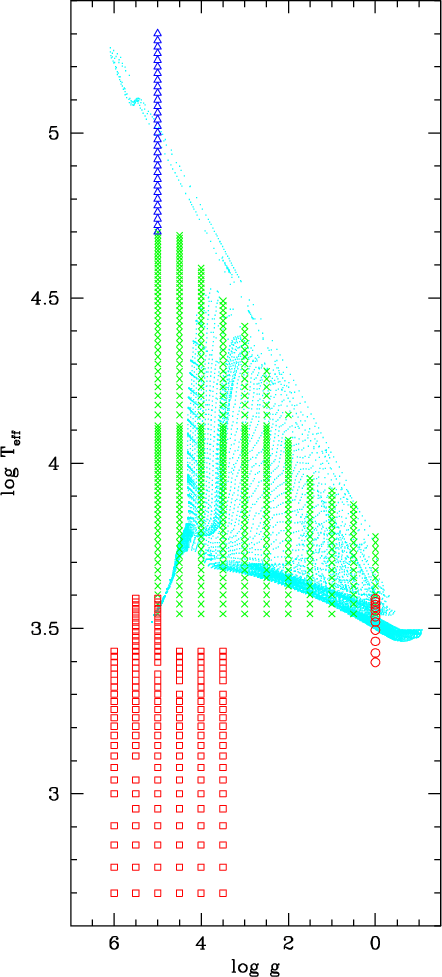 |
Figure 1:
Distribution of the
![$\mbox{\rm [{\rm M}/{\rm H}]}=0$](/articles/aa/full/2002/31/aah3268/img75.gif) spectra incorporated in our
stellar library (large symbols) in the
plane,
compared to the position of stellar models of solar metallicity
(small dots; these models are isochrones to be discussed later in
Sect. 5.1). The spectra are taken from Castelli et al.
(1997; crosses), Fluks et al. (1994; circles),
Allard et al. (2000a; squares), and pure blackbody
(triangles). Fluks et al. spectra have been arbitrarily located at
spectra incorporated in our
stellar library (large symbols) in the
plane,
compared to the position of stellar models of solar metallicity
(small dots; these models are isochrones to be discussed later in
Sect. 5.1). The spectra are taken from Castelli et al.
(1997; crosses), Fluks et al. (1994; circles),
Allard et al. (2000a; squares), and pure blackbody
(triangles). Fluks et al. spectra have been arbitrarily located at
 .
Similar
distributions hold for all metallicities between .
Similar
distributions hold for all metallicities between
![$\mbox{\rm [{\rm M}/{\rm H}]}=-2.5$](/articles/aa/full/2002/31/aah3268/img77.gif) and +0.5(see text).
and +0.5(see text). |
Earlier Padova isochrones were based on the Kurucz (1993)
libraries of ATLAS9 synthetic atmospheres.
As discussed in a series
of papers by Castelli et al. (1997), Bessell et al. (1998),
and Castelli (1999), these models are superseded by now.
Firstly, small discontinuities associated to the scheme of
"approximate overshooting'' initially adopted by Kurucz have
been corrected (cf. Bessell et al. 1998).
Secondly, no-overshooting
models have been demonstrated to produce
 -colour relations
in better agreement with empirical ones, at least for stars hotter
than the Sun (Castelli et al. 1997).
-colour relations
in better agreement with empirical ones, at least for stars hotter
than the Sun (Castelli et al. 1997).
In the present work, we adopt the ATLAS9
no-overshoot models that have been calculated by
Castelli et al. (1997). They correspond to the "NOVER''
files available at http://cfaku5.harvard.edu/grids.html.
The metallicities cover the values
,
-2.0, -1.5,
-1.0, -0.5, 0.0, and +0.5, with solar-scaled abundance ratios.
A microturbulent velocity
 ,
and a mixing length
parameter
,
and a mixing length
parameter
 ,
are adopted.
Notice that these models are now being extended so as to include
also
,
are adopted.
Notice that these models are now being extended so as to include
also  -enhanced chemical mixtures, which represents a potentially
important improvement for our future works.
-enhanced chemical mixtures, which represents a potentially
important improvement for our future works.
Kurucz models cover quite well the region of the
 vs.
vs.  plane actually occupied by stars,
at least in the
plane actually occupied by stars,
at least in the
 ,
,
 intervals (see Fig. 1).
However, it has to be extended to
both lower and higher
s, as will be detailed below.
intervals (see Fig. 1).
However, it has to be extended to
both lower and higher
s, as will be detailed below.
It is important to recall that Kurucz (ATLAS9) spectra are widely used in the field of synthetic photometry, mainly because of their wide coverage of stellar parameters and easy availability. Moreover, there are also good indications in the literature that these spectra do a good job in synthetic photometry, provided that we are dealing with broad-band systems. Compelling examples of this can be found in Bessell et al. (1998), who compares the UBVRIJHKL results obtained from the recent ATLAS9 spectra to empirical relations derived with the infrared flux method, lunar occultations, interferometry, and eclipsing binaries. Their results indicate that the 1998 ATLAS9 models are well suited to synthetic photometry, but for small errors, generally lower than 0.1 mag in colours, that we do not consider as critical. In fact, we are more interested in the overall dependencies of colours and magnitudes with stellar parameters - probably well represented by present synthetic spectra - than on details of this order of magnitude.
Additionally, Worthey (1994) presented extensive comparisons between Kurucz (1993) spectra and stars in the low-resolution spectral library by Gunn & Stryker (1983), obtaining generally a good match for wavelengths redder than the B pass-band. Worthey's Fig. 9 also presents a comparison between Kurucz (1993) solar spectra and Neckel & Labs (1984) data, with excellent results (errors lower than 0.1 mag) all the way from the UV up to the near-IR. Since the ATLAS9 1998 spectra differ just little from the Kurucz (1993) version (a few percent in extreme cases), these results are to be considered still valid.
The previously mentioned works point to a reasonably good agreement between ATLAS9 spectra and those of real stars of near-solar metallicity, especially in the visual and near-infrared pass-bands. However, there are many known inadequacies in these spectra, which should be kept in mind as well. Here, we give just a brief list of the potential problems, concentrating on those which may be more affecting our synthetic colours.
ATLAS9 spectra are based on 1D static and plan-parallel LTE model atmospheres, which use a huge database of atomic line data (Kurucz 1995). The line list is known not to be accurate: In fact, Bell et al. (1994) show that the solar spectra calculated using Kurucz list of atomic data present many unobserved lines; moreover, the number of lines which are too strong exceeds those which are too weak. The problem can be appreciated by looking at the high-resolution spectral plots presented by Bell et al. (1994), but could hardly be noticeable in low-resolution plots (such as in the comparisons presented in Worthey's 1994 Fig. 9, and in Castelli et al. 1997 Fig. 2).
Also, Bell et al. (2001) show that a motivated increase in
the Fe I bound-free opacity cause a significant
improvement in the fitting of the solar spectrum in the
3000-4000 Å wavelength region, affecting the entire
UV region as well. Such increased sources of continuous
opacity are still missing in ATLAS9 atmospheres![[*]](/icons/foot_motif.gif) .
.
These results indicate that
ATLAS9 spectra will produce worse results when applied to
(i) narrow-band photometric systems, in which individual metallic
lines can more significantly affect the colours, and (ii) in the UV
region, especially shortward of 2720 Å (see Bell et al. 2001).
In both cases, the errors caused by wrong atomica data are such that
we can expect not only systematic and
-dependent
offsets in synthetic colours,
but also a somewhat wrong dependence on metallicity.
Clearly, these points are worth being properly investigated by
means of detailed spectral comparisons.
Regarding the present work, the above-mentioned problems (i) critically determine the inadequacy of synthetic colours computed for the Strömgren system (Girardi et al., in preparation), and (ii) may possibly cause significant errors in our synthetic HST/WFPC2 UV colours.
Other potential problems worth of mention are:
 6000 K. The consequences of spatial and thermal inhomogeneities
in the atmosphere of the Sun and Procyon have been investigated by
Allende Prieto et al. (2001, 2002);
-enhanced
ones.
6000 K. The consequences of spatial and thermal inhomogeneities
in the atmosphere of the Sun and Procyon have been investigated by
Allende Prieto et al. (2001, 2002);
-enhanced
ones.
Finally, we remark that some authors (Lejeune et al. 1997, 1998)
propose the application of a posteriori transformations
to Kurucz (1993) spectra, as a function of wavelength and
,
such as to reduce the errors of the derived synthetic UBVRIJHKL
photometry. In our opinion,
such transformations are questionable because they do
not correct the cause of the discrepancies - majorly
identifiable in the imperfect modelling of absorption lines -
and the case for applying them to stars of all surface
metallicities and gravities is far from compelling.
For
 K, we simply assume black-body spectra.
This is probably a good approximation for wavelengths
K, we simply assume black-body spectra.
This is probably a good approximation for wavelengths
 Å. In fact, we find always a reasonably smooth
transition in the computed
Å. In fact, we find always a reasonably smooth
transition in the computed
 s as we cross the
 K temperature boundary.
Synthetic spectra for M giants have still many problems - mainly in their ultraviolet-blue region - that partially derive from incomplete opacity lists of molecules such as TiO, VO and H2O (see e.g. Plez 1999; Alvarez & Plez 1998; Alvarez et al. 2000; and Houdashelt et al. 2000a,b to appreciate the state of the art in the field).
Therefore, we prefer to use the empirical M giant spectra from Fluks et al. (1994; or "intrinsic'' spectra as referred in their paper). They cover the wavelength interval from 3800 Å to 9000 Å. Outside this interval, the empirical spectra have been extendend with the "best fit'' synthetic spectra computed by the same authors.
However, the whole procedure reveals a problem:
if we simply merge empirical and synthetic spectra from
Fluks et al. (1994), the resulting synthetic  and
and  colours
just badly correlate with the measured colours for the
same stars (which were also obtained by Fluks et al. 1994).
This problem probably derives from a
bad flux calibration at the blue extremity
of the observed spectra and/or from the imperfect match between
synthetic and observed spectra at 3800 Å. In order
to circumvent (at least partially) the problem, we simply
multiply each M-giant spectrum blueward of 4000 Å (with a smooth
transition in the range from 4000 Å to 4800 Å) by a constant,
typically between 0.8 and 1.2, so that the synthetic colours recover
the observed behaviour of the
vs.
colours
just badly correlate with the measured colours for the
same stars (which were also obtained by Fluks et al. 1994).
This problem probably derives from a
bad flux calibration at the blue extremity
of the observed spectra and/or from the imperfect match between
synthetic and observed spectra at 3800 Å. In order
to circumvent (at least partially) the problem, we simply
multiply each M-giant spectrum blueward of 4000 Å (with a smooth
transition in the range from 4000 Å to 4800 Å) by a constant,
typically between 0.8 and 1.2, so that the synthetic colours recover
the observed behaviour of the
vs.  data.
The first two panels of Fig. 2 show the results.
data.
The first two panels of Fig. 2 show the results.
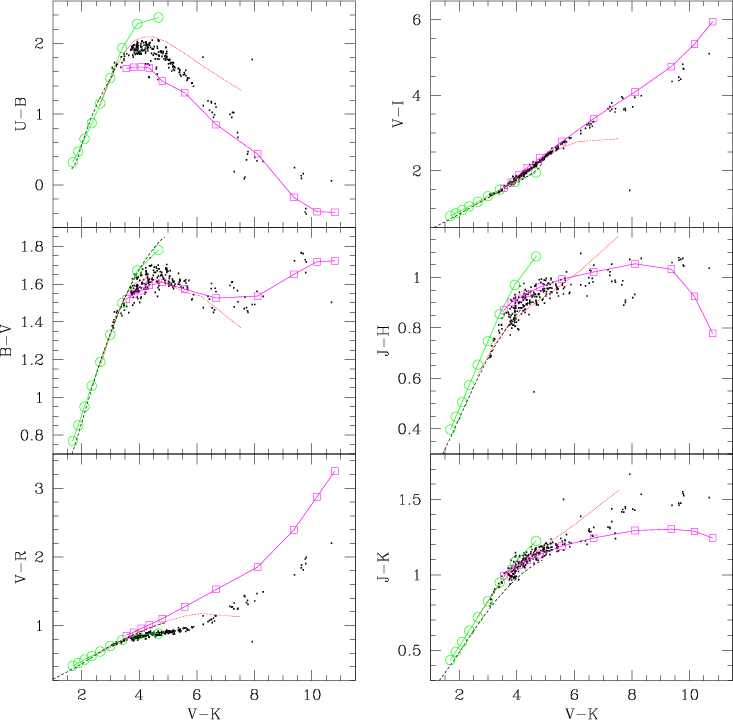 |
Figure 2:
Colour vs.
relations for giants.
The connected open circles represent the
relation obtained from
ATLAS9 spectra located
along the
 line (the typical location for
RGB stars) in the diagram of Fig. 1.
The connected open squares correspond to the
relation obtained from the M-giant spectra from Fluks et al. (1994),
completed and modified at
line (the typical location for
RGB stars) in the diagram of Fig. 1.
The connected open squares correspond to the
relation obtained from the M-giant spectra from Fluks et al. (1994),
completed and modified at
 Å as detailed in the text.
The dashed lines represent the empirical relations for F0-K5
solar-metallicity giants from Alonso et al. (1999b), whereas the
dotted lines are the synthetic relations for K0-M7 giants from
Houdashelt et al. (2000a).
The empirical data for M giants (small dots) are from
Fluks et al. (1994). As far as possible, all observations have been
converted to the same photometric system as used in our synthetic
photometry (i.e. the "Bessell'' UBVRIJHK system; see text). Å as detailed in the text.
The dashed lines represent the empirical relations for F0-K5
solar-metallicity giants from Alonso et al. (1999b), whereas the
dotted lines are the synthetic relations for K0-M7 giants from
Houdashelt et al. (2000a).
The empirical data for M giants (small dots) are from
Fluks et al. (1994). As far as possible, all observations have been
converted to the same photometric system as used in our synthetic
photometry (i.e. the "Bessell'' UBVRIJHK system; see text). |
Actually, Fig. 2 presents six different
colour vs.
diagrams that are useful to understand the
situation for giants. Care has been taken in expressing data and models
in the same photometric system, the "Bessell''
UBVRIJHK one, that we will detail later in Sect. 4.1.
For M giants, the empirical photometric data from Fluks et al.
(1994; small dots) can be compared with the results of our
synthetic photometry. Noteworthy, there is a
reasonably good match between the synthetic and observed relations
for most colours. This has been imposed for
and ,
whereas is
a natural result for all colours involving wavelengths longer
than 4800 Å. The only clear exception is the  colour,
for which differences of 0.4 mag are found for all giants
of spectral type later than M4 (
colour,
for which differences of 0.4 mag are found for all giants
of spectral type later than M4 (
 ). The reason for this
discrepancy is not clear, but may lie in the use of R filters
with different transmission curves. Also the predictions for
). The reason for this
discrepancy is not clear, but may lie in the use of R filters
with different transmission curves. Also the predictions for
 do not fit well all the photometric data, somewhat failing
for the spectral types later than M7 (
do not fit well all the photometric data, somewhat failing
for the spectral types later than M7 (
 ). However, since
these latters are quite rare, such mismatch does not pose a
serious problem.
). However, since
these latters are quite rare, such mismatch does not pose a
serious problem.
For the sake of comparison, Fig. 2
also presents the relations obtained by means of
the M-giant models from Houdashelt et al. (2000a), in the
case of solar metallicity. Together with other recent examples
(e.g. Plez 1999; Alvarez et al. 2000), they represent
state-of-the-art computations of cool oxygen-rich stellar
atmospheres. As can be appreciated in the figure,
Houdashelt et al. models reproduce well the empirical data as
far as
 (spectral types earlier than M5), but start
departing from these for cooler stars. A similar situation
holds if we look at different
(spectral types earlier than M5), but start
departing from these for cooler stars. A similar situation
holds if we look at different
 -colour relations, as
can be seen in Figs. 13 and 14 of Houdashelt et al. (2000a),
where they compare their
-colour relations with those
obtained with Fluks et al. (1994) spectra and data for field
giants. Also in this case, it seems that Fluks et al. (1994)
spectra do better reproduce the empirical relations for the
spectral types later than M4.
-colour relations, as
can be seen in Figs. 13 and 14 of Houdashelt et al. (2000a),
where they compare their
-colour relations with those
obtained with Fluks et al. (1994) spectra and data for field
giants. Also in this case, it seems that Fluks et al. (1994)
spectra do better reproduce the empirical relations for the
spectral types later than M4.
Once we have defined the library of M-giant spectra,
we associate effective temperatures to them by using the scale
favoured by Fluks et al. (1994). In this scale, M giants cover
the temperature interval from 3 850 K
(MK type M0) to 2500 K (MK type M10).
We recall that Fluks et al. (1994)
values
are derived from a careful fitting of the observed spectra with
synthetic model atmospheres of solar metallicity. Their scale is also
in excellent agreement with the empirical one from Ridgway et al.
(1980), which covers spectral types earlier than M6.
After the proper
is attributed, each one of our modified
spectra is completely re-scaled by a constant, so that the
total flux vs.
relation - i.e.
 - is recovered.
Finally, we face the problem of defining the transition between the M-giant spectra, and the ATLAS9 ones which are available for temperatures higher than 3500 K. To this aim, it is helpful to examine Fig. 2, where we also include:
,
which represents fairly well the locus of low-mass red giants
in a
vs.
diagram (see Fig. 1);
![$\mbox{\rm [{\rm Fe}/{\rm H}]}=0$](/articles/aa/full/2002/31/aah3268/img99.gif) as derived from Alonso et al. (1999b) fitting formulas
(dashed lines).
as derived from Alonso et al. (1999b) fitting formulas
(dashed lines).
From inspecting this and other similar plots, we can conclude that
the mismatch between Kurucz ATLAS9 and
Fluks et al. (1994) spectra starts at about
 and
increases slowly as the temperature decreases down to 3500 K
(i.e. from
and
increases slowly as the temperature decreases down to 3500 K
(i.e. from
 to
to
 ).
Hence, we adopt a smooth transition between these two spectral
sources over this temperature interval. The same
M giant spectra are assumed for all metallicities.
).
Hence, we adopt a smooth transition between these two spectral
sources over this temperature interval. The same
M giant spectra are assumed for all metallicities.
The complete procedure ensures reasonable colour vs.
relations
for all giants of near-solar
metallicity (Fig. 2). Nevertheless, this kind
of approach cannot be completely satisfactory, first because the
original Fluks et al. (1994) spectra have been artificially
corrected at wavelengths shorter than 4800 Å in order to produce
reasonable
and ,
and second because we do not dispose of similar M-giant spectra for
metallicities very different from solar. Better empirical and
theoretical spectra for M giants seem to be urgently needed.
Anyway, in the context of the present work the problem is not
dramatic because M giants cooler than
 K are only
found in the RGB-tip and TP-AGB phases of high metallicity stellar
populations, and constitute just a tiny fraction of the number of
red giants. The problem could be critical, instead, when we consider
integrated properties of stellar populations, because M giants,
despite their small numbers, have high luminosities and
contribute a sizeable fraction of the integrated light.
K are only
found in the RGB-tip and TP-AGB phases of high metallicity stellar
populations, and constitute just a tiny fraction of the number of
red giants. The problem could be critical, instead, when we consider
integrated properties of stellar populations, because M giants,
despite their small numbers, have high luminosities and
contribute a sizeable fraction of the integrated light.
Although the modelling of cool dwarfs atmospheres presents challenges comparable to those found in late-M giants (e.g. the inadequacy of TiO and H2O line lists, and dust formation; see Tsuji et al. 1996, 1999; Leggett et al. 2000), present results compare reasonably well with observational spectral data (see e.g. Fig. 9 in both Leggett et al. 2000 and 2001). A review on the subject can be found in Allard et al. (1997).
An extended library of synthetic spectra for cool dwarfs (of types M and later) is provided by Allard et al. (2000a; see ftp://ftp.ens-Lyon.fr/pub/users/CRAL/fallard). We use their set of "BDdusty1999'' atmospheres (see also Chabrier et al. 2000; Allard et al. 2000b, 2001), that should supersede the "NextGen'' models from the same group (Hauschildt et al. 1999) due to the consideration of better opacity lists and dust formation. Dust can significantly affect the coolest atmospheres, corresponding to dwarfs of spectral types L and T.
The selected spectra cover the
intervals:
![$\mbox{\rm [{\rm M}/{\rm H}]}=0.0$](/articles/aa/full/2002/31/aah3268/img105.gif) ,
-0.5, -1.0, -1.5, and both
,
-0.5, -1.0, -1.5, and both
 and 5.5;
,
and
values between 3.5 and 6.0.
and 5.5;
,
and
values between 3.5 and 6.0.
 with a Gaussian filter of
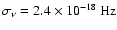 ,
that corresponds to a FWHM
of 20 Å at
,
that corresponds to a FWHM
of 20 Å at
 Å. The resulting spectra were then
reported to the same grid of wavelengths of Kurucz' spectra.
Å. The resulting spectra were then
reported to the same grid of wavelengths of Kurucz' spectra.
We find that there is a good agreement between
ATLAS9 and BDdusty1999 spectra in the
range between
3800 K and 4000 K. Then, we set the transition between
ATLAS9 and BDdusty1999 spectra at 3900 K. This choice
guarantees smooth
vs. colour relations for dwarfs.
Copyright ESO 2002