A&A 391, 195-212 (2002)
DOI: 10.1051/0004-6361:20020612
Theoretical isochrones in several photometric systems
I. Johnson-Cousins-Glass, HST/WFPC2, HST/NICMOS,
Washington, and ESO Imaging Survey filter sets
L. Girardi1,2 - G. Bertelli3,4 -
A. Bressan4 - C. Chiosi1 - M. A. T. Groenewegen5,6 -
P. Marigo1 - B. Salasnich1 - A. Weiss7
1 - Dipartimento di Astronomia, Università di Padova,
Vicolo dell'Osservatorio 2, 35122 Padova, Italy
2 -
Osservatorio Astronomico di Trieste,
via Tiepolo 11, 34131 Trieste, Italy
3 -
Istituto di Astrofisica Spaziale, CNR, via del Fosso del Cavaliere,
00133 Roma, Italy
4 -
Osservatorio Astronomico di Padova,
Vicolo dell'Osservatorio 5, 35122 Padova, Italy
5 -
PACS ICC-team, Instituut voor Sterrenkunde,
Celestijnenlaan 200B, 3001 Heverlee, Belgium
6 -
European Southern Observatory, Karl-Schwarzschild-Str.
2, 85740 Garching bei München, Germany
7 -
Max-Planck-Institut für Astrophysik, Karl-Schwarzschild-Str.
1, 85740 Garching bei München, Germany
Received 5 November 2001 / Accepted 19 April 2002
Abstract
We provide tables of theoretical isochrones in several
photometric systems. To this aim, the following steps
are followed:
(1) first, we re-write the formalism for converting
synthetic stellar spectra into tables of bolometric
corrections. The resulting formulas can be
applied to any photometric system, provided that
the zero-points are specified by means of either ABmag, STmag,
VEGAmag, or a standard star system that includes well-known
spectrophotometric standards. Interstellar absorption can be
considered in a self-consistent way.
(2) We assemble an extended and
updated library of stellar intrinsic spectra. It is mostly
based on "non-overshooting'' ATLAS9 models, suitably extended
to both low and high effective temperatures. This offers an
excellent coverage of the parameter space of
 ,
,
 ,
and [M/H]. We briefly discuss the main uncertainties and points
still deserving more improvement.
(3) From the spectral library, we derive tables of bolometric
corrections for Johnson-Cousins-Glass, HST/WFPC2, HST/NICMOS,
Washington, and ESO Imaging Survey systems (this latter
consisting on the WFI, EMMI, and SOFI filter sets).
(4) These tables are used to convert several sets of Padova
isochrones into the corresponding absolute magnitudes and
colours, thus providing a useful database for several astrophysical
applications. All data files are made available in electronic
form.
,
and [M/H]. We briefly discuss the main uncertainties and points
still deserving more improvement.
(3) From the spectral library, we derive tables of bolometric
corrections for Johnson-Cousins-Glass, HST/WFPC2, HST/NICMOS,
Washington, and ESO Imaging Survey systems (this latter
consisting on the WFI, EMMI, and SOFI filter sets).
(4) These tables are used to convert several sets of Padova
isochrones into the corresponding absolute magnitudes and
colours, thus providing a useful database for several astrophysical
applications. All data files are made available in electronic
form.
Key words: stars: fundamental parameters - Hertzprung-Russell (HR)
and C-M diagrams
1 Introduction
One of the primary aims of stellar evolution theory is that of
explaining the photometric data - e.g. colour-magnitude diagrams
(CMDs), luminosity functions, colour histograms - of resolved
stellar populations. To allow whatever comparison between theory and
data, the basic output of stellar models - the surface
luminosity L and effective temperature
- must be first
converted into the observable quantities, i.e. magnitudes and
colours. This conversion is performed by means of
bolometric corrections (BC) and
-colour relations, and
later by considering the proper distance, absorption and
reddening of the observed population, and the photometric errors.
Determining BCs and
-colour relations
is indeed one of the most basic tasks in stellar astrophysics.
Empirical determinations (see e.g. the compilations by
Schmidt-Kaler 1982; Flower 1996; Alonso et al.
1999a,b) involve a great observational effort, and
are obviously the most reliable if compared to purely
theoretical determinations. However, since the empirical calibrations
are mostly based on
nearby stars, only a limited region in the space of stellar
parameters (
,
,
and metallicity [M/H]) can be covered by
observations. This contrasts with our
present-day capabilities of getting resolved photometry of populations
that are certainly very different from the local one, like those in dwarf
galaxies and in the Bulge. For instance, present empirical relations
do not include young-metal poor populations, or super-metal rich stars,
which are likely present in the resolved galaxies of the Local Group.
Another important limitation of empirical relations is that they are
usually available just for a small set of filters or photometric
systems, like the popular Johnson-Cousins-Glass one. Again, this is in
contrast with the rapid diffusion in the use of specific filter sets,
for which no empirical relation is yet available, though large
databases are already being collected. Just to mention a few relevant
examples, new filter sets have been adopted in the Hubble
Space Telescope (HST) Wide Field Planetary Camera 2 (WFPC2), in the
European Southern Observatory (ESO) Wide Field Imager (WFI), and in
the Hipparcos mission. Moreover, brand-new photometric systems
have been designed for the Sloan Digital Sky Survey (SDSS), and will
be adopted in the future GAIA mission. An impressive amount of data
will be provided by these instruments in the coming years, and much of
it will soon become of public access. Then, it would be highly desirable
to have the capability of converting stellar models to these many
new photometric systems, bypassing for a moment the time-consuming
procedure of empirical calibration.
With this target in mind, we have undertaken a project aiming at providing
theoretical BCs and colour transformations for any broad-band
photometric system, and many intermediate-band systems as well.
Actually, the project starts with the work by
Bertelli et al. (1994), who presented a large database of theoretical
isochrones and converted them to the Johnson-Cousins-Glass UBVRIJHK
system. The transformations were primarily based on Kurucz (1993)
synthetic atmosphere models, suitably extended in the intervals
of lower and higher effective temperatures. In Chiosi et al. (1997),
the same theoretical isochrones are converted to the WFPC2 photometric
system, and the attention is paid to the features that
isochrones and single stellar populations present in ultraviolet (UV)
colours. In particular, they address the question whether the
variation of UV colours of elliptical galaxies as a function of
red-shift presents signatures from which one can infer the age and type
of the source emitting the UV flux. Later on, Salasnich et al. (2000)
present new isochrones for  -enhanced chemical mixtures,
for both UBVRIJHK and WFPC2 photometric systems.
-enhanced chemical mixtures,
for both UBVRIJHK and WFPC2 photometric systems.
The present work is a natural follow-up of this project, in which,
besides extending the number of available photometric systems,
we aim at updating and improving the database of stellar spectra
which is at the basis of the complete procedure.
The plan of this paper is as follows:
Sect. 2 details the adopted formalism.
In Sect. 3, we describe the stellar spectral
library in use. Section 4 gives the basic
information about the several photometric systems under consideration.
The resulting tables of bolometric corrections are then applied to a
large database of stellar isochrones, which are already described in
published papers and briefly recalled in Sect. 5.
Section 6 illustrates some main properties of the
derived isochrones, and describes the retrieval of data in electronic
form.
2 Synthetic photometry
By synthetic photometry we mean the derivation of photometric
quantities based on stellar intrinsic (and mostly theoretical)
spectra, rather than on actual observations. The first works in
this field (e.g. Buser & Kurucz 1978;
Edvardsson & Bell 1989) were based on sets of synthetic spectra
covering very modest - by present standards - intervals of
effective temperature, gravity, and metallicity. The situation
dramatically improved with the release of a large database of
ATLAS9 synthetic spectra
by Kurucz (1993). The first systematic use of Kurucz spectra on
theoretical isochrones has been from Bertelli et al. (1994)
and Chiosi et al. (1997).
In order to apply synthetic photometry to sets of theoretical
isochrones, the basic step consists in the derivation of bolometric
corrections and temperature-colour relations from the available
spectra. Several papers deal with the problem (e.g.
Bertelli et al. 1994; Chiosi et al. 1997; Lejeune et al. 1997;
Bessell et al. 1998),
presenting mathematical formalisms that, although looking somewhat
different, should be equivalent and produce the same results
when applied to the same sets of spectra, filters, and zero-points.
In the following, we re-write this formalism in a very simple way.
Our aim is to have generic formulas that, by just
minimally changing their input quantities, can be applied
to a wide variety of photometric systems.
2.1 Basic concepts
For a star, the spectral flux
as it arrives at the Earth,  ,
is simply related
to the flux at the stellar surface,
,
is simply related
to the flux at the stellar surface,  ,
by
,
by
 |
(1) |
where R is the stellar radius, d is its distance, and  is the extinction in magnitudes at the wavelength
  .
Once
is known, the apparent magnitude
.
Once
is known, the apparent magnitude
 ,
in a given pass-band with transmission curve
,
in a given pass-band with transmission curve  comprised
in the interval
comprised
in the interval
![$[\lambda_1,\lambda_2]$](/articles/aa/full/2002/31/aah3268/img18.gif) ,
is given by
,
is given by
 |
(2) |
where
 represents a reference spectrum (not necessarily
a stellar one) that produces a known apparent magnitude
represents a reference spectrum (not necessarily
a stellar one) that produces a known apparent magnitude
 .
In other words,
and
completely define
the zero-points of a synthetic photometric system (see
Sect. 2.3 below).
.
In other words,
and
completely define
the zero-points of a synthetic photometric system (see
Sect. 2.3 below).
In Eq. (2), the integrands
 are proportional to the photon flux
(i.e. number of photons by unit time, surface,
and wavelength interval) at the telescope detector.
This kind of integration applies well to
the case of modern photometric systems that have been
defined and calibrated using photon-counting devices such as
CCDs and IR arrays. However, more traditional systems
like the Johnson-Cousins-Glass
UBVRIJHKLMN one, have been
defined using energy-amplifier devices. In this latter case,
energy integration, i.e.
are proportional to the photon flux
(i.e. number of photons by unit time, surface,
and wavelength interval) at the telescope detector.
This kind of integration applies well to
the case of modern photometric systems that have been
defined and calibrated using photon-counting devices such as
CCDs and IR arrays. However, more traditional systems
like the Johnson-Cousins-Glass
UBVRIJHKLMN one, have been
defined using energy-amplifier devices. In this latter case,
energy integration, i.e.
 |
(3) |
would be more appropriate to recover the original system.
Notice, however, that the difference between energy and photon
integration is usually very small, unless the pass-bands are
extremely wide. Unless otherwise stated, in papers of this
series we will adopt the integration of photon counts.
2.2 Deriving bolometric corrections
The starting point of our work are extended libraries of stellar
intrinsic spectra ,
as derived from atmosphere calculations
for a grid of effective temperatures
,
surface gravities g,
and metallicities
![$\mbox{\rm [{\rm M}/{\rm H}]}$](/articles/aa/full/2002/31/aah3268/img24.gif) .
The particular library we adopt will be
described in Sect. 3.
.
The particular library we adopt will be
described in Sect. 3.
From this library, we aim to derive the absolute magnitudes
 for each star of known
![$(\mbox{$T_{\rm eff}$ }, g, \mbox{\rm [{\rm M}/{\rm H}]})$](/articles/aa/full/2002/31/aah3268/img26.gif) -
and hence known .
This can be obtained by means of
Eq. (2) (or (3)), once a distance
of d=10 pc is assumed, i.e.
-
and hence known .
This can be obtained by means of
Eq. (2) (or (3)), once a distance
of d=10 pc is assumed, i.e.
![\begin{displaymath}M_{S_\lambda} = -2.5~\log\left[
\left(\!\frac{R}{10~{\rm pc}...
...ambda \mbox{${\rm d}$ }\lambda }
\right]
+ m^0_{S_\lambda}
\end{displaymath}](/articles/aa/full/2002/31/aah3268/img27.gif) |
(4) |
and once the stellar radius R is known.
Since the quantities
are not enough to
specify R (in this case we need to have also the stellar mass M),
we should first eliminate R from our equations. This
is possible if we deal with the bolometric corrections,
 |
|
|
(5) |
From the definition of bolometric magnitude,
we have (see also Bessell et al. 1998 for a similar approach):
where
 is the total emerging flux at the stellar
surface.
is the total emerging flux at the stellar
surface.
Substituting Eqs. (3) and (6)
into Eq. (5), we get
 |
|
|
(7) |
that, as expected, depends only the spectral shape
(
 ), and on basic
astrophysical constants.
), and on basic
astrophysical constants.
To keep consistency with our previous works (e.g. Salasnich et al. 2000), we adopt
 ,
and
,
and
 (Bahcall et al. 1995).
By means of Eq. (7), we tabulate
 for all
spectra in our input library, and for several different photometric
systems. The
can be then derived for any
intermediate
value, by interpolation
in the existing grid. We adopt simple
linear interpolations, with
for all
spectra in our input library, and for several different photometric
systems. The
can be then derived for any
intermediate
value, by interpolation
in the existing grid. We adopt simple
linear interpolations, with
 ,
,
and [M/H] as the
independent variables.
,
,
and [M/H] as the
independent variables.
Next, to attribute absolute magnitudes to stars of given
 along an isochrone, we simply compute
 with Eq. (6), and hence
 |
(8) |
In this formalism, an extinction curve
can be applied
to all spectra of the stellar library, so as to allow the
derivation of bolometric corrections (and synthetic absolute
magnitudes) that already include extinction in a
self-consistent way (cf. Eqs. (7)
and (8)). With this approach,
the extinction on each pass-band depends not only on the
total amount of extinction, but also on the spectral energy
distribution of each star - i.e. on its spectral type, luminosity
class, and metallicity (see also Grebel & Roberts 1995).
Anyway, for the sake of simplicity, in the present work we will
deal with the case
 only. Tables for different
extinction curves will be discussed in a forthcoming paper.
only. Tables for different
extinction curves will be discussed in a forthcoming paper.
Finally, it is worth mentioning that the newly-defined SDSS photometric
system makes use of an unusual definition for magnitudes (see Lupton
et al. 1999). This specific case, for which some of the above equations do
not apply, will also be discussed in a subsequent paper of this series.
2.3 Reference spectra and zero-points
By photometric zero-points, one usually means the constant quantities
that one should add to instrumental magnitudes in order to
transform them to standard magnitudes, for each filter .
In the formalism here adopted, however, we do not
make use of the concept of instrumental magnitude, and hence
such constants do not need to be defined. Throughout this work,
instead, by "zero-points'' we refer to the quantities in
Eqs. (2) and (3) that depend only
on the choice of
and
.
They are constant for each filter, and are responsible for
the conversion of the synthetic magnitude scale into a standard
system.
As for these quantities, there are four different cases of
interest.
They make use of Vega ( Lyr) as
the primary calibrating star. The most famous among these systems is
the Johnson-Cousins-Glass
UBVRIJHKLMN one, that can be accurately
recovered by simply assuming that Vega has V=0.03 mag, and all
colours equal to 0.
Other systems, like Washington and the HST/WFPC2 VEGAmag one,
follow a similar definition (some colours, however, are defined to
have values slightly different from 0).
Calibrated empirical spectra of Vega are available (e.g. Hayes & Latham
1975; Hayes 1985), covering the wavelength range from 3300 to
10 500 Å, an interval that can be extended up to 1150 Å when
complemented with IUE spectra (Bohlin et al. 1990).
They can be used to define VEGAmag systems in the optical
and ultraviolet. However, as the wavelength range accessible
to present instrumentation is much wider, a Vega spectrum covering
the complete spectral range has become necessary. Synthetic spectra
as those computed by Kurucz (1993) and Castelli & Kurucz (1994),
fulfill this aim. In this case, the predicted fluxes at Vega's
surface, ,
are scaled by the geometric dilution factor
 |
(9) |
where
 is the observed Vega's angular diameter
(in arcsec) corrected by limb darkening.
is the observed Vega's angular diameter
(in arcsec) corrected by limb darkening.
More recently, composite spectra of Vega have been constructed by
assembling empirical and synthetic spectra together
(e.g. Colina et al. 1996), so that some small deficiencies
characteristic of synthetic spectra![[*]](/icons/foot_motif.gif) are corrected.
This has the precise scope of providing a reference spectrum for
conversions between apparent magnitudes of real (observed)
stars, and physical fluxes.
However, it is not clear whether such composite Vega
spectrum should be preferable when synthetic photometry
is performed on theoretical spectra, as in the present work.
For instance, if the ATLAS9 spectrum for Vega has the core of
Balmer lines differing by as much as
10 percent from the observed ones (cf. Colina et al. 1996),
it is probable that the same deviations will be present in all Kurucz
spectra of comparable temperatures/gravities. If this is the case,
the synthetic Vega spectrum would probably give better zero-points
for these stars than the composite Colina et al. (1996) one.
are corrected.
This has the precise scope of providing a reference spectrum for
conversions between apparent magnitudes of real (observed)
stars, and physical fluxes.
However, it is not clear whether such composite Vega
spectrum should be preferable when synthetic photometry
is performed on theoretical spectra, as in the present work.
For instance, if the ATLAS9 spectrum for Vega has the core of
Balmer lines differing by as much as
10 percent from the observed ones (cf. Colina et al. 1996),
it is probable that the same deviations will be present in all Kurucz
spectra of comparable temperatures/gravities. If this is the case,
the synthetic Vega spectrum would probably give better zero-points
for these stars than the composite Colina et al. (1996) one.
For this reason, we simply adopt the synthetic ATLAS9
model for Vega, with
 K,
K,
 ,
,
![$[{\rm M/H}]=-0.5$](/articles/aa/full/2002/31/aah3268/img47.gif) ,
and microturbulent velocity
,
and microturbulent velocity
 ,
the spectrum being provided by Kurucz (1993).
Castelli & Kurucz (1994) have computed a higher-resolution spectrum
for the same model, using the more refined ATLAS12 code. As
discussed by these authors, ATLAS9 and ATLAS12 spectra for
Vega are almost identical.
,
the spectrum being provided by Kurucz (1993).
Castelli & Kurucz (1994) have computed a higher-resolution spectrum
for the same model, using the more refined ATLAS12 code. As
discussed by these authors, ATLAS9 and ATLAS12 spectra for
Vega are almost identical.
Once the synthetic model
 is chosen,
we just need to adopt a fixed value for the dilution factor
(R/d)2, in order to have
is chosen,
we just need to adopt a fixed value for the dilution factor
(R/d)2, in order to have
 at the
Earth's surface (outside the atmosphere).
Two choices are possible then: we
either (i) adopt an observed value of
as input to Eq. (9),
or (ii) adopt the observed Vega flux as measured at the
stellar surface, at a given wavelength, as an input to
Eq. (1).
at the
Earth's surface (outside the atmosphere).
Two choices are possible then: we
either (i) adopt an observed value of
as input to Eq. (9),
or (ii) adopt the observed Vega flux as measured at the
stellar surface, at a given wavelength, as an input to
Eq. (1).
Since direct measures of
are relatively more
uncertain than direct measures of
,
we prefer to adopt the second alternative: Taking the flux values
at 5556 Å from Hayes (1985;

 ), and at 5550 Å from
Kurucz (1993) Vega model
(
), and at 5550 Å from
Kurucz (1993) Vega model
(
 erg s-1 cm-2 Å-1),
we obtain
erg s-1 cm-2 Å-1),
we obtain
 .
This
value implies an angular diameter of
.
This
value implies an angular diameter of
 mas
(Eq. (9)) for Vega,
that compares very well with the observed values of
mas
(Eq. (9)) for Vega,
that compares very well with the observed values of
 mas (Code et al. 1976) and
 mas (Ciardi et al. 2000).
It is worth remarking that, since the zero-points in
VEGAmag systems are attached
to the observed Vega fluxes, their synthetic absolute magnitudes
may have systematic errors of a few hundredths of
magnitude (say up to 0.03 mag), which is the typical magnitude of
errors in measuring fluxes at the Earth's surface. Somewhat smaller
errors, however, are expected in the colours.
These uncertainties will probably not be eliminated unless
definitive
and
measurements become available.
In the original work by Oke (1964), monochromatic AB magnitudes are
defined by
 |
(10) |
This means that a reference spectrum of
constant flux density per unit frequency
 |
(11) |
will have AB magnitudes
 at all frequencies
  .
.
This definition can be extended to any filter system, provided that
we replace the monochromatic flux  with the
photon counts over each pass-band
obtained from the star,
compared to the photon counts that one would get by observing
with the
photon counts over each pass-band
obtained from the star,
compared to the photon counts that one would get by observing
 :
:
![\begin{displaymath}m_{{\rm AB}, S_\lambda} = -2.5~\log
\left[
\frac{ \int_{\l...
...B},\lambda}^0
S_\lambda\mbox{${\rm d}$ }\lambda }
\right],
\end{displaymath}](/articles/aa/full/2002/31/aah3268/img64.gif) |
(12) |
where
 .
Then, it is easy to show that
Eq. (12) is is just a particular case of
our former Eq. (2), for which
is the reference spectrum, and
.
Then, it is easy to show that
Eq. (12) is is just a particular case of
our former Eq. (2), for which
is the reference spectrum, and
 are the
reference magnitudes.
are the
reference magnitudes.
It is worth mentioning that different practical implementations of
the ABmag system have been defined over the years (e.g. Oke & Gunn
1979; and Fukugita et al. 1996).
They differ only in the definition of the reference
stars (or reference stellar spectra) used as spectrophotometric
standards during the conversion from observed
instrumental magnitudes into fluxes
(that are used
in Eq. (10)). Since we are dealing
with synthetic spectra only, such a conversion is not necessary in our
case. It follows that these different definitions are not a
point of concern to us.
ST monochromatic magnitudes have been introduced
by the HST team, and are defined by
 |
(13) |
This means that a reference spectrum of
constant flux density per unit wavelength
 |
(14) |
will have ST magnitudes
 at all wavelengths.
Similarly to the case of AB magnitudes, this can be generalized to any
pass-band system with:
at all wavelengths.
Similarly to the case of AB magnitudes, this can be generalized to any
pass-band system with:
![\begin{displaymath}m_{{\rm ST}, S_\lambda} = -2.5~\log
\left[
\frac{ \int_{\l...
...\lambda}^0 S_\lambda\mbox{${\rm d}$ }\lambda }
\right] \cdot
\end{displaymath}](/articles/aa/full/2002/31/aah3268/img70.gif) |
(15) |
Again, this situation is easily reproduced in our formalism
with the adoption of
 and
and
 .
.
This class comprises
all photometric systems that use standard stars different from
Vega to define the zero-points. Good examples are the Vilnius
(Straizys & Zdanavicius 1965) and Thuan-Gunn (Thuan & Gunn 1976)
systems.
In this case, we are forced to use empirical spectra of standard
stars in order to define
and
.
A good set is provided by the four metal-poor subdwarfs
BD +17 4708, BD+262606, HD 19445 and HD 84937, which
are widely-used spectrophometric secondary standards
(Oke & Gunn 1983), as well as standards for several photometric
systems.
4708, BD+262606, HD 19445 and HD 84937, which
are widely-used spectrophometric secondary standards
(Oke & Gunn 1983), as well as standards for several photometric
systems.
Actually, the present work does not deal with any "standard stars''
system, and this case is here included just for the sake of
completeness.
Details about a few specific systems - including the possible
choices for
- will be given in forthcoming papers.
3 The stellar spectral library
In the following, we will present the stellar spectral library
put together for this work. For the sake of reference,
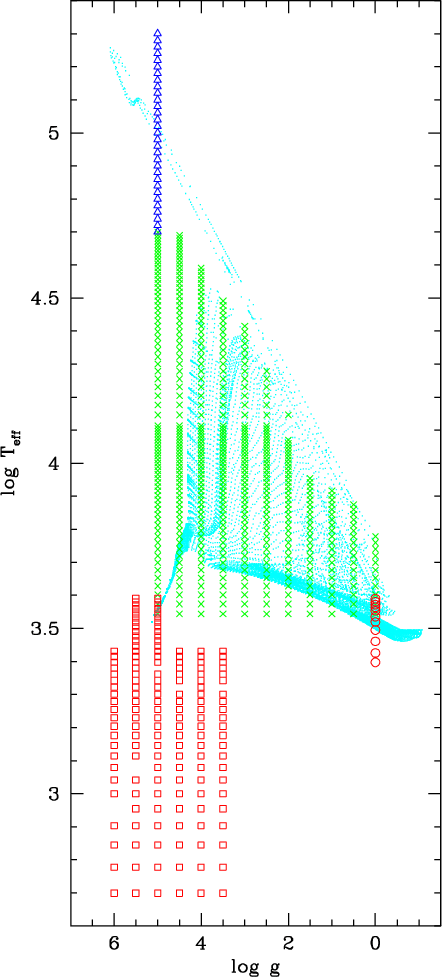
Fig. 1 presents the distribution of all spectra
in the
 plane.
 |
Figure 1:
Distribution of the
![$\mbox{\rm [{\rm M}/{\rm H}]}=0$](/articles/aa/full/2002/31/aah3268/img75.gif) spectra incorporated in our
stellar library (large symbols) in the
plane,
compared to the position of stellar models of solar metallicity
(small dots; these models are isochrones to be discussed later in
Sect. 5.1). The spectra are taken from Castelli et al.
(1997; crosses), Fluks et al. (1994; circles),
Allard et al. (2000a; squares), and pure blackbody
(triangles). Fluks et al. spectra have been arbitrarily located at
spectra incorporated in our
stellar library (large symbols) in the
plane,
compared to the position of stellar models of solar metallicity
(small dots; these models are isochrones to be discussed later in
Sect. 5.1). The spectra are taken from Castelli et al.
(1997; crosses), Fluks et al. (1994; circles),
Allard et al. (2000a; squares), and pure blackbody
(triangles). Fluks et al. spectra have been arbitrarily located at
 .
Similar
distributions hold for all metallicities between .
Similar
distributions hold for all metallicities between
![$\mbox{\rm [{\rm M}/{\rm H}]}=-2.5$](/articles/aa/full/2002/31/aah3268/img77.gif) and +0.5(see text).
and +0.5(see text). |
| Open with DEXTER |
3.1 Kurucz atmospheres
Earlier Padova isochrones were based on the Kurucz (1993)
libraries of ATLAS9 synthetic atmospheres.
As discussed in a series
of papers by Castelli et al. (1997), Bessell et al. (1998),
and Castelli (1999), these models are superseded by now.
Firstly, small discontinuities associated to the scheme of
"approximate overshooting'' initially adopted by Kurucz have
been corrected (cf. Bessell et al. 1998).
Secondly, no-overshooting
models have been demonstrated to produce
-colour relations
in better agreement with empirical ones, at least for stars hotter
than the Sun (Castelli et al. 1997).
In the present work, we adopt the ATLAS9
no-overshoot models that have been calculated by
Castelli et al. (1997). They correspond to the "NOVER''
files available at http://cfaku5.harvard.edu/grids.html.
The metallicities cover the values
,
-2.0, -1.5,
-1.0, -0.5, 0.0, and +0.5, with solar-scaled abundance ratios.
A microturbulent velocity
,
and a mixing length
parameter
 ,
are adopted.
Notice that these models are now being extended so as to include
also -enhanced chemical mixtures, which represents a potentially
important improvement for our future works.
,
are adopted.
Notice that these models are now being extended so as to include
also -enhanced chemical mixtures, which represents a potentially
important improvement for our future works.
Kurucz models cover quite well the region of the
vs.
plane actually occupied by stars,
at least in the
 ,
,
 intervals (see Fig. 1).
However, it has to be extended to
both lower and higher
s, as will be detailed below.
intervals (see Fig. 1).
However, it has to be extended to
both lower and higher
s, as will be detailed below.
It is important to recall that Kurucz (ATLAS9) spectra are widely
used in the field of synthetic photometry, mainly because of their
wide coverage of stellar parameters and easy availability.
Moreover, there are also good indications in the literature that
these spectra do a good job in synthetic photometry,
provided that we are dealing with broad-band systems.
Compelling examples of this can be found in
Bessell et al. (1998), who compares the UBVRIJHKL results obtained
from the recent ATLAS9 spectra to empirical relations derived with the
infrared flux method, lunar occultations, interferometry, and eclipsing
binaries. Their results indicate that the 1998 ATLAS9 models are
well suited to synthetic photometry, but for small errors,
generally lower than 0.1 mag in colours, that we do not
consider as critical. In fact, we are more interested in the
overall dependencies of colours and magnitudes with stellar
parameters - probably well represented by present synthetic
spectra - than on details of this order of magnitude.
Additionally, Worthey (1994) presented extensive comparisons between
Kurucz (1993) spectra and stars in the low-resolution spectral
library by Gunn & Stryker (1983), obtaining generally a good match
for wavelengths redder than the B pass-band. Worthey's Fig. 9
also presents a comparison between Kurucz (1993) solar spectra and
Neckel & Labs (1984) data, with excellent results (errors
lower than 0.1 mag) all the way from the UV up to the near-IR.
Since the ATLAS9 1998 spectra differ just little from the Kurucz
(1993) version (a few percent in extreme cases), these
results are to be considered still valid.
The previously mentioned works point to a reasonably good
agreement between ATLAS9 spectra and those of real stars of
near-solar metallicity,
especially in the visual and near-infrared pass-bands.
However, there are many known inadequacies in these
spectra, which should be kept in mind as well.
Here, we give just a brief list of the potential problems,
concentrating on those which may be more affecting our
synthetic colours.
ATLAS9 spectra are based on 1D static and plan-parallel
LTE model atmospheres, which use a huge database of atomic
line data (Kurucz 1995). The line list is known not to be
accurate: In fact, Bell et al. (1994) show
that the solar spectra calculated using Kurucz
list of atomic data present many unobserved lines;
moreover, the number of lines which are too strong exceeds
those which are too weak.
The problem can be appreciated by looking at the high-resolution
spectral plots presented by Bell et al. (1994), but could
hardly be noticeable in low-resolution plots (such as in the
comparisons presented in Worthey's 1994 Fig. 9,
and in Castelli et al. 1997 Fig. 2).
Also, Bell et al. (2001) show that a motivated increase in
the Fe I bound-free opacity cause a significant
improvement in the fitting of the solar spectrum in the
3000-4000 Å wavelength region, affecting the entire
UV region as well. Such increased sources of continuous
opacity are still missing in ATLAS9 atmospheres.
These results indicate that
ATLAS9 spectra will produce worse results when applied to
(i) narrow-band photometric systems, in which individual metallic
lines can more significantly affect the colours, and (ii) in the UV
region, especially shortward of 2720 Å (see Bell et al. 2001).
In both cases, the errors caused by wrong atomica data are such that
we can expect not only systematic and
-dependent
offsets in synthetic colours,
but also a somewhat wrong dependence on metallicity.
Clearly, these points are worth being properly investigated by
means of detailed spectral comparisons.
Regarding the present work, the above-mentioned problems (i)
critically determine the inadequacy of synthetic colours computed
for the Strömgren system (Girardi et al., in preparation),
and (ii) may possibly cause significant errors in our synthetic
HST/WFPC2 UV colours.
Other potential problems worth of mention are:
-
The deficiencies in 1D atmosphere models and in the mixing length
description of convection, as compared to exploratory 3D model
atmospheres (e.g. Asplund et al. 2000).
They should affect mainly the intermediate-strong lines with
significant non-thermal broadening and in stars cooler than
 6000 K. The consequences of spatial and thermal inhomogeneities
in the atmosphere of the Sun and Procyon have been investigated by
Allende Prieto et al. (2001, 2002);
6000 K. The consequences of spatial and thermal inhomogeneities
in the atmosphere of the Sun and Procyon have been investigated by
Allende Prieto et al. (2001, 2002);
-
Inadequacies in the hydrogen line computations. Especially
affected are high members of the Balmer series in GK stars
- due to inhomogeneities in real
atmospheres and inadequate treatment of hydrogen line broadening
in cool stars (see Barklem et al. 2000a,b)
- and the core of Balmer lines and the region around the Paschen
discontinuity and longward in A stars (Colina et al. 1996).
In synthetic photometry, these inadequacies are
expected to slightly affect the U and B magnitudes for
A-F stars, but to have a greater effect in Strömgren indices;
-
The inadequacy of using scaled-solar metal ratios
in giants where the abundance of CNO elements has been altered by
dredge-up events. Similarly, the inadequancy of using scaled-solar
abundances for halo and bulge stars, instead of -enhanced
ones.
Obviously, some improvement upon these points is expected in future releases
of ATLAS spectra (see Castelli & Kurucz 2001), and of other
extended spectral grids as well.
Fortunately, the work by Bessell et al. (1998)
gives us some confidence that present broad-band magnitudes
and colours (from U to K) are modelled with an accuracy
that is already acceptable for many applications.
Finally, we remark that some authors (Lejeune et al. 1997, 1998)
propose the application of a posteriori transformations
to Kurucz (1993) spectra, as a function of wavelength and
,
such as to reduce the errors of the derived synthetic UBVRIJHKL
photometry. In our opinion,
such transformations are questionable because they do
not correct the cause of the discrepancies - majorly
identifiable in the imperfect modelling of absorption lines -
and the case for applying them to stars of all surface
metallicities and gravities is far from compelling.
3.2 Extension to higher temperatures
For
 K, we simply assume black-body spectra.
This is probably a good approximation for wavelengths
K, we simply assume black-body spectra.
This is probably a good approximation for wavelengths
 Å. In fact, we find always a reasonably smooth
transition in the computed
s as we cross the
Å. In fact, we find always a reasonably smooth
transition in the computed
s as we cross the
 K temperature boundary.
3.3 Extension to M giants
Synthetic spectra for M giants have still many problems -
mainly in their ultraviolet-blue region - that
partially derive from incomplete opacity lists of molecules
such as TiO, VO and H2O (see e.g. Plez 1999; Alvarez & Plez 1998; Alvarez et al. 2000;
and Houdashelt et al. 2000a,b to appreciate the state of
the art in the field).
Therefore, we prefer to use the empirical M giant spectra
from Fluks et al. (1994; or "intrinsic'' spectra as referred
in their paper). They cover the wavelength interval from 3800 Å
to 9000 Å. Outside this interval, the empirical spectra have been
extendend with the "best fit'' synthetic spectra computed by the
same authors.
However, the whole procedure reveals a problem:
if we simply merge empirical and synthetic spectra from
Fluks et al. (1994), the resulting synthetic  and
and  colours
just badly correlate with the measured colours for the
same stars (which were also obtained by Fluks et al. 1994).
This problem probably derives from a
bad flux calibration at the blue extremity
of the observed spectra and/or from the imperfect match between
synthetic and observed spectra at 3800 Å. In order
to circumvent (at least partially) the problem, we simply
multiply each M-giant spectrum blueward of 4000 Å (with a smooth
transition in the range from 4000 Å to 4800 Å) by a constant,
typically between 0.8 and 1.2, so that the synthetic colours recover
the observed behaviour of the
vs.
colours
just badly correlate with the measured colours for the
same stars (which were also obtained by Fluks et al. 1994).
This problem probably derives from a
bad flux calibration at the blue extremity
of the observed spectra and/or from the imperfect match between
synthetic and observed spectra at 3800 Å. In order
to circumvent (at least partially) the problem, we simply
multiply each M-giant spectrum blueward of 4000 Å (with a smooth
transition in the range from 4000 Å to 4800 Å) by a constant,
typically between 0.8 and 1.2, so that the synthetic colours recover
the observed behaviour of the
vs.  data.
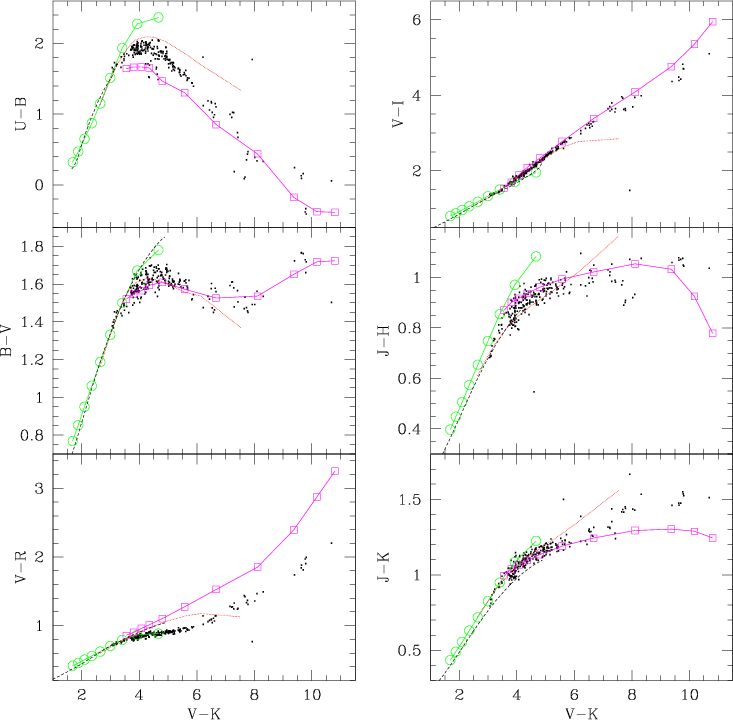
The first two panels of Fig. 2 show the results.
data.
The first two panels of Fig. 2 show the results.
 |
Figure 2:
Colour vs.
relations for giants.
The connected open circles represent the
relation obtained from
ATLAS9 spectra located
along the
 line (the typical location for
RGB stars) in the diagram of Fig. 1.
The connected open squares correspond to the
relation obtained from the M-giant spectra from Fluks et al. (1994),
completed and modified at
line (the typical location for
RGB stars) in the diagram of Fig. 1.
The connected open squares correspond to the
relation obtained from the M-giant spectra from Fluks et al. (1994),
completed and modified at
 Å as detailed in the text.
The dashed lines represent the empirical relations for F0-K5
solar-metallicity giants from Alonso et al. (1999b), whereas the
dotted lines are the synthetic relations for K0-M7 giants from
Houdashelt et al. (2000a).
The empirical data for M giants (small dots) are from
Fluks et al. (1994). As far as possible, all observations have been
converted to the same photometric system as used in our synthetic
photometry (i.e. the "Bessell'' UBVRIJHK system; see text). Å as detailed in the text.
The dashed lines represent the empirical relations for F0-K5
solar-metallicity giants from Alonso et al. (1999b), whereas the
dotted lines are the synthetic relations for K0-M7 giants from
Houdashelt et al. (2000a).
The empirical data for M giants (small dots) are from
Fluks et al. (1994). As far as possible, all observations have been
converted to the same photometric system as used in our synthetic
photometry (i.e. the "Bessell'' UBVRIJHK system; see text). |
| Open with DEXTER |
Actually, Fig. 2 presents six different
colour vs.
diagrams that are useful to understand the
situation for giants. Care has been taken in expressing data and models
in the same photometric system, the "Bessell''
UBVRIJHK one, that we will detail later in Sect. 4.1.
For M giants, the empirical photometric data from Fluks et al.
(1994; small dots) can be compared with the results of our
synthetic photometry. Noteworthy, there is a
reasonably good match between the synthetic and observed relations
for most colours. This has been imposed for
and ,
whereas is
a natural result for all colours involving wavelengths longer
than 4800 Å. The only clear exception is the  colour,
for which differences of 0.4 mag are found for all giants
of spectral type later than M4 (
colour,
for which differences of 0.4 mag are found for all giants
of spectral type later than M4 (
 ). The reason for this
discrepancy is not clear, but may lie in the use of R filters
with different transmission curves. Also the predictions for
). The reason for this
discrepancy is not clear, but may lie in the use of R filters
with different transmission curves. Also the predictions for
 do not fit well all the photometric data, somewhat failing
for the spectral types later than M7 (
do not fit well all the photometric data, somewhat failing
for the spectral types later than M7 (
 ). However, since
these latters are quite rare, such mismatch does not pose a
serious problem.
). However, since
these latters are quite rare, such mismatch does not pose a
serious problem.
For the sake of comparison, Fig. 2
also presents the relations obtained by means of
the M-giant models from Houdashelt et al. (2000a), in the
case of solar metallicity. Together with other recent examples
(e.g. Plez 1999; Alvarez et al. 2000), they represent
state-of-the-art computations of cool oxygen-rich stellar
atmospheres. As can be appreciated in the figure,
Houdashelt et al. models reproduce well the empirical data as
far as
 (spectral types earlier than M5), but start
departing from these for cooler stars. A similar situation
holds if we look at different
(spectral types earlier than M5), but start
departing from these for cooler stars. A similar situation
holds if we look at different
 -colour relations, as
can be seen in Figs. 13 and 14 of Houdashelt et al. (2000a),
where they compare their
-colour relations with those
obtained with Fluks et al. (1994) spectra and data for field
giants. Also in this case, it seems that Fluks et al. (1994)
spectra do better reproduce the empirical relations for the
spectral types later than M4.
-colour relations, as
can be seen in Figs. 13 and 14 of Houdashelt et al. (2000a),
where they compare their
-colour relations with those
obtained with Fluks et al. (1994) spectra and data for field
giants. Also in this case, it seems that Fluks et al. (1994)
spectra do better reproduce the empirical relations for the
spectral types later than M4.
Once we have defined the library of M-giant spectra,
we associate effective temperatures to them by using the scale
favoured by Fluks et al. (1994). In this scale, M giants cover
the temperature interval from 3 850 K
(MK type M0) to 2500 K (MK type M10).
We recall that Fluks et al. (1994)
values
are derived from a careful fitting of the observed spectra with
synthetic model atmospheres of solar metallicity. Their scale is also
in excellent agreement with the empirical one from Ridgway et al.
(1980), which covers spectral types earlier than M6.
After the proper
is attributed, each one of our modified
spectra is completely re-scaled by a constant, so that the
total flux vs.
relation - i.e.
 - is recovered.
Finally, we face the problem of defining the transition between
the M-giant spectra, and the ATLAS9 ones which are available for
temperatures higher than 3500 K. To this aim, it is helpful
to examine Fig. 2, where we also include:
-
the synthetic photometry for a sequence of ATLAS9 spectra for
M giants (empty circles). These
spectra are located along the line
,
which represents fairly well the locus of low-mass red giants
in a
vs.
diagram (see Fig. 1);
-
the mean empirical relations for F0-K5 giants of
![$\mbox{\rm [{\rm Fe}/{\rm H}]}=0$](/articles/aa/full/2002/31/aah3268/img99.gif) as derived from Alonso et al. (1999b) fitting formulas
(dashed lines).
as derived from Alonso et al. (1999b) fitting formulas
(dashed lines).
An important fact to be noticed is that our synthetic photometry
reproduces Alonso et al. (1999b) relations
in all colours remarkably well.
From inspecting this and other similar plots, we can conclude that
the mismatch between Kurucz ATLAS9 and
Fluks et al. (1994) spectra starts at about
 and
increases slowly as the temperature decreases down to 3500 K
(i.e. from
and
increases slowly as the temperature decreases down to 3500 K
(i.e. from
 to
to
 ).
Hence, we adopt a smooth transition between these two spectral
sources over this temperature interval. The same
M giant spectra are assumed for all metallicities.
).
Hence, we adopt a smooth transition between these two spectral
sources over this temperature interval. The same
M giant spectra are assumed for all metallicities.
The complete procedure ensures reasonable colour vs.
relations
for all giants of near-solar
metallicity (Fig. 2). Nevertheless, this kind
of approach cannot be completely satisfactory, first because the
original Fluks et al. (1994) spectra have been artificially
corrected at wavelengths shorter than 4800 Å in order to produce
reasonable
and ,
and second because we do not dispose of similar M-giant spectra for
metallicities very different from solar. Better empirical and
theoretical spectra for M giants seem to be urgently needed.
Anyway, in the context of the present work the problem is not
dramatic because M giants cooler than
 K are only
found in the RGB-tip and TP-AGB phases of high metallicity stellar
populations, and constitute just a tiny fraction of the number of
red giants. The problem could be critical, instead, when we consider
integrated properties of stellar populations, because M giants,
despite their small numbers, have high luminosities and
contribute a sizeable fraction of the integrated light.
K are only
found in the RGB-tip and TP-AGB phases of high metallicity stellar
populations, and constitute just a tiny fraction of the number of
red giants. The problem could be critical, instead, when we consider
integrated properties of stellar populations, because M giants,
despite their small numbers, have high luminosities and
contribute a sizeable fraction of the integrated light.
3.4 Extension to M+L+T dwarfs
Although the modelling of cool dwarfs atmospheres presents
challenges comparable to those found in late-M giants
(e.g. the inadequacy of TiO and H2O line lists, and dust
formation; see Tsuji et al. 1996, 1999; Leggett et al. 2000),
present results compare reasonably well
with observational spectral data (see e.g. Fig. 9 in
both Leggett et al. 2000 and 2001). A review on the subject
can be found in Allard et al. (1997).
An extended library of synthetic spectra for cool dwarfs (of types M
and later) is provided by Allard et al. (2000a; see
ftp://ftp.ens-Lyon.fr/pub/users/CRAL/fallard). We use their set of
"BDdusty1999'' atmospheres (see also Chabrier et al.
2000; Allard et al. 2000b, 2001),
that should supersede the "NextGen'' models from the same
group (Hauschildt et al. 1999) due to the consideration of
better opacity lists and dust
formation. Dust can significantly affect the coolest atmospheres,
corresponding to dwarfs of spectral types L and T.
The selected spectra cover the
intervals:
- from 4000 K to 2800 K ("AMES'' models)
for metallicities
![$\mbox{\rm [{\rm M}/{\rm H}]}=0.0$](/articles/aa/full/2002/31/aah3268/img105.gif) ,
-0.5, -1.0, -1.5, and both
,
-0.5, -1.0, -1.5, and both
 and 5.5;
- from 2800 K down to 500 K ("AMES-dusty''
models) only for
,
and
values between 3.5 and 6.0.
These spectra are presented with a extremely high resolution, that by
far exceeds the one necessary in our work. Thus, we have convolved the
flux per unit frequency  with a Gaussian filter of
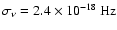 ,
that corresponds to a FWHM
of 20 Å at
,
that corresponds to a FWHM
of 20 Å at
 Å. The resulting spectra were then
reported to the same grid of wavelengths of Kurucz' spectra.
Å. The resulting spectra were then
reported to the same grid of wavelengths of Kurucz' spectra.
We find that there is a good agreement between
ATLAS9 and BDdusty1999 spectra in the
range between
3800 K and 4000 K. Then, we set the transition between
ATLAS9 and BDdusty1999 spectra at 3900 K. This choice
guarantees smooth
vs. colour relations for dwarfs.
4 Photometric systems available
In this section we present the basic information regarding the filter
transmission curves and zero-points for each photometric system.
As a reference to the discussion, Fig. 3 presents
the filter sets under consideration, as compared to the spectra of a
hot (Vega), an intermediate (the Sun), and a cool star (an M5 giant).
 |
Figure 3:
The filter sets used in the
present work. From top to bottom, we show the
filter+detector transmission curves
for the systems:
(1) HST/NICMOS, (2) HST/WFPC2, (3) Washington, (4) ESO/EMMI,
(5) ESO/WFI UBVRIZ + ESO/SOFI JHK, and (6) Johnson-Cousins-Glass.
All references are given in Sect. 4.
To allow a good visualisation of the filter curves,
they have been re-normalized to their
maximum value of .
For the sake of comparison, the bottom panel presents
the spectra of Vega (A0V), the Sun (G2V), and a M5 giant,
in arbitrary scales of . |
| Open with DEXTER |
4.1 Johnson-Cousins-Glass system
Aiming to reproduce the Johnson-Cousins-Glass system,
we adopt the filter pass-bands indicated by Bessell (1990; for
Johnson-Cousins UBVRI) and Bessell & Brett (1988; for JHK).
We also apply their prescription for computing the U-B colour
by means of a slightly modified pass-band BX90, instead of
the normal B one. Moreover, in order to better recover the
original system, we adopt energy instead of photon count
integrations (see Sect. 2.1).
It is worth recalling that these pass-bands
represent just one specific version
of the "standard'' Johnson-Cousins-Glass system, that may
differ from filter systems in usage at several observatories.
The Bessell & Brett (1988) JHKLM pass-bands, for instance,
represent an effort in the direction of homogenizing
several different near-infrared systems
(SAAO, ESO, CIT/CTIO, MSO, AAO, and Arizona).
In Bessell (1990) and
Bessell & Brett (1988), the reader can find a set of
useful fitting relations between colours in the several
original systems.
As previously mentioned, Johnson-Cousins-Glass is essentially a
VEGAmag system. We fix the zero-points by assuming that Vega has
apparent magnitudes equal to 0.03 in all UBVRIJHK bands, i.e.
we impose all colours to be null. Notice that our definition is
very similar to the Bessell et al. (1998) one, who adopt Vega
colours differing from zero by just some thousandths of a magnitude
(see their Table A1).
In the context of the present work, the distinctive feature
of HST photometry is the use of ABmag and STmag systems, which
greatly simplifies the definition of zero-points. WFPC2 and NICMOS
observations can also be expressed in VEGAmag magnitudes.
4.2.1 WFPC2
As for the WFPC2, we produce bolometric corrections and magnitudes
in the F170W, F218W, F255W, F300W, F336W, F439W, F450W, F555W,
F606W, F702W, F814W, and F850LP filters. Similar tables have been
produced in previous papers (Chiosi et al. 1997;
Salasnich et al. 2000); the
present ones differ just in minor details.
The transformations have been computed in STmag, ABmag, and VEGAmag
systems. Whereas the STmag and ABmag systems can be
straightforwardly simulated, the VEGAmag one deserves some
comments.
According to the SYNPHOT package distributed with the STSDAS
software, in a VEGAmag system Vega should have apparent magnitudes
equal to zero in all pass-bands. However,
the most widely used calibration of WFPC2 photometry
comes from Holtzman et al. (1995), who adopt a set of zero-points
in which Vega has apparent magnitudes
U=0.02, B=0.02, V=0.03, R=0.039, I=0.035.
Accordingly, we choose this latter definition, and
impose that for the WFPC2 filters that correspond to UBVRI
in wavelength, the synthetic magnitudes of Vega have these
same values. For filters of intermediate wavelength,
we adopt a linear interpolation between these values,
whereas for bluer and redder filters a Vega magnitude equal
to zero is assumed.
As for the
functions, we use the
pre-launch pass-bands kindly provided by Jon Holtzman
(see Holtzman et al. 1995). We recall that,
owing to the presence of contaminants inside the WFPC2
(see Baggett & Gonzaga 1998; Holtzman et al. 1995), changes slowly with time, especially for UV filters.
To cope with this, observers usually apply small corrections
to the definition of the instrumental magnitudes,
in order to bring the magnitudes back to the original conditions
(see Holtzman et al. 1995). This justifies our use of
pre-launch pass-bands instead of the present-day ones
provided by SYNPHOT.
4.2.2 NICMOS
For NICMOS filters, we compute bolometric corrections and
absolute magnitudes in the ABmag, STmag, and VEGAmag systems.
For the moment, calculations are limited to the
three most frequently used filters, i.e. F110W, F160W, and F205W.
The pass-bands come from SYNPHOT, and have been kindly provided
by Don Figer.
NICMOS observations are also frequently expressed in units
of milli-Jansky (mJy). The conversion between AB magnitudes and
mJy is straightforward:
 |
(16) |
4.3 ESO Imaging Survey (EIS) filter sets
The EIS survey (Renzini & da Costa 1997; da Costa 2000)
aims at providing a large database of
deep photometric data, among which the astronomical community could
select interesting targets for VLT spectroscopy.
The survey is conducted at several different instruments at ESO.
4.3.1 WFI
The Wide Field Imager (WFI) at the
MPG/ESO 2.2 m La Silla telescope provides imaging of excellent
quality over a
 field of view.
It contains a peculiar set of broad-band filters,
very different from the "standard'' Johnson-Cousins ones.
This can be appreciated in Fig. 3; notice in
particular the particular shapes of the WFI B and I
filters. Moreover, EIS makes use of the WFI Z filter which
does not have a correspondency in the Johnson-Cousins system.
field of view.
It contains a peculiar set of broad-band filters,
very different from the "standard'' Johnson-Cousins ones.
This can be appreciated in Fig. 3; notice in
particular the particular shapes of the WFI B and I
filters. Moreover, EIS makes use of the WFI Z filter which
does not have a correspondency in the Johnson-Cousins system.
Given the very unusual set of filters, the importance of
computing isochrones specific for WFI is evident. This has benn
done so for the broad WFI filters U (ESO#841), B (ESO#842),
V (ESO#843), R (ESO#844), I (ESO#845), and Z (ESO#846),
that - here and in Fig. 3 - are referred to
as UBVRIZ for short.
Bolometric corrections have been computed in the VEGAmag
system assuming all Vega apparent magnitudes to be 0.03,
and in the ABmag system, which is adopted by the EIS group.
The photometric calibration
of EIS data is discussed in Arnouts et al. (2001).
It is very important to notice that any
photometric observation performed with WFI that makes use
of standard stars (e.g. Landolt 1992) to convert WFI instrumental
magnitudes to the standard Johnson-Cousins UBVRI system,
will not be in the WFI VEGAmag system we are dealing
with here. Instead, in that case, we should better
compare the observations with the isochrones in the
standard Johnson-Cousins system, or, alternatively, apply
colour transformations to our WFI isochrones so that they
reproduce the
-colour sequences of dwarfs and giants
in the Johnson-Cousins system. This aspect will be better
illustrated Sect. 6.
4.3.2 SOFI
SOFI is a near-infrared imager and grism spectrograph at
the ESO NTT 3.6 m telescope. It is used to complement WFI observations in
near-infrared pass-bands. More specifically, it disposes of
J, H and  filters
that have some similarity to Glass JHK (see Fig. 3).
VEGAmag magnitudes are computed assuming the same as before, i.e.
that Vega apparent magnitudes are 0.03.
filters
that have some similarity to Glass JHK (see Fig. 3).
VEGAmag magnitudes are computed assuming the same as before, i.e.
that Vega apparent magnitudes are 0.03.
4.3.3 EMMI
EMMI is a visual imager and grism spectrograph also at
the NTT. The EIS project uses a set of its
wide filters, i.e.  ,
,
 ,
,
 ,
and
,
and  ,
together with the
R filter. The pass-bands have been kindly provided by S. Arnouts.
As before, VEGAmag magnitudes are computed assuming that Vega
has 0.03 mag in all filters.
,
together with the
R filter. The pass-bands have been kindly provided by S. Arnouts.
As before, VEGAmag magnitudes are computed assuming that Vega
has 0.03 mag in all filters.
4.4 Washington system
The Washington system, originally defined by G. Wallerstein and
developed by Canterna (1976), has been more and more used
since Geisler (1996) defined a set of CCD standard fields.
In the present paper, we reproduce the Washington
CCD system (filters C, M, T1 and T2) by adopting
the transmission curves as revised by Bessell (2001).
Following Geisler (1996), the Washington T1 filter has been
frequently replaced by the Kron-Cousins filter R, which presents
a similar transmission curve and is available in almost
all observatories. Additionally, Holtzman et al. (in preparation)
suggest the use of BVI colours together with Washington
ones for breaking the age-metallicity degeneracy
of stellar populations in colour-colour
diagrams. For these reasons, in all tables that deal
with the Washington
C M T1 T2 system, we also insert the
information for the Johnson-Cousins BVRI filters.
Finally, following Geisler (private communication),
the zero-points should be well represented by a VEGAmag
system. We assume Vega has magnitude 0.03 in all filters.
4.5 Other planned systems
Forthcoming papers of this series will be dedicated to
- other traditional systems like Strömgren,
Thuan-Gunn, Vilnius, etc.;
- systems corresponding to some successful and
recent/ongoing observational campaigns, like Hipparcos,
MACHO, DENIS, 2MASS, and SDSS;
- newly-proposed systems, like the ones for the future
astrometric mission GAIA.
Since the procedure for computing
tables is relatively
easy, provided the necessary information - i.e. filter transmission
curves and a zero-point definition that corresponds to one of the
cases discussed in Sect. 2.3 - is given, we can provide
isochrone tables for any photometric systems upon request.
5 Available stellar tracks and isochrones
The tables of bolometric corrections here described have been
primarily constructed to be applied to the Padova database of
stellar evolutionary tracks and isochrones. These latter have been described in several
previous papers, and a complete description of them is
beyond the scope of this work.
In the following, our intention is just to briefly mention
the sets of isochrones which are the most useful for
comparisons with observed photometric data, and to first
mention some data that has not been published in precedence.
A summary table of the available material is presented in
Table 1.
Table 1:
Stellar tracks used in the different set of isochrones.
|
Initial chemical comp.: |
Evolutionary tracks: |
Isochrones: |
| |
Mass ranges (in  ):2 ):2 |
TP-AGB |
convec- |
age range |
filename in |
basic |
| Z |
Y |
kind1 |
0.15-0.55 |
0.6-7.0 |
>7.0 |
evolution3 |
tion4 |
 |
database |
reference2 |
|
0.0 |
0.230 |
S |
- |
Ma01 |
Ma01 |
- |
O |
6.30 - 10.25 |
isoc_z0.dat |
Ma01 |
| 0.0001 |
0.230 |
S |
Gi01 |
Gi01 |
Gi96 |
G |
O |
6.60 - 10.25 |
isoc_z0001.dat |
Gi01+Gi96 |
| 0.0004 |
0.230 |
S |
Gi00 |
Gi00 |
Fa94a |
G |
O |
6.60 - 10.25 |
isoc_z0004.dat |
Gi00+Be94 |
| 0.001 |
0.230 |
S |
Gi00 |
Gi00 |
- |
G |
O |
7.80 - 10.25 |
isoc_z001.dat |
Gi00 |
| 0.004 |
0.240 |
S |
Gi00 |
Gi00 |
Fa94b |
G |
O |
6.60 - 10.25 |
isoc_z004.dat |
Gi00+Be94 |
| 0.008 |
0.250 |
S |
Gi00 |
Gi00 |
Fa94b |
G |
O |
6.60 - 10.25 |
isoc_z008.dat |
Gi00+Be94 |
| 0.019 |
0.273 |
S |
Gi00 |
Gi00 |
Br93 |
G |
O |
6.60 - 10.25 |
isoc_z019.dat |
Gi00+Be94 |
| 0.030 |
0.300 |
S |
Gi00 |
Gi00 |
- |
G |
O |
7.80 - 10.25 |
isoc_z030.dat |
Gi00 |
|
0.019 |
0.273 |
S |
Gi00 |
Gi00 |
- |
G |
C |
7.80 - 10.25 |
isoc_z019nov.dat |
Gi00 |
|
0.008 |
0.250 |
S |
Sa00 |
Sa00 |
Sa00 |
G |
O |
7.00 - 10.25 |
isoc_z008s.dat |
Sa00 |
| 0.019 |
0.273 |
S |
Sa00 |
Sa00 |
Sa00 |
G |
O |
7.00 - 10.25 |
isoc_z019s.dat |
Sa00 |
| 0.040 |
0.320 |
S |
Sa00 |
Sa00 |
Sa00 |
G |
O |
7.00 - 10.25 |
isoc_z040s.dat |
Sa00 |
| 0.070 |
0.390 |
S |
Sa00 |
Sa00 |
Sa00 |
G |
O |
7.00 - 10.25 |
isoc_z070s.dat |
Sa00 |
| 0.008 |
0.250 |
A |
Sa00 |
Sa00 |
Sa00 |
G |
O |
7.00 - 10.25 |
isoc_z008a.dat |
Sa00 |
| 0.019 |
0.273 |
A |
Sa00 |
Sa00 |
Sa00 |
G |
O |
7.00 - 10.25 |
isoc_z019a.dat |
Sa00 |
| 0.040 |
0.320 |
A |
Sa00 |
Sa00 |
Sa00 |
G |
O |
7.00 - 10.25 |
isoc_z040a.dat |
Sa00 |
| 0.070 |
0.390 |
A |
Sa00 |
Sa00 |
Sa00 |
G |
O |
7.00 - 10.25 |
isoc_z070a.dat |
Sa00 |
|
0.004 |
0.240 |
S |
Gi00 |
Gi00 |
- |
M |
O |
7.80 - 10.25 |
isoc_z004m.dat |
MG01 |
| 0.008 |
0.250 |
S |
Gi00 |
Gi00 |
- |
M |
O |
7.80 - 10.25 |
isoc_z008m.dat |
MG01 |
| 0.019 |
0.273 |
S |
Gi00 |
Gi00 |
- |
M |
O |
7.80 - 10.25 |
isoc_z019m.dat |
MG01 |
1 S indicates a solar-scaled distribution
of metals, A indicates an -enhanced one. The adopted
metal abundance ratios are specified in Salasnich et al. (2000).
2 References for tracks and isochrones:
Be94 = Bertelli et al. (1994, A&AS, 106, 275);
Br93 = Bressan et al. (1993, A&AS, 100, 647);
Fa94a = Fagotto et al. (1994a, A&AS, 104, 365);
Fa94b = Fagotto et al. (1994b, A&AS, 105, 29);
Gi96 = Girardi et al. (1996, A&AS, 117, 113);
Gi00 = Girardi et al. (2000, A&AS, 141, 371);
Gi01 = Girardi (2001, unpublished);
Ma01 = Marigo et al. (2001, A&A, 371, 152);
MG01 = Marigo & Girardi (2001, A&A, 377, 132);
Sa00 = Salasnich et al. (2000, A&A, 361, 1023).
3 G means a simple synthetic evolution as in
Girardi & Bertelli (1998), whereas M stands for more detailed
calculations as in Marigo (2001; and references therein).
4 O means a model with overshooting
(see Gi00 for all references), whereas C corresponds to classical
semi-convective models. |
5.1 An extended set of isochrones
Girardi et al. (2000) computed a set of low- and
intermediate-mass stellar tracks which supersedes
those previously used in Bertelli et al. (1994) isochrones.
Additional models (unpublished)
have been recently computed for initial chemical
composition
[Z=0.0001, Y=0.23].
Thus, we have created a new set of isochrones combining
the latest low- and intermediate mass tracks (in the range
0.15 - 7.0 )
with the formerly
available massive ones. The full references are given in
Table 1.
In all cases in which "2000'' and "1994'' tracks have been combined,
we find excellent agreement between the relevant quantities (lifetimes,
tracks in the HR diagram) at the transition mass of 7-8 .
This is explained considering
that the intermediate- and high-mass models share the
same prescription for convection, and have interior opacities dominated
by electron scattering (which has not been changed in the meanwhile).
For the solar metallicity, we have combined tracks presenting
slightly different initial metallicities -
[Z=0.019, Y=0.273] in Girardi et al. (2000),
and
[Z=0.020, Y=0.280] in Bressan et al. (1993) -
without finding any significant discontinuity.
Finally, to this extended set we have included the Marigo et al.
(2001) isochrones for zero-metallicity stars.
5.2 Overshooting vs. classic models
For solar metallicity and in the mass range
0.15 - 7.0 ,
Girardi et al. (2000) presents an additional set of tracks and
isochrones computed with the
classical semi-convective prescription for convective borders.
Then, the two
[Z=0.019, Y=0.273] sets are useful if one
chooses to compare classical with overshooting models.
The same kind of work is being extended to metallicities
[Z=0.004, Y=0.240] and
[Z=0.008, Y=0.250] (Barmina et al. 2002),
and will be included in the database when completed.
5.3 Solar-scaled vs. -enhanced models
Salasnich et al. (2000) presents new
models for 4 different metallicities
(
[Y=0.250, Z=0.008],
[Y=0.273, Z=0.019],
[Y=0.320, Z=0.040]
and
[Y=0.390, Z=0.070]), computed both with scaled-solar and
alpha-enhanced distributions of metals. The tracks cover the
mass range from 0.15 to 20 .
They represent a valid
alternative to the isochrones referred to in Sect. 5.1,
but do not cover the low-metallicity interval.
Anyway, it has been demonstrated by Salaris et al. (1993; see
also Salaris & Weiss 1998; and VandenBerg 2000),
that for low metallicities one may safely use scaled-solar
stellar models instead of -enhanced ones of same Z.
5.4 Simple vs. more detailed TP-AGB models
All the tracks and isochrone sets above mentioned, include the
complete TP-AGB phase as computed with a simple synthetic algorithm
(Girardi & Bertelli 1998). In parallel,
Marigo (2001, and references therein) has developed a much more
sophisticated code for synthetic TP-AGB evolution, which includes
crucial processes such as the third dredge-up and hot-bottom burning.
Sets of complete TP-AGB tracks have been so far presented
for metallicities
[Y=0.240, Z=0.004],
[Y=0.250, Z=0.008], and
[Y=0.273, Z=0.019] (Marigo 2001). A set of isochrones has been
generated by combining these detailed TP-AGB tracks with the previous
evolution from Girardi et al. (2000); they are
presented in the appendix of Marigo & Girardi (2001).
These isochrones represent a useful alternative to the isochrones
referred to in Sect. 5.1, any time the
TP-AGB population is under scrutiny - for instance, when we have
near-infrared photometry of objects above the RGB-tip.
Marigo TP-AGB models are being extended to cover a larger
metallicity interval.
6 Discussion and concluding remarks
This work is dedicated to the presentation
of theoretical isochrones in several photometric systems.
It represents the continuation of a wide project of the Padova
group, started with Bertelli et al. (1994) and then carried on
by Chiosi et al. (1997), and more recently by Salasnich et al.
(2000). It starts describing the formalism for
converting synthetic stellar spectra into tables of bolometric
corrections (Sect. 2), in such a way that it
can be easily applied to different photometric systems, and
with the possibility of including extinction in a self-consistent way.
 |
Figure 4:
Comparison of Girardi et al. (2000)
isochrones transformed to Johnson-Cousins-Glass magnitudes and
colours by using either present
relations (continuous lines) or Bertelli et al. (1994) ones
(dashed lines), in several CMDs.
The isochrones have solar metallicity (Z=0.019) and ages
108, 109, and 1010 yr (from top to bottom). |
| Open with DEXTER |
 |
Figure 5:
Comparison of Girardi et al. (2000)
isochrones as transformed to the WFPC2 VEGAmag system
using either present relations (continuous lines) or
Salasnich et al. (2000) ones (dashed lines).
The isochrone ages and metallicities
are the same as in Fig. 4. |
| Open with DEXTER |
Then, we describe the assemblage of an updated library of stellar
spectra (Sect. 3). The library is quite
extended in
and ,
and includes the crucial dependence
of spectral features on metallicity. Of course, it suffers from some
limitations:
very hot stars and M-giants are not included among synthetic spectra,
a situation which can be remediated by using blackbody and empirical
spectra, respectively. The strinkingly different spectra of
carbon stars will also have to be
considered in the future (Marigo et al., in preparation).
These are probably the points where the models can be most improved.
Moreover, several problems may be affecting the ATLAS9
synthetic spectra we are using to simulate the broad-band
colours of most stars
(see Sect. 3.1). Although such spectra
have been demonstrated to be suitable for
synthetic photometry (mainly for the Johnson-Cousins-Glass
system; e.g. Bessell et al. 1998), their accuracy
has still to be sistematically evaluated for stars of all
metallicities, temperatures and gravities.
Anyway, we assume that they
are good enough for simulating broad-band photometric systems
in the visual-infrared wavelength region, whereas
expect that the results in narrow-band systems, and in the
ultraviolet pass-bands, will be affected by more significant
errors.
Another important aspect of synthetic spectra is that they
are usually computed for scaled-solar chemical compositions,
whereas the extension to peculiar and -enhanced mixtures
would be of high interest. This latter problem will probably be
alleviated in a near future, with the release of extensions
to ATLAS9 spectra.
From the spectral library, we derive bolometric corrections for each
pass-band mentioned in Sect. 4, and apply them
to the Padova isochrones. In practice, only in few
cases we present newly-constructed isochrones: the bulk of
isochrone data is already described in previous papers by our group,
and
it is only the transformation from theoretical quantities to
absolute magnitudes that changes compared to past releases.
Section 5 summarizes the
basic characteristics of the different sets
of isochrones, indicating the full references.
It is important to illustrate the differences between the
present and previous transformations. The previous ones for
UBVRIJHK are fully described in Bertelli et al. (1994), and
were adopted by Girardi et al. (2000), Salasnich et al. (2000)
and Marigo et al. (2001); for HST/WFPC2 photometry, they are the
ones described in Salasnich et al. (2000).
The situation for Johnson-Cousins-Glass is tentatively illustrated in
Fig. 4, which compares a set of
Girardi et al. (2000) isochrones, transformed according to both
present (continuous lines) and Bertelli et al. (1994;
dashed lines) transformations. We point out that:
- 1.
- For stars hotter than
 K, present transformations
are very similar to those of Bertelli et al. (1994).
The differences amount to just a few
hundredths of a magnitude over most regions of the CMD, including
the entire main sequence and subgiant branch, and most of the RGB.
They can be entirely attributed to the slightly different pass-bands
and zero-points, and to the use of more recent ATLAS9 "NOVER''
atmospheres instead of Kurucz (1993) ones;
K, present transformations
are very similar to those of Bertelli et al. (1994).
The differences amount to just a few
hundredths of a magnitude over most regions of the CMD, including
the entire main sequence and subgiant branch, and most of the RGB.
They can be entirely attributed to the slightly different pass-bands
and zero-points, and to the use of more recent ATLAS9 "NOVER''
atmospheres instead of Kurucz (1993) ones;
- 2.
- A somewhat similar situation holds for dwarfs cooler
than
K (see bottom end of the main sequence in
all panels, for
 ,
and
,
and
 ).
The differences are generally small and can
be attributed to the change from Kurucz (1993) to
Allard et al. (2000a) spectra. The exceptions are
and
).
The differences are generally small and can
be attributed to the change from Kurucz (1993) to
Allard et al. (2000a) spectra. The exceptions are
and
 colours, for which the differences between the two versions
become sizeable;
colours, for which the differences between the two versions
become sizeable;
- 3.
- For giants cooler than 4000 K, present transformations
become very different. This can be noticed in the upper-right
corner of all diagrams. M-giants corresponding to the
RGB-tip and TP-AGB, are now seen to
fade by some magnitudes in V, due to a sort of rapid increase
of visual BCs at
 K. This effect is caused by the
use of Fluks et al. (1994) spectra and their
vs.
scale. Such a bending of the RGB is indeed
observed in CMDs of old metal-rich clusters
(see e.g. Ortolani et al. 1990; and Rich et al. 1998),
and seems to be better
reproduced now than with previous transformations.
Other differences appear in all colours: the most remarkable
are the excursion of M-giants of latest type towards much
bluer ,
and the much smoother behaviour now obtained
for
and
K. This effect is caused by the
use of Fluks et al. (1994) spectra and their
vs.
scale. Such a bending of the RGB is indeed
observed in CMDs of old metal-rich clusters
(see e.g. Ortolani et al. 1990; and Rich et al. 1998),
and seems to be better
reproduced now than with previous transformations.
Other differences appear in all colours: the most remarkable
are the excursion of M-giants of latest type towards much
bluer ,
and the much smoother behaviour now obtained
for
and  .
.
A quite similar situation holds for HST/WFPC2 photometry,
as illustrated in Fig. 5. This time,
we compare the same isochrones as transformed with present
(continuous lines) and Salasnich et al. (2000; dashed lines)
transformations. It is evident that the present transformations
ensure a more continuous behaviour of the colours for all low-temperature
stars (both dwarfs and giants).
From the plots at the top row of Fig. 5, one can
also appreciate the unusual appearance of isochrones in CMDs
that involve ultraviolet WFPC2 pass-bands: Notice for instance that
in F170W, F218W, F255W and F330W magnitudes, giants may be fainter
than turn-off stars. Isochrones in the F218W vs. F170W-F218W and
F255W vs. F218W-F255W diagrams are even "twisted'', because the
vs. colour relations are not monotonic for
these filters. These effects are related to the presence of a
red leak in the ultraviolet HST filters (for both the present WFPC2
and the former FOC camera), and are extensively
discussed by Yi et al. (1995) and Chiosi et al. (1997).
As a consequence of the great similarity between present and
previous UBVRIJHK and HST/WFPC2 transformations,
for most colours and over a large portion of the HR diagram,
most results derived from previous Padova isochrones
are not expected to change.
Exceptions may show up for works that are concerned with
the photometry of the reddest giants, with
K
(
 ), or that deal with low-mass main-sequence stars
in the
and ultraviolet colours.
), or that deal with low-mass main-sequence stars
in the
and ultraviolet colours.
 |
Figure 6:
Isochrones in the CMDs of NICMOS ABmag photometry.
Ages and metallicities are the same as in
Fig. 4. |
| Open with DEXTER |
 |
Figure 7:
Isochrones in the T1 vs. C-T1 plane
of Washington photometry. Left panel: from top to bottom,
a sequence of Z=0.008 isochrones with ages 107,
108, 109, and 1010 yr. Right panel: from left to right,
a sequence of 14 Gyr old isochrones with metallicities
Z=0.0001, 0.0004, 0.001, 0.004, 0.008, 0.019,
and 0.030. |
| Open with DEXTER |
The greatest improvement of the present database is
in the presentation of Padova isochrones in several
photometric systems for which they were not available so far -
including the case of brand-new systems.
Three examples of theis kind are given
in Figs. 6-8.
First, Fig. 6 presents the isochrones in
NICMOS ABmag system. In a VEGAmag system,
NICMOS isochrones would look similar to their equivalent
Johnson-Cousins-Glass ones, shown in Fig. 4.
In the ABmag system, however, they appear shifted to quite
different colour and magnitude intervals.
Figure 7 illustrates how Padova
isochrones look like in the T1 vs. C-T1 CMD of Washington
photometry, both for varying age at constant metallicity
(left panel), and for varying metallicity at constant age
(right one). The striking feature in these plots is the excellent
separation in metallicity offered by the C-T1 colour,
from the main sequence up to red giant phases.
This feature, combined to the excellent throughput in the C filter
(Fig. 3), is among the
advantages that make the Washington system a very competitive one
if compared to Johnson-Cousins (see also Paltoglou & Bell 1994;
Geisler & Sarajedini 1999).
Preliminary comparisons point to a good agreement
between our Washington isochrones and real data for LMC
fields from Bica et al. (1998). Just to mention an
example, we notice that C-T1 for giants
"saturates'' at 3.4, both in the models and in
the LMC data.
 |
Figure 8:
Comparison between the same set of
Z=0.019 isochrones as seen in the UBVI CMDs
using either Johnson-Cousins (dashed lines) or WFI filters
(continuous lines). VEGAmag systems are used in both cases.
Ages are the same as in Fig. 4. |
| Open with DEXTER |
An example of "new'' photometric system is provided
by the WFI, which has broad-band filters very different
from Johnson-Cousins ones. To illustrate the effect in
colours, Fig. 8 shows exactly the same
isochrones as seen in BVI CMDs
using either Johnson-Cousins or WFI filters, and applying
in both cases the VEGAmag definition of zero-points.
The differences are striking. In particular, since the BV
WFI filters represent a wavelength baseline shorter than the
Johnson ones, they provide a more modest separation of stars
in
 colour. It is evident from this plot that the normal
Johnson-Cousins isochrones cannot be used to interpret WFI data that
has been converted to VEGAmag or ABmag systems, as for most of
EIS data (e.g. Arnouts et al. 2001; Groenewegen et al.
2002).
colour. It is evident from this plot that the normal
Johnson-Cousins isochrones cannot be used to interpret WFI data that
has been converted to VEGAmag or ABmag systems, as for most of
EIS data (e.g. Arnouts et al. 2001; Groenewegen et al.
2002).
All the data here mentioned are available at the WWW site
http://pleiadi.pd.astro.it. The database already includes a
very large number of files, and is expected to increase further
as we publish data for other photometric systems. Thus, it is
hard to describe here both the structure of the database,
and the content of each file. Moreover, this kind of information
is probably useful just to whom actually accesses the database.
Thus, we opt to provide all the relevant information
in readme.txt files inserted in the database.
To the general reader, suffice it to briefly mention the kind of
data which is available:
- Tables of bolometric corrections for each metallicity:
they contain the quantities
for each filter, and
as a function of stellar
and .
Metallicities available
are
![$\mbox{\rm [{\rm Fe}/{\rm H}]}=-2.0$](/articles/aa/full/2002/31/aah3268/img133.gif) ,
-1.5, -1.0, -0.5, 0, +0.5. The values
of
and
are not exactly the same for all
metallicities, but correspond quite well to the regions indicated
in Fig. 1;
,
-1.5, -1.0, -0.5, 0, +0.5. The values
of
and
are not exactly the same for all
metallicities, but correspond quite well to the regions indicated
in Fig. 1;
- Tables of isochrones: they include all metallicities
and cases indicated in Sect. 5. The various
photometric systems are separated in different directories.
For each isochrone file, the information and structure are the
same as already presented in Girardi et al. (2000), Salasnich et al. (2000), and Marigo & Girardi (2001), with the obvious
difference that instead of UBVRIJHK absolute magnitudes, in each
file we tabulate the absolute magnitudes for the photometric
system under consideration;
- Tables of integrated colours of single-burst stellar
populations: a table of this kind is present for each
isochrone table. They provide integrated magnitudes in each
pass-band, as a function of age.
Acknowledgements
L.G. thanks the many people who
helped by providing filter transmission curves
and zero-points information (in particular E. Bica,
D. Geisler, J. Holtzman, D. Figer, E. Grebel, M. Gregg,
M. Rich, S. Arnouts, and L. da Costa). Particularly appreciated
are the availability (R. Kurucz, F. Allard) and help with
(I. Baraffe) on-line spectral data, the useful comments by B. Plez
regarding cool giants, and the many useful remarks by R. Bell and
M.S. Bessell, which greatly helped to improve this paper.
Also acknowledged are those who
kindly pointed out some mistakes in our preliminar releases
of data. L.G. acknowledges a stay at MPA funded by the European TMR
grant ERBFMRXCT 960086.
This work was partially funded by the Italian MURST.
- Allard, F., Hauschildt, P. H., Alexander, D. R., & Starrfield, S.
1997, ARA&A, 35, 137
In the text
NASA ADS
- Allard, F., Hauschildt, P. H., Alexander, D. R., Tamanai, A., &
Ferguson, J. W. 2000a,
in Proc. of From giant planets to cool stars,
ed. C. A. Griffith, & M. S. Marley, ASP Conf. Ser., 212,
127
In the text
- Allard, F., Hauschildt, P. H., & Schwenke, D. 2000b, ApJ, 540, 1005
In the text
NASA ADS
- Allard, F., Hauschildt, P. H., Alexander, D. R., Tamanai, A., &
Schweitzer, A. 2001, ApJ, 556, 357
In the text
NASA ADS
- Allende Prieto, C., Barklem, P. S., Asplund, M., & Ruiz Cobo, B.
2001, ApJ, 558, 830
NASA ADS
- Allende Prieto, C., Asplund, M., Garcia López, R. J., & Lambert, D. L.
2002, ApJ, 567, 544
NASA ADS
- Alonso, A., Arribas, S., & Martínez-Roger, C. 1998, A&AS, 131, 209
NASA ADS
- Alonso, A., Arribas, S., & Martínez-Roger, C. 1999a, A&AS, 139, 335
In the text
NASA ADS
- Alonso, A., Arribas, S., & Martínez-Roger, C. 1999b, A&AS, 140, 261
In the text
NASA ADS
- Alvarez, R., Lançon, A., Plez, B., & Wood, P. R. 2000, A&A, 353, 322
In the text
NASA ADS
- Alvarez, R., & Plez, B. 1998, A&A, 330, 1109
In the text
NASA ADS
- Arnouts, S., Vandame, B., Benoist, C., et al. 2001, A&A, 379, 740
In the text
NASA ADS
- Asplund, M., Ludwig, H.-G., Nordlund, A., & Stein, R. F. 2000, A&A, 359, 669
In the text
NASA ADS
- Baggett, S., & Gonzaga, S. 1998, ISR WFPC2 98-03
In the text
- Bahcall, J. N., Pinsonneault, M. H., & Wasserburg, G. J. 1995,
Rev. Mod. Phys., 67(4), 781
In the text
NASA ADS
- Barklem, P. S., Piskunov, N., & O'Mara, B. 2000a, A&A, 355, 5
In the text
- Barklem, P. S., Piskunov, N., & O'Mara, B. 2000b, A&A, 363, 1091
NASA ADS
- Barmina, R., Girardi, L., & Chiosi, C. 2002, A&A, 385, 847
In the text
NASA ADS
- Bell, R. A., Paltoglou, G., & Tripicco, M. J. 1994, MNRAS, 268, 771
In the text
NASA ADS
- Bell, R. A., Balachandran, S. C., & Bautista, M. 2001, ApJ, 546, L65
In the text
NASA ADS
- Bertelli, G., Bressan, A., Chiosi, C., Fagotto, F., & Nasi, E. 1994,
A&AS, 106, 275
In the text
NASA ADS
- Bessell, M. S. 1979, PASP, 91, 589
NASA ADS
- Bessell, M. S. 1990, PASP, 102, 1181
In the text
NASA ADS
- Bessell, M. S. 2001, PASP, 113, 66
In the text
NASA ADS
- Bessell, M. S., & Brett, J. M. 1988, PASP, 100, 1134
In the text
NASA ADS
- Bessell, M. S., Castelli, F., & Plez, B. 1998, A&A, 333, 231
In the text
NASA ADS
- Bica, E., Geisler, D., Dottori, H., et al. 1998, AJ, 116, 723
In the text
NASA ADS
- Bohlin, R. C., Holm, A. V., Harris, A. W., & Gry, C. 1990, ApJS, 73, 413
In the text
NASA ADS
- Bressan, A., Fagotto, F., Bertelli, G., & Chiosi, C. 1993,
A&AS, 100, 647
In the text
NASA ADS
- Buser, R., & Kurucz, R. 1978, A&A, 70, 555
In the text
NASA ADS
- Canterna, R. 1976, AJ, 81, 228
In the text
NASA ADS
- Castelli, F. 1999, A&A, 281, 817
In the text
NASA ADS
- Castelli, F., & Kurucz, R. L. 1994, A&A, 281, 817
In the text
NASA ADS
- Castelli, F., & Kurucz, R. L. 2001, A&A, 372, 260
In the text
NASA ADS
- Castelli, F., Gratton, R. G., & Kurucz, R. L. 1997, A&A, 318, 841
In the text
NASA ADS
- Chabrier, G., Baraffe, I., Allard, F., & Hauschildt, P. H. 2000,
ApJ, 542, 464
In the text
NASA ADS
- Chiosi, C., Vallenari, A., & Bressan, A. 1997, A&AS, 121, 301
In the text
NASA ADS
- Ciardi, D. R., van Belle, G. T., Thompson, R. R., Akeson, R. L., &
Lada, E. A. 2000, AAS, 197, 4503
In the text
NASA ADS
- Code, A. D., Bless, R. C., Davis, J., & Brown, R. H. 1976, ApJ, 203, 417
In the text
NASA ADS
- Colina, L., Bohlin, R., & Castelli, F. 1996,
Instrument Science Report CAL/SCS-008
In the text
- da Costa, L. 2000, in From Extrasolar Planets to Cosmology:
The VLT Opening Symp., ed. J. Bergeron, & A. Renzini
(Springer-Verlag, Berlin), 192
In the text
- Edvardsson, B., & Bell, R. A. 1989, MNRAS, 238, 1121
In the text
NASA ADS
- Fagotto, F., Bressan, A., Bertelli, G., & Chiosi, C. 1994a, A&AS, 104, 365
In the text
NASA ADS
- Fagotto, F., Bressan, A., Bertelli, G., & Chiosi, C. 1994b, A&AS, 105, 29
In the text
NASA ADS
- Flower, P. J. 1997, ApJ, 469, 355
NASA ADS
- Fluks, M. A., Plez, B., The, P. S., et al. 1994, A&AS, 105, 311
In the text
NASA ADS
- Fukugita, M., Ichikawa, T., Gunn, J. E., et al. 1996, AJ, 111, 1748
In the text
NASA ADS
- Geisler, D. 1996, AJ, 111, 480
In the text
NASA ADS
- Geisler, D., & Sarajedini, A. 1999, AJ, 117, 308
In the text
NASA ADS
- Girardi, L., & Bertelli, G. 1998, MNRAS, 300, 533
In the text
NASA ADS
- Girardi, L., Bressan, A., Chiosi, C., Bertelli, G., & Nasi, E. 1996,
A&AS, 117, 113
In the text
NASA ADS
- Girardi, L., Bressan, A., Bertelli, G., & Chiosi, C. 2000, A&AS, 141, 371
In the text
NASA ADS
- Grebel, E. K., & Roberts, W. J. 1995, A&AS, 109, 293
In the text
NASA ADS
- Groenewegen, M. A. T., Girardi, L., Hatziminaoglou, E.,
et al. 2002, A&A, submitted
In the text
- Gunn, J. E., & Stryker, L. L. 1983, ApJS, 52, 121
In the text
NASA ADS
- Hayes, D. S. 1985, Calibration of fundamental stellar quantities,
ed. D. S. Hayes, L. E. Pasinetti, & A. G. D.
Philip (Dordrecht, Reidel), IAU Symp., 111, 225
In the text
- Hayes, D. S., & Lathan, D. W. 1975, ApJ, 197, 593
In the text
NASA ADS
- Hauschildt, P. H., Allard, F., Ferguson, J., Baron, E., & Alexander, D. R.,
1999, ApJ, 525, 871
In the text
NASA ADS
- Holtzman, J. A., Burrows, C. J., Casertano, S., et al. 1995, PASP, 107, 1065
In the text
NASA ADS
- Houdashelt, M. L., Bell, R. A., Sweigart, A. V., & Wing, R. F. 2000a,
AJ, 119, 1424
In the text
NASA ADS
- Houdashelt, M. L., Bell, R. A., & Sweigart, A. V. 2000b, AJ, 119, 1448
NASA ADS
- Kurucz, R. L. 1993, in The Stellar Populations of Galaxies,
ed. B. Barbuy, A. Renzini (Dordrecht, Kluwer), IAU
Symp., 149, 225
In the text
- Kurucz, R. L. 1995, in Astrophysical Applications of Powerful
New Databases, Joint Discussion No. 16 of the 22nd
IAU General Assembly,
ed. S. J. Adelman, & W. L. Wiese (publisher: Astronomical
Society of the Pacific, San Francisco, California), ASP Conf. Ser., 78, 205
In the text
- Landolt, A. U. 1992, AJ, 104, 340
In the text
NASA ADS
- Leggett, S. K., Allard, F., Dahn, C., et al. 2000, ApJ, 535, 965
In the text
NASA ADS
- Leggett, S. K., Allard, F., Geballe, T. R., Hauschildt, P. H., &
Schweitzer, A. 2001, ApJ, 548, 908
In the text
NASA ADS
- Lejeune, T., Cuisinier, F., & Buser, R. 1997, A&AS, 125, 229
In the text
NASA ADS
- Lejeune, T., Cuisinier, F., & Buser, R. 1998, A&AS, 130, 65
In the text
NASA ADS
- Lupton, R. H., Gunn, J. E., & Szalay, A. S. 1999, AJ, 118, 1406
In the text
NASA ADS
- Marigo, P. 2001, A&A, 370, 194
In the text
NASA ADS
- Marigo, P., & Girardi, L. 2001, A&A, 377, 132
NASA ADS
- Marigo, P., Girardi, L., Chiosi, C., & Wood, P. R. 2001, A&A, 371, 152
NASA ADS
- Momany, Y., Vandame, B., Zaggia, S., et al. 2001, A&A, 379, 436
NASA ADS
- Neckel, H., & Labs, D. 1984, Sol. Phys., 90, 205
In the text
NASA ADS
- Oke, J. B. 1964, ApJ, 140, 689
In the text
NASA ADS
- Oke, J. B., & Gunn, J. E. 1983, ApJ, 266, 713
In the text
NASA ADS
- Ortolani, S., Barbuy, B., & Bica, E. 1990, 263, 362
In the text
- Paltoglou, G., & Bell, R. A. 1994, MNRAS, 268, 793
In the text
NASA ADS
- Plez, B. 1999, in Asymptotic Giant Branch Stars,
ed. T. Le Bertre, A. Lebre, & C. Waelkens, IAU Symp., 191, 75
In the text
- Renzini, A., & da Costa, L. 1997, The Messenger, 87, 23
In the text
NASA ADS
- Rich, R. M., Ortolani, S., Bica, E., & Barbuy, B. 1998, AJ, 116, 1295
In the text
NASA ADS
- Ridgway, S. T., Joyce, R. R., White, N. M., & Wing, R. F. 1980, ApJ, 235, 126
In the text
NASA ADS
- Salaris, M., Chieffi, A., & Straniero, O. 1993, ApJ, 414, 580
In the text
NASA ADS
- Salaris, M., & Weiss, A. 1998, A&A, 335, 943
In the text
NASA ADS
- Salasnich, B., Girardi, L., Weiss, A., & Chiosi, C. 2000, A&A, 361, 1023
In the text
NASA ADS
- Schmidt-Kaler, T. 1982, in Landolt-Börnstein, Neue Serie VI/2b
(Springer-Verlag, Berlin), 453, 15
In the text
- Straizys, V., & Zdanavicius, K. 1965, Bull. Vilnius Obs., 14, 1
In the text
- Thuan, T. X., & Gunn, J. E. 1976, PASP, 88, 543
In the text
NASA ADS
- Tsuji, T., Ohnaka, K., & Aoki, W. 1996, A&A, 305, 1
In the text
NASA ADS
- Tsuji, T., Ohnaka, K., & Aoki, W. 1999, ApJ, 520, 119
In the text
- VandenBerg, D. A. 2000, ApJS, 129, 315
In the text
NASA ADS
- Yi, S., Demarque, P., & Oemler, Jr. A. 1995, PASP, 107, 273
In the text
NASA ADS
- Worthey, G. 1994, ApJS, 95, 107
In the text
NASA ADS
Copyright ESO 2002