The link between solar and low metallicity
![[*]](/icons/foot_motif.gif)
A&A 390, 481-489 (2002)
DOI: 10.1051/0004-6361:20020757
L. Vanzi1 - L. K. Hunt2 - T. X. Thuan3
1 - ESO, Alonso de Cordova, 3107 Santiago Chile
2 -
IRA/CAISMI - CNR,
Largo E. Fermi 5, 50125 Firenze, Italy
3 -
Astronomy Department, University of Virginia,
Charottesville, VA 22903, USA
Received 4 March 2002 / Accepted 22 May 2002
Abstract
We have obtained near-infrared images and spectra of three blue compact dwarf galaxies
of intermediate sub-solar metallicity Tol 35, Tol 3 and UM 462.
This work is part of a larger project aimed to study the star formation and the stellar
populations of low metallicity galaxies in the near-infrared.
In this frame work galaxies of intermediate metallicity represent an important
step in understanding the most extreme cases filling the gap between solar
and very low metallicity galaxies.
We have observed HII region like spectra in all three galaxies; in all cases the
star formation episodes are only a few Myr old. Consistently with a young age our
spectra show no evidence for stellar absorption features typical of supergiants, nor of
[FeII] emission typical of supernovae. The K-band gas fraction ranges from 20 to 40% showing that gas emission can significantly contaminate broadband near-infrared
colors in young metal-poor starbursts. We have detected molecular hydrogen in emission in
all three objects. All sources show bright knots superimposed on a lower surface brighness
envelope. The knots are identified with Super Star Clusters; six of them
are present in UM 462. In all galaxies we detect the presence of an old stellar population.
Key words: galaxies: dwarf - galaxies: starburst - galaxies: stellar content - galaxies: individual: Tol 35, Tol 3, UM 462
Since the discovery of the first two Blue Compact Dwarf (BCD) Galaxies
by Sargent & Searle (1970) and Searle & Sargent (1972), and their
identification by Thuan & Martin (1981) as a class of low-luminosity
metal-deficient objects, the importance of these galaxies has increased.
BCD galaxies are characterized by strong episodes of star formation as
evidenced by the blue optical colors and the presence of bright
emission lines in the optical spectra. They
span a range of metallicities that goes from about a third solar down to
 /51 for I Zw 18, indicating a non-uniform star formation history
possibly undergoing episodic bursts (Thuan 1991).
The importance of these galaxies is obvious since
they are forming stars in an environment that must be similar to that
expected in primeval galaxies (Izotov & Thuan 1999). For this reason they
are unique laboratories to study star formation as it occurred
in the Universe during its earliest phases.
/51 for I Zw 18, indicating a non-uniform star formation history
possibly undergoing episodic bursts (Thuan 1991).
The importance of these galaxies is obvious since
they are forming stars in an environment that must be similar to that
expected in primeval galaxies (Izotov & Thuan 1999). For this reason they
are unique laboratories to study star formation as it occurred
in the Universe during its earliest phases.
Izotov & Thuan (1999) have proposed, based on an extensive study of a sample of
BCD galaxies, to use the oxygen abundance as an age indicator; all galaxies with
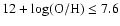 would be younger than 40 Gyr. However single star photometry
of one BCD galaxy showed that this limit is actually 1 Gyr (Izotov & Thuan 2002).
Another approach to the problem of the age is the study of the stellar populations
based on deep multi-wavelength photometry.
NIR colors are effective indicators of the age of a stellar population once
the metallicity is known. However
Vanzi et al. (2000) point out how, though the NIR colors of normal, active and
starburst galaxies are fairly well understood, their interpretation
in BCDs is not easy and certainly not free from ambiguity. This is mainly
due to two factors,
1) the broadband photometry of BCDs is strongly affected by nebular
emission and no reliable conclusion on the stellar population can be driven
without correcting the colors for this effect,
2) the interpretation of the colors is complicated by
the difficultiy of incorporating the effect of metallicity into the
evolutionary models in a satisfactory way.
The case of SBS 0335-052 (the second lowest metallicity BCD with
/40) is a good testbench
since none of the currently available models is able to reproduce the colors of
this galaxy even after taking into account the nebular contribution.
To measure the nebular contribution spectroscopy is necessary. NIR spectra
also offer the unique opportunity to probe the molecular hydrogen warm phase and to
study a number of features not accesible at other wavelengths.
Our main motivation for studying BCDs with
would be younger than 40 Gyr. However single star photometry
of one BCD galaxy showed that this limit is actually 1 Gyr (Izotov & Thuan 2002).
Another approach to the problem of the age is the study of the stellar populations
based on deep multi-wavelength photometry.
NIR colors are effective indicators of the age of a stellar population once
the metallicity is known. However
Vanzi et al. (2000) point out how, though the NIR colors of normal, active and
starburst galaxies are fairly well understood, their interpretation
in BCDs is not easy and certainly not free from ambiguity. This is mainly
due to two factors,
1) the broadband photometry of BCDs is strongly affected by nebular
emission and no reliable conclusion on the stellar population can be driven
without correcting the colors for this effect,
2) the interpretation of the colors is complicated by
the difficultiy of incorporating the effect of metallicity into the
evolutionary models in a satisfactory way.
The case of SBS 0335-052 (the second lowest metallicity BCD with
/40) is a good testbench
since none of the currently available models is able to reproduce the colors of
this galaxy even after taking into account the nebular contribution.
To measure the nebular contribution spectroscopy is necessary. NIR spectra
also offer the unique opportunity to probe the molecular hydrogen warm phase and to
study a number of features not accesible at other wavelengths.
Our main motivation for studying BCDs with
 is to link the
well-studied extremely metal deficient BCDs, like I Zw 18 and SBS 0335-052, with the
dwarf irregulars at the other end of the metallicity range, such as the LMC
(
is to link the
well-studied extremely metal deficient BCDs, like I Zw 18 and SBS 0335-052, with the
dwarf irregulars at the other end of the metallicity range, such as the LMC
(
 ).
The fact that the properties of sub-solar
and very low metallicity dwarf galaxies could be smoothly
connected is suggested by the finding of Guseva et al. (2000) that the number of
Wolf-Rayet stars in these galaxies is an increasing function of the metallicity in
agreement with the predictions of the models.
We are particularly interested in the photometric and spectroscopic properties of
BCDs, their star-formation process, dust, gas and H2 content as a function of
the metallicity.
It is our opinion that this approach can put important constraints on the star formation
history of BCDs and on star formation models.
).
The fact that the properties of sub-solar
and very low metallicity dwarf galaxies could be smoothly
connected is suggested by the finding of Guseva et al. (2000) that the number of
Wolf-Rayet stars in these galaxies is an increasing function of the metallicity in
agreement with the predictions of the models.
We are particularly interested in the photometric and spectroscopic properties of
BCDs, their star-formation process, dust, gas and H2 content as a function of
the metallicity.
It is our opinion that this approach can put important constraints on the star formation
history of BCDs and on star formation models.
The present paper is organized as follows. In Sect. 2 we present our new observations. Sect. 3 is devoted to the discussion of the spectra and Sect. 4 to the images. In Sect. 5 we summarize the conclusions of our work.
We have selected Tol 35, Tol 3 and UM 462 as representative of star formation
at intermediate sub-solar
metallicity. Their abundances are /6 for Tol 35 and Tol 3
(Kobulnicky et al. 1999) and /9 for UM 462 (Izotov & Thuan 1998;
Guseva et al. 2000). All three galaxies display the Wolf-Rayet features at 4686 Å
(Vacca & Conti 1992; Schaerer et al. 1999; Guseva et al. 2000). This is indicative
of a recent and short star formation episode as shown by the evolution of the number of WR over O stars predicted by single population evolutionary models (e.g. Leitherer &
Heckman 1995).
We have calculated distances to the sample galaxies
using a Hubble constant H0 of 70 km s-1 Mpc-1, and the Virgo
nonlinear flow model defined by Kraan-Korteweg (1986) and Giovanardi (2002).
With this H0 and the model of Kraan-Korteweg, the Virgo distance is 17.0 Mpc
The characteristics of the galaxies are summarized in Table 1.
| Tol 35 | Tol 3 | UM 462 | |
| RA (2000) | 13:27:06 | 10:06:33 | 11:52:37 |
| Dec (2000) | -27:57:24 | -29:56:09 | -02:28:10 |
| v (km s-1) | 2023 | 865 | 1055 |
| D (Mpc) a | 30.3 | 10.2 | 15.3 |
 |
1/6 | 1/6 | 1/9 |
| m(B) | 14.5 | 13.5 | 14.5 |
| other names | Tol 1324-276 | Tol 1004-296 | Mrk1307 |
| IC4249 | NGC 3125 | UGC 6850 |
| object | grism |
 (min)
(min) |
PA | aperture( ) ) |
| Tol 35 | blue | 32 | 124 |
 |
| Tol 35 | red | 28 | 124 |
|
| Tol 3 | blue | 30 | 113 |
 |
| Tol 3 | red | 24 | 113 |
|
| UM 462 | blue | 30 | 23 |  |
| UM 462 | red | 24 | 23 | |
NIR spectra were observed with SOFI at the ESO NTT in 2000 April and 2001 April
using the low resolution red and blue grisms which give a resolution R=600 with
a 1
wide slit. The slit position angle
(PA) was always chosen to include what seemed to be the most interesting
regions in the  acquisition image. All
galaxies were observed nodding along the slit. The Log of the observations
is presented in Table 2.
The reduction of the spectra was carried out in IRAF following the standard steps.
1D spectra centered on the brightest sources present in the slit
were extracted with apertures that maximize the S/N, see Table 2. The telluric absorption
features were removed from the spectra dividing by the spectrum of an O or G type star, then the original spectral shape was reestablished by multiplying
by a black-body of suitable temperature in the first case or by the solar
spectrum in the second one. The spectra were flux calibrated using the
photometry of broadband images within the spectra extraction apertures.
The agreement between the slope of the spectra and the photometry was at
the 10% level for Tol 3 and Tol 35 and at the 20% level for UM 462.
For this reason
a correction factor was applied to the spectra. The comparison
between the spectral fluxes and the photometry was always
done by integrating the spectrum over the filters bandpass. Since the atmosphere
significantly affects transmission, especially in the J filter its effect was included
as well. The flux-calibrated
spectra are displayed in Figs. 1, 2 and 3.
The detected emission lines are listed in Table 3.
acquisition image. All
galaxies were observed nodding along the slit. The Log of the observations
is presented in Table 2.
The reduction of the spectra was carried out in IRAF following the standard steps.
1D spectra centered on the brightest sources present in the slit
were extracted with apertures that maximize the S/N, see Table 2. The telluric absorption
features were removed from the spectra dividing by the spectrum of an O or G type star, then the original spectral shape was reestablished by multiplying
by a black-body of suitable temperature in the first case or by the solar
spectrum in the second one. The spectra were flux calibrated using the
photometry of broadband images within the spectra extraction apertures.
The agreement between the slope of the spectra and the photometry was at
the 10% level for Tol 3 and Tol 35 and at the 20% level for UM 462.
For this reason
a correction factor was applied to the spectra. The comparison
between the spectral fluxes and the photometry was always
done by integrating the spectrum over the filters bandpass. Since the atmosphere
significantly affects transmission, especially in the J filter its effect was included
as well. The flux-calibrated
spectra are displayed in Figs. 1, 2 and 3.
The detected emission lines are listed in Table 3.
![\begin{figure}
\par\includegraphics[height=17.6cm,width=7.4cm,angle=-90,clip]{ms2435_f1.ps}
\end{figure}](/articles/aa/full/2002/29/aa2435/img14.gif) |
Figure 1: NIR spectrum of Tol 35. The lower spectrum is extracted from the nucleus - region B (refear to flux in the right scale), the upper one from the brightest HII region in the galaxy - region A (refear to flux in the left scale). The regions of poor atmospheric transmission have been replaced by straight lines. |
| Open with DEXTER | |
![\begin{figure}
\par\includegraphics[height=17cm,width=7.4cm,angle=-90,clip]{ms2435_f2.ps}
\end{figure}](/articles/aa/full/2002/29/aa2435/img15.gif) |
Figure 2: NIR spectrum of UM 462 centered on region 1. |
| Open with DEXTER | |
![\begin{figure}
\par\includegraphics[height=17.6cm,width=7.4cm,angle=-90,clip]{ms2435_f3.ps}
\end{figure}](/articles/aa/full/2002/29/aa2435/img16.gif) |
Figure 3: NIR spectrum of Tol 3. The lower spectrum is extracted from region B (refear to flux in the right scale), the upper spectrum from region A (refear to flux in the left scale). |
| Open with DEXTER | |
| line |
 |
Tol 35 A | Tol 3 A | Tol 3 B | UM 462 |
| [SIII]+Pa 8 | 0.953 | 23.5 0.5 0.5 |
48.20.3 |
12.80.3 |
8.70.3 |
Pa |
1.005 | 3.10.2 |
6.60.2 |
5.80.3 |
1.20.3 |
| HeI | 1.082 | 15.50.3 |
36.10.3 |
2.50.3 |
10.50.5 |
Pa |
1.093 | 4.10.2 |
11.80.3 |
1.70.3 |
2.30.3 |
![$[\rm OI]$](/articles/aa/full/2002/29/aa2435/img21.gif) |
1.128 | - | 0.50.2 |
- | - |
Pa |
1.282 | 8.30.2 |
18.20.2 |
4.10.2 |
4.60.3 |
| ? | 1.498 | 0.20.1 |
- | - | 0.60.2 |
| Br13 | 1.611 | 0.20.1 |
- | - | - |
| Br12 | 1.641 | 0.20.1 |
1.20.3 |
- | - |
| Br11 | 1.681 | 0.40.1 |
0.80.1 |
- | 0.30.1 |
| HeI | 1.701 | 0.20.1 |
0.50.1 |
- | - |
| Br10 | 1.736 | 0.50.1 |
1.20.1 |
- | - |
| Br9 | 3.7? |
0.40.1 |
- | - | |
| Br |
1.944 | 1.30.1 |
2.80.1 |
0.70.3 |
1.10.1 |
| H2(1-0)S(3) | 1.957 | 0.20.1 |
0.20.1 |
- | - |
| HeI | 2.058 | 0.60.1 |
1.80.1 |
- | 0.60.1 |
| HeI | 2.113 | - | 0.30.1 |
- | - |
| H2 | 2.121 | 0.20.1 |
0.60.1 |
- | 0.10.1 |
| Br |
2.165 | 1.60.1 |
4.10.1 |
0.60.2 |
1.10.1 |
| H2 | 2.248 | - | 0.20.1 |
- | - |
| H2 | 2.407 | - | 0.40.2 |
- | - |
| H2 | 2.413 | - | 0.40.2 |
- | - |
Broadband images in the J, H and
NIR filters were acquired with
SOFI at the ESO-NTT in 2000 July.
The integration time was 10 min per filter for
all galaxies. All galaxies being small compared to the field of view
they were observed dithering ON source. The images were reduced
using the ESO Eclipse Package. The accuracy of the photometry was always
better than 3%. Images of the three galaxies in the band
are shown in Figs. 4, 5 and 6.
![\begin{figure}
\par\includegraphics[width=8.8cm,clip]{ms2435_f4.ps}
\end{figure}](/articles/aa/full/2002/29/aa2435/img23.gif) |
Figure 4:
Image of Tol 35 in .
The field is 1 1 arcmin, north is up est at
left. A and B mark the sources for which we extracted spectra. 1 arcmin, north is up est at
left. A and B mark the sources for which we extracted spectra. |
| Open with DEXTER | |
![\begin{figure}
\par\includegraphics[width=8.8cm,clip]{ms2435_f5.ps}
\end{figure}](/articles/aa/full/2002/29/aa2435/img24.gif) |
Figure 5:
Image of Tol 3 in .
A and B mark the sources for which we extracted spectra. Field and orientation as in the previous images. |
| Open with DEXTER | |
![\begin{figure}
\includegraphics[width=8.8cm,clip]{ms2435_f6.ps}
\end{figure}](/articles/aa/full/2002/29/aa2435/img25.gif) |
Figure 6:
Image of UM 462 in .
Numbers from 1 to 6 mark the regions for which we
extracted photometry. The spectrum is centered on region 1. Field and orientation as
in the previous image. |
| Open with DEXTER | |
 it is possible to calculate the extinction
toward the observed regions. We assume the intrinsic value 5.86 for the ratio as
given by Hummer &
Storey (1987) for T=104 K and n=102 cm-3 and the extinction law of Rieke &
Lebofsky (1985). Galactic extinction is not negligible toward Tol 35 and Tol 3,
AV=0.270 and 0.327 respectively, so that we have corrected for this effect first.
Though the errors are large, a
non-negligible extinction is observed in all cases. We obtain
it is possible to calculate the extinction
toward the observed regions. We assume the intrinsic value 5.86 for the ratio as
given by Hummer &
Storey (1987) for T=104 K and n=102 cm-3 and the extinction law of Rieke &
Lebofsky (1985). Galactic extinction is not negligible toward Tol 35 and Tol 3,
AV=0.270 and 0.327 respectively, so that we have corrected for this effect first.
Though the errors are large, a
non-negligible extinction is observed in all cases. We obtain
 in Tol 35 A,
 in Tol 3 A,
 in Tol 3 B and
 in UM 462 1.
These estimates are in good agreement with the optical values for the first two galaxies.
Vacca & Conti (1992) give
AV=0.77 for Tol 35 A and 1.97 for Tol 3 A. From the data of Terlevich et al.
(1991) we derive AV=0.26 for UM 462 while Guseva et al. (2000) measure AV=0.27.
Although the discrepancy in the case of UM 462 could be possibly due
to a mis-match in slit position (the morphology of UM 462 seems in fact
quite different in the optical and NIR - see Sect. 4),
such a large difference could also be ascribed to the presence of hidden star formation
somewhat similar to, but less extreme than in SBS 0335-052 (Hunt et al. 2001). Dust could
be well present in UM 462 that has been detected by IRAS at 60 and 100
in UM 462 1.
These estimates are in good agreement with the optical values for the first two galaxies.
Vacca & Conti (1992) give
AV=0.77 for Tol 35 A and 1.97 for Tol 3 A. From the data of Terlevich et al.
(1991) we derive AV=0.26 for UM 462 while Guseva et al. (2000) measure AV=0.27.
Although the discrepancy in the case of UM 462 could be possibly due
to a mis-match in slit position (the morphology of UM 462 seems in fact
quite different in the optical and NIR - see Sect. 4),
such a large difference could also be ascribed to the presence of hidden star formation
somewhat similar to, but less extreme than in SBS 0335-052 (Hunt et al. 2001). Dust could
be well present in UM 462 that has been detected by IRAS at 60 and 100  m.
We calculated the star formation rate in this galaxy using the global H
m.
We calculated the star formation rate in this galaxy using the global H flux
from Guseva et al. (2000) (
flux
from Guseva et al. (2000) (
 erg/s/cm2) and the IRAS fluxes
(
F60=0.944 and
F100=0.896 Jy) with the conversion factors of Kennicutt (1998)
obtaining SFR(H) =
erg/s/cm2) and the IRAS fluxes
(
F60=0.944 and
F100=0.896 Jy) with the conversion factors of Kennicutt (1998)
obtaining SFR(H) =
 yr and SFR(IR) =
 yr.
From this comparison we do not find strong evidence to support the presence of
hidden star formation so that the issue must be investigated further.
yr.
From this comparison we do not find strong evidence to support the presence of
hidden star formation so that the issue must be investigated further.
Based on our Br
fluxes corrected for the extinction we measured a SFR of
0.28, 0.24 and 0.24
 yr respectively in Tol 35 A, Tol 3 A and UM 462 or
 ,
,
 and
and
 /yr/kpc2.
Molecular hydrogen emission lines are detected in all galaxies.
The (1,0)S(1)/Br
ratios are 0.15, 0.12 and 0.09 respectively
for Tol 3 A, Tol 35 A and UM 462. They are
similar to the value measured in SBS 0335-520 by Vanzi et al.
(2000) and perfectly consistent with the trend reported by Vanzi & Rieke (1997),
suggesting that the H2 emission is not affected, or it is
affected at a low level, by the metallicity. The fact that the H2 2.12 flux is
only marginally affected by the metallicity in BCD galaxies is a remarkable finding:
it tells us that H2 is probably clumpy, confined to the star forming regions
dust-enriched by SNe and not diffuse, consistently with the observations of FUSE
(e.g. Vidal-Madjar et al. 2000; Thuan et al. 2002).
The detection of the (1,0)S(3) transition in Tol 35 and Tol 3 is not significant
enough to derive
any conclusion on the excitation mechanism but the reddest part of the spectrum of Tol 3
is good enough to allow unambiguous detection of the transitions (2,1)S(1)2.248,
(1,0)Q(1)2.407 and (1,0)Q(2)2.413. These detections strongly support the fluorescent
excitation of H2 as can be easily seen from the models reviewed by Engelbracht et al.
(1998). Such a mechanism is quite natural in regions dominated by a strong UV field from young massive stars. From the similarity of the objects under study
we can assume that the same mechanism is at work also in Tol 35 and UM 462 and
explain the low (1,0)S(1)/Br
ratio observed as produced by large "nude''
clusters of young stars (Vanzi et al. 2000; Puxley et al. 1990).
The NIR lines of [FeII] are often used as indicators of supernovae in starburst
galaxies (e.g. Vanzi & Rieke 1997) since the ratio [FeII]/Br
has been found
high (>20) in galactic SN remnants and low (<0.1) in galactic HII regions
(Moorwood & Oliva 1988).
[FeII] is not detected in any of the regions observed, either at 1.26 or at 1.64 m,
meaning that the spectra are dominated by young episodes of star formation
where even the most massive stars have not yet had time to evolve to become SN.
In other words the star formation observed in Tol 35 A, Tol 3 A and UM 462 must
be younger than about 10 Myr. This conclusion is also supported by the very
high equivalent width of Br,
90, 110 and 170 Å respectively in the 3 galaxies. According to Starburst99 (SB99, Leitherer et al. 1999), using an
instantaneous burst,
 and a Salpeter IMF, these correspond to
ages between 5 and 7 Myr.
Further support to the extreme youth of the observed episodes of
star formation is given by the HeI lines.
The HeI line at 1.700 m is clearly detected in region A of Tol 3 and
region A of Tol 35. The HeI line at 2.113 m is detected in Tol 3
only. Both lines are strong signatures of the presence of young
massive stars as discussed by Vanzi et al. (1996).
The ratios HeI1.7/Br10 and HeI2.11/Br
in Tol 3 A, respectively 0.42
and 0.07, and the ratio
and a Salpeter IMF, these correspond to
ages between 5 and 7 Myr.
Further support to the extreme youth of the observed episodes of
star formation is given by the HeI lines.
The HeI line at 1.700 m is clearly detected in region A of Tol 3 and
region A of Tol 35. The HeI line at 2.113 m is detected in Tol 3
only. Both lines are strong signatures of the presence of young
massive stars as discussed by Vanzi et al. (1996).
The ratios HeI1.7/Br10 and HeI2.11/Br
in Tol 3 A, respectively 0.42
and 0.07, and the ratio
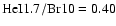 in Tol 35 A, are in good agreement
with the saturated values calculated by Vanzi et al. (1996).
The two lines are not detected in UM 462 whose spectrum is however of lower quality.
The presence of Wolf-Rayet stars in all three BCDs also gives an age of about 5-6 Myr for the young massive stellar population (Guseva et al. 2000).
in Tol 35 A, are in good agreement
with the saturated values calculated by Vanzi et al. (1996).
The two lines are not detected in UM 462 whose spectrum is however of lower quality.
The presence of Wolf-Rayet stars in all three BCDs also gives an age of about 5-6 Myr for the young massive stellar population (Guseva et al. 2000).
| Name | J | J-H | H-K |
 |
 |
 |
 |
 |
|
| Tol3 | A | 15.89 | 0.45 | 0.47 | 0.30 | 0.19 | 0.24 | 0.16 | -0.08 |
| B | 15.91 | 0.62 | 0.31 | 0.05 | 0.02 | 0.03 | 0.03 | -0.01 | |
| ext. | 0.60 | 0.25 | |||||||
| Tol35 | A | 16.67 | 0.41 | 0.41 | 0.25 | 0.19 | 0.20 | 0.08 | -0.01 |
| B | 16.50 | 0.60 | 0.27 | 0.00 | 0.00 | 0.00 | 0.00 | 0.00 | |
| ext. | 0.55 | 0.18 | |||||||
| UM462 | 17.74 | 0.29 | 0.49 | 0.42 | 0.30 | 0.39 | 0.20 | -0.15 | |
| ext. | 0.53 | 0.19 |
The [SIII] line at 0.953 m is detected in all the spectra. Diaz et al.
(1985) use this line as a diagnostic of the excitation mechanism. We took the
ratio [SIII]/Pa,
after subtracting the contribution of Pa8 that is
blended with [SIII] at our resolution, and converted
it to [SIII]/H
using a standard value for H P.
Our values
lie at the extreme high-excitation end of the HII region area in the plot of
Diaz et al. (1985).
This is easily explained by the low metallicity of our galaxies compared to the
galactic HII regions used by other authors. The [SIII] line is in fact sensitive to
the sulfur abundance (Rudy et al. 2001).
P.
Our values
lie at the extreme high-excitation end of the HII region area in the plot of
Diaz et al. (1985).
This is easily explained by the low metallicity of our galaxies compared to the
galactic HII regions used by other authors. The [SIII] line is in fact sensitive to
the sulfur abundance (Rudy et al. 2001).
The CO absorption band at 2.29 m can be used to constrain the age of
the star-formation episode in starburst galaxies (Doyon et al. 1994), although it is not
particularly reliable for ages older than roughly 10 Myr (Origlia & Oliva 2000),
when red supergiants begin to emerge.
In low metallicity environments, CO absorption is generally weak mostly
because carbon abundance is lower, but also because stellar temperatures are warmer
than those in more metallic systems (Origlia et al. 1997). Our NIR spectra
reveal no absorption bands either at the CO(6,3) bandhead at 1.62 m or at
2.29 m, the CO(2,0) bandhead. In addition to the metallicity effect,
this non-detection can be explained also by the young age of the bursts.
As seen in the images presented in Figs. 4, 5, and 6, all galaxies show two or more bright knots of intense star-formation activity, surrounded by low-surface brightness envelopes. Because of the non-ellipticity of its outer isophotes, UM 462 would be classified as iI according to the classification scheme of Loose & Thuan (1986). Tol 3 and Tol 35, on the other hand, present rather regular elliptical isophotes in the outer regions (although the foreground star disturbs the appearance toward the SE in Tol 35), and therefore would be classified as iE, the most common morphology of BCDs. In terms of morphology, Tol 3 and Tol 35 are reminiscent of I Zw 18, which is dominated by two main bright centers of star formation surrounded by a low surface-brightness envelope. UM 462 shows a peculiar morphology characterized by several knots of varying brightness, embedded within an irregular outer envelope. However a deeper B optical image of UM 462 by Cairós et al. (2001) does show that the outermost contours do become elliptical, and thus should be classified as iE. In all galaxies, the NIR colors and spectra of the knots differ, and may represent examples of propagating star formation (see Sect. 4.3).
To better constrain the colors of the extended regions,
we have derived surface-brightness profiles of the galaxies.
The profiles were extracted by first fitting elliptical isophotes
to the J-band image,
In Tol 3 and Tol 35, ellipse centers were fixed to the brightest
knot (Tol 3A and Tol 35B);
in the case of UM 462, the ellipse center was assigned to be
the center of symmetry of the outer isophotes.
In this case, the surface brightness peaks integrated azimuthally
appear as a "shoulder'' in the profile at
 .
While average-sigma clipping was performed for all objects,
for Tol 35 it was also necessary to apply a mask in order to
minimize the effect of the bright foreground star;
nevertheless, the effects of the star appear in the profile at
.
While average-sigma clipping was performed for all objects,
for Tol 35 it was also necessary to apply a mask in order to
minimize the effect of the bright foreground star;
nevertheless, the effects of the star appear in the profile at
 .
We note also that Tol 35B corresponds to the center of symmetry of
the outer isophotes, and is most probably the nucleus of the
galaxy.
The surface-brightness profiles are described by exponential laws
in Tol 35 and Tol 3 and by a higher order generalized exponential in
UM 462.
Mean colors of the outer regions of the galaxies were estimated
from the profiles by averaging; these are shown by horizontal
dashed lines in the lower panels of Figs. 8
and 10 and reported in Table 4.
We have calculated the colors in the spectroscopic apertures,
and performed photometry of the bright knots.
All colors have been corrected for Galactic extinction (Schlegel et al. 1998).
For the knots, we used a photometric aperture roughly equal to
the seeing width (1),
appropriate for characterizing colors of point sources
superimposed on a variable background.
In Table 4 we list the colors observed in the spectroscopic apertures,
and the corrections for nebular emission.
The continuum correction was estimated by using the coefficients in Joy
& Lester (1988) and our Br
fluxes.
The correction for emission lines was calculated by summing over
the lines in our spectra.
Total gas fractions are also reported in Table 4, and range from 20-40% in the brightest knots; J band fractions tend to be slightly
larger than those in because of the strong emission lines around 1 m.
Such large gas fractions and the corresponding color corrections
clearly illustrate how ionized gas significantly affects broadband
colors of young HII regions.
.
We note also that Tol 35B corresponds to the center of symmetry of
the outer isophotes, and is most probably the nucleus of the
galaxy.
The surface-brightness profiles are described by exponential laws
in Tol 35 and Tol 3 and by a higher order generalized exponential in
UM 462.
Mean colors of the outer regions of the galaxies were estimated
from the profiles by averaging; these are shown by horizontal
dashed lines in the lower panels of Figs. 8
and 10 and reported in Table 4.
We have calculated the colors in the spectroscopic apertures,
and performed photometry of the bright knots.
All colors have been corrected for Galactic extinction (Schlegel et al. 1998).
For the knots, we used a photometric aperture roughly equal to
the seeing width (1),
appropriate for characterizing colors of point sources
superimposed on a variable background.
In Table 4 we list the colors observed in the spectroscopic apertures,
and the corrections for nebular emission.
The continuum correction was estimated by using the coefficients in Joy
& Lester (1988) and our Br
fluxes.
The correction for emission lines was calculated by summing over
the lines in our spectra.
Total gas fractions are also reported in Table 4, and range from 20-40% in the brightest knots; J band fractions tend to be slightly
larger than those in because of the strong emission lines around 1 m.
Such large gas fractions and the corresponding color corrections
clearly illustrate how ionized gas significantly affects broadband
colors of young HII regions.
![\begin{figure}
\par\includegraphics[width=12.5cm,clip]{ms2435_f7.ps}
\end{figure}](/articles/aa/full/2002/29/aa2435/img49.gif) |
Figure 7:
J-H vs. H-K diagram for bright knots and extended regions of
sample galaxies. Tol 3 is represented by circles, Tol 35
by squares, and UM 462 by crosses (with number of knot when applicable).
Filled symbols show photometry for the spectroscopic aperture, and
open ones the mean colors of the outer regions. Colors observed and corrected
for the gas contribution are plotted and connected by solid lines.
SB99 models are shown for
three metallicities: 1/20 (blue, solid line), 1/5 (green, dotted line),
and solar (red, dashed line). The cyan-colored grid rapresents the empirical NIR colors of
late-type and dwarf galaxies.
An extinction vector starts from the point of age 7 Myr on the
model,
points corresponding to AV=1 are marked by open triangles. |
| Open with DEXTER | |
![\begin{figure}
\par\includegraphics[width=8.8cm,clip]{ms2435_f8.ps}
\end{figure}](/articles/aa/full/2002/29/aa2435/img50.gif) |
Figure 8:
Surface-brightness profiles of Tol 3 (left panel) and Tol 35 (right panel).
In the upper panels, the J band profile is shown by data points with
uncertainties, together with the H and bands shown by solid lines.
The lower panels show the radial variation of the NIR colors, with the mean
colors of the outer isophotes shown as horizontal dashed lines.
The surface-brightness profile of Tol 35 is compromised. |
| Open with DEXTER | |
![\begin{figure}
\par\includegraphics[width=8.8cm,clip]{ms2435_f9.ps}
\end{figure}](/articles/aa/full/2002/29/aa2435/img51.gif) |
Figure 9: Surface-brightness profiles of Tol 3. Same as previous figure. |
| Open with DEXTER | |
![\begin{figure}
\par\includegraphics[width=8.8cm,clip]{ms2435_f10.ps}
\end{figure}](/articles/aa/full/2002/29/aa2435/img52.gif) |
Figure 10: Surface-brightness profiles of UM 462. Same as previousfigure. |
| Open with DEXTER | |
In Fig. 7, we compare our results with models: Tol 3 is represented
by circles, Tol 35 by squares, and UM 462 by X's (with number of knot when applicable).
Filled symbols show photometry for the spectroscopic aperture, and
open ones the mean colors of the outer regions. For the spectral
apertures, photometry corrected for gas emission is shown (first lines,
then continuum+lines).
SB99 models are shown for three metallicities: 1/20 (blue, solid line),
1/5 (green, dotted line), and solar (red, dashed line) for a Salpeter IMF
with upper cut-off at
 .
For 1/5 ,
ages of 4, 10, and 25 Myr are marked with arrows.
The characteristic shape of the curves is given by the fact that
young ages are characterized by the reddest H-K colors, because of the
dominant gas (continuum only in SB99) emission such emission can dominate
the K band (see Vanzi et al. 2000). Empirical NIR colors of
late-type and dwarf galaxies (de Jong 1996) are shown as a cyan-colored grid.
The X's numbered from 1 to 6 correspond to the knots detected in
UM 462, and will be discussed below.
.
For 1/5 ,
ages of 4, 10, and 25 Myr are marked with arrows.
The characteristic shape of the curves is given by the fact that
young ages are characterized by the reddest H-K colors, because of the
dominant gas (continuum only in SB99) emission such emission can dominate
the K band (see Vanzi et al. 2000). Empirical NIR colors of
late-type and dwarf galaxies (de Jong 1996) are shown as a cyan-colored grid.
The X's numbered from 1 to 6 correspond to the knots detected in
UM 462, and will be discussed below.
As in the majority of BCDs,
the colors of the extended emission are in quite good agreement
with evolved stellar populations of 1/5
to
metallicity.
It is clear that in each of our sample galaxies, at metallicities
from  to
to  ,
the extended envelope is populated
by evolved (age > 5 Gyr) stars.
Judging from J-H, Tol 3 is the most evolved galaxy; the knot B colors
are very similar to those of the extended envelope, and both are
relatively red in J-H and blue in H-K.
To compare the colors of the knots with the models,
it is necessary to correct the observations for gas line emission,
since SB99 includes the contribution of the nebular continuum only.
The only knot clearly compatible with the models is knot 1 in UM 462,
although the colors have not been corrected for line emission.
The remaining knots in Tol 3 (circles), Tol 35 (squares), and UM 462
(X's) are roughly compatible with a stellar population younger than 10 Myr,
and a few magnitudes of extinction.
Such young ages are consistent with the Br equivalent widths
and the presence of HeI emission lines in our spectra;
they are also consistent with the presence of Wolf-Rayet stars in these
galaxies (Guseva et al. 2000; Vacca & Conti 1992).
The brightest knots in each galaxy show a peak red
H-K=0.5, in contrast to the surrounding H-K color of 0.2.
Such a red color is an almost certain signature of gas or hot dust,
especially since we see
no spectral sign of red supergiants but do detect large extinction and
large gas fraction.
The brightest knots also show a blue J-H color:
while the surrounding regions and the extended envelopes have
J-H=0.5-0.6, typical of evolved stellar populations,
the bright knots have J-H =0.2, consistent
with young stars+gas (the J-H color of gas including lines
is
,
the extended envelope is populated
by evolved (age > 5 Gyr) stars.
Judging from J-H, Tol 3 is the most evolved galaxy; the knot B colors
are very similar to those of the extended envelope, and both are
relatively red in J-H and blue in H-K.
To compare the colors of the knots with the models,
it is necessary to correct the observations for gas line emission,
since SB99 includes the contribution of the nebular continuum only.
The only knot clearly compatible with the models is knot 1 in UM 462,
although the colors have not been corrected for line emission.
The remaining knots in Tol 3 (circles), Tol 35 (squares), and UM 462
(X's) are roughly compatible with a stellar population younger than 10 Myr,
and a few magnitudes of extinction.
Such young ages are consistent with the Br equivalent widths
and the presence of HeI emission lines in our spectra;
they are also consistent with the presence of Wolf-Rayet stars in these
galaxies (Guseva et al. 2000; Vacca & Conti 1992).
The brightest knots in each galaxy show a peak red
H-K=0.5, in contrast to the surrounding H-K color of 0.2.
Such a red color is an almost certain signature of gas or hot dust,
especially since we see
no spectral sign of red supergiants but do detect large extinction and
large gas fraction.
The brightest knots also show a blue J-H color:
while the surrounding regions and the extended envelopes have
J-H=0.5-0.6, typical of evolved stellar populations,
the bright knots have J-H =0.2, consistent
with young stars+gas (the J-H color of gas including lines
is  0.0-0.2).
Such colors are indicative of extreme youth, since they are
almost certainly due to a high gas fraction plus perhaps a small
amount of hot dust that reddens
0.0-0.2).
Such colors are indicative of extreme youth, since they are
almost certainly due to a high gas fraction plus perhaps a small
amount of hot dust that reddens
 .
.
While the data and the models appear to be in moderate disagreement, it should be borne in mind that the corrections for nebular emission and extinction are uncertain. Moreover, the corrected colors tend to be slightly redder than the models in H-K, which could point to the presence of hot dust (Vanzi et al. 2000). Indeed, 500 K dust does not affect J-H, but reddens H-K, making this color a strong diagnostic for hot dust emission.
| Name | Knot | J-H | H-K |
 |
 |
Size (pc) |
| Tol3 | A | 0.47 | 0.46 | 15.32 | -14.72 | 37 |
| B | 0.64 | 0.29 | 16.13 | -13.91 | 38 | |
| B-tip | 0.27 | 0.47 | - | - | ||
| Tol35 | A | 0.25 | 0.49 | 16.79 | -15.61 | 72 |
| B | 0.56 | 0.28 | 16.63 | -15.78 | 173 | |
| UM462 | 1 | 0.19 | 0.48 | 17.61 | -13.31 | 42 |
| 2 | 0.41 | 0.32 | 18.14 | -12.79 | 55 | |
| 3 | 0.38 | 0.14 | 18.20 | -12.73 | 86 | |
| 4 | 0.47 | 0.13 | 18.38 | -12.55 | 55 | |
| 5 | 0.37 | 0.19 | 18.45 | -12.48 | 66 | |
| 6 | 0.41 | 0.25 | 18.45 | -12.47 | 100 |
Table 5 lists the photometric properties of the bright knots
in the sample galaxies.
All of the bright knots have absolute magnitudes
ranging from -12.5 in the weakest knot (#4 in UM 462) to -15.6 in Tol 35A;
Tol 35B, the probable galactic nucleus, has
 ,
the brightest knot in our sample.
These have not been corrected for gas emission, so are essentially
upper limits; cluster #1 in UM 462 with a
gas fraction of 40%,
would be diminished by roughly 0.6 mag.
We have measured the diameter of the clusters, taking into account
the resolution limit dictated by our seeing
(ranging from 0.8-1.1
in );
1
corresponds to 50, 147, and 74 pc for
Tol 3, Tol 35, and UM 462, respectively.
Virtually all of the clusters are barely resolved or unresolved,
having diameters ranging from 40 pc in UM 462 and
Tol 3 (the nearest galaxies) to 70 pc or larger in Tol 35
(the most distant).
These are almost certainly size upper limits because of the seeing
and distance constraints.
,
the brightest knot in our sample.
These have not been corrected for gas emission, so are essentially
upper limits; cluster #1 in UM 462 with a
gas fraction of 40%,
would be diminished by roughly 0.6 mag.
We have measured the diameter of the clusters, taking into account
the resolution limit dictated by our seeing
(ranging from 0.8-1.1
in );
1
corresponds to 50, 147, and 74 pc for
Tol 3, Tol 35, and UM 462, respectively.
Virtually all of the clusters are barely resolved or unresolved,
having diameters ranging from 40 pc in UM 462 and
Tol 3 (the nearest galaxies) to 70 pc or larger in Tol 35
(the most distant).
These are almost certainly size upper limits because of the seeing
and distance constraints.
To derive the number of equivalent O7V stars in the regions
observed spectroscopically and listed in Table 4, we
first correct the Br
fluxes for extinction, then multiply
by 35.94 to convert to H
fluxes
(for 100 cm-3 and
T = 10 000 K, Osterbrock 1989). We
then convert the H
fluxes to the number of Lyman
continuum photons using the conversion factor given by Guseva et al. (2000).
Adopting 1049 s-1 as the number of Lyman continuum photons
for an O7V star, we obtain 462 O7V stars in Tol3 A,
1435 O7V stars in Tol 35 A, 695 O7V stars in Tol3 B, and 307 O7V stars in
UM462-1.
The absolute magnitudes, size and number of stars of the clusters
observed are indicative of Super Star Clusters (SSCs) (Billet et al. 2002;
Whitmore 2000)
The SSCs in UM 462 vary in NIR color, and appear to follow
a trend with age or gas fraction or both.
Knot #1 has the reddest
and bluest J-H color, followed by the two
nearest knots (#2 and #6).
While
gets bluer with increasing knot number (and distance from
knot #1),
J-H remains roughly constant at 0.4 also for knots #3 and #5,
but gets redder for knot #4.
Such a trend suggests a decreasing gas fraction (because of the decreasing
color) going from knot #1, #2, #6, to knot #4.
This may also be interpreted as an age trend, since gas fraction
decreases with age, and J-H for knot #4 is slightly redder.
Without spectral information for the different knots, it is difficult
to be more definite.
Nevertheless, the colors of the knots in UM 462 suggests that the
star formation in knot is #1 is more recent than that in the remaining
knots; knot #4 appears to be the oldest.
The knots in Tol 3 show similar trends, with knot B appearing to be
older than knot A. This is suggestive of propagating star formation,
with the shock waves triggered by supernovae in the older knots
triggering star formation in the younger knots.
band gas fractions range from 3 to 40%, implying that ionized gas
significantly affects broadband colors.
Acknowledgements
We are grateful to Jason Spyromilio for generously sharing with us part of his observing time.