A&A 390, 801-807 (2002)
DOI: 10.1051/0004-6361:20020740
Optimum imaging observation wavelength selection
for astronomical
telescopes with partial correction adaptive optics
Changhui Rao - Wenhan Jiang
Adaptive Optics Laboratory, Institute of Optics and Electronics, Chinese Academy of Sciences, PO Box 350, Shuangliu, Chengdu 610209, Sichuan, PR China
Received 20 June 2001 / Accepted 15 April 2002
Abstract
In order to maximize the compensation potential of adaptive optics system for
atmospheric turbulence, an appropriate observing wavelength should be selected on the basis of
system capability and the working conditions to improve the optical resolution of astronomical
telescopes. Based on the analysis of the wavefront residual error of the adaptive optics system, the optimum imaging observation wavelengths giving maximum imaging resolution of a partial
correction adaptive optics system are derived for short-exposure and long exposure imaging
respectively. The developed method is used to evaluate the optimum observing wavelength and the
corresponding imaging resolution for the 61-element adaptive optical system at the 1.2 m telescope
of the Yunnan Observatory.
Key words: telescopes - atmospheric effects - instrumentation: adaptive optics - methods:
observational
It is well known that atmospheric turbulence (Roddier 1981) severely limits the resolution of large ground-based telescopes in the visible and near infrared bands. Adaptive optics (Jiang et al. 1995) techniques can be used to correct random optical wavefront distortions induced by the atmospheric turbulence in real time.
The performance requirements for adaptive optics systems (AOS) depend on their mission. In
the visible band, large telescopes require very complex AOS with hundreds of correction channels
in order to produce high-resolution object images. But the large telescopes with low-order AOS
perform well in the near infrared band. The imaging observation wavelength is one of the most
significant factors in the requirements of AOS. For ground-based solar telescopes (Rimmele &
Radick 1998), high-resolution monochromic imaging observations are usually done at a single wavelength with a very narrow band because of strong enough sunlight. For nighttime
astronomical telescopes, a range of wavelengths is often used for imaging observation. For
nighttime astronomical adaptive optical systems, the observing wavelength during setting up an
observation is generally confined to the end portion of the red visible (R and I bands), the
non-thermal near IR (J and H bands), or thermal IR (K band) according to the practical
requirements and system capabilities.
In selecting an imaging observation wavelength, two competing effects must be considered.
On the one hand, as the imaging wavelength is increased, the wavefront residual error decreases,
resulting in a sharper point spread function. On the other hand, diffraction increases with
wavelength, producing the opposite effect. For telescopes with partial correction AOS, the
appropriate observing wavelength should be selected on the basis of the system capability and the
working conditions in order to achieve the best angular resolution.
In previous publications, Tyler (Tyler & Fender 1994) derived an expression for the
wavelength giving maximum resolution for the telescopes with AOS. In his study, the imaging
Strehl ratio is simplified as
 ,
where
,
where
 is the variance of the residual phase error.
This is only valid for small residual phase error. For the partial correction AOS, this condition can commonly not be satisfied. In this paper, we derive the expressions of the optimum short-exposure
and long-exposure imaging observation wavelength of astronomical telescopes with partial
correction adaptive optics based on the analysis for the wavefront residual error of AOS. The
paper is organized as follows. The parameters of atmospheric turbulence are briefly introduced in
Sect. 2. In Sect. 3, the wavefront residual error of AOS is analyzed by considering the
limitation factors of the practical AOS. Section 4 derives the optimum imaging observation
wavelength on the basis of the relationship between the angular resolution and the wavefront
residual error for the astronomical telescopes with partial correction AOS. In Sect. 5, the
optimum imaging observation wavelength is computed for the 61-element adaptive optical system
at the 1.2 m telescope of the Yunnan Observatory.
is the variance of the residual phase error.
This is only valid for small residual phase error. For the partial correction AOS, this condition can commonly not be satisfied. In this paper, we derive the expressions of the optimum short-exposure
and long-exposure imaging observation wavelength of astronomical telescopes with partial
correction adaptive optics based on the analysis for the wavefront residual error of AOS. The
paper is organized as follows. The parameters of atmospheric turbulence are briefly introduced in
Sect. 2. In Sect. 3, the wavefront residual error of AOS is analyzed by considering the
limitation factors of the practical AOS. Section 4 derives the optimum imaging observation
wavelength on the basis of the relationship between the angular resolution and the wavefront
residual error for the astronomical telescopes with partial correction AOS. In Sect. 5, the
optimum imaging observation wavelength is computed for the 61-element adaptive optical system
at the 1.2 m telescope of the Yunnan Observatory.
The effects of atmospheric turbulence on astronomical telescopes are commonly
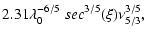
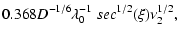
characterized as the following atmospheric parameters: the turbulence coherence length, namely
Fried's parameter r0, the Greenwood frequency  ,
the Tyler frequency
,
the Tyler frequency  ,
and the anisoplanatic angle
,
and the anisoplanatic angle  .
These parameters are usually specified at the visible wavelength of 0.55
.
These parameters are usually specified at the visible wavelength of 0.55  m (Roddier 1981):
where

 m,
m,
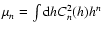 ,
,
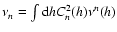 .
.
 is
the zenith angle. Cn2(h) and
is
the zenith angle. Cn2(h) and  are the index-of-refractive model and wind speed profile respectively. Note that formula (4) is only effective for G-tilt, namely for an average gradient of the pupil.
Most adaptive optics compensation systems apply the conjugate surface of the phase
measured by WFS with a pair of active elements consisting of a high-speed TM and a DM. TM is
usually used to correct the tilt component of the wavefront distortions induced by atmospheric
turbulence. The figure (tilt-removed) component of the wavefront perturbation is compensated by
DM. In the practical AOS, the compensation is not perfect because of the individual errors such as
the uncompensated turbulence-induced error due to the finite bandwidth of the servo system and
the measurement noise.
The main figure residual errors include: (1) uncompensated turbulence-induced figure error
due to the bandwidth of the figure compensation servo system; (2) closed-loop figure noise error
due to the measurement error of the wavefront sensor; (3) fitting error due to the finite corrector elements; (4) anisoplanatic error due to the angular anisoplanatism and the focal anisoplanatism.
The uncompensated turbulence-induced figure error depends on the temporal power spectrum
of the figure (tilt-removed) component of the turbulence
 and the servo control transfer function
 :
:
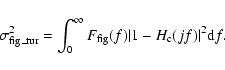 |
(5) |
For Kolmogorov turbulence, the power spectrum of the figure (tilt-removed) component of
the turbulence with the unit of rad2/Hz, developed by Greenwood and Fried (Greenwood & Fried
1976), has the following form:
| |
|
 |
|
| |
|
 |
(6) |
In practical AOS, there exists a time delay between the wavefront sensing and wavefront
correcting. Considering the effect of the time delay on servo control loop, the closed-loop transfer function of AOS can be expressed as (Rao et al. 2000)
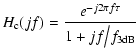 |
|
|
(7) |
where
 is the closed-loop -3dB bandwidth and
  is the time delay.
For high-bandwidth figure compensation, the uncompensated turbulence-induced figure error
at the imaging wavelength  can be obtained with the high-frequency form of the figure
spectrum over the entire frequency range, so that (Li et al. 2000):
can be obtained with the high-frequency form of the figure
spectrum over the entire frequency range, so that (Li et al. 2000):
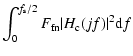
In AOS, the noise resulting from WFS mainly consists of the photon shot noise due to the
finite light intensity and the read-out noise of the detector such as a CCD. Assuming the noise is
white, the closed-loop figure noise error can be obtained as (Rao et al. 2000):
where
 is the noise power spectrum and
  is the sampling frequency of the system.
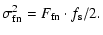
Note that the wavefront measurement noise
 relates the noise power spectrum to:
 |
|
|
(10) |
Substituting Eq. (10) into Eq. (9), the closed-loop figure noise error at the imaging
observation wavelength
can be expressed as
 |
|
|
(11) |
where
 is the detecting wavelength of WFS and
![${\rm arctg}[f_{\rm s}/(2f_{\rm 3dB})]\approx\pi/2$](/articles/aa/full/2002/29/aa1566/img45.gif) is used.
is used.
The uncorrected phase error due to the figure (tilt-removed) component of turbulence at the
imaging wavelength ,
namely figure fitting error, is conveniently expressed in terms of the ratio of the subaperture spacing and the turbulence coherence length (Hardy 1998):
![$\displaystyle \sigma_{\rm fig\_fit}^2=0.34[d_{\rm s}/r_0(\lambda)]^{5/3}=0.34(\lambda_0/\lambda)^2[d_{\rm s}/r_0(\lambda_0)]^{5/3}$](/articles/aa/full/2002/29/aa1566/img46.gif) |
|
|
(12) |
where  is the subaperture spacing.
When the beacon of AOS and the target object do not lie in the same direction, the error due
to angular anisoplanatism at the imaging wavelength
can be expressed as (Fried 1982)
 |
|
|
(13) |
where  is the angle between the beacon and the target object.
Furthermore, because the atmospheric turbulence is only partially detected by the beacon
light, the use of laser beacons in AOS produces the error due to focal anisoplanatism, which may
be expressed as (Tyler 1994)
 |
|
|
(14) |
where D is the diameter of the telescope. For the beacon with height H, the value of d0 implied by
Eq. (14) is
where
 and
and
 and are the
upper and lower turbulence moments at height H respectively.
and are the
upper and lower turbulence moments at height H respectively.
The total figure residual error of AOS with the unit of phase rad2 at the imaging wavelength
may be expressed as the sum of individual errors in the form
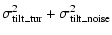
In AOS, the tilt component of turbulence is often measure by quadrant detectors and centroid
trackers. This tilt belongs to G-tilt, namely average gradient over the pupil. The main errors
involved in compensating the tilt component of turbulence are: (1) uncompensated
turbulence-induced tilt error due to the bandwidth of the tilt compensation servo system;
(2) closed-loop tilt noise error due to the measurement error of the tracking sensor.
According to the tracking frequency
defined by Tyler (Tyler 1994), see Eq. (4), the uncompensated turbulence-induced tilt error at the imaging wavelength
can be expressed as
![$\displaystyle \sigma_{\rm tilt\_tur}^2=\left[f_{\rm T}(\lambda)/f_{\rm c}\right]^2(\lambda/D)^2=\left[f_{\rm T}(\lambda_0)/f_{\rm c}\right]^2(\lambda_0/D)^2$](/articles/aa/full/2002/29/aa1566/img61.gif) |
|
|
(17) |
where  is the closed-loop -3dB bandwidth of the tracking servo loop.
Similar to the closed-loop figure noise error, the closed-loop tilt noise error at the imaging
wavelength
relates the tilt measurement error
 ,
the sampling frequency of the tracking system
,
the sampling frequency of the tracking system
 and the closed-loop -3dB bandwidth of the tracking servo loop to
 |
|
|
(18) |
where
 is the detecting wavelength of the tracking sensor. The tilt measurement error
is scaled as the unit of
is the detecting wavelength of the tracking sensor. The tilt measurement error
is scaled as the unit of
 .
.
The total tilt residual error with the unit of tilt rad2 at the imaging wavelength
is given by the sum of the uncompensated turbulence-induced tilt error and the closed-loop tilt noise error,
The effect of wavefront residual error of AOS on an optical image is to remove energy from
the central peak, distributing it into a surrounding halo. The halo is absent for a perfect wavefront,
but dominates the image structure in the presence of a wavefront error typical of uncompensated
turbulence.
For the astronomical telescope with AOS, the image resolution is most affected. To investigate
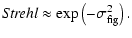
the image quality of AOS, it is useful to begin with the extended Marechal approximation, which
provides a relationship between the figure error and the Strehl ratio under weak-turbulence
conditions
 |
|
|
(20) |
This is only valid for small residual phase error. For most partial correction AOS, this condition is
generally not satisfied.
Assuming all of the energy lost from the central core of the beam is scattered over a region of
width
 ,
a composite short-exposure image Strehl ratio (Parenti & Sasiela 1994) for partial correction AOS can be shown as
,
a composite short-exposure image Strehl ratio (Parenti & Sasiela 1994) for partial correction AOS can be shown as
![$\displaystyle {\it Strehl}_{\rm SE}\approx \exp\left(-\sigma_{\rm fig}^2\right)+\frac{1-\exp\left(-\sigma_{\rm fig}^2\right)}{1+[D/r_0(\lambda)]^2}\cdot$](/articles/aa/full/2002/29/aa1566/img73.gif) |
|
|
(21) |
Accordingly, the short-exposure image resolution (Parenti & Sasiela 1994) for partial
correction AOS can be expressed as
 |
|
|
(22) |
Similarly, for the long-exposure imaging, the Strehl ratio and the resolution (Parenti & Sasiela
1994) for AOS can be approximated to
![$\displaystyle {\it Strehl}_{\rm LE}\approx\frac{\exp\left(-\sigma_{\rm fig}^2\r...
...rm tilt}^2}+\frac{1-\exp\left(-\sigma_{\rm fig}^2\right)}{1+[D/r_0(\lambda)]^2}$](/articles/aa/full/2002/29/aa1566/img75.gif) |
|
|
(23) |
and
 |
|
|
(24) |
respectively. Note that the first term of Eqs. (21) and (23) is the relative peak intensity of the
central core of the imaging beam and the second term is that of the surrounding halo. Generally,
the peak intensity of the central core is much larger than that of the halo for imaging with AOS.
As the figure residual error is very small, the short-exposure Strehl ratio can be simplified as
mentioned above. For partial correction adaptive optical systems, the imaging performance as
shown in Eqs. (21-24) is by far superior.
Figure 1 presents the short-exposure imaging resolution of AOS versus the observing
wavelength for different figure residual root mean square errors. It can be seen from Fig. 1 that
for a certain figure residual error, the imaging resolution improves with increasing observing
wavelength as the observing wavelength is relatively shorter. When the observing wavelength is
longer, the imaging performance gradually becomes worse with the lengthening of the wavelength.
Note that there exists an optimum observing wavelength in which the imaging resolution is
highest for a certain figure residual error. The larger the figure residual error, the longer the
optimum wavelength. So in astronomical telescopes with adaptive optics, the appropriate imaging
observation wavelength need to be selected based on the system capability and its mission in order
to exploit fully the compensation function of AOS for atmospheric turbulence.
![\begin{figure}
\par\includegraphics[width=7.5cm,clip]{aa1566f1.eps}
\end{figure}](/articles/aa/full/2002/29/aa1566/Timg77.gif) |
Figure 1:
The imaging resolution vs. observing wavelength for adaptive optical systems. |
| Open with DEXTER |
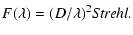
The optimum wavelength would maximize the imaging resolution of the astronomical
telescopes with adaptive optics. For convenience of analysis, a new function
 is defined to
used to optimize the imaging observation wavelength of AOS,
is defined to
used to optimize the imaging observation wavelength of AOS,
 |
|
|
(25) |
Evidently, the maximizations of the function
and the imaging resolution are both
equivalent.
For short-exposure imaging, the imaging resolution depends mainly on the figure residual
error of AOS, so that
can be written as
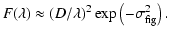
For astronomical imaging through adaptive optics correction for atmospheric turbulence, the
imaging Strehl ratio and the resolution mostly lies on the intensity distribution of the central core
of the beam. Note that generally the diameter of the system is much larger than the coherence
length, namely
 ,
so the function
can be simplified as
,
so the function
can be simplified as
 |
|
|
(27) |
Substituting Eqs. (16) into Eq. (27), one can obtain
![$\displaystyle F(\lambda)\approx(D/\lambda)^2\exp[-A(\lambda_0/\lambda)^2]$](/articles/aa/full/2002/29/aa1566/img85.gif) |
|
|
(28) |
where A is the figure residual error of AOS at the wavelength
 m,
m,
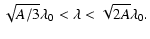
In order to verify the existence of the optimum imaging observation wavelength, one can
obtain, by taking the second order derivative for the function
and letting it be less than
zero, the following inequation:
Solving the above inequation, one can obtain
 |
|
|
(31) |
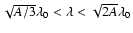
That is to say that there exists an optimum imaging observation wavelength for AOS only as
 .
.
![\begin{figure}
\par\includegraphics[width=15cm,clip]{aa1566f2.eps}
\end{figure}](/articles/aa/full/2002/29/aa1566/Timg94.gif) |
Figure 2:
Optimum short exposure observing wavelength and the corresponding image resolution. |
| Open with DEXTER |
![\begin{figure}
\par\includegraphics[width=15cm,clip]{aa1566f3.eps}
\end{figure}](/articles/aa/full/2002/29/aa1566/Timg95.gif) |
Figure 3:
Optimum long exposure observing wavelength and the corresponding image resolution. |
| Open with DEXTER |
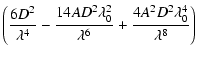
Taking the first order derivative for the function
and letting it be equal to zero, we
can write:
![$\displaystyle \frac{{\rm d}F(\lambda)}{{\rm d}\lambda}=\left(\frac{-2D^2}{\lamb...
...{2AD^2\lambda_0^2}{\lambda^5}\right)\exp\left[-A(\lambda_0/\lambda)^2\right]=0.$](/articles/aa/full/2002/29/aa1566/img96.gif) |
|
|
(32) |
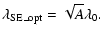
For short-exposure imaging, the optimum imaging observation wavelength for AOS, taking
the solution of Eq. (32), can be derived as
 |
|
|
(33) |
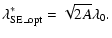
According to Tyler (Tyler & Fender 1994), the optimal imaging observation wavelength for AOS
should be
 |
|
|
(34) |
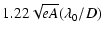
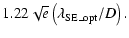
Subsituting Eq. (33) into Eq. (22), the corresponding resolution for short-exposure
imaging at the optimum wavelength can be expressed approximately as
For long-exposure imaging, the imaging resolution depends not only on the figure residual
error but also on the tilt residual error of AOS, Thus
can be simplified as
![$\displaystyle F(\lambda)\approx(D/\lambda)^2\frac{\exp[-A(\lambda_0/\lambda)^2]}{1+5B(\lambda_0/\lambda)^2}$](/articles/aa/full/2002/29/aa1566/img102.gif) |
|
|
(36) |
where B is the tilt residual error of AOS at the wavelength
m,
![$\displaystyle B=[f_{\rm T}(\lambda_0)/f_{\rm c}]^2+(\lambda_{\rm T}/\lambda_0)^2\pi f_{\rm c}\sigma_{\rm tn}^2/f_{\rm st}.$](/articles/aa/full/2002/29/aa1566/img103.gif) |
|
|
(37) |
Similarly, one can derive the optimum imaging observation wavelength for long-exposure
imaging as
![$\displaystyle \lambda_{\rm LE\_opt}=\left[\sqrt{\left(A+\sqrt{A^2+20AB}\right)\big/2}\right]\lambda_0.$](/articles/aa/full/2002/29/aa1566/img104.gif) |
|
|
(38) |
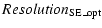
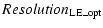
Subsituting Eq. (38) into Eq. (24), the corresponding resolution for long-exposure
imaging at the optimum wavelength can be expressed approximately as
Figures 2 and 3 present optimum imaging observation wavelength and the
corresponding image resolution for short-exposure imaging and long-exposure imaging
respectively. It can be seen from Figs. 2 and 3 that the optimum imaging observation
wavelength of AOS depends directly on the wavefront residual error of AOS. The larger the
wavefront residual error, the longer the optimum imaging observation wavelength is. Especially,
the optimum imaging observation wavelength for short-exposure imaging, see Eq. (33), can
be explained as the corresponding wavelength under the condition that the figure residual error is
1 rad2.
Furthermore, the optimal observing wavelength and the corresponding short-exposure
imaging resolution according to Tyler and Fender's (Tyler & Fender 1994) result, see Eq. (34), are also presented in Fig. 2. Note that the optimal wavelength derived by Tyler and Fender (Tyler & Fender 1994) is larger than that in this paper. The imaging performance according to
Tyler and Fender's result is inferior to the result of this paper. The interpretation is that the
imaging short-exposure Strehl ratio in Tyler and Fender's derivation (Tyler & Fender 1994) is approximated as
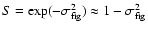 .
If the required precision is 10%, the figure residual
error should be less than 0.14 rad2. When the figure residual error is equal to 0.6 rad2, the precision
can only attain 27%. In contrast with the results of this paper, the percentages of the departure of
the optimal wavelength derived by Tyler and Fender (Tyler & Fender 1994) and the
corresponding imaging resolution are 41.4% and 10% respectively. Evidently, the imaging
resolution based on the calculated optimal observing wavelength in this paper is superior to that
according to the optimal wavelength derived by Tyler and Fender (Tyler & Fender 1994). This
result shows also that the calculation in this paper is more precise and more effective than the
rough estimate carried by Tyler and Fender (Tyler & Fender 1994).
.
If the required precision is 10%, the figure residual
error should be less than 0.14 rad2. When the figure residual error is equal to 0.6 rad2, the precision
can only attain 27%. In contrast with the results of this paper, the percentages of the departure of
the optimal wavelength derived by Tyler and Fender (Tyler & Fender 1994) and the
corresponding imaging resolution are 41.4% and 10% respectively. Evidently, the imaging
resolution based on the calculated optimal observing wavelength in this paper is superior to that
according to the optimal wavelength derived by Tyler and Fender (Tyler & Fender 1994). This
result shows also that the calculation in this paper is more precise and more effective than the
rough estimate carried by Tyler and Fender (Tyler & Fender 1994).
For nighttime astronomical telescopes with adaptive optics, the imaging observations are
mostly done at a range of wavelengths. Figure 4 presents the percentage of the short-exposure
imaging resolution departure from the optimum resolution as function of the percentage of the
observing wavelength departure from the optimum wavelength. As AOS is not operated in the
optimum wavelength but just 10% longer or shorter, the resolution degrades only about 1%. This
result shows that the derived optimum observing wavelength in this paper can be applied not only
in the monochromic observation with very narrow band but also in the nighttime observation with
a certain range of wavelength.
![\begin{figure}
\par\includegraphics[width=7.5cm,clip]{aa1566f4.eps}
\end{figure}](/articles/aa/full/2002/29/aa1566/Timg112.gif) |
Figure 4:
The percentage of the short-exposure imaging resolution departure from the optimum resolution as a function of the percentage of the observing wavelength departure from the optimum wavelength. |
| Open with DEXTER |
We have built a 61-element adaptive optical system at the 1.2 m telescope of the Yunnan
Observatory (Jiang et al. 1998) for astronomical observations in the visible range. It consists of a
61-element deformable mirror, a Shack-Hartmann wavefront sensor with 8*8 subapertures and a
digital wavefront processor. The detector of the Shack-Hartmann wavefront sensor is an
intensified CCD with frame rate of 838 Hz. The effective diameter of the system is 1.06 m and the
time delay is 2.8 T (T is the sampling period of the system). Figure 5 shows the experimental
results of the measurement noise of WFS for the measured photoelectrons and its fitting curve.
The measurement noise may be expressed as
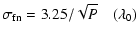 |
|
|
(40) |
where P is the photoelectrons detected by WFS per subaperture and per frame.
![\begin{figure}
\includegraphics[width=7.5cm,clip]{aa1566f5.eps}
\end{figure}](/articles/aa/full/2002/29/aa1566/Timg114.gif) |
Figure 5:
The measured wavefront noise r.m.s. value vs. photoelectrons per subaperture and per frame. |
| Open with DEXTER |
For this system, Fig. 6 presents the optimum short-exposure imaging observation
wavelength and the corresponding image resolution as a function of the measured photoelectrons
for the closed-loop bandwidth of 30 Hz, 60 Hz and 120 Hz respectively. During the computation,
the anisoplanatic error is not considered and the following atmospheric parameters according to
the statistial values at this site are taken:
 cm,
cm,
 Hz.
Hz.
![\begin{figure}
\par\includegraphics[width=15cm,clip]{aa1566f6.eps}
\end{figure}](/articles/aa/full/2002/29/aa1566/Timg117.gif) |
Figure 6:
Optimum observing wavelength and the corresponding image resolution as a function of photoelectrons per subaperture and per frame for different closed-loop bandwidths. |
| Open with DEXTER |
It can be seen from Fig. 6 that for the reference beacon with high brightness, the larger the
closed-loop bandwidth, the shorter the optimum imaging observation wavelength is, and the
higher the corresponding resolution. For the reference beacon with low brightness, the reverse is
true. This is due to the fact that the uncompensated turbulence-induced error, decreasing with the
increasing closed-loop bandwidth, dominates over the total wavefront residual error in contrast
with the closed-loop noise error, which is proportional to the closed-loop bandwidth, induced
by the measurement error of the wavefront detector for the reference beacon with high brightness.
For the reference beacon with low brightness, the closed-loop noise error is larger than the
uncompensated turbulence-induced error. In this case, the wider the closed-loop bandwidth, the
larger the total wavefront residual error.
In this paper, the figure residual error and the tilt residual error for adaptive optics systems
are analyzed. The optimum imaging observation wavelengths giving the maximum resolution of a
partial correction adaptive optics system are expressed as the function of the wavefront residual
errors for short-exposure and long exposure imaging respectively. As an example, the optimum
observing wavelength and the corresponding imaging resolution for the 61-element adaptive
optical system at the 1.2 m telescope of the Yunnan Observatory are presented. The results show
the optimum imaging observation wavelength of AOS depends directly on the wavefront residual
error of AOS. The larger the wavefront residual error, the longer the optimum imaging observation
wavelength.
Furthermore, it is necessary to note that the discrete nature of atmospheric transmission bands,
the noise characteristics of the detector and its quatumn efficiency etc. must be considered for the
selection of the practical imaging observation wavelength of astronomical telescopes with
adaptive optics.
This work may be useful not only in designing adaptive optics system for astronomical
telescopes but also in planning the experiments for astronomical telescopes with AOS.
Acknowledgements
This work is funded by the Hi-tech Project of China and National Natural Science Foudation
of China (No. 19789301). The authors acknowledge the reviewers for valuable suggestions.
- Fried, D. L. 1982, J. Opt. Soc. Am. 72, 52-61
In the text
- Greenwood, D. P. 1976, J. Opt. Soc. Am. 66, 193-206
In the text
- Hardy, J. W. 1998, Adaptive Optics for Astronomical Telescopes (New York,
Oxford University Press)
In the text
- Jiang, W., Li, M., Tang, G., et al. 1995, Opt. Eng., 34, 15-20
In the text
NASA ADS
- Jiang, W., Ling, N., Tang, G., et al. 1998, SPIE Proc.,
3353, 696-703
In the text
- Li, X., Jiang, W., Wang, C., & Xian, H. 2000, Acta Optica Sinica, 20, 10, 1328-1334
In the text
- Parenti, R. R., & Sasiela, R. J. 1994, J. Opt. Soc. Am. A, 11, 288-309
In the text
- Rao, C., Shen, F., & Jiang, W. 2000, Acta Optica Sinica, 20, 68-73
In the text
- Rimmele, T. R., & Radick, R. R. 1998, SPIE Proceedings, 3353, 72-81
In the text
- Roddier, F. 1981, The effects of atmospheric turbulence in optical astronomy, in Progress in Optics, ed. E. Wolf (North-Holland, Amsterdam), 19, 281-376
In the text
- Tyler, D. W., & Fender, J. S. 1994, SPIE Proceedings, 2201, 227-238
- Tyler, G. A. 1994, J. Opt. Soc. Am. A 11, 325-338
- Tyler, G. A. 1994, J. Opt. Soc. Am. A 11, 358-367
In the text
Copyright ESO 2002
 =
=![$\displaystyle \left[0.423k_0^2~sec(\xi)\mu_0\right]^{-3/5},$](/articles/aa/full/2002/29/aa1566/img8.gif)
 =
=![$\displaystyle \left[2.91k_0^2~sec^{8/3}(\xi)\mu_{5/3}\right]^{-3/5},$](/articles/aa/full/2002/29/aa1566/img10.gif)
 =
=
 =
=


![$\displaystyle [f_{\rm G}(\lambda)/f_{\rm 3dB}]^{5/3}
[1+2.2156(2\pi\tau f_{\rm 3dB})^{2/3}$](/articles/aa/full/2002/29/aa1566/img32.gif)
![$\displaystyle +1.3292(2\pi\tau f_{\rm 3dB})^{5/3}]$](/articles/aa/full/2002/29/aa1566/img33.gif)
![$\displaystyle (\lambda_0/\lambda)^2[f_{\rm G}(\lambda_0)/f_{\rm 3dB}]^{5/3}[1+2.2156(2\pi\tau f_{\rm 3dB})^{2/3}$](/articles/aa/full/2002/29/aa1566/img34.gif)
![$\displaystyle +1.3292(2\pi\tau f_{\rm 3dB})^{5/3}].$](/articles/aa/full/2002/29/aa1566/img35.gif)

![$\displaystyle F_{\rm fn}f_{\rm 3dB}~{\rm arctg}[f_{\rm s}/(2f_{\rm 3dB})]$](/articles/aa/full/2002/29/aa1566/img38.gif)


![$\displaystyle \left.-0.452\mu_2^-(H)/H^2]\right\}^{-3/5},$](/articles/aa/full/2002/29/aa1566/img53.gif)


![$\displaystyle (\lambda_0/\lambda)^2\left\{[f_{\rm G}(\lambda_0)/
f_{\rm 3dB}]^{5/3}[ 1+2.2156(2\pi\tau f_{\rm 3dB})^{2/3}\right.$](/articles/aa/full/2002/29/aa1566/img58.gif)
![$\displaystyle +(\lambda_{\rm W}/\lambda_0)^2\pi f_{\rm 3dB}
\sigma_{\rm fn}^2/f_{\rm s}+0.34[d_{\rm s}/r_0(\lambda_0)]^{5/3}$](/articles/aa/full/2002/29/aa1566/img59.gif)


![$\displaystyle (\lambda_0/D)^2\left\{[f_{\rm T}(\lambda_0)/f_{\rm c}]^2+(\lambda_{\rm T}/\lambda_0)^2\pi f_{\rm c}\sigma_{\rm tn}^2/f_{\rm st}\right\}\cdot$](/articles/aa/full/2002/29/aa1566/img70.gif)
![\begin{figure}
\par\includegraphics[width=7.5cm,clip]{aa1566f1.eps}
\end{figure}](/articles/aa/full/2002/29/aa1566/img77.gif)


![$\displaystyle (D/\lambda)^2
\left[\exp\left(-\sigma_{\rm fig}^2\right)+\frac{1-\exp\left(-\sigma_{\rm fig}^2\right)}{1+\left(D/r_0(\lambda)\right)^2}\right]\cdot$](/articles/aa/full/2002/29/aa1566/img82.gif)
![$\displaystyle [f_{\rm G}(\lambda_0)/f_{\rm 3dB}]^{5/3}[ 1+2.2156(2\pi\tau f_{\rm 3dB})^{2/3}$](/articles/aa/full/2002/29/aa1566/img87.gif)

 =
=
![$\displaystyle \times\exp\left[-A(\lambda_0/\lambda)^2\right]<0.$](/articles/aa/full/2002/29/aa1566/img91.gif)
![\begin{figure}
\par\includegraphics[width=15cm,clip]{aa1566f2.eps}
\end{figure}](/articles/aa/full/2002/29/aa1566/img94.gif)
![\begin{figure}
\par\includegraphics[width=15cm,clip]{aa1566f3.eps}
\end{figure}](/articles/aa/full/2002/29/aa1566/img95.gif)
![$\displaystyle 1.22\left\{\left[\left(A+\sqrt{A^2+20AB}\right)\big/2+5B\right]\right.$](/articles/aa/full/2002/29/aa1566/img106.gif)
![$\displaystyle \left. \times \exp\left[2\big/\left(1+\sqrt{1+20B/A}\right)\right]\right\}^{1/2}(\lambda_0/D)$](/articles/aa/full/2002/29/aa1566/img107.gif)
![$\displaystyle 1.22\Bigg\{\left[\left(A+\sqrt{A^2+20AB}\right)+10B\right]$](/articles/aa/full/2002/29/aa1566/img108.gif)
![$\displaystyle \times\frac{\exp\left[2\big/\left(1+\sqrt{1+20B/A}\right)\right]}{A+\sqrt{A^2+20AB}}\Bigg\}$](/articles/aa/full/2002/29/aa1566/img109.gif)

![\begin{figure}
\par\includegraphics[width=7.5cm,clip]{aa1566f4.eps}
\end{figure}](/articles/aa/full/2002/29/aa1566/img112.gif)
![\begin{figure}
\includegraphics[width=7.5cm,clip]{aa1566f5.eps}
\end{figure}](/articles/aa/full/2002/29/aa1566/img114.gif)
![\begin{figure}
\par\includegraphics[width=15cm,clip]{aa1566f6.eps}
\end{figure}](/articles/aa/full/2002/29/aa1566/img117.gif)