A&A 390, 167-172 (2002)
DOI: 10.1051/0004-6361:20020747
Research Note
Asteroseismic tests for models of magnetically active close binaries with orbital period modulation
A. F. Lanza1 - M. Rodonò2
1 - Osservatorio Astrofisico di Catania of the Istituto Nazionale di Astrofisica,
Via Santa Sofia, 78, Città Universitaria,
95123 Catania, Italy
2 -
Dipartimento di Fisica e Astronomia dell'Università degli Studi,
Via Santa Sofia, 78, Città Universitaria,
95123 Catania, Italy
Received 23 January 2002 / Accepted 24 April 2002
Abstract
Magnetic activity and orbital period modulation in close binaries
are considered in order to identify possible asteroseismic tests for
models that have been proposed to understand their relationship. These
models are based on the variation
of the gravitational quadrupole moment of the active star, as a consequence
of the modification of its internal rotation and magnetic field along
its activity cycle (Applegate 1992; Lanza et al. 1998a).
An analysis based on the solar analogy shows that surface magnetic activity
may produce shifts, splitting and broadening of the p-mode
peaks in the oscillation spectrum of a star. Such effects make the
direct detection of the internal structural changes predicted by the models
very difficult. However, a time variation of the internal
rotation can be detectable because the p-mode rotational splittings are
proportional to the azimuthal quantum number m, whereas structural
and surface effects controlled by the magnetic fields
are |m| dependent. Therefore, we propose
a method that correlates
the variation of the a1 splitting coefficients, that sample the
internal rotation, with the orbital period variation in order to test the
predictions of the models. The RS CVn short-period systems, such as V 471 Tau,
RT And or CG Cyg, are the most suitable objects for such a test
because surface magnetic effects are likely to be less prominent than in classical
or long-period RS CVn binaries.
Key words: stars: binaries: close - stars: binaries: eclipsing -
stars: oscillations - stars: magnetic fields - stars: activity
The long-term timing of eclipses in several classes of close binaries
has shown that their orbital periods are not constant and often oscillate
around a mean value with time scales from a few to several decades.
The phenomenon is well documented in the Algols and RS Canum Venaticorum binaries for which cyclic variations of the orbital period P of amplitude
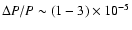 have been
reported, with a typical value of the modulation cycle of
have been
reported, with a typical value of the modulation cycle of  40-50 yr
(cf. Hall 1989). Recent studies suggest a connection
between orbital period modulation and
magnetic activity
on the component stars, as reviewed by, e.g., Hall (1989), Applegate (1992)
and Lanza & Rodonò (1999).
40-50 yr
(cf. Hall 1989). Recent studies suggest a connection
between orbital period modulation and
magnetic activity
on the component stars, as reviewed by, e.g., Hall (1989), Applegate (1992)
and Lanza & Rodonò (1999).
Several mechanisms have been proposed to explain such a connection, but
serious problems are encountered in reproducing the short time scale of the observed changes and, at the same time, to meet
the constraints set by
the stellar energy budget
(see, e.g., Applegate 1992; Lanza et al. 1998a; Lanza & Rodonò 1999). The only mechanism that appears viable was
proposed by Applegate (1992) and it was based on cyclic changes of the
gravitational quadrupole moment of the magnetically active component. Applegate's model assumes that a small fraction of
the internal angular
momentum of the active component is cyclically exchanged between
an inner and an outer convective shell
due to a varying internal
magnetic torque versus the activity cycle phase.
This modifies the oblateness and the gravitational quadrupole moment
of the active star, which oscillates around its mean value.
When the quadrupole
moment is maximum, the companion star feels a stronger gravitational
acceleration and is then forced to move closer and faster along its orbit
attaining the minimum orbital period. Conversely, when the quadrupole
moment is minimum the orbital period attains a maximum value.
In principle, a test of Applegate's model is possible
by using the variation of the total area of starspots, which can be adopted
as a proxy
for the magnetic field on the active component. Moreover,
spots can also be used as tracers of the surface rotation.
Rodonò et al. (1995), Lanza et al. (1998b), Donati (1999),
Lanza et al. (2002) performed such tests for RS CVn,
AR Lac, HR 1099 and RT Lac, respectively. They found that for RS CVn,
AR Lac and RT Lac
the orbital period cycles are about two times longer than the spot
activity cycles, at variance with Applegate's model. Moreover, the
predicted angular velocity variations are too large compared with the changes of the spot rotation rate in all of the studied binaries.
In an attempt to overcome such difficulties,
Lanza et al. (1998a) and Lanza & Rodonò (1999) improved
Applegate's model by including the effects of a strong internal magnetic
field on the star figure of equilibrium. This may
explain the length of the orbital modulation cycles and
reduce the amplitude of the angular velocity changes. However,
the difficulties in reconciling the models with the observations
may also arise from the use of spots
as tracers of the rotation changes. As a matter of fact,
the analysis of starspot longitude distributions in close binaries
from long-term time series have shown
the existence of rather persistent active longitudes,
which can affect the capability of spots to probe
surface rotation (e.g., Henry et al. 1995;
Rodonò et al. 1995; Eaton et al. 1996; Oláh et al. 1997; Lanza et al.
1998b; Lanza et al. 2001). Therefore, an independent
tool to measure the time variation of the rotation rate of the outer convection
zone would be desirable to confirm the results based on starspots and to perform a more stringent test of
the models that have been proposed to explain the orbital period changes of active binaries.
Such a tool may be provided by the measurements of the frequencies of the p-modes in active stars, which may soon become possible
by space observatories.
For the Sun, the availability of spatially resolved data allows us to
measure the internal rotation and its possible time variation with high
accuracy (e.g., Schou et al. 1998; Howe et al. 2000). For distant stars
we shall be able to measure only the frequencies of
low degree (l =0-3)
oscillation modes with different radial order n. The expected spectrum has a characteristic appearance that can be predicted by the asymptotic theory of stellar oscillations (see Tassoul 1980; Brown & Gilliland 1994). Moreover,
the frequency splittings
due to rotation can be measured and used to get some hints on
the internal rotation of solar-like stars.
In the present paper we focus on the possibility offered by asteroseismic
techniques to test the proposed models for orbital period modulation in
close binaries. It is important to note that magnetic activity affects
solar p-mode frequencies also through surface effects. Therefore,
it is important
to estimate what could be the effects of surface activity on the asymptotic
p-mode spectrum of an active star in order to see whether we can disentangle the signatures of processes occurring deep in the convection zone from near-surface perturbations.
Solar magnetic activity produces a variable increase of p-mode frequencies
that, for modes with frequency
 Hz, at cycle
maximum and minimum differs by
Hz, at cycle
maximum and minimum differs by

 Hz,
that is
Hz,
that is
 .
Not only the central frequency
of each multiplet is changed, but also the splittings are modified by
solar activity. Since the current observations can detect variations
in modes with l as large as 100-150, it is customary to fit
each frequency in a multiplet
.
Not only the central frequency
of each multiplet is changed, but also the splittings are modified by
solar activity. Since the current observations can detect variations
in modes with l as large as 100-150, it is customary to fit
each frequency in a multiplet  with a Legendre polynomial series:
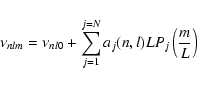 |
(1) |
where n, l, m are the angular descriptors of the oscillation, P is the
Legendre polynomial and L=l or
[l(l+1)]1/2 depending on the choice in the data reduction procedure; N usually ranges from 5-6 to 30-35,
depending on the maximum l and the data accuracy (cf. Howe et al. 1999).
The lack of a detailed theoretical model of the interaction between
magnetic activity and p-modes does not allow us to make definite predictions
on the p-mode frequency behaviour in very active stars. However,
we may obtain some hints by scaling the simple
model proposed by Goldreich et al. (1991) to the stellar case. Their Eq. (20) can be scaled by assuming that
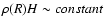 ,
where
,
where  is the density and H the pressure scale height at the
photosphere,
and the mode masses
is the density and H the pressure scale height at the
photosphere,
and the mode masses
 are comparable to those of the solar modes.
This yields the following relative perturbation of the
low-degree p-mode frequency
with
are comparable to those of the solar modes.
This yields the following relative perturbation of the
low-degree p-mode frequency
with
 (corresponding to the maximum power in the solar spectrum):
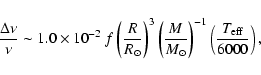 |
(2) |
where
 is the filling factor of the magnetic field,
 is the
effective temperature in Kelvin and R and M are the radius and mass of the star, respectively. The photospheric filling factors of
very active stars in close binaries are typically one or two orders of magnitude
higher than in the solar case, and the field strength in the photospheric flux tubes can be
assumed to be roughly in equipartition with the gas pressure (e.g., Saar 1996).
Therefore, the expected p-mode frequency perturbations are correspondingly
greater.
Specifically, we may estimate the frequency shifts for p-modes of radial order
n=20 in the case of the K2 V secondary of V471 Tauri, and of the
K0 subgiant secondary of AR Lacertae.
Assuming their filling factors to be 0.70 and 0.50, we find:
is the
effective temperature in Kelvin and R and M are the radius and mass of the star, respectively. The photospheric filling factors of
very active stars in close binaries are typically one or two orders of magnitude
higher than in the solar case, and the field strength in the photospheric flux tubes can be
assumed to be roughly in equipartition with the gas pressure (e.g., Saar 1996).
Therefore, the expected p-mode frequency perturbations are correspondingly
greater.
Specifically, we may estimate the frequency shifts for p-modes of radial order
n=20 in the case of the K2 V secondary of V471 Tauri, and of the
K0 subgiant secondary of AR Lacertae.
Assuming their filling factors to be 0.70 and 0.50, we find:
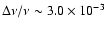 and
and
 ,
respectively. The large shift obtained in the case of the subgiant
in AR Lac is mainly the result of its large radius
,
respectively. The large shift obtained in the case of the subgiant
in AR Lac is mainly the result of its large radius
 ,
and cannot be regarded as a small perturbation in the sense of the
Goldreich et al. (1991)
model. In any case, this result suggests that surface
magnetic effects may be significantly higher in subgiants than in dwarf
stars of comparable activity level.
In the case of the
active component of V471 Tau, for the mode with
,
and cannot be regarded as a small perturbation in the sense of the
Goldreich et al. (1991)
model. In any case, this result suggests that surface
magnetic effects may be significantly higher in subgiants than in dwarf
stars of comparable activity level.
In the case of the
active component of V471 Tau, for the mode with
 ,
the magnetically induced
perturbation is estimated to be
,
the magnetically induced
perturbation is estimated to be  Hz. It will not
distort the asymptotic spectrum too much because it has a large separation
of the peaks of
Hz. It will not
distort the asymptotic spectrum too much because it has a large separation
of the peaks of  Hz and a small separation of
  Hz (cf. Brown & Gilliland 1994)
![[*]](/icons/foot_motif.gif) .
.
Activity cycles in very active
stars are characterized by large variations of the spot filling factors
up to 30-40% (e.g., Rodonò et al. 1995; Lanza et al. 2001).
It is not know whether the filling factor of the magnetic field
outside spots, which is considered responsible for the frequency shift
in the present model, is also subject to such large variations.
It is likely that in very active stars the field filling factor is
at a saturation level,
thus the expected fluctuations of f should be smaller, i.e., of the order of
5-10% at most. The time scales for such small changes may be quite short
because sizeable changes of the spot pattern are usually observed on timescales of a few rotations. Therefore, it is likely that the frequency shift would
fluctuate by 5-10% during the typical intervals along which asteroseismic data sets will be acquired (Brown & Gilliland
1994). In other words, the spectral lines of the oscillation spectrum
are expected to be broadened, in addition to finite mode
lifetime, by the shift fluctuation due to surface activity. The
contribution to the line width
may be of the order of 50 nHz, in the case of the
mode in the spectrum of V471 Tau we considered above. However, it may be
considerably reduced in the case of lower frequency p-modes, because
such a line broadening should
scale with the square of the frequency (cf. Eq. (20) of Goldreich
et al. 1991).
Larger broadenings
are expected for active subgiants and this may significantly limit
the precision of the p-mode frequency measurements.
In the case of distant stars, only a limited number of l and m values
are accessible by the observations, therefore it is not possible to
pursue the expansion indicated in Eq. (1) beyond N=2 or 3.
Magnetic activity is expected to influence the even coefficients that in
our case reduce to a2, which sample the quadrupolar component of
the magnetic perturbation, i.e., that described by the second-order
Legendre polynomial P2.
The perturbation of the a2 coefficient due to surface
magnetic fields may be
estimated according to, e.g., Dziembowski & Goode
(1991). They showed that, for a given surface distribution of the
magnetic flux, the perturbation increases proportionally to the
P2 component of the latitudinal distribution of the filling factor.
In very active stars, the time variation of the surface distribution
of the field is likely to induce a variable a2 coefficient
with a characteristic time scale ruled by the fluctuations of the
surface filling factor and the latitudinal migration of the magnetic flux, i.e., between
100-1000 days (cf., e.g., Donati 1999).
Assuming that the typical filling factor fluctuations
are of the order of 10%, the expected amplitude for the variations of
the measured a2 coefficients
in V471 Tau
are of the order of  Hz.
Hz.
Subgiants and giant components in classical and long-term RS CVn systems
are expected to show larger magnetically induced perturbations of their
oscillation spectra, which makes more difficult the extraction of the
asteroseismic information. Therefore, we focus our discussion on
short-period RS CVn systems.
The models proposed by Applegate (1992) and Lanza et al. (1998a)
assume that the quadrupole moment of an active star changes along
the activity cycle
in response to the variation of the internal centrifugal and Lorentz
forces.
Consequently, three specific sources of p-mode frequency changes can be identified:
a) the modification of the internal stratification
due to the varying centrifugal and Lorentz forces;
b) the changes of the propagation speed of the acoustic waves due to the
variation of the
internal magnetic field; c) the modification of the internal
rotation, which produces a change of the advection term in the momentum
equation. The first two sources produce effects that are
insensitive to the sign of the azimuthal order m because they
cannot distinguish between the sense of propagation of a wave
along the equator.
Therefore, they affect only the even coefficients a2i in the
splitting expansion. Their effect on the a2 coefficient can be easily
estimated from the theory developed by Gough & Thompson (1990).
Typically,
the a2 produced by stellar rotation
is of the order of
 for RS CVn and Algol systems, where
  is the angular velocity of rotation and G the gravitational constant.
The variation of the splitting coefficients, that is produced
by the relative variation
is the angular velocity of rotation and G the gravitational constant.
The variation of the splitting coefficients, that is produced
by the relative variation
 of the angular velocity
of the outer shell of the stellar convection zone, is of the order:
of the angular velocity
of the outer shell of the stellar convection zone, is of the order:
 |
(3) |
This implies a change of the order of
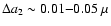 Hz for
 and, therefore, it is not detectable, being about 10 times smaller than the fluctuations of the a2 coefficients due to magnetic activity (cf. Sect. 2). Similar results
are obtained when the perturbations to the inner density or sound
speed by a strong internal magnetic field are considered.
and, therefore, it is not detectable, being about 10 times smaller than the fluctuations of the a2 coefficients due to magnetic activity (cf. Sect. 2). Similar results
are obtained when the perturbations to the inner density or sound
speed by a strong internal magnetic field are considered.
The only change that may give rise to observable effects is
related to the variation of the advection term in the momentum
equation
due to rotation. It manifests in the variation of the odd
a2i+1 coefficients, in particular of the a1 coefficients
(cf., e.g., Gough & Thompson 1990).
In order to correlate the variation of the orbital period with the
internal rotation change and the variation of the a1 coefficients,
we assume a specific realization of Applegate's model.
We consider an active star of mass
 in a close binary
system with a companion of the same mass on a 12-hr orbit, which
represents a typical short-period RS CVn system. A simple
structure model for the active star is computed using the code by Hansen
& Kawaler (1994) assuming a homogeneous ZAMS structure with
X=0.74 and Y=0.24. The basic parameters of our model star are
listed in Table 1, where
in a close binary
system with a companion of the same mass on a 12-hr orbit, which
represents a typical short-period RS CVn system. A simple
structure model for the active star is computed using the code by Hansen
& Kawaler (1994) assuming a homogeneous ZAMS structure with
X=0.74 and Y=0.24. The basic parameters of our model star are
listed in Table 1, where
 is the fractional radius at the
base of the convection zone and
is the fractional radius at the
base of the convection zone and
 the fractional mass at the base of the
convection zone. A comparison with the more accurate models by VandenBerg et al. (1983)
shows that our structure quantities are correct within 10%.
the fractional mass at the base of the
convection zone. A comparison with the more accurate models by VandenBerg et al. (1983)
shows that our structure quantities are correct within 10%.
In order to produce a quadrupole moment variation, we consider a
time-dependent differential rotation with an angular velocity
 .
At the beginning of the activity cycle, at t=t0,
the rotation is rigid with
.
At the beginning of the activity cycle, at t=t0,
the rotation is rigid with
 ,
where
,
where
 is equal to the angular velocity of the orbital motion. Half a cycle later, at time t1, the internal angular velocity is
given by:
is equal to the angular velocity of the orbital motion. Half a cycle later, at time t1, the internal angular velocity is
given by:
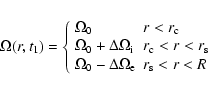 |
(4) |
where  is the outer radius of the inner shell participating in the
exchange of angular momentum and
is the outer radius of the inner shell participating in the
exchange of angular momentum and
 and
and
 denote the variation of the angular velocity
in the inner and outer shells, respectively. They are constrained by total angular momentum conservation, that is:
denote the variation of the angular velocity
in the inner and outer shells, respectively. They are constrained by total angular momentum conservation, that is:
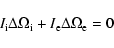 |
(5) |
where  and
and  are the moments of inertia of the inner and
outer shells, respectively.
are the moments of inertia of the inner and
outer shells, respectively.
We computed the quadrupole moment change  between
times t0 and t1 as a function of
between
times t0 and t1 as a function of
 for three different values of
 by the method outlined in
Goldreich & Schubert (1968) (see also Paternò et al. 1996). The corresponding orbital period changes were
evaluated for our model binary and are plotted together with
in Fig. 1. We notice that the quadrupole moment
increases with the angular momentum of the inner
shell because it is significantly more massive than the outer shell
and thus dominates the variation of Q. The sign of
by the method outlined in
Goldreich & Schubert (1968) (see also Paternò et al. 1996). The corresponding orbital period changes were
evaluated for our model binary and are plotted together with
in Fig. 1. We notice that the quadrupole moment
increases with the angular momentum of the inner
shell because it is significantly more massive than the outer shell
and thus dominates the variation of Q. The sign of  is negative because P decreases when the quadrupole moment increases.
![\begin{figure}
\par\includegraphics[width=8.8cm,height=6.6cm,clip]{ms2292f1.ps}\end{figure}](/articles/aa/full/2002/28/aa2292/Timg60.gif) |
Figure 1:
The quadrupole moment changes
(scale on the left)
and the corresponding orbital
period variation
 (scale on the right)
versus the relative change of the inner shell angular velocity
for three different
values of the ratio
(as labelled).
(scale on the right)
versus the relative change of the inner shell angular velocity
for three different
values of the ratio
(as labelled). |
| Open with DEXTER |
In order to compute the variation of the p-mode splitting produced
by the assumed rotation changes, we considered modes with radial order
n=23, 24 and
 ,
which have frequencies near the
expected maximum of the power spectrum of our model star, according
to Kjeldsen & Bedding (1995). The frequencies and the eigenfunctions of the p-modes of the non-rotating star were computed
using the pulsation code by Hansen & Kawaler (1994). The mode
frequencies and the a1 splitting coefficients for rigid rotation
with angular velocity
are listed in Table 2.
,
which have frequencies near the
expected maximum of the power spectrum of our model star, according
to Kjeldsen & Bedding (1995). The frequencies and the eigenfunctions of the p-modes of the non-rotating star were computed
using the pulsation code by Hansen & Kawaler (1994). The mode
frequencies and the a1 splitting coefficients for rigid rotation
with angular velocity
are listed in Table 2.
Table 2:
Frequency and rotational splitting of the considered p-modes
for rigid rotation.
| Radial Order |
Degree |
Frequency |
a1 |
| |
|
( Hz) Hz) |
(Hz) |
| n=24 |
l=1 |
5585 |
22.23 |
| n=24 |
l=2 |
5679 |
22.16 |
| n=23 |
l=3 |
5556 |
22.15 |
![\begin{figure}
\par\includegraphics[width=8.8cm,height=10.6cm,clip]{ms2292f2.ps}\end{figure}](/articles/aa/full/2002/28/aa2292/Timg63.gif) |
Figure 2:
The variation of the splitting
coefficients
 for the three p-modes
in Table 1 versus the relative angular velocity change in the
inner shell of the convection zone
.
The splitting coefficients refer to modes with
n=24, l=1 (solid line),
n=24, l=2 (dashed line) and
n=23, l=3 (dot-dashed line),
respectively. The upper panel reports the results for
for the three p-modes
in Table 1 versus the relative angular velocity change in the
inner shell of the convection zone
.
The splitting coefficients refer to modes with
n=24, l=1 (solid line),
n=24, l=2 (dashed line) and
n=23, l=3 (dot-dashed line),
respectively. The upper panel reports the results for
 ,
the
middle one for ,
the
middle one for
 and the lower one for
 ,
respectively. ,
respectively. |
| Open with DEXTER |
The variation of the a1 coefficients was computed according to
Brown et al. (1989).
The results are reported in Fig. 2 as a function of the relative
change of the internal angular velocity and for the three values of
.
It is interesting to note that our results are not affected by an
internal latitudinal
differential rotation profile, provided that it
does not change with time. In fact, the
a1 coefficients are linear functions of the angular velocity
profile (cf. Brown
et al. 1989). The sizeable increase of the variation of the splitting
coefficients a1 with
is due to the increase of the
angular velocity variation of the outer shell due to
the steep increase of the ratio
 with
:
goes from
0.52 for
to 3.57 for
.
The p-mode splittings predominantly sample
the angular velocity variations of the outer shell because the envelope
of their rotational kernels scales approximately as
with
:
goes from
0.52 for
to 3.57 for
.
The p-mode splittings predominantly sample
the angular velocity variations of the outer shell because the envelope
of their rotational kernels scales approximately as
 ,
where
,
where
 is the sound speed (cf. Christensen-Dalsgaard 1988).
Our model for the quadrupole moment changes is based on the
simple approach outlined by Applegate (1992) and allows a clear
identification of the basic physical effects.
In particular, the quadrupole moment changes arise mainly
from the inner shell, whereas the splittings of the p-modes
arise predominantly from the outer shell. A situation with
 would be ideal for maximizing the splitting variations, but it is
unlikely to occur, considering the large kinetic energy change
that is required (cf. Applegate 1992; Lanza & Rodonò 1999).
would be ideal for maximizing the splitting variations, but it is
unlikely to occur, considering the large kinetic energy change
that is required (cf. Applegate 1992; Lanza & Rodonò 1999).
If we adopt the models proposed by Lanza et al. (1998a) and Lanza
& Rodonò (1999), the splitting variations are reduced because
a fraction of the quadrupole moment change is produced by
the Lorentz force and not by a change of the internal rotation.
However, the most likely situation is that in which the contributions of
both effects are comparable, the expected splitting variations
being reduced by about a factor of two.
Moreover, the model proposed by Lanza et al. (1998a) predicts a cycle for the
orbital period change with a length twice the spot
activity cycle. The a1 frequency splittings are expected to show the same
period of the orbital period modulation, that is, twice the spot area cycle.
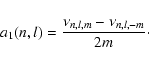
The a1 coefficients can be derived from the observed frequencies in a
multiplet by means of the formula:
 |
(6) |
Given the presence of random errors, the
actual values are derived by means of a best fit over the different
azimuthal numbers m of each mode. It is
interesting to note that the
contributions arising from the varying centrifugal and Lorentz forces
cancel out in Eq. (6) because they depend on |m| and the same
is true also for the surface magnetic effects
(cf. Sect. 2). The contributions from possible a3 coefficients
cancel out when time variations are
considered, because the a3 coefficients sample the latitudinal
profile of the differential rotation, which is assumed to be constant in our model (cf. Brown et al. 1989).
The detection of the variation of the splitting coefficients requires
a sufficiently high photometric accuracy and
sufficiently long time series to resolve the individual frequencies.
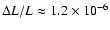
According to Kjeldsen & Bedding (1995), the amplitude of the p-modes should
approximately scale as L/M, which implies that the luminosity change expected for our model star is
 at the peak
of the p-mode spectrum for an isophotal wavelength
at the peak
of the p-mode spectrum for an isophotal wavelength
 nm.
A one-meter space-borne telescope may detect a single oscillation
with that amplitude in an mV =10 star from a
continuous 50-60 day monitoring time (cf. Brown & Gilliland 1994).
The accuracy of the frequency determination is a function of the
mode lifetime, of the ratio between the power level of the mode and
the background noise and of the total observing time
(Libbrecht 1992).
Unfortunately, the first
two quantities are unknown in the stellar case and they
can be roughly estimated only on the basis of the solar analogy.
Specifically,
if we assume that the background noise due to convection scales as L/M and that the mode lifetimes are comparable to those of the solar modes, an accuracy of
nm.
A one-meter space-borne telescope may detect a single oscillation
with that amplitude in an mV =10 star from a
continuous 50-60 day monitoring time (cf. Brown & Gilliland 1994).
The accuracy of the frequency determination is a function of the
mode lifetime, of the ratio between the power level of the mode and
the background noise and of the total observing time
(Libbrecht 1992).
Unfortunately, the first
two quantities are unknown in the stellar case and they
can be roughly estimated only on the basis of the solar analogy.
Specifically,
if we assume that the background noise due to convection scales as L/M and that the mode lifetimes are comparable to those of the solar modes, an accuracy of  Hz may well be achieved in an observing
time of 2-3 yr (Libbrecht 1992). However, a significant source of noise
could be related to magnetic activity,
in particular to microflaring which might show timescales comparable
with those of the p-modes. Multi-band simultaneous observations could be
used to isolate the effects of microflaring because flares have a characteristic
wavelength dependence in the optical band since their amplitude increases
toward shorter wavelengths.
Hz may well be achieved in an observing
time of 2-3 yr (Libbrecht 1992). However, a significant source of noise
could be related to magnetic activity,
in particular to microflaring which might show timescales comparable
with those of the p-modes. Multi-band simultaneous observations could be
used to isolate the effects of microflaring because flares have a characteristic
wavelength dependence in the optical band since their amplitude increases
toward shorter wavelengths.
The broadening of the p-mode peaks
due to surface magnetic activity may set an intrinsic limit to the
accuracy of the frequencies. However, our estimates in Sect. 2 suggest that
it should be at least 2-3 times smaller than the expected frequency changes
near the peak of the power spectrum.
We conclude that the rotation
changes predicted by Applegate's model may be detected by a long-term monitoring
of an active star from a space-borne observatory. The variation of the
frequency splittings can be correlated with
the orbital period change allowing us to test the different versions of the model and to infer interesting
information on the operation of the non-linear stellar dynamo.
It is important to note that we are not proposing to measure the internal
rotation of the star, for which the accuracy would be very low (cf. Goupil
et al. 1996), but its time variations and to correlate them with an
independent phenomenon, i.e., the orbital period change. The most suitable
objects to which such a test can be applied are the very active dwarf stars in bright, short-period RS CVn systems, like V 471 Tau, RT And, CG Cyg, for which the orbital period changes can be monitored with rather good accuracy. We notice that
the method is not restricted to eclipsing binaries because orbital period
changes can be detected in spectroscopic binaries through long-term
radial velocity monitoring (Frasca & Lanza 2000).
The long time scales of the orbital period changes (from several years
to a few decades), should require successive generations of space-borne
observatories such as the
planned COROT mission
(e.g., Baglin et al. 2001) and the still under definition Eddington mission.
The best observational strategy would be to observe the candidate system
before and after a significant change of the orbital period had occured
and that can be easily detected by ground-based long-term monitoring programs
(cf., e.g., Rodonò et al. 2001).
The precise determination of the splitting coefficients a1 requires
time series extending for at least 2-3 yr, which is within the
expected lifetimes of the planned missions,
although their observing strategy is to spend on average 5-6 months on
each group of targets in the same field of view in order to maximize the
number of stars observed. Therefore, our proposal demands a substantial
modification of the planned mission strategy to be fulfilled,
significantly reducing the number of targets in order to increase the time spent
observing each of them and to achieve a frequency accuracy of Hz.
Acknowledgements
The authors wish to thank L. Paternò and M. P. Di Mauro for a critical reading of the manuscript and stimulating comments. They are also grateful to
the Referee, C. Catala, for his careful reading and interesting comments.
Research on stellar physics at Catania Astrophysical Observatory of the
Istituto Nazionale di Astrofisica and at
the Dept. of Physics and Astronomy of Catania University is funded by
MIUR (Ministero dell'Istruzione, Università e Ricerca) and
Regione Sicilia, whose financial support is gratefully acknowledged.
-
Applegate, J. H. 1992, ApJ, 385, 621
In the text
NASA ADS
-
Baglin, A., Auvergne, M., Catala, C., Michel, E., & COROT Team 2001,
ESA-SP 464, 395
In the text
-
Brown, T. M., Christensen-Dalsgaard, J., Dziembowski, W. A., et al. 1989, ApJ, 343, 526
In the text
NASA ADS
-
Brown, T. M., & Gilliland, R. L. 1994, ARA&A, 32, 37
In the text
NASA ADS
-
Christensen-Dalsgaard, J. 1988, in Advances in Helio- and Asteroseismology,
ed. J. Christensen-Dalsgaard, & S. Frandsen (D. Reidel, Publ. Co.,
Dordrecht), 3
In the text
-
Christensen-Dalsgaard, J., Däppen, W., Dziembowski, W. A., & Guzik, J. A.
2000, in Variable Stars as Essential Astrophysical Tools, ed. C. Ibanoglu
(Kluwer Ac. Publ., Dordrecht), 59
-
Donati, J.-F. 1999, MNRAS, 302, 457
In the text
NASA ADS
-
Dziembowski, W. A., & Goode, Ph. R. 1991, ApJ, 376, 782
In the text
NASA ADS
-
Eaton, J. A., Henry, G. W., & Fekel, F. C. 1996, ApJ, 462, 888
In the text
NASA ADS
-
Frasca, A., & Lanza, A. F. 2000, A&A, 356, 267
In the text
NASA ADS
-
Goldreich, P., Murray, N., & Willette, G. 1991, ApJ, 370, 752
In the text
NASA ADS
-
Goldreich, P., & Schubert, G. 1968, ApJ, 154, 1005
In the text
NASA ADS
-
Gough, D. O., & Thompson, M. J. 1990, MNRAS, 242, 25
In the text
NASA ADS
-
Goupil, M.-J., Dziembowski, W. A., Goode, Ph. R., & Michel, E. 1996,
A&A, 305, 487
In the text
NASA ADS
-
Hall, D. S. 1989, Space Sci. Rev., 50, 219
In the text
NASA ADS
-
Hall, D. S. 1991, in
The Sun and cool stars: Activity, magnetism, dynamos,
ed. I. Tuominen, D. Moss, & G. Rüdiger (Springer-Verlag, Berlin), 353
-
Hansen, C. J., & Kawaler, S. D. 1994, Stellar Interiors (Springer-Verlag,
Berlin)
In the text
-
Henry, G. W., Eaton, J. A., Hamer, J., & Hall, D. S. 1995, ApJS, 97, 513
In the text
NASA ADS
-
Howe, R., Christensen-Dalsgaard, J., Hill, F., et al. 2000, Science, 287, 2456
In the text
NASA ADS
-
Howe, R., Komm, R., & Hill, F. 1999, ApJ, 524, 1084
In the text
NASA ADS
-
Kjeldsen, H., & Bedding, T. R. 1995, A&A, 293, 87
In the text
NASA ADS
-
Lanza, A. F., & Rodonò, M. 1999, A&A, 349, 887
In the text
NASA ADS
-
Lanza, A. F., Catalano, S., Cutispoto, G., Pagano, I., & Rodonò, M. 1998b,
A&A, 332, 541
In the text
NASA ADS
-
Lanza, A. F., Rodonò, M., & Rosner, R. 1998a, MNRAS, 296, 893
In the text
NASA ADS
-
Lanza, A. F., Rodonò, M., Mazzola, L., & Messina, S. 2001, A&A, 376, 1011
In the text
NASA ADS
- Lanza, A. F., Catalano, S., Rodonò, M., et al. 2002, A&A, 386, 583
In the text
NASA ADS
-
Libbrecht, K. G. 1992, ApJ, 387, 712
In the text
NASA ADS
-
Oláh, K., Kövari, Zs., Bartus, J., et al. 1997, A&A, 321, 811
In the text
NASA ADS
-
Paternò, L., Sofia, S., & Di Mauro, M. P. 1996, A&A, 314, 940
In the text
NASA ADS
-
Rodonò, M., Lanza, A. F., & Catalano, S. 1995, A&A, 301, 75
In the text
NASA ADS
-
Rodonò, M., Cutispoto, G., Lanza, A. F., & Messina, S. 2001, AN, 322, 333
In the text
NASA ADS
-
Saar, S. H. 1996, Magnetodynamic Phenomena in the Solar Atmosphere,
ed. Y. Uchida, T. Kosugi, & H. S. Hudson (Kluwer Ac. Publ., Dordrecht),
367
In the text
-
Schou, J., Antia, H. M., Basu, S., et al. 1998, ApJ, 505, 390
In the text
NASA ADS
-
Strassmeier, K. G., & Bartus, J. 2000, A&A, 354, 537
NASA ADS
-
Tassoul, M. 1980, ApJS, 43, 469
NASA ADS
-
VandenBerg, D. A., Hartwick, F. D. A., Dawson, P., & Alexander, D. R.
1983, ApJ, 266, 747
NASA ADS
Copyright ESO 2002
 -mode frequencies


![\begin{figure}
\par\includegraphics[width=8.8cm,height=6.6cm,clip]{ms2292f1.ps}\end{figure}](/articles/aa/full/2002/28/aa2292/img60.gif)
![\begin{figure}
\par\includegraphics[width=8.8cm,height=10.6cm,clip]{ms2292f2.ps}\end{figure}](/articles/aa/full/2002/28/aa2292/img63.gif)