A&A 389, 742-751 (2002)
DOI: 10.1051/0004-6361:20020577
Supermassive black hole masses of AGNs with elliptical hosts
Xue-Bing Wu
- F. K. Liu - T. Z. Zhang
National Astronomical Observatories of CAS & Department of Astronomy, Peking University,
Beijing 100871, PR China
Received 4 February 2002 / Accepted 8 March 2002
Abstract
The recently discovered tight correlation between supermassive black hole mass and
central velocity dispersion for both inactive and
active galaxies suggests a possibility to estimate the
black hole mass from the measured central velocity dispersion. However, for
most AGNs it is difficult to measure the central velocity dispersions of their
host galaxies directly with spectroscopic studies. In this paper
we adopt the
fundamental plane for ellipticals to estimate the central velocity
dispersion and black hole mass for a number of AGNs with morphology
parameters of their elliptical host galaxies obtained by the Hubble Space
Telescope imaging observations.
The estimated black hole masses of 63 BL Lac objects, 10 radio galaxies,
10 radio-loud quasars and 9 radio-quiet quasars are mostly in the range of
 to
to
 .
No significant difference in black hole
mass is found for high-frequency peaked BL Lacs and low-frequency peaked
BL Lacs, as well as for radio galaxies and radio-loud quasars.
The Eddington ratios of radio galaxies are
substantially smaller than those of quasars.
This
suggests that the different observational features of these radio-loud AGNs may be
mainly dominated by different accretion rate rather than by
the black hole mass, which is in agreement with some evolutionary scenarios recently
proposed for radio-loud AGNs.
Different to some previous claims,
we found that the derived mean black hole mass for radio-loud quasars is only
slightly larger than that of radio-quiet quasars. Though the black hole mass
distributions between radio-loud and radio-quiet quasars are statistically
different, their Eddington ratio distributions are probably from the same population.
In addition, we noted that the relation
between black hole mass and host galaxy luminosity we obtained
using the fundamental plane
provides further arguments for a nonlinear scaling law between
supermassive black hole mass and galactic bulge mass.
.
No significant difference in black hole
mass is found for high-frequency peaked BL Lacs and low-frequency peaked
BL Lacs, as well as for radio galaxies and radio-loud quasars.
The Eddington ratios of radio galaxies are
substantially smaller than those of quasars.
This
suggests that the different observational features of these radio-loud AGNs may be
mainly dominated by different accretion rate rather than by
the black hole mass, which is in agreement with some evolutionary scenarios recently
proposed for radio-loud AGNs.
Different to some previous claims,
we found that the derived mean black hole mass for radio-loud quasars is only
slightly larger than that of radio-quiet quasars. Though the black hole mass
distributions between radio-loud and radio-quiet quasars are statistically
different, their Eddington ratio distributions are probably from the same population.
In addition, we noted that the relation
between black hole mass and host galaxy luminosity we obtained
using the fundamental plane
provides further arguments for a nonlinear scaling law between
supermassive black hole mass and galactic bulge mass.
Key words: black hole physics -
BL Lacertae objects: general -
galaxies: active -
galaxies: nuclei -
quasars: general
The masses of central black holes (
 )
in about 40 nearby galaxies have
been recently obtained using the stellar and gas dynamic methods by the Hubble
Space Telescope (HST) (for a recent review see Kormendy & Gebhardt 2001). A tight
correlation between black hole mass and bulge velocity
dispersion (
)
in about 40 nearby galaxies have
been recently obtained using the stellar and gas dynamic methods by the Hubble
Space Telescope (HST) (for a recent review see Kormendy & Gebhardt 2001). A tight
correlation between black hole mass and bulge velocity
dispersion ( )
has been found for nearby galaxies (Gebhardt et al. 2000a;
Ferrarese &
Merritt 2000). With the reverberation mapping technique (Netzer & Peterson 1997), the
supermassive black hole (SMBH) masses of about 20 Seyfert 1 galaxies
(Wandel et al. 1999;
Ho 1999) and 20 nearby quasars (Kaspi et al. 2000)
were estimated based on a virial assumption about the dynamics of
the broad line region of Active Galactic Nuclei (AGNs). Interestingly,
the black hole masses derived
for a few Seyfert galaxies with measured central velocity dispersions
of their host galaxies follow the same
-
relation as
nearby galaxies (Gebhardt et al. 2000b; Ferrarese et al. 2001). This
indicates that the
-
relation is probably universal
for both active and inactive galaxies. The small scatters of this
relation also imply that it may be more fundamental than the relation
between black hole mass and bulge luminosity (Magorrian et al. 1998). The
close correlation between black hole mass and bulge properties has important
implications for the formation and evolution of SMBHs and
galaxies.
)
has been found for nearby galaxies (Gebhardt et al. 2000a;
Ferrarese &
Merritt 2000). With the reverberation mapping technique (Netzer & Peterson 1997), the
supermassive black hole (SMBH) masses of about 20 Seyfert 1 galaxies
(Wandel et al. 1999;
Ho 1999) and 20 nearby quasars (Kaspi et al. 2000)
were estimated based on a virial assumption about the dynamics of
the broad line region of Active Galactic Nuclei (AGNs). Interestingly,
the black hole masses derived
for a few Seyfert galaxies with measured central velocity dispersions
of their host galaxies follow the same
-
relation as
nearby galaxies (Gebhardt et al. 2000b; Ferrarese et al. 2001). This
indicates that the
-
relation is probably universal
for both active and inactive galaxies. The small scatters of this
relation also imply that it may be more fundamental than the relation
between black hole mass and bulge luminosity (Magorrian et al. 1998). The
close correlation between black hole mass and bulge properties has important
implications for the formation and evolution of SMBHs and
galaxies.
On the other hand, the tight
-
relation suggests an interesting
possibility to estimate the central black hole masses for galaxies using the
measured values of bulge velocity dispersions. This straightforward
method is particularly important
for AGNs because the dynamical method cannot be applied for the determination of
the black hole mass for most of them. For some AGNs, especially BL Lacertae objects,
the reverberation mapping technique cannot be applied because they
have no or only very weak emission lines in their optical spectra. However,
AGNs usually have very bright nuclear emission, which makes it very difficult
to measure their stellar velocity dispersions with the spectroscopic method.
So far, stellar velocity dispersions have been obtained only for some
nearby Seyfert galaxies (Nelson & Whittle 1995; Ferrarese et al. 2001)
and recently for a few nearby BL Lac objects (Barth et al. 2002;
Falomo et al. 2002). For most
AGNs, one has to look for other methods to determine the central velocity
dispersions of their host galaxies in order to use the
-
relation to estimate the SMBH mass.
Imaging studies on the host galaxies of AGNs with HST have
clearly revealed that a lot of AGNs,
including almost all BL Lac objects, radio galaxies, radio-loud quasars, and
some radio-quiet quasars, have massive elliptical hosts (Urry et al. 2000;
McLure et al. 1999; Dunlop et al. 2002). It is well known for
ellipticals that three observables, the effective radius,
the corresponding average surface
brightness and the central velocity dispersion, follow a surprisingly
tight linear relation (so-called fundamental plane, see Djorgovski
& Davis 1987; Dressler et al. 1987; Faber et al. 1989).
Some subsequent studies have shown that the elliptical hosts of radio
galaxies follow the same fundamental plane
as normal ellipticals (Bettoni et al. 2001).
Because the fundamental plane is probably universal and exists also for
elliptical hosts of AGNs, it is possible to estimate the central velocity dispersions
from the morphology parameters of the host galaxies (McLure & Dunlop
2001). This provides
another possible way to derive the SMBH masses of AGNs for which
high quality images of their host galaxies have been obtained.
In this paper we adopt the fundamental plane to estimate the central
velocity dispersions and SMBH masses for some AGNs which have been imaged by HST.
In Sect. 2 we introduce
the fundamental plane for AGN elliptical hosts. The SMBH
masses of these AGNs are derived in Sect. 3. In Sect. 4
the physics nature of these AGNs are briefly discussed based on our results.
The fundamental plane of ellipticals has been extensively studied and
well established with the
ground based observations (Djorgovski
& Davis 1987; Dressler et al. 1987; Faber et al. 1989; Jorgensen et al. 1996).
Such a plane has been shown to be close to the plane defining the viral equilibrium if
a rigorous homology among galaxies is assumed (Faber et al. 1989).
Imaging studies on the host elliptical galaxies of low redshift radio galaxies found
a similar fundamental plane as for inactive elliptical galaxies
(Bettoni et al. 2001), with radio galaxies representing
the brightest end of the population of early type galaxies.
This also implies that the global properties of early-type galaxies are not influenced
by the gas accretion process around the central black hole.
It is therefore quite likely that not only radio galaxies but also other AGNs with
elliptical host galaxies follow the similar
fundamental plane as normal ellipticals.
Using the observational data of about 300 normal ellipticals and radio galaxies,
Bettoni et al. (2001) found that the fundamental plane can be robustly described as
where  is the effective radius in kpc,
is the central velocity
dispersion in km s-1, and
is the effective radius in kpc,
is the central velocity
dispersion in km s-1, and
 is the average surface brightness in R-band.
If we assume that all AGNs with elliptical hosts follow this fundamental plane, we can
estimate their central velocity dispersions based on the morphology parameters,
and
,
which can be derived from high quality imaging studies of
their host galaxies.
is the average surface brightness in R-band.
If we assume that all AGNs with elliptical hosts follow this fundamental plane, we can
estimate their central velocity dispersions based on the morphology parameters,
and
,
which can be derived from high quality imaging studies of
their host galaxies.
In this section we will adopt the fundamental plane and the
-
relation
to estimate the SMBH masses of some BL Lac objects, radio galaxies and quasars that
have been imaged by the HST recently. The higher spatial resolution of HST can provide
high quality images of the host galaxies of AGNs, which enables us to reliably derive
the morphology parameters.
The BL Lac snapshot survey using the HST WFPC2 camera has obtained images for 110
BL Lac objects in a well selected sample (Scarpa et al. 1999). By fitting the surface
brightness profiles using the de Vaucouleurs model, Urry et al.
(2001) has obtained
host galaxy parameters for 72 BL Lac objects. They showed that these detected hosts
are very luminous, round galaxies with a median absolute magnitude of
<MR> =-23.7 mag
and a median effective radius of
 kpc (we used
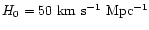 and q0=0 throughout the paper). Among these BL Lacs, 63 objects
have measured redshifts. 51 of them are classified as high-frequency peaked BL Lacs (HBL)
and 12 of them as low-frequency peaked BL Lacs (LBL). The morphology parameters of their
elliptical hosts, including the angular effective radius
and q0=0 throughout the paper). Among these BL Lacs, 63 objects
have measured redshifts. 51 of them are classified as high-frequency peaked BL Lacs (HBL)
and 12 of them as low-frequency peaked BL Lacs (LBL). The morphology parameters of their
elliptical hosts, including the angular effective radius  ,
corresponding surface brightness
,
corresponding surface brightness
 and
absolute R magnitude MR,
have been reported in Urry et al. (2001). It has been shown that the
-
relation
for the elliptical hosts of these BL Lac objects is almost the same as normal elliptical
galaxies. This strongly suggests that the fundamental plane of normal ellipticals exists also
for the host galaxies of BL Lac objects. Urry et al. (2001) also mentioned that there are no
systematic differences in the host galaxies of
HBLs and LBLs.
and
absolute R magnitude MR,
have been reported in Urry et al. (2001). It has been shown that the
-
relation
for the elliptical hosts of these BL Lac objects is almost the same as normal elliptical
galaxies. This strongly suggests that the fundamental plane of normal ellipticals exists also
for the host galaxies of BL Lac objects. Urry et al. (2001) also mentioned that there are no
systematic differences in the host galaxies of
HBLs and LBLs.
In Table 1 we listed 63 BL Lac objects, together with their redshifts, R-band apparent and absolute
magnitudes, effective radius and average surface brightness of their host galaxies. The values
for redshifts, R-band absolute magnitudes, and effective radii are taken from
Urry et al. (2001). The R-band apparent magnitudes have been corrected for
Galactic extinction,
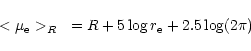
cosmological dimming and K-corrections. The average surface
brightness was derived from the formula:
 |
(2) |
where the effective radius
is in unit of arcseconds. We can then estimate the central
velocity dispersions for the hosts of BL Lac objects using the fundamental plane (Eq. (1)).
The SMBH masses of these objects can be derived by the
-
relation. Such a
relation has been given as
 |
(3) |
by Merritt & Ferrarese (2001, hereafter MF01) and as
 |
(4) |
by Gebhardt et al. (2000a, hearafter G00).
Note that the derived central velocity dispersion using Eq. (1) is in
an aperture of diameter of
1.19 h-1 kpc (h=0.5 in this paper), while the
luminosity-weighted average
velocity dispersion in G00 relation is in the half-light radius ()
and the "central''
velocity dispersion in MF01 relation in an aperture of radius
 .
There is a
systematic difference among these velocity dispersions. However, as demonstrated in
G00, MF01 and Barth et al. (2002), such a difference is remarkably less significant when
.
There is a
systematic difference among these velocity dispersions. However, as demonstrated in
G00, MF01 and Barth et al. (2002), such a difference is remarkably less significant when
 .
In fact,
if we follow the aperture correction method suggested by Jorgensen et al.
(1995), we can estimate the difference of these velocity dispersions to be as small as
several percent. Therefore, we ignore such a difference in our present work.
In Table 1 we give the derived central
velocity dispersions and black hole masses using the above relations for 63 BL Lacs.
.
In fact,
if we follow the aperture correction method suggested by Jorgensen et al.
(1995), we can estimate the difference of these velocity dispersions to be as small as
several percent. Therefore, we ignore such a difference in our present work.
In Table 1 we give the derived central
velocity dispersions and black hole masses using the above relations for 63 BL Lacs.
![\begin{figure}
\par\includegraphics[width=6.8cm,clip]{2337f1.eps} \end{figure}](/articles/aa/full/2002/27/aa2337/Timg28.gif) |
Figure 1:
The derived central velocity dispersion, black hole mass (using both MF01 and G00
relations) for BL Lac objects against
the R-band absolute magnitude of the host galaxies. The open and solid circles
correspond to HBLs and LBLs. The dashed line shows the OLS bisector fit to each relation. The open
triangle represents the data for Mrk 501. |
| Open with DEXTER |
![\begin{figure}
\par\includegraphics[width=6.8cm,clip]{2337f2.eps}
\end{figure}](/articles/aa/full/2002/27/aa2337/Timg29.gif) |
Figure 2:
Histogram of the derived black hole mass distribution of HBLs and LBLs using the
G00 relation. |
| Open with DEXTER |
Figure 1 shows the relation of derived central velocity dispersions and black hole masses
with R-band absolute magnitudes of the host galaxies of BL Lac objects. Figure 2 shows the
histograms of the derived black hole masses (according to the G00 relation) for HBLs and LBLs.
It is clear that there is no significant difference in the central velocity dispersions and
the black hole masses between HBLs and LBLs. The average black hole masses of both HBLs and LBLs
are around
 .
Most BL Lacs have black hole masses in the
range of
to
.
Most BL Lacs have black hole masses in the
range of
to
 .
A t-test gives a significance of
81% that the distributions of SMBH masses of HBLs and LBLs are from the population
with the same true variance.
Considering the substantial uncertainties in
deriving the R-band absolute magnitude and central velocity dispersions of host galaxies, we adopt
the ordinary least square (OLR) bisector method (Isobe et al. 1990) to fit
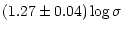
the relations shown in Fig. 1, which gives:
.
A t-test gives a significance of
81% that the distributions of SMBH masses of HBLs and LBLs are from the population
with the same true variance.
Considering the substantial uncertainties in
deriving the R-band absolute magnitude and central velocity dispersions of host galaxies, we adopt
the ordinary least square (OLR) bisector method (Isobe et al. 1990) to fit
the relations shown in Fig. 1, which gives:
 ,
,
 ,
and
,
and
 .
We noted that
the
-bulge luminosity relation we obtained here is consistent with that found previously
for normal galaxies and AGNs (Laor 2001; Wu & Han 2001).
.
We noted that
the
-bulge luminosity relation we obtained here is consistent with that found previously
for normal galaxies and AGNs (Laor 2001; Wu & Han 2001).
Recently Barth et al. (2002) measured the calcium triplet lines in the spectra of a nearby
bright BL Lac object Mrk 501 taken with the Palomar Hale 200-inch telescope and derived
the stellar velocity dispersion of the host galaxy as
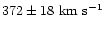 .
The R-band
absolute magnitude of the host galaxy has been estimated to be -24.6 (Nilsson et al. 1999).
From Fig. 1 we can see the observational data of Mrk 501 are well in agreement with
the relation that we found for other BL Lac objects. Therefore we think it is quite possible that
Mrk 501 hosts a supermassive black hole with mass of about (1
.
The R-band
absolute magnitude of the host galaxy has been estimated to be -24.6 (Nilsson et al. 1999).
From Fig. 1 we can see the observational data of Mrk 501 are well in agreement with
the relation that we found for other BL Lac objects. Therefore we think it is quite possible that
Mrk 501 hosts a supermassive black hole with mass of about (1
 .
We note that this is much larger than the maximum primary black hole mass (
.
We note that this is much larger than the maximum primary black hole mass (
 )
required for the binary black hole model of Mrk 501 (Rieger & Mannheim 2000) and
the mass (
)
required for the binary black hole model of Mrk 501 (Rieger & Mannheim 2000) and
the mass (
 )
estimated from the
)
estimated from the  -ray variability timescale (Fan et al. 1999).
We note that there are significant uncertainties in our derived velocity dispersions
and SMBH masses, which are caused by the systematic errors of fundamental plane relation
(Eq. (1)),
the measurement uncertainties of
and ,
and the scatters of the
-
relation. Considering the typical uncertainties of
(about
0.5
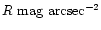 )
and
(about 1 kpc), Eq. (1) gives an uncertainty
)
and
(about 1 kpc), Eq. (1) gives an uncertainty
 as large as of about 50%. This leads to an uncertainty
 of about 2. Such a significant uncertainty of the derived SMBH
masses should be kept in mind when these values are adopted in any
correlation studies.
of about 2. Such a significant uncertainty of the derived SMBH
masses should be kept in mind when these values are adopted in any
correlation studies.
A deep HST imaging study of the host galaxies of a sample of 10 radio galaxies (RGs), 10 radio-loud
quasars (RLQs) and 13 radio-quiet quasars (RQQs) has been performed recently (McLure et al. 1999;
Dunlop et al. 2002). It has been found that the hosts of both radio-loud AGNs and bright
radio-quiet AGNs are virtually all massive ellipticals. The basic properties of these host
galaxies are indistinguishable from those of normal ellipticals. Therefore, it is quite possible
that the host galaxies of these low redshift AGNs also follow the same fundamental plane
as normal ellipticals.
Using the same approach as we did for BL Lac objects, we can also derive the central
velocity dispersions and black hole masses for this sample of AGNs based on the morphology
parameters of their host galaxies.
Table 2 listed the name, redshift, R-band apparent magnitude and absolute magnitude, effective
radius and average surface brightness of 10 RGs, 10 RLQs and 9 RQQs with elliptical hosts
(Dunlop et al. 2002). The R-band apparent magnitudes of the host galaxies
have been corrected for
the Galactic extinctions (taken from NED![[*]](/icons/foot_motif.gif) ), cosmological dimming and
K-corrections (assuming spectra index of
), cosmological dimming and
K-corrections (assuming spectra index of
 ,
Dunlop et al. 2002).
The angular size of effective radius was derived using Eq. (9.94) in Peterson (1997) from
listed in Dunlop et al. (2002) (where they adopted q0=0.5):
,
Dunlop et al. 2002).
The angular size of effective radius was derived using Eq. (9.94) in Peterson (1997) from
listed in Dunlop et al. (2002) (where they adopted q0=0.5):
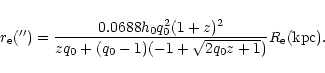 |
(5) |
The
R-band absolute magnitudes of the host galaxies were also calibrated to the case of
q0=0. The average surface brightness was calculated using Eq. (2) for each objects.
With these parameters, the central velocity dispersions of the host galaxies of
29 AGNs can be estimated using Eq. (1), and their SMBH masses can be derived using
Eqs. (3) and (4). The results are listed in Table 2.
![\begin{figure}
\par\includegraphics[width=6.8cm,clip]{2337f3.eps} \end{figure}](/articles/aa/full/2002/27/aa2337/Timg45.gif) |
Figure 3:
The derived central velocity dispersion, black hole mass (using both MF01 and G00
relations) for AGNs against
the R-band absolute magnitude of the host galaxies. The solid and open
triangles represent radio-quiet and radio-loud quasars. The open squares represent radio
galaxies. The dashed line shows the OLS bisector fit to each relation. |
| Open with DEXTER |
![\begin{figure}
\par\includegraphics[width=6.8cm,clip]{2337f4.eps} \end{figure}](/articles/aa/full/2002/27/aa2337/Timg46.gif) |
Figure 4:
Histogram of the derived black hole mass distribution of radio galaxies,
radio-loud and radio-quiet quasars using the G00 relation. |
| Open with DEXTER |
![\begin{figure}
\par\includegraphics[width=6.8cm,clip]{2337f5.eps} \end{figure}](/articles/aa/full/2002/27/aa2337/Timg47.gif) |
Figure 5:
Comparison of the estimated SMBH masses of quasars by MF01 and G00 relations with those
derived from the H line study. The dashed line shows the one-to-one correspondence.
 |
| Open with DEXTER |
Figure 3 shows the relation of derived central velocity dispersions and black hole masses
with R-band absolute magnitudes of the host galaxies for 10 RGs, 10 RLQs and 9 RQQs. Figure 4
shows the
histograms of the derived black hole masses (according to the G00 relation) for these AGNs.
It is clear that there are no significant differences in the central velocity dispersions and
SMBH masses among RGs, RLQs and RQQs. The average SMBH masses of RGs, RLQs and
RQQs are
 ,
,
 and
and
 respectively.
Most of these AGNs have black hole masses in the
range of
to
.
Our results indicate that there is no
difference in SMBH masses of BL Lacs, RGs and RLQs. A t-test shows a possibility
of 44% that the distributions of SMBH masses of RGs and RLQs are from the same population.
Different from some previous claims that
RLQs have more massive SMBHs than RQQs
(Laor 2000), our result shows that there is only a weak difference in our derived
SMBH masses for RQQs and RLQs in this sample. The mean SMBH mass of 9 RQQs
is smaller by only a factor of two than that of 10 RLQs.
However, a t-test gives a possibility of only 4.5% that the two distributions are
from the same population. Although it may indicate some statistical differences
between RLQs and RQQs (see also Dunlop et al. 2002), a more definitive conclusion about such
a difference can be reached only with with larger and more
complete samples of quasars.
The OLR bisector fits
of the relations shown in Fig. 3 give:
respectively.
Most of these AGNs have black hole masses in the
range of
to
.
Our results indicate that there is no
difference in SMBH masses of BL Lacs, RGs and RLQs. A t-test shows a possibility
of 44% that the distributions of SMBH masses of RGs and RLQs are from the same population.
Different from some previous claims that
RLQs have more massive SMBHs than RQQs
(Laor 2000), our result shows that there is only a weak difference in our derived
SMBH masses for RQQs and RLQs in this sample. The mean SMBH mass of 9 RQQs
is smaller by only a factor of two than that of 10 RLQs.
However, a t-test gives a possibility of only 4.5% that the two distributions are
from the same population. Although it may indicate some statistical differences
between RLQs and RQQs (see also Dunlop et al. 2002), a more definitive conclusion about such
a difference can be reached only with with larger and more
complete samples of quasars.
The OLR bisector fits
of the relations shown in Fig. 3 give:
 ,
,
 ,
and
,
and
 .
These relations are slightly flatter than those we obtained for 63 BL Lac objects.
This may be caused by the smaller sample of 29 AGNs or several offset LBLs shown in Fig. 1.
.
These relations are slightly flatter than those we obtained for 63 BL Lac objects.
This may be caused by the smaller sample of 29 AGNs or several offset LBLs shown in Fig. 1.
We noted that the SMBH masses of 10 RLQs and 7 RQQs in our AGN sample have been estimated
in McLure & Dunlop (2001) based on the H
emission line width measurements and an
empirical relation between broad line region size and optical luminosity (Kaspi et al. 2000).
After re-calculating the SMBH masses, assuming the characteristic velocity in the broad line
region of AGN can be estimated from the observed FWHMs of H
lines by
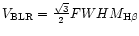 (Wandel et al. 1999), in Fig. 5 we plotted the comparison of the SMBH masses
derived by using the fundamental plane with those obtained by H
line study.
The agreement is not bad but
on average the SMBH masses estimated based on H
line study are
larger
than those obtained by us by a factor of two. If the relation between
(Wandel et al. 1999), in Fig. 5 we plotted the comparison of the SMBH masses
derived by using the fundamental plane with those obtained by H
line study.
The agreement is not bad but
on average the SMBH masses estimated based on H
line study are
larger
than those obtained by us by a factor of two. If the relation between
 and
and
 was assumed to be
 as taken by McLure & Dunlop (2001), the difference
between the SMBH masses obtained by H
line study will be
larger than our estimations by approximately a factor of 5.
It is unclear whether such differences are due to our assumption of the fundamental
plane for AGN host galaxies or the overestimations of the broad line region sizes of AGNs
according to the empirical relation between the broad line region size and
the optical luminosity (Kaspi et al. 2000). We note that the latter relation is much more scattered
than the previous one. Another advantage of our method is that it is model independent, while
the method based on H
line study sensitively depends on the assumptions
of the dynamics and geometry of broad line regions of AGNs (Krolik 2001). Considering
that both methods may have uncertainties of as larger as a factor of three, the difference
in SMBH estimations shown in Fig. 5 is not unexpected.
as taken by McLure & Dunlop (2001), the difference
between the SMBH masses obtained by H
line study will be
larger than our estimations by approximately a factor of 5.
It is unclear whether such differences are due to our assumption of the fundamental
plane for AGN host galaxies or the overestimations of the broad line region sizes of AGNs
according to the empirical relation between the broad line region size and
the optical luminosity (Kaspi et al. 2000). We note that the latter relation is much more scattered
than the previous one. Another advantage of our method is that it is model independent, while
the method based on H
line study sensitively depends on the assumptions
of the dynamics and geometry of broad line regions of AGNs (Krolik 2001). Considering
that both methods may have uncertainties of as larger as a factor of three, the difference
in SMBH estimations shown in Fig. 5 is not unexpected.
![\begin{figure}
\par\includegraphics[width=6.8cm,clip]{2337f6.eps} \end{figure}](/articles/aa/full/2002/27/aa2337/Timg58.gif) |
Figure 6:
Comparisons of Eddington ratios of radio-loud quasars, radio-quiet quasars
and radio galaxies. |
| Open with DEXTER |
Using the derived SMBH masses, we can estimate the Eddington ratio (defined as the
ratio of bolometric luminosity and Eddington luminosity) of the source in our sample
of RGs, RLQs and RQQs. We adopted the assumptions of
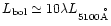 (Kaspi et al. 2000) and
 (Dunlop et al. 2002) to convert the
R-band luminosity to the bolometric luminosity for the nuclear component of AGNs. Figure 6 shows the distributions of Eddington ratios of 9 RGs, 10 RLQs and 9 RQQs. It is clear
that the Eddington ratios of RGs are systematically smaller than those of RLQs and RQQs
by two orders, while there is less significant difference in Eddington ratios for RLQs
and RQQs. Our result is qualitatively consistent with that
obtained by Ho (2002) who recently suggested that the strongly active AGNs have larger
Eddington ratios. Figure 6 shows that both RLQs and RQQs have a bolometric luminosity
comparable to the Eddington
luminosity. A t-test also shows a significance of 56% that the Eddington ratios of RLQs
and RQQs are from the same population. Therefore, our results indicate that the SMBH
masses of RLQs may be slightly larger than those of RQQs; their Eddington ratios may not be
significantly different. However, we must noted that these results were obtained with
a small sample of radio-loud and radio-quiet quasars. More definitive conclusions can
be reached only with larger and more complete samples.
(Dunlop et al. 2002) to convert the
R-band luminosity to the bolometric luminosity for the nuclear component of AGNs. Figure 6 shows the distributions of Eddington ratios of 9 RGs, 10 RLQs and 9 RQQs. It is clear
that the Eddington ratios of RGs are systematically smaller than those of RLQs and RQQs
by two orders, while there is less significant difference in Eddington ratios for RLQs
and RQQs. Our result is qualitatively consistent with that
obtained by Ho (2002) who recently suggested that the strongly active AGNs have larger
Eddington ratios. Figure 6 shows that both RLQs and RQQs have a bolometric luminosity
comparable to the Eddington
luminosity. A t-test also shows a significance of 56% that the Eddington ratios of RLQs
and RQQs are from the same population. Therefore, our results indicate that the SMBH
masses of RLQs may be slightly larger than those of RQQs; their Eddington ratios may not be
significantly different. However, we must noted that these results were obtained with
a small sample of radio-loud and radio-quiet quasars. More definitive conclusions can
be reached only with larger and more complete samples.
The SMBH masses of AGNs are important to understand the nature of AGN activities, however,
there are only very limited methods which can be used to derive the mass of them
(Ho 1999).
Many observational studies have shown that a lot of AGNs, especially radio-loud AGNs,
have massive elliptical hosts. The basic properties of these host galaxies are
indistinguishable from normal ellipticals.
By assuming
that the
elliptical hosts of AGNs follow the same fundamental plane as normal ellipticals and adopting
the
-
relation recently discovered for both inactive and active galaxies,
we estimated the SMBH masses for 63 BL Lac objects and 29 other AGNs that have been imaged
by HST recently. Our results, though with substantial uncertainties,
show that the SMBH masses of these AGNs are mostly in the range
of
to
.
There are no significant differences in SMBH masses
for different AGNs with elliptical hosts. This seems to be a natural consequence if we believe
that the tight correlations between the SMBH masses and the galaxy properties
also exist for the host galaxies of AGNs. In Fig. 7, we compare our results obtained for
AGNs with the measured central velocity dispersions and black hole masses of 20 nearby
elliptical galaxies compiled by Kormendy & Gebhardt (2001).
Except for the outlier NGC 4486B whose
outer region may have been stripped away in the tidal interactions with a
more massive companion galaxy (Faber 1973), the relations of our derived central velocity dispersions and
SMBH masses with the R-band absolute magnitudes are consistent with the trends for normal
ellipticals. In fact, the derived SMBH masses of AGNs
have a significant overlap
with those of massive normal ellipticlas. Moreover,
we note that the consistency of our derived -MR relation with the
recent measurement of the stellar velocity dispersion
of Mrk 501 (Barth et al. 2002) also supports the assertion that using the fundamental plane to derive
the central velocity dispersions of AGN elliptical hosts is possible and practical.
![\begin{figure}
\par\includegraphics[width=6.8cm,clip]{2337f7.eps} \end{figure}](/articles/aa/full/2002/27/aa2337/Timg61.gif) |
Figure 7:
Comparison of the relations of central velocity dispersion, black hole mass
estimated by the G00 relation with
the R-band absolute magnitude for AGN hosts and nearby galaxies. |
| Open with DEXTER |
Our results show that both HBLs and LBLs have similar SMBH masses in the range
from
to
.
The SMBH masses of BL Lac objects are similar to those in radio galaxies and radio-loud
quasars. This indicates that the different observational
appearances among HBLs, LBLs and radio-loud AGNs cannot be dominated by the different
SMBH masses. Several evolutionary scenarios have been recently suggested for radio-loud
AGNs. Ghisellini et al. (1998) proposed an evolutionary sequence HBL
 LBL
flat-spectrum radio quasars (FSRQ) according to the increasing level of
external radiation to the soft radiation field in the emitting region. D'Elia & Cavaliere
(2001) and Cavaliere & D'Elia (2002) suggested that the gradual depletion of the central
environment may lead to the evolution from FSRQ
LBL
HBL.
Similarly, Böttcher & Dermer (2002) recently argued that the decline of accretion
power
can also lead to such an evolutionary sequence. As indicated by Böttcher & Dermer
(2002), the key parameter of
these scenarios is accretion rate rather than the SMBH mass. The depletion of accretion
power can lead to the decrease of the accretion rate, which may result in
the transition of different accretion modes. Theoretical investigations have pointed
out that accretion near the Eddington limit may
produce optically thick accretion disks extending all the way to the innermost
stable orbit, while accretion at very lower accretion rate may lead to advection
dominated accretion mode (see Narayan et al. 1998 for a review). In fact,
Fabian & Rees (1995) has proposed that
the nearby galaxies can be modeled with the advection-dominated accretion flow.
The
radio properties of some low-luminosity AGNs may be also related to the advection-dominated
accretion mode (Ulvestad & Ho 2001). Recently Ghisellini & Celotti (2001) also proposed
that the separation of FR I and FR II radio galaxies may be closely related to the
critical accretion rates. In addition, the state transition of Galactic black hole
X-ray transients has been explained according to the different accretion modes
at the different accretion rates (Esin et al. 1998). Recently Fender & Kuulkers
(2001) also found that the formation and luminosity of jets in
Galactic X-ray transients are closely related to the accretion rates.
From all these points we suspect that
the main reason for the evolutionary sequence of radio-loud AGNs may be accretion rate rather
than the SMBH mass.
Our estimations of the SMBH masses and Eddington ratios of different AGNs are also
consistent with this suspicion.
In addition, our results show that there may still be a difference in SMBH masses of
radio-loud and radio-quiet quasars, but such a difference is not significant as previously claimed.
The Eddington ratios of these two sub-classes of quasars seem to be from the same population. These
points are very important for our understanding of the physics of quasars and obviously need to be
confirmed with larger samples.
LBL
flat-spectrum radio quasars (FSRQ) according to the increasing level of
external radiation to the soft radiation field in the emitting region. D'Elia & Cavaliere
(2001) and Cavaliere & D'Elia (2002) suggested that the gradual depletion of the central
environment may lead to the evolution from FSRQ
LBL
HBL.
Similarly, Böttcher & Dermer (2002) recently argued that the decline of accretion
power
can also lead to such an evolutionary sequence. As indicated by Böttcher & Dermer
(2002), the key parameter of
these scenarios is accretion rate rather than the SMBH mass. The depletion of accretion
power can lead to the decrease of the accretion rate, which may result in
the transition of different accretion modes. Theoretical investigations have pointed
out that accretion near the Eddington limit may
produce optically thick accretion disks extending all the way to the innermost
stable orbit, while accretion at very lower accretion rate may lead to advection
dominated accretion mode (see Narayan et al. 1998 for a review). In fact,
Fabian & Rees (1995) has proposed that
the nearby galaxies can be modeled with the advection-dominated accretion flow.
The
radio properties of some low-luminosity AGNs may be also related to the advection-dominated
accretion mode (Ulvestad & Ho 2001). Recently Ghisellini & Celotti (2001) also proposed
that the separation of FR I and FR II radio galaxies may be closely related to the
critical accretion rates. In addition, the state transition of Galactic black hole
X-ray transients has been explained according to the different accretion modes
at the different accretion rates (Esin et al. 1998). Recently Fender & Kuulkers
(2001) also found that the formation and luminosity of jets in
Galactic X-ray transients are closely related to the accretion rates.
From all these points we suspect that
the main reason for the evolutionary sequence of radio-loud AGNs may be accretion rate rather
than the SMBH mass.
Our estimations of the SMBH masses and Eddington ratios of different AGNs are also
consistent with this suspicion.
In addition, our results show that there may still be a difference in SMBH masses of
radio-loud and radio-quiet quasars, but such a difference is not significant as previously claimed.
The Eddington ratios of these two sub-classes of quasars seem to be from the same population. These
points are very important for our understanding of the physics of quasars and obviously need to be
confirmed with larger samples.
We note that the relations between SMBH mass and the elliptical host luminosity derived
by us for AGNs are a little different from those obtained by some previous studies. McLure
& Dunlop (2002) derived such a relation for 92 active and inactive galaxies
as
 .
They argued that it is consistent with a linear scaling between
the black hole and bulge mass. Wandel (2002) reached a similar conclusion for a sample of 35
quiescent galaxies and 47 broad line AGNs. However, Laor (2001) and Wu & Han (2001)
obtained steeper slopes of the
-bulge luminosity relation for different
samples of AGNs and argued that
the scaling of the black hole and bulge mass is nonlinear.
Here we provide an additional argument for this nonlinear relation.
In our present study, the slope of the relation between SMBH mass and the elliptical host luminosity
is estimated from -0.64 to -1.02 for different samples. This is identical to a nonlinear
relation between the black hole and bulge mass
.
They argued that it is consistent with a linear scaling between
the black hole and bulge mass. Wandel (2002) reached a similar conclusion for a sample of 35
quiescent galaxies and 47 broad line AGNs. However, Laor (2001) and Wu & Han (2001)
obtained steeper slopes of the
-bulge luminosity relation for different
samples of AGNs and argued that
the scaling of the black hole and bulge mass is nonlinear.
Here we provide an additional argument for this nonlinear relation.
In our present study, the slope of the relation between SMBH mass and the elliptical host luminosity
is estimated from -0.64 to -1.02 for different samples. This is identical to a nonlinear
relation between the black hole and bulge mass
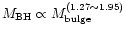 if the mass-to-light ratio of the host galaxy is taken
to be
if the mass-to-light ratio of the host galaxy is taken
to be
 (Jorgensen et al. 1996).
In fact, we can obtain this conclusion directly from some existing relations.
From the fundamental plane Eq. (1), the
-
relation Eq. (3) or (4),
and the formula for average brightness (Eq. (2)), we can derive a relation between
the SMBH mass and R-band absolute magnitude of the host galaxy as:
(Jorgensen et al. 1996).
In fact, we can obtain this conclusion directly from some existing relations.
From the fundamental plane Eq. (1), the
-
relation Eq. (3) or (4),
and the formula for average brightness (Eq. (2)), we can derive a relation between
the SMBH mass and R-band absolute magnitude of the host galaxy as:
 .
This clearly indicates a nonlinear relation:
.
This clearly indicates a nonlinear relation:
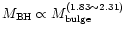 .
Such a result is
well in agreement with that in Wu & Han (2001) who obtained
.
Such a result is
well in agreement with that in Wu & Han (2001) who obtained
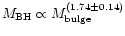 .
However, we noted the large uncertainties in our derived SMBH masses and host galaxy luminosities
may have significant effects on the correlation between SMBH and galactic bulge masses.
Although the non-linear scaling between
them has been also implied in some theoretical models (e.g. Adams
et al. 2001; Wang et al. 2000),
more detailed theoretical investigations,
as well as more high quality imaging observations on larger samples of active and inactive
galaxies, are obviously needed to confirm it.
.
However, we noted the large uncertainties in our derived SMBH masses and host galaxy luminosities
may have significant effects on the correlation between SMBH and galactic bulge masses.
Although the non-linear scaling between
them has been also implied in some theoretical models (e.g. Adams
et al. 2001; Wang et al. 2000),
more detailed theoretical investigations,
as well as more high quality imaging observations on larger samples of active and inactive
galaxies, are obviously needed to confirm it.
Acknowledgements
We thank the referee, Todd Boroson, for a construcitve referee's report and
Jiansheng Chen, Jun Ma, Hong Wu, Xiang-Ping Wu, Xu Zhou for
stimulating discussions.
This work was supported by the NSFC (No. 10173001) and the Scientific Fundation for
Returned Overseas Chinese
Scholars, Ministry of Education, China. This research has made use of the NASA/IPAC Extragalactic
Database (NED) which is operated by the Jet
Propulsion Laboratory, California Institute of Technology, under contract with
the National Aeronautics and Space
Administration.
- Adams, F. C., Graff, D. G., & Richstone, D. O. 2001, ApJ, 551, 31
In the text
- Barth, A. J., Ho, L. C., & Sargent, W. L. W. 2002, ApJ, 566, L13
In the text
NASA ADS
- Bettoni, D., Falomo, R., Fasano, G., et al. 2001, A&A, 380, 471
In the text
NASA ADS
- Bóttcher, M., & Dermer, C. D. 2002, ApJ, 564, 86
In the text
NASA ADS
- Cavaliere, A., & D'Elia, V. 2002, ApJ, 571, 226
In the text
NASA ADS
- D'Elia, V., & Cavaliere, A. 2001, in Blazar Demographics and Physics, ed. P. Padovani, & C. M. Urry (San Francisco: Astronomical Society of the Pacific), ASP Conf. Ser, 227, 252
In the text
- Djorgovski, S., & Davis, M. 1987, ApJ, 313, 59
In the text
NASA ADS
- Dressler, A., Lynden-Bell, D., Burstein, D., et al. 1987, ApJ, 313, 42
In the text
NASA ADS
- Dunlop, J. S., McLure, R. J., KuKula, M. J., et al. 2002, MNRAS,
in press [atro-ph/0108397]
In the text
- Esin, A. A., Narayan, R., Cui, W., Grove, J. E., & Zhang, S. N. 1998, ApJ, 505, 854
In the text
NASA ADS
- Faber, S. M. 1973, ApJ, 179, 423
In the text
NASA ADS
- Faber, S. M., Wegner, G., Burstein, D., et al. 1989, ApJS, 69, 763
In the text
NASA ADS
- Fabian, A. C., & Rees, M. J. 1995, MNRAS, 277, L55
In the text
NASA ADS
- Falomo, R., Kotilainen, J. K., & Treves, A. 2002, ApJ, 569, L35
In the text
NASA ADS
- Fan, J. H., Xie, G. Z., & Bacon, R. 1999, A&AS, 136
In the text
- Fender, R. P., & Kuulkers, E. 2001, MNRAS, 324, 923
In the text
NASA ADS
- Ferrarese, L., & Merritt, D. 2000, ApJ, 539, L9
NASA ADS
- Ferrarese, L., Pogge, R. W., Peterson, B. M., et al. 2001, ApJ, 555, L79
In the text
NASA ADS
- Gebhardt, K., Bender, R., Bower, G., et al. 2000a, ApJ, 539, L13 (G00)
In the text
NASA ADS
- Gebhardt, K., Kormendy, J., Ho, L. C., et al. 2000b, ApJ, 543, L5
NASA ADS
- Ghisellini, G., & Celloti, A. 2001,
A&A, 379, L1
In the text
NASA ADS
- Ghisellini, G., Celloti, A., Fassati, G., Maraschi, L., & Comastri, A. 1998, MNRAS, 301, 451
In the text
NASA ADS
- Ho, L. C. 1999, in Observational Evidence for Black Holes in the Universe,
ed. S. K. Charkrabarti (Dordrecht: Kluwer), 157
In the text
- Ho, L. C. 2002, ApJ, 564, 120
In the text
NASA ADS
- Isobe, T., Feigelson, E., Akritas, M. G., & Babu, G. J. 1990, ApJ, 364, 104
In the text
NASA ADS
- Jorgensen, I., Frank, M., & Kjaergaard, P. 1995, MNRAS, 276, 134
In the text
- Jorgensen, I., Frank, M., & Kjaergaard, P. 1996, MNRAS, 280, 167
In the text
NASA ADS
- Kaspi, S., Smith, P. S., Netzer, H., et al. 2000, ApJ, 533, 631
In the text
NASA ADS
- Kormendy, J., & Gebhardt, K. 2001, in The 20th
Texas Symposium on
Relativistic Astrophysics, ed. J. C. Wheeler, & H. Martel, AIP Conf. Proc., 586, 363
In the text
- Krolik, J. H. 2001, ApJ, 551, 72
In the text
NASA ADS
- Laor, A. 2000, ApJ, 543, L111
In the text
NASA ADS
- Laor, A. 2001, ApJ, 553, 677
In the text
NASA ADS
- Magorrian, J., Tremaine, S. Richstone, D., et al. 1998, AJ, 115, 2285
In the text
NASA ADS
- McLure, R. J, & Dunlop, J. S. 2001, MNRAS, 327, 199
In the text
NASA ADS
- McLure, R. J, & Dunlop, J. S. 2002, MNRAS, 331, 795
In the text
NASA ADS
- McLure, R. J, Kukula, M. J., Dunlop, J. S., et al. 1999, MNRAS, 308, 377
In the text
NASA ADS
- Merritt, D., & Ferrarese, L. 2001, ApJ, 547, 140 (MF01)
NASA ADS
- Nelson, C. H., & Whittle, M. 1995, ApJS, 99, 67
In the text
NASA ADS
- Netzer, H., & Peterson, B. M. 1997, in Astronomical Timing
Series, ed. D. Maoz, A. Sternberg, & E. Leibowitz (Dordrecht: Kluwer), 85
In the text
- Nilsson, K., Pursimo, T., Takalo, L. O., et al. 1999, PASP, 111, 1223
In the text
NASA ADS
- Riegger, F. M., & Mannheim, K. 2000, A&A, 359, 948
NASA ADS
- Scarpa, R., Urry, C. M., Falomo, R., et al. 1999, ApJ, 521, 134
In the text
NASA ADS
- Ulvestad, J. S., & Ho, L. C. 2001, ApJ, 562, L113
In the text
- Urry, C. M., Scarpa, R., O'Dowd, M., et al. 2000, 532, 816
- Wandel, A. 2002, ApJ, 565, 762
In the text
NASA ADS
- Wandel, A., Peterson, B. M., & Malkan, M. A. 1999, ApJ, 526, 579
In the text
NASA ADS
- Wang, Y. P., Biermann, P. L., & Wandel, A. 2000, A&A, 361, 550
In the text
NASA ADS
- Wu, X.-B., & Han, J. L. 2001, A&A, 380, 31
In the text
NASA ADS
Copyright ESO 2002
 =
=



 )
) )
) )
)![\begin{figure}
\par\includegraphics[width=6.8cm,clip]{2337f1.eps} \end{figure}](/articles/aa/full/2002/27/aa2337/img28.gif)
![\begin{figure}
\par\includegraphics[width=6.8cm,clip]{2337f2.eps}
\end{figure}](/articles/aa/full/2002/27/aa2337/img29.gif)
![\begin{figure}
\par\includegraphics[width=6.8cm,clip]{2337f3.eps} \end{figure}](/articles/aa/full/2002/27/aa2337/img45.gif)
![\begin{figure}
\par\includegraphics[width=6.8cm,clip]{2337f4.eps} \end{figure}](/articles/aa/full/2002/27/aa2337/img46.gif)
![\begin{figure}
\par\includegraphics[width=6.8cm,clip]{2337f5.eps} \end{figure}](/articles/aa/full/2002/27/aa2337/img47.gif)
![\begin{figure}
\par\includegraphics[width=6.8cm,clip]{2337f6.eps} \end{figure}](/articles/aa/full/2002/27/aa2337/img58.gif)
![\begin{figure}
\par\includegraphics[width=6.8cm,clip]{2337f7.eps} \end{figure}](/articles/aa/full/2002/27/aa2337/img61.gif)