![[*]](/icons/foot_motif.gif)
A&A 389, L47-L50 (2002)
DOI: 10.1051/0004-6361:20020663
P.-A. Duc1,2 - P. B. Hall 3 - D. Fadda 4 - P. Chanial 2 - D. Elbaz 2 - P. Monaco 5 - E. Pompei 6 - B. M. Poggianti 7 - H. Flores 8 - A. Franceschini 9 - A. Biviano 10 - A. Moorwood 11 - C. Cesarsky 11
1 - CNRS URA 2052
2 -
CEA, DSM, DAPNIA, Service d'Astrophysique, 91191 Gif-sur-Yvette Cedex, France
3 -
Pontificia Universidad Católica de Chile, Departamento de
Astronomía y Astrofísica, Casilla 306, Santiago 22, Chile
and Princeton University Observatory, Princeton, NJ 08544-1001, USA
4 -
Instituto de Astrofisica de Canarias, Via Lactea s/n, 38200 La Laguna - Tenerife, Spain
5 -
Dipartimento di Astronomia, via G.B. Tiepolo 11, 34131 Trieste, Italy
6 -
European Southern Observatory, Santiago
7 -
Osservatorio Astronomico di Padova, vicolo dell'Osservatorio 5, 35122 Padova, Italy
8 -
DAEC/LUL, Observatoire de Paris-Meudon, 5 place Jules Janssen, 92195 Meudon, France
9 -
Dipartimento di Astronomia, Università di Padova, Vicolo dell'Osservatorio, 5, 35122 Padova, Italy
10 -
INAF - Osservatorio Astronomico di Trieste, via G.B. Tiepolo, 11, 34131 Trieste, Italy
11 -
European Southern Observatory, Karl-Schwarzschild-Strasse, 2, 85748 Garching bei München, Germany
Received 8 March 2002 / Accepted 2 May 2002
Abstract
We report the discovery of an unusual low-ionization broad absorption line
quasar at z=1.776 which exhibits
absorption lines from many excited states of Fe II.
This member of the rare class of "FeLoBAL'' quasars was serendipitously found in a
mid-infrared (MIR) survey of distant clusters carried out with the ISOCAM camera.
ISO J005645.1-273816 has a high MIR to UV luminosity ratio, suggesting a strong
dust obscuration plus emission from very hot dust. This characteristic
makes MIR surveys particularly efficient at detecting LoBAL quasars.
Key words: quasars: absorption lines - quasars: individual: ISO J005645.1-273816 - infrared: galaxies
About 10% of optically selected quasars show absorption from gas with
blueshifted outflow velocities of typically  0.1c (Weymann et al. 1991).
These Broad Absorption Line (BAL) quasars may just be normal quasars seen along
a particular line of sight, such that
most quasars
have BAL outflows covering
0.1c (Weymann et al. 1991).
These Broad Absorption Line (BAL) quasars may just be normal quasars seen along
a particular line of sight, such that
most quasars
have BAL outflows covering  10-30% of the sky, with mass loss rates
comparable to the quasar accretion rates (1
10-30% of the sky, with mass loss rates
comparable to the quasar accretion rates (1  yr-1).
It is also possible that BAL quasars represent a dust-enshrouded early phase
in the lives of most, if not all, quasars (Becker et al. 2000). In either case,
BAL outflows must be understood to understand quasars as a whole.
yr-1).
It is also possible that BAL quasars represent a dust-enshrouded early phase
in the lives of most, if not all, quasars (Becker et al. 2000). In either case,
BAL outflows must be understood to understand quasars as a whole.
BAL quasars are divided into three observational subtypes depending on what type of absorption is seen. HiBAL quasars show absorption from high-ionization lines like C IV. LoBAL quasars (Voit et al. 1993) also show absorption from low-ionization lines like Mg II. FeLoBAL quasars (Becker et al. 1997) are LoBAL quasars which also show absorption from excited Fe II or Fe III. Populations of unusual BAL quasars with extremely strong or complex absorption have recently been found through followup of FIRST radio sources (Becker et al. 1997, 2000; Menou et al. 2001; Lacy et al. 2002), z>4 quasar candidates from the Digitized Palomar Sky Survey (Djorgovski et al. 2001), and color-selected quasar candidates from the Sloan Digital Sky Survey (Hall et al. 2002). These unusual BAL quasars suggest that the range of physical conditions present in BAL outflows is larger than previously suspected.
In this paper we report the discovery of another such unusual BAL quasar with
the Infrared Space Observatory (ISO).
What little data exists on the mid- to far-IR properties of BAL quasars
suggests that BAL quasars, and especially LoBAL quasars, may be much more
common or have larger covering fractions than suggested by optical surveys.
For example, the dusty LoBAL quasar Hawaii 167 was discovered in a near-IR
survey covering only 77 square arcmin (Cowie et al. 1994),
and
20-10+15% of all IRAS-selected quasars are
LoBAL quasars (Weymann et al. 1991; Low et al. 1989; Boroson & Meyers 1992)
vs. only 1.5% in optical surveys.
Dusty gas with a nearly 100% covering factor in LoBAL quasars
helps explain many of their unusual properties, including
ubiquitous signs of recent mergers in their host galaxies (Canalizo & Stockton 2001).
The quasar ISO J005645.1-273816 (hereafter ISO 0056-2738) was serendipitously discovered as part of an on-going study of distant clusters of galaxies mapped in the mid-infrared by the ISOCAM camera on board the ISO satellite. This quasar was found in the field of the z=0.56 cluster J1888.16CL.
J1888.16CL was observed with ISOCAM at 6.75 and 15  m in December 1997 and with ISOPHOT at 200 m
in December 1996.
The ISOCAM data were processed following the method
presented by Fadda et al. (2000) which uses extensive simulations
based of the addition of fake sources to the science images to estimate
flux reconstruction factors as well as error estimates.
ISOPHOT data were reduced with the standard pipeline PIA (Gabriel et al. 1997).
m in December 1997 and with ISOPHOT at 200 m
in December 1996.
The ISOCAM data were processed following the method
presented by Fadda et al. (2000) which uses extensive simulations
based of the addition of fake sources to the science images to estimate
flux reconstruction factors as well as error estimates.
ISOPHOT data were reduced with the standard pipeline PIA (Gabriel et al. 1997).
B and R images of J1888.16CL were obtained in August and September 1999 with
the WFI camera installed on the MPG/ESO 2.2m telescope at La Silla, as part
of a program on supernova monitoring (PI: Patat). Near-infrared J, H and Ks
broad-band images of the field were
taken in August 2001 with SOFI on the NTT at La Silla.
We retrieved a F814W image from the HST archives.
The optical spectrum of ISO 0056-2738 was obtained in September 2000 with the FORS1
instrument installed on the VLT UT1/Antu. The medium-resolution grism 300 V (resolution
420) covering the wavelength range 4200 Å-8820 Å was used associated
with a slitlet of
 positioned with the MOS unit.
![\begin{figure}
\par\includegraphics[width=7cm,clip]{Ec083_f1.ps}
\end{figure}](/articles/aa/full/2002/26/aaec083/img8.gif) |
Figure 1:
ISOCAM LW3 (15
 )
contours superimposed on a
combined F606W+F814W HST image centered on the quasar. The levels are
2, 2.5 and 3 Jy arcsec-2. )
contours superimposed on a
combined F606W+F814W HST image centered on the quasar. The levels are
2, 2.5 and 3 Jy arcsec-2. |
| Open with DEXTER | |
With a flux of 1.3 mJy, ISO 0056-2738 is one of the brightest 15 m extragalactic
sources in the field of J1888.16CL. It is unambiguously associated with an object
which appears unresolved in the optical and near-infrared bands.
On the HST image, its FWHM is lower than
 ,
and no clear extension is visible (see Fig. 1).
,
and no clear extension is visible (see Fig. 1).
The basic properties of the object, including position and photometry, are listed in
Table 1.
ISO 0056-2738 was not detected by IRAS at 60 and 100
,
nor at 200
by ISOPHOT or at 20 cm by
the NRAO VLA Sky Survey (NVSS).
| RA (J2000) | 00:56:45.15 |
| DEC (J2000) | -27:38:15.6 |
|
B (0.46
) |
 mag mag |
| R (0.65
) |
 mag mag |
| J (1.25
) |
 mag mag |
| H (1.65
) |
 mag mag |
| Ks (2.16
) |
 mag mag |
| LW2 (6.75
) |
 mJy mJy |
| LW3 (15
) |
 mJy mJy |
| PHOT (200
) |
<1 Jy |
| VLA NVSS (20 cm) | <2.3 mJy |
![\begin{figure}
\par\includegraphics[width=15.2cm,clip]{Ec083_f2.ps}
\end{figure}](/articles/aa/full/2002/26/aaec083/img17.gif) |
Figure 2: The VLT spectrum of ISO 0056-2738. The horizontal dot-dashed line is the zero flux level. Dotted lines above the spectrum show the wavelengths of the strong emission lines labeled across the top of the plot (including the expected wavelength of the C III] line peak). Dashed lines below the spectrum show the wavelengths of the strong absorption lines from the z=1.7598 system labeled across the bottom of the plot. |
| Open with DEXTER | |
The VLT spectrum of ISO 0056-2738 is shown in Fig. 2. Extensive UV absorption plus narrow emission from Fe II UV1 and Mg II identifies it as an unusual FeLoBAL quasar similar to FIRST 0840+3633 (Becker et al. 1997) and especially PSS 1537+1227 (Djorgovski et al. 2001).
We adopt a systemic redshift of
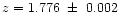 based on the
narrow emission lines of C IV, Fe II 2627 (multiplet UV1) and Mg II,
using the effective wavelengths for those transitions in the first SDSS
composite quasar (Vanden Berk et al. 2001).
As long as the relative velocity shifts of the lines in this quasar do not
differ greatly from those quasars used to construct the composite, this should
yield consistent redshifts for all lines.
Indeed, the three redshifts agree to better than
based on the
narrow emission lines of C IV, Fe II 2627 (multiplet UV1) and Mg II,
using the effective wavelengths for those transitions in the first SDSS
composite quasar (Vanden Berk et al. 2001).
As long as the relative velocity shifts of the lines in this quasar do not
differ greatly from those quasars used to construct the composite, this should
yield consistent redshifts for all lines.
Indeed, the three redshifts agree to better than  .
Of course, since all three emission lines are affected by absorption, the true
systematic emission line redshift may lie blueward of our adopted value.
The balnicity index (BI; Weymann et al. 1991) of this object,
measured from Al III, is a small but nonzero 305 km s-1.
The less restrictive absorption index (AI; Hall et al. 2002) is 2860 km s-1.
Both measures assume the Al III trough is at least 6280 km s-1 wide,
though it could be confused with a different trough beyond 4000 km s-1.
.
Of course, since all three emission lines are affected by absorption, the true
systematic emission line redshift may lie blueward of our adopted value.
The balnicity index (BI; Weymann et al. 1991) of this object,
measured from Al III, is a small but nonzero 305 km s-1.
The less restrictive absorption index (AI; Hall et al. 2002) is 2860 km s-1.
Both measures assume the Al III trough is at least 6280 km s-1 wide,
though it could be confused with a different trough beyond 4000 km s-1.
At least two different redshift systems are present in the absorption.
The C IV and Mg II troughs appear to reach zero flux at
 .
The narrow absorption from the Fe III UV34 multiplet
(
.
The narrow absorption from the Fe III UV34 multiplet
( 1895.46,1914.06,1926.30) gives
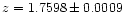 .
There are no obvious features in the C IV or Mg II troughs at this redshift,
but there is absorption from
Ni II 1709,1741,1751, Si II 1808,
and Zn II
.
There are no obvious features in the C IV or Mg II troughs at this redshift,
but there is absorption from
Ni II 1709,1741,1751, Si II 1808,
and Zn II
 2026,2062 plus Cr II 2056,2062,2066.
Overall, however, the spectrum is dominated by absorption
from ground and excited terms of Fe II. Essentially every absorption trough
not labelled in Fig. 2 can be identified with Fe II.
For example, the strong absorption just redward of C IV at 1550-1600 Å is
from Fe II UV multiplets 44-46 (Wampler et al. 1995; Hall et al. 2002).
Fe II multiplets from excited atomic terms are present up to at least
UV191 (1787 Å, excitation potential 2.88 eV). There may also
be excited Cr II UV5-UV8 absorption near 2675 and 2835 Å (de Kool et al. 2002).
The 3130 Å trough could have contributions from even more highly
excited Cr II and possibly O III 3133, as discussed in
Sect. 5.1.3 of Hall et al. (2002).
Given the strength of the Fe II absorption, the Mg II absorption must be saturated. However, the flux in the absorption troughs does not reach zero except for narrow regions in the C IV and Mg II troughs. This means that the absorbing region does not cover the continuum source except at a narrow range of velocities, and that the Fe II absorbing region probably has a smaller partial covering factor than the Mg II and C IV regions.
![\begin{figure}
\par\includegraphics[angle=-90,width=8cm,clip]{Ec083_f3.ps}
\end{figure}](/articles/aa/full/2002/26/aaec083/img24.gif) |
Figure 3: Rest-frame spectral energy distribution of ISO J005645.1-273816 (plain circles) and, for comparison, of other BAL quasars with IR data: Mrk 231 (LoBAL; z=0.04; data from NED); PG 1700+518 (LoBAL; z=0.292; Andreani et al. 1999), ELAIS J164010+410502 (BAL; z=1.099; Morel et al. 2001); FIRST J155633.7+351757 (LoBAL; z=1.48; Clavel 1998), H1413+117 (BAL; z=2.54; Barvainis et al. 1995). Note the lines joining the data points, indicated by plain squares, were drawn to guide the eye and by no means represent the real SEDs. We used H0= 75 km s-1 Mpc-1 and q0=0.5. |
| Open with DEXTER | |
The spectral energy distribution of ISO 0056-2738 in the rest-frame UV to infrared domain is compared in Fig. 3 to that of a sample of BAL quasars for which mid and far infrared fluxes are available in the literature.
The SED of ISO 0056-2738 appears to be similar, in shape and luminosity,
to that of the nearby optically selected low ionization BAL quasar PG 1700+518, at least
within the wavelength range for which data are available for both
objects.
If this similarity extends to the far infrared where IRAS fluxes are available for PG 1700+518,
one would infer for ISO 0056-2738 a total infrared luminosity of
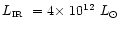 .
Instead one may use as template Mrk 231, which is known as the nearest
galaxy with a LoBAL signature, and has a strong IR bump at 60
.
Taking the rest-frame 5
luminosity as the normalizing factor,
the total infrared luminosity of ISO 0056-2738 becomes
.
Instead one may use as template Mrk 231, which is known as the nearest
galaxy with a LoBAL signature, and has a strong IR bump at 60
.
Taking the rest-frame 5
luminosity as the normalizing factor,
the total infrared luminosity of ISO 0056-2738 becomes
 .
The PHOT measurement at 200
flux indicates that this is
most likely an upper limit.
One may conclude for this analysis that unless its SED
plunges at
.
The PHOT measurement at 200
flux indicates that this is
most likely an upper limit.
One may conclude for this analysis that unless its SED
plunges at
 ,
ISO 0056-2738 belongs to the class of ULIRGs and
may even be a hyperluminous infrared galaxy, like many quasars
(e.g. Haas et al. 2000).
ISO 0056-2738 lies behind a rich cluster of galaxies; however the distance
from the cluster center, about 3.5', is such that a gravitational lensing
by the cluster is unlikely.
,
ISO 0056-2738 belongs to the class of ULIRGs and
may even be a hyperluminous infrared galaxy, like many quasars
(e.g. Haas et al. 2000).
ISO 0056-2738 lies behind a rich cluster of galaxies; however the distance
from the cluster center, about 3.5', is such that a gravitational lensing
by the cluster is unlikely.
The spectral energy distribution of the quasar in the rest-frame ultraviolet
is much redder than that of the SDSS composite quasar of Vanden Berk et al. (2001).
Using the SMC extinction curve of Prevot et al. (1984), we estimate a
large but not unprecedented extinction of
 .
Besides, ISO 0056-2738 seems to share with the few other LoBAL quasars with
available mid-IR data (see Fig. 3) a steep UV to MIR spectral index.
In addition to the extinction in the UV, its very high MIR to UV luminosity ratio
(rest-frame
.
Besides, ISO 0056-2738 seems to share with the few other LoBAL quasars with
available mid-IR data (see Fig. 3) a steep UV to MIR spectral index.
In addition to the extinction in the UV, its very high MIR to UV luminosity ratio
(rest-frame
 (5.40
)/
(0.16
)
=12)
is likely due to the presence of unusually large quantities of very hot dust
at 1000 K, the emission of which peaks at about 3
.
Becker et al. (1997) claim that a relative excess of radio emission could
be another property of LoBAL quasars. Note that ISO 0056-2738 is
not likely to be radio-loud (
(5.40
)/
(0.16
)
=12)
is likely due to the presence of unusually large quantities of very hot dust
at 1000 K, the emission of which peaks at about 3
.
Becker et al. (1997) claim that a relative excess of radio emission could
be another property of LoBAL quasars. Note that ISO 0056-2738 is
not likely to be radio-loud (
 ).
It has
).
It has
 using the Becker et al. (2000) definition
with
using the Becker et al. (2000) definition
with
 ,
but corrected for reddening of
E(B-V)=0.25it has intrinsic
,
but corrected for reddening of
E(B-V)=0.25it has intrinsic
 .
.
To our knowledge, ISO 0056-2738 is the first FeLoBAL quasar so far directly found at
mid-infrared wavelengths.
At optical wavelengths,
the SDSS Early Data Release Quasar Sample (Schneider et al. 2002) only contains
four FeLoBAL quasars out of 200-300 BAL quasars at
1.485 < z < 3.9where both HiBAL and LoBAL quasars can be selected via SDSS spectra,
and three or four more FeLoBAL quasars at lower redshift (Hall et al. 2002). Therefore
the probability of a serendipitous discovery with ISOCAM of such
FeLoBAL quasars is then extremely low unless mid-IR surveys are very efficient
in detecting such objects.
A quasar like ISO 0056-2738
would likely have been missed by most optical
surveys since it does not show any prominent broad emission lines and has no UV excess.
The infrared surveys with SIRTF such as GOODS
and SWIRE
should soon confirm whether the number of FeLoBAL quasars has
been underestimated in optically-based surveys.
Acknowledgements
PBH acknowledges financial support from Chilean grant FONDECYT/1010981. We are grateful to our referee, M. Lacy, for his comments which helped clarifying the paper. We thank G. Rodighiero for her help in reducing the PHOT data, E. Cappellaro and F. Patat for providing us the optical images of J1888.16CL.